After Arguing People Shouldn’t Attack Media Indiscriminately, Jamie Dimon Attacks Media Indiscriminately

When last we saw Jamie Dimon being a dick, he was appealing to what he presumably imagined was reporters’ shared sense of indiscriminate victimization.

Is it surprising that people lash out after such a severe recession in which we’ve seen these polars of wealth creation and destruction?

I can give you all the reasons why. But whenever anyone says to me, “All media,” I turn it off. “All politicians.” I turn it off. I don’t think it’s the right way to have discourse. Abe Lincoln didn’t do it. George Washington didn’t do it. It shouldn’t be done.

You don’t justify it because you’ve had a tough time. As a matter of fact, in a tough time, the best people stand tallest. They’re the ones who discriminate between the right and wrong. They’re the ones who stick to the true blue. … Not the ones who out of convenience scapegoat and finger-point.

It was wrong, Dimon argued, for people to indiscriminately pick on the media out of convenience.

In our latest edition of Jamie the Psychopath, he attacks newspapers, indiscriminately, as a convenient way to suggest banks don’t pay inordinate salaries.

“Obviously our business, in investment banking in particular, all of our businesses, we have high capital and high human capital,” Dimon said today at a presentation in New York, where the bank is based. “Newspapers — I went and got this one day just for fun — 42 percent payout ratio, which I just think is just damned outrageous.”

[snip]

“Worse than that, you don’t even make any money!” Dimon said, directing his comments to those in the media covering the company’s investor day and drawing laughter from his audience. “We pay 35 percent. We make a lot of money.” JPMorgan posted $19 billion in profit last year.

Especially nice, however, is Dimon’s suggestion that the justification for such a payout–for banks and for newspapers–is and should only be profit. If only the media just provided an even shittier product–and put the difference to profits–then all would be right with this world.

Presumably because then no one would chronicle what a dick he is.
Share this entry

Wall Street Shills Hype How Much Preet Bharara Could Make If He Stopped Shielding Wall Street

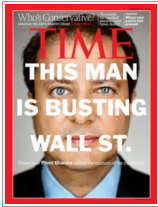
The Time Cover–facetiously suggesting that SDNY US Attorney Preet Bharara was busting anyone of note–was bad enough.

But this piece from noted Wall Street booster, Charlie Gasparino, reads more like a reminder to his readers of the protection they might lose if Bharara decided to check out and cash in.

Preet Bharara, the US Attorney for the Southern District, is telling friends that if he should leave his job today, he could earn as much as $6 million in the private sector, according to people with direct knowledge of these conversations. Bharara’s private statements come as speculation grows in Washington that the politically savvy prosecutor might also replace his boss, US Attorney General Eric Holder, if President Obama wins re-election.

[snip]

That said, private law firms seek out prosecutors of Bharara’s level primarily because of the high-profile clients they can attract.

An especially nice touch is the vote of approval from Harvey Pitt, whose enabling of financial corruption set new standards even from the Wall Street-coddling SEC.

“I have no doubt he would be a star in the private sector,” said former SEC chairman Harvey Pitt, who also worked as a high-profile private-sector attorney. “Bharara deserves enormous credit for the insider-trading effort, the cases his office has brought, and what his office is accomplishing. I just think it would be better if other people said that.”

When Harvey Pitt hails what your office is accomplishing, it usually means Wall Street crooks are getting a legal pass.

As they are.

And now we know the price Bharara expects when he cashes out: $6 million.

Share this entry

Jamie Dimon: A $50,000 ATM Is a Big Risk

Jamie Dimon’s got his whine on again (or should I say “still”), wishing we all could just move on from the catastrophe Dimon and his buddy banksters caused.

Dimon’s strategy here is rather amusing. He twice suggests that the media and the banks are both unfairly denigrated, as a “class.”

You’ve criticized others for an ongoing vilification of Wall Street and bankers?

I would say it differently. This indiscriminate scapegoating and finger-pointing. I don’t think it’s a good thing if you do it to banks or media. The point is there is some decent media and not decent; some good businesspeople and some not so good. My belief is this indiscriminate blame of both classes denigrates our society, destroys confidence — it certainly can’t boost it — and damages us.

Is it surprising that people lash out after such a severe recession in which we’ve seen these polars of wealth creation and destruction?

I can give you all the reasons why. But whenever anyone says to me, “All media,” I turn it off. “All politicians.” I turn it off. I don’t think it’s the right way to have discourse. Abe Lincoln didn’t do it. George Washington didn’t do it. It shouldn’t be done.

You don’t justify it because you’ve had a tough time. As a matter of fact, in a tough time, the best people stand tallest. They’re the ones who discriminate between the right and wrong. They’re the ones who stick to the true blue. … Not the ones who out of convenience scapegoat and finger-point.

And, having appealed to the journalist’s sense of common angst and suggested those seeking precisely to distinguish between right and wrong are “fingerpointing,” Dimon gets a piece that focuses on the number of people Chase has hired locally rather than his patently false claim that none of Chase’s foreclosures were improper and “we don’t know of any where the actual information in the affidavit about the foreclosure itself is wrong.”

Where Dimon’s latest whine says something new, however, is where he tries to suggest that the people who deposit their money with Chase–effectively loan Chase their money–are just freeloading.

Let’s talk about fees. We’ve seen some fees like the debit charge go away at the same time others are surfacing. Has it gone too far?

More than 80 percent don’t pay the monthly fee (on checking). Here’s the issue: It costs $300 to give you a checking account. What’s the cost of that? Branches, ATMs, online bill pay, Smart systems, checking account, a debit card. Any business has a cost. If you want a customer, you care, but you have to make a fair profit to survive.

But even after the debit fee went away, banks were still profitable.

Very often people will see us as having a profit, and I’m saying it’s really suboptimal results. Because we’re big and have a lot of capital, it sounds like a lot. But these are huge services and huge risks these banks take. We want to be fairly paid for services we provide. Just like a newspaper or anybody else.

Is the issue one of degree? For instance, that $5 ATM fee you were testing?

If you’re a client, we don’t charge you for ATMs. We charge nonclients. I think we charge $2 now. It costs us $50,000 a year to have an ATM. It’s not a gift. It’s for our clients. [my underline]

Right. The $50,000 ATM is a big risk. Dumping loads of money into derivatives? That’s apparently not where Chase’s big risk lies. Rather, it’s in replacing human tellers with machines that require relatively little maintenance, no health benefits, and no days off to give customers a reason–convenience–to loan Chase their money.

Or maybe now that Chase has made billions in the casino, they expect their $50,000 ATMs to be just as profitable. So Dimon will call a simple computer, an ATM, a huge risk, and demand exorbitant fees. Because banks shouldn’t have to pay the cost of doing business anymore, I guess. Asking them to do so is treating them unfairly as a class.

Share this entry

Mitt Advocates Taking Healthcare from Retirees to Give Money to Bailed Out Banks

Someone gave Mitt Romney a shovel just in time to dig shit snow in MI for the next two weeks. There’s a lot that is fact-impaired in this op-ed doubling down on the “let GM go bankrupt” (starting with the lack of funding for a bankruptcy, meaning a managed bankruptcy was impossible).

By the spring of 2009, instead of the free market doing what it does best, we got a major taste of crony capitalism, Obama-style.

Thus, the outcome of the managed bankruptcy proceedings was dictated by the terms of the bailout. Chrysler’s “secured creditors,” who in the normal course of affairs should have been first in line for compensation, were given short shrift, while at the same time, the UAWs’ union-boss-controlled trust fund received a 55 percent stake in the firm.

He’s complaining, of course, that VEBA (the trust fund run by professionals that allowed the auto companies to spin off contractual obligations–retiree healthcare–to the unions) got a stake in Chrysler while Chrysler’s secured creditors took a haircut.

So, in part, he’s basically complaining that the bailout preserved the healthcare a bunch of 55+ year old blue collar workers were promised. He’s pissed they got to keep their healthcare.

He’s also complaining that banks took a haircut, as would happen in any managed bankruptcy.

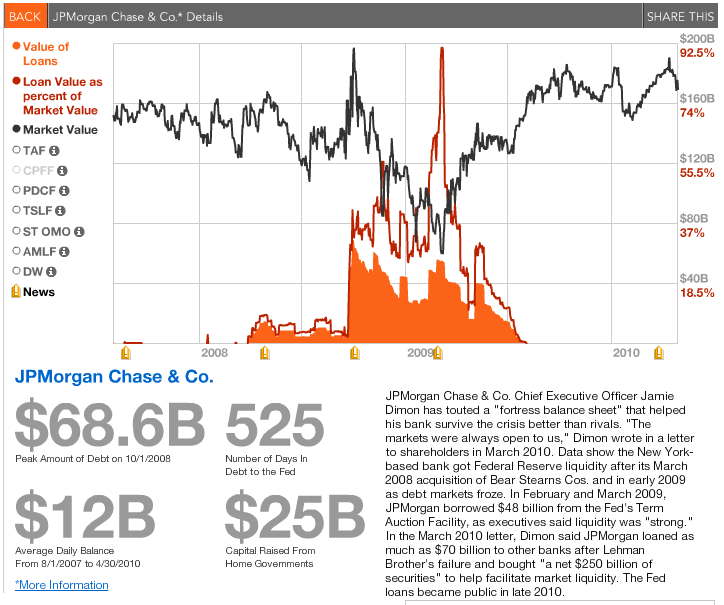
But it’s more than that. He’s complaining that a bunch of banks that themselves had been bailed out had to take a haircut. He’s complaining, for example, that JP Morgan Chase, Chrysler’s largest creditor at the time and the recipient, itself, of $68.6B in bailout loans, had to take a haircut on $2B in loans to Chrysler.

Mitt’s op-ed makes him sound a lot like Jimmy Lee, Chase’s top negotiator on the auto bailout, who,

demanded to know why, if the government thought banks important enough to give them tens of billions in TARP money, it wanted to squeeze them on [the Chrysler] deal.

I guess Mitt, too, thinks the banks are so important they should take precedence over retiree healthcare, too.

But as the kind of bankster who, at Bain, relied on government subsidies to fund his “restructurings” that ended up taking people’s jobs and healthcare, that’s not all that surprising.

Still, the UAW retirees who still have healthcare today instead of Jamie Dimon having another yacht probably don’t feel the same way as Mitt does.

Share this entry

Lanny Breuer’s Theory of Chatting Accountability for CEOs

[youtube]L_Mg6YOxjTg[/youtube]

This whole video is worth watching. Eliot Spitzer, former US Attorney Mary Jo White, and Assistant Attorney General Lanny Breuer discuss financial crimes, with SIGTARP head Neil Barofsky moderating. I was fairly troubled, in general, of the hesitations White and Breuer expressed over actually prosecuting financial crime.

But I found the passage just after 46:00, where Lanny Breuer argues you don’t need prosecutions for deterrence among CEOs, to be stunning.

Look, I want to be clear, I don’t want to suggest for a moment that we don’t–and we will–aggressively pursue cases criminally but, I guess both as a defense lawyer, which I was for many years, a white collar defense lawyer and now as AAG, I don’t think we should completely discount the deterrent effect when we investigate cases even if we don’t bring them.

If a CEO or CFO of a major institution feels that he or she is subject to criminal liability, when we interview them or put them in the grand jury, they have lawyers and this is hanging over their head for years and years. It may be at the end we decide not to prosecute the company or the individual but I think it’s really inaccurate to suggest that that doesn’t have a very strong effect. I’m not sure CEOs on Wall Street right now feel as if they can do what they want and there’s no deterrence.

He returns to a discussion of “going in and out” between corporate representation and DOJ after 52:00 and he avoids talking about robo-signing at 1:00.

As you read that, think about what has happened with Lloyd Blankfein. He bullshitted Carl Levin’s investigatory committee back in April 2010. Levin released a report last year stating he had lied, and referred his investigation to DOJ.

And Lloyd Blankfein, who almost two years ago didn’t take Congress sufficiently seriously to tell the truth, is still running around free profiting off of European countries’ debts.

Does Breuer really think seeing Blankfein treat Congress and regulators with utter disdain served as a deterrent to anyone? On the contrary, what appears to have been Lanny’s Chatting Accountability for CEOs only serves to show that these MOTUs are above the law.

Share this entry

Eric Schneiderman: Foreclosure Settlement “Down Payment”

Given that we’re talking about some relief for homeowners who are so far underwater that they’ve completely lost the value of the down payment they paid on their homes, I thought NY Attorney General Eric Schneiderman’s use of the phrase “down payment” to be a curious way to describe that he considers this settlement just the first step toward achieving justice.

Down payments don’t have the kind of value they used to have.

Perhaps the most interesting thing Schneiderman said other than that, though, was he thought they’d get some relief from MERS through legal means, and therefore wouldn’t need any legislation about MERS. Does that mean he thinks he can shut down MERS with his suit? Let’s hope so. That would go a long way to fix the problems in our mortgage system.

Other than that, he offered little explanation of my two main questions about this: 1) how he expects to get to the underlying problems with mortgages–the securitization problems–without using the robosigning efforts as a way to work up a chain to a real prosecution and 2) how letting banks off the hook for fraud and forgery doesn’t encourage more of the same?

In his press conference–and at more length in an interview with Greg Sargent–he said we skeptics should believe that Obama (now) takes this seriously because of assurances he gave Schneiderman and the emphasis he gave it at the SOTU.

Asked if progressives should be skeptical of the administration’s assurances, given the lack of accountability so far, Schneiderman insisted that Obama’s private and public assurances have left him convinced he is serious about a real accounting.

“He took ownership of this,” Schneiderman. “Sometimes people on the left have to take yes for an answer. The President is accepting the challenge. It’s time for progressives to say, `okay, he’s moving with us now, he’s using resources of government to aggressively pursue the malefactors of great wealth, as Teddy Roosevelt put it.’”

Perhaps most interestingly, Schneiderman said that the coalition of liberal, progressive and labor organizations that had come together to insist that the current settlement not let the banks off the hook would help force the task force to ultimately succeed.

“This will ultimately depend on the coalition that’s assembled around these principles,” Schneiderman said. “We’ve now got a progressive coalition that … can move public officials to take a more aggressive approach.”

I do have some faith Scheiderman will succeed in doing some real investigation. But when I read this description of Obama’s commitment, I couldn’t help but think of Elizabeth Warren. Sure, she got a CFPB set up. But when it came time to using a recess appointment to put her in charge of it, well, that never happened.

Also, to trust Obama on this? He’s the same guy who promised accountability on illegal wiretapping and changes to FISA Amendments Act.

I still trust Schneiderman will get some investigation here, but I’ve learned from experience that Obama may renege on his promises to progressives for accountability.

Share this entry

Bank Bailout Day, February 9, 2012

I may or may not have more to say about this.

But I’m thinking of declaring this Bank Bailout Day, a holiday of the stature of President’s day.

Forty-nine states, every one but Oklahoma, as well as federal regulators, will participate in a foreclosure fraud settlement that will release the five biggest banks (Wells Fargo, Citi, Ally/GMAC, JPMorgan Chase and Bank of America) and their mortgage servicing units from liability for robo-signing and other forms of servicer abuse, in exchange for $25 billion in funding for legal aid, refinancing, short sales, restitution for wrongful foreclosures and principal reduction for underwater borrowers. The announcement will be made on Thursday.

[click through for the details]

And then there’s the settlement price: $25 billion, divided up several ways. $3 billion will go toward refinancing for current borrowers who are underwater on their loans, as well as short sales. $5 billion will go as a hard cash penalty to the states, which can use them for legal aid services, foreclosure mitigation programs, and ongoing fraud investigations in other areas (one official close to the talks feared that much of that hard cash payout will go in some Republican states toward filling their budget holes). The federal government will get a cash penalty as well. Out of that $5 billion, up to 750,000 borrowers wrongfully foreclosed upon will get a $1,800-$2,000 check if they sign up for it, the equivalent of saying to them “sorry we stole your home, here’s two months rent.”

If you read DDay’s full post (or if you’ve read anything here), it’s clear that the amount of fraud was astronomical: 60% failures in one case. And if you’ve read that far, you know this is a bail out, every much as the billions gifted to banks in September 2008 was a bailout.

The Administration wants to call this a settlement.

Share this entry

Short Sale at the White House?

I haven’t had much time to cover the ins and outs of the foreclosure settlement, which has been genuinely imminent for two weeks, but which is faltering now on banks’ refusal to be sued for anything. My guess is that Eric Schneiderman’s indefinite delay of his presumed announcement that he was joining the settlement last night means he had demonstrated the banks weren’t serious about how narrow they claimed the release to be.

That said, I found this to be a rather interesting article. It confirms what was obvious when they held a meeting in Chicago a few weeks back: this settlement is now the White House’s baby.

The White House has quietly injected itself into ongoing settlement discussions aimed at resolving regulators’ allegations that leading US banks abused struggling homeowners, underscoring the deal’s potential impact on the broader housing market and the presidential election.

Aides to President Barack Obama have in recent weeks courted civil rights groups and borrower advocacy organisations, scheduling meetings and calls in an attempt to gain support for the expected settlement and muffle criticism from key political allies.

Now, one of the aides named in the story is Jon Carson, director of the White House’s office of public engagement. It makes sense that he’d be the one to reach out to groups like NAACP and La Raza, as the story describes (It sounds like NAACP is much more willing to buy this sell than La Raza).

I also find it interesting that they’re reaching out though civil rights groups. That’s because–at least according to the way-too-optimistic release terms posted by Mike Lux–civil rights claims are at the top of the list of abuses not immunized with this settlement.

No release on any fair housing, fair lending, or civil rights claims.

Also, predatory subprime lending has been one of the few abuses actually investigated and, in a few cases, settled (albeit with inadequate payouts).

In addition to Carson, National Economic Council Chair Gene Sperling is the other White House aide named in the article. Granted, he had a big role in the auto bailout, so he has not limited himself to bank issues, but I found it notable in any case.

But here’s one question I’ve got about this article. It says that Sperling and Carson are sharing the terms of the deal.

In addition to sharing confidential details of the settlement terms, the White House has sought to alleviate advocates’ concerns that the liability release is too broad by detailing which legal claims would remain if a settlement were reached.

Really? These confidential details can be shared? Well then, why aren’t they being shared?

That Obama is sharing the purported details of the deal with certain groups is all the more alarming given that the AGs who have been working on this deal for over a year appear to have no idea of what the terms actually are.

In short, it’s not so much that I’m surprised the White House is running this show. It’s that this stinks to high hell of another asymmetrical info op, the kind they pull on national security all the time. By compartmenting information, they ensure people buy off on stuff they have a badly incomplete understanding of.

Look, if NGOs can have access to this information, than so can everyone, from taxpayers to the Attorneys General trying to hold banks accountable.

Share this entry

Mitt Cozying Up to Foreclosure Mill that Got McCain in Trouble

Back in 2008, John McCain’s campaign shacked up with one of MI’s two notorious foreclosure mills, Trott & Trott. That housing situation became rather uncomfortable after the Macomb County GOP Chair asserted, in an on-the-record interview, that Republicans planned to use foreclosure lists to conduct vote-caging.

The chairman of the Republican Party in Macomb County, Michigan, a key swing county in a key swing state, is planning to use a list of foreclosed homes to block people from voting in the upcoming election as part of the state GOP’s effort to challenge some voters on Election Day.

“We will have a list of foreclosed homes and will make sure people aren’t voting from those addresses,” party chairman James Carabelli told Michigan Messenger in a telephone interview earlier this week. He said the local party wanted to make sure that proper electoral procedures were followed.

A couple of weeks after the Democrats sued to prevent the practice, McCain packed up in a hurry and abandoned the state–a state he had won in the 2000 primary.

Apparently, Mitt has the same poor taste in friends as McCain does. Trott & Trott is dumping significant money into Mitt’s SuperPAC and campaign.

A Farmington Hills law firm that represents mortgage giants Fannie Mae and Freddie Mac in foreclosure and eviction cases has contributed $200,000 to a super PAC supporting Republican Mitt Romney for president.

That super PAC, Restore Our Future, has run ads against Romney’s GOP rival Newt Gingrich, attacking his ties to Freddie Mac and accusing him of “cashing in” on the foreclosure crisis.

The Dec. 27 contribution, disclosed Tuesday in a Federal Election Commission filing, was written from the corporate account of Trott & Trott PC. A 2010 Supreme Court decision allows corporations and unions to spend unlimited amounts on independent campaigns to support or oppose federal candidates.

Managing partner David Trott is a member of Romney’s Michigan finance committee. He and his wife also contributed $7,500 to the Romney campaign, and his employees contributed more than $11,000 to Romney.

You’d think Republicans would have learned their lesson in 2008. In one of the states hardest hit by the foreclosure crisis, the support of foreclosure mills like Trott & Trott only  serves to make it clear where Republican loyalties lie–and it’s not with the homeowners hurt by the financial crisis.

Share this entry

Never Put Money within Reach of Jamie Dimon

I actually don’t think Federal Reserve Bank of NY Board Member Jamie Dimon got his hands on the almost $3 billion of Iraqi money deposited in the FBRNY that has vanished.

An audit by [Special Inspector General for Iraq Reconstruction Stuart] Bowen’s office published on Sunday investigated the roughly $3 billion the Iraqi government gave the Defense Department to pay bills for contracts the Coalition Provisional Authority awarded before it dissolved in 2004. Most of these funds were deposited into an account at the Federal Reserve Bank of New York.  Even though DOD was responsible for maintaining the proper documentation, it could only account for $1 billion of the money.

“It’s symptomatic of the poor record keeping that was rife throughout the early stages of the reconstruction effort,” Bowen, who has conducted three other major audits into the original pot of roughly $21 billion in Iraqi funds the U.S. managed in 2003 and 2004, said.

After all, that money dates to 2004 and Dimon’s service on the FBRNY Board didn’t begin until January 2007. (Though I will note that Jamie Dimon and Iraq’s money overlapped at the FBRNY for a year.) Moreover, it was DOD’s responsibility to keep track of the money, not the FBRNY or Jamie DImon.

Still, I can’t help but notice that the announcement that we’ve lost almost $3 billion of Iraqi’s money (on top of the more than $100 million in cash that managed to walk out of Saddam’s former palace) came within a day of the time some are declaring the missing MF Global $1.2 billion has “vaporized.”

Nearly three months after MF Global Holdings Ltd. collapsed, officials hunting for an estimated $1.2 billion in missing customer money increasingly believe that much of it might never be recovered, according to people familiar with the investigation.

As the sprawling probe that includes regulators, criminal and congressional investigators, and court-appointed trustees grinds on, the findings so far suggest that a “significant amount” of the money could have “vaporized” as a result of chaotic trading at MF Global during the week before the company’s Oct. 31 bankruptcy filing, said a person close to the investigation.

That money does seem to have been lost in the immediate vicinity of Dimon’s JP Morgan.

As the week progressed, MF Global executives came to believe that JPMorgan Chase & Co., one of MF Global’s primary bankers and a middleman moving that cash, was dragging its feet in forwarding the funds.

Corzine phoned Barry Zubrow, then JPMorgan’s chief risk officer, to question the slow payments. Corzine also called William Dudley, president of the Federal Reserve Bank of New York, to update him on MF Global’s status and told him that payments were slow to arrive from JPMorgan and others.

[snip]

JPMorgan was able to slow the delivery of funds, worsening MF Global’s distress. As a result, they note, hundreds of millions of dollars of MF Global money may be still stuck in accounts at JPMorgan.

So while I’m not suggesting Jamie Dimon bears any personal liability for these missing billions (or those of Lehman or Bear Stearns), I will note that Dimon seems to have the 21st Century equivalent of the Midas Touch: Rather than turning things into gold when he touches them, when billions get within reach of Jamie Dimon, they seem to vaporize.

Poof!

Share this entry