Obama Swaps a JP Morgan Chase Chief of Staff for a Citi One

Former JP Morgan Chase Exec Bill Daley has finally quit the job he sucked at, White House Chief of Staff. He will be replaced by former Citi Exec and current OMB Director Jack Lew.

Chicagoan Bill Daley is stepping down as White House chief of staff and budget director Jack Lew is taking over the president’s team as it heads into a tough election year, senior administration officials say.

Daley gave his letter of resignation to the president in a private meeting in the Oval Office last week, recounting the administration’s successes of his one year on the job and saying it was time for him to return to his hometown of Chicago.

Obama plans to announce the change in leadership in a public event this afternoon. The official shift will take place at the end of this month, giving Lew time to complete the administration’s budget proposal while Daley leads the team through the crafting of the State of the Union address due in two weeks.

The guy who’s been doing Daley’s job for some time–Pete Rouse–and who appears to be quite good at the job has no ties with any TBTF bank.

I guess that’s why he’s not getting the job officially.

Share this entry

John Yoo Defends Senate’s Authority to Sit Around and Do Nothing

Yes, it is hysterical, in general, that John Yoo has finally discerned some limits to the President’s authority under Article II now that Obama used a recess appointment to get around Senate obstruction.

The president’s power over what are known as “recess appointments” stems from Article II of the Constitution, which grants him the authority “to fill up all Vacancies that may happen during the Recess of the Senate, by granting Commissions which shall expire at the End of their next Session.” The Constitution does not define what a “recess” is — the Senate adjourns for short periods of time, and the question becomes when an “adjournment” becomes long enough to turn into a “recess.” In the past, attorneys general and presidents have thought that an adjournment would have to be longer than at least ten days to become a “recess.”

Particularly given that Yoo has embraced a rather expansive notion of what Youngstown says about Presidential authority regarding activities that aren’t defined under existing statute.

I’m amused, too, by the way Yoo trolls for clients at the end of his column.

Most importantly, private parties outside government can refuse to obey any regulation issued by the new agency. They will be able to defend themselves in court by claiming that the head of the agency is an unconstitutional officer, and they will have the grounds for a good test case. They can call Richard first, me second, for advice!

I hope, for NRO’s sake, they get a cut if Yoo does go on to consult with the Chamber of Commerce, which has threatened to sue.

But I’m most amused by what Yoo has to defend to make his case. John Yoo, arch conservative, defends the right of Senators to sit around doing nothing but reading the paper on the taxpayer’s dime.

It is up to the Senate to decide when it is in session or not, and whether it feels like conducting any real business or just having senators sitting around on the floor reading the papers.

I’ll grant you, the Senate is pretty ineffective and it usually feels like they are, in fact, not doing anything. I’m sure they do have the legal authority to just sit around scratching their collective arse. But I do find it rather cute that John Yoo has come out of his hole to make an inspired defense of Article I authority based on Senators’ rights to do absolutely nothing.

This constitutional lawyer business really is a noble profession.

Share this entry

The Challenge To Richard Cordray Not Being Discussed

The internets are alive with the sound of excitement over the appointment today by President Obama of Richard Cordray to be Director of the Consumer Finance Protection Bureau (CFPB). And, as Brian Buetler correctly points out, by doing it today, the first day of the new legislative session, Obama (assuming he gets re-elected) has provided Cordray with the longest term possible to serve as a recess appointee:

By acting today, with session two of this Congress technically under way, Obama has given Cordray the rest of this session and the full next session of the Senate to run the bureau. Cordray could potentially serve through the end of 2013.

The Congressional Research Service outlined this in a recent report (PDF) — and the White House and Senate leaders of both parties confirm the analysis.

If Obama loses in 2012, that could shorten Cordray’s tenure — and of course Cordray can leave early if he wants to. But this move makes it much more likely that the CFPB will truly take root.

Most of the banter so far has been on the viability of Obama’s move to recess appoint in this manner. I have looked at this issue for years, going back to early in the Dawn Johnsen imbroglio, and find no reason to believe this was not a proper exercise of Presidential power and prerogative.

The long and short of it is, there is no restriction on timing of recess appointments by a President pursuant to Article II, Section 2 of the Constitution. Both the “10 day rule”, which got narrowed to the “3 day rule” were practices and, at best were based on non-binding dicta from an early 90s DOJ memo; they are not now, nor have they ever been, binding law or rule. Legally, they are vapor. The issue was actually litigated in the 2004 11th Circuit case of Evans v. Stephens.

And when the President is acting under the color of express authority of the United States Constitution, we start with a presumption that his acts are constitutional.2 See United States v. Allocco, 305 F.2d 704, 713 (2d Cir. 1962) (Recess Appointments Clause case); see also U.S. v. Nixon, 94 S.Ct. 3090, 3105 (1974) (observing “In the performance of assigned constitutional duties each branch of the Government must initially interpret the Constitution, and the interpretation of its powers by any branch is due great respect from the others.”).
…….
The Constitution, on its face, does not establish a minimum time that an authorized break in the Senate must last to give legal force to the President’s appointment power under the Recess Appointments Clause. And we do not set the limit today.

And there you have it. There is no minimum time. Also, somewhat significant, is that Evans was decided by the full 11th Circuit, not a three judge panel, and SCOTUS considered a full cert application, and denied it, leaving the 11th Circuit decision standing as good law and citable precedent.

Oh, and if you wonder if SCOTUS has a real hard on for Presidential recess appointments, the answer would appear to be no. During the oral argument in New Process Steel v. NLRB last year, Chief Justice Roberts scoldingly asked Deputy Solicitor General Neal Katyal “And the recess appointment power doesn’t work why?” I am not sure the blustering Republicans like McConnell and Boehner will find quite as receptive an ear from the Roberts Court as they think.

Well, as Beutler notes, things should be all rosy and good to go for Cordray and CFPB, right? Not so fast, there is another issue not receiving any attention by the chattering classes.

The CFPB was promulgated by a pretty bizarre act – The Dodd Frank Act – bizarre, specifically, in how it structures and empowers the CFPB in its various duties. Notably, several of the key powers flow not necessarily through the agency, but through the “confirmed director” of CFPB. If there is no director, the bureau is run in the interim by the Treasury Secretary. Yep, good ‘ole Turbo Tax Timmeh Geithner. Specifically, Section 1066 provides:

The Secretary is authorized to perform the functions of the Bureau under this subtitle until the Director of the Bureau is confirmed by the Senate in accordance with section 1011. (emphasis added)

So, in all this meantime, and despite the White House trying to put the patina on that Liz Warren was running the CFPB, it has actually been Geithner. And the problem with this has been (remember I said the enabling language was bizarre??) that not all of the full powers of the CFPB vest, nor can they be exercised, until there is a director.

A director “confirmed by the Senate” according to the literal wording of the Dodd Frank Act.

If I were speculating on legal challenges to Cordray, rather than focusing solely on Obama’s ability to so appoint him (which, again, I think stands up), I might be more concerned about the issue of whether Cordray has full powers to lead and operate CFPB because he is not “confirmed by the Senate”. That should be a stupid argument you would think, but the words “confirmed by the Senate” in the enabling act make it at least a very cognizable question.

Normally a confirmed appointee and a recess appointee have the same legal authority and powers but, to my knowledge, there is no other situation in which substantive power for an agency flows only through its specific “confirmed” director. If I were going to attack Cordray, I would certainly not restrict it to the propriety of Obama’s recess appointment, I would also attack his scope of authority since he was not “confirmed”. I would like to think such a challenge fails, but Congress sure left a potential hidden boobytrap here.

Share this entry

How Dare the President Protect Consumers!?!?!

We’ll have to come back to the issue of why President Obama decided to use his recess authority to appoint Richard Cordray to head the Consumer Financial Protection Board but not Dawn Johnsen or Elizabeth Warren. But for now, I’d like to collect the wails of Republican outrage.

Shorter John Boehner: Protecting consumers from rapacious banks is an extraordinary and entirely unprecedented power grab! Protecting consumers is bad for the economy!

Shorter Mitch McConnell: Obama has arrogantly circumvented the American people by protecting the American people!

Shorter Orrin Hatch: It is a very grave decision by this heavy-handed, autocratic White House to appoint someone to protect consumers. The American people deserve to be treated with more respect than this White House is affording them by protecting them from the banks!

Shorter Spencer Bachus: Appointing a director to the CFPB will cripple it for years. The greatest threat to our economy right now is uncertainty, and by protecting consumers the President just guaranteed there will be even more uncertainty.


Share this entry

Shorter Jamie Dimon: “I am not a psychopath”

As business professor Clive Boddy describes it, banksters like Jamie Dimon succeed–and cause great catastrophe–because they are able to exploit the chaos of today’s business environment while ignoring the consequences of their ruthlessness.

Boddy says psychopaths take advantage of the “relative chaotic nature of the modern corporation,” including “rapid change, constant renewal” and high turnover of “key personnel.” Such circumstances allow them to ascend through a combination of “charm” and “charisma,” which makes “their behaviour invisible” and “makes them appear normal and even to be ideal leaders.”

[snip]

They “largely caused the crisis” because their “single- minded pursuit of their own self-enrichment and self- aggrandizement to the exclusion of all other considerations has led to an abandonment of the old-fashioned concept of noblesse oblige, equality, fairness, or of any real notion of corporate social responsibility.”

Boddy doesn’t name names, but the type of personality he describes is recognizable to all from the financial crisis.

He says the unnamed “they” seem “to be unaffected” by the corporate collapses they cause. These psychopaths “present themselves as glibly unbothered by the chaos around them, unconcerned about those who have lost their jobs, savings and investments, and as lacking any regrets about what they have done.

Meanwhile, a Reuters article offers a possible explanation for how millions of MF Global funds disappeared: because its clearing firm, JP Morgan Chase, dawdled while clearing hundreds of millions of dollars in securities MF Global sold to Goldman Sachs as an effort to stay afloat.

MF Global unloaded hundreds of millions of dollars’ worth of securities to Goldman Sachs in the days leading up to its collapse, according to two former MF Global employees with direct knowledge of the transactions. But it did not immediately receive payment from its clearing firm and lender, JPMorgan Chase & Co , one of the sources said.

The sale of securities to Goldman occurred on October 27, just days before MF Global Holdings Ltd filed for bankruptcy on October 31, the ex-employees said. One of the employees said the transaction was cleared with JPMorgan Chase.

[snip]

JPMorgan has fought aggressively in bankruptcy court to protect its interests, and received a lien on some of MF Global’s assets in exchange for granting the firm $8 million to fund its bankruptcy costs. The lien puts JPMorgan’s interests ahead of MF Global customers who have not yet received an estimated $900 million worth of money from their accounts, which remain frozen as regulators search for missing funds.

As it turns out, a week before JPMC was stalling on clearing MF Global’s sales, Jamie Dimon sent out an email to JPMC employees boasting about the firm’s expansion at a time of strife for the industry.

“2011 was another year of challenges, both for JPMorgan Chase and for countries around the world,” Dimon wrote in a year-end e-mail to staff. “There is a lot of frustration out there and more than a little hostility toward our industry.”

[snip]

JPMorgan hired 16,000 people in the U.S. in 2011, Dimon said in the letter, expanding its total workforce to more than 260,000 in a year when financial companies announced more than 200,000 job cuts and protests against Wall Street firms spread worldwide. The New York-based lender is adding about 175 branches a year in the U.S., he said.

“In the face of challenges, JPMorgan Chase is doing its part,” Dimon wrote. “We have not shrunk back.”

I tell you, indefinite detention looks better and better for Jamie Dimon.

Share this entry

“Crackpots don’t make good messengers”

For the record, I have no intention of voting for Ron Paul in the General election (though depending on how the GOP primary rolls out, I might consider crossing over to vote for Paul in the MI primary, for similar reasons as I voted for John McCain in the 2000 primary: because I knew my vote wouldn’t matter in the Democratic primary and I hoped a McCain win might slow down George Bush’s momentum and focus some attention on campaign finance reform, McCain’s signature issue at the time).

I don’t want Ron Paul to be President and, for all my complaints with Obama, he is a less bad presidential candidate than Paul.

But that’s an entirely different question then the one Kevin Drum purports to address with this post:

Should we lefties be happy he’s in the presidential race, giving non-interventionism a voice, even if he has other beliefs we find less agreeable? Should we be happy that his non-mainstream positions are finally getting a public hearing?

Drum doesn’t actually assess the value of having a non-interventionist in the race, or even having a civil libertarian in the race (which he largely dodges by treating it as opposition to the drug war rather than opposition to unchecked executive power), or having a Fed opponent in the race.

Instead, he spends his post talking about what a “crackpot” Paul is, noting (among other things), that Paul thinks climate change is a hoax, thinks the UN wants to confiscate our guns, and is a racist.

Views, mind you, that Paul shares in significant part with at least some of the other crackpots running for the GOP nomination.

Of course, Paul does have views that none of the other Republicans allowed in Presidential debates share. And that’s what Drum would need to assess if he were genuinely trying to answer his own question: given a field of crackpots, several of whom are explicit racists, several of whom make claims about cherished government programs being unconstitutional, most of whom claim to believe climate change doesn’t exist, is it useful that one of the candidates departs from the otherwise universal support for expanded capitulation to banks, authoritarianism, and imperialism? Read more

Share this entry

A Note About OWS and Pre-Trial Diversion in Los Angeles

I have seen a lot of garment rending on Twitter and in discussion forums I participate in about the Los Angeles Times report that a pre-trial diversion option is being offered to some Occupy Wall Street-Los Angeles protesters:

Many Occupy L.A. protesters arrested during demonstrations in recent months are being offered a unique chance to avoid court trials: pay $355 to a private company for a lesson in free speech.

Los Angeles Chief Deputy City Atty. William Carter said the city won’t press charges against protesters who complete the educational program offered by American Justice Associates.

He said the program, which may include lectures by attorneys and retired judges, is being offered to people with no other criminal history and who were arrested on low-level misdemeanor offenses, such as failure to disperse.

“Tin eared!” “Propaganda!” “Re-Education!” “Stupid!” “Tone-deaf!” “By a private corporation??” “Seriously, LA, this is the worst ever!” “Unbelievable!”

Those are a smattering of the responses I saw, and all are from people I know and respect greatly. And they are all wrong to take such umbrage at this report. Here is why.

Pre-trial diversion of criminal misdemeanor charges is an extremely common tool in municipal and other misdemeanor courts (and in some felon courts on the lowest grade offenses such as marijuana possession). It is, from a policy perspective, considered a win-win for both sides; the state and taxpayers avoid the cost of processing the defendant through the court system, and the defendant avoids having a conviction on their record (often avoid even having a formal charge lodged). But whether or not to offer pre-trial diversion lies entirely within the prosecutorial discretion of the state’s attorney. It is an option that can be offered, but certainly is not mandatory.

Just as pre-trial diversion is a voluntary option that does not have to be offered in the first place, the decision on whether to accept the offer is entirely up to the individual facing the charge. There is no punishment whatsoever for declining – none – they will stand in the EXACT same position vis a vis the state as if they had not been offered pre-trial diversion at all, i.e. there will be a municipal offense that has either been charged, or is pending charge, with a one year statute of limitation running.

There has been a hue and cry that – gasp! – the program will be administered by – gasp! – a private company. Well, they always are. I have never seen a diversion program with an educational component that was not farmed out to a private or non-profit outside entity. That is simply how it is done; cities and individual courts are not structured and funded to have classrooms, instructors and curriculum for these matters. And, being as it is a discretionary option to resolve outside of the criminal process (most are contractual, not court compelled) it just does not make fiscal or judicial sense to have it run by the court or state.

As to the content suggested for this particular diversion program offer, it is precisely what you would expect to be offered under the circumstances. Pre-trial diversion at the misdemeanor level almost always involves a perfunctory remedial/instructive class in the subject of the offense. This is the case with defensive driving class to get out of a ticket, it is the case with anger management for assault and domestic violence, it is the case for shoplifting and solicitation programs as well. For the OccupyLA cases, it is hard to imagine a more appropriate subject than a free speech centered Read more

Share this entry

Fuck You To Jamie Dimon & His Plaintive Wail For The 1%

Pardon me for the Taibbi like insolence, but this is just fucking amazing. While most Americans are struggling to stay alive, employed, and their families fed and in their homes, much less celebrate a decent Christmas, the 1% Masters Of The Universe have gotten together for a group bitchfest of elitist assholes:

Jamie Dimon, the highest-paid chief executive officer among the heads of the six biggest U.S. banks, turned a question at an investors’ conference in New York this month into an occasion to defend wealth.

“Acting like everyone who’s been successful is bad and because you’re rich you’re bad, I don’t understand it,” the JPMorgan Chase & Co. (JPM) CEO told an audience member who asked about hostility toward bankers. “Sometimes there’s a bad apple, yet we denigrate the whole.”

Dimon, 55, whose 2010 compensation was $23 million, joined billionaires including hedge-fund manager John Paulson and Home Depot Inc. (HD) co-founder Bernard Marcus in using speeches, open letters and television appearances to defend themselves and the richest 1 percent of the population targeted by Occupy Wall Street demonstrators.

Uh, fuck you Jamie Dimon and to the plaintive wail of the skimming, raping moneychangers.

Oh, and in case you had any question on what side of the 1%/99% divide Barack Obama and his Administration are on, yet another answer was given today with the announcement of their proposed selection for the critical “independent” seat on the Federal Deposit Insurance Corporation (FDIC):

The Obama administration is considering nominating Jeremiah Norton, an executive director for JPMorgan Chase’s investment bank, to sit on the FDIC’s board of directors.

Who is Jeremiah Norton? Well, as this quote states, he executive director of the investment banking shop and one of Obama’s buddy, Jamie Dimon’s, right hand men. Oh, and before that, Norton was former Goldman Sachs honcho Henry Paulson’s right hand man in the Bush Treasury Department and assisted Paulson in getting Goldman Sachs a backdoor bailout through AIG.

And, remember, if Barack Obama has to replace Turbo Tax Timmeh Geithner, Jamie Dimon is near the top of the list of replacements thought to be on the White House’s list.

So, while OWS is out protesting and the majority of citizens are falling deeper in despair and many losing their homes and hopes, and Barack Obama duplicitously coos about feeling the pain of the 99%, this is what is going on where the rubber meets the actual road.

PS: Digby has pounded Dimon on this as well if you want more searing criticism.

Share this entry

The Next Round of Looting

Here are three data points that will make you cranky.

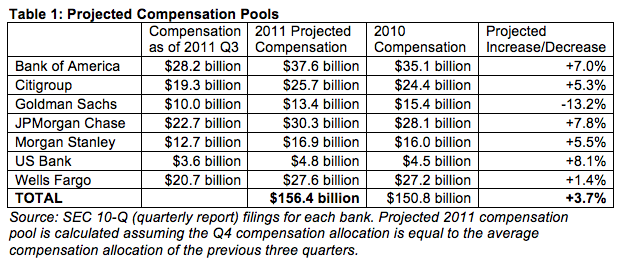
First, the New Bottom Line has taken the bonus pool data the big banks have released from the first three quarters of this year to estimate what they’ll be for the year. They are:

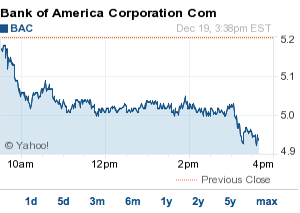
Next, here’s Bank of America’s stock ticker for the day:

It just closed under $5 for the day.

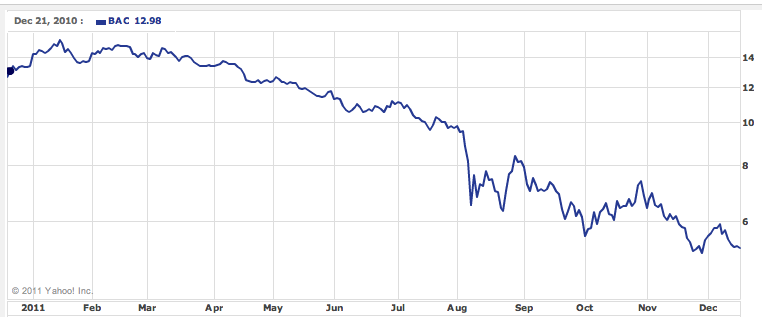
To put that into perspective, BAC’s stock ticker for the year:

And here’s a list of the top holders of BAC stock. It shows that JPMorgan Chase and Citi are the 6th and 7th largest owners of BAC stock, and between those two big bonus recipients and Goldman Sachs, they own over 4% of BAC’s stock. {Update: Though almost all of that was in index funds they hold for their clients.]

You see, you might look at the impending demise of BAC and wonder why its banksters merit any bonus this year. You might argue that awarding any bonuses amounted to looting what was left of the company the banksters had already almost finished looting.

But then you’d see that over 30% of the owners of BAC are similarly suited MOTUs. That goes a long way to explaining why they’ll get away with it. (Yes, I also need to look at PAC donations, which probably explains the rest of it.)

Share this entry

How to Indefinitely Detain Jamie Dimon

Kagro X and I were engaging in a little thought experiment on Twitter to show how easy it would be to solve our dangerous bankster problem by indefinitely detaining them.

It turned out to be pretty easy to do. Here’s how.

First, before you indefinitely detain a bankster, you need to show either that he is,

A person who was part of or substantially supported al-Qaeda, the Taliban, or associated forces that are engaged in hostilities against the United States or its coalition partners, including any person who has committed a belligerent act or who has supported such hostilities in aid of such enemy forces.

Or, you need to show he has supported (using the Iraq AUMF that we’re keeping around to make sure the President’s authority isn’t limited to just al Qaeda),

another international terrorist group that the President has determined both (a) is in armed conflict with the United States and (b) poses a threat of hostile actions within the United States;

Now, making that case with Jamie Dimon is very easy to do, because his company, JP Morgan Chase, has materially helped Iran. We have several pieces of proof it has done so. First, there’s the Treasury Report showing that JPMC:

  • Gave a $2.9 million loan on December 22, 2009 to the Islamic Republic of Iran Shipping Lines, which the Office of Foreign Assets Control has found to be involved in WMD proliferation
  • Advised and confirmed a $2,707,432 letter of credit on April 24, 2009, in which the underlying transaction involved a vessel identified by OFAC as blocked due to its affiliation with the same Iranian shipping line
  • Processed nine wire transfers between April 27, 2006 and November 28, 2008, which totaled $609,308, some of which involved sanctioned Iranian and terrorist entities
  • Transferred 32,000 ounces of gold bullion valued at approximately $20,560,000 to benefit a sanctioned Iranian bank on May 24, 2006

We need no further proof that JPMC has done these things. Not only has JPMC admitted to them, but as Janice Rogers Brown has made clear, we cannot question the Executive Branch’s intelligence reports, so all of OFAC’s claims must be accepted as true for the purposes of indefinite detention. And all of that illegal support for Iran happened while Jamie Dimon was President of JPMC.

But there may even be proof–enough, anyway, to satisfy Rogers Brown–that JPMC materially supported an attempt to deploy a WMD in a terrorist attack on American soil. As I have shown, the bank account to which Manssor Arbabsiar transferred almost $100,000 as downpayment for the alleged Quds Force plot to assassinate Saudi Ambassador Adel al-Jubeir was probably a Chase account. And that affidavit should be enough. The FBI, after all, is an intelligence agency. And Janice Rogers Brown does not find redactions–even much more extensive ones–to in any way impair the reliability of Administration claims to justify indefinite detention.

In other words, the Administration has provided sufficient proof that JPMC materially supported Iran to the tune of at least $23 million in illegal financial transactions.

Now, if Chase is indeed the bank that accepted the downpayment for the Scary Iran Plot, we need no further basis to indefinitely detain Jamie Dimon. After all, the government’s Amended Complaint (from the FBI, an intelligence agency whose reports we cannot question) asserts that Abdul Reza Shahlai was the mastermind behind the Scary Iran Plot, and at the time of the plot, he had already been sanctioned as a supporter of the insurgency in Iraq. That was based on a questionable intelligence report, admittedly, but Janice Rogers Brown says we cannot consider such problems. So if Chase did, indeed, play a role in the Scary Iran Plot, then that’s all we need to indefinitely detain Jamie Dimon as head of the entity that materially supported that terrorist attack.

But even if Chase wasn’t involved in the Scary Iran Plot, the Executive Branch can still indefinitely detain Jamie Dimon. After all, the Executive Branch has been claiming that Iran was harboring al Qaeda since 2003. In addition, an official Executive Branch report–a September 12, 2009 diplomatic cable–includes the following hearsay claim, made by Saudi Arabia’s then Minister of the Interior, now the Crown Prince, Nayif bin Abdulaziz:

Iran has hosted Saudis (all Sunnis) — including Osama bin Laden’s son Ibrahim — who had contacts with terrorists and worked against [Saudi Arabia]

And Janice Rogers Brown has said that so long as it appears in an official government document, any hearsay problem is overcome. And as recent reporting makes clear, there’s even some evidence that Iran was at least aware of, and in some ways facilitated, the 9/11 plot itself. That assertion is based on NSA reports which, as official government documents, would meet Rogers Brown’s standard for claims supporting indefinite detention.

All of which would seem to reach the bar of making Iran a force associated with al Qaeda. I don’t necessarily buy these reports, mind you, but again, it’s not for me to question these official government records. And helping such an associated force access $23 million of funding sure seems to qualify as “substantial support.”

Now let me be clear. I don’t advocate indefinitely detaining Jamie Dimon–or anyone else either, particularly not American citizens, no matter how loathsome or dangerous to the United States. But given that our country maintains it is more important to “incapacitate” terrorists and those who support them than to punish those who did trillions of dollars of damage to our economy, we may well have to treat Jamie Dimon as a material supporter of terrorism to get some justice.

And Jamie? If I were you I would report to an Embassy or some other official government office right away, as the government claims Anwar al-Awlaki should have. Because while Obama seems uninterested in indefinitely detaining American citizens, he has been known to kill those he claimed were particularly dangerous.


Share this entry