Foreclosure Fraud: The Most Dangerous Panel in the World

They’ve scheduled DDay’s Netroots Nation foreclosure fraud panel–with Lynn Szymoniak, Malcom Chu, and Neil Barofsky–in a room with no streaming, and President Obama is holding a press conference to conflict with it. Which suggests this is the most dangerous panel in the world.

So I’m gonna liveblog it.

DDay introduces Barofsky as the first George Bush appointee to speak at Netroots Nation. Says Szymoniak made the name Linda Green famous. Chu is a Springfield MA foreclosure activist.

DDay: We told Eric Schneiderman’s Chief of Staff we could fit him in. I don’t see him here. We’ll put a seat here for Elijah. It occurs I could call this panel “Foreclosure Fraud, the first 5000 years.” Elizabeth Warren, Jeff Merkley, nothing has changed. Dissipation of a lot of the leverage that the regulators have.

Read more

Share this entry

The Banksters and the Cartels

Two Colombian economists decided to see who’s getting money off the illegal drug trade. And they discovered that American and British banks are getting a big chunk of the profits. (h/t Chris from Americablog) That’s because the cartels are laundering their proceeds through those banks.

The most far-reaching and detailed analysis to date of the drug economy in any country – in this case, Colombia – shows that 2.6% of the total street value of cocaine produced remains within the country, while a staggering 97.4% of profits are reaped by criminal syndicates, and laundered by banks, in first-world consuming countries.

Mind you, I’m not sure the analysis would be that different for any agricultural export. Even for food, farmers make less than 12% of all the money spent.

But one of the factors, the economists contend, is that the US more stringently polices money laundering in Colombian banks than in US ones.

Colombia’s banks, meanwhile, said Mejía, “are subject to rigorous control, to stop laundering of profits that may return to our country. Just to bank $2,000 involves a huge amount of paperwork – and much of this is overseen by Americans.”

“In Colombia,” said Gaviria, “they ask questions of banks they’d never ask in the US. If they did, it would be against the laws of banking privacy. In the US you have very strong laws on bank secrecy, in Colombia not – though the proportion of laundered money is the other way round. It’s kind of hypocrisy, right?”

I have noted (as does the Guardian), how banks like Wachovia used drug proceeds to help offset their losses from the mortgage bubble shitpile. I have noted how much less stringent we were in rooting out all the crime than we are with other banks, such as the Lebanese Canadian Bank. And I noted Citi’s recent wrist slap for allowing money laundering in the same shitpile period.

This article shows the other side to that: while our banksters get rich off of crime here, Colombia and Mexico and Honduras suffer the violence that results. That really has to change.

Share this entry

Only Banks Might Want to Review How Criminal Banks Are

The other day, I noted how–days after his department reported that suspected bankster crimes are growing quickly and terrorist financing crimes are going down–Treasury Department fired FinCEN head, Jim Freis. Given some of the reporting describing the firing, which explained that Treasury wanted to focus on things like terrorist financing whereas Fries had been focusing on things like mortgage fraud, I wondered whether Treasury fired Freis, in part, for showing that the emphasis on terrorism resulted in the neglect of bankster crimes.

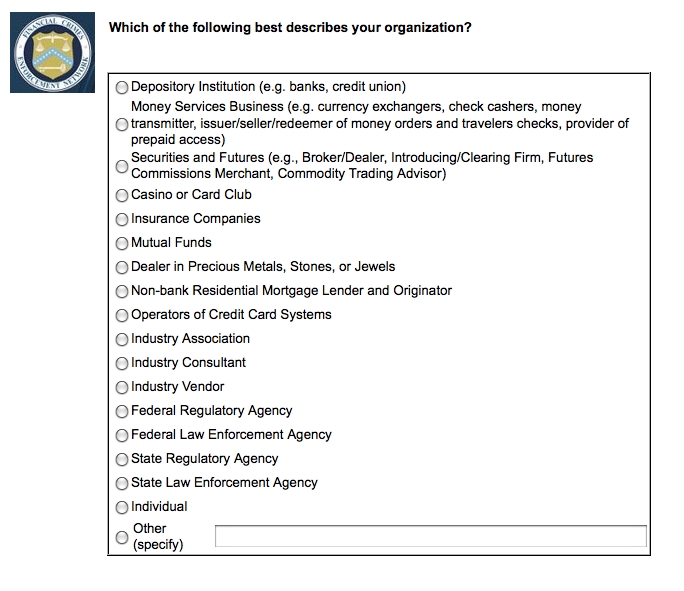
Today, FinCEN sent out notice of a survey to determine how useful that report and another yearly report–on Tips and Trends–they produce are (note, the email notice says an invitation to the survey is here, but as of 8:15 it is not).

As a subscriber to e-mail updates from the United States Department of Treasury’s Financial Crimes Enforcement Network (FinCEN), FinCEN invites you to participate in a survey assessing the value of two of our recurring publications:  The SAR Activity Review-Trends, Tips & Issues and The SAR Activity Review-By the Numbers.  This invitation has been sent to you in follow up to FinCEN’s prior e-mail notification.  A copy of that notice and this invitation can be found on FinCEN’s official website at http://www.fincen.gov/hotTopics.html

To participate in this completely voluntary survey, please click on the following link: https://svy.cfigroup.com/cgi-bin/qwebcorporate.dll?idx=HWGKEN   Please note that this link will direct you to a website hosted by the CFI Group, which FinCEN has commissioned to conduct this survey.  FinCEN has obtained permission from the Office of Management and Budget through control number 1090-0007 to conduct this survey in accordance with the Paperwork Reduction Act (44 U.S.C. § 3501-3520) and its implementing regulations (5 C.F.R. Part 1320).

Through the survey, we hope to learn more about your needs and identify opportunities to improve these products.  The results of the survey will be reported to FinCEN only in the aggregate; individual responses will be grouped anonymously along with those of other FinCEN customers.

Read more

Share this entry

Did Treasury Fire Jim Freis for Showing that Banksters Are a Bigger Problem than Terrorists?

As I noted earlier, a few weeks ago Treasury fired the head of FinCEN, Jim Freis. (FinCEN makes sure that financial institutions report whatever evidence of potential crimes they’re seeing.)

American Banker reported that Treasury wanted “additional focus on international areas such as terrorist financing,” and less focus on “other financial crimes such as mortgage fraud.”

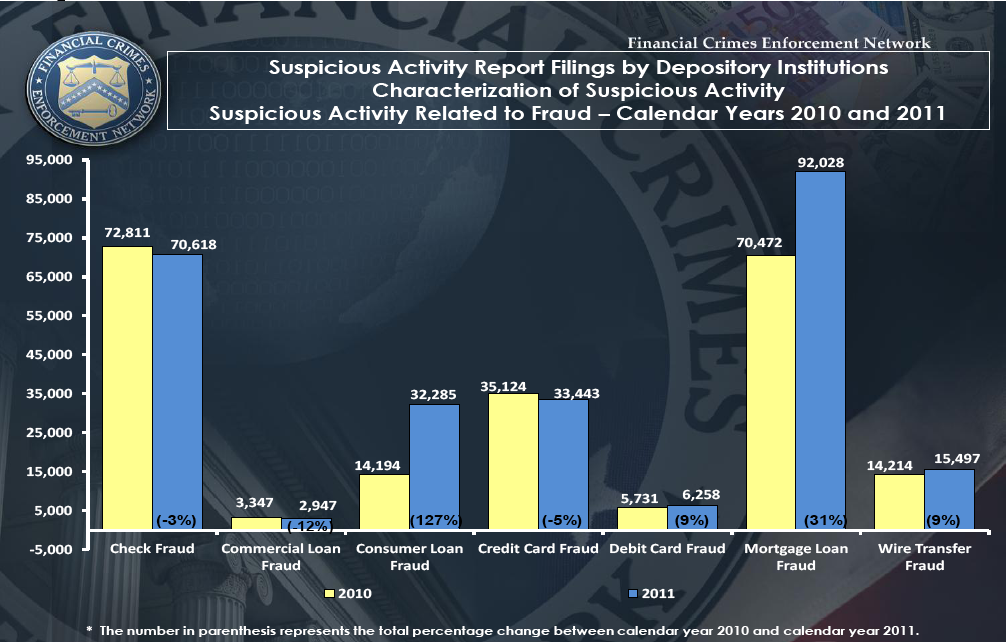
Three days before he was fired, FinCEN released this report, showing in aggregate what all of last year’s Suspicious Activity Reports revealed. It shows that among the SARs from depository institutions (which make up over half of all SARs), reports of terrorist financing and hacking (computer intrusion) are going down, while reports of behavior targeting consumers–mortgage and consumer loan fraud–are going up (though it notes the mortgage loan fraud reports are inflated because some date from years ago).

  • Reports of Terrorist Financing declined 14%, from 711 instances in 2010 to 609 for the same period in 2011.
  • The number of depository institution SARs identifying Mortgage Loan Fraud as a Characterization of Suspicious Activity continued to rise (up 30.6% in calendar year 2011). Quite markedly, Mortgage Loan Fraud is the only summary characterization that has experienced an increase every year since 1996, with the past two years (2010 and 2011) accounting for nearly 37% of all noted instances of this specific activity for the last decade. Note that depository institutions may submit Mortgage Loan Fraud SARs well past the actual date of the activity. This upward spike in mortgage fraud counts is in predominant part attributable to mortgage repurchase demands and special filings generated by several institutions.4
  • Of the eleven reportable suspicious activities that experienced decreases, none saw greater than Computer Intrusion, falling 21% in 2011 as compared to those filed in 2010. For the second year in a row, this drop is amongst the largest of any of the defined summary characterizations.
  • Though having experienced decreases in 2009 and 2010, the number of reports indicating Consumer Loan Fraud (in whole or part) significantly rose in 2011, up 127% from the prior year.

Such trends are similar to what the report shows in the securities and futures industries, with an even bigger drop in terrorist financing and big gains in futures fraud, embezzlement, and insider trading.

  • Embezzlement/Theft saw the second largest gain of any of the suspicious activities reported in SAR-SF filings, rising 38% in CY2011. However, of the 21 Types of Suspicious Activity listed, Futures Fraud saw the biggest rise (up 85%) for the same year, increasing from 20 instances in 2010 to 37 instances in 2011.
  • Likewise, Insider Trading (+34%) and Forgery (+19%) also experienced double-digit growth, making them the only two distinct activities that have continued to rise every year since 2003.
  • Of those activity types showing a decrease, Bribery/Gratuity (down 74%) and Terrorist Financing (down 59%) both saw a sizeable drop between 2010 and 2011, with the former down from 69 reported instances last year to just 18 in 2011 and the latter falling from 46 instances in 2010 to a low of 19 twelve months later.

Remember, SARs are not a reflection of what Freis demands (nevermind the fact he’s been on the job when things like terrorist financing were higher). Rather, this is what banks and securities firms self report, as mandated by law, about what they’re seeing in their own records.

Jim Freis showed that terrorism is getting better and bankster crimes are getting worse. And then Treasury fired him.

And the report from American Banker suggests that by replacing Freis, Treasury may intend to have FinCEN dictate what financial institutions prioritize. Which will mean terrorism–and not the crimes of banksters–will once again be the focus.

Fincen is likely to take a higher profile when it receives new leadership. In the immediate aftermath of the Sept. 11 attacks, Fincen was very active in dealing with bank regulatory matters, including helping to shape policy on anti-money laundering requirements. But the financial crisis largely pushed Fincen to the side and the agency focused on many of its other responsibilities. Treasury appears to want Fincen to take a larger role in terrorist financing activities and possibly reassert itself in the bank regulatory sphere. In past few years, banks have not had to focus on what Fincen’s agenda was. A more assertive Fincen changes the equation.

FinCEN offers one objective read of the relative prevalence of various forms of financial crime. And last year, it showed that banksters were a growing problem and terrorists a shrinking one.

And that message was so dangerous to the powers that be, it appears, Treasury decided to kill the messenger.

Share this entry

Will Treasury Hire the Guy Who Allowed JP Morgan Help Iran Launder Money?

Two weeks ago, Treasury fired the guy in charge of FinCEN (the part of Treasury that enforces and tracks Suspicious Activities Reports), Jim Freis, reportedly (pay wall) because he wanted to focus on law enforcement and financial crimes, rather than a more focused counterterrorism focus.

The issue wasn’t Fincen’s speed or personality conflicts, but more about control. To put it simply, Treasury wants more oversight of Fincen’s activities, including additional focus on international areas such as terrorist financing. “Fincen ought to be better integrated and tethered to the policy issues that relate to money laundering, terrorist financing and economic sanctions on behalf of the U.S. government. It’s not as well integrated as it should be,” said a senior administration official who spoke on condition of anonymity.

Freis saw Fincen’s role as more independent, and was primarily concerned with the agency’s role in supporting law enforcement agencies as well as tackling other financial crimes such as mortgage fraud.

And if that isn’t enough to make you wonder about this Administration’s commitment to making banks obey the law, consider that the apparent leading candidate to replace Freis is JP Morgan’s anti-money laundering VP, William Langford.

In December 2009, when JPMC extended a $2.9 million loan to the Islamic Republic of Iran Shipping lines, in violation of WMD sanctions, Langford was the VP at JPMC in charge of money laundering. He was there, too, when JPMC decided not to self-disclose the loan until they had almost been repaid.

In the months before March 2011, when JPMC repeatedly claimed it didn’t have 20 documents relating to a wire transfer with Khartoum? Langford was at JPMC for that too.

The 9 wire transfers since April 2006 in violation of a range of sanctions? He was there for most of those.

And he was probably at JPM–though just barely–when JPMC transferred $20M in gold bullion–a ton of gold!–for an Iranian bank?

Now, presumably all this money laundering and sanctions violating happened in remote corners of JPMC, far from Langford’s views (though you would think his office would be involved in the non-responsive answers about the Khartoum documents and decisions about when and whether to self-disclose some of these violations). There is no reason to believe Langford facilitated any of this money laundering and sanctions violating.

Still, even aside from the whole revolving door problem, from the centrality of JPMC in both the MF Global and JPMC’s won Fail Whale investigations, it seems like Treasury might hire someone who couldn’t keep one bank in line, much less all of them.

Share this entry

Jamie Dimon: Inspiring Fear Among “Wealthy Private Clients” Even in Disgrace

I’ve got that wonderfully satisfied yet mildly sick feeling I used to get after eating too many sweets as a kid, what with all the schadenfreude directed at Jamie Dimon and his $2 billion loss.

But I’m particularly struck by this story, in which Gretchen Morgenson recounts how Jamie DImon called Paul Volcker and Richard Fisher “infantile” at a party a month ago, for warning about Too Big To Fail banks. That piece of news, like all the rest, added to my sugar buzz. But I was struck by this passage, describing Morgenson’s sources.

The party, sponsored by JPMorgan for a group of its wealthy private clients, took place at the sumptuous Mansion on Turtle Creek hotel. Mr. Dimon was on hand to thank the guests for their patronage and their trust.

During the party, Mr. Dimon took questions from the crowd, according to an attendee who spoke on condition of anonymity for fear of alienating the bank. One guest asked about the problem of too-big-to-fail banks and the arguments made by Mr. Volcker and Mr. Fisher.

Mr. Dimon responded that he had just two words to describe them: “infantile” and “nonfactual.” He went on to lambaste Mr. Fisher further, according to the attendee. Some in the room were taken aback by the comments.

That is, Morgenson’s source(s) is not some entry level trader. He or she is a private client, a very rich person, whom Dimon was brought in to suck up to. Not just suck up to, but “thank … for their trust.”

Here we are a month later and Dimon and JPM generally have proven that trust was misplaced. If it were me, I’d be pulling my money out of JPM before Dimon pulls an MF Global with it. Yet even still, this very rich person is afraid of “alienating the bank.”

Not that that’s surprising. After all, Goldman Sachs still commands the kind of fear that leads people to invest with it, even after it became clear it was suckering clients to buy shitpile that it could then short.

Still, if there’s a sign of just how perverse our finance system is right now, it’s that the rich people Dimon is supposed to be sucking up to actually fear him, even after he has been disgraced.

Share this entry

Whose Illicit Money Did Citi Help Launder?

Back when the story of how Wachovia helped drug cartels launder money was breaking in 2010, reports said that cartels had also used Citi to launder their money.

A Mexican judge on Jan. 22 accused the owners of six centros cambiarios, or money changers, in Culiacan and Tijuana of laundering drug funds through their accounts at the Mexican units of Banco Santander SA, Citigroup Inc. and HSBC, according to court documents filed in the case.

Citigroup, HSBC and Santander, which is the largest Spanish bank by assets, weren’t accused of any wrongdoing. The three banks say Mexican law bars them from commenting on the case, adding that they each carefully enforce anti-money-laundering programs.

HSBC has stopped accepting dollar deposits in Mexico, and Citigroup no longer allows non-customers to change dollars there. Citigroup detected suspicious activity in the Tijuana accounts, reported it to regulators and closed the accounts, Citigroup spokesman Paulo Carreno says.

At the time, it seemed that Citi had reported the attempted money laundering as required by US bank secrecy laws.

I guess they didn’t report everything they were supposed to. The Office of the Comptroller and the Currency, Citi’s regulator, just announced a cease and desist order covering inadequacies in Citi’s anti-money laundering compliance.

(3) Some of the critical deficiencies in the elements of the Bank’s BSA/AML compliance program include the following:
(a) The Bank has internal control weaknesses including the incomplete identification of high risk customers in multiple areas of the bank, inability to assess and monitor client relationships on a bank-wide basis, inadequate scope of periodic reviews of customers, weaknesses in the scope and documentation of the validation and optimization process applied to the automated transaction monitoring system, and inadequate customer due diligence;
(b) The Bank failed to adequately conduct customer due diligence and enhanced due diligence on its foreign correspondent customers, its retail banking customers, and its international personal banking customers and did not properly obtain and analyze information to ascertain the risk and expected activity of particular customers;
(c) The Bank self-reported to the OCC that from 2006 through 2010, the Bank failed to adequately monitor its remote deposit capture/international cash letter instrument processing in connection with foreign correspondent banking;
(d) As a result of that inadequate monitoring, the Bank failed to file timely SARs involving remote deposit capture/international cash letter activity in its foreign correspondent banking business; and
(e) The Bank’s independent BSA/AML audit function failed to identify systemic deficiencies found by the OCC during the examination process. [my emphasis]

Note that among other things, Citi took this opportunity to ‘fess up to not adequately monitoring the use of cash letters (see this article for a description of how cash letters are used in money laundering) in the 2006-2010 period. You know? The period when Citi was reeling because it had invested too deeply in shitpile?

Now maybe in the near future, Treasury will release a similar notice telling us whether all this negligence on Citi’s part only could have–or actually did–help some nefarious types launder money. But for now, OCC’s not telling. Nor is OCC fining Citi (which they would normally do if Citi violates this consent order–banks, you see, get do-overs when they fuck up).

Read more

Share this entry

David Gregory & NBC Give John McCain Blowjob; Screw Americans

Saturday evening, the New York Times put up an important editorial, The Banks Win Again, on its website regarding the financial crisis, an editorial piece that would be key in their Sunday Morning Edition Opinion Section:

Last week was a big one for the banks. On Monday, the foreclosure settlement between the big banks and federal and state officials was filed in federal court, and it is now awaiting a judge’s all-but-certain approval. On Tuesday, the Federal Reserve announced the much-anticipated results of the latest round of bank stress tests.

How did the banks do on both? Pretty well, thank you — and better than homeowners and American taxpayers.

That is not only unfair, given banks’ huge culpability in the mortgage bubble and financial meltdown. It also means that homeowners and the economy still need more relief, and that the banks, without more meaningful punishment, will not be deterred from the next round of misbehavior.

The nation is on the cusp on having the government, both federal and states, sign off on arguably the biggest financial fraud on the American public in history, and doing so in a way that massively rewards the offending financial institutions and refuses serious investigation, much less prosecution, of any participants perpetrating the conduct. This pattern of craven conduct cratered not just the US economy, but most of the world economy.

In the face of all this, David Gregory and MTP had on the Sunday morning show one of the most senior Senators in the United States Senate, John McCain, who serves as a key member of both the Governmental Affairs and Health, Education, Labor and Pensions Committees, both of which Read more

Share this entry

As Government Releases Evidence of Systemic Mortgage Fraud, FBI Focuses on Distressed Homeowner Fraud

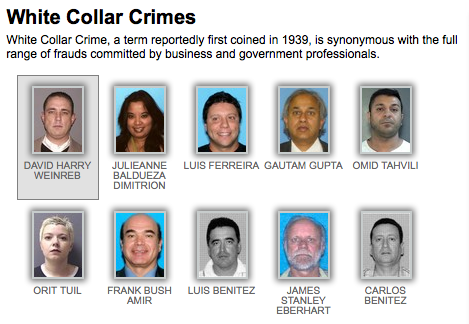
Why isn't Jamie Dimon on this Most Wanted poster?

The Administration finally released the HUD Inspector General Reports that consist of the only investigation of foreclosure fraud conducted as part of the foreclosure settlement.

I’ll probably have more to say about the reports tomorrow. But here’s a hint. The Wells Fargo report describes WF management refusing almost all cooperation.

Wells Fargo provided a list of 14 affidavit signers and notaries and then initially restricted our access to interview them. Wells Fargo attorneys interviewed them first and then only allowed us to interview 5 of the 14 affidavit signers. Wells Fargo told us that we could not interview the others because they had reported questionable affidavit signing or notarizing practices when it interviewed them. After discussion with attorneys for Wells Fargo and OIG counsel, terms were agreed to, permitting us to interview these remaining nine persons. The terms that Wells Fargo set required that Wells Fargo management and attorneys attend all of the interviews as facilitators. This condition resulted in delays and may have limited the effectiveness of those interviews. Wells Fargo’s terms also required that persons we interviewed have private counsel present on their behalf. Wells Fargo chose the private counsel and paid the attorney fees of the persons we interviewed. Wells Fargo was not timely in arranging the private attorneys, which further delayed our interviews.

And it concludes that WF may have have violated the False Claims Act.

Based upon the results of our review, Wells Fargo’s practices may have exposed it to liability under the False Claims Act for submitting the claims for insurance benefits to FHA without following HUD requirements. We provided our preliminary findings to DOJ for its assessment and determination on any potential liability issues.

In other words, the government has been sitting on evidence of significant crime for the last 18 months–crime that resulted in people losing their homes and the government being defrauded.

The government just gave the banks a Get Out of Jail Free Card for those crimes.

Meanwhile, here’s the financial fraud the FBI says it spent 2011 investigating, while DOJ sat on this evidence and the underlying frauds it clearly would lead to:

Mortgage fraud: During 2011, mortgage origination loans were at their lowest levels since 2001, partially due to tighter underwriting standards, while foreclosures and delinquencies have skyrocketed over the past few years. So, distressed homeowner fraud has replaced loan origination fraud as the number one mortgage fraud threat in many FBI offices. Other schemes include illegal property flipping, equity skimming, loan modification schemes, and builder bailout/condo conversion. During FY 2011, we had 2,691 pending mortgage fraud cases.

Financial institution fraud: Investigations in this area focused on insider fraud (embezzlement and misapplication), check fraud, counterfeit negotiable instruments, check kiting, and fraud contributing to the failure of financial institutions. The FBI has been especially busy with that last one—in FY 2010, 157 banks failed, the highest number since 181 financial institutions closed in 1992 at the height of the savings and loan crisis.

Distressed homeowner fraud, property flipping, and check kiting. That’s what the FBI has been looking at during the entire period when DOJ has just been sitting on this evidence of much greater, more destructive fraud.

Share this entry

Senate Judiciary Committee: Closing the Barn Door after the Barn’s Been Foreclosed

Sometime this week, the long-awaited terms for the foreclosure settlement will be released, giving banks immunity for much of the fraud and forgery they committed in the course of taking homeowners’ houses.

Which makes the timing of this hearing the Senate Judiciary Committee just announced beyond absurd.

“Examining Lending Discrimination Practices and Foreclosure Abuses”

Senate Judiciary Committee
Full Committee

DATE: March 7, 2012

A better time for such a hearing might have been December 2010, just as the full extent of the robosigning was being exposed. In fact, that’s the second-to-last hearing John Conyers hadbefore Dems lost their House majority. Since that time, he has been imploring the Administration and the Attorneys General to do something substantive about foreclosure problems, even asking MI’s AG not to sign onto the settlement.

But next week!?!?! Just as the settlement will be enacted, making many of these issues (though reportedly not civil rights issues) moot?!?! Really?!?!

I mean, if the Judiciary Committee is going to hold a hearing in the immediate future, it’d be far better to hold a hearing considering what impact it will have on justice in this country to assign a $2,000 price tag to fabricating forged documents or engaging in other fraudulent activities before a court. Will judges ever be able to trust corporations in their courtrooms again? Will private citizens have access to this $2,000 Get Out of Jail Free card, or only Too Big to Fail institutions?

Alternately, act like the bankster-owned body the Senate is, and simply call a hearing to discuss whether having pension funds pay to buy immunity for the banks hurts corporations.

And then there’s the witness list: right now, just Civil Rights Division head Thomas Perez will testify. I’m all in favor of Thomas Perez in most any role–his work at Civil Rights has easily been the best part of DOJ under Obama. But aren’t there other people who might better address foreclosure abuses, even if the hearing just focuses on lending discrimination?

I mean, I’m all in favor of someone finally conducting oversight over the fraud going on in this country. But this hearing couldn’t be more badly timed.


Share this entry