Fat Al Gore Colludes with Banksters in the Midwest

There’s an ominous storm brewing in flyover country that may amount to little more than higher food and fuel prices, or may amount to something else.

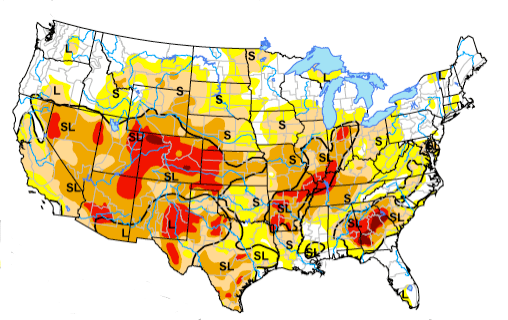
First there’s the drought. Last week’s heat wave and the last month’s dry weather hit just as much of America’s corn crop was set to pollinate. And if the corn doesn’t pollinate, it never grows kernels. Even as I’ve been writing this post, USDA sharply cut forecasts for the corn harvest.

As a result, corn prices (soy prices too) are rising sharply. Which will, for better and worse, have repercussions on all the aspects of our super-processed life that relies on corn.

“The drought of 2012 will be one for the records,” said Peter Meyer, the senior director for agricultural commodities at PIRA Energy Group in New York, who forecasts a drop in output to 11 billion bushels if the hot, dry spell lasts another three weeks. “Whether it’s ethanol or livestock, no one is immune from this impending disaster. The ramifications will be widespread, affecting everything from your food to your gasoline.”

And all that’s before any follow-on effects, if the drought continues. Even in Grand Rapids, we’ve had some unusual fires. Rivers that were experiencing historic floods last year are approaching record lows this year; traffic on the Mississippi has already slowed.

Yet all that–even with our country’s industrialized reliance on corn–might be no more concerning than other droughts, such last year’s drought in Texas.

Meanwhile, banksters keep stealing farmers’ money–first via MF Global and now with Peregrine.

The U.S. futures industry reeled as regulators accused Iowa-based PFGBest of misappropriating more than $200 million in customer funds for more than two years, a new blow to trader trust just months after MF Global’s collapse.

Read more

Share this entry

First They Came for WikiLeaks … Then They Came for Pot Dispensaries … Then Online Sharing

Remember when Visa and PayPal cut off services to WikiLeaks as a result of what was clearly Administration pressure? The Administration never explicitly revealed it had pressured the financial services companies to cut off WikiLeaks. It never offered any due process. Just–poof! WikiLeaks was no longer welcome to use a public service other corporate-people were able to.

And almost no one blinked at that abuse of due process.

Then Visa and MasterCard cut off pot dispensaries in California.

Your credit is no longer any good at California medical marijuana dispensaries, whose accounts with credit card processors have been canceled, thanks to pressure from the federal government.
Merchant services providers — the intermediaries between retailers and credit card companies who process customers’ payments — began informing their medical marijuana dealing clients that cannabis credit card transactions would not be processed after July 1, according to Stephen DeAngelo, Executive Director of Oakland’s Harborside Health Center.
No government agency is taking credit for making marijuana a cash-only business. But the “factual pattern” is as follows, DeAngelo said: Officials from the Treasury Department flexed on credit card companies, who then informed merchant services providers that they’d be “dropped from Visa and MasterCard forever” unless they stopped processing medical marijuana payments.

And PayPal has imposed new terms of services on file-sharing sites that will allow it to monitor sites for content.

According to TorrentFreak, PayPal has recently changed its terms of service, making requirements for file-sharing and newsgroup services far tighter than before.

The payment service, owned by eBay, now requires that “merchants must prohibit users from uploading files involving illegal content and indicate that users involved in such file transfers will be permanently removed from their service,” and that “merchants must provide PayPal with free access to their service, so PayPal’s Acceptable Use Policy department can monitor the content.”

The pot dispensary move is really heartless: as the article points out, it means customers have to walk around with wads of cash. And since a lot of medical marijuana customers are on disability, it means poor people can’t afford themselves the flexibility offered by credit cards.

And in addition to the specific injustice of undermining otherwise legal businesses, there’s the general issue. As it does with international financial exchange, so the Government is now doing with corporate entities in the US, picking and choosing which ones will have access to modern financial services and which won’t.

It’s an arbitrary exercise of power against entities the government can’t or won’t make a legal, due process entailing case against.

Maybe you’ll arbitrarily lose your credit card privileges next!

Share this entry

The Banksters Know They’re Banksters

The headline news from this survey is that almost a quarter of 500 bankster executives surveyed responded they need to engage in ethical or legal wrongdoing to succeed, and a sixth said they’d definitely engage in insider trading to make $10M if they knew they could get away with it.

In a survey of 500 senior executives in the United States and the UK, 26 percent of respondents said they had observed or had firsthand knowledge of wrongdoing in the workplace, while 24 percent said they believed financial services professionals may need to engage in unethical or illegal conduct to be successful.

Sixteen percent of respondents said they would commit insider trading if they could get away with it, according to Labaton Sucharow.

Couple those findings, though, with these responses from the survey showing that fewer than a third of those polled believe regulators are effective.

Only 30% of all respondents felt that the SEC/SFO effectively deters, investigates and prosecutes securities violations.

[snip]

With respect to FINRA and the FSA, only 29% of all respondents felt these agencies effectively deter, investigate and prosecute securities violations.

And those numbers are lower for American respondents than British ones.

The two details, together, are more important than in isolation. Not only do a significant proportion of finance execs admit they’d engage in wrongdoing if they wouldn’t get caught, but they also say the SEC and FINRA aren’t going to stop them.

No wonder the banksters keep crashing the economy.

Share this entry

Rupert Murdoch and the Invisible Hand Job of Capitalism

Someone let Rupert Murdoch free on Twitter again.

Libor ” scandal” very suspicious. 2008/9 huge crisis and Brown should defend pressure to keep rates down and prevent meltdown.

Don’t know, but suspect Diamond scapegoat used by old establishment who did not like energetic competitor.

So one of the richest and most powerful businessmen in the world–and the owner of America’s premiere business newspaper–considers the way the banks gamed a key market measure a scare-quote “scandal.” This newsman appears to suggest Gordon Brown (a man who has been trashing Murdoch relentlessly of late) should get out there and defend having his government tell Barclays to lie about how healthy it was, all to prevent a meltdown.

Nevermind the municipalities who got robbed in the process. Nevermind that the practice of gaming LIBOR started before the crash and reportedly continued after the danger had passed.

Rupert Murdoch appears to want to defend what Simon Johnson, cataloging the business press acknowledging what a big deal lying about LIBOR is, calls “Lie-More as a Business Model.”

I guess it shouldn’t surprise me. After all, some of Murdoch’s most important properties, starting with Fox, thrive on lying as a business model. But at a time when even the (British, at least) business community is finally awakening to what happens when the banksters reveal the “market” is just a bunch of really rich white guys operating behind a curtain, Rupert Murdoch is doubling down on lies.

Share this entry

The Invisible Hand-Job of Capitalism

[youtube]SjbPi00k_ME[/youtube]

First we confirm what we long suspected–bankers were manipulating the LIBOR rate to benefit themselves, corrupting one of the “market” measures at the core of the financial system.

And now, in an Abu Dhabi Commercial Bank suit against Morgan Stanley over residential backed mortgages, we get proof that banks pressured ratings agencies to rate shitpile as gold and even wrote their own ratings reports.

For example, when the primary analyst at S.& P. notified Morgan Stanley that some of the Cheyne securities would most likely receive a BBB rating, not the A grade that the firm had wanted, the agency received a blistering e-mail from a Morgan Stanley executive. S.& P. subsequently raised the grade to A.

And when a Morgan Stanley colleague asked for information about the Cheyne deal, Rany Moubarak, an analyst at Morgan Stanley on the deal, wrote in an e-mail: “I attach the Moody’s NIR (that we ended up writing)” referring to the new issue report published by Moody’s in August 2005.

The court filings also demonstrate a lack of methodology for analyzing the Cheyne debt. For example, in an e-mail before the deal was sold, S.& P.’s lead analyst wrote to a colleague: “I had difficulties explaining ‘HOW’ we got to those numbers since there is no science behind it. The documents show that the lead analyst at Moody’s noted there was “no actual data backing the current model assumptions” for segments of the Cheyne deal.

Read more

Share this entry

Last Week in Deferred and Non-Prosecution Agreements: Arming China and Stealing Trillions from Municipalities

I’m so old I remember the time, four years ago, when Democrats hated Deferred Prosecution Agreements.

Back in the days when Chris Christie, former US Attorney, was challenging Jon Corzine, once and future bankster, to be governor of New Jersey, Democrats made hay of the significant numbers of DPAs Christie signed, mostly with a series of medical device companies busted for kickbacks. After it was revealed Christie had picked his former boss, John Ashcroft, to make $52 million monitoring one of those medical device companies, it became a convenient way to show the corporatist corruption of Christie.

There was even a bit of discussion, in early 2009, about whether DPAs made banks more likely to engage in fraud because they assumed they’d get a DPA rather than a prosecution. Those discussions largely centered on the two DPAs AIG got in the mid-00s for fraudulently hiding its risk, which nevertheless didn’t prevent AIG from taking on so much risk it blew up the entire financial system. One of the monitors of those DPAs–who arguably should have but didn’t see AIG’s ongoing fraud–was a guy by the name of James Cole. He’s now the Deputy Attorney General.

And as recently as 2010, NJ Congressman Bill Pascrell had this to say, in response to the publication of a GAO report showing some improvement but greater need for oversight over DPAs.

One cannot ignore the spike of 38 deferred prosecution agreements in 2007, up from a mere four agreements in 2003. That proves that what was supposed to be an option to be used in rare circumstances had become the norm at the Department of Justice.

[snip]

It is imperative that the Congress reign in the unmitigated power that federal prosecutors hold to serve as judge, jury and sentencer in the deferred prosecution process.

And yet I have heard very little about the two DPAs signed last week–perhaps because big corporate impunity has become such a common occurrence in the post-crash era.

First, there’s the deal Pratt & Whitney and two subsidiaries signed for evading export restrictions to help China build an attack helicopter. Effectively Pratt & Whitney laundered their production of some development helicopters–plus the military grade engine control module software to go with them–through a Canadian subsidiary. And when they finally admitted they had deliberately avoided US export restrictions on military equipment, they lied to DOJ about doing so. While they have to pay a $75 million fine, some of the charges are being deferred. And no individual has been charged with helping China get a helicopter designed to attack tanks.

So DOJ’s punishment for a defense contractor to put Chinese civil contracts ahead of US national security is a big fine, deferred prosecution, but no jail time.

Even more troubling is the Non-Prosecution Agreement signed with Barclays over its manipulation of the LIBOR rate. Effectively, during the heady bubble days, Barclays colluded to lie about the interbank lending rate to maximize its own trades; as finance was crashing and Barclays itself had to pay higher rates for credit, it lied about that to imply the bank was healthier than it was. And while between DOJ, Commodity Futures Trading Commission, and Britain’s Financial Services Authority, Barclays will have to pay around $475 million in fines, and while CFTC imposed the kind of mandated fixes that DOJ normally would under a DPA, Barclays is basically scot-free for colluding to lie about a rate that affects people throughout the financial system.

Matt Taibbi explains why this is so important: because when the banks said the LIBOR rate was lower than it really was, a lot of investors got a smaller return on their LIBOR-tracked investments than they otherwise would have.

A sizable chunk of the world’s adjustable-rate investment vehicles are pegged to Libor, and here we have evidence that banks were tweaking the rate downward to massage their own derivatives positions. The consequences for this boggle the mind. For instance, almost every city and town in America has investment holdings tied to Libor. If banks were artificially lowering the rates to beef up their trading profiles, that means communities all over the world were cheated out of ungodly amounts of money.

Read more

Share this entry

Rocket Pitches A No Hitter; DOJ Whiffs A Golden Sombrero+2

Six up, and six down for William Roger Clemens. From Jim Bambach at Newsday:

Former Yankees pitcher Roger Clemens was acquitted Monday on all six counts in his trial on charges he lied to Congress when he denied using performance-enhancing drugs, ending a 41/2-year battle to clear his name.

The jury deliberated for less than 12 hours before reaching a verdict, capping a two-month trial at which 46 witnesses appeared, including the wives of Clemens and accuser Brian McNamee.

Yep, six counts alleged, six counts acquitted on. Not a hit on any of them. And if the jury deliberations had not have been broken up by a weekend, the verdict may well not have taken even the nine plus hours it did. From the clear call of the unanimous verdicts, I would also hazard a guess that the jury may not even have been out the short time it was but for the fact lead Clemens defense attorney Rusty Hardin opened a wee door in cross-examining the tainted prosecution star witness Brian McNamee, allowing for, eventually superfluous, rebuttal evidence to come in by the DOJ to try to bolster their flawed criminal witness McNamee. Even that was clearly nowhere enough for the wise jury.

The entire substantive DOJ case flowed through two discredited and sham witnesses, Brian McNamee and the always questionable Fed Investigator Jeff Novitsky. If they were not discredited before, let the record reflect they are now.

More from Bambach:

Clemens’ attorney Rusty Hardin called his client “a helluva man.”

“This is a celebration for us,” Hardin said. “Let me tell you something. Justice won out.”

The loss was a blow to the Justice Department and the prosecution, which last year caused a mistrial on the second day of the trial.

Prosecutors declined to comment on their way out of the courthouse.

Yes, the Brave Sir Robin like crack prosecutors at DOJ so ethically turned their heads and fled like Sir Robin. Brave Sir Robin.

The focus, though, is easy to peg on Brian McNamee, and does he deserve it. But, remember, the single person who pushed this puppet theater, in addition to George Mitchell and corporate interest, Bud Selig, was Jeff Novitsky. One still wonders if the story of the MLB, IRS, DEA, HOS/GRC(Waxman/Congress) and Novitsky “workgroup” will ever be fully disclosed; but the Read more

Share this entry

“Cozy Ties Between Regulators, Politicians and Utilities” Gives New Nuke Agency in Japan, Business as Usual on Wall Street

Reuters reports this morning that Japan’s lower house of parliament has passed a law authorizing creation of a new nuclear regulatory agency. The second paragraph of the story stands out to me:

The 2011 Fukushima disaster cast a harsh spotlight on the cozy ties between regulators, politicians and utilities – known as Japan’s “nuclear village” – that experts say were a major factor in the failure to avert the crisis triggered when a huge earthquake and tsunami devastated the plant, causing meltdowns.

The underlying cause of the “nuclear village” where regulators are captured by the industry they regulate and the politicians also are owned by the same system applies equally as well to the situation that enabled the meltdown of global financial markets in 2008. There is far less recognition of the village aspect of Wall Street’s lack of regulation in the financial crisis, and where there have been moves ostensibly toward regulation or even prosecution of crimes, they have been a sham:

On March 9 — 45 days after the speech and 30 days after the announcement — we met with Schneiderman in New York City and asked him for an update. He had just returned from Washington, where he had been personally looking for office space. As of that date, he had no office, no phones, no staff and no executive director. None of the 55 staff members promised by Holder had materialized. On April 2, we bumped into Schneiderman on a train leaving Washington for New York and learned that the situation was the same.

Tuesday, calls to the Justice Department’s switchboard requesting to be connected with the working group produced the answer, “I really don’t know where to send you.” After being transferred to the attorney general’s office and asking for a phone number for the working group, the answer was, “I’m not aware of one.”

The promises of the President have led to little or no concrete action.

In fact, the new Residential Mortgage-Backed Securities Working Group was the sixth such entity formed since the start of the financial crisis in 2009. The grand total of staff working for all of the previous five groups was one, according to a surprised Schneiderman. In Washington, where staffs grow like cherry blossoms, this is a remarkable occurrence.

We are led to conclude that Donovan was right. The settlement and working group — taken together — were a coup: a public relations coup for the White House and the banks. The media hailed the resolution for a few days and then turned their attention to other topics and controversies.

But for 12 million American homeowners, collectively $700 billion under water, this was just another in a long series of sham transactions.

Perhaps in homage to the Schneiderman and other sham units, the Reuters article on Japan’s new agency does show a bit of caution regarding the new agency:

The legislation, however, swiftly came under fire for appearing to weaken the government’s commitment to decommissioning reactors after 40 years in operation, even as it drafts an energy program to reduce nuclear power’s role.

Under a deal ending months of bickering by ruling and opposition parties, the new regulatory commission could revise a rule limiting the life of reactors to 40 years in principle.

“Does this reflect the sentiment of the citizens, who are seeking an exit from nuclear power?” queried an editorial in the Tokyo Shimbun daily. “Won’t it instead make what was supposed to be a rare exception par for the course?”

And as for the coziness between politicians in the US and the financial industry, we need look no further than Wednesday’s appearance by Jamie Dimon before the Senate Banking, Housing and Urban Affairs Committee. One of Marcy’s tweets during the hearing says all we need to know about that “hearing”:

BOB CORKER WIPE THAT SPOOGE FROM YOUR CHIN RIGHT NOW!

Japan’s response to its meltdown has been to shut down all nuclear plants while the framework for how they will operate if they are allowed to restart is debated. Imagine how much better off the world would be if JP Morgan Chase and Goldman Sachs had been shut down while a proper regulatory framework for them was developed.

Share this entry

JPM and ING: Some Trading with the Enemy Is More Equal than Other Trading with the Enemy

ING just signed a $619M settlement with Treasury for sanctions violations, largely with Cuba, but also with Iran, Burma, North Korea, Sudan, and Syria. Aside from the fact that that’s the biggest sanctions settlement ever, I’m interested in it because of just how different Treasury’s publication of ING’s settlement looks from JPMC’s $88.3M settlement last August.

The difference largely comes down to one big detail: Treasury didn’t release the actual settlement with JPMC, but did with ING. Rather than the JPMC settlement, Treasury released just a PDF version of the public announcement on a blank sheet of paper (compare smaller civil penalties, for example, where they release just a link and a PDF of the details, link and PDF). With ING, the settlement appears in full, on letterhead, with the signatures of ING’s General Counsel and Vice Chair at the bottom, not far below the terms of the settlement. And the settlement reads like an indictment, with a 6 pages of factual statements. Indeed, ING signed Deferred Prosecution Agreements with both the NY DA and DC US Attorneys Offices.

And the information included in the settlement is quite interesting. Most interestingly, the settlement describes how ING manipulated SWIFT reporting to hide its transfers with restricted countries.

Beginning in 2001, ING Curacao increasingly used MT 202 cover payments to send Cuba-related payments to unaffiliated U.S. banks, which would not have to include originator or beneficiary information related to Cuban parties. For serial payments, up until the beginning of 2003, NCB populated field 50 of the outgoing SWIFT MT 103 message with its own name or Bank Identifier Code, Beginning in the second quarter of 2003, NCB populated field 50 with its customer’s name, but omitted address information. ING Curacao also included its customer’s name, but no address information, in field 50 of outgoing SWIFT messages.

Read more

Share this entry

Why The DOJ Can’t Prosecute Banksters: Map of Clemens Investigation

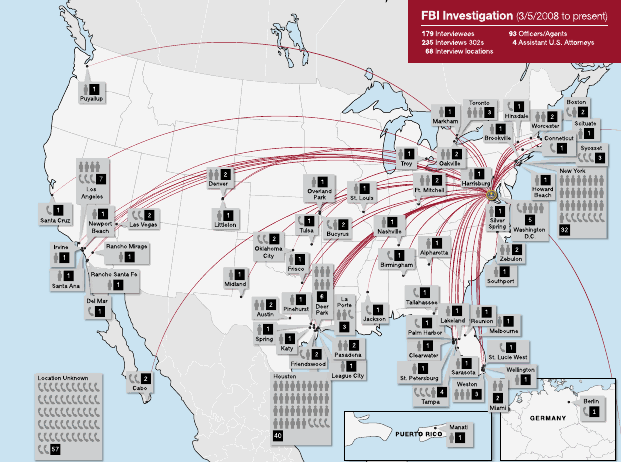
At a time when there are still no significant prosecutions of major players, banks and investment shops responsible for the financial fraud that nearly toppled the world economy and is still choking the US economy, we get an explanation why from an unlikely source – the Roger Clemens trial in Judge Reggie Walton’s courtroom in the DC District. During defense examination of FBI special agent John Longmire today, a map of the FBI/DOJ investigation of Roger Clemens, who was accused of lying about getting a few steroid shots in the late 90s and early 2000s, was displayed. We are now two full months into the second trial of Roger Clemens stemming from this investigation.

Any more questions on why DOJ cannot get around to prosecuting banksters??

Share this entry