Robert Mueller Reveals Counterterrorism Intelligence Techniques Being Used to Combat Healthcare Fraud

We’ve long known that many of the techniques used to combat terrorism derived from the drug war. We’ve known that law enforcement agencies around the country are adopting counterterrorism techniques–and even PATRIOT Act tools–in regular law enforcement.

Robert Mueller just explained that the FBI is taking lessons learned in its counterterrorism intelligence techniques to combat healthcare fraud.

The comment was in response to a question from Amy Klobuchar. She noted that MN has pretty good success at cracking down on healthcare fraud, but inquired about “hot spots” in healthcare fraud.

Mueller responded by lauding the lessons FBI has learned in counterterrorism, then said [these are my notes–I’ll check his exact quote later], “building an intelligence infrastructure across the country allows us to see where … they’re going to go to next,” implying that they were using intelligence techniques to figure out where new healthcare fraud networks were going to pop up next.

Now, as Josh Gerstein noted on Twitter, FBI used the kind of administrative subpoenas now used to combat terrorism before they were used for terrorism. But Mueller’s comment seemed to suggest far more: I assume, given his reference to intelligence networks, FBI is using informants and the like to infiltrate suspected healthcare fraud networks.

I’m all in favor of making sure Medicare and Medicaid money goes to healthcare. But isn’t the use of intelligence networks in the healthcare industry rather invasive?

Share this entry

What If We Scrubbed Wachovia Like We Did the Lebanese Canadian Bank?

I’ll have several things to say about Jo Becker’s story on the big Hezbollah money laundering ring. For the moment, I’m most interested in how Treasury Department authorities uncovered the ring: by first declaring Lebanese Canadian Bank a money launderer, providing reason to break it up. When an affiliate of Société Générale agreed to buy the bank, they also agreed to scrub its money laundering accounts. To do so, it specifically had someone beyond the Big Four accounting firm that had “overlooked” the accounts in the past scrub the books, including bringing in John Ashcroft.

As part of its own agreement with Treasury officials, Lebanon’s Central Bank set up a process to scrub the books. But compliance officers at S.G.B.L.’s French partner, Société Générale, were skeptical of the Central Bank’s choice of investigators. One of them, the local affiliate of the international auditing firm Deloitte, had presumably missed the drug-related accounts the first time around, when it served as the Lebanese Canadian Bank’s outside auditor.

And, according to people knowledgeable about Lebanese banking, the central bank’s on-the-ground representative had been recommended to that post by Hezbollah.

As an extra step, to reassure wary international banks, the chairman of S.G.B.L.,  Antoun Sehnaoui, commissioned a parallel audit, with the help of Société Générale’s chief money-laundering compliance officer. And to make sure that his bank did not run afoul of Treasury officials by inadvertently taking on dirty assets, he also hired a consultant intimately familiar with the Patriot Act provision used to take the bank down: John Ashcroft, the former attorney general whose Justice Department wrote the law.

And then it investigated (presumably using pattern analysis) each and every account at the bank.

Initially, the auditors looked only at records for the past year. As they began combing through thousands of accounts, they looked for customers with known links to Hezbollah. They also looked for telltale patterns: repeated deposits of vast amounts of cash, huge wire transfers broken into smaller transactions and transfers between companies in such wildly incongruous lines of business that they made sense only as fronts to camouflage the true origin of the funds.

Each type of red flag was assigned a point value. An account with 1 or 2 points on a scale to 10 was likely to survive. One with 8 or 9 cried out for further scrutiny. Ultimately, the auditors were left with nearly 200 accounts that appeared to add up to a giant money-laundering operation, with Hezbollah smack in the middle, according to American officials. Complex webs of transactions featured the same companies over and over again, most of them owned by Shiite businessmen, many known Hezbollah supporters. Some have since been identified as Hezbollah fronts.

So effectively, they took a bank known to ignore money laundering controls and took it apart, piece by piece, to see all the money laundering it had sheltered.

Compare how the US dealt with Wachovia, which was involved in laundering a far greater chunk of money for drug cartels: $363 billion.

US authorities partly became aware Wachovia was helping cartels launder money when they captured a plane in 2006. In addition, the DEA first noted their role in launder Casas de Cambio money in 2005, and a British whistleblower had identified signs that same year.

But it’s clear that by 2007 officials from top regulators were aware of the problems.

Late in 2007, Woods attended a function at Scotland Yard where colleagues from the US were being entertained. There, he sought out a representative of the Drug Enforcement Administration and told him about the casas de cambio, the SARs and his employer’s reaction. The Federal Reserve and officials of the office of comptroller of currency in Washington DC then “spent a lot of time examining the SARs” that had been sent by Woods to Charlotte from London.

“They got back in touch with me a while afterwards and we began to put the pieces of the jigsaw together,” says Woods. What they found was – as Costa says – the tip of the iceberg of what was happening to drug money in the banking industry, but at least it was visible and it had a name: Wachovia.

But the prosecution of Wachovia wasn’t initiated until after Wells Fargo took it over in 2008. Which means Treasury could have insisted on the same process–an examination of a bank with known problems with money laundering to find all of its criminal clients.

It’s possible Treasury did–or is still doing that. Read more

Share this entry

Government Establishes Task Force to Combat HAMP Scams, But Not Foreclosure Scams

Treasury, SIGTARP, and the Consumer FInancial Protection Board just formed a task force to fight HAMP fraud.

Mind you, they’re not aiming to fight the fraud servicers engage in–that is, using HAMP as a way to get force homeowners to stop paying their mortgages and then using that “default” as a means to tack on fees and ultimately foreclose.

Nope, our government is going to fight other fraudsters.

SIGTARP, the CFPB, and Treasury investigate mortgage modification schemes, among other things, in which companies charge struggling homeowners a fee in exchange for false promises of lowering the homeowner’s mortgage debt or payments through HAMP, a foreclosure prevention program funded by the Troubled Asset Relief Program (TARP) and administered by the U.S. Department of the Treasury.

omeowners struggling to make their mortgage payments should beware of con artists and scams that promise to save their homes and lower their mortgage debt or payments.
If you are struggling to pay your mortgage and are seeking a mortgage modification, keep the following tips in mind:

  • You can apply to the federal Home Affordable Modification Program (HAMP) on your own or with free help from a housing counselor approved by the U.S. Department of Housing and Urban Development (HUD).  Applying to the program is always FREE.  For more information on how to apply, call the Homeowner’s HOPE™ Hotline at 1-888-995-HOPE (1-888-995-4673) or visit www.MakingHomeAffordable.gov.
  • Only your mortgage servicer has discretion to grant a loan modification.  Therefore, no third party can guarantee or pre-approve your HAMP mortgage modification application.
  • Beware of anyone seeking to charge you in advance for mortgage modification services – in most cases, charging fees in advance for a mortgage modification is illegal.
  • Paying a third party to assist with your HAMP application does not improve your likelihood of receiving a mortgage modification.  Accordingly, beware of individuals or companies that ask you for payment and tout success rates or claim to be “experts” in HAMP.
  • If an individual or company claims to be affiliated with HAMP or displays a seal or logo representing the U.S. government in correspondence or on the Web, you should check the connection by calling the Homeowner’s HOPE™ Hotline.
  • Beware of individuals or companies that offer money-back guarantees.
  • Beware of individuals or companies that advise you as a homeowner to stop making your mortgage payments or to not contact your mortgage servicer.

Financially troubled homeowners can avoid scams by working with a HUD-approved housing counselor to understand their options and to apply for assistance.  Assistance from HUD-approved housing counselors is free, and homeowners can reach them by calling the Homeowner’s HOPE™ Hotline at 1-888-995-HOPE (1-888-995-4673) or by visiting www.MakingHomeAffordable.gov.

Meanwhile, the government is trying to settle with servers for their fraud.

I’m not angry that the government is trying to protect struggling homeowners. But they’ve badly misjudged where the biggest threat lies.

Share this entry

Jed Rakoff to SEC: Do you think I’m a tool?

Judge Jed Rakoff has rejected the SEC’s proposed wrist slap of Citibank for selling mortgage-backed securities it knew to be of poor qualify.

Effectively, what he did was join this complaint with SEC’s complaint–filed at the same time as they filed the proposed Citi settlement–against a Citi employee, Brian Stoker, in which the SEC explicitly alleged that Citi knew what it was doing when it dealt shitty securities it intended to short. By doing so, Rakoff imposed the same trial process on this complaint as on Stoker. Effectively, he’s saying, “If you’re prepared to prove that Stoker knew what he was doing in selling shitty MBS, you’re prepared to prove that Citi did too.”

But the rest of his ruling focuses more generally on his demand that the SEC stop treating him–and federal judges generally–as tools of their efforts to cover over corporate crime. When he uses “tool” in this passage, I couldn’t help thinking he mean tool both literally, but also in the derogatory sense.

Without multiplying examples, it is clear that before a court may employ its injunctive and contempt powers in support of an administrative settlement, it is required, even after giving substantial deference to the views of the administrative agency, to be satisfied that it is not being used as a tool to enforce an agreement that is unfair, unreasonable, inadequate, or in contravention of the public interest. [my emphasis]

After showing that Citi changed its mind, once it became clear Rakoff would be judging the issue, about the standard for judicial review in such cases,

In its original Memorandum in support of the proposed Consent Judgment, filed before the case had been assigned to any judge, the S.E.C. expressly endorsed the standard of review set forth by this Court in its Bank of America decisions, i.e., “whether the proposed Consent Judgment … is fair, reasonable, adequate, and in the publc interest.”

[snip]

In its most recent filing in this case, however, the S.E.C.
partly reverses its previous position and asserts that, while the Consent Judgment must still be shown to be fair, adequate, and reasonable, “the public interest … is not part of [the] applicable standard of judicial review.”

Rakoff then went on to argue that fact finding was necessary to serve the public interest, repeating his angry language about being used by the SEC.

Purely private parties can settle a case without ever agreeing on the facts, for all that is required is that a plaintiff dismiss his complaint. But when a public agency asks a court to become its partner in enforcement by imposing wide-ranging injunctive remedies on a defendant, enforced by the formidable judicial power of contempt,3 the court, and the public, need some knowledge of what the underlying facts are: for otherwise, the court becomes a mere handmaiden to a settlement privately negotiated on the basis of unknown facts, while the public is deprived of ever knowing the truth in a matter of obvious public
importance.

3 The Second Circuit has described the contempt power as “among the most formidable weapons in the court’s arsenal.”

At which point he really starts to vent.

An application of judicial power that does not rest on facts is worse than mindless, it is inherently dangerous. The injunctive power of the judiciary is not a free roving remedy to be invoked at the whim of a regulatory agency, even with the consent of the regulated. If its deployment does not rest on facts–cold, hard, solid facts, established either by admissions or by trials–it serves no lawful or moral purpose and is simply an engine of oppression.

Read more

Share this entry

Geithner’s Duplicitous Efforts to Reinforce the Oligarchy

Bloomberg’s blockbuster story–showing that the Fed was dumping $7.77 trillion into the same banks that Treasury was claiming were solvent to qualify them for TARP–shows a number of different things. It focuses on the $13 billion in profits the banks made off of massive secret loans from the Fed.

The 190 firms for which data were available would have produced income of $13 billion, assuming all of the bailout funds were invested at the margins reported, the data show.

More importantly, IMO, the Bloomberg piece also shows how Ben Bernanke, TurboTax Timmeh Geithner, and Hank Paulson used secrecy to get DC’s bureaucracy–both Congress and Executive Branch officials–to push through his preferred plan to prop up the TBTF banks.

They did this in two ways: first, by keeping details of the Fed’s massive lending secret from the people implementing TARP.

The Fed initially released lending data in aggregate form only. Information on which banks borrowed, when, how much and at what interest rate was kept from public view.

The secrecy extended even to members of President George W. Bush’s administration who managed TARP. Top aides to Paulson weren’t privy to Fed lending details during the creation of the program that provided crisis funding to more than 700 banks, say two former senior Treasury officials who requested anonymity because they weren’t authorized to speak.

This meant the Fed could hide the fact that the six biggest banks were basically insolvent, and should have been wound down rather than propped up with a strings-free TARP.

The Treasury Department relied on the recommendations of the Fed to decide which banks were healthy enough to get TARP money and how much, the former officials say. Read more

Share this entry

Is the Government Hiding Chase’s Cooperation in the Scary Iran Plot?

As I noted in this post, earlier this month, the government unsealed the redacted first complaint in the Scary Iran Plot. I will do a post summarizing the differences between the original and amended complaint later (short version: in a number of ways seeing both complaints weakens their case slightly against Quds Force).

But in this post, I want to suggest–and this is speculation–that the secrecy about the complaint may serve, in part, to protect JP Morgan Chase.

Read more

Share this entry

Some Pigs Money Launderers Are More Equal Than Other Pigs Money Launderers

Treasury is going to ratchet up sanctions against Iran today, designating it as a primary money laundering concern.

he Treasury Department plans to designate Iran as an area of “primary money laundering concern” on Monday, a U.S. official said, a move allowing it to take steps to further isolate the Iranian financial sector.

[snip]

The decision — which the official said was to be announced by Secretary of State Hillary Clinton and Treasury Secretary Timothy Geithner on Monday — appeared designed as a warning about the risks of dealing with Iran’s financial institutions.

Maybe if the government would actually punish those who traded with Iran–like JP Morgan Chase–rather than imposing fines but then funneling them more money than the fines, it would have an effect on entities dealing with Iran’s financial institutions?

More importantly, the Treasury Department must think “money launderer” means something different than I understand it to mean. Because these guys are still operating as a favored financial jurisdiction for Americans and American companies.

A small group of Cayman Islands “jumbo directors” are sitting on the boards of hundreds of hedge funds as demand for independent directors booms in the Caribbean tax haven.

At least four individuals hold more than 100 non-executive directorships each, and 14 have more than 70 – each worth as much as $30,000 a year.

One has been listed as on the boards of 567 Cayman entities, almost all of which were hedge funds.

So long as we allow Cayman Islands and the hedgies to set up a kind of dangerous hybrid, where the hedgies themselves get to make sure the Cayman banks operate “ethically” as they launder the hedgies money, whatever concern we try to muster about Iran will ring false.

But I guess that’s increasingly par for the course.

Share this entry

The More You Look for Terrorists, the Fewer Banksters You Have to Prosecute

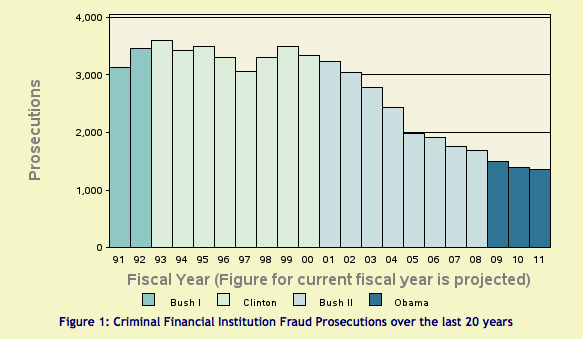
This report–or rather the HuffPo piece on it–has gotten a lot of attention. It shows the government as a whole has prosecuted 57.7% fewer financial fraud crimes than they did 10 years ago, when 9/11 changed everything.

The report on our government’s growing disinterest in prosecuting banksters should be paired with this FBI report which I reported on some weeks ago (since that time, FBI has removed the link to the report). The FBI report makes it clear that the FBI, at least, has shifted its approach over the last decade from a “case driven” focus to a “threat driven” focus–meaning that it decides what it’s going to look for and then goes to find criminals committing that crime rather than finds crimes and responds to them. Depending on whether you believe this report or Director Mueller’s June reconfirmation hearing, financial fraud is either the 7th or 5th highest priority for the FBI, behind terrorism, counterintelligence, and cyberattacks.

Those priorities show. As part of its focus on terrorism, the FBI has increased surveillance capacity by 48%. And over that time, the report boasts, the FBI has written 85,500 raw intelligence reports. It has set up 10,200 SCI workstations.

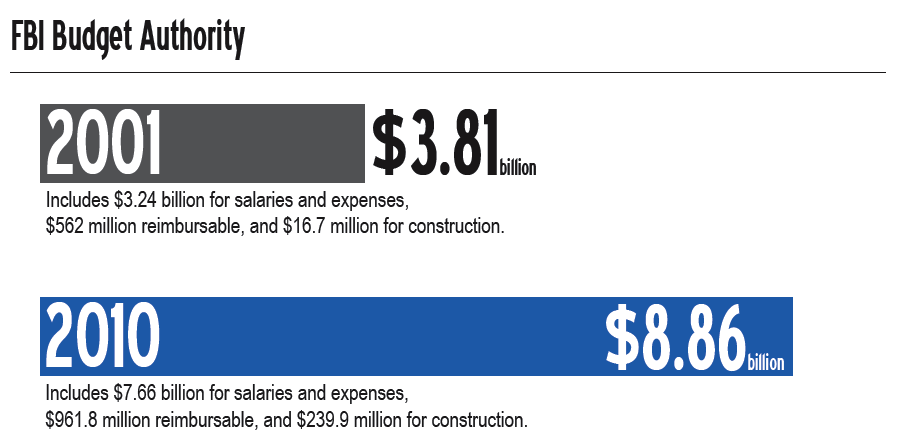
All of which costs money. The FBI reports that its budget authority–which it notes is driven by the strategy–has more than doubled over the period in which it has found half as many banksters.

Most telling, though, is a stat you get by putting the two reports together. TRAC notes that FBI referred 37.6% of the fraud cases for prosecution so far this year–working out to be roughly 470 cases. But if you work out how many financial cases they say they were tracking last year (they say “more than 2,800” equates to 57% of the cases), you see they were tracking roughly 4,912 financial fraud cases. If these numbers are correct, it means fewer than 10% of the banksters and other fraudsters they’re tracking ever get charged.

In other words, it’s not that they’re not seeing the crime. They’re just not referring it for prosecution, choosing instead to look for young Muslim men to entrap.

Share this entry

Two MI Counties File Class Action Suit against MERS and Banks for Being Tax Cheats

Two MI County Registers of Deeds–Curtis Hertel of Ingham (Lansing’s county) and Nancy Hutchins of Branch–have filed a class action suit against MERS, seeking the taxes the banks should have been paying to counties and the state every time they transfer property, plus penalties.

Plaintiffs are seeking money and punitive damages, tax penalties, costs, and attorney fees in the return of unpaid taxes, interest and penalties to Plaintiffs as class representatives of the 83 counties of the State of Michigan.

In addition to MERS, BoA, Chase, Wells Fargo, and Citi, the suit cites parts of the state’s biggest foreclosure mills, eTITLE, 1st Choice Title, and Attorney’s Title and Fannie Mae. The suit argues that the defendants had a duty to record the real value of property transferred in the state, and by failing to do so, they cheated counties out of the taxes on those property transfers.

Defendants, as grantors, makers, executors, issuers and deliverers of deeds or instruments conveying an interest in real property under MCL 207.507, had a DUTY to declare the true value of the property and full consideration given/received on the face of each and every property transfer documents in Exhibit 2, as well as all those other similar filings made by Defendants; or in the alternative Defendants had a DUTY to attach an affidavit to the deeds and instruments stating the true value of the property. Defendants had these same DUTIES with regard to all those other deeds and instruments filed by them in all 83 counties of the State of Michigan over the last 15 years.

Defendants made, executed, issued and/or delivered for recording with the Registers of Deeds in all 83 counties in Michigan, assignments and other real property transfer documents transferring all or part of an interest in real property without stating the actual and true value of the property on the face of the instrument; and without alternatively attaching an affidavit stating the true value of the property interest being transferred. MCL 207.504/MCL207.525(2).

As a direct consequence of Defendants’ failure to properly make, execute, issue, and/or deliver real property transfer deeds, assignments, and other documents recorded in the 83 counties of the State of Michigan transferring property and security interests, neither County nor State Real Estate Transfer Taxes have been paid on thousands of real property transfers filed by/for Defendants across the counties of the State of Michigan as required by law.

When Hutchins filed a similar suit covering just Branch County–a rural county with a population of 45,000–in August, she estimated the county had lost $100,000 in the last 5-10 years. Even in Ingham County alone, with its population of over 250,000, that number is going to be much higher. Add in the state taxes, and the money will start to add up.

But the principle will be even more important: the banks have been cheating counties and states with this MERS scheme. It’s time they finally paid taxes like the rest of us.

Share this entry

As the Next Phase of the Crash Accelerates, Watch for More Looting

[youtube]4RPt9czGADk[/youtube]

The earth avoided getting hit by an asteroid last night. Then today, FEMA tested its catastrophic communications system, only to discover some problems. In my own case, the warning signal started skipping, dadadadadadada, sounding like a machine gun, before it switched my jazz to a bad disco station. Outside, there are whistling high winds blowing through the dark afternoon and a threat of snow.

All of which feels appropriate as a set of clowns arrive in the state and prepare to debate over whether they were right to say MI’s major industry–and my state–should go bankrupt.

Jefferson County, AL just did go bankrupt. Finally.

Which sort of feels like the preview to the collapse of Europe. Here’s Brad DeLong:

Time to Spread Foam on the Runway: The Federal Reserve Needs to Act Now to Firewall Off the Eurocrisis

I have been complaining for some time now that Reinhart and Rogoff think that the time is always 1931 and that we are always Austria–that the great fiscal crisis is about to erupt and send us lurching down toward Great Depression II. Well, right now guess what? The time is 1931, and we are Austria.

And he quotes Paul Krugman.

This is the way the euro ends.

Not with a bang but with bunga-bunga.

Seriously, with Italian 10-years now well above 7 percent, we’re now in territory where all the vicious circles get into gear — and European leaders seem like deer caught in the headlights.

[snip]

I still find it hard to believe that the euro will fail; but it seems equally hard to believe that Europe will do what’s needed to avoid that failure. Irresistible force, meet immovable object — and watch the explosion.

The crash is starting to accelerate again.

With that in mind, it’s worth reading this Misha Glenny piece.

Capricious, unreliable and ideologically driven were some of the more printable epithets hurled at George Papandreou in his final week as Greek prime minister. We should look at the motives of his detractors before taking such critiques at face value. While engaged in titanic political struggles at home and abroad, he has been quietly trying to tackle one of the most intractable root causes of the Greek tragedy – crime and corruption.

As the new Greek government struggles to convince Europe of its resolve to cut the country’s bloated public sector, it also has to decide whether to face down the real domestic threat to Greece’s stability: the network of oligarch families who control large parts of the Greek business, the financial sector, the media and, indeed, politicians.

[snip]

The oligarchs have responded in two ways. First, they have accelerated their habitual practice of exporting cash. In the last year, the London property market alone has reported a surge of Greek money.

Second, they have mobilised hysterical media outlets which they own in order to denounce and undermine Mr Papandreou at every opportunity, aware he is the least pliable among Greece’s political elite.

Their aim is clear – they are waiting to pounce on the state assets which, under the various bail-out plans, the Greek government must privatise.

I’ve long suspected this crisis has been regarded by some–if not planned–as a means to accomplish in developed nations what their fellow Oligarchs in developing nations used to pull off via geography: the wholesale looting of their countries. And with it, dismantling the social contract on which modern democracy has depended.

Who needs democracy when you can force more austerity onto a country to shield the banks? Who needs democracy when you can add city after city to the ranks of those led by Emergency Financial Managers.

Yeah, the Occupiers have inspired some real fear among the looters. Small-d democracy won some battles last night in Maine and Ohio. But that’s not enough, without real vigilance, to stop the looters.

Share this entry