Mark Udall: Leakers on Senate Intelligence Torture Report Got Facts Wrong

Last week, I noted that leaks to the WSJ about CIA’s response to the Senate Intelligence Torture report seemed designed to box John Brennan in, making it very difficult for him to authorize declassification of the report.

Sure enough, the very day after Brennan won confirmation, WSJ reports that CIA is not done with their review yet, but they disagree with the report’s findings.

The report examines the details of conditions under which each detainee was held and interrogated, the quality of the information provided and the accuracy of how the CIA described the program to other officials and lawmakers. It included 20 recommendations, officials said.

The report assesses the utility of information from interrogations in 20 cases and concludes that it wasn’t useful; the CIA disputes that conclusion in all but one or two of those assessments, officials said.

The CIA is objecting to the majority of the report, a senior intelligence official said.

“The overall objection was the report basically says we never in any instances got good information from this program,” another U.S. official said. “To anyone who has worked at the CIA on this issue, that’s not true.”

Even CIA officers who opposed the interrogation program acknowledge that the agency obtained useful information, the U.S. official said.

Even if Brennan wanted to declassify this report — and given his stated desire to protect CIA from criticism, he probably doesn’t want to — he’d have a hard time doing so, because it would instantly turn the torture dead-enders against him, which is not the safest way to start a job managing a bunch of talented spooks. [my emphasis]

In today’s Global Threat Assessment hearing, Mark Udall addressed the WSJ report. He revealed that the leakers behind that report had gotten basic facts about the report wrong — such as that there were 20 recommendations.

He then asked John Brennan three questions:

  • CIA officials are leaking what may or may not be official response to the report. Do you believe this is leak of CIA views?
  • Do you anticipate looking into leak?
  • There’s no new deadline for CIA comments in response to report. When can we get it?

Brennan did say the CIA was assessing the story to determine whether “there had been a disclosure.” I’m not sure whether he answered whether the leaks represented the views of the CIA.

Brennan also hedged a bit about a new deadline to respond to Congress. He would like to say comments will come back within a months time, he said (the original deadline was February 15, basically a month past already). He then promised his “firm resolve” to look at what CIA has put together and get back to the Senate Intelligence Committee.
Share this entry

James Clapper Sneaks Climate Change — But Not Bankster Speculation — Into His Threat Assessment

You wouldn’t know it by looking at his written statement, which lists Cyber, Terrorism and Transnational Crime, Counterintelligence, and Counterspace before it lists Natural Resource Insecurity, but water and food insecurity was actually the first threat Director of National Intelligence James Clapper described in today’s Worldwide Threat Hearing.

That said, in his spoken statement, he didn’t utter the words “climate change.”

Though those words do appear in the written statement, as a subcategory of resource scarcity, as follows:

Food security has been aggravated partly because the world’s land masses are being affected by weather conditions outside of historical norms, including more frequent and extreme floods, droughts, wildfires, tornadoes, coastal high water, and heat waves. Rising temperature, for example, although enhanced in the Arctic, is not solely a high-latitude phenomenon. Recent scientific work shows that temperature anomalies during growing seasons and persistent droughts have hampered agricultural productivity and extended wildfire seasons. Persistent droughts during the past decade have also diminished flows in the Nile, Tigris-Euphrates, Niger, Amazon, and Mekong river basins.

Note: the head of our intelligence community seems to have missed that “persistent droughts” have not only diminished flows in the Nile, Tigris-Euphrates, Niger, Amazon, and Mekong river basins. Last year’s drought also diminished flows right here in the US, in the Missouri-Mississippi basin.

I guess somehow the US is exempt from climate change, intelligence folks?

I’m glad Clapper got climate change in his statement, I’m glad he put water and food scarcity at the front of his presentation (last year just water scarcity appeared in his written statement). But if we’re going to treat climate change merely as one underlying factor contributing to resource scarcity, perhaps we should also look at bankster speculation, which is increasingly recognized as a key driver of rising food costs. Food speculation, after all, is something we can do a great deal to fix, here in the US. But we have refused to do so, choosing instead to deal with the instability that results.

Ah well, baby steps, people. The Director of National Intelligence just implicitly said that climate change and resource scarcity is the most urgent problem facing us. I’ll take it.

Share this entry

The Bipartisan Effort to Keep Robert Mueller on at FBI Starts

I’m watching the Senate Intelligence Committee’s hearing on Global Threats.

And I’m a bit alarmed that both Dianne Feinstein and Saxby Chambliss used their statements to suggest Robert Mueller should stay beyond the end of his already-extended term this year.

DiFi said,  “unless Congress intervenes again, this threats hearing will be the last one for Robert Mueller” and then looked at him and said, “it could happen.”

Then Saxby repeated that line, saying he would shortly approach Mueller to ask him to stay on again.

Before his statement, James Clapper also nodded to Mueller, noting he has served as Director for 12 years.

We have terms for FBI Director for good reason. Not just to prevent the rise of another J Edgar Hoover, one person with an empire over the secret information collection in the US. But also to bring a fresh approach to such things as our manufacturing of “terrorists.”


Share this entry

A Partial Defense of Bill Keller’s Column on Manning

Late Sunday, former New York Times Executive Editor Bill Keller put up an op-ed column at the NYT website on the state of Bradley Manning’s case, his perception of Manning’s motivations and what may have been different had Manning actually gotten his treasure trove of classified information to the Times instead of WikiLeaks. The column is well worth a read, irrespective of your ideological starting point on Mr. Manning.

Bradley Manning has ardent supporters and, predictably, they came out firing at Keller. Greg Mitchell immediately penned a blog post castigating Keller for not sufficiently understanding and/or analyzing the Manning/Lamo chat logs. Kevin Gosztola at Firedoglake also had sharp words for Keller, although, to be fair, Kevin did acknowledge this much:

It is an interesting exercise for Keller. Most of what he said is rational and, knowing Keller’s history, he could have been more venerating in his description of how the Times would have handled Manning.

Frankly, many of the points Mitchell and Gosztola made, which were pretty much representative of a lot of the chatter about Keller’s op-ed on Twitter, were fair criticism even if strident. And part of it seems to simply boil down to a difference in perspective and view with Keller, as evidenced in Keller’s response to inquiry by Nathan Fuller, where he indicates he simply views some things differently.

This is all healthy give and take, difference in view and sober discussion by the referenced Read more

Share this entry

18 USC 1119 Foreign Murder and Obama Targeted Kill White Paper

Back in February, when the “White Paper” was first “leaked”, Marcy wrote a fantastic article entitled Article II or AUMF? “A High Level Official” (AKA John Brennan) Says CIA Can Murder You on the issues of Article II authority versus AUMF authority in relation to the Obama targeted killing program. First off, let me say that the the lack of recognition of the presence of both these these respective authorities in the targeted killing program, even among legal commentators I respect greatly, is one of, if not the, most discouraging aspects of the discussion being had. Sadly, the big filibuster by Sen. Rand Paul did not necessarily improve the understanding, and even the New York Times continues to propagate the misdirection and misinformation peddled by the Obama Administration.

I wish to discuss the interaction of the statutory law contained in 18 USC 1119, the “Foreign Murder statute”, with the greater Obama Administration Targeted Killing Program, and the White Paper foundation for it. Specifically I want to point out the circular and disingenuous way in which the White Paper tries to bootstrap itself, and the Administration, around criminal liability for murder in the case of a targeted US citizen such as Anwar Awlaki. Frankly, Marcy let fly with another must read post on 18 USC 1119 and the White Paper yesterday in the wake of the New York Times sop to the Administration, and it filets both the White Paper, and the NYT, open at the seams.

The most important principle to understand about the White Paper’s discussion of 18 USC 1119 is, as Marcy noted, that it is impertinent if the the law of war (formally the “Law of Armed Conflict” or “LOAC”) is truly in play. In short, if the Administration is using the AUMF – military force – in an active battle situation, there is no need for further discussion, whether Mr. Awlaki is a US citizen or not. That, of course is diametrically opposed to what the facts were at the action point with Awlaki, and that we now know.

The truth is the Administration used a civilian agency, the CIA, to kill a US citizen without judicial due process, far from the “hot battlefield” and that is why such a deliberate attempt was made in the White Paper to obfuscate the legal basis for their targeting and killing, and why such a seemingly inordinate time was spent in the White Paper on a traditional criminal law statute, 18 USC 1119.

The statutory language of 18 USC 1119 states:
Read more

Share this entry

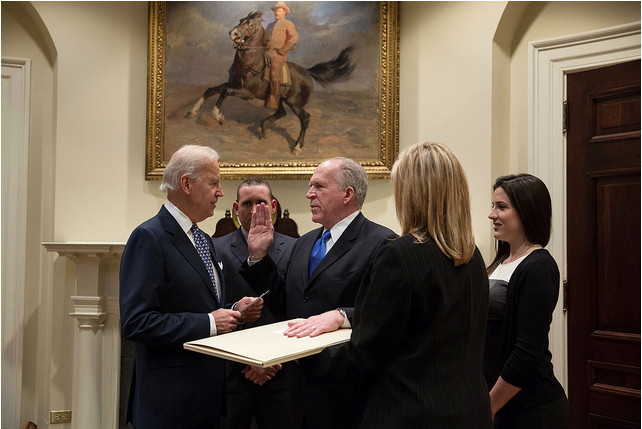
John Brennan Sworn in as CIA Director Using Constitution Lacking Bill of Rights

Screen shot 2013-03-08 at 1.27.57 PMAccording to the White House, John Brennan was sworn in as CIA Director on a “first draft” of the Constitution including notations from George Washington, dating to 1787.

Vice President Joe Biden swears in CIA Director John Brennan in the Roosevelt Room of the White House, March 8, 2013. Members of Brennan’s family stand with him. Brennan was sworn in with his hand on an original draft of the Constitution, dating from 1787, which has George Washington’s personal handwriting and annotations on it.

That means, when Brennan vowed to protect and defend the Constitution, he was swearing on one that did not include the First, Fourth, Fifth, or Sixth Amendments — or any of the other Amendments now included in our Constitution. The Bill of Rights did not become part of our Constitution until 1791, 4 years after the Constitution that Brennan took his oath on.

I really don’t mean to be an asshole about this. But these vows always carry a great deal of symbolism. And whether he meant to invoke this symbolism or not, the moment at which Brennan took over the CIA happened to exclude (in symbolic form, though presumably not legally) the key limits on governmental power that protect American citizens.

Update: Olivier Knox describes how the White House pushed the symbolism of this.

Hours after CIA Director John Brennan took the oath of office – behind closed doors, far away from the press, perhaps befitting his status as America’s top spy – the White House took pains to emphasize the symbolism of the ceremony.

“There’s one piece of this that I wanted to note for you,” spokesman Josh Earnest told reporters gathered for their daily briefing. “Director Brennan was sworn in with his hand on an original draft of the Constitution that had George Washington’s personal handwriting and annotations on it, dating from 1787.”

Earnest said Brennan had asked for a document from the National Archives that would demonstrate the U.S. is a nation of laws.

“Director Brennan told the president that he made the request to the archives because he wanted to reaffirm his commitment to the rule of law as he took the oath of office as director of the CIA,” Earnest said.

Update: I’m assuming this copy of the Constitution is the one Brennan used.

Share this entry

Cables, Confirmed

I’ve long traced the severance and disconnection of various parts of the world from telecommunication cables on this blog, most recently in the wake of Syria losing Toobz access after it purportedly mixed some chemical weapons.

Danger Room’s sources aren’t even asserting that both events–the mixing of the CW on Wednesday and the Intertoobz blackout on Thursday–are both signs of Bashar al-Assad’s panic.

Which would sort of be the default unless intelligence sources had reason to know that the Intertoobz blackout had nothing to do with the CW mixing.

We’ve long traced interesting Intertoobz blackouts caused by cut cables on this blog: the recent blackout in Djibouti. to a cable in the Bay Area, to a number of cut cables in the Middle East back in 2008.

It appears to be an increasingly common tactic, one difficult to attribute to a specific actor.

But if one of those actors comes out a few days after an outage and says they have no reason to find that outage as suspicious as the mixing of CW, maybe it’s not so hard to attribute after all.

One of the interesting revelations in this profile on the guy who shot Osama bin Laden is that sending Seal Team Six to do something with underwater cables is apparently routine enough that’s what they were told the mission would be before they were read into the real target.

There was so much going on — the Libya thing, the Arab Spring. We knew something good was going to go down. We didn’t know how good.

The first day’s briefing, they actually kind of lied to us, being very vague. They mentioned underwater cables because of the earthquake in Japan or some craziness.

Consider me thoroughly unsurprised.

Share this entry

Did Administration Stall Congressional Oversight Just to Beat ACLU in Court?

In an interview with WSJ last March, White House Counsel Kathryn Ruemmler said that publicly explaining the drone program would be “self-defeating.”

White House Counsel Kathy Ruemmler acknowledged Mr. Obama has developed a broader view of executive power since he was a senator. In explaining the shift, she cited the nature of the office.

“Many issues that he deals with are just on him, where the Congress doesn’t bear the burden in the same way,” she said. “Until one experiences that first hand, it is difficult to appreciate fully how you need flexibility in a lot of circumstances.”

[snip]

Ms. Ruemmler said Mr. Obama tries to publicly explain his use of executive power, but says certain counterterrorism programs like the drone campaign are exceptions. Opening them to public scrutiny would be “self-defeating,” she said.

At the time, I thought she was treating the NYT and ACLU as “the public.” After all, in a debate over releasing the targeted killing memos in the situation room in November 2011, she had warned that releasing the memo might weaken the government’s position in litigation, presumably the FOIA battle with the two entities.

The CIA and other elements of the intelligence community were opposed to any disclosures that could lift the veil of secrecy from a covert program. Others, notably the Justice and State departments, argued that the killing of an American citizen without trial, while justified in rare cases, was so extraordinary it demanded a higher level of public explanation. Among the proposals discussed in the fall: releasing a “white paper” based on the Justice memo, publishing an op-ed article in The New York Times under Holder’s byline, and making no public disclosures at all.

The issue came to a head at a Situation Room meeting in November. At lower-level interagency meetings, Obama officials had already begun moving toward a compromise. David Petraeus, the new CIA director whose agency had been wary of too much disclosure, came out in support of revealing the legal reasoning behind the Awlaki killing so long as the case was not explicitly discussed. Petraeus, according to administration officials, was backed up by James Clapper, the director of national intelligence. (The CIA declined to comment.) The State Department, meanwhile, continued to push for fuller disclosure. One senior Obama official who continued to raise questions about the wisdom of coming out publicly at all was Janet Napolitano, the Homeland Security director. She argued that the calls for transparency had quieted down, as one participant characterized her view, so why poke the hornet’s nest? Another senior official expressing caution about the plan was Kathryn Ruemmler, the White House counsel. She cautioned that the disclosures could weaken the government’s stance in pending litigationThe New York Times has filed a lawsuit against the Obama administration under the Freedom of Information Act seeking the release of the Justice Department legal opinion in the Awlaki case. [my emphasis]

But having now updated my timeline of the over 14 requests members of Congress have made for the targeted killing memos, she seems to lump Congress with the ACLU and NYT.

More troubling, though: it appears the White House stalled its response to Congress for almost nine months simply to gain an advantage in the ACLU FOIA lawsuits.

Here are the relevant dates: Read more

Share this entry

Five Questions for John Brennan

I’m sure I could grill John Brennan for hours. But after a lot of thought, here are the five questions I believe most important that should be asked of him Today.

1) Do you plan to continue lying to Americans?

You have made a number of demonstrable lies to the American people, particularly regarding the drone program and the Osama bin Laden raid. Most egregiously in 2011, you claimed “there hasn’t been a single collateral death” in almost a year from drone strikes; when challenged, you revised that by saying, “the U.S. government has not found credible evidence of collateral deaths,” even in spite of a particularly egregious case of civilian deaths just months earlier. On what basis did you make these assertions? What definition of civilian were you using in each assertion? (More background)

In addition, in a speech purportedly offering transparency on the drone program, you falsely suggested we know the identities of all people targeted by drones. Why did you choose to misrepresent the kind of intelligence we use in some strikes?

2) What was the intelligence supporting the first attempt to kill Anwar al-Awlaki?

The US government’s first attempt to kill Anwar al-Awlaki with a drone strike was December 24, 2009. WikiLeaks cables make it clear that Awlaki was a primary target of that strike, not just intended collateral damage. Yet the Webster report makes clear that on that day — that is, until the Underwear Bomber attempt the next day — the Intelligence Community did not consider Awlaki to be operational. Thus, the strike seems to have been approved before he fulfilled the criteria of the white paper released the other day, which authorizes the targeting of senior operational leaders of groups like AQAP. What was the legal basis for targeting this American citizen at a time when the IC did not believe him to be operational? (More background)

3) Will your close friendships with Saudis cloud your focus on the US interest?

In a fawning profile the other day, Daniel Klaidman nevertheless laid out the following points:

  • You considered Yemen to be a “domestic conflict.”
  • You opposed signature strikes in the country.
  • You nevertheless approved signature strikes in Yemen because of personal entreaties from people you know from when you were stationed on the Arabian peninsula in the 1990s.

In addition, recent reports have confirmed that the drone strike that killed Anwar al-Awlaki was launched from Saudi territory.

Were the personal entreaties you responded to from Yemenis or Saudis (or both)?

What role did the Saudis have in the Awlaki strike? Did they have an operational role?

As someone with such close ties to liaison sources, how have you and will you manage to prioritize the interests of the United States over the interests of friends you have from two decades ago?

To what degree is your intelligence sharing — especially with the Saudis — a stovepipe that creates the same risks of intelligence failures that got us into the Iraq War? (More background)

4) What role did you have in Bush’s illegal wiretap program?

The joint Inspector General report on the illegal wiretap program reported that entities you directed — the Terrorist Threat Integration Center in 2003 and 2004, and the National Counterterrorism Center in 2004 and 2005 — conducted the threat assessments for the program.

What role did you have, as the head of these entities, in the illegal wiretapping of Americans? To what extent did you know the program violated FISA? What role did you have in counseling Obama to give telecoms and other contractors immunity under the program? What influence did you have in DOJ decisions regarding suits about the illegal program, in particular the al-Haramain case that was thrown out even after the charity had proved it had been illegally wiretapped? Did you play any role in decisions to investigate and prosecute whistleblowers about this and other programs, notably Thomas Drake? (More background)

5) Did you help CIA bypass prohibitions on spying domestically with the NYPD intelligence (and other) programs?

In your additional prehearing questions, you admit to knowing about CIA’s role in setting up an intelligence program that profiled Muslims in New York City. What was your role in setting up the program? As someone with key oversight over personnel matters at the time, did you arrange Larry Sanchez’ temporary duty at the NYPD or CIA training for NYPD detectives?

Have you been involved in any similar effort to use CIA resources to conduct domestic spying on communities of faith? You said the CIA provides (among other things) expertise to local groups spying on Americans. How is this not a violation of the prohibition on CIA spying on Americans?  (More background)

Update: I realized that I have left out a caveat in Brennan’s drone lies — he was talking in the previous year. I’ve fixed that.

Share this entry

John Brennan, Unplugged

As a special service to emptywheel readers, I am going to provide an abridged version of John Brennan’s answers to Additional Prehearing Questions in advance of his confirmation hearing on Thursday.

Q1 Bullet 3: 7 CIA officers died in Khost in a suicide bombing that was direct retaliation for our drone attack on a funeral, and then another drone attack on a thuggish enemy of Pakistan and his young wife. Let’s discuss this event as a counterintelligence event, shall we?

A: I have been impressed with CIA’s counterintelligence briefings.

Q6 Bullet 1: What principles should determine whether we conduct covert action under Title 50, where they’re legally supposed to be, or Title 10, where we’ve been hiding them?

A: Whatever works. But tell Congress!

Q6 Bullet 3: Should we reevaluate this?

A: Only if the President decides he wants to stop this shell game.

Q7: Should CIA be a paramilitary agency?

A: See answer to question 6.1.

Q9: We missed the Arab Spring. Shouldn’t we expect better?

A: The liaison relationships with Egypt, Israel, and Saudi Arabia that failed us before won’t fail us again.

Q10: Rather than asking whether you set up the CIA-on-the-Hudson, can you just answer whether you knew about this attempt to bypass restrictions on CIA operating in the US?

A: Yes, I did. CIA likes providing “key support” to local entities under the guise of Joint Terrorism Task Forces.

Q12: How would you manage CIA?

A: Moral rectitude.

Q13: You have lied about things like the Osama bin Laden raid to boost President Obama’s political fortunes. How will you ensure independence from the White House?

A: I will provide him with objective intelligence but I won’t necessarily provide such objective intelligence to anyone else.

Q15: How will you work with your buddies in the Saudi and similar intelligence agencies?

A: I will be the gatekeeper to all US intelligence community elements, but I promise to keep the Chief of Mission informed. At least about what the US side of that relationship is doing.

Q16: How will you staff the agency?

A: Moral rectitude.

Q17: How will you ensure accountability?

A: As CIA did when it was torturing, we’ll refer allegations of criminal wrongdoing to DOJ.

Read more

Share this entry