Iran Claims Capture of CIA Agents

Iran’s Mehr News English website (but not, at the time of this writing, its Fars News website or the PressTV site) carries a sloppy and poorly translated story in which Iran claims to have captured a number of CIA agents. Such claims from Iran are not unprecedented, and, as usual, there is no clear indication of when the agents were claimed to have been captured. The poor translation is reflected in the current headline:

I would posit that intelligence agents are not being intelligent if they are captured by the country in which they are operating. The story carries photos of a number of the people Iran claims to have captured. The unifying characteristic appears to be that each of those captured is said to have been in Iran through some association with high technology.

Iran describes the operation these agents are accused of carrying out (or more likely, the Iranian Intelligence Ministry operation that caught them, once again, the writing is sloppy) as “constant and smart” and says cryptically that “part of the operation was carried out in France and elsewhere”.

It appears that Iran claims that a man they identify as Matti Waluk was the leader of the group. Here is the photo they posted of him:
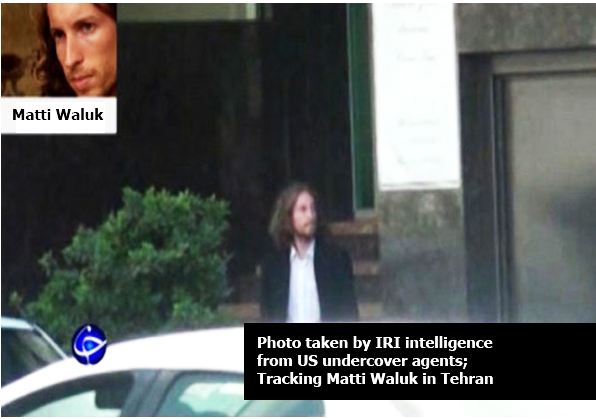
As with the entire article, the description of Waluck is very difficult to decipher:

Matti Waluk, a CIA operator and executive of a CIA intelligence plan was arrested by security and intelligence agents of Iran along with other members of anti-Iran group.

“In 2008, I registered an employment website, NGR, and signed contracts with European prestigious companies to introduce expert human force to them. In 2009, an individual calling himself Steven Logano, contacted me via Prizma Company Email, purportedly to cooperate,” Mati Waluk accounts.

“In first days, I recognized that his real name was not Steven Logano, and that he is a senior CIA officer, with mission of infiltrating Iranian elite circles and collecting information on Iranian developments in hi-tech industries,” he adds.

The final paragraph of the story is just as unintelligible:

The plan was aborted by the Iranian intelligence systemtracking the agents , and thus their mission, who would endanger Iran’s critical structures, had it failed.

Back in November of 2011, Iran claimed to capture 12 CIA agents. In an article about those arrests, CBS News noted:

Iran periodically announces the capture or execution of alleged U.S. or Israeli spies, and often no further information is released.

By including photos of those who they claim to have captured, Iran would appear to be fairly confident that they have indeed captured agents. It will be interesting to see whether there is any response from the US in the next few days.

This development comes as we learn that the two days of negotiations between Iran and the IAEA ended yesterday without an agreement on the framework for an IAEA inspection of the Parchin site. Negotiations are set to resume February 12, so there is still some hope an agreement can be reached.

Update: Here is a YouTube (not in English) that is said to be a documentary from the Iranian Intelligence Ministry on the arrests:

[youtube]http://www.youtube.com/watch?v=r0Dmco9G3z4[/youtube]

Share this entry

Did John Brennan Create the Loopholes CIA Used to Help Spy on New Yorkers?

There’s one question I haven’t seen anyone ask but which seems utterly critical to John Brennan’s fitness to be CIA Director.

Back when the AP was first exposing how the CIA set up a spying program for the NYPD, they asked John Brennan about it. He professed to be “intimately familiar” with the program.

President Barack Obama’s homeland security adviser, John Brennan, who was the deputy executive director the CIA when the NYPD intelligence programs began, said he was intimately familiar with the CIA-NYPD partnership. He said that agency knew what the rules were and did not cross any lines.

As the program got more attention last year, Brennan even went to NYC to personally give the domestic spying program his seal of approval.

The White House added its stamp of approval a month later when President Obama’s top counterterrorism adviser John Brennan visited police headquarters.

“I have full confidence that the NYPD is doing things consistent with the law, and it’s something that again has been responsible for keeping this city safe over the past decade,” he said.

Remember, this program is offensive not just because it spies on so many Americans and in such incompetent fashion. It’s offensive because it involved the CIA in training NY Police Officers in CIA spy techniques.

These operations have benefited from unprecedented help from the CIA, a partnership that has blurred the line between foreign and domestic spying.

[snip]

David Cohen arrived at the New York Police Department in January 2002, just weeks after the last fires had been extinguished at the debris field that had been the twin towers. A retired 35-year veteran of the CIA, Cohen became the police department’s first civilian intelligence chief.

Cohen had an exceptional career at the CIA, rising to lead both the agency’s analytical and operational divisions. He also was an extraordinarily divisive figure, a man whose sharp tongue and supreme confidence in his own abilities gave him a reputation as arrogant. Cohen’s tenure as head of CIA operations, the nation’s top spy, was so contentious that in 1997, The New York Times editorial page took the unusual step of calling for his ouster.

[snip]

Among Cohen’s earliest moves at the NYPD was making a request of his old colleagues at CIA headquarters in Langley, Va. He needed someone to help build this new operation, someone with experience and clout and, most important, someone who had access to the latest intelligence so the NYPD wouldn’t have to rely on the FBI to dole out information.

CIA Director George Tenet responded by tapping Larry Sanchez, a respected veteran who had served as a CIA official inside the United Nations. Often, when the CIA places someone on temporary assignment, the other agency picks up the tab. In this case, three former intelligence officials said, Tenet kept Sanchez on the CIA payroll.

When he arrived in New York in March 2002, Sanchez had offices at both the NYPD and the CIA’s station in New York, one former official said. Sanchez interviewed police officers for newly defined intelligence jobs. He guided and mentored officers, schooling them in the art of gathering information. He also directed their efforts, another said.

There had never been an arrangement like it, and some senior CIA officials soon began questioning whether Tenet was allowing Sanchez to operate on both sides of the wall that’s supposed to keep the CIA out of the domestic intelligence business.

Read more

Share this entry

For Lack of the Most Appropriate Word: “Lie”

I really wanted to just ignore this Michael Cohen column, which purports to explain to “the Left” (which by and large approves of Obama’s drone war) why they should welcome John Brennan to head the CIA because he will reform the drone war there.

But when I read this paragraph–the 10th of 11 paragraphs in the column, I couldn’t resist.

In addition, Brennan’s public statements on the drone program and U.S. policy toward Yemen have, for lack of a better term, not always passed the smell test. His assertion last year that he could not confirm the death of a single civilian from U.S. drones hardly seems credible. Moreover, if Brennan was so serious about reforming drone use, why hasn’t he done it already?

Cohen picks up a criticism I made with him on Twitter the other day, which Glenn Greenwald, the Bureau of Investigative Journalism, and I have written about: John Brennan has said things about the drone program that have, “for lack of a better term, not always passed the smell test.” (Note, Cohen doesn’t acknowledge that Brennan’s public speech on drones was also obviously misleading, not least because it disclaimed the existence of signature strikes.)

Of course, there is a better term for the assertion–made by the man who (Cohen has spent much of the previous 10 paragraphs telling us) is privy to all the information exchanged in the drone program–that there had been no civilian casualties in the drone war.

A lie.

So in paragraph 10  of an 11 paragraph column, Cohen sort of admits, even if he cowers from the best term for it, that Brennan has lied about the very subject of this column.

Which is all the funnier, because two of the assertions Cohen makes on in paragraphs 1 through 9 rely on claims Brennan made.

Brennan [] goes to President Obama for his approval [as I have noted, there’s a long history of Presidential gatekeepers who do not in fact inform the President of things so he can retain plausible deniability about them]

[snip]

Brennan stated this past fall, “I think the rule should be that if we’re going to take actions overseas that result in the deaths of people, the United States should take responsibility for that.”

And while there is evidence that Brennan has reeled in the CIA Counterterrorism Center head’s out-of-control signature strike campaign in Pakistan (at least until the last couple of weeks), he also approved the same kind of signature strikes in Yemen.

This is one of the problems with Brennan’s boosters. They invest everything in chosen Brennan statements, while ignoring that he has shamelessly lied in statements about the very same topic.

Sure, Brennan might be telling the truth in some of these public statements, even in spite of the fact that his past statements were such obvious lies. Brennan might want to reform the drone program (even though he stalled the effort to do so that was part of preparation for a Mitt Romney administration and ignored his own reformed rules). But no one should build an argument off them, because given Brennan’s history of lying, they cannot be considered credible. That’s the problem with lying as embarrassingly as Brennan has done, because such lies should–in a rational world–undermine the credibility of all your statements. Cohen builds his argument, in paragraphs 1 through 9, on statements that he admits should not be trusted in paragraph 10.

Side note: It’s troubling how, just 10 years after Bush lied us into the Iraq War with help from Brennan’s boss, George Tenet, Brennan’s boosters seem unconcerned about putting a proven liar in charge of the CIA.

Read more

Share this entry

Why Not Have a Hearing on Civilian Drone Casualties?

Yesterday, I suggested that Mike Rogers and Dutch Ruppersberger’s certainty that public accounts of drone casualties are overstated may say more about our failed intelligence oversight than it does about the number of civilians who have died in our drone strikes.

Later yesterday, Steven Aftergood posted a must read reflection on how our intelligence oversight has backed off public accountability. I’ll have more to say about Aftergood’s post, but for the moment I wanted to look at a measure of public accountability he uses: the number of public oversight hearings, particularly those with outside experts.

Over the past decade, however, the Committee’s priorities appear to have changed, to the detriment of public accountability.  In fact, despite the Committee’s assurance in its annual reports, public disclosure even of the Committee’s own oversight activities has decreased.

In 2012, the Committee held only one public hearing, despite the prevalence of intelligence-related public controversies.  That is the smallest number of public hearings the Committee has held in at least 25 years and possibly ever.  A non-governmental witness has not been invited to testify at an open Committee hearing since 2007.

Breaking! Under Dianne Feinstein’s leadership, the Senate Intelligence Committee has had its fewest public hearings in at least 25 years!

Aftergood’s point, though, suggests one remedy for the problem with Mike Rogers’ boasting (or more lucrative assurances from DiFi that her oversight is all we need on drone strikes).

Why not have a public hearing at which the major contributors to the discussion of drone casualties testify in the same place?

The Intelligence Committees could invite both The Bureau for Investigative Journalism and the AP to explain how they conducted independent assessments of civilian casualties and what those assessments showed. They could invite Peter Bergen to explain his dubious numbers publicly (at one point, after all, Bergen actually knew as much about Osama bin Laden as the people hunting him in secret).  They could invite Pepperdine professor Gregory Neal–who has a paper saying that when the government uses its collateral damage estimation process, it does a remarkably good job at keeping collateral damage low, but admits that “due to the realities of combat operations, the process cannot always be followed.” Hell, they could even invite John Brennan to lie publicly about civilian casualties, as he has done in the past. Maybe, too, Brennan can explain how all militant age men are treated and counted, by default, as militants.

The point is there is a partial remedy to the grave problems with the cognitive challenges overseers like Mike Rogers and Dianne Feinstein face. One of those is to publicly accept the testimony of those who have different investments than the intelligence community.

Right now, continuing to rest the drone program’s legitimacy on repeated public calls to “trust me” actually undermines its legitimacy.

Sadly, resting our national security policy on repeated “trust mes” appears to be what Rogers and Feinstein like.

Share this entry

Washington Post Lifts Veil Further on CIA’s Global Response Staff, Raymond Davis

Greg Miller and Julie Tate provide some fascinating reading in today’s Washington Post, where they provide many new details on the CIA’s Global Response Staff and reveal that its most famous (probably now former) member is Raymond Davis.

One thing that we learn is that members of the GRS typically are contractors and that they are paid a “lucrative” salary around $140,000, but with no benefits. I suppose an argument can be made that by hiring contractors, the CIA has an extra layer of deniability, but it still strikes me as completely heartless and stark that people with such important missions and at such high risk are treated in a way that nonprofit foundations have to exist to provide for school expenses for the surviving children when these operatives die while on duty.

What I want to concentrate on here, though, is the description of what GRS does and how that might give us new insight into the Raymond Davis incident. Here are Miller and Tate on what GRS does:

The GRS, as it is known, is designed to stay in the shadows, training teams to work undercover and provide an unobtrusive layer of security for CIA officers in high-risk outposts.

/snip/

CIA veterans said that GRS teams have become a critical component of conventional espionage, providing protection for case officers whose counterterrorism assignments carry a level of risk that rarely accompanied the cloak-and-dagger encounters of the Cold War.

Spywork used to require slipping solo through cities in Eastern Europe. Now, “clandestine human intelligence involves showing up in a Land Cruiser with some [former] Deltas or SEALs, picking up an asset and then dumping him back there when you are through,” said a former CIA officer who worked closely with the security group overseas.

Bodyguard details have become so essential to espionage that the CIA has overhauled its training program at the Farm — its case officer academy in southern Virginia — to teach spies the basics of working with GRS teams.

I have always been troubled by the Raymond Davis incident, trying to understand why Davis would have been seen as a target worthy of attacking in the middle of a busy and highly populated urban site. But now I wonder whether Davis was by himself when the incident started. If he was providing security to a high value target, that would provide a much better explanation for why his vehicle was attacked. Also, recall that a Toyota Land Cruiser rushed to the scene from the Lahore consulate, killing a third Pakistani when it went the wrong way down a one-way street. The whole Davis incident would make more sense to me if this Land Cruiser picked up the high value target and, most likely, a second GRS protector and took them back to the Lahore consulate. Recall that as Marcy pointed out, John Kerry subsequently smuggled the Land Cruiser driver out of Pakistan. Did he also remove the high value target and the other GRS protector?

One final note. The article addresses recruitment for GRS, stating “The work is lucrative enough that recruiting is done largely by word of mouth”. I had previously speculated that Davis was a CIA recruiter, but given the GRS duties we now know, the types of recruiting targets I described fit even better into GRS jobs.


Share this entry

DiFi and the Silly Season of Senate Committee Music Chairs

A little over an hour ago, there was some rather notable news tweeted out by CNN:

Intel cte’s @SenFeinstein will give up the chair and move to Judiciary, source tells @CapitolHillCNN. @SenatorReid to announce today

I have talked to both sources at both the Senate Judiciary Committee and Personnel offices and have yet to hear a denial. This is, then, significant news as to a complete reshuffling of key Majority Senate Leadership assuming it continues to bear out.

First off, a tenured Senator like Feinstein does not leave a high value Committee Chairmanship without another, or something higher, on the offer. CNN said she it is to “move to Judiciary”. But DiFi has long been a member of the SJC, that can only portend she will then become Chairman of Judiciary.

Ryan Grim at Huffington Post has also picked up this shuffle, and beat me to the punch by a few minutes:

If Feinstein does take over leadership of the Judiciary Committee, that could ease the passage in the Senate of a renewed assault weapons ban, which was passed under President Bill Clinton in 1994 but expired in 2004. The shooting rampage on Friday in Newtown, Conn., in which 20 children and six adults were murdered by a gunman with a military-style assault weapon and high-capacity magazines, has renewed calls for stricter gun control legislation.

On Tuesday, speaking in the Capitol before the party’s weekly caucus lunch, Feinstein told reporters who had asked her whether she will jump to Judiciary, “Keep tuned. I think it is [going to become open], and I think it’ll happen.”

On Monday, Sen. Daniel Inouye (D-Hawaii) who was the chairman of the powerful Senate Appropriations Committee, passed away at the Walter Reed National Military Medical Center. Now that Inouye’s post is empty, Sen. Patrick Leahy (D-Vt.) is rumored to be looking at taking over Appropriations — in turn opening up the leadership slot at Judiciary. Feinstein could then move from her current spot as chair of the Senate Intelligence Committee to chair Judiciary.

That is good, fast reporting and coincides with what I can discern. And Appropriations Chair is a long time traditional home for the Senate Pro-Tem, which Pat Leahy became with yesterday’s passing of Inouye.

So, what about SSCI? Next in line would, by seniority, be Jay Rockefeller. But, as Mother Jones’ Nick Baumann pointed out, Rockefeller gave up leadership at Intel nearly three years ago to take over the Commerce, Science and Transportation Committee helm, and there is no reason to think he would double back. That gave a brief glimmer of hope that Ron Wyden might get the nod at SSCI, but HuffPo’s Grim, in a tweet, thinks he is more likely to take over the helm of the Senate Energy and Natural Resources Committee for the outgoing Jeff Bingaman of New Mexico, who did not seek reelection. That would mean the next senior Democrat on SSCI as Barbara Mikulski of Maryland.

Now, if I were Wyden, I would want the SSCI job over Energy. It is likely most progressives would like him there as well, which is why the smart money likely says Reid talks him into the Energy Chair.

So, we are into the Congressional equivalent of Formula One silly season; i.e. the end of the year shuffling of drivers before the season is really over. The one real wildcard here is Wyden.

Share this entry

Amid Reports of Near Agreement and IAEA, Iran Followup Meeting, Jahn Eats Crow

Despite the best efforts of those who want a military attack on Iran to paint Iran as hiding attempts to develop a nuclear weapon, cooler heads appear to be prevailing as yesterday’s talks in Tehran produced reports of a likely agreement and a follow-up meeting between the IAEA and Iran in only a month. One of the most important signs of progress is that the AP’s George Jahn, who has served as a conduit for many of the most flimsy charges against Iran even gave space at the end of his report today to provide an alternate viewpoint that calls most of his reporting for the past year into significant question.

From Reuters, Fred Dahl (who at times has dabbled in the same rumor-mongering as Jahn, but not as blatantly) reports on the progress made yesterday:

The U.N. atomic agency failed to gain access to a military site in talks with Iran this week but expects to reach a deal in January to resume a stalled nuclear probe, the chief U.N. inspector said after returning from Tehran on Friday.

Even though the International Atomic Energy Agency was not allowed to see the Parchin complex during Thursday’s visit to the Iranian capital, IAEA team leader Herman Nackaerts said progress had been made in the meeting.

/snip/

“We expect to finalize the structured approach and start implementing it then shortly after that,” he said, referring to a framework agreement that would enable the IAEA to restart its investigation into suspected atomic bomb research in Iran.

“We had good meetings,” Nackaerts added. “We were able to make progress.”

It is not just the IAEA who characterized the meeting as productive. From PressTV, we also get positive news from the Iranian side of the meeting:

Earlier, Iran’s Ambassador to the IAEA Ali-Asghar Soltanieh told Press TV that Tehran and the UN nuclear body agreed at the end of the one-day meeting to hold a next round of talks in January.

“This round of talks was constructive and good progress was made,” Soltanieh added.

Adding to the possible momentum generated yesterday, both the Reuters article linked above and this Fars News piece from Iran report that a new round of the P5+1 talks also could be taking place soon.

But perhaps the most encouraging news of all comes from what appears in today’s report from the AP’s George Jahn, who has been at the center of controversy many times during the last year because of the way he publishes “leaked” material coming from countries that favor military action in Iran and who want to disrupt diplomatic negotiations. In today’s story, he does recite some of his litany of charges against Iran and the claims that work at the Parchin military site may have been carried out to develop an explosive trigger device for a nuclear weapon. He also relates that David Albright emailed to AP a “series of commercial satellite photographs of the Parchin site” detailing activities at the site that Albright and Jahn have been hyping as aimed at “cleansing” the site of radioactive signatures of the trigger development work. Presumably, Albright had to email the photos to Jahn because Jahn is not able to find them on Albright’s website where he posted them along with a “they’re still at it” type of “analysis” earlier this week.

However, after giving space for more information from Albright, Jahn makes the remarkable move of providing an alternate viewpoint from an authoritative source [emphais added]:

But a former IAEA inspector questioned what the information shown on the satellite photos actually mean.

This ‘sanitization story’ is an old wives’ tale,” said Robert Kelley, in an email Friday to the AP. “It is clear from examination of the satellite images that there is no concerted effort to disguise possible uranium contamination outside the building.”

Kelley said the activities at Parchin reflected “a construction project, not a demolition effort,” adding: “This is clearly not a sanitization.

Seeing his last year of work on behalf of war mongers dismissed as “an old wives’ tale” and then including it in his report had to hurt Jahn. He is due a bit of respect for reporting it, even if he did hide it at the very end of his report.

Share this entry

Zero Dark 30 “Heroine” Outed and Scarred By European Torture Judgment

[SEE CRITICAL UPDATE BELOW]

Although many people have been long familiar with her name and career, there seems to be new buzz about the [possible] identity of the female CIA operative lionized in the bin Laden killing and talk of the town movie “Zero Dark Thirty“.

The Twitters are abuzz this morning, but this article from John Cook at Gawker last September tells the tale:

Her name is Alfreda Frances Bikowsky and, according to independent reporters Ray Nowosielski and John Duffy, she is a CIA analyst who is partially responsible for intelligence lapses that led to 9/11. The two reporters recently released a “documentary podcast” called “Who Is Richard Blee?” about the chief of the agency’s bin Laden unit in the immediate run-up to the 9/11 attacks and featuring interviews with former counterterrorism official Richard Clarke, former CIA agent Bob Baer, Looming Tower author Lawrence Wright, 9/11 Commission co-chairman Tom Keane, and others. In it, Nowosielski and Duffy make the case that Bikowsky and another CIA agent named Michael Anne Casey deliberately declined to tell the White House and the FBI that Khalid al-Mihdhar, an Al Qaida affiliate they were tracking, had obtained a visa to enter the U.S. in the summer of 2001. Al-Mihdhar was one of the hijackers on American Airlines Flight 77. The CIA lost track of him after he entered the U.S.

Bikowsky was also, according to Nowosielski and Duffy, instrumentally involved in one of the CIA’s most notorious fuck-ups—the kidnapping, drugging, sodomizing, and torture of Khalid El-Masri in 2003 (El-Masri turned out to be the wrong guy, and had nothing to do with terrorism). As the Associated Press’ Adam Goldman and Matt Apuzzo reported earlier this year, an analyst they described only by her middle name—”Frances”—pressed for El-Masri to be abducted even though some in the agency weren’t convinced he was the terrorist that Frances suspected he was. Instead of being punished or fired for the error, “Frances” was eventually promoted to running the Global Jihad Unit by then-CIA director Michael Hayden. According to Goldman and Apuzzo’s story, “Hayden told colleagues that he gave Frances a pass because he didn’t want to deter initiative within the counterterrorism ranks.”

My, my, the CIA does have problems keeping secrets lately, don’t they? A point saliently noted by Marcy in relation to both Matt Bissonnette and the Mexican “trainers” who were involved in in an ambush. I guess the de rigueur Obama Administration leak prosecution will be along any second.

It is fairly amazing Bikowsky’s name has been kept out of the real limelight surrounding [speculation on] Zero Dark Thirty this long, considering her known involvement in the other issues, especially the one about gleefully horning in on the torture show viewing [which Bikowsky did in regards to KSM]. An attitude that speaks volumes as to Read more

Share this entry

Iran Claims to Have Decoded All Data From Captured ScanEagle and RQ-170 Drones: What Did They Learn?

Iran has published reports in which it claims to have decoded all data carried by the recently captured ScanEagle drone and the RQ-170 Sentinel drone captured last year. As proof of this decoding, Iran provided descriptions of the missions flown by the surveillance drones. The described mission for the ScanEagle fits well with what would be expected for its use, but the description for the RQ-170 conflicts with widely published accounts in the US media.

The decoding of the mission for the ScanEagle was reported last week, just one day after it was captured:

“Yes, we have fully extracted the drone’s data…,” the IRGC Public Relations Department said on Wednesday, referring to the ScanEagle drone — a long-endurance aircraft built by Insitu, a subsidiary of Boeing.

“The drone, in addition to gathering military data, used to pursue gathering data in the field of energy, especially the transfer of oil from Iran’s oil terminals,” the department said.

It said that the capture of the aircraft helps discovery of “what kind of data they (the Americans) are after.”

This report for the ScanEagle fits well with what we were told about the use of ScanEagles in the region when Iran first made the claim of capturing this drone. However, the report today on decoding data from the RQ-170 Sentinel drone captured last year is more confusing: Read more

Share this entry

“Liberal” 9th Circuit Deals Death Blow To Al-Haramain Illegal Wiretapping Accountability Case

There is only one substantive case left in litigation with the ability to bring tangible accountability for the illegal and unconstitutional acts of the Bush/Cheney Administration’s warrantless wiretapping and surveillance program. That case is Al-Haramain v. Bush/Obama. Yes, there is still Clapper v. Amnesty International, but that is a prospective case of a different nature, and was never designed to attack the substantive crimes of the previous Administration.

A little over a couple of hours ago, late morning here in the 9th, the vaunted “most liberal of all Circuit Courts of Appeal”, the Ninth Circuit, drove what may be the final stake in the heart of Al-Haramain by declining to conduct an en banc review of its August 7, 2012 opinion. The notice from the court today is brief:

The opinion filed on August 7, 2012, and appearing at 690 F.3d 1089, is hereby amended. An amended opinion is filed concurrently with this order.

With these amendments, the panel has voted to deny the petition for panel rehearing and the petition for rehearing en banc.

The full court has been advised of the petition for rehearing and rehearing en banc and no judge has requested a vote on whether to rehear the matter en banc. Fed. R. App. P. 35.

The petition for panel rehearing and petition for rehearing en banc are DENIED. No further petitions for en banc or panel rehearing shall be permitted.

Before going further with analysis, a word about the “amendments” to the opinion. The “Amended Opinion” is here. You can compare for yourself to the August 7 original opinion linked above, but the difference is pretty slight.

It appears all the court did is delete a few sentences here and there about 18 USC 2712(b). The court did not address, nor change, their erroneous assertion that plaintiffs’ Al-Haramain could have sued under 1806(a), or restore the misleadingly-omitted (by elipsis) language from 1806(a). Nor did the Read more

Share this entry