Two People Plead Guilty in Conspiracy to Transport Ashley Biden Diary

Aimee Harris and Robert Kurlander pled guilty today to a conspiracy to transfer personal items that Ashley Biden had stored in Florida to Project Veritas in New York.

Kurlander entered into a cooperation agreement.

Among other things, Harris stole Ms. Biden’s diary from a period when she was in rehab, one that ended up getting published around the same time the “Hunter Biden” “laptop” story broke. In addition, Harris stole a thumb drive with private pictures of the Biden family, and tax records. At one point during the negotiations with Project Veritas, Kurlander acknowledged what a shitty thing they were doing to Ms. Biden.

I’m expecting that they’re gonna pay up to $100,000 each maybe more . . . I made it so that the 10,000 is NOT your only payment as it was written and if this does turn into something good or blockbusting then I’ll get us more money. They of course come I across as the nicest people in the world but their job is to pay the least and they aren’t your or my best friends. They are in a sketchy business and here they are taking what’s literally a stolen diary and info . . . and trying to make a story that will ruin [the Victim’s] life and try and effect the election. [The Victim] can easily be thinking all her stuff is there and not concerned about it. .  . we have to tread even more carefully and that stuff needs to be gone through by us and if anything worthwhile it needs to be turned over and MUST be out of that house.

Given that this is a conspiracy and that the Special Master in this case was finalizing her report to share information from (among others) James O’Keefe’s phone in July, the people described as potential co-conspirators in the document — including two Executives of Project Veritas (probably their Office Manager, as well as O’Keefe) and one Employee who had been involved in moving the materials across state lines — may be in a good deal of trouble.

To the credit of Trump’s campaign, they told Kurlander and Harris to bring the materials to the FBI.

“[Candidate-2] campaign can’t use it. They want it to go to the FBI. There is NO WAY [Candidate-2] can use this. It has to be done a different way . . .”

emptywheel coverage of Project Veritas scandal

Parallel Tracks: Project Veritas Served on Their Subpoena Stance

Sting Ray: Project Veritas’ Schrodinger’s Proxy

In Their Bid for Special Master, Project Veritas Provided Evidence of Possible Extortion

Citing “Considerable Detail” in Affidavits, Judge Denies Bid to Unseal Project Veritas Warrants

Jeffrey Rosen Targeted Project Veritas’ Office Manager Long before Merrick Garland Targeted James O’Keefe

Tick Tock: SDNY Tells Project Veritas, Again, To Wait Until James O’Keefe Is Indicted to Complain

Share this entry

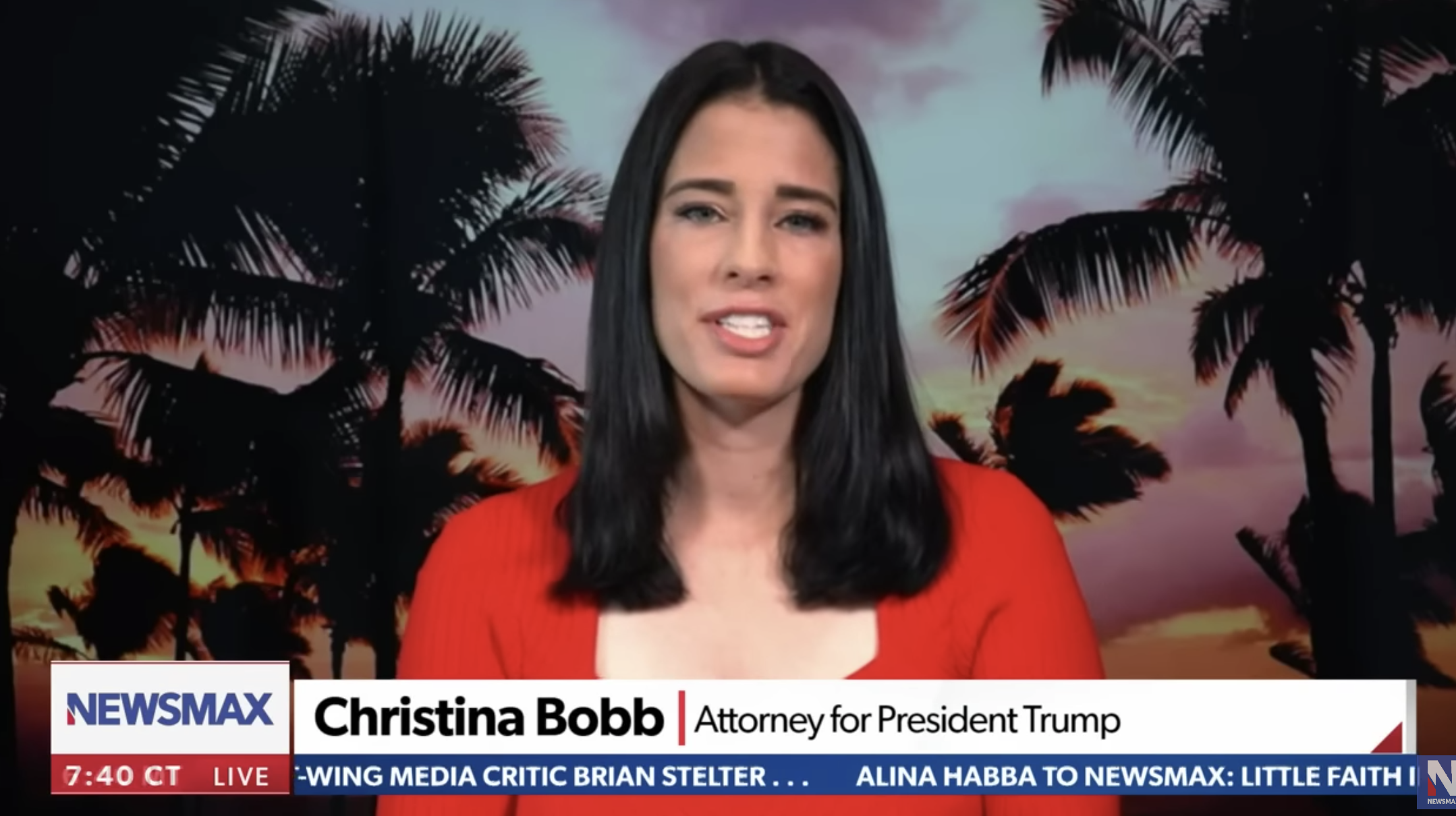
Christina Bobb, Custodian of Records and Coup Conspirator

According to Donald Trump’s whack-ass filing the other day, he personally has yet to receive a subpoena in the investigation of his  suspected theft of classified documents and obstruction of one or more investigations by hiding, ripping, or flushing documents. Instead, his hospitality company and Christina Bobb have.

DOJ sent the June 22 subpoena for surveillance footage at Mar-a-Lago to the Custodian of Records at the Trump Organization.

On June 22, 2022, the Government sent a subpoena to the Custodian of Records for the Trump Organization seeking footage from surveillance cameras at Mar-a-Lago. At President Trump’s direction, service of that subpoena was voluntarily accepted, and responsive video footage was provided to the Government.

The WaPo explained that it was sent to Trump Organization, not Trump, because that’s who actually owns Mar-a-Lago.

By the way, that means that Trump Organization could have, but thus far has not, intervened in the August 8 search as well as Donald. Indeed, that may have been what Magistrate Judge Bruce Reinhart, who has read the search warrant affidavit, was alluding to when he memorialized his order asking DOJ to provide more justification for its review. He noted that neither Trump nor any other “purported owner” of Mar-a-Lago had intervened.

Neither Former President Trump nor anyone else purporting to be the owner of the Premises has filed a pleading taking a position on the Intervenors’ Motions to Unseal.

In fact, when Trump intervened in the Michael Cohen search in 2018 — and did so after just four days — he did so in the persons of Trump Organization lawyer Alan Futerfas and Futerfas’ partner Ellen Resnick. Having Trump Organization ask for a Temporary Restraining Order would have been another way to intervene in more timely and competent way than Trump has done so far — but Trump Organization has been rather distracted preparing for depositions in Tish James’ investigation and the October trial testimony of their former CFO in a New York City trial.

In any case, it is totally normal for a grand jury to subpoena the “Custodian of Records” of a corporation from which it wants records. In the case of the surveillance video (and presumably a renewed subpoena after the search), that just happened to place the legal obligation to respond on an entity that has a whole heap of other legal problems right now.

In Trump’s whack filing, though, the hero of our story Donald J. Trump magnanimously instructed Trump Organization to accept service and provide the video (it appears that Eric or the failson would have been the ones legally to give that order), otherwise known as “complying with a subpoena.”

It’s the other subpoena I find more interesting.

On May 11, 2022, Movant voluntarily accepted service of a grand jury subpoena addressed to the custodian of records for the Office of Donald J. Trump, seeking documents bearing any classification markings. President Trump determined that a search for documents bearing classification markings should be conducted — even if the marked documents had been declassified — and his staff conducted a diligent search of the boxes that had been moved from the White House to Florida. On June 2, 2022, President Trump, through counsel, invited the FBI to come to Mar-a-Lago to retrieve responsive documents. [italics Trump’s, bold mine]

There’s a lot going on in this passage. Whereas the earlier passage described the government sending the subpoena, here Trump’s team only describes that service for it was accepted, “voluntarily,” it notes in italics, which is not a thing.

It’s a subpoena, you don’t get a choice.

The passage dates that acceptance to May 11 — the day after, we now know, that the Acting Archivist Debra Steidel Wall had informed Evan Corcoran, acting as Trump’s attorney, that she would not respect Trump’s “protective assertion of executive privilege.” The dates are almost certainly related, but we can’t be sure how, because we can’t be sure when DOJ subpoenaed Trump for the rest of the classified documents he was hoarding.

More interesting, to me, is the way this passage introduces a second role (and third) it will rely on heavily to describe what must be a core focus of the obstruction investigation, that Custodian of Records of the Office of Donald J. Trump. The Custodian of Records accepted the subpoena (and so would be on the legal hook for it), “his staff conducted a diligent search,” and then his counsel — Corcoran — “invited” Jay Bratt to come get the additional classified documents that would constitute proof Trump had violated the Espionage Act. Trump doesn’t reveal who did the search (though other reports have said Corcoran did it). But as presented, this process implicated three different roles, at least one role performed by a guy who signed this very whack filing that works so hard to obscure all this.

All that is set-up for the meeting on June 3, which will carry a great deal of legal import going forward, not least in an inevitable Fourth Amendment suppression motion. Here’s the tale the whack filing, written in part by Evan Corcoran, tells:

The next day, on June 3, 2022, Jay Bratt, Chief of the Counterintelligence and Export Control Section in the DOJ’s National Security Division, came to Mar-a-Lago, accompanied by three FBI agents. President Trump greeted them in the dining room at Mar-a-Lago. There were two other attendees: the person designated as the custodian of records for the Office of Donald J. Trump, and counsel for President Trump. Before leaving the group, President Trump’s last words to Mr. Bratt and the FBI agents were as follows: “Whatever you need, just let us know.”

Responsive documents were provided to the FBI agents. Mr. Bratt asked to inspect a storage room. Counsel for President Trump advised the group that President Trump had authorized him to take the group to that room. The group proceeded to the storage room, escorted by two Secret Service agents. The storage room contained boxes, many containing the clothing and personal items of President Trump and the First Lady. When their inspection was completed, the group left the area.

Once back in the dining room, one of the FBI agents said, “Thank you. You did not need to show us the storage room, but we appreciate it. Now it all makes sense.” Counsel for President Trump then closed the interaction and advised the Government officials that they should contact him with any further needs on the matter.

This passage is designed to portray Trump’s response as completely cooperative, which is set up for a claim the warrant was not necessary. As such, it describes an FBI comment undoubtedly designed, legally, to reiterate that a consensual search — of the storage room — was indeed consensual, as if it means something else, that the FBI had had all its questions answered. But when Trump eventually receives the affidavit that relies on this FBI agent’s first-hand observations during a consensual search to show probable cause for a warrant to come back and search the storage room further, Trump will have ceded the consensual nature of it and therefore his ability to suppress the August 8 search.

Evan Corcoran will one day be underbussed for agreeing (and in this filing, attesting) to this consensual search; given the way he’s portrayed in this WaPo story, the underbussing may have already begun. But for now, it is the stated version Trump wants to tell.

What I’m interested in, though, is that according to this version — a version that makes absolutely no mention of the declaration Jay Bratt required Trump’s team provide after that consensual search of the storage room — the roles that Corcoran and Christina Bobb played were different, and different in a way that holds legal weight. They don’t name names, but because Corcoran is known to have done the things attributed to “counsel” in this whack filing, he must be the counsel in the meeting and Bobb, by process of elimination, was the Custodian of Records. So Bobb was the person on the hook for the subpoena response.

As a reminder, here’s the most complete description of the declaration that Corcoran neglected to mention in the whack filing, from an NYT article that studiously avoids mentioning that obstruction is one of the crimes under investigation.

Mr. Bratt and the agents who joined him were given a sheaf of classified material, according to two people familiar with the meeting. Mr. Corcoran then drafted a statement, which Ms. Bobb, who is said to be the custodian of the documents, signed. It asserted that, to the best of her knowledge, all classified material that was there had been returned, according to two people familiar with the statement.

Bobb, performing the role as the Custodian of Records and so the person on the legal hook for the search, is the one who signed the declaration, based off a search that unnamed Trump “staff” members — described as a third role separate from that of Custodian of Records Christina Bobb and counsel Evan Corcoran — conducted.

Who knows whether Bobb really played the legal function of Custodian of Records at the Office of Donald J. Trump? I’ll come back to that in a bit.

Whatever Bobb really is, though, three pages later, Trump’s Custodian of Records gets a dizzying demotion to one of “three attorneys in the general area” who showed up to observe the search. That demotion may serve the legal function of justifying a claim, made another 11 pages later, that the search warrant receipts Bobb signed do not meet the standards required by Rule 41.

Among other actions taken after being notified of this unprecedented event, counsel for President Trump contacted three attorneys in the general area who agreed to go to Mar-a-Lago. Once they arrived, they requested the ability to enter the mansion in order to observe what the FBI agents were doing, which the Government declined to permit.

After approximately nine hours, the FBI concluded its search. An FBI agent provided one of the attorneys who had been waiting outside for nearly the full nine hours with a copy of the Search Warrant. TheFBI also provided a three-page Receipt for Property. Receipt for Property

[Case 9:22-mj-08332-BER, ECF 17 at 5-7 of 7]. That list provided almost no information that would allow a reader to understand what was seized or the precise location of the items.

[snip]

In addition, Movant requests that this Court direct the United States to prepare and provide a specific and detailed Receipt for Property. See Fed. R. Crim. P. 41(f). The “Receipt For Property” provided to Movant on August 8, 2022 is so vague and lacking in specificity that the reader does not know what was seized from Movant’s home.

[snip]

Movant submits the current Receipt for Property is legally deficient. Accordingly, the Government should be required to provide a more detailed and informative Receipt For Property, which states exactly what was seized, and where it was located when seized. In addition, Movant requests that the Court provide him with a copy of the inventory. This, along with inspection of the full Affidavit, is the only way to ensure the President can properly evaluate and avail himself of the important protections of Rule 41. [my emphasis]

Rolling Stone has a piece explaining that this whack filing is not actually the significant Fourth Amendment filing we were promised. That one, a bid to demand that Trump get these files back, is still coming.

[T]he former president’s legal team appears to be working to retrieve at least some of the papers seized during the Aug. 8 federal search. In recent days, the Trump team — led by former federal prosecutor Evan Corcoran — has been quietly prepping additional legal arguments and strategies to try to pry back material that the feds removed from the ex-president’s Florida abode and club, the sources say. Those measures include drafting a so-called “Rule 41(g) motion,” which allows  “a person aggrieved by an unlawful search and seizure of property” to “move for the property’s return,” according to the Federal Rules of Criminal Procedure.

This would be a follow-up measure to the lawsuit, filed Monday by Trump and his attorneys, calling for the appointment of a special master to review the Mar-a-Lago materials for potentially privileged materials. It is unclear when the ex-president’s lawyers plan to file a subsequent motion, which people close to Trump expect to be more narrowly tailored than what the former president apparently wants.

But this whack filing is meant to lay the groundwork for the future promised significant Fourth Amendment whack filing.

And the success of both depends on a claim that poor Christina Bobb, who in her role as the Custodian of Records is either a witness or suspect in the obstruction side of this investigation, was on the day of the search just a pretty little lawyer who happened to be walking her dog in the neighborhood, and who asked the nice FBI agents to let her watch the search but wasn’t allowed to, which is why she signed off on the receipt without asking for more details on the front end. This entire scheme will fail when the FBI points out that a suspected co-conspirator didn’t do the due diligence Trump is now claiming (falsely) is legally required according to the standards of Rule 41.

It would almost certainly fail anyway, but it will especially fail when DOJ points out that Bobb is not just some lady walking her dog in the neighborhood, but played the role of the Custodian of Records, and so had the competence to demand a more complete receipt on the day of the search, but did not. The Office of Donald J. Trump has effectively already waived the issue of the receipts.

But consider the import of the claim that Christina Bobb functioned at the Custodian of Records for the Office of Donald J. Trump, particularly given Paul Sperry’s claim (h/t Ron Filipkowski) that Trump withheld these documents because he knew that if he turned them over, the Archives would in turn provide them to the January 6 Committee (and now, DOJ’s January 6 investigation).

Christina Bobb is not only not just a lady walking her dog in the neighborhood of Mar-a-Lago, she also played a key role in the coup attempt.

She was the first author of the draft Executive Order attempting to seize the voting machines.

That document is nearly identical to a draft executive order the National Archives has shared with the Jan. 6 committee, and that POLITICO published last month. Metadata on the document says it was created by a user named Christina Bobb, and later updated by an unnamed person. A One America News anchor by that name was involved in Giuliani’s work for Trump, and previously worked in the Department of Homeland Security during the Trump administration.

The Washington Post reported that Bobb was on at least one conference call about setting up alternate slates of electors for the Jan. 6 certification vote, and that she was at the Willard hotel “command center” that Trump’s allies used as a home base to coordinate efforts to overturn the election. The emails did not cast light on Bobb’s ties to the draft executive order beyond her name’s appearance in the metadata, and she did not respond to requests for comment.

And as Seth Abramson first confirmed, after leaving the Cannon Office Building at 1PM on January 6, Bobb spent the rest of the day in the Willard right alongside Rudy.

While the Archives spent a year trying to get Trump to return identified documents, some reports say things came to a head in December.

WaPo reports that Trump personally oversaw the packing of boxes to be returned to the Archives, and they were retrieved on January 17.

What followed was a tortured standoff among Trump; some of his own advisers, who urged the return of documents; and the bureaucrats charged by the law with maintaining and protecting presidential records. Trump only agreed to return some of the documents after a National Archives official asked a Trump adviser for help, saying they may have to soon refer the matter to Congress or the Justice Department.

Nearly a year later, on Jan. 17, 2022, Trump returned 15 boxes of newspaper clips, presidential briefing papers, handwritten notes and assorted mementos to the National Archives. That was supposed to settle the issue.

[snip]

It could not be determined who was involved with packing the boxes at Mar-a-Lago or why some White House documents were not sent to the Archives, though people familiar with the episode said Trump oversaw the process himself — and did so with great secrecy, declining to show some items even to top aides. Philbin and another adviser who was contacted by the Archives in April have told others that they had not been involved with the process and were surprised by the discovery of classified records.

What’s clear is that effort to pack up boxes, an effort Trump personally oversaw, was happening during the same period when Trump was trying to prevent the Archives from handing over records to the January 6 Committee.

October 18, 2021: Trump sues to prevent the Archives from complying with January 6 Committee subpoena.

November 10, 2021: Judge Tanya Chutkan denies Trump’s motion for an injunction against NARA. (While it wouldn’t appear in the affidavit, in recent days Paul Sperry has claimed that Trump withheld documents to prevent NARA from turning them over to the January 6 Committee.)

December 9, 2021: DC Circuit upholds Judge Chutkan’s decision releasing Trump records to the January 6 Committee.

On January 17, 2022, NARA retrieved 15 boxes of Records from 1100 S. Ocean Blvd, Palm Beach, FL.

January 19, 2022: SCOTUS upholds Chutkan’s decision.

Any tampering with already packed boxes may have happened after the DC Circuit ruled in favor of the Committee, but in any case, in courts in DC, such tampering happened during a period when Trump was legally fighting to hide records that would implicate him … and Christina Bobb.

I’m still not convinced that the January 6 investigation(s) are the primary thing that Trump was trying to retain, though I think there’s a decent chance they’re included among the investigation(s) that Trump is suspected of obstructing by hiding, ripping, and flushing documents.

But to the extent that Trump was attempting to obstruct parallel investigations of his efforts to steal the 2020 election, Bobb’s role as both a co-conspirator in the coup plan and as Custodian of Records would raise additional concerns for the FBI.

Share this entry

The Day After Paul Sperry Claimed Trump Had Been Hiding January 6 Documents, DOJ Subpoenaed the Archives Again

CNN reported today that Thomas Windom, the lead AUSA on January 6 investigations targeting Trump and his cronies, sent a second subpoena to NARA.

The Justice Department has issued a new grand jury subpoena to the National Archives for more documents as part of its investigation into the January 6, 2021, attack on the US Capitol, two sources familiar with the investigation tell CNN.

This latest subpoena, issued on August 17, is in addition to a subpoena the Department of Justice sent to the Archives earlier this year, requesting the same documents and information that the Archives had previously handed over to the House select committee investigating January 6.

This new subpoena, which has not been previously reported, is understood to request additional documents and data from the Archives, pertaining to a period of time both before and after January 6.

Thomas Windom, an Assistant US Attorney, who is leading the criminal probe into the effort to impede the transfer of power after the 2020 election, including the potential role played by former President Donald Trump and allies to organize a group of fake electors who could keep Trump in power despite losing the election.

As a reminder, NYT reported that Windom subpoeaned all the stuff that the Archives had turned over to the January 6 Committee, for which the J6C had gone through the tedious process of getting an Executive Privilege waiver.

Federal prosecutors investigating the role that former President Donald J. Trump and his allies played in the events leading up to the Jan. 6, 2021, attack on the Capitol have issued a grand jury subpoena to the National Archives for all the documents the agency provided to a parallel House select committee inquiry, according to a copy of the subpoena obtained by The New York Times.

The subpoena, issued to the National Archives in May, made a sweeping demand for “all materials, in whatever form” that the archives had given to the Jan. 6 House committee. Those materials included records from the files of Mr. Trump’s top aides, his daily schedule and phone logs and a draft text of the president’s speech that preceded the riot.

There are, to be sure, a number of possible explanations for this: Perhaps Windom believes he’ll get information on the Secret Service or DHS that eluded the deletion effort shortly after Joe Biden’s inauguration. Perhaps Windom knows of someone else covered by the Archives that the January 6 Committee hasn’t yet identified, one not covered by Executive Privilege.

But I can’t help but notice that Windom obtained the subpoena the day after Paul Sperry claimed the Trump had been hoarding documents at Mar-a-Lago with the intent of thwarting the January 6 Committee. (h/t Ron Filipkowski)

Anything seized in the raid would, by definition, be evidence of a crime (the obstruction already under investigation). And Windom might have been able to craft the subpoena to obtain everything January 6 related that Trump had withheld, without the privilege waiver from Biden.

And if Windom issued this subpoena in response to Sperry’s comment, then it’ll increase the likelihood that responsive materials will be turned over before any further legal stalling happens.

In other words, by hoarding the documents he most wanted to withhold from the Committee, he may have made it easier for prosecutors to get the materials.

Share this entry

A Roger Stone Pardon for MacronLeaks Isn’t As Crazy as It Sounds

In April 2020, DOJ released the warrants from the Roger Stone investigation. With six of those, DOJ redacted broad swaths of the justifications behind the warrants, none of which were shared with him as part of his obstruction prosecution.

September 26, 2018: Mystery Twitter Account

September 27, 2018: Mystery Facebook and Instagram Accounts

September 27, 2018: Mystery Microsoft include Skype

September 27, 2018: Mystery Google

September 27, 2018: Mystery Twitter Accounts 2

October 5, 2018: Mystery Multiple Googles

All six were obtained by Patrick Myers, an FBI agent located in Pittsburgh, whereas almost all the warrants obtained before that were signed by agents located in DC (in earlier weeks, Myers had also obtained a warrant targeting a second account used by the GRU persona, Guccifer 2.0).

In his order releasing the warrants, Judge Christopher Cooper explained that all the redacted information (and so the information justifying these warrants) was redacted to protect, “the private information of non-parties, financial information, and non-public information concerning other pending criminal investigations.”

One of those warrants explicitly said that the government requested a gag on the provider involved (in that case, Twitter) because Roger Stone seemed not to understand the full extent of the investigation into him.

It does not appear that Stone is currently aware of the full nature and scope of the ongoing FBI investigation. Disclosure of this warrant to Stone could lead him to destroy evidence or notify others who may delete information relevant to the investigation.

In addition to the crimes for which Mueller declined to charge Stone (foreign donations) or of which he was convicted (witness tampering and obstructing an investigation), the warrant sought evidence of conspiracy (18 USC 371), two foreign agent laws (18 USC 951 and 22 USC 611), and computer hacking (18 USC 1030).

These warrants strongly suggest that in April 2020, as Bill Barr was making unprecedented efforts to limit Stone’s punishment for the crimes of which he had been convicted, DOJ continued to investigate whether Stone conspired with foreign entities — and given that a Guccifer 2.0 warrant is among this series, Russia would be that foreign entity — to engage in computer hacking.

That’s important background to the seizure from Trump’s office of document reflecting Executive Clemency for Stone that appears to have a link to a French President, possibly Emmanuel Macron.

If Stone were involved with the MacronLeaks operation on which the GRU teamed up with alt-Right figures in Stone’s orbit, it’s conceivable Trump secretly pardoned him to prevent him from being included in the indictment covering that operation.

Based on the FOIA exemptions in various versions of the Mueller Report released, the Stone investigation that continued after Mueller closed up shop appears to have been closed between September 18, 2020 and November 2, 2020. On the latter date — literally the day before the 2020 election — DOJ provided Jason Leopold a version of the Mueller Report with newly-unsealed passages. It revealed for the first time that, on page 178, a footnote modified the discussion in the body of the Report about whether Stone could be prosecuted for conspiring with Russia on computer hacking by explaining that Mueller had referred the issue to DC US Attorney’s Office for further investigation.

The Office determined that it could not pursue a Section 1030 conspiracy charge against Stone for some of the same legal reasons. The most fundamental hurdles, though, are factual ones.1279

1279 Some of the factual uncertainties are the subject of ongoing investigations that have been referred by this Office to the D.C. U.S. Attorney’s Office.

A version of the report released to Leopold on June 3, 2019 redacted that footnote because of an ongoing investigation. And a spreadsheet justifying all continued redactions released on September 18, 2020 seems to have redacted it too. The unredacted publication of it on November 2, 2020 suggests whatever investigation in Stone DOJ had been pursuing had been closed.

Stone’s wasn’t the only investigation that got shut down in the months before Donald Trump would lose the presidency. In that period, previously redacted references to investigations into two of Paul Manafort’s businesses, and an investigation into a suspected $10 million cash infusion during the 2016 election from an Egyptian state-owned bank were unsealed — though both were unsealed by the time of that September filing. There was even reference to a warrant for Erik Prince’s phone, suggesting any investigation into him had similarly been shut down.

What made Stone’s case different, however, is that DOJ never told us what the investigation was about (indeed, two referrals that likely pertain to Stone were redacted in that November 2020 release, which they shouldn’t have been if the cases were really closed).

The most important referral from the Mueller investigation, then — the one that Billy Barr was hired to make go away — simply got deep-sixed sometime in the months when it looked like Trump would lose the election, with no explanation as to what the investigation even was. And, again, it appears to have happened between September 18 and November 2, 2020.

As it happens, DOJ rolled out an indictment against GRU on October 19, just 15 days before the election (and just 14 days before DOJ released the language pertaining to Stone). It covered six GRU attacks, though focused especially on the 2018 Olympic Destroyer attack on the Pyeongchang Olympics.

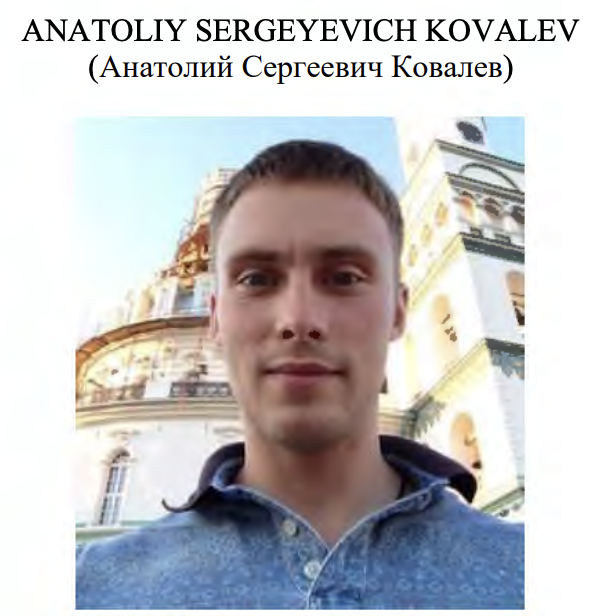
But it included, almost as a throwaway, GRU’s role in the 2017 MacronLeaks campaign. By description, it held just one of the charged individuals accountable for the spearphishing part of the MacronLeaks campaign: Anatoliy Kovalev, the one guy (as noted) also charged in the DNC hack.

Defendant ANATOLIY SERGEYEVICH KOVALEV was a Russian military intelligence officer assigned to Military Unit 74455. KOVALEV sent spearphishing emails targeting a wide variety of entities and individuals, including those associated with French local government entities, political parties, and campaigns; the 2018 Winter Olympics; the DSTL; and a Georgian media entity. KOVALEV also engaged in spearphishing campaigns for apparent personal profit, including campaigns targeting large Russian real estate companies, auto dealers, and cryptocurrency miners, as well as cryptocurrency exchanges located outside of Russia. KOVALEV is a charged defendant in federal indictment number 18-CR-215 in the District of Columbia. [my emphasis]

In the Mueller indictment of the GRU, Kovalev is described as the guy responsible for the hacking that targeted voting infrastructure — the kind of stuff that really could have affected the outcome, especially in North Carolina.

72. In or around July 2016, KOVALEV and his co-conspirators hacked the website of a state board of elections (“SBOE 1”) and stole information related to approximately 500,000 voters, including names, addresses, partial social security numbers, dates of birth, and driver’s license numbers.

[snip]

75. In or around October 2016, KOVALEV and his co-conspirators further targeted state and county offices responsible for administering the 2016 U.S. elections. For example, on or about October 28, 2016, KOVALEV and his co-conspirators visited the websites of certain counties in Georgia, Iowa, and Florida to identify vulnerabilities.

76. In or around November 2016 and prior to the 2016 U.S. presidential election, KOVALEV and his co-conspirators used an email account designed to look like a Vendor 1 email address to send over 100 spearphishing emails to organizations and personnel involved in administering elections in numerous Florida counties. The spearphishing emails contained malware that the Conspirators embedded into Word documents bearing Vendor 1’s logo.

The Olympic Destroyer indictment obtained weeks before the election held Kovalev (and the GRU) accountable for the spearphish and communications with some French participants.

27. From on or about April 3, 2017, through on or about May 3, 2017 (during the days leading up to the May 7, 201 7, presidential election in France), the Conspirators conducted seven spearphishing campaigns targeting more than 100 individuals who were members of now-President Macron’s “La Republique En Marche!” (“En Marche!”) political party, other French politicians and high-profile individuals, and several email addresses associated with local French governments. The topics of these campaigns included public security announcements regarding terrorist attacks, email account lockouts, software updates for voting machines, journalist scoops on political scandals, En Marche! press relationships, and En Marchel internal cybersecurity recommendations.

28. KOVALEV participated in some of these campaigns. For example, on or about April 21, 2017, KOVALEV developed and tested a technique for sending spearphishing emails themed around file sharing through Google Docs. KOVALEV then crafted a malware-laced document entitled “Qui_peut_parler_ aux journalists.docx” (which translates to “Who can talk to journalists”) that purported to list nine En Marche! staff members who could talk to journalists about the previous day’s terrorist attack on the Champs-Elysees in Paris. Later that day, the Conspirators used an email account that mimicked the name of then-candidate Macron’s press secretary to send a Google Docs-themed spearphishing email to approximately 30 En Marche! staff members or advisors, which purported to share this document.

29. From on or about April 12, 2017, until on or about April 26, 2017, a GRU-controlled social media account communicated with various French individuals offering to provide them with internal documents from En Marche! that the user(s) of the account claimed to possess.

But it professed utter and complete ignorance about how the stolen documents started to get leaked.

30. On or about May 3 and May 5, 2017, unidentified individuals began to leak documents purporting to be from the En Marche! campaign’s email accounts.

But they weren’t unidentified, at least not all of them! As a DFIR report released 15-months before this indictment laid out, while there was a Latvian IP address that hadn’t been publicly identified at that point (one the FBI surely had some ability to unpack), the American alt-right, including Stone associate Jack Posobiec, made the campaign go viral, all in conjunction with WikiLeaks.

First there was a rumor spread from that Latvian IP to 4Chan to William Craddick to Jack Posobiec.

Last but not least came the “#MacronGate” rumor. Two hours before the final televised debate between Macron and Le Pen, on Wednesday, May 3, at 7:00 p.m.,41 a user with a Latvian IP address posted two fake documents on 4chan. The documents suggested that Macron had a company registered in Nevis, a small Caribbean island, and a secret offshore bank account at the First Caribbean Bank, based in the Cayman Islands. Again, the rumor itself was not entirely new. Macron himself had seen it coming. More than two weeks earlier on TV he warned that this type of rumor was likely to appear: “This week, you will hear ‘Mr. Macron has a hidden account in a tax haven, he has money hidden at this or that place.’ This is totally false, I always paid all my taxes in France and I always had my accounts in France.”42 What was new this time, however, was the release of two documents supposedly proving this rumor. The user who posted the two documents on 4chan did it purposefully on the evening on the final televised debate to attract more attention, and even suggested a French hashtag: “If we can get #MacronCacheCash trending in France for the debates tonight, it might discourage French voters from voting Macron”43.

Then the rumor spread on Twitter. The 4chan link was first posted by Nathan Damigo, founder of the American neo-Nazi and white-supremacist group Identity Evropa, and was further circulated by William Craddick, founder of Disobedient Media and notorious for his contribution to the Pizzagate conspiracy theory that targeted the US Democratic Party during the 2016 American presidential campaign. The first real amplifier was Jack Posobiec—an American alt-right and pro-Trump activist with 111,000 followers at the time: his tweet was retweeted almost 3,000 times. Only after 10:00 p.m. did the rumor begin to spread in French, mostly through far-right accounts using the #MacronCacheCash hashtag. The first tweets in French seemed to have been automatically translated from English.44

[snip]

The same user with the Latvian IP address who posted the fake documents on Wednesday announced on Friday morning that more were coming, promising, “We will soon have swiftnet logs going back months and will eventually decode Macron’s web of corruption.”49 Those responsible for #MacronGate thereby provided evidence that they were the same people responsible for the #MacronLeaks that were released later that day.

Then there were the leaked files themselves, which followed the same pattern: an anonymous leak to Craddick to Posobiec to WikiLeaks.

The files were initially posted on Archive.org, an online library site, supposedly in the morning63 (the time of first release on the website cannot be determined, as these original threads have since been deleted). At 7:59 p.m., the links to the threads were posted on PasteBin, a file-sharing site, under the name “EMLEAKS.” At 8:35 p.m., they were shared on 4chan. Then came their appearance on Twitter: Craddick was again the first to share the link to the PasteBin dump at 8:47 p.m., quickly followed by Jack Posobiec at 8:49 p.m., who provided a link to the 4chan thread with, for the first time, the hashtag #MacronLeaks.64 Contrary to what would later become a widespread misconception, Posobiec was not the first to tweet, Craddick was. However, Posobiec was the first to use the hashtag that would lend its name to the entire operation, hence the confusion. Posobiec’s tweet and hashtag was retweeted eighty-seven times within five minutes. He later said he had been alerted to the incoming dump by the user with a Latvian IP address who had posted the #MacronGate fake documents two days prior: “The same poster of the financial documents said to stay tuned tomorrow for a bigger story–so I pretty much spent the next 24 hours hitting refresh on the site.”65

So far, this conversation was exclusively Anglophone. This makes it clear that the hashtag #MacronLeaks was launched and spread in the United States, by the American alt-right. It was WikiLeaks that internationalized the spread, at 9:31 p.m., by tweeting: “#MacronLeaks: A significant leak. It is not economically feasible to fabricate the whole. We are now checking parts,” with a link to the files on PasteBin. Only then came the first French amplifiers, who happened to be Le Pen supporters

MacronLeaks was, openly and proudly, a joint venture between the GRU, far right influencers in Stone’s immediate orbit, and WikiLeaks. It was an attempt to repeat the 2016 miracle that elected Donald Trump, by supporting the Russian-supporting Marine Le Pen by damaging Macron.

There’s something unusual about the indictment, too. Alone among the indictments obtained by the Pittsburgh US Attorney’s office that month (October 2020), it was the single one signed in wet blue ink by the US Attorney, Scott Brady. Both the copy released by DOJ and the one docketed in PACER also lacked a jury foreperson’s signature.

Admittedly, most of the indictments WDPA obtained that month were fairly podunk crimes that wouldn’t need heightened security: a fentanyl dealer, a cocaine dealer, two unhoused men charged with theft, an aggravated assault, manufacturing a controlled substance, Social Security fraud, VA benefit fraud, all were signed in black ink, at least some of them electronically. But a child sexual trafficking indictment and a CSAM possession indictment, both originally filed under seal, also bear the foreperson’s signature and that black ink signature. Even a ransomware indictment rolled out nationally on October 15 — which would have the same kind of international sensitivities and national coordination as the GRU indictment — had a normal jury foreperson’s signature.

While Brady was not a surprising choice for US Attorney in Pittsburgh (he had previously been an AUSA), he was perhaps the most politicized of Trump’s US Attorneys. He’s the guy whom Barr put in charge of ingesting the dirt on Hunter Biden that Rudy Giuliani was getting from suspected Russian agents.

To be clear: There’s no public allegation that Stone had anything to do with MacronLeaks, though HateWatch places him at a Milo Yiannopoulos party where MacronLeaks appears to have come up, after the leaks but before the French election. I’m not saying that Stone was involved in the MacronLeaks operation.

But the response to the Stone reference in the subpoena receipt has assumed that the Stone reference cannot be related to the French President reference, all assumptions made by journalists that never covered the ongoing aspects into whether Stone conspired with Russia on a hack. If Trump did issue his rat-fucker a secret pardon for follow-on cooperation with Russian hackers, though, it would explain a number of things about the aftermath of the Mueller investigation, including what happened to the investigation into whether Stone conspired with Russia on hacking campaigns.

For his part, Trump included a bit of a tirade about the Stone reference in his motion for a Special Master last night.

In addition, did the affiant to the warrant fairly disclose any pretextual “dual” purpose at work in obtaining the warrant? For example, the Receipt for Property largely fails to identify seized documents with particularity, but it does refer to the seizure of an item labelled “Executive Grant of Clemency re: Roger Jason Stone, Jr.” Aside from demonstrating that this was an unlawful general search, it also suggests that DOJ simply wanted the camel’s nose under the tent so they could rummage for either politically helpful documents or support other efforts to thwart President Trump from running again, such as the January 6 investigation.

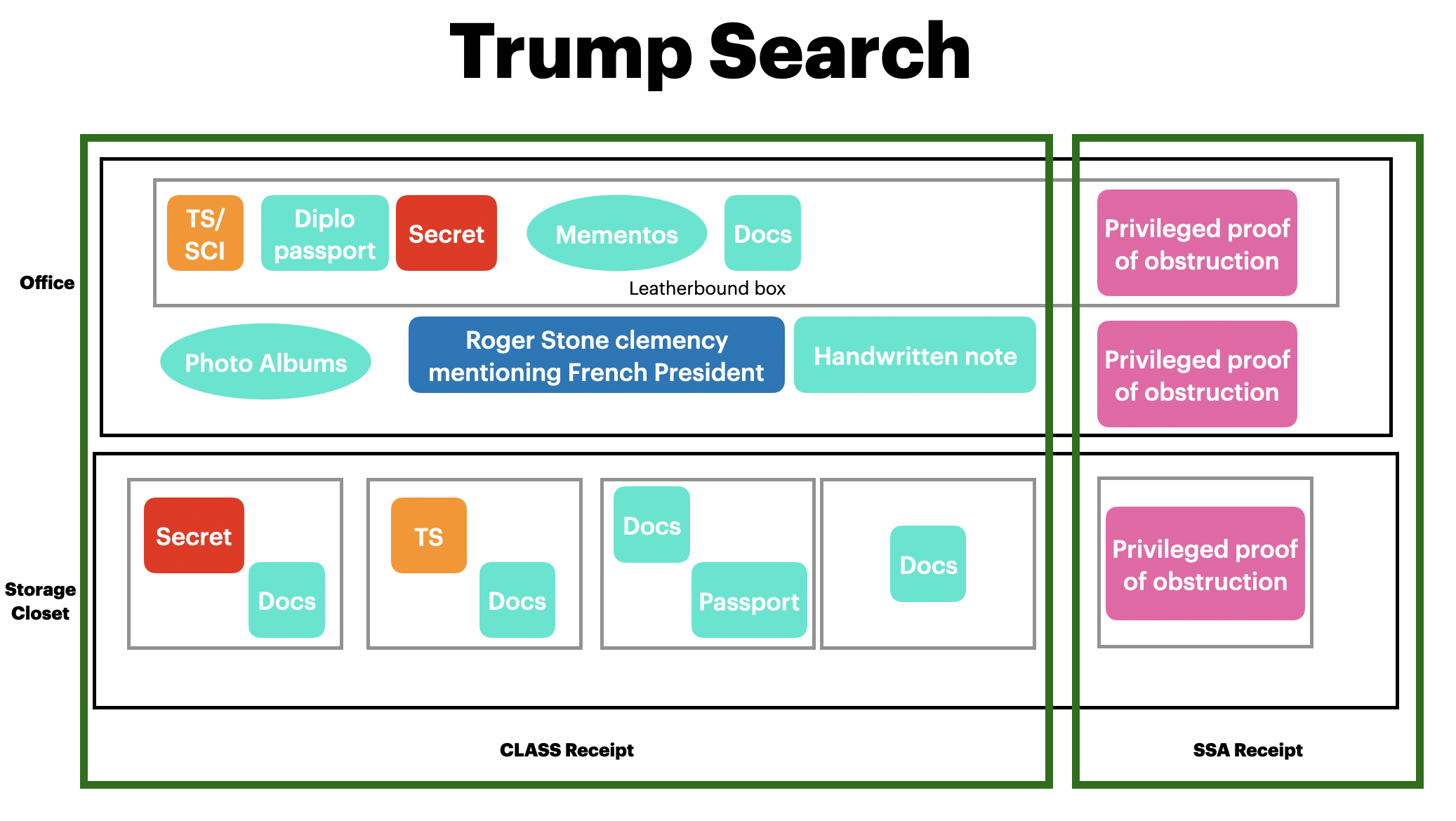
This is legally and politically nonsensical. If the pardon is the known pardon, then it’s not politically damaging at all. If it’s a real pardon of any kind — as a pardon written on a cocktail napkin arguably would be — then it’s a Presidential Record and squarely within the scope of the warrant (which permits seizure of any Presidential record created during Trump’s term). If the information about the French President is part of the document and appears to be sensitive, then it would qualify as a likely classified document. If the pardon were found in Trump’s safe next to his leatherbound box of TS/SCI documents, then it would be covered by the proximal search protocol laid out in the warrant. The pardon was legally seized.

Trump’s claims are nonsensical. But they’re also the the kind of squealing that invites further attention to what the clemency document really is.

Share this entry

Mastering Obstruction: Two of Trump’s Attorneys May Be Witnesses or Suspects

NYT published a 1,700-word story on the investigation into Donald Trump that didn’t include the word “obstruction” once. It implied (though the reporting wasn’t entirely clear) that the government has already found about a hundred additional classified documents among the boxes seized on August 8, on top of around 200 already identified from the boxes turned over in January and the meeting with Jay Bratt on June 3.

WaPo published a 2,100-word story on the investigation that likewise failed to mention that “obstruction” was one of the crimes for which DOJ believed they’d find evidence at Mar-a-Lago. The WaPo story treated the ridiculous filing Trump’s attorneys, including Evan Corcoran, submitted yesterday as if it were a serious legal endeavor.

You cannot understand several of the things that appear in these stories without considering the legal import of the fact that after Corcoran and Christina Bobb (who is described alternately in Trump’s filing as, on page 5, the custodian of records and, on page 8, as one of “three attorneys in the general area” who showed up to observe the search) jointly signed a declaration stating that there were no more classified documents at Mar-a-Lago, the FBI found 100 more classified documents at Mar-a-Lago.

Here’s how the NYT story described it.

On June 3, Jay Bratt, the chief of the counterespionage section of the national security division of the Justice Department, went to Mar-a-Lago to meet with two of Mr. Trump’s lawyers, Evan Corcoran and Christina Bobb, and retrieve any remaining classified material to satisfy the subpoena. Mr. Corcoran went through the boxes himself to identify classified material beforehand, according to two people familiar with his efforts.

Mr. Corcoran showed Mr. Bratt the basement storage room where, he said, the remaining material had been kept.

Mr. Trump briefly came to see the investigators during the visit.

Mr. Bratt and the agents who joined him were given a sheaf of classified material, according to two people familiar with the meeting. Mr. Corcoran then drafted a statement, which Ms. Bobb, who is said to be the custodian of the documents, signed. It asserted that, to the best of her knowledge, all classified material that was there had been returned, according to two people familiar with the statement.

Since Corcoran and Bobb created that declaration, and particularly since FBI seized evidence proving it was not true, they became likely witnesses or co-conspirators in this investigation, both in the obstruction side of the investigation (because they might know whether classified documents were deliberately hidden for Bratt’s visit and who knew that declaration to be a lie) and the Espionage Act side (because 18 USC 793 has a conspiracy provision).

So when Bobb arrived during the search on August 8 and “requested the ability to enter the mansion in order to observe what the FBI agents were doing,” the FBI would have viewed her as a potential co-conspirator in obstruction of an Espionage Act investigation.

And when Corcoran signed a filing demanding that the Court (a different court than the one that approved the warrant) appoint a Special Master who will work with lawyers from both sides to review the documents and also demanding that he and Trump’s other lawyers get a detailed list of what was seized, the FBI would view him as a potential co-conspirator in obstruction of an Espionage Act investigation.

Movant requests that this Court appoint a Special Master pursuant to Rule 53(a)(1)(B) of the Federal Rules of Civil Procedure and this Court’s inherent equitable powers and authority. This step — which the Government itself has requested in cases involving the seizure of privileged and/or potentially privileged materials — is needed to preserve the sanctity of executive communications and otherprivileged materials. Furthermore, Movant requests that this Court issue a protective order enjoining the United States from any further review of the items seized until this Court can rule on the present Motion. See Fed.R.Civ.P.26(b)(5)& (c) (1); S.D.Fla.L.R.26.l(g).

In addition, Movant requests that this Court direct the United States to prepare and provide a specific and detailed Receipt for Property. See Fed.R.Crim.P.41(f). The Receipt For Property” provided to Movant on August 8, 2022 is so vague and lacking in specificity that the reader does not know what was seized from Movant’s home.

Indeed, one likely goal of this filing is to get a different judge — one who doesn’t know whether Corcoran is named as a suspect on the affidavit — to force DOJ to tell everyone whether he is or not.

One reason the FBI asked for more surveillance footage — which the NYT story that doesn’t mention obstruction says is part of the hunt for more classified documents — is because they need to understand who caused that false filing to be filed in June and what happened in the storage area between Bratt’s visit and the search.

Even after the extraordinary decision by the F.B.I. to execute a search warrant at Mar-a-Lago on Aug. 8, investigators have sought additional surveillance footage from the club, people familiar with the matter said.

It was the second such demand for the club’s security tapes, said the people familiar with the matter, and underscored that authorities are still scrutinizing how the classified documents were handled by Mr. Trump and his staff before the search.

It remains true that we have no idea how narrowly or broadly the FBI scoped the probable cause of obstruction in the warrant affidavit. But what is clear is that DOJ will view both Bobb and Corcoran — the latter of whom remains one of the lawyers in closest contact with Bratt and who is the person who issued what has been viewed as a veiled threat to Merrick Garland — as either witnesses or subjects in this investigation.

And you really can’t explain the significance of that without using the word “obstruction.”

emptywheel Trump Espionage coverage

Mastering Obstruction: Two of Trump’s Attorneys May Be Witnesses or Suspects

Archives Letter Demonstrates Import of Past Kash Patel Claim of Declassification

Trump’s Reneges on Promised Significant Fourth Amendment Filing

Next Steps in the Trump Stolen Documents Investigation

Maggie Haberman: Heads It’s Only Obstruction, Tails It’s Not Obstruction

The French President May Be Contained Inside the Roger Stone Clemency

Which of the Many Investigations Trump Has Obstructed Is DOJ Investigating?

The Known and Likely Content of Trump’s Search Warrant

The ABCs (and Provisions e, f, and g) of the Espionage Act

Trump’s Latest Tirade Proves Any Temporary Restraining Order May Come Too Late

How Trump’s Search Worked, with Nifty Graphic

Pat Philbin Knows Why the Bodies Are Buried

Trump’s Timid (Non-Legal) Complaints about Attorney-Client Privilege

18 USC 793e in the Time of Shadow Brokers and Donald Trump

[from Rayne] Other Possible Classified Materials in Trump’s Safe

Trump’s Stolen Documents

John Solomon and Kash Patel May Be Implicated in the FBI’s Trump-Related Espionage Act Investigation

[from Peterr] Merrick Garland Preaches to an Overseas Audience

Three Ways Merrick Garland and DOJ Spoke of Trump as if He Might Be Indicted

The Legal and Political Significance of Nuclear Document[s] Trump Is Suspected to Have Stolen

Merrick Garland Calls Trump’s Bluff

Trump Keeps Using the Word “Cooperate.” I Do Not Think That Word Means What Trump Wants the Press To Think It Means

[from Rayne] Expected Response is Expected: Trump and Right-Wing DARVO

DOJ’s June Mar-a-Lago Trip Helps Prove 18 USC 793e

The Likely Content of a Trump Search Affidavit

All Republican Gang of Eight Members Condone Large-Scale Theft of Classified Information, Press Yawns

Some Likely Exacerbating Factors that Would Contribute to a Trump Search

FBI Executes a Search Warrant at 1100 S Ocean Blvd, Palm Beach, FL 33480


Share this entry

Archives Letter Demonstrates Import of Past Kash Patel Claim of Declassification

Yesterday, propagandist John Solomon posted a letter (NARA link now added) that the Acting Archivist, Debra Steidel Wall, sent Evan Corcoran on May 10. It described a series of communications in which Corcoran asked the Archives to delay giving the FBI access to the documents returned by the former President in January and to treat the files with, “a protective assertion of executive privilege made by counsel for the former President. After letters on April 29 and May 1 asking for delay, on May 5, Corcoran asked to review what had been returned.

Please note that, in accordance with the PRA, 44 U.S.C. § 2205(3), the former President’s designated representatives can review the records, subject to obtaining the appropriate level of security clearance. Please contact my General Counsel, Gary M. Stern, if you would like to discuss the details of such a review, such as you proposed in your letter of May 5, 2022, particularly with respect to any unclassified materials. [my emphasis]

The date and Steidel Wall’s response is significant. That’s the date Kash Patel claimed, for the first time, that he had witnessed Trump declassifying broad swaths of material at the White House.

“Trump declassified whole sets of materials in anticipation of leaving government that he thought the American public should have the right to read themselves,” Patel told Breitbart News in a phone interview.

“The White House counsel failed to generate the paperwork to change the classification markings, but that doesn’t mean the information wasn’t declassified,” Patel said. “I was there with President Trump when he said ‘We are declassifying this information.’”

While Patel declined to say specifically what Trump had declassified, he did describe it to include both “Russiagate” [sic] and the impeachment.

It’s information that Trump felt spoke to matters regarding everything from Russiagate to the Ukraine impeachment fiasco to major national security matters of great public importance — anything the president felt the American people had a right to know is in there and more.

At one level, this looks more like a belated — and pathetic — attempt to give the President an alibi after he was caught storing Special Access Program documents in a basement room in his heavily-trafficked resort for a year.

But by mentioning two things Trump was investigated for, Patel effectively suggested the point of demanding that FBI hold off its investigation was, in part, an attempt to delay access to such materials.

And then, weeks after Steidel Wall said that those who were representatives could access the files for which he was being investigated, Trump informed her he was making Patel a representative.

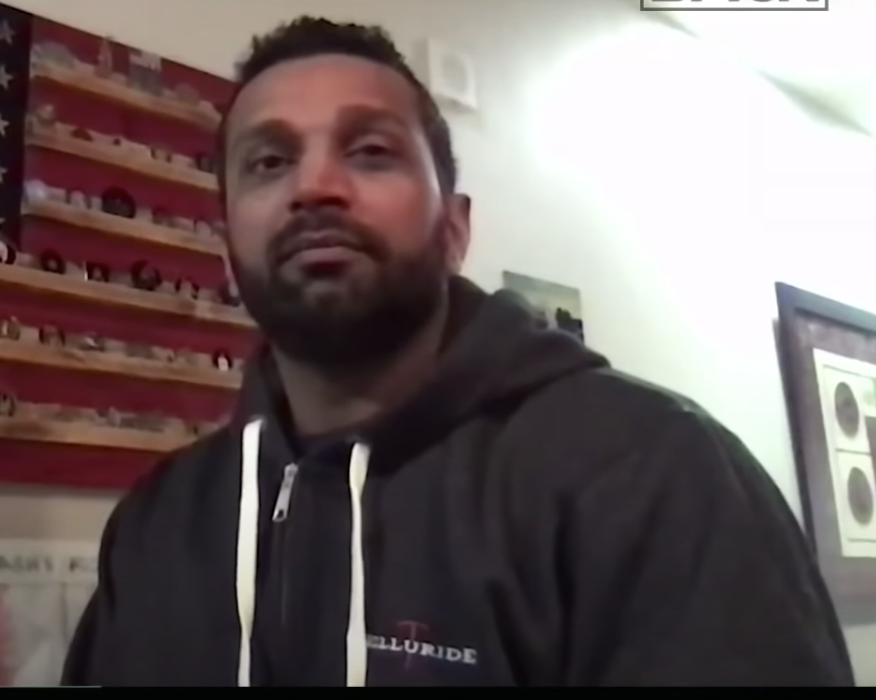
I write to designate two individuals – Kash Patel and John Solomon – as my representatives for access to Presidential records of my administration, pursuant to the Presidential Records Act, 44 U.S.C. §§ 2201 – 2207, and 36 C.F.R. § 1270.44(a)(4).

Patel has made all sorts of claims about whether he has been given access to Trump’s documents at all.

But by his own public comments on May 5, the same day Corcoran first floated the idea of having Trump’s people review the documents already in hand, Patel gave the FBI even more reason to be concerned.

emptywheel Trump Espionage coverage

Archives Letter Demonstrates Import of Past Kash Patel Claim of Declassification

Trump’s Reneges on Promised Significant Fourth Amendment Filing

Next Steps in the Trump Stolen Documents Investigation

Maggie Haberman: Heads It’s Only Obstruction, Tails It’s Not Obstruction

The French President May Be Contained Inside the Roger Stone Clemency

Which of the Many Investigations Trump Has Obstructed Is DOJ Investigating?

The Known and Likely Content of Trump’s Search Warrant

The ABCs (and Provisions e, f, and g) of the Espionage Act

Trump’s Latest Tirade Proves Any Temporary Restraining Order May Come Too Late

How Trump’s Search Worked, with Nifty Graphic

Pat Philbin Knows Why the Bodies Are Buried

Trump’s Timid (Non-Legal) Complaints about Attorney-Client Privilege

18 USC 793e in the Time of Shadow Brokers and Donald Trump

[from Rayne] Other Possible Classified Materials in Trump’s Safe

Trump’s Stolen Documents

John Solomon and Kash Patel May Be Implicated in the FBI’s Trump-Related Espionage Act Investigation

[from Peterr] Merrick Garland Preaches to an Overseas Audience

Three Ways Merrick Garland and DOJ Spoke of Trump as if He Might Be Indicted

The Legal and Political Significance of Nuclear Document[s] Trump Is Suspected to Have Stolen

Merrick Garland Calls Trump’s Bluff

Trump Keeps Using the Word “Cooperate.” I Do Not Think That Word Means What Trump Wants the Press To Think It Means

[from Rayne] Expected Response is Expected: Trump and Right-Wing DARVO

DOJ’s June Mar-a-Lago Trip Helps Prove 18 USC 793e

The Likely Content of a Trump Search Affidavit

All Republican Gang of Eight Members Condone Large-Scale Theft of Classified Information, Press Yawns

Some Likely Exacerbating Factors that Would Contribute to a Trump Search

FBI Executes a Search Warrant at 1100 S Ocean Blvd, Palm Beach, FL 33480


Share this entry

Trump’s Reneges on Promised Significant Fourth Amendment Filing

As you no doubt know, Trump filed a document that purports to be a request for a Special Master last night, over a week after discussing privilege issues with DOJ and three days after promising a significant Fourth Amendment filing.

This document is a lot of things:

One thing it is not is a significant Fourth Amendment filing. Trump couldn’t even manage that competently.

My thread on it is here.

I’m going to go update my “known and likely affidavit contents” post with more basis for probable cause with claims from this and the NARA letter to Trump (PDF via NARA) John Solomon released.

emptywheel Trump Espionage coverage

Trump’s Reneges on Promised Significant Fourth Amendment Filing

Next Steps in the Trump Stolen Documents Investigation

Maggie Haberman: Heads It’s Only Obstruction, Tails It’s Not Obstruction

The French President May Be Contained Inside the Roger Stone Clemency

Which of the Many Investigations Trump Has Obstructed Is DOJ Investigating?

The Known and Likely Content of Trump’s Search Warrant

The ABCs (and Provisions e, f, and g) of the Espionage Act

Trump’s Latest Tirade Proves Any Temporary Restraining Order May Come Too Late

How Trump’s Search Worked, with Nifty Graphic

Pat Philbin Knows Why the Bodies Are Buried

Trump’s Timid (Non-Legal) Complaints about Attorney-Client Privilege

18 USC 793e in the Time of Shadow Brokers and Donald Trump

[from Rayne] Other Possible Classified Materials in Trump’s Safe

Trump’s Stolen Documents

John Solomon and Kash Patel May Be Implicated in the FBI’s Trump-Related Espionage Act Investigation

[from Peterr] Merrick Garland Preaches to an Overseas Audience

Three Ways Merrick Garland and DOJ Spoke of Trump as if He Might Be Indicted

The Legal and Political Significance of Nuclear Document[s] Trump Is Suspected to Have Stolen

Merrick Garland Calls Trump’s Bluff

Trump Keeps Using the Word “Cooperate.” I Do Not Think That Word Means What Trump Wants the Press To Think It Means

[from Rayne] Expected Response is Expected: Trump and Right-Wing DARVO

DOJ’s June Mar-a-Lago Trip Helps Prove 18 USC 793e

The Likely Content of a Trump Search Affidavit

All Republican Gang of Eight Members Condone Large-Scale Theft of Classified Information, Press Yawns

Some Likely Exacerbating Factors that Would Contribute to a Trump Search

FBI Executes a Search Warrant at 1100 S Ocean Blvd, Palm Beach, FL 33480


Share this entry

In Jesse Benton Case, DOJ Says a Trump Pardon Does Not Blot Out Guilt

In 2016, GOP fundraiser Jesse Benton was convicted and sentenced for effectively using a donation to an IA State Senator to win support for Ron Paul’s 2012 Presidential campaign. In the very same period, according to an indictment obtained September, he was working to arrange for and cover-up a Russian donation to Trump’s SuperPAC.

Trump gave Benton a pardon for the initial campaign finance crime on the same day he pardoned Roger Stone, Paul Manafort, and Charles Kushner (among others).

As part of pretrial motions in his case, he and the government are fighting about whether the government can use the prior conviction to show that Benton already knew about one of the campaign finance laws in question and had, in the past, covered up the true source of campaign donations. The government maintains that it should be able to use the prior crime to impeach him because the pardon does not “blot out” his prior crime.

Although Defendant moves to preclude the government from using his prior conviction to impeach him under Federal Rule of Evidence 609, based on the fact that the conviction was pardoned, his brief is devoid of case law regarding the issue, and he makes no attempt to establish the requisite predicates under Federal Rule of Evidence 609(c). See ECF No. 35, at 7-8. As laid out in the government’s motions in limine, under Federal Rule of Evidence 609(c), evidence of a conviction that has been pardoned is only inadmissible where the pardon was based on a finding that the person has been rehabilitated or the pardon was based on a finding of innocence. The plain language of Defendant’s pardon does not indicate that the pardon was based on either a finding of actual innocence or rehabilitation. See Zinman v. Black & Decker, 983 F.2d 431, 435 (2d Cir. 1993) (“We have construed Rule 609(c)(1) strictly, interpreting it to bar admission of a prior conviction only when there has been an express finding that the person convicted has been rehabilitated.”); Watkins v. Thomas, 623 F.2d 387, 387 (5th Cir. 1980) (allowing impeachment by pardoned convictions where defendant’s pardons “were not the consequence of subsequent proof of innocence” but rather defendant was pardoned “because he performed undercover activities in the service of the Federal Bureau of Narcotics and Dangerous Drugs.”). The explanation for the pardon provided by the White House similarly does not indicate that the pardon was based on either a finding of actual innocence or rehabilitation. See Ex. F (Statement from the Press Secretary Regarding Executive Grants of Clemency). Moreover, while pardons mitigate the offender’s punishment, “the granting of a pardon is in no sense an overturning of a judgment[.]” Nixon v. United States, 506 U.S. 224, 232 (1993). Courts have made clear that a pardon “does not ‘blot out guilt’ in any literal or uncritical sense[.]” Richards v. United States, 192 F.2d 602, 607 (D.C. Cir. 1951) (citation omitted); see also Bjerkan v. United States, 529 F.2d 125, 128 n.2 (7th Cir. 1975). As such, and for the reasons laid out in the government’s motions in limine, the Court should deny Defendant’s motion and permit the government to impeach Defendant with his prior conviction under Federal Rule of Evidence 609 should he take the stand.

Given the sheer number of corrupt pardons Trump gave, it’s an important argument — one that is also appearing in Philip Esformes’ case, whom the government wants to retry on health care fraud charges on which the jury hung but for which Trump did not grant Esformes a commutation.

Here, the argument is even easier: There’s no contest that Benton committed the prior acts, there’s no contest he violated his probation by allegedly engaging in further campaign finance crime, there’s no contest his past conviction would have made him well aware of the legal obligations the accurately record such donations.

But it may clarify the status of all the corrupt pardons Trump has granted.

Benton’s case is being tried before Trump appointee Trevor McFadden.

Share this entry

Maggie Haberman: Heads It’s Only Obstruction, Tails It’s Not Obstruction

Maggie Haberman had a column last week that pissed a lot of people off, in which she wrote 1,600 words presenting what she claimed were “the main possibilities” for why oh why Trump might have stolen Presidential documents.

The only reasons she could come up with were:

  • He gets his rocks off looking at important documents
  • He thinks he’s Louis XIV
  • He has a compulsion to rip up paper
  • He was collecting information about friends and foes

It was facile analysis and in two respects probably erroneous.

But it pissed me off less than it did others (at least at first) because I think it is important to remember that Trump’s narcissism explains a significant part of his theft.

Maggie’s an expert of Trump’s narcissism.

Still, at one level the document is a remarkable confession on Maggie’s part of her own inconsistencies as a Trump enabler (and as I said, in two ways, it may be factually wrong).

That’s because Maggie, who has covered this search for the same two weeks I have, doesn’t even mention the possibility laid out explicitly in search warrant: Obstruction.

To obtain this warrant, the government showed probable cause that Trump ripped up, flushed, and hid documents to obstruct investigations. But having (presumably) read that warrant, Maggie instead claims that Trump rips up documents just for shits and giggles.

Ripping up paper

Although Trump White House officials were warned about the proper handling of sensitive material, aides said Mr. Trump had little interest in the security of government documents or protocols to keep them protected.

Early on, Mr. Trump became known among his staff as a hoarder who threw all manner of paper — sensitive material, news clips and various other items — into cardboard boxes that a valet or other personal aide would cart around with him wherever he went.

Mr. Trump repeatedly had material sent up to the White House residence, and it was not always clear what happened to it. He sometimes asked to keep material after his intelligence briefings, but aides said he was so uninterested in the paperwork during the briefings themselves that they never understood what he wanted it for.

He also had a habit of ripping up paper, from routine documents to classified material, and leaving the pieces strewn around the floor or in a trash can. Officials would have to rummage through the shreds and tape them back together to recreate the documents in order to store them as required under the Presidential Records Act.

On some occasions, Mr. Trump would rip up documents — some with his handwriting on them — and throw the pieces in a toilet, which occasionally clogged the pipes in the White House. He did the same thing on at least two foreign trips, former officials said.

The government has told us all that they have shown probable cause that some of this ripping, flushing, and hiding was designed to withhold evidence from a, or multiple, investigations. But Maggie, apparently, either doesn’t understand that or decided without seeing the evidence that the government simply misunderstands Trump’s quirky ripping, flushing, and hiding fetish.

Where this column struck me as particularly ridiculous, however, is the way it’s a perfect mirror for Maggie’s Mueller investigation coverage.

With Mike Schmidt, after all, Maggie largely set the narrative that Mueller was only investigating Trump for obstructing the investigation. In July 2018 they reported as breaking news that Mueller was just investigating Trump for tweets, not what they called “collusion.” In August 2018, they kept repeating that word — obstruct obstruct obstruct obstruct obstruct obstruct obstruct obstruct obstruct obstruct obstruct obstruct obstruct obstruct — as if the only thing being investigated was obstruction. In February 2019, Maggie (with Peter Baker that time) spun Trump describing a bribe and not answering questions about the Stone indictment as the opposite. Last October, when Maggie complained about my piece quoting Roger Stone and Rick Gates describing how they used her and Ken Vogel, she claimed I had predicted Mueller would go further than he had — when the reality is that she has still uncorrected errors about the Manafort investigation, never reported on the investigation into whether Stone conspired with Russia that continued even after Mueller finished, and missed the bribery prong of the investigation. I’m also not aware that she ever matched the WaPo’s reporting that Mueller told Trump’s lawyers that the President was at risk, himself, of prosecution in the CFAA conspiracy with Russia, the same part of the Stone investigation she missed.

During the Mueller investigation, Maggie spent years reporting — falsely, the records unsealed since prove — that an investigation into whether Trump conspired with Russia was really just an obstruction investigation.

This time around the government told us — explicitly!! — that Trump is under investigation for obstructing investigation(s) by ripping and flushing and hiding documents, and Maggie’s “analysis” concludes that all that ripping and flushing and hiding is instead just a quirk.

Which brings me to her second possible error, on top of ignoring the obstruction investigation: here’s how Maggie explains the mention of a French President in the warrant receipt.

Other advisers wondered if Mr. Trump kept some documents because they contained details about people he knew.

Among the items that presidents are given on overseas trips are biographies of foreign leaders, a former administration official said. One version is unclassified and fairly routine. But the other is classified and can contain numerous personal details.

One of the files the F.B.I. seized at Mar-a-Lago was marked “info re: President of France,” about Emmanuel Macron.

It’s hard to tell whether Maggie is reporting here — confirming what most of us have assumed, that the reference to a French President was most likely a reference to Macron. To substantiate that, she cites only the same warrant that mentions the obstruction investigation she somehow missed. If she has confirmed that’s about Macron, this error may be all the more remarkable.

But for the reasons I laid out here, the most obvious reading of that reference is that the information about a French President is linked in some way to Executive Clemency for Maggie’s old BFF, Roger Stone.

The reference to a French President — Maggie tells us it is Macron — may well be contained in an Executive Grant of Clemency for Stone.

If that’s the case, then it’s in Trump’s files not because he saw a scrap of gossip about Macron and stuck it in a box or hoarded a classified pre-trip biography from years ago, which Maggie says are the best explanations, but because he wrote something down about Macron (or whichever President), quite possibly in conjunction with clemency for his rat-fucker.

To be sure, Maggie is not the only reporter covering this search who has entirely ignored the obstruction prong of the investigation. Many reporters have. But for a reporter publishing the book on Trump’s ripping, flushing, and hiding that seems to be at the core of that investigation, it seems a significant oversight.

Update: In an article Saturday that appears, in significant part, to be an attempt to underbus Mark Meadows, Maggie and others included this remarkable paragraph about an investigation into both Espionage Act violations and obstruction.

Where all of that material ended up is not clear. What is plain, though, is that Mr. Trump’s haphazard handling of government documents — a chronic problem — contributed to the chaos he created after he refused to accept his loss in November, unleashed a mob on Congress and set the stage for his second impeachment. His unwillingness to let go of power, including refusing to return government documents collected while he was in office, has led to a potentially damaging, and entirely avoidable, legal battle that threatens to engulf the former president and some of his aides.

This is another story that treats this all as one big misunderstanding and not an investigation into willful conduct designed to obstruct one or more investigations.

Maggie seems quite happy that this claim has been picked up.

The single source it relies on, described as “a person with knowledge of the situation,” speaks of their belief, not their certainty. And aside from people inside the investigation, there is no single person competent to make that claim, in part because only the family are reported to have known of the leather box in which Trump kept the Top Secret/SCI documents seized, and none of the family would know the full inventories of the boxes that were seized from storage closets.

emptywheel Trump Espionage coverage

Maggie Haberman: Heads It’s Only Obstruction, Tails It’s Not Obstruction

The French President May Be Contained Inside the Roger Stone Clemency

Which of the Many Investigations Trump Has Obstructed Is DOJ Investigating?

The Known and Likely Content of Trump’s Search Warrant

The ABCs (and Provisions e, f, and g) of the Espionage Act

Trump’s Latest Tirade Proves Any Temporary Restraining Order May Come Too Late

How Trump’s Search Worked, with Nifty Graphic

Pat Philbin Knows Why the Bodies Are Buried

Trump’s Timid (Non-Legal) Complaints about Attorney-Client Privilege

18 USC 793e in the Time of Shadow Brokers and Donald Trump

[from Rayne] Other Possible Classified Materials in Trump’s Safe

Trump’s Stolen Documents

John Solomon and Kash Patel May Be Implicated in the FBI’s Trump-Related Espionage Act Investigation

[from Peterr] Merrick Garland Preaches to an Overseas Audience

Three Ways Merrick Garland and DOJ Spoke of Trump as if He Might Be Indicted

The Legal and Political Significance of Nuclear Document[s] Trump Is Suspected to Have Stolen

Merrick Garland Calls Trump’s Bluff

Trump Keeps Using the Word “Cooperate.” I Do Not Think That Word Means What Trump Wants the Press To Think It Means

[from Rayne] Expected Response is Expected: Trump and Right-Wing DARVO

DOJ’s June Mar-a-Lago Trip Helps Prove 18 USC 793e

The Likely Content of a Trump Search Affidavit

All Republican Gang of Eight Members Condone Large-Scale Theft of Classified Information, Press Yawns

Some Likely Exacerbating Factors that Would Contribute to a Trump Search

FBI Executes a Search Warrant at 1100 S Ocean Blvd, Palm Beach, FL 33480

Share this entry

Rule of Law: DOJ Obtained Trump’s Privilege-Waived Documents in May

Last December, when the DC Circuit ruled that the Archives should share Donald Trump’s materials relating to January 6 with the January 6 Committee, it emphasized the “rare and formidable alignment of factors supports the disclosure of the documents at issue.”

On this record, a rare and formidable alignment of factors supports the disclosure of the documents at issue. President Biden has made the considered determination that an assertion of executive privilege is not in the best interests of the United States given the January 6th Committee’s compelling need to investigate and remediate an unprecedented and violent attack on Congress itself. Congress has established that the information sought is vital to its legislative interests and the protection of the Capitol and its grounds. And the Political Branches are engaged in an ongoing process of negotiation and accommodation over the document requests.

It likewise pointed to the careful attention (and month-long reviews) the Biden White House gave to each tranche of materials at issue.

Still, when the head of the Executive Branch lays out the type of thoroughgoing analysis provided by President Biden, the scales tilt even more firmly against the contrary views of the former President.

Judge Patricia Millet’s opinion even found that the due consideration Biden exercised was enough to reject Trump’s claim that the Presidential Records Act had given him “unfettered discretion to waive” his own Executive Privilege claim.

Lastly, former President Trump argues that, to the extent the Presidential Records Act is construed to give the incumbent President “unfettered discretion to waive former Presidents’ executive privilege,” it is unconstitutional. Appellant Opening Br. 47. There is nothing “unfettered” about President Biden’s calibrated judgment in this case.

Citing Mazars, the opinion also noted SCOTUS’ deference to information-sharing accommodations between the Political Branches, the Executive and Legislative Branches.

Weighing still more heavily against former President Trump’s claim of privilege is the fact that the judgment of the Political Branches is unified as to these particular documents. President Biden agrees with Congress that its need for the documents at issue is “compelling[,]” and that it has a “sufficient factual predicate” for requesting them. First Remus Ltr., J.A. 107; see also Third Remus Ltr., J.A. 173. As a result, blocking disclosure would derail an ongoing process of accommodation and negotiation between the President and Congress, and instigate an interbranch dispute.

The Supreme Court has emphasized the importance of courts deferring to information-sharing agreements wrestled over and worked out between Congress and the President. See Mazars, 140 S. Ct. at 2029, 2031.

In other words, the request of a coequal branch of government, made with the assent of the incumbent President, presented a very powerful legal case for sharing Trump’s January 6 records with Congress.

When the Supreme Court considered the question, only Ginni Thomas’ spouse disagreed (Brett Kavanaugh did attempt to limit the decision).

The courts may well have come to this same conclusion had Merrick Garland’s DOJ subpoenaed records from the Archives for its own investigation of Donald Trump directly. A “subpoena or other judicial process issued by a court of competent jurisdiction for the purposes of any civil or criminal investigation or proceeding” is one of the three exceptions the Presidential Records Act makes to the parts of the law that restrict access to the materials for a period after the President’s Administration.

But constitutionally, it would have been a very different legal and political question.

Importantly, the only way to obtain a privilege waiver from Biden in that situation would be to violate DOJ’s Contacts Policy that firewalls the White House from ongoing criminal investigations, and so the request would either have lacked that waiver from the incumbent President, or would risk politicizing the DOJ investigation.

The Biden White House’s strict adherence to that Contacts Policy is what allowed Karine Jean-Pierre to make a categorical denial of any advance warning of the search on Trump’s home and to use that as a reaffirmation of the rule of law last week.

She’ll probably get similar questions today, and make the same categorical denial of any White House knowledge.

All that is the predictable background to the NYT report that, after the January 6 Committee subpoenaed these records, and after the Archives gave both Presidents an opportunity to weigh in, and after the DC Circuit and Supreme Court ruled against Trump’s complaints, DOJ subpoenaed all the same material from the Archives themselves.

Federal prosecutors investigating the role that former President Donald J. Trump and his allies played in the events leading up to the Jan. 6, 2021, attack on the Capitol have issued a grand jury subpoena to the National Archives for all the documents the agency provided to a parallel House select committee inquiry, according to a copy of the subpoena obtained by The New York Times.

The subpoena, issued to the National Archives in May, made a sweeping demand for “all materials, in whatever form” that the archives had given to the Jan. 6 House committee. Those materials included records from the files of Mr. Trump’s top aides, his daily schedule and phone logs and a draft text of the president’s speech that preceded the riot.

While the NYT doesn’t say it, it seems likely that the Archives gave these already privilege-reviewed documents to prosecutor Thomas Windom with nary a squeak, and we’re just learning about it — indeed Trump may have just learned about it, which is where the subpoena probably came from — four months later. We’re just learning about it, importantly, after the FBI seized another 27 boxes of documents that Trump had refused to turn over to the Archives, including records (if you can believe Paul Sperry) pertinent to January 6.

When I predicted this would happen in December, I went out of my way to ask constitutional lawyers if they had another solution to the puzzle of getting Trump’s documents without violating that Contacts Policy, and no one even engaged with a question — how to overcome Executive Privilege — that had been a real problem for Robert Mueller, when he was investigating Donald Trump.

People will wail about the timing of this request and others, including the NYT, will falsely claim this is proof that DOJ is following the January 6 Committee.

Asking the National Archives for any White House documents pertaining to the events surrounding Jan. 6 was one of the first major steps the House panel took in its investigation. And the grand jury subpoena suggests that the Justice Department has not only been following the committee’s lead in pursuing its inquiry, but also that prosecutors believe evidence of a crime may exist in the White House documents the archives turned over to the House panel.

There were covert steps taken before that, including the (admittedly belated) request for call records at least a month earlier.

In addition, Justice Department investigators in April received phone records of key officials and aides in the Trump administration, including his former chief of staff, Mark Meadows, according to two people familiar with the matter.

And we’ve already seen proof that the fake electors investigation, at least, has pursued leads that the Committee had not yet made public before DOJ was including them in subpoenas.

Furthermore, the subpoena was issued before the Committee started its public hearings on June 9.

There are a couple of other notable details about this timing.

First, in addition to coming after the SCOTUS decision, this subpoena came after Mark Meadows and Ivanka made efforts to comply with the Presidential Records Act by providing the Archives copies of official business they conducted on their own email and Signal accounts. It also came after any responsive documents from the 15 boxes of records that Trump did provide to the Archives earlier this year were identified. DOJ made its request at a time when the Archives were more complete than they had been when the Committee started identifying big gaps in the records.

The only thing we know remains missing from those Archives (aside from documents seized last week) is Peter Navarro’s ProtonMail account, which DOJ sued to obtain earlier this month.

The Archives’ request also came after Trump had largely given up the effort to fight individual releases.

As NYT correctly noted, DOJ only issued this subpoena at a time when it was issuing other subpoenas (the fact of, but not the substance, of Brandon Straka’s cooperation had been made public in January, and Ali Alexander’s excuses for his actions at the Capitol had already been debunked in January after Owen Shroyer, who was arrested a year ago, made the very same excuses).

The subpoena was issued to the National Archives around the same time that it became publicly known that the Justice Department was looking beyond the rioters who were present at the Capitol and trying to assess the culpability of people who had helped organize pro-Trump rallies in Washington on Jan. 6. In the spring, for instance, Mr. Windom issued a grand jury subpoena to Ali Alexander, a prominent organizer of “Stop the Steal” events who complied by submitting records to prosecutors and testifying before the grand jury.

We don’t know what steps DOJ took before May (aside from those that have shown in cases like Straka’s). We do know that at that point, DOJ started taking overt steps that would build on previous covert ones. We also know that we keep learning about steps that DOJ took months ago, when people were wailing that they would know if DOJ had taken such steps.

I can’t prove that this was always the plan from the time, 375 days ago, when I first observed how DOJ was getting privilege waivers from Biden without violating their new Contacts Policy. I can’t prove it was the plan when I wrote an entire post in December about the puzzle of Executive Privilege waivers. I had no idea that DOJ was issuing that subpoena when I stated that it was probably doing so in May, the month it occurred.

We should assume the same kind of [synthesis with a Congressional investigation as happened with Mueller] is happening here. All the more so given the really delicate privilege issues raised by this investigation, including Executive, Attorney-Client, and Speech and Debate. When all is said and done, I believe we will learn that Merrick Garland set things up in July such that the January 6 Committee could go pursue Trump documents at the Archives as a co-equal branch of government bolstered by Biden waivers that don’t require any visibility into DOJ’s investigation. Privilege reviews covering Rudy Giuliani, Sidney Powell, and John Eastman’s communications are also being done. That is, this time around, DOJ seems to have solved a problem that Mueller struggled with. And they did so with the unsolicited help of the January 6 Committee.

What I can say with no doubt, though, is that Merrick Garland’s DOJ solved one of the most challenging constitutional problems facing an investigation of a former President. And it solved that problem months ago.

And no one knew about it.

emptywheel Trump Espionage coverage

Trump’s Timid (Non-Legal) Complaints about Attorney-Client Privilege

18 USC 793e in the Time of Shadow Brokers and Donald Trump

[from Rayne] Other Possible Classified Materials in Trump’s Safe

Trump’s Stolen Documents

John Solomon and Kash Patel May Be Implicated in the FBI’s Trump-Related Espionage Act Investigation

[from Peterr] Merrick Garland Preaches to an Overseas Audience

Three Ways Merrick Garland and DOJ Spoke of Trump as if He Might Be Indicted

The Legal and Political Significance of Nuclear Document[s] Trump Is Suspected to Have Stolen

Merrick Garland Calls Trump’s Bluff

Trump Keeps Using the Word “Cooperate.” I Do Not Think That Word Means What Trump Wants the Press To Think It Means

[from Rayne] Expected Response is Expected: Trump and Right-Wing DARVO

DOJ’s June Mar-a-Lago Trip Helps Prove 18 USC 793e

The Likely Content of a Trump Search Affidavit

All Republican Gang of Eight Members Condone Large-Scale Theft of Classified Information, Press Yawns

Some Likely Exacerbating Factors that Would Contribute to a Trump Search

FBI Executes a Search Warrant at 1100 S Ocean Blvd, Palm Beach, FL 33480

The ABCs (and Provisions e, f, and g) of the Espionage Act

Trump’s Latest Tirade Proves Any Temporary Restraining Order May Come Too Late

How Trump’s Search Worked, with Nifty Graphic

Pat Philbin Knows Why the Bodies Are Buried

Rule of Law: DOJ Obtained Trump’s Privilege-Waived Documents in May

Share this entry