Christina Bobb Claimed No Copies of the Stolen Classified Documents Had Been Made

I want to look more closely at the actions of Evan Corcoran (described as “counsel” in last night’s filing before Aileen Cannon) and Christina Bobb (described as “Custodian of Records”) surrounding the June 3 meeting a Mar-a-Lago.

DOJ’s filing describes how DOJ served a subpoena on Trump on May 11, with a return date of May 24.

Through its investigation, the FBI developed evidence indicating that even after the Fifteen Boxes were provided to NARA, dozens of additional boxes remained at the Premises that were also likely to contain classified information. Accordingly, DOJ obtained a grand jury subpoena, for which the former President’s counsel accepted service on May 11, 2022. See Attachment C; see also D.E. 1 at 5. The subpoena was directed to the custodian of records for the Office of Donald J. Trump, and it requested “[a]ny and all documents or writings in the custody or control of Donald J. Trump and/or the Office of Donald J. Trump bearing classification markings [list of classification markings].” Attachment C. DOJ also sent the former President’s counsel a letter that suggested they could comply by “providing any responsive documents to the FBI at the place of their location” and by providing from the custodian a “sworn certification that the documents represent all responsive records.” See Attachment D. The letter further stated that if no responsive documents existed, the custodian should provide a sworn certification to that effect. Id.

The subpoena asked for all documents with classification marks, and specified a bunch of classification marks, which suggests what DOJ thought they were looking for:

Any and all documents or writings in the custody or control of Donald J. Trump and/or the Office of Donald J. Trump bearing classification markings, including but not limited to the following: Top Secret, Secret, Confidential, Top Secret/SI-G/NOFORN/ORCON, Top Secret/SI-G/NOFORN, Top Secret/HCS-O/NOFORN/ORCON, Top Secret/HCS–O/NOFORN, Top Secret/HCS-P/NOFORN/ORCON, Top Secret/HCS-P/NOFORN, Top Secret/TK/NOFORN/ORCON, Top Secret/TK/NOFORN, 1- Secret/NOFORN, Confidential/NOFORN, TS, TS/SAP, TS/SI-G/NF/OC, TS/SI-G/NF, TS/HCS0/NF/OC, TS/HCS-0/NF, TS/HCS-P/NF/OC, TS/HCS-P/NF, TS/HCS-P/SI-G, TS/HCS-P/SI/TK, TS/TK/NF/OC, TS/TK/NF, S/NF, S/FRD, S/NATO, S/SI, C, and C/NF.

Here’s what some of those markings mean:

  • HSC-P refers to a product of Human Intelligence (HUMINT).
  • HSC-O refers to an operation being conducted with HUMINT.
  • TK refers to satellite collection.
  • SI-G refers to intercepts from Signals Intelligence (SIGINT).
  • FRD refers to former Restricted Data — that is, materials formerly restricted under the Atomic Energy Act. Bill Leonard, the former head of ISOO, explains that this material is still covered by AEA, meaning the President cannot unilaterally declassify it.

FRD is still covered by the Atomic Energy Act.    It primarily refers to the military utilization of nuclear weapons and can be handled as classified NSI but it is not NSI and is still covered by the Atomic Energy Act, thus even the President cannot unilaterally declassify.

At first, Trump stalled, asking for a delay, which DOJ initially refused, then granted. Then, on the evening of June 2, Corcoran contacted DOJ and told them to show up the next day.

The subpoena’s return date was May 24, 2022. Counsel sought an extension for complying. After initially denying the request, the government offered counsel an extension for complying with the subpoena until June 7, 2022. Counsel for the former President contacted DOJ on the evening of June 2, 2022, and requested that FBI agents meet him the following day to pick up responsive documents.

As DOJ describes the June 3 meeting that Trump’s side has been leaking about relentlessly, Jay Bratt and three FBI agents showed up and met with Evan Corcoran (“counsel”) and Bobb (“custodian of records”). Notably, DOJ makes no mention of Trump’s presence. That doesn’t mean Trump wasn’t present. But DOJ is certainly not repeating the tale that Trump waltzed in just before he left for Bedminster to meet his Saudi buddies and told DOJ they could have whatever they wanted.

Corcoran handed the documents over in a folder appropriate to the treatment of classified documents and — as DOJ notes — made no claim about Executive Privilege (even though less than a month earlier he had made expansive Executive Privilege claims in communications with Acting Archivist Debra Steidel Wall).

On June 3, 2022, three FBI agents and a DOJ attorney arrived at the Premises to accept receipt of the materials. In addition to counsel for the former President, another individual was also present as the custodian of records for the former President’s post-presidential office. When producing the documents, neither counsel nor the custodian asserted that the former President had declassified the documents or asserted any claim of executive privilege. Instead, counsel handled them in a manner that suggested counsel believed that the documents were classified: the production included a single Redweld envelope, double-wrapped in tape, containing the documents.

Then, Bobb handed over a declaration (I’ll return to the content below).

The individual present as the custodian of records produced and provided a signed certification letter, which stated in part the following:

Based upon the information that has been provided to me, I am authorized to certify, on behalf of the Office of Donald J. Trump, the following:

a. A diligent search was conducted of the boxes that were moved from the White House to Florida;

b. This search was conducted after receipt of the subpoena, in order to locate any and all documents that are responsive to the subpoena;

c. Any and all responsive documents accompany this certification; and

d. No copy, written notation, or reproduction of any kind was retained as to any responsive document.

I swear or affirm that the above statements are true and correct to the best of my knowledge. See Attachment E. 4

After Bobb handed over the declaration based on “information that has been provided to me,” Corcoran separately made a representation to FBI agents, a representation that would be subject to false statements charges under 18 USC 1001 if it were false.

After producing the Redweld, counsel for the former President represented that all the records that had come from the White House were stored in one location—a storage room at the Premises (hereinafter, the “Storage Room”), and the boxes of records in the Storage Room were “the remaining repository” of records from the White House. Counsel further represented that there were no other records stored in any private office space or other location at the Premises and that all available boxes were searched. As the former President’s filing indicates, the FBI agents and DOJ attorney were permitted to visit the storage room.

According to the DOJ, Bratt and the three FBI agents “were permitted” to visit the storage room. They emphasize here (as the Trump filing described an FBI agent doing at the time) that the search of the storage room was consensual. But they were not permitted to open any box.

See D.E. 1 at 5-6. Critically, however, the former President’s counsel explicitly prohibited government personnel from opening or looking inside any of the boxes that remained in the storage room, giving no opportunity for the government to confirm that no documents with classification markings remained.

As DOJ explains, after the meeting, they developed evidence (we know from coverage that this included surveillance video showing boxes being moved in and out of the storage room, as well as witness testimony describing that Trump stored secret materials in his office) that there was more.

[T]he government developed evidence that a search limited to the Storage Room would not have uncovered all the classified documents at the Premises. The government also developed evidence that government records were likely concealed and removed from the Storage Room and that efforts were likely taken to obstruct the government’s investigation.

DOJ describes how the August 8 search proved that their video evidence and witness testimony proved to be correct: There were more classified documents in the storage room, and there were classified documents stored in a place other than the storage room: Trump’s office.

Notwithstanding counsel’s representation on June 3, 2022, that materials from the White House were only located in the Storage Room, classified documents were found in both the Storage Room and in the former President’s office. Moreover, the search cast serious doubt on the claim in the certification (and now in the Motion) that there had been “a diligent search” for records responsive to the grand jury subpoena. In the storage room alone, FBI agents found 76 documents bearing classification markings. All of the classified documents seized in the August 8 search have been segregated from the rest of the seized documents and are being separately maintained and stored in accordance with appropriate procedures for handling and storing classified information. That the FBI, in a matter of hours, recovered twice as many documents with classification markings as the “diligent search” that the former President’s counsel and other representatives had weeks to perform calls into serious question the representations made in the June 3 certification and casts doubt on the extent of cooperation in this matter.

Given the extent of their representations, it is possible that neither Bobb nor Corcoran knowingly lied to the FBI, exposing themselves to false statements charges.

If no one told Corcoran about the stuff in Trump’s office and if all other classified documents had been moved out of the storage room, unbeknownst to Corcoran, he may have believed the following claims to be true:

  • All the records that had come from the White House were stored in one location—a storage room at the Premises
  • The boxes of records in the Storage Room were “the remaining repository” of records from the White House
  • There were no other records stored in any private office space or other location at the Premises
  • All available boxes were searched

It’s certainly possible that Corcoran was a victim of a ruse by his client and his client’s flunkies. After all, he had only recently joined Trump’s defense team (though had been representing Bannon for months). He was not a Mar-a-Lago insider.

DOJ, from their surveillance video, would likely know if Corcoran knew his claims to be true or not. But, given that Corcoran refused to let the FBI open any boxes, DOJ may have reason to believe he knew some of his claims were not true.

Similarly, if Corcoran had done the search on his own, with no involvement from “Custodian of Records Christina Bobb,” it’s possible she believed the following to be true:

a. A diligent search was conducted of the boxes that were moved from the White House to Florida;

b. This search was conducted after receipt of the subpoena, in order to locate any and all documents that are responsive to the subpoena;

c. Any and all responsive documents accompany this certification; and

According to reports, she didn’t do the search. She had every reason to believe that Corcoran — who after all is a real lawyer — had done a diligent search.

I mean, it’s possible that Custodian of Records Bobb — who unlike Corcoran has been part of Trump’s crime spree for a while — also wasn’t a part or aware of the effort to remove documents from the storage room before Corcoran did the search.

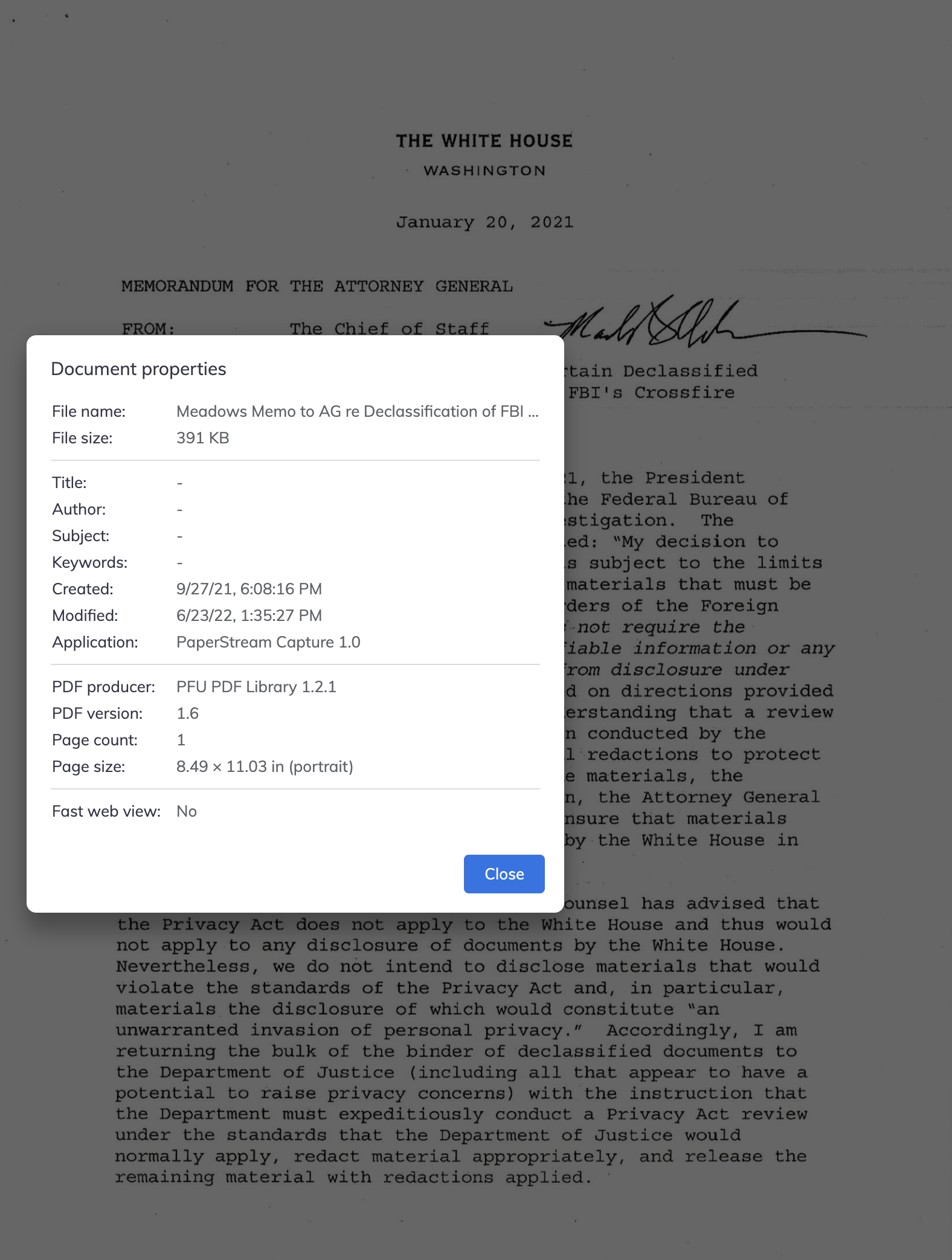
It’s the following representation that Bobb seemingly offered up unbidden that makes my spidey senses tingle (particularly given the odd metadata on the copy of the Mark Meadows declassification memo I raised in this post).

d. No copy, written notation, or reproduction of any kind was retained as to any responsive document.

Maybe DOJ asked Bobb to make such representations — but it’s not in the backup DOJ included with its filing. The letter Bratt sent Corcoran along with the subpoena said that if Trump chose to simply drop off the remaining classified documents at the local FBI officer,

The custodian would also provide a sworn certification that the documents represent all responsive records.

Trump’s people decided to type up a declaration even in spite of handing documents off personally, and they seem to have included an odd representation about making copies, unbidden.

Particularly given that weird metadata on the John Solomon document, showing creation of a document on September 27, 2021 and the apparent reproduction of that document on June 23, 2022, after the June 3 meeting, after Trump made Solomon a NARA representative, and days after DOJ subpoenaed the surveillance footage.

Update: Added clarifying language about FRD from Bill Leonard.
Share this entry

Trump Stored Some of the Nation’s Most Sensitive Secrets with His Framed Time Magazine Cover

I wrote an initial thread of my read of the filing in the Trump document theft here.

It details how the investigation evolved, from 18 USC 2071 for the torn documents and 18 USC 793 for the stolen classified documents to add 18 USC 1519 after it was clear Trump and his team were willfully withholding stuff.

It describes the three sets of inventories of documents seized, roughly as follows (the filing didn’t break down the documents seized on August 8 by classification type):

I’m interested in where the FBI found certain things on August 8. As the filing notes, 13 boxes (not 11, as suggested by the warrant receipt) contained classified information, with over 100 marked classified documents identified.

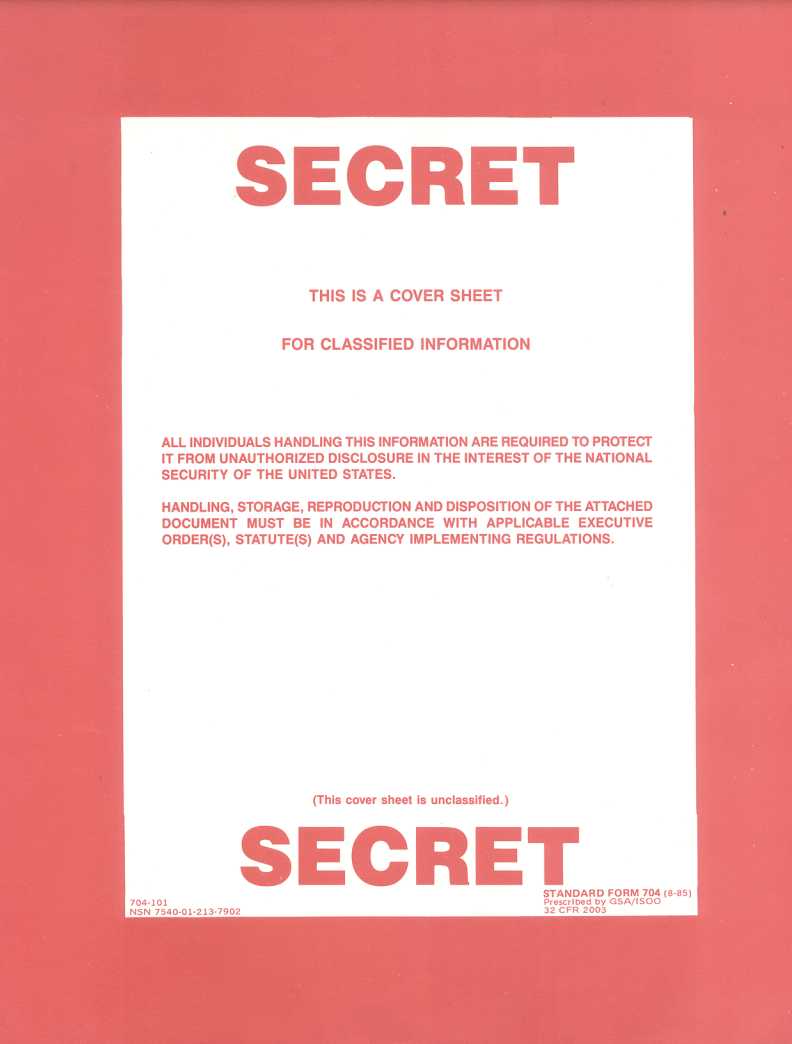
The investigative team has reviewed all the materials in the containers that the privilege review team did not segregate as potentially attorney-client privileged. Of the Seized Evidence, thirteen boxes or containers contained documents with classification markings, and in all, over one hundred unique documents with classification markings—that is, more than twice the amount produced on June 3, 2022, in response to the grand jury subpoena—were seized. Certain of the documents had colored cover sheets indicating their classification status. See, e.g., Attachment F (redacted FBI photograph of certain documents and classified cover sheets recovered from a container in the “45 office”). The classification levels ranged from CONFIDENTIAL to TOP SECRET information, and certain documents included additional sensitive compartments that signify very limited distribution. In some instances, even the FBI counterintelligence personnel and DOJ attorneys conducting the review required additional clearances before they were permitted to review certain documents.

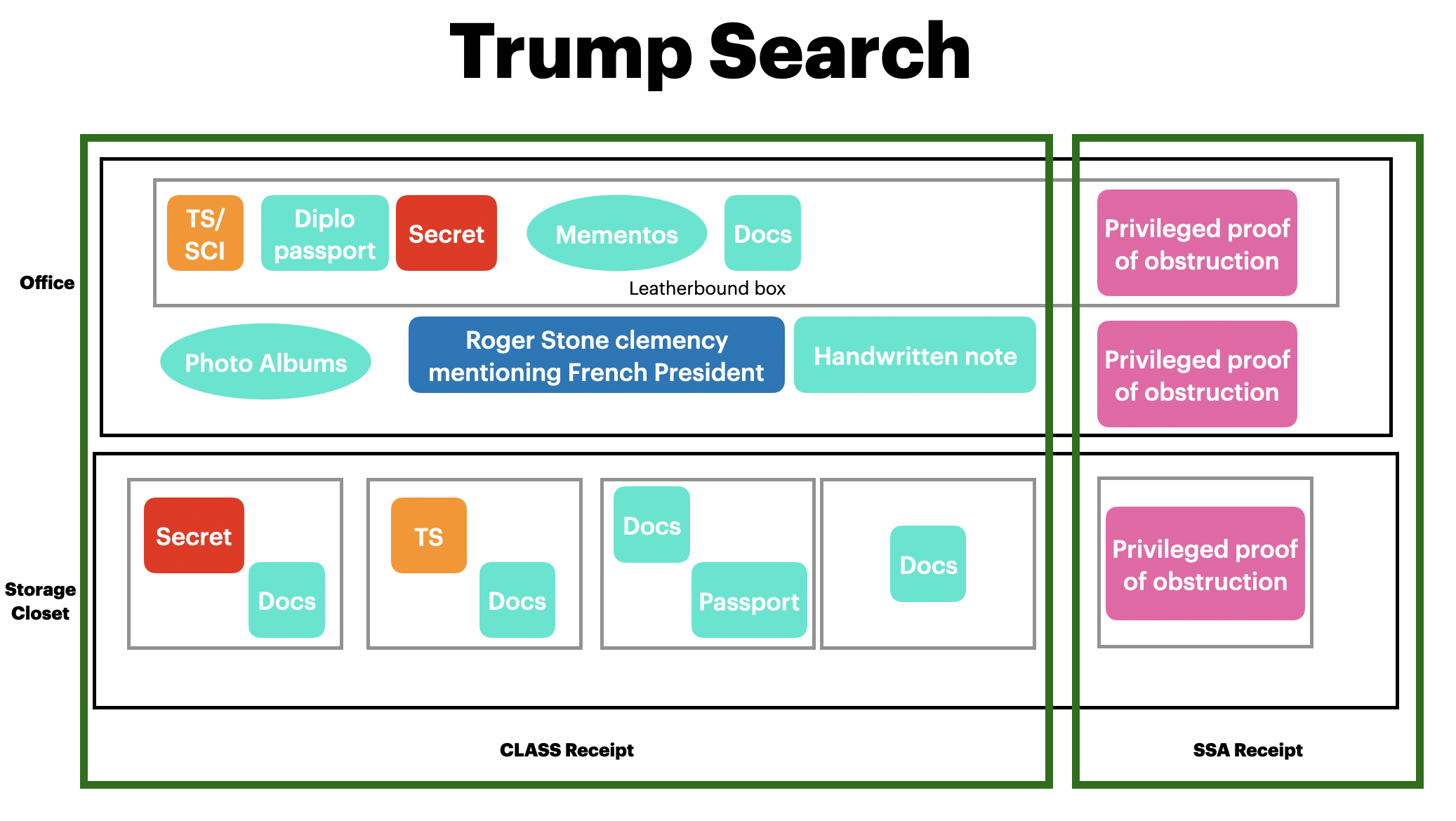
Documents with classified markings were found in two places: the storage room and Trump’s office.

Notwithstanding counsel’s representation on June 3, 2022, that materials from the White House were only located in the Storage Room, classified documents were found in both the Storage Room and in the former President’s office.

76 documents were in the storage room, leaving at least 25 in his office. Three of those were found in desk drawers, at least some of them with his passports.

Three classified documents that were not located in boxes, but rather were located in the desks in the “45 Office,” were also seized.

[snip]

Consistent with Attachment B to the search warrant, the government seized the contents of a desk drawer that contained classified documents and governmental records commingled with other documents. The other documents included two official passports, one of which was expired, and one personal passport, which was expired. The location of the passports is relevant evidence in an investigation of unauthorized retention and mishandling of national defense information; nonetheless, the government decided to return those passports in its discretion.

That leaves at least 22 documents.

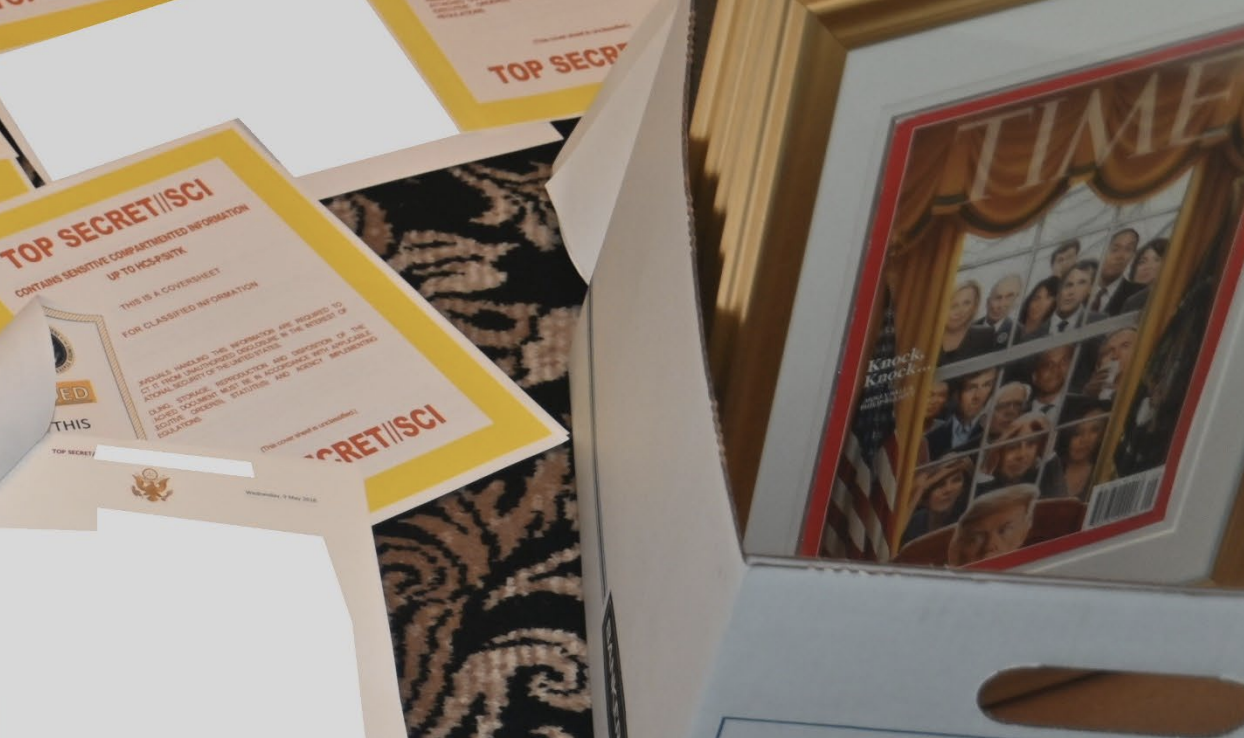
The photo included as an exhibit of the filing, is described as a “redacted FBI photograph of certain documents and classified cover sheets recovered from a container in the ’45 office’,” which must be the leatherbound box described in the search warrant returns.

That shows that Trump was keeping some of the nation’s most sensitive secrets next to a framed Time Magazine cover.

And they were probably all in a standard hotel safe.

Update: This photo has been widely misunderstood. It is part of the FBI’s inventorying process. Effectively, the agents found the leatherbound box, emptied it out, and took pictures of everything in there. The 2A shows that these are the contents of that box. See this post for more about how the FBI documents their searches.

Share this entry

“The President Was … Working in a Filing Room”

The unredacted part of the affidavit for Trump’s search shows that it incorporated a “statement” Trump put out on February 18, in an attempt to rebut the report that the Archives provided Carolyn Maloney about what was discovered in the 15 boxes Trump finally returned. In a redacted part of the affidavit, there’s something that looks like a second post of some kind, which appears at the end of a nine-paragraph section describing the Archives’ fight to get the boxes back. One possibility is that it’s a second statement Trump issued before the other one.

I’d like to look at the two statements he put out in February, the one that might be that second post, and the one that is included in the affidavit but was illegible in the rendering of it on PACER. Here’s the first one:

The first attacks Maggie Haberman’s story about flushing documents (but is limited just to White House toilets; she has since reported he flushed stuff while traveling as well).

It also falsely claims that “the papers were given easily and without conflict and on a very friendly basis.” Whatever the seven redacted paragraphs in the affidavit about the fight to get the documents back includes, it would show that that claim was utterly false.

But the statement does claim that “I have been told I was under no obligation to give this material back based on various legal rulings.” We know Trump was told this after the documents were returned. As CNN reported, Judicial Watch’s Tom Fitton was telling Trump just that, citing a ruling pertaining to Bill Clinton.

Not long after the National Archives acknowledged in February that it had retrieved 15 boxes of presidential records from former President Donald Trump’s Mar-a-Lago residence in Florida, Trump began fielding calls from Tom Fitton, a prominent conservative activist.

Fitton, the longtime head of the legal activist group Judicial Watch, had a simple message for Trump — it was a mistake to give the records to the Archives, and his team should never have let the Archives “strong-arm” him into returning them, according to three sources familiar with the matter.

Those records belonged to Trump, Fitton argued, citing a 2012 court case involving his organization that he said gave the former President authority to do what he wanted with records from his own term in office.

The Judicial Watch president suggested to Trump that if the Archives came back, he should not give up any additional records, according to sources with knowledge of their conversations, which have not been previously reported.
While Trump continued to publicly tout his cooperation with the Archives, privately the former President began obsessing over Fitton’s arguments, complaining to aides about the 15 boxes that were handed over and becoming increasingly convinced that he should have full control over records that remained at Mar-a-Lago, according to people with knowledge of his behavior at the time.

Trump even asked Fitton at one point to brief his attorneys, said a person familiar with the matter.

“The moment Tom got in the boss’ ear, it was downhill from there,” said a person close to the former President, who spoke on the condition of anonymity to discuss internal matters.

If Trump’s statement was a reference to Fitton’s advice, it may suggest that advice started even before the Archives publicly confirmed returning the documents (or that Fitton immediately got inside Trump’s head).

What I was most interested in, however, was Trump’s description that the “boxes [] contained letters, records, newspapers, magazines, and various articles,” suggesting that all this excitement was just a fight over 15 boxes of shit.

In fact, the affidavit reveals the initial Archives referral explained, those boxes did contain a lot of shit. But intermixed with all that shit were “a lot of classified records.”

The NARA Referral stated that according to NARA’s White House Liaison Division Director, a preliminary review of the FIFTEEN BOXES indicated that they contained “newspapers, magazines, printed news articles, photos, miscellaneous print-outs, notes, presidential correspondence, personal and post-presidential records, and ‘a lot of classified records.’ Of most significant concern was that highly classified records were unfoldered, intermixed with other records, and otherwise unproperly [sic] identified.”

As I understand it, the description that this was “unfoldered” means it had been separated from a classified cover sheet that the government uses to highlight that the document enclosed is classified (they’re color-coded so a person can readily see how secret something is). When people try to hide that they’ve got classified information, one of the first things they do is rip off that cover sheet because it’s such a dead giveaway (which is, after all, the point). As I’ve said elsewhere, the FBI found such cover sheets in Joshua Schulte’s shredder when they did the search of his apartment, which they used to suggest, fairly or not, that Schulte was trying to hide things in the wake of the Vault 7 release.

As Elizabeth de la Vega noted when reading the affidavit, newspaper articles and magazines are the kinds of things that white collar criminals use as filler to try to obscure their crimes.

Trump claimed that the boxes were full of things that might appear worthless, and when the Archives opened them up and looked more closely, that’s precisely what they were full of, aside from the classified documents stripped of their cover sheets. But in a public statement the day after the investigation was announced, Trump tried to insist it was just filler, as if that were going to confuse the FBI or even a building full of committed archivists.

And that’s one reason the second post — the one that we know appears in the affidavit — is so interesting.

Unsurprisingly, Trump pitched the discovery of classified documents in a continuity with his past investigations — Russia, Ukraine Impeachment, January 6 Impeachment.

Trump’s statement said the same thing when the search broke on August 8.

Since then, however, Kash Patel, in a column cited in the affidavit, has given us reason to believe that the real continuity is that (at least some of) the documents Trump had stolen were about the Russian investigation or the Ukraine impeachment.

Patel did not want to get into what the specific documents were, predicting claims from the left that he was disclosing “classified” material, but said, “It’s information that Trump felt spoke to matters regarding everything from Russiagate to the Ukraine impeachment fiasco to major national security matters of great public importance — anything the president felt the American people had a right to know is in there and more.”

And Paul Sperry revealed that one reason Trump was withholding these records was because of the ongoing investigation(s) into January 6.

I guess, if you refused to turn over records regarding past investigations, wailing that this is just a continuation of those past investigations is a good way to inoculate your mob for scandalous new disclosures about those past investigations.

But I’m most interested that Trump’s response deflects by complaining,

The Fake News is making it seem like me, as the President of the United States, was working in a filing room.

In fact, there was a public report that had emphasized Trump’s role in packing up the boxes before they got sent to the Archives, one of the WaPo stories that really led the way on this story in February.

At one point, Archives officials threatened that if Trump’s team did not voluntarily produce the materials, they would send a letter to Congress or the Justice Department revealing the lack of cooperation, according to a third person familiar with the situation.

“At first it was unclear what he was going to give back and when,” said one of these people, who, like the others, spoke on the condition of anonymity to share candid details of a sensitive situation.

Trump was noticeably secretive about the packing process, and top aides and longtime administrative staffers did not see the contents, the people said.

That entire article — which includes details about Trump trying to get the Archives to issue false claims about his cooperation with the investigation — seems to be closely aligned with the kinds of sources that the FBI seems to have subsequently developed.

But the allegation Trump was attempting to rebut — that he personally was involved in packing boxes — has since been matched. The NYT cited multiple sources describing Trump going through the boxes to be returned to the Archives personally.

Mr. Trump went through the boxes himself in late 2021, according to multiple people briefed on his efforts, before turning them over.

More recently (and possibly part of an attempt to blame Mark Meadows for all this) the NYT described how stuff that had accumulated on the dining room table of the White House where he worked was not only getting dumped into two dozen boxes that would not get sent to the Archives, but staffers were bringing additional documents into him there, including the Kim Jong Un letters that — because the Archives knew to go looking for them — have served as a beacon for the stolen documents throughout this story.

Papers he had accumulated in his last several months in office had been dropped into boxes, roughly two dozen of them, and not sent to the National Archives. Aides had even retrieved letters from Kim Jong-un, the North Korean leader, and given them to Mr. Trump in the final weeks, according to notes described to The New York Times.

[snip]

Although the White House Counsel’s Office had told Mark Meadows, Mr. Trump’s last chief of staff, that the roughly two dozen boxes worth of material in the residence needed to be turned over to the archives, at least some of those boxes, including those with the Kim letters and some documents marked highly classified, were shipped to Florida. There they were stored at various points over the past 19 months in different locations inside Mar-a-Lago, Mr. Trump’s members-only club, home and office, according to several people briefed on the events.

Whether the first of these two posts is the redacted one or not, both times the Archives issued a public statement, Trump issued public, false, denials (and, according to the contemporaneous WaPo story, attempted to get the Archives to do the same).

At that level, then, the statements feel familiar from the Russian investigation, Trump’s well-studied ability to flood the zone with bullshit.

But buried in the two, together, seems to tie closer to actions — Trump’s personal involvement in stuffing the boxes full of shit under which to hide damning documents — that would go some distance to prove deliberate obstruction.

Share this entry

One Big Potentially Pending Question: What Happens to Trump’s Impeachment 1.0 Papers?

There’s a comment in DOJ’s response to Judge Aileen Cannon’s order to file an update by tomorrow that caught my attention. DOJ suggests there may be no dispute about whether the stuff it has been pursuing a review of is really privileged.

Although the government will provide the Court more detail in its forthcoming supplemental filing, the government notes that, before the Court issued its Preliminary Order, and in accordance with the judicially authorized search warrant’s provisions, the Privilege Review Team (as described in paragraphs 81-84 of the search warrant affidavit) identified a limited set of materials that potentially contain attorney-client privileged information, completed its review of those materials, and is in the process of following the procedures set forth in paragraph 84 of the search warrant affidavit to address potential privilege disputes, if any.

As I laid out here (and as virtually all journalists are still getting wrong), DOJ used a privilege team for the search on August 8. At least according to Fox News, all the potentially privileged material was inventoried on what I call the SSA receipt (because it was signed by the Supervisory Special Agent, rather than the Special Agent).

I surmised and DOJ has now confirmed that DOJ has been “in the process of following the procedures set forth in paragraph 84 of the search warrant affidavit to address potential privilege disputes, if any.” That means DOJ is using one of these methods:

84. If the Privilege Review Team determines that documents are potentially attorney-client privileged or merit further consideration in that regard, a Privilege Review Team attorney may do any of the following: (a) apply ex parte to the court for a determination whether or not the documents contain attorney-client privileged material; (b) defer seeking court intervention and continue to keep the documents inaccessible to law-enforcement personnel assigned to the investigation; or (c) disclose the documents to the potential privilege holder, request the privilege holder to state whether the potential privilege holder asserts attorney-client privilege as to any documents, including requesting a particularized privilege log, and seek a ruling from the court regarding any attorney-client privilege claims as to which the Privilege Review Team and the privilege-holder cannot reach agreement.

Option c is effectively to invite Trump to provide feedback on the privilege issues, an option that Evan Corcoran has told us DOJ specifically rejected  back on august 11.

Option b is to simply not access the materials; since FBI seized it, it’s likely they saw something on August 8 that made them want to access the materials.

So we can be fairly sure that DOJ is pursuing Option a to get this material, an ex parte review by a judge — the implication is Bruce Reinhart, but it’s possible they’ve involved someone who’s more senior, such as DC Chief Judge Beryl Howell (who is presiding over the grand jury conducting this investigation) or SDFL Chief Judge Cecilia Altonaga — to see whether it is attorney-client privileged.

I want to talk about three categories of documents that might appear to be covered by attorney-client privilege that a judge might otherwise decide are not. DOJ’s suggestion that there may not be a dispute reminds me of how, during the privilege review of Michael Cohen’s phones in 2018, as soon as Judge Kimba Woods ruled that any fight over privilege would have to be public, Trump slithered away and stopped fighting to keep the recordings about hush payments that Cohen kept on his phone away from prosecutors.

In other words, particularly since DOJ completely bypassed any involvement from Trump, I suspect DOJ believes that the materials currently under ex parte review by Reinhart or some other judge may be crime-fraud excepted.

Consider the kinds of materials that, under the warrant, could be seized:

  • Any Presidential or government record created during Trump’s term, which would include most if not all of the subcategory of documents bearing classification marks
  • Documents stored along with (that is, perhaps in the same storage closet) documents bearing classification marks
  • Evidence of the knowing alteration, destruction, or concealment of government and/or Presidential records — basically, of obstruction

If it remains true that all documents with potentially privileged materials are on the SSA receipt, it is likely that there were a chunk of documents — labeled just “documents” seized from his office (where the privilege team did all the initial search) — as well as five boxes that by description were stored with documents bearing classified markings, probably found in the storage room and handed off to the filter team for some reason.

The most obvious set of materials that would appear privileged but might be deemed by a judge to be crime-fraud excepted would pertain to obstruction: Materials that post-date Trump’s Presidency involving lawyers (either the former White House counsels who attempted to get him to return the documents) or his current attorneys, especially including the effort to refuse NARA and DOJ’s requests and/or to provide bullshit information in response to one or more subpoenas. That’s what those documents seized from Trump’s office might consist of.

Another category of documents might include materials involving non-governmental lawyers — Rudy Giuliani or John Eastman are likely possibilities — that appeared on official government records. These materials might pertain to January 6. Particularly given that SCOTUS approved the waived privilege claims over Trump’s governmental files, those seem like an easy decision.

A third category of information pertains to advice White House counsel lawyers gave Trump while still in office outside the context of a legal proceeding (different from the advice the same former White House counsels gave during the extended fight with NARA) that he wants to keep from DOJ. The Bill Clinton precedent would say that NARA at least gets this information, and if there is a legal basis for the FBI to obtain it (such as that it includes classified information, as the White House counsel response to the Zelenskyy-Trump call would be), then it would seem FBI would be able to obtain it. Given Trump’s bid to claim Executive Privilege over certain information, I wouldn’t be surprised if this were a heated issue.

The one set of documents that I think does raise real concerns, though, is Trump’s defense during Impeachment 1.0. At least three members of the White House Counsel staff were part of Trump’s defense team: Pat Cipollone, Patrick Philbin, and Michael Purpua. Taxpayers paid their salaries during the period when they were defending Trump, and so under the Clinton precedent, any files involving them would seem to be government documents covered by the Presidential Records Act. But Trump also had some talking heads — like Alan Dershowitz and Pam Bondi — and one of the real private attorneys who represented him in the Russian investigation, Jane Raskin. Trump’s communications with the later two groups should be privileged.

I’ve asked experts on Richard Nixon and Bill Clinton what happened with their impeachment records. Best as I can tell, many of those records are in the Archives. But I’m still not sure how the special case of Trump’s impeachment defense would be treated.

Update: Removed Eric Herschmann from the list of WH Counsels who represented Trump in impeachment. He was still in private practice then.

Share this entry

Key Details about Evan Corcoran that Evan Corcoran Did Not Disclose to Judge Aileen Cannon

Over the weekend, Judge Aileen Cannon ordered DOJ — which had not yet been formally served in Donald Trump’s civil suit to get a Special Master appointed to conduct a review of the materials seized from his home — to take initial steps towards appointing a Special Master.

There are a lot of procedural reasons why that order is crazy.

But Judge Cannon might be excused for believing some grave wrong has been done against the former President. That’s because the two filings his lawyers submitted — neither of which was accompanied by a sworn declaration — were wildly misleading.

I’d like to lay out a few of those details here. (First filing, Supplemental filing)

One of the lawyers who signed the filings is Evan Corcoran.

Some useful background first. In the Steve Bannon case, Corcoran let Bannon’s earlier attorney, Robert Costello, join his defense team even though Costello was a witness in the case against Bannon. He did so even after DOJ warned that might pose a problem. Ultimately, Costello conceded that might pose a conflict and he dropped off the team. So even in the last year, Corcoran has been rather flexible about where the role of defense attorney ends and the role of witness begins.

Now let’s look at the filings that Evan Corcoran signed, with two others.

One thing that Evan Corcoran didn’t bother to tell Aileen Cannon is that Evan Corcoran plays a lead role in the filing. The following are actions described in the two Trump filings that Evan Corcoran is either known, or by consistent reference, must have done, but which are attributed only to Trump’s counsel:

  • Communicated with DOJ, the White House, and NARA about the documents
  • On June 3, met with Jay Bratt at Mar-a-Lago
  • Told Bratt and three FBI agents that Trump consented to a search of a storage room that contributed to the probable cause that Trump was still refusing to return classified documents
  • Asked Bratt to communicate with him if they needed anything more
  • On June 8, received an email directing Trump to secure the storage room
  • Was the person informed of the search on August 8
  • Engaged in “heated discussion” after being so informed
  • Asked three questions after being informed of the search
  • Refused to turn off surveillance video during the search
  • Was informed on August 11 that the FBI had seized materials that might include privileged material
  • On August 11, stated the following to Jay Bratt:
    • President Trump wants the Attorney General to know that he has been hearing from people all over the country about the raid. If there was one word to describe their mood, it is “angry.'” The heat is building up. The pressure is building up. Whatever I can do to take the heat down, to bring the pressure down, just let us know.
  • Was informed that filter agents who searched the Former President’s office had taken three passports

Here are some other details regarding events in which Corcoran was involved that he did not disclose to Judge Cannon:

  • After the meeting with Bratt, Trump did not identify and provide all classified documents at Mar-a-Lago to DOJ in response to a subpoena
  • In response to a direction to Corcoran to secure the storage room, Trump did nothing more than add a new lock
  • Corcoran made the comment about “the heat [] building up” in the wake of an attack by an armed Trump supporter on an FBI office
  • After Corcoran was informed on August 11 that DOJ would not use a Special Master, he did nothing for ten days
  • DOJ did, in fact, include a Corcoran letter that the first filing suggested they had not, thereby alerting Bruce Reinhart of Corcoran’s claim that Presidents have absolute authority to declassify documents

Perhaps most critically, in the second filing that quotes from the warrant affidavit, Evan Corcoran did not disclose to Judge Cannon that Evan Corcoran’s own actions are described in the unredacted parts of the warrant affidavit. He is mentioned five times in just in the unredacted section (and the fact that the affidavit refers to FPOTUS COUNSEL 1 strongly suggests there’s an FPOTUS COUNSEL 2, Christina Bobb, mentioned in the redacted sections).

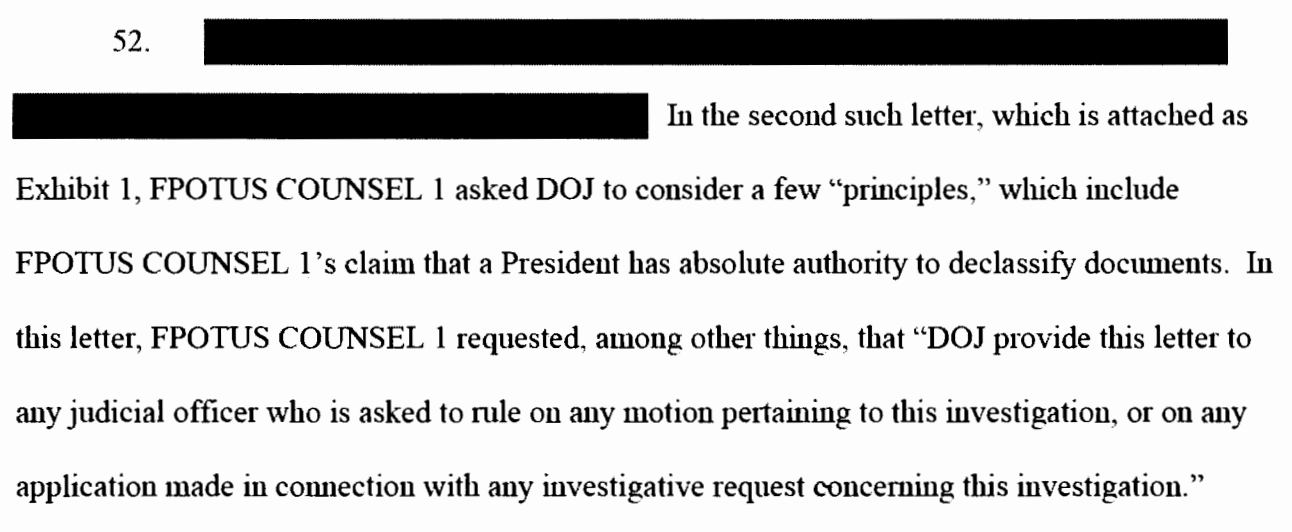
[redacted] In the second such letter, which is attached as Exhibit 1, FPOTUS COUNSEL 1 asked DOJ to consider a few “principles,” which include FPOTUS COUNSEL 1’s claim that a President has absolute authority to declassify documents. In this letter, FPOTUS COUNSEL 1 requested, among other things, that “DOJ provide this letter to any judicial officer who is asked to rule on any motion pertaining to this investigation, or on any application made in connection with any investigative request concerning this investigation.”

[snip]

On June 8, 2022, DOJ COUNSEL sent FPOTUS COUNSEL 1 a letter, which reiterated that the PREMISES are not authorized to store classified information and requested the preservation of the STORAGE ROOM and boxes that had been moved from the White House to the PREMISES. Specifically, the letter stated in relevant part:

As I previously indicated to you, Mar-a-Lago does not include a secure location authorized for the storage of classified information. As such, it appears that since the time classified documents [redacted] were removed from the secure facilities at the White House and moved to Mar-a-Lago on or around January 20, 2021, they have not been handled in an appropriate manner or stored in au appropriate location. Accordingly, we ask that the room at Mar-a-Lago where the documents had been stored be secured and that all of the boxes that were moved from the White House to Mar-a-Lago (along with any other items in that room) be preserved in that room in their current condition until farther notice.

On June 9, 2022, FPOTUS COUNSEL 1 sent an email to DOJ COUNSEL stating, ”I write to acknowledge receipt of this letter.”

That makes the other things that Corcoran chose to misrepresent to or conceal from Aileen Cannon far more important:

  • That the warrant provided the reason for the search
  • That the reason for the search was to find documents Trump had refused to return, which amounted to probable cause for violations of the Espionage Act, 18 USC 2071, and obstruction (Corcoran had falsely affirmed the warrant was about the Presidential Records Act, which was not named on the face of the warrant at all)
  • That a quote in the second filing focusing on Presidential Records neglected to mention the evidence of Espionage Act and obstruction in the same paragraph; Corcoran withheld the following bolded language:
    • Further, there is probable cause to believe that additional documents that contain classified NDI or that are Presidential records subject to record retention requirements currently remain at the PREMISES. There is also probable cause to believe that evidence of obstruction will be found at the PREMISES.
  • Trump fought for 8 months before he acceded to send the first 15 boxes back
  • Christina Bobb was the custodian of records that accepted service for a subpoena asking for all remaining classified documents
  • Trump didn’t return all classified documents in response to a subpoena for them
  • That custodian of records, Bobb, not some lawyer who happened to be in the neighborhood, signed off on the property receipt
  • Custodian of records Bobb made no objections as to the form of the search warrant receipt — one basis for the claimed action — at the time of the search or since
  • No Special Counsel issued a finding that the FBI agents who investigated Trump were biased; the Inspector General issued a finding that there no evidence bias affected the investigation and a Special Counsel attempted to make similar claims that have thus far all failed (Corcoran makes a slew of other false claims about the Horowitz Report as his basis to suggest the FBI has been mean to Trump)
  • The Acting Archivist Debra Steidel Wall obtained an Executive Privilege waiver for documents inappropriately withheld under the PRA in May and informed Corcoran of that
  • In the ensuing three months after Corcoran was informed of the Executive Privilege waiver, he is not known to have done anything to contest it
  • The National Security Division filter team Corcoran describes and the filter process described in the warrant appear to be different (the former seems to be one described to him by the Acting Archivist)
  • The filter team process in the warrant approved by Reinhart includes the possibility of a Special Master, something Corcoran claims Reinhart could not approve:
    • (c) disclose the documents to the potential privilege holder, request the privilege holder to state whether the potential privilege holder asserts attorney-client privilege as to any documents, including requesting a particularized privilege log, and seek a ruling from the court regarding any attorney-client privilege claims as to which the Privilege Review Team and the privilege-holder cannot reach agreement.
  • If the storage of classified materials fit the terms of the CFR guiding storage of classified documents, then the surveillance video Corcoran refused to turn off would have shown to Trump what materials were seized from where
  • That DOJ acknowledged the passports weren’t validly seized under the warrant (they were, and Corcoran even suggests why they were — because they were in the same safe holding classified documents), when DOJ simply said they weren’t included in the scope of the crimes under investigation

Evan Corcoran, in a filing that failed to disclose his own role in the events under investigation, misrepresented to the judge that this was a search about the Presidential Records Act and not an investigation into violations of the Espionage Act and obstruction.

He didn’t even tell her that he is named in the affidavit showing probable cause of obstruction.

Update: DOJ has acknowledged Cannon’s order. As expected, they’ve completed much of the privilege review already.

Although the government will provide the Court more detail in its forthcoming supplemental filing, the government notes that, before the Court issued its Preliminary Order, and in accordance with the judicially authorized search warrant’s provisions, the Privilege Review Team (as described in paragraphs 81-84 of the search warrant affidavit) identified a limited set of materials that potentially contain attorney-client privileged information, completed its review of those materials, and is in the process of following the procedures set forth in paragraph 84 of the search warrant affidavit to address potential privilege disputes, if any. Additionally, the Department of Justice and the Office of the Director of National Intelligence (“ODNI”) are currently facilitating a classification review of materials recovered pursuant to the search. As the Director of National Intelligence advised Congress, ODNI is also leading an intelligence community assessment of the potential risk to national security that would result from the disclosure of these materials.

Share this entry

Six Days: Trump’s Second Whack Filing Is Too Late

According to the Trump affidavit, between May 16 and May 18, the FBI conducted a preliminary review of the 15 boxes of materials he returned to NARA in January.

47. From May 16-18, 2022, FBI agents conducted a preliminary review of the FIFTEEN BOXES provided to NARA and identified documents with classification markings in fourteen of the FIFTEEN BOXES. A preliminary triage of the documents with classification markings revealed the following approximate numbers: 184 unique documents bearing classification markings, including 67 documents marked as CONFIDENTIAL, 92 documents marked as SECRET, and 25 documents marked as TOP SECRET. Fm1her, the FBI agents observed markings reflecting the following compartments/dissemination controls: HCS, FISA, ORCON, NOFORN, and SI. Based on my training and experience, I know that documents classified at these levels typically contain NDI. Several of the documents also contained what appears to be FPOTUS ‘s handwritten notes.

We know from the letter from Acting Archivist Debra Steidel Wall that the FBI first got access to those records no earlier than May 12.

I have therefore decided not to honor the former President’s “protective” claim of privilege. See Exec. Order No. 13,489, § 4(a); see also 36 C.F.R. 1270.44(f)(3) (providing that unless the incumbent President “uphold[s]” the claim asserted by the former President, “the Archivist discloses the Presidential record”). For the same reasons, I have concluded that there is no reason to grant your request for a further delay before the FBI and others in the Intelligence Community begin their reviews. Accordingly, NARA will provide the FBI access to the records in question , as requested by the incumbent President, beginning as early as Thursday, May 12, 2022.

One … two … three … four … five … six.

That’s how many days it took the FBI to process 15 boxes of material and then find 184 unique pieces of evidence that the former President violated the Espionage Act.

Six days.

Now consider a detail included in the affidavit. As I’ve pointed out repeatedly, there was a filter team onsite. The affidavit helpfully explains that the primary job of the filter team was to do the search of Trump’s office.

82. The Case Team will be responsible for searching the TARGET PREMISES. However, the Privilege Review Team will search the “45 Office” and conduct a review of the seized materials from the “45 Office” to identify and segregate documents or data containing potentially attorney-client privileged information.

Probably, the case team brought the privilege review team five other boxes to review. That’s because Fox News told us already that all the items on what I call the SSA receipt include privileged materials, but the numbers for five of those boxes suggest they were found in the proximity of all the rest, likely the storage closet.

So five boxes (and a stash of documents) were identified to include privileged information. The remainder, a total of 22 boxes (one of which is the leatherbound box with the TS/SCI documents), would presumably be subjected to a similar process as that used in May.

Probably, that initial search was done with a limited team, because the investigation was not overt yet (though Trump obviously knew about it). Now, this time around, FBI was undoubtedly assuming that Trump could run to the court to get a Temporary Restraining Order at any time, so they may have thrown additional bodies at the problem. But let’s assume the process took the same amount of time. There are approximately 50% more boxes on the CLASS receipt than FBI first accessed in May. 50% more days would be nine days.

August 8 … August 9 … August 10 … August 11 … August 12 … August 15 … August 16 … August 17 … August 18. Nine days.

Even assuming that the FBI didn’t throw extra bodies at the problem, even assuming they took weekends off — both completely ridiculous assumptions when you’re trying to beat a notoriously litigious suspect trying to hide stuff — they would have been done with that same preliminary review around August 18. Nine days ago.

They could have gone through the entire process twice in the time elapsed since the search of Mar-a-Lago!!!

That timeline is consistent, in fact, with NYT having gotten a leak that the FBI had found maybe 100 more documents with classified markings, just from the 27 (or maybe just 22 of the) boxes seized on August 8, by August 22.

The initial batch of documents retrieved by the National Archives from former President Donald J. Trump in January included more than 150 marked as classified, a number that ignited intense concern at the Justice Department and helped trigger the criminal investigation that led F.B.I. agents to swoop into Mar-a-Lago this month seeking to recover more, multiple people briefed on the matter said.

In total, the government has recovered more than 300 documents with classified markings from Mr. Trump since he left office, the people said: that first batch of documents returned in January, another set provided by Mr. Trump’s aides to the Justice Department in June and the material seized by the F.B.I. in the search this month.

Every single document with classified markings seized on August 8 is another piece of evidence that the former President took classified documents the Presidential Records Act says must be in the Archives or the agency that generated the documents and refused to give them back. And then refused again. And again. And again. If the DOJ were ever to charge Trump, they might focus on just twenty documents, like they did with Hal Martin.

They’ve got 15 times that to choose from already.

Now let’s go back to the privileged documents — 5 boxes and a pile of other documents, presumably obtained from Trump’s office. For some reason — perhaps because they’re also government records or include classified information — even after identifying them as privileged, FBI still got to seize them.

Five boxes, a third the number as the original batch from Mar-a-Lago. Once you got into those boxes, it might take just two days to do an initial review of them.

Now, we don’t know what DOJ is doing with them (though they did decide to take them). But here’s what, per the affidavit, they were permitted to do:

84. If the Privilege Review Team determines that documents are potentially attorney-client privileged or merit further consideration in that regard, a Privilege Review Team attorney may do any of the following: (a) apply ex parte to the court for a determination whether or not the documents contain attorney-client privileged material; (b) defer seeking court intervention and continue to keep the documents inaccessible to law-enforcement personnel assigned to the investigation; or (c) disclose the documents to the potential privilege holder, request the privilege holder to state whether the potential privilege holder asserts attorney-client privilege as to any documents, including requesting a particularized privilege log, and seek a ruling from the court regarding any attorney-client privilege claims as to which the Privilege Review Team and the privilege-holder cannot reach agreement.

They can hold off entirely (option b), they can engage in a sort of a Special Master review (option c), or (option a), they can secretly go to the judge and ask him to decide whether they’re privileged. The way this is written suggests that DOJ imagined that Bruce Reinhart might look at documents the privilege team identified as privileged and decide they weren’t privileged, possibly because they were crime-fraud excepted.

Remember that Fox News report relaying Trump’s complaints that the FBI had taken attorney-client privileged documents? That was published on August 13, six days after the search.

To be sure, Judge Reinhart probably can’t sort through boxes of documents at the pace the FBI can (though, what else was he going to do, given that he was hiding out from Trump’s mob?). Still, by the time Trump learned that the SSA receipt reflecting 5 boxes and some other documents from his office had privileged material in them, DOJ had had five days to do their own filter search and go back to Reinhart and ask him to confirm they could access those materials.

And that was something like fourteen days ago.

Yesterday, five days after their first attempt to submit a whack filing asking for (among other things) a Special Master to review the seized documents — but not for attorney-client privilege, but for Executive Privilege (documents that, by definition, belong at the Archives) — and after some polite prodding from an wildly pro-Trump Judge, Aileen Cannon, they submitted their second attempt.

I’m not going to go through it in depth this time (here’s a typically hilarious thread from Mike Dunford on it). But here are two key details. First, in response to one of the really helpful prods from Judge Cannon, Trump’s lawyers confessed that, no, they hadn’t thought to formally inform DOJ about this lawsuit before she reminded them that’s necessary.

Finally, the Court has directed Movant to address the status of service of process on the Government. Dkt. 10. Movant served the Motion to United States Attorney Juan Antonio Gonzalez and Jay Bratt, Chief of the Counterintelligence and Export Control Section in the DOJ’s National Security Division, on the date of filing, August 22, 2022, via electronic mail. Counsel for Movant spoke with Mr. Bratt on August 25, 2022, and inquired as to the Government’s position on acceptance of service. Mr. Bratt consulted the U.S. Attorney’s Office for the Southern District of Florida (“SDFL”), and informed counsel for Movant that, consistent with DOJ practice, SDFL adheres to the requirements of Rule 4(i) of the Federal Rules of Civil Procedure for service of process in a civil matter against the United States. Accordingly, counsel for Movant sought an executed copy of a Summons, which has been issued by the Clerk. See Dkt. 26. Movant will promptly serve it, and a copy of the pleadings, on the U.S. Attorney’s Office for SDFL and will promptly file proof of service thereafter.

But, two days after she nudged them to do so, Trump’s lawyers decided to call Jay Bratt, and asked him if he’d really like formal notice that they want to sue him to prevent him from doing his job.

He did.

So sometime on Monday, maybe — that’ll be 21 days after the FBI seized 27 boxes from Trump’s hotel, more than three times as long as it took for FBI to find 184 unique pieces of evidence that Trump violated the Espionage Act back in May — DOJ will have formal notice that this is going on, which would be the earliest that Judge Cannon could conceivably say, “Stop what you’re doing!!”

But she won’t, because first she’s going to give DOJ a chance to weigh in, even if on accelerated schedule.

With that in mind, here’s the second point. On their second attempt, Trump’s lawyers managed to ask for the thing they needed to do if they really wanted a Special Master: to ask for an injunction.

Movant requests two categories of relief in the present proceeding. First, Movant seeks an order directing the appointment of a Special Master to oversee the review of materials seized from Mar-a-Lago on August 8, 2022 and enjoining the Government from engaging in any further review of those materials.

[snip]

The present Motion seeks injunctive relief in the form of an order barring the Government from engaging in any further review of materials seized on August 8, 2022.

I’m not sure they’ve made this ask properly. At this point, 18 days after the search, it’s probably not even worth the effort figuring it out. The point, though, is how this will work. 21 days after the search of Trump’s house, 17 days after DOJ told Trump they’re going to pursue some other option to access the stuff already identified as attorney-client privileged (one of which might be asking Reinhart to allow them to access it), and 14 days after Trump started getting stuff — his passports — that was out of scope of the investigation, is the first moment that they will have formally told a judge, “Emergency!!! We need a Special Master!!!”

Update: Two significant developments. First, Judge Cannon has issued an order to the government — which has not yet been served — to respond to Trump’s motion by Tuesday.

 On or before August 30, 2022, Defendant shall publicly file a Response to the Motion and Supplement, including Plaintiff’s request for the appointment of a special master.

In addition to the Response, on or before August 30, 2022, Defendant shall file under seal the following materials:

i. A more detailed Receipt for Property specifying all property seized pursuant to the search warrant executed on August 8, 2022.

ii. A particularized notice indicating the status of Defendant’s review of the seized property, including any filter review conducted by the privilege review team and any dissemination of materials beyond the privilege review team.

Meanwhile, Director of National Intelligence Avril Haines has told various Committee Chairs and Ranking Members that the IC is conducting a classification review and what sounds like a preliminary damage assessment. That suggests the stolen documents are already out to the agencies.

Update: In DOJ’s initial response, they’ve noted that the privilege review is already done.

Although the government will provide the Court more detail in its forthcoming supplemental filing, the government notes that, before the Court issued its Preliminary Order, and in accordance with the judicially authorized search warrant’s provisions, the Privilege Review Team (as described in paragraphs 81-84 of the search warrant affidavit) identified a limited set of materials that potentially contain attorney-client privileged information, completed its review of those materials, and is in the process of following the procedures set forth in paragraph 84 of the search warrant affidavit to address potential privilege disputes, if any. Additionally, the Department of Justice and the Office of the Director of National Intelligence (“ODNI”) are currently facilitating a classification review of materials recovered pursuant to the search. As the Director of National Intelligence advised Congress, ODNI is also leading an intelligence community assessment of the potential risk to national security that would result from the disclosure of these materials.


Share this entry

Did Kash Patel Already Confess to Illegally Disseminating Carter Page FISA Information?

I’m pretty proud of how closely my two posts (first, second) predicted what the likely and known contents of the Trump affidavit would be. I pretty accurately described the structure, the contents, and many of the known details of what we’ve seen of the application so far.

That’s especially true of the statutory section. I not only predicted that — “Particularly given the novel legal issues implicating a search of the former President” — there would be a substantial statutory background section, but that, “If there’s a version of this statutory language, it may be among the things DOJ would acquiesce to releasing.”

Which they did.

And, to a significant extent, I predicted what would be in that statutory section. Here is that section of my post, with the paragraphs of the Trump affidavit where that language appears in bold and linked.

Everything I expected to be in there, was in there. The details I didn’t anticipate, though, are pretty noteworthy.

That’s particularly true of the section describing special designations. These designations all stem from what the FBI found in the 15 boxes Trump returned in January.

From May 16-18, 2022, FBI agents conducted a preliminary review of the FIFTEEN BOXES provided to NARA and identified documents with classification markings in fourteen of the FIFTEEN BOXES. A preliminary triage of the documents with classification markings revealed the following approximate numbers: 184 unique documents bearing classification markings, including 67 documents marked as CONFIDENTIAL, 92 documents marked as SECRET, and 25 documents marked as TOP SECRET. Further, the FBI agents observed markings reflecting the following compartments/dissemination controls: HCS, FISA, ORCON, NOFORN, and SI. Based on my training and experience, I know that documents classified at these levels typically contain NDI. Several of the documents also contained what appears to be FPOTUS ‘s handwritten notes.

If the FBI found a document of a particular type in May, it included that designation in this statutory section.

The Atomic Energy Act was not included, which means (as some knowledgable people predicted in advance), if Trump had nuke documents, they’re not about our nukes, they’re about someone else’s. Trump’s affidavit also includes a description of HCS and SI, Human and Signals Intelligence, designations which have appropriately sobered the response of at least some Republicans, because they mean Trump could get someone killed.

The mention of ORCON — Originator Controlled material — would mostly matter if the FBI found that one of NSA documents that Mike Ellis was sharing with unauthorized people and places during the period Trump was packing up were among the things in the boxes. Those documents were both described as relating to (a or some), “controlled, compartmented NSA program,” in the Inspector General Report on Ellis and the designation ORCON would matter more if documents were retained after the Originator made a sustained effort to get them back, as NSA did in this case.

It’s the mention of FISA, though, that I should have anticipated, and which could present heightened legal problems for Trump — and Kash Patel, and others.

14. Foreign Intelligence Surveillance Act, or “FISA,” is a dissemination control designed to protect intelligence information derived from the collection of information authorized under the Foreign Intelligence Surveillance Act by the Foreign Intelligence Surveillance Court, or “FISC.”

That’s because both Kash and John Solomon have been attempting to create an alibi for information that may include the final Carter Page application. And, as that preliminary review determined, there was at least one FISA document in the boxes returned in January.

On top of any violations of the Espionage Act, if Trump took a copy of that with him after he was fired, it might constitute unlawful dissemination under FISA.

Between them, Kash and Solomon — whom Trump made his representatives to NARA on June 19 — have described that materials relating to the Russian investigation were among those NARA found in the returned boxes and that they might include a Carter Page FISA warrant (which I assume must mean the application).

There’s the May 5 column in which Kash claimed that everything that had been returned in the 15 boxes had been declassified.

“Trump declassified whole sets of materials in anticipation of leaving government that he thought the American public should have the right to read themselves,” Patel told Breitbart News in a phone interview.

“The White House counsel failed to generate the paperwork to change the classification markings, but that doesn’t mean the information wasn’t declassified,” Patel said. “I was there with President Trump when he said ‘We are declassifying this information.’”

In that column, Kash exhibited knowledge that the materials included documents from “Russiagate” [sic] and Impeachment 1.0.

“It’s information that Trump felt spoke to matters regarding everything from Russiagate to the Ukraine impeachment fiasco to major national security matters of great public importance — anything the president felt the American people had a right to know is in there and more.”

That’s the column cited in the Trump affidavit — though there’s at least one sentence of that paragraph that remains redacted.

I am aware of an article published in Breitbart on May 5, 2022, available at https://www.breitbart.com/politicsi2022i05/05/documents-mar-a-lago-marked-classified-wereah-eadv-declassifi.ed-kash-patel-savs/, which states that Kash Patel, who is described as a former top FPOTUS administration official, characterized as ”misleading” reports in other news organizations that NARA had found classified materials among records that FPOTUS provided to NARA from Mar-a-Lago. Patel alleged that such reports were misleading because FPOTUS had declassified the materials at issue. [redacted]

Kash has issued a statement complaining, even though he had no complaint when information about Michael Isikoff was unsealed in the Carter Page FISA application for a similar published statement.

More interesting still, on July 20, John Solomon (who did a podcast on January 14, 2021 bragging of detailed knowledge of what Russian investigation materials would be released in the coming days) described having newly obtained a January 20, 2021 Mark Meadows memo to DOJ instructing them to declassify documents from the Russian investigation.

Even though the Meadows memo cites from Trump’s own January 19, 2021 order stating that the declassification, “does not extend to materials that must be protected from disclosure pursuant to orders of the Foreign Intelligence Surveillance Court,” Solomon described that the declassified information did include both transcripts of “intercepts made by the FBI of Trump aides,” (which may have included the intercepts of Mike Flynn obtained by targeting Sergey Kislyak which, because the intercepts took place in the US, may have been conducted under FISA) and “a declassified copy of the final FISA warrant approved by an intelligence court.”

The declassified documents included transcripts of intercepts made by the FBI of Trump aides, a declassified copy of the final FISA warrant approved by an intelligence court, and the tasking orders and debriefings of the two main confidential human sources, Christopher Steele and Stefan Halper, the bureau used to investigate whether Trump had colluded with Russia to steal the 2016 election.

In the end, multiple investigations found there was no such collusion and that the FBI violated rules and misled the FISA court in an effort to keep the probe going.

The documents that Trump declassified never saw the light of day, even though they were lawfully declassified by Trump and the DOJ was instructed by the president though Meadows to expeditiously release them after redacting private information as necessary. [my emphasis]

Curiously, the PDF of the Mark Meadows memo Solomon linked (my link) — which includes a staple mark and other oddities for an original document preserved by NARA — shows a September 27, 2021 creation date, with a modification date just days after Trump designated Solomon as his representative at NARA. (h/t @z3dster for the observation)

Back to Solomon’s implication that the documents in question — documents that Kash had suggested were among those boxed and sent back to NARA — included the final Carter Page warrant.

If the former President’s stash included an unredacted copy of the final FISA application targeting Carter Page, it could mean additional trouble for him and anyone else involved.

Even a Kislyak intercept would, because it would impact Mike Flynn’s privacy.

Similarly, even if, after three years of effort led largely by Kash Patel, an Inspector General hadn’t deemed the Carter Page FISA applications problematic, Trump took the Carter Page warrant application home after he left office, it would be an egregious violation of FISA’s minimization procedures, which strictly limit how such material can be disseminated. A disgruntled former government’s employee’s desire to spread propaganda about his tenure is not among the approved dissemination purposes.

But Carter Page, almost uniquely of any American surveilled under FISA, has special protections against such things happening.

That’s because in the wake of the IG Report on Carter Page, and in the wake of Bill Barr’s DOJ withdrawing its claim of probable cause for the last two Page warrants, James Boasberg required the government to ensure that materials for which there might not have been probable cause were no longer disseminated. In issuing that order, Boasberg cited 50 USC 1809(a)(2), the part of FISA that makes it a crime, punishable by a five year sentence, to disseminate improperly collected material from a targeted person. As a result, in June 2020, Boasberg issued an order sequestering the material collected from the Carter Page FISA except for five designated purposes.

Indulging the former President’s tantrum is not one of those five purposes.

And Trump and Kash, especially, have reason to know about this sequester. That’s because in October 2020 — at a time when Kash was still babysitting John Ratcliffe at DNI — DOJ violated the sequester by sharing information on Page with the Jeffrey Jensen and John Durham inquiries. As far as we know, that violation of the sequester order didn’t result in surveillance records on Carter Page being stored in a poorly secured storage closet in a resort hotel, but it still involved a hearing before the FISC and a public scolding.

If there’s an unredacted copy of the Page application, it would mean sections like this and this would be unsealed. There’s even a description of the emails that Page sent to the campaign bragging about his access to top Russian officials that, because of how it came to be in the application, would be subject to Boasberg’s sequestration order. There might even be contacts that Page had with Steve Bannon, whose privacy would also be implicated. Disseminating any of that stuff in unredacted form is, by itself, a crime, one the FISC has warned Trump and Kash’s bosses about repeatedly.

In his January 2021 podcast, Solomon claimed that the material Trump wanted to release would prove he was spied on. To show that from materials relating to Carter Page would require sharing information specifically covered by the sequestration order. Shipping that from the White House to Mar-a-Lago would be a crime. Sharing it from there would definitely be a crime. And any authorization would have to involve the FISA Court. No President — not Trump and not Biden — can lawfully ignore that order.

Since at least May, both Kash and Solomon seem frantic to help Trump develop a cover story. And their frantic efforts seem to explicitly include materials pertaining to Carter Page.

And that’s why the confirmation that Trump had FISA materials in his stolen boxes could present additional headaches for the former President and his flunkies.

Share this entry

The Elements of the Offense for an 18 USC 793e Prosecution

Back on August 10, I did a post laying out the elements of the offense from some pattern jury instructions for 18 USC 793e, which is what a judge would instruct a jury to consider if the Trump document theft ever went to trial.

I want to update with contents of the affidavit that so that others understand how things like the June 3 meeting at Mar-a-Lago were not only an attempt to get the stolen classified documents back, but were, short of doing so, a way to establish probable cause in the event that Trump would not cooperate. These efforts would overcome the real challenges — laid out in this WaPo article — of holding a former President accountable.

Key to holding Donald J. Trump accountable for the theft of classified documents will not be, as it is in most cases, reference to the multiple Non-Disclosure Agreements that cleared people have to sign (for the reasons the WaPo laid out). Instead, it would be to show that the Presidential Records Act required Trump to return every Presidential Record, classified or not, and that because he did not have clearance after he was no longer President nor (according to Joe Biden) a need to know, he could not retain any NDI. Given the atrocious conditions under which he kept this stuff at Mar-a-Lago and his refusal to fix that, the guidelines on retaining classified information (which are cited in the affidavit) would also be key.

Here’s what jurors would be asked to decide:

Did the defendant, without authorization, have possession of, access to, or control over a document that was National Defense Information?

Yes. As of January 20, 2021, Donald Trump (FPOTUS) had an affirmative obligation to return all Presidential Records to the National Archives, whether or not those records had National Defense Information.

From May 6, 2021 until late December 2021, NARA informed FPOTUS of missing documents and attempted to negotiate their return. Upon retrieval of those documents, NARA sent a referral to DOJ regarding the classified documents. Inventories and witness testimony confirmed FPOTUS retained further Presidential Records, including classified records. On May 12, the FBI subpoenaed the remaining classified documents at Mar-a-Lago, but when Jay Bratt arrived to retrieve them on June 3, he discovered FPOTUS continued to withhold classified documents.

From January 20, 2021 until August 8, 2022, FPOTUS retained 100s of documents including NDI in defiance of the Presidential Records Act, as well as other documents.

Did the document in question relate to the national defense?

From January 20, 2021 until January 2022, FPOTUS retained the following documents containing NDI:

  • 67 Confidential documents
  • 92 Secret documents
  • 25 Top Secret documents
  • Others marked HCS, FISA, ORCON, NOFORN, and SI
  • Some documents with Trump’s handwritten notes

From January 2022 until June 3, 2022, FPOTUS retained [description of the documents turned over]. On that day, representatives showed Jay Bratt–but refused to turn over–identifiable documents containing NDI.

From January 20, 2021 until August 8, 2022, FPOTUS had unauthorized possession of 11 boxes including NDI documents, including documents classified TS/SCI.

All of these documents were closely held, related to national defense, would do grave damage if released.

Did the defendant have reason to believe the information could be used to the injury of the United States or to the advantage of any foreign nation?

Trump is such a psychopath that the answer to this might normally be in question. After all, he routinely treated top secret intelligence like it was toilet paper or party favors for visiting Russians. But because of that June meeting, they will likely be able to reach that, as well.

On June 3, 2022, DOJ’s head of Counterintelligence traveled to Mar-a-Lago to discuss the unlawfully retained documents. FPOTUS acknowledged Mr. Bratt’s goal and acceded to the goal of securing the documents. After Mr. Bratt sent attorney for FPOTUS a communication on June 8, 2022, directing him to secure all NDI material according to the terms of 32 CFR Parts 2001 and 2003. Attorney for FPOTUS acknowledged receipt and took action in response. However, on August 8, 2022, both the storage closet containing 10 boxes of documents including NDI information and one box, including TS/SCI documents, stored in a hotel safe, remained insecure.

Did the defendant retain the above material and fail to deliver it to the officer or employee of the United States entitled to receive it?

From May 2021 until January 2022, NARA informed FPOTUS of the requirements to comply with the Presidential Records Act. On May 12, 2022, the FBI subpoenaed remaining classified information.

Nevertheless, FPOTUS refused to comply, even with a lawful subpoena, and remained in possession of 11 boxes including NDI information on August 8, 2022.

Did he keep this document willfully?

In addition to refusing NARA’s legal requests to return the documents and a lawful subpoena, FPOTUS took efforts to conceal NDI information from his representatives to prevent them from returning documents. Multiple witnesses have testified that FPOTUS responded to consultations about the importance of returning NDI information by insisting they were, “Mine!”

All of the above, aside from the witness testimony declaring Presidential Records including classified NDI, “Mine,” would be backed by multiple exchanges of paperwork.

Share this entry

Trump Had Human, Signals, and FISA Intelligence in an Insecure Room at Mar-a-Lago for a Year

Here’s the affidavit used to search the home and resort of the 45th President of the United States for classified documents he refused to return. My live tweet is here. I’ll do running updates in this thread. Here’s my earlier post on what the affidavit would include which accurately predicated a great deal of what was in here.

The investigation

The affidavit spends three paragraphs describing how, after NARA made a referral on February 9, 2022, the FBI opened an investigation to learn:

  • How classified documents were removed from the White House
  • Whether the storage facilities at Mar-a-Lago were suitable for storing classified materials
  • Whether there were anymore classified documents at Mar-a-Lago or elsewhere
  • Who had removed and retained the documents in unauthorized spaces

In a probable cause paragraph, it explains that there were 15 boxes with classified information at Mar-a-Lago and there was probable cause to believe there were more.

There’s a redacted paragraph that may describe the basis for suspecting obstruction. A later sentence in the probable cause paragraph describes that there likely will be evidence of obstruction at MAL.

The affidavit explains that this is an investigation into (among other things) 18 USC 793e — which I was among the first people to predict. This means that DOJ maintains that Trump was not authorized to have these documents.

Statutory authorities

As I predicted, there is a series of paragraphs that lay out the statutory authorities implicated. This tells us how sensitive the documents in question are.

It does not list the Atomic Energy Act.

It does have paragraphs defining:

  • 18 USC 793(e), the Espionage Act
  • EO 13526, the Executive Order governing classified information
  • Confidential, Secret, and Top Secret classifications
  • Secure Compartmented Information
  • Special Intelligence, which is SIGINT
  • HCS, which refers to clandestine human spying
  •  FISA
  • NOFORN, material not permissible to share with foreign governments
  • Originator Controlled, meaning whoever created controls it
  • Need to know
  • 32 CFR Parts 2001 and 2003 which describes the Storage requirements for classified information
  • 18 USC 1519, obstruction
  • 18 USC 2071, willfully removing information
  • 44 USC 2201, the Presidential Records Act
  • 44 USC 3301(a), the Federal Records Act

NARA Referral

Two paragraphs describe the NARA referral.

First, it describes the February 9, 2022 message to DOJ describing how Trump had “classified records [that were] unfoldered,” meaning their protective cover sheets were gone, “intermixed with other records, and otherwise unproperly [sic] identified.

Former Watergate prosecutor Elizabeth de la Vega described that this sounds like an old white collar crime technique.

There’s also a description, first, of the notice NARA gave to Carolyn Maloney as the Chair of the House Oversight Committee, and Trump’s response. It also included Trump’s statement in response falsely claiming he was raided.

Redacted pack-up description

There are four paragraphs that appear before the description of Trump’s move out of the White House. Those must include details about what was known of his pack-up.

Boxes containing documents were transported from the White House to Mar-a-Lago

There are eight paragraphs that start with a description of how he moved at least two trucks of stuff to Mar-a-Lago.

It’s unclear what the rest of this section describes (though it may include witness testimony about how things were unpacked). It also seems to quote from correspondence.

Provision of the fifteen boxes to NARA

Nine paragraphs (and one footnote) describe the effort to retrieve the boxes. It describes the effort lasting from May 6, 2021 to “approximately late December 2021,” when NARA was informed there were 12 — not 15 — boxes ready to be retrieved.

That section ends with a redaction, possibly a Trump Text.

The FIFTEEN BOXES provided to NARA contain classified information

What may be just two paragraphs describes what was found in the original 15 boxes: 184 documents bearing classification marks, including:

  • 67 Confidential documents
  • 92 Secret documents
  • 25 Top Secret documents
  • Others marked HCS, FISA, ORCON, NOFORN, and SI
  • Some documents with Trump’s handwritten notes

Two redacted documents

Paragraphs 49 and 50 are a separate section. They may describe evidence of obstruction.

A description of Trump’s refusal to return materials [redacted title]

Paragraphs 51 through 61 describe DOJ’s efforts to get Trump to return the rest. Most are redacted. The unredacted passages include:

  • A May 25 letter from Evan Corcoran purporting to lay out “principles” covering the the President’s authority to declassify, asking NARA to share that letter with “any judicial officer who is asked to rule on any motion pertaining to this investigation.”
  • A link to the Kash Patel post where he claimed Trump had declassified documents. (I accurately predicted these were related.)
  • A description of the June 8 letter from Jay Bratt to Corcoran, informing him that the facilities were not authorized for classified information.

A footnote to the paragraph leading into that section distinguishes NDI from classified information. Clearly, Trump was claiming he had declassified everything, and DOJ was saying that didn’t matter.

Seven redacted paragraphs

This may explain the declaration Christina Bobb signed and reason DOJ believed it was false.

There is probable cause to believe that documents containing classified NDI and Presidential Records remain at the premises

Seven paragraphs in this section are classified.

The eighth explains that the classified documents are likely to be in the STORAGE ROOM, FPOTUS’ residential suite (which is called Pine Hall), and the “45 Office.”

A mostly redacted paragraph describes where this stuff has been stored. After a redaction, it explains that the club is closed for the summer, and explains that rooms that are not currently occupied may be searched.

Conclusion

This is summary asking for proof of all three crimes.

Sealing

This is a standard sealing paragraph.

Search procedures for handling potential attorney-client privileged information

Four paragraphs describe that a taint team will conduct the search of Trump’s office. If it finds stuff that is privileged that DOJ wants to search, it provides three further ways to get it:

  • An ex-parte determination of whether they are privileged
  • Simple deferral of accessing the information
  • Cooperation with Trump

This must be the stuff on the SSA receipt.

Update: Corrected something I thought was a heading but which was not.

Share this entry

Magistrate Judge Bruce Reinhart Accepts DOJ’s Proposed Redactions

Magistrate Judge Bruce Reinhart just accepted DOJ’s proposed redactions in the Donald Trump affidavit and ordered them to post it by noon ET tomorrow.

According to his order, DOJ will redact:

(1) the identities of witnesses, law enforcement agents, and uncharged parties,

(2) the investigation’s strategy, direction, scope, sources, and methods,

(3) grand jury information protected by Federal Rule of Criminal Procedure 6(e).

This likely means even Trump’s name will be redacted. But the parts of the investigation that have become public — such as the Archives’ referral and possibly some of the statutes involved — may be unsealed.

One of the biggest pieces of suspense, for me, is whether Trump attempts to take action overnight to prevent this from coming out.

Share this entry