Lindsey’s Loaner AUSAs Can’t Decide What the Clinton Investigation Is

Remember how I said that the hopeless confusion Tyler Lemons exhibited in his response to Comey’s motion to dismiss for vindictive and selective prosecution showed why Comey was right to request a Bill of Particulars? In that filing, Lemons played games with transcripts, confused what was a Clinton investigation, what a Russian investigation not yet focused on Trump, and what was, instead, inaccurate propaganda from John Solomon?

Well, if anything, the problem has gotten worse.

Loaner AUSA Gabriel Diaz submitted the following response memos today:

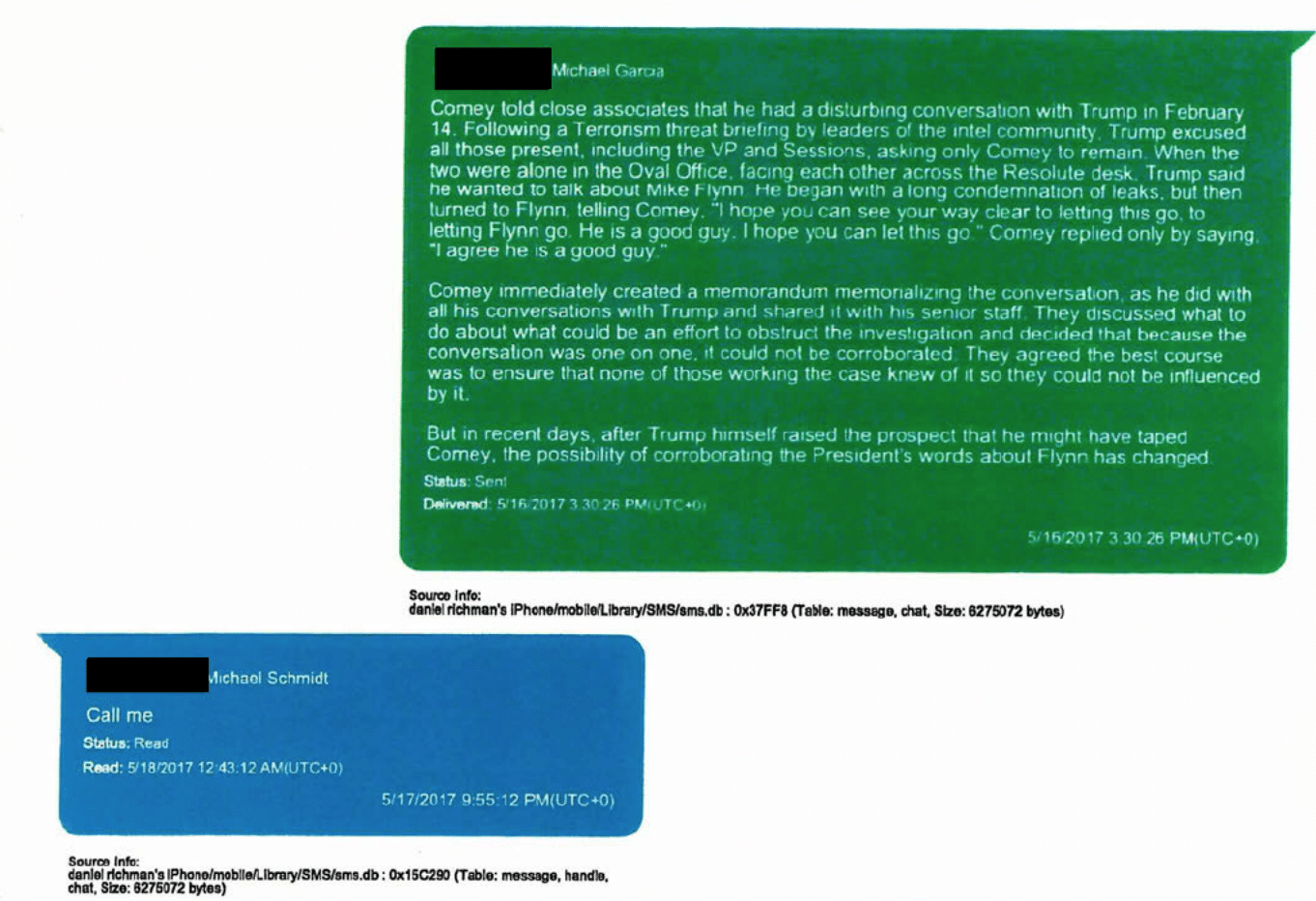
After Lemons spent 15 pages of last week’s vindictive prosecution response — laying out (A) November 2016 communications between Jim Comey and Dan Richman leading to this story, (B) February 2017 communications with Chuck Rosenberg leading to this story, and (C) May 2017 communications between Dan Richman and Mike Schmidt leading to this story, as well as presenting (D) a wildly misleading story about the “Clinton Plan,” the Gabriel[s] spent five pages throwing half that out.

(B) and (C) are gone, perhaps sacrificed to the reality that Dan Richman had left the FBI before those, meaning they didn’t fit the terms of Ted Cruz’ question. Or maybe, in the case of (C), to the possibility their attorney-client breach will blow up in their face.

After Lemons’ Response to vindictive and selection bitched twice that publicly available transcripts Comey had used included minor inaccuracies,

6 The transcript attached to the defendant’s motion non-substantively corrects Senator Grassley’s second question. See C-Span, User Clip: Sen. Grassley Questions James Comey (May 3, 2017), https://www.c-span.org/clip/senate-committee/user-clip-sen-grassley-questions-jamescomey/4853218.

[snip]

9 The transcript attached to the defendant’s motion non-substantively corrects Senator Cruz’s questions and the defendant’s first answer; the transcript also erroneously adds the word “that” to Senator Cruz’s final question and omits the word “is” from the same question. See, e.g., POLITICO, Archive: Sen. Ted Cruz questions James Comey on Trump and Clinton investigation leaks (Sept. 26, 2025), https://www.politico.com/video/2025/09/26/archive-sen-ted-cruzquestions-james-comey-on-trump-and-clinton-investigation-leaks-1759922.

The Response on Bill of Particulars noted that their own did too.

2 The Government’s response in opposition to the Defendant’s motion to dismiss erroneously omitted the word “the” before the words “Clinton investigation” in quoting Senator Cruz. See Dkt. 138 at 11.

Yet, if either the Response on Bill of Particulars or the Response to literal truth addresses this complaint from Comey, I don’t see it.

As detailed in Mr. Comey’s Motion to Dismiss the Indictment Based on Vindictive and Selective Prosecution, as well as the Motion to Dismiss the Indictment Based on Fundamental Ambiguity and Literal Truth, the text of Count One both misstates the testimony Mr. Comey actually gave and misquotes the question.

We’re two months into this thing and no one has gotten around to addressing the fact that the language in the indictment misrepresents what happened.

Remember: While Diaz said Lindsey the Insurance Lawyer showed 14 exhibits to the grand jury, none of those lay out the Cruz and Comey exchange, so we can’t entirely rule out Lindsey the Insurance Lawyer just … making up what was said, as she assuredly did in the indictment.

Then, having included a full transcript of the Cruz-Comey exchange in the filing, Lemons (or is it Shedd?) dismissed the way Cruz misspoke his lines — substituting “administration” for “investigation” in his question — this way.

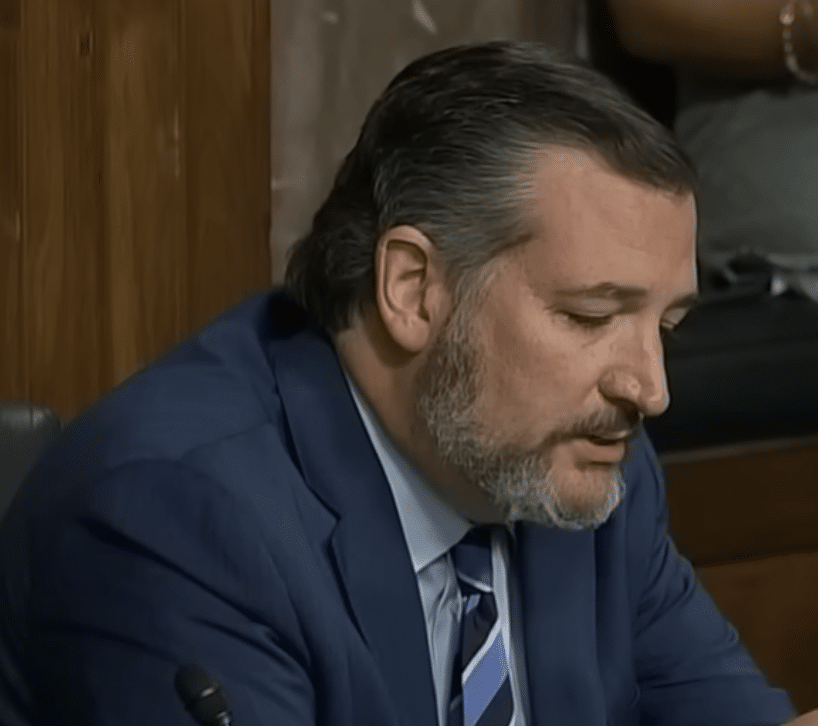
The “other ambiguities” do no more to obscure the meaning of Senator Cruz’s questions. See Def. Mem., Dkt. 105 at 14. The defendant flags Senator Cruz’s mistaken use of “Clinton administration” instead of “Clinton investigation.” See Oversight Hearing Transcript at 11. Yet Senator Cruz had correctly referred to the “Clinton investigation” two sentences prior and he was recounting the defendant’s own testimony, so the mistake would have been obvious to the defendant.

But then it largely dodges the way Cruz framed his question to focus on Andrew McCabe.

Under the narrow interpretation, Senator Cruz asked the defendant only whether he authorized McCabe to be an anonymous source. Under the broad interpretation, Senator Cruz asked the defendant whether he authorized anyone at the FBI to be an anonymous source.

The broad interpretation is the better one.

That exacerbates a problem.

There wasn’t one — the — Clinton investigation in 2016.

There were two. And the one Cruz was invoking by addressing McCabe’s involvement in a WSJ story was not the email investigation. It was the Clinton Foundation investigation.

By October 25, 2016, McCabe had been notified that Barrett was working on a follow-up story to the October 23 article that would cover McCabe’s oversight of the CF Investigation and potential connections with McAuliffe campaign contributions to McCabe’s wife. McCabe thereafter authorized Special Counsel and AD/OPA to talk to Barrett about this follow-up story.

Lindsey’s Loaner AUSAs appear not to understand that we’re still fighting over a leak (plus McCabe’s response) that revealed a previously undisclosed investigation days before an election and somehow Trump is the victim? And so while they’re excusing Cruz’ imprecision they’re committing more of their own.

Now go back to the Response to the Bill of Particulars request. As Lemons did in the original map of the investigation, the Gabriel[s] buried the transcript for the exchanges about the “Clinton plan” in an exhibit, thereby burying the fact that they keep misrepresenting Lindsey Graham’s questions worse and worse. They don’t correct Lindsey Graham’s lie about this being an investigative referral. They couldn’t be bothered with the slop of his use of the word “taught.” And of course they don’t account for the fact that to Comey (and John Brennan), these details were interesting for what they said about Russia’s hacking of Hillary-related victims, not about the totally legal and normal thing Hillary was alleged to be doing, engaging in politics.

More insane still, the Gabriel[s] turn the “Clinton plan,” into a story about the Clinton email investigation.

During the same September 30, 2020 hearing, the defendant was asked by Senator Graham whether he remembered being “getting” or being “taught” of “a[n] investigatory lead from the intelligence community” regarding “U.S. presidential candidate Hillary Clinton’s approval of a plan concerning U.S. presidential candidate Donald Trump and Russian hackers hampering U.S. elections as a means of distracting the public from her use of a private email server,” i.e., the conduct that the FBI investigated during the Midyear Exam investigation. See Dkt. 138-14 at 1. The defendant replied that that information “d[idn’t] ring any bells with [him].” See id. He similarly informed Senator Hawley that he did not “remember” receiving the investigatory [sic] referral, or “anything described” therein. See id. at 5. The government has nevertheless determined that the defendant’s handwritten notes appear to show that he was informed in September 2016 regarding an “HRC plan to tie Trump.” See Dkt. 138 at 14–15; see also Dkt. 138-13. [my emphasis]

Note, the Gabriel[s] are misrepresenting the transcript here. Comey said, “I don’t remember receiving anything that is described in that letter,” referring back to the misleading letter Ratcliffe wrote about all this, not the referral itself.

Once again, proving Comey’s point that what prosecutors are presenting as the alleged lies are, themselves, lies.

Having misrepresented the alleged lie, some pages later, they confess that, yup, they’re prosecuting Comey for the conduct they got no-billed on.

But, as provided in discovery and via the indictment, the government intends to seek the admission of evidence at trial on this count regarding the defendant’s statements to senators during the September 30, 2020, committee hearing. For instance, the defendant’s statements to Senators Grassley and Cruz regarding his use of Richman as an anonymous source concerning the Clinton email investigation and his statements to Senators Graham and Hawley regarding his alleged lack of memory concerning the so-called Clinton plan to “tie Trump” to Russia.

I feel like maybe we’re a second or generation into frothy misrepresentations of what happened in 2016 and 2017, and these young AUSAs are badly in need of a roadmap laying out the actual events behind Grampa Trump’s delirium, rather than just regurgitating the slop that John Solomon feeds them.

There’s a reality here, and these Loaner AUSAs seem blissfully unaware of that reality.

And that’s all before you get into the fact that whatever frothy Republicans were misled into believing by Ratcliffe back in 2020, taxpayers have spent millions of dollars to confirm all this is Russian disinformation, and having determined that, those who use it to get indictments are (per John Durham and his lead investigator Jack Eckenrode) committing a crime.

Finally, having redefined Russian disinformation to be about Hillary’s email investigation rather than the conspiracy theory that the plan was true and proven by Christopher Steele getting snookered by Oleg Deripaska or Michael Sussmann passing along Rodney Joffe’s discovery of a real anomaly in good faith, they’ve made the “Clinton plan” useless for the one thing it might have been used for: materiality. As Comey noted in his Bill of Particulars motion, that 2020 hearing had a clear scope, and that clear scope must be adopted to define the scope of the investigation Comey allegedly obstructed.

1 Before the hearing, the committee agreed that it would be limited to four specific topics: (i) “Crossfire Hurricane,” (ii) the December 2019 Department of Justice Inspector General report’s “Review of Four FISA Applications and Other Aspects of the FBI’s Crossfire Hurricane Investigation,” (iii) the Carter Page FISA applications, and (iv) Christopher Steele’s source network and primary sub-source.

That wasn’t a hearing about Clinton’s emails! So every effort to retcon events so they’ll fit the Ted Cruz question in fact makes the evidence useless to prove Comey obstructed anything. Graham did, very much, want to suggest that Comey should have viewed the dossier more skeptically having been exposed to Russian disinformation claiming a Clinton plan, which is why he asked the question.

But Lindsey’s Loaner AUSAs, in a desperate bid to fit the available facts to their false claims about false claims, have turned it into something else.
Share this entry

Lindsey Halligan’s Seven Times 18-Minute Gap

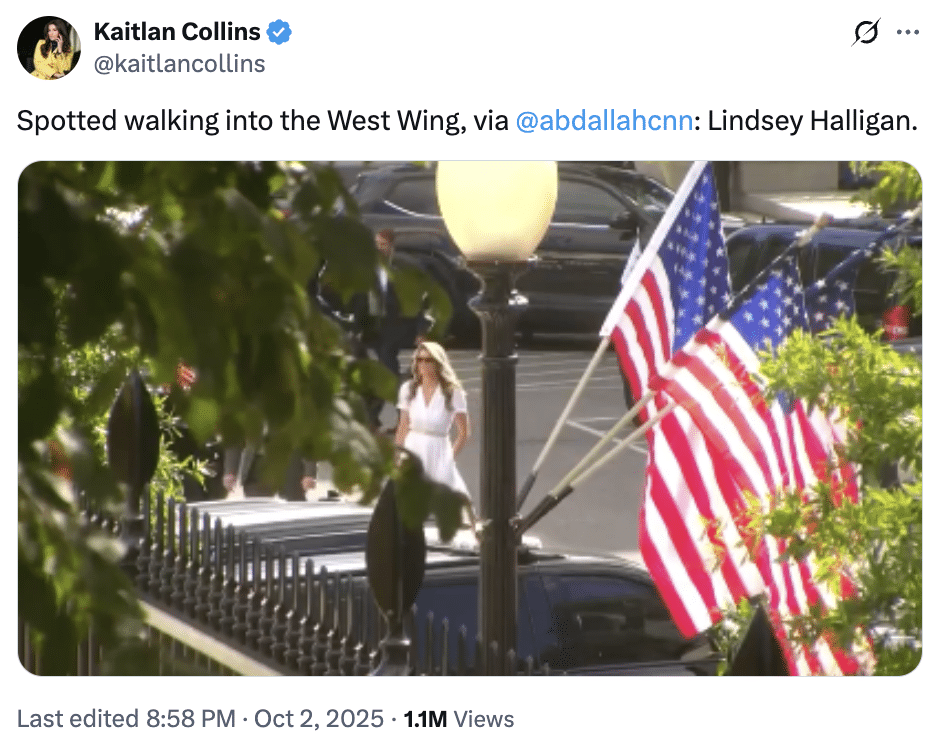
Update As I lay out here, Lindsey Halligan has submitted a digitally signed unsworn statement saying that there is nothing missing from the transcript. One possible explanation is that she did not instruct the grand jury as to the law. In any case, she now appears to claim she only presented the case once.

It’s time to return to the mystery of the magical disappearing Jim Comey grand jury transcript.

On October 28, Senior Judge Cameron McGowan Currie — the woman presiding over Jim Comey and Letitia James’ challenge to Lindsey Halligan’s appointment, ordered the government to provide her, no later than Monday, November 3, 2025, at 5:00 pm, all documents relating to the indictment signer’s participation in the grand jury proceedings, along with complete grand jury transcripts.

On November 3, Currie revealed that when prosecutors gave her the transcripts on October 31, they hadn’t given her the part she most needed — revealing what Lindsey Halligan said to the grand jury — and ordered them to try again, asking them to provide a complete transcript and/or recording of what Lindsey the Insurance Lawyer did.

On Friday, October 31, 2025, the court received a package containing, inter alia, a “Transcript of Grand Jury proceedings on September 25, 2025.” This court has reviewed the transcript and finds it fails to include remarks made by the indictment signer both before and after the testimony of the sole witness, which remarks were referenced by the indictment signer during the witness’s testimony. In addition, the package contains no records or transcripts regarding the presentation of the three-count indictment referenced in the Transcript of the Return of Grand Jury Indictment Proceedings before the Magistrate Judge. See ECF No. 10.

Accordingly, the Government is directed to submit, no later than Wednesday, November 5, 2025, at 5:00 pm, for in camera review, a complete Transcript and/or recording of all statements made by the indictment signer to the grand jury on September 25, 2025, to include statements made prior to and after the testimony of the witness and during the presentation of the three-count and subsequent two-count indictments.

On the morning of November 5, Magistrate Judge William Fitzpatrick, presiding over Comey’s challenge to DOJ’s bid to breach his privilege, ordered the government to provide all of that to Comey.

As part of this, I am going to order the government to disclose to the defense all grand jury materials, not just the testimony of the agent, but anything that was said during the course of the grand jury. How the grand jury was instructed, any presentation to the grand jury, any questions that were asked of either the agent or the United States Attorney, all of that is to be disclosed because I think the defense needs that in order to marry up the information that they have or the information that they will get to how it was used.

Among the concerns Pat Fitzgerald raised was that Lindsey the Insurance Lawyer had presented materials pertaining to the “Clinton Plan” that had been rejected during her first attempt as part of her obstruction charge.

And on top of that, Your Honor, I think there’s another motion coming from us, in light of some disclosures that were made Monday, where we think that the government is expanding its case, we believe, to include the conduct that was no true billed in Count One as part of its proof of Count Two, which raises serious issues for us. So we’ll do everything we can, but to do all that while getting Mr. Comey access to materials…

Later that day, November 5, Loaner AUSA Tyler Lemons submitted a filing claiming he had complied with Currie’s order; he explained they had previously only provided the grand jury transcript that “was previously provided to the government [passive voice] by the transcription service.” But now, in response to Judge Currie’s order, they were providing “the complete recording.”

The Court had previously Ordered the government to provide, for in camera review, all documents relating to the indictment signer’s participation in the grand jury proceedings, along with complete grand jury transcripts. [DE 95]. In response, the government provided the transcript of the Grand Jury proceedings that was previously provided to the government by the transcription service.

The Court’s subsequent Order at Docket Entry 148 additionally requested the recording from the Grand Jury presentation. Upon receiving this order, the government immediately contacted the transcription service and requested the complete recording.

But Loaner AUSA Lemons did not make the grand jury transcript available to Comey. Instead, on November 6 (and in this order), he (or rather James Hayes, the guy at Main DOJ who keeps writing these things but who has not filed an appearance) claimed he would comply with the order to provide all the material seized from Dan Richman. Then he (or rather Hayes) appealed the order to share grand jury transcripts.

The next day, November 7, Judge Currie noted she had received the grand jury materials on November 5.

In advance of a hearing on November 10, Comey revealed that Loaner AUSA Lemons had not complied with Magistrate Judge Fitzpatrick’s order.

This Court subsequently entered a written order denying the government’s motion for implementation of a filter protocol and compelling production of seized materials4 and the grand jury materials, together with restrictions on further government review.

4 On November 6, 2025, the government produced various copies of what appear to be the raw returns for the search warrants at issue, unscoped for responsiveness and filtered for Mr. Richman’s privileges. But the government provided incorrect passwords to large subsets of those materials. The defense engaged a vendor who worked throughout the weekend to load and process those materials; the government provided the correct passwords on November 9, 2025.

5 The Order also required the government to provide, in writing, by the same deadline: “Confirmation of whether the Government has divided the materials searched pursuant to the four 2019 and 2020 warrants at issue into materials that are responsive and non-responsive to those warrants, and, if so, a detailed explanation of the methodology used to make that determination; A detailed explanation of whether, and for what period of time, the Government has preserved any materials identified as non-responsive to the four search warrants; A description identifying which materials have been identified as responsive, if any; and A description identifying which materials have previously been designated as privileged.” ECF No. 161 at 1-2.

Despite certifying on November 6 that it had complied with the Court’s Order, ECF No. 163, the government did not provide this information until the evening of November 9, 2025, in response to a defense inquiry. The government told the defense that it “does not know” whether there are responsive sets for the first, third, and fourth warrants, or whether it has produced those to the defense, and said that in that regard, “we are still pulling prior emails” and the “agent reviewed the filtered material through relativity but there appears to be a loss of data that we are currently trying to restore.” [my emphasis]

Nevertheless, Fitzpatrick adopted the government request that he first review the “transcript” to see whether Comey’s suspicions about privilege and Fourth Amendment violations could result in the dismissal of the entire indictment.

Later that day, November 10, the government submitted what should have been the grand jury materials for Fitzpatrick’s review.

At that point, both Judge Currie and Magistrate Judge Fitzpatrick should have had a record of everything Lindsey the Insurance Lawyer did in her attempt to indict Jim Comey.

In spite of the urgency, we haven’t heard from Fitzpatrick yet; I was wondering if he wanted to get a sense of how the Currie hearing today went.

But maybe he’s having the same problem Currie did.

In the disqualification hearing today, Currie revealed (ABC; CNN; Politico)  that nothing from 4:28 on was recorded.

Currie also laid into Whitaker during the hearing on whether Attorney General Pam Bondi had reviewed the grand jury transcript in James Comey’s case, noting there was no record of anything that happened after 4:28pm ET that day. Comey wasn’t indicted for nearly two hours after that, according to available court transcripts.

“It became obvious to me that the attorney general could not have reviewed” the entire proceeding, Currie said, adding that it appeared “there was no court reporter present” at the time of the missing portion.

In preparation for Thursday’s hearing, Currie privately reviewed the transcripts and said previously that she thought looking at the transcripts was “necessary to determine the extent of the indictment signer’s involvement in the grand jury proceedings.”

That’s what I said, Judge Currie!! Pam Bondi couldn’t have reviewed the transcripts when she claimed to ratify this prosecution on October 31!

If Lindsey presented in the order of the exhibit numbers, the latter part of this presentment focused on the Mike Schmidt communications and the “Clinton plan” documents — the things Comey expressed particular interest in. Plus, if you’re missing the latter bit of the presentment, you don’t have proof the grand jury voted to indict.

Remember that the foreperson did not specify that just one of the charges was no-billed (though there definitely were two indictments, both of which Lindsey the Insurance Lawyer signed).

Lindsey the Insurance Lawyer has done Rosemary Woods one, two, three, four, five, six, seven better, creating a gap of 139 minutes, from 4:28 until 6:47, over seven 18-minutes worth long.

Not bad for a rookie.

Update: Per CNN, DOJ claims nothing is missing.

In a statement to CNN following the hearing, a representative for the Justice Department denied that there was anything missing from the transcript.

“There is no ‘missing two hours.’ That time period refers to when the jurors were deliberating behind closed doors, which would not be included in a transcription,” the statement said.

The DOJ, however, did not offer an explanation for the gap in court.

Update: I think the answer is that the last bit of Lindsey’s instruction is missing, plus the entirety of the deliberation, which wouldn’t be recorded.

Update: Corrected “indictment” which would be dismissed for “transcript.”

Share this entry

Judge Jamel Semper Mostly Denies LaMonica McIver’s Bid to Dismiss Prosecution

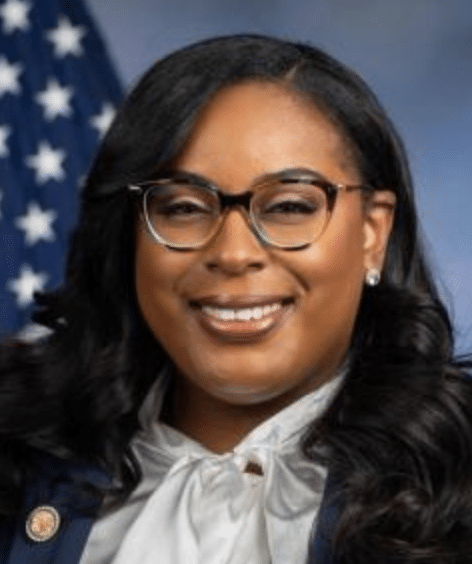
Judge Jamel Semper has denied most of LaMonica McIver’s bid to throw out her prosecution, denying her selective and vindictive prosecution claim, as well as a request to obtain more discovery, outright, and dismissing her legislative immunity claim on two of three counts.

Given the precedent, Semper’s ruling on the selective and vindictive prosecution claim is not surprising. What is surprising, however, is the presumption of regularity Judge Semper affords DOJ (and ICE) even after he has had to order DOJ to whack-a-mole remove all the false statements Tricia McLaughlin keeps posting about McIver. He makes no mention, for example, of the evidence showing Todd Blanche ordered Ras Baraka be arrested even though he was no longer on Delaney Hall property.

His analysis of the legislative immunity, however, is less convincing.

He dismisses McIver’s claim that she was present at Delaney Hall for a legislative function — the government concedes the inspection itself is legislative — to an entire trip to DC, some of which did not involve legislative acts.

Defendant further contends that her exercise of congressional authority “comfortably shows that her presence at Delaney Hall was ‘manifestly legislative activity.’” (Mot. I at 17) (emphasis added). The case law does not support Defendant’s broad interpretation. The Third Circuit’s holding in Lee is instructive, where the court declined to find that the entirety of a legislator’s fact-finding trip was protected by the Speech or Debate Clause. See 775 F.2d at 522. There, a legislator from the Virgin Islands argued that the conversations and meetings that took place during a trip he took to New York and Washington, D.C. were entitled to immunity because the purpose of his trip was for legislative fact-finding.19 See id. The Court disagreed. In rejecting his argument as too broad, it found that for “conversations to trigger the protection of legislative immunity, they must have involved legislative fact-finding.” Id. The Court wrote that “it is Senator Lee’s purpose or motive that will determine in part whether the trip was a legislative act at all” and ordered the district court to examine “which acts were proper legislative acts and which were personal and non-legislative acts.” Id. at 522, 524.

19 The defendant in Lee had received approval from the President of the Virgin Islands legislature for a legislative fact-finding trip to New York and Washington, D.C. to conduct meetings and discuss such official legislative business as consumer affairs, interior matters and issues involving transportation. See 775 F.2d at 517. An investigation by law enforcement later revealed that many of the meetings with government officials he claimed took place did not in fact happen. See id.

But before and after the fracas, McIver was simply trying to do that inspection. The kidnapping of Baraka was ICE’s response to that.

Even with Count Two, which criminalizes McIver’s response after an ICE guy grabbed her, Semper dodges by saying the record about her motive to return onto Delaney Hall premises where she conducted the inspection she originally came for remains uncertain. He does so even though he describes the ICE guy initiating physical contact.

Surveillance video shows that as Defendant and Representative-2 tried to reenter the facility through the Security Gate, V-2 blocked Defendant from entering by forcibly pushing her back into the public parking lot, and Defendant responded by pushing V-2 in return. (Id., 1:28:08-21.) Defendant was only able to reenter the facility when Representative-2 wrapped his arms around her and pulled her through the Security Gate. (Id., 1:28:15-24.) Defendant and the Representatives were subsequently allowed to conduct their congressional oversight inspection of Delaney Hall later that day.10 (Mot. I at 11.)

[snip]

As Defendant attempted to reenter the facility through the Security Gate, V-2 forcibly pushed Defendant back into the public parking lot before Defendant pushed V-2 in response. 25 (Id., 1:28:10-1:28:20.) The indictment alleges Defendant “pushed past V-2 while using each of her forearms to forcibly strike V-2 as she returned inside of the secured area of Delaney Hall.” (Ind., Count 2 ¶ 3.) Defendant successfully reentered the facility after Representative-2 wrapped his arms around her and pulled her through the Security Gate, as the agents kept protestors from entering the Security Gate. (Def. Ex. A, 1:28:20-1:28:25.) Following her reentry into the secured area of Delaney Hall, Defendant and the Representatives were allowed to conduct their inspection of the facility. (Mot. I. at 11.)

25 Surveillance video reveals a dynamic situation where V-2 struggled through a crowd of hostile protestors before encountering Defendant at the Security Gate. (See generally Def. Ex. I.) The Court makes no finding on V-2’s intent when he forcibly pushed Defendant as she lawfully tried to reenter the Security Gate. While the inchoate record does not allow for a determination of Defendant’s predominate purpose upon reentry into the Security Gate, it is axiomatic that Defendant’s statutory right to enter and inspect the facility could not be infringed, even if mistakenly, by V-2. Upon completion of the record, Count Two will be subjected to scrutiny.

[snip]

Discovery is ongoing, and the parties are in process of reviewing two hours of complete video from the inspection. 26 The facts surrounding that inspection are relevant to Defendant’s motive in reentering the facility in Count Two, and whether her intent was related to her oversight duties. 27

26 The Government is in the process of turning over the complete set of surveillance footage from the Members’ tour, which took place after the subject incident. (See Tr. at 20:1-14.)

27 A Member of Congress may only “be prosecuted under a criminal statute provided that the Government’s case does not rely on legislative acts or the motivation for legislative acts.” Helstoski, 442 U.S. at 487-88.

He’s describing law enforcement assaulting a member of Congress as she tries to do her job and that doesn’t qualify for legislative immunity?

Likewise, Semper dismissed her claim that Trump v. US stands for the principle that if Trump’s motives while attacking Congress cannot be scrutinized, then hers cannot either with no consideration that Speech and Debate has more Constitutional protection than Trump’s Executive authority.

Finally, Defendant suggests that inquiry into Defendant’s motives “would raise significant separation-of-powers concerns considering Trump’s holding that courts evaluating claims of presidential immunity emphatically ‘may not inquire into the President’s motives.’” (Mot. I. at 20) (emphasis in original) (quoting Trump v. United States, 603 U.S. 593, 618 (2024)). Defendant asks this Court to extend the Supreme Court’s ruling on presidential immunity to the area of legislative immunity. But these are two separate immunities applicable to two separate branches of government, scrutinized under two separate legalstandards. Article I of the Constitution confers legislative immunity for speech or debate, which the courts have interpreted and developed through case law, while the presidential immunity doctrine is a court-created doctrine derived from the executive’s Article II powers. See Youngstown Sheet & Tube Co. v. Sawyer, 343 U.S. 579 (1952); see also Nixon v. Fitzgerald, 457 U.S. 731 (1982). Moreover, the question of whether the President engages in “official action” is a distinct inquiry from whether a Member of Congress was engaging in a legislative act. Trump, 603 U.S. at 617.

To be fair, he can afford to err on the side of conservatism. This challenge (but not the selective and vindictive one) is entitled to interlocutory appeal. So the Third Circuit — with Emil Bove safely installed — will review this before any trial.

11 The Court’s decision regarding Defendant’s immunity under the Speech Clause is subject to immediate appeal under the collateral order doctrine. See Helstoski v. Meanor, 442 U.S. 500, 506– 08 (1979). See also United States v. McDade, 28 F.3d 283, 288 (3d Cir. 1994) (“[W]e have jurisdiction to entertain the defendant’s claim that the Speech or Debate Clause requires dismissal of the entire indictment or particular charges contained in the indictment.”).

And by then, McIver may have a more fulsome understanding of what was happening elsewhere at the facility.

As of now, though, Judge Semper has ruled that immunity doesn’t attach when ICE goons stage a kidnapping in the middle of an attempt to exercise legislative oversight.

That seems like a problem.

Share this entry

Trump Already Confessed He Knew about “the Girls”

On the same day Adelita Grijalva will finally be sworn in and provide the 218th vote to force a vote to release the Epstein files, Oversight Dems have released three records from Jeffrey Epstein’s estate making it clear Trump is more implicated in Epstein’s crimes than he has let on.

There’s one email that will ensure that Melania Trump backs off her threat to sue Michael Wolff. He and the sex trafficker were discussing how to craft an answer Trump could give to CNN about their relationship during the 2015 election.

Effectively, Epstein was offering to provide Trump an answer to make things easy on Trump.

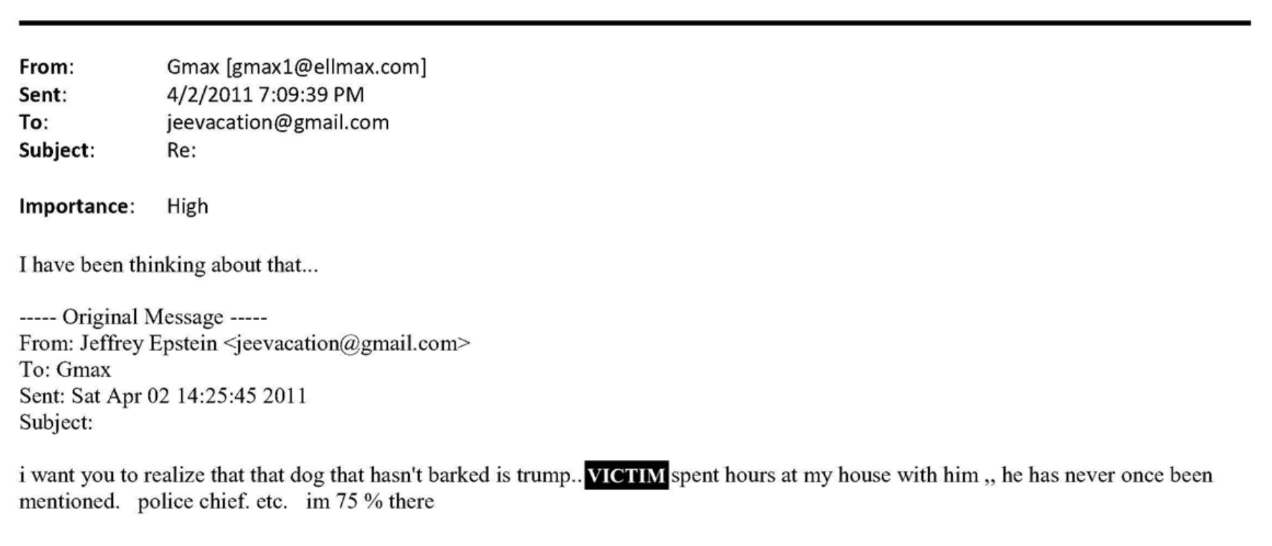
The most damning describes Epstein, discussing with Ghislaine Maxwell in 2011 one of the victims spending “hours at [Epstein’s] house with Trump.

That conversation transpired in April 2011, just a month before Trump dropped out of the presidential race.

The most intriguing was another email exchanged with Wolff, just six months before Epstein was arrested and then suicided, in which Epstein claimed Trump was lying when he “said he asked me to resign, never a member  ever.”

One of the first times this claim was aired was in a 2007 Page Six story that preceded many of the details becoming public.

Meanwhile, the Mar-a-Lago Club in Palm Beach last night confirmed a Web site report that Epstein has been banned there. “He would use the spa to try to procure girls. But one of them, a masseuse about 18 years old, he tried to get her to do things,” a source told us. “Her father found out about it and went absolutely ape-[bleep]. Epstein’s not allowed back.” Epstein denies he is banned from Mar-a-Lago and says, in fact, he was recently invited to an event there.

Trump has, at times, admitted he served as an anonymous source for Page Six.

Trump repeated this story, in two parts, in July.

First, days after Todd Blanche sat down with Ghislaine Maxwell, Trump described that Epstein “hired help” from Trump, and continued doing so even after Trump “said, don’t ever do that again,” implying that he told Epstein to stop.

What caused the breach with him? Very easy to explain. But I don’t want to waste your time by explaining it. But for years I wouldn’t talk to Jeffrey Epstein. I wouldn’t talk. Because he did something that was inappropriate. He hired help. And I said, don’t ever do that again. He stole people that worked for me. I said, don’t ever do that again. He did it again. And I threw him out of the place. Persona non grata. I threw him out. And that was it.

Then, the next day, Trump confessed that Virginia Giuffre was one of the “young women” that Epstein “stole.”

Reporter 1: I’m just curious. Were some of the workers that were taken from you — were some of them young women?

Trump: Were some of them?

Reporter 1: Were some of them young women?

Trump: Well, I don’t wanna say, but everyone knows the people that were taken. It was, the concept of taking people that work for me is bad. But that story’s been pretty well out there. And the answer is, yes, they were.

[inaudible]

Trump: In the spa. People that work in the spa. I have a great spa, one of the best spas in the world at Mar-a-Lago. And people were taken out of the spa. Hired. By him. In other words, gone. And um, other people would come and complain. This guy is taking people from the spa. I didn’t know that. And then when I heard about it I told him, I said, listen, we don’t want you taking our people, whether they were spa or not spa. I don’t want him taking people. And he was fine and then not too long after that he did it again and I said Out of here.

Reporter 2: Mr. President, did one of those stolen persons, did that include Virginia Giuffre?

Trump: Uh, I don’t know. I think she worked at the spa. I think so. I think that was one of the people, yeah. He stole her. And by the way, she had no complaints about us, as you know. None whatsoever.

Both these limited hangouts, delivered in the wake of Blanche’s interviews with Maxwell, blame Epstein for stealing his girls.

But it wasn’t Epstein stealing the girls and he didn’t tell Epstein to stop.

He told Maxwell to stop.

And then he lied and claimed he had kicked Epstein out as a result.

And then Todd Blanche moved Epstein’s co-conspirator, who didn’t mention the girl Trump spent hours with or remind Blanche of Trump’s knowledge she was trafficking girls from his club, into comfier digs.

Share this entry

Corruption Is All Fun and Games Until It Threatens to Tank the Economy

WSJ has a follow-up to the story Reuters published a week ago, on November 5 (which I wrote about here). The Reuters piece described that FHFA’s Inspector General had been fired as he was preparing to share information relevant to EDVA’s cases — so Letitia James — and also Congress.

The ouster of Joe Allen, FHFA’s acting inspector general, follows the agency’s director, Bill Pulte, becoming an outspoken voice in support of the Trump administration. Across the government, the Trump administration has so far fired or reassigned close to two dozen agency watchdogs, who police waste, fraud and abuse. It has also defunded the group that supervises those offices.

[snip]

Allen received notice of his termination from the White House after he made efforts to provide key information to prosecutors in that office, according to four sources. The information he turned over was constitutionally required, two of them said, while a third described it as being potentially relevant in discovery.

His ouster also came about as he was preparing to send a letter to Congress notifying lawmakers that the FHFA was not cooperating with the inspector general’s office, three of the sources said.

WSJ describes that Allen was investigating whether Bill Pulte ordered people to snoop in Trump’s adversaries’ records. It also confirms that Allen did share that information with EDVA (it doesn’t mention whether Allen had succeeded in sending off any letter to Congress).

Fannie Mae watchdogs who were removed from their jobs had been probing if Trump appointee Bill Pulte had improperly obtained mortgage records of key Democratic officials, including New York Attorney General Letitia James, according to people familiar with the matter.

Fannie’s ethics and investigations group had received internal complaints alleging senior officials had improperly directed staff to access the mortgage documents of James and others, according to the people. The Fannie investigators were probing to find out who had made the orders, whether Pulte had the authority to seek the documents and whether or not they had followed proper procedure, the people said.

That group elevated the probe about the James documents to the more senior Office of Inspector General for the Federal Housing Finance Agency, the agency that oversees Fannie Mae and Freddie Mac and that Pulte heads, the people said. The acting inspector general then passed the report to the U.S. attorney’s office in eastern Virginia, some of the people said.

[snip]

The FHFA acting inspector general sent the office the report at least in part because it could be considered material information for James’s defense in the case, one of the people said.

The very days this all happened, on November 4, the Loaner AUSA in the James case, Roger Keller, filed a notice saying DOJ was not going to comply with Judge Jamar Walker’s order to turn over vindictive and selective prosecution evidence, specifically pointing to the carve out in Federal Rules of Criminal Procedure for “reports, memoranda, or other internal government documents” made by “other government agents in connection with the investigation,” language that would cover any FHFA reports into Bill Pulte’s corruption.

Federal Rule of Criminal Procedure 16 does not require the Government to produce vindictive/selective prosecution-related evidence before a defendant files such a motion. The Rule permits a defendant to discover evidence material to her defense, FED. R. CRIM. P. 16(a)(1)(C), but “defense” means the “defense against the Government’s case in chief, . . . not to the preparation of selective prosecution claims.” Armstrong, 517 U.S. at 462 (citing FED. R. CRIM. P. 16(a)(1)(C))(emphasis added). FED. R. CRIM. P. 16(a)(2) underscores the limitation to “defense” as it “exempts from defense inspection ‘reports, memoranda, or other internal government documents made by the attorney for the government or other government agents in connection with the investigation or prosecution of the case.’” Id. (quoting FED. R. CRIM. P. 16(a)(2)). “If a selective-prosecution claim is a ‘defense,’ Rule 16(a)(1)(C) gives the defendant the right to examine Government work product in every prosecution except his own.” Id. [my emphasis]

James did mention the earlier Reuters report in her vindictive and selective prosecution motion, submitted last Friday.

The retribution campaign against AG James had only just begun. Around the same time, another federal agency, the Federal Housing Finance Agency (FHFA), led by Director William Pulte, was also looking for dirt to use against AG James. By April 14, they had concocted it. Mr. Pulte delivered a criminal referral “[b]ased on media reports” to DOJ against AG James, claiming she had “in multiple instances, falsified bank documents and property records to acquire government backed assistance and loans and more favorable loan terms.” Ex. F at 1. The criminal referral cherry-picked documents to claim fraud over three properties—one even going back to 1983—none of which was the Peronne Property at issue in the indictment.16 The referral asked DOJ to open a criminal investigation into AG James. See Ex. F at 1. Mr. Pulte also coordinated with Edward Martin—the self-described “captain” of DOJ’s Weaponization Working Group who is President Trump’s close confidante and would later also be named a Special Attorney.17

16 Mr. Pulte’s conduct demonstrates how far allies of the President would go to carry out his “get James” orders. Public reports indicate that Mr. Pulte “skipped over his agency’s inspector general when making criminal referrals” against President Trump’s political enemies. Reports also indicate he may have bypassed ethics rules in doing so. Marisa Taylor & Chris Prentice, Exclusive: Trump official bypassed ethics rules in criminal referrals of Fed governor and other foes, sources say, Reuters (Oct. 6, 2025), https://perma.cc/HK6Y-LJVR. The FHFA has no generalized crimefighting or anti-fraud authority. It does not even have an express authority to make criminal referrals besides those granted to the FHFA’s Inspector General under the Inspector General Act of 1978. In addition to violations of the act itself, Mr. Pulte may have failed to comply with the FHFA’s own Privacy Act regulations, which require FHFA to “ensure” that records containing personally identifiable information are “protected from public view.” Domenic Powell, Are Pulte’s “Mortgage Fraud” Investigations Legal?, Yale J. Reg.: Notice and Comment (Nov. 1, 2025), https://perma.cc/2U6G-S46X.

17 Alan Feuer et al., Trump Demands That Bondi Move ‘Now’ to Prosecute Foes, N.Y. Times (Sept. 20, 2025), https://perma.cc/FC9R-U8TK. [link added]

This story may provide opportunity to submit a follow-up (or at least revisit the issue in a reply memo due in two weeks).

By then, of course, we may have more visibility into who got Allen fired, and whether simply the referral to Lindsey Halligan did the trick.

Particularly if Allen did succeed in getting that letter sent to Congress.

All this is happening at a curious time. First, just yesterday Politico claimed someone in Trump’s immediate orbit was furious at the way Pulte sold Trump on an insanely stupid 50-year mortgage plan.

White House officials are furious with Bill Pulte, the Federal Housing Finance Agency director, who talked the president into suggesting a 50-year mortgage plan.

The White House was blindsided by the idea, according to two people familiar with the situation granted anonymity to discuss internal thinking, and is now dealing with a furious backlash from conservative allies, business leaders and lawmakers.

On Saturday evening, Pulte arrived at President Donald Trump’s Palm Beach Golf Club with a roughly 3-by-5 posterboard in hand. A graphic of former President Franklin Roosevelt appeared below “30-year mortgage” and one of Trump below “50-year mortgage.” The headline was “Great American Presidents.”

Roughly 10 minutes later, Trump posted the image to Truth Social, according to one of the people familiar, who was with the president at the time.

Almost immediately, aides were fielding angry phone calls from those who thought the idea – which would endorse a 50 year payback period for a mortgage – was both bad politics and bad policy, a move that could raise housing costs in the long run, the person said.

After describing fury about how Pulte did this — hitting Trump up with visuals at the golf club — Politico spends 11 paragraphs describing a range of people panning the idea before describing the last time Pulte did this: when pitching a plan to bring Fannie and Freddie public, another insanely stupid idea.

“Anything that goes before POTUS needs to be vetted,” said the person present for Pulte’s poster presentation. “And a lot of times with Pulte they’re not. He just goes straight up to POTUS.”

[11 ¶¶ of influencers and experts panning the idea]

This is not the first time Pulte’s policy proposals have caused headaches. He was also behind the idea Trump floated earlier this year to take Fannie Mae and Freddie Mac public, which also resulted in significant pushback from industry.

Which brings us to the very last paragraph of the WSJ story, a story mostly focused on Pulte’s investigation-related corruption. It suggests Pulte’s corruption may make it harder to bring Fannie and Freddie public, that prior idea he floated by cornering Trump with unvetted ideas.

The Trump administration is considering an initial public offering for Fannie Mae and Freddie Mac, one of the biggest IPOs in history at a crucial moment for the mortgage market. That process will require convincing potential investors, and the broader mortgage-bond market, the management of the companies is stable.

As I read both James’ and Comey’s motions to dismiss for vindictive prosecution, there’s part of me that selfishly wants this process to be one step harder than it needs to be: rather than simply dismissing on the abundant evidence of vindictive prosecution laid out (or, even more likely, because Lindsey the Insurance Lawyer is only playacting as US Attorney, about which there is a hearing tomorrow), I want them to get discovery so we can unpack all this process and bring down the corrupt enablers like Pulte, Eagle Ed Martin, on up to Pam Bondi and Todd Blanche.

Still, there’s something that may force this to go even more public than it otherwise would: Lisa Cook, into whose private records Pulte was likely also snooping, who will have a hearing about whether Trump attempted to fire her “for cause,” or because Pulte snooped in her private records looking for cause.

Corruption is all fun and games until it gets fast-tracked to SCOTUS (where, admittedly, Justices have been all too happy to legalize corruption). It’s all fun and games, Trump’s team seems to believe, until it poses a risk to the housing market.

For whatever reason, Bill Pulte seems to be getting fast-tracked in Trump world, from a useful corrupt flunky to a dangerous liability.

Share this entry

“Witch Hunt!” Jim Comey Channels Media Matters

One of the most scathing passages in Jim Comey’s reply brief on his vindictive prosecution claim repeats something Media Matters does persistently to understand how Donald Trump’s brain works.

It’s a reply to this passage of the government response, which is the cornerstone to their claim that Donald Trump’s years of attacks on Comey weren’t animus, they reflected, instead, a sound concern about crime.

The defendant argues that he’s being prosecuted to punish him for being a “[v]ocal [c]ritic of President Trump.” Def. Mem., Dkt. No. 59 at 11. Yet according to his own version of events, the earliest that he “spoke out on public and political issues” was June 8, 2017. Id.; see Def. Mem., Dkt. No. 59-4 at 2 (pinning the earliest exercise of the defendant’s First Amendment rights to criticize the Trump Administration to a New York Times article published on June 8, 2017). By that point, however, the President had already accused him of committing a crime. On May 21, [sic] 2017, less than three weeks after the defendant first testified that he never “authorized anyone at the FBI to be an anonymous source in news reports about the Trump investigation or the Clinton investigation,” Def. Mem., Dkt. No. 59-2 at 4, the President publicly accused him of giving “false or misleading testimony,” Def. Mem., Dkt. No. 59-4 at 2. That accusation of criminal conduct was mounted before the defendant first stepped into his self-described role as a vocal critic of the President. And that “sequence of public events” should disabuse any notion that the defendant is being punished for exercising his First Amendment rights. See Wilson, 262 F.3d at 317 (reasoning that a defendant’s “theory on proving causation” will be “belied by the record” if the government’s “efforts to prosecute [him] preceded” his exercise of a protected right).

I focused closely on this passage — on other problems with this passage — here, noting that prosecutors had kicked off a fight about chickens and eggs.

I didn’t note that Lindsey’s Loaner AUSAs got the date wrong, May 21 instead of May 31 (Comey was generous enough not to note it), a date correctly recorded in both Comey’s appendices collecting these things (one, two).

[Note my screen cap is +5.]

But I missed the even bigger problem with this argument.

Lindsey’s Loaner AUSAs didn’t check what Trump was watching on Fox and Friends that day.

On May 19, 2017, in the uproar that followed, the Senate Intelligence Committee announced that Mr. Comey would testify before the Committee about his dismissal and the investigation into Russian interference with the 2016 election. Former FBI Director Comey Agrees to Testify in Open Session at Senate Intel Committee, U.S. Senate Select Committee on Intelligence (May 19, 2017), https://perma.cc/HC5K-KYUV.

That announcement was followed on May 31, 2017, by the first of the President’s allusions to “false or misleading” testimony by Mr. Comey. The government suggests that this tweet shows that the President’s prosecutorial motive arose from Mr. Comey’s May 3, 2017 Senate Judiciary Committee testimony and that he voiced it before Mr. Comey entered into public debate. ECF No. 138 at 28. The tweet shows nothing of the kind.

To begin, the tweet does not reflect the President’s opinion about Mr. Comey, nor does it refer to Mr. Comey’s May 3 testimony as the government misleadingly implies. Instead, the tweet quotes a report based on a conversation on Fox and Friends describing a letter written by former Trump campaign advisor Carter Page stating Page’s view of Mr. Comey’s March 20, 2017 testimony about links between the Trump campaign and the Russia government.5 This tweet can hardly qualify as expressing the President’s legitimate prosecutorial motive—as opposed to relaying hearsay from a television program with no factual basis. In fact, it is the type of unfounded accusation that displays animus rather than a genuine interest in justice. And despite the government’s reliance on it as preceding Mr. Comey’s public statements, the tweet came after the news broke about Mr. Comey’s imminent testimony, i.e., after the President knew that Mr. Comey intended to exercise his First Amendment rights to speak publicly about Mr. Trump’s conduct in office. The President’s preemptive effort to discredit Mr. Comey reflects his animus triggered by Mr. Comey’s anticipated protected speech.

Finally, and most damaging to the government’s theory of the President’s longstanding prosecutorial motive to bring this case, the tweet has nothing to do with this prosecution: it was issued years before the testimony that forms the basis for the charges against Mr. Comey.

5 The tweet (issued in two parts) says: “So now it is reported that the Democrats who have excoriated Carter Page about Russia, don’t want him to testify. He blows away their….” “…case against him & now wants to clear his name by showing ‘the false or misleading testimony by James Comey, John Brennan…’ Witch Hunt!” Appendix at 1. The tweet was issued thirty minutes after Fox and Friends broke the same story. Id. And Mr. Comey had testified publicly before the House Intelligence Committee on March 20, 2017, to confirm the Trump-campaign and Russian-interference investigation. See Mueller Report, supra n.4 at 52-53

Trump was parroting Carter Page complaining about Comey’s March 20 testimony, not commenting on Comey’s May 3 testimony, testimony that prosecutors want to make relevant to this case.

Donald Trump was parroting Carter Page and that’s what prosecutors claimed was the genesis of Trump’s purported good faith prosecutorial concern about Comey’s leaking.

Oops.

There is, to be clear, a fair amount of chicken and egg in Comey’s reply, too, some not entirely persuasive (though that pertains to their representation of the evidence prosecutors presented, not the legal argument, and so could be mooted if some of this gets suppressed). But it reads with the confidence of people who, now, have the exhibits with which prosecutors hope to prove their case, as well as a sense of whether and if so which exhibits will be thrown out as unlawfully obtained.

And in the process, Comey has demonstrated to the Loaner AUSAs how little they know about this whole story and the man whose batshit rants they’re treating as credible.

Share this entry

Gabriel Diaz’ 14 Exhibits

As I noted here, in a telephone hearing yesterday, Magistrate Judge William Fitzpatrick ordered the government to provide him with the grand jury transcripts in the Jim Comey case, which he will review after reading an ex parte filing from Comey’s team laying out the unlawful evidence they suspect got presented to the grand jury.

Loaner AUSA Gabriel Diaz may have helped them write that memo by confirming there were 14 exhibits presented to the grand jury.

His claim — that there were 14 exhibits — may not be entirely true.

I say that because that number — 14 — matches the number of exhibits included in last week’s response to Comey’s vindictive prosecution claim (the reply to which Comey submitted yesterday, which I’ll return to). The exhibits posted to docket last week, which all include exhibit tags, consist of the following:

This order would suggest they laid out the evidence that Comey lied, focusing heavily on the 2016 exchange (the only one from when Richman was at the FBI), and presenting Comey’s April 23, 2017 thank you email to Richman ahead of Richman’s February 11, 2017 recruitment of Chuck Rosenberg, possibly creating the misimpression that Comey asked for Richman to weigh in on what became the April 2017 story.

Then they presented the Comey memo exchange (Exhibits 10 and 11), and the “Clinton Plan” (Exhibits 12-14). As presented, they did not present the “Clinton plan” referral itself to the grand jury (which might have made it even more apparent that Lindsey was not asking about what Comey’s notes laid out).

There must be at least one more exhibit as presented for the indictment the grand jury approved. As laid out here, the grand jury was not shown how Comey responded to Ted Cruz’ question (to say nothing of Chuck Grassley’s question on which Cruz’ question was based). That is, as laid out here, prosecutors did not include the exhibit that laid out the one lie actually charged.

There must be a video or something — though I find it interesting that they didn’t provide a transcript of Cruz’ question (if they didn’t), since he garbled it about ten different ways.

There are three other questions this exhibit list raises for me.

First, one concern Comey’s attorneys have is the treatment of the materials obtained with a second warrant for Dan Richman’s Columbia emails  — presumably the source of Exhibits 4-9.

What’s interesting is the Bates stamps for those are inconsistent. The earlier set are marked with a Richman Bates stamp.

The two later ones, including the one from the same Jim Comey ReinholdNiebuhr7 alias Gmail, have COLUM Bates stamps.

That suggests those two sets of communications were treated differently. Possibly, the earlier one was part of Richman’s privilege log.

The Bates stamps on the texts between Richman and Mike Schmidt also raise questions, because there’s no source of any kind noted (or if there is, it is redacted), just a series starting with 4801.

Given some of the other details we’ve learned: that all the Feebs involved in this report directly to Kash Patel, that the agent who read the attorney-client privileged text was reading the entire Cellebrite extraction of Richman’s phone — that is, without privileged texts removed — it raises real questions about whether some other team provided them, a team with its own (obscured) Bates stamp.

Worse still, the one of the two agents who read the privileged text attested that he only handed Miles Starr two pages of texts, all dated May 11.

SA Warren provided the indictment preparation team a two-page document containing limited text message content only from May 11, 2017, predating the reference to potential future legal representation.

But the exhibit is eight pages long!

Having been told there was privileged communication there and shielded from it, someone went back to those texts to get more of them, to present them to the grand jury. And that same someone led the Loaner AUSAs to believe that sharing the Comey memos after consulting with attorneys was a crime.

Effectively, SA Warren has reported a crime committed by his superiors, the willful violation of Jim Comey’s privilege.

Which is undoubtedly why James Hayes is so intent on letting the FBI lead a privilege review.

Finally, one more thing. Remember how weird the no-billed indictment is, which I laid out here?

The indictment the grand jury approved charged Comey with lying to Ted Cruz (as Diaz would have it, without being shown what that lie is), and obstructing a Congressional proceeding, “by making false and misleading statements before that committee.”

The exhibit list makes clear that Lindsey the Insurance Lawyer did shoehorn the no-billed charge into the obstruction charge, presumably treating questions about the Comey memos and “Clinton plan” — the only things in the indictment that were material to the scope of the hearing — as “misleading” rather than “false” statements. Last week, Pat Fitzgerald had said they were going to raise concerns about that this week, but they may be waiting to get that grand jury transcript.

Now go back and look at how that obstruction charges looks in the no-billed (top) and approved (bottom) indictment.

Update: As Amicus12 points out below, sometime within a day or so of the indictment, this error got fixed. Here’s what the fixed document looks like:

It is increasingly clear that Lindsey the Insurance Lawyer literally replaced what would have been Count Three of the no-billed indictment with Count Two of the approved indictment. That explains why that page has:

  • Staple and scan marks matching the real indictment
  • The numbering from the second indictment (these paragraphs should be numbered 7 and 8 in the no-billed indictment)
  • Both the signature of the foreperson (note the part of a signature that crosses into the “U” of the True Bill line) and Lindsey herself on that page

She simply swapped the page.

There’s good reason to ask whether she wasn’t just being dumb and inexperienced (which is what it looked like in the 7-minute hearing with the judge), but was also being deceitful.

For example, it’s possible that the original indictment charged Comey with obstructing the Senate’s investigation only by making false statements, but in a bid to get the material things in there pertinent to the larger investigation, the “Clinton plan” and the Comey memos, Lindsey the Insurance Lawyer added the word “misleading” to lower the bar to get a vote from the grand jurors.

It’s unclear whether Fitzpatrick will or can review some of these issues. He’s scrutinizing the indictment for unlawful and privileged exhibits. That also might explain why Diaz tried hard to prevent Comey from providing a list of things to look for.

The unlawful exhibits are bad enough. But there seems to be worse still.

Share this entry

Kash Patel’s Plot Against Jim Comey Thickens!

The two sides have submitted additional filings in advance of a hearing about the attorney-client and Fourth Amendment violations in the Jim Comey case:


The government claims that Comey hasn’t demonstrated a need to see what happened in the grand jury because there’s no way any privileged or Fourth Amendment violative material was presented, and even if it were, that would be insufficient to dismiss the indictment, which is the standard.

Even assuming the defendant could prove that the government violated the Fourth Amendment or attorney-client privilege in its grand jury presentation (and to be clear, he cannot), the remedy would be to suppress that evidence at trial—not to dismiss the indictment. So, the defendant has not shown that “a ground may exist to dismiss the indictment because of a matter that occurred before the grand jury.” Fed. R. Crim. P. 6(e)(3)(E)(ii). He is not entitled to access grand jury material.

There are problems with both these claims.

First, Miles Starr was briefed orally on the comms between Dan Richman and Mike Schmidt and Jim Comey the morning of the grand jury presentment. Then, the FBI Agent who was tainted provided a written document that only covered stuff on May 11.

On the morning of September 25, 2025, the team was preparing for an indictment of James Comey, to occur later that afternoon. SA Warren provided case agent SA Miles Starr and an FBI Office of General Counsel (OGC) attorney a limited overview of the text message communications to and from “Michael Garcia” (now understood to be Daniel Richman). SA Warren advised SA Starr and the FBI OGC attorney that some of the messages appeared to reference potential future legal representation. The FBI OGC attorney immediately advised that any of the text message communications referencing potential future legal representation should not be part of the indictment preparation. SA Warren provided the indictment preparation team a two-page document containing limited text message content only from May 11, 2017, predating the reference to potential future legal representation.

But DOJ itself recognizes that anything after May 9, the day Comey was fired, may be privileged.

4 The defendant was removed as FBI Director on May 9, 2017. He told the Office of Inspector General that “the day after his removal, or ‘very shortly thereafter,’ he retained attorneys Patrick Fitzgerald, David Kelley, and Daniel Richman.” Dkt. No. 138-11 at 33 (Aug. 2019 Office of the Inspector General Report). Any claim of privilege involving those attorneys would necessarily arise after May 9, 2017.

So they took insufficient steps to prevent taint of the grand jury, because materials between Richman and Comey from May 9 and 10 may well be privileged.

Even if that were sufficient, there’s no reason why communications between Comey and Richman in May could be deemed relevant to the grand jury. That’s because he admitted sharing information with Richman back in 2017. He didn’t hide it from the Senate Judiciary Committee.

Meanwhile, the government has no fucking clue whether it presented other Fourth Amendment violative content to the Grand Jury. They confessed last night, days after telling Magistrate Judge William Fitzpatrick they had complied with his order to provide this information, that they had no fucking clue whether they were looking at data that included both scoped and unscoped content (though this passage suggests that the materials obtained from Columbia, which includes the only material that remotely matches the first charge, with the second warrant were scoped).

5 The Order also required the government to provide, in writing, by the same deadline: “Confirmation of whether the Government has divided the materials searched pursuant to the four 2019 and 2020 warrants at issue into materials that are responsive and non-responsive to those warrants, and, if so, a detailed explanation of the methodology used to make that determination; A detailed explanation of whether, and for what period of time, the Government has preserved any materials identified as non-responsive to the four search warrants; A description identifying which materials have been identified as responsive, if any; and A description identifying which materials have previously been designated as privileged.” ECF No. 161 at 1-2.

Despite certifying on November 6 that it had complied with the Court’s Order, ECF No. 163, the government did not provide this information until the evening of November 9, 2025, in response to a defense inquiry. The government told the defense that it “does not know” whether there are responsive sets for the first, third, and fourth warrants, or whether it has produced those to the defense, and said that in that regard, “we are still pulling prior emails” and the “agent reviewed the filtered material through relativity but there appears to be a loss of data that we are currently trying to restore.”

Remember, this entire investigation started when Kash discovered documents that had been handled improperly. And now, because these documents have been handled improperly, his own team has been violating Jim Comey’s Fourth Amendment rights.

There are several more alarming details in today’s filings. First, both FBI agents exposed to tainted information (in addition to Miles Starr, from whom DOJ didn’t bother to obtain an affidavit, and who has not been withdrawn from this or any other investigative teams) are part of the Director’s Advisory Team, meaning they work directly for Kash Patel.

The agent who first saw the privileged material claims:

  • They didn’t know who Michael Garcia was (a pseudonym Richman used for these communications), but nevertheless reviewed them as part of a search for communications between Comey and Richman
  • They were handed the entire extraction of Dan Richman’s devices, suggesting it did not extract the privilege reviewed content

Indeed, the materials DOJ provided Comey — the ones they had been accessing — had not been filtered for privilege or responsiveness.

4 On November 6, 2025, the government produced various copies of what appear to be the raw returns for the search warrants at issue, unscoped for responsiveness and filtered for Mr. Richman’s privileges. But the government provided incorrect passwords to large subsets of those materials. The defense engaged a vendor who worked throughout the weekend to load and process those materials; the government provided the correct passwords on November 9, 2025.

Effectively, Kash has been investigating Comey using a general warrant on his friend Dan Richman.

It’s not just Kash and his personal squad of Jim Comey hunters who’ve violated Comey’s Fourth Amendment rights, Comey’s filing suggests.

Pam Bondi’s imagined “ratification” of the grand jury proceedings — the ones based on incomplete records — would have exposed her, too, to unlawful material.

2 Concerns about taint arising from the improper use of potentially privileged and unconstitutionally-obtained materials are heightened because of the government’s continued use of the materials obtained pursuant to the warrants and grand jury transcripts. On October 31, 2025, the Attorney General purported to ratify the indictment based on her review of the grand jury proceedings. ECF No. 137-1 at 2-3. If that review entailed further improper use of privileged or unconstitutionally-obtained materials insofar as they were presented to the grand jury, it casts further doubt on the propriety of the government’s conduct of this case. The government produced the grand jury materials on November 5, 2025 to Judge Currie for in camera review, and thus could quickly produce the same materials to the defense. See ECF No. 158.

The Loaner AUSAs are trying to cut their losses, by asking Fitzpatrick to conduct a review of the grand jury materials himself — no doubt to prevent Comey from using grand jury material in his challenge of these warrants, which is currently due on November 19.

But there’s virtually no way he would be able to figure out if Lindsey the Insurance Lawyer presented material that violated Comey’s Fourth Amendment rights.

This should all be sorted out at a hearing at 4PM ET.

Update: Fitzpatrick came in ready to accept the government’s request he review this in camera. But after it became clear he would not budge on that, Rebekah Donaleski asked to submit something ex parte tomorrow to lay out where they believe the violations are.

Share this entry
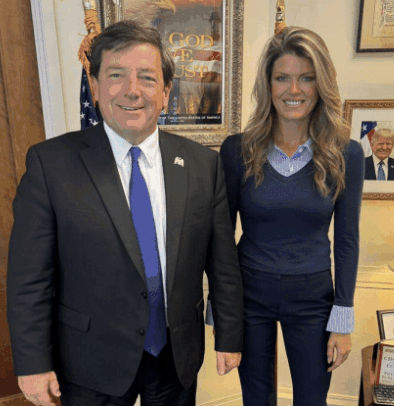
An awkward picture of Eagle Ed Martin and Lindsey Halligan posing in his office.

Letitia James Highlights Eagle Ed Martin Just Before He Goes on a Conspiratorial Rant

Vindictive and selective prosecution cases are always nearly impossible to win, because of how narrowly the precedent draws the analysis. To prove vindictive prosecution, the defendant has to prove that the prosecutor who made a charging decision harbored animus to the defendant.

But of course, in Jim Comey and Letitia James’ case, the playacting prosecutor, Lindsey Halligan, is just doing what her boss installed her to do. She didn’t act out of animus towards Comey and James, except insofar as such animus is a litmus test for belonging in Trump’s tribe (though her brief stint at the Smithsonian also exposed her as a dumb bigot, which could be relevant in James’ case). She acted out of a corrupt willingness to do anything her boss tells her to do.

Here’s how Lindsey’s Loaner AUSAs argued that Comey had not met that standard in their response to his vindictive and selective prosecution motion.

To start, the relevant analysis is whether the “prosecutor charging” the offense “harbored vindictive animus.” Wilson, 262 F.3d at 316; see United States v. Gomez-Lopez, 62 F.3d 304, 306 (9th Cir. 1995) (noting that the focus “is on the ultimate decision-maker”). Here, that prosecutor is the U.S. Attorney. Yet the defendant doesn’t present any evidence that she harbors animus against him. Instead, he says that he doesn’t need any such evidence because his claim “turns on the animus harbored by the official who prompted the prosecution.” See Def. Mem., Dkt. No. 59 at 21. And, according to him, that is the President. See id. As discussed below, the President does not harbor vindictive animus against the defendant in the relevant sense. Before reaching that issue, however, the Court should determine whether the defendant has offered sufficient evidence to find that the President displaced the U.S. Attorney as “the ultimate decision-maker” in bringing this prosecution. See Gomez-Lopez, 62 F.3d at 304. The only “direct evidence” on the issue says otherwise. See Wilson, 262 F.3d at 314.

The defendant’s argument relies on the imputed-animus theory. The Fourth Circuit has never adopted that theory. In fact, when a defendant asked the Fourth Circuit to impute animus from investigating law-enforcement agents, the Fourth Circuit categorically rejected the theory. See United States v. Hastings, 126 F.3d 310, 314 (4th Cir. 1997) (“We will not impute the unlawful biases of the investigating agents to the persons ultimately responsible for the prosecution.”); see also United States v. Cooper, 617 F. App’x 249, 251 (4th Cir. 2015). That is consistent with other circuits’ application of the theory in that context. See, e.g., United States v. Gilbert, 266 F.3d 1180, 1187 (9th Cir. 2001) (“In all but the most extreme cases, it is only the biases and motivations of the prosecutor that are relevant.”); United States v. Spears, 159 F.3d 1081, 1087 (7th Cir. 1998).

When courts have entertained the imputed-animus theory in other contexts, they have required a significant evidentiary showing: there must be “evidence that the federal prosecutor did not make the ultimate decision to bring the indictment.” Spears, 159 F.3d at 1087.

It is true that Comey and James (in a filing submitted Friday) both did ultimately say Trump ordered up their prosecutions, relying heavily on his tweet ordering Pam Bondi to install Lindsey Halligan to do so.

But they took a different approach in laying out the weaponization of DOJ. Comey, relying on a 60-page exhibit of Trump tweets to demonstrate the President’s animus, focused relentlessly on Trump. He didn’t even mention the now-FBI Director’s equally rabid animus.

Tish James had her exhibit showing how obsessively Trump hates her too; it includes not just tweets, but also speeches, and at 113 pages is almost twice as long as Comey’s exhibit.

But James also focused on the way the Trump Administration, more generally, has been (literally) stalking her, notably in the form of Eagle Ed Martin, as well as Pam Bondi, Stephen Miller, and Bill Pulte (this section is where James includes the Reuters report about firing the FHFA IG to prevent him from sharing information with prosecutors; that footnote and others are at the bottom of this page).

AG Bondi took the President’s mission to heart, and on the first day of her appointment, established DOJ’s “Weaponization Working Group,” with the stated objective to examine “[f]ederal cooperation with the weaponization” by “New York Attorney General Letitia James” to “target President Trump, his family and his businesses,” among other top priorities. 15 Ex. C. The goal was to retaliate against the President’s perceived political enemies, including AG James.

In March, President Trump also issued a Presidential Memorandum, “Rescinding Security Clearances and Access to Classified Information from Specified Individuals,” specifically calling out AG James, claiming “it is no longer in the national interest” for her, along with fourteen of his other perceived political opponents, to have a security clearance or access classified information. Ex. D.

The retribution campaign against AG James had only just begun. Around the same time, another federal agency, the Federal Housing Finance Agency (FHFA), led by Director William Pulte, was also looking for dirt to use against AG James. By April 14, they had concocted it. Mr. Pulte delivered a criminal referral “[b]ased on media reports” to DOJ against AG James, claiming she had “in multiple instances, falsified bank documents and property records to acquire government backed assistance and loans and more favorable loan terms.” Ex. F at 1. The criminal referral cherry-picked documents to claim fraud over three properties—one even going back to 1983—none of which was the Peronne Property at issue in the indictment.16 The referral asked DOJ to open a criminal investigation into AG James. See Ex. F at 1. Mr. Pulte also coordinated with Edward Martin—the self-described “captain” of DOJ’s Weaponization Working Group who is President Trump’s close confidante and would later also be named a Special Attorney.17 Reporting even indicates that President Trump had been bypassing his senior DOJ lead regularly telephoning Martin for updates on his work, leaving [DAG Todd] Blanche ‘frustrated and annoyed,’” according to sources.18

Standing outside the White House on the day the referral was released, one of the President’s aides, Deputy Chief of Staff Stephen Miller, told reporters AG James “is one of the most corrupt, shameless individuals ever to hold public office” and “is guilty of multiple, significant, serial criminal violations” for having “persecute[d] an innocent man,” referring to President Trump.19 President Trump also did not withhold his views about FHFA’s criminal referral to DOJ, attacking AG James directly in several social media posts discussing the referral:

Turns out you can’t have your principal residence in Virginia and be AG of New York. You can’t say your dad’s your husband. Or claim a five-unit is a four. But that’s what Letitia James did—while going after Trump for the same thing. You’ve got to be kidding me

Ex. A. at No. 334;

Letitia James, a totally corrupt politician, should resign from her position as New York State Attorney General, IMMEDIATELY. Everyone is trying to MAKE NEW YORK GREAT AGAIN, and it can never be done with this wacky crook in office.

Id. at No. 333.

On the heels of the referral to DOJ, in May, Mr. Martin admitted that he planned to use his authority to expose and discredit opponents of the President whom he believes to be guilty. 20 He made plain that it did not matter if there were no facts to back up President Trump’s accusations or even if a charge had no merit: “If they can be charged, we’ll charge them. But if they can’t be charged, we will name them. And we will name them, and in a culture that respects shame, there should be people that are shamed.”21 Discussing targets for criminal investigation, Martin stated that the Weaponization Working Group’s prerogative included “Letitia James.”22

And to support this additional prong of animus, James included a second, 12-page exhibit, which includes (among other things), all the creepy pictures Eagle Ed has posted of himself stalking James, including pictures showing him reviewing files with Halligan just before she indicted James or just randomly chatting up someone at FHFA.

It also documents Eagle Ed’s juvenile trolling on Xitter.

It may be an awkward time, for Eagle Ed, to have such a focus on his trollish obsessions.

That’s because he is currently involved in equally pathetic troll campaign targeting a woman that right wing nutjobs have decided must be the Pipe Bomber based off gait analysis — I guess they’ll get around to using phrenology? — and their dislike of how she testified against Guy Reffitt, the first Jan6er to go to trial.

Anna Bower has been spending her weekend documenting how Eagle Ed first posts, then deletes, tweets trying to gin up the frothy mob. In the first such instance, someone — maybe Todd Blanche — made Eagle Ed affirmatively deny the gait-analysis claims as a “fake.”

These tweets show not just that a key cog in the James prosecution — the guy who accepted allegations from Bill Pulte and then ferried them to the woman playacting as US Attorney — is a wild conspiracy theorist happy to magnify any kind of bullshit he gets from frothy right wingers, but also that some babysitter at DOJ knows he is, and is attempting to rein him in.

I’m not sure whether Comey’s more focused approach or James’ wholistic one works better. Given that prosecutors dismissed Comey’s comparators because none had precisely the same role he once did, he certainly has an opportunity to use the opening memo that Tyler Lemons submitted last week which led to these charges to show that the current FBI Director lied his ass off to the Senate Judiciary Committee when he told Mazie Hirono that he had no intention of revisiting history to prosecute Comey.

Senator Hirono (02:18:49):

Do you plan to investigate James Comey, who’s on your list?

Kash Patel (02:18:54):

I have no intentions of going backwards-

The opening memo shows that Kash wasted no time in doing just that — not just chasing the John Durham prosecution predicated of Russian disinformation, but putting Durham’s wildly-conflicted lead investigator in charge, literally finding a lame excuse to revisit the Durham investigation.

The broad or narrow scope may not matter. Indeed, unless the cases get dismissed because Lindsey was just playacting as US Attorney, there’s a non-zero chance these arguments will be appealed through the Fourth Circuit together, which is presumably why Comey had loaded his team with appellate lawyers and scores of people are submitting amicus briefs.

These vindictive and selective prosecution arguments may make new precedent, about whether the President can repurpose the Department of Justice to prioritize jailing his political adversaries.

But Eagle Ed has now made clear that one element of that repurposed DOJ is seizing and stoking baseless conspiracy theories to rile up the base.


15 Ryan Lucas, New attorney general moves to align Justice Department with Trump’s priorities, NPR (Feb. 5, 2025), https://perma.cc/WLU8-FPBL.

16 Mr. Pulte’s conduct demonstrates how far allies of the President would go to carry out his “get James” orders. Public reports indicate that Mr. Pulte “skipped over his agency’s inspector general when making criminal referrals” against President Trump’s political enemies. Reports also indicate he may have bypassed ethics rules in doing so. Marisa Taylor & Chris Prentice, Exclusive: Trump official bypassed ethics rules in criminal referrals of Fed governor and other foes, sources say, Reuters (Oct. 6, 2025), https://perma.cc/HK6Y-LJVR. The FHFA has no generalized crimefighting or anti-fraud authority. It does not even have an express authority to make criminal referrals besides those granted to the FHFA’s Inspector General under the Inspector General Act of 1978. In addition to violations of the act itself, Mr. Pulte may have failed to comply with the FHFA’s own Privacy Act regulations, which require FHFA to “ensure” that records containing personally identifiable information are “protected from public view.” Domenic Powell, Are Pulte’s “Mortgage Fraud” Investigations Legal?, Yale J. Reg.: Notice and Comment (Nov. 1, 2025), https://perma.cc/2U6G-S46X.

17 Alan Feuer et al., Trump Demands That Bondi Move ‘Now’ to Prosecute Foes, N.Y. Times (Sept. 20, 2025), https://perma.cc/FC9R-U8TK.

18 Andrew Feinberg, Trump ally probing rivals’ ‘mortgage fraud’ speaks directly with the president – and skips typical DOJ hierarchy, The Independent (Aug. 29, 2025), https://perma.cc/4LXUUUAC.

19 Statement of Stephen Miller, White House Homeland Security Adviser and Deputy Chief of Staff for Policy, to Reporters outside the White House (Apr. 18, 2025), https://perma.cc/9X5GX7YB (emphasis added).

20 U.S. Attorney Ed Martin Holds News Conference, C-SPAN (May 13, 2025), https://www.cspan.org/program/news-conference/us-attorney-ed-martin-holds-news-conference/659817.

Share this entry

Spill! The EDVA Case against Jim Comey Could Well Harm the Even More Corrupt SDFL Case

It looks increasingly likely that because someone snuck a peek into Jim Comey’s privileged communications — or, because Tyler Lemons cares enough about his bar license that he disclosed that someone snuck a peek into Comey’s privileged communications — Comey may get a ruling that the government violated his Fourth Amendment rights, throwing out some of the material used in the government’s filing laying out the theory of their case.

The exhibits to that filing which were seized from Dan Richman include a bunch of communications sent from two different Columbia University emails, as well as texts sent on Richman’s phone.

  • January 2, 2015: Letter stating that Richman would not comment on matters he “work[s] on for the Bureau” [1st Columbia email]
  • October 29, 2016: Text saying, “The country can’t seem to handle your finding stuff” [2nd Columbia email]
  • October 30, 2016: Richman offering to write an op-ed for NYT [2nd Columbia email]
  • November 1-2, 2016: Comey suggests perhaps Richman can make Mike Schmidt smarter [2nd Columbia email]
  • November 2, 2016: Richman noting story about Hillary [2nd Columbia email]
  • February 11, 2017: Richman recruiting Chuck Rosenberg for article [1st Columbia email]
  • April 23, 2017: Email to Richman thanking him [Columbia email]
  • May 2017: Texts between Schmidt and Richman [Dan Richman’s phone]

As Rebekah Donaleski described the warrants in Wednesday’s hearing, the Columbia emails likely came from a warrant served on the university in October 2019, whereas the texts should have only been available via the fourth warrant on Richman’s phone, but as I’ll show, may have instead come from unlawful searches from the hard drive seized with the first warrant in August 2019.

  • August 29, 2019: FBI seizes Richman’s hard drive. The government does a privilege review of that, not Richman.
  • October 2019: FBI obtains emails from Columbia. Richman withheld privileged or sensitive (from students), but conducted no responsiveness review.
  • January 2020: FBI obtains Richman’s iCloud. His attorney did a privilege review. The warrant specifically said it could not seize privileged material.
  • June 4, 2020: FBI gets warrants to access iPhone and iCloud back-ups on the original hard drive.

The arguably legal emails don’t prove DOJ’s case

Aside from the fact that the FBI accessed them without a warrant tailored to the current investigation, the two bolded emails were clearly responsive to the investigation into whether Richman leaked the SVR materials in advance of the April 22, 2017 story about them. But as I noted here, they don’t help the government prove that Comey lied to Ted Cruz about authorizing Richman, while he was at FBI, to be an anonymous source for a story about the Hillary investigation because:

  • There’s no evidence of Comey’s involvement in the story in advance
  • The emails unquestionably post-date Richman’s departure from FBI (Anna Bower expanded on the work I did to show that Richman was arguably never formally “at FBI” in this period)
  • Richman was a named source in the story

The January 2, 2015 email might be legal, but who cares? It doesn’t help the government’s case at all (and most likely was used to mislead grand jurors about the time frame of Richman’s relationship with the FBI).

The emails that come closest to proving the government’s case may be out of scope

It’s less clear whether the emails from fall 2016 — the ones that best match the theory of the case — should have been accessible to investigators for the investigation into whether Comey lied to Ted Cruz. That’s because — at least per a November 22, 2019 interview — Richman didn’t learn about the SVR emails until January 2017.

According to Richman, he and Comey had a private conversation in Comey’s office in January 2017. The conversation pertained to Comey’s decision to make a public statement on the Midyear Exam investigation. Comey told Richman the tarmac meeting between Lynch and Clinton was not the only reason which played into Comey’s statement on the Midyear Exam investigation. According to Richman, Comey told Richman of Lynch’s characterization of the investigation as a “matter” and not that of an investigation. Richman recalled Comey told him there was some weird classified material related to Lynch which came to the FBI’s attention. Comey did not fully explain the details of the information. Comey told Richman about the Classified Information, including the source of the information. Richman understood the information could be used to suggest Lynch might not be impartial with regards of the conclusion of the Midyear Exam investigation. Richman understood the information about Lynch was highly classified and it should be protected. Richman was an SGE at the time of the meeting.

Nothing in the hearing on Wednesday describes the date scope of the warrants. But immediately after she described this warrant, Doneleski raised doubts about whether the Columbia emails had been reviewed for responsiveness, with non-responsive emails sealed.

As Your Honor is aware, each of these warrants require the government to conduct a responsiveness review and then seal and not review the nonresponsive set. I don’t know if that happened here, and Mr. Lemons didn’t describe whether the government created a responsive set.

[snip]

MS. DONALESKI: Judge, the government provided us with affidavits describing what happened; and from the affidavits, it sounds like the agents accessed the filtered returns, meaning both the nonresponsive and responsive set, because Mr. Richman’s counsel and Columbia did not conduct a responsiveness review. If that is indeed what they accessed, for the reasons we set forward in our papers, that clearly violates the Fourth Amendment because the government cannot then go back into a nonresponsive set that has not been identified responsive and continue searching pursuant to stale warrants for separate offenses.

If these emails were out of scope according to the 2019 warrants, then they should be sealed, inaccessible to anyone.

The privileged material was prohibited under the previous warrants

Tyler Lemons tried to excuse an agent for having read privileged communications by explaining that in those communications, Dan Richman used the name Michael Garcia.

MR. LEMONS: I don’t know the status — I don’t know if the team knew the status of their relationship. The other complicating factor, Your Honor — and we have two affidavits here that we’ve provided to the defense, and we have copies for the Court as well if you’d like to review it — one of the issues was the conversation that was being reviewed, the telephone name associated with one of the participants was Michael Garcia. And so it wasn’t as if the agent went in reviewing a conversation between James — the defendant and Daniel Richman; it was a conversation between the defendant and Michael Garcia. And so at a certain point, the agent began to understand the topics and the kind of factual — the history of the case; came to the conclusion that Michael Garcia looks like it’s actually Daniel Richman under a pseudonym or whatever it is. And at that point, it kind of brought into focus what, potentially, the conversations that the agent was looking at could be pertaining to.

That’s the name Richman used in texts exchanged with Mike Schmidt about the memo Comey had documenting Trump asking to let the Mike Flynn case go and because of timing — Richman only formally represented Comey after he was fired on May 9 — it’s likely the privileged stuff is the counterpart to this discussion.

It’s unclear whether these texts would have been in scope for the Arctic Haze investigation. In addition to the leak crime, 18 USC 793, the government also investigated using government materials, 18 USC 641, converting government records for personal use. In an interrupted comment, Lemons claimed it was responsive, which it might have been to that second crime. Donaleski wondered how the government filed them if they paused all review.

The government filed, on Monday, text message chats that came from the Arctic Haze warrants.

The question is how privileged texts between Richman and Comey were available in the first place. Lemons blamed the review Richman did.

MR. LEMONS: It would appear that he was — I don’t know for sure, Your Honor, but my assumption and based on him raising his hand on this, is that he was reviewing material that had not been filtered by Daniel Richman or his attorneys.

But given Donaleski’s mention of that original warrant, the one for which Richman did not do a filter, I wonder if DOJ got unfiltered content by accessing the unfiltered backup (which is effectively how prosecutors got the most damning texts used against Hunter Biden at his trial).

However investigators got to the privileged texts, it doesn’t fix the problem because they still accessed stuff from Comey before he had had an ability to make privilege determinations. And Donaleski argued anything privilege was not permitted to be seized, so anything reviewed now would be unlawful.

the warrants themselves specify that the government could only seize non-privileged materials

[snip]

MS. DONALESKI: And so to the extent the government now wants to look at materials that Mr. Richman’s counsel identified as privileged, those were never within the scope of the warrants, so they were never properly seized by the government, so no one can look at those materials. They weren’t seized five years ago. The government’s filter team didn’t challenge those designations, so no one can look at them. There’s no case law that says the government can go back five years later under stale warrants for separate offenses to look at things that were not seized five years ago.

Here’s where things get interesting, though.

The Comey memos are unresponsive to this investigation

Comey’s team has until the 19th to submit a Fourth Amendment challenge to this material. I imagine their argument may include the privilege problem and the responsiveness problem.

But then there’s the issue of proving that these texts are relevant to this investigation.

The Comey memos are undoubtedly responsive to the conspiracy conspiracy Trump is attempting to put together in Florida. This entire privilege effort seems to be an effort to clean up the material for the other investigation, not this one (which may be why James Hayes is on all the most important filings in this fight). The Florida case seems focused on claiming that by releasing the memo with the intent of precipitating a Special Counsel investigation, Comey unfairly harmed Trump.

But to argue these texts are responsive to this investigation, prosecutors would have to claim that they’re still relevant even after Comey admitted he had shared the memo via Richman, way back in 2017. Republicans have known that detail for years. His public admission of that fact is central to their claim that Trump had legitimate cause to worry about Comey leaking.

But to make that claim, they have to rely on the same false claim prosecutors (one of the filings that metadata attributes to James Hayes) made last month: that the act of sharing a memo that Comey understood to be unclassified was a criminal leak. (Starting in 2020, the government began to have problems charging 18 USC 641 in this context and precedent may rule it out any longer.)

That is, if prosecutors have to get a warrant for this material, it’s not clear they could get one for the EDVA case. If they tried for the Florida case, it could well blow up that case.

This whole effort started when, in the wake of the taint, prosecutors decided to use this case to quickly force though access to the privileged texts they saw. But thus far, the effort may make it harder to access material for both this case and that one.

Share this entry