Just How Special Are Afghan Special Forces?

8592469264_d1d0248721

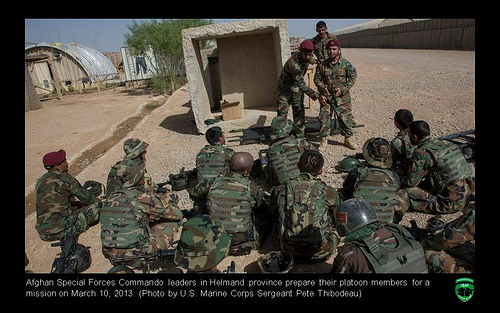
Because I follow the issue of training Afghan forces very closely, I clicked on an article today from TOLONews on graduation of a new group of Afghan Special Forces soldiers. One tidbit in the article caught my eye (emphasis added):

About 200 soldiers on Thursday graduated to the special operations forces of the Afghan National Army, ready to be deployed to the frontlines of the war against insurgents, army official said.

Deputy Chief of Army Staff Gen Azal Aman said at a graduation ceremony for the new commandos that the soldiers had been professionally trained and people should trust them as they are now responsible for the security of major parts of the country.

The ANA soldiers received 12 weeks of intense training to graduate to do special operations.

Hmmm. To be in Afghan Special Forces, it only takes 12 weeks of training? Here is what it takes to be labelled Special Forces for the US:

Like all soldiers, SF candidates begin their career with nine weeks of Boot Camp. Upon completion of Basic Combat Training you will attend Advanced Individual Training. For Special Forces, you will go to Infantry School to learn to use small arms, anti-armor, and weapons like howitzers and heavy mortars. Basic Combat Training lasts 9 weeks, AIT lasts four weeks, and Airborne last 3 weeks. All take place at Fort Benning, Georgia.

After graduating AIT your training will continue with the following schools:

  • Army Airborne School – 3 weeks in Ft Benning GA
  • Special Operations Preparation Course (SOPC)  – 4 weeks in Ft Bragg NC
  • Special Forces Assessment and Selection (SFAS) – 3 weeks in Ft Bragg NC
  • Special Forces Qualification Course (SFQC) – 34 -76 weeks depending upon MOS Specialty
  • Live Environment Training (LET) –  Immersion Training in foreign countries – varies in time.

Depending upon your MOS within Special Forces Training, the process of completing these schools can take 14-18 months.

Okay then. Afghan Special Forces are so special that they can get the name after only 12 weeks of training but US soldiers need up to 18 months of training to be Special Forces. And yet, as we saw above, “people should trust them as they are now responsible for the security of major parts of the country”. That should work out just swell.

Share this entry

SIGAR: Widely Cited 352,000 ANSF Force Size Is Not Validated

The January 2013 Special Inspector General for Afghanistan Reconstruction report has been out for some time now, but @SIGARHQ has still been tweeting about it regularly. One of their tweets yesterday brought my attention to the section of their report (pdf) where they discuss force size for Afghan National Security Forces. Since the interruption in training brought about by decreased interactions between US and Afghan forces during the  massive outbreak of green on blue attacks, I have maintained that the claim of 352,000 for ANSF force size was no longer credible. It appears that my skepticism is well-founded, as the pertinent section of the SIGAR report bears this heading:

ANSF NUMBERS NOT VALIDATED

The section begins:

Determining ANSF strength is fraught with challenges. U.S. and coalition forces rely on the Afghan forces to report their own personnel strength numbers. Moreover, the Combined Security Transition Command-Afghanistan (CSTC-A) noted that, in the case of the Afghan National Army, there is “no viable method of validating [their] personnel numbers.” SIGAR will continue to follow this issue to determine whether U.S. financial support to the ANSF is based on accurately reported personnel numbers.

There are several important bits to unpack in that paragraph. First, note that even though the US (well, officially, NATO) is training the Afghan forces, it is the Afghans themselves who report on their force size. It appears that our training of the Afghans, however, has not trained them on how to count personnel in a way that can be validated. But the end of the paragraph is the kicker, because it appears that our financial support of the Afghans is based on their own reporting of the force size. Since we are paying them for the force size they report, why wouldn’t they inflate the numbers to get paid as much as possible? The Afghans know that the bulk of US policy is built around the 352,000 force size myth, so they know that there will be absolutely no push-back (aside from an obscure SIGAR report that only DFH’s will read) for inflating the number to get the result the US desires. For further enticement, recall that NATO has proposed extending the time over which a force size of 352,000 will be supported, in a move that I saw as a blatant attempt to dangle an additional $22 billion ready for embezzling in front of Afghan administrators.

It comes as no small surprise, then, that SIGAR has found that the Afghan-reported numbers somehow manage to include over 11,000 civilians in the reports for security force size that is specifically meant to exclude civilian personnel.

A related area in which SIGAR has found a disgusting level of dishonesty is in how the US goes about evaluating Afghan forces in terms of readiness. Because it became clear to the trainers in 2010 that they had no hope of achieving the trained and independent force size numbers that NATO planners wanted (and because SIGAR found that the tool they were using at the time was useless), they decided that the only way to demonstrate sufficient progress was to redefine the criteria for evaluating progress. From the report: Read more

Share this entry

Once Again, US Pretends to Hand Over Control of Parwan Prison, Holds Back Some Prisoners

Stop me if you’ve heard this one before. We have headlines at multiple news outlets trumpeting that the US has ceded control of Parwan Prison (newly re-named today as the Afghan National Detention Facility at Parwan!), but when we drill down just a bit, we see that the US can never truly let go of its love of indefinite detention without trial, and so they have held back a few prisoners from today’s deal. Rod Nordland and Alissa Rubin do the best job of cutting through the US reliance on deception and semantics with their article in today’s New York Times, where even the headline writer got into the spirit of seeing this “agreement” as it really is: “U.S. Cedes Control, Almost, on Afghan Prisoners“.

At the heart of the long-standing difficulty in handing over control of the Parwan facility has been the US insistence that some prisoners be maintained indefinitely without charge while Afghanistan has continued to point out that the rule of law should prevail and all prisoners deserve a trial to determine their guilt. Nordland and Rubin were fed a list of recidivist Taliban figures who have been released by Afghanistan only to return to battle, but they did not allow that information to cloud their reporting on the fact that the US has held back some prisoners in the handover:

The American military formally transferred all but “a small number” of the Afghan prisoners at the Bagram Prison to the Afghan government on Monday in a ceremony that almost, but not quite, marked the end of the American involvement in the long-term detention of insurgents here.

/snip/

Afghan officials said the review boards will no longer exist and all prisoners at Bagram, present and future, will go straight into normal judicial proceedings. American officials, however, said they expected the Afghans to maintain review boards, but without American participation. The difference may be a semantic one, as Afghans expect teams of prosecutors to review which prisoners are released and which are prosecuted in court.

An American military official in Kabul insisted that the military has confidence that those insurgents whom the United States views as enduring security threats would not be released easily or quickly. “These people pose a threat to Afghan soldiers and Afghan civilians, too,” the official said. “We’re confident they will have appropriate measures in place to ensure dangerous detainees don’t pose a threat to Afghan and coalition forces.”

The Americans have long argued for a nonjudicial review process and a way to hold insurgent prisoners in long-term administrative detention, because of the difficulty of building criminal cases under battlefield conditions. Americans have argued that without such a system, soldiers in the field may be tempted to kill rather than capture insurgents. Afghan officials objected that administrative detention was unconstitutional.

We get a bit more information on the prisoners held back in the AP story carried in the Washington Post:

The detention center houses about 3,000 prisoners and the majority are already under Afghan control. The United States had not handed over about 100, and some of those under American authority do not have the right to a trial because the U.S. considers them part of an ongoing conflict.

There are also about three dozen non-Afghan detainees, including Pakistanis and other nationals that will remain in American hands. The exact number and nationality of those detainees has never been made public.

“They are not the priority of the Afghan government so the Americans can keep them for the time being. Our priority are the Afghan detainees,” Afghan Defense Ministry spokesman Gen. Zahir Azimi said.

The US sweetened the pot today with an extra $39 million in funding for the facility on top of the approximately $250 million it has already spent building and maintaining it.

Both Afghan news sources I follow, Khaama Press and TOLONews, run straight stories today reporting full handover without mentioning the prisoners that the US is holding back.

All coverage of today’s handover agreement that I have read does place it in the context of the next agreement that is required on whether US troops remaining behind after the NATO withdrawal at the end of 2014 will have criminal immunity. (I must have made too many SOFA jokes in post headlines, because now all US news sources refer to the need for a “bilateral security agreement” rather than a “status of forces agreement”.) The timing for getting today’s agreement in place is quite significant, as John Kerry has suddenly appeared in Afghanistan, presumably to do a bit of SOFA shopping. I’m guessing he will promise a very good purchase price.

Update: The New York Times article has mutated and no longer has the headline that was so revealing. New headline: “Amid Fears of Releases, U.S. Cedes Prison to Afghanistan”. Oh well, the clear explanation lasted for a while and even still lingers in the url of the article.

Share this entry

Agreement Announced on Special Operations Forces in Wardak Province, Explanations Vary Widely

NATO is claiming that there now is an agreement with Afghan President Hamid Karzai regarding the withdrawal of US Special Operations Forces from Maidan Wardak province in the wake of Karzai’s insistence last month that the troops leave immediately. Despite the presence of an agreement, however, there appear to be many different explanations for just what the agreement means for how long US SOF will be present in the province. Given the history of the US bargaining with Afghanistan in bad faith (see, for example, this post on the Parwan Prison handover and work backwards in time through the links and this post for a description of US reliance on semantics in making these sham agreements), it is not at all surprising to me that these initial reports on the agreement would cite a lack of specificity and that different news organizations would come up with widely differing descriptions of its expected effects.

Reuters puts its doubts about the meaning of the agreement right up front in its report:

Afghan President Hamid Karzai and NATO-led forces have reached an agreement on the departure of foreign troops from a strategically key province near the capital, coalition forces said, but it was unclear if U.S. special forces would leave.

An Afghan defense ministry spokesman told reporters in Kabul that the elite American force would quit Wardak within a few days, despite earlier U.S. concerns that their departure would leave a security vacuum.

The NATO-led International Security Assistance Force (ISAF) in Afghanistan said in a statement Afghan security forces would take over security from coalition forces in Wardak, but did specifically mention the withdrawal of U.S. special forces.

Note that Reuters knows that ISAF statements must be parsed carefully and they do a good job here of warning us that ISAF did not state outright that US SOF would leave the province.

Writing for AP, Kimberly Dozier provides less analysis of the statements received, and so her report provides conflicting information from ISAF and from an Afghan spokesman. The article opens:

The U.S. military and the Afghan government reached a deal Wednesday on a gradual pullout of American special forces and their Afghan counterparts from a contentious eastern province, officials said.

President Hamid Karzai has blamed the troops for egregious human rights abuses in Wardak province, allegations which U.S. military officials have steadfastly denied.

However, NATO forces said in a statement that commander Gen. Joseph Dunford agreed with Karzai to remove American troops first from Wardak’s Nerkh district and then later from other parts of the province.

But then the information from an Afghan spokesman presented next appears to conflict with the ISAF information:

Afghan Defense Ministry spokesman Gen. Zahir Azimi confirmed there has been a deal in a news conference in Kabul on Wednesday.

“The international forces are ready to withdraw the special forces from Nirkh district of Maidan Wardak province and Afghan army units are going to replace them in the coming days,” Azimi said, adding that there are no other U.S. commando units in the rest of the province.

A U.S. military official explained that a small, mostly U.S. army special operations team would withdraw from Nerkh, as would the Afghan local police force that works alongside the Americans.

Azimi states outright that the only US Special Operations Forces in Wardak are in the Nerkh district and that these will be withdrawn. Dozier misses the point that Reuters parsed out, namely, that it appears that ISAF speaks of US forces withdrawing from the province while being silent on whether SOF also would withdraw.

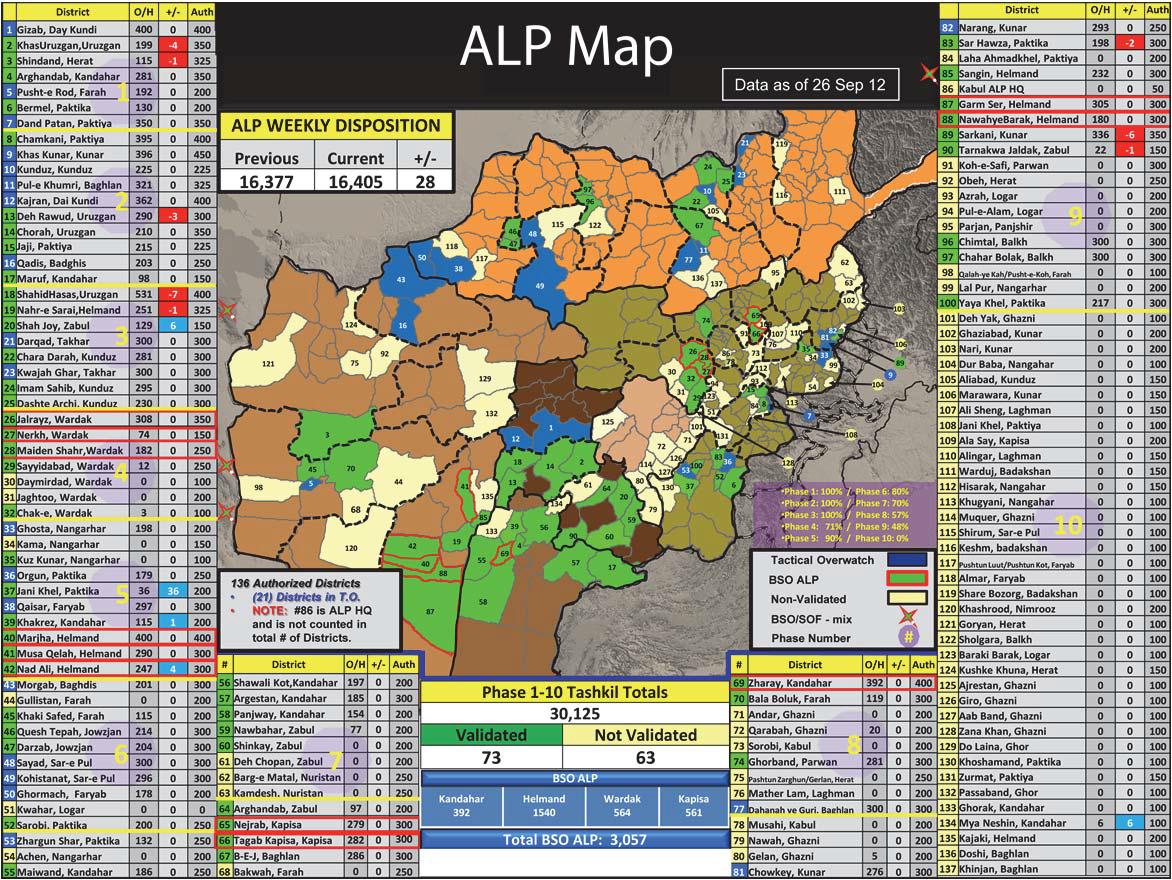
There is a larger problem with Dozier accepting Azimi’s statement at face value, though. In this post, I addressed what is known (unfortunately, September, 2012 is the latest information from this map) about Afghan Local Police presence in Wardak: Read more

Share this entry

Dick Cheney’s Biggest Strategic Failure

Screen shot 2013-03-19 at 12.15.49 PMDick Cheney’s biggest failures are surely moral. The hundreds of thousands of Iraqis killed, senselessly. The thousands of Americans killed, senselessly. The hundreds of thousands, perhaps over a million, on both sides, maimed and poisoned and scarred both physically and mentally.

Senselessly.

See Juan Cole and Tomas Young (who will shortly die from wounds suffered in the Iraq War) for an accounting of that cost.

But there has been far too little accounting of the cost of Dick Cheney’s strategic choices.

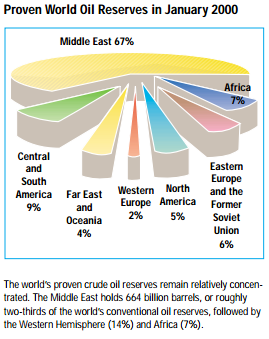
Dick Cheney spent the first several months of the Bush Administration assessing where the US would get its energy in future years and how that would sustain our hegemonic role in the world. In his autobiographical novel, published in 2011, he had this to say about his Energy Task Force.

The report is one I am very proud of. I commend it to anyone looking to understand America’s energy challenges still today.

[snip]

The environmental groups that criticized the report are all too often, in my experience, opposed to any increase in the production of conventional sources of energy. They don’t want to drill anyplace. They don’t want to mine coal anyplace. They seem to believe we can depend on alternative sources of energy, such as solar or wind. It’s my view — and it’s the view reflected in the report — that while we should develop alternative sources, in the final analysis, we can’t effectively address our energy problems in the near term nor can we remain competitive in the global economy unless we also produce more energy from conventional, domestic sources.

Right now, none of the alternative sources of energy can compete economically with petroleum and coal and other conventional sources. It’s also the case that time and time again, we have found that developing alternative sources has undesirable, unanticipated consequences. The push for ethanol fuel produced from corn, for example, resulted in driving the price of a bushel of corn up significantly. This had a huge impact on people who used corn for purposes other than fuel — purposes that weren’t subsidized. Cattleman, for example, were suddenly faced with significantly higher feed prices. [my emphasis]

While Cheney’s report did have a chapter on “Nature’s Power,” (which is not, interestingly, one of the two he accused critics of having not read), just one paragraph on any alternative source of power but hydropower shows up on the chapter on “Energy for a New Century.”

Hydropower is, to date, the most successful form of renewable energy. However, some forms of renewable energy generation—wind, geothermal, and biomass— have the potential to make more significant contributions in coming years, and the cost of most forms of renewable energy has declined sharply in recent years. The most important barrier to increased renewable energy production remains economic; nonhydropower renewable energy generation costs are greater than other traditional energy sources. The following chapter discusses renewable and alternative energy in greater detail

Never mind that Cheney’s understanding of the competitiveness of alternatives by 2011, particularly with coal, which the report boosted aggressively, was badly mistaken.

He argued in 2011 — 10 years after 9/11 and 7 years after the Iraq War had descended into a clusterfuck — that alternative energy has some nasty unintended consequences (he might have a point if he talked about how Ethanol contributed to increase food insecurity for actual human beings, which contributes to political instability, but apparently he sees feeding Americans cheap grain fed beef to be a higher priority).

And of course, the nasty unintended consequence that is climate change did not show up in this discussion in the least.

On May 16, 2001, Dick Cheney released a report declaring (based partly on a shortage in CA artificially caused by Enron) an energy crisis, and proposing recommendations to bring more fossil fuels online quickly, as well as nuclear power.

America in the year 2001 faces the most serious energy shortage since the oil embargoes of the 1970s.

[snip]

This imbalance, if allowed to continue, will inevitably undermine our economy, our standard of living, and our national security.

[snip]

Present trends are not encouraging, but they are not immutable. They are among today’s most urgent challenges, and well within our power to overcome. Our country has met many great tests. Some have imposed extreme hardship and sacrifice. Others have demanded only resolve, ingenuity, and clar­ ity of purpose. Such is the case with energy today.

We submit these recommendations with optimism. We believe that the tasks ahead, while great, are achievable. The en­ergy crisis is a call to put to good use the re­sources around us, and the talents within us. It summons the best of America, and offers the best of rewards – in new jobs, a healthier environment, a stronger economy, and a brighter future for our people.

Four months later, 19 Arabs, 15 of whom were Saudis, destroyed the World Trade Center and damaged the Pentagon. All of them were motivated, in part, by America’s increasing presence in the Middle East.

Read more

Share this entry

No SOFA? Then Transition Death Squad Control from Special Operations to CIA

A little over a year ago, Greg Miller outlined what he said would be the CIA’s roles in Iraq and Afghanistan in the near future.  It appears now that he was only half right:

The CIA is expected to maintain a large clandestine presence in Iraq and Afghanistan long after the departure of conventional U.S. troops as part of a plan by the Obama administration to rely on a combination of spies and Special Operations forces to protect U.S. interests in the two longtime war zones, U.S. officials said.

/snip/

The withdrawal of U.S. forces from Iraq in December has moved the CIA’s emphasis there toward more traditional espionage — monitoring developments in the increasingly antagonistic government, seeking to suppress al-Qaeda’s affiliate in the country and countering the influence of Iran.

In Afghanistan, the CIA is expected to have a more aggressively operational role. U.S. officials said the agency’s paramilitary capabilities are seen as tools for keeping the Taliban off balance, protecting the government in Kabul and preserving access to Afghan airstrips that enable armed CIA drones to hunt al-Qaeda remnants in Pakistan.

Note that bit about the US withdrawing all of its troops from Iraq in December of 2011. The full withdrawal of course wasn’t what the US intended, but was a result of the botched negotiations for a Status of Forces Agreement that would confer immunity to US troops who remained behind in Iraq after the official “withdrawal”. A significant portion of those troops that would have been left behind would have been Special Operations Forces to train and control counterinsurgency militia groups. We were reminded just last week that these groups in Iraq were responsible for so many atrocities that they became known as death squads. As I pointed out, Petraeus’ counterinsurgency program in Afghanistan was built in the same way.

We have a report today in the Wall Street Journal that shows Miller’s prediction of “espionage only” for the CIA’s role in Iraq was wrong, as militias formerly trained and run by Special Operations Forces are now under CIA control (h/t to Joanne Leon for tweeting me a link to this article):

In a series of secret decisions from 2011 to late 2012, the White House directed the CIA to provide support to Iraq’s Counterterrorism Service, or CTS, a force that reports directly to Iraqi Prime Minister Nouri al-Maliki, officials said.

The CIA has since ramped up its work with the CTS—taking control of a mission long run by the U.S. military, according to administration and defense officials. For years, U.S. special-operations forces worked with CTS against al Qaeda in Iraq. But the military’s role has dwindled since U.S. troops pulled out of the country at the end of 2011.

In Afghanistan, it turns out that the CIA trained its own secret militia very soon after arriving there. Kimberly Dozier and Adam Goldman described the CIA’s Afghan militia back in 2010: Read more

Share this entry

Iran, Pakistan Break Ground on Gas Pipeline, Capping Horrible Week for US in Region

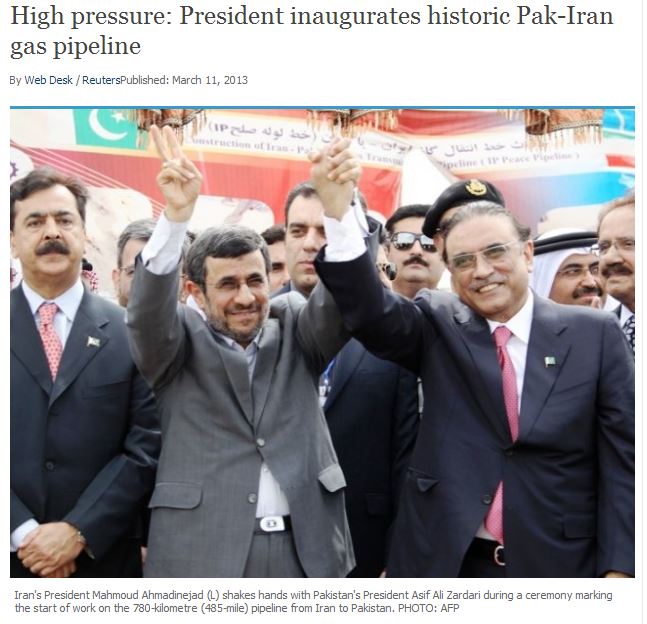
Headline and photo from Pakistan's Express Tribune announcing the pipeline groundbreaking ceremony.

Headline and photo from Pakistan’s Express Tribune announcing the pipeline groundbreaking ceremony. The image could be an old one, since that is Pakistan’s former Prime Minister Yousaf Raza Gilani on the left.

On Saturday, the ceremony to transfer final control of the Detention Facility in Parwan to Afghanistan was canceled at the last minute as the US once again tried to maintain veto power over Afghan decisions on which prisoners to free. This occurred amid a backdrop of a range of other events demonstrating how the US is trapped in a quagmire in Afghanistan and yesterday was no better, as Karzai ratcheted up his rhetoric even further, prompting cancellation of the joint press appearance featuring Karzai and Chuck Hagel, who was making his first trip to Afghanistan as the new US Secretary of Defense.

Today caps the shitstorm in the region, as we have yet another green on blue attack, and although it is very early in sorting out details, it appears to involve US Special Forces in Maidan Wardak province, where Karzai had made today the deadline for SOF to withdraw from the province over allegations of widespread atrocities at the hands of groups claiming to be affiliated with and/or trained by US SOF. But US pain and embarrassment spread further out into the region immediately surrounding Afghanistan today, as Pakistan’s President Asif Ali Zardari and Iranian President Mahmoud Ahmadinejad made a joint appearance to commemorate the official ground-breaking for construction of Pakistan’s side of the Iran-Pakistan gas pipeline. From the PressTV account of the event, we get some background:

The 1,600-kilometer pipeline, projected to cost USD 1.2-1.5 billion, would enable the export of 21.5 million cubic meters of Iranian natural gas to Pakistan on a daily basis.

Iran has already constructed more than 900 kilometers of the pipeline on its soil.

Tehran-based Tadbir Energy Development Group will reportedly undertake all engineering procurement and construction work for the first segment of the project, which starts from the Iran-Pakistan border and costs around USD 250 million.

The Iranian firm will also carry out the second segment of the project, and extend the financing later to USD 500 million.

The Express Tribune relates the history of the US trying to prevent the pipeline being built:

The two sides hope the pipeline will be complete in time to start delivery of 21.5 million cubic metres of gas per day to Pakistan by December 2014.

The US has issued warnings to invoke economic sanctions already in place against Iran if Pakistan went ahead with its plans to import natural gas from the Islamic republic.

The United States has steadfastly opposed Pakistani and Indian involvement, saying the project could violate sanctions imposed on Iran over nuclear activities that Washington suspects are aimed at developing a weapons capability. Iran denies this.

India quit the project in 2009, citing costs and security issues, a year after it signed a nuclear deal with Washington.

Isn’t that interesting? The pipeline could come online the same month that NATO troops are scheduled to end their involvement in Afghanistan. That could well be why we see this paragraph in the Fars News story on the pipeline:

During the meeting at the international airport of the Southeastern Iranian port of Chabahar today, Ahmadinejad and Zardari said that the gas pipeline will further strengthen the economic, political and security relations between Tehran and Islamabad and other regional states.

US presence in the region clearly has been a destabilizing force. Iran and Pakistan appear to be taking steps toward what they hope will be improved stability once we are gone.

Share this entry

18 USC 1119 Foreign Murder and Obama Targeted Kill White Paper

Back in February, when the “White Paper” was first “leaked”, Marcy wrote a fantastic article entitled Article II or AUMF? “A High Level Official” (AKA John Brennan) Says CIA Can Murder You on the issues of Article II authority versus AUMF authority in relation to the Obama targeted killing program. First off, let me say that the the lack of recognition of the presence of both these these respective authorities in the targeted killing program, even among legal commentators I respect greatly, is one of, if not the, most discouraging aspects of the discussion being had. Sadly, the big filibuster by Sen. Rand Paul did not necessarily improve the understanding, and even the New York Times continues to propagate the misdirection and misinformation peddled by the Obama Administration.

I wish to discuss the interaction of the statutory law contained in 18 USC 1119, the “Foreign Murder statute”, with the greater Obama Administration Targeted Killing Program, and the White Paper foundation for it. Specifically I want to point out the circular and disingenuous way in which the White Paper tries to bootstrap itself, and the Administration, around criminal liability for murder in the case of a targeted US citizen such as Anwar Awlaki. Frankly, Marcy let fly with another must read post on 18 USC 1119 and the White Paper yesterday in the wake of the New York Times sop to the Administration, and it filets both the White Paper, and the NYT, open at the seams.

The most important principle to understand about the White Paper’s discussion of 18 USC 1119 is, as Marcy noted, that it is impertinent if the the law of war (formally the “Law of Armed Conflict” or “LOAC”) is truly in play. In short, if the Administration is using the AUMF – military force – in an active battle situation, there is no need for further discussion, whether Mr. Awlaki is a US citizen or not. That, of course is diametrically opposed to what the facts were at the action point with Awlaki, and that we now know.

The truth is the Administration used a civilian agency, the CIA, to kill a US citizen without judicial due process, far from the “hot battlefield” and that is why such a deliberate attempt was made in the White Paper to obfuscate the legal basis for their targeting and killing, and why such a seemingly inordinate time was spent in the White Paper on a traditional criminal law statute, 18 USC 1119.

The statutory language of 18 USC 1119 states:
Read more

Share this entry

Prison Handover Agreement Blows Up, Again, During Hagel’s First Visit to Afghanistan Quagmire

Exactly one year ago today, I posted on the agreement in principle that would hand over the Detention Facility in Parwan, located near Bagram Air Base, to full Afghan control. I noted at the time however, that the “agreement” depended heavily on semantics and that the US was in fact doing its best retain as much control as possible:

The agreement appears to use semantics to say that the prisons are being handed over today, but with the reality being that there will be a gradual process taking six months. From the New York Times:

The memorandum of understanding would officially hand over control of detainees to an Afghan official as of Friday, but would also allow for a six-month period of transition to full Afghan control of the American-held detainees, American officials said.

As a practical matter, American officials are expected to maintain day-to-day control over the 3,200 detainees, most of them suspected Taliban insurgents.

During the six months, custody of the American-held prisoners would gradually transfer to Afghan authority, with the first 500 prisoners to be transferred within 45 days, according to American military and diplomatic officials who spoke on condition of anonymity as a matter of policy.

The move is a major concession to the Afghans, but the Americans will retain ultimate veto authority over releases of any insurgent detainees as long as American troops are in Afghanistan, and will continue to monitor humane treatment of the prisoners, the American officials said.

With the US maintaining veto power over release of any prisoners, perhaps Senator Graham will have to hold off on throwing his next tantrum, as his major objection to the handover had been that the Afghans would release prisoners who would immediately attack US troops. It’s not clear how the US will be monitoring humane treatment of the prisoners, since it is US training that put the torture methods in place to begin with.

The six month gradual handover phase has now been a full year, during which we have seen many rough patches. At the six month mark, I noted that the US balked on finalizing the handover because the Afghans refused to put into place a system for indefinite detention without trial. But throughout this process, the key really has been that the agreement itself has been a sham (just as with most of our agreements with Afghanistan) primarily because the US continues to maintain that it has final veto power on Afghan decisions to release prisoners.

On Wednesday of this week, the dispute over prisoner release came to a head, as Afghan President Hamid Karzai announced to the Afghan parliament that the final handover of Parwan would take place today and that he would immediately release a number of prisoners he said are innocent. Unsurprisingly, the US today unilaterally cancelled the final handover ceremony, throwing the whole agreement into disarray. From the New York Times: Read more

Share this entry

Guardian Lays Out Details of How Petraeus Organized Death Squads in Iraq

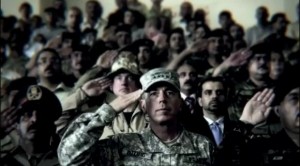
Petraeus salutes the death squads that advanced his career

Petraeus salutes the death squads that advanced his career

Yesterday, the Guardian published an article detailing how the US turned to the use of death squads in Iraq to quell the rise of Sunni militias. The article provides convincing evidence that this was an intentional policy and was in fact a central tenet of David Petraeus’ often-praised counterinsurgency, or COIN, strategy. The key person in the Guardian’s reporting is James Steele, who was a veteran in organizing Central American death squads on behalf of the US during the Reagan years.

In reading the material from the Guardian, however, it should be kept in mind that Petraeus did not institute his COIN strategy only in Iraq. He put it into place in Afghanistan as well, and the fact that it lead to widespread allegations of torture and murder there demonstrates that the atrocities committed by these militias is a feature of the funding and training provided to them and not an unfortunate outgrowth, because this practice has now produced death squads in Central America, Iraq and Afghanistan. Recall that less than two weeks ago, Hamid Karzai called for the expulsion of US Special Operations forces from Maidan Wardak province due to allegations of abuse by the Afghan Local Police there. The Afghan Local Police are in reality groups of local militias trained and funded by US Special Operations forces and operating separately from the Karzai government. The ALP became one of the primary features of Petraeus’ COIN strategy when he moved it to Afghanistan.

Here’s the opening of the Guardian article:

The Pentagon sent a US veteran of the “dirty wars” in Central America to oversee sectarian police commando units in Iraq that set up secret detention and torture centres to get information from insurgents. These units conducted some of the worst acts of torture during the US occupation and accelerated the country’s descent into full-scale civil war.

Colonel James Steele was a 58-year-old retired special forces veteran when he was nominated by Donald Rumsfeld to help organise the paramilitaries in an attempt to quell a Sunni insurgency, an investigation by the Guardian and BBC Arabic shows.

Via email, my friend Kirk pointed out this report from Newsweek back in early 2005 where the concept of the Salvador option was floated openly by the Bush administration:

What to do about the deepening quagmire of Iraq? The Pentagon’s latest approach is being called “the Salvador option”–and the fact that it is being discussed at all is a measure of just how worried Donald Rumsfeld really is. “What everyone agrees is that we can’t just go on as we are,” one senior military officer told NEWSWEEK. “We have to find a way to take the offensive against the insurgents. Right now, we are playing defense. And we are losing.” Last November’s operation in Fallujah, most analysts agree, succeeded less in breaking “the back” of the insurgency–as Marine Gen. John Sattler optimistically declared at the time–than in spreading it out.

Now, NEWSWEEK has learned, the Pentagon is intensively debating an option that dates back to a still-secret strategy in the Reagan administration’s battle against the leftist guerrilla insurgency in El Salvador in the early 1980s. Then, faced with a losing war against Salvadoran rebels, the U.S. government funded or supported “nationalist” forces that allegedly included so-called death squads directed to hunt down and kill rebel leaders and sympathizers. Eventually the insurgency was quelled, and many U.S. conservatives consider the policy to have been a success–despite the deaths of innocent civilians and the subsequent Iran-Contra arms-for-hostages scandal. (Among the current administration officials who dealt with Central America back then is John Negroponte, who is today the U.S. ambassador to Iraq. Under Reagan, he was ambassador to Honduras. There is no evidence, however, that Negroponte knew anything about the Salvadoran death squads or the Iran-Contra scandal at the time. The Iraq ambassador, in a phone call to NEWSWEEK on Jan. 10, said he was not involved in military strategy in Iraq. He called the insertion of his name into this report “utterly gratuitous.”)

The most disgusting aspect of this apparent “trial balloon” floated by the Bush administration is that the program quite possibly was already underway when the Newsweek article came out. The Guardian article reminds us that Petraeus, the architect of this program,  was sent to Iraq in June of 2004 (this was his second deployment to Iraq) to begin training Iraqis, and the Newsweek article wasn’t published until January of 2005. Steele, who was reporting directly to Rumsfeld, first went to Iraq in 2003 (Rumsfeld delighted in running his own people separately from the chain of command; he did this at times with McChrystal as well).

More evidence that the program was entirely intentional comes from the role of torture in the program and the moves the US made to ignore torture just as the program was put into place. Read more

Share this entry