Graphing the Afghanistan Surge Out of Existence

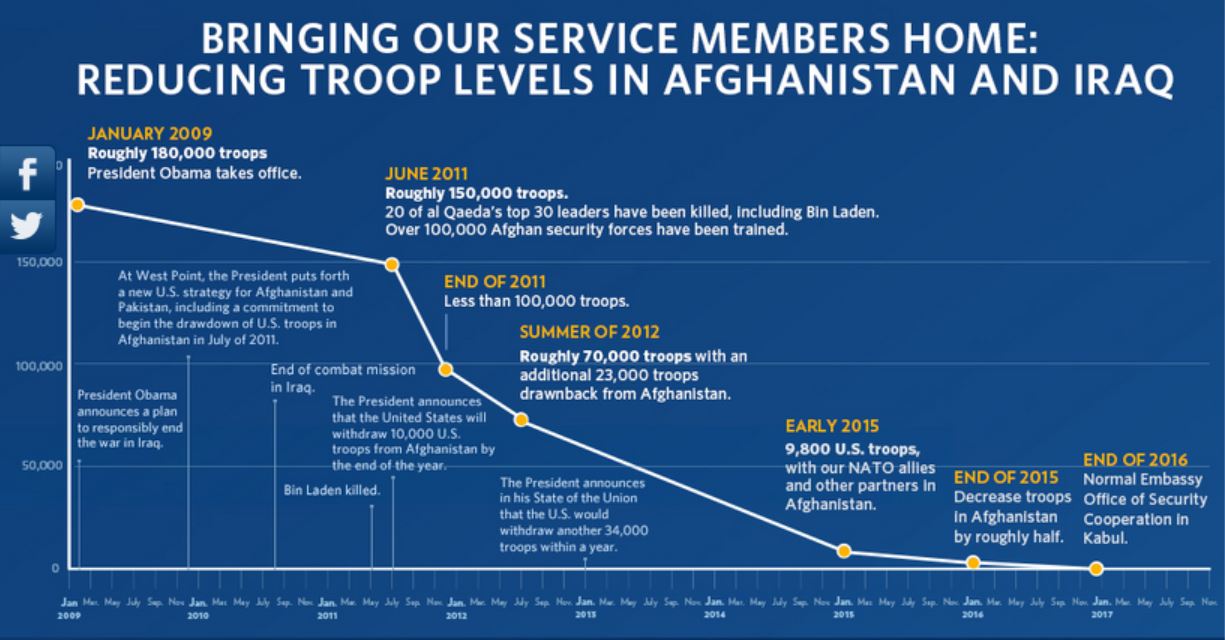
On Wednesday, Jason Leopold tweeted this image that had been released by the White House:

What surge?

What surge?

Marcy quickly responded, “Funny how you can graph surge out of existence.” 

So how did the White House make Obama’s surge of troops into Afghanistan disappear? Consider this graph of troop levels in Afghanistan, where we see the surge of US troops into Afghanistan standing out clearly:

Afghanistan troop levels.

Afghanistan troop levels.

This graph shows what we are used to seeing for Afghanistan, where troop levels were only around 35,000 when Obama took office in 2009 and surged to almost 100,000 in 2010, remaining at that level through most of 2011, as well. So how did the White House hide this surge in their feel-good “bringing home the troops” message? They did it by making the graph include both Iraq and Afghanistan.

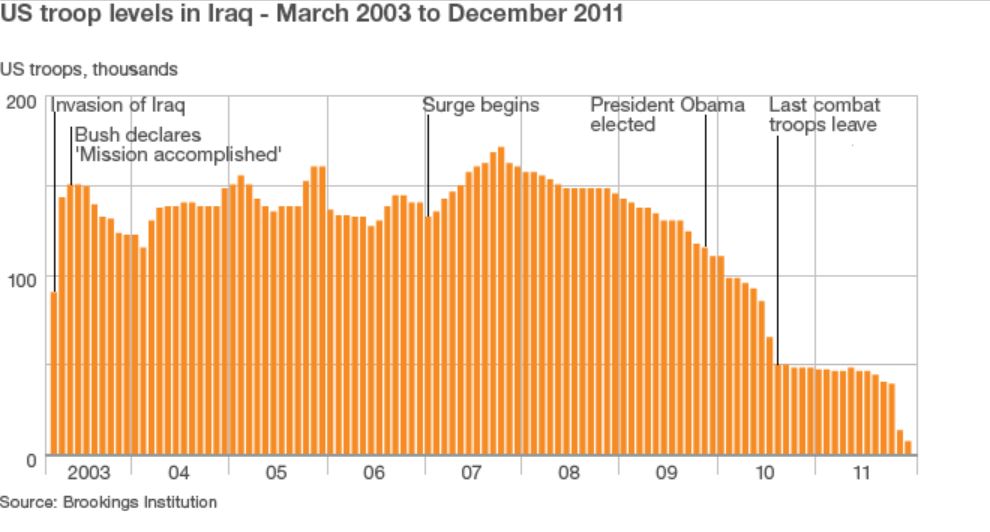
Here are the troop levels for Iraq:

Iraq troop levels.

Iraq troop levels.

There were around 150,000 US troops in Iraq when Obama took office and by the time his Afghanistan surge (remember, Obama campaigned about Afghanistan being the “good war”) reached its peak in late 2010, Iraq troop levels had dropped to around 50,000 (although Obama waved his hand and declared that these were no longer “combat troops”). So, with a net loss of 100,000 troops  in Iraq during the same time period, the White House was able to make it appear that the surge of about 65,000 troops into Afghanistan never happened.

Maybe next week the White House can graph that pesky inequality of capital distribution out of existence. I’m sure it will make us all feel richer.

Share this entry

Did Obama’s Handling of Karzai When Visiting Kabul Put Bilateral Security Agreement at Risk?

Demonstrating once again that electoral politics trumps all other considerations for his administration, Barack Obama mostly went along with the military’s recommendation (successful US political campaigns NEVER contradict the military) on troop levels in Afghanistan after this year, announcing a force size of 9800 after the military had requested 10,000 to 12,000 troops. Even the one instance of bucking military hawks comes from an electoral standpoint, as he announced that the force size will be cut in half after a year and then taken to only a handful by the end of 2016, which magically coincides with when Obama expects to triumphantly ride off into the sunset. Republicans are upset about an announced end to the troop presence, rather than allowing “conditions on the ground”, which is shorthand for letting the military do what it damn well pleases, to dictate force levels, but Obama seems to think that putting the end of our troop presence just before the next presidential election will get troops out at the one time electoral blowback will be minimized.

Obama’s announcement came with a large helping of arrogance in the handling of his invitation to meet with Karzai during the surprise visit to Kabul over the weekend. Although Obama fully intended his poor treatment of Karzai, he seems to have raised the ire of many more Afghans with his actions. Will that put the Bilateral Security Agreement, on which his troop size plan depends, at risk? From Khaama Press:

President Hamid Karzai was praised by Afghans for rejecting the invitation by President Barack Obama to meet him in Bagram air base.

A last-minute invitation was sent to President Karzai to come to Bagram air base as Obama arrived to Afghanistan on Sunday following an unannounced visit to meet with the US troops.

White House officials said, “We did offer him the opportunity to come to Bagram, but we’re not surprised that it didn’t work on short notice.”

Obama’s plan on troop levels is fully dependent on the winner of next month’s presidential runoff signing the Bilateral Security Agreement that Karzai has refused to sign. Although both Abdullah and Ghani have said they will sign it, their responses to the handling of Karzai are very interesting. Returning to the same Khaama Press article:

In the meantime, Abdullah Abdullah, one of the leading candidates in Afghanistan’s presidential race, said the decision by President Karzai not to go to Bagram was “respectful to the people of Afghanistan.”

Ashraf Ghani Ahmadzai, one of the other leading candidates, told Wall Street Journal in an interview that he wasn’t privy to the security discussions surrounding Mr. Obama’s visit.

Some Afghans saw the episode as a deliberate snub and said the U.S. leader didn’t respect diplomatic protocol.

Ghani said, “We do understand security concerns, but adhering to protocol helps cementing relationships.”

Obama has set himself up for a huge problem here. It looks as though both Abdullah and Ghani are indicating that they expect to be treated with the respect due to the office of President. Should Obama continue his cavalier attitude of simply assuming the BSA will be signed once the winner is sworn into office, he could be in for a big surprise.

On the other hand, there are still the four billion US dollars every year that come with our continued presence (and all the attendant opportunities for embezzlement), so perhaps in the end Obama can continue his arrogance without fear of consequences. With that in mind, the role of that final handful of military personnel to be left in Afghanistan after 2016 stands out. From the Washington Post article linked above:

At the end of that year, the force will shrink to the size of a regular armed forces assistance group, largely to handle military sales, under the authority of the U.S. ambassador.

Even after our troops are gone, the US will do everything it can to keep enriching military contractors.

Share this entry

Afghan Election Commission Fires 3300 Staffers, But Runoff Will Proceed in Most Corrupt Place on Earth

Reuters brings us the shocking news that the election commission in Afghanistan has just fired over 3000 staffers even though the runoff election for President is only about three weeks from now on June 14:

Afghanistan’s election commission said on Wednesday it had fired more than 3,000 staff accused of fraud in the first round of the country’s presidential election, as it sought to quell fears that it might fail to deliver a legitimate outcome.

/snip/

Spokesman Noor Mohammad Noor said the Independent Election Commission had blacklisted the fired staff, so that they would not be hired in the second round.

“Some fraud was reported from those polling stations,” he added, referring to the sites where the fired staff had worked.

Independent election monitors say many complaints were ignored in the effort to meet deadlines and the decision making process lacked transparency.

It appears that threats of violence may have been behind the earlier decision to ignore the fraud:

Runner-up former World Bank economist Ashraf Ghani said most fraudulently cast votes were included in the final tally because of threats from rival candidates.

“Threats of violence, where the opposing team promised rivers of blood, created a chilling environment,” Ghani said in a statement after the final results were released.

“Close to 800,000 votes that should have been declared fraudulent were included in the final count.”

Although Reuters says that the election commission announced the firings today, ToloNews carried the story on on May 18:

The Independent Election Commission (IEC) sent out a notice on Sunday to their staff warning them that any sort of fraud happens during runoff under their staffs’ supervision will be terminated.

“This time we will seriously deal with the issue,” IEC Spokesman Noor Mohammad Noor said. “Those staff members who were found guilty in the first round of elections have been dismissed.”

/snip/

The IEC has identified and dismissed 3,300 IEC employees who were involved in the manipulation of the first round of presidential elections.

Firing thousands of staffers just before the runoff has to be unprecedented. Except that it isn’t. It turns out that the same thing happened just before the scheduled runoff in 2009:

Half of the most senior Afghan district election officials will be fired, U.N. officials said on Wednesday, to prevent more fraud in a run-off presidential poll crucial to the country’s credibility and foreign support.

That announcement came on October 21, 2009, when the runoff had been scheduled for November 7, so it came even closer to the date of the runoff than this year’s firings. Since Abdullah Abdullah withdrew from that election on November 1, citing fraud, we do not have a track record for how the current runoff might proceed in light of so many firings.

Despite all the rosy claims from the US military and the Obama administration for how well the Afghan election process has gone so far, there is very little reason to expect a fair election. Afghanistan has become the most corrupt place on Earth and it is the direct fault of the US and its military that this has happened.

The latest quarterly report (pdf) from the Special Inspector General for Afghanistan Reconstruction opens in this way: Read more

Share this entry

As Taliban Launch Offensive in Afghanistan, More Data Pierce Narrative of Weakened Insurgency

As noted last week, the Afghan Taliban brazenly stated the day and hour at which their 2014 offensive would launch while also characterizing the targets they would attack. It appears that the attacks started pretty much at the appointed hour this morning, with rocket attacks aimed at the airport in Kabul and Bagram Air Base. There also was an attack on a government building in Nangahar. The rocket attacks appear to have done little or no damage, while there were at least four deaths in the attack on the building.

Data continue to accumulate that pierce the narrative that the US military has tried to create around a “weakened” Taliban insurgency. Khaama Press reports that the United Nations Assistance Mission in Afghanistan released a report stating that at least 545 children were killed in Afghanistan in 2013. The same article notes that the Independent Human Rights Commission of Afghanistan has counted at least 284 children have been killed so far this year, suggesting that 2014 will be even worse for child deaths. A report from the International Crisis Group is also being released today, and in it we see that violence in Afghanistan is indeed continuing to rise. From the Wall Street Journal:

Violence levels across Afghanistan are steadily rising as U.S.-led troops return home, an indication that the Taliban remain determined to fight for power, according to a report by the International Crisis Group set for release on Monday.

An analysis by the ICG, an independent conflict-resolution organization, estimates that the number of insurgent attacks in Afghanistan increased 15-20% in 2013 from a year earlier, the first time such figures will be released publicly. It added that violence continued to escalate in the first months of 2014.

Despite the fact that the International Crisis Group describes itself as an “independent, non-profit, non-governmental organisation committed to preventing and resolving deadly conflict”, its leaders published an op-ed in today’s Globe and Mail aimed at drumming up support for Afghanistan’s armed forces. Even the title of the piece is aimed at the military’s battle for hearts and minds: “Reduced to eating grass, Afghanistan’s forces are in dire need of our help”, and the text seems just as slanted toward the West maintaining a presence in Afghanistan:

Afghan forces are holding the district by themselves, so far, but Taliban roadblocks are causing food shortages. Ghorak’s defenders recently started to eat boiled grass.

It’s the same story in many other rural areas: Afghan police and soldiers are keeping the insurgency at bay, but they need more support from the international community.

/snip/

Current plans for international support of the ANSF are insufficient. Donors must go beyond the annual commitment of $3.6-billion (U.S.) made at the Chicago 2012 summit and provide funding for maintenance of an ANSF personnel roster approximately equal to its current size, until stability improves in Afghanistan.

The Afghan government also needs international assistance with logistics, air support, intelligence and other technical aspects of security operations sometimes known as “enablers.” There is, for example, a pressing need for more helicopters and armoured vehicles. Currently, Afghan police and soldiers, far from urban centres, die of minor injuries while they wait for scarce helicopters or armoured convoys to transfer them to medical facilities.

As for the bullshit claim to need even more armored vehicles, read this from last August. But again, this whole plea by the International Crisis Group is just the same line we have gotten from the military essentially from the start of the Afghan quagmire. The narrative of a weakened Taliban and an increasingly capable Afghan defense force is always there, and yet the entire operation always teeters on the edge of collapse if we don’t ramp up our support. Completely missing is an understanding that the Taliban’s targets are centered around the presence of US troops and those who collaborate with them. When US troops are completely gone, the main reason for fighting is also gone.

Share this entry

After Delaying Runoff, Afghan Taliban Announce Start Date of Fighting Season, Targets

One of the most enduring formulas throughout the nearly 13 year US quagmire in Afghanistan has been the persistent claims by our military and their fans that we are making tremendous progress and that the Taliban has been weakened significantly. That formula held true in spectacular fashion for the Afghan election, with broad instant claims of how successful and peaceful voting was. But alas, once real information started coming out, it turns out that election day was in fact extremely violent. Even less noticed is that the facilities of the Independent Election Commission have been attacked since the day of the vote and now it appears that there will be a delay in the runoff election because of that attack. As if that blow is not enough, the “weakened” Afghan Taliban has now announced the date for the start of their spring offensive and have provided a long list of the types of targets they will attack.

Here is ISAF patting itself on the back on the day of the elections because those ANSF troops they trained did so well:

The International Security Assistance Force congratulates the people of Afghanistan on today’s historic election. Today’s success clearly demonstrates that the Afghan people have chosen their future of progress and opportunity.

As the world watched, Afghan National Security Forces provided the opportunity for the Afghan people to choose their new President, securing over 6,200 polling centers across the country. Soldiers and policemen confidently patrolled the cities and countryside to protect innocent civilians and prevent insurgents from disrupting today’s elections. Afghan voters displayed confidence in their army and police, turning out in unprecedented numbers to cast their ballot for the future of Afghanistan.

“The people of Afghanistan can be proud of their security forces,” said General Joseph F. Dunford Jr., ISAF commander. “For months, they’ve conducted planning and security operations to ensure that the conditions were set for inclusive elections. What we saw today as a result of that effort was extraordinary. In addition to their physical performance, what equally impresses me is the sense of responsibility and determination they had in ensuring the Afghan people had a secure environment in which to vote and determine their own future.”

Ah, but that carefully crafted narrative of peaceful elections was bullshit that took several days for the media to pierce. Ten days after the election, the Washington Post had this to say:

But on voting day, the country seemed unusually calm, prompting Afghan politicians to speculate that the Taliban had intentionally allowed the election to proceed.

“I don’t think the other side put too much pressure,” said Hedayat Amin Arsala, a presidential candidate. “They even prevented some people from attacking.”

The statistics tell another story. Data released Monday by the U.S. military in Kabul show that April 5 was, in fact, an unusually violent day, spiking far above the norm, although falling 36 percent short of the peak number of attacks during the 2009 election, one of the bloodiest days of the war.

Of the 286 insurgent attacks during this election, the vast majority (226) occurred in eastern Afghanistan, followed by 21 in the Kandahar area of southern Afghanistan, 17 in the west, 14 in the north, seven in the Helmand region and just one in Kabul.

It now turns out that the fallout from Taliban attacks after the election could be huge, with the runoff possibly delayed:

Independent Election Commission (IEC) Chairman Ahmad Yusuf Nuristani admitted on Wednesday that the runoff round expected between Abdullah Abdullah and Ashraf Ghani Ahmadzai could face delays.

A runoff is required by Afghan law if no presidential candidate gets over 50 percent of votes in the first round. As of now, no one has passed that threshold. Although the runoff round was originally scheduled for May 28, election officials have said a number of setbacks have made it more likely that the round will be delayed.

Mr. Nuristani cited the Taliban’s attack on the IEC’s headquarters in Kabul as the cause of the delay.

“The election law says that a run-off must be held two weeks after the final results’ announcement, but the Taliban launched a rocket attack, and as a result of the attack we lost some of our critical materials, therefore, we will not be able to hold a run-off after two weeks,” he explained.

So the Taliban, despite the early claims of a hugely successful election, has now managed to get a crucial delay in the runoff election. Remember that Hamid Karzai has refused to sign the Bilateral Security Agreement that would allow US troops to stay in Afghanistan after the end of this year. Although both Abdullah and Ghani have said that they would sign the agreement, a delay in the winner taking office increases the odds that the US will simply withdraw completely if they feel there isn’t sufficient time to plan for the number of troops to leave behind.

And the Taliban are pressing ahead, announcing the start of their spring offensive: Read more

Share this entry

Cuts to CIA Militias in Afghanistan Tiny Fraction of Force Available to Them

Somehow I had missed Kimberly Dozier’s recent move from AP to The Daily Beast. In an article that she published last night, it appears that she is trying to move in on Eli Lake’s territory there as chief CIA mouthpiece. From the breathless opening, it appears that we are to wring our hands over the CIA being forced to dismantle key forces in its counterterrorism operations in Afghanistan:

The CIA is dismantling its frontline Afghan counterterrorist forces in south and east Afghanistan leaving a security vacuum that U.S. commanders fear the Taliban and al-Qaeda will fill—and leaving the Pakistan border open to a possible deluge of fighters and weapons.

“The CIA has started to end the contracts of some of those militias who were working for them,” said Aimal Faizi, spokesman for outgoing Afghan President Hamid Karzai, a longtime critic of the CIA’s Afghan operatives. “Some of them were in very important locations, so we deployed our troops there.”

U.S. and Afghan military commanders tell The Daily Beast that Afghan forces are stretched too thin to replace many of those departing CIA paramilitaries. Thousands more CIA-trained operatives are about to get the boot ahead of what already promises to be a bloody summer fighting season. That could mean spectacular attacks against U.S. and Afghan targets just as the White House is weighing its long-term commitment to Afghanistan. And it could give the now-small al-Qaeda movement inside the country more freedom to grow and eventually hatch new plots more than a decade after the invasion meant to wipe out the perpetrators of the Sept. 11th attacks. 

Note this very interesting Twitter conversation between Arif Rafiq and Blake Hounshell regarding the purpose of this article as most likely the CIA leaking the information in order to get some of the changes reversed. But there is another aspect to this story that needs to be considered. As we get further into the story, we get details on the numbers involved:

The forces now facing the chopping block are 750 members of the Counterterrorist Pursuit Teams in the Kunar region — home to the elusive Afghan al-Qaeda leader Farouq al-Qahtani al-Qatari — and the entire 3,500-strong Khost Protection Force.

Completely missing from the article is any mention of another network of small militias that also operate within Afghanistan with CIA and/or JSOC handlers “advising” them: the Afghan Local Police.  I had already noted over a year ago that with the impending pullout of US troops, control of these death squads would transition exclusively to the CIA (note Dozier’s statement that the CIA is not affected by the Bilateral Security Agreement–meaning that they have no intention of leaving even if the military is forced into the “zero option”), even as they are forced to withdraw to fewer bases.

If we look at the latest quarterly report (pdf) from the Special Inspector General for Afghanistan Reconstruction, we see that the ALP now sits at a force size of 26,647 with all but a little fewer than 900 of them fully trained. That is still a very formidable number of operatives for the CIA to control, and as seen in this post from about a year ago, they have good distribution across the country. These are ruthless forces that are not well-regarded by local residents, as we see in SIGAR’s report: Read more

Share this entry

US, UK Just Can’t Stop Hiding Prisoners in Afghanistan

It is a tradition that goes back to the very start of the Great War on Terror. Secret detention of prisoners has been both a central feature of the US approach to its response to terrorism and a rallying point for the creation of new enemies. In order to sustain this practice, the US has resorted to remarkable levels of dissembling and language engineering. Fresh controversy has arisen in Afghanistan centering around Afghanistan’s insistence (rooted in Afghan law), that all Afghan prisoners must be under Afghan control (note: the issue of some 49 or so foreign prisoners the US maintains at Parwan prison is completely separate).

The New York Times first broke the story on this latest controversy on Saturday:

A commission appointed by President Hamid Karzai to investigate detention facilities run by American and British forces in southern Afghanistan claimed Saturday to have uncovered secret prisons on two coalition bases, an allegation that could not be immediately confirmed but that was likely to further complicate relations between the Afghan government and its allies.

“We have conducted a thorough investigation and search of Kandahar Airfield and Camp Bastion and found several illegal and unlawful detention facilities run and operated by foreign military forces,” said Abdul Shakur Dadras, the panel’s chairman.

Additional stories on the issue now have come out from both the Washington Post and AP. The Post story describes the facilities that were found:

Abdul Shokur Dadras, a member of the commission, said two of the jails were overseen by British soldiers at Camp Bastion in Helmand province, while a third jail at that base was under American military control. At Kandahar Airfield, also in the southern part of the country, three more foreign-run prisons were discovered — one controlled by American soldiers, one by the British and one managed by a joint coalition force, Dadras said.

The US, as usual, was quick to declare innocence. From the Times story:

Lt. Col. J. Todd Breasseale, a spokesman for the Defense Department, wrote in an email, “Every facility that we use for detention is well known not only by the government of the Islamic Republic of Afghanistan, but also by the I.C.R.C.,” a reference to the International Committee of the Red Cross, a nonpartisan organization that provides humanitarian care for victims of conflict.

The International Security Assistance Force, or I.S.A.F., as the coalition is known, said in a statement on Saturday that it was “aware of their investigative team looking into the detention facilities in Kandahar and Helmand and we are cooperating fully with the investigation on this matter.”

Once again, it appears that a restriction that isn’t really a restriction could be the basis for this latest controversy. From the Times story:

He [Dadras] said his team reviewed the number of prisoners as well as the details of their detention. The issue at Camp Bastion has been aired before. The British military must abide by rules that prohibit the transfer of prisoners to facilities where torture is believed to occur. For now, that concern is unresolved, and the sites where these detainees are held by the British forces could be the locations Mr. Dadras is referring to.

In Kandahar, the details are less clear. American forces are allowed to detain combatants seized on the battlefield for up to 96 hours before turning them over to the Afghan government. It was unclear whether Mr. Dadras was referring to such detainees or whether his commission had uncovered evidence of prisons that were illegally holding Afghans.

As we will see in a bit, this restriction to holding Afghan prisoners for 96 hours applies to British forces as well. Except that as with virtually all “restrictions” on coalition forces in Afghanistan, this one doesn’t apply if they don’t want it to. From the AP story: Read more

Share this entry

Was Kabul Hospital Shooting Triggered by Proselytizing?

Yesterday, Dr. Jerry Umanos and two still unidentified US visitors whom he was greeting were killed outside the Cure International Hospital in Kabul, Dr. Umanos has spent most of each of the last nine years working at Cure International in Kabul while going back to the Chicago area for a few months each year to maintain his clinical practice there as well. The New York Times agonizes over the shooting this morning, noting that there is a “grim trend” in Afghanistan of ” a new wave of so-called green-on-blue shootings spurred by deepening Afghan resentment”. And yet, despite a recitation of the recent attacks on civilians both by the Taliban and Afghan security personnel, the Times ignores what could be a very large clue on just what might have provided the resentment for this particular gunman.

Here are the details of the shooting as recounted by the Times:

The shooting took place at Cure International Hospital, which specializes in the treatment of disabled children and women’s health issues. Afghan police officials said that one of the doctors there was hosting visitors from the United States who, after taking pictures together in front of the hospital, were headed inside when they were attacked.

Among the dead was a pediatrician from Chicago, Dr. Jerry Umanos, who had volunteered at the Cure hospital for almost nine years, treating children and helping train Afghan doctors. There were few details about the other victims on Thursday night.

Afghan officials identified the gunman, who was wounded, as a two-year veteran of the Kabul police force named Ainuddin, who had only recently been assigned to guard the hospital. Witnesses and officials said he fired on the Americans as they approached his security post at the building’s entrance, killing three and wounding a female doctor before entering the interior courtyard and seeking new targets.

The Times provides this description of Cure International:

Cure International, a Christian organization, was started in 1998 in Kenya and now operates hospitals and programs in 29 countries. The organization focuses on health issues for which treatment is difficult to obtain in the developing world, including club foot, cleft palate and untreated burns, according to its website.

A look at the Cure International website shows that the “Christian” part of the organization appears to be particularly strong. From a 2011 blog post by Cure founder Scott Harrison (original links within post retained):

CURE’s mission statement is:
CURE International, healing the sick and proclaiming the kingdom of God.

Those words come directly from Jesus’ own instructions to his disciples – first to the twelve and then to the seventy. The partnership of healing the sick and sharing the good news of “God with us” was linked in almost every facet of His life and work, and CURE strives to be a 21st century expression of Jesus’ 1st century healing ministry.

But what is the “kingdom of God”, how do we recognize it when we see it, and how can we partner with God to proclaim it? Fortunately, Jesus addressed many of these questions, and it’s the aim of this series of posts to humbly shed light on those answers through His own words.

Oh my. So just how enthusiastic is Cure International about its mission to proclaim the kingdom of God? Well, one clue comes from word about a new hospital that Cure will be opening later this year in the Philippines. Here is a snippet from their announcement of a search for medical director for the hospital:

CURE International has begun the search for the first Medical Director for the Tebow CURE Hospital in Davao City, Philippines. The hospital, built in partnership with the Tim Tebow Foundation, will open later this year. CURE is seeking an orthopedic surgeon with experience in a management role and a heart to heal the sick and proclaim the kingdom of God.

Although we have no information about how aggressive Cure International is in “proclaiming the kingdom of God”, their chosen partner for the hospital in the Philippines, Tim Tebow, has a clear history of such proclamations in a  very out-front style that often made other players uneasy.

But recall that Umanos had maintained a practice in the Chicago area as well. It was at Lawndale Christian Health Center: Read more

Share this entry

With Removal of Materials Under CW Agreement Nearly Complete, Concern in Syria Over Chlorine Use

Yesterday, the Organization for the Prohibition of Chemical Weapons noted another delivery of materials by Syria under the agreement calling for Syrian chemical weapons-related materials to be destroyed. Tuesday’s delivery took the current totals to 86.5% of all materials to be removed and 88.7% of the Priority 1, or most dangerous, chemicals. That leaves only “two or three” more deliveries to complete removal of all of the materials that Syria declared under the agreement and appears to have Syria on track to meet the current goal of all materials being removed later this month and destroyed by the end of June.

But, because this is Syria, significant controversy continues to swirl. The latest issue centers on the  likely use of chlorine gas. That chlorine has been used seems fairly certain, but each side in the conflict accuses the other of being the perpetrator. It should be noted from the outset that chlorine is a widely used material with many peaceful uses and is not covered by the agreement under which Syria gave up its chemical weapons. It was used by Germany in WWI, but more effective chemical agents have since taken its place.

One central question on whether it is Assad’s forces who used the chlorine hinges on whether it can be shown that the gas was released from helicopters or airplanes, since the rebel forces have no air capabilities. Numerous news outlets quote anonymous US officials suggesting that chlorine has been delivered by aircraft, but no proof has been offered (nor has Syria provided proof that the rebels are responsible for the chlorine).

Today’s New York Times article is typical of the anonymous accusations against Syria:

Nearly 90 percent of the chemicals in Syria’s arsenal have now been exported and only a few shipments remain, international monitors reported Tuesday, but the progress was overshadowed by growing concerns that the Syrian military may be dropping bombs filled with chlorine, a common industrial compound not on the list of prohibited poisons.

Disarmament experts said that if the unconfirmed reports that Syrian warplanes and helicopters have been using chlorine-filled bombs in the civil war were true, that would be a violation of the Chemical Weapons Convention treaty signed by Syria last year and could constitute a war crime.

But CNN went much further in the accusations against Syria on Monday:

The Obama administration and its allies believe the Syrian government may have used chlorine gas in a deadly attack this month on its own people, several U.S. officials and other diplomats told CNN.

The alleged assault that killed at least two and affected dozens of others occurred in the village of Kafr Zeita, a rebel-held area.

While there is no firm proof as the matter is being looked into, several U.S. officials and Western diplomats say the United States believes the regime of Bashar al-Assad is responsible because it has such chemicals and the means to deliver them.

“Our assessment is it is, at a minimum, concentrated chlorine dropped from helicopters,” a U.S. official said. “That could only be the regime.”

The official did not speak for full attribution.

As usual for accusations in Syria, attention is turning to video posted to YouTube. Today, one focus is on a chlorine canister attached to a detonator. The chlorine canister appears to have come from China: Read more

Share this entry

Pat Tillman Was A Man, Not Just A Symbol

As you probably know by now, yesterday was the tenth anniversary of the death of Pat Tillman. The media has been replete with stories, remembrances, tributes and the like from the sad tale of a fellow Army Ranger who lives with the fear it was he who shot Pat, to calls for Pat to be in the Pro Football Hall of Fame, to Dave Zirin’s renewed questions on the events surrounding Pat’s death and many others.

To be honest, I have mixed emotions about it all. It is fantastic Pat Tillman is so fondly and deeply remembered, but at the same time, it stirs negative emotions from how much Pat became a symbol, first for the pro war crowd, and then the anti-war crowd upon his death. The Pat Tillman I knew would have been more than uncomfortable with both and, similarly, uncomfortable with much of the hagiography over the last couple of days.

For these reasons, I vacillated with whether to join in the fray; part of me just felt uneasy with it all despite my respect for Pat. In fact, it is my deep respect for Pat that gave me pause. But there is another side of Pat Tillman that really needs more emphasis.

The article I most suggest is a long and beautiful piece in The Arizona Republic centered on Marie Tillman, Pat’s long time love and, now, widow. Marie talks a lot about Pat the man, their growing up together in California, move to Arizona, and how she has come to both accept, and at the same time move on in peace from, Pat’s death. It is really beautiful, please read it.

As Marie Tillman wants to focus on who Pat Tillman the person was, so too do I. Back on the day the Phoenix Cardinals played the Pittsburgh Steelers in the Super Bowl, on February 1, 2009, we did a post here at Emptywheel entitled “Pat Tillman’s Super Bowl”. The first part was by Marcy and was a great discussion of the problems and questions with the government’s conduct after Pat’s death, and I suggest you read that.

The second part of “Pat Tillman’s Super Bowl” was written by me and was exactly what I am trying to convey today: Pat was a man, not just a symbol. He stood for so much that is good as a human, and that seems to get lost in all the rah rah symbolism and martyrdom. I cannot say it better than I did then, so I am going to reprint that portion here in this post:

Earlier this morning, Marcy posted this serious and wonderful piece on Pat Tillman, and the Super Bowl he is missing. Unfortunately, it has turned somewhat, and predictably, into a knock down drag out on conspiracy theories and acts, I would like to return for a moment to the subject of her post, namely who Pat was, and what he did, which is why the answers his family seeks are so important in the first place.

First off, Pat gave up a large contract with the Cardinals to join the Army after 9/11. That is well known and part of the lore. What you should also know is that the contract offer could have been much bigger than that, but Pat was willing to take less money than he was worth on the open market to stay with the Cardinals because he believed in their redemption and he loved the community of Tempe and Phoenix. He had grown roots here from his four years at Arizona State and was determined to see the Cardinals through the transformation into a winning team. The contract he walked away from with the Cardinals was for about 3.6 million; he had turned down previously a 9 million dollar multi-year contract with the St. Louis Rams, right in the middle of their Super Bowl years, in order to stay with and build the Cardinals in what he considered to be his home at the time. That is the kind of man that Pat was.

Pat didn’t give a damn about money and the trappings of celebrity. Years after already being a high paid and wealthy NFL star, you would still find Pat traversing the streets of Tempe on his bicycle, looking like a hippy with his long hair and book bag. This was literally how he would go to work every day at the Cardinals training center in South Tempe. Pat was an avid reader. Of everything. He loved politics and world events, and there was nothing he loved more than spirited discussion of the same, whether it was current events, WW II, or ancient European battles. And he could discuss all intelligently, deeply and passionately. Pat knew business and marketing as well, that was his major at ASU and he was brilliant at how he understood, and could see through, the forces at work in our economy.

Pat was an iconoclast. He was his own man and would back down from nothing, and no one, if he thought he was right. This is what made him an odd fit for the military. He had every ounce of the heroism, valor, trust and honesty that the military has always purported to stand for, and then some. But he was not a yes man and was trained, from my estimation since birth, to question authority, especially if it was malignant and wrong. I believe this may have caused a rougher ride for him in the military than most would have expected, or would suspect even now, from the outside, and almost certainly played a huge role in how his death was handled, irrespective of how his death occurred. LabDancer spoke the word in comments:

Pat’s death was caused by our side; our side covered that up, employing things our side knew were untrue; our side used that same cover to distort, turn and pervert the story of his death into a symbol aimed at promoting a falsehood: that Pat died pursuing a myth our side knew for a fact he’d personally determined beforehand to be a lie – meaning that, in end, our side rendered an obscenity from Pat’s death. That’s more than enough to earn him the status emptywheel submits as his due.

That is right on the money. It is also what motivated me to write this, the use of Pat is, at this point, not just by the Bush Administration for their glory, but by the contra for theirs as well. From being a player who loved football as a game, Pat has become the football in the game. That is wrong, very very wrong.

As you may surmise here, or as some may recall from discussions at The Next Hurrah long ago, I had the privilege of knowing Pat Tillman a little. I did not know him well, but well enough to get the measure of the man he was. I used to live a little less than a mile from the Cardinals headquarters and practice facility in South Tempe. On days when I worked at home, I used to ride my bicycle to a little deli, Capistrano’s, between my house and the Card’s facility. It was there that I met Pat, who also stopped in on his bicycle, and had a few long lunch conversations with him. He was everything he has been made out to be and more. He was twenty years younger than I, but you would never know it. He was such a deep and diverse thinker that he was almost the antithesis to the world as we currently know it.

The nation, and the world, lost a lot with Pat Tillman’s death. When we talk about the type of people we need to foster and grow to lead into the future, he was a prime example. That, to me, is why his loss stings, and lingers, so deeply. Pat’s family, the nation, and the world deserve the answers to what happened, it is, and remains, important.

But, above and beyond all else, what people should be taking away is not the dickering over the mechanism and coverup of his death, although that is important; but more importantly, the facts and honor of his life, beliefs and hopes. Honor and fight what he stood for, and what he wanted the country to stand for, that is what he would want.

Pat Tillman was quite a guy. He learned, and lived, a lot in his all too short stay on this earth. He was so much more than the football and war hero, and symbol, that has comprised most of the remembrances on this tenth anniversary of his death.

Pat Tillman had a love for life, for his wife Marie, for literature, and for all knowledge he could possibly absorb, and he could absorb a lot. He was a critical thinker. And he was a great guy. Let him be remembered, and honored as a role model, for that too. RIP.

Share this entry