Trump Needs a Shrink and a Baby-Sitter, Not a National Security Adviser

Thanks to NYT’s sane washing, most people didn’t notice how nutso Trump was about Greenland until he sent his batshit note to Norwegian Prime Minister Jonas Gahr Støre the other day.

Dear Jonas: Considering your Country decided not to give me the Nobel Peace Prize for having stopped 8 Wars PLUS, I no longer feel an obligation to think purely of Peace, although it will always be predominant, but can now think about what is good and proper for the United States of America. Denmark cannot protect that land from Russia or China, and why do they have a “right of ownership” anyway? There are no written documents, it’s only that a boat landed there hundreds of years ago, but we had boats landing there, also. I have done more for NATO than any other person since its founding, and now, NATO should do something for the United States. The World is not secure unless we have Complete and Total Control of Greenland. Thank you! President DJT

But Trump said more about his own fragile psyche in the interview that NYT sane washed. Donald Trump didn’t just describe his aspiration to own Greenland as necessary for his own personal psychology.

David E. Sanger

Why is ownership important here?

President Trump

Because that’s what I feel is psychologically needed for success. I think that ownership gives you a thing that you can’t do, whether you’re talking about a lease or a treaty. Ownership gives you things and elements that you can’t get from just signing a document, that you can have a base.

David E. Sanger

So you’re going to ask them to buy it?

Katie Rogers

Psychologically important to you or to the United States?

President Trump

Psychologically important for me. Now, maybe another president would feel differently, but so far I’ve been right about everything. [my emphasis]

He also described — while explaining why he no longer had a good relationship with Zohran Mamdani — his Venezuelan invasion as a psychological success.

Zolan Kanno-Youngs

Do you still have a good relationship with Mamdani?

President Trump

Well, I did, but [Mamdani] hit me sooner than I thought. I thought it would take him at least a month. I mean, he hit me on Venezuela.

Tyler Pager

What did he — what did you say to him?

President Trump

He didn’t. We didn’t talk about it. Oh, yeah, we did. He called and said: “I just want to let you know. I’m going to come out against —”

Zolan Kanno-Youngs

He called you beforehand?

President Trump

Uh, he called me after it was done, after this incredible military, financial and psychological success. He called me to say that, respectfully, I disagree with what you did. And I said, “Give me a reason why.” And I didn’t feel he had a reason, but he disagreed nevertheless. I would say it was politics more than anything else. Although I think it’s bad politics.

I think it’s been one of the very successful — it’s been one of the greatest military success — nobody’s ever seen anything like it. We attacked a fort with thousands of people and soldiers in that fort. You know, that was built there. It was built as a safe house with sealed doors and everything else. [Mr. Trump makes a sound like an explosion.] It was like they were paper. [my emphasis]

And he viewed it as a psychological success against the background of Jimmy Carter’s failed attempt to rescue the Iranian hostages, Operation Eagle Claw, a failure that became the impetus for modernizing US Special Forces.

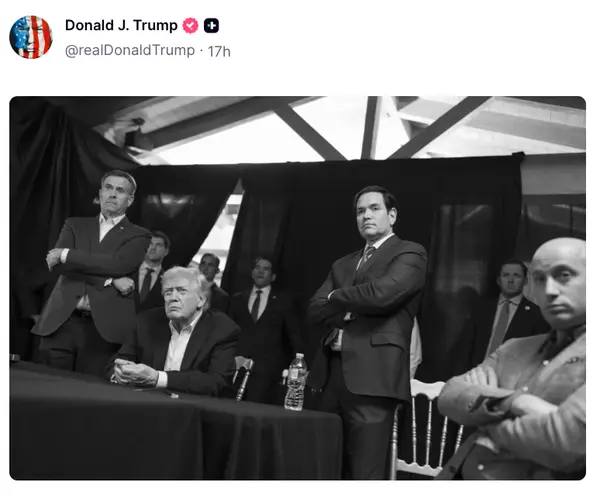
Trump explicitly raised the Carter failure in response to Katie Rogers’ question about what he was thinking as he watched the operation.

David E. Sanger

Did you watch either by video —

President Trump

I did. I was, I saw it.

David E. Sanger

What — what did that feel like? You were down at Mar-a-Lago?

President Trump

It’s like watching a movie, except you’re — it’s a little bit, you know — look, you don’t know if —

Katie Rogers

Are you worried when this is happening, while you’re watching? Or what is going through your mind?

President Trump

Yeah, I’m worried that it ends up being Jimmy Carter disaster that destroyed his entire administration.

And then — after an extensive discussion with Sanger about whether the Eagle Claw failure caused Carter’s election loss that year (neither mentioned Ronald Reagan’s interventions with Iran) — Trump returned to Eagle Claw in response to a Sanger attempt to understand Trump’s “Remote Control” occupation of Venezuela. This came in a passage where Sanger, suffering from normalcy bias, attempted to probe how Trump planned to impose order on Venezuela (Trump had earlier responded to a Tyler Pager question, in one of the very few pieces of real news in the interview, that he would be running Venezuela “much longer” than a year).

Trump didn’t want to talk about occupation; he wanted to talk about which of his quick strikes was the most important.

David E. Sanger

Each one of those, sir, was a one-off, you know, attack, where you could attack and then retreat. You are now in the middle of an occupation —

President Trump

But let me ask you a question: Of the four things that we talked about —

David E. Sanger

A remote control.

President Trump

— and I did other stuff — which is the most important? Al-Baghdadi, Suleimani, this one or the Iran nuclear attack?

David E. Sanger

I think people would probably disagree on that, but I think a lot of people would argue that anything that set back Iran from getting a nuclear weapon may have been the most important.

President Trump

I would say. And yet this seems to get more — more interest in this one than the other three.

Sanger attempted to return to the question of occupation, but Trump didn’t realize at first that Sanger is talking about the occupation, not just the quick strike.

David E. Sanger

But this has got more complication for you —

President Trump

Very complicated.

David E. Sanger

Because you’re going to have years —

President Trump

Oh, I see, you mean future complication.

David E. Sanger

— future — you’re going to have years in which you’re going to have to —

Tyler Pager

You said it’s going to be more than a year.

David E. Sanger

Yeah, you’re going to have to decide: Am I sending in troops?

[Mr. Trump speaks briefly off the record.]

Tyler Pager

Mr. President, on the record, just the —

[There is cross-talk.]

Whatever got said off the record, it distracted from Sanger’s focus on the occupation, and Pager returned to issues better understood as Trump’s psyche: his confidence, his boasts (repeated elsewhere in the interview, including to explain the huge budget deficits he caused with tax cuts) that he single-handedly rebuilt the military in his first term.

Tyler Pager

On the success of the Maduro operation. Does it mean — give you confidence? Or does it mean you’re going to pursue future military action against Mexico or Colombia or other countries in the Caribbean?

President Trump

No, but it — I didn’t need confidence. I have a lot of confidence in my people, in my military. I built the military. Remember this: Our military, when I took over in my first term, was a mess. I rebuilt the entire military, and now I’m doing it even more so. So, our military’s great. And more importantly, we’re the best soldiers.

Sanger persisted, imagining that Trump, who has never studied a day in his life, studied other occupations before deciding to do his Venezuela occupation on the cheap.

David E. Sanger

Did you study some other occupations? Japan, Iraq, others?

President Trump

Yes, yes. I studied, I studied —

David E. Sanger

And what — what lesson did you draw from that, that we should know —

President Trump

That it’s highly risky.

David E. Sanger

— for Venezuela?

President Trump

That’s what I do.

David E. Sanger

OK, so —

President Trump

I looked at — I looked at some of the attacks. I studied the Carter attack. It was a disaster. I would have never done it that way.

It took Sanger some time before he figured out Trump can’t even conceive of the occupation. Trump was still talking about the quick strike attack and contemplating how it could have ended like it did for Jimmy Carter, in ignominy.

David E. Sanger

You were talking about the attack. I was asking about the occupations that followed —

President Trump

You know, they had — they had a — they had a sandstorm. Did you know that? And they decided to go forward. We would go back, and let’s hit it three days later. They wanted to go forward, and they said, keep going. Helicopters don’t work well in the sand.

Karoline Leavitt

Sir, do you want to show them the renovations?

And that’s when Karoline Leavitt, who had been trying to end the entire interview, instead distracted Trump, like one would a toddler, with a topic she knows he loves, his renovations.

Here’s your binky, Donald.

NYT did a grave disservice by sane washing this interview; indeed, Trump betrayed his fundamental vulnerability elsewhere in the interview.

Because what it shows is that Trump is literally like a toddler knocking over the Monopoly board because he’s frustrated with the rules. No matter how Sanger attempts to normalize it, Trump’s foreign policy is not (as Sanger fancies) a normal second term investment in legacy.

Rather, Donald Trump is invading sovereign foreign countries, without even the ability to consider the years-long aftermath, out of a psychological need.

Share this entry

No One Could Have Anticipated, Venezuelan Edition

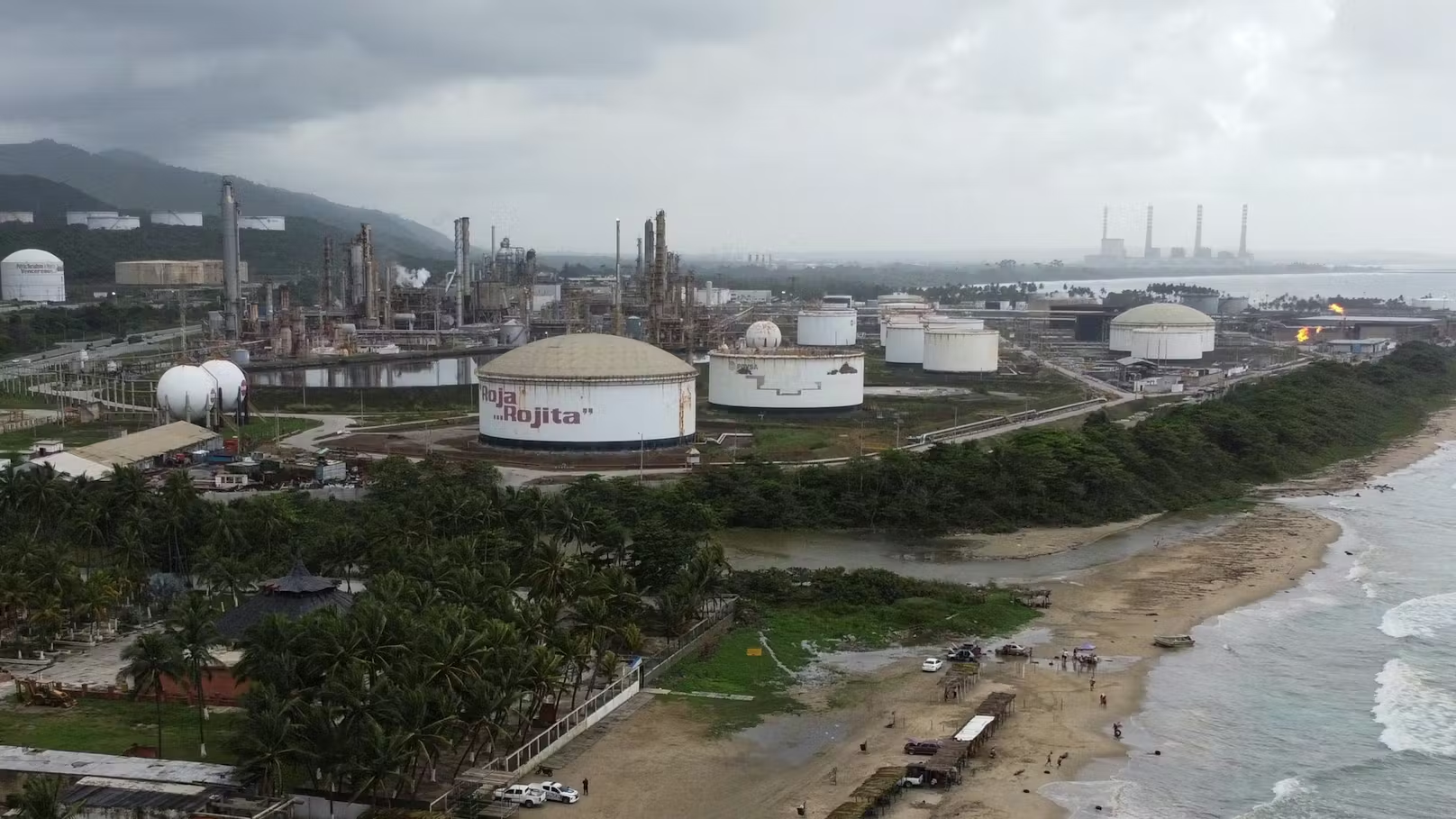
The scenic Venezuela Refinery in Puerto Cabello, ready to welcome the legions of American oil company employees

No one could have anticipated . . . 

The United States has urged its citizens to leave Venezuela immediately amid reports that armed paramilitaries are trying to track down US citizens, one week after the capture of the South American country’s president, Nicolás Maduro.

In a security alert sent out on Saturday, the state department said there were reports of armed members of pro-regime militias, known as colectivos, setting up roadblocks and searching vehicles for evidence that the occupants were US citizens or supporters of the country.

“US citizens in Venezuela should remain vigilant and exercise caution when traveling by road,” the alert added, urging citizens to depart immediately now that some international flights from Venezuela have restarted.

You don’t say.

The US closed its embassy in Venezuela back in 2019, so it’s not like this kind of warning is entirely new. But this ought to be a flashing red light and blaring siren to all who think that after the abduction of Maduro, everything is just peachy-keen for American oil companies to send hundreds of civilian employees into the country to start extracting oil.

I await Trump’s triumphant visit to Venezuela to receive the accolades of a grateful Central American nation.


Share this entry

Fridays with Nicole Sandler

Listen on Spotify (transcripts available)

Listen on Apple (transcripts available)

Update: We’re going to do some house cleaning around here, with a refresh of the site in the next bit. One thing I’m trying to do is put up resource pages on particular topics, which will be available from the front page. You’ve seen me do this with the Hunter Biden and Jim Comey cases, as well as DOGE debunkings. Some will be more formal, some will serve to capture links and try to understand what we’re seeing.

Have a look!

Trump Corruption

Stephen Miller resources

Immigration resources

Share this entry

Todd Blanche Takes Stephen Miller’s Ham Sandwich to the Fifth Circuit

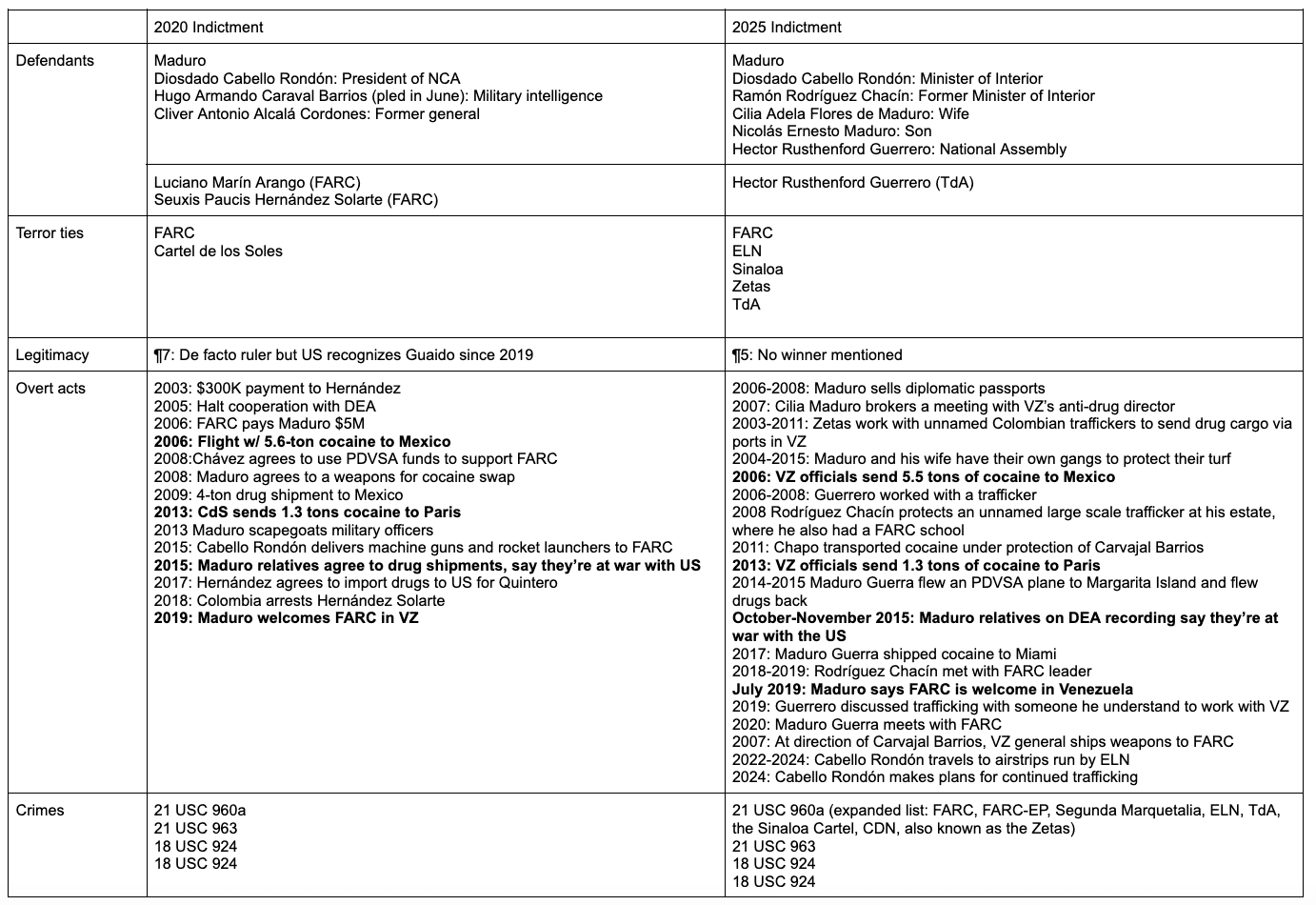
Remember how I predicted that the inclusion, based on very thin allegations including Tren de Aragua’s leader, Hector Rusthenenford Guerrero Flores, in Nicolás Maduro’s superseding indictment, that Stephen Miller would use the probable cause finding to renew his bid for Alien Enemies Act deportations?

The Tren de Aragua is likewise thin. In the 2020 indictment, two FARC leaders were included as co-conspirators, but that reflected a sustained relationship with Maduro as laid out in the overt acts. The TdA inclusion here relies on a similar move, including its leader, Hector Ruthsenford Guerrero Flores as a co-conspirator. But his inclusion relies on two overt acts that don’t involve Maduro: Guerrero’s actual trafficking with someone not alleged to be part of this conspiracy, and comments made in a Venezuelan prison in 2019. (These may be the comments that US intelligence services have deemed to be unreliable.)

f. Between approximately 2006 and 2008, HECTOR RUSTHENFORD GUERRERO FLORES, a/k/a “Nifio Guerrero,” the defendant, worked with one of the largest drug traffickers in Venezuela, Walid Makled. Members of the Venezuelan regime helped protect Makled’s cocaine shipments that were transported from San Fernando de Apure, Venezuela, to Valencia, Venezuela, and were then sent by plane from the Valencia international airport to Mexico and other locations in Central America for eventual distribution to the United States. Between in or about 2008 and in or about 2009, GUERRERO FLORES also provided another major Venezuelan drug trafficker with protection for cocaine shipments moving through Venezuela, including by providing armed men who carried, among other automatic weapons, AK47s, MP5s, and AR-15s, as well as grenades. At times, GUERRERO FLORES personally accompanied large cocaine loads as they were guarded by the teams of armed men, en route to airports or airstrips for transport north and eventual distribution to the United States. GUERRERO FLORES was paid a fee per kilogram of cocaine transported or received and he sometimes received an interest in portions of these massive cocaine shipments in lieu of payment. The traffickers that GUERRERO FLORES worked with moved thousands of kilograms per shipment, multiple times per month, resulting in the distribution of hundreds of tons of cocaine to the United States. In or about 2009, Makled was charged with narcotics offenses in this District and is a fugitive.

[snip]

o. In or about 2019, TdA’s leader, GUERRERO FLORES, discussed drug trafficking with an individual he understood to be working with the Venezuelan regime. Over multiple calls, GUERRERO FLORES offered to provide escort services for drug loads, explaining that GUERRERO FLORES and TdA had control of the coastlines of Venezuela’s Aragua State. GUERRERO FLORES, speaking from TdA’s base of operations in Tocor6n Prison, explained that TdA could handle the logistics of every aspect of the drug trade, including the use of storage compartments that GUERRERO FLORES called “cradles” located on a beach in Aragua State. In doing so, GUERRERO FLORES confirmed TdA’s ability to protect over one ton of cocaine.

That is, neither is TdA necessary to substantiate the narco-trafficking charges, which are well-substantiated based on protection of FARC, nor is the substance of TdA’s inclusion all that convincing.

At all.

But no doubt Stephen Miller will use this — a grand jury finding probable cause tying TdA to Maduro — to attempt to renew his Alien Enemies Act deportations.

They’re so fucking predictable. (This is the appeal of one of the AEA cases to the Fifth Circuit.)

Appellees respectfully submit this letter pursuant to Federal Rule of Appellate Procedure 28(j) to advise the Court of an indictment against co-conspirators Nicholas Maduro, the leader of Tren De Aragua (“TdA”) Hector Rusthenford Guerrero Flores, and several of Maduro’s family members and high-ranking officials. Ex. A. Among other charges, Maduro and his high-ranking officials are alleged to have “worked directly with” several “narco-terrorist organizations” to funnel deadly drugs into the United States, including “TdA, which controls a criminal network able to assist with the transportation of cocaine within Venezuela and on the Venezuelan coast.” Id. ¶¶ 20, 24.

The indictment reinforces the Proclamation’s findings that the Maduro Regime and TdA have formed a “hybrid criminal state” directed by the Regime. This significant development further refutes Petitioners’ argument that the Government no longer treats TdA as entwined with the Maduro Regime. Indeed, in announcing the apprehension and indictment of Maduro, the President made clear that Maduro has “waged a ceaseless campaign of violence, terror, and subversion against the United States of America, threatening not only our people, but the stability of the entire region.” Ex. B at 8:07-8:27. In particular, “Maduro sent savage and murderous gangs, including the bloodthirsty prison gang, Tren de Aragua, to terrorize American communities nationwide” through murder and taking “over apartment complexes.” Id. at 8:27-9:24. The President emphasized that “Tren de Aragua… [was] sent by Maduro to terrorize our people,” providing examples of Americans victimized by their terror campaign. Id. at 11:41-12:51. These new developments underscore the Maduro Regime’s control over TdA and TdA’s violent invasion or predatory incursion on American soil. As a result, it is even clearer that the President’s invocation of the Alien Enemies Act was part of a high-level national security mission that exists outside the realm of judicial interference.

Mind you, ACLU’s Lee Gelernt makes mincemeat of this ploy in response.

The government’s January 5 letter contends that Maduro’s indictment shows that he and TdA were intertwined. But the indictment’s allegations cannot erase the administration’s own repeated assertions that the United States was in a non-international armed conflict with TdA to justify its boat strikes—not a conflict with a “foreign nation or government” as required by the AEA. Pet’rs’ En Banc Br. 8, 31–41. At a minimum, the conflicting assertions undermine the request for deference.

Moreover, the indictment confirms that, even in the government’s view, Maduro’s alleged actions were not military, but rather criminal offenses properly handled through the justice system. Indeed, the administration stated that the Venezuelan operation was a “law enforcement” operation. Appellees’ 28(j) Letter, Ex. B at 38:58–39:57.

The government also fails to address why the Proclamation’s assertions are not fatally undermined by Maduro’s ouster given that the Proclamation specifically says that “Maduro” and the “Maduro regime”—not Venezuela as a “foreign nation”—direct TdA. While the Proclamation’s assertions never justified the claim that Maduro directed TdA (a claim refuted by 17 of 18 national security agencies1 ), there is now no longer anything to defer to given that Maduro is in a U.S. jail. Indeed, President Trump himself has declared that Maduro’s capture means that “[t]here will no longer be threats” to Americans from Venezuela or TdA. Id. at 11:41– 12:24.

Finally, the indictment undercuts the Proclamation’s factual assertion that “Cártel de los Soles” is a “narcoterrorism enterprise” central to enlisting TdA to send drugs as a “weapon” against the United States. The indictment now describes Cártel de los Soles as simply a loose “patronage system” that is part of “a culture of corruption” for elites’ personal enrichment—not a cartel at all. Appellees’ 28(j) Letter, Ex. A at 8; see Charlie Savage, Justice Dept. Drops Claim That Venezuela’s ‘Cartel de los Soles’ Is an Actual Group, N.Y. Times, Jan. 6, 2026, https://www.nytimes.com/2026/01/05/us/trump-venezueladrug-cartel-de-los-soles.html.

And that was yesterday. That same day, the Senate passed Tim Kaine’s War Powers Resolution prohibiting Trump from invading further without approval from Congress, with Todd Young, Lisa Murkowski, Susan Collins, Rand Paul, and Josh Hawley’s support.

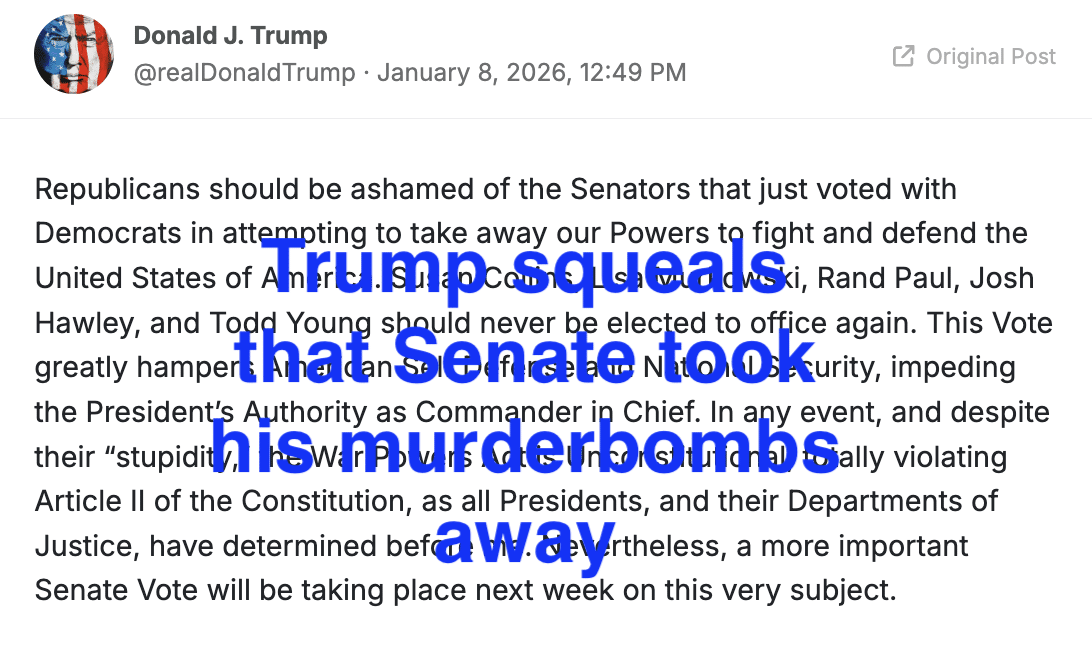
While not yet binding (and as Trump noted in his squealed response, Lindsey Graham is going to try to reverse this, and the House would have to pass it too), the WPR will make it harder for even the Fifth Circuit to sustain Trump’s claims that this is an invasion.

Nevertheless, it didn’t stop Kristi Noem to use TdA as her excuse for the second DHS shooting this week, this of two people in Oregon.

It’s all just lies on top of lies, and until Appellate judges start calling Trump’s team on it, entire lives will be upended or ended based on the lies Stephen Miller invents in his feverish nightmares of power.

Share this entry

The Bankrupt Premise of Trump’s Venezuela Colony

The headline and opening paragraphs of a 1,400-word story basically reporting that Trump had sat for the interview Joe Biden had denied the NYT (okay, they didn’t mention the latter bit) focus on Trump’s plan to run Venezuela’s oil industry indefinitely.

Trump Says U.S. Oversight of Venezuela Could Last for Years

President Trump said on Wednesday evening that he expected the United States would be running Venezuela and extracting oil from its huge reserves for years, and insisted that the interim government of the country — all former loyalists to the now-imprisoned Nicolás Maduro — is “giving us everything that we feel is necessary.”

“Only time will tell,” he said, when asked how long the administration will demand direct oversight of the South American nation, with the hovering threat of American military action from an armada just off shore.

“We will rebuild it in a very profitable way,” Mr. Trump said during a nearly two-hour interview. “We’re going to be using oil, and we’re going to be taking oil. We’re getting oil prices down, and we’re going to be giving money to Venezuela, which they desperately need.”

[snip]

During the wide-ranging interview with The New York Times, Mr. Trump did not give a precise time range for how long the United States would remain Venezuela’s political overlord. Would it be three months? Six months? A year? Longer?

“I would say much longer,” the president replied.

That he said that is surely news. And while I assume David Sanger will do a follow-up story that might explain this, NYT did not here.

The headline gives Trump something he badly needs — false assurances to oil companies that have been disabusing Trump of his insane notions that oil will pay for a Venezuela invasion that the US would stick around to make investments worthwhile.

But it doesn’t get into all the problems with Trump’s rapidly moving attempt to turn this into a win: even with that much longer security guarantee, it’s not at all clear this will work.

It started 10 days before the invasion, when Trump told oil companies they had to invest now to get reimbursed for nationalizations in the past.

Administration officials have told oil executives in recent weeks that if they want compensation for their rigs, pipelines and other seized property, then they must be prepared to go back into Venezuela now and invest heavily in reviving its shattered petroleum industry, two people familiar with the administration’s outreach told POLITICO on Saturday. The outlook for Venezuela’s shattered oil infrastructure is one of the major questions following the U.S. military action that captured leader Nicolás Maduro.

But people in the industry said the administration’s message has left them still leery about the difficulty of rebuilding decayed oil fields in a country where it’s not even clear who will lead the country for the foreseeable future.

“They’re saying, ‘you gotta go in if you want to play and get reimbursed,’” said one industry official familiar with the conversations.

The offer has been on the table for the last 10 days, the person said. “But the infrastructure currently there is so dilapidated that no one at these companies can adequately assess what is needed to make it operable.”

Apparently, Trump didn’t heed these warnings, and in the aftermath of the invasion he has made grandiose promises that oil would pay for the invasion.

To be fair, his first announcement — that “the Interim Authorities in Venezuela” had agreed to give the United States (or perhaps Trump personally)  between 30 and 50 MILLION Barrels of High Quality, Sanctioned Oil” which would “be sold at its Market Price, and that money will be controlled by me, as President of the United States of America, to ensure it is used to benefit the people of Venezuela and the United States!” may well be an effort to pay for the costs of the invasion.

It’s not at all clear a $2 billion payment would even do that.

DOD has been conducting periodic murderboat strikes every several days, each of which surely costs millions of dollars.

One hellfire missile, for example, typically costs about $150,000, and reaper drones cost around $3,500 per hour to fly. An F-35 costs around $40,000 per hour to fly. The cost per flight hour of an AC-130J gunship is not public but its predecessor, the AC-130U, which was phased out in 2019, cost over $40,000 per hour to fly.

The Gerald Ford has been in the Caribbean since November 16, which works out to be about $424 million (though there were already ships there). One of the $50 million Chinooks used in the attack was badly damaged. Similarly, the Delta Force lead was seriously injured, so taxpayers are paying his recovery and possibly his retirement. There were 150 aircraft used in the attack.

It was a tremendously successful attack.

It wasn’t cheap.

But within days of promising that oil would pay for his new colony, outlets started reporting that taxpayers might have to subsidize that effort.

Donald Trump has suggested US taxpayers could reimburse energy companies for repairing Venezuelan infrastructure for extracting and shipping oil.

Trump acknowledged that “a lot of money” would need to be spent to increase oil production in Venezuela after US forces ousted its leader, Nicolás Maduro, but suggested his government could pay oil companies to do the work.

“A tremendous amount of money will have to be spent and the oil companies will spend it, and then they’ll get reimbursed by us or through revenue,” the president said.

The reasons why are clear: even assuming Venezuela remains stable long enough to develop investments (the promise Trump is floating to the NYT), the cost of refining Venezuelan oil is just too high, particularly given current prices.

The energy-intensive upgrading process also increases the carbon footprint of these heavy grades, which could push up costs further if more governments start taxing emissions or raising existing levies.

Breakeven costs for key grades in the Orinoco belt already average more than $80 a barrel, according to estimates by consultancy Wood Mackenzie. That places Venezuelan oil at the higher end of the global cost scale for new production. By comparison, heavy oil produced in Canada has an average breakeven cost of around $55 a barrel.

Exxon’s breakeven target for its global oil production by 2030 is $30 a barrel, driven by low-cost fields in Guyana and the U.S. Permian shale basin. Chevron has a similar target, while Conoco has a long-term plan to generate free cash flow even if oil prices fall to $35 a barrel. Oil , currently trades at around $60.

While energy boards have increasingly supported greater exploration in recent years, they are insisting that this be done with spending discipline in mind in the face of rising global supplies and uncertainty over the energy transition.

Here’s a table from Bloomberg that shows that Venezuela, even ignoring the potential instability, is just not a competitive investment.

The rest of the article explains what better alternatives the majors are investing in.

Trump seems not to understand this math (or he’s engaged in another con job), because he keeps bragging about the price of oil coming down which … yeah, that’s the point. That’s precisely why imagining you’re going to have willful takers for your offer to invest in expensive-to-refine Venezuelan oil at today’s prices is a pipe dream.

Thus the bribes … er, subsidies, that American taxpayers will end up paying. On top of any deployment, taxpayers will bribe oil companies.

So it doesn’t make sense for the oil companies.

But it also doesn’t make sense for Venezuelans, because the first thing Trump’s backers will demand is that Venezuela pay off years of debt.

Analysts estimate Venezuela now owes $150-$170 billion and JP Morgan calculates that $102 billion of that is in the form of bonds, while bilateral debt to China totals $13-$15 billion.
Venezuela has not reported debt figures for around a decade and state oil company Petroleos de Venezuela (PDVSA) has in the meantime struck complex oil-backed debt deals with China.

Despite Washington’s ousting of Maduro, the main hurdles to a debt restructuring remain in place.

U.S. sanctions — including against Venezuela’s interim President Delcy Rodriguez – mean that even sitting down for creditor talks could breach U.S. Treasury Department curbs.

[snip]

“The U.S. administration has an interest in moving the restructuring forward, because without that restructuring, these oil companies will not be participating and will not be investing anything,” said Ed Al-Hussainy of Columbia Threadneedle Investments, which has Venezuelan bond exposure.

“The possibility of a U.S. government financial line of credit or a guarantee or a backstop of some sort is going to be music to the ears of investors,” the portfolio manager added.

Lee Robinson, founder of Altana Wealth which also holds Venezuelan bonds, said there was enough at stake for the U.S. itself to put a loan in place to kickstart Venezuela’s recovery.
JP Morgan said a recognition of Rodriguez’s new government by the Trump administration would open many questions.

“Should the Fund be bypassed in favour of a faster-track, oil-based bilateral program, we could be going down the road of a faster-track, less orthodox bond restructuring than what we have seen in the years since the pandemic and the advent of the Common Framework,” JP Morgan said.

Sounds like the taxpayers will be on the hook for the debt restructuring, just like the bailout to keep “libertarian” Javier Milei in office.

Moe Tkacik has written a bunch on the extraction involved here, as in this November story on Juan Guaidó’s role in it, during the last time Trump tried to milk Venezuela, making it easier for Paul Singer to acquire CITGO.

On January 23, 2019, when Guaidó proclaimed himself the “interim president” of an incredulous Venezuela, Secretary of State Mike Pompeo announced that the Trump administration would recognize Guaidó as the Bolivarian Republic’s genuine leader, and unveiled a suite of tough new sanctions on PDVSA, pitched as a bid to force Maduro to step down. The whole thing seemed like a joke, a throwback to the days when our foreign-policy establishment insisted a drug-trafficking warlord on an island of six million was the “real” leader of the world’s most populous country—though at least most Chinese knew who Chiang Kai-shek was when he fled to Taiwan in 1949 to preside over what the United Nations insisted on calling the “Republic of China.” Only the Miami Herald noted an unusual provision of the new arrangement, explained by then-Treasury Secretary Steve Mnuchin, who told the newspaper “that if Guaidó succeeds in forming a government, the money” from international sales of Venezuelan oil that he was freezing under the new sanctions regime “would go to him.” On Twitter, Guaidó promised this new arrangement would “prevent the looting from continuing.”

[snip]

Venezuela, PDVSA, and Citgo were legally separate entities. But in mid-February, Guaidó named entirely new slates of board members to PDVSA, its U.S. holding company, and Citgo, a move Rodríguez knew would strengthen Crystallex’s case. That same week, the glass manufacturer Owens-Illinois, which had been awarded a half-billion-dollar arbitration judgment over two Coke bottle factories Chávez had expropriated in 2010, sued Citgo on the basis that it was an “alter ego” of the state. Owens-Illinois had expert witness assistance from none other than José Ignacio Hernández, whom Guaidó had just named the attorney general of the shadow government.

That is, Trump proposes to fix the problem he, in significant part, caused in his first term.

Plus, until you fix Venezuela’s corruption problem — which Trump has pointedly declined to do in retaining Delcy Rodríguez, partly because he’s relying on Maduro’s suppression regime to offer stability to oil companies, partly because he affirmatively loves corruption — then the Venezuelan people aren’t going to see anything, even while Trump is attempting to oust China’s slightly more favorable float.

And all this is happening on a time frame — big investments and risks on the front end, very long timetable for returns to anyone — that I imagine China is taking some solace about being surprised, if it was surprised, by looking at how Trump’s obsession with becoming a petro-autocrat leaves it untouched to dominate renewables for the foreseeable future, renewables that will continue to put pressure on oil prices in a way that Trump seems not to understand.

And all that assumes Trump, or Dalcy Rodríguez, can ensure stability, something for which there’s no evidence. All that assumes that no one decides to make a target of the resources Trump has put in the middle of an increasingly volatile Caribbean.

Trump is literally making up Colonialism 2.0 on the fly. And the serially bankrupt businessman appears to be doing funny math at every turn.

So yeah, Trump is making expansive claims to the NYT. But they are part of an elaborate con job to prevent this Venezuela adventure from backfiring in a spectacular way.

Share this entry

Stephen Miller Has Similar Plans for Colombia and Columbia

Laura Jedeed wonders whether Trump is testing out a new kind of colonialism, where you basically issued orders to the corrupt illegitimate authorities, rather than installing the opposition.

Trump and Rubio’s talking points combine into a message intended not for the people of America, but for the heads of state in Cuba, Columbia, [sic] and worldwide. The message itself is simple, elegant, and ugly: do exactly what we say or America will destroy you—not your country, or your economy, or your people, but you, personally. This strategy doesn’t just let America “run” Venezuela. It allows this administration to “run” any country unable to attack us on our home turf: extract their resources, dictate their domestic policy, force their leaders to resign. All by credibly threatening extreme personal violence against any head of state who pushes back.

Credit where credit is due: it’s an entirely new approach to colonialism. Here’s how it’s worked since Britain perfected the art: you invade the country, then place the opposition party in power. That party requires your support to maintain control (if they had enough force to do it themselves they’d already be in charge). In exchange for military backup, their leader will do anything you ask.

Trump, on the other hand, has endorsed Maduro’s Vice President, Delcy Rodríguez, allegedly because the opposition party “doesn’t have the support within, or the respect within the country.” This assertion is aggressive nonsense. Opposition party weakness is a feature, not a bug, for the reasons stated above. It’s also patently untrue in this case. Election monitors from several countries agree that candidate Edmundo González Urrutia beat Maduro in a landslide two years ago by as much as 51 percent. Trump and his allies know this—they’ve used Maduro’s election theft to justify invasion. It’s kind of perfect: the party doesn’t have the power to gain power by themselves, but they’re popular enough to minimize the danger of revolt. It’s the dream situation—so why isn’t the Trump administration going for it?

Most people seem to think Trump’s endorsement of the unpopular and hostile Rodríguez stems from bitterness towards María Corina Machado, the opposition party leader who received the Nobel Peace Prize that Trump wanted so badly last year. Machado seems to think so too; she’s offered to give the prize to Trump and spent ten minutes abasing herself before the Peace President on Hannity yesterday. It won’t help. Trump is petty to the core, it’s true, but Stephen Miller and the other ghouls actually running this country would never set the entire colonial playbook on fire just to appease some old queen’s ego.

The real reason, I suspect, is this: leaving Rodríguez in charge is the only move that does not require a full-scale invasion.

Unlike Machado, Rodríguez possesses a military and police force capable of holding Venezuela together. Under the old model, that force would have threatened our hegemony, but under Colonialism 2.0, she has a strong incentive to do exactly as she’s told regardless; she is, after all, one surgical strike away from losing her freedom or possibly her life. As long as she doesn’t call Trump’s bluff or get coup’d herself, it’s foolproof.

[snip]

And the administration was right: Rodríguez is already rolling over. “We consider it a priority to move towards a balanced and respectful relationship between the US and Venezuela,” she wrote on Telegram late Sunday. “We extend an invitation to the US government to work together on an agenda for cooperation that is aimed towards shared development.” So far, so good.

That’s certainly what Trump is trying to do.

But it’s wildly premature to assess whether it’ll work.

Before I explain how it may backfire, let me observe that this plan is precisely the same plan Trump (Stephen Miller, really) is attempting with the US.

What Trump plans for Colombia is little different than what he succeeded in doing with Columbia University: Make demands on the elected leader, extract tribute, change the rules to benefit the authoritarian state. Whether it will work long term has yet to be seen, but the lesson of New College in Florida shows where things may head in the medium term: with dramatically increased costs and noticeably decreased utility. Once DeSantis is out of power, the effort is likely to be abandoned, turning New College into a bigger shell than it is already is. Columbia might take longer to collapse, unless Stephen Miller doubles down on his demands.

Now consider what makes Venezuela (or Colombia) different from Columbia, starting with the guns, guns which might come from at least three different places.

First, there are Russia, China, and some other Venezuelan patron states that are under assault as well. Trump has ordered Venezuela to expel them, stop doing business with them, and sell oil only to the US.

The Trump administration has told Venezuela’s interim president Delcy Rodriguez that the regime must meet the White House’s demands before being allowed to pump more oil, according to three people familiar with the administration’s plan.

First, the country must kick out China, Russia, Iran, and Cuba and sever economic ties, the sources said. Second, Venezuela must agree to partner exclusively with the U.S. on oil production and favor America when selling heavy crude oil, they added.

According to one person, Secretary of State Marco Rubio told lawmakers in a private briefing on Monday that he believes the U.S. can force Venezuela’s hand because its existing oil tankers are full. Rubio also told lawmakers that the U.S. estimates that Caracas has only a couple of weeks before it will become financially insolvent without the sale of its oil reserves.

As we speak, the Trump Administration is carrying out a replay of the OJ White Bronco chase, but with an empty oil tanker headed for Russia.

Russia has sent a submarine and other naval assets to escort an empty, rusting oil tanker that has become a new flashpoint in U.S.-Russia relations, according to a U.S. official.

The tanker, formerly known as the Bella 1, has been trying to evade the U.S. blockade of sanctioned oil tankers near Venezuela for more than two weeks. The vessel failed to dock in Venezuela and load with oil. Although the ship is empty, the U.S. Coast Guard has pursued it into the Atlantic in a bid to crack down on a fleet of tankers that ferry illicit oil around the world, including black-market oil sold by Russia.

The vessel’s crew repelled an effort by the U.S. to board the vessel in December and steamed into the Atlantic. As the Coast Guard followed it, the crew sloppily painted a Russian flag on its side, changed its name to the Marinera and switched its registration to Russia.

Russia has been concerned by U.S. seizures of tankers that ferry its illicit oil around the world and power its economy, and it has made the unusual move of allowing the tanker to register in Russia without an inspection or other formalities, experts say.

Update: The US has now seized the tanker.

Will this lead to some kind of direct conflict? I have no fucking clue and neither do you, because both Trump and Putin are fucking nuts. If Trump were rational, he’d retaliate not with direct confrontation in the North Sea, but by arming Ukraine and giving them the green light to up its attacks on Russia, but he’s not rational. Russia’s economy is actually close to collapse, and it wouldn’t take much to get it there. Russia, of course, has other means it might use to retaliate against Trump.

We shall see.

China is another matter though. China not only is rational, but China kicked the shit out of Trump in his last attempt to demand obeisance, the tariffs. Trump thought he could achieve with tariffs what he is trying to achieve with Venezuela: obeisance and personal tribute. Not only have all the tariffs harmed the US, spiking small business bankruptcies and inflation (and in the process making Trump’s political support far weaker), but China used its near-monopoly on rare earths and ability to replace US soybeans to bring Trump to his knees instead.

In fact, the Venezuelan coup might be partly a response to China’s success at wielding the rare earth weapon. While there’s much I disagree with in it, this post argues the Venezuela invasion was not about oil, but about the rare earth China currently extracts.

Investigative reporting documented Chinese buyers operating directly at mining sites in Bolívar state. The Venezuelan government established official collection centers in Los Pijiguaos and Morichalito in 2023 specifically for cassiterite, coltan, nickel, rhodium, and titanium. The Maduro regime designated these as strategic resources for commercialization, meaning state control over extraction and export, with Chinese buyers integrated into official operations from the start.

The supply chain from Venezuelan mines to Chinese refineries operates through both formal and informal channels, with Chinese buyers exercising operational control at the extraction source. Minerals extracted in the Orinoco Arc move by river and air transport to Colombian border towns, then to Bogotá for smelting into refined bars. These materials are relabeled under incorrect tariff codes, transforming raw ore into processed ferro-tantalum or other classifications that obscure origin. Final export occurs through Colombian ports at Santa Marta and Buenaventura, destined for Chinese processing facilities.

Once Venezuelan minerals blend with Colombian or Brazilian ore in these intermediary steps, tracing origin becomes effectively impossible. This laundering mechanism allows Venezuelan minerals to enter legitimate global supply chains, including those feeding US defense contractors. The result is Pentagon weapons systems potentially incorporating materials extracted under Chinese buyer supervision in Venezuelan territory, then processed in Chinese refineries controlled by Beijing.

Chinese buyers do not operate at arm’s length through market transactions. They coordinate directly at the mining sites with both Colombian guerrilla groups (ELN, FARC dissidents) who control physical security and Venezuelan state security (SEBIN) who facilitate transport using official government vehicles. One miner described seeing Chinese operatives and ELN commanders “eating together, buying material together, and getting off the helicopter together.” This is not commercial activity. This is integrated operational control where Chinese buyers work directly with armed groups and state officials to extract strategic minerals.

Trump doesn’t need — indeed, the oil companies probably don’t want — Venezuela’s oil, at least not in the short term.

He does need rare earth deposits (which is also the stated purpose of usurping Greenlands).

It took us some months to understand how China responded to Trump’s threat of tariffs. It took less time to recognize China’s advance preparation for them (based on Trump’s trade war from the first term).

A lot of the coverage of the coup views it as a profound humiliation for China, not least because China’s Latin American envoy met with Nicolás Maduro the day before the coup. That didn’t stop China (and Russia and Iran) from attending Rodríguez’ signing in, so there’s a distinct possibility they’re in at least as close coordination with Rodríguez right now as Marco Rubio.

But the most belligerent thing — the thing people expect — is that China will take Taiwan, as it was practicing to do even as Trump had a fifth of deployed assets in the Caribbean preparing to invade.

With all the attention on Venezuela, there has been too little attention on vacuums created with this extended deployment off the coast of Venezuela (the most immediate of which is probably in the Middle East). But it is clear that Trump keeps launching little wars with resources most of Congress believes should be used to counter China’s expansionary plans.

But as China showed with the tariffs, they likely have ways to respond that are less direct and at least as devastating.

But China and Russia aren’t the only ones who have guns here.

So does, just as one example, Interior Minister Diosdado Cabello, who has been indicted in SDNY alongside Maduro since 2020. Reuters describes that the US already threatened Cabello.

In the meantime, they have communicated to Cabello via intermediaries that if he is defiant, he could face a similar fate to Maduro, the authoritarian leader captured in a U.S. raid on Saturday and whisked away to New York to face prosecution on “narco-terrorism” charges, or could see his life in danger, the source said.

But taking out Cabello could be risky, possibly motivating pro-government motorcycle groups, known as colectivos, to take to the streets, unleashing the chaos Washington wants to avoid. Their reaction may depend on whether they feel protected by other officials, however.

In one of her first decisions as acting president, Rodríguez appointed General Gustavo González López as new head of the Presidential Honor Guard and the Directorate General of Military Counterintelligence (DGCIM), state TV said late on Tuesday.

González López, who has been sanctioned by the U.S. and EU along with at least half a dozen other high-ranking officials for rights violations and corruption, served as Venezuela’s intelligence director until mid-2024, when he was replaced by Maduro in a reshuffle of his cabinet and security team.

Later that year, he began working with Rodríguez as head of strategic affairs and control at state oil company PDVSA.

González López was considered close to Cabello, but it was not immediately clear whether his appointment was a gesture of support from Rodríguez to the man considered the strongman of the ruling party, or, on the contrary, a sign of a rift.

The officer replaces General Javier Marcano, whose performance came under scrutiny after Maduro’s capture, according to analysts.

One thing I’ve seen no coverage of is why the US thinks Rodríguez will be secure within Venezuela now that Trump killed the 40 Cubans who were protecting Maduro. And the militias via which Cabello exercises some of his repression could carry out a deniable kind of violence.

But Cabello isn’t even the only one with guns in question. The purported purpose of this operation is about stopping drug trafficking. But unless Trump is doing what every other caudillo does — manage the trade while extracting tribute — there will, eventually, be a counter response from the cartels, which don’t take kindly to losing their markets and have the ability to exercise violence both on site — in Venezuela — but also closer to home, including in the United States. Stephen Miller has so much of US law enforcement snatching workers at Home Depot that certain kinds of crime are likely far easier to pull off. Update: About which the NYT has another story today.

Finally, there are the Venezuelan people. Maduro only remained in power with a great deal of repression, and Trump is tinkering with that system of repression. Meanwhile, Trump’s plans to expel much of the Chinese may exacerbate already dire economic conditions for Venezuelans, because Trump won’t subsidize soft power in the way China has been willing to (to say nothing of the expulsion of Cubans who were providing medical care). Where Stephen Miller’s authoritarianism has failed most dramatically in the US is the way the counter reaction to his goons has revitalized civil society in cities that stand up to the goons. And there’s already a practiced opposition in Venezuela that, as in the US, dramatically outnumbers the goons in charge.

It’s only day four. We have no fucking idea how this will turn out. While Delta Force and the CIA performed spectacularly, there’s really just a handful of people in charge, and most — like Stephen Miller, who thinks of Venezuela as an island surrounded by a US armada and therefore is likely forgetting about a porous border with Colombia — are utterly ignorant about Venezuela and childish about power.

Columbia University was easy to subjugate, because no one had guns. But even there it only happened by damaging the host. There are a lot of people with guns with an interest in Venezuela.

It’s just as likely, in my opinion, that this precipitates World War III as that it succeeds in Venezuela much less produces the treasure Trump is demanding.

Update: CEO of the Human Rights Foundation, Venezuelan Thor Halvorssen, predicts Delcy Rodríguez’ quick demise.

Reports indicate the Trump administration has struck a deal with Delcy Rodríguez, Mr. Maduro’s iron-fisted vice president, positioning her as a transitional leader. She has, it seems, convinced U.S. officials that she can dismantle the Maduro dictatorship, which would have to include demobilizing the armed militias, disbanding the dreaded secret police and ending the regime’s drug empire. But this is a fantasy. Ms. Rodríguez will fail spectacularly, leading to the final unraveling.

Venezuela isn’t like Mexico, where a state coexists uneasily with cartels. Here, the cartel is the state. Factions—enriched generals, intelligence chiefs and narco-traffickers—won’t surrender power in a Washington-brokered deal. Ms. Rodríguez herself faces insurmountable obstacles, beginning with her utter lack of legitimacy. Never elected vice president, she has less authority than Mr. Maduro, the usurper who appointed her.

I think he wildly overestimates the extent that Trump would even permit any lapse in repression.

Update: Meanwhile on Xitter, I take this as confession that Stephen Miller knows fuckall about the oil market, especially the discount at which Venezuelan oil must be sold and the price at which it is worth drilling.

Paul Krugman’s column today is on how Trump’s oil math doesn’t add up.

[W]hatever it is we’re doing in Venezuela isn’t really a war for oil. It is, instead, a war for oil fantasies. The vast wealth Trump imagines is waiting there to be taken doesn’t exist.

Update: WSJ goes into more depth about the challenges Cabello may pose to Trump’s plans.

Fond of swinging a spiked club while spouting conspiracy theories on his hourslong weekly show on state television called “Bringing Down the Hammer,” now on its 556th episode, Cabello is hard to predict.

Cabello, a 62-year-old whose official title is minister of interior, justice and peace, has so far signaled unity, taking part in Rodriguez’s swearing-in ceremony on Monday, where various factions of Venezuela’s ruling socialist party were present.

But that night, Cabello was toting a rifle and riling up black-uniformed security forces before they patrolled Caracas to prevent citizens from protesting.

“Doubting is treason!” he said, before telling the armed group, “Now, off to battle in the streets for victory.”

Under a state of emergency that the government declared after Maduro’s capture, security forces were ordered to hunt down U.S. sympathizers, according to the Official Gazette, where the Venezuelan government publishes new laws and decrees. Residents in the capital reported new roadblocks around the city where armed, masked men checked the phones of ordinary Venezuelans for antigovernment messages.

Update: This offers a good explanation of all the people with guns who would make things difficult even if Delcy Rodríguez did want to cooperate with the US.

Update, January 9: This analysis lays out the difficulties of Delcy Rodriguez’ position better than I did.

For her part, Rodríguez confronts an unprecedented challenge for a Venezuelan leader: She must satisfy Washington’s demands while maintaining sufficient Chavista coalition support to prevent an internal fracture or a military coup. The Trump administration demands sufficient cooperation to enable US oil company operations, likely including transparent property contracts and regulatory stability—precisely the institutional environment that Chavismo systematically dismantled. Rodríguez making such an agreement with Trump would alienate the regime’s hardliners, who would view her accommodation as a betrayal. Thus, Rodríguez may be unable to guarantee the stability required for the business operations Trump wants to run in Venezuela.

Her public contradictions reflect this impossible position. In her first televised addresses as interim president, she demanded Maduro’s immediate release to demonstrate loyalty to domestic audiences. Less than twenty-four hours later, however, she declared it a priority to move toward a “balanced and respectful” economic cooperation between the United States and Venezuela.

This double game cannot persist indefinitely. Rodríguez must choose between accommodating Trump’s demands or preserving Chavista unity. Trump’s threat that if Rodríguez “doesn’t do what’s right, she is going to pay a very big price, probably bigger than Maduro” makes clear that there will be consequences of noncompliance. Purging the hardliners may be Rodríguez’s best option.

Perhaps Rodríguez’s most complex challenge is managing Venezuela’s deep entanglements with China, Russia, Iran, and Cuba while simultaneously partnering with the Trump administration. This is especially the case after the Trump administration demanded that Venezuela immediately cut ties and cease intelligence cooperation with Russia, China, Iran, and Cuba. These relationships represent more than diplomatic alignments—they constitute binding financial obligations, operational dependencies, and strategic commitments that cannot simply be abandoned without triggering massive economic and security consequences.

China presents the most significant financial exposure. Venezuela owes Beijing around twenty billion dollars in loans. These debts are secured through oil-for-loan arrangements that require repayment through crude deliveries, with China currently absorbing more than half of Venezuela’s oil exports (approximately 746,000 barrels per day in November 2025).

Beyond petroleum, Chinese state enterprises control critical Venezuelan infrastructure.

Share this entry

How the Deep State Taught Stephen Miller to Love Socialism

Recent reporting suggests that the CIA — more than Trump’s other top intelligence advisors — continues to give the President unvarnished advice. And by yoking that advice to spectacular covert operative success (and probably a good deal of boasting to the press), the CIA seems to be building value with Trump and his stupider advisors (with the exception of the deliberately stupidest, Steve Witkoff).

Remain in Ukraine

Take Ukraine. A recent profile of how the US betrayed Ukraine describes the CIA has remained there fighting.

But there was a counternarrative, spooled out largely in secret. At its center was the C.I.A.

Where Mr. Hegseth had marginalized his Ukraine-supporting generals, the C.I.A. director, Mr. Ratcliffe, had consistently protected his own officers’ efforts for Ukraine. He kept the agency’s presence in the country at full strength; funding for its programs there even increased. When Mr. Trump ordered the March aid freeze, the U.S. military rushed to shut down all intelligence sharing. But when Mr. Ratcliffe explained the risk facing C.I.A. officers in Ukraine, the White House allowed the agency to keep sharing intelligence about Russian threats inside Ukraine.

CIA didn’t just remain in Ukraine collecting intelligence. They’ve played a role in Ukraine’s spectacular success in using drone attacks to degrade Russia’s security.

In June, beleaguered U.S. military officers met with their C.I.A. counterparts to help craft a more concerted Ukrainian campaign. It would focus exclusively on oil refineries and, instead of supply tanks, would target the refineries’ Achilles’ heel: A C.I.A. expert had identified a type of coupler that was so hard to replace or repair that a refinery would remain offline for weeks. (To avoid backlash, they would not supply weapons and other equipment that Mr. Vance’s allies wanted for other priorities.)

Russia no doubt understands the CIA remains intelligent (heh) and focused on its original adversary. When they recruited Witkoff to manage Trump’s capitulation, they specifically ordered him not to bring CIA.

Steve Witkoff, a billionaire real-estate developer and longtime golfing partner of Donald Trump, was just days into his job as the new president’s special envoy to the Middle East when he received a tantalizing message from the crown prince of Saudi Arabia.

Vladimir Putin was interested in meeting Witkoff—so interested that he might consider releasing an American prisoner to him. The invitation came from a Kremlin moneyman named Kirill Dmitriev, using the de facto Saudi ruler, Mohammed bin Salman, as an intermediary.

There was just one thing: Witkoff would be expected to come alone, without any CIA handlers, diplomats or even an interpreter, a person familiar with the outreach said.

And Witkoff, obedient to Putin’s demands, continues to refuse CIA briefings.

Witkoff has declined multiple offers from the CIA for a briefing on Russia.

[snip]

Ahead of his trip, the CIA offered to brief Witkoff; he declined. Nor was he accompanied by an interpreter: He had been told that Russia’s president wouldn’t allow him to bring another person into the meeting.

A White House official said he participated in multiple briefings before his first trip to Russia, including Trump’s intelligence briefing. The CIA regularly briefs him on other issues like Gaza—but not Russia.

Inform Trump that Ukraine did not strike Russia

The thing is, the ability to provide accurate intelligence and (I assume this was more important) really cool attacks that make the attacker look strong appears to be increasing the CIA’s value to Trump.

Not only did CIA conclude (unsurprisingly) that Putin was lying when he recently claimed that Ukraine had attempted to target his residence,

The CIA has assessed Ukraine was not targeting a residence used by Russian President Vladimir Putin in a recent drone attack in the north of his country, according to US officials, undercutting an assertion the Russian leader had made to President Donald Trump in a Monday phone call.

The CIA’s director John Ratcliffe briefed Trump on the assessment Wednesday, the officials said.

Russia had publicly raised allegations Ukraine attempted to hit Putin’s home Monday, and Trump told reporters Putin had told him of it over the phone. At the time, the president said he was troubled by the reported action, seeming to believe the Russian leader even as Ukraine strenuously denied it was behind any such attack.

“I don’t like it. It’s not good,” Trump said, describing himself as “very angry” upon hearing the claim.

But in the wake of Ratcliffe’s briefing, Trump has repeated that conclusion.

President Donald Trump on Sunday told reporters that U.S. officials have determined that Ukraine did not target a residence belonging to Russian President Vladimir Putin in a drone attack last week, disputing Kremlin claims that Trump had initially greeted with deep concern.

Russian Foreign Minister Sergey Lavrov last week said Ukraine launched a wave of drones at Putin’s state residence in the northwestern Novgorod region that the Russian defense systems were able to defeat. Lavrov also criticized Kyiv for launching the attack at a moment of intensive negotiations to end the war.

The allegation came just a day after Ukrainian President Volodymyr Zelenskyy had traveled to Florida for talks with Trump on the U.S. administration’s still-evolving 20-point plan aimed at ending the war. Zelenskyy quickly denied the Kremlin allegation.

Trump said that “something happened nearby” Putin’s residence but that Americans officials didn’t find the Russian president’s residence was targeted.

“I don’t believe that strike happened,” Trump told reporters as he traveled back to Washington on Sunday after spending two weeks at his home in Florida. “We don’t believe that happened, now that we’ve been able to check.”

Sure, this is just one instance, one single time when Trump believed his own spooks over Putin. But given that Trump first started to parrot obviously bullshit Russian claims eight years ago, in Helsinki, the fact that Trump would accept CIA’s judgment and in the process withstand an obvious attempt to pull Trump back towards capitulation, the instance feels momentous.

Venezuela central to success of operation

And given the CIA’s role in delivering one of the most sadistic thrills of this term, Trump may have no way back.

NYT dedicated an an entire story to describing how CIA (probably assisted by the $50 million reward the FBI offered) recruited someone within Maduro’s government who shared details of the dictators pattern of life.

The American spy agency, the people said, produced the intelligence that led to the capture of Mr. Maduro, monitoring his position and movements with a fleet of stealth drones that provided near constant monitoring over Venezuela, in addition to the information provided by its Venezuelan sources.

The C.I.A. had a group of officers on the ground in Venezuela working clandestinely beginning in August, according to a person familiar with the agency’s work. The officers gathered information about Mr. Maduro’s “pattern of life” and movements.

It is not clear how the C.I.A. recruited the Venezuelan source who informed the Americans of Mr. Maduro’s location. But former officials said the agency was clearly aided by the $50 million reward the U.S. government offered for information leading to Mr. Maduro’s capture.

Given how volatile things are in Venezuela, the CIA may not be able to sustain this person’s loyalty (or life, not least because Trump has made it a lot harder to support assets in various ways).

But for now, the CIA is taking credit for a key role in one of Trump’s only successes — and Trump is boasting of their work (again, in ways that may get assets in the field killed).

Advise Trump to keep regime members

Even before that success, though, CIA advised — and Trump heeded their advice — to stick with a Maduro loyalist to govern after his snatching. WSJ reports that senior Trump officials asked for this analysis weeks before the snatch.

Senior Trump administration officials commissioned the CIA to undertake the analytical assessment and debated it during discussions about day-after plans for Venezuela, the people said. The people familiar with the assessment said they were unsure of the precise date it was produced.

The report was briefed to Trump in recent weeks, according to two of the people.

The assessment didn’t describe how Maduro could lose power, or advocate for removing him, but attempted to gauge the domestic situation in Venezuela in the event that he did, people familiar with it said.

The intelligence report, the people said, cited Rodríguez and two other top Venezuelan regime figures as possible interim rulers who could keep order. The people familiar with the assessment didn’t identify the other two officials, but besides Rodríguez, the two most influential power brokers are Interior Minister Diosdado Cabello and Defense Minister Vladimir Padrino.

This advice may well backfire in the near term. It is undoubtedly the case that a Chavista will have far more ability to sustain order. But particularly given Trump’s belated realization that the oil won’t pay for itself — and the US government will have to subsidize oil development, it will very quickly sour at least some of the people most excited by this invasion, the Cuban-American community.

And ultimately, the Administration has gone all in with Chavistas who rule through brutal repression, as Stephen Miller said in that batshit interview with Jake Tapper where he also repeatedly said that Venezuela is an island.

For those who may be indicted, the best choice they can possibly make is to be part of a constructive decision-making process for the future of Venezuela. The best decision they can make is to cooperate fully and completely with the United States to be part of building this brighter future for Venezuela.

When Miller envisions cooperating with the other people who were indicted, he’s stating that he’s happy to cooperate with Diosdado Cabello, who has been far more involved in the day-to-day trafficking than Maduro, and who is very much an ideological Chavista.

Stephen Miller went on TV — around the same time as Trump said he was going to give welfare to oil companies so they could benefit Venezuela — and bragged about working with precisely the socialists he has defined his entire existence in opposition to.

John Ratcliffe’s CIA, the Deep State! after building Donald Trump’s trust over a year, convinced Stephen Miller to love socialists.

Ratcliffe bypassed the DNI gatekeeper

Meanwhile, Tulsi has remained silent since the snatch.

Leaving people to mock her past statements predicting precisely what is happening in Venezuela.

Tulsi almost lost her job in advance of the Iran strikes after posting a video warning of World War III.

It’s not necessarily a good thing that Tulsi’s skepticism is being supplanted with Ratcliffe’s willingness to go big on covert operations. Both of them suck. Neither can offer wise counsel to Trump (but both likely know Venezuela is not an island).

But at least some reality has begun to seep into Trump’s thinking.

Update, January 8: Sure enough, Bloomberg reports that Tulsi was systematically excluded from the planning for Venezuela.

The White House excluded Director of National Intelligence Tulsi Gabbard from months of planning to oust Nicolas Maduro because her previous opposition to military action in Venezuela cast doubt on her willingness to support the operation, people familiar with the matter said.

The move to cut Gabbard out of the meetings was so well-known that some White House aides joked that the acronym of her title, DNI, stood for “Do Not Invite,” according to three of the people. They asked not to be identified discussing private conversations. A White House official denied there was any such joke.

As a Democratic congresswoman in 2019, Gabbard said the US needs to “stay out” of Venezuela, and as recently as last month she railed against “warmongers” pushing the US into conflict.

The exclusion was the latest evidence of long-running tension over Gabbard’s role in the Donald Trump administration, and has underscored how the president’s decision to oust Maduro — despite campaigning against starting new wars — has widened fissures not only among his MAGA supporters but also within his team.

Tulsi’s people even pointed to that hilarious tweet to push back on this story.

A senior intelligence official pushed back against the characterization that Gabbard had been excluded, saying she provided intelligence that helped the overall mission, even if it was less operational and more analytical. An ODNI spokeswoman referred Bloomberg to a social media post Gabbard wrote Tuesday lauding servicemembers for the operation’s “flawless execution” of the move to capture Maduro.

“President Trump promised the American people he would secure our borders, confront narcoterrorism, dangerous drug cartels, and drug traffickers,” she wrote. The post broke a days-long silence after other top national security officials cheered the operation in press conferences, TV interviews and on social media.

Share this entry

Stephen Miller and Plans for Post-Decapitation

Stephen Miller’s breeding partner created a worldwide scandal by posting a picture of Greenland as an American flag.

The map from a far right podcaster, however well-connected, was actually less important than that the US President, the same day, told Michael Scherer, “we do need Greenland” because it was “surrounded by Russian and Chinese ships,” a sentiment Trump repeated on Air Force One yesterday.

During our call, Trump, who had just arrived at his golf club in West Palm Beach, was in evident good spirits, and reaffirmed to me that Venezuela may not be the last country subject to American intervention. “We do need Greenland, absolutely,” he said, describing the island—a part of Denmark, a NATO ally—as “surrounded by Russian and Chinese ships.”

Of course, since both Katie Miller and Donald Trump largely parrot what they’ve recently heard, both comments likely reflected the views of Stephen Miller.

Meanwhile, this passage of a story describing how Trump really hasn’t (yet) committed regime change, but instead decapitated the Venezuelan state only to leave Maduro’s cronies in place (for now), attracted a flood of confirmation bias.

Two people close to the White House said the president’s lack of interest in boosting Machado, despite her recent efforts to flatter Trump, stemmed from her decision to accept the Nobel Peace Prize, an award the president has openly coveted.

Although Machado ultimately said she was dedicating the award to Trump, her acceptance of the prize was an “ultimate sin,” said one of the people.

“If she had turned it down and said, ‘I can’t accept it because it’s Donald Trump’s,’ she’d be the president of Venezuela today,” this person said.

I have no doubt Trump was pissed María Corina Machado got the Nobel Prize and he did not. But a Miami Herald story published just six days after Machado’s recognition described that Delcy Rodriguez had been pitching a Madurismo without Maduro via back channels for months.

A group of senior Venezuelan government officials, led by Vice President Delcy Rodríguez and her brother Jorge, who is president of the National Assembly, have quietly promoted a series of initiatives in recent months aimed at presenting themselves to Washington as a “more acceptable” alternative to Nicolás Maduro’s regime, according to people with direct knowledge of the talks.

The proposals, funneled through intermediaries in Qatar, sought to persuade sectors of the U.S. government that a “Madurismo without Maduro” could enable a peaceful transition in Venezuela—preserving political stability without dismantling the ruling apparatus.

According to the sources, Qatari mediators presented to the U.S. two formal proposals this year, one in April and another in September. Both outlined potential governing mechanisms without Maduro in power. In those scenarios, Delcy Rodríguez would serve as the institutional continuity figure, while retired Gen. Miguel Rodríguez Torres, who is currently in exile and is not related to the Rodriguez siblings, would head a transitional government.

The central argument, the sources said, was that the Rodríguez siblings represent a “more palatable” version of so-called chavismo — the socialist ideology named for deceased leader Hugo Chávez — for Washington, since neither has been indicted on narcotrafficking charges by U.S. courts. However, former regime officials— whose accounts have been used by U.S. prosecutors in cases linked to the so-called Cartel of the Suns—have implicated both siblings in logistical support and money laundering operations.

Delcy Rodriguez is also the person who, according to the indictment charging Marco Rubio’s old roomie, former Congressman David Rivera, with acting as an unregistered agent of Venezuela (for which he is due to stand trial next month) who ordered CITGO to serve as a front for the contract. As part of the contract, Rivera lobbied Rubio in 2017 on a Maduro succession plan.

Delcy Rodriguez has been in the thick of such efforts from the moment Trump first became President.

So while the attribution of Trump’s sidelining of Venezuela’s democratic opposition — by a single person “close to the White House” — to the President’s narcissism surely has some truth, I’m more interested in that same story’s report that Stephen Miller may actually take on some of the duties of Viceroy that Trump initially assigned to the Miami-raised Spanish speaking Marco Rubio, not least because that may explain why Trump chose decapitation — retention of the oppressive Maduro regime — over regime change, replacement with a democratic one.

Having dismantled much of the U.S. foreign policy infrastructure since he came to power, Trump depends on a small number of trusted personnel and business associates to handle core issues such as his peace plan in Gaza, negotiations between Ukraine and Russia, and now Venezuela.

The National Security Council staff has been gutted and the administration has yet to nominate an assistant secretary of state to handle the Western Hemisphere.

The White House is weighing giving Stephen Miller, Trump’s deputy White House chief of staff and homeland security adviser, a more elevated role in overseeing post-Maduro operations in Venezuela, according to one person with knowledge of the conversations, who, like others, spoke on the condition of anonymity to discuss sensitive dealings.

Miller has been the architect of the administration’s anti-immigration and border policy, and took a central role in the effort to remove Maduro. He was among the handful of top administration officials flanking the president during the news conference Saturday at Trump’s Mar-a-Lago Club.

War on the Rocks argues that too many people are trying to read Trump’s decision to invade Venezuela as a statement of his ideology, rather than the result of the chaotic fight for influence within his White House.

Many observers of this administration underestimate the power struggle inside the administration and how it scrambles the output. Venezuela has been an interesting case of this. My hypothesis here is that Venezuela has been an outlet of sorts for the hawks, especially Secretary of State Marco Rubio but also others. There has been no sustained appetite for confrontation with Russia or China, and only limited room to maneuver on those fronts without significant escalation risks. Iran and Venezuela, by contrast, offered arenas for hawkish foreign policy.

[snip]

When it comes to predicting the president’s next move, too many politicians and analysts assume coherence where there is division, chaos when there is improvisation, and restraint where there is only selectivity. Trump’s foreign policy behavior emerges not from doctrine but from friction. Venezuela offered a target that felt weak, morally disreputable, geographically proximate, and manageable.

Under Trump, foreign policy outcomes are less the product of grand strategy than of episodic alignment. Observers should stop asking whether a given action is consistent with Trump’s supposed beliefs and start asking whether it is legible to him as fast, dominant, and containable. They should pay closer attention to intra-administration dynamics and to how ideas persist even when not immediately acted upon. Otherwise, the failure to predict Venezuela will not be an outlier.

Given the WaPo report (which came after Viceroy Rubio bombed on the Sunday shows) that Miller will be playing in a key role in America’s new colony, I want to situate the Venezuelan coup in Miller’s own history.

It is my belief — this is a hunch based entirely on observation, not any insider reporting — that Miller made himself indispensable when he helped Trump pull himself together after the Butler assassination attempt. Trump was completely dysfunctional after the near-death experience (I don’t blame him — everyone would be floored by that trauma). I would argue that Trump has never actually reclaimed his poise since then — throughout the campaign, he was already surpassing all decency on his political attacks, and he frequently got lost on the campaign trail, including his sundowning episode on the campaign trail. Everything people point to now as proof that he is unfit to be President was evident on the campaign trail. But Trump buried his collapse under ever grandiose fascist theater, much of it orchestrated by Miller, leading up to Trump’s fascist rally at Madison Square Garden, and shortly after, to election victory.

Whether or not that’s the case, it is clear that in the same period, Miller started laying the groundwork to use Venezuela as a propaganda foil for his assault on democracy, which I documented here.

  • 2023: Miller decides invoking the Alien Enemies Act will be a nifty way to deport people without due process.
  • September 2024: right wing propagandists stoke claim that Aurora, CO has been invaded by Tren de Aragua.
  • October 11, 2024: Miller stages a hate fest in Aurora.
  • October 18, 2024: After Tim Walz and others debunk Miller’s lies, he accuses them of defending gang members.
  • February 9, 2025: One of Miller’s earliest high profile raids targets Aurora but nets just a single TdA member.
  • February 26, 2025: The IC debunks Miller’s false claims about TdA.
  • March 14, 2025: Trump nevertheless relies on those lies while invoking the Alien Enemies Act.
  • March 16, 2025: DHS unloads planes of mostly innocent Venezuelan men in defiance of order from Judge James Boasberg.
  • March 21, 2025: Trump claims he’s not the one who signed the AEA invocation.
  • April 2025: WaPo reports that the NIE also debunked Miller’s false claims about TdA.
  • April 10, 2025: SCOTUS rules Trump has to make some effort to get Kilmar Abrego back.
  • April 14, 2025: Performance art with Nayib Bukele in Oval Office.
  • April 19, 2025: SCOTUS halts an AEA deportation order in process.

But then, on July 18, 2025, Trump swapped Venezuelans from CECOT for 10 Americans in Venezuela, seemingly dealing Stephen Miller a major defeat in his plan to rely on AEA.


I questioned why that happened here. And on the same day, NYT provided what is in retrospect even more critical background, a batshit insane story I glossed here. As the entire CECOT drama was proceeding, Trump was dicking around the Miami Hispanic community, which was clamoring to pressure Maduro, first halting then renewing Chevron’s Venezuela license.

  • January 31: Maduro makes a deal with Grenell.
  • February: Cuban-American Members of Congress (CAMC) pressure Trump to pull the Chevron license, which he does in late February (possibly between the time Rubio signs the deal with Bukele and the day 200 mostly-innocent men are loaded on planes?).
  • Chevron CEO Mike Wirth notes that if Chevron can’t export Venezuela’s oil, China will do so.
  • CAMC learn that Trump might reverse his decision, so threaten to vote against the Big Ugly Bill.
  • Stephen Miller pitches Trump on murderboats.
  • Trump lets Chevron license expire on May 27.
  • CAMC vote to pass Big Ugly.
  • Around the same time Trump considers a pardon for convicted drug kingpin Hernández, Marco Rubio sells Trump on a claim that Maduro is a drug kingpin.
  • July: Based in part on Wirth’s China argument, Trump reverses course, again, on Chevron license, Maduro accepts the CECOT prisoners and releases 10 Americans, including a triple murderer.

Trump’s flip-flopping over the Chevron license would lead up to Trump’s command, ten days before the actual invasion, that oil companies prepare to invest in Venezuela if they want compensation for equipment Maduro seized.

But we know that, after Miller first pitched Trump on drone strikes in Mexico, and then he and Rubio (Miller to support his fascist project including hopes to return to using the AEA declaration, Rubio to cater to Miami’s Cuban-American desires) pitched Trump to instead attack Venezuelan-related drug trafficking. On July 25 — a week after returning the hundreds of mostly innocent men to Venezuela — Trump signed an order to begin the murderboat campaign, with murderboat strikes beginning in September. That same day, Marco Rubio pretended this was all about the election Maduro stole last year. Another week later, Pam Bondi upped the reward to help capture Maduro — $50 million we don’t yet know whether has been claimed.

This would have been the period when CIA and Delta Force started practicing the snatch of Maduro.

According to a new WSJ story, it wasn’t yet a foregone conclusion that Trump would approve the attack. Maduro remained dancing in videos that reported inflamed Trump, and dancing in negotiations to leave peacefully (even as Delcy Rodriguez was working back channels to assume power in his wake).

  • October 7: CNN reveals Trump has a covert finding authorizing strikes on cartels.
  • October 10: Machado wins Nobel Prize.
  • October 15: Trump confirms he has signed a finding authorizing strikes on cartels.
  • October 16: Alvin Holsey announces his retirement.
  • November 16: Ford carrier group arrives in the Caribbean.
  • December 1: Trump pardons Juan Orlando Hernández, whose crimes include shipping drugs originating in and protected by Venezuela.
  • December 10: Trump starts seizing oil tankers; Machado arrives in Oslo just after the prize is awarded.
  • December 23: Maduro rejects offer to exile in Turkey.
  • Roughly December 25: Trump orders oil companies to prepare to invest in Venezuela.
  • December 29: CIA strikes a loading facility in Venezuela.
  • Unknown date: DOJ supersedes existing indictment against Maduro, shifting emphasis (without much substantiation) from Cartel de los Soles to Tren de Aragua, and including Maduro’s wife and son.
  • January 3: Trump snatches Maduro.

And immediately after Trump’s Administration imagined that they had proven their concept of decapitation without regime change, Trump started listing other places he would attack, including Cuba — high on Rubio’s list — but also Mexico (which Miller had had to defer earlier), Colombia, and Greenland.

If Marco Rubio had unilaterally won these battles, the chances would have been greater for genuine regime change; and his failure to deliver may soon sour his constituency on the snatch.

That this was, at least for the moment, decapitation, suggests Miller presided in the end.

After all, Trump also immediately likened the snatch operation to Miller’s domestic efforts to subjugate both civil society, including universities, law firms, and hospitals treating trans children, but also entire blue states, with paramilitary invasions launched in the name of deportation.

Miller’s goals are to demand subservience from everyone on threat of invasion, if not death, the stated means of keeping Delcy Rodriguez on track.

In the end, Stephen Miller is perfectly happy to get in bed with proud socialists, it turns out, so long as he can appropriate their authoritarian tools to his own ends.

Share this entry

DOJ’s Politically Illegitimate Basis for Political Illegitimacy in Nicolás Maduro Indictment

As I’ll explain below (and mapped in this table), the superseding indictment against Nicolás Maduro and his wife unsealed yesterday is a more political document than the one that first charged Maduro in 2020. One important difference lies in how DOJ attempted to claim Maduro is not the leader of Venezuela, which will be a key element required to overcome any immunity claim Maduro will surely invoke.

Before I explain the differences between these indictments, let me stress that both are real indictments, documenting decades of corruption and cooperation with drug traffickers and terrorists. Prosecutors worked hard to pull them together and investigators (in the US and around Latin America) and sources no doubt risked their lives to make it possible.

The charges remain the same as in 2020

Both indictments charge the same four crimes:

  • Narco-Terrorism Conspiracy (21 USC 960a)
  • Cocaine Importation Conspiracy (21 USC 963)
  • Two counts of use of machine guns or destructive devices in furtherance of the conspiracies (18 USC 924)

The latter charges, charging Maduro for possessing machine guns, have attracted some mockery, including from me. DOJ is at the same time arguing that DC must allow semi-automatic weapons and at the same time charging a foreign leader with possessing machine guns. The charges are there (and were put there years ago) because they’re a way to get significant sentencing enhancements for other crimes. The presentencing memo for Hugo Armando Caraval-Barrio, who was charged with Maduro in 2020 and pled guilty in June, added so many sentencing enhancements they’re having a multi-day hearing later this month to fight about which ones apply. But given the evolution of gun prohibitions in the US since Bruen (issued in 2022), Maduro may try to challenge this charge, though Caraval-Barrio pled to those same charges in June.

DOJ includes Sinaloa, los Zetas, and Tred de Aragua for reasons that likely have to do with Stephen Miller’s fever dreams

In addition to adding overt acts that happened since 2020, the Narco-Terrorism Conspiracy charged in the newly unsealed indictment is interesting — and may have further significance — because it added several new cartels that have been deemed terrorist organizations last year. The 2020 indictment focused on FARC, the left wing Colombian terrorist organization that trafficked drugs, and Cartel de Soles (the vague name used for Maduro’s corruption). But in the last year, the Trump Administration has, for the first time (and controversially), designated drug cartels that engage in extreme violence as terrorist organizations. So the new indictment names not just FARC and ELN — Colombian terrorists whom Maduro gave shelter — but Sinaloa and the Zetas, along with Tren de Aragua.

24. It was a part and an object of the conspiracy that NICOLAS MADURO MOROS, DIOSDADO CABELLO RONDON, and RAMON RODRIGUEZ CHACIN, the defendants, and others known and unknown, would and did engage in conduct that would be punishable under Title 21 , United States Code, Section 841 ( a), if committed within the jurisdiction of the United States, to wit, the distribution of, and possession with the intent to distribute, five kilograms and more of mixtures and substances containing a detectable amount of cocaine, knowing and intending to provide, directly and indirectly, something of pecuniary value to a person and organization that has engaged and engages in terrorism and terrorist activity (as defined in Title 8, United States Code, Section 1182(a)(2)(B)), or terrorism (as defined in Title 22, United States Code, Section 2656f(d)(2)), to wit, the following organizations that have been designated by the United States Secretary of State as FTOs pursuant to Section 219 of the INA, during times relevant to this Superseding Indictment: FARC, FARC-EP, Segunda Marquetalia, ELN, TdA, the Sinaloa Cartel, CDN, also known as the Zetas, and each organization’s members, operatives, and associates, having knowledge that such organizations and persons have engaged and engage in terrorist activity and terrorism, in violation of Title 21, United States Code, Section 960a. [my emphasis]

This is one of the things I view as political. There’s far more substance behind the FARC allegations than the Sinaloa and Zetas ones. The Zetas allegation relies on the Zetas’, working with unnamed Columbian traffickers, use of Venezuelan ports from 2003 to 2011. The Sinaloa allegation relies on Caraval-Barrio’s protection of Chapo Guzmán in 2011. Both those allegations took place long before Marco Rubio included the Mexican cartels in his new designations. But by including them in this indictment, DOJ makes this application of such crimes applicable in Mexico, an ominous inclusion given Trump’s overt threats to pull the same kind of invasion in Mexico next.

The Tren de Aragua is likewise thin. In the 2020 indictment, two FARC leaders were included as co-conspirators, but that reflected a sustained relationship with Maduro as laid out in the overt acts. The TdA inclusion here relies on a similar move, including its leader, Hector Ruthsenford Guerrero Flores as a co-conspirator. But his inclusion relies on two overt acts that don’t involve Maduro: Guerrero’s actual trafficking with someone not alleged to be part of this conspiracy, and comments made in a Venezuelan prison in 2019. (These may be the comments that US intelligence services have deemed to be unreliable.)

f. Between approximately 2006 and 2008, HECTOR RUSTHENFORD GUERRERO FLORES, a/k/a “Nifio Guerrero,” the defendant, worked with one of the largest drug traffickers in Venezuela, Walid Makled. Members of the Venezuelan regime helped protect Makled’s cocaine shipments that were transported from San Fernando de Apure, Venezuela, to Valencia, Venezuela, and were then sent by plane from the Valencia international airport to Mexico and other locations in Central America for eventual distribution to the United States. Between in or about 2008 and in or about 2009, GUERRERO FLORES also provided another major Venezuelan drug trafficker with protection for cocaine shipments moving through Venezuela, including by providing armed men who carried, among other automatic weapons, AK47s, MP5s, and AR-15s, as well as grenades. At times, GUERRERO FLORES personally accompanied large cocaine loads as they were guarded by the teams of armed men, en route to airports or airstrips for transport north and eventual distribution to the United States. GUERRERO FLORES was paid a fee per kilogram of cocaine transported or received and he sometimes received an interest in portions of these massive cocaine shipments in lieu of payment. The traffickers that GUERRERO FLORES worked with moved thousands of kilograms per shipment, multiple times per month, resulting in the distribution of hundreds of tons of cocaine to the United States. In or about 2009, Makled was charged with narcotics offenses in this District and is a fugitive.

[snip]

o. In or about 2019, TdA’s leader, GUERRERO FLORES, discussed drug trafficking with an individual he understood to be working with the Venezuelan regime. Over multiple calls, GUERRERO FLORES offered to provide escort services for drug loads, explaining that GUERRERO FLORES and TdA had control of the coastlines of Venezuela’s Aragua State. GUERRERO FLORES, speaking from TdA’s base of operations in Tocor6n Prison, explained that TdA could handle the logistics of every aspect of the drug trade, including the use of storage compartments that GUERRERO FLORES called “cradles” located on a beach in Aragua State. In doing so, GUERRERO FLORES confirmed TdA’s ability to protect over one ton of cocaine.

That is, neither is TdA necessary to substantiate the narco-trafficking charges, which are well-substantiated based on protection of FARC, nor is the substance of TdA’s inclusion all that convincing.

At all.

But no doubt Stephen Miller will use this — a grand jury finding probable cause tying TdA to Maduro — to attempt to renew his Alien Enemies Act deportations.

Adding the family, leaving behind the key co-conspirator

On top of swapping FARC co-conspirators for a TdA one, the newly unsealed indictment adds Maduro’s wife and son as co-conspirators.

The inclusion of Maduro’s son is better substantiated. The indictment alleges that his plane was used to ship drugs, he shipped drugs to Miami, and he met with FARC (though neither he nor his mother are included in the narco-trafficking charge).

The inclusion of Cilia Maduro — who was shipped to SDNY along with her husband — rests on her allegedly accepting a bribe in 2007 to broker a meeting between a trafficker and Venezuela’s corrupt top anti-drug cop.

b. In approximately 2007, CILIA ADELA FLORES DE MADURO, the defendant, attended a meeting in which FLORES DE MADURO accepted hundreds of thousands of dollars in bribes to broker a meeting between a large-scale drug trafficker and the director of Venezuela’s National Anti-Drug Office, Nestor Reverol Torres. The drug trafficker later arranged to pay a monthly bribe to Reverol Torres, in addition to approximately $100,000 for each flight that was transporting cocaine to ensure the flight’s safe passage, a portion of which was then paid to FLORES DE MADURO. In or about 2015, Reverol Torres was charged with narcotics offenses in the Eastern District of New York and is a fugitive.

But prosecutors likely included Maduro’s family — and snatched Cilia along with her spouse — to acquire leverage against him.

One more point about alleged co-conspirators. In the wake of yesterday’s invasion, Diosdado Cabello Rondón, who is incorporated into the narco-trafficking charge and was already in 2020, was the first person to call for calm, calling the Americans terrorists.

At the crack of dawn, Diosdado Cabello, the regime’s second-in-command, appeared on state-run Venezolana de Televisión, clad in tactical vest and helmet and surrounded by members of the political police. Cabello called the U.S. attack “treacherous and vile” and urged his supporters “not to lose their composure, to avoid despair.” “Avoid situations that favor the invading enemy,” he said. Cabello questioned the role of “international organizations” in this crisis, accusing them of being “complicit in a massacre of civilians.” The leader addressed his men on camera with the two central slogans of the regime’s security forces: “Always loyal, never traitors” and “To doubt is treason.”

This analysis of the aftermath notes that you’d have to take out more of Maduro’s aides, including Cabello, to defeat his government.

For more than a decade, real power in Venezuela has been held by a small circle of senior officials. Analysts and officials say though that the system depends on a sprawling web of loyalists and security organs, fueled by corruption and surveillance.

Within the inner circle, a civilian-military balance reigns. Each member has their own interests and patronage networks. Currently Rodriguez and her brother represent the civilian side. Padrino and Cabello represent the military side.

This power structure makes dismantling Venezuela’s current government more complex than removing Maduro, according to interviews with current and former U.S. officials, Venezuelan and U.S. military analysts and security consultants to Venezuela’s opposition.

“You can remove as many pieces of the Venezuelan government as you like, but it would have to be multiple actors at different levels to move the needle,” said a former U.S. official involved in criminal investigations in Venezuela.

A big question mark surrounds Cabello, who exerts influence over the country’s military and civilian counterintelligence agencies, which conduct widespread domestic espionage.

“The focus is now on Diosdado Cabello,” said Venezuelan military strategist Jose Garcia. “Because he is the most ideological, violent and unpredictable element of the Venezuelan regime.”

Donald Trump conducted a months-long operation to carry out an arrest, he claims. But somehow they left behind someone alleged to be just as culpable in the headline charges of the indictment, Cabello.

Disavowing democracy in attempting to negate Maduro’s immunity claim

Yesterday, Trump and Marco Rubio claimed that Maduro’s Vice President, Delcy Rodriguez, would do as she was told. Then she went on TV and said Maduro was still the president and Venezuela would never again be the colony of an empire. It’s unclear whether she’s misleading Marco Rubio or the Venezuelan people, or simply trying to find middle ground.

But her claim to authority only comes through Maduro.

And that’s important because, as Oona Hathaway explained this in an interview with Isaac Chotiner, whether or not Maduro is and was a head of state is central to what will surely be an attempt to claim he is immune from all this.

What do you mean, exactly, about his “seizure and indictment”? Venezuela had an election. It was not a free election. He declared himself President, and he’s broadly recognized as the President of Venezuela, but, again, he was not freely elected by the people of Venezuela. That could justify his indictment in an American court?

I should back up. As part of this military operation, at least one of the key goals seems to have been the capture of Maduro and his wife, who have been indicted for criminal charges in the Southern District of New York. The only way they can do that is if they’re claiming that he’s not a head of state, because heads of state get immunity and heads of state are not subject to criminal prosecution in the domestic courts of other states. That’s just a basic rule of international law. The United States has long recognized it.

So you were not saying that the fact that he stole an election per se means you can grab him and try him in an American court but, rather, that if he were not a head of state, that would at least allow for trying him in an American court, which normally would not be the case?

Right. So if he’s not actually a head of state, then head-of-state immunity doesn’t apply. And it’s connected to this broader question of the use of military force in that it may be that they would make a claim—although I haven’t yet seen this—that because he’s not the legitimate head of state that somehow they have a legal authority to use force to grab him. But, again, the two don’t connect. So the problem is that merely saying that he’s not head of state doesn’t then justify the use of military force in Venezuela.

[snip]

So if Maduro goes to trial in an American court, is this going to be a contested legal issue about whether he can even be tried based on whether he is the head of state of Venezuela? Is that something that American courts are going to have to weigh in on?

Yes, it is something that the American courts are going to have to weigh in on. It definitely is the case that his lawyers will make the argument that he’s a sitting head of state at the time that he was seized and that he remains the sitting head of state and therefore, under international law and under U.S. law, he should be given immunity, which means that he’s not subject to the jurisdiction of U.S. courts and can’t be criminally charged. This has come up once before with the criminal indictment of Manuel Noriega, the former leader of Panama, when the U.S. invaded Panama in 1989 and seized Noriega and then brought him back to the United States and indicted him for drug smuggling and money laundering.

Back then, Noriega argued that he enjoyed head-of-state immunity, and the executive branch argued that he didn’t because the United States had not recognized him as a legitimate leader of Panama. That gives us a hint as to what is likely to happen in this case. My guess is that the United States will argue that it’s never recognized Maduro as a legitimate leader of Venezuela and therefore he doesn’t receive immunity. And the courts are going to be in the position of having to decide whether they defer to the executive branch’s determination that he’s not head of state or whether they make an independent assessment of his legitimacy as a leader of Venezuela.

How did the Noriega case play out?

In the Noriega case, the courts deferred to the executive branch. They said they were going to accept that the executive branch said that he’s not a constitutional head of state, and therefore he can, in fact, be prosecuted.

Seems quite possible they will do so again now.

It seems likely they’re going to do the same thing. I mean, this is a weaker argument on the part of the executive branch.

Both indictments attempt to deal with this issue. The 2020 one does so by pointing to the US’ 2019 endorsement of Juan Guaidó.

In or about 2018, MADURO MOROS declared victory in a presidential election in Venezuela. In or about 2019, the National Assembly of Venezuela invoked the Venezuelan constitution and declared that MADURO MOROS had usurped power and was not the president of Venezuela. Since in or about 2019, more than 50 countries, including the United States, have refused to recognize MADURO MOROS as Venezuela’s head of state and instead recognized Juan Guaidó as the interim president of Venezuela. In or about January 2020, the United States Department of State certified the authority of Guaidó, as the interim president of Venezuela, to receive and control property in accounts at the United States Federal Reserve maintained by the Venezuelan government and the Central Bank of Venezuela.

The Trump Administration went all-in on declaring Guaidó interim president and … that went nowhere.

This equivalent paragraph in the newly unsealed indictment doesn’t say who runs Venezuela.

5. NICOLAS MADURO MOROS, the defendant, a Venezuelan citizen, was previously the President of Venezuela, and is now, having remained in power despite losses in recent elections, the de facto but illegitimate ruler of the country. MADURO MOROS also previously held a seat in Venezuela’s National Assembly between in or about 2000 and in or about 2006, acted as the Venezuelan Minister of Foreign Affairs between in or about 2006 and in or about 2013, and acted as the Vice President of Venezuela in or about 2013. MADURO MOROS succeeded to the Venezuelan presidency after former President Hugo Chavez died in or about 2013 and, during MADURO MOROS’s own presidency, continued to participate in cocaine trafficking with drug dealers and narco-terrorist groups. In or about 2018, MADURO MOROS declared victory in a disputed and internationally condemned presidential election in Venezuela. In or about 2019, Venezuela’s National Assembly invoked the Venezuelan constitution and declared that MADURO MOROS had usurped power and was not the legitimate President of Venezuela. Nonetheless, MADURO MOROS continued to exercise the powers of the Venezuelan presidency, causing more than 50 countries, including the United States, to refuse to recognize MADURO MOROS as Venezuela’s head of state. In or about 2024, Venezuela held another presidential election that was again widely criticized by the international community, in which MADURO MOROS declared himself the winner despite widespread condemnation.

Most independent observers believe Edmundo González won last year’s election. María Corina Machado just won a Nobel Prize as the leader of the opposition (though she claims González is the rightly elected President).

Yet not only doesn’t this indictment name either of them, yesterday Trump said of Machado, “She’s a very nice woman, but she doesn’t have the respect.”

I’ll leave it to experts like Hathaway to unpack whether Trump’s explicit denial of those with a real democratic claim to power has any impact on an immunity claim that Maduro is sure to mount. Her observation that SCOTUS, especially this SCOTUS, will likely defer to the Administration.

I’m simply observing that this indictment was designed, from the start, to rely on illegitimate claims about the lawful president in Venezuela. It had puppet power built into it.

Again, none of this says that the guts of this indictment are suspect. They’re not.

But it’s the packaging of it — a shift that occurred since Trump last indicted Maduro in 2020 — that could have significantly broader repercussions.

Share this entry

Trump’s Selective Drug Enforcement in Latin America

Donald Trump conducted a military invasion of Venezuela purportedly in service of arresting Nicolás Maduro to stand trial in the US.

The indictment against him (I assume it has been superseded since he was added in March of 2020) alleges that he personally was involved in negotiating FARC-sourced cocaine shipments.

5. While pursuing these and other objectives, NICOLÁS MADURO MOROS, the defendant, negotiated multi-ton shipments of FARC-produced cocaine; directed that the Cártel the Los Soles provide military-grade weapons to the FARC; coordinated foreign affairs with Honduras and other countries to facilitate large-scale drug trafficking; and solicited assistance from FARC leadership in training an unsanctioned militia group that functioned, in essence, as an armed forces unit for the Cártel de Los Soles.

Maduro’s former military intelligence head, Hugo Armando Carvajal Barrios, pled guilty in June. There’s no sign, at least not public, that Carvajal Barrios is cooperating (they’re holding a hearing this month before Judge Alvin Hellerstein because he claims not to have pled to the individual elements of the offense from which SDNY crafted an onerous sentence).

Meanwhile, I have already pointed to this excellent Bloomberg piece on the similar efforts SDNY made to bring former. President of Honduras Juan Orlando Hernández to justice. It describes how JOH’s family pitched Trump on a pardon in part by promising that with his pardon (and the return of his party to power, as has happened), Honduras would return the autonomous zones Trump allies like Peter Thiel have championed.

By July, the family and their lawyers had written an 18-page draft outlining some of the ways they might appeal to Trump’s pardon czar, Alice Marie Johnson. From Trump, they’d learned the language of modern political grievance: “Just like President Trump, President Hernández is a victim of lawfare, waged by the Biden administration.” If pardoned, Hernández would return to Honduras and dedicate himself to building a political movement in Latin America aligned with Trump’s foreign policy ambitions. The memo noted that Hondurans would go to the polls on Nov. 30 to elect a new president, and it suggested a timely pardon could energize conservatives in a region threatened by “radical left” regimes, including China and Venezuela. (Johnson didn’t respond to a request for comment.)

But it wasn’t only Trump who could benefit from a pardon. Castro, Hernández’s successor, repealed the legal framework that had established the country’s semi-autonomous economic development zones, including Próspera. That led the Honduran supreme court to declare those zones unconstitutional, triggering still-unresolved lawsuits from their investors. (Próspera continues to operate.) The memo asserted that Castro’s administration “has effectively stolen billions” from the financial backers of Próspera. The memo named Peter Thiel (“a longtime collaborator of Vice President J.D. Vance”) and Marc Andreessen (“who also donated millions to ensure that Trump’s policy goals could be achieved”).

A timely pardon—especially one delivered before the election—might remedy all that. It could also give Trump one more regional ally against the “narco-dicatorship” in Venezuela, where the Trump administration in September would begin launching military strikes against boats suspected of carrying drugs.

This kidnapping of Maduro is not about drug trafficking, though the indictment against him is real.

It’s about getting a piece of the action.

Update: Here’s the final paragraphs of a 1989 OLC opinion that then OLC head and future AG when Maduro was first indicted Bill Barr signed to rationalize the Panama invasion, on which this was surely modeled.

IV. Conclusion This Office concludes that at the direction of the President or the Attorney General the FBI may use its statutory authority under 28 U.S.C. § 533(1) and 18 U.S.C. § 3052 to investigate and arrest individuals for violations of applicable United States law, even if those actions depart from customary international law or unexecuted treaties. Moreover, we conclude that the President, acting through the Attorney General, has inherent constitutional authority to deploy the FBI to investigate and arrest individuals for violations of United States law, even if those actions contravene international law. Finally, we conclude that an arrest that is inconsistent with international or foreign law does not violate the Fourth Amendment.

35 There is some doubt whether the Fourth Amendment standard includes a requirement o f domestic law authority to arrest. The 1980 Opinion concluded that it does 4B Op O L C at 553-54. That Opinion relied principally on United States v. D i Re, 332 U S 581, 589-92 (1948), a case involving exclusion o f evidence obtained incident to an unauthorized arrest by federal officials. But it is not clear that Di Re was a Fourth Amendment decision, and it is also unclear that the-Constitution requires statutory or other authonty to arrest. See 1 Wayne R. LaFave, Search- and Seizure § 1 5(b) at 107 (2d ed. 1987) (concluding that D i Re is not a Fourth Amendment case but “simply an instance of the court utilizing its supervisory power to exclude from a federal prosecution evidence obtained pursuant to an illegal but constitutional federal arrest”). Cf George E Dix, Fourth Amendment Federalism: The Potential Requirement of State Law Authorization for Law Enforcement Activity, 14 Am J. Crim L. 1, 10 (1987) ( “There is considerable doubt. as to whether the Court has . . committed itself to the position that the fourth amendment reasonableness o f an arrest depends upon the existence o f state Jaw and the arrest’s validity under that law.”). In any event, as we have previously stated, we believe that authority exists for the Executive to authorize the FBI to make arrests in foreign countnes 3r’As to an arrest in a non-public place, there are circumstances in which an arrest warrant is required. Payton v New York., 445 U S 573, 576 (1980). While presumably an arrest warrant often could be obtained, there are limitations to the extraterritonal junsdiction o f the magistrate’s writ See 18 U.S C §§ 3041-3042 Commentators have questioned, however, whether the warrant requirements o f Payton and other cases should apply overseas. See Saltzburg, supra, 20 Va J Int’l L. at 762; Stephan, supra, 20 Va. J Int’l L at 792 n.44 37 We note that fear that our agents will be extradited for violations of foreign law during an enforcement operation authonzed by the President or the Attorney General is not a warranted concern The Secretary o f State always has discretion to refuse to extradite, even if the offense is covered by an extradition treaty entered into with another country See 18 U S C. § 3186 (Secretary of State “may” extradite the person committed under section 3184); Stndona v Grant, 619 F.2d 167 (2d Cir 1980), Wacker v. Bisson, 348 F.2d 602, 606 (5th Cir 1965). 183

WILLIAM P. BARR

Assistant Attorney General

Office of Legal Counsel

Update: Here’s the superseding indictment.The machine gun allegations are far sillier than I imagined.

Share this entry