FBI Retirees Warn against Jim Comey, Torture, and Indefinite Detention

When one of the unions that represent FBI Agents floated a trial balloon supporting Mike Rogers to be FBI Director, it got a lot more press attention than the unlikelihood of their request merited.

Let’s see whether this letter — from 5 retired FBI Agents — gets similar press attention. It raises concerns about two parts of Jim Comey’s past: his concurrence with a May 10, 2005 memo authorizing (among other things) torture — which I wrote about here — and his support for the indefinite detention of Jose Padilla.

However, the public record also shows that Mr. Comey concurred with a May 10, 2005 Office of Legal Counsel opinion that justified those same enhanced interrogation techniques for use individually. These techniques include cramped confinement, wallstanding, water dousing, extended sleep deprivation, and waterboarding, all of which constitute torture or cruel, inhuman, or degrading treatment in contravention of domestic and international law. Further, Mr. Comey vigorously defended the Bush administration’s decision to hold Jose Padilla, a United States citizen apprehended on U.S. soil, indefinitely without charge or trial for years in a military brig in Charleston, South Carolina.

Among the signatories is Jack Cloonan, a former member of the Osama bin Laden team who watched as CIA started interrupting successful interrogations to subject the detainee to torture instead. I’d be surprised, too, if he didn’t know Comey from the Southern District of NY days.

The letter suggests that Comey might not guard the FBI’s legacy as nobly as Robert Mueller (!) did.

The FBI, while not a perfect institution, has a proud history of dealing with terrorism suspects in accordance with the law. When other agencies and departments resorted to “enhanced interrogation” techniques, FBI Director Mueller directed FBI agents not to participate and in many cases FBI agents were pulled from the field where there were concerns about complicity with unlawful interrogation approaches. To date, the FBI has played a role in prosecuting within the civilian criminal justice system nearly 500 international terrorism cases–often leading to substantial periods of incarceration—

without having to resort to indefinite detention. Even Jose Padilla was ultimately given a trial in a civilian court, despite claims by Mr. Comey that prosecuting Padilla or otherwise affording him traditional due process protections would compromise national security.

They also tied Comey’s confirmation process to the declassification of the Senate Intelligence Committee’s torture report.

The Agents ask only that Comey “reject” the May 10, 2005 OLC memo. Me, I’d like the Senate to demand a full explanation for the circumstances of it. The memo was retroactive to cover someone who had already been tortured (though of course probably served to authorize Abu Faraj al-Libi’s torture, among others). At the very least the Senate Judiciary Committee could demand that Comey explain the circumstances of that retroactive approval.

Share this entry

Government Spying: Why You Can’t ‘Just Trust Us’

imagesOkay you Wheelhouse mopes, Marcy, Jim and I are all in San Jose at Netroots. Not sure the jail in this here town is big enough to hold us all. Marcy already put up two posts earlier today, but posting may be a bit spotty, we shall see. I have an important one that will probably go up tomorrow morning on the Aaron Swartz case.

At any rate, to give some extra fodder here, and because Ms. Wheeler is terminally lame at noticing our own blog when she writes articles elsewhere, I am hereby placing you on notice that she has a great article that went up late yesterday at The Nation titled:

Government Spying: Why You Can’t ‘Just Trust Us’

Go read it, you will be glad you did! Other than that, use this as an open thread for Trash Talk (GO SPURS!), and anything and everything else you want to yammer about.

Share this entry

Terrorist Hobgoblins Bite the Intelligence Community in Its Efficacy Ass

I just finished watching the House Intelligence Committee hearing on the NSA programs revealed by Edward Snowden. I’ll have a lot more to say about the content of the revelations in the next few days. But first, a general observation.

Since the initial Snowden revelations, the Intelligence Community and other Administration surrogates have been trying to minimize our understanding of the scope of their surveillance and use traditional fearmongering to justify the programs by focusing on the importance of the Section 702 collection to stopping terrorism. While James Clapper’s office has made it clear that Section 702 goes beyond counterterrorism by revealing that its  successes include counterproliferation and cybersecurity successes, as well as counterterrorism ones, the focus has nevertheless been on TERROR TERROR TERROR.

Today’s hearing was really the culmination of that process, when Keith Alexander boasted up upwards of 50 terrorist plots — about 40 of which were overseas — that Section 702 has prevented.

Of the four plots the government has revealed — David Headley, Najibullah Zazi, as well as these two today

Mr. Joyce described a plot to blow up the New York Stock Exchange by a Kansas City man, whom the agency was able to identify because he was in contact with “an extremist” in Yemen who was under surveillance. Mr. Joyce also talked about a San Diego man who planned to send financial support to a terrorist group in Somalia, and who was identified because the N.S.A. flagged his phone number as suspicious through its database of all domestic phone call logs, which was brought to light by Mr. Snowden’s disclosures.

… the government has either overblown the importance of these programs and their success or are fairly minor plots.

None of the four may be as uniquely worthwhile as the cyberattack described by Clapper’s office a week ago, which it has not, however, fleshed out.

Communications collected under Section 702 have provided significant and unique intelligence regarding potential cyber threats to the United States, including specific potential network computer attacks. This insight has led to successful efforts to mitigate these threats.

That is, the government might–might!–be able to make a far better case for the value of these programs in discussing their role in preventing cyberattacks rather than preventing terrorist plots.

And yet it hasn’t done so, even as it pushes one after another attempt to legislate internet access in the name of protecting Intellectual Property and critical infrastructure.

Given the increasing focus on cybersecurity — and the already dishonest claims people like Mike Rogers have made about the means to accomplish that focus — this is the discussion we need to be having, rather than digging up terror plots first developed in 2004 that never happened. But in the same way the government shied away from conducting an honest discussion with us in 2001 and again in 2006 about these programs, it is refusing to conduct an honest discussion about cybersecurity today.

And, ironically, that refusal is preventing them from describing the value of a program that surely contributes more to countering cyberattacks than terror attacks at this point.

Share this entry

BREAKING: Iran Is a Terrorist Organization

I’m trying to sort through the irreconcilable claims about the Section 215 and PRISM/702 programs made in today’s Senate Appropriations Committee hearing on cyber.

But for now, I want to post Dianne Feinstein’s statement about what Section 215 does because, well, it seems Iran is now a terrorist. (This is around 1:55)

The Section 215 Business Records provision was created in 2001 in the PATRIOT for tangible things: hotel records, credit card statements, etcetera. Things that are not phone or email communications. The FBI uses that authority as part of its terrorism investigations. The NSA only uses Section 215 for phone call records — not for Google searches or other things. Under Section 215, NSA collects phone records pursuant to a court record. It can only look at that data after a showing that there is a reasonable, articulable that a specific individual is involved in terrorism, actually related to al Qaeda or Iran. At that point, the database can be searched. But that search only provides metadata, of those phone numbers. Of things that are in the phone bill. That person, um [flips paper] So the vast majority of records in the database are never accessed, and are deleted after a period of five years. To look at, or use content, a court warrant must be obtained.

Is that a fair description, or can you correct it in any way?

Keith Alexander: That is correct, Senator.

Frankly, Dianne Feinstein has appeared to keep her facts straight about Section 215, at least, better than Mike Rogers and James Clapper over the last week. But this statement conflicts in some important ways with what others are saying.

So maybe this is not accurate.

But according to DiFi — and backed by General Keith Alexander, head of NSA — Iran, along with al Qaeda, is now a terrorist organization.

Share this entry

Still No Answer on How Minh Quang Pham Materially Supported Terror While in Custody

The WaPo has an interesting story about US intelligence efforts to disrupt the most recent release of Inspire magazine. While the confirmation that the US was responsible for the recent disrupted release is not surprising, I find this rather interesting.

“You can make it hard for them to distribute it, or you can mess with the content. And you can mess with the content in a way that is obvious or in ways that are not obvious,” said one intelligence official, who, like others, spoke on condition of anonymity to discuss sensitive internal debates.

WaPo’s sources are now bragging that they’ve altered the content of Inspire, in addition to delaying its release.

While the article focuses on this most recent sabotage, it rather bizarrely makes no mention that the first installment of Inspire was hacked in very similar way (purportedly by the Brits).

In the case of Inspire, the debate stretches back three years. The first issue contained a recipe for making a bomb using common materials, such as nails and a pressure cooker like the ones used in Boston. The title of the article was “Make a Bomb in the Kitchen of Your Mom.”

There was also a threat to Molly Norris, a Seattle cartoonist who published a satirical cartoon about the prophet Muhammad. “She should be taken as a prime target of assassination,” wrote Anwar al-Awlaki, the American-born cleric who was killed in a U.S. drone strike.

Though it does quote Keith Alexander making the case for sabotage.

“It’s obvious if people are calling for crazies to murder a U.S. citizen, why wouldn’t you stop it?” said one former official, recalling the debate in which National Security Agency Director Gen. Keith B. Alexander argued on behalf of disruption.

In that case, the administration decided against action, in part because the CIA preferred to use the site to gather intelligence. In subsequent debates, the danger of an imminent threat “really made the difference” in terms of whether to disrupt issues of the magazine, according to a former administration official.

DOD and CIA have, according to public reports without details, had significant deconfliction issues in the past on cyber operations. Are we so convinced DOD didn’t help the Brits insert cupcake recipes in that first installment?

And this article doesn’t mention something I’ve been tracking for a while: the case of Vietnamese-English Minh Quang Pham graphic artist, whom the US charged with materially support Al Qaeda in the Arabian Peninsula last year. Of note, when they charged him, they called for him to forfeit any means he had to influence AQAP.

As a result of planning and perpetuating Federal crimes of terrorism against the United States … defendant [] shall forfeit … all right, title, and interest in all assets, foreign and domestic, affording a source of influence over al Shabaab and AQAP.

Which is all the more interesting still considering the period for which the US charged Pham for material support includes five months — from July to December 2011 — during which a great deal of evidence suggests he was in British custody.

I suppose it might make it easier to hack Inspire if you had their graphic artist in secret custody.

Share this entry

Are Guardian’s Sources Responding to a New Use of Surveillance, Post-Boston?

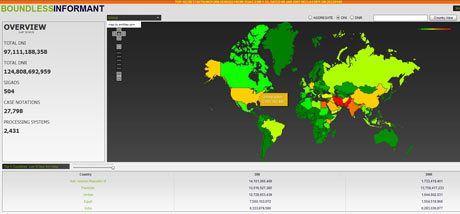
boundless heatmap

Update: The Guardian source, Edward Snowden, has revealed himself. Stunning.

Little mentioned as we talk about the massive amounts of spying Obama’s Administration undertakes is this passage from the President’s recent speech on counterterrorism.

That’s why, in the years to come, we will have to keep working hard to strike the appropriate balance between our need for security and preserving those freedoms that make us who we are. That means reviewing the authorities of law enforcement, so we can intercept new types of communication, and build in privacy protections to prevent abuse. [my emphasis]

As massive as the surveillance collection currently is, Obama recently called to expand it.

Most people have assumed that’s a reference to FBI’s persistent call for CALEA II, newly proposed to be a law imposing fines on companies that don’t comply with “wiretap” orders.

The F.B.I. director, Robert S. Mueller III, has argued that the bureau’s ability to carry out court-approved eavesdropping on suspects is “going dark” as communications technology evolves, and since 2010 has pushed for a legal mandate requiring companies like Facebook and Google to build into their instant-messaging and other such systems a capacity to comply with wiretap orders. That proposal, however, bogged down amid concerns by other agencies, like the Commerce Department, about quashing Silicon Valley innovation.

While the F.B.I.’s original proposal would have required Internet communications services to each build in a wiretapping capacity, the revised one, which must now be reviewed by the White House, focuses on fining companies that do not comply with wiretap orders. The difference, officials say, means that start-ups with a small number of users would have fewer worries about wiretapping issues unless the companies became popular enough to come to the Justice Department’s attention.

That is certainly at least part of what Obama’s seeking (though the ill-considered plan presents as many security issues as it does privacy ones).

But I note that Mike Rogers said this on ABC this morning.

And so each one of these programs — and I think the Zazi case is so important, because that’s one you can specifically show that this was the key piece that allowed us to stop a bombing in the New York Subway system.

But these programs, that authorized by the court by the way, only focused on non-United States persons overseas, that gets lost in this debate, are pieces of the puzzle. And you have to have all of the pieces of the puzzle to try to put it together. That’s what we found went wrong in 9/11.

And we didn’t have all of the pieces of the puzzle, we found out subsequently, to the Boston bombings, either. And so had we had more pieces of the puzzle you can stop these things before they happen. [my emphasis]

Mike Rogers asserted, with no evidence given, that had we had more information on Tamerlan Tsarnaev, we might have been able to prevent the Boston attack.

Rogers has, in the past, suggested that if we had gotten the texts between Tsarnaev’s mother and a relative in Russia discussing Tamerlan’s interest in fighting jihad. But it’s not clear that anything prevented us from collecting the relative’s communications, and if the discussion of fighting is as obvious as reporting claims (I suspect it is not), there would have been adequate probable cause to ID the mother.

In fact, one of the Guardian’s other scoops makes it clear that we don’t collect all that much SIGINT from Russia in the first place, so the fact we missed the text may say more about our intelligence focus than the technologies available to us.

Nevertheless, Rogers at least suggests that we might have been able to prevent the attack had we had more data.

In part of an interview with Andrea Mitchell that has not yet (AFAIK) been shown, James Clapper whined that the intelligence community was accused of not being intrusive enough following the Boston attack.

DNI Clapper @TodayShow: I find it a little ironic that after the Boston bombings we were accused of not being intrusive enough

Which makes me wonder whether Obama is calling for more than just CALEA II, but has floated using all this data in new ways because two guys were able to conduct a very low-tech attack together.

Glenn Greenwald said somewhere (I haven’t been able to find it) that he had been working on the PRISM story for around 2 months. If so, that would put it close to the Boston attack (though if it were two full months, it’d make it before the attack).

Given that timing, I’m wondering if the final straw that motivated this presumably high level NSA person to start leaking was a proposed new use of all this data hoovered up. Clapper et al insist that the FISA Court does not currently allow the NSA to data mine the data collected in its dragnet.

But have then been thinking about changing that?

Share this entry

Mike Rogers: As Confused about Telecom Surveillance as He Is about Drone Strikes

Congressman Mike Rogers, like most members of the ranking Gang of Four members of the Intelligence Committees, has long made obviously false claims about the drone program, such as that public reports of civilian casualties (which were being misreported in intelligence reports) were overstated.

That’s just one of the many reasons I was dubious about this report, claiming that, well … it’s not entirely clear what it claimed. Here’s the lead two paragraphs:

A secret U.S. intelligence program to collect emails that is at the heart of an uproar over government surveillance helped foil an Islamist militant plot to bomb the New York City subway system in 2009, U.S. government sources said on Friday.

The sources said Representative Mike Rogers, chairman of the House of Representatives Intelligence Committee, was talking about a plot hatched by Najibullah Zazi, an Afghan-born U.S. resident, when he said on Thursday that such surveillance had helped thwart a significant terrorist plot in recent years.

These paragraphs suggest that we found Najibullah Zazi — pretty clearly the most successful effort to prevent a known terrorist attack since 9/11 — because of one of the programs the Guardian (and WaPo) broke over the last few days.

Some paragraphs down, the piece explains the program in question was the “one that collected email data on foreign intelligence suspects.” Which is weird, because we’ve learned about a program to collect email data on everyone in the United States, not “foreign intelligence suspects.” And a program to collect a range of telecom content on known foreign intelligence suspects and their associates. Already, Reuters’ sources seemed confused.

The next paragraph describes the PRISM program by name.

The Washington Post and Britain’s Guardian newspaper on Thursday published top-secret information from inside NSA that described how the agency gathered masses of email data from prominent Internet firms, including Google, Facebook and Apple under the PRISM program.

And the rest of the report traces what former Agent and now FBI mouthpiece CBS pundit John Miller had to say.

All of that might lead you to believe this is a story reporting that we had foiled Zazi’s plot using PRISM, the program that involves the NSA accessing bulk data on everything these foreign targets were doing. But even that is problematic, since Zazi is a US person, whose communications are supposedly excluded from this program.

Then there are the problems with the actual content of this.

Read more

Share this entry

WHO, Bill Gates and Islamic Scholars All Push For Polio Vaccination in Province Now Governed by Khan’s PTI

There are public calls on a remarkable number of different fronts for a renewed commitment to polio vaccination in the Khyber Pakhtunkhwa province of Pakistan, which is now governed by Imran Khan’s PTI party. Direct appeals to Khan are coming from the World Health Organization and from Bill Gates. A major conference of Islamic scholars also came out with a statement backing polio immunization and providing push-back against the view that immunization campaigns aim to sterilize Muslims or are run by Western intelligence agencies.

Dawn gives us the details of the WHO push:

World Health Organisation, Pakistan polio chief Dr Elias Durry on Thursday apprised Pakistan Tehreek-i-Insaf chairman Imran Khan in Lahore of the threat to the health of Khyber Pakhtunkhwa children due to non-vaccination, it is learned. PTI, which has the most seats in the Khyber Pakhtunkhwa Assembly, leads a coalition government in the province.

According to the relevant officials, the meeting has coincided with the confirmation of three fresh polio cases from Federally Administered Tribal Areas by National Institute of Health.

They said Fata had reported five, Khyber Pakhtunkhwa four and Sindh two of this year’s 13 countrywide polio cases.

Khan is eager to help in the campaign and has taken part in promoting immunization before his party was elected to govern KP:

The officials said WHO had publicly recorded its reservations about polio eradication efforts in Khyber Pakhtunkhwa, especially in Peshawar.

They said the PTI chairman, who had inaugurated various polio campaigns in the country’s several cities, apprised the WHO, Pakistan polio chief of his eagerness to see fight against polio succeed.

The officials said Imran Khan carefully listened to Dr Elias Durry’s concerns about Khyber Pakhtunkhwa children’s vaccination and assured him that he would convey them to the PTI-led provincial government for necessary action on emergency basis.

“Imran Khan said he would issue special instructions to the provincial chief minister (who belongs to PTI) to ensure vaccination of all children under five as ensuring better health care in the province is his government’s top priority,” an official said.

Also joining the push for immunization is Bill Gates, as we learn from the Express Tribune:

Famous American business magnate Bill Gates has sought Imran Khan’s cooperation to eradicate polio in Khyber-Pakhtunkhwa, as the province apparently failed to provide security to polio workers.

Gates sent a personal letter through his emissary to chairman Pakistan Tehreek-e-Insaf (PT) Imran Khan asking for his party’s cooperation in furthering the anti polio vaccination programme in Khyber Pakhtunkhwa, said an official statement.

Imran Khan is scheduled to speak to him on the phone to discuss modalities of moving against polio which takes the lives of so many children in Pakistan especially in Khyber Pakhtunkhwa.

Especially welcome news comes from a meeting held by Islamic scholars who produced a statement in favor of immunization and condemning the killing of vaccination workers. They also condemned Dr. Shakil Afridi and any other participation of intelligence agencies in vaccination programs: Read more

Share this entry

BREAKING: Globalization Is Dangerous

Globalization is dangerous.

But not, as it turns out, because it has gutted the middle class. Not even because a globalized supply chain has made it easier for our rivals to sabotage our defense programs, or that a globalized supply chain has led to a loss of manufacturing capacity that threatens our defense, to say nothing of our distinctly American commercial sectors.

Rather, retired Admiral James Stavridis, in a more popularized version of a piece he wrote for a National Defense University volume on the topic, argues that “deviant globalization,” whether that of drug traffickers, terrorists, counterfeiters, or hackers, poses a rising threat.

Convergence may be thought of as the dark side of globalization. It is the merger of a wide variety of mobile human activities, each of which is individually dangerous and whose sum represents a far greater threat.

I’m sure it is a threat. But Stavridis makes the same mistake just about everyone else makes when they consider criminal globalized networks to be a security threat: they ignore that there is little these illicit networks do that licit ones didn’t already pioneer. They ignore that the only thing that makes them illicit is state power, the same state power that corporatized globalization has weakened.

In fact Stavridis’ fourth point telling how to combat deviant globalization is notable for what it’s missing.

Fourth, we must shape and win the narrative. Many have said there is a “war of ideas.” That is not quite the right description. Rather, the United States is a “marketplace of ideas.” Our ideas are sound: democracy, liberty, freedom of speech and religion — all the values of the Enlightenment. They have a critical role in confronting the ideological underpinnings of crime and terror. Our strategic communications efforts are an important part of keeping our networks aligned and cohesive.

You see it? In spite of using the metaphor of the market to describe the realm of ideas, Stavridis neglects to mention that one of our ideas, so-called capitalism (or the marketplace itself!), that value of Enlightenment, is precisely the logic that has made globalization imperative.

If the way to beat these criminal globalized networks is to compete ideologically, but the ideological foundation our elites cling to most desperately is the same one the criminal globalized networks are exploiting so spectacularly, haven’t we already lost the battle of ideas?

Stavridis’ choice to ignore capitalism is probably why he doesn’t get the problem with his call to “follow the money.”

Third, we must follow the money. Huge sums of cash from these trafficking activities finance terrorists and insurgents such as the Taliban, as well as corruption. The money is used to undermine fragile democracies. Efforts to upend threat financing must be fused with international initiatives, move across U.S. agency lines and have the cooperation of the private-sector institutions involved.

It is true that globalized cash flows undermine weak governments (the same ones that otherwise might make these criminal globalized networks illicit). But that’s at least as true of the money looted from poorer countries and deposited, completely legally per western elites, in secrecy regimes, or of the hot money that destabilizes the global economy more generally. Moreover, one of the biggest impediments to tracking the flows of criminal globalized networks is that the so-called licit multinational banks they use to transfer their money are more interested in the profits from the money than in cooperating with increasingly weak states. So long as HSBC can get away with a wrist slap, after all, why would any multinational bank give up its customer base to American authorities?

Stavridis ends his column by citing Hardy’s warning about icebergs.

Just over a century ago , the poet Thomas Hardy wrote “The Convergence of the Twain” about the collision of the Titanic and the iceberg that sank it. “And as the smart ship grew/ In stature, grace, and hue/ In shadowy silent distance grew the Iceberg too.” There is an iceberg out there in the form of weapons of mass destruction; what is most worrisome is the convergence of such a weapon with a sophisticated global trafficking route enabled by cybercrime and the cash it generates. That is the convergence we must do all in our power to prevent.

Stavridis almost gets it. He almost gets it that these global trafficking routes, whether deemed licit or illicit by increasingly weak states, are the iceberg that is looming.

It’s just that he chooses to ignore the iceberg he can see for the parts he can’t see.

Share this entry

APB: At Least Two Missing “Law Enforcement Personnel,” Last Seen at Ibragim Todashev Homicide Scene

When the FBI first admitted that it had killed Ibragim Todashev, it indicated there were at least 5 people at the scene: Two Massachusetts State cops, the FBI Agent being blamed for shooting Todashev, and “law enforcement personnel” — plural — whom it chose not to describe at all.

The FBI is currently reviewing a shooting incident involving an FBI special agent. Based on preliminary information, the incident occurred in Orlando, Florida during the early morning hours of May 22, 2013. The agent, two Massachusetts State Police troopers, and other law enforcement personnel were interviewing an individual in connection with the Boston Marathon bombing investigation when a violent confrontation was initiated by the individual. During the confrontation, the individual was killed and the agent sustained non-life threatening injuries. As this incident is under review, we have no further details at this time. [my emphasis]

That number correlates with the third-hand report of Khusen Taramov, Todashev’s friend who was at the site of the killing, but then sent home after some hours of interrogation himself.

The father said Taramov told him that U.S. agents interrogated him on the street while five officials interrogated Todashev in his Florida house for eight hours on May 22, the night he was shot.

But the anonymous law enforcement sources now trying to straighten out the FBI story seem to have kidnapped or disappeared those at least two other “law enforcement personnel.” CNN obliquely notes this, though doesn’t explain the discrepancy (or point out FBI’s official statement seeming to support Todashev and Taramov’s version).

Contrary to what a U.S. official said, Todashev’s father claimed there were “four of five” law enforcement agents with his son at the time, “all armed.”

The rest of the press seem to be blithely disappearing the at least two additional “law enforcement personnel” without comment, now reporting that just the FBI Agent and two MSP cops were at the scene.

NYT:

The shooting occurred after an F.B.I. agent from Boston and two detectives from the Massachusetts State Police had been interviewing Mr. Todashev for several hours about his possible involvement in a triple homicide in Waltham, Mass., in 2011, according to the law enforcement official, who spoke on the condition of anonymity because the investigation was continuing.

CBS:

The FBI says 27-year-old mixed martial arts fighter Ibragim Todashev was killed last week during a violent confrontation in his Orlando home while an FBI agent and two Massachusetts state troopers questioned him about his ties to slain Boston Marathon bombing suspect Tamerlan Tsarnaev, as well as about a 2011 triple slaying in Massachusetts.

AP:

The FBI says Todashev was being questioned by an FBI agent and two Massachusetts state troopers about his ties to Tamerlan Tsarnaev, as well as about a 2011 triple slaying in Massachusetts.

Of course, between the time FBI said there was one FBI Agent and two MSP cops and at least two other “law enforcement personnel” and the FBI’s currently operative story that those at least two other “law enforcement personnel” weren’t there, one anonymous source was claiming secondhand that the (unnumbered) other “law enforcement officials” had stepped out of the room before the violence and killing started.

An official said that according to one account of the shooting, the other law enforcement officials had just stepped out of the room, leaving the FBI agent alone with Todashev, when the confrontation occurred.

The current NYT version, which for some reason a bunch of commentators are taking as credible, suggests one “detective” was in the room when the violence and shooting went down, but did not fire a weapon.

[Todashev] then started to write a statement admitting his involvement while sitting at a table across from the agent and one of the detectives when the agent briefly looked away, the official said.

At that moment, Mr. Todashev picked up the table and threw it at the agent, knocking him to the ground.

While trying to stand up, the agent, who suffered a wound to his face from the table that required stitches, drew his gun and saw Mr. Todashev running at him with a metal pole, according to the official, adding that it might have been a broomstick.

The agent fired several shots at Mr. Todashev, striking him and knocking him backward. But Mr. Todashev again charged at the agent. The agent fired several more shots at Mr. Todashev, killing him. The detective in the room did not fire his weapon, the official said.

There are a lot of ongoing problems with the FBI’s story, which I laid out here, and Conor Friedersdorf catalogued here. But this is an increasingly fascinating one.

The coroner in this case declared Todashev’s cause of death a homicide. But the FBI seems to be intent on ensuring that at least two people who were present at the scene of that homicide disappear entirely.

Update: Note that more sources are stating that an Orlando cop was at the scene, which would resolve who one of these at least two law enforcement personnel is.

And check out this BoGlo piece which tries to catalog and explain away all the changes to the story. While it admits that the story of how many and what kind of law enforcement has also changed, it doesn’t offer an explanation for that change.

After 10 days of conflicting reports, even the most basic facts in Todashev’s killing remain unclear: Did he or did he not have a weapon when he was shot and killed? And, who was in the room at the time of the shooting?

Share this entry