Preparations Underway for Zero Option in Afghanistan

As I posited yesterday, Pakistan appears to be putting together a US-style counterterrorism structure. This morning, we see even stronger hints that a full-blown military offensive against the Taliban may soon be launched by Pakistan. Although we have not seen any evidence that they have done so yet, I fully expect Pakistan to include both the Afghan Taliban and Haqqani network among their targets in this operation. In fact, the Washington Post article mentions that Pakistan “would ‘not discriminate’ among the TTP, the Haqqani network and other militant groups in North Waziristan, including al-Qaeda”. In return for this offensive, look for Pakistan to get a massive amount of US financial and intelligence assistance. The US also appears to be making a renewed push against the Haqqani network inside Afghanistan and this report from Missy Ryan and Phil Stewart describes that effort while noting that the US wants Pakistan to take on the Haqqanis and any other groups that use Pakistan as a sanctuary from which to launch attacks in Afghanistan.

These moves by Pakistan and the US make more sense when we see that the US has come to the realization that an ongoing troop presence in Afghanistan is increasingly unlikely. There was significant movement on that front yesterday, with President Obama speaking to Afghan President Hamid Karzai on the telephone. From the White House readout of the call:

President Obama called President Karzai today to discuss preparations for Afghanistan’s coming elections, Afghan-led peace and reconciliation efforts, and the Bilateral Security Agreement.

/snip/

With regard to the Bilateral Security Agreement, in advance of the NATO Defense Ministerial, President Obama told President Karzai that because he has demonstrated that it is unlikely that he will sign the BSA, the United States is moving forward with additional contingency planning. Specifically, President Obama has asked the Pentagon to ensure that it has adequate plans in place to accomplish an orderly withdrawal by the end of the year should the United States not keep any troops in Afghanistan after 2014. At the same time, should we have a BSA and a willing and committed partner in the Afghan government, a limited post-2014 mission focused on training, advising, and assisting Afghan forces and going after the remnants of core Al Qaeda could be in the interests of the United States and Afghanistan. Therefore, we will leave open the possibility of concluding a BSA with Afghanistan later this year.  However, the longer we go without a BSA, the more challenging it will be to plan and execute any U.S. mission. Furthermore, the longer we go without a BSA, the more likely it will be that any post-2014 U.S. mission will be smaller in scale and ambition.

The United States continues to support a sovereign, stable, unified, and democratic Afghanistan, and will continue our partnership based on the principles of mutual respect and mutual accountability.  We remain fully supportive of our partners in the Afghan security forces, and we continue to proudly work side by side with the many Afghans who continue to work to ensure the stability and prosperity of their fellow citizens.

Although there is no clear deadline date, this phone call has the hallmarks of a “final warning” to Karzai. If the US doesn’t see movement from him on the BSA soon, look for the zero option of a full US withdrawal from Afghanistan to take place. As noted in the readout, the lack of a signed BSA is causing trouble for NATO, as well. A NATO gathering (called a Defense Ministerial)  opened today, but with no BSA in place, Afghanistan planning can’t be done, prompting a very uncomfortable opening press conference for Secretary General Rasmussen.

Adam Goldman brings us another strong indicator that the US is moving toward a full withdrawal from Afghanistan: Read more

Share this entry

Is John Brennan Shaping Pakistan’s New Counterterrorism Program?

There are now multiple reports (one of the earliest is here) that while the world was concentrating on a number of pressing developments in the Ukraine and elsewhere last week, John Brennan slipped into Pakistan to pay a quiet visit. The visit seems to me to cap a series of developments that have taken place over the last few months to put into place a counterterrorism program in Pakistan that seems modeled on the US plan. Almost exactly a month ago, I had wondered whether Pakistani Prime Minister Nawaz Sharif was making a play for US counterterrorism funds that would become available as the US withdraws its troops from Afghanistan. Pakistan Today has a summary of the series of meetings that has brought us to this point:

After a nearly three-year long freeze Pak-US relations are on the mend once again. Secretary of State John Kerry’s visit to Islamabad paved way for Nawaz Sharif’s meeting with President Obama. In December, Pentagon Chief Chuck Hagel was in Pakistan where he also met the new COAS Gen Sharif. The prime minister’s meeting with President Obama in October was followed by a flurry of visits by civilian and military leaders from both sides. Important federal ministers including Sartaj Aziz, Ahsan Iqbal, Khwaja Asif and Shahid Khqan Abbasi have made several trips to Washington to discuss energy, trade and security related issues. During the last four weeks CENTOM Commander General Lloyd J Austin visited Islamabad to hold talks with COAS Gen Sharif and CJCSC Rashad Mahmood. Defence Secretary Asif Yasin Malik is currently in Washington leading a Pakistani delegation to hold military to military talks. Unconfirmed reports tell of CIA chief John Brennan having paid a clandestine visit to Rawalpindi to meet COAS Gen Sharif.

The article notes that security issues are driving the meetings:

The key factor is the concern for the security of the region after the US exits from Afghanistan. Washington wants to withdraw troops in an orderly manner and to ensure that the Afghanistan and Pakistan do not fall under the influence of Al Qaeda and other militant groups with global reach, threatening the US and its worldwide interests. After trying peaceful methods which failed, the PML-N government now seems to have realised the gravity of the situation and is inclined to take on the TTP and other militant groups. It knows however that it cannot deal with them on its own.

Oh, but that passage is so loaded with meaning. Recall that the talks between Pakistan’s government and the TTP were just getting ready to get started when John Brennan called for the drone strike that took out TTP leader Hakimullah Mehsud. That strike seems to have tipped the balance for the TTP and Pakistan’s government to continue back and forth strikes rather than peace talks, with Pakistan now carrying out attacks on Taliban hideouts in the tribal areas using jet fighters. The latest attack, today, appears to have killed at least 30. But Pakistan can’t take on the militants on its own, so the US has to step up with support, at least according to the prevailing thought.

But now we see that Pakistan’s cabinet is suddenly discussing a draft security policy only a few days after John Brennan’s secret visit. From Dawn:

Sources told DawnNews that in accordance with the policy, the National Counter-Terrorism Authority (Nacta) would be the focal organisation for national security, adding that the heads of the armed forces would be among members of Nacta.

The cabinet agreed that all decisions pertaining to anti-terror measures would be taken at the highest levels of authority.

/snip/

The policy also entails the formation of a joint intelligence directorate to make the exchange of information more effective on federal and provincial levels.

Moreover, the policy document notes that the total strength of 33 national security organisations, including the police and other civil armed forces, both at the federal as well as the provincial level, exceeded 600,000, which is more than the sixth largest standing army of the world i.e. Pakistan.

Gosh, I wonder where Pakistan could have gotten the idea for a National Counter-Terrorism Authority? Perhaps from the person who was the first director of the National Counterterrorism Center in US? That, of course, was John Brennan.

In an interesting article in The Nation, we get a description of Pakistan’s complaint that Afghanistan is not attacking and perhaps even supporting TTP fighters who flee Pakistan’s tribal areas into Afghanistan: Read more

Share this entry

1st Amendment Justice Delayed is Justice Denied for Col. Morris Davis

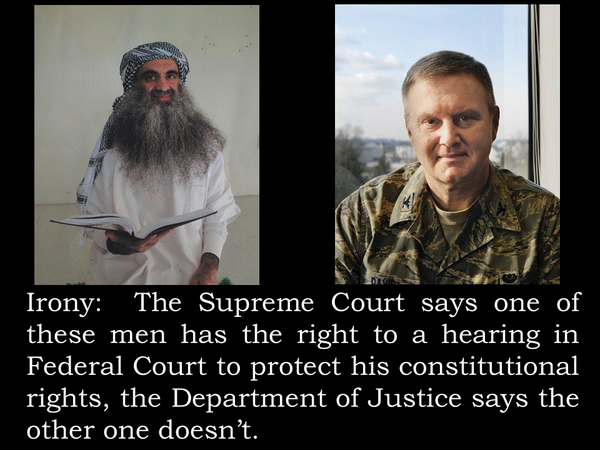
Bg32jNgCYAApToACol. Morris Davis is, at least for my money, an American hero. He served and fought not only for his country, but for the Constitution he swore to protect. The subject of what happened to him at the hands of the very government he defended deserves a much longer, and deeper, dive than I have time for in this post. We will likely come back for that at a later date as it seems as if the legal case Col. Davis brought to correct the wrongs done to him will likely go on forever.

And the going on forever part is the subject of this post. Col. Davis was scheduled to have a hearing in United States District Court in Washington DC tomorrow in front of Judge Reggie Walton. But the hearing was postponed. And that is the problem, this is the FOURTEENTH (14th) TIME hearing on Col. Davis’ case has been delayed. One delay was due to a conflict on Judge Walton’s part, and one because the offices of Davis’ attorneys at the ACLU in New York were substantially damaged by Hurricane Sandy. Other than that, the delay has been at the hands of an intransigent and obstreperous DOJ. If the actions of the DOJ in relation to Col. Davis are not “bad faith”, it is hard to imagine what the term stands for.

Now, to be fair, it appears the latest delay was at the unilateral hand of the court, as yesterday’s minute entry order reads:

In light of the fact that potentially dispositive motions remain pending, it is hereby ORDERED that the status hearing currently scheduled for Friday, February 21, at 9:15 a.m. is CONTINUED to a date and time to be determined by the Clerk.

The problem with that is that the “dispositive motions” the court speaks of as being “pending” have been “pending” for a VERY long time, since July of last year. And the case itself has been going on since the complaint was filed on January 8, 2010.

Why is it taking so long you ask? Because of the aforementioned bad faith and obstreperousness of the Department of Justice, that’s why. To get an idea of just what is going on here, a little background is in order. Peter Van Buren gives a good, and relatively brief synopsis:

Morris Davis is not some dour civil servant, and for most of his career, unlikely to have been a guest at the Playboy Mansion. Prior to joining the Library of Congress, he spent more than 25 years as an Air Force colonel. He was, in fact, the chief military prosecutor at Guantánamo and showed enormous courage in October 2007 when he resigned from that position and left the Air Force. Davis stated he would not use evidence obtained through torture. When a torture advocate was named his boss, Davis quit rather than face the inevitable order to reverse his position.

Morris Davis then got fired from his research job at the Library of Congress for writing an article in the Wall Street Journal about the evils of justice perverted at Guantanamo, and a similar letter to the editor of the Washington Post. (The irony of being fired for exercising free speech while employed at Thomas Jefferson’s library evidently escaped his bosses.) With the help of the ACLU, Davis demanded his job back. On January 8, 2010, the ACLU filed a lawsuit against the Library of Congress on his behalf. In March 2011 a federal court ruled against the Obama Administration’s objections that the suit could go forward (You can read more about Davis’ struggle.)

Moving “forward” is however a somewhat awkward term to use in regards to this case. In the past two years, forward has meant very little in terms of actual justice done.

Yes, you read that right. Col. Davis was fired from the job he truly loved at the Congressional Research Service because he, on his own time as a private citizen, exercised his First Amendment right to speak. As one of Davis’ pleadings puts it:

Col. Davis was unconstitutionally removed from his position at the Library of Congress’ Congressional Research Service for writing opinion pieces in the Wall Street Journal and the Washington Post expressing his nonpartisan, personal views on the failures of the American military commissions established to try detainees at Guantánamo Bay, Cuba. His speech lies at the very core of the First Amendment and exemplifies the kind of speech that federal courts have been most vigilant in protecting from government retaliation.

The full pleading that quote came from, Col. Davis’ response to the government’s motion for summary judgment (one of the “pending dispositive motions”) can be found here and is a good read if you are interested in more background.

That is exactly what happened and what is at stake. And you do not have to take my word for it, Judge Walton thinks it is a solid and valid claim too. Here is language from Judge Walton in an order in late January 2010, not long after the case was filed:

The Court is satisfied that the plaintiff has established, at least based on the record before the Court at this time, that the likelihood of success on the merits and public policy prongs of the preliminary injunction standard weigh in his favor. Essentially, the record before the Court suggests that the plaintiff was terminated immediately after two specific opinion editorials he authored were published in national newspapers. Regardless of the defendants’ contention to the contrary, it appears that the content of the plaintiff’s published opinions was one of the reasons, if not the primary reason, he was fired, i.e., because the plaintiff took a position on the prosecution of detainees being housed at the United States military’s Guantánamo Bay facility which the Congressional Research Service felt would call into question its impartially as to any policy recommendation it would make and any research it would conduct on that issue. This conclusion is supported by the fact that the opinion articles were specifically referenced in the plaintiff’s termination letter, and also the timing of the letter, which was issued only several days after his writings were published. The plaintiff’s likelihood of success position therefore is well-founded, at least with respect to the record the Court now has before it. And as to the public interest prong, it cannot be questioned that government employees retain First Amendment rights. (citations omitted)

So, there is really no question but that protected First amendment rights were involved, and that Col. Davis was wrongfully fired for exercising them. Makes you wonder why the DOJ would string him out and fight so hard in a case that is only about the rights and not even about the money damages he suffered as a result (that would have to be litigated in a separate action).

As the graphic at the top questions, why is the DOJ willing to give free speech rights to a terrorist at Guantanamo and not to Col. Morris Davis? Bad faith is the answer. Complete, scandalous, bad faith.

Share this entry

Pakistan Facing Difficult Choice: Peace Talks or Military Action?

With mounting pressure from many sides, Pakistan is quickly approaching a decision point at which it must choose whether it prefers to pursue peace talks with militant groups or to take military action against them. The latest spectacular incident involved a splinter group of Pakistan’s Taliban executing 23 Pakistani Frontier Corpsmen who had been in custody since being captured in 2010. This killing has caused at least a temporary pause in the ongoing peace talks between representatives of the TTP and Pakistan’s government.

The Express Tribune brings us word of Prime Minister Nawaz Sharif’s reaction to the executions:

Prime Minister Nawaz Sharif on Monday condemned the execution of kidnapped soldiers by a Taliban faction, warning that the deaths could affect ongoing peace talks.

“Such incidents have an extremely negative impact on the ongoing dialogue aimed at promoting peace,” Nawaz said in a statement issued by his office.

A faction of the Tehreek-e-Taliban Pakistan (TTP) from the northwestern Mohmand district claimed on Sunday night that they had killed 23 paramilitary Frontier Corps members who were kidnapped in June 2010.

Sharif goes on to note that this is just the latest attempt to disrupt the peace talks:

Nawaz added that Pakistan “cannot afford such bloodshed” and lamented that previous attempts to start dialogue were “sabotaged whenever it reached an encouraging stage”.

So while this disruption of the talks is clearly the responsibility of the Mohmand splinter group of the TTP that carried out the executions, recall that the US disrupted the talks last November with a drone killing of the TTP leader the day before talks were to begin.

In its coverage of the executions, Dawn notes the decision that Pakistan faces:

Highly placed sources have said the military was prepared to launch a full scale operation against militant sanctuaries in North Waziristan.

Sources said the army was awaiting a green signal from the government, adding that a large number of troops were being dispatched to North Waziristan from various formations across the country.

Meanwhile, army formations were carrying out field firing and battle inoculation exercises which are being regarded as preparations of a possible operation.

The exercises were aimed as practice for troops in operating under real battlefield environment with live firing of various weapon systems, the Inter-Services Public Relations (ISPR) said.

Meanwhile, those who have been appointed to the negotiating group on behalf of the TTP are doing their best to get the talks going again.

Sadly, though, violent pressure on Pakistan’s government is continuing on many more fronts. Read more

Share this entry

Iran-Pakistan Border Incidents Continue

The last time we checked in on the ongoing incidents along the Iran-Pakistan border, fourteen Iranian border guards had been killed on October 25 in an attack and Iran had promptly executed sixteen prisoners the next day in retaliation. A subgroup within Jundallah, Jeish Al-Adl, was credited for the attack, and Iran made veiled accusations about what countries might be backing the group.

A bit later, on November 5, an Iranian legislator (who seems to make mostly hard-liner pronouncements) publicly accused the United States and Pakistan’s ISI of being behind Jeish Al-Adl’s actions:

An Iranian lawmaker says the US and Pakistani intelligence services lead the Pakistan-based Jaish-ul-Adl terrorist group responsible for the recent deadly attack on Iranian border guards.

“The key point in this case is the role that US spy agencies play by means of Pakistan’s Inter-Services Intelligence (ISI) in conducting such terrorist attacks. This issue has been confirmed in the meeting between representatives of the Islamic Revolution Guards Corps (IRGC) and members of the Majlis National Security and Foreign Policy Committee,” Javad Karimi Qoddousi said on Monday.

He added, “The direct affiliation of these groups to US spy agencies and the ISI’s control over such terrorist outfits have been authenticated.”

The next day, a prosecutor in the border town of Zabol was killed. Jeish Al-Adl quickly claimed responsibility:

The Sunni armed group Jaish-ul Adl has claimed responsibility for the assassination of a public prosecutor in Iran’s southeast, media reports say.

Thursday’s reports came a day after Mousa Nouri – prosecutor of the city of Zabol, which lies near the Afghan border in Sistan-Baluchestan province – was slain in a “terrorist attack,” according to officials.

Jaish-ul Adl, the rebel group formed last year whose name means Army of Justice in Arabic, said in a statement Wednesday night that the killing was carried out in retaliation for a mass hanging last week.

“After the hanging of 16 innocent young Baluchis, the fighters decided to take revenge and kill a judicial official,” read the statement posted on the group’s website, jaishuladl.blogspot.fr.

/snip/

Security forces later killed four rebels in a separate clash near Mirjaveh, a town close to the border with Pakistan, officials said last week.

But Iran announced on November 18 that they had captured the prosecutor’s killers. They went to great lengths to point out that the killers were drug smugglers unrelated to Jeish Al-Adl: Read more

Share this entry

Friday News Dump Not Dead Yet: Stephen Kim Guilty Plea

Just when Kevin Drum declared the “Friday News Dump” dead, comes proof news of said death was greatly exaggerated.

As Josh Gerstein and others have reported, the plea will be entered this afternoon:

Under the terms of the agreement, Kim will plead guilty to a single felony count of disclosing classified information to Rosen in June 2009, and serve a 13-month prison sentence. Judge Colleen Kollar-Kotelly would have to accept the sentence or reject it outright?, in which case Kim could withdraw his plea. Kim would also be on supervised release for a year, but would pay no fine.

Judge Kollar-Kotelly is expected to accept the guilty plea at today’s hearing, but will not impose a sentence until sometime later.

Well, that is kind of a big deal dropped out of nowhere on a Friday afternoon.

As you may recall, this is the infamous case where the Obama/Holder DOJ was caught classifying a journalist, James Rosen of Fox News, as an “aider and abettor” of espionage. As the Washington Post reported, the scurrilous allegation was clear as day in a formal warrant application filed as an official court document:

“I believe there is probable cause to conclude that the contents of the wire and electronic communications pertaining to the SUBJECT ACCOUNT [the gmail account of Mr. Rosen] are evidence, fruits and instrumentalities of criminal violations of 18 U.S.C. 793 (Unauthorized Disclosure of National Defense Information), and that there is probable cause to believe that the Reporter has committed or is committing a violation of section 793(d), as an aider and abettor and/or co-conspirator, to which the materials relate,” wrote FBI agent Reginald B. Reyes in a May 28, 2010 application for a search warrant.

The search warrant was issued in the course of an investigation into a suspected leak of classified information allegedly committed by Stephen Jin-Woo Kim, a former State Department contractor, who was indicted in August 2010.

The Reyes affidavit all but eliminates the traditional distinction in classified leak investigations between sources, who are bound by a non-disclosure agreement, and reporters, who are protected by the First Amendment as long as they do not commit a crime.

[snip]

As evidence of Mr. Rosen’s purported culpability, the Reyes affidavit notes that Rosen and Kim used aliases in their communications (Kim was “Leo” and Rosen was “Alex”) and in other ways sought to maintain confidentiality.

“From the beginning of their relationship, the Reporter asked, solicited and encouraged Mr. Kim to disclose sensitive United States internal documents and intelligence information…. The Reporter did so by employing flattery and playing to Mr. Kim’s vanity and ego.”

“Much like an intelligence officer would run an [sic] clandestine intelligence source, the Reporter instructed Mr. Kim on a covert communications plan… to facilitate communication with Mr. Kim and perhaps other sources of information.”

Of course, the fully justifiable uproar over the Rosen treatment by DOJ eventually led to “new guidelines”, being issued by the DOJ. The new guidelines are certainly a half step in the right direction, but wholly unsatisfactory for the breadth and scope of the current Administration’s attack on the American free press.

But now the case undergirding the discussion in the Stephen Kim case will be shut down, and the questions that could play out in an actual trial quashed. All nice and tidy!

Frankly, I have mixed emotions about the reported Kim plea itself. It is, all in all, a pretty good deal for Kim and his attorney, the great Abbe Lowell. The case is done, bad precedent does not get etched into a jury verdict and appeal, and the nightmare has an end in sight for the defendant, Stephen Kim. All things considered, given the seriousness of the espionage and false statement charges in the indictment, 13 months is a good outcome. And it is not a horrible sentence to have as a yardstick for other leakers (were I Ed Snowden and Ben Wizner, I would like this result). By the same token, the damage done by the ridiculous antics and conduct of the DOJ in getting to this point is palpable. It will leave a stain that won’t, and shouldn’t, go away.

That still leaves the matter of Jeffrey Sterling, and reporter James Risen, though. Whither DOJ on that? And it is an important question since the much ballyhooed and vaunted “New Media Policies” announced by DOJ left wide open the ability to force Risen (and others that may some day be similarly situated) to testify about his sources of face jail for contempt.

Share this entry

Peace Talks Between Pakistan Government and Taliban Are Underway

After a cancelled meeting earlier in the week, peace talks between Pakistan’s government and the Tehrik-e-Taliban Pakistan (TTP), a Taliban group that has been carrying out terrorist attacks against targets inside Pakistan, have gotten underway. Although Reuters reported that the meeting was in an undisclosed Islamabad location and Dawn reported that the meeting was in Khyber Pakhtunkhwa House in Islamabad, it appears that both stories have elements of truth. From the Express Tribune:

The meeting of government and Tehreek-e-Taliban Pakistan (TTP) peace talks committees started at an undisclosed location in Islamabad at 2:24pm on Thursday, Express News reported.

The meeting later shifted to Pakhtunkhwa House.

The Dawn story reports that there was a “cordial atmosphere”, but adds another very important point:

Sources said that talks were being held in a cordial atmosphere and that negotiations would now be continued on a daily basis.

With daily meetings planned, it sounds like the talks could be more than a mere formality.

Returning to the Dawn story, we have the line-up of negotiators for each side:

The government’s negotiators include Irfan Siddiqui, special assistant to the prime minister and coordinator of the committee, Rustam Shah Mohmand, a former Pakistan ambassador to Afghanistan, Peshawar-based journalist Rahimullah Yousufzai and retired Major Amir Khan.

Negotiators from the TTP’s side include Maulana Samiul Haq, Maulana Abdul Aziz and Professor Mohammad Ibrahim.

/snip/

The TTP had initially also nominated Pakistan Tehrik-i-Insaf (PTI) chief Imran Khan and former Jamiat Ulema-i-Islam (JUI-F) lawmaker Mufti Kifayatullah in their committee. However, both later refused to be part of the committee.

Although none of the stories point it out, I find it very interesting that at least part of today’s discussions were held at Khyber Pakhtunkhwa House. Even though Imran Khan declined to be a part of the negotiating team for the TTP, recall that his PTI party controls the government in Khyber Pakhtunkhwa province. After a bit more poking around, I found this version of an AFP story on the meetings that has a photo of the outside of Khyber Pakhtunkhwa House. Note the emblem on the gate in the photo. It clearly is the emblem of the Khyber Pakhtunkhwa province and not of Pakistan’s government (see here), suggesting that Khan’s provincial government may well be playing the role of a host or facilitator for the talks. There also appears to be a restaurant in Islamabad with the name Khyber Pakhtunkhwa House, but the AFP photo appears to rule out the restaurant.

An official speaking to Reuters also added to the importance of the meetings:

“The progress of the talks will be submitted to the prime minister,” the government official, who declined to be named, as he is not authorized to comment on progress of the talks, told Reuters.

Recall that Prime Minister Nawaz Sharif had the establishment peace talks with the Taliban as one of his main campaign promises. Note also that Imran Khan made ending US drone strikes one his main campaign issues. With Sharif monitoring the talks and Khan providing a venue (at least for today), it then becomes very interesting that the spokesperson for Pakistan’s Foreign Office today said that the announced US slowdown on drone strikes is not enough. She stated that the strikes have to end altogether. Although Sharif’s government has called for an end to drone strikes several times in the past, reiterating it today could well be important in the context of the talks and Khan’s potential role as a mediator of sorts.

Share this entry

Mike Rogers Throws Tantrum Over Obama’s Drone Policy

It seems that Mike Rogers lately is aiming to take over the Emptywheel blog. When he’s not yapping about criminalizing journalism or dissembling about Congressional briefings on the Patriot Act renewal, he’s putting out bloodthirsty endorsements of drone violence. When we last heard from him on the drone front, he was joining the mad rush to come up with the most damning indictment of Hakimullah Mehsud after the US disrupted Pakistan’s plans to start peace talks the very next day with a Taliban group headed by Mehsud. Yesterday, Rogers used a hearing of his House Intelligence Committee as a venue in which to pitch a tantrum over the US daring to adjust its drone policy, leading to fewer strikes.

Now, almost exactly three months after the Mehsud drone strike, we see the prospect for peace talks between Pakistan and the Taliban disrupted again. As I mentioned yesterday, Taliban negotiators fear that Pakistan’s government may be planning to scuttle the talks in order to launch an offensive against the Taliban in tribal areas, which might also play into a desire by Sharif’s government to be in line for counterterrorism funds which the US might not be spending in Afghanistan.

The Washington Post has Rogers’ tirade. First, there is news of a pause in drone strikes in Pakistan:

The Obama administration has sharply curtailed drone strikes in Pakistan after a request from the government there for restraint as it pursues peace talks with the Pakistani Taliban, according to U.S. officials.

“That’s what they asked for, and we didn’t tell them no,” one U.S. official said. The administration indicated that it will still carry out strikes against senior al-Qaeda targets, if they become available, and move to thwart any direct, imminent threat to U.S. persons.

Concern about Pakistani political sensitivities provides one explanation for the absence of strikes since December, the longest pause in the CIA’s drone campaign since a six-week lull in 2011, after an errant U.S. air assault killed 24 Pakistani soldiers at a border post, triggering a diplomatic crisis.

Oooh, look! There’s Marcy’s favorite word again, “imminent“. But this lull in drone strikes, coupled with the explanation offered in the Post, tells us that no suitable al Qaeda targets with credible plans against the US presented themselves in Pakistan’s tribal areas for over a month. That didn’t deter Rogers; he’s upset that any potential targets aren’t blasted immediately: Read more

Share this entry

Dzhokhar Tsarnaev Faces the Death Penalty

Attorney General Holder has decided to seek the death penalty for Dzhokhar Tsarnaev. The Prosecutors cite Dzhokhar’s “betrayal of the US,” his encouragement to others, the depraved manner in which he conducted his attack, and his targeting of the Boston Marathon among the reasons for their decision.

But, as Matt Apuzzo suggests in his story on the decision, DOJ’s pursuit of the death penalty — along with their earlier accession to letting death penalty specialist Judy Clarke represent him — actually makes a plea deal more likely. Clarke specializes in negotiating plea deals for clients in similar situations. Thus, one way to look at this decision is as a decision to aim for a plea deal rather than a trial.

There are multiple reasons DOJ may want to do that, starting with the contrast such a tidy resolution would offer with the 9/11 defendants, who are still engaged in the Kangaroo Court in Gitmo 13 years after their attack. A quick plea deal with ensure that Dzhokhar will be sent to Florence SuperMax within 20 months of his attack, yet again proving that civilian resolution to terrorism actually works better than the Kangaroo Court. Obama would get to look tough on terrorism and prove yet again that civilian trials work better than what Republicans prefer.

There’s also the way that a plea deal would serve to reinforce DOJ’s narrative of the crime, of two brothers radicalized by reading Anwar al-Awlaki’s Inspire (though if they were, why wasn’t NSA tracking them?) who acted on their own. The decision may also serve to close any questions about Ibragim Todashev’s death at the hands of the FBI and other unnamed law enforcement (or intelligence?) personnel; if I know this DOJ, they might even require Tsarnaev to throw in incriminating statements about the 2011 Watertown murders. It also would serve to side-step any evidence about the Tsarnaev’s family (including their spooked up uncle).

So I’m betting this leads not to the death penalty, but to a plea deal that closes the case.


Share this entry

Is Sharif Making a Play for Counterterrorism Funds US Cut from Afghanistan Budget?

Back in early November, the US carried out one of its most controversial drone strikes in Pakistan, killing TTP head Hakimullah Mehsud just hours before peace talks between the TTP and Pakistan were to begin. This move by the US seems to have pushed the TTP in a more radicalized direction, resulting in many new attacks. Pakistan’s government has responded to these attacks with counterattacks, effectively putting an end to prospects for restarting the talks.

Today, we see Sharif’s government vowing to take on another radical Sunni group, this time in Balochistan:

The government has finally decided to launch an operation against the feared Sunni terrorist outfit, the Lashkar-e-Jhangvi, and other militant groups involved in fomenting unrest in Balochistan.

The decision was taken in a meeting attended by Interior Minister Chaudhry Nisar, Balochistan Chief Minister Dr Abdul Malik Baloch, the Quetta corps commander, the Balochistan inspector general (IG) police and the Frontier Corps IG.

Dr Baloch was made in-charge of the operation against Lashkar-e-Jhangvi.

It is important to mention that the decision to launch an operation against terrorists was taken following an attack on Shias in Mastung that killed 29 pilgrims on Tuesday.

Significant government resources were brought in quickly after the attack on the bus:

The Government of Balochistan has suspended buses carrying pilgrims from travelling through the province to neighbouring Iran due to security concerns after a suicide attack killed 28 pilgrims in Mastung this week.

A 700 km highway connecting Quetta and Iran, home to many Shia pilgrimage sites, has seen dozens of suicide and roadside bomb attacks.

“We have temporarily suspended the movement of buses on the highway until the security situation improves,” a senior official of the Balochistan government told Reuters on Friday.

The provincial government then arranged C-130 flights to ferry 301 Shia pilgrims from Dalbandin town in Chagai district to Quetta International Airport for fear of more attacks on the pilgrims on Taftan-Quetta Highway. The pilgrims had entered Pakistan via Iran border in Taftan Town on Wednesday.

“The pilgrims were stopped in Taftan and barred from travelling by passenger buses. They were later shifted to Dalbandin under tight security,” another official said.

FC and Levies personnel escorted the pilgrims from Taftan to Dalbandin.

Although the C-130 flights were provided by the provincial government, the Frontier Corps is under the control of Pakistan’s army and so there appears to be national coordination in this response, as is also indicated by Nisar being mentioned in the Pakistan Today article quoted above (Prime Minister Nawaz Sharif, although not mentioned in the article, is in the accompanying photo).

Almost under the radar, we get word that talks begin in Washington, DC tomorrow on the “strategic” relationship between Pakistan and the US. It appears that counterterrorism is high on the list of topics under discussion: Read more

Share this entry