High Urban Turnout, No Major Violence, But How Successful Was Afghan Election?

With no catastrophic attacks taking place and reports of over 7 million people voting, on first impressions it would appear that Afghanistan’s presidential election on Saturday was a resounding success. Digging a bit deeper, though, reveals disturbing evidence of hundreds of violent incidents that received little attention and large areas of the country where the electorate was too scared of the Taliban to vote. Another large cautionary note is that the slow rate of vote counting means that it will be a long time before there can be any meaningful analysis of the extent of vote-stuffing. Further, the US goal of a new president clearing the way to a signed Bilateral Security Agreement is likely to be put off further, as any runoff will not happen until late May, which could well be past the point at which the US will have to decide if it will invoke the zero option and withdraw all troops from the country at the end of the year.

The New York Times gives us the rosy version of the voting:

After enduring months of Taliban attacks and days of security clampdowns, Afghans reveled Sunday in the apparent success of the weekend’s presidential election, as officials offered the first solid indications that the vote had far exceeded expectations.

Two senior officials from the Independent Election Commission said the authorities supervising the collection of ballots in tallying centers had counted between seven million and 7.5 million total ballots, indicating that about 60 percent of the 12 million eligible voters had taken part in the election. The officials spoke on the condition of anonymity because results will not be released for weeks.

Even this report, though, cautions that fraud could still be a problem and will take time to detect:

Afghan election observers backed up the numbers offered by election officials, as did Western diplomats, though the latter struck a more cautious tone. But both said that some votes would invariably be thrown out because of fraud.

The question was how many, and whether Afghanistan would see a repeat of the 2009 election, which was marred by widespread ballot stuffing and other fraud. Turnout that year was about 38 percent, though some estimates put it lower. The memory of what happened that year still hovers here, giving many reason to hesitate before declaring this weekend’s vote an unqualified success.

It took days for the full extent of the problems with the 2009 election to emerge, and the ensuing political crisis lasted months, souring relations between President Karzai and the United States, embittering many Afghans and helping fuel a Taliban insurgency that was gaining momentum.

But the claims of no large attacks overshadowed the news that there were actually hundreds of attacks aimed at the voting:

The anti-government armed militants carried out 690 attacks across the country during the presidential and provincial council elections on Saturday.

Defense ministry spokesman, Gen. Zahir Azimi said Saturday that the attacks by militants included direct fire, rocket attacks, improvised explosive device (IED) attacks and suicide attacks.

/snip/

Azimi also added that 164 militants were killed and 82 others were injured during the attacks while Afghan army soldiers seized various types of weapons belonging to the assailant militants.

He said at least 7 Afghan national army soldiers were martyred and 45 others were injured during these attacks.

That Khaama Press account did not cite figures on civilian deaths or injuries, but this Reuters article does note some civilian deaths: Read more

Share this entry

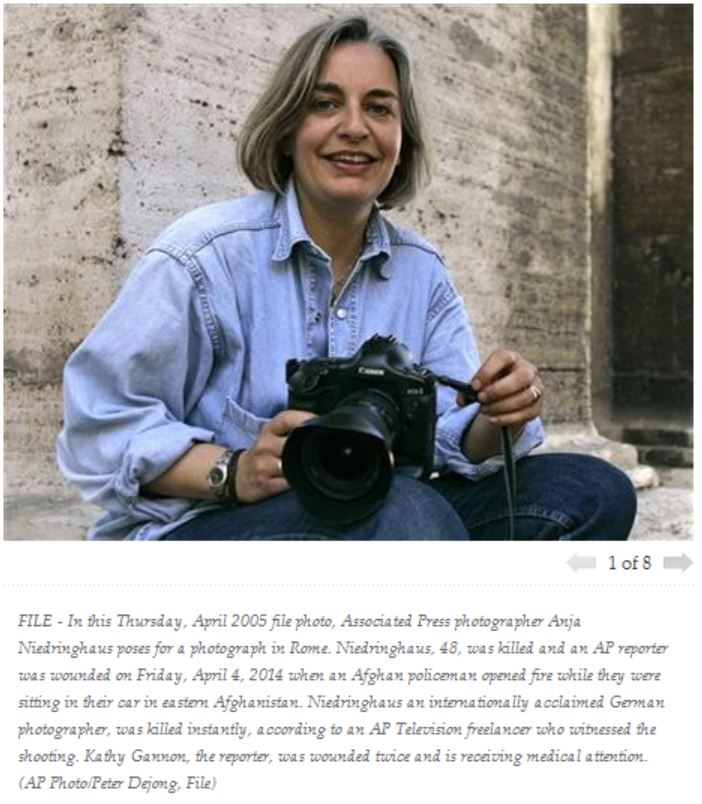
Afghan Policeman Kills AP Photographer Niedringhaus, Wounds Reporter Gannon

This photo of Niedringhaus accompanies the AP story on her death.

This photo of Niedringhaus accompanies the AP story on her death.

Yesterday, in noting the large deployment of Afghan security personnel for Saturday’s presidential election, I wondered in an aside how well these troops had been screened, since a large contingent of them were described in the Afghan press as “fresh”. Sadly, a police unit commander in the Tanai District on the outskirts of Khost turned his gun on a vehicle occupied by AP photographer Anje Niedringhaus and AP reporter Kathy Gannon. Niedringhaus was killed and Gannon is being treated for at least two bullet wounds but is said to be in stable condition. Early reports suggest that the police officer who opened fire was not a recent recruit and was taken into custody when he surrendered immediately after the incident.

AP provides details on Niedringhaus’ Pulitzer Prize-winning career:

Niedringhaus covered conflict zones including Kuwait, Iraq, Libya, Gaza and the West Bank during a 20-year stretch, beginning with the Balkans in the 1990s. She had traveled to Afghanistan numerous times since the 2001 U.S.-led invasion.

Niedringhaus, who also covers sports events around the globe, has received numerous awards for her works.

She was part of an AP team that won the 2005 Pulitzer Prize in breaking news photography for coverage of the war in Iraq, and was awarded the Courage in Journalism Award from the International Women’s Media Foundation. She joined the AP in 2002 and had since been based in Geneva, Switzerland. From 2006 to 2007, she was awarded a Nieman Fellowship in journalism at Harvard University.

Niedringhaus started her career as a freelance photographer for a local newspaper in her hometown in Hoexter, Germany at the age of 16. She worked for the European Press Photo Agency before joining the AP in 2002, based in Geneva. She had published two books.

Reporter Kathy Gannon is also experienced in war zones and Afghanistan particularly:

Gannon, 60, is a Canadian journalist based in Islamabad who has covered Afghanistan and Pakistan for the AP since mid-1980s.

She is a former Edward R. Murrow Fellow at the Council on Foreign Relations in New York and the author of a book on the country, “I Is for Infidel: From Holy War to Holy Terror: 18 Years Inside Afghanistan.”

The New York Times has one of the more complete descriptions of the attack that I have seen:

Ms. Niedringhaus and Ms. Gannon had spent Thursday night at the compound of the provincial governor in Khost, and had left on Friday morning with a convoy of election workers delivering ballots to an outlying area in the Tanai district, The A.P. and Afghan officials said.

The convoy was protected by the Afghan police, soldiers and operatives from the National Directorate of Security, Afghanistan’s main intelligence agency, said Mubarez Zadran, a spokesman for the provincial government. Ms. Niedringhaus and Ms. Gannon were in their own car, traveling with a driver and an Afghan freelance journalist who was working with the news agency.

After the convoy arrived at the government compound in Tanai, Ms. Niedringhaus and Ms. Gannon were waiting in the back seat for the convoy to start moving again when a police commander approached the car and looked through its windows. He apparently stepped away momentarily before wheeling around and shouting “Allahu akbar!” — God is great — and opening fire with an AK-47, witnesses and The A.P. said. His shots were all directed at the back seat.

Ms. Niedringhaus was killed instantly.

The police commander, identified by the authorities as Naqibullah, 50, then surrendered to other officers and was arrested. Witnesses said he was assigned to the force guarding the government compound and was not one of the officers traveling with the election convoy.

I have written extensively on the issue of green on blue killings, where Afghan forces attack US forces. It would appear that this is the first instance, though, of Afghan security personnel turning fire on Western members of the press. The Times addresses the insider killing aspect in relation to previous events: Read more

Share this entry

Afghanistan Staggers Toward Election

Saturday will mark the first time Afghanistan has gone to the polls to choose a new president since the US overthrew the Taliban and put Hamid Karzai in charge. This will hardly be an accomplishment to herald in the US press, although I am sure the military will attempt to get major outlets to tout it as so after the fact. In fact, even the rosy “look what has been accomplished in Afghanistan” fluff piece published today in Khaama Press cites a paltry list of accomplishments, such as 50 television stations and not quite half a million Afghans on Facebook. Tellingly, though, a closer look reveals that the piece is attributed to Dr. Florance Ebrahimi. It turns out that even though she is originally from Kabul, she practices in Sydney. And why shouldn’t she? Afghanistan is tied with North Korea and Somalia at the very bottom of the list when countries are ranked for their level of corruption. And it appears that even before the election takes place, ten percent of the planned polling stations have been closed due to security concerns. And what of the candidates? The top three are profiled here by the New York Times.  All three of the leaders have already pledged to sign the Bilateral Security Agreement, keeping US troops in Afghanistan beyond the end of this year–and thus assuring the maximal continuing flow of US funds to fuel even more corruption. The candidates are noteworthy to me only in that two of them have running mates that would rival Dick Cheney as the most notorious war criminal to be Vice President of a country in the past 15 years.

Today’s New York Times piece cited above on the closure of polling places due to anticipated violence is devastating. For example:

One of the few polling centers in this part of Logar Province is the government’s district headquarters, a building so devastated by rocket attacks and Taliban gunfire that it looks more like a bomb shelter than an administrative office.

As the body count for security forces has risen over the past few days in this embattled district, a stretch of dusty farmland surrounded by mountains, it has become clear that no one here is going to vote on Saturday, either for president or for provincial council delegates.

So far, that has not stopped security officials from proclaiming the district open for voting: It is not among the roughly 10 percent of 7,500 total national sites shut down as too dangerous to protect. The Charkh district center has been pumped full of security forces to keep the vote a nominal possibility, but residents know that within a day or two after the elections, the guards will be gone and the Taliban will remain.

“The government has no meaning here,” said Khalilullah Kamal, the district governor, who was shot two times in the stomach a few months back while speaking in a mosque. “If there is no expectation that we will arrest people who break the law, then how do we expect the people to come and vote?”

Think about that. The polling place in this passage looks like a bomb shelter and life has gotten so violent there that it is clear nobody will vote there Saturday. And yet this site isn’t included among the 10 percent of sites that won’t be open Saturday. Further, “government has no meaning here” reflects the utter failure of US efforts to establish a unified government in Afghanistan. But does that apply only to a small area? Hardly. Consider that the Special Inspector General for Afghanistan Reconstruction stated back in October that it is likely that no more than 21 percent of Afghanistan will be accessible to SIGAR  (pdf) to carry out oversight functions (and the State Department warned them that the 21 percent figure may be overly optimistic) by the end of this year.

Since the US has already formally handed over security operations to the Afghans, what are they doing to make the election safe? On Tuesday they announced that 60,000 “fresh” (I presume this means newly trained? How well were they screened?) Afghan National Army troops were deployed across the country for election security. Then, on Wednesday, the figure was increased to 195,000 total security personnel when ANA figures were joined with security personnel from the Afghan National Police and the National Directorate of Security. That’s quite a force. So for roughly 7500 polling stations, that gives about 26 security personnel guarding each site if they are distributed evenly. Oh, and to protect Westerners before the election, places where they tend to gather have been closed.

Whatever the outcome on Saturday, I see little reason to be optimistic that there will be any improvement in living conditions for the average Afghan citizen.

Share this entry

Billion Dollar Boondoggle: Israel’s Iron Dome Misfires

Schematic of Iron Dome missile defense system. (Wikimedia Commons image, rotated 180 degrees)

Schematic of Iron Dome missile defense system. $1.3 billion price tag removed. (Wikimedia Commons image, rotated 180 degrees)

Less than two weeks after the US announced yet another $429 million in funding for Israel’s Iron Dome missile defense system (which had already gotten over $900 million from the US), the system malfunctioned badly on Tuesday, resulting in the firing of two interceptor missiles by the system. The mishap frightened citizens in Eilat, where the incident took place around 7:30 am. Iran was quick to note the event and picked up on an important point: initial reports inside Israel claimed another “success” from the Iron Dome system, saying three rockets were incoming to Eilat and two of them were destroyed. The report later was withdrawn and the firing was blamed on an accident. Here is Fars News on the incident:

Israel’s Iron Dome missile system ‘accidentally’ fired interceptor rockets into the Red Sea resort city of Eilat in Southern Negev.

Eilat residents were panicked early on Tuesday morning following a series of explosions that also sent Israeli forces scrambling to find the source of the booms, press tv reported.

The Israeli army initially presumed that a rocket attack had occurred in the area.

Initial reports said three Grad rockets were fired at the resort town. They claimed two of the rockets were intercepted by the Iron Dome while the third one exploded in an open area.

However, the army later claimed that the attacks were really a false alarm caused by an error at the Iron Dome site near the city.

An army spokesperson said the explosions were caused by two Iron Dome anti-missile projectiles accidentally fired at around 7:30 am (0530 GMT).

PressTV took things a bit further, stating that Israel’s bluffing about the capabilities of Iron Dome is meant to deter enemies. So did Israel initially claim that rockets had been intercepted? That does appear to be true. In my searching for news stories on this event, I found a story on Debka.com. The story now reads like this:

The loud explosions heard in Eilat early Tuesday came from Iron Dome which accidentally ejected two rockets. They were earlier accounted for erroneously by another Grad attack on Israel’s southernmost town from Sinai.

But the Google remembered that Debka had originally described things differently. Here is how the story was displayed by Google in the search results (as an aside, whatever happened to the “cached copy” option that used to show up on Google?):

Google result Debka

It turns out that despite cheerleading about Iron Dome from obvious sources like the US Missile Defense Agency and the Heritage Foundation, there are serious questions about just how well the system works and whether Israel has been falsely inflating its capabilities. Just over a year ago, the New York Times looked into how well Iron Dome functions. They found significant problems:

After President Obama arrived in Israel, his first stop on Wednesday was to inspect an installation of Iron Dome, the antimissile system hailed as a resounding success in the Gaza conflict in November. The photo op, celebrating a technological wonder built with the help of American dollars, came with considerable symbolism as Mr. Obama sought to showcase support for Israel after years of tensions over Jewish settlements and how to curb Iran’s nuclear ambitions.

/snip/

Israeli officials initially claimed success rates of up to 90 percent. Michael Oren, Israel’s ambassador to the United States, hailed the antimissile system as the first to succeed in combat. Congress recently called the system “very effective” and pledged an additional $680 million for deployments through 2015.

But a growing chorus of weapons experts in the United States and in Israel say their studies — based largely on analyses of hits and misses captured on video — suggest that Iron Dome destroyed no more than 40 percent of incoming warheads and perhaps far fewer. Many rockets, they argue, were simply crippled or deflected — failures that often let intact or dying rockets fall on populated areas.

The story continues:  Read more

Share this entry

Has Afghanistan’s National Directorate of Security Infiltrated the Taliban?

As we get into the final days before voting begins on Saturday for Afghanistan’s presidential election, the biggest question aside from the issue of who will win is whether the Taliban will succeed in its determination to disrupt the election through violence and intimidation. Rapidly unfolding events today represent either a remarkable combination of good work and good luck by Afghan authorities or the product of an infiltration of the Taliban by the National Directorate of Security, which is Afghanistan’s intelligence agency. Breaking news stories today inform us of Afghan forces capturing 22 tons of explosives from a Taliban hideout in Takhar province, the deaths of six Taliban commanders when a suicide vest went off “prematurely” (in Logar province) and the deaths of 16 Taliban commanders when a suicide bomber is said (by the NDS) to have developed differences with the leaders and decided to turn on them, exploding his suicide vest in Ghazni province.

Reuters brings us the story of the captured explosives:

Afghan security forces have seized more than 22 tons of explosives, enough to make hundreds of bombs, the interior ministry said on Tuesday, four days before a presidential election.

Taliban insurgents have declared war on the April 5 vote, calling it a Western-backed sham and threatening to disrupt it.

“This discovery will prevent hundreds of bomb attacks and would have a significant impact on the overall security of the elections,” Sediq Sediqqi, an Interior Ministry spokesman, told Reuters.

/snip/

Sediqqi said the explosives, hidden in some 450 bags, were seized from a basement in the relatively peaceful northern province of Takhar, where the Taliban have gained ground in recent years.

What remarkable timing! Just four days before the election, Afghan forces find a huge cache of explosives in a “relatively peaceful” province. Four days would not have been a lot of time to produce the hundreds of bombs and distribute them to voting stations, but that is still a lot of dangerous material to be removed from use.

Moving south of Kabul to Logar province, we have this story of a suicide vest apparently going off too soon:

At least six Taliban commanders were killed following a suicide blast in eastern Logar province of Afghanistan on Tuesday.

According to NDS officials, the incident took place around 12:30 pm local time in Charkh district.

The officials further added that the Taliban commanders were looking to prepare a suicide bomber for an attack when the suicide bombing vest went off.

Hmm. It’s the NDS and not local police who are cited by Khaama Press in this story.

For the story of the suicide bomber deciding to attack the Taliban instead of voters, here is more from Khaama Press:

At least 16 senior Taliban commanders were killed following a suicide attack in eastern Ghazni province of Afghanistan on Tuesday.

Afghan Intelligence – National Directorate of Security (NDS) said the incident took place in a Taliban leaders gathering in Gelan district.

National Directorate of Security (NDS) following a statement said the Taliban leaders were planning coordinated attacks in Ghazni province when a Taliban suicide bomber opposed with the Taliban leaders plans and detonated his explosives.

Wow. Sixteen senior Taliban commanders is a huge gathering for one spot. And isn’t it interesting that it would be during that gathering that a suicide bomber would suddenly become “opposed with the Taliban leaders plans” and decide to detonate his explosives, taking them all out? And on the very day of this event, NDS seems quite confident that the 16 killed were senior Taliban leaders. Further, the NDS even seems to already know that some of the Taliban leaders killed came from Pakistan.

So did Afghanistan get incredibly lucky today, with a premature explosion taking out 6 Taliban leaders and a difference of opinion leading to a suicide bomber changing sides to take out 16 Taliban leaders, or is there another explanation? It seems to me that we have to at least consider that the National Directorate of Security has been developing assets inside Taliban cells and is choosing this pivotal week as the time to put those assets into action. Such assets could have provided the key information leading to the discovery of the explosives cache. It is also possible that these assets could have gained control of the suicide vests that went off today, either as the suicide bombers themselves or through some form of remote control, creating the appearance of accidents or betrayals.

Whatever caused these events, when grouped together they represent a major setback for Taliban plans to disrupt the election. Will they be able to respond?

Share this entry

Widely Varying Reports on First Talks Between Pakistan Government, TTP

The first round of formal talks involving figures from Pakistan’s government and military on one side and the Pakistan Taliban, or TTP, on the other concluded Wednesday. Because the talks were held in the tribal areas, reports on how the talks went have been slow to filter out. Further, even within single media outlets in Pakistan, the reports vary widely. Consider this report from Dawn:

The first round of direct peace talks between the government and the Tehreek-i-Taliban Pakistan (TTP) leadership concluded on Wednesday, with both the sides reportedly reaching an agreement on several issues, DawnNews reported.

Information Minister Pervaiz Rashid, however, did not share any details of the landmark talks, saying only that once the negotiators returned, it would be up to the government to make statements to media.

The negotiations are part of a push by the government of Prime Minister Nawaz Sharif to negotiate a peace deal with the Taliban that would end a bloody insurgency that has killed thousands of people in recent years.

Sources told DawnNews that the both parties sought guarantees from each other, during the talks, which were held at Biland Khel area of Shawa Tehsil on the border of Orakzai and North Waziristan tribal agencies bordering Afghanistan.

The TTP also responded positively to the demands of indefinite ceasefire and the release of non-combatant prisoners put forward by the government’s committee, they added.

But Dawn also is carrying this story, which was put on their website a little more than a day after the one above:

Despite a degree of optimism and feel-good impression generated by the militant-handpicked committee, insiders believe the first direct face-to-face interaction with militants has hit a stalemate and unless some quick decisions are taken, it will be difficult to prolong the ceasefire. The ceasefire is to expire on Monday.

According to an insider, the militants have set two conditions for continuation of the peace talks. One, the creation of a demilitarised peace zone in mountainous Shaktoi, South Waziristan, to allow freedom of movement and two, the release of non-combatants.

The insider said the five-member militants’ committee sought written guarantees before they could commit to an extension in the month-long ceasefire. “For nearly seven hours, we talked to them about the destruction wrought by over a decade of violence, the loss of lives and property and displacement of people.

“We said ‘let bygones be bygones, let’s bury the hatchet and make a new beginning’,” the insider said.

“Nothing seemed to appeal to them. I have come back really disappointed. The chances of success and continuation are not terribly bright. This is a non-starter,” he said.

The Express Tribune, meanwhile, seems to have a more positive take on what transpired: Read more

Share this entry

FO Claims Captured Iranian Border Guards Not in Pakistan; Iran Threatens Use of Special Forces for Rescue

Since word emerged on Sunday that Jeish Al-Adl executed one of the five Iranian border guards that had been abducted last month, there has been a very interesting series of developments between Iran and Pakistan. Iran has summoned Pakistan’s ambassador to lodge a formal complaint about the death and Pakistan’s apparent inability to find the terrorist group and release the hostages. Iran’s Foreign Minister also sent an open letter to the UN, appealing for help in controlling “state sponsored” groups that are responsible for this and other attacks on Iran. Pakistan, meanwhile, has announced today that they don’t believe the border guards are being held in Pakistan. Complicating matters even further, Iran now is claiming that it would be within their right to employ special forces in a raid on Pakistani territory to release the hostages and kill those responsible for the kidnapping.

The summoning of the ambassador seemed innocuous enough:

Iran’s Foreign Ministry has summoned Pakistan’s ambassador to Tehran over Iranian kidnapped guard’s death and expressed strong objections to Pakistan for lack of control of its borders.

Deputy Director General of the department of West Asian countries of Iran’s Foreign Ministry expressed Islamic Republic of Iran’s objection on Iranian border guards’ abduction and their transfer to Pakistan emphasizing on Iran’s demand for their release, health and also delivering the terrorists to Iran.

He continued “Pakistan should have proper control over its borders and prevent recurrence of such events unless two countries’ good relations would be affected.”

Pakistan’s ambassador to Iran, Noor Mohammad Jadmani, offered condolences for one of the Iranian abducted guard’s death in Pakistan and expressed regret for the terrorist incident.

“Pakistan is also worried about the growth of terrorist actions and extremism.” added he and that “Pakistan will not let such incidents be repeated again and affect the two countries’ relations.”

Likewise, the letter to the UN starts off as normal diplomacy, but it eventually gets to some fairly broad claims about attacks on Iran:

It is extremely regrettable that all available evidence indicate that these cowardly acts of terror targeting the Islamic Republic of Iran and its citizens have been perpetrated by State-sponsored extremist groups, with similar patterns of funding, coordination, support and direction.  The entire international community should be alarmed by the regional and extra-regional ramifications of sectarian tension and extremist violence, which are being systematically organized, sponsored and orchestrated in various parts of our region. In fact, learning from recent history, a sober assessment of the medium and long-term implications of this dangerous trend will show that the very sponsors of such hatred, who for ill-conceived interests have hastily resorted to such short-sighted tactics to remedy their strategic miscalculations and failures, stand to lose the most from the sectarian and extremist violence that they are spreading.

What a strange passage. In protesting attacks against themselves, it appears that the Iranians are making a not very veiled threat to carry out their own “sectarian and extremist violence” against those they perceive to be behind the attacks.

The Express Tribune provides a bit more perspective on Iran’s distrust of Saudi Arabia being behind this part of the letter: Read more

Share this entry

After US Adventure in Death Squad Training for Syria, Brennan Now Complains About al Qaeda Training There

Trying to prove once again that no level of hypocrisy is ever high enough for the US security theater industrial complex, today’s New York Times gives space for John Brennan to lament the use of Syria as a training ground for al Qaeda terrorists. Never mind that the US touted its efforts at developing death squads to send into Syria last fall, we must be outraged against this latest development:

Dozens of seasoned militant fighters, including some midlevel planners, have traveled to Syria from Pakistan in recent months in what American intelligence and counterterrorism officials fear is an effort to lay the foundation for future strikes against Europe and the United States.

“We are concerned about the use of Syrian territory by the Al Qaeda organization to recruit individuals and develop the capability to be able not just to carry out attacks inside of Syria, but also to use Syria as a launching pad,” John O. Brennan, the C.I.A. director, told a House panel recently.

But wait a minute. Didn’t we spend all that time and money droning the shit out of the terrorists in Pakistan? Oh, yeah:

The extremists who concern Mr. Brennan are part of a group of Qaeda operatives in Pakistan that has been severely depleted in recent years by a decade of American drone strikes. But the fighters still bring a wide range of skills to the battlefield, such as bomb-building, small-arms tactics, logistics, religious indoctrination and planning, though they are not believed to have experience in launching attacks in the West.

That is just classic Brennan security theater. We are supposed to get our panties in a wad about a group that he spent years to render “severely depleted” and now they suddenly are going to move to Syria, where they will magically develop the ability to attack the West even though they “are not believed to have experience in launching attacks in the West”.

Okay, then. Recall that just back in September, the US was thumping its chest over its own efforts in training death squads for Syria. Except that Obama then had to doctor the record a bit on the timing and size of the first death squad we sent in when it coincided too closely with the chemical weapons attack in August. Oh, and we had to tell people that the guy eating his opponent’s heart really was from one of the moderate groups we were training.

The bottom line is that the US can use the region to train any group of terrorists it wants to use in service of its own goals, but nobody else is allowed to do exactly what we are doing.

Meanwhile, the humanitarian situation in Syria remains dire.  Reuters reports on a just released but not published report from the UN. And, of course, the US is wasting no time in spinning the findings of the report:

A U.N. report on how Syria’s neediest civilians are often not accessible to humanitarian relief workers makes it clear that the government of President Bashar al-Assad shoulders most of the blame, a U.S. official said on Tuesday.

/snip/

“What the report shows is that the magnitude and frequency of violence committed by the Assad regime far outstrips that of the armed groups in Syria,” a U.S. official told Reuters on condition of anonymity.

“The Syrian government’s massive and indiscriminate use of violence is the single most important factor driving the humanitarian crisis,” the official said. “The report is very clear on this and in pointing to the government’s failure to implement the resolution’s provisions.”

Information released to date doesn’t make either side look very good: Read more

Share this entry

Jeish Al-Adl Executes One of Five Iranian Border Guards Abducted Last Month

There is a major new development in the ongoing saga of incidents along the Iran-Pakistan border. Recall that a group of Sunni extremists, Jeish Al-Adl, captured five Iranian border guards in early February (after killing 14 in an attack last October). Iran had briefly claimed that the guards had been released earlier this month, but then quickly backed down on that claim. It seems that Iran has difficulty getting accurate information on the status of the guards, as they first denied and then finally confirmed that the highest ranking of the guards, Jamshid Danaeifar (his face is circled on a photo of the detained guards that is circulating on Twitter) has been executed:

Informed sources in Pakistan confirmed earlier reports that Jeish al-Adl terrorist group has executed one of the five Iranian border guards that it abducted along Iran-Pakistan border on February 6.

The sources told FNA in Islamabad on Monday that “Jeish al-Adl has martyred one of the kidnapped border guards”.

This is while the Iranian Interior Ministry earlier today rejected Jeish al-Adl’s claim.

“We don’t confirm this report; were it true, we would have been informed,” Interior Ministry Spokesman Hossein Ali Amiri said on Monday.He said that the five border guards are kept in Pakistan at present and are safe and sound.

Amiri made the remarks after Jeish al-Adl claimed on its tweeter page that it has killed Jamshid Danayeefar, one of the kidnapped border guards.

News of the execution came just as Iran had been expressing hope that the guards were about to be released. From an earlier report on Sunday by Fars News:

Efforts and consultations with the Pakistani officials still continue to secure the release of the five border guards abducted along Iran-Pakistan border on February 6, an Iranian official announced on Sunday.

“Talks with national and local Pakistani officials have been held at different levels and they have made some promises,” Governor-General of Iran’s Southeastern Sistan and Balouchestan province Ali Awsat Hashemi told FNA today.

He expressed the hope that the five young border guards would be released to return to their families soon.

Writing at the International Policy Digest, Sadaf Megan informs us that Jeish Al-Adl has stated that if their demands on the release of prisoners are not met, they will execute another prisoner in ten days:

In the statement following the announcement of his death, Jaish al-Adl demands that if 50 of their prisoners are not released by Iran then Jaish al-Adl will execute another hostage within 10 days.

The clock is ticking for the four remaining “pasdar(s)” or guards. In the meantime it seems unlikely that the Iranian government will be able to fulfill or want to meet the demands of Jaish Al-Adl. A regime that does not succumb to threats and ultimatums by the West is unlikely to make a deal with a terrorist group.

The article also has interesting background information on Jeish Al-Adl, providing perspective on the relationship with Jundallah:

Jaish al-Adl operates in the Sistan-Baluchistan region of Iran, and frequently utilizes the Iranian-Pakistani border to carry out attacks. Cross border operations have been practiced during the time of Abdolmalek Rigi’s Sunni Balochi group, Jundallah. After Iran executed Rigi in 2010, Jundallah dissolved and merged with Jaish al-Adl.

Stay tuned for further developments. With Pakistan still reeling from the Carlotta Gall article the Express Tribune wound up censoring entirely because of its revelations of ISI sheltering bin Laden, they risk displaying more evidence of collaboration with terrorists if they are unable to secure the release of the remaining border guards before the next one is executed.

Share this entry

Carlotta Gall: ISI Sheltered Bin Laden in Pakistan

The New York Times has just released an excerpt from Carlotta Gall’s upcoming book “The Wrong Enemy: America in Afghanistan, 2001-2014″. Recall that Gall lived in Afghanistan and covered Afghanistan and Pakistan for the Times from 2001-2013 (Declan Walsh also covered Pakistan from inside Pakistan until he was expelled just before the election in 2013). The biggest revelation in the excerpt is that Pakistan knew about, and Pakistan’s intelligence agency, the ISI, actively sheltered, Osama bin Laden when he was in hiding in Pakistan.

Gall claims that then-ISI head Ahmed Shuja Pasha had direct knowledge of bin Laden’s presence:

Soon after the Navy SEAL raid on Bin Laden’s house, a Pakistani official told me that the United States had direct evidence that the ISI chief, Lt. Gen. Ahmed Shuja Pasha, knew of Bin Laden’s presence in Abbottabad. The information came from a senior United States official, and I guessed that the Americans had intercepted a phone call of Pasha’s or one about him in the days after the raid. “He knew of Osama’s whereabouts, yes,” the Pakistani official told me. The official was surprised to learn this and said the Americans were even more so. Pasha had been an energetic opponent of the Taliban and an open and cooperative counterpart for the Americans at the ISI. “Pasha was always their blue-eyed boy,” the official said. But in the weeks and months after the raid, Pasha and the ISI press office strenuously denied that they had any knowledge of Bin Laden’s presence in Abbottabad.

Although Pasha knew, it appears that ISI compartmented the knowledge very carefully:

In trying to prove that the ISI knew of Bin Laden’s whereabouts and protected him, I struggled for more than two years to piece together something other than circumstantial evidence and suppositions from sources with no direct knowledge. Only one man, a former ISI chief and retired general, Ziauddin Butt, told me that he thought Musharraf had arranged to hide Bin Laden in Abbottabad. But he had no proof and, under pressure, claimed in the Pakistani press that he’d been misunderstood. Finally, on a winter evening in 2012, I got the confirmation I was looking for. According to one inside source, the ISI actually ran a special desk assigned to handle Bin Laden. It was operated independently, led by an officer who made his own decisions and did not report to a superior. He handled only one person: Bin Laden. I was sitting at an outdoor cafe when I learned this, and I remember gasping, though quietly so as not to draw attention. (Two former senior American officials later told me that the information was consistent with their own conclusions.) This was what Afghans knew, and Taliban fighters had told me, but finally someone on the inside was admitting it. The desk was wholly deniable by virtually everyone at the ISI — such is how supersecret intelligence units operate — but the top military bosses knew about it, I was told.

Gall’s reporting on Taliban factions and their madrassas came at great personal risk. This story picks up at a point where her Pakistani colleagues have been picked up by the ISI at the hotel where they were staying and she had been summoned to meet the ISI agents outside: Read more

Share this entry