The Inaugural Donald J. Trump Awards

The Inaugural Donald J. Trump Award Trophy, awaiting the engraving of Donald J. Trump’s name and massive accomplishments.

It’s been quite a year, which is just the way Donald Trump, a narcissist the likes of which the world has never seentm, wants it.

Almost.

Can’t you just hear him: “I do, I do, and I do some more, more than anyone else ever, and yet I don’t get all the accolades I deserve. Haters.”

Now sure, he got the inaugural Gianni “Human rights problems? What human rights problems?” Infantino FIFA Peace Prize. But he wanted more, as he believes is only his due. Sadly, so many other awards have been somehow given to other clearly underdeserving folks, and still other awards are just begging to be given but no one has had the imagination or chutzpah to actually award them.

Until now. May I have the envelopes, please?

The Donald J. Trump Award for Narcissistic Rebranding goes to . . . Donald J. Trump for The Donald J. Trump and John F. Kennedy Center for the Performing Arts. And how dare any mere jazz musicians object to this.

The Donald J. Trump Award for Nationalistic Rebranding goes to . . . Donald J. Trump for the Gulf of America. All the haters at the AP and elsewhere can just get a life.

The Donald J. Trump Award for Interior Decoration goes to . . . Donald J. Trump for the over-the-top golden decorations, the “live, laugh, love” style signage, and the stunning — really absolutely stunning — renovations of the Lincoln Bathroom at the White House. The Presidential Walk of Fame with its image of Biden the AutoPen and the jawdropping plaques recounting each president’s achievements is truly beyond belief.

The Donald J. Trump Award for Architectural Salvage goes to . . . Donald J. Trump for his efforts to save the nation from the abomination that was the White House East Wing and replacing it with a much more appropriate Donald J. Trump White House Ballroom. Specific plans for the ballroom remain vague – I believe the phrase “we have a concept of a plan” fits this project, among others – but simply removing the East Wing was something that clearly needed to happen. And why does FLOTUS need any office space anyway?

The Donald J. Trump Award for Services to the Legal Community goes to . . . Donald J. Trump for his amazing record of presidential appointments to remake the legal system. From his SCOTUS appointments at the top to his appointment of judges like Emil Bove in the middle and Aileen Cannon at the bottom, as well as his appointment of prosecutors like Jeanine Pirro and Lindsey the Insurance Lawyer, he has truly installed only the best peopletm and that would be enough to earn him this award. But Trump didn’t stop there. Add to this the way in which he pushed out career DOJ staffers and the manner in which he got Big Law to bend the knee in the private sector, and this award is a slam dunk.

The Donald J. Trump Award for Medical Advancements goes to . . . Donald J. Trump for his efforts to dismantle and destroy the World Health Organization. Reading what Johns Hopkins University’s Bloomberg School of Public Health describes as WHO’s role in the world, it is obvious that WHO is a clear nuisance that needs to go:

The WHO plays many roles—the visible, apparent roles that many people are familiar with, and the roles that are less visible. This includes:

  • Detecting, monitoring, and responding to emerging health threats, pandemics, and diseases of importance; we saw that during the COVID-19 crisis.
  • Gathering and evaluating data and information from all over the world in order to understand the status of health globally and detect emerging problems. This includes acute crises as well as larger trends in health—which issues are causing a higher burden of disease and which ones we’re making progress on and should sustain efforts to address.
  • Setting standards and developing guidelines that help people around the world, including here in the U.S., deal with various health threats and crises—not only infectious diseases, but all sorts of health issues.
  • Providing commodities and goods to improve health around the world, including vaccines and drugs for many diseases. The U.S.’s withdrawal from WHO impacts not only the people who receive those goods, but also the supply chain for them, which includes many people in corporate America.
  • Assisting with humanitarian response, which has important implications both for the populations who are affected by those crises and for global diplomacy and the role of our humanitarian responses in improving global diplomacy around the world.
  • Providing very important technical assistance to governments and partners around the world to be able to respond to health challenges. The U.S. plays a very important role in providing this technical assistance.

Yeah. Who needs all that? (The “Bloomberg” in the name of the school was a clear giveaway as to JH’s unreliable wokeness.)

The Donald J. Trump Award for Services to the Environment goes to . . . Donald J. Trump’s decision to shut down the National Center for Atmospheric Research in Colorado. As climate scientist Kim Cobb told PBS,

“We’re talking about unique, one-of-a-kind facilities like supercomputers, ticked-out [sic, should be tricked-out] airplanes, and most importantly, a staff of over 800 people who are at the top of their game in innovating in weather and climate science for public good, putting out data that is on every single climate scientist’s computer around the country, if not around the world, and a nexus of collaboration as well that is important training grounds for the next generation of leaders.”

Yeah. Who needs all that when we’ve got The Weather Channel, amiright?

The Donald J. Trump Award for Service to Diplomacy goes to . . . Donald J. Trump for his muscular engagement with Nigeria, Venezuela, Iran, Yemen, Syria, Somolia, among other nations. (Simply renaming the US Institute of Peace as the Donald J. Trump US Institute of Peace seems hardly enough of a recognition for Trump’s breathtaking diplomatic work.)

The Donald J. Trump Award for Economic Excellence goes to . . . Donald J. Trump for his truly amazing grasp of the power of tariffs. Just ask the Kentucky Bourbon industry, US soybean farmers, and the members of the chambers of commerce in cities and towns along the US/Canada border.

The Donald J. Trump Award for Civil Rights goes to . . . Donald J. Trump for his dismantling of anything that smacks of a lack of racial harmony throughout American history. The Stonewall Riots, the Civil War, and anything having to do with Native Americans are merely the tip of the iceberg on the list of things that need to be forgotten, for the good of the nation. Trump is Making America Great Again by going back to the basics. As the faculty senate of Haskell Indian Nations University put it, Trump’s cuts to Native American education “represents a continuation of the trail of broken treaties” that is all too familiar to Native Americans. (Rumor has it he is working on how to get the women back in the kitchen (barefoot and pregnant), the gays back in the closet, and the blacks back in the fields, but those are clearly just rumors. I think. I hope.)

And that’s just a start.

I’m sure there are awards I am missing, but I trust that the imaginative and creative Emptywheel commentators can add to the list. Because really, Alfred Nobel has six prizes with his name on them, and what did he do, really, except invent dynamite? Trump surely deserves many more awards with his name on them than Nobel’s six. or the few that I have listed here.

Trump is truly in a league of his own.

Happy New Year’s, everyone. May next year be better (OK, that’s a low bar, but I’ll take it.).
Share this entry

Peeling Off MTG

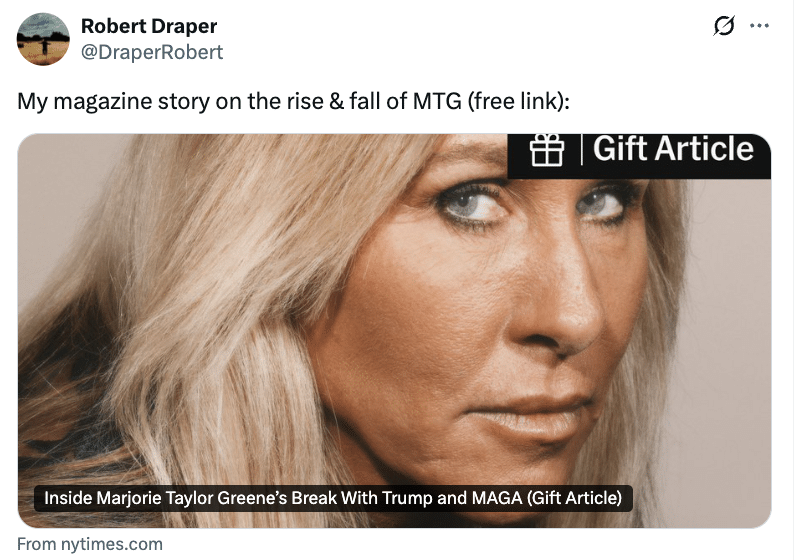
Robert Draper did a 1,000-word piece describing the Four Takeaways of his much longer magazine profile describing Marjorie Taylor Greene’s Break With Trump. It focuses on four steps in the process, which he presents out of chronological order:

  • “Trump’s speech at Charlie Kirk’s memorial was a clarifying moment,” because it contrasted Erika Kirk’s forgiveness with Trump’s lack of Christian faith
  • “Greene’s demands to release the Epstein files seemed to be the last straw for Trump,” because MTG’s threat to reveal the names of those who abused Epstein’s victims would hurt Trump’s friends
  • “Her disillusionment with Trump goes beyond the Epstein files,” in which Draper lumps tariffs and Gaza but focuses primarily on the way Trump’s stochastic terrorism led to threats against MTG’s son
  • “Greene said she was wrong for accusing Democrats of treason in the past,” which simply doubles down on the apology MTG made already on CNN and explained that MTG realized Christians don’t do such things

I don’t doubt that Draper thinks of the transformation he describes as dominated — bullets one and four — by MTG living by her faith, but the word “Christian” only appears in the 8,100-word profile six times.

And word frequency is just one tell that Draper may be indulging MTG’s own retroactive reconstruction of it.

The profile is based on interviews that took place earlier this month, though as Draper recounts, he has been covering MTG closely since 2021 and met with her repeatedly before this month. The Kirk memorial with which Draper began both his profile and his Four Takeaways occurred on September 21. He describes MTG’s perception of the difference between Erika’s forgiveness and Trump’s doubling down as the moment when, “the stress fracture that had been steadily widening between Greene and her political godfather became an irrevocable break.”

But his stress fracture comment introduces a paragraph listing five policy splits with Trump, most of which predate the Kirk memorial, the most important of which — her support for releasing all the Epstein files — predates the memorial by several weeks and gets its own paragraph here and a more focused treatment later.

  • Declaring the war in Gaza a “genocide”
  • Objecting to cryptocurrency and artificial-intelligence policies that, from her perspective, prioritized billionaire donors over working-class Americans
  • Criticizing the Trump administration for:
    • Approving foreign student visas
    • Enacting tariffs that hurt businesses in her district
    • Allowing Obamacare subsidies to expire
  • Argu[ing] that all investigative material pertaining to Jeffrey Epstein should be released

Much later, the profile describes that well before the Epstein break came the realization that Trump does not return loyalty (including a campaign disloyalty similar to the one that drove Elise Stefanik’s later break), followed by Trump’s targeted harassment when MTG opposed his cryptocurrency graft.

She considered running against Senator Jon Ossoff but announced in May that she had decided not to.

Greene’s stated reasoning at the time was that “the Senate is where good ideas go to die.” But the week after her announcement, The Wall Street Journal reported that Trump had shared with her a survey from his pollster, Tony Fabrizio, projecting that Ossoff would beat her by 18 points. Later, Trump would claim in a Truth Social post that their split “seemed to all begin” when he sent her the poll — suggesting, in effect, that Greene was pouting over his lack of support: “All I see ‘Wacky’ Marjorie do is COMPLAIN, COMPLAIN, COMPLAIN!” Greene insisted to me, “It wasn’t about a Fabrizio poll.” She added: “I never had a single conversation with the president about it. Instead, he told me all the time, ‘You should run for governor — you’d win.’”

Still, Greene told me, it began to dawn on her that when it came to the president, loyalty is “a one-way street — and it ends like that whenever it suits him.” Being disabused of the idea that subservience would be rewarded appeared to have a liberating effect on her.

In June, Greene did an about-face on the president’s One Big Beautiful Bill after conceding that she voted for it without realizing that it contained a provision that would prevent states from enforcing restrictions on artificial intelligence for a period of 10 years. If the Senate did not strike the moratorium from the bill, Greene publicly warned, “when the O.B.B.B. comes back to the House for approval after Senate changes, I will not vote for it with this in it.” On July 1, the Senate voted to sever the provision from the bill, which Trump signed into law three days later.

Greene broke again from Trump on July 17, arguing on X that his cryptocurrency bill could permit a future president to “TURN OFF YOUR BANK ACCOUNT AND STOP YOUR ABILITY TO BUY AND SELL!!!!!” This time, Trump made his displeasure known to her — and to her peers.

That same day, Greene and roughly a dozen other House Republicans who also had reservations about the bill were summoned to the Oval Office. In Greene’s recollection, Trump focused his wrath on her. “When you have a group of kids,” she said, “you pick the one that is the most well behaved, that always does everything right, and you beat the living shit out of them. Because then the rest of them are like: ‘Oh, man, holy shit. If Dad does that to her, what would he do to me?’” A White House spokeswoman disputes that the meeting was contentious. “Not surprising to me at all,” Greene replied when I informed her of this. “They have major problems, and it’s only starting to build.”

That all preceded the date when MTG signed the Epstein discharge petition, which Tom Massie initiated in July, the day before Trump told her that his friends would get hurt if she exposed their names.

After the hearing, Greene held a news conference at which she threatened to identify some of the men who had abused the women. (Greene says that she didn’t know those names herself but that she could have gotten them from the victims.) Trump called Greene to voice his displeasure. Greene was in her Capitol Hill office, and according to a staff member, everyone in the suite of rooms could hear him yelling at her as she listened to him on speakerphone. Greene says she expressed her perplexity over his intransigence. According to Greene, Trump replied, “My friends will get hurt.”

When she urged Trump to invite some of Epstein’s female victims to the Oval Office, she says, he angrily informed her that they had done nothing to merit the honor. It would be the last conversation Greene and Trump would ever have.

Along the way, Draper inserts something between the Epstein break and the Kirk epiphany and the ultimate break: the 8-week recess, during which MTG stewed as she heard complaints about affordability from her constituents.

But there was one more important ingredient.

As noted, Draper describes the evolving relationship he had with MTG. He first flew down to Rome, GA, in 2022, and honored MTG’s confidences, which built trust. She blew off a meeting for drinks during last year’s convention because Trump was giving her pride of place at the Convention, but shortly thereafter met with a NYT team and scoffed at their claim Trump would pursue retribution. Draper persisted with someone who adhered to the axiom that real news was fake for years.

There are a lot of lefties who hate this profile: They feel it goes easy on her (and given the Christian reconstruction, I’d agree). They see it as a willingness to let MTG rebrand herself, even while it foregrounds her transphobia. They hate the glam photo of her, which nevertheless provides helpful context to MTG’s claim she always opposed the plastic femininity of Mar-a-Lago (and provides a useful contrast with the still fresh Karoline Leavitt portrait).

In particular, she told me recently: “I never liked the MAGA Mar-a-Lago sexualization. I believe how women in leadership present themselves sends a message to younger women.” She continued: “I have two daughters, and I’ve always been uncomfortable with how those women puff up their lips and enlarge their breasts. I’ve never spoken about it publicly, but I’ve been planning to.”

I would add that Draper still treats Trump as the actor — Trump banished MTG, rather than she stood her ground in face of his demands.

It has been tempting for some observers to predict that the meteoric crash and burn of the MAGA movement’s loudest champion signals the beginning of the end for its leader as well. But it is Greene who is exiting the stage, while Trump continues to dominate it, as he did through impeachments and indictments and other controversies that no other politician would have survived.

Still, Draper hedges his bets. Maybe she will be a harbinger.

But because it represents an evolution for Greene, she may yet again prove to be a harbinger of a sea change in the movement she once helped lead.

By far the most fascinating part of the profile to me is how Draper traces MTG’s cognitive dissonance. In 2022 — and still today — MTG is certain there’s no way Joe Biden could have won the election in 2020.

One autumn evening in 2022, I ventured to ask just how she thought the 2020 election was stolen. Did she really think that a grand conspiracy, perhaps masterminded by the Obamas and the C.I.A., had secretly rigged the results?

“Robert,” she replied with a searching look, “do you really think Joe Biden got 81 million votes without even campaigning?”

“Yes,” I said. “They counted all the votes. That was the final tally. Why wouldn’t I believe it?” The look she then gave me, which I will never forget, was one of bottomless pity.

But the contrast between the earnest stories of the survivors followed by hearing Trump complain that naming those who abused Epstein’s girls would hurt his friends broke through a belief created by the bubble of Fox News.

The reason for her lack of concern, as Greene explained it to me, might seem improbable to anyone who is unfamiliar with how the mainstream press and the right-wing media cover the same story differently — or not at all. “The story to me,” she said, “was that I’d seen pictures of Epstein with all these people. And Trump is just one of several. And then, for me, I’d seen that Bill Clinton is on the flight logs for his plane like 20-something times. So, for people like me, it wasn’t suspicious. And then we’d heard the general stories of how Epstein used to be a member of Mar-a-Lago, but Trump kicked him out. Why would I think he’s done anything wrong, right?”

For Greene, the decades that Epstein spent eluding justice for exploiting and sexually assaulting countless girls and young women while amassing a fortune, and the seeming efforts by the government to cover up the injustice, “represents everything wrong with Washington,” she told me. This September, Greene spoke with several of Epstein’s victims for the first time in a closed-door House Oversight Committee meeting. She knew that the women had paid their own way to come to Washington. She saw some of them trembling and crying as they spoke. Their accounts struck her as entirely believable. Greene herself had never been sexually abused, but she knew women who had. In her own small way, Greene later told me, she could understand what it was like for a woman to stand up to a powerful man.

One of the most important parts of MTG’s split from Trump has been an evolving relationship with the media, especially Fox News, and therefore, the truth, but with Draper always there persisting. That is, MTG had to work through the cognitive dissonance of learning that Trump really did have ties to Jeffrey Epstein’s sex trafficking, that he really was trying to cover it up, before she got to the point of retconning it all inside a faith narrative. Her own banishment from Fox News may have helped work through the cognitive dissonance.

I talk a lot about one of the ways you fight fascism is to peel off members of Congress, four in the Senate or eight in the House. I’ve laid out repeatedly how central the Epstein scandal was to that process.

Whether you like the Draper profile or not, whether or not MTG’s split from Trump will be a harbinger of more (like Stefanik’s) to come, what this profile does do is show what it took for one diehard MAGAt to go through it: political betrayal, real policy differences, retaliation, and then cognitive dissonance regarding Epstein, the Kirk epiphany, until finally responding to his terrorism in a dramatically different way than almost every other Republican, whether MAGAt or not.

There’s a process.

Share this entry

Fridays with Nicole Sandler

Listen on Spotify (transcripts available)

Listen on Apple (transcripts available)

Share this entry

Four Ways to Fight Fascism: Checking In

Throughout this year, I have argued there are four ways to fight fascism — and doing so through the guise of the Democratic Party (especially DC Democrats) is not yet the best way to do so.

I argued these were the four ways to peacefully fight Donald Trump’s authoritarianism:

  1. The Erica Chenoweth rule, which says that if you can get 3.5% of a population in the streets, it often leads to regime change.
  2. Beginning to peel off four people in the Senate or eight or nine people in the House.
  3. Rescuing Republicans from a predictable catastrophe like Democrats did in 2008 and 2020.
  4. Waiting until 2026, winning at least one house of Congress, and beginning to rein in Trump that way.

Since for many of you, today will be the last normal day of the year, and unless Trump sets off a predictable catastrophe, today will also be the last Nicole Sandler show we do, I wanted to check in on how we’re doing on these four issues.

The 3.5% rule

Start with people in the streets.

If 6.5 million people attended October’s No Kings rallies (some estimates go as high as 7 million), it would amount to about 1.8% of the US population. That would make them the biggest protests in American history, but still just halfway to that 3.5% mark, and not directly in response to a particular outrage. The organizing and openness of those protests was a huge accomplishment and, at the very least, taught a lot of people who had never protested before how to do so.

But it wasn’t enough to oust Trump.

A more interesting measure of people in the streets, however, is Chicago (and other anti-ICE/CBP protests). I have no idea what population of Chicago took part in mobilizing to oppose Stephen Miller’s goons. But there are aspects of that mobilization — perhaps most importantly the way media coverage arose from citizen witness to local media to independent media to mainstream outlets — that provided real lessons in how to thrive in a disastrous media environment.

One point I keep making about this kind of opposition: it does not have to be, and arguably is far more successful if it is not, coincident with the Democratic party. Some of the most powerful moments in Chicago’s opposition came when right wingers in conservative suburbs joined in — holy hell those people were assholes!!

Whatever else Stephen Miller’s terrible dragnets have done, they have renewed civil society in most places the invasions happened.

Peeling off defectors

Both Axios and Politico took a break from Dems in Disarray or ragebait stories this week to instead focus on Hakeem Jeffries, both focusing on Jeffries’ success at getting four “moderate” Republicans to vote for his discharge position extending ObamaCare subsidies for three years.

Time and again this year, Democrats under Minority Leader Hakeem Jeffries have maneuvered to successfully undercut the GOP agenda and put its leaders on the back foot. From a daily drumbeat on health care to the long-running saga over the late sex offender Jeffrey Epstein to a new focus on the rising cost of living, they believe they’re succeeding by making the party in power talk about Democratic priorities, not its own.

Their success was underscored this week when four House Republicans joined a Jeffries-led effort to force a vote on expiring Obamacare insurance subsidies — a major embarrassment for the GOP speaker.

“Our message to Mike Johnson is clear — you can run, but you cannot hide,” Jeffries said as he took a victory lap on the House steps Thursday.

And as Politico notes, it started (actually, two months earlier than they credit) with the Jeffrey Epstein effort.

Indeed, since Tom Massie and Ro Khanna, with Jeffries’ cooperation, chased Mike Johnson away a week earlier in July for fear of Epstein votes, Johnson has largely vacated his majority.

There have been limited instances where Republicans have defected on other issues. Just before the SCOTUS hearing on Trump’s illegal tariffs, for example, a handful of Republicans defected to pass resolutions against Trump tariffs.

Where things may get more interesting in the new year — on top of what is sure to be a frantic effort to fix the healthcare crisis Republicans are causing — is on Russia. The NDAA Trump signed yesterday included a number of restrictions on European and Ukrainian funding and troop alignment, measures that directly conflict with Trump’s National Security Strategy.

In a break with Trump, whose fellow Republicans hold majorities in both the House and Senate, this year’s NDAA includes several provisions to boost security in Europe, despite Trump early this month releasing a national security strategy seen as friendly to Russia and a reassessment of the US relationship with Europe.

The fiscal 2026 NDAA provides $800m for Ukraine – $400m in each of the next two years – as part of the Ukraine Security Assistance Initiative, which pays US companies for weapons for Ukraine’s military.

It also authorizes the Baltic Security Initiative and provides $175m to support Latvia, Lithuania and Estonia’s defense. And it limits the Department of Defense’s ability to drop the number of US forces in Europe to fewer than 76,000 and bars the US European commander from giving up the title of Nato supreme commander.

To be sure, thus far, Congress has done nothing to police Trump when he spends money in ways they tell him not to. But these restrictions (along with a few things to make Whiskey Pete Hegseth behave) might set up a conflict early in the year.

Remember: recruiting defectors actually takes efforts to reach out to them, often the opposite of what people think they want.

And while all that is not enough defectors to stop Trump, Marjorie Taylor Greene may set off a stampede for the exit. And that could make it easier for Jeffries, at least, to continue to pants Mike Johnson.

Predictable catastrophe

Democrats have done a good job of seeding the ground to get credit for rescuing the country from Trump-caused catastrophes in healthcare and the economy — and both will exacerbate the other in days ahead.

I’m less sanguine that Democrats have prepared to rescue the country (and claim credit) for other likely Trump catastrophes, like a collapsing AI bubble or epidemic. Laying the ground for both is really critical, in the former case bc AI bros plan to spend big in 2026 in the same way crypto bros did in 2024, and in the former case, because bigots are trying to blame rising measles (and, now, whooping cough) on migrants rather than assholes like RFK Jr.

2026

Democrats are doing surprisingly well to position themselves for 2026, both because they’re overperforming by numbers that suggest they will do well (including in elections, like TN-07, with midyear-levels of turnout), and because they’re matching Republican redistricting efforts (and Stephen Miller’s goon squads mean the redistricting in Texas may not turn out like Trump wants).

But it will be harder to achieve a true Blue Wave than in 2018.

Even as this year’s election results have left many in the party encouraged they can mount a massive blue wave, next year’s battleground is a far cry from 2018 — with fewer Republican-held seats for Democrats to easily target.

Democrats don’t need to win as many seats this time around, netting just three seats rather than two dozen to claim a majority. But the hill to reach a comfortable majority like the 235 seats they held after the last blue wave has grown much steeper, driven by multiple rounds of gerrymandering — including ongoing redistricting in several states that threatens to erode the battlefield even further.

The result is that Democrats could post a bigger national swing than in 2018 and still end up with a slimmer majority than they had after that year.

Where Democrats are doing better is in promising consequences if and when they do get a majority.

I’m more interested in Democrats promising those capitulating to Trump — whether it be law firms or Paramount — that there’ll be consequences in 2027 than I am in discussions about impeachment (except for people like RFK Jr, such discussions will work against other Democratic efforts, IMO).

Such efforts, in my opinion, are one way to do more to lay out Trump’s accountability for predictable disasters.

All in all, opponents of fascism have more momentum than they had when caught flat-footed in January. But there’s still a lot of work to do.

Share this entry

Rent-Seeking: Trump Sells Patriotic Fraud to Boost His Tariff Lies

I was going to write about how Trump’s promise, last night, to send a bunch of service members a $1,776 checks, was actually a confession that there will be no tariff rebates for civilians.

Two paragraphs after Trump introduced his false claims about tariffs — “my favorite word” — he said that because of tariffs, along with the Big Ugly, Trump was sending some number (he bolloxed the number repeatedly) service members would get a check.

This historic trend will continue. Already, I’ve secured a record-breaking $18 trillion of investment into the United States, which means jobs, wage increases, growth, factory openings and far greater national security. Much of this success has been accomplished by tariffs, my favorite word, tariffs, which for many decades have been used successfully by other countries against us, but not anymore. Companies know that if they build in America, there are no tariffs, and that’s why they’re coming home to the U.S.A. in record numbers. They’re building factories and plants at levels we haven’t seen. A.I., automobiles, we’re doing what nobody thought was even possible, not even remotely possible. There has never, frankly, been anything like it.

[snip]

Because of tariffs, along with the just passed One Big, Beautiful Bill, tonight I am also proud to announce that more than 1,000, 450,000, think of this, 1,450,000 military service members will receive a special, we call warrior dividend before Christmas, a warrior dividend. In honor of our nation’s founding in 1776, we are sending every soldier $1,776. Think of that. And the checks are already on the way. Nobody understood that one until about 30 minutes ago. We made a lot more money than anybody thought because of tariffs, and the bill helped us along. Nobody deserves it more than our military. And I say congratulations to everybody. And by the way, we now have record enlistment in our military, and last year we had among the worst recruitment numbers in our military’s history. What a difference a year makes.

He once was offering bigger refunds — $2,000 — for everyone but high income people. That was, as Dean Baker did the math at the time, totally unaffordable, even ignoring that Trump is likely to have to pay some portion of the tariffs back, only to importers, not the consumers who have paid increased prices for consumer goods.

Doing the simple arithmetic, the country has 340 million people. If 10 percent of these people fit Trump’s definition of high-income, and therefore don’t get the rebate, roughly 300 million people would get the checks.

At $2,000 a piece it would come to $600 billion, more than twice what Trump is collecting from us with his import taxes. Since he’s already $330 billion short, how can Trump think he has money to pay down the national debt? Also, he seems not to know that our deficit this year is projected to be $1.8 trillion, so he is actually adding considerably to the debt and would be adding even more with his $600 billion tariff “rebate.”

So, I figured, promising a smaller number (but hiding the smaller amount in patriotic shlock) to a far smaller number of people would serve the purpose of the rebates — to generate public support for keeping the tariff revenue rather than paying them back — in a way that would be hard to oppose.

Who would begrudge service members a check, after all.

But once you give that $2.5 billion away (assuming the larger number is the correct one), you’ve started eating into the $100 billion you might be able to use to give money away.

The service members were going to get the check instead of everyone.

But according to Defense One, even that is not what is going on. Trump is taking money Congress allocated to expand housing allowances and paying it as a direct check instead.

President Donald Trump’s $1,776 checks for more than a million troops, announced Wednesday, come from Congressionally-allocated reconciliation funds intended to subsidize housing allowances for service members, a senior administration official confirmed.

During a prime-time TV address, Trump said he was “proud to announce” that “1,450,000 military service members will receive a special, we call ‘warrior dividend,’ before Christmas.” He added that to honor the nation’s founding, “we are sending every soldier $1,776. Think of that. And the checks are already on the way.”

The senior administration official told Defense One in an emailed statement late Wednesday evening that Defense Secretary Pete Hegseth directed the Pentagon to “disburse $2.6 billion as a one-time basic allowance for housing supplement” to all eligible service members ranks 0-6 and below.

“Congress appropriated $2.9 billion to the Department of War to supplement the Basic Allowance for Housing entitlement within The One Big Beautiful Bill,” the senior official said. “Approximately 1.28 million active component military members and 174,000 Reserve component military members will receive this supplement.”

It has nothing to do with tariffs (though was provided, without enough guidance to prevent such a gimmick, in the Big Ugly bill). Trump just told that lie along with his $18 trillion lie in order to claim his tariffs have been less disastrous than they have been.

Who knows? Maybe Trump will bankrupt the country to send rebates to cover over how much consumers have paid for these tariffs.

For now, though, Trump is simply piling lie on top of lie about it all.

Share this entry

Donald Trump Is Getting a Pass for His Catastrophic Trade War

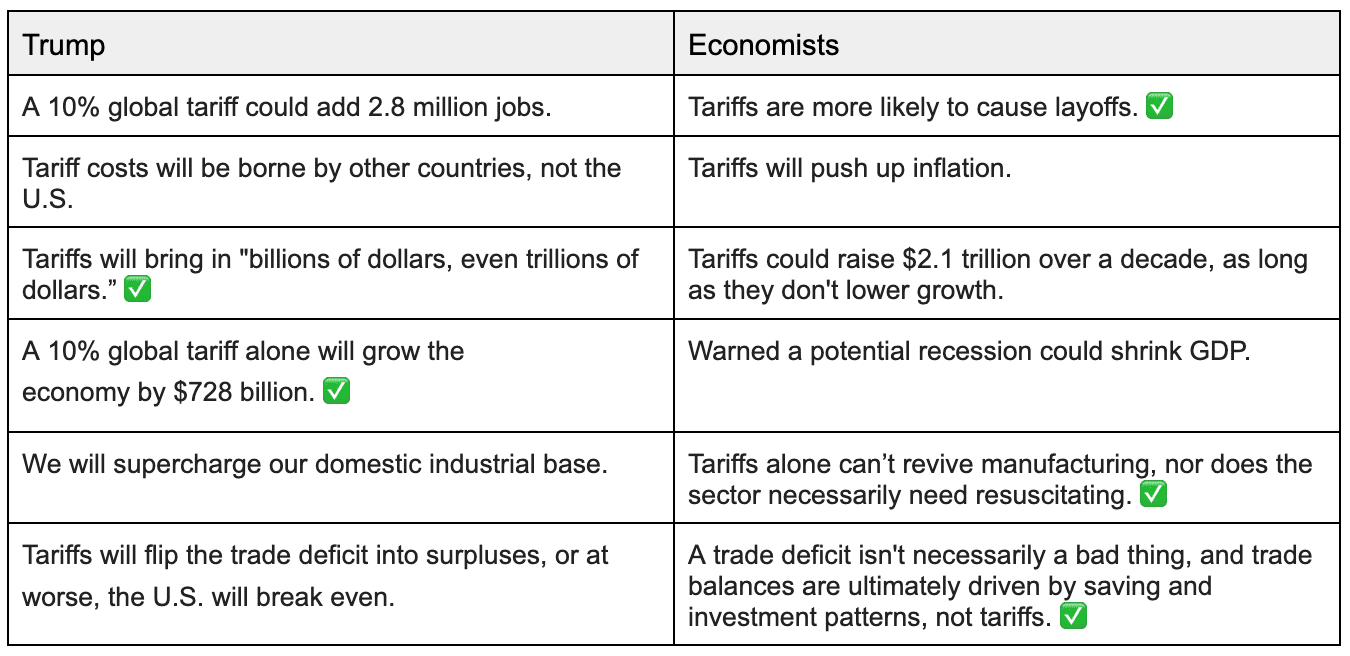
WSJ had a heavily-produced story on Sunday, “Why Everyone Got Trump’s Tariffs Wrong,” purporting to assess the claims that Trump and economists had made … at some point about his tariffs.

This table includes the six allegedly competing claims WSJ assesses; I’ve added a check marking whichever side WSJ claimed was really right.

For most of six paired predictions, WSJ makes a show of adjudicating who was right, giving Trump credit on two predictions and less ostentatiously confirming economists’ predictions on three.

For example, WSJ provides this table purporting to show that both Trump and the economists were wrong about inflation (with steeper tables showing the spike in coffee and appliances); for some reason, WSJ indexes this to January 1, 2024 prices, not 2025 (and some of the tables at WSJ’s source show steeper spikes).

WSJ judges that economists were wrong this way:

Tariffs swiftly hit Americans’ wallets as major retailers from Macy’s to Best Buy raised prices in response to the duties.

“The magnitude and speed at which these prices are coming to us is somewhat unprecedented in history,” Walmart Chief Financial Officer John David Rainey told The Wall Street Journal in May.

But the worst inflation fears haven’t come to pass. Inflation has for months hovered around 3%—higher than the Federal Reserve’s 2% target, though still lower than many economists’ expectations.

But starting in the very next paragraph, WSJ explains why inflation wasn’t as bad as predicted: first, because Trump reversed the worst tariffs. Then, because companies are still trying to figure out what the fuck his tariff policy will be, especially after the Supreme Court gets done with it, and so haven’t passed on all of the tariffs, which they will eventually do.

Another factor at play: Trump’s repeated policy shifts on tariffs.

Many companies have said they want to see where tariffs will ultimately settle before introducing more price changes. The still-undecided Supreme Court case on Trump’s authority to impose tariffs gives them another reason to wait a bit longer.

Economists predict higher prices as companies draw down on their pre-tariffed inventory and renegotiate contracts with retailers and distributors.

If no new tariffs are announced, the Fed estimates the current ones will take nine months to work their way through the economy. That could push inflation from goods down in the back half of 2026. But “we haven’t been able to predict this with any precision,” said Fed Chairman Jerome Powell. “No one is.”

The rest of the article has similar equivocations. WSJ returns to Trump’s decision to reverse many of the tariffs when discussing the GDP growth (and notes that AI has kept the GDP afloat, without also noting that it’s likely in a bubble that is beginning to crash).

Trump has also walked back and delayed many of his threatened duties.

WSJ’s discussion of Trump’s failure to bring manufacturing back returns to changing policy.

Big projects will likely take years to materialize, if they happen at all, as government policies could shift again in that time.

And the flux makes this assessment impossible. Two days ago, for example, WSJ hailed September’s good job’s report.

The U.S. added 119,000 jobs in September, far more than economists had expected. But the figure was an outlier from previous months, in which job growth had lagged. As of September, the unemployment rate reached 4.4%, the highest in four years.

But that got revised downward today and — Justin Wolfers describes in reading today’s report — in reality there may be zero or negative job growth since Trump tried to impose his big tariffs, which if that proves true, would vindicate the economists.

WSJ gives Trump credit for predicting some revenue growth even while noting he wildly exaggerated how much growth there might be, but then admits that not only will much of the revenue go away if SCOTUS throws out the tariffs, but Trump would have to pay some portion — potentially as much as half — of the tariffs back.

Future collections hang on the Supreme Court’s decision on Trump’s authority to impose the tariffs, expected in coming days.

If the court strikes down tariffs imposed under the International Emergency Economic Powers Act, monthly revenue collected would fall by more than half. More than $100 billion already collected might also need to be refunded.

And WSJ also notes that a lot of the data it would need to measure all this is delayed (it doesn’t address Trump’s efforts to tamper with the data).

Perhaps the most salient assessment in the story is the last line: “As long as Trump continues to surprise the market with tariffs, trade will remain volatile,” which is both a platitude and an observation that you can’t assess many of these claims using regular measures, because the tariffs are not (or not just) about creating a precondition to shift trade flows.

Trump’s tariffs aren’t just tariffs. They are week-to-week business uncertainty.

They are also, just as importantly, about giving Trump a tool to attempt to leverage power, something captured in a different WSJ story, this interview with Meredith McGraw, in which Trump offers word salad to explain why tariffs are so cool.

When asked if he has alternative ways to use tariffs, the president said there are other laws but they are not as “nimble, not as quick.” He added, “I can do other things, but it’s not as fast. It’s not as good for national security.”

Trump also argued that tariffs gave him leverage in negotiations with other countries.

“I just used tariffs 10 minutes ago, just before you came, to settle the new inflammation that took place with Thailand and Cambodia,” Trump said. “And I told them, ‘If you have the war, not only am I going to break the trade deal we have, but I’m going to put tariffs on your country.’” He added, “Nobody can do that but me.”

“Nobody can do that but me,” Trump said of an authority that SCOTUS is likely to say he cannot lawfully do.

Worse, Trump equates being able to coerce other countries nimbly with national security. But it is anything but.

Consider how inconsistent Trump’s logic is. In the same week that Trump approved the sale of Nvidia chips to China (which chips China promptly said they would limit use), chips that remained, that very day, illegal to ship to China, the White House halted negotiations on similar kinds of technology with the UK because the Brits would not bow to Trump’s demands on food and tech standards. Trump wants to send chips to China instead of (just) shitty chicken, but he won’t send chips to the UK unless they accept US shitty chicken and Nazi Xitter posts.

None of it makes sense.

And this misrepresentation of how Trump is using tariffs — treating as sincere his false claims about how he claims he is using them — is just part of the reason why the reporting on Trump’s catastrophic tariffs has been so shitty.

To be sure, there has been persistent reporting on how badly his tariffs have devastated farm markets, especially soybeans but now shifting to wheat. There have been stories on how China has gotten pretty much what it has wanted. But there has been less coverage of how Trump’s stupid ass trade war — and China’s preparation for it since Trump’s last Administration — has created the opportunity for China to leverage its rare earth dominance and soybean consumption to bring Trump to heel.

Trump thought America was the irreplaceable market, and attempted to leverage access to it accordingly. But as he has discovered how little of all that he understands, it has backfired, giving China leverage it otherwise didn’t have.

And, if we can believe Vanity Fair’s profile of Susie Wiles, half of Trump’s advisors knew it wouldn’t work in real time.

“So much thinking out loud is what I would call it,” said Wiles of Trump’s chaotic tariff rollout. “There was a huge disagreement over whether [tariffs were] a good idea.” Trump’s advisers were sharply divided, some believing tariffs were a panacea and others predicting disaster. Wiles told them to get with Trump’s program. “I said, ‘This is where we’re going to end up. So figure out how you can work into what he’s already thinking.’ Well, they couldn’t get there.”

Wiles recruited Vance to help tap the brakes. “We told Donald Trump, ‘Hey, let’s not talk about tariffs today. Let’s wait until we have the team in complete unity and then we’ll do it,’ ” she said. But Trump barreled ahead, announcing sweeping “reciprocal” tariffs, from 10 to 100 percent—which triggered panic in the bond market and a sell-off of stocks. Trump paused his policy for 90 days, but by that time the president’s helter-skelter levies had given rise to the TACO chant: “Trump Always Chickens Out.”

Wiles believed a middle ground on tariffs would ultimately succeed, she said, “but it’s been more painful than I expected.”

All this is so painful not just because tariffs are a stupid policy and the way in which Trump implemented them is even stupid. It is painful because Trump has no fucking ability to discern what is good for America, and he doesn’t much care if he fucks up and destroys entire markets as a result.

And coverage of Trump’s destruction of the soybean market has not yet called out the systematic lies Republicans tell claiming Trump’s grant of $12 billion to struggling farmers is only an attempt (again) to reverse the damage he did, which will not come close to making farmers whole. Right wingers are, across the board, hailing Trump’s payoff and blaming the damage Trump did on Joe Biden … and almost no one is calling out the projection and lies.

Trump’s tariffs are a failure not just as tariffs, in fulfilling their purported purpose. But because Trump knows so little about the markets he’s trying to alter, he’s simply making the US vulnerable.

Update: Paul Krugman has more on what we learned from yesterday’s job numbers.

[T]he data show a weak labor market. Employment isn’t falling off a cliff, but job growth has been weak and hasn’t kept pace with the number of people seeking work. The headline unemployment rate in November was 4.6 percent, up from an average of 4 percent in 2024. That number is close to triggering the Sahm Rule, an economic rule of thumb devised by Claudia Sahm, a former economist at the Board of Governors of the Federal Reserve, that has historically been highly successful at identifying the early stages of a recession.

We can’t do a strict application of the Sahm Rule yet because Sahm’s method is based on the average unemployment rate over the past three months. Unfortunately, the shutdown prevented the Bureau of Labor Statistics from collecting key data in October. But if we do an interpolation of October’s unemployment rate by averaging over September’s rate of 4.4% and November’s rate of 4.6%, we can estimate that October’s unemployment rate was 4.5%. And those 3 months of unemployment numbers bring us within a whisker of the unemployment rise that, according to the Sahm Rule, signals that a recession is on the horizon.

The state of the economy looks even worse if we take a wider view of the labor market.

[snip]

Normally, when a president experiences a troubled economy during his first year he dispatches his flying monkeys minions to declare that it’s all his predecessor’s fault. And some Trump officials, like Scott Bessent, are indeed trying to play the blame game. But this standard political tactic is unlikely to work for this president.

First, the economy that Trump inherited when he took office was in much better shape than today’s economy, with lower unemployment combined with faster job growth, and inflation trending down.

Second, Trump’s radical policy changes – huge (illegal) tariffs, mass deportations, big tax cuts (for the rich), benefit cuts (for the poor and middle class), mass layoffs of federal workers, disinvesting in huge green energy projects and aid to farmers — have been clearly damaging to everything besides crypto and AI. It strains credulity – even for the Trump faithful – to claim that we are still in Joe Biden’s economy.

Share this entry