Posts

The June 9 Trump Tower Limited Hangout

I did two podcasts this week where I elaborated on my theory that the current story we have about the June 9, 2016 Trump Tower meeting is just a limited hangout, a partial story that I suspect serves to hide a later, more damning part of the meeting:

I first started suspecting that the current story — that Natalia Veselnitskaya pitched a request for Magnitsky sanctions relief in exchange for … almost no dirt on Hillary — was a limited hangout as I tracked Scott Balber’s repeated heavy-handed attempts to craft a story that could explain the known emails and documents.

I want to lay out my evolving, more developed theory here.

For weeks, Russians had been offering emails in exchange for meetings

The Trump campaign first learned about “dirt” on Hillary in the form of thousands of emails on April 26. The day after learning of those emails, George Papadopoulos sent two emails to Trump campaign staffers, that may have reflected a discussion of an early quid pro quo: some meetings — meant to lead to one between Trump and Putin — in exchange for emails.

To Stephen Miller, Papadopoulos wrote, “Have some interesting messages coming in from Moscow about a trip when the time is right.” To Corey Lewandowski, it appears he asked for a phone call “to discuss Russia’s interest in hosting Mr. Trump. Have been receiving a lot of calls over the last month about Putin wanting to host him and the  team  when the time is right.”

That same day, he sent his Russian handler, Ivan Timofeev, an email saying that the first major Trump foreign policy speech he helped author was a “signal to meet.” The speech spoke, in part, about making a great deal with Russia.

I believe an easing of tensions, and improved relations with Russia from a position of strength only is possible, absolutely possible. Common sense says this cycle, this horrible cycle of hostility must end and ideally will end soon. Good for both countries.

Some say the Russians won’t be reasonable. I intend to find out. If we can’t make a deal under my administration, a deal that’s great — not good, great — for America, but also good for Russia, then we will quickly walk from the table. It’s as simple as that. We’re going to find out.

Over the course of the next month, Papadopoulos sent a Timofeev invitation for a meeting  to move towards setting up a Putin-Trump meeting via email to Lewandowski (on May 4), to Sam Clovis (on May 5, after which they spoke by phone), and to Paul Manafort (on May 21), with additional back and forth in between.

Who is the Crown Prosecutor?

Around that time in late May, Natalia Veselnitskaya met with long-time Trump associate Aras Agalarov and mentioned her efforts to help Denis Katsyv in his legal fight with Bill Browder (note, elsewhere Veselnitskaya claimed she normally keeps her clients’ business compartmented, but claims not to have done so in this case) and to lobby against the Magnitsky sanctions. That’s where, according to Veselnitskaya, the idea of connecting her with Don Jr first came about, though she doesn’t remember who came up with the idea.

Around the end of May 2016, during a conversation with a good acquaintance of mine, being my client, Aras Agalarov on a topic that was not related to the United States, I shared the story faced when defending another client, Denis Katsyv, about how terribly misled the US Congress had been by the tax defrauder William Browder, convicted in Russia, who, through his lobbyists and his close-minded rank-and-file Congress staffers, succeeded in adopting the Act in the name of a person whom Browder practically hardly ever knew.

I considered it my duty to inform the Congress people about it and asked Mr. Agalarov if there was any possibility of helping me or my colleagues to do this. I do not remember who of us was struck by the idea that maybe his son could talk about this with Donald Trump, Jr., who, although a businessman, was sure to have some acquaintances among Congress people. After my conversation with Mr. Agalarov, I prepared a reference in case it would be necessary to hand over the request – to support the hearings in the Subcommittee in the US House Committee on Foreign Affairs as to the Magnitsky’s and Browder’s story, scheduled for mid-June.

The timing of this meeting is important. We know that the date on the document alleged to be the “dirt” handed to Don Jr — one that she claims she prepared “in case it would be necessary to hand over” is May 31. Either this meeting happened before May 31 (which is when Veselnitskaya described it to have taken place), or the document was instead drawn up exclusively for lobbying purposes (which would be unsurprising, but would be inconsistent with the testimony that uses the talking points to prove the meeting was only about Magnitsky sanctions). Elsewhere she gets sketchy about the date of the document, and produced as it was by Agalarov lawyer Scott Balber, we can’t be sure about the forensics of the document.

The reason the date is important, however, is that, in pitching the Trump Tower meeting on June 3, Rob Goldstone told Don Jr that Emin Agalarov’s father met with “the Crown Prosecutor” that morning.

Emin just called and asked me to contact you with something very interesting.

The Crown prosecutor of Russia met with his father Aras this morning and in their meeting offered to provide the Trump campaign with some official documents and information that would incriminate Hillary and her dealings with Russia and would be very useful to your father.

This is obviously very high level and sensitive information but is part of Russia and its government’s support for Mr. Trump – helped along by Aras and Emin. [my emphasis]

Admittedly, any discrepancy on dates might be due to the game of telephone going on — Aras to Emin to Goldstone. But if the meeting in question really did happen on June 3, then it significantly increases the likelihood that “Crown Prosecutor” is not at all a reference to Veselnitskaya (who claims to have met with Agalarov earlier), as has been claimed, but is to someone else, dealing a different kind of dirt.

Spoiler alert: I suspect it is not a reference to her.

In his version of this story, Goldstone says he only played this broker role reluctantly.

“I remember specifically saying to Emin, you know, we probably shouldn’t get involved in this. It’s politics, it’s Hillary Clinton and Donald Trump. Neither of us have any experience in this world. It’s not our forte. I deal with music. You’re a singer and a businessman.”

Don Jr seems to have shown no such reluctance. He emailed back 17 minutes later saying, “if it’s what you say I love it especially later in the summer.” He says that, in spite of the claim he made in his testimony that, “I had no additional information to validate what Rob was saying, I did not quite know what to make of his email.” Whatever Don Jr expected it to include on June 3, he may have gotten a clearer sense of what it was on June 6, when he spoke to Emin in a phone call set up in about an hour’s time, just as Emin got off the stage.

In fact, Don Jr had three “very short” phone calls in this period, but he’s getting forgetful in his old age and so doesn’t remember what transpired on them.

My phone records show three very short phone calls between Emin and me between June 6th and 7th. I do not recall speaking to Emin. It is possible that we left each other voice mail messages. I simply do not remember.

Veselnitskaya did not get her visa to come to the US until June 6. That’s the day when Goldstone, referencing Don Jr’s earlier instructions on timing, followed-up about a meeting.

Let me know when you are free to talk with Emin by phone about this Hillary info.

Ike Kaveladze’s still unexplained late inclusion in the meeting

Goldstone was still finalizing the meeting time on June 8 at 10:34 AM. But sometime, presumably after the time on June 7 at 6:14PM, when Don Jr told Goldstone that Paul Manafort and Jared Kushner would also attend, fellow Agalarov employee Ike Kaveladze got invited, though without Veselnitskaya ever learning why. At some unidentified time, Kaveladze called an associate of Goldstone’s and learned that the meeting would be about discussing “dirt” on Hillary Clinton — the same word Papadopoulos’ handlers had used.

Scott Balber, Kaveladze’s attorney, told The Daily Beast that before Kaveladze headed from Los Angeles to New York for the meeting, he saw an email noting that Kushner, Manafort, and Trump Jr. would all be involved. He thought it would be odd for them to attend the meeting, so he called Beniaminov before heading to New York. Both Beniaminov and Kaveladze have worked with the Agalarov’s real estate development company, the Crocus Group.

Balber said that Beniaminov told Kaveladze that he heard Rob Goldstone— Emin Agalarov’s music manager—discuss “dirt” on Hillary Clinton. It’s never become completely clear what kind of “dirt” the Russians were talking about.

Having learned of a meeting dealing dirt that included Don Jr, Kushner, and Manafort, Kaveladze got on a plane and flew to NYC.

According to Veselnitskaya’s very sketchy account, she got an email finalizing the meeting when she arrived in NYC on June 8 — an email that was also CC’ed to Kaveladze. She and Kaveladze spoke by phone sometime that day, and met sometime before the meeting.

With those present at the meeting, Samochernov, Kaveladze, and Akhmetshin, I spoke about the meeting on the day it was to be held, possibly, I mentioned it the day I arrived in New York when speaking with Kaveladze by phone, but I do not have exact information about it.

[snip]

We got acquainted first by phone when I was in Moscow. I met him personally first on June 9 shortly before the meeting.

[snip]

We had a phone call and met at a café, I do not remember where and at what café. I told him briefly what I knew about the Browder case, about the Ziffs and their possible support when lobbying his interests in the United States.

Like Don Jr’s memory of his phone calls with Emin, Veselnitskaya claims to have forgotten what got said in that phone call with Kaveladze.

Competing versions of the meeting

Which brings us to June 9.

We don’t know what Kaveladze’s schedule was. We do know that on the morning of June 9 — before lunch, which is when Veselnitskaya said Akhmetshin first got involved — Veselnitskaya asked Goldstone if she could bring Akhmetshin, whom she claimed had just “arrived that day in New York for an evening performance of Russian theatre stars.” Goldstone responded a half hour later, “Please bring them with you and meet Ike for your meeting at 4PM today.” (The copy of the email publicly released does not include the CC to Kaveladze that Veselnitskaya said was included.)

As I laid out in this post, Veselnitskaya says she arrived at the meeting with her translator, Kaveladze, and Akhmetshin, was met by Goldstone there, and brought to a board room where Don Jr and Manafort were already present.

I came to the meeting with Anatoly Samochornov, a translator, Irakly Kaveladze, a lawyer of my client who helped to arrange for the meeting, Rinat Akhmetshin, my colleague who was working with me on the Prevezon case. We were met by a big, stout man who introduced himself as Rob and escorted us on the elevator to the boardroom. I saw two men in the boardroom – one of them introduced himself as Donald Trump Jr., while the other did not introduce himself. Another young man entered the boardroom a little later and left it shortly afterwards. I found out much later that the two unidentified gentlemen were P. Manafort and J. Kushner.

According to Veselnitskaya, Kaveladze was introduced — to the extent he was — as “Ike.” Remember that he attended the 2013 dinner celebrating the Agalarov-brokered deal to bring Miss Universe to Moscow, meaning at least some in the Trump camp should know him.

Veselnitskaya’s account seems to line up with Jared Kushner’s, which basically has him arriving late, staying for about 10 minutes of Veselnitskaya’s discussion of adoptions (though he seems to be claiming not to be present for any discussion of Magnitsky sanctions), then asked his assistant to give him an excuse to leave.

I arrived at the meeting a little late. When I got there, the person who has since been identified as a Russian attorney was talking about the issue of a ban on U.S. adoptions of Russian children. I had no idea why that topic was being raised and quickly determined that my time was not well-spent at this meeting. Reviewing emails recently confirmed my memory that the meeting was a waste of our time and that, in looking for a polite way to leave and get back to my work, I actually emailed an assistant from the meeting after I had been there for ten or so minutes and wrote “Can u pls call me on my cell? Need excuse to get out of meeting.” I had not met the attorney before the meeting nor spoken with her since. I thought nothing more of this short meeting until it came to my attention recently. I did not read or recall this email exchange before it was shown to me by my lawyers when reviewing documents for submission to the committees. No part of the meeting I attended included anything about the campaign, there was no follow up to the meeting that I am aware of, I do not recall how many people were there (or their names), and I have no knowledge of any documents being offered or accepted.

Jared claims not to know who was at the meeting, which is somewhat credible given that he arrived after introductions.

For some reason, Goldstone holds out the claim this meeting started by talking about Democratic campaign donations then moved to sanctions.

Goldstone tells me that he only half-listened to the presentation from Natalia Veselnitskaya, the Russian lawyer, as he checked emails on his phone. But he insists, as Trump Jr has done, that the meeting ended awkwardly after she switched tack from discussing Democratic funding to US sanctions legislation and Moscow’s retaliatory policy that restricts Americans from adopting Russian children. “It was vague, generic nonsense,” Goldstone says.

[snip]

“Within minutes of starting, Jared said to her, ‘Could you just get to the point? I’m not sure I’m following what you’re saying,’ ” Goldstone says.

It was then that she started talking in detail about the provisions of the Magnitsky legislation and adoptions, he says. “I believe that she practised a classic bait-and-switch. She got in there on one pretext and really wanted to discuss something else.”

Don Jr’s memory of the meeting is somewhat different. Not only doesn’t he remember Akhmetshin’s presence at all, but he remembers Manafort arriving after the visitors were already in the conference room (mind you, I don’t consider this a significant discrepancy). And he definitely remembers adoptions being discussed at the same time as the sanctions.

As I recall, at or around 4 pm, Rob Goldstone came up to our offices and entered our conference room with a lawyer who I now know to be Natalia Veselnitskaya. Joining them was a translator and a man who was introduced to me as Irakli Kaveladze. After a few minutes, Jared and Paul joined. While numerous press outlets have reported that there were a total of eight people present at the meeting, I only recall seven. Because Rob was able to bring the entire group up by only giving his name to the security guard in the lobby, I had no advance warning regarding who or how many people would be attending. There is no attendance log to refer back to and I did not take notes.

After perfunctory greetings, the lawyer began telling the group very generally something about individuals connected to Russia supporting or funding Democratic Presidential Candidate Hillary Clinton or the Democratic National Committee. It was quite difficult for me to understand what she was saying or why. Given our busy schedules, we politely asked if she could be more specific and provide more clarity about her objective for the meeting. At that point, Ms. Veselnitskaya pivoted and began talking about the adoption of Russian children by U.S. citizens and something called the Magnitsky Act.

Until that day, I had never heard of the Magnitsky Act and had no familiarity with this issue. It was clear to me that her real purpose in asking for the meeting all along was to discuss Russian adoptions and the Magnitsky Act. At this point, Jared excused himself from the meeting to take a phone call.

Despite some minor differences in choreography, thus far the differences in the stories are not that substantial.

That changes, though, in the descriptions of how the meeting ended.

Don Jr claims he said that Trump was a private citizen so could do nothing to help.

I proceeded to quickly and politely end the meeting by telling Ms. Veselnitskaya that because my father was a private citizen there did not seem to be any point to having this discussion.

Goldstone claims something similar — that Don Jr told Veselnitskaya she should talk to Obama’s Administration, not the future Trump one.

“Don Jr ended it by telling her that she should be addressing her concerns to the Obama administration, because they were the ones in power.”

But in an an interview with Bloomberg that Veselnitskaya disavowed in her statement to SJC, she said that Don Jr suggested he would reconsider the sanctions “if we came to power.”

“Looking ahead, if we come to power, we can return to this issue and think what to do about it,’’ Trump Jr. said of the 2012 law, she recalled. “I understand our side may have messed up, but it’ll take a long time to get to the bottom of it,” he added, according to her.

The extra details in the contemporaneous record as interpreted by Glenn Simpson

As far as we know, there’s only one contemporaneous record of this meeting: the notes that Manafort — whom Veselnitskaya claimed “closed his eyes and fell asleep” during the 20 minute meeting — took on his phone. Glenn Simpson was asked to comment on Manafort’s notes in his Senate testimony. Some of what he describes confirms these public accounts: the early reference to Browder, the other reference to Juliana Glover, the reference to adoptions.

MR. DAVIS: These are the meeting notes from 3 the June 9th meeting at Trump Tower. These are Mr. Manafort’s notes or they’re contemporaneous.

BY THE WITNESS:

A. I could tell — obviously you know who Bill Browder is. Cyprus Offshore, Bill Browder’s structure, you know, investment — Hermitage Capital, his hedge fund, set up numerous companies in Cyprus to engage in inward investment into Russia, which is a common structure, both partially for tax reasons but also to have entities outside of Russia, you know, managing specific investments. I can only tell you I assume that’s what that references. I don’t know what the 133 million —

[snip]

A. I can skip down a couple. So “Value in Cyprus as inter,” I don’t know what that means. “Illici,” I don’t know what that means. “Active sponsors of RNC,” I don’t know what that means. “Browder hired Joanna Glover” is a mistaken reference to Juliana Glover, who was Dick Cheney’s press secretary during the Iraq war and associated with another foreign policy controversy. “Russian adoptions by American families” I assume is a reference to the adoption issue.

While Simpson doesn’t recognize the reference, in addition to the passing reference to Cyprus shell companies, the notes allegedly used for the meeting explain the 133 million reference.

In the period of late 1999 to 2004, two companies – Speedwagon Investments 1 and 2, registered in New York, and owned by the said U.S. investors, acting through three Cypriot companies, Giggs Enterprises Limited, Zhoda Limited, Peninsular Heights Limited illegally acquired more than 133 million Gazprom shares in the amount exceeding $80 million in the name of the Russian companies Kameya, Lor, Excalibur, Sterling Investments.

But there seems to be more extensive reference to Cyprus (the laundering of money through which, of course, Manafort is himself an expert; it features centrally in his indictment).

And none of the accounts of the meeting seem to explain Manafort’s half-written “illicit,” nor does “Active sponsors of RNC” appear anywhere.

So there appear to be two things in Manafort’s notes that aren’t explained by the several accounts of the meeting: RNC support (elsewhere attributed to the reference to Ziff brothers’ political donations, something which Manafort might independently know) and, most intriguingly, “illicit” (as well, as perhaps, the more central focus on Cyprus than reflected in the talking points).

Who left the conference room when?

This brings me to the question of who left the conference room when.

According to the LAT, Mueller’s team seems newly interested in an exchange between Ivanka, Veselnitskaya, and Akhmetshin, which attests to Ivanka’s awareness — whatever her spouse’s and brother’s ignorance — of Akhmetshin’s presence.

Investigators also are exploring the involvement of the president’s daughter, Ivanka Trump, who did not attend the half-hour sit-down on June 9, 2016, but briefly spoke with two of the participants, a Russian lawyer and a Russian-born Washington lobbyist. Details of the encounter were not previously known.

It occurred at the Trump Tower elevator as the Russian lawyer, Natalia Veselnitskaya, and the lobbyist, Rinat Akhmetshin, were leaving the building and consisted of pleasantries, a person familiar with the episode said. But Mueller’s investigators want to know every contact the two visitors had with Trump’s family members and inner circle.

But it also may suggest that, after arriving with the two Russians, Ike Kaveladze may have stayed on for a bit afterwards.

Which may be backed by another detail in the various accounts of the meeting. Both Don Jr …

She thanked us for our time and everyone left the conference room. As we walked out, I recall Rob coming over to me to apologize.

And Goldstone claim that the music promoter apologized for the meeting at the end.

As he emerged from the meeting, Goldstone says that he told Trump Jr he was “deeply embarrassed” that it had been an apparent waste of time.

If Goldstone “apologized” for the meeting, as he and Don Jr claim, it suggests Goldstone, at least, stayed behind long enough to say something that would otherwise be rude to say in front of Veselnitskaya. Don Jr’s claim of an apology might provide convenient excuse.

Perhaps most curious among the first-hand accounts is Goldstone’s claim that he thought the 20-30 minute meeting was “dragging on.”

He had not even planned to attend, but was encouraged to stay by Trump Jr. His biggest concern, he says, was that if the meeting dragged on, he would be caught in the notorious Lincoln Tunnel traffic on his journey home.

But her emails

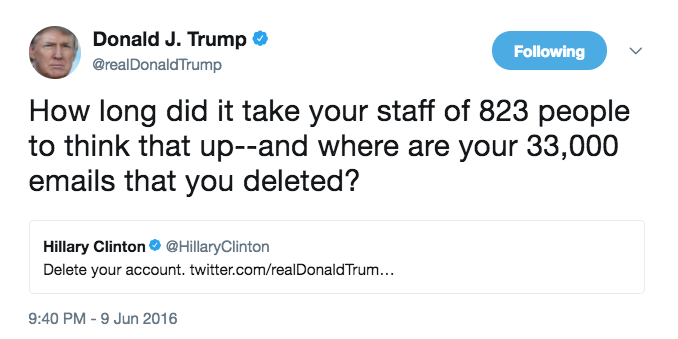
At 4:40 PM, 40 minutes after the meeting started, Trump tweeted what would become one of the most famous exchanges of the campaign, his retort to Hillary Clinton’s taunt that he should delete his Twitter account with this response,

Did you say “dirt” in the form of Hillary emails?

Six days after that meeting, Guccifer 2.0 released the first of the documents stolen by hacking Democratic targets (though note, none of these are known to have come from the DNC, which is the only hack the WaPo reported on the day before; while some have been traced to Podesta’s emails, the others remain unaccounted for).

While I have argued that the specific content in that dump can be explained, in significant part, as an effort to respond to and rebut the claims CrowdStrike and the Democrats made to the WaPo, some of the documents would be particularly valuable in selling the Trump team on the value of any “dirt” on offer. That includes the oppo research on Trump himself (though that was definitely also a response to the WaPo), but also what purports to be a secret policy document stolen from Hillary’s Secretary of State computer, and a document on Hillary’s election plans. Significantly, all three of these documents were among the ones with the altered metadata, in part bearing the signature of Felix Edmundovich Dzerzhinsky.

In short, that first post from Guccifer 2.0 would not only refute the confident claims the Democrats made to the WaPo, but it would provide the Trump camp with a sense of the scope of documents on offer. Within that first week, Guccifer 2.0 would even offer what claimed to be a (heh) “dossier” on Hillary Clinton. (Given my concerns that Russians learned of the Steele dossier and filled it with disinformation, I find it rather interesting that Guccifer 2.0 first advertised this dossier on the same day, June 20, that Steele submitted the first report in his dossier.)

Eerie

If, in fact, there was a second part of this meeting, it seems to be the high level meeting that George Papadopoulos had been working on setting up for weeks, meetings discussed in the context of offering dirt in the form of emails. The Russians laid out a quo — relief of the Magnitsky sanctions — and a week later, provided the first installments of the quid — oppo research from Hillary Clinton.

That would more readily explain why, on June 14, Goldstone would forward this account of the DNC hack to Emin and Ike (but not the other attendees) declaring the DNC hack to be eerie in the wake of what transpired at the meeting.

In one email dated June 14, 2016, Goldstone forwarded a CNN story on Russia’s hacking of DNC emails to his client, Russian pop star Emin Agalarov, and Ike Kaveladze, a Russian who attended the meeting along with Trump Jr., Trump’s son-in-law Jared Kushner and Manafort, describing the news as “eerily weird” given what they had discussed at Trump Tower five days earlier.

And that, I suspect, is the real story that Scott Balber has been working so hard to obscure.

Share this entry

Stephen Miller Claims that Trump’s Russian Investigation Line Was a Disclaimer

In this post, I noted that Trump (in his interview with the WSJ) appears to believe asking for and getting a letter from Rod Rosenstein justifying Jim Comey’s firing is proof that his firing of Comey wasn’t obstruction of justice. I suggested that that argument may have been planned from the start — and noted the proximity of that argument to the claim, which we know Jared Kushner provided, that Democrats would be thrilled by Comey’s firing.

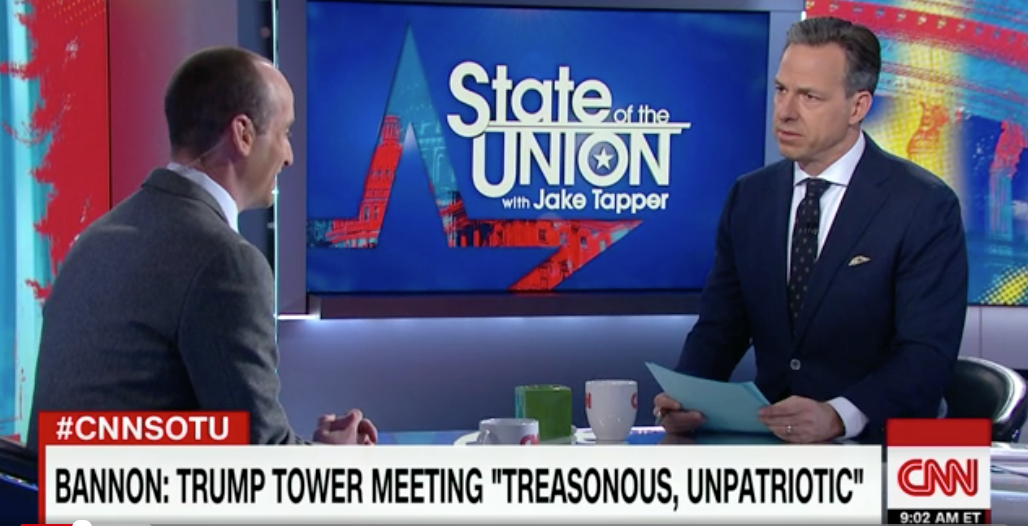
Having suggested that there was more of a plan behind the orchestrated firing of Comey than we might imagine, I want to return to the Jake Tapper interview with Stephen Miller on Sunday.

Tapper asked Miller about his role in writing the initial draft of the letter that fired Comey, which NYT reported on this way:

Mr. McGahn successfully blocked the president from sending the letter — which Mr. Trump had composed with Stephen Miller, one of the president’s top political advisers — to Mr. Comey. But a copy was given to the deputy attorney general, Rod J. Rosenstein, who then drafted his own letter. Mr. Rosenstein’s letter was ultimately used as the Trump administration’s public rationale for Mr. Comey’s firing, which was that Mr. Comey had mishandled the investigation into Hillary Clinton’s private email server.

Mr. Rosenstein is overseeing Mr. Mueller’s investigation into Russian efforts to disrupt last year’s presidential election, as well as whether Mr. Trump obstructed justice.

Mr. McGahn’s concerns about Mr. Trump’s letter show how much he realized that the president’s rationale for firing Mr. Comey might not hold up to scrutiny, and how he and other administration officials sought to build a more defensible public case for his ouster.

[snip]

Mr. Trump ordered Mr. Miller to draft a letter, and dictated his unfettered thoughts. Several people who saw Mr. Miller’s multi-page draft described it as a “screed.”

Mr. Trump was back in Washington on Monday, May 8, when copies of the letter were handed out in the Oval Office to senior officials, including Mr. McGahn and Vice President Mike Pence. Mr. Trump announced that he had decided to fire Mr. Comey, and read aloud from Mr. Miller’s memo.

Some present at the meeting, including Mr. McGahn, were alarmed that the president had decided to fire the F.B.I. director after consulting only Ms. Trump, Mr. Kushner and Mr. Miller. Mr. McGahn began an effort to stop the letter or at least pare it back.

[snip]

Rosenstein was given a copy of the original letter and agreed to write a separate memo for Mr. Trump about why Mr. Comey should be fired.

In the interview with Tapper, Miller claimed that the key claim the NYT said got removed — about Comey thrice telling Trump he wasn’t personally under investigation — was actually in the final letter.

Tapper: According to the New York Times, Special Counsel Robert Mueller has, in his possession, an early draft of a letter that you helped write, in May 2017, detailing reasons to fire FBI Director James Comey. According to the newspaper, the first line of the letter mentions the Russia investigation. Did you write a letter outlining the reasons to fire Comey and list the Russia investigation. Is that true?

Miller: Here’s the problem with what you’re saying: the final draft of the letter the one that was made —

Tapper: I’m not talking about that one, I’m talking about the one that Comey [sic] has that mentions Russia —

Miller: If you want to have an answer to your question and not to get hysterical, then I’ll answer it. The final draft of the letter has the same line about the fact that there is a Trump-Russia investigation that this has nothing to do with.

Tapper: So it was just moved from the top to the bottom.

Miller: No. No! Look at the letter. It’s at the beginning. The investigation is referenced at the beginning of the final letter that was released to point out about the fact that notwithstanding, having been informed that there’s no investigation, that the um, the move that is happening is completely unrelated to that. So it was a disclaimer. It appeared in the final version of the letter that was made public.

Here’s the letter Trump sent to fire Comey. The passage Miller must be talking about reads,

While I greatly appreciate you informing me, on three separate occasions, that I am not under investigation, I nevertheless concur with the judgment of the Department of Justice that you are not able to effectively lead the Bureau.

That’s the passage that was so confounding when we all read that in real time.

And while I’m not prepared to believe Miller that that is the totality of the reference to Russia in the original letter — after all, this doesn’t even mention Russia — what I do think Miller provided proof for on national TV is that the connotation of that sentence changed from first to second draft, and in a way that he, Kushner, and Don McGahn all surely recognize.

In the first letter, according to McGahn and others, the “screed” listed the Russia investigation as a reason to fire Comey. Here, according to the guy who drafted it, it is meant to serve as a disclaimer, a denial that this firing was about the Russia investigation.

And that’s what Miller surely told Mueller’s investigators.

No wonder he kept ranting and had to be escorted off Tapper’s set. He just revealed, for everyone, how this second letter was designed to be misleading.

In the last week, Miller and Trump have told CNN and WSJ, respectively, about their cover-up.

Update: I forgot to reference this language from the NYT’s latest. The line originally said that the investigation was“fabricated and politically motivated.” If that reporting is correct then they also changed the wording of the reference to the investigation.

Share this entry

Mark Corallo’s Obstruction Concerns: “The President…did not attend the meeting.”

Mark Corallo reportedly told Michael Wolff that he quit working for Donald Trump as Marc Kasowitz’ spokesperson because he believed the Air Force One response to the June  9 meeting to be a cover-up.

An aggrieved, unyielding, and threatening president dominated the discussion, pushing into line his daughter and her husband, Hicks, and Raffel. Kasowitz—the lawyer whose specific job was to keep Trump at arm’s length from Russian-related matters—was kept on hold on the phone for an hour and then not put through. The president insisted that the meeting in Trump Tower was purely and simply about Russian adoption policy. That’s what was discussed, period. Period. Even though it was likely, if not certain, that the Times had the incriminating email chain—in fact, it was quite possible that Jared and Ivanka and the lawyers knew the Times had this email chain—the president ordered that no one should let on to the more problematic discussion about Hillary Clinton.

[snip]

In Washington, Kasowitz and the legal team’s spokesperson, Mark Corallo, weren’t informed of either the Times article or the plan for how to respond to it until Don Jr.’s initial statement went out just before the story broke that Saturday.

[snip]

Mark Corallo was instructed not to speak to the press, indeed not to even answer his phone. Later that week, Corallo, seeing no good outcome—and privately confiding that he believed the meeting on Air Force One represented a likely obstruction of justice—quit.

Though as the book makes clear, Trump’s handling (which came just after spending an hour speaking with Vladimir Putin with no minders) of the June 9 meeting story is also what led Kasowitz to leave — both parts of a legal firewall that Steve Bannon had personally put in place.

Given my increasing suspicion that there was a second part of the meeting that has not yet been made public and Bannon’s claim — one Stephen Miller spent 12 minutes not denying over the weekend — that there was no chance that Trump wasn’t part of the meeting, I want to look more closely at the things Corallo said before he was silenced, before the former DOJ spox left out of concerns real obstruction of justice had just occurred.

Here’s some of what appeared in the first NYT story on the June 9 meeting, including a Mark Corallo statement that got repeated elsewhere.

In his statement, Donald Trump Jr. said: “It was a short introductory meeting. I asked Jared and Paul to stop by. We primarily discussed a program about the adoption of Russian children that was active and popular with American families years ago and was since ended by the Russian government, but it was not a campaign issue at the time and there was no follow up.”

He added: “I was asked to attend the meeting by an acquaintance, but was not told the name of the person I would be meeting with beforehand.”

Late Saturday, Mark Corallo, a spokesman for the president’s lawyer, issued a statement implying that the meeting was a setup. Ms. Veselnitskaya and the translator who accompanied her to the meeting “misrepresented who they were,” it said.

In an interview, Mr. Corallo explained that Ms. Veselnitskaya, in her anti-Magnitsky campaign, employs a private investigator whose firm, Fusion GPS, produced an intelligence dossier that contained unproven allegations against the president. In a statement, the firm said, “Fusion GPS learned about this meeting from news reports and had no prior knowledge of it. Any claim that Fusion GPS arranged or facilitated this meeting in any way is false.”

That’s interesting enough, because it piggy backs on the larger efforts to treat the dossier as the sole basis for the Russian investigation, and more importantly because it focuses on Natalia Veselitskaya and Rinat Akhmetshin, and not Ike Kaveladze and Rob Goldstone — whom I increasingly suspect stuck around for a second part of the meeting.

If there were two parts to this meeting, then Corallo’s statement and NYT interview addressed just one part of it.

But that’s not the last thing Corallo did that week, before leaving.

He also released this statement to the AP and others.

Mark Corallo, a spokesman for Trump’s legal team, said only, “The President was not aware of and did not attend the meeting.”

The guy who left the White House out of concern about obstruction of justice that very same week, the guy whom Steve Bannon (he who was sure that Trump did meet the meeting attendees) as a firewall in the Russia investigation, denied that Trump had been at the meeting.

The last words Corallo said before leaving out of concerns about obstruction of justice were that Trump did not attend the meeting.

Share this entry

Stephen Miller Spends 12 Minutes Refusing to Answer Whether Trump Met with Russians Offering Dirt

36 seconds into his 12:34 minute interview with Stephen Miller, Jake Tapper asked Miller, “Did President Trump meet with any of the so-called ‘jumos’ who were in that Trump Tower meeting?”

Miller spent the remaining 12 minutes of the meeting repeating the talking points, “grotesque work of fiction” and “political genius” over and over: Grotesque work of fiction political genius grotesque work of fiction political genius grotesque work of fiction political genius grotesque work of fiction political genius grotesque work of fiction political genius grotesque work of fiction political genius.

Tapper asked whether Trump had met the Russians again, “Can you just settle that for us?”

Miller responded, “I have no knowledge of anything to do with that meeting.” His response actually answers a different question, not whether Trump ever met with the Russians in it.

As a reminder, on April 25, 2016, 45 days before the Trump Tower meeting, George Papadopoulos told Miller “The Russian government has an open invitation by Putin for Mr. Trump to meet him when he is ready []. The advantage of being in London is that these governments tend to speak a bit more openly in ‘neutral’ cities.” Two days later, the day after Papadopoulos learned the Russians had political dirt in the form of thousands of Hillary emails, Papadopoulos emailed Miller again. “Have some interesting messages coming in from Moscow about a trip when the time is right.

Miller may have no knowledge of the June 9 meeting itself. But it is almost certainly the case that he knows about negotiations regarding dirt in the form of emails, because he appears to have been the first person on the campaign that Papadopoulos spoke to after learning of them.

And yet, in the 12 minutes of this interview, Miller never managed a denial that Trump had met with the Russians involved in the Trump Tower meeting.

Share this entry

Did The Most Senior White House Official Lie to the NYT about the Content of the Comey Firing Letter?

One week after conducting a “surprise” interview set up by Trump ally Christopher Ruddy (for which he was widely criticized), Mike Schmidt has a widely hailed story describing the evidence supporting an obstruction charges against Donald Trump.

Or maybe against Attorney General Jeff Sessions.

Most interestingly, it suggests that several days after Trump attacked Jeff Sessions while watching Jim Comey’s May 3 testimony to Congress, Sessions sent an aide to Congress to try to gin up a series of damning stories about Comey.

White House aides gave updates to Mr. Trump throughout, informing him of Mr. Comey’s refusal to publicly clear him. Mr. Trump unloaded on Mr. Sessions, who was at the White House that day. He criticized him for recusing himself from the Russia investigation, questioned his loyalty, and said he wanted to get rid of Mr. Comey.

[snip]

Two days after Mr. Comey’s testimony, an aide to Mr. Sessions approached a Capitol Hill staff member asking whether the staffer had any derogatory information about the F.B.I. director. The attorney general wanted one negative article a day in the news media about Mr. Comey, according to a person with knowledge of the meeting.

A Justice Department spokeswoman said the incident did not occur. “This did not happen and would not happen,” said the spokeswoman, Sarah Isgur Flores. “Plain and simple.”

Hmmm. I don’t think Sessions has honored his recusal.

He may have also ordered up Rod Rosenstein to suggest Comey needed firing.

Earlier that day, Rod J. Rosenstein, the deputy attorney general, had pulled one of Mr. McGahn’s deputies aside after a meeting at the Justice Department. Mr. Rosenstein told the aide that top White House and Justice Department lawyers needed to discuss Mr. Comey’s future. It is unclear whether this conversation was related to the effort to dig up dirt on Mr. Comey.

The following weekend, Trump went to Bedminster to have Stephen Miller write up a letter firing Comey. It’s this detail I’m most interested in.

In interviews with The Times, White House officials have said the letter contained no references to Russia or the F.B.I.’s investigation. According to two people who have read it, however, the letter’s first sentence said the Russia investigation had been “fabricated and politically motivated.” [my emphasis]

Remember, Schmidt has just had a rather celebrated interview with one particular White House official. Er, The White House Official. Half of the off-the-record comments omitted from the NYT transcript of the interview clearly pertain to the Russian investigation.

TRUMP: Everybody knows the answer already. There was no collusion. None whatsoever.

_________

TRUMP: Maybe I’ll just say a little bit of a [inaudible]. I’ve always found Paul Manafort to be a very nice man. And I found him to be an honorable person. Paul only worked for me for a few months. Paul worked for Ronald Reagan. His firm worked for John McCain, worked for Bob Dole, worked for many Republicans for far longer than he worked for me. And you’re talking about what Paul was many years ago before I ever heard of him. He worked for me for — what was it, three and a half months?

[snip]

TRUMP: What I’ve done is, I have absolute right to do what I want to do with the Justice Department. But for purposes of hopefully thinking I’m going to be treated fairly, I’ve stayed uninvolved with this particular matter.

_________

TRUMP: For purposes of the Justice Department, I watched Alan Dershowitz the other day, who by the way, says I, says this is a ridiculous —

SCHMIDT: He’s been very good to you.

TRUMP: He’s been amazing. And he’s a liberal Democrat. I don’t know him. He’s a liberal Democrat. I watched Alan Dershowitz the other day, he said, No. 1, there is no collusion, No. 2, collusion is not a crime, but even if it was a crime, there was no collusion. And he said that very strongly. He said there was no collusion. And he has studied this thing very closely. I’ve seen him a number of times. There is no collusion, and even if there was, it’s not a crime. But there’s no collusion. I don’t even say [inaudible]. I don’t even go that far.

_________

TRUMP: So for the purposes of what’s going on with this phony Russian deal, which, by the way, you’ve heard me say it, is only an excuse for losing an election that they should have won, because it’s very hard for a Republican to win the Electoral College. O.K.?

This last break in the transcript picks up right where the information these White House officials lying to the NYT leave off: with the claim that this is a “fabricated and politically motivated” investigation.

Particularly given that Schmidt has been working this aspect of the story for months, what are the chances that the most senior White House official lied to Schmidt about what he had written to justify firing Jim Comey?

Share this entry

Speech and Email Release: The Three Public Statement Signals Tied to Russia’s Dirt-as-Emails

In this post I did a timeline of all the known George Papadopoulos communications. The timeline made something clear: on two occasions, Papadopoulos alerted Ivan Timofeev to something in a Trump speech. On each occasion, something happened with emails. And there may actually be a third instance of Papadopoulos signaling to his handler.

April 26 notice of emails precedes Trump’s April 27 speech including a “signal to meet”

First, on April 26, 2016, over breakfast London time, he learned the Russians had thousands of email as dirt on Hillary Clinton.

On or about April 26, 2016, defendant PAPADOPOULOS met the Professor for breakfast at a London hotel. During this meeting, the Professor told defendant PAPADOPOULOS that hehadjust returned from a trip to Moscow where he had met with high level Russian government officials. The Professor told defendant PAPADOPOULOS that on that trip he(the Professor) learned that the Russians had obtained “dirt” on then-candidate Clinton. The Professor told defendant PAPADOPOULOS, as defendant PAPADOPOULOS later described to the FBI, that “They [the Russians] have dirt on her”; “the Russians had emails of Clinton”; “they have thousands of emails.”

The next day he discusses his outreach to Russians with both Stephen Miller and Corey Lewandowski. He emails Miller to say he “Ha[s] some interesting messages coming in from Moscow about a trip when the time is right.” And he emails Lewandowski, apparently asking to speak by phone, “to discuss Russia’s interest in hosting Mr. Trump. Have been receiving a lot of calls over the last month about Putin wanting to host him and the team when the time is right.”

That all happened while Papadopoulos was helping draft Trump’s first speech, in which Trump said,

We desire to live peacefully and in friendship with Russia and China. We have serious differences with these two nations, and must regard them with open eyes, but we are not bound to be adversaries. We should seek common ground based on shared interests.

Russia, for instance, has also seen the horror of Islamic terrorism. I believe an easing of tensions, and improved relations with Russia from a position of strength only is possible, absolutely possible. Common sense says this cycle, this horrible cycle of hostility must end and ideally will end soon. Good for both countries.

Some say the Russians won’t be reasonable. I intend to find out. If we can’t make a deal under my administration, a deal that’s great — not good, great — for America, but also good for Russia, then we will quickly walk from the table. It’s as simple as that. We’re going to find out.

As the NYT revealed the other day, Papadopoulos helped draft that speech, and he told Timofeev that it was the “signal to meet.”

Papadopoulos was trusted enough to edit the outline of Mr. Trump’s first major foreign policy speech on April 27, an address in which the candidate said it was possible to improve relations with Russia. Mr. Papadopoulos flagged the speech to his newfound Russia contacts, telling Mr. Timofeev that it should be taken as “the signal to meet.”

So the Russians mentioned emails, and the next day Papadopoulos delivered a speech that signaled (at least according to Papadopoulos, who at times oversold these things) Trump’s interest in meeting.

July 21 RNC speech precedes the WikiLeaks dump

A second coincidence comes in July. On July 21, a week after Papadopoulos informed Timofeev that a ““meeting for August or September in the UK (London) with me and my national chairman” had been approved, he then messages Timofeev the day of Trump’s RNC speech, saying, “How are things [Timofeev]? Keep an eye on the speech tonight. Should be good.” This message is one of the ones he tried to destroy by nuking his Facebook account after his second interview with the FBI last February.

Trump’s RNC speech included no mention of Russia. But it did include an indictment of Hillary’s actions as Secretary of State, focusing on a number of the issues that lay behind Putin’s loathing of Hillary.

Another humiliation came when president Obama drew a red line in Syria – and the whole world knew it meant nothing.

In Libya, our consulate – the symbol of American prestige around the globe – was brought down in flames. America is far less safe – and the world is far less stable – than when Obama made the decision to put Hillary Clinton in charge of America’s foreign policy.

I am certain it is a decision he truly regrets. Her bad instincts and her bad judgment – something pointed out by Bernie Sanders – are what caused the disasters unfolding today. Let’s review the record. In 2009, pre-Hillary, ISIS was not even on the map.

Libya was cooperating. Egypt was peaceful. Iraq was seeing a reduction in violence. Iran was being choked by sanctions. Syria was under control. After four years of Hillary Clinton, what do we have? ISIS has spread across the region, and the world. Libya is in ruins, and our Ambassador and his staff were left helpless to die at the hands of savage killers. Egypt was turned over to the radical Muslim brotherhood, forcing the military to retake control. Iraq is in chaos.

Iran is on the path to nuclear weapons. Syria is engulfed in a civil war and a refugee crisis that now threatens the West. After fifteen years of wars in the Middle East, after trillions of dollars spent and thousands of lives lost, the situation is worse than it has ever been before.

[snip]

We must abandon the failed policy of nation building and regime change that Hillary Clinton pushed in Iraq, Libya, Egypt and Syria. Instead, we must work with all of our allies who share our goal of destroying ISIS and stamping out Islamic terror.

The focus on Syria is key: remember that Jared Kushner explained his request to Sergei Kislyak for a Russian-run secure back challenge as an effort to cooperate on Syria.

The Ambassador expressed similar sentiments about relations, and then said he especially wanted to address U.S. policy in Syria, and that he wanted to convey information from what he called his “generals.” He said he wanted to provide information that would help inform the new administration. He said the generals could not easily come to the U.S. to convey this information and he asked if there was a secure line in the transition office to conduct a conversation. General Flynn or I explained that there were no such lines. I believed developing a thoughtful approach on Syria was a very high priority given the ongoing humanitarian crisis, and I asked if they had an existing communications channel at his embassy we could use where they would be comfortable transmitting the information they wanted to relay to General Flynn.

So it’s possible the attacks on Hillary’s Syria policy were a signal — as the earlier speech’s call for engagement with Russia apparently was — to Timofeev.

In any case, the next day, WikiLeaks started releasing the DNC emails, just in time to bollox the DNC (though I maintain that forcing the Democrats to finally fire Debbie Wasserman Schultz was a necessary move).

A possible third message?

Which brings us to a possible third signal. Another of the Facebook messages that Papadopoulos attempted to destroy was a link he shared with Timofeev to this interview. Among the other things Papadopoulos says in the interview is that sanctions on Russia have hurt the US.

Q.: Do you agree that the U.S. sanctions against Russia did not help to resolve the crisis in Ukraine?

A.: Sanctions have done little more than to turn Russia towards China as a primary market for Russian goods, services and energy. It is not in the interest of the West to align China and Russia in a geopolitical alliance that can have unpredictable consequences for U.S. interests in the South China Sea, Eastern Mediterranean and Middle East.

[snip]

Q.: Your professional background is related to global energy. Do you agree that European countries should reduce their dependence on Russian energy?

A.: The U.S. and Russia will compete over both the European and Pacific gas markets. This is inevitable. Unfortunately for the U.S., sanctions on Russia have resulted in massive energy deals between Russia and China.

Papadopoulos also poo poos the idea of expanding NATO.

Q.: How do you see the future of NATO? Do you support a further expansion of the alliance? If so, do you think that NATO should take into the account Russia’s concerns regarding this issue?

A.: If NATO is to expand, all new members must spend the required 2% of GDP on defense expenditure. Currently only five members do. Without a common mission that all countries subscribe to, or the pledge that all members spend 2% of GDP on defense, the alliance in its current form is likely not sustainable. The three largest threats NATO will have to combat over the next couple decades will be a rising and belligerent China, radical Islam and a nuclear Iran. Russia can be helpful in mitigating the dangerous consequences of these three forces colliding simultaneously.

Q.: You did not answer the question on whether you would support a possible NATO extension or not. Russia has repeatedly expressed its concerns about NATO’s military infrastructure moving toward Russia’s borders…

A.: We should look at the circumstances. If mutual confidence between our countries exists, then we will better understand the expectations of each other, and we can more accurately define the ‘red lines‘ which cannot be crossed. However, what is happening today between Russia and NATO, and between Russia and the West in general, creates an extremely dangerous and unstable situation in which every incident could become fatal.

An interview with a policy advisor is nowhere near as momentous as a speech from Trump. But by this point — the NYT informs us — Papadopoulos’ interventions were being reviewed closely by the campaign. So it’s likely this was closely vetted.

Papadopoulos shared that link on October 1. Later that week, the John Podesta emails started coming out.

The timing wasn’t dictated by these speeches

Let me make something clear: I’m not saying that the timing of these email releases were dictated by the speeches. Of course they weren’t. They were timed to do maximal damage to the Hillary campaign (not incidentally, in a way that coincided with the “later in the summer” timing Don Jr asked for in his communications with Rob Goldstone).

Rather, I’m saying that Papadopoulos seems to have been signaling Timofeev, and those signals closely mapped to email releases.

And those signals are among the things he tried to destroy.

Share this entry

Trump Transition Team Outraged To Be Treated as Transition Team!!

This is a general post on the GOP claim Mueller improperly obtained emails from ~13 Transition officials, updated as new news comes available. This post explains what is really going on: the Transition appears to have withheld emails — including the KT McFarland one referring to the election as having been “thrown” — and Mueller obtained proof they were withholding things. 

Both Fox News and Axios have pieces reflecting the outrage!!! among Trump people that they got asked questions about emails they thought they had hidden from Mueller’s investigation. Axios reveals that Mueller obtained the full contents of 12 accounts (Reuters says 13), one including 7,000 emails, from people on the “political leadership” and “foreign-policy team;” it says it includes “sensitive emails of Jared Kushner.”

Fox reveals that a transition lawyer wrote Congress today claiming that it was unlawful for government employees to turn over emails hosted on government servers for a criminal investigation.

A lawyer for the Trump presidential transition team is accusing Special Counsel Robert Mueller’s office of inappropriately obtaining transition documents as part of its Russia probe, including confidential attorney-client communications and privileged communications.

In a letter obtained by Fox News and sent to House and Senate committees on Saturday, the transition team’s attorney alleges “unlawful conduct” by the career staff at the General Services Administration in handing over transition documents to the special counsel’s office.

Officials familiar with the case argue Mueller could have a problem relating to the 4th Amendment – which protects against unreasonable searches and seizures.

Kory Langhofer, the counsel to Trump for America, wrote in the letter that the the GSA “did not own or control the records in question.”

But, Langhofer says, Mueller’s team has “extensively used the materials in question, including portions that are susceptible to claims of privilege.”

And Axios explains that the Trump people actually sorted through this stuff. “The sources say that transition officials assumed that Mueller would come calling, and had sifted through the emails and separated the ones they considered privileged.”

I’m really looking forward to hearing the full story about this, rather than just this partisan spin. For example, I’m interested in whether Mueller realized via some means (perhaps from someone like Reince Priebus or Sean Spicer — update, or George Papadopoulos) that the White House had withheld stuff that was clearly responsive to his requests, so he used that to ask GSA to turn over the full set.

I’m also interested in how they’ll claim any of this was privileged. The top 13 political and foreign policy people on the Trump team might include (asterisks mark people confirmed to be among those whose accounts were obtained):

  1. Pence
  2. Bannon
  3. Jared*
  4. Flynn*
  5. KT McFarland
  6. Spicer
  7. Priebus
  8. Nunes
  9. Sessions
  10. Seb Gorka
  11. Stephen Miller
  12. Hope Hicks
  13. Ivanka
  14. Don Jr
  15. Rebekah Mercer
  16. Kelly Anne Conway
  17. Rudy Giuliani
  18. Steven Mnuchin
  19. Rick Gates
  20. Corey Lewandowski
  21. Tom Bossert

Just one of those people — Sessions — is a practicing lawyer (and he wasn’t, then), and he wasn’t playing a legal role in the transition (though both Sessions and Nunes may have been using their congressional email, in which case Mueller likely would show far more deference; update: I’ve added Rudy 911 to the list, and he’d obviously qualify as a practicing lawyer). Though I suppose they might have been talking with a lawyer. But I would bet Mueller’s legal whiz, Michael Dreeben, would point to the Clinton White House Counsel precedent and say that transition lawyers don’t get privilege.

Furthermore, Trump wasn’t President yet! This has come up repeatedly in congressional hearings. You don’t get privilege until after you’re president, in part to prevent you from doing things like — say — undermining existing foreign policy efforts of the actually still serving President. So even if these people were repeating things Trump said, it wouldn’t be entitled to privilege yet.

Finally, consider that some of these people were testifying to the grand jury months and months ago. But we’re only seeing this complaint today. That’s probably true for two reasons. One, because Mueller used the emails in question (most notably, the emails between McFarland and Flynn from December 29 where they discussed Russian sanctions) to obtain a guilty plea from Flynn. And, second, because Republicans are pushing to get Trump to fire Mueller.

Update: I’ve added Pence, Don Jr., Ivanka, Hope Hicks, Kelly Anne Conway, Rudy Giuliani, Steven Mnuchin back in here.

Update: Here’s more from Reuters.

Langhofer, the Trump transition team lawyer, wrote in his letter that the GSA’s transfer of materials was discovered on Dec. 12 and 13.

The FBI had requested the materials from GSA staff last Aug. 23, asking for copies of the emails, laptops, cell phones and other materials associated with nine members of the Trump transition team response for national security and policy matters, the letter said.

On Aug. 30, the FBI requested the materials of four additional senior members of the Trump transition team, it said.

The GSA transfer may only have been discovered this week (probably as a result of Congress’ investigation). But the witnesses had to have known these emails went beyond the scope of what the transition turned over. And the request date definitely is late enough for Mueller to have discovered not everything got turned over, perhaps even from George Papadopoulos, who flipped in late July.

Update: One more thing. Remember that there were worries that transition officials were copying files out of a SCIF. That, by itself, would create an Insider Threat concern that would merit FBI obtaining these emails directly.

Update: Here’s a report dated June 15 on a transition lawyer instructing aides and volunteers to save anything relating to Russia, Ukraine, or known targets (Flynn, Manafort, Page, Gates, and Stone).

Update: AP reports that Flynn was (unsurprisingly) among those whose email was obtained.

Update: Here’s the letter. I unpacked it here. It’s a load of — I believe this is the technical term — shite. First, it stakes everything on PTT not being an agency. That doesn’t matter at all for a criminal investigation — Robert Mueller was no FOIAing this stuff. It then later invokes a bunch of privileges (the exception is the attorney client one) that only come with the consequent responsibilities. It then complains that Mueller’s team didn’t use a taint team.

Perhaps the craziest thing is they call for a law that would only permit someone to access such emails for a national security purpose — as if an espionage related investigation isn’t national security purpose!

Update: Chris Geidner got GSA’s side of the story. Turns out they claim the now dead cover up GC didn’t make the agreement the TFA lawyer says he did. In any case, GSA device users agreed their devices could be monitored.

“Beckler never made that commitment,” he said of the claim that any requests for transition records would be routed to the Trump campaign’s counsel.

Specifically, Loewentritt said, “in using our devices,” transition team members were informed that materials “would not be held back in any law enforcement” actions.

Loewentritt read to BuzzFeed News a series of agreements that anyone had to agree to when using GSA materials during the transition, including that there could be monitoring and auditing of devices and that, “Therefore, no expectation of privacy can be assumed.”

Update: Mueller’s spox, Peter Carr, issued a statement saying, “When we have obtained emails in the course of our ongoing criminal investigation, we have secured either the account owner’s consent or appropriate criminal process.”

Share this entry

Maybe Stephen Miller’s Discussions with George Papadopoulos Are Why Jeff Sessions Can’t Recall Any Email Discussions?

Over the weekend, the NYT published the best reported piece yet on the George Papadopoulos plea. I’m most intrigued by the description of how a young Russian intern turned Joseph Mifsud into a Russian expert in 2014. But the most important detail in the story is that the loathsome Stephen Miller is the Senior Policy Adviser described in the plea.

The day before he learned about the hacked emails, Mr. Papadopoulos emailed Mr. Miller, then a senior policy adviser to the campaign, saying Mr. Trump had an “open invitation” from Mr. Putin to visit Russia. The day after, he wrote Mr. Miller that he had “some interesting messages coming in from Moscow about a trip when the time is right.”

Those emails were described in court papers unsealed Oct. 30 disclosing that Mr. Papadopoulos had pleaded guilty to lying about his contacts to the F.B.I. But the documents did not identify Mr. Miller by name, citing only a “senior policy adviser.” Neither he nor his lawyer responded on Friday to requests for comment.

During interviews with Mr. Mueller’s investigators, former campaign officials now working at the White House have denied having advance knowledge of the stolen emails, according to an official familiar with those discussions. Mr. Miller was among those recently interviewed.

The NYT hints at what I laid out explicitly: FBI charged Papadopoulos for his lies because they were designed to hide whether he told the campaign about the emails Mifsud told him about. And given the timing, it seems highly likely Papadopoulos’ reference in his April 27 email (the government cites just one line from the email, so it may not be the most exciting detail) to “interesting messages coming in from Moscow,” those interesting messages included discussion about the “dirt” Russia had on Hillary in the form of emails.

That is, it seems highly likely that on April 27 (or whenever Papadopoulos was next in DC), Miller learned that Russia had some kind of emails from Hillary.

Miller, recall, is Jeff Sessions’ close aide, his installment in the Administration. The NYT makes clear that Miller was interviewed by Mueller’s team recently, which means he was one of the people the government planned to interview just after locking in Papadopoulos’ plea.

Which makes this exchange from Jeff Sessions’ most recent congressional appearance, on October 18, all the more interesting. First, Patrick Leahy got the Attorney General to admit that there was a difference between not recalling something and affirmatively denying something. Leahy then pointed out that, once the meetings he had denied were disclosed, Sessions started not recalling certain things about the meetings that he had previous affirmatively denied.

Leahy: Later in March, when you did disclose such meetings, you said you could not recall what was said at the meetings. Your answer to my question was an emphatic no. It wasn’t, “I don’t recall.” You are a lawyer, I am a lawyer. You are, in fact, our nation’s top lawyer. Is there a difference between responding “no” and “I do not recall”?

Sessions: Yes.

Leahy: Thank you.

Sessions: Certainly it is, Senator Leahy.

Leahy: So if you could not recall, then you could not answer have answered my first question, yes or no, if later you said that you don’t recall what was discussed. The reason I ask is that, US intelligence intercepts reported in July that it would appear you did in fact discuss campaign issues with the Russian Ambassador.

Leahy then asked Sessions whether he had, since the election, had conversations with Russian officials about a slew of things, starting with emails. Sessions got even squirrelier than he normally is, and first attempted to answer a question Leahy didn’t ask.

Sessions: I have never had a meeting with any Russian officials to discuss any kind of coordinating campaign efforts.

So then Leahy asked about each item in turn.

Leahy: Let’s take this piece by piece. Did you discuss any of the following: Emails?

Sessions: Repeat the question again about emails.

Leahy: Since the 2016 campaign, have you discussed with any Russian connected official anything about emails?

Sessions: Discuss with them. I don’t recall having done any such thing.

Right after this exchange, Sessions totally balks when Leahy asks him if he has been interviewed or asked for an interview by Mueller, saying he should clear it with the Special Counsel.

Now, there was some imprecision in this questioning. It’s clear that Sessions believed he was answering the question about during the campaign, not since it.

But of the things Leahy asked about — emails, Russian interference, sanctions, or any policies or positions of the Trump campaign or presidency — Sessions ultimately not-recalled in response to just one question: the emails.

Based on the past practice Leahy had just laid out, Sessions claimed to not recall issues that he had actually done. Which would suggest Sessions is worried that there’s evidence he has discussed emails — with someone. It’s just not clear how he interpreted that question.

Luckily, he’s due in the House Judiciary Committee tomorrow, when Democrats can try to get him to recall whether he spoke to his top aide, Stephen Miller, about emails the Russians were promising.

Share this entry

The Curious Timing of Flynn Events and EO 13769

The crew here has been seasonally busy; there are graduations, returns from college, business and vacation travel, many other demands keeping us away from the keyboard. Bear with us.

That’s not to say we’re not stewing about — well, everything. EVERYTHING. Pick a subject and it’s probably on fire if it’s not smoldering. Touch it and it may burst into flame, kind of like James Comey’s job.

Yesterday’s Senate Judiciary Committee hearing with testimony from Sally Yates and James Clapper is one such topic utterly ablaze. How to even start with what went wrong — like Ted ‘Zodiac Killer’ Cruz and his sidling up to ‘But her emails!’. Or John Kennedy’s [string a bunch of expletives together and insert here] questions which did nothing to further any investigation.

I’m glad Sally Yates laid one across Cruz on the Immigration and Nationality Act of 1965 (INA); he deserved it for his particularly egregious mansplaining.

As you can see from their tweets, I know my fellow contributors have much they wish they could post about the hearing. I know after the closing gavel I had many more questions, not fewer.

Like timing. Timing seemed so inter-related on seemingly disparate issues.

What about the timing of Yates’ discussion with White House Counsel Don McGahn about Lt. Gen. Michael Flynn (ret.) and the timing of the Muslim travel ban, Executive Order 13769?

10-NOV-2017 — First warning about Flynn to Trump by Obama during post-election meeting.

18-NOV-2017 — Flynn named National Security Adviser by Trump.

25-DEC-2017 — Flynn allegedly sends text messages to Russian ambassador Sergei Kislyak including holiday greetings.

29-DEC-2017 — New sanctions announced by Obama, including eviction of 35 Russians (including family members) from two compounds.

29-DEC-2017 — Michael Flynn talks with Kislyak more than once on the same day.

30-DEC-2017 — Trump tweeted positively about Russian president Vladimir Putin’s refusal to retaliate against the new sanctions.

12-JAN-2017 — The Washington Post reported on the Flynn-Kislyak conversations; source cited is “a senior U.S. government official.”

15-JAN-2017 — VP Mike Pence says in a TV interview that he had talked with Flynn about contact with Kislyak:

JOHN DICKERSON: Let me ask you about it was reported by David Ignatius that the incoming national security advisor Michael Flynn was in touch with the Russian ambassador on the day the United States government announced sanctions for Russian interference with the election. Did that contact help with that Russian kind of moderate response to it? That there was no counter-reaction from Russia. Did the Flynn conversation help pave the way for that sort of more temperate Russian response?

MIKE PENCE: I talked to General Flynn about that conversation and actually was initiated on Christmas Day he had sent a text to the Russian ambassador to express not only Christmas wishes but sympathy for the loss of life in the airplane crash that took place. It was strictly coincidental that they had a conversation. They did not discuss anything having to do with the United States’ decision to expel diplomats or impose censure against Russia.

JOHN DICKERSON: So did they ever have a conversation about sanctions ever on those days or any other day?

MIKE PENCE: They did not have a discussion contemporaneous with U.S. actions on—

JOHN DICKERSON: But what about after—

MIKE PENCE: —my conversation with General Flynn. Well, look. General Flynn has been in touch with diplomatic leaders, security leaders in some 30 countries. That’s exactly what the incoming national security advisor—

JOHN DICKERSON: Absolutely.

MIKE PENCE: —should do. But what I can confirm, having spoken to him about it, is that those conversations that happened to occur around the time that the United States took action to expel diplomats had nothing whatsoever to do with those sanctions.

JOHN DICKERSON: But that still leaves open the possibility that there might have been other conversations about the sanctions.

MIKE PENCE: I don’t believe there were more conversations.

20-JAN-2017 — Inauguration Day

21-JAN-2017 — Flynn has a follow-up call with Kislyak with regard to a future phone call between Trump and Putin.

23-JAN-2017 — Answers to questions during a press briefing with White House Press Secretary Sean Spicer didn’t match what Pence said in the 15-JAN interview. Spicer said, “There’s been one call. I talked to Gen. Flynn about this again last night. One call, talked about four subjects. … During the transition, I asked Gen. Flynn that – whether or not there were any other conversations beyond the ambassador and he said no.”(Come on, Spicey. Come the fuck on. Pure sloppiness; this isn’t the time for disinformation.)

24-JAN-2017 — Flynn is interviewed by the FBI and without a lawyer present. Yates informed McGahn about Flynn’s interview.

25-JAN-2017 — Yates reviews Flynn’s interview.

25-JAN-2017 — Draft of the travel ban EO leaked and published by WaPo

A provision about safe zones in Syria appears in this draft. It will not appear in the final EO.

26-JAN-2017 — Yates called McGahn that morning and asked for an in-person meeting about a sensitive topic she could not discuss on the phone. They met later that afternoon at McGahn’s office:

…We began our meeting telling him that there had been press accounts of statements from the vice president and others that related conduct that Mr. Flynn had been involved in that we knew not to be the truth.”

A senior member of the DOJ’s National Security Division accompanied Yates. Yates explained why Flynn was compromised and how his actions set Pence up to make unknowingly false statements to the public.

Spicer has said McGahn immediately notified and briefed Trump after meeting with Yates.

27-JAN-2017 — McGahn called Yates and asked for a second in-person meeting. Yates met him at his office. During their conversation, McGahn asked, “Why does it matter to DOJ if one White House official lies to another?” Yates re-reviews the FBI’s concerns shared the previous day. (I want to ask if McGahn got his JD out of a box of Cracker Jacks.) McGahn asked,

“And there was a request made by Mr. McGahn, in the second meeting as to whether or not they would be able to look at the underlying evidence that we had that we had described for him of General Flynn’s conduct.” (Bold mine; who is ‘they’?)

Yates indicated she would work with FBI team and “get back with him on Monday morning.”

27-JAN-2017 — Travel ban EO signed and distributed. Rex Tillerson has not yet appeared before the Senate in a confirmation hearing. Defense Department’s James Mattis did not see the EO until morning of January 27; the EO is signed later in the day after Mattis was sworn in just before 3:00 p.m. Homeland Security Secretary John Kelly said he saw final EO draft not long before it was signed. Office of Legal Counsel issued a determination about the EO that day, “the proposed order is approved with respect to form and legality.” According to Yates’ SJC testimony the OLC’s determination goes to the form and not the content of the EO.

28-JAN-2017 — Federal Judge Ann Donnelly issued a stay late Saturday on deportations of persons with valid visas.

29-JAN-2017 — Though not yet confirmed as Secretary of State, Tillerson involved in cabinet-level meetings in pre-dawn hours regarding the travel ban.

30-JAN-2017 — Yates called McGahn that morning and told him he could go to FBI to look at “underlying evidence.” McGahn does not reply until the afternoon. Yates didn’t know whether McGahn looked at evidence because “because that was my last day with DOJ.” Yates ordered DOJ not to defend the EO in court

30-JAN-2017 — Yates is fired by the White House Monday night. White House statement said,

“The acting Attorney General, Sally Yates, has betrayed the Department of Justice by refusing to enforce a legal order designed to protect the citizens of the United States … This order was approved as to form and legality by the Department of Justice Office of Legal Counsel. … Ms. Yates is an Obama Administration appointee who is weak on borders and very weak on illegal immigration. It is time to get serious about protecting our country. Calling for tougher vetting for individuals travelling from seven dangerous places is not extreme. It is reasonable and necessary to protect our country.”

08-FEB-2017 — WaPo reports Flynn denied twice discussing Russian sanctions with Kislyak.

09-FEB-2017 — Allegedly, Pence learned this day Flynn was not straight with him about his interactions with Kislyak. WaPo reported Flynn had discussed sanctions with Kislyak prior to the inauguration.

10-FEB-2017 — ABC News reported Flynn wasn’t certain he talked about the sanctions with Kislyak. Pence spoke with Flynn twice this day.

12-FEB-2017 — Stephen Miller dodges questions about Flynn’s status during Sunday morning TV interviews.

13-FEB-2017 — Flynn resigns, 18 days after Yates raised questions with the White House about his vulnerability to compromise.

Yates’ directive not to enforce the illegal travel ban EO is the prima facie reason why she was fired a week after the EO was pushed. But was it really the travel ban or the fact she had not only warned the White House about Flynn’s compromised status but the implication there might be more at stake?

The rushed timing of the EO — pushed out on a Friday night after business hours — and its inception generate more questions about the travel ban.

Who really wrote the travel ban? Some reports say the ‘major architects’ were Stephen Miller and Steve Bannon, neither of whom have law degrees or any experience in legal profession. Wikipedia entry for Bannon indicates he has a master’s in national security studies from Georgetown, but there’s no indication about the date this was conferred and it’s still not a law degree. Miller has a BA from Duke and a bunch of cred from writing conservative stuff, much of it with a white nationalist bent. (Yeah, stuff, because none of it provided adequate background to write effective executive orders.)

There were reports a week after the first travel ban EO was issued which indicated Congressional aides actually wrote the executive order — aides from Rep. Bob Goodlatte’s office.

Who were those aides?

Why Goodlatte’s aides? Was it because Goodlatte is the Chairman of the House Judiciary Committee?

Was it because of Goodlatte’s immigration bills circa 2013:

H.R. 2278, the “Strengthen and Fortify Enforcement Act” (The SAFE Act)
H.R. 1773, the “Agricultural Guestworker Act”
H.R. 1772, the “Legal Workforce Act”
H.R. 2131, the “SKILLS Visa Act”

In other words, did the aides who wrote those bills also assist with and/or write the EO?

If these aides helped the ‘major architects’, why did the travel ban EO look so clearly illegal?

Did these aides ever refer the ‘major architects’ to the Office of Legal Counsel for assistance with the EO’s wording?

Did media try to interview the aides in question? If not, why? If not permitted to do so, why?

Did those aides sign a non-disclosure agreement with the White House? (Why the hell are there NDAs for ANY government employee anyhow, especially those with security clearance of any level? This is OUR government, not the Trump holding company.) Did the aides limit their work to transition team support, or were they working on the EO post-inauguration? Did they take vacation time to do the work? Or were they performing work for the White House on Congress’ dime?

In spite of his iffy-sounding support for their work, did Goodlatte kick those aides in the ass for moonlighting while puncturing the separation between the Executive Branch and the Legislative Branch, making it appear (if tenuously) there was a degree of concurrence between the two branches?

Did Michael Flynn talk about the EO with these aides?

And was Flynn one of the ‘major architects’ of the travel ban EO along with Miller and Bannon as reported in some outlets?

Assuming Flynn was a co-architect/co-author of the EO, was the EO pushed through in a hurry to effect Flynn’s work before he might be terminated and/or prosecuted?

Was the execution of a travel ban EO part of a quid pro quo with a foreign entity?
Is this the reason why Trump reduced the role of chairman of the Joint Chiefs of Staff and the director of national intelligence to “an as-needed basis” on National Security Council — to reduce potential interference by seasoned security professionals who might stop the EO?

Was Miller’s role in the creation of the travel ban EO less about any experience he has but instead related to his former work during 113th Congress with the Gang of Eight on immigration reform? (We come full circle – see Goodlatte’s bills above.)

How might this travel ban EO — banning Muslims from specific countries — help a foreign entity?

Or was the Muslim travel ban EO simply launched early — before the administration even had a Secretary of State, before its content was reasonably defensible — to distract Yates and the DOJ and derail further investigation into Flynn’s compromised status?

I’m sure if I spend any more time re-reading the SJC’s hearing transcript I’ll come up with even more questions. But as events around Flynn and the travel ban EO unfolded as if knit together, I can’t help wondering if they really were of a piece.

How odd that the first thing the first SJC non-chair member did, before asking witnesses any questions, was hand out a timeline of events to all the participants.

And how convenient FBI Director James Comey screwed up his last testimony before congress enough that his firing this evening by the White House would look entirely justified — immediately removing him not only from the next FBI flight from Los Angeles to DC but from any further investigation into Michael Flynn.

What timing.

Share this entry

Stephen Miller’s and Trump’s Gross Re-Politicization of DOJ

There was some legitimate concern about inappropriate machination of the Department of Justice when Trump named and confirmed Jeff Sessions as his Attorney General. Typical discussion followed this by Isaac Arnsdorf at Politico:

Donald Trump suggested on the campaign trail that he could use the Justice Department to fulfill his political agenda, taunting Hillary Clinton by threatening to throw her in jail over her email scandal.

Now, Sen. Jeff Sessions, Trump’s pick for attorney general, will have to decide whether to follow his predecessors by vowing to not let politics drive the DOJ’s decision-making.

That was one, and a serious, level of concern. Today we find said concern not close to being deep enough as to how the Trump White House would try to run Justice as merely a lever of their extreme politics.

But, via the New York Daily News, comes a little noticed, and truly frightening report of just how renegade and ridiculous the “fine tuned machine” the Trump White House is determined to be in politicizing the DOJ. In an article captioned “Stephen Miller called Brooklyn U.S. Attorney at home and told him how to defend travel ban in court”, comes the stunning news that:

In the chaotic hours after President Trump signed on a Friday afternoon the sloppily written executive order meant to fulfill his Muslim ban campaign promise, Stephen Miller called the home of Robert Capers to dictate to the U.S. Attorney for the Eastern District how he should defend that order at a Saturday emergency federal court hearing.

That’s according to a federal law enforcement official with knowledge of the call, which happened as Department of Justice attorneys cancelled plans, found babysitters and rushed back to their Brooklyn office to try and find out what exactly it was they were defending and who was being affected by it — how many people were already being held in America, how many were being barred from arriving here and the exact status of each person.

The full article at the NYDN is mandatory reading, but let that sink in for a second. 31 year old Stephen Miller, a wet behind the ears extreme right wing ideologue with white nationalist leanings and NO, repeat NO legal training, much less law degree, called up a United States Attorney – at home! – to “dictate” how the DOJ would operate in an emergency litigation situation in an United States District Court.

Stunning is too weak of a response. Shocking is insufficient. It is actually hard to know what the proper words for this are.

I asked Matthew A. Miller, former OPA head under the Obama DOJ for a thought on the implications of Stephen Miller’s hubris in this instance. His reply was:

The last time a White House started dictating demands to U.S. attorneys, the sitting Attorney General had to resign in disgrace. This raises yet another in a series of questions about whether the Sessions Justice Department will be independent from the Trump White House.

Exactly. I would have said “unprecedented” above along with “stunning” and “shocking”, but for what occurred during a period of the Bush/Cheney regime when the interaction and control of the DOJ from the White House was extreme. And, ultimately, blown up as beyond unacceptable and appropriate by more reasoned minds and authorities. And, I might add, substantially due to the Fourth Estate of the press, that Trump blithely and ignorantly describes as “enemies of the American people”.

Yes, it is really that important of a moment now with Stephen Miller (note: NO relation to Matthew A. Miller) and the extreme hubris and lack of institutional awareness, competence or control, and obvious disdain for any, by the Trump Administration.

Back in 2007 Senator Sheldon Whitehouse created, and displayed at a Senate hearing, a stunning graphic displaying the shocking difference between communication between the Clinton White House and DOJ, and the ridiculous political input that the Bush Cheney White House had to DOJ.

With the grossly inappropriate statements of President Donald Trump as to how “he” will direct prosecutions of political enemies and other criminal and military defendants, leakers and others, to the literally insane conduct of Stephen Miller here, it is time to remember Senator Whitehouse’s chart.

It is also time to wonder if Sheldon Whitehouse and other members of the Senate Judiciary Committee have the cojones to take the fight for the Constitution and integrity of the justice system once again to a renegade White House. And the Trump White House has quickly made the Bush/Cheney White house look better in the rear view mirror, as truly craven as they were.

And, yes, the situation is exactly that dire if you recall the same Stephen Miller, being sent out and directed to all the Sunday political shows to declare and mandate that:

“…our opponents, the media and the whole world will soon see as we begin to take further actions, that the powers of the president to protect our country are very substantial and will not be questioned.”

This is straight up an Article II Branch declaration of pure tyranny by Stephen Miller and Trump. This is a serious problem, and this is an Administration making good on its promise and determination in that regard.

Share this entry