I know you all probably want a thread where you can talk about Aileen Cannon’s 3-page order denying Trump’s motion to dismiss based on bullshit claims about the Presidential Records Act.
For these reasons, accepting the allegations of the Superseding Indictment as true, the Presidential Records Act does not provide a pre-trial basis to dismiss under Rule 12(b)(3)(B)(v)—either as to Counts 1 through 32 or as to the remaining counts, all of which state cognizable offenses.
Separately, to the extent the Special Counsel demands an anticipatory finalization of jury instructions prior to trial, prior to a charge conference, and prior to the presentation of trial defenses and evidence, the Court declines that demand as unprecedented and unjust [see ECF No. 428]. The Court’s Order soliciting preliminary draft instructions on certain counts should not be misconstrued as declaring a final definition on any essential element or asserted defense in this case. Nor should it be interpreted as anything other than what it was: a genuine attempt, in the context of the upcoming trial, to better understand the parties’ competing positions and the questions to be submitted to the jury in this complex case of first impression [ECF No. 407]. As always, any party remains free to avail itself of whatever appellate options it sees fit to invoke, as permitted by law.
Lee Kovarsky, who generally has a great read about the appellate posture of such things, warns that it’s unlikely Smith will ask for a writ of mandamus, but might ask for her recusal, which probably won’t work.
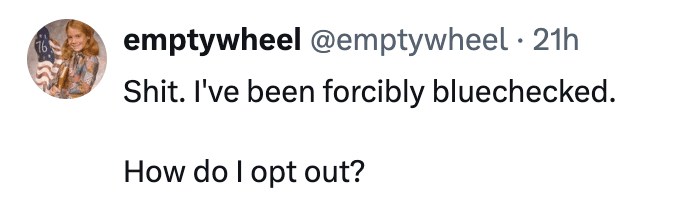
But really, I’m more immediately interested in this superb quote Will Oremus included in a WaPo article describing disgruntled new owners of a Xitter blue check, which may be my best ever quote in a mainstream publication.
Marcy Wheeler, an independent journalist covering national security who greeted her blue verification badge Wednesday by posting an expletive, said she remains on X mostly to monitor right-wing narratives and disinformation so she can push back on them. She said she believes the verification changes are part of an effort to restore X’s status as a “public square” so that Musk can use it to “mainstream far-right ideas.”
On Thursday, Musk amplified various posts from verified X users defending a Jan. 6, 2021, suspect, decrying a rise in the “foreign-born” population under President Biden, highlighting crimes by Syrian migrants, mocking diversity and inclusion programs, and suggesting that leftists want to disarm American citizens “because they intend to do things that American citizens would want to shoot them for.”
In between, he agreed with a post that said that “a blue checkmark is a stamp of authenticity.”
As I said, have at it!
https://empty.runengine.com/wp-content/uploads/2024/04/Screenshot-2024-04-04-at-22.02.22.png212694emptywheelhttps://www.empty.runengine.com/wp-content/uploads/2016/07/Logo-Web.pngemptywheel2024-04-04 17:04:152024-04-04 17:04:15Bullshit and Also, Aileen Cannon, Post
Both Trump and Jack Smith have responded to Aileen Cannon’s whack order to write proposed jury instructions as if the Presidential Records Act says something it doesn’t. Neither are all that happy about it.
Trump used his response to claim that having the jury assess whether Trump really did make these documents personal records rather than simply steal them would put them in the role that, he’s arguing, only a (former) President can be in.
Smith — as many predicted — spent much of the filing arguing that Cannon cannot leave this issue until jury instructions because it must have an opportunity to seek mandamus for such a clear legal error; they cite the 11th Circuit slapdown of Cannon’s last attempt to entertain this fantasy in support.
Along the way, though, Smith also did something I had hoped he would do: explain where, and when, Trump’s own whack theory came from in the first place.
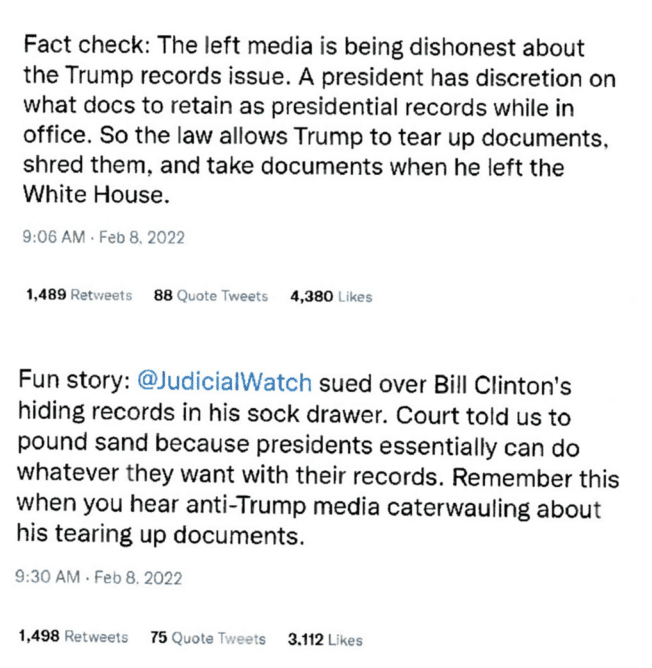
It came from Tom Fitton’s Xitter propaganda in response to the public report, in February 2022, that Trump had returned documents, including classified ones. But even after Fitton first intervened, Trump’s handlers continued to treat any remaining classified documents as presidential records for months.
On February 8, 2022, the day after the Washington Post article was published, the president of Judicial Watch posted the following two statements on Twitter5
:
Immediately after posting the second Tweet, the Judicial Watch president sent to an employee in Trump’s post-presidency office a link to the Tweet and offered to discuss the issue with Trump. A few hours later, the Judicial Watch president sent the same person his analysis of the case Judicial Watch v. NARA, 845 F. Supp. 2d 288 (D.D.C. 2012). That evening, the Judicial Watch president circulated to the employee a proposed public statement for Trump’s consideration, which included language that the PRA and judicial decisions gave Trump the right to keep the documents he returned to NARA. The statement never issued.
Around this same time, the Judicial Watch president, who was not an attorney, told another Trump employee that Trump was being given bad advice, and that the records Trump possessed at Mar-a-Lago should have been characterized as personal. The second employee advised the Judicial Watch president that they disagreed with the Judicial Watch president’s analysis: in Judicial Watch, former President Clinton had made the designation of certain records personal while President, whereas Trump had not done so. The second employee further informed Trump that the Judicial Watch president was wrong and explained why. Nevertheless, on February 10, 2022, Trump released a statement claiming in part, “I have been told I was under no obligation to give the material based on various legal rulings that have been made over the years.”6 Before this time, the second employee had never heard this theory from Trump. No other witness recalled Trump espousing this theory until after the Judicial Watch president conveyed it to him in February 2022.
Smith doesn’t, however, draw out the implication of this explicitly.
Not only has Trump been falsely suggesting — without evidence — that he did designate these documents personal records. He couldn’t have done so, because he didn’t know of this theory until over a year after he stole the documents.
But Cannon is such a chump that she has been chasing a theory spun up by Fitton, someone who has only an English BA.
Cannon may well respond poorly to Smith’s use of 20-some pages to lay all this out. It’s the kind of thing that routinely elicits miffed responses from her.
At this point, though, it seems Smith is simply laying a record for a challenge at the 11th Circuit.
https://empty.runengine.com/wp-content/uploads/2024/04/Screenshot-2024-04-03-at-06.43.38.png668652emptywheelhttps://www.empty.runengine.com/wp-content/uploads/2016/07/Logo-Web.pngemptywheel2024-04-03 01:56:022024-04-03 03:24:05Jack Smith to Aileen Cannon: Treating Non-Lawyer Tom Fitton’s Theories as Law Will Lead to Mandamus
Simon Rosenberg didn’t panic about a 2022 Red Wave. As analysts everywhere were wailing that the Sky Was Falling, he was quietly confident.
Keep that in mind as you listen to this conversation he had with Greg Sargent. I have about the same cautious optimism as Rosenberg (I was less confident than he was in 2022) on this year’s election, but he’s a pro who works from fundamentals, not just last week’s poll results.
Among other things, he talks about how any of six big negatives for Trump could blow the election for him:
He raped E. Jean Carroll in a department store dressing room
He oversaw one of the largest frauds in America history and that he and Rudy Giuliani through all their various misdeeds own over $700M dollars
He stole American secrets, lied to the FBI about it, and shared these secrets with other people
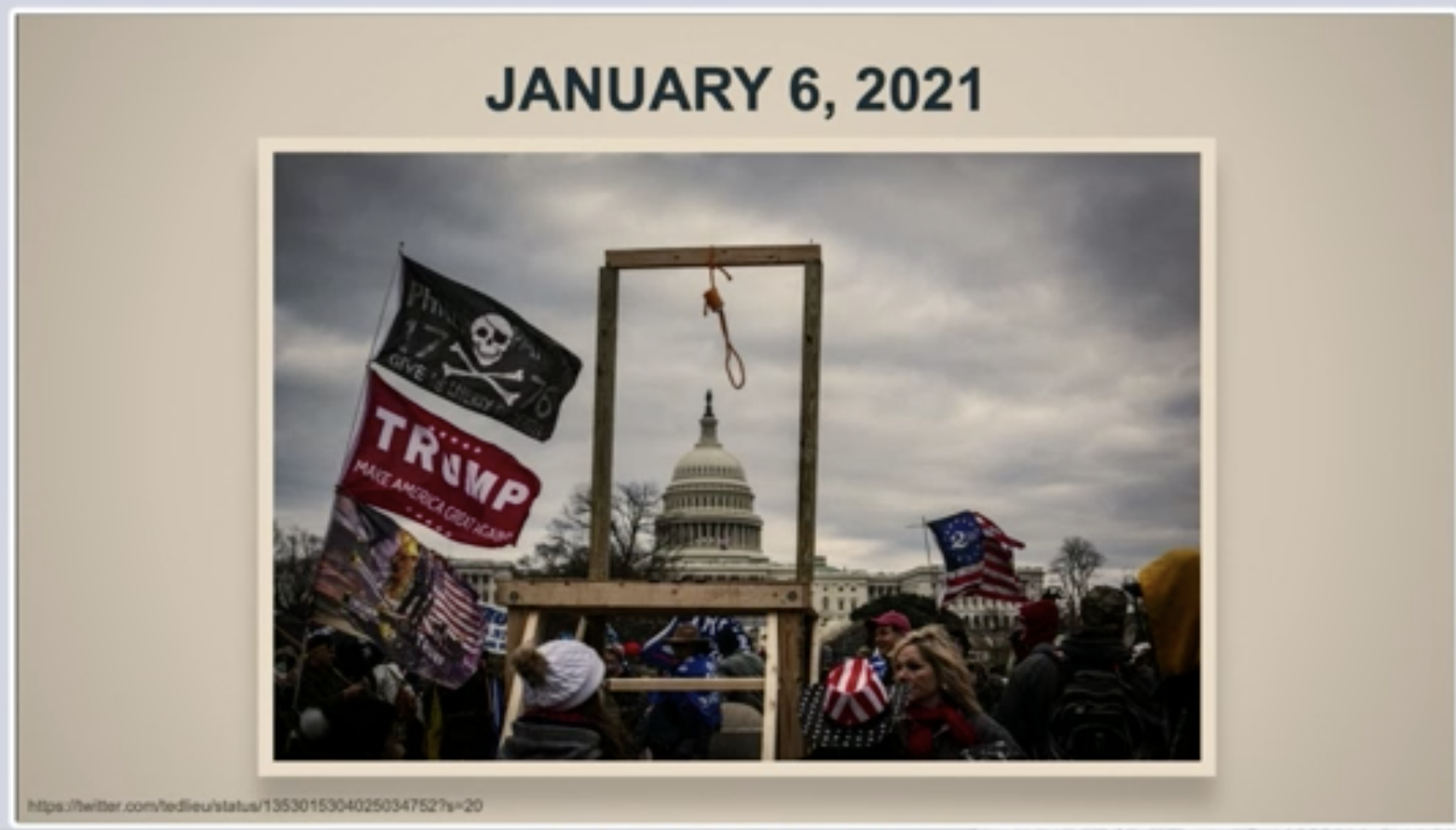
He led an insurrection against the United States
He and his family have corruptly taken billions from foreign governments
He is singularly responsible for ending Roe and stripping the rights and freedoms away from more than half the population
I would add two more: First, Trump routinely defrauds MAGAt supporters. Over the last week, he turned the RNC into a means to do so on a grander scale. Republicans need to hear that they’re being taken to the cleaner by Trump — and by Steve Bannon, whose trial for doing so will also serve as backdrop to this election season.
More tellingly, Rosenberg addressed this detail when he described how Biden’s two big negatives have resolved (my biggest complaint about this interview is it didn’t address Gaza, the unmentioned third), not when he addressed Trump’s scandals.
The Biden crime family story, we just learned in the last few weeks, was a Russian op that was being laundered by the Republican party that blew up in their face.
Rosenberg treated the manufactured “Biden crime family” that was actually a Russian op laundered by the GOP as a resolved Biden negative after he made this point, the most important in the interview, in my opinion.
We have to learn the lesson from waiting for Mueller. Waiting for Mueller was a mistake by the Democratic Party. It prevented us from prosecuting the case against Trump and his illicit relationship with the Russian government that was out there all for us to see. Right? The Russians played a major role in his election in 2016. This is not in dispute in any way. And so I think now what we need to do is not wait for Jack Smith or wait for Merrick Garland. We need to use what’s in front of us and prosecute this in ways that we know is going to do enormous harm.
No superhero will come tell any one of these stories for Democrats. Trump’s opponents have to tell the story of Trump’s corruption. They cannot wait for Mueller. Or Jack Smith.
One of many reasons I’m so focused on the Hunter Biden story is that it is actually what proves the continuity of that story of Russian influence that Democrats failed to tell. Trump asks for Russian help in 2016 and gets it. As part of a campaign in which Rudy Giuliani solicited Russian spies for dirt on Hunter Biden, Trump withheld security support from Ukraine to get the same. Even after that, Trump’s DOJ created a way to launder the dirt Rudy collected from known Russian spies to use in the 2020 election. That campaign created the shiny object that has created the “Biden crime family” narrative. Like Russia’s role in the 2016 election, none of this is in dispute. It’s just not known.
You cannot wait for Robert Mueller or Jack Smith to tell this narrative. But for four months this entire story — this arc — has passed largely unnoticed, even as Trump took steps to deliver Ukraine’s bleeding corpse to his liege, Vladimir Putin.
Those who want to defeat Trump — and honestly, Republicans like Liz Cheney and Amanda Carpenter have been doing a better job of this than most Democrats — have to make sure this story gets told.
This is what I’ve been trying to say over and over and over. The reason why the moderate press hasn’t been telling the story of Trump’s role in the insurrection, of his ties to militia members and his direct inspiration for the most brutal assaults on cops on January 6 is because all their TV lawyers have been whinging instead about their own misunderstanding of the January 6 investigation. They haven’t been telling the story of what we know.
They have been complaining that Merrick Garland hasn’t compromised the investigation to tell them them more, turning Garland into their villain, not Trump.
In the few minutes after I posted these comments on Twitter, commenters have:
Complained that the full Mueller Report hasn’t been released, when really they’ve simply been too lazy to understand that the most damning bits have been released.
Bitched that Merrick Garland hired Rob Hur, rather than bitching about Rob Hur telling a narrative even after his own investigation had debunked it.
Complained about a delay in the January 6 investigation that didn’t happen.
Kaitlan Collins’ interview with Brian Butler, a former Trump employee whose testimony badly incriminated his one-time best friend, Carlos De Oliveira, has been drowned out by all the complaints.
The story barely made a blip. It’s not just the NYT that buries important Trump stories under complaints about Biden, it’s Democratic supporters.
Rosenberg went on to describe how Democrats need to improve this. He noted that the Right Wing noise machine provides them a great advantage on this front, one that Biden will have to spend to combat.
We have to recognize, Greg, that the information environment in the United States is really broken right now and that the power of the Right Wing noise machine to bully and intimidate mainstream media into being complicit in advancing some of their narratives is something that needs a campaign that has half a billion dollars in it to be able to draw even on. What we’ve learned is there is a structural imbalance in the information game between the two parties, that the Republicans have a significant advantage over us in a day-to-day information war.
This is true. But the insularity of the Right Wing noise machine can be made into a weakness for Republicans, even before spending the money. Because right wingers so rarely try to perform for a mainstream audience, as soon as they do — whether it is rising star Katie Britt or Kentucky redneck James Comer — they look like lying morons.
And in the face of that Right Wing noise, Democrats need to be disciplined.
The Biden campaign’s going to have to be wildly disciplined. They can’t chase the daily story. They’re going to have to pick the two or three things they know from research are the things that are a rubicon with the electorate.
[snip]
It’s going to be incumbent upon them to not allow the Trumpian mania and madness sort of push them around every day. They’re going to need to develop an offensive strategy both on what we’re selling and on what we’re indicting him with.
Rosenberg laid out the six bullets; I added two more. Trump will try to distract from that with daily outrages, with spectacle.
Trump — abetted by social media — will try to distract from that argument by demeaning all ability to make, or understand, coherent arguments.
I’m less sanguine than Rosenberg that even discipline is enough to overcome Trump’s circus. Therein lies the challenge.
But he’s right that those who want to defeat Trump have to make that case themselves. Neither Jack Smith, nor the NYT, will save you.
https://empty.runengine.com/wp-content/uploads/2018/02/RobertMueller_PeteSouza_2012_Wikimedia.jpg10541500emptywheelhttps://www.empty.runengine.com/wp-content/uploads/2016/07/Logo-Web.pngemptywheel2024-03-14 10:35:512024-03-14 14:06:23The “Waiting for Mueller” Mistake and the Right Wing Bubble
MSNBC was kind enough to invite me to make the case, again, that those blaming Merrick Garland for delays in the January 6 investigation simply aren’t familiar with the investigation. Readers will be familiar with much of this, but two details are new.
First, I describe what investigative steps prosecutors had to take to prepare the most obvious piece of evidence, Trump’s 2:24 tweet targeting Mike Pence.
Take the tweet Trump sent at 2:24 p.m. Jan. 6: “Mike Pence didn’t have the courage.” It was right there in public! But to present that in court first required the exploitation of at least two phones, nine months of fights over executive privilege, a 23-day stall from Twitter and two sets of interviews with at least eight different top aides.
And something that’s long overdue: Holding the January 6 Committee responsible for their unnecessary delays, which almost bolloxed the Proud Boys trial.
One delay that was unnecessary was caused by some of the people who most loudly blamed Garland: the Jan. 6 Committee. DOJ first asked the committee for witness transcripts in April 2022. That June, prosecutors in the trial of leaders of the Proud Boys agreed to reschedule their trial from August until December because the committee would not release transcripts until September. The prosecutors were vindicated when those transcripts finally came out in December, after three additional months of delay and jury selection had already started. Twice during the trial, prosecutors learned that witnesses had told the committee something they hadn’t told the FBI; in one instance, a committee transcript revealed an attorney conflict that threatened prosecutors’ reliance on testimony from their most important cooperating witness. Given that court filings suggest Smith will treat the Proud Boys akin to co-conspirators when this case finally goes to trial, those are the kinds of unnecessary screw-ups that could jeopardize Trump’s trial itself.
https://empty.runengine.com/wp-content/uploads/2021/02/Screen-Shot-2021-02-10-at-9.37.01-PM.png9741708emptywheelhttps://www.empty.runengine.com/wp-content/uploads/2016/07/Logo-Web.pngemptywheel2024-03-07 17:12:182024-03-07 17:12:18emptywheel Takes to MSNBC to Explain the January 6 Investigation
https://empty.runengine.com/wp-content/uploads/2023/06/Screenshot-2023-06-10-at-08.02.55.png692600emptywheelhttps://www.empty.runengine.com/wp-content/uploads/2016/07/Logo-Web.pngemptywheel2024-03-07 16:32:182024-03-07 18:08:14Jack Smith Is Not Amused
The Supreme Court has not only held that states cannot enforce the 14th Amendment for Federal offices,
This case raises the question whether the States, in addition to Congress, may also enforce Section 3. We conclude that States may disqualify persons holding or attempting to hold state office. But States have no power under the Constitution to enforce Section 3 with respect to federal offices, especially the Presidency.
But it held that Congress must exclude insurrectionists from office.
The respondents nonetheless maintain that States may enforce Section 3 against candidates for federal office. But the text of the Fourteenth Amendment, on its face, does not affirmatively delegate such a power to the States. The terms of the Amendment speak only to enforcement by Congress, which enjoys power to enforce the Amendment through legislation pursuant to Section 5.
It points to the predecessor to 18 USC 2383 as means to exclude someone.
Instead, it is Congress that has long given effect to Section 3 with respect to would-be or existing federal officeholders. Shortly after ratification of the Amendment, Congress enacted the Enforcement Act of 1870. That Act authorized federal district attorneys to bring civil actions in federal court to remove anyone holding nonlegislative office—federal or state—in violation of Section 3, and made holding or attempting to hold office in violation of Section 3 a federal crime. §§14, 15, 16 Stat. 143–144 (repealed, 35 Stat. 1153–1154, 62 Stat. 992–993). In the years following ratification, the House and Senate exercised their unique powers under Article I to adjudicate challenges contending that certain prospective or sitting Members could not take or retain their seats due to Section 3. See Art. I, §5, cls. 1, 2; 1 A. Hinds, Precedents of the House of Representatives §§459–463, pp. 470–486 (1907). And the Confiscation Act of 1862, which predated Section 3, effectively provided an additional procedure for enforcing disqualification. That law made engaging in insurrection or rebellion, among other acts, a federal crime punishable by disqualification from holding office under the United States. See §§2, 3, 12 Stat. 590. A successor to those provisions remains on the books today. See 18 U. S. C. §2383. [my emphasis]
Taken in tandem with SCOTUS’ punt on Trump’s immunity bid, this seems like an invitation for Jack Smith to supersede Trump with inciting insurrection. After all, SCOTUS has now upheld the DC Circuit opinion that says there’s no double jeopardy problem with trying someone for something on which they were acquitted after impeachment.
Jack Smith could — today — charge Trump with inciting insurrection in response to this order. It is the one Constitutional means to disqualify him, according to this order.
https://empty.runengine.com/wp-content/uploads/2021/02/Screen-Shot-2021-02-10-at-9.37.01-PM.png9741708emptywheelhttps://www.empty.runengine.com/wp-content/uploads/2016/07/Logo-Web.pngemptywheel2024-03-04 10:12:252024-03-04 10:32:45SCOTUS Invites Jack Smith to Supersede Trump with Inciting Insurrection
It seems likely SCOTUS has committed to deciding the immunity question by the end of term, in June.
That would present Tanya Chutkan with the decision of whether to try the January 6 case during the election season (it is her choice, not DOJ’s to make). She had been entertaining starting the trial in August, which would have bled into election season as it is, so she may decide to do this. If she does, it is unlikely a jury would reach a verdict before election day, but the trial would give voters opportunity to see the evidence before voting.
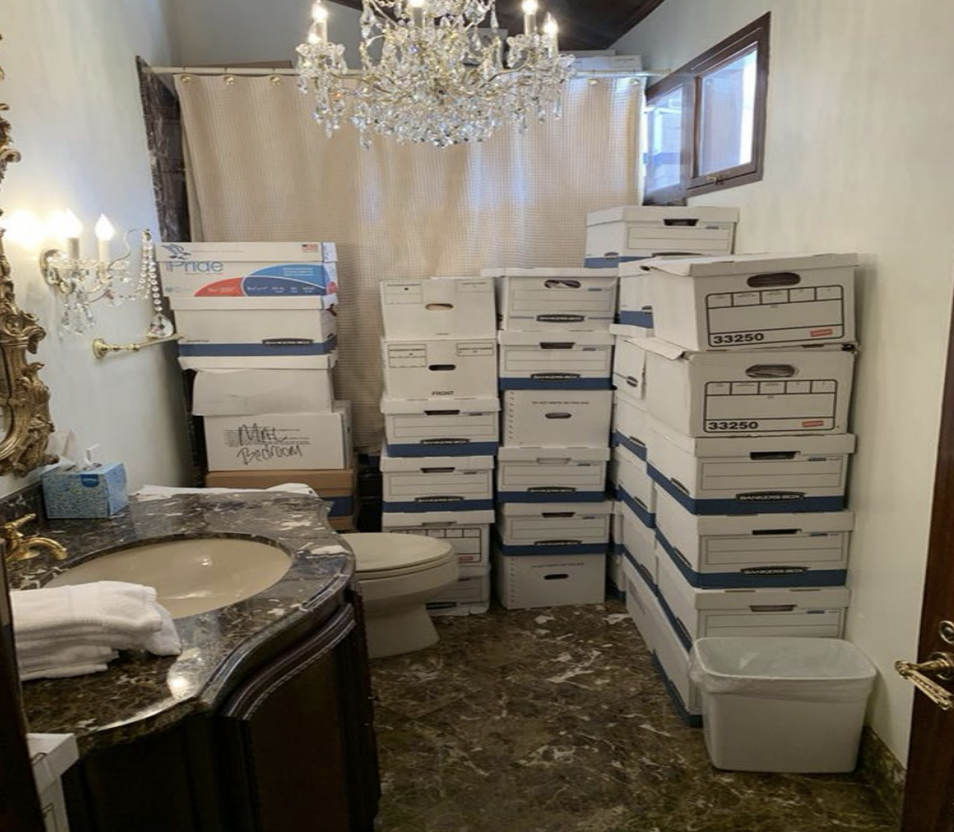
The decision to grant cert is as interesting for Trump’s other immunity claim — Trump’s even more frivolous claim that he can’t be prosecuted for stealing boxes and boxes of classified documents because his claimed decision to convert those government documents to his personal possession in violation of the Presidential Records Act is immune from prosecution, as well. I’ve seen some commentary that SCOTUS may have been trying to come up with a different solution but then decided to hear the case. If that’s true, the decision to hear the case came less than a week after Trump made that other claim of immunity, that he can steal classified documents with impunity. Who knows? It’s not before the court, but it may have affected their decision to hear the case.
The matter will be fully briefed by the time Jack Smith submits his brief to SCOTUS on April 8. So he can have two absurd claims of immunity to address, Trump’s claim he can steal the election with impunity, and Trump’s claim he can convert boxes and boxes of classified documents to do with as he pleases on the way out the door even if it violates the Presidential Records Act, a law passed specifically to apply to Presidents. One of the matters that had been hypothetical before the DC Circuit — that Trump might sell nuclear documents to our adversaries — has become concrete.
Given the question as posed by SCOTUS — Whether and if so to what extent does a former President enjoy presidential immunity from criminal prosecution for conduct alleged to involve official acts during his tenure in office? — I think SCOTUS may have been uncomfortable with the DC Circuit’s thin treatment of Trump’s argument that, without immunity, former Presidents could be prosecuted for things like approving the drone strike on Anwar al-Awlaki (note, when Trump raises this, he never mentions that he himself killed Awlaki’s daughter).
Former President Trump argues that criminal liability for former Presidents risks chilling Presidential action while in office and opening the floodgates to meritless and harassing prosecution. These risks do not overcome “the public interest in fair and accurate judicial proceedings,” which “is at its height in the criminal setting.” Vance, 140 S. Ct. at 2424.
Former President Trump first asserts that the prospect of potential post-Presidency criminal liability would inhibit a sitting President’s ability to act “fearlessly and impartially,” citing the “especially sensitive duties” of the President and the need for “bold and unhesitating action.”
There has to be something that distinguishes such actions from those charged against Trump. That something is likely the conversion of the Presidency to one’s own personal benefit. It’s not in the DC Circuit opinion and needs to be — all the more so given that, in Florida, Trump is claiming that he could legally simply convert boxes and boxes of classified documents to his personal property, even though the Presidential Records Act prohibits it.
It’s not in the DC Circuit opinion. But something like that has to be, some measure to distinguish the ordinary unlawful stuff Presidents are asked to authorize on behalf of the country and the venal stuff Trump did to benefit himself.
Tomorrow, Judge Cannon will hold a hearing to discuss how to schedule that trial. Her original schedule included six months of things after pretrial motions, which would put her schedule at September as well (though she’s obviously more likely to stall until after the election). But one thing she can expect is that, by June, Trump’s immunity claim will be resolved.
Update: Here’s the language from Trump’s brief that addresses this problem.
The panel opinion ignores the long history of real-world examples of Presidents engaging in actual behavior that political opponents viewed as egregious and “criminal.” Instead, keying on the Special Counsel’s arguments, the panel fretted about lurid hypotheticals that have never occurred in 234 years of history, almost certainly never will occur, and would virtually certainly result in impeachment and Senate conviction (thus authorizing criminal prosecution) if they did occur—such as a hypothetical President corruptly ordering the assassination of political rivals through “SEAL Team Six.” D.C. Cir. Oral Arg Tr. 10:19-21. Such hypotheticals provide fodder for histrionic media coverage, but they are a poor substitute for legal and historical analysis. Confronted with real-world hypotheticals—such as President Obama’s killing of U.S. citizens by drone strike—the Special Counsel conceded below that Presidential immunity from criminal prosecution for official acts likely exists and would apply, directly contradicting the “categorical,” App’x 20A, holdings to the contrary of both the appellate panel and the trial court. D.C. Cir. Oral Arg Tr. 49:18-22 (Special Counsel admitting that a “drone strike” where “civilians were killed … might be the kind of place in which the Court would properly recognize some kind of immunity”). Further, the logical presupposition of such speculative hypotheticals—i.e., that the Founders supposedly must have intended that no alleged Presidential misdeed could ever escape prosecution—is plainly incorrect and contradicts the basic premises of a system of separated powers. “While the separation of powers may prevent us from righting every wrong, it does so in order to ensure that we do not lose liberty.” Morrison, 487 U.S. at 710 (Scalia, J., dissenting).
Jack Smith’s response doesn’t really deal with this issue in depth.
7 A sufficient basis for resolving this case would be that, whatever the rule in other contexts not presented here, no immunity attaches to a President’s commission of federal crimes to subvert the electoral process. See Amici Br. of John Danforth et al., at 7. The court of appeals’ analysis was “specific” to the allegations that applicant conspired to “overturn federal election results and unlawfully overstay his Presidential term,” Appl. App. 31A, and a stay can be denied on that basis alone, leaving for another day whether any immunity from criminal prosecution should be recognized in any circumstances. See Gov’t C.A. Br. 45-49 (explaining that foreign affairs are not implicated in this case); cf. Nixon, 418 U.S. at 707, 710, 712 n.19 (reserving whether an absolute presidential-communications privilege might exist for military, diplomatic, or national security secrets).
https://empty.runengine.com/wp-content/uploads/2023/06/Screen-Shot-2023-06-09-at-7.53.48-PM.png832954emptywheelhttps://www.empty.runengine.com/wp-content/uploads/2016/07/Logo-Web.pngemptywheel2024-02-29 05:32:362024-02-29 06:18:57Trump’s Other Immunity Claim: Stealing Boxes and Boxes of Classified Documents
The application for a stay presented to The Chief Justice is referred by him to the Court. The Special Counsel’s request to treat the stay application as a petition for a writ of certiorari is granted, and that petition is granted limited to the following question: Whether and if so to what extent does a former President enjoy presidential immunity from criminal prosecution for conduct alleged to involve official acts during his tenure in office. Without expressing a view on the merits, this Court directs the Court of Appeals to continue withholding issuance of the mandate until the sending down of the judgment of this Court. The application for a stay is dismissed as moot.
The case will be set for oral argument during the week of April 22, 2024. Petitioner’s brief on the merits, and any amicus curiae briefs in support or in support of neither party, are to be filed on or before Tuesday, March 19, 2024. Respondent’s brief on the merits, and any amicus curiae briefs in support, are to be filed on or before Monday, April 8, 2024. The reply brief, if any, is to be filed on or before 5 p.m., Monday, April 15, 2024.
This is sub-optimal, insofar as I had hoped they would rule quickly. Perhaps Trump’s immunity claim in Florida changed that?
Nevertheless, we should get an order in June, and so possibly a trial starting in late August?
https://empty.runengine.com/wp-content/uploads/2013/03/Supreme-Court-Cool1.jpg346568emptywheelhttps://www.empty.runengine.com/wp-content/uploads/2016/07/Logo-Web.pngemptywheel2024-02-28 17:09:382024-02-28 17:09:38Supreme Court to Hear Trump Immunity Claim on April 22
Trump and at least Carlos De Oliveira are filing motions to dismiss (some are being unsealed via a review process). I’ll post them here until I read in more detail.
I’m close to bed, so I won’t read it here, but here is Jack Smith’s SCOTUS response on Trump’s immunity claim. This was Trump’s appeal.
Remember that this was technically an application for a stay, not the entire appeal (though one option for SCOTUS is that it treats Trump’s request as a cert position). What Jack Smith is arguing is that the stay should be lifted.
https://empty.runengine.com/wp-content/uploads/2013/03/Supreme-Court-Cool1.jpg346568emptywheelhttps://www.empty.runengine.com/wp-content/uploads/2016/07/Logo-Web.pngemptywheel2024-02-14 18:06:132024-02-14 18:11:29Mr. Smith Goes to SCOTUS