Posts

How Garland-Whinger Ankush Khardori’s Willful Impotence Helps Trump Evade Accountability

There’s a telling quote from Greg Sargent in his description of Kamala Harris’ difficulties in convincing voters that Trump was a bad president.

Some Democrats believe that the leading pro-Harris Super PAC, Future Forward, failed to spend enough of its enormous budget on advertising early on that might have reminded voters of the horrors of the Trump presidency. That perhaps allowed him to slowly rehabilitate himself and edge up his favorable numbers while Democrats weren’t looking.

“There was a calculation among Democrats after 2020 that Trump was disqualified and wouldn’t be back,” Democratic data analyst Tom Bonier told me. “That evolved into a calculation that he would be disqualified by his legal troubles and could end up in jail. Democrats undeniably failed to disqualify him. The result was that by the time the Harris campaign started, it was too late.”

“Was disqualified … would be disqualified … failed to disqualify.”

Bonier is just one person. But the passivity he describes on the part of Democrats expecting and hoping that some magic unicorn would just make the problem of Donald Trump go away is telling. As described, Democrats as a party apparently abdicated all agency for making that case themselves until it was far too late.

It is precisely the reason I’m so impatient with the Merrick Garland whinger industry, which has flourished again since Trump’s win: because they replicate precisely the impotence that got us here. They always asked that Garland do the work, singlehandedly, of making Trump go away, without considering the political groundwork that was necessary to any successful legal case.

Take Ankush Khardori’s description of Trump’s legal impunity. After laying out that, with his election, Trump’s legal troubles will now go away, with which I mostly agree, Khardori then lays out his three culprits: Merrick Garland, Mitch McConnell, SCOTUS.

His culprits are not in temporal order; if McConnell — who had an immediate way to disqualify Trump from further office — had engaged in an impeachment effort, DOJ would have had more time to prosecute.

They’re not in order of culpability. He addresses SCOTUS’ actions in four paragraphs close to the end of his rant. He ignores how their interventions on the Colorado case and Fischer also affected DOJ’s options, and never mentions precisely how long they stalled the case: eight months, with a guarantee of more on the back end. Once you address SCOTUS’ delays and rewriting of the Constitution, it’s not clear a case could ever have been brought before an election, even ignoring how COVID stalled everything for a year, to say nothing of bringing an insurrection charge that would be (per the Colorado decision) the only thing that could disqualify Trump from office. If that’s the case, it wouldn’t matter whether Garland or a gun-toting Adam Schiff, as prosecutor, were in charge. SCOTUS’ intervention, assuming it would have been the same whether it happened in 2021 or 2022 or 2023, was decisive. Trump’s judges made a prosecution of him before the election impossible and further ruled that the only thing that could disqualify him was an insurrection charge.

Instead of focusing primarily on the main culprits, Khardori prioritizes what he imagines was Garland’s role over that of McConnell and — astonishingly — SCOTUS.

And as is typical with Garland whingers, his indictment of Garland is riddled with problems (and, as the red typeface I used to mark links to his own past pieces shows, his own bellybutton lint).

It is now clearer than ever that Garland was a highly questionable choice to serve as attorney general from the start. From the outset of the Biden presidency, it was readily apparent that Garland had little desire to investigate and potentially prosecute Trump.

The most comprehensive accounts on the matter, from investigative reporting at The Washington Post and The New York Times, strongly indicate that the Jan. 6 committee’s investigation and public hearings in 2022 effectively forced Garland to investigate Trump and eventually to appoint Smith in November of that year — nearly two years after Trump incited the riot at the Capitol.

There are many people — including many Democratic legal pundits — who have continued to defend this delay and may continue to do so, so let me be very clear: Those people are wrong.

It was clear after Trump’s loss in 2020 — even before Jan. 6 — that his conduct warranted serious legal scrutiny by the Justice Department, particularly in the area of potential financial crimes. But that probe, which could and should have been pursued by Biden’s U.S. Attorney and aspiring attorney general in Manhattan, somehow never materialized.

It was also clear — on Jan. 6 itself — that Trump may have committed criminal misconduct after his loss in 2020 that required immediate and serious attention from the Justice Department.

The formation of the Jan. 6 committee in early 2021 did nothing to change the calculus. There too, it was clear from the start that there would still need to be a criminal investigation to deliver any meaningful legal accountability for Trump.

In fact, the warning signs for where this could all end up — where the country finds itself now — were clear by late 2021, less than a year into Biden’s term. The public reporting at the time indicated (correctly, we now know) that there was no real Justice Department investigation into Trump and his inner circle at that point, even though the outlines of a criminal case against Trump — including some of the charges themselves that were eventually brought nearly two years later — were already apparent.

As a result, the Biden administration and the Garland Justice Department were running an extremely obvious risk — namely, that Trump would run for reelection and win, and that any meaningful criminal accountability for his misconduct after 2020 would literally become impossible. That, of course, has now happened. It was all eminently predictable.

Garland’s defenders over the years — including many Democratic lawyers who regularly appear on cable news — claimed that Garland and the department were simply following a standard, “bottom-up” investigative effort. Prosecutors would start with the rioters, on this theory, and then eventually get to Trump.

This never made any sense.

It did not reflect some unwritten playbook for criminal investigations. In fact, in criminal cases involving large and potentially overlapping groups of participants — as well as serious time sensitivity — good prosecutors try to get to the top as quickly as possible.

The Justice Department can — and should — have quickly pursued the rioters and Trump in parallel. The fact that many legal pundits actually defended this gross dereliction of duty — and actually argued that this was the appropriate course — continues to amaze me.

As for Garland, his legacy is now out of his control, and the early returns are not looking good.

Garland is a serious, well-intentioned and complex figure. But given all this, he may go down as one of the worst and most broadly unpopular attorney generals in American history — hated by the anti-Trump part of the country for failing to bring Trump to justice, and hated by the pro-Trump part of the country for pursuing Trump at all. I sincerely hope he provides a first-hand accounting of what happened after he too leaves office next year.

The only sources of information on the investigation Khardori cites (aside from his own posts about what he could see without looking) are a WaPo and a NYT article. From both, only Glenn Thrush, a political journalist rehabilitated to the DOJ beat, covered the Trump case closely; none covered the larger investigation.

The WaPo article, which fairly obviously relies heavily on sources from the January 6 Committee members and people who left DOJ when Garland came in, has a number of problems I’ve laid out before (one, two, three).

  • It missed the significance of Brandon Straka, whose “cooperation” I believe was mishandled, but had it not been, might have gotten you into the Willard in March 2021.
  • It focused on the Oath Keepers and almost entirely ignores the Proud Boys, and in the process misunderstands the specific role they played, the ways DOJ under Bill Barr had made their prosecution far harder, and their importance to any hypothetical insurrection charge (because they kicked off the insurrection before Trump did, a problem impeachment prosecutors faced).
  • It ignored the decisions DOJ made with Rudy Giuliani’s phone — which was seized with a warrant obtained on Lisa Monaco’s first day on the job — which made that content, including content J6C never got, available to DOJ starting in November 2021.
  • It ignored the way DOJ, in August 2021, opportunistically used the prior Deferred Prosecution Agreement of Alex Jones sidekick Owen Shroyer to arrest and exploit the phone of someone who otherwise would likely be protected under media guidelines.
  • It ignored the overt investigative steps against Sidney Powell taken no later than September 2021.
  • It ignored a subpoena that was overt in May 2022, which included people who were not immediately a focus of J6C (and so not derivative of that investigation), as well as warrants dating no later than May 2022 targeting (among others) John Eastman. Since then, thanks to Khardori’s colleagues at Politico who do cover these investigations, we’ve learned the exact date that kicked off over ten months of Executive Privilege fights to get the testimony of 14 of Trump’s closest aides: June 15, 2022, one day before J6C interviewed those same witnesses: Marc Short and Greg Jacob. Which is to say, WaPo’s timeline even of known investigative steps is off in a way that suggests DOJ was entirely derivative of J6C, which it could not have been.
  • Perhaps predictably, given the obvious reliance on J6C sources, it didn’t talk about how their decision to delay sharing transcripts from April until December 2022 withheld information both helpful and crucial from criminal investigators.

More importantly, WaPo focused on Steve D’Antuono’s hesitancy to turn to the fake electors, even as DOJ was pushing to do so. Which is to say that D’Antuono — someone no longer at DOJ — was the key cause for delay, not Garland.

So there are a lot of problems with the WaPo story that Khardori, if he had actually tracked the investigation or followed those of us (including Politico’s own reporters) who do, should have known.

But Khardori didn’t even need to do that to understand that the WaPo had blind spots. That’s because the NYT story describes two prongs of the investigation, started in 2021, that don’t make the WaPo. It describes that,

  • Garland encouraged investigators to follow the money in his first meeting with them, though that turned out to be largely a dead end (note: Garland publicly implied that investigators were following the money in October 2021).
  • By summer of 2021, Lisa Monaco convened a team focusing on John Eastman, Boris Epshteyn, Rudy, and Roger Stone.

The NYT story missed a lot of what I included above, too (though not the Proud Boys), but it tells a very different story about efforts to focus on people close to Trump in 2021 than the WaPo did.

In spite of the NYT description of two prongs of the investigation that started in March and summer 2021 that attempted to get directly to those in Trump’s orbit, Khardori spent four paragraphs of his complaint claiming that DOJ had exclusively tried to work their way up from rioters. That’s not what the public record shows, it’s not what NYT says happened, it’s not what public reports on the Powell subpoenas say, it’s not what Garland said in October 2021 testimony. And yet that is the basis Khardori uses to condemn Garland. Further, the NYT describes that, in his first meeting with investigators, Garland, “said he would place no restrictions on their work, even if the ‘evidence leads to Trump,'” That statement is inconsistent with most of Khardori’s first two paragraphs on Garland. The Attorney General told investigators from the start he had no problem investigating Trump. Yet Khardori still links his own past work and claims vindication, rather than confessing that, if the NYT piece he relies on is accurate, he was wrong.

Which is to say, Khardori doesn’t claim to (and shows no signs of) having reviewed how the investigation actually happened.  That’s not his job, I guess, as a legal journalist. Instead, he relies on two sources, one of which partly debunks the other, as well as countering his own claim about Garland’s unwillingness to investigate and his four-paragraph argument that Garland should have pursued multiple routes to Trump but did not.

There are facts. And Khardori chooses to ignore them, clinging instead to past assertions that he falsely claims have been vindicated.

It’s the most irresponsible kind of laziness. Without having learned what really happened, Khardori concocts out of his uncertainty and frustration broad judgements that support his priors but are inconsistent with the public record. Via that invented theory to explain the scary unknown, Merrick Garland remains his primary villain, not John Roberts, not Mitch McConnell.

Poof! Thousands of clicks, each time misleading another despondent reader, encouraging helplessness.

Having made Garland his villain, he proclaims defeat.

I am, if anything, more furious than Khardori that Trump will not face legal accountability for his alleged crimes, because I know the kind of insurrectionists whose likely pardons will effectively flip patriotism on its head, valorizing Trump over country. This is a potentially irreparable blow to rule of law in the US.

But I’m not ready, as Khardori seems to be, to concede defeat. That’s because legal accountability is not the only recourse; indeed, we were never going to get legal accountability without first demanding political accountability. That’s the mistake many made: by looking passively at Merrick Garland and begging for a sparkle unicorn to make Trump go away, many failed to take steps, themselves, to hold Republicans to account for abandoning rule of law.

Consider how Khardori disempowers himself elsewhere in his column. Here’s how he describes Jack Smith’s closure of the case.

Already there is reporting suggesting that special counsel Jack Smith will leave his post and dismiss the pending cases, which is not that surprising considering that Trump pledged to fire him once back in office anyway.

He describes this as driven by Trump’s threat to fire Jack Smith, not DOJ regulations that prohibit further prosecution. He doesn’t link or consider any of the reports that lay out the obvious: by stepping down rather than waiting to get fired, Smith obliges himself to write a report. He chooses how he will go out. Admittedly, Khardori published his piece before last week’s filing that suggests we’ll have, at least, clarity by early December which, if it were the actual report, would (among other things) be early enough to hold a hearing.

That’s not going to change Trump’s win. But it provides an opportunity to lay a marker in the sand: This is what Republicans have chosen to enable going forward. This is what Republicans have chosen as a party to become.

It lays a marker for the two other villains in Khardori’s column: McConnell and the other Senate Republicans who refused to convict Trump, and John Roberts and his colleagues who vastly expanded his power without even knowing what Jack Smith had discovered.

Fresh off a big electoral victory, I doubt any will much care. But when the obvious repercussions come — when a guy who stored nuclear documents in a coat closet further compromises US security — the report and the hearing provide a marker that those who failed to stop Trump were warned and chose to do nothing (or worse, on the part of SCOTUS, chose to give him more power).

One of the only remaining possible checks on Trump’s power are the people in the Senate and SCOTUS who failed to check him on these alleged crimes before (though SCOTUS did check some of his other initiatives the first time around). We won’t soon persuade any of them to change their minds. But that doesn’t mean we stop trying — or at least laying a record of their complicity. In that path lies capitulation.

All the more so given that Roberts and his colleagues will be the villains in many more stories that have direct impact on people’s lives going forward.

Donald Trump is about to do a great deal of outrageous things at the start of his term to reverse the treatment of January 6 as a crime. The response cannot be to say, ho hum, if only that awful Merrick Garland would have yelled louder, and give up, especially not when no amount of yelling was going to change what SCOTUS did.

The response is to stop hoping for a sparkle unicorn to do this work for us. The response is to take some agency for making the case about Donald Trump. And a first step in that process is to stop blaming Garland for things — the public record shows — he didn’t do, and especially to stop blaming Garland for things that more important villains, like John Roberts, did do.

The first step to effective accountability is to identify the actual villain.

Update: Ty Cobb, when asked what he thinks about Trump’s promise to pardon the Jan6 defendants, stated, I don’t think anybody in our history has more tarnished the rule of law than Donald Trump.”
Jack Smith Asks for Three Weeks

Jack Smith just requested and got a consent motion to file a status report “or otherwise inform” Judge Tanya Chutkan of what they’re going to do with the January 6 case.

As a result of the election held on November 5, 2024, the defendant is expected to be certified as President-elect on January 6, 2025, and inaugurated on January 20, 2025. The Government respectfully requests that the Court vacate the remaining deadlines in the pretrial schedule to afford the Government time to assess this unprecedented circumstance and determine the appropriate course going forward consistent with Department of Justice policy. By December 2, 2024, the Government will file a status report or otherwise inform the Court of the result of its deliberations. The Government has consulted with defense counsel, who do not object to this request.

If that “otherwise inform” is a report, it would be done in plenty of time for Dick Durbin to hold a hearing.

When Special Counsels Finish Up, They Must Write Reports

A bunch of outlets are reporting that, given Trump’s election, Jack Smith is in discussions about how to wind down the two cases against Trump

“Oh, it’s so easy. It’s so easy,” Trump said when asked by conservative radio host Hugh Hewitt whether he would “pardon yourself” or “fire Jack Smith” if reelected.

“I would fire him within two seconds,” Trump said.

The discussions between Smith and DOJ leadership are expected to last several days.

Justice Department officials are looking at options for how to wind down the two criminal cases while also complying with a 2020 [sic] memo from the department’s Office of Legal Counsel about indictments or prosecutions of sitting presidents.

They’re not mentioning a fairly obvious detail. According to governing regulations, when a Special Counsel finishes his work, he must write a report to the Attorney General.

Closing documentation. At the conclusion of the Special Counsel’s work, he or she shall provide the Attorney General with a confidential report explaining the prosecution or declination decisions reached by the Special Counsel.

So if Smith is totally done, he has to write a report.

These reports that Smith is engaged in these discussions come as Bill Barr and others are yapping their mouths about Smith simply dismissing the cases. By telling the press that Smith is already working on shutting down the cases, Smith pre-empts any effort from Trump to offer another solution — and does so before Trump files his response to the immunity brief on November 21.

In other words, this may be no more than an effort to get one more bite at the apple, to describe what Smith found, which would be particularly important if there are still undisclosed aspects of the case, as I suggested there might be.

Where things get interesting, though, is Trump’s co-conspirators, people like Rudy Giuliani and Steve Bannon. Those guys could be prosecuted, as Roger Stone was after Mueller finished up. Trump would order his Attorney General to dismiss the cases — they’re never going to be prosecuted. But it would impose a political cost right at the beginning of his administration.

Update: NYT’s version of this notes that they are trying to preserve the appeal in the 11th Circuit. Of course Walt Nauta is still on that appeal.

Trump Sold Grievance and America Liked What He Was Selling

Once Trump got everyone hooked on his grievance drug, Merrick Garland was never going to make a difference.

I have tried, over and over, to explain how the investigation into Trump and his co-conspirators proceeded. More recently, I’ve explained how you couldn’t have charged Trump with insurrection — the only thing that would have disqualified him from running — until after May 2023, and had Jack Smith done so, it would have ended up exactly where we are here, with John Roberts delaying everything until after the election.

No effort to explain the process — the two years of exploiting phones, the months of January 6 Committee delay, the ten months of privilege fights, the month Elon Musk stole, or the eight months John Roberts bought Trump — none of that has mattered, of course. People needed an explanation for their own helplessness and Merrick Garland was the sparkle pony they hoped would save them.

But nothing Merrick Garland would have done would have mattered anyway.

That’s because since January 2017, since Trump learned that Mike Flynn had been caught undermining sanctions on the phone with Sergey Kislyak, Trump has used every effort to hold him accountable as a vehicle to sell grievance.

This is the core premise of the Ball of Thread podcast I’ve been doing with LOLGOP.

Rather than being grateful when learning that FBI was investigating four of his close campaign advisors had monetized their access to him — rather than imagining himself as the victim of the men who snuck off and met with Russian spies — Trump made himself the victim of the FBI. He invented a claim he was wiretapped, and then kept inventing more and more such false claims. And then he (possibly on the advice of Paul Manafort, whose associate Oleg Deripaska funded HUMINT before the Democrats did) used the dossier as stand-in for the real Russian investigation. It wasn’t the Coffee Boy yapping him mouth that led to the investigation into those trying to monetize access, this false story tells, it was the dossier Russia filled with disinformation, a guaranteed way to discredit the investigation. Once you convince people of the lie that the FBI really did investigate a candidate based off such a flimsy dossier, it becomes easy to target all those involved, along the way gutting the Russian expertise at FBI.

Then Bill Barr came in and used the authority of the Attorney General to lie about what the investigation found; almost no media outlets have revisited the findings once it became clear that Barr didn’t even bother learning what the report said. While trying to kill Zombie Mueller — the parts of the investigation that remained after Mueller finished — Barr’s DOJ literally altered documents in an attempt to put Joe Biden at the genesis of the investigation into Donald Trump, yet another attempt to replace the actual investigation, the Coffee Boy and campaign manager and National Security Advisor and personal lawyer and rat-fucker who were found to have lied to cover up the 2016 Russian operation, with a storytale in which Democrats are the villains.

John Durham never bothered to learn what the report actually said either. Had he done so, it would have been far harder to criminalize Hillary Clinton for being a victim of a hack-and-leak operation, along the way taking out still more expertise on Russia.

And while Barr was criminalizing people, he followed Rudy’s chase for dick pics in an effort to criminalize Hunter Biden and his father.

Do you see the genius of this con, Donald Trump’s most successful reality TV show ever?

Vast swaths of America, including at least half the Supreme Court, and millions of working class voters, really believe that he — the guy who asked Russia to hack his opponent some more — was the victim.

And that’s how a billionaire grifter earns the trust of the working guy.

For the most part, the press just played along, repeating Trump’s claims of victimhood as if they were true.

It’s also the problem in thinking that if only Trump faces legal consequences, he’ll go away, he’ll be neutralized.

We saw this every time he faced justice. The first impeachment. The second one. The New York trials. Each time, his grievance became a loyalty oath. Each time, he sucked more and more Republicans into the con. Each time he made them complicit.

The hatred of and for Trump by Rule of Law is what made him strong, because he used it to — ridiculously!! — place himself into the role of the little guy, the target of those mean elites.

We’ll have decades, maybe, to understand why Trump resoundingly won yesterday. Some of it is inflation (and the unrebutted claims it is bigger than it is), which makes working people angry at the elites, people they might imagine are the same people persecuting Trump.

For many, though, it’s the appeal of vengeance.

Trump has spent nine years spinning a tale that he has reason to wreak vengeance on Rule of Law. The greatest con he ever pulled.

So even if DOJ had charged Trump, two months before Merrick Garland was confirmed (though all three of the charges people imagine would be easy — incitement, the call to Brad Raffensperger, and the fake electors plot — have been unsuccessful in other legal venues), even if DOJ had convicted Trump along with the earliest crime scene defendant in March 2022, even if Trump hadn’t used the very same means of delay he used successfully, which would have still stalled the case past yesterday’s election, it still wouldn’t have disqualified him from running.

It still would be the centerpiece of his manufactured tale of grievance.

It still would be one of the elements he uses to make working people think he’s just like them.

You will only defeat Trumpism by destroying that facade of victimhood. And you will not achieve meaningful legal victories until you do that first.

I know we all need an easy way to explain this — an easy culprit for why this happened.

But it’s not Merrick Garland, because years before he came on the scene, Trump had already convinced everyone that any attempt to hold him accountable was just another attempt by corrupt powers to take him down.

Trump sold the country on grievance and victimhood. And in the process he made half the country hate Rule of Law.

Update: This is a good summary of how Trump lures in people attracted to grievance.

The Republican Party has been the party of the Low-Trust voter for a very long time. It’s the party that wants to get rid of institutions, of any of the bonds that connect us all together. The Democratic Party is the party of institutions, the party of Good Governance. It’s the party of trusting other Americans to make good choices for you. There is very little that the Democrats can do to appeal to the Low-Trust voter, and you saw what that means for the future of our politics last night. I would go so far as to say that we’re seeing the effects of a realignment of what partisanship is. The GOP is the party of the perpetual outsider and the Low-Trust voter, the people calling for things to be torn down. The Democrats are the insiders, the institutionalists. That’s why you saw realignment of people like Liz Cheney and Vermont Governor Phil Scott, people who still think the government matters even if they disagree on how it should be doing things.

I don’t know what you can do to win back the Low-Trust voters.

[snip]

I don’t know how you build back trust in the government. Things like FEMA in disasters are supposed to be able to do that, but the post-hurricane situation in North Carolina, where outside agitators went in to try to destroy that trust, and people on the Internet went out of their way to spread lies about how the Federal government had abandoned Asheville, are just examples of how everything can be used to pop out more Low-Trust voters.

Jack Smith’s Delicate Treatment of BadgerPundit Kenneth Chesebro

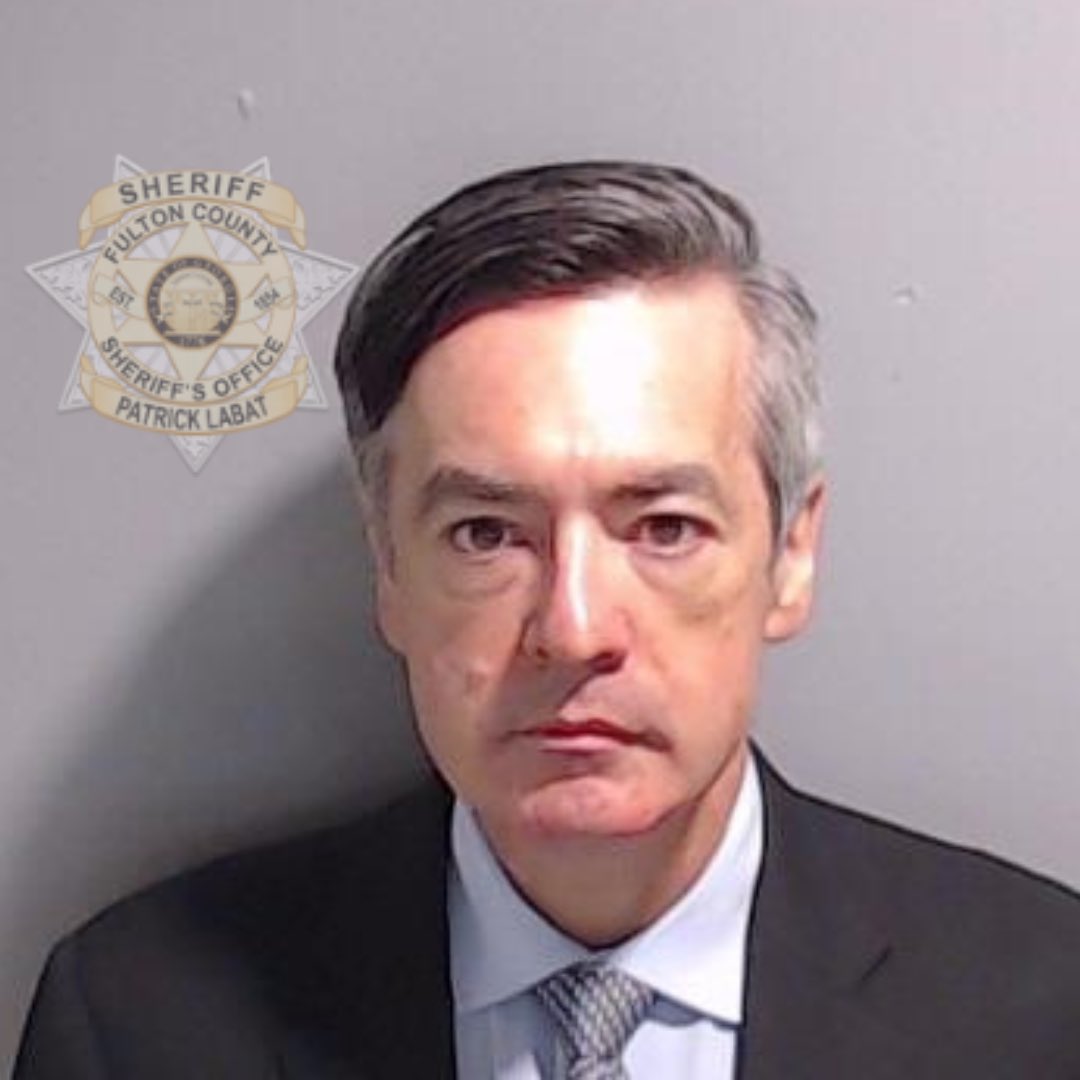
As I’ve said a few times, when I was hunting for Lee Chatfield, I found Kenneth Chesebro.

There is a transcript in the mostly sealed Appendix I to Jack Smith’s immunity brief that must be Chesebro’s. Several passages describing events in which Chesebro was involved cite a transcript, spanning from roughly GA 97 to GA 103, that appears between Lee Chatfield and probable Pat Cipollone transcripts (GA 55-56 is someone whose name appears alphabetically between Bowers and Cannon; this may be Trump campaign staffer Michael Brown).

On December 16, [Chesebro] traveled to Washington with a group of private attorneys who had done work for the defendant’s Campaign in Wisconsin for a photo opportunity with the defendant in the Oval Office.315

[snip]

Later that morning, [Chesebro] worked with another attorney for the defendant, who contacted a U.S. Senator to ask him to obtain the fraudulent Wisconsin and Michigan documents from the U.S. Representative’s office and hand-deliver them to the Vice President.408

315 Documentary evidence, Presidential Daily Diary, GA 100-101

408 Documentary evidence, GA 55-56, GA 102-103, Chris Hodgson [Compare to full transcript]

That would mean that this section, which suggests the co-conspirators deliberately lied to fake electors, is sourced partly to Chesebro too (GA 517-518 is part of an at least 6-page section describing the fake elector involvement of someone whose name appears alphabetically between Raffensperger and Scavino, which hypothetically could be Mike Roman, but nothing marks it as necessarily him).

In practice, the fraudulent elector plan played out somewhat differently in each targeted state. In general, the co-conspirators deceived the defendant’s elector nominees in the same way that the defendant and [Eastman] deceived [Ronna McDaniel] by falsely claiming that their electoral votes would be used only if ongoing litigation were resolved in the defendant’s favor.282

282 Documentary evidence, GA 97-98, GA 517-518.

It’s not terribly surprising that Jack Smith got an interview with Chesebro. After all, Chesebro made a great show of cooperating in various state investigations — at a minimum, Georgia, Nevada, Wisconsin, and Michigan, as CNN laid out last December. But as CNN also reported, the veracity of his testimony came into question by February, when CNN caught Chesebro covering up a Twitter account he had.

So Jack Smith appears to have gotten an interview with Chesebro, but Chesebro may not be terribly reliable.

Perhaps for that reason, there are a great many things involving Chesebro that are not sourced to that transcript. Chesebro’s plotting about the fake electors plot, for example, is always sourced to the documents themselves.

More interestingly, this passage — describing that Chesebro followed Trump’s public instructions to go to DC, but also describing that he collected copies of the fake Michigan and Wisconsin elector certificates and handed them off to Congressman Mike Kelly — is sourced entirely to documentary evidence.

Meanwhile, [Chesebro] who had traveled to Washington as directed by the defendant’s public messages, obtained duplicate originals of the fraudulent certificates signed by the defendant’s fraudulent electors in Michigan and Wisconsin, which they believed had not been delivered by mail to the President of the Senate or Archivist.389 [Chesebro] received these duplicates from Campaign staff and surrogates, who flew them to Washington at private expense.390 He then hand-delivered them to staffers for a U.S. Representative at the Capitol as part of a plan to deliver them to Pence for use in the certification proceeding.391

Similarly, the description of Chesebro’s participation in the mob is sourced exclusively to documentary evidence.

Among these was [Chesebro] who had attended the defendant’s speech from the Washington Monument, marched with the crowd to the Capitol, and breached the restricted area surrounding the building.449

There’s a problem with Chesebro’s testimony on this point, of course: If he ferried fake elector certificates, then he wasn’t responding to Trump’s public tweeting about January 6. He was responding to the instructions of other plotters.

Which makes the way Smith sourced this passage, describing a December 16 meeting with Trump that Reince Priebus also attended, more interesting.

On December 16, [Chesebro] traveled to Washington with a group of private attorneys who had done work for the defendant’s Campaign in Wisconsin for a photo opportunity with the defendant in the Oval Office.315 During the encounter, the defendant complained about Wisconsin Supreme Court Justice [Brian Hagedorn] who two days earlier had cast the deciding vote in rejecting the defendant’s election challenge in the state.316 As the group was leaving, the defendant spoke directly—and privately—to [Chesebro]. 317 As late as early January, the conspirators attempted to keep the full nature of the fraudulent elector plan secret. On January 3, for instance, in a private text message exchange, [Boris Epshteyn] wrote to [Chesebro] “Careful with your texts on text groups. No reason to text things about electors to anyone but [Eastman] and me.” [Chesebro] responded, “K,” and followed up, “I’m probably a bit paranoid haha.” [Epshteyn] wrote, “A valuable trait!”318

315 Documentary evidence plus Chesebro

316 Probably Reince Priebus

317 Probably Reince Priebus

318 Documentary evidence

That is, Smith relies on Chesebro for the claim that this meeting was a photo op. But he doesn’t include Chesebro’s claims about what he said privately to Trump; he relies solely on what is likely Reince Priebus witnessing, but not participating in, that conversation.

Rather than describing what Chesebro claimed he and Trump said to each other, Smith relies on what Chesebro told another lawyer (likely Jim Troupis), afterwards. As soon as Chesebro saw Trump’s tweet announcing the January 6 rally, he texted someone else and boasted that “we” had a “unique understanding” of Trump’s December 19 Tweet calling people to DC.

The defendant first publicly turned his sights toward January 6 in the early morning hours of December 19. At 1:42 a.m., the defendant posted on Twitter a copy of a report falsely alleging fraud and wrote, ““. . . Statistically impossible to have lost the 2020 Election. Big protest in D.C. on January 6th. Be there, will be wild!”319 When [Chesebro] learned about the Tweet, he sent a link about it to another of the Wisconsin attorneys who had met with the defendant in the Oval Office on December 16 and wrote, “Wow. Based on 3 days ago, I think we have unique understanding of this.”320

319 Trump tweet

320 Documentary evidence

Chesebro has testified about the December 16 meeting. TPM got his testimony to Michigan prosecutors. He described to them that he told Trump that the real deadline for certification was January 6.

Chesebro traveled to Washington to meet with Trump on Dec. 16 alongside a coterie of other Trump campaign attorneys.

Three years later, in the interview with Michigan prosecutors, Chesebro recalled the meeting with Trump: “The marching orders were, don’t say anything that would make [Trump] feel more positive than he did at the beginning of the meeting.”

He did not follow that advice. Chesebro told prosecutors that he began to speak with Trump after listening to the President talk on speakerphone with Newt Gingrich about something to do with Georgia voting machines. Then, the conversation turned to Trump’s chances in Arizona.

Chesebro did exactly what he had been told not to do: give Trump a sense of hope. He recalled telling Trump that the “real deadline” was Jan. 6. He was later admonished by former White House chief of staff Reince Preibus because, as Chesebro put it later to prosecutors, “the vibe that I had given him was some ground for optimism.”

Chesebro himself compared the meeting to a widely reported and infamous late-night encounter, two days later on Dec. 18, between Trump, Sidney Powell, former Overstock CEO Patrick Byrne, and the White House counsel’s office, saying that it was “sort of unauthorized.”

If Chesebro reliably told Jack Smith the same thing, it might strengthen the obstruction case. As it is, Jack Smith argues that the riot happened, Trump did nothing to stop it, and then he opportunistically targeted Mike Pence as his mob was hunting him down. He stops well short of saying he summoned the mob to overrun Congress.

Chesebro’s apparent unreliability may be preventing Jack Smith from taking the next step, showing that Trump heard from Chesebro on December 16 that there was still one more step to certification on January 6, which led him — less than three days later — to summon his mob. But if Chesebro’s testimony were more reliable, then he would not simultaneously be explaining that he ferried a second set of fake Michigan and Wisconsin certificates to DC but also simply showed up on January 6 in response to Trump’s Tweets. And it might change the import of the way he shadowed Alex Jones.

Still, as it is, Chesebro is central to the continued viability of 18 USC 1512(c)(2) and (k) charges. Under Fischer, there must be an evidentiary component to the obstruction charge. And in Chesebro, you have the sole member of the conspiracy who joined the mob on January 6 having earlier ferried fake elector certificates to members of Congress in hopes that Mike Pence would use the certificates to throw out Joe Biden’s votes.

If this ever goes to trial, Chesebro’s role — and possible testimony — may be key. But thus far, at least, it doesn’t appear that his testimony is reliable enough to build the case on.

How to Read the Immunity Appendix

I’m still working through a deeper dive of the appendix to his immunity brief that Jack Smith released on Friday.

But I thought I’d share how I’m reading it, as I’ll need to refer back to that when I write up some of the interesting things I’ve found.

The appendix was released in four volumes:

Volume I: GA 1 through GA 722

Volume II: GA 723 through GA 965

Volume III GA 968 through GA 1503

Volume IV: GA 1503 through GA 1885

There are also a bunch of GA 1900 references in the immunity brief; those are to video and other multimedia, but we don’t get them.

But what we’ve got may be better understood in sections:

GA 1 through at least GA 653: Most of Volume I consists of interview transcripts arranged in alphabetical order, Barr to Wren, in what is visible. Once you understand that that section is in alpha order, it helps to substantiate whether citations in the immunity brief are to one or another person. For example, it seems highly likely that the GA 97 to 102 range is Kenneth Chesebro, because citations to those pages describe stuff he was involved with, and those pages appear between the visible Rusty Bowers and Justin Clark sections, and after material that must be from Georgia Attorney General Christopher Carr and former MI House Speaker Lee Chatfield. I’ll return to both Chesebro and Chatfield tomorrow.

These transcripts are generally truncated, including just the pages necessary to substantiate the material in the brief — though there are transcripts in there, such as that of Ronna Not-Romney McDaniel in the GA 323 to GA 342 range, that cover the full range of activities in which she played a part.

There are people, like former MI Senate Majority Leader Mike Shirkey, whose only citations are to January 6 transcripts (and so are visible). There are far more people (like Chatfield, Chesebro, and McDaniel) whose only citations are to DOJ interviews, so are sealed. But some people, starting from Bill Barr, have citations to both J6C and DOJ transcripts. In general, the DOJ transcripts appear to come after the J6C ones (though I’m not sure that’s the case with Jason Miller).

GA 654 through GA 722: The balance of the first volume may also be transcripts, but it’s not in obvious order. Although one or several Eric Herschmann interviews appear from around GA 190 through GA 238 in the alpha order section, a great deal of GA 654 through GA 722 is also Herschmann-related material (including the blacked out pages starting at GA 709). There’s a lot of Herschmann in this brief, and I thought prosecutors did a less compelling job of explaining why those were unofficial than the Mike Pence material.

I had considered whether this section consists of more sensitive files, and it may. But it’s not the sensitivity I first considered: that of Executive Privilege (or grand jury versus interview transcripts). Mike Pence’s interviews appear starting at least by GA 413, between the visible Jason Miller and Katrina Pierson transcripts.

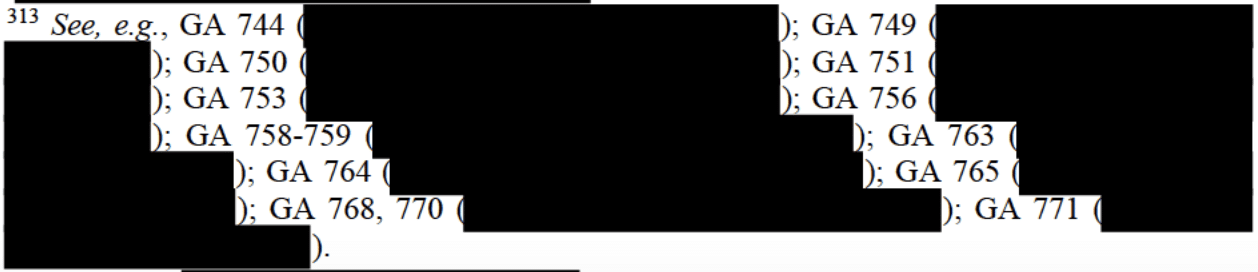
GA 723 through GA 771: The first 50 pages of Volume II are from the President’s Daily Diary, which documents all of the President’s calls and meetings. That the section tracked calls involving Trump was already evident from this footnote, which substantiates Steve Bannon’s near-daily phone calls with Trump resuming in mid-December:

And footnote 546 identifies GA 742 as PDD explicitly.

GA 772 to GA 965: The rest of that volume is Tweets and other social media, by Trump and by others. One interesting aspect of this volume is the type of Tweet. For example, it appears prosecutors attempted to include both the legal process version and the screen cap of all of Trump’s Tweets, but they don’t always do that. Trump’s RTs, in particular, appear to have been difficult to reproduce; remember that, because Trump’s account was suspended, there were some difficulties in reconstituting parts of it. There’s a bunch obtained from the Trump Twitter archive, suggesting they may not have been preserved at Twitter. There’s also just the text of the Mike Pence courage Tweet and his “sacred landslide” Tweet, which may come from a dump of the phone (and serve to substantiate that it was written with that phone). And there are a bunch of what appear to be text versions of Trump’s Tweets or Team Trump disseminations of them, the latter of which prosecutors point to to substantiate their argument that these are campaign, as opposed to Presidential, Tweets. If this ever goes to trial, how these got used will often say as much as the actual content included.

The other two volumes provide all the other kinds of backup to the immunity brief, largely documentary evidence.

This documentation generally follows the structure of the immunity brief itself, though obviously there’s a lot of overlap, particularly between Trump’s pressure on state parties and his fake elector plot. That may explain why prosecutors broke the Volumes where they did.

In addition to some random stuff (not included in my table), Volume III has the state-focused evidence.

GA 966 to GA 999: Forming the conspiracy

GA 1000 to GA 1236: Pressuring states to help deceive

GA 1245 to GA 1502: Fake Electors plot

Volume IV picks up from the effort to pressure Pence to throw out the votes and includes January 6. But it also includes a bunch of things — like campaign advertising and funding records — in there to substantiate an argument that Trump was acting in his role as a candidate, not as President.

GA 1503 to GA1663: Pressure Pence

GA 1664 to GA 1684: January 6

GA 1685 to GA 1869: Prove this is Unofficial

So Volume III and IV both have the same type of evidence: documentary backup. But rather than showing what happened, there’s a part of Volume IV that aspires to show that what happened amounted to campaign activity.

With that as a framework, one can figure out almost all of what is in the appendix in sealed form, based off the footnotes. And while none of the good stuff — the dickish comments Mike Roman made while on a conference call trying to tamp down a revolt from Pennsylvania’s fake electors, for example — are unsealed in the appendix, those two pages of text messages that appear at GA 1407 and 1408 do appear in the text itself.

We can’t see most of what’s in the appendix. But understanding how it works does provide some insight about the investigation.

Update: Corrected post to reflect beginning of Volume II as entries from the Presidential Daily Diary.

Witnesses

Update: Here’s a list of my best guesses for the interviews included in Volume I. I’m fairly certain about the identity of the people listed here; I’m fair less certain about where they begin and end. I’ve bolded the people I’m pretty certain have both sealed and unsealed content. I’ve italicized the people who, I think, have only unsealed content. The rest have just sealed content.

This is very rough!!!

GA 2-6: A cop who will testify about the riot.

GA 7-13: Bill Barr, sealed and unsealed.

GA 15: A Chapman/Shirkey related witness.

GA 20: Rusty Bowers.

GA 55-56: A lawyer who worked with Chesebro to deliver fake certificates.

GA 58-59: Probably Alex Cannon, testifying to the quasi campaign role Herschmann had.

GA 62-67: GA Attorney General Christopher Carr.

GA 70-82: Former MI Speaker of the House Lee Chatfield.

GA 97-103: Kenneth Chesebro.

GA 105-122: Pat Cipollone, testifying about things he wasn’t involved in, as well as efforts to get Trump to do something on January 6.

GA 126-?: Justin Clark has both sealed and sealed content. His testimony may extend to where Kellyanne Conway’s begins.

GA 160: Kellyanne Conway. [May be an unsealed only.]

GA 164-5: A fake elector.

GA 166: White House valet.

GA 170: Ruby Freeman.

GA 173: Details of the targeting of PA electors.

GA 175: Details of the riot; possibly Pence’s Secret Service.

GA 180: Stephanie Grisham.

GA 184-189: WI Supreme Court Judge Hagedorn.

GA 190: Vincent Haley, testifying about adding attacks on Pence back into speech.

GA 194 – ??: Where Eric Herschmann begins and ends is tough to tell, but it’s roughly from GA 194 through GA 238.

GA 246-259: Hope Hicks.

GA 261: Chris Hodgson.

GA 266: Greg Jacob. It’s unclearhow much of this is Jacob, but at least through 283.

GA 295-296: Chris Krebs.

GA 297: Amy Kremer.

GA 310-319: Nick Luna.

GA 320: Tom Marino (he dropped off as a fake elector in PA).

GA 323 through 359: It’s unclear how much of this is Ronna McDaniel, but her testimony covers a range of topics.

GA 361 to 368: Mark Meadows. This may go further.

GA 374 until around 397: Jason Miller.

GA 399-406: The then SAC of the Washington Field Office Secret Service office.

GA 405-406: This may be Stephen Miller (in which case the SAC’s last name is Miller too).

GA 411-467: It’s unclear where Mike Pence begins and ends (and where Pat Philbin begins, but something like this.

GA 476: Pat Philbin.

GA 481: Katrina Pierson.

GA 488-495: Fake elector.

GA 497-501: I think this is Reince Priebus.

GA 513: Brad Raffensperger.

GA 517-523: Fake electors.

GA 525-541: Dan Scavino.

GA 550-551: Al Schmidt.

GA 553-578: Mike Shirkey.

GA 578-588: Marc Short.

GA 600: There may be a senior campaign advisor besides Bill Stepien in here.

GA 609: Bill Stepien. [If there is sealed testimony, it may only be a page.]

GA 616-633: Larry Tabas.

GA 634-642: Ross Worthington.

GA 643: Caroline Wren.

After Wren, there may be someone who was involved in calls to Doug Ducey.


Trump’s GOP Is Running on a Platform of Freeing Seditionists and Cop Assailants

I’m halfway done my first review of the materials Jack Smith released today.

All of us who have followed this have concluded there’s not any new news (though the presentation of it reveals certain things about Smith’s investigation).

So why did Trump’s lawyers wail and wail about releasing these materials before the election?

Just days ago, after all, Trump’s lawyers argued that releasing these materials would alter the election.

It may be this:

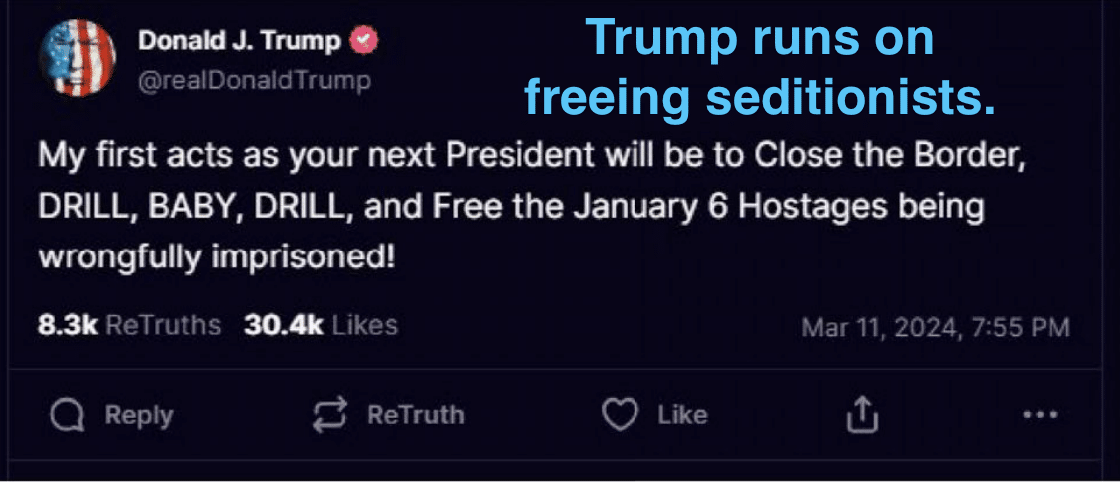
As the appendix documents, on March 11, 2024, Trump posted to Truth Social that, along with closing the border and DRILL, BABY, DRILL, his first priority, Day One, was to free the seditionists and cop assailants who had fought for him on January 6.

Prosecutors cited that post to support their argument that Trump ratified the violence that day.

As the Government identified in its Rule 404(b) notice, ECF No. 174-1 at 8-9, the Government will introduce some of the defendant’s numerous statements that post-date his time as President in which he has blamed Pence and approved of the actions of his supporters who breached the Capitol and obstructed the certification proceeding,722 thus providing evidence of his intent on January 6.

The defendant’s endorsement of the violent actions of his supporters on January 6, and his sentiment that they were justified in threatening Pence—all made while the defendant was a private citizen after the end of his term in office—are probative of his intent during the charged conspiracies.

722 See, e.g., GA 1970 at 17:37 (Video of Trump Interview 07/10/2021); GA 1926 at 1:15:30 (Video of Conroe Rally 01/29/2022); GA 1971 at 15:51, 16:42 (Video of Trump Interview 02/01/2022): GA 1962 at 48:29 (Video of Trump at Faith and Freedom Coalition 06/17/2022); GA 1966 at 09:30 (Video of Trump Interview 09/01/2022); GA 1973 at 43:07 (Video of Waco Rally 03/25/2023); GA 1694 (Transcript of CNN Town Hall 05/10/2023); GA 1964 (Video of Trump Campaign Statement 2024); GA 1967 at 45:18 (Video of Trump Interview 08/23/2023); GA 1965 at 56:10, 57:11 (Video of Trump Interview on Meet the Press 09/17/2023); GA 1935 at 35:50, 01:16:16 (Video of Greensboro Rally 03/02/2024); GA 967 (Donald J. Trump Truth Social Post 03/11/2024); Isaac Arnsdorf and Maeve Reston, 7rump claims violence he inspired on Jan. 6 was Pence’s fault, WASH. PostT, (Mar. 13, 2023, 8:09 p-m.), https://www.washingtonpost.com/politics/2023/03/13/trump-pence-iowa/. [my emphasis]

The GOP candidate for President has a criminal docket. And in that criminal docket, today, the government included a post promising to free seditionists and cop-assailants with the same urgency with which Donald Trump promises to close the border. “My first acts,” the GOP standard-bearer stated, would include freeing the people who assaulted the Capitol on January 6.

This was the proposal back in March, one of the first things Trump did after Nikki Haley conceded. And since that time, the entire GOP has fallen into line behind that plan.

The Republican Party’s candidate for President is running on a platform of freeing cop assailants and seditionists.

There’s nothing new in this appendix. But that post does clarify things considerably.

Jack Smith’s Appendix

Sorry it has taken me so long to post the appendix to Jack Smith’s immunity briefing. The four sections are here:

Volume I

Volume II

Volume III

Volume IV

There’s virtually nothing new here. Trump’s temper tantrum was little more than a public wail that if people saw already-public documents about his plotting to run fake electors, it would swing the election.

That said, there are a few things we can confirm from the structure of all this, which I’ll write up over the weekend.

Jack Smith Takes Up the Aid and Abet Theory Endorsed by Judge Amit Mehta in 2022

Back in February 2022, 32 months ago, think I was the only one who made much of Judge Amit Mehta’s ruling that Trump might plausibly be on the hook for abetting the assaults of cops at the Capitol on January 6.

Halberstam v. Welch remains the high-water mark of the D.C. Circuit’s explanation of aiding-and-abetting liability. The court there articulated two particular principles pertinent to this case. It observed that “the fact of encouragement was enough to create joint liability” under an aiding-and-abetting theory, but “[m]ere presence . . . would not be sufficient.” 705 F.2d at 481. It also said that “[s]uggestive words may also be enough to create joint liability when they plant the seeds of action and are spoken by a person in an apparent position of authority.” Id. at 481–82. A “position of authority” gives a “suggestion extra weight.” Id. at 482.

Applying those principles here, Plaintiffs have plausibly pleaded a common law claim of assault based on an aiding-and-abetting theory of liability. A focus just on the January 6 Rally Speech—without discounting Plaintiffs’ other allegations—gets Plaintiffs there at this stage. President Trump’s January 6 Speech is alleged to have included “suggestive words” that “plant[ed] the seeds of action” and were “spoken by a person in an apparent position of authority.” He was not “merely present.” Additionally, Plaintiffs have plausibly established that had the President not urged rally-goers to march to the Capitol, an assault on the Capitol building would not have occurred, at least not on the scale that it did. That is enough to make out a theory of aiding-and-abetting liability at the pleadings stage.

I noted at the time that Judge Mehta — whose ruling on Trump’s susceptibility to lawsuit for actions taken as a candidate would largely be adopted in the DC Circuit’s opinion on the topic — was presiding over a number of the key assault cases where the since-convicted defendants described being called to DC or ordered to march to the Capitol by Trump before they started beating the shit out of some cops.

He also presided over the Oath Keeper cases.

That’s interesting background to Jack Smith’s response to Trump’s supplement to his motion to dismiss his indictment.

As I expected, Smith noted that Trump’s frivolous supplement didn’t even mention the language in the superseding indictment alleging that Trump willfully created false evidence.

Beyond that critical flaw, the defendant’s supplement ignores entirely that the superseding indictment includes allegations that involve the creation of false evidence. As construed by Fischer, Section 1512(c)(1) covers impairment of records, documents, or objects by altering, destroying, mutilating, or concealing them, and Section 1512(c)(2) covers the impairment (or attempted impairment) of records, documents, and objects by other means—such as by “creating false evidence.” 144 S. Ct. at 2185-86 (citing United States v. Reich, 479 F.3d 179 (2d Cir. 2007) (Sotomayor, J.)). In Reich, for example, the defendant was convicted under Section 1512(c)(2) after he forged a court order and sent it to an opposing party intending to cause (and in fact causing) that party to withdraw a mandamus petition then pending before an appellate court. 479 F.3d at 183, 185-87. Just as the defendant in Reich violated Section 1512(c)(2) by “inject[ing] a false order into ongoing litigation to which he was a party,” id. at 186, the superseding indictment alleges that the defendant and his co-conspirators created fraudulent electoral certificates that they intended to introduce into the congressional proceeding on January 6 to certify the results of the 2020 presidential election. See ECF No. 226 at ¶¶ 50-66.

That’s the primary reason I didn’t even treat Trump’s filing with much attention: it ignored how differently situated Trump is than the Fischer defendants.

But I’m most interested in the way Smith rebuts Trump’s argument that he bears no responsibility for the riots at the Capitol. He adopts that same aid and abet theory that Judge Mehta endorsed back in 2022.

Contrary to the defendant’s claim (ECF No. 255 at 7) that he bears no factual or legal responsibility for the “events on January 6,” the superseding indictment plainly alleges that the defendant willfully caused his supporters to obstruct and attempt to obstruct the proceeding by summoning them to Washington, D.C., and then directing them to march to the Capitol to pressure the Vice President and legislators to reject the legitimate certificates and instead rely on the fraudulent electoral certificates. See, e.g., ECF No. 226 at ¶¶ 68, 79, 82, 86-87, 94. Under 18 U.S.C. § 2(b), a defendant is criminally liable when he “willfully causes an act to be done which if directly performed by him or another would be” a federal offense. See, e.g., United States v. Hsia, 176 F.3d 517, 522 (D.C. Cir. 1999) (upholding a conviction for willfully causing a violation of 18 U.S.C. § 1001). [my emphasis]

Smith then repeats that language of “willfully caus[ing]” people to storm the Capitol.

As described above, the superseding indictment alleges that the defendant willfully caused others to violate Section 1512(c)(2) when he “repeated false claims of election fraud, gave false hope that the Vice President might change the election outcome, and directed the crowd in front of him to go to the Capitol as a means to obstruct the certification,” ECF No. 226 at ¶ 86, by pressuring the Vice President and legislators to accept the fraudulent certificates for certain states in lieu of those states’ legitimate certificates. Those allegations link the defendant’s actions on January 6 directly to his efforts to corruptly obstruct the certification proceeding and establish the elements of a violation of Section 1512(c)(2), which suffices to resolve the defendant’s motion to dismiss on statutory grounds. [my emphasis]

Note that this reliance on an abetting theory of liability for the riot explains DOJ’s effort to sustain some select 1512(c)(2) charges against crime scene defendants. Smith will want to closely tie Trump to the actions of key crime scene defendants.

But that depends on sustaining at least some of those key cases. But they’ve already taken at least some steps to do that. In at least one case, cooperating Oath Keeper Jon Schaffer, they’ve done an addendum to the statement of facts to sustain the plea under Fischer.

Perhaps relatedly, the nature of Schaffer’s cooperation remains redacted in the government sentencing memo asking for probation for Schaffer.

For over a year, Trump’s team has been trying to disavow his mob, and for almost a year, prosecutors have promised to show how Trump obstructed the vote certification through the actions of specific rioters.

At trial, the Government will prove these allegations with evidence that the defendant’s supporters took obstructive actions at the Capitol at the defendant’s direction and on his behalf. This evidence will include video evidence demonstrating that on the morning of January 6, the defendant encouraged the crowd to go to the Capitol throughout his speech, giving the earliest such instruction roughly 15 minutes into his remarks; testimony, video, photographic, and geolocation evidence establishing that many of the defendant’s supporters responded to his direction and moved from his speech at the Ellipse to the Capitol; and testimony, video, and photographic evidence that specific individuals who were at the Ellipse when the defendant exhorted them to “fight” at the Capitol then violently attacked law enforcement and breached the Capitol.

The indictment also alleges, and the Government will prove at trial, that the defendant used the angry crowd at the Capitol as a tool in his pressure campaign on the Vice President and to obstruct the congressional certification. Through testimony and video evidence, the Government will establish that rioters were singularly focused on entering the Capitol building, and once inside sought out where lawmakers were conducting the certification proceeding and where the electoral votes were being counted. And in particular, the Government will establish through testimony and video evidence that after the defendant repeatedly and publicly pressured and attacked the Vice President, the rioting crowd at the Capitol turned their anger toward the Vice President when they learned he would not halt the certification, asking where the Vice President was and chanting that they would hang him. [my emphasis]

As I’ve said, I think Jack Smith may believe he has the evidence to prove Trump more actively incited violence, but was prevented from indicting that before the election. But for now, Smith is making it explicit that he is adopting the theory of liability that Judge Mehta ruled was at least plausible, years ago.