Posts

Mark Meadows’ Middling Path: There Are Several Paths to Prosecute Donald Trump

Two things happened over the weekend that may provide more clarity about Mark Meadows’ fate in the twin Trump investigations in which he’s implicated.

Second in terms of order but I’ll deal with it first, ABC had a big scoop about key parts of his testimony in the stolen documents case. There are four key disclosures about Meadows’ testimony.

  • Meadows knew of no standing order to declassify documents
  • He was not involved in packing boxes, didn’t see Trump doing so, and wasn’t aware Trump had taken classified documents

  • Meadows offered to sort through boxes of documents after NARA inquired about them in May 2021, but Trump declined the offer
  • Meadows ultimately backed his ghostwriter’s account that the Iran document that Trump described to Meadows’ ghost-writer was on the couch in front of him at the time of the exchange

The circumstances around Meadows’ testimony about his ghost-writer are the most telling. As ABC describes it, his ghost-writer sent him a draft that conflicted with the final copy of his book. That draft described that when Trump boasted about an Iran document he could use to prove Mark Milley wrong, it was in front of him on the couch. After receiving the draft, Meadows edited out the account that would provide proof Trump was sharing a classified document at Bedminster.

But a draft version of the passage initially sent to Meadows by his ghostwriter, which was reviewed by ABC News, more directly referenced the document allegedly in Trump’s possession during the interview.

“On the couch in front of the President’s desk, there’s a four-page report typed up by Mark Milley himself,” the draft reads. “It shows the general’s own plan to attack Iran, something he urged President Trump to do more than once during his presidency. … When President Trump found this plan in his old files this morning, he pointed out that if he had been able to make this declassified, it would probably ‘win his case.'”

Investigators may have found this by obtaining a warrant for Meadows’ email and discovering it as a clearly non-privileged attachment, by subpoenaing Meadows’ ghost writer, or both. It would be unsurprising if Jack Smith obtained Meadows’ email from 2020 through the FBI search of Mar-a-Lago, particularly given reports that his account got a privilege review too, and attachments are often the most interesting things obtained from cloud warrants.

The discrepancy between the draft and the final — hinting that Meadows recognized the document to be particularly sensitive — may have driven investigative focus on the document, leading Smith to obtain several recordings of the conversation and ultimately testimony sufficient to charge Trump’s willful retention of it in the superseding indictment.

Just as significantly, for a read of Meadows’ posture towards the dual investigations into Trump: ABC describes that his testimony changed. At some unspecified original interview (by context it appears to have been before the MAL search), Meadows said that he edited that passage because he didn’t believe it. But, apparently in that first interview, he conceded that if Trump did have the document in Bedminster to share with his ghost-writer, it would be problematic.

Sources told ABC News that Meadows was questioned by Smith’s investigators about the changes made to the language in the draft, and Meadows claimed, according to the sources, that he personally edited it out because he didn’t believe at the time that Trump would have possessed a document like that at Bedminster.

Meadows also said that if it were true Trump did indeed have such a document, it would be “problematic” and “concerning,” sources familiar with the exchange said.

But then Meadows’ own testimony changed — possibly at the April grand jury appearance mentioned by ABC.

Meadows said his perspective changed on whether his ghostwriter’s recollection could have been accurate, given the later revelations about the classified materials recovered from Mar-a-Lago in the months since his book was published, the sources said.

Meadows’ explanation for his changed testimony is not all that credible. It sounds like, as he came to understand how solid the case against Trump was, he became less interested in exposing himself to legal troubles by protecting him.

But for Meadows’ purposes, it likely doesn’t have to be. Meadows was not a direct witness to this incident. After prosecutors spent much of the spring fleshing out what happened here, it seems, Meadows conceded the points that were necessary. And the concession may well have been key to the inclusion of the document in the indictment(s): because it meant a witness who might otherwise have provided exculpatory testimony was locked into testimony that did not dispute the testimony of the direct witnesses against Trump.

Importantly, this is not the testimony of a cooperating witness. It is the testimony of someone prosecutors have coaxed to tell the truth by collecting so much evidence there’s no longer room to do otherwise. And it is testimony, if Meadows provided it at that April grand jury appearance, obtained four months after Fani Willis lost her grand jury as an investigative tool.

Which brings us to Meadows’ motion to dismiss the Georgia charges against him, submitted in federal court in NDGA.

The day after the GA indictment, Meadows’ attorneys filed to have it removed from GA to federal court because he was a senior government official during the events in question; this was expected from him, and still is expected from Trump and Jeffrey Clark. The next day, Judge Steve Jones ruled that he had to hear the challenge — effectively ruling that there was nothing procedurally wrong with Meadows’ demand.

Then Friday, Meadows’ team submitted their motion to dismiss the Georgia charges against him. Again, this was expected. But I also expected the brief to be far stronger than it is. It is an example where a team of superb lawyers argue the law — 19 pages of citations before they finally get around to addressing the alleged facts, and several more pages of law but not facts to follow.

Meadows’ motion makes three arguments about how the law applies to the alleged facts:

  • Meadows’ alleged actions in the GA indictment fall within his duties as Chief of Staff
  • But for his position as Chief of Staff which required him to remain close to provide advice, he would not have done the actions alleged
  • His actions were legal at the federal level

The first two points are closely related and appear in two successive paragraphs. It is true that Meadows’ job was to arrange whatever calls the President wanted to make. And most — but not all — of Meadows’ alleged Georgia acts fit into that kind of thing.

The question is not whether Mr. Meadows was specifically authorized or required to do each act, but whether they fall within “the general scope of [his] duties.” Baucom, 677 F.2d at 1350. They surely do. As noted, those duties included information-gathering and providing close and confidential advice to the President. Moreover, as explained below, the State’s characterization of one of these acts as violating state law is wholly irrelevant. See Part II.B, infra. Stripped of the State’s gloss, the underlying facts entail duties with the core functions of a Chief of Staff to the President of the United States: arranging or attending Oval Office meetings, contacting state officials on the President’s behalf, visiting a state government building, and setting up a phone call for the President with a state official. Those activities have a plain connection to his official duties and to the federal policy reflected in establishing the White House Office. [my emphasis]

From there, Meadows argues that if he weren’t Chief of Staff to epic scofflaw Donald Trump, he wouldn’t have been doing these unlawful things for Donald Trump, and if he had simply left the room to object, then he wouldn’t be in the room to provide close and confidential advice.

The “nexus” is readily apparent. Only by virtue of his Chief of Staff role was Mr. Meadows involved in the conduct charged. Put another way, his federal position was a but-for cause of his alleged involvement. Moreover, if Mr. Meadows had absented himself from Oval Office meetings or refused to arrange meetings or calls between the President and governmental leaders, that would have affected his ability to provide the close and confidential advice that a Chief of Staff is supposed to provide. It is inescapable that the charged conduct arose from his duties and was material to the carrying out of his duties, providing more than merely “some nexus.”

Thus far (and ignoring that not all of the charged conduct in Georgia qualifies), this argument actually makes perfect sense for the removal and dismissal argument. Several of the actions charged against Meadows in Georgia really are about arranging meetings and phone calls for the President.

And the argument that Meadows had to stick around to provide advice is stronger than you might think.

It’s where Meadows’ team argues that his actions were legal at the federal level where, in my opinion, the argument starts to collapse — but also where this filing hints at more about Meadows’ strategy for avoiding charges himself.

Meadows team recites the alleged Georgia acts as Judge Jones has characterized them on page 19 and then directly quotes the references to Meadows in the federal indictment on page 26. It helps to read them a table together:

There’s an arc here. The early acts in both indictments might be deemed legal information gathering. After that, in early December, Meadows takes two actions, one alleged in Georgia and the other federally, both of which put him clearly in the role of a conspirator, neither of which explicitly involves Trump as charged in the Georgia indictment. Meadows:

  • Asks Johnny McEntee for a memo on how to obstruct the vote certification
  • Orders the campaign to ensure someone is coordinating the fake electors

The events on December 22 and 23, across the two indictments, are telling. Meadows flies to Georgia and, per the Georgia indictment, attempts to but fails to access restricted areas. Then he flies back to DC and, per the federal indictment, tells Trump everything is being done diligently. Then Meadows arranges and participates in another call. Both in a tweet on December 22 and a call on December 23, Trump pressures Georgia officials again. For DOJ’s purposes, the Tweet is going to be more important, whereas for Georgia’s purposes, the call is more important. But with regards his argument for removal and dismissal, Meadows would argue that he used his close access to advise Trump that Georgia was proceeding diligently.

On December 27, Meadows calls and offers to use campaign funds to ensure the signature validation is done by January 6. This was not Meadows arranging a call so Trump could make the offer himself, it was Meadows doing it himself, likely on behalf of Trump, doing something for the campaign, not the country.

On January 2, Meadows participates in the Raffensperger call, first setting it up then intervening to try to find agreement, but then ultimately pressuring state officials not so much to just give Trump the votes he needs, which was Trump’s ask, but to turn over state data.

Meadows: Mr. President. This is Mark. It sounds like we’ve got two different sides agreeing that we can look at these areas ands I assume that we can do that within the next 24 to 48 hours to go ahead and get that reconciled so that we can look at the two claims and making sure that we get the access to the secretary of state’s data to either validate or invalidate the claims that have been made. Is that correct?

Germany: No, that’s not what I said. I’m happy to have our lawyers sit down with Kurt and the lawyers on that side and explain to my him, here’s, based on what we’ve looked at so far, here’s how we know this is wrong, this is wrong, this is wrong, this is wrong, this is wrong.

Meadows: So what you’re saying, Ryan, let me let me make sure … so what you’re saying is you really don’t want to give access to the data. You just want to make another case on why the lawsuit is wrong?

Meadows was pressuring a Georgia official, sure, but to do something other than what Trump was pressuring Raffensperger to do. His single lie (he was charged for lying on the call separately from the RICO charge), one Willis might prove by pointing to the overt act from the federal indictment on December 3, when Jason Miller told Meadows that the number of dead voters was not 10,000, but twelve, is his promise that Georgia’s investigation has not found all the dead voters.

I can tell you say they were only two dead people who would vote. I can promise you there were more than that. And that may be what your investigation shows, but I can promise you there were more than that.

But even there, two is not twelve. Meadows will be able to challenge the claim that he lied, as opposed to facilitated, as Chief of Staff, Trump’s lies.

Finally, in an overt act not included in the Georgia indictment, Meadows is among the people on January 6 who (the federal indictment alleges) attempted to convince Trump to call off the mob.

There’s a lot that’s missing here — most notably Meadows’ coordination with Congress and any efforts to coordinate with Mike Flynn and Roger Stone’s efforts more closely tied to the insurrection and abandoned efforts to deploy the National Guard to protect Trump’s mob as it walked to congress. Unless those actions get added to charges quickly, Meadows will be able to argue, in Georgia, that his actions complied with federal law without having to address them. If and when they do get charged in DC, I’m sure Meadows’ attorneys hope, his criminal exposure in Georgia will be resolved.

Of what’s included here, those early December actions — the instruction to Johnny McEntee to find some way to obstruct the January 6 vote certification and the order that someone coordinate fake electors — are most damning. That, plus the offer to use campaign funds to accelerate the signature match, all involve doing campaign work in his role as Chief of Staff. For the federal actions, Jack Smith might just slap Meadows with a Hatch Act charge and end the removal question — but that might not help him, Jack Smith, make his case, because several parts of his indictment rely on exchanges Meadows had privately with Trump, and Meadows is a better witness if he hasn’t been charged with a crime.

Aside from those, Meadows might argue — indeed, his lawyers may well have argued to Jack Smith to avoid being named as a co-conspirator — that his efforts consistently entailed collecting data which he used to try to persuade the then-President, using his access as a close advisor, to adopt other methods to pursue his electoral challenges. Meadows’ lawyers may well have argued that several things marked his affirmative effort to leave the federally-charged conspiracies. In this removal proceeding, I expect Meadows will argue that his actions on the Raffensperger call were an attempt, like several others, to collect more data to use his close access as an advisor to better persuade the then-President to drop the means by which he was challenging the vote outcome.

Meadows’ motion to dismiss is weakest because he doesn’t explain there was any federal policy interest in these actions, much less an executive branch one. The early December activities — the order to Johnny McEntee to find a way to delay the vote certification that both the Constitution and the Electoral College Act reserve to Congress and the order to coordinate fake electors overstep executive authority. How Georgia tallies their vote, which Meadows might otherwise claim were efforts to advise Trump, is reserved to Georgia. There’s no federal policy interest here because Trump’s efforts stomped on the prerogatives of both Congress and the state of Georgia.

The 19 pages of Meadows’ motion to dismiss that discuss the law in isolation of the facts mentions the centrality of federal policy 9 times. The part that discusses the facts uses the word “policy” twice (once, which I’ve bolded, in the Secretary of State passage cited above), but makes no effort whatsoever to describe how these actions — particularly the intervention into matters reserved for Congress and the states — pertained to federal policy. These very good lawyers simply never get around to applying their law about intervention, which pivots on federal policy, to the facts. Instead, their argument relies much more heavily on their claim that, particularly since Meadows hasn’t been charged, Willis won’t be able to prove that Meadows’ actions violated federal law. That argument will only matter if they succeed in getting the case removed to federal court.

Between the overt political nature of three of his actions and the lack of any policy argument, Fani Willis should be able to mount an aggressive challenge to this effort, though the effort is not entirely frivolous and Meadows has very good lawyers even if those lawyers don’t have great facts.

But there’s a bunch more going on here.

First, as I noted in this post, these prosecutors are using different strategies to get Trump to trial. Willis, who can’t be fired by Trump if he wins in 2024, charged broadly and presumably hopes to use the RICO exposure to flip some of the key conspirators as witnesses against others. Smith, who may have a much shorter clock (but who also has both indicted crimes, but also his financial investigation, to play off each other), has chosen to charge Trump  for January 6 alone, with six people identified as unindicted co-conspirators. Smith seems to believe he can introduce all the evidence he needs to convict Trump relying on the hearsay exception just for those six unindicted co-conspirators. He hasn’t made Meadows a co-conspirator, and so is confident he can get Meadows to take the stand and testify to the facts alleged in the indictment.

Until now, the two investigations have not coordinated, though something Willis said in her press conference suggested that perhaps they’ve started talking now, possibly to exchange evidence as permitted under grand jury rules.

Reporter: Have you had any contact with the special counsel about the overlap between this indictment and–

Willis: I’m not going to discuss our investigation at this time.

Plus, they’ve been working on different tracks. Willis had to take overt steps earlier, mostly last summer, and lost her power to compel testimony in December (though she has immunized all but three of the fake electors in recent months). While DOJ was provably doing covert things during Willis’ overt investigation, most of DOJ’s overt acts took place since Willis lost investigative subpoena power.

Willis, who has close ties to January 6 Committee and certain TV lawyers, may well believe their propaganda about how little DOJ was doing, and likewise may share their (provably incorrect, given what we’ve seen in the Steve Bannon and Peter Navarro contempt prosecutions) view that DOJ could have and should have prosecuted Meadows for contempt for blowing off the J6C. She may believe she needs to, and that it is key to her case, to flip Meadows.

That’s where the ABC report that Meadows changed his testimony about the Iran document is instructive. When he was interviewed in what may have been an interview before the August search of Mar-a-Lago, Meadows said he believed his ghost-writer was incorrect when they claimed Trump had the Iran document in front of him. When Meadows testified before Willis’ grand jury, he offered next to nothing, invoking the Fifth Amendment repeatedly.

Using the Fifth Amendment or citing various legal privileges was a strategy that the grand jury saw from several of the most prominent witnesses, including Trump White House chief of staff Mark Meadows, according to [investigative grand jury foreperson Emily] Kohrs.

“Mark Meadows did not share very much,” she said. “I asked if he had Twitter, and he pled the Fifth.”

Now, at least in the stolen documents probe, Meadows has reversed his prior testimony, explaining that given how damning the facts against Trump are in that case, he thinks his ghost-writer is probably correct about the Iran document being there on the couch.

Meadows also provided compelled, executive privilege-waived testimony since, grand jury testimony obtained before both federal indictments against Trump, grand jury testimony that Smith’s prosecutors used to lock Meadows into a certain story.

These dynamics may explain the curious sequence as portrayed across the two indictments from December 22 and 23, 2020.

On or about the 22nd day of December 2020, MARK RANDALL MEADOWS traveled to the Cobb County Civic Center in Cobb County, Georgia, and attempted to observe the signature match audit being performed there by law enforcement officers from the Georgia Bureau of Investigation and the Office of the Georgia Secretary of State, despite the fact that the audit was not open to the public. While present at the center, MARK RANDALL MEADOWS spoke to Georgia Deputy Secretary of State Jordan Fuchs, Office of the Georgia Secretary of State Chief Investigator Frances Watson, Georgia Bureau of Investigation Special Agent in Charge Bahan Rich, and others, who prevented MARK RANDALL MEADOWS from entering into the space where the audit was being conducted. This was an overt act in furtherance of the conspiracy.

On December 23, a day after the Defendant’s Chief of Staff personally observed the signature verification process at the Cobb County Civic Center and notified the Defendant that state election officials were “conducting themselves in an exemplary fashion” and would find fraud if it existed, the Defendant tweeted that the Georgia officials administering the signature verification process were trying to hide evidence of election fraud and were “[t]errible people!”

On or about the 23rd day of December 2020, DONALD JOHN TRUMP placed a telephone call to Office of the Georgia Secretary of State Chief Investigator Frances Watson that had been previously arranged by MARK RANDALL MEADOWS. During the phone call, DONALD JOHN TRUMP falsely stated that he had won the November 3, 2020, presidential election “by hundreds of thousands of votes” and stated to Watson that “when the right answer comes out you’ll be praised.” This was an overt act in furtherance of the conspiracy.

Given what Kohrs said about Meadows’ grand jury appearance, we can be sure that all of the claims in Willis’ indictment come from Georgia witnesses. A bunch of people will testify that Meadows tried to force his way into a restricted area — itself suspicious as hell — and Frances Watson will testify that after Meadows reported back, he arranged a call on which Trump harangued her in such a way that is entirely inconsistent with having been told that Meadows told Trump the Georgia investigators were “conducting themselves in an exemplary fashion.”

Meanwhile, that “exemplary fashion” claim could only have come from Meadows’ grand jury testimony, almost certainly in April. Sandwiched between the two overt acts in the Georgia indictment, it is not all that credible. But we can be sure it is locked in as grand jury testimony.

The degree to which subsequent events, including the Georgia indictment, may discredit Meadows’ federal grand jury testimony likely explains why we’ve gotten the first ever leak as to the substance of Meadows’ testimony, which often serves as a way to telegraph testimony to other witnesses. Several of the things ABC describes him as testifying to — that he had no idea Trump took classified documents and that he offered to sort through everything but Trump refused — seem unlikely. But so long as whoever else could refute that (including Walt Nauta, who helped pack up the boxes) tells the same story, he might get away with improbable testimony.

With January 6, though, it’s far less likely he’ll get away with improbable claims before a grand jury, especially if he fails to get the prosecution removed to federal court.

That explains his rush. It explains why Meadows wants to prevent Trump’s and Clark’s motions for removal from causing any delay in his own, which is currently scheduled to be heard on August 28.

Because if and when any other federal crimes come out, his entire argument starts to collapse, particularly given that he failed to argue there was some policy interest in badgering Georgia officials.

Meadows appears, thus far, to have succeeded with a very tricky approach. He has great lawyers and it may well succeed going forward. But with all the indictments flying, that effort gets far more difficult, particularly given the way the overt acts in the Georgia indictment discredit Meadows’ federal grand jury testimony.

Update: I continue to write “Mar-a-Lago” when I mean Bedminster. Fixed an instance of that here.

Beryl Howell Scoffs That We Think We Know Anything about the Trump Investigations

On February 16, CNN published a story describing that there were eight sealed grand jury matters in the twin investigations into Trump. In addition to the not-yet filed Mike Pence challenge to his own testimony, it named seven other sealed proceedings:

  • The crime-fraud ruling pertaining to Evan Corcoran
  • DOJ’s bid to hold Trump in contempt for failing to turn over all stolen documents in his possession
  • Trump’s Executive Privilege claim with Greg Jacob and Marc Short
  • Trump’s Executive Privilege claim with the two Pats, Cipollone and Philbin
  • Scott Perry’s Speech and Debate challenge to the warrant for his phone
  • The privilege fight over Jeffrey Clark, John Eastman, Ken Klukowski, and one other person’s content
  • The order compelling Kash Patel to testify

Just over a week later, on February 24, Xitter’s lawyers would include that story in package of media articles it claimed — in its reply brief to vacate the gag order — showed that DOJ didn’t need to keep the warrant for Trump’s Xitter account sealed any longer.

That story about how little we knew of sealed grand jury proceedings became part of yet another sealed grand jury proceeding in the investigation into Donald Trump.

The reply motion itself made a bunch of claims about how much was known about the investigation, with more links to news articles.

3 Mr. Trump may be unique in this regard for this investigative step. Because he was announced as a principal subject of investigation and because the public reporting has focused on investigative actions directed at him, he may have a unique level of knowledge about investigative actions regarding him—even relative to other investigations of him that were conducted with far less public awareness.

4 The news articles Twitter cited its initial motion are attached here as Exhibit A. The articles cited in this Reply are attached as Exhibit B.

5 Maggie Haberman & Michael S. Schmidt, Jared Kushner and Ivanka Trump Subpoenaed in Jan. 6 Investigation, N.Y. TIMES (Feb. 22, 2023), available at [link redacted]

6 Maggie Haberman & Glenn Thrush, Pence Gets Subpoena From Special Counsel in Jan. 6 Investigation, N.Y. TIMES (Feb. 9, 2023), available at [link redacted]

7 C. Ryan Barber & Sadie Gurman, Mark Meadows, Trump’s Last Chief of Staff, Subpoenaed by Grand Jury, WALL STREET JOURNAL (Feb. 15, 2023), available at [link redacted]

8 C. Ryan Barber & Alex Leary, Trump Lawyers Appeared Before Grand Jury as Part of Classified-Documents Probe, WALL STREET JOURNAL (Feb. 11, 2023), available at [link redacted]

9 Katelyn Polantz et al., Special counsel is locked in at least 8 secret court battles in Trump investigations, CNN (Feb. 16, 2023), available at [link redacted]

10 C. Ryan Barber & Alex Leary, Trump Lawyers Appeared Before Grand Jury as Part of Classified-Documents Probe, WALL STREET JOURNAL (Feb. 11, 2023).

11 Jim Small, GOP Arizona legislators, including leaders of the house and senate, subpoenaed to testify in special counsel probe of Trump, Arizona Mirror (Feb. 17, 2023), available at [link redacted]

That February 24 package was actually the second package of news articles Xitter cited or linked to support its argument that revealing the warrant wouldn’t help Trump because so much of the investigation had been publicly reported; it cited a bunch in the initial motion to vacate, too.

First, the Department of Justice’s criminal investigation into former President Trump and his potential role in the efforts to overturn the 2020 presidential election and the January 6, 2021 attack on the United States Capitol, has been public for several months prior to the issuance of this Warrant. Specifically, the news media has reported extensively that presidential advisors, including White House counsel and senior staff, have been subpoenaed to testify before a federal grand jury investigating those events. See e.g., Casey Gannon et al., Former Trump White House Counsel and His Deputy Testify to Jan. 6 Criminal Grand Jury, CNN (Dec. 2, 2022), available at [link redacted] First on CNN: Top Trump Advisor Stephen Miller Testifies to January 6 Federal Grand Jury, CNN (Nov. 29, 2022), available at [links redacted]; Bart Jansen, Justice Department Subpoenas Dozens of Trump Aides in Apparent Escalation of Investigation, According to Reports, USA Today (Sept. 12, 2022),  available at [link redacted]; Kyle Cheney, Two Top Pence Aides Appear Before Jan. 6 Grand Jury, POLITICO (Jul. 25, 2022), available at [link redacted].

[snip]

It is also well known that, as part of its investigation, the Department of Justice is closely examining the private communications of people within the scope of its investigation, including the former president’s aides and allies. Indeed, the Department of Justice has obtained search warrants for electronic devices of numerous close associates of former President Trump. See e.g., Steve Benen, DOJ Seizes Team Trump Phones as Part of Intensifying Jan. 6 Probe, MSNBC (Sept. 13, 2022), available at [link redacted]; Ella Lee, Pennsylvania Rep. Scott Perry, a Trump Ally, Says FBI Agents Seized His Cellphone, USA TODAY (Aug. 10, 2022), available at [link redacted]; Scott Gleeson, MyPillow CEO, Trump Ally Mike Lindell Says FBI Issued Subpoena, Seized Phone at a Hardee ‘s, USA TODAY (Sept. 14, 2022), available at [link redacted]; Alan Feuer & Adam Goldman, Federal Agents Seized Phone of John Eastman, Key Figure in Jan. 6 Plan, N.Y. Times (Jun. 27, 2022), available at [link redacted]. The Federal Bureau of Investigation (“FBI”) has also executed a search warrant at the home of a Trump ally to seize electronic devices. See e.g. Alan Feuer at al., Federal Authorities Search Home of Trump Justice Dept. Official, N.Y. Times (Jun 23, 2022), available at [link redacted].

Then it included those articles as an appendix in its opposition to show cause to hold it in contempt.

Over and over again, Xitter argued that the media coverage of the investigation provided a thorough understanding of the steps taken so far in the investigation.

It was an argument that then-Chief Judge Beryl Howell, deep into presiding over her second and third investigations — that we know of! — into Donald Trump found wildly unpersuasive.

She and AUSA Gregory Bernstein discussed it at some length in the February 7 hearing on the warrant.

At first, she asked how much Xitter really knew so she could figure out whether Xitter had refused to respond to a warrant thinking that no one would protect Trump’s privileges — thinking that somehow Judge Howell, deep into presiding over her second and third investigation of Donald Trump, had ignored those sensitivities.

Howell: I need to be clear about what Twitter has  seen of the warrant package. I don’t know how many of you at Twitter’s table have ever been prosecutors; but you know the warrant is a very thin little part — important part, critical part, it is a court order — a thin part of a warrant package. I am not clear from this record what Twitter has seen and what it hasn’t. It doesn’t know very much at all, although it thinks it does, about the government’s investigation; but it certainly doesn’t know, I don’t think, very much about the warrant that I signed and all of its parts. But I need to be clear about what it does and doesn’t know about that.

[snip]

THE COURT: ALL right. Now let’s turn to the warrant package. Okay.

So the warrant package consisted of an incredibly lengthy affidavit, the warrant itself. The warrant itself had Attachment A, property to be searched; it had Attachment B, particular things to be searched; and Attachment B had different parts.

Now, certainly, Twitter hasn’t seen the application part of the package; it hasn’t seen the affidavit part of the package. Is that right?

MR. BERNSTEIN: Yes, Your Honor.

THE COURT: That’s correct?

MR. BERNSTEIN: That’s correct, Your Honor.

THE COURT: Certainly, Twitter has seen the warrant and Attachment A; is that correct?

MR. BERNSTEIN: That’s correct, Your Honor.

THE COURT: And out of Attachment B, has Twitter seen any part other than Part 1?

MR. BERNSTEIN: No, Your Honor.

THE COURT: Okay. Well, that’s sort of what I thought, but I wanted to make sure.

So Twitter, as it sits here, has zero idea and zero affirmation about whatever filter protocol or procedure there is attached to this warrant in terms of processing any warrant returns; is that correct?

MR. BERNSTEIN: That’s correct, Your Honor.

THE COURT: And if they know, it’s not from the government.

MR. BERNSTEIN: I’m sorry. Can you repeat the question, Your Honor?

THE COURT: They wouldn’t know from the government.

MR. BERNSTEIN: They would not know from the government, Your Honor, that’s correct.

THE COURT: ALL right. So to the extent that Twitter is standing here, as I understand their position, trying to protect any privilege of the account user with this solution of providing prior notice to the account user, they are taking no account because they can’t — because they haven’t seen it and they don’t know anything about any filter protocol that might be attached to this warrant.

MR. BERNSTEIN: That’s correct, Your Honor. They do not know about any Filter protocol that could or could not be attached to the warrant.

THE COURT: Got it. Okay.

I just want to make it clear, when providers step in here and take up my time on what should be a simple processing of a warrant, exactly how much in the dark they are. Okay.

But then she returned to the question — and the first of Xitter’s two big packets of articles on the investigation — when trying to ascertain whether Xitter had any basis to claim that revealing the warrant wouldn’t alter the balance of the public knowledge on the investigation.

THE COURT: Okay. So Twitter, in its opposition, had, like, I don’t know, I counted like pages of an exhibit of all these press reports about the special counsel investigation; I didn’t look at it in detail.

But, in sum, Twitter’s argument is: Hey, the government’s interest in maintaining the NDO isn’t compelling because look at all this press. Lots of people know about this investigation going on. The Attorney General has an order on the DOJ website saying: I have appointed the special counsel to look at the following issues.

Twitter goes on to say that the press has been doing its job, thankfully. And so, as a consequence, we all know that, you know, the government, in aggressively pursuing this investigation, has been looking at the communications of a number of people.

So it sums up by saying: It strains credulity to believe that the incremental disclosures of this warrant could somehow alter the current balance of public knowledge in any meaningful way so as to cause harm to the investigation.

So just like Twitter doesn’t know much about the warrant here at all, and has only seen a small sliver of the entire warrant package, do you think that it strains credulity to believe the incremental disclosure of this order would somehow alter the current balance of public knowledge in any meaningful way?

MR. BERNSTEIN: Absolutely not, Your Honor.

There is an incredible difference between the public knowing about the existence of the investigation and the account holder in this case knowing about a concrete, investigative step that the government has taken.

And, again, I have to be careful about what I say in this setting because I don’t want to disclose information that’s covered by 6(e) or that otherwise would compromise the investigation. With that said, Your Honor, I think when Your Honor gets our ex parte filing with respect to the NDO, I think Your Honor will wholeheartedly reject the assertion that it strains credulity to think that there could be serious adverse consequences from the President finding out about this search warrant.

Howell and Bernstein returned to the question a short time later, when Bernstein said, “they don’t know anything” but where making “confident factual assertions without knowing the actual facts of the investigation.”

Howell: So do you want to respond to that? — to Twitter’s comment that there is no reason to believe notification would suddenly cause Trump or potential confederates to destroy evidence, intimidate witnesses, or to flee prosecution, or are you waiting on that for an ex parte submission?

MR. BERNSTEIN: We are waiting. But I can give Your Honor two responses in the meantime.

First, they don’t know anything. I mean, they know some stuff. They know what they have read in the newspapers. But they’re making these confident factual assertions without knowing the actual facts of the investigation.

Number two, they have cited a number of news articles. They seem to have a robust understanding of what is in the public record. They seem to be ignoring the fact that there is an entirely separate public investigation into the former President for doing just that, for taking obstructive efforts with respect to NARA’s request to retrieve classified documents, and then the government — the grand jury’s request to subpoena classified documents  from the former President, and the steps that he took to obstruct those efforts. So there will be considerably more detail about the basis for the NDO when we brief this issue.

For now, though, the assertion that they’re making, one, is not based on any factual foundation that they could possibly be aware of; and then, second, to the extent that they are able to ascertain details from the public record, they seem to be ignoring those details.

Xitter had no factual foundation to make the confident assertions about the investigation, an AUSA who had been involved in crafting the warrant explained.

DOJ repeated that argument in its opposition to Xitter’s motion to vacate the order of contempt.

Twitter offers (Twitter’s Mem. 8–14) two unpersuasive arguments to the contrary. First, Twitter contends (id. at 8–12) that because some aspects of the investigation are publicly known, it “strains credulity to believe” that providing the Warrant to the former president will “alter the current balance of public knowledge in any meaningful way” because such a disclosure would be merely “incremental.” Id. at 11. That contention is flawed in several respects. Although the investigation’s existence is no longer secret, it does not follow that the specific ongoing investigative steps the Government is pursuing are therefore publicly known. Many of the media accounts that Twitter cites (id. at 8–10) attempt to fill in gaps based on discrete pieces of information or courthouse sightings of witnesses.4 Whatever the effect of those accounts on the “current balance of public knowledge,” id. at 11, they provide nowhere close to the detail supplied in the Warrant. Providing the Warrant to the former president at this point in the investigation would thus far exceed some mere “incremental” step in informing the former president, as described in the ex parte submission.

4 The same is true of the 80 pages of articles and other documents that Twitter submitted as an exhibit to its opposition to the Government’s Motion to Show Cause. See Twitter’s Opposition to Government’s Motion for an Order to Show Cause, Exhibit B (filed Feb. 6, 2023).

At the same time as we were having very public, ugly battles about what TV lawyers were sure they knew about the investigation, Beryl Howell and Gregory Bernstein were scoffing at the idea that anyone would have a thorough understanding of the investigation based off what witnesses shared with the press or what journalists spied from staking out Prettyman Courthouse.

While Politico sussed out that WilmerHale was involved in a high level fight with Jack Smith’s team when the lawyers came back for an appellate hearing in May, no one knew way back in early February that the pitched battle was already, at that point, several weeks in progress.

Neither Politico nor CNN — the two best outlets for staking out the courthouse — knew their own work had been cited as proof that the public knew all there was to know about the investigation, only to have Beryl Howell scoff at the idea.

No one knew that Jack Smith had obtained Trump’s Xitter account. And even after seeing 500 pages from the fight over that warrant, no one yet knows precisely what they were looking for.

I take that back.

After Judge Tanya Chutkan crafted a protective order last week, Trump got his first batch of discovery. And here’s what he described learning about the investigation, in his bid to delay the January 6 trial until April 2026.

It, among other things, interviewed and subpoenaed hundreds of witnesses, executed over 40 search warrants, and compiled information from countless individual sources. The government included some, but not all, of these materials in a massive, 8.5-terabyte initial production, totaling over 11.5 million pages, together with native files, recordings, and other electronic data not amenable to pagination. [my emphasis]

We’ve spent the last two weeks entranced by a single warrant, making grand conclusions about what Xitter — which also knew nothing — was emphasizing to win a legal battle.

We know of perhaps ten other warrants, if Jack Smith is sharing the warrants for Trump’s co-conspirators and close aides (though he doesn’t have a Fourth Amendment interest in any of those warrants).

  1. Rudy’s devices (likely a warrant served on the FBI in NY)
  2. Ken Klukowski’s Google account
  3. Jeffrey Clark’s Outlook account
  4. Jeffrey Clark’s Google account
  5. Jeffrey Clark’s phone
  6. The fourth account from an as-yet unidentified non-lawyer
  7. John Eastman’s Chapman University emails
  8. John Eastman’s phone
  9. Boris Epshteyn’s phone
  10. Mike Roman’s phone

We know of subpoenas targeting Sidney Powell. We know nothing — literally nothing — about the investigation targeting Ken Cheseboro, one of Trump’s unindicted co-conspirators (except that investigators would have been very interested to learn why he was tailing Alex Jones during the attack on the Capitol, filming him on his phone).

We know of subpoenas obtaining information from NARA. We know of other phones that were seized — like Scott Perry’s and some of the key fake electors and Owen Shroyer — but those present sensitivities that make it less likely they would get shared with Trump, that they would be among the 40 warrants he knows about but we don’t.

We can assume that DOJ obtained warrants for every little last shred of cloud content available from Trump and his co-conspirators, long before they would have started seizing phones.

We can be sure that Trump’s Xitter file would be the last to be seized, not the first. The filings themselves cite how Trump and his associates use Xitter, which DOJ would have learned by seizing those associates’ Xitter accounts first.

Donald Trump is looking at forty warrants and we only know of one with his name on it, and even there we have no idea what DOJ was really after.

I’d say that Beryl Howell was right to scoff at Xitter’s lawyers, at us, for our confident statements about the investigation.

Citing Trump’s Executive Privilege Stalling, DOJ Asks for January Trial

DOJ has proposed that Trump’s January 6 trial should start on January 2, 2024.

In addition to citing repeatedly from the things John Lauro has said on the Sunday shows, it cites Trump’s Executive Privilege claims at least two — and almost certainly three — times.

First, it cited the DC Circuit upholding Judge Chutkan’s own decision that the Archives could hand over Trump’s materials to the January 6 Committee.

The D.C. Circuit has determined that “[t]here is direct linkage between [the defendant] and the events of [January 6, 2021],” which it described as “the single most deadly attack on the Capitol by domestic forces in the history of the United States.” Trump v. Thompson, 20 F.4th 10, 35-36 (D.C. Cir. 2021), cert. denied, 142 S. Ct. 1350, 212 L. Ed. 2d 55 (2022)

Then, it cited Trump’s initial Executive Privilege challenge to J6C’s request.

The defendant has been aware of— and has responded forcefully in opposition to—certain relevant information made public through hearings and the report written by the House Select Committee to Investigate the January 6th Attack on the United States Capitol. See, e.g., Letter from Donald J. Trump to Hon. Bennie G. Thompson, Chairman, House Select Committee to Investigate the January 6th Attack on the U.S. Capitol (Oct. 13, 2022).

Finally, it cites first contact with prosecutors in the case in June 2022, which probably was the initial challenge to the testimony of Greg Jacob and Marc Short.

Furthermore, the defendant and his counsel have long been aware of details of the Government’s investigation leading to his indictment, having had first contact with Government counsel in June 2022.

Trump says he can’t go on trial before the election because under the Speedy Trial Act, he’ll need more time. DOJ notes that STA also protects the interest of the public.

And then it notes that Trump has been delaying this investigation in various ways since October 2022.

Update: Technically, I may be wrong about the letter to Bennie Thompson. It is not cited in Trump’s lawsuit against Thompson at all, even though it was sent on the same day as Thompson moved to obtain Trump’s records.

The Overt Investigative Steps into Trump’s Co-Conspirators TV Lawyers Ignored

The first overt act in the investigation into Donald Trump’s six co-conspirators happened on January 25, 2021.

The Jeffrey Clark investigation started at DOJ IG

On that day, DOJ Inspector General Michael Horowitz announced that he was opening an investigation, “into whether any former or current DOJ official engaged in an improper attempt to have DOJ seek to alter the outcome of the 2020 Presidential Election.” The announcement came three days after Katie Benner did a story laying out Jeffrey Clark’s efforts to undermine the election results. Horowitz explained that he made the announcement, “to reassure the public that an appropriate agency is investigating the allegations.”

We don’t know all the details about what happened between Horowitz’s announcement of that investigation and last week’s indictment describing Clark as co-conspirator 4. Probably, when Merrick Garland arranged for Joe Biden to waive Executive Privilege so Jeffrey Rosen and others could tell the Senate Judiciary Committee what happened in July 2021, that freed up some communications to DOJ IG. For the record, I raised questions about why it took so long — though I suspect the delay in restoring the contacts policy at DOJ was part of it. Some time before May 26, 2022, DOJ obtained warrants for a private Jeffrey Clark email account and on May 26, Beryl Howell approved a filter process. On June 23, 2022, the FBI seized Clark’s phone — with some involvement of DOJ IG — and the next day DOJ seized a second email account of Clark’s. When FBI seized Clark’s phone, I predicted it would take at least six months to fully exploit Clark’s phone, because that’s what it was generally taking, even without a complex privilege review. Indeed, five months after first seizing some of Clark’s cloud content, on September 27, 2022, he was continuing to make frivolous privilege claims to keep his own account of the events leading up to January 6 out of the hands of investigators.

The first overt act in the investigation into one of Trump’s co-conspirators happened 926 days ago. Yet TV lawyers continue to insist the investigation that has resulted in an indictment including Clark as Donald Trump’s co-conspirator didn’t start in earnest until Jack Smith was appointed in November 2022.

A privilege review of Rudy’s devices was set in motion (in the Ukraine investigation) in April 2021

Clark is not the only one of Trump’s co-conspirators against whom investigative steps occurred in 2021, when TV lawyers were wailing that nothing was going on.

Take the December 6, 2020 Kenneth Chesebro memo that forms part of the progression mapped in the indictment from Chesebro’s efforts to preserve Wisconsin votes to trying to steal them. NYT liberated a copy and wrote it up here. It’s not clear where DOJ first obtained a copy, but one place it was available, which DOJ took steps to obtain starting on April 21, 2021 and which other parts of DOJ would have obtained by January 19, 2022, was on one of the devices seized from Rudy Giuliani in the Ukraine influence-peddling investigation. The PDF of a December 6 Kenneth Chesebro memo shows up in Rudy’s privilege log in the Ruby Freeman suit, marked with a Bates stamp from the Special Master review initiated by SDNY.

While Rudy is claiming privilege over it in Freeman’s lawsuit, it is highly likely Barbara Jones ruled that it was not (only 43 documents, total, were deemed privileged in that review, and there are easily that many emails pertaining to Rudy’s own defense in his privilege log).

The way in which SDNY did that privilege review, in which SDNY asked and Judge Paul Oetken granted in September 2021 that the review would cover all content post-dating January 1, 2018, was public in real time. I noted in December 2021, that Rudy’s coup-related content would be accessible, having undergone a privilege review, at any such time as DC investigators obtained probable cause for a warrant to access it.

Since then, Rudy has claimed — to the extent that claims by Rudy are worth much — that all his coup-related content would be available, and would only be available, via materials seized in that review. (In reality, much of this should also have been available on Gmail and iCloud, and Rudy’s Protonmail account does not appear to have been captured in the review at all.)

But unless you believe that Rudy got designated co-conspirator 1 in the indictment without DOJ ever showing probable cause against him, unless you believe DOJ decided to forego directly relevant material that was already privilege-reviewed and in DOJ custody, then we can be certain January 6 investigators did obtain that content, and once they did, the decisions made in April and August and September 2021 would have shaved nine months of time off the investigation into him going forward.

Indeed, those materials are one likely explanation for why DOJ’s investigation, as represented by subpoenas sent starting in May 2022, had a slightly different focus than January 6 Committee did. The first fake elector warrants sent in May 2022 as well as those sent in June and November all included Victoria Toensing and Joe DiGenova. Rudy’s known J6C interview included the couple as key members of his post-election team. But no one else seems to have cared or figured out what they did. After Rudy listed them in his January 6 interview, the Committee never once raised them again. But they were always part of a sustained focus by DOJ.

The more explicit investigative steps targeting Rudy have come more recently. Rudy was subpoenaed for information about how he was paid in November 2022. He sat for an interview in June.

But a privilege review on the coup-related content on seven of Rudy’s devices would have been complete by January 19, 2022 — the day before the long privilege battle between J6C and John Eastman started.

DOJ’s investigation of Sidney Powell’s graft was overt by September 2021

The investigation into one more of the six co-conspirators described in Trump’s indictment was also overt already in 2021: Sidney Powell.

Subpoenas sent out in September — along with allegations that Powell’s associates had made damning recordings of her — were first reported in November 2021. The investigation may have started under the same theory as Jack Smith’s recent focus on Trump: That Powell raised money for one thing but spent the money on something else, her legal defense. Molly Gaston, one of the two prosecutors who has shown an appearance on Trump’s indictment and who dropped off her last crime scene cases in March 2021, played a key role in the investigation.

By the time of DOJ’s overt September steps, both Florida’s Nikki Fried and Dominion had raised concerns about the legality of Powell’s graft.

According to Byrne, Powell had received a wave of donations in the aftermath of the election after being praised by mega-popular right-wing radio host Rush Limbaugh. But the donations were often given haphazardly, sometimes as a dollar bill or quarter taped to a postcard addressed to Powell’s law office. Byrne claims he discovered that Powell had amassed a fortune in contributions, somewhere between $20 and $30 million but provided no evidence to support the claim. A projected budget for Defending the Republic filed with the state of Florida lists only $7 million in revenue for the group.

Defending the Republic’s funds weren’t going towards the pro-Trump goals donors likely envisioned, according to Byrne. Instead, he claimed they were spent on paying legal bills for Powell, who has faced court disciplinary issues and a daunting billion-dollar defamation lawsuit from Dominion Voting Systems.

“It shouldn’t be called ‘Defending the Republic,’” Byrne said in the recording. “It should be called ‘Defending the Sidney Powell.’”

Attorneys for Dominion have also raised questions about the finances for Defending the Republic, which the voting technology company has sued alongside Powell. In court documents filed in May, Dominion accused Powell of “raiding [Defending the Republic’s funds] to pay for her personal legal defense.”

Dominion attorneys claimed in the filing that Powell began soliciting donations to Defending the Republic before officially incorporating the group. That sequence, they argued, meant that donations for the group “could not have been maintained separately in a bank account” and “would have necessarily been commingled in bank accounts controlled by [Powell].”

[snip]

Defending the Republic’s finances first attracted the scrutiny of regulators in Florida shortly after Powell founded the group in November 2020 when authorities received a complaint and subsequently issued a subpoena to internet hosting service GoDaddy for information about the group’s website.

In a June press conference, Florida Agriculture Commissioner Nikki Fried said Defending the Republic was “found to be soliciting contributions from the State of Florida or from persons within the State of Florida” on the internet “without having filed in the State of Florida” as a charitable organization.”

On Aug. 24, Defending the Republic paid a $10,000 fine as part of a settlement agreement with Florida authorities over its fundraising.

All that graft would directly overlap with the sole focus on Powell in the indictment: on her false claims about voting fraud, particularly relating to Dominion. Aside from a claim that Powell was providing rolling production of documents in January 2022, it’s not clear what further steps this investigation took. Though it’s not clear whether Powell showed up on any subpoenas before one sent days after Jack Smith’s appointment in November.

Unlike Clark and Eastman, there have been no public reports that Powell had her phone seized.

DOJ may have piggybacked off John Eastman’s legislative purpose subpoena

DOJ’s overt focus on John Eastman came after the January 6 Committee’s long privilege battle over his Chapman University emails. Two months after Judge David Carter found some of Eastman’s email to be crime-fraud excepted (at a lower standard for “corruptly” under 18 USC 1512(c)(2) than was being used in DC District cases already), DOJ obtained its own warrant for Eastman’s emails, and a month later, his phone.

While it seems like DOJ piggybacked off what J6C was doing, the phone warrant, like Clark’s issued on the same day, also had involvement from DOJ IG.

Whatever the import of J6C, it’s notable that J6C was able to get those emails for a legislative purpose, without first establishing probable cause a crime had occurred. DOJ surely could have subpoenaed Eastman themselves (though not without tipping him off), but it’s not clear they could have obtained the email in the same way, particularly not if they had to show “otherwise illegal” actions to do so, which was the standard Beryl Howell adopted in her first 1512(c)(2) opinion, issued orally on January 21, 2022.

DOJ’s focus on Kenneth Chesebro (whom J6C didn’t subpoena until July 2022, months after DOJ was including him on subpoenas; see correction below) and whoever co-conspirator 6 is likely were derivative of either Rudy and/or Eastman; J6C subpoenaed Rudy, Powell, and Epshteyn on January 18 — though Epshteyn did not comply — and Mike Roman on March 28. Epshteyn shows up far more often in Rudy’s privilege log than Roman does.

But of the four main co-conspirators in Trump’s indictment, DOJ opportunistically found means to take investigative steps — the DOJ IG investigation, probable cause warrants in another investigation, and a fundraising investigation — to start investigating at least three of the people who last week were described as Trump’s co-conspirators. Importantly, with Clark and Rudy, such an approach likely helped break through privilege claims that would otherwise require first showing the heightened probable cause required before obtaining warrants on an attorney.

We know a fair amount about where and when the investigation into four of Trump’s six co-conspirators came from. And for three of those, DOJ took investigative steps in 2021, before the January 6 Committee sent out their very first subpoena. Yet because those investigative steps didn’t happen where most TV commentators were looking — notably, via leaks from defense attorneys — those steps passed largely unnoticed and unobstructed.

Update, August 20: The J6C sent a subpoena to Chesebro in March, before the July one that was discussed at his deposition.

Trump’s DC Trial Strategies, Helsinki, and Dumb and Dumber

After Trump was indicted in DC, the speculation — informed and otherwise — went to his possible defense strategies. “Delay delay delay” was an early one, following his increasingly successful efforts to do so in the Mar-a-Lago case before Judge Cannon. Judge Chutkan, however, is no Judge Cannon, and she has been pushing hard to move things along briskly. Trump sycophants have been putting some trial balloons out there, to see what might fly with the base, if not with the court, such as cries of “Free Speech!” and “First Amendment!” which pointed to a possible defense strategy. Another was the claim that Trump was relying on the advice of counsel, and thereby cannot be held liable.

That last one I found rather  . . . what’s the correct legal term of art? Oh yes . . . silly.

White House Counsel Pat Cippolone told Trump that his claims of fraud were silly. He was more polite about it, but that’s what his advice boiled down to. Trump’s AG, DAG, Acting AG, head of OLC, and numerous other lawyers at the DOJ told Trump that his claims of fraud were silly. Christopher Krebs, a lawyer and the first head of the Cybersecurity and Infrastructure Security Agency at DHS told Trump that his claims of fraud were silly for multiple reasons. DNI John Ratcliffe (per Cassidy Hutchinson) said Trump’s claims were silly and dangerous.

But apparently the advice of all these lawyers he appointed to positions in his own administration wasn’t enough for Trump, because Rudy et al. said all these lawyers were wrong.

Out in the states, there were other lawyers weighing in, too. Ryan Germany, the general counsel to Georgia Secretary of State Brad Raffensperger, told him that his claims about fraud in Georgia were silly. Some of Trump’s own lawyers in Pennsylvania and Arizona withdrew from representing Trump before the courts in their states, which is a strong sign that their client would not listen to them and take their advice that his claims were silly. Then more of his PA lawyers did the same. Even the lawyers who stayed on to represent Trump in these election cases told the judges in their cases that Trump’s claims of fraud were silly, as there was no evidence to back up those claims.

But apparently the advice of all these lawyers wasn’t enough for Trump, either.

Which brings us to the judges. State judges and federal judges. Trial judges and appellate judges. The justices of the Supreme Court of the United States. In more than five dozen separate cases, the rulings issued by all these courts said that as a matter of law, Trump’s claims were silly. Let’s let US Judge Matthew Brann of the Middle District of Pennsylvania speak for the all lawyers who wear the black robes, who passed judgment on one or more of Trump’s claims. As Brann wrote in the Introduction to his ruling in DONALD J. TRUMP FOR PRESIDENT, INC., et al. v. KATHY BOOCKVAR, et al.:

In this action, the Trump Campaign and the Individual Plaintiffs (collectively, the “Plaintiffs”) seek to discard millions of votes legally cast by Pennsylvanians from all corners – from Greene County to Pike County, and everywhere in between. In other words, Plaintiffs ask this Court to disenfranchise almost seven million voters. This Court has been unable to find any case in which a plaintiff has sought such a drastic remedy in the contest of an election, in terms of the sheer volume of votes asked to be invalidated. One might expect that when seeking such a startling outcome, a plaintiff would come formidably armed with compelling legal arguments and factual proof of rampant corruption, such that this Court would have no option but to regrettably grant the proposed injunctive relief despite the impact it would have on such a large group of citizens.

That has not happened. Instead, this Court has been presented with strained legal arguments without merit and speculative accusations, unpled in the operative complaint and unsupported by evidence. In the United States of America, this cannot justify the disenfranchisement of a single voter, let alone all the voters of its sixth most populated state. Our people, laws, and institutions demand more. At bottom, Plaintiffs have failed to meet their burden to state a claim upon which relief may be granted. Therefore, I grant Defendants’ motions and dismiss Plaintiffs’ action with prejudice.

Short Judge Brann: Mr. Trump, you’re being silly. Go away, and don’t bring this crap into my courtroom again.

So back to the case before Judge Chutkan. If Trump’s team tries to raise the “reliance on the advice of counsel” defense, I would hope that Jack Smith and his team would run through the list of each one of the Trump administration lawyers who told Trump his claims were silly, and each one of the judges who ruled that as a matter of law, these claims were silly, and ask whoever is representing Trump one simple question: how many MORE lawyers need to tell Trump he’s wrong before he accepts their conclusions?

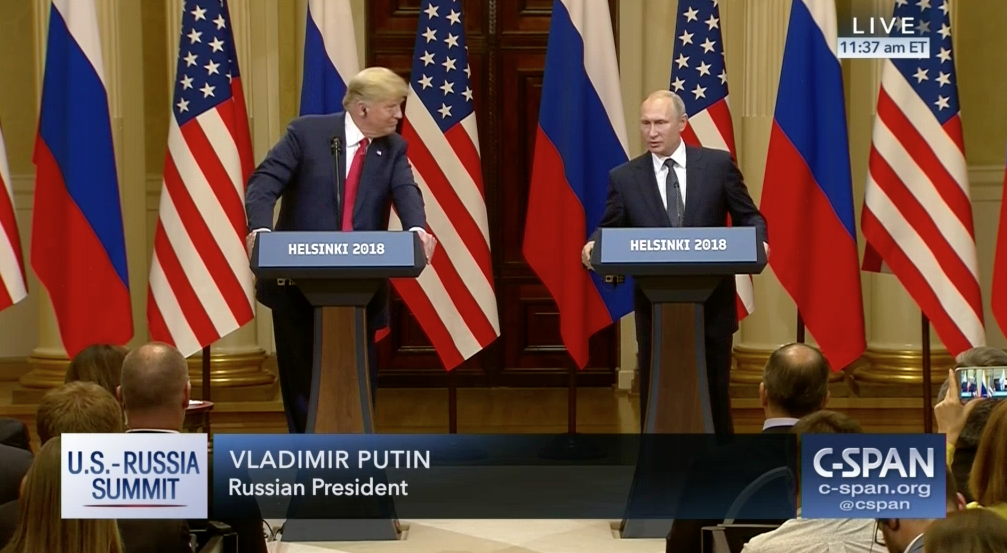
Which brings me to the final question asked at Trump’s infamous July 2018 press conference alongside Vladimir Putin in Helsinki.

Jonathan Lemire: Thank you. A question for each President. President Trump, you first. Just now, President Putin denied having anything to do with the election interference in 2016. Every U.S. intelligence agency has concluded that Russia did. What – who – my first question for you, sir, is, who do you believe? My second question is, would you now, with the whole world watching, tell President Putin – would you denounce what happened in 2016? And would you warn him to never do it again?

Donald J. Trump: So let me just say that we have two thoughts. You have groups that are wondering why the FBI never took the server. Why haven’t they taken the server? Why was the FBI told to leave the office of the Democratic National Committee? I’ve been wondering that. I’ve been asking that for months and months, and I’ve been tweeting it out and calling it out on social media. Where is the server? I want to know, where is the server? And what is the server saying? With that being said, all I can do is ask the question. My people came to me – Dan Coats came to me and some others – they said they think it’s Russia. I have President Putin; he just said it’s not Russia.

I don’t see any reason why it would be, but I really do want to see the server. But I have – I have confidence in both parties. I really believe that this will probably go on for a while, but I don’t think it can go on without finding out what happened to the server. What happened to the servers of the Pakistani gentleman that worked on the DNC? Where are those servers? They’re missing. Where are they? What happened to Hillary Clinton’s emails? Thirty-three thousand emails gone – just gone. I think, in Russia, they wouldn’t be gone so easily. I think it’s a disgrace that we can’t get Hillary Clinton’s 33,000 emails. So I have great confidence in my intelligence people, but I will tell you that President Putin was extremely strong and powerful in his denial today. And what he did is an incredible offer; he offered to have the people working on the case come and work with their investigators with respect to the 12 people. I think that’s an incredible offer. Okay? Thank you.

Given a choice between believing the conclusions of every US intelligence agency on Russian interference in the 2016 election on the one hand and the extremely strong and powerful denial by the leader of Russia on the other, Trump chose Putin.

Can you see why Helsinki came to my mind?

Trump has a pattern when it comes to getting advice from others, that revolves around two immutable statements:

  1. Trump wants advice that supports his current thinking, OR advice that will provide him some kind of immediate or future benefit.
  2. Trump does NOT want advice that tells him he is wrong about something, that he lost a court case or election, or that he otherwise failed.

When confronted by failure, Trump will seize on anything that suggests even the slimmest possibility of ultimate success.

Again, look at Helsinki. Sure, the unanimous conclusion of the US intelligence community was that Russia meddled in the 2016 election, but if Trump accepted that conclusion in public, while standing next to Putin, any hope Trump had of a grand Trump Tower Moscow (something he had worked on for years) would be gone. Also, if Putin held some kind of compromising information on Trump (a conclusion that Marcy leaned toward in her post on the press conference), Putin would surely release it. The result of backing the US IC would be immediate harm and future failure for Trump. Not good.

Would this loss and damage be outweighed by some other benefit, like being seen as the heroic leader of the US intelligence community? Hardly. In Trump’s eyes, these were Deep State folks who were out to get him, and even if he accepted their advice, they’d never accept him as their leader, and he’d piss off his other supporters who had been backing him against the IC. Also not good. Thus, Trump’s answer to Lemire’s question was simple: I believe Putin.

Faced with a mountain of evidence against him, either in Helsinki or in courtrooms across the country, Trump will always reject the advice of those who say definitively that he has lost and cling for his life to the advice of whomever tells him otherwise. Trump lives by the immortal line of Lloyd Christmas: “So you’re telling me there’s a chance . . . Yeah!”

Trump is not seeking out folks like Rudy “Four Seasons Total Landscaping” Giuliani, Sidney “Release the Kracken!” Powell, or any of his other lawyers to guide his legal strategy. He keeps them around because they keep telling him that there’s a chance.

Spoiler alert for Trump and anyone who hasn’t seen Dumb and Dumber: Lloyd’s 1 in a million chance did not come through for him, and he didn’t get the girl.


Protective Order: Who Is the Victim of Trump’s 18 USC 241 Charge?

Yesterday, one day after Magistrate Judge Moxila Upadhyaya warned Trump not to engage in witness tampering, he posted first a video claiming that the prosecutors who are prosecuting him — none of whom Joe Biden appointed — were Biden’s accomplices in an attempt to win the election. He followed that with a tweet threatening, “IF YOU GO AFTER ME, I’M COMING AFTER YOU!”

Shortly thereafter, two prosecutors who were career prosecutors in the Trump Administration before they came to report to Merrick Garland, Molly Gaston and Thomas Windom, filed a motion for a protective order. While the ostensible goal of the motion was to accelerate the process of sharing discovery in a way that won’t end up in a tweet somewhere, they did use it to alert Judge Tanya Chutkan of Trump’s tweet.

The Government’s proposed order is consistent with other such orders commonly used in this District and is not overly restrictive. It allows the defendant prompt and effective use of discovery materials in connection with his defense, including by showing discovery materials to witnesses who also agree to abide by the order’s terms. All the proposed order seeks to prevent is the improper dissemination or use of discovery materials, including to the public. Such a restriction is particularly important in this case because the defendant has previously issued public statements on social media regarding witnesses, judges, attorneys, and others associated with legal matters pending against him. And in recent days, regarding this case, the defendant has issued multiple posts—either specifically or by implication—including the following, which the defendant posted just hours ago:

If the defendant were to begin issuing public posts using details—or, for example, grand jury transcripts—obtained in discovery here, it could have a harmful chilling effect on witnesses or adversely affect the fair administration of justice in this case. See Gentile v. State Bar of Nevada, 501 U.S. 1030, 1070 (1991) (“The outcome of a criminal trial is to be decided by impartial jurors, who know as little as possible of the case, based on material admitted into evidence before them in a court proceeding. Extrajudicial comments on, or discussion of, evidence which might never be admitted at trial . . . obviously threaten to undermine this basic tenet.”). [my emphasis]

As I predicted, Trump quickly claimed the threat was about RINOs — even the Koch Brothers! — not the prosecutors prosecuting him.

Contrary to the claims of Trump and dozens of lawyers who haven’t read the indictment, it’s really not about his First Amendment right to lie, which is undoubtedly why he’s staging an early attempt to make this about his ongoing First Amendment right to lie.

Whatever. As I’m writing this I keep thinking about the line from the indictment describing that Trump tweeted his implicit threat against Mike Pence during the riot at a moment his advisors left him alone in his Dining Room: “after advisors had left the Defendant alone in his dining room, the Defendant issued a Tweet intended to further delay and obstruct the certification.”

The actual substance of the debate over the protective order will be genuinely interesting. Trump is running for office and he is entitled to attack Biden — albeit not physically. The motion described that prosecutors had proposed a recent protective order issued by Carl Nichols, a Trump appointee.

It’s likely that Judge Chutkan will call a hearing to deal with extrajudicial statements, while the lawyers fight about the protective order.

The whole predictable attack made me think, though, about Joe Biden’s role in all this. While the implicit threat against Jack Smith certainly threatens, “the fair administration of justice in this case,” the other prosecutors are not parties here. And there were no known witnesses included in Trump’s attack. Contrary to what Trump said, Biden has had no role in all this (in fact he should enjoin Trump from claiming prosecutors he didn’t appoint are his “accomplices”).

Depending on how DOJ conceives the 18 USC 241 charges, he could be Trump’s victim.

DOJ didn’t really lay that out in the indictment — whose votes Trump attempted to leave uncounted. Probably, as a Michigan mail-in voter (and in the county where Trump actually lost the election!), I’m among those people. I assume Rayne and bmaz are too.

But is Biden the victim here, too?

It won’t affect the resolution of this particular spat. But it does raise interesting questions about the structure of any gag going forward.

Update: Chutkan is not ordering Trump to explain his tweet.

MINUTE ORDER as to DONALD J. TRUMP: It is hereby ORDERED that by 5:00 PM on August 7, 2023, Defendant shall file a response to the government’s [10] Motion for Protective Order, stating Defendant’s position on the Motion. If Defendant disagrees with any portion of the government’s proposed Protective Order, ECF No. 10-1, his response shall include a revised version of that Protective Order with any modifications in redline. 

The “Crazy” Kraken Conspirator

Sidney Powell is undoubtedly co-conspirator 3 in Trump’s January 6 indictment.

Co-Conspirator 3, an attorney whose unfounded claims of election fraud the Defendant privately acknowledged to others sounded “crazy.” Nonetheless, the Defendant embraced and publicly amplified Co-Conspirator 3’s disinformation.

But her role — as described — is actually very limited. Just one paragraph describes her actions:

20. On November 16, 2020, on the Defendant’s behalf, his executive assistant sent Co-Conspirator 3 and others a document containing bullet points critical of a certain voting machine company, writing, “See attached – Please include as is, or almost as is, in lawsuit.” Co-Conspirator 3 responded nine minutes later, writing, “IT MUST GO IN ALL SUITS IN GA AND PA IMMEDIATELY WITH A FRAUD CLAIM THAT REQUIRES THE ENTIRE ELECTION TO BE SET ASIDE in those states and machines impounded for non-partisan professional inspection.” On November 25, Co-Conspirator 3 filed a lawsuit against the Governor of Georgia falsely alleging “massive election fraud” accomplished through the voting machine company’s election software and hardware. Before the lawsuit was even filed, the Defendant retweeted a post promoting it. The Defendant did this despite the fact that when he had discussed Co-Conspirator 3’s far-fetched public claims regarding the voting machine company in private with advisors, the Defendant had conceded that they were unsupported and that Co-Conspirator 3 sounded “crazy.” Co-Conspirator 3’s Georgia lawsuit was dismissed on December 7.

Go back and look! Her most famous role — when she got cleared into the White House and told Trump he should make her Special Counsel and seize the voting machines — doesn’t appear at all. Indeed, my greatest disappointment with the indictment is that it doesn’t explain one of the enduring mysteries of January 6: what led Trump to adopt January 6 as his plan shortly after that meeting.

It describes Trump’s December 19 tweet — the tweet that triggered thousands of MAGAts to start planning a trip to DC — but not what led up to it.

Curse you, Jack Smith!!!

What a remarkable structure, then, for including Sidney Powell in this indictment.

From the description of Powell at the beginning, it makes it sound like she is in there as proof that Trump knew his claims were false: In November, he declared her crazy. But he nevertheless kept magnifying her craziness.

That would almost help prove that Trump knew she was a liar when he used her propaganda.

But paragraph 20 says something different: It says that on November 16, on a date she was still ostensibly on Rudy’s team, Trump fed her the Dominion voting machine false claims and told her — Trump told Powell, not vice versa — to include the Dominion claims.

The false claims about Dominion, according to this, came from Trump.

And then, after Rudy and Jenna Ellis publicly separated themselves from her, Powell submitted the first of a number of lawsuits that would rely on the Dominion claim.

And when called on her crazy, Sidney Powell claimed that, “no reasonable person would conclude that [her] statements were truly statements of fact.”

It’s not just Trump who thinks she’s crazy, she thinks she’s crazy.

But once she filed that lawsuit, on November 25, Trump boosted it.

That’s all pretty interesting timing given something else that was occurring at the very same time. At a time when they were both together in South Carolina plotting how to steal the election for Trump, Trump pardoned Mike Flynn.

The same crazy that went into Sidney Powell’s election disinformation went into her claims about Flynn. If Trump thought she was crazy, he should never have pardoned Flynn.

It gets still more interesting from there — including to where Powell funded at least some of the Oath Keepers’ defense — including, possibly, Kelly Meggs’ attorney, Stan Woodward.

You get the idea.

Even without her plan to seize the voting machines on December 18, even without Flynn’s call for martial law in the days leading up to it, the timeline laid out in the indictment — where Trump gave Powell the Dominion claims, then decided she was crazy, then pardoned her client based off her crazy claims — sure piles up some interesting implications in what are just two paragraphs of a 130-paragraph indictment.

“Conspiracy Shit Beamed Down from the Mothership:” The Prehistory of Trump’s Ellipse Lies


In Jack Smith’s statement announcing the Trump indictment yesterday, he emphasized how Trump’s lies “fueled” the attack on the Capitol.

The attack on our nation’s capital on January 6, 2021, was an unprecedented assault on the seat of American democracy. As described in the indictment, it was fueled by lies. Lies by the defendant targeted at obstructing a bedrock function of the U.S. government, the nation’s process of collecting, counting, and certifying the results of the presidential election.

The men and women of law enforcement who defended the U.S. Capitol on January 6 are heroes. They’re patriots, and they are the very best of us. They did not just defend a building or the people sheltering in it. They put their lives on the line to defend who we are as a country and as a people. They defended the very institutions and principles that define the United States.

For each sub-section in the section of the indictment that lays out Trump’s pressure on states, the indictment shows how Trump repeated false claims on January 6 that he had been told were false. While the indictment doesn’t cite the actual language that would appear in Trump’s Ellipse speech, it invokes these five lies (it doesn’t include the lies he told about Nevada):

In the state of Arizona, over 36,000 ballots were illegally cast by non-citizens. Two thousand ballots were returned with no address. [cited here]

[snip]

Over 10,300 ballots in Georgia were cast by individuals whose names and dates of birth match Georgia residents who died in 2020 and prior to the election. [cited here]

[snip]

That’s Detroit. One hundred and seventy-four thousand ballots were counted without being tied to an actual registered voter. Nobody knows where they came from. [cited here]

[snip]

There were over 205,000 more ballots counted in Pennsylvania. Think of this, you had 205,000 more ballots than you had voters. That means you had two. Where did they come from? You know where they came from? Somebody’s imagination, whatever they needed. [cited here; also cited in January 4 meeting with Pence]

[snip]

In Wisconsin, corrupt Democrat-run cities deployed more than 500 illegal, unmanned, unsecured drop boxes, which collected a minimum of 91,000 unlawful votes. [cited here]

With each of these lies, the indictment shows when he was told these claims were false (Arizona, Georgia, Michigan, Pennsylvania, Wisconsin). In several cases, the indictment also shows DOJ officials telling Trump those lies were false (Georgia, Michigan, Pennsylvania, Wisconsin).

The actual citations from Trump’s Ellipse speech, which appears in the section on his pressuring of Mike Pence, focus on that — his false claims about what Pence could do (and the indictment describes Rudy Giuliani and John Eastman’s speeches as further effort to pressure Pence).

But before that, the indictment tracks the lies in the speech that Trump used to mobilize the mob.

Discoveries in the Stolen Document Discovery

As I noted in this post, the government provided a supplemental discovery notice yesterday. It included the following:

  • CCTV provided by Trump Org on May 9 and May 12 in response to an April 27 subpoena
  • CCTV obtained after June 8 pertaining to new obstruction allegations (DOJ does not confirm whether this came from Trump Org or not)
  • All 302s finalized by yesterday (302s are what the FBI calls interview reports)
  • All grand jury transcripts in government’s possession

The discovery confirms that the government took certain steps after June 8 to add Carlos De Oliveira to the indictment. There are two kinds of surveillance footage that appear in that section of the indictment: from De Oliveira and Walt Nauta’s stomping around trying to understand what surveillance footage there would be, including looking right at the key cameras in the hallway outside the storage room, as well as their discussions in the bushes just off Mar-a-Lago property.

The reference to location data may mean they obtained De Oliveira’s phone account.

The discovery also means that, if DOJ was using another grand jury, in addition to the DC and SDFL ones, Trump is now aware of it, because DOJ has turned over all transcripts in their possession (past notices had specified the two grand juries).

Finally, the discovery also describes that DOJ subpoenaed Trump Organization for yet more surveillance footage in April, which Trump Org turned over on May 9 and 12. That subpoena was already public; NYT reported it in May.

Prosecutors have also issued several subpoenas to Mr. Trump’s company, the Trump Organization, seeking additional surveillance footage from Mar-a-Lago, his residence and private club in Florida, people with knowledge of the matter said. While the footage could shed light on the movement of the boxes, prosecutors have questioned a number of witnesses about gaps in the footage, one of the people said.

The timing is interesting though. It comes after — per this WaPo report — Carlos De Oliveira was informed he might be charged after he claimed not to remember the dates when Trump returned to Mar-a-Lago in July 2022 (note: this “proffer” session sounds more like an interview conducted under a limited proffer before a grand jury appearance).

For one thing, De Oliveira said he did not remember his boss coming back to Mar-a-Lago in July, the people said. Trump tended to stay away from the Florida summer heat, and it did not seem likely to some investigators that De Oliveira would forget the former president showing up twice in two weeks.

The prosecutors’ dissatisfaction came to a head in mid-April, when De Oliveira was given a proffer session — an interview in which a prosecutor and a defense lawyer meet with a person to decide if they have valuable information to offer an investigation, the kind that could lead to a plea deal.

If prosecutors grew convinced De Oliveira was lying, they may have pulled his grand jury appearance. His charged false statements were in a January 13, 2023 interview at his Florida residence, not this appearance in what may still have been DC.

In the same time frame as this subpoena for additional surveillance footage, DOJ also subpoenaed Trump’s business records from the Saudi LIV tournament.

One of the previously unreported subpoenas to the Trump Organization sought records pertaining to Mr. Trump’s dealings with a Saudi-backed professional golf venture known as LIV Golf, which is holding tournaments at some of Mr. Trump’s golf resorts.

A later NYT story reported that the subpoenas were broader: to include foreign deals with a variety of countries.

The subpoena — drafted by the office of the special counsel, Jack Smith — sought details on the Trump Organization’s real estate licensing and development dealings in seven countries: China, France, Turkey, Saudi Arabia, Kuwait, the United Arab Emirates and Oman, according to the people familiar with the matter. The subpoena sought the records for deals reached since 2017, when Mr. Trump was sworn in as president.

And then, after those subpoenas but before Trump Org complied with them, the Matthews Calamari testified about why Walt Nauta sent Calamari senior a text in the time frame when he and De Oliveira were allegedly stomping around Mar-a-Lago attempting to implement Trump’s order to destroy surveillance footage.

Both Calamaris testified to the federal grand jury in Washington on Thursday, and were questioned in part on a text message that Trump’s valet, Walt Nauta, had sent them around the time that the justice department last year asked for the surveillance footage, one of the people said.

The text message is understood to involve Nauta asking Matthew Calamari Sr to call him back about the justice department’s request,

In that same April time frame, DOJ was also asking about loyalty oaths before being given Trump-paid attorneys to represent them — the fruit of which questions likely show up in ¶91 of the superseding indictment.

Another line of inquiry that prosecutors have been pursuing relates to how Mr. Trump’s aides have helped hire and pay for lawyers representing some of the witnesses in investigations related to the former president. They have been trying to assess whether the witnesses were sized up for how much loyalty they might have to Mr. Trump as a condition of providing assistance, according to people briefed on the matter.

It was after that, though, after the first indictment on June 8 which may have helped demonstrate the seriousness of this inquiry, when per CNN reporting the following happened with Yuscil Taveras, the IT guy who said he didn’t have the rights, on his own, to delete surveillance footage:

  • Receives a target letter
  • Decides he wants to be more forthcoming
  • Gets a new lawyer (reportedly after a conflict review instigated by a judge)
  • Testifies about the request De Oliveira made inside the sound room and his own response that De Oliveira would have to call people who might be one of the Calamaris

In that same period, per yesterday’s discovery letter, that DOJ obtained more surveillance footage and possibly the warrant tracking location data.

One note: If people testified before the grand jury in DC before Jack Smith moved to present charges in SDFL, they would have separate exposure for perjury there.

Here’s my track of what DOJ has turned over when (with links to the documents below).


June 21, 2023: Response Discovery Order

June 23, 2023: Motion to Implement Special Conditions

July 6, 2023: Supplemental Response Discovery Order

July 10, 2023: Defendants Response Motion for Continuance

July 13, 2023: Government Reply Motion for Continuance

July 17, 2023: Supplemental Response Discovery Order

July 18, 2023: Status Hearing (Lawfare account)

July 31, 2023: Supplemental Response Discovery Order

Update: Answered two questions I’ve gotten up in the text above: First, I used “provided by Trump Org” and “obtained” in the bullets above because that’s how the filing describes these. As I’ve noted, the video showing De Oliveira and Nauta in the bushes might well have come from a different property owner.

Second, I defined 302s, which are what the FBI calls interview reports.

“Rights” and Wrongs: Where the Stolen Documents Investigation Is Headed

I want to start this post about where the stolen documents investigation may be headed with an observation a commenter here made about this passage of the superseding indictment: the import of the word, the “rights,” coming from an IT guy who would think in terms of access privileges.

The passage comes in the midst of the Keystone Cops routine where Walt Nauta and Carlos De Oliveira try to figure out how to achieve Trump’s apparent order — probably given during a 24-minute phone call to De Oliveira on June 23 and to Nauta face-to-face at Bedminster sometime between 3:44 and 5:02PM on June 24 — to delete the surveillance server. They were stomping around, squawking about how sensitive this mission was. Nauta sent someone texts with shush emojis and De Oliveira told a valet Nauta’s visit should remain secret.

The evening of June 25 — one day after DOJ sent Trump Organization a subpoena for surveillance video — they get a flashlight and go to inspect what the surveillance cameras would pick up; by moving in front of the surveillance cameras, which we now know are motion activated, they would have triggered the cameras, thereby creating more damning surveillance footage.

Imagine the video exhibit at trial, as both Nauta and De Oliveira point a flashlight at the surveillance camera that, weeks earlier, caught both of them moving just half the boxes full of classified documents back into the storage room, two earnest faces looking straight into the camera. That footage wouldn’t be covered by the subpoena they were, at that moment, trying to defy; it would probably be covered by the next subpoena.

Two days later (there’s no indication of how Nauta spent his day on Sunday June 26), on June 27, De Oliveira walks into the IT room and asks Yuscil Taveras in front of a witness (possibly in front of another security camera) to step away so they could speak. They go to what they call an “audio closet” (which could be the decommissioned SCIF) and De Oliveira tells Taveras that “the boss” wants the surveillance server deleted.

Taveras says three things in response:

  1. He doesn’t know how to accomplish that
  2. He doesn’t have the “rights” to do that
  3. To accomplish the task, De Oliveira would have to reach out to one of the Matthew Calamaris

The words, “rights,” here hasn’t gotten enough attention. Taveras was saying that he did not have the computer privileges to just delete the surveillance server: one of the Matthew Calamaris in New York would have to be involved to make such a thing happen.

So after that, De Oliveira checks back in with Nauta (who has flown to Florida to accomplish this task, along with whatever he did on June 26), they stomp around some more in suspicious ways that are visible to yet more surveillance cameras, and then two hours later Trump speaks to De Oliveira for 3.5 minutes. As described, Trump calls De Oliveira, not the other way around.

Remember how I said — of the January 6 investigation — that the January 6 investigation would take more time than the Watergate investigation because, unlike Nixon, Trump is not known to have wiretapped himself?

Well, on the stolen documents investigation, he did, effectively, wiretap himself, or at least all the employees he sent to accomplish his corrupt mission. And then Trump tried, over and over, to Rosemary Woods away incriminating video, at least this first time, captured on video again.

But amid all the Keystone Cops stomping around talking about secrets while on surveillance camera and sending shush texts, what Taveras said is an important hint of where this investigation may go next (as I laid out here).

Thus far, this story — and the conspiracy as charged so far — is just a story of a failed attempt to destroy surveillance video. De Oliveira: Can you delete the server? Taveras: Nope. I don’t have the rights. Stomp stomp stomp, almost all of it on surveillance video.

The Keystone Cops caper ends with Trump calling De Oliveira at 3:55PM on June 27, with no word of what led Trump to call De Oliveira and no word of whether whatever video got deleted was deleted in Florida or New York, or somewhere else.

The superseding indictment doesn’t mention, for example, the text that Nauta sent Calamari Sr — possibly even between 1:50PM when he and De Oliveira were stomping in bushes adjacent to Mar-a-Lao and the phone call that Trump made to De Oliveira at 3:55PM.

Both Calamaris testified to the federal grand jury in Washington on Thursday, and were questioned in part on a text message that Trump’s valet, Walt Nauta, had sent them around the time that the justice department last year asked for the surveillance footage, one of the people said.

The text message is understood to involve Nauta asking Matthew Calamari Sr to call him back about the justice department’s request,

Calamari was the guy, Taveras told De Oliveira, who would have the privileges to delete surveillance footage. And sometime in that period, Nauta texted him about the surveillance request.

Thus far, this is a story and a crime about an alleged attempt to delete surveillance footage. But we can be pretty certain that surveillance video was, in fact, deleted. That’s because reporters have reported on witnesses being asked that for months. There would be no reason to obtain nine months of surveillance video — 57 terabytes of raw video, if you can believe the defense attorneys — unless there was a whole bunch more to learn from the surveillance videos.

The initial production also included some 57 terabytes of compressed raw CCTV footage (so far there is approximately nine months of CCTV footage, but the final number is not yet certain).

And there would be no reason for Trump, on August 26, to get Nauta to verify De Oliveira’s loyalty (stomp stomp stomp) before arranging to provide him a lawyer if what came next, what happened after Trump’s phone call to De Oliveira on June 27 isn’t even more damning.

Indeed, that’s why it matters that — buried in a Devlin Barrett story opining that De Oliveira’s, “alleged actions could bolster the obstruction case against the former president” because apparently Devlin hasn’t learned his lesson about presenting evidence of more serious crimes and calling it obstruction — Trump (unusually) came back to Mar-a-Lago twice between June 3 and August 8: once from July 10 to 12, and once again on July 23, and that De Oliveira told the FBI he had given away the key to storage when they showed up on August 8.

The Keystone Cop caper, in part because it is so colorful and in part because it is charged as an unsuccessful attempt, has distracted most commentators from the fact that there was a more successful attempt, and that more successful attempt didn’t hide the movement of boxes in and out of the storage closet. As I’ve noted, all the movement of boxes in May and June shows up in the search affidavit relying on what DOJ did get from Trump, save one: Nauta’s retrieval of a single box on May 22.

The superseding indictment describes that the subpoena asked for footage from “certain locations,” plural, of which the basement hallway is just one. And the most recent unsealing of the affidavit reveals that the only cameras included on the hard drive of surveillance footage turned over on July 6 were four cameras in the basement hallway. So one way or another, footage of those other locations was not turned over in response to the first subpoena.

Everyone treats this indictment as a terminal indictment — and if that’s as far as Jack Smith gets, it’s still far more damning than most everyone imagined on June 8. But multiple public references — the discussion on July 13 of continued efforts to fully exploit Nauta’s phone, the reference in DOJ’s descriptions of discovery that suggest there’s a grand jury somewhere other than DC or SDFL, and the suggestion that interviews have continued after June 23 — suggests that the current instantiation of the indictment is intended to be part of an ongoing investigation.

I noted from the first indictment that it was a “tactical nuke” designed to persuade Nauta to cooperate. Not only hasn’t the effort worked, but Stan Woodward has adopted a position on classified discovery — that Nauta, in addition to his attorneys, should get to see all the stolen classified documents — that I think makes it more likely DOJ would supersede to add a conspiracy to retain classified documents charge with him, because the elements of offense are all satisfied in the existing indictment.

Here are the obvious things that obtaining credible cooperation from Nauta would obtain:

  • ¶25: Details of Trump’s intent as Nauta helped pack up documents from the White House
  • ¶46: Why Trump was trying to hide when he instructed Nauta to replace the lids of the boxes
  • ¶54: What he was sent for on May 22
  • ¶61: What Trump instructed Nauta before he moved half the boxes back into storage for Evan Corcoran to search
  • ¶73: What boxes got loaded on the plane to Mar-a-Lago on June 3
  • ¶78: What Trump told him at Bedminster that led him to fly to Florida and try to bury the surveillance video (as well as what else he did on June 26, which is not accounted for)
  • ¶86: What both men discussed in the bushes
  • How Nauta came to text Matthew Calamari
  • ¶91: How Trump came to ask Nauta to ascertain De Oliveira’s loyalty and whether Trump had similarly offered him legal representation
  • What Nauta witnessed as Trump’s bodyman, especially in Bedminster

Here are the obvious things that obtaining credible cooperation from De Oliveira would obtain:

  • ¶76: Details of the 24-minute call he had with Trump, while Trump was at Bedminster
  • ¶86: What both men discussed in the bushes
  • ¶87: What Trump said on the phone call and whether De Oliveira had a role in the successful deletion of video, and how he knew what to delete
  • ¶91: What the terms of his representation are and whether it led him to lie (a question, other reports have made clear, many witnesses have been asked)
  • Why Trump returned to Mar-a-Lago twice before the August 8 search
  • To whom he gave the key to the storage room and on whose orders
  • Whether the October flood of the server room was an(other) attempt to destroy surveillance footage and if so, whether he was instructed to do so

De Oliveira might be a key witness to lead Nauta to reconsider his decision to protect Trump.

More importantly, one or both might be irreplaceable witnesses to answer a number of closely intertwined questions:

  • How is Trump is using lawyers to command loyalty and does it create conflict or obstruction issues
  • What surveillance footage has Trump prioritized for destruction and why
  • Why did Trump steal the documents, how has he used them, and where did the ones that went to Bedminster disappear to
  • What role does Trump’s PAC have in exploitation of the documents
  • What role does Trump Organization have in exploitation of the documents
  • Who else has had ready access to these documents

All this superseding indictment shows is that Trump had something to hide that goes beyond his desire to hoard the classified documents. Jack Smith may require the cooperation of one or both of these men to fully understand what Trump is really hiding.

This fairly remarkable post from the WSJ opinion page demonstrates the stakes of trying to answer it. It’s a pitch to elect someone other than Trump in the GOP primary, and premised on an utterly bullshit claim that Biden has politicized justice. But it gets a good distance of the way to an important discovery: even the Keystone Cops attempt already included in the indictment totally debunks Trump’s public defense, because if he believed in June 2022 that he had the right to keep these, he wouldn’t have dug himself — and thus far two staffers — deeper into a legal hole.

If Mr. Trump sought to destroy evidence, it undercuts his defense on the document charges. He contends that the Presidential Records Act gives him the right to retain documents from his time in office. But if Mr. Trump believed that, he would have played it straight. If the indictment is right that he hid the files from his own lawyers and tried to wipe the security video to stop anybody from finding out, then he didn’t buy his own defense.

From a Murdoch rag, this is a really important insight. But then WSJ predictably refuses to take the next logical step: That Trump’s obstruction makes it clear he didn’t just do this out of pigheadedness.

Prudential questions about the wisdom of this prosecution remain. Mr. Trump appears to have kept the files out of pigheadedness, not because he wanted to do something nefarious like sell them to an adversary. The FBI raided Mar-a-Lago to recover the documents.

The episode reflects poorly on Mr. Trump. But is this conduct that truly gives President Biden no choice except to ask a jury to jail his leading political opponent in next year’s election? At least Watergate involved a burglary.

We can’t even rule out a burglary, if Trump learned that he compromised these documents by storing them in his beach resort! Especially since De Oliveira claimed he had given the key away to others. We can’t rule out selling them to an adversary! We sure as hell can’t rule out trying to exploit them for the success of his PAC.

The indictment and an attempt to try this before the general election is an important goal, though potentially unrealistic given the CIPA challenges.

But it really is important to learn what Trump did do with these documents, who got the key, where they disappeared to.

This indictment doesn’t answer the question of why Trump stole these documents or what he did with them. All the superseding indictment did is make the question more urgent.

Update: Fixed Trump’s location from whence he called De Oliveira — the first call would have been Bedminster.