Posts

One Explanation for Elon Musk’s Claimed DOGE Departure that Gossip-Mongers Missed

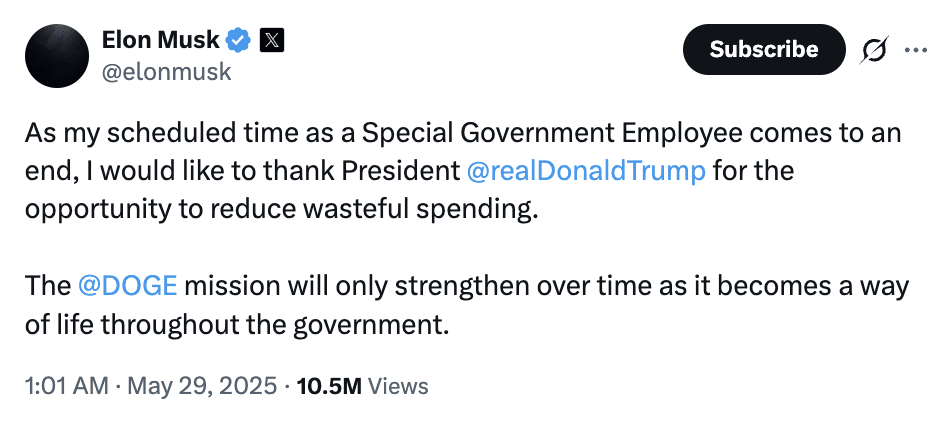
The NYT wrote an 1800-word, 5-byline post claiming Elon Musk’s departure from DOGE reflected tensions over Trump’s Big Ugly Tax Bill without mentioning one additional — possibly far more important — factor that may have influenced his announced departure.

This may be an attempt to preserve the damage Elon did to government, up to and including the data consolidation that DOGE carried out.

Even NYT’s claimed basis for Elon’s departure is unpersuasive.

On Tuesday, CBS posted a clip from an interview that will air Sunday, in which Musk complains that the Big Ugly Tax Bill raises the deficit.

Elon Musk says he is “disappointed” by the price tag of the domestic policy bill passed by Republicans in the House last week and heavily backed by President Trump. The billionaire who recently stepped back from running the Department of Government Efficiency, or DOGE, made the remark during an exclusive broadcast interview with “CBS Sunday Morning.”

“I was disappointed to see the massive spending bill, frankly, which increases the budget deficit, not just decreases it, and undermines the work that the DOGE team is doing,” Musk said.

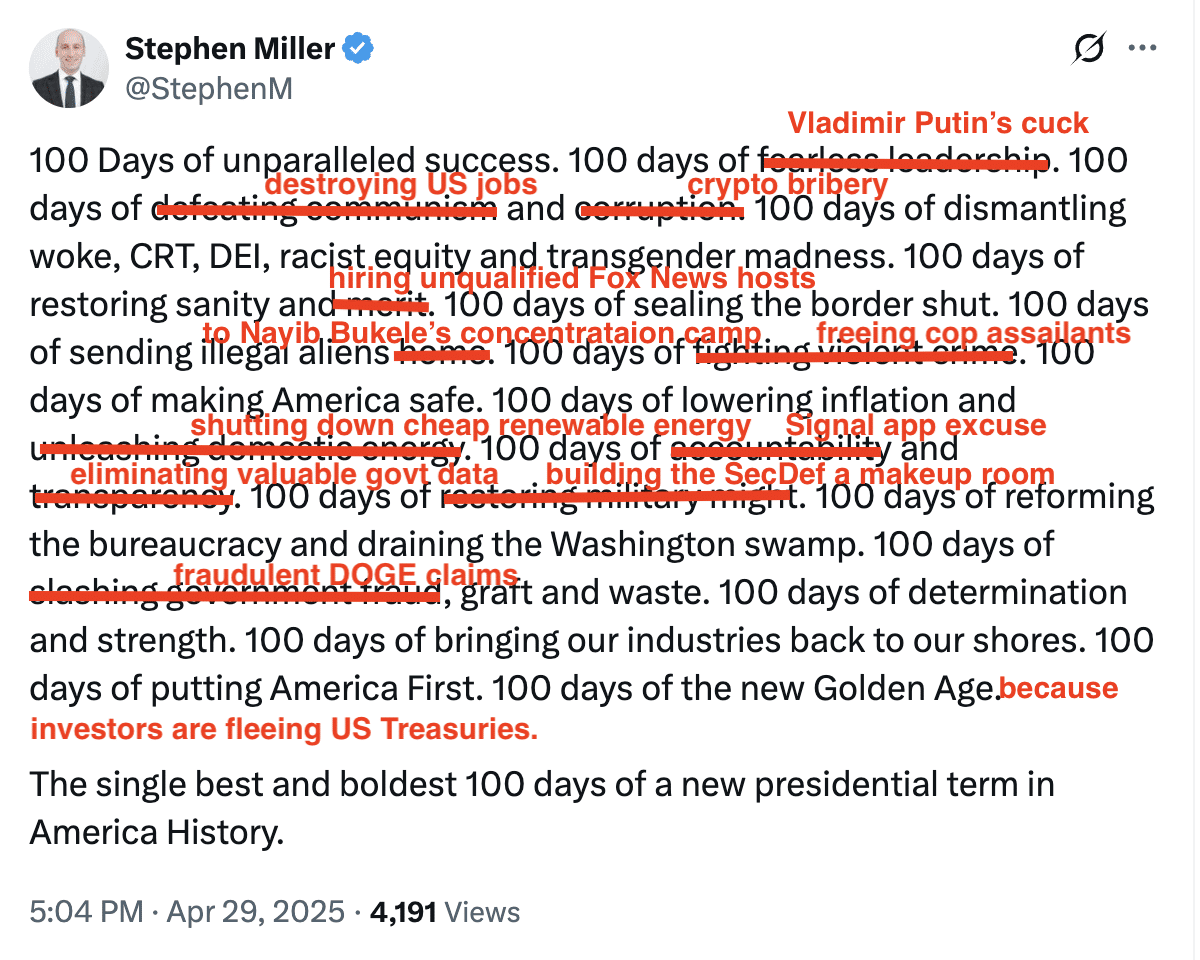
NYT claims that this tweet was a response to Elon. (These screencaps are ET+6.)

That led, NYT claims, to Elon’s announced departure from DOGE.

As it is, there are problems with this narrative. The non-inclusion of DOGE was not Elon’s prior complaint about the Big Ugly; the exacerbation of the budget deficit was. There were plenty of people, in Congress and outside, who were complaining that the Big Ugly didn’t codify DOGE cuts or did fund USAID, complaints more directly relevant to Stephen Miller’s comment. And Miller has been lying about the bill already.

Maybe the NYT’s portrayed drama is correct.

Or maybe this is yet more theater about Elon’s relationship with the Trump Administration.

There was an important DOGE-related development in recent days that may be impacted by Elon’s claimed imminent departure, one not mentioned in NYT’s long story.

After John Roberts, on Sunday, stayed a Christopher Cooper order regarding a FOIA that CREW served on DOGE, on Tuesday, Tanya Chutkan denied DOJ’s effort to dismiss an Appointments Clause lawsuit by blue states — led by New Mexico — against DOGE. [docket]

The DC Circuit (Henderson, Millett, and Walker) had earlier stayed a discovery order from Chutkan pending her decision on the motion to dismiss, holding that she should only grant discovery if the lawsuit will continue. If Chutkan’s decision stands, the government may have to provide the discovery on DOGE that John Roberts halted (in a different, FOIA, context).

Chutkan summarized a list of things the states allege Musk did that would require Senate confirmation.

States claim that DOGE, with Musk at the helm, “has inserted itself into at least 17 federal agencies” and exercises “significant authority” across the Executive Branch. Id. ¶¶ 70, 200. They identify the following categories of allegedly unauthorized actions by DOGE and Musk:

  • Controlling Expenditures and Disbursements of Public Funds: States allege that DOGE obtained “full access” to payment systems at multiple agencies and used that access to halt payments. Id. ¶¶ 78–79, 85, 127–30. For instance, after the acting-Secretary at U.S. Department of Treasury refused to “halt” payments, DOGE personnel threatened the acting Secretary with “legal risk [] if he did not comply with DOGE.” Id. ¶ 84. Then, on February 2, DOGE obtained “full access” to Treasury’s Bureau of the Fiscal Services payment systems, which disburses funds for social security benefits, veteran’s benefits, childcare tax credits, Medicaid and Medicare reimbursements, federal employee wages, federal tax refunds, and facilitates state recovery of delinquent state income taxes. Id. ¶¶ 78–79, 85. That day, Musk posted on X that “[t]he @DOGE team is rapidly shutting down these illegal payments,” in response to a post by a non-profit organization receiving funds pursuant to government contracts. Id. ¶ 86.
  • Terminating Federal Contracts and Exercising Control over Federal Property: States allege that Musk and DOGE asserted responsibility for terminating federal contracts across the Executive Branch. Id. ¶ 203–04. DOGE reported the cancellation of “104 contracts related to diversity, equity, inclusion and accessibility (DEIA) at more than a dozen federal agencies” on January 31, id. ¶ 205; of “thirty-six contracts across six agencies” on February 3, id. ¶ 206; of “twelve contracts in the GSA and the Department of Education” on February 4, id. ¶ 207; and “cuts of $250 million through the termination of 199 contracts” on February 7, id. ¶ 208. States also allege that DOGE and Musk exercise control over federal property by demanding access to secure facilities and threatening intervention by U.S. Marshals when agency officials refuse, id. ¶¶ 94–95; by “push[ing]” high-ranking officials out of their offices at agency headquarters, id. ¶¶ 164–66, by terminating leases for federal property, id. ¶ 206, and by announcing plans to “liquidate as much as half of the federal government’s nonmilitary real estate holdings,” id. ¶ 160.
  • Binding the Government to Future Financial Commitments without Congressional Authorization: States point to the Fork in the Road Email, which offered federal employees pay and benefits through September 2025 if they resigned by February 6, as entering into binding financial commitments. Id. ¶¶ 116–20, 212.
  • Eliminating Agency Regulations and Entire Agencies and Departments: States allege that DOGE personnel took steps to dismantle USAID and CFPB. On February 3, DOGE personnel allegedly “handed” USAID’s acting leadership “a list of 58 people, almost all senior career officials, to put on administrative leave.” Id. ¶ 102. The next day, USAID placed “nearly its entire workforce on administrative leave.” Id. ¶ 103. When “USAID contract officers emailed agency higher-ups” for authorization to cancel programs, DOGE personnel responded directly. Id. ¶ 101. Musk posted on X “CFBP RIP” on the same day that Musk’s aides “set up shop . . . at CFPB’s headquarters” and CFPB’s website was taken down. Id. ¶¶ 146–47. Three days later, CFPB’s acting Director Russell Vought told all employees to “[s]tand down from performing any work task” and “not come into the office.” Id. ¶ 148.
  • Directing Action by Agencies: States allege that Musk and DOGE obtain compliance from agency officials and employees by threatening action by U.S. Marshals, legal risks, or termination. Id. ¶ 84 (threatening acting-Treasury Secretary with “legal risk”); id. ¶ 95 (threatening USAID personnel blocking access to facility with action by U.S. Marshals); id. ¶¶ 176–178 (DOL employees told to comply or “face termination”). States claim that if agency officials object or raise concerns, Musk and DOGE ignore or override the agency and place on administrative leave or otherwise remove non-compliant individuals. Id. ¶¶ 84– 85 (acting-Treasury Secretary “placed on administrative leave” after refusing to halt payments); id. ¶ 110 (DOGE “gained full and unfettered access to OPM systems over the existing CIO’s objection”); id. ¶¶ 137–38 (DOGE representative was “installed” as the Department of Energy’s (“DOE”) “chief information officer” after DOE’s general counsel’s office and chief information office opposed DOGE’s access to DOE’s IT system); id. ¶ 166 (DOGE personnel “pushed” the “highest-ranking officials” at the Department of Education (“ED”) “out of their own offices”).
  • Acting as a Principal Officer Unsupervised by Heads of Departments: States allege that Musk acts and directs DOGE’s conduct without supervision by agency heads. For instance, States allege that Musk and his team sent the Fork in the Road Email “via a custom-built email system . . . without consultation with other advisers to the President or OMB officials,” id. ¶ 120; that DOGE personnel at agencies do not “interact at all with anyone who is not part of their team,” id. ¶ 165; and that Musk “reports only to President Trump,” id. ¶ 71.
  • Obtaining Unauthorized Access to Secure Databases and Sensitive Information: States allege that Musk and DOGE personnel obtained access to secure databases and systems at Treasury, id. ¶ 85, USAID, id. ¶ 95, OPM, id. ¶ 110, the Department of Health and Human Services, id. ¶ 127, DOE, id. ¶ 137, ED, id. ¶¶ 164, 167, DOL, id. ¶¶ 177–78, National Oceanic and Atmospheric Administration, id. ¶ 190, Federal Emergency Management Agency, id. ¶ 194, and Small Business Association, id. ¶ 198.

These are all the DOGE actions that might be imperiled if this lawsuit succeeds.

Chutkan’s opinion sustaining the lawsuit focused closely on Elon’s role in DOGE.

Elon Musk’s role, authority, and conduct within the federal government is a central issue in this case. Defendants formally classify Musk as a “special Government employee.” Compl. ¶ 25 (citing 18 U.S.C. § 202(a)); see also Decl. of Joshua Fisher ¶¶ 3–4, ECF No. 24-1. Plaintiff States allege that Musk leads DOGE and directs the actions of DOGE personnel. Compl. ¶¶ 51, 59. Specifically, they claim that the “statements and actions of President Trump, other White House officials, and Mr. Musk himself indicate that Mr. Musk has been directing the work of DOGE personnel since at least January 21, 2025.” Id. They allege that, in this role, Musk “exercise[es] virtually unchecked power across the entire Executive Branch, making decisions about expenditures, contracts, government property, regulations, and the very existence of federal agencies.” Id. ¶ 67.

And given the precedents, it necessarily focused on whether Musk’s position at the head of DOGE is “continuing.”

That does not end the court’s inquiry. Having concluded that special government employees are not automatically exempt from the Appointments Clause, the court must assess whether Musk’s particular position is “sufficiently ‘continuing’ to constitute an office.” United States v. Donziger, 38 F. 4th 290, 296 (2d Cir. 2022), cert denied, 142 S.Ct. 868 (2023). In doing so, the court takes a holistic approach, focusing on a position’s “tenure, duration, emolument, and duties,” and whether the duties are “continuing and permanent, not occasional or temporary.” United States v. Germaine, 99 U.S. 508, 511–12 (1878); The Test for Determining “Officer” Status Under the Appointments Clause, 49 Op. O.L.C. __, slip op. at 3 (Jan. 16, 2025) (“[T]he Supreme Court’s approach to assessing the ‘continuing’ nature of a position has been a holistic one that considers both how long a position lasts as well as other attributes of the position that bear on continuity.” (citations omitted)). Positions that do not qualify are “transient or fleeting,” “personal to a particular individual,” and assigned merely “incidental” duties. Donziger, 38 F.4th at 296–97 (citation omitted).

[snip]

States allege that Musk is DOGE’s leader. Compl. ¶¶ 59–60, 224. The court finds that States have sufficiently pleaded that this position qualifies as “continuing and permanent, not occasional or temporary,” Germaine, 99 U.S. at 511–12. The subsidiary DOGE Service Temporary Organization has a termination date of July 4, 2026, but there is no termination date for the overarching DOGE entity or its leader, suggesting permanence.

So on Tuesday, Judge Chutkan ruled that Elon’s continuing role in DOGE made this lawsuit viable. On Wednesday, Elon announced he would not be continuing at DOGE.

The government has already filed with the DC Circuit asking to offer additional briefing on its challenge to Judge Chutkan’s orders.

Way back in February I pointed out the viability of an Appointments Clause challenge before SCOTUS explained the obvious efforts to retcon Elon’s role.

In a response and declaration, the government blew off the first question [ordering details about DOGE firing plans], but on the second, denied that Musk has the power of DOGE. He’s just a senior Trump advisor, one solidly within the White House Office, and so firewalled from the work of DOGE, yet still protected from any kind of nasty disclosure requirements.

But as the attached declaration of Joshua Fisher explains, Elon Musk “has no actual or formal authority to make government decisions himself”—including personnel decisions at individual agencies. Decl. ¶ 5. He is an employee of the White House Office (not USDS or the U.S. DOGE Service Temporary Organization); and he only has the ability to advise the President, or communicate the President’s directives, like other senior White House officials. Id. ¶¶ 3, 5. Moreover, Defendants are not aware of any source of legal authority granting USDS or the U.S. DOGE Service Temporary Organization the power to order personnel actions at any of the agencies listed above. Neither of the President’s Executive Orders regarding “DOGE” contemplate—much less furnish—such authority. See “Establishing and Implementing the President’s Department of Government Efficiency,” Exec. Order No. 14,158 (Jan. 20, 205); “Implementing the President’s ‘Department of Government Efficiency’ Workforce Optimization Initiative,” Exec. Order 14,210 (Feb. 11, 2025).

The statement is quite obviously an attempt to retcon the structure of DOGE [sic], one that Ryan Goodman has already found several pieces of evidence to debunk.

But it is a testament that the suit in question — by a bunch of Democratic Attorneys General, led by New Mexico [docket] — might meet significant success without the retconning of Elon’s role.

[snip]

The retconning of his role is all the more obvious when you understand that the right wing judges on SCOTUS feel very strongly about the Appointments Clause. And Trump is on the record relying on it, most spectacularly in convincing Aileen Cannon that Jack Smith had to be confirmed by the Senate before he could indict Trump.

In practice, Trump is saying Elon can dismantle entire agencies without Senate confirmation, but Jack Smith couldn’t prosecute him as a private citizen without it.

Or he was. Now he’s arguing that all this is happening without Elon’s personal direction.

And here we are again, two months later, and the apparent retconning has not stopped.

This ploy has already worked once. After Judge Theodore Chuang ruled that a USAID-focused Appointments Clause lawsuit was likely to succeed, the Fourth Circuit overruled him. Then DOJ installed DOGE staffer Jeremy Lewin as USAID Administrator, and actions which, back in February, were done by DOGE, now appear to be agency actions. On Tuesday, Chuang denied plaintiffs in that suit discovery.

These lawsuits are different. DOGE did a number of things at other agencies — most notably the data consolidation — that weren’t a central feature of shutting down USAID. Elon’s role at some other agencies was even more clearcut than Judge Chuang found at USAID.

But even if the states can show that Elon exercised the authority to override agency heads, as he reportedly did in several instances, the government is likely to point to Elon’s departure as proof that his appointment was always temporary, and therefore did not require Senate confirmation.

DOJ has been retconning what happened with DOGE for four months now. There’s no reason to believe the drama at this point.


As Trump Seeks New Ways to Defund Harvard, Elon Musk Continues to Blow Shit Up

Yesterday, Trump moved to cut all remaining contracts with Harvard University via a letter from GSA instructing agencies to cancel or reassign $100 million in contracts the government has with the university.

The letter instructs agencies to respond by June 6 with a list of contract cancellations. Any contracts for services deemed critical would not be immediately canceled but would be transitioned to other vendors, according to the letter, signed by Josh Gruenbaum, commissioner of the G.S.A.’s federal acquisition service, which is responsible for procuring government goods and services.

Contracts with about nine agencies would be affected, according to the administration official.

Examples of contracts that would be affected, according to a federal database, include a $49,858 National Institutes of Health contract to investigate the effects of coffee drinking and a $25,800 Homeland Security Department contract for senior executive training. Some of the Harvard contracts under review may have already been subject to “stop work” orders.

“Going forward, we also encourage your agency to seek alternative vendors for future services where you had previously considered Harvard,” the letter said.

Meanwhile, SpaceX — among several Elon Musk companies that expect to get increased federal funding under Trump — experienced another failure. While his Starship didn’t blow to smithereens over the Caribbean in its latest launch, like it had on its previous two attempts, it lost control and hurtled to Earth.

The latest flight of SpaceX’s Starship, the largest and most powerful rocket ever built, got all the way up to space, but not all the way back down to Earth.

The upper-stage vehicle coasted through space on Tuesday, surpassing flights in January and March that ended in explosions and showers of debris over the Atlantic Ocean. But halfway through its journey, the spacecraft sprang a propellant leak. That caused it to start spinning out of control. The Starship vehicle used in the test flight was not able to survive the intense heat, breaking up as it fell back into the atmosphere.

By design, the debris fell into the Indian Ocean, far from areas inhabited by people.

I’m writing a longer post on the blasé way reporters are covering Trump’s all-out assault on Harvard, as if such a relentless and largely illegal attack on one of the longest standing bastions of civil society in the US would have no effect on democracy or American well-being.

I’ve been struggling to figure out a way to tell that story better.

The answer may be sitting right there: a comparison of Harvard with Elon Musk.

Which entity engages in more egregious antisemitic behavior, the pretext behind many of Trump’s attacks on Harvard?

The guy who made a Nazi symbol at Trump’s inauguration and welcomed Nazis back onto the platform that the government increasingly uses as an official messaging platform (and as such should be covered by Trump’s Executive Orders prohibiting spending federal dollars on antisemitism).

Which entity commands the more disproportionate profits, a complaint made about Harvard’s endowment in support of attacks on its non-profit tax status?

The guy being paid $46 billion by the failing Tesla, which rivals the size of Harvard’s entire $53 billion endowment.

Which entity engages in more obviously unethical behavior which, along with alleged antisemitism, was the basis GSA cited for canceling contracts with Harvard?

In light of this deeply troubling pattern each agency should consider its contracts with Harvard University and determine whether Harvard and its services efficiently promote the priorities of the agency Agencies should also of course consider various provisions of the Federal Acquisition Regulation (FAR including without limitation provisions such as FAR 52.203-13(b ( (ii which requires contractors to otherwise promote an organizational culture that encourages ethical conduct and commitment to compliance with the law.

The guy firing regulators who had started investigations into $2.7 billion of alleged wrong-doing implicating Musk companies, the guy who bought a President for a quarter-billion dollars.

By Laura Loomer’s standards, Elon Musk has as many challenges with immigration as Harvard does, starting with the undocumented workers who helped build his plant in Texas, continuing to his alleged illegal discrimination against refugees,  including his expanded reliance on H1B visas in recent years. And all that’s before you consider the evidence that Musk himself violated immigration law while on a student visa.

Viewed as a university, Harvard might be an easy target for Trump — the Wharton grad — to attack as elitist.

But compared as a partner of the Federal government, Harvard has provided far more benefit to the public than Elon Musk.

Harvard was on the path to curing cancer. Meanwhile, like Icarus, Elon spins out of control on his quest to Mars.

Today’s Difficult Budget Negotiations Will Be Far More Difficult as Shelves Go Bare

There’s a detail that often gets missed from slobbering transcription of DOGE propaganda. When Elon Musk first said DOGE would save $150 billion, he said that money would be saved in FY26 — that is, the year starting in October, the year for which Republicans are pushing through a budget now.

That’s important background to the expected release today of Trump’s topline proposed budget, which cuts … $163 billion from discretionary spending, largely consisting of the things that Elon has been putting through a woodchipper.

The fiscal 2026 budget proposal, which the White House is planning to release on Friday, is a largely symbolic wish list that lays out the president’s spending and political priorities. Congress, which Republicans control by narrow majorities in both chambers, will spend months debating which elements of the proposed plan should be turned into law.

The budget plan will propose $557 billion in nondefense discretionary spending, officials said. It would reduce nondefense discretionary spending by $163 billion, the officials said. The administration said that represents a 22.6% cut from projected spending in fiscal 2025, which ends Sept. 30. It wasn’t clear how the administration calculated that percentage.

[snip]

According to administration officials, Trump’s proposed budget cuts include:

  • Eliminating offices at the Cybersecurity and Infrastructure Security Agency
  • Defunding “environmental justice” initiatives at the EPA
  • Closing USAID and reallocating grant funding
  • Eliminating a federal program that provides grants to nonprofits that help people who face housing discrimination
  • Defunding the National Endowment for Democracy, a nonprofit that supports democratic institutions around the world
  • Cutting what it calls “wasteful and woke FEMA grant programs”
  • Closing the U.S. Institute of Peace, a congressionally funded think tank that seeks to prevent global conflict
  • Refocusing the National Institutes of Health on research that aligns with Trump’s “Make America Healthy Again” agenda
  • Eliminating a $315 million grant program for preschool development that the administration contends pushed DEI initiatives
  • Cutting $77 million in grant funding for teacher preparation and professional development the administration says pushed “Critical Race Theory” and DEI initiatives
  • Eliminating the Minority Business Development Agency, which promotes minority-owned businesses
  • Eliminating the Community Development Financial Institutions Fund, which promotes economic growth in poor communities
  • Cutting $5.2 billion from the National Science Foundation
  • Canceling $15 billion in funding in the infrastructure law signed by former President Joe Biden for renewable energy technology
  • Eliminating U.S. investments in global funds to help developing countries deal with the effects of climate change
  • Eliminating EPA research grants to nongovernmental organizations
  • Cutting $2.5 billion from the Energy Department’s renewable energy program
  • Cutting $80 million from renewable energy programs at the Interior Department
  • Eliminating grants at NOAA, which forecasts weather and monitors oceanic and atmospheric conditions, among other things

If these cuts aren’t made, it’s not clear whether DOGE will have saved anything, even while incurring hundreds of billion in costs.

There’s already some discomfort between Congress and the Administration about this process.

Tom Cole and other budget Chairs were supposed to meet — and provide advance feedback — both about the prospective budget and the rescissions (the money not spent in this current year for which Trump needs Congress’ retroactive sanction). But Russ Vought rescheduled the meeting to do so from Thursday morning to Thursday afternoon, after members go home for the week.

House Appropriations Chair Tom Cole vented Thursday about the White House’s seemingly inattentive approach to its relations with congressional funders, saying that President Donald Trump is not the “commander” of Congress and that top Republicans need the White House to quickly share their funding plans.

The unusually tart comments from Cole (R-Okla.) came after White House budget director Russ Vought canceled a planned Thursday morning meeting with the House’s GOP funding leaders because of a “presidential request,” Cole said.

While a White House official said that was “fake news” and that the meeting was rescheduled for later Thursday, Cole noted that most lawmakers would already be headed back home.

“It’s not going to be happening with all the cardinals later today, because we’re not going to be here later today,” Cole said of the dozen chairs of the House’s appropriations panels.

Those leaders are increasingly vexed that the White House budget office has not shared details of the funding cuts it is already undertaking at federal agencies and its plans for the fiscal year that starts in October.

“Look, no president — and administrations — don’t get to dictate what’s going to happen here,” Cole told reporters Thursday morning. “Congress is not the Army. And the president is the president, but not the commander in chief of Congress.”

Having advance influence on the rescissions package is particularly important because there are some things that DOGE cut (and more specifically, Pete Marocco cut while Marco Rubio claimed he had not) that Republicans don’t want to sanction, starting with PEPFAR.

The administration initially floated sending $9.3 billion of DOGE cuts to the Hill, which would encompass DOGE’s elimination of the main agency providing foreign aid, the U.S. Agency for International Development, as well as zeroing out some money for public broadcasting. The cuts would take just 51 votes in the Senate to pass, which means lawmakers would not need to worry about a Democratic filibuster to make the cuts permanent, under a provision in the 1974 budget law that allows requests for rescinded funding to be expedited. Musk has claimed $160 billion in savings so far.

This week, however, lawmakers began to raise concerns about even that smaller effort, with Sen. Susan Collins (R-Maine) telling colleagues she would have trouble supporting cuts to PEPFAR, an effort to combat HIV/AIDS abroad that other foreign-policy minded senators also support.

“I think it depends what’s in it precisely,” Collins said of the package’s chances of passing in the Senate. “For example, the $8.3 billion in foreign aid cuts, if that includes the women’s global health initiative as is rumored, if it cuts PEPFAR as it may, I don’t see those passing.”

[snip]

Rep. Tom Cole (R-Oklahoma), the chairman of the House Appropriations Committee, said passing DOGE cuts could be difficult even in the Republican-controlled Congress, given the chamber’s tiny majority. He’s asked the administration to review the package before it is submitted to ensure the cuts have political support.

“Do you really want to roll out and have a failure?” Cole asked. “I think if they put it out there, they need to succeed at it.”

The futility of this process — having someone like Elon cut a bunch of things, in hopes Congress would take the politically risky vote to sanction it — has people like Rand Paul and Tom Massie mocking the whole process, to say nothing of Mike Johnson’s servitude to Trump.

“One of the most surreal moments this year was at the State of the Union, when my colleagues all got up and clapped because DOGE found all of these cuts and all this wasteful spending,” Rep. Thomas Massie of Kentucky, who often wears an electronic national debt-tracker clipped to his suit, told NOTUS on Thursday. “It was all stuff they funded, and all stuff they were going to fund again in the CR. And they were just, like, clapping.”

“They didn’t realize it was actually an insult and an indictment of their own performance,” Massie said. “Not only do we write the checks, we’re responsible for the oversight after we do write the checks. And clearly we failed.”

[snip]

Massie, for his part, thinks there are plenty of institutional changes that could help Congress do more work to monitor spending, instead of relying on an outside panel like DOGE. One tweak he’d like to see would allow members to hire contractors to do short-term oversight projects instead of relying only on full-time staff.

But, he said, getting serious about spending would also “take a speaker who wants to breathe life back into this institution.”

“Mike Johnson’s stated goal is to carry water for Trump,” Massie complained. “That’s not going to get it done.”

But it may be bigger than that.

If Congress doesn’t approve of Trump’s rescissions — the gutting of foreign aid that is popular with Republicans by boys who know nothing about it — it will make Trump’s legal justification for having made these cuts before a score of judges around the country far more fraught. In the same period Congress will be debating these rescissions, judges will be considering whether the cuts were legal.

This may be Russ Vought’s goal, to treat Congress as an appendage. But in theory, at least, it should create a Constitutional crisis. And this time, the courts will have a say.

This is one of many reasons why I think it so important that Trump’s self-imposed tariff disaster will start causing excruciating pain before Congress works through retroactively codifying the things he has been doing.

Right now, it looks increasingly likely that Trump’s tariff emergency will pre-empt — and likely dramatically disrupt — both the effort to codify his agenda and his bid to get SCOTUS to neuter Congress entirely.

[snip]

The shit is going to start hitting the tariff-inflated fan in the next few weeks. We’re beginning to see spikes in certain items (including toilet plunger parts). We’re beginning to see increasingly large layoffs tied to the expect drop in shipping. In the coming weeks, we expect to see expanding shortages.

Unless something dramatic changes, the US will experience a COVID-like crisis without the COVID, and with no appetite or excuse to start throwing money at people to stave off further crisis.

[snip]

[M]aybe Trump will get a deal and convince people who can’t buy fans and toilet plungers — to say nothing about small businesses who will be filing for bankruptcy and farmers watching their crops go to waste — that his tariffs aren’t a disaster. Maybe he will make a humiliating reversal on tariffs, one of the few things in which Trump actually believes. Maybe that will happen. Republican members of Congress, in particular, have a near-infinite ability to allow themselves to buy rank bullshit and that may well happen here.

Or, maybe, the economy will be in meltdown by May, June, July, when the Administration needs near-total unity from Congressional Republicans to codify Trump’s policies into law.

How’s that going to work out?

[snip]

What I am certain of, though, is that the wavering unanimity we’re seeing as everyone rubbernecks at the car crash of Trump’s trade policy may dissolve if Trump continues to willfully destroy the US economy.

Tom Cole is already pissy at Russ Vought, and pissy especially because Vought has snubbed Congress’ power of the purse. Susan Collins, his counterpart on appropriations in the Senate, is already warning Trump things may not work out like he imagines.

That’s this week, when the impact of Trump’s tariff emergency is mostly anxiety and initial lost jobs.

Next week, when the Chairs who had a meeting with Vought that he unilaterally rescheduled will return to work,  is when the shit hits the tariff-inflated fan.

Some of the last cargo ships carrying Chinese goods without crippling tariffs are currently drifting into US ports. Come next week, though, that will change.

Cargo on ships from China loaded after April 9 will carry with them the 145% tariff President Donald Trump slapped on goods from that nation last month. Next week, those goods will arrive, but there will be fewer ships at sea and they will be carrying less cargo. For many importers, it is too expensive to do business with China.

[snip]

“Starting next week is when we begin to see the arrivals off of that (tariff) announcement on April 2,” said Gene Seroka, executive director of the Port of Los Angeles, where nearly half of the business comes from China. “Cargo coming into Los Angeles will be down 35% compared for a year ago.”

Again, I’m not saying this will grow Republicans a spine (though this negotiation was always going to be difficult given the majorities). I’m not saying this will change the outcome.

I am saying that the already-testy negotiating environment is going to get far testier as shelves start to go bare.

Update, May 12: In a very good state of play on the fragile status of negotiations, David Dayen notes:

There’s a mechanism in the reconciliation instructions that ties the amount available for tax cuts to the spending cuts; if Republicans fail to hit $2 trillion, they have to pull the tax cuts back. That could mean time-limiting them, pulling parts out, or raising taxes elsewhere in the package, like the tax increase for millionaires that Trump has gently proposed. “Gently” is precisely the word, as on Friday Trump spat out a word salad about such a tax increase that concluded, “Republicans should probably not do it, but I’m OK if they do!”

Slightly increasing the top marginal rate on taxpayers who make above $2.5 million in income, as a policy matter, does not offset the large loophole on pass-through income, the lack of a wealth tax to deal with capital income, all the tax avoidance strategies (like “buy, borrow, die”) rich people use to skip taxes, and the gutting of the IRS that would track that money down. But it would close off a Democratic talking point about how the Trump tax cuts are only for the rich, while humiliating the last part of the Republican establishment Trump hasn’t corralled: the “no new taxes” fiscal zealots.

But that ideology is embedded in Republican DNA; while a couple of Freedom Caucus right-populists like Rep. Andy Harris (R-MD) might go along with it, there are few others. As an example of the bind he and his party are in, Trump also floated closing the “carried interest” loophole that lowers the tax rates for hedge funders. Within days, four committee chairs and the head of the Republican campaign arm in the House joined a letter saying, basically, “No way.”

That incident shows that Trump’s falling approval ratings and the likelihood of a recession are diminishing his ability to dictate terms to Congress. The initial Energy and Commerce proposal I scooped last week included a White House proposal for “most favored nation” status for prescription drugs, a measure Trump tried by executive order in his first term that would attempt to limit drug purchases in Medicare to the price other countries pay.

But suddenly, Trump declared that he would announce the most favored nation initiative today, by executive order. As Bill Scher says correctly, this is a sign of weakness, that he couldn’t get the idea past Republicans in Congress and the phalanx of drug company lobbyists who surround the Capitol. Republican congressional opposition takes away one of the few budget-reducing measures that is actually popular, by dropping the cost of prescription drugs. [my emphasis]

100 Days, a Trillion Dollars: DOGE’s Costs Keep Adding Up

Congratulations! You’ve survived 100 of the 1461 total days Trump is scheduled to serve as President.

In honor of the occasion, I wanted to pull together three accounts of DOGE, which suggest DOGE and related cuts have cost Americans over a trillion dollars.

First, there’s this WaPo story from March, which describes the cuts to IRS may cost 10% of revenue — or $500 billion a year.

Senior tax officials are bracing for a sharp drop in revenue collected this spring, as an increasing number of individuals and businesses spurn filing their taxes or attempt to skip paying balances owed to the Internal Revenue Service, according to three people with knowledge of tax projections.

Treasury Department and IRS officials are predicting a decrease of more than 10 percent in tax receipts by the April 15 deadline compared with 2024, said the people, who spoke on the condition of anonymity to share nonpublic data. That would amount to more than $500 billion in lost federal revenue; the IRS collected $5.1 trillion last year. For context, the U.S. government spent $825 billion on the Defense Department in fiscal 2024.

NYT reported last week (in a piece that discussed, but did not put a price tag on, other costs) that the way Elon carried out personnel cuts may have created $135 billion in personnel costs, partly because Elon fucked up firings and so Russ Vought had to do it again.

The Partnership for Public Service, a nonprofit organization that studies the federal work force, has used budget figures to produce a rough estimate that firings, re-hirings, lost productivity and paid leave of thousands of workers will cost upward of $135 billion this fiscal year.

And today, Rosa DeLauro and Patty Murray released a tracker that lays out $430 billion in spending that taxpayers have paid for, but for which the services have been withdrawn or frozen.

As the tracker details, President Trump has—through a variety of different means—frozen, cancelled, clawed back, illegally impounded, and slow-walked federal funding for all manner of key priorities. Among much else, this includes investments in:

  • Critical research into Alzheimer’s disease, women’s health, cancer, diabetes, and much more, throwing research already conducted into the shredder and setting back treatments and cures.
  • Public safety, including COPS grants, Office of Violence Against Women grants, and programs to help victims of crime.
  • Relief for states and communities responding to and recovering from natural disasters.
  • Farmers and local agriculture businesses, making it more expensive for hardworking people to run their farms and cutting off research they count on.
  • School lunches and food for child care institutions at the detriment of the farmers who rely on these local markets.
  • Head Start. Head Start programs are already beginning to close their doors as this administration slow-walks funding, kicking kids out of their classrooms and sending parents scrambling to find new preschool options.
  • Critical investments in transportation projects—for roads and bridges, airports, public transit, ports, and more—and energy projects across the country that are creating new, good jobs and lowering families’ monthly energy bills.
  • Our national security and efforts to prevent and end global conflicts.
  • Essential health services like birth control and cancer screenings for over 800,000 patients—and resources to protect people from public health threats.

As a reminder, I’m collecting these and other DOGE debunkings here.

Altogether, that’s $1.065 trillion (of which the $430 billion includes stuff Elon touts as “cost savings”).

Elon Musk came in promising (at various times) to save a trillion dollars.

Instead, a hundred days in, and we’re already a trillion in the hole, and that’s before you consider defending these unlawful cuts, the increased costs that disease and extreme weather and wars will incur because we’ve defunded their mitigation, or increased borrowing costs arising from Trump’s trade war.

Trump Has No Policy Process, Just Wormtongue and Palace Intrigue

The last paragraph of this NYT story describing absolutely insane plans for the State Department -“eliminating almost all of its Africa operations,” “cutting offices … that address climate change[,] refugee issues, … democracy[,] and human rights concerns,” mandating use of AI for “‘policy development and review’ and ‘operational planning’,” and replacing the Foreign Service exam with loyalty oaths — describes that the Executive Order laying out those plans is not the only proposed plan out there.

It links this story, published by NYT five days earlier, describing more modest plans: closing six embassies in Africa, not the entire continent.

The Trump administration is considering plans to close 10 embassies and 17 consulates and reduce or consolidate the staff of several other foreign missions, according to an internal State Department memo viewed by The New York Times.

The closures and other reductions outlined in the document, which is undated, would pare back the American presence on nearly every continent. They represent an expansion of plans the Trump administration was working on earlier this year for closing a dozen foreign missions and laying off local staff who work in those locations.

The cuts are in keeping with President Trump’s plans to reduce federal spending across the government, as well as a proposal that State Department leaders have been considering to cut nearly 50 percent of the department’s spending.

But the new proposed reductions have raised fresh concerns that the United States will be ceding vital diplomatic space to China, including in areas of the world where Washington has a greater presence than Beijing, compromising American national security, including intelligence gathering.

The competing plans — one a memo, the other an Executive Order that would be signed by Trump and would therefore oblige memo-writers to defer to Trump’s order — comes in the wake of the ouster of Pete Marocco, the Jan6er who effectuated the destruction of USAID, from the State Department.

There are several versions of Marocco’s ouster and his fate, but this Politico story describes that Marco Rubio fired him, in part because of differing opinions about how to destroy USAID (which has long since been accomplished, but during which, Rubio repeatedly made claims about GOP-supported programs like PEPFAR that turned out to be false).

Peter Marocco, the Trump administration official in charge of dismantling USAID, left a meeting at the White House last week to return to his office at the State Department. But when he arrived, Marocco could not enter the building: security told him he was no longer an employee there, according to a person familiar with the situation.

Word of Marocco’s firing quickly tore through the Republican Party and MAGA ecosystem, startling President Donald Trump’s loyalists who viewed the aide as part of an elite cohort of administration true believers. Loud voices on the right piled on Secretary of State Marco Rubio, accusing him of undermining their disruptive agenda.

Yet Marocco’s abrupt termination, which has not been fully reported until now, was not an impulsive dismissal or a case of Rubio going rogue. This report was based on conversations with five people, including administration officials and allies, all of whom were granted anonymity to discuss sensitive internal matters. Four of the people said Rubio fired Marocco. They gave varying explanations: one administration official said Rubio and others wanted Marocco out due to what they saw as his bulldozer operating style and failure to work effectively with colleagues; others pointed to substantive disagreements between Rubio and Marocco over how to dismantle USAID. Meanwhile, Marocco allies viewed Rubio and his team as insular, controlling and obstructionist to the DOGE agenda ordered by the president.

One White House official said Rubio went to a senior White House aide for clearance to remove Marocco after tensions reached a boiling point last week. They described Marocco’s firing as “the first MAGA world killing from inside the White House.”

It also describes the backlash targeting Rubio that has resulted.

In the days since his ouster, Marocco’s MAGA allies have come to his defense and raised new suspicions of Rubio, including questions about why he would want to protect USAID and whether he’s loyal to the president.

[snip]

“He’s really not a MAGA guy, he’s a neocon,” a Trump ally said of Rubio, adding that this move “is gonna bite him.”

This is the third instance of an ugly cabinet-level dispute in the Trump Administration in recent weeks.

NYT’s account of Gary Shapley’s installment to head the IRS, without Scott Bessent’s involvement, followed by his removal at the hands of Bessent, incorporates several pieces of intrigue. First, there’s Shapley’s installment by Musk and then Bessent’s reversal of Musk’s plot.

Mr. Bessent had complained to Mr. Trump this week that Mr. Musk had done an end run around him to get Mr. Shapley installed as the interim head of the I.R.S., even though the tax collection agency reports to Mr. Bessent, the people familiar with the situation said. They spoke on the condition of anonymity to discuss private conversations.

The clash was the latest instance of Mr. Musk’s influence in the Trump administration that has alarmed top officials. It was also the latest upheaval at the tax agency, with much of its staff pushed out or quitting. Mr. Trump earlier this week called for the I.R.S. to revoke Harvard University’s tax-exempt status after the school refused to impose sweeping changes demanded by the administration.

An I.R.S. spokeswoman declined to comment on the leadership changes.

Mr. Shapley, a longtime I.R.S. agent, gained fame among conservatives after he claimed that the Justice Department had slow-walked its investigation into Hunter Biden’s taxes.

Mr. Musk’s Department of Government Efficiency pushed Mr. Shapley’s appointment through White House channels, but Mr. Bessent was not consulted or asked for his blessing, according to those with knowledge of the dynamic. Mr. Bessent then got Mr. Trump’s approval to unwind the decision within days, they said. Mr. Shapley had been working from the I.R.S. commissioner’s office as late as Friday morning.

Then, there’s Musk’s magnification of Laura Loomer’s attack on Bessent in response.

The feud between Mr. Musk and Mr. Bessent went public late Thursday night, when Mr. Musk amplified a social media post from the far-right researcher Laura Loomer accusing Mr. Bessent of colluding with a “Trump hater.”

“Troubling,” Mr. Musk wrote about Mr. Bessent’s meeting John Hope Bryant, the chief executive of the nonprofit Operation HOPE. Mr. Bryant is working on a financial literacy effort with Treasury officials.

Ms. Loomer had called that meeting a “vetting failure.”

Finally, there’s an oblique comment about DOGE boy Gavin Kliger’s removal on the same day as Shapley, one that WaPo describes in more detail: Kliger was shut out of IRS systems just as he was about to start a purge of IRS employees in the middle of tax season.

Early Friday morning, the IRS rescinded building and systems access for DOGE official Gavin Kliger, according to the people familiar with the situation. The Post could not immediately confirm the reason for the revocation.

Kliger was managing the massive layoffs at the agency that could cut the tax agency’s headcount by 25 percent. More layoff notices had been planned for Friday afternoon, the people said, but those notifications have been paused.

As laid out in declarations from USAID workers, Kliger left his digital fingerprints all over Marocco’s dismantling of USAID.

Left unsaid is whether Musk installed Shapley so as to empower Kliger to destroy the IRS just as it sets to processing this year’s tax receipts.

Thus far, we have correlation, without any insight into causation.

The far right targeting of Bessent is of particular concern, given the evidence he’s holding together the US (and with it, the global) economy with his own shoestrings. WSJ reported this week that he and Howard Lutnick had to sneak into the Oval Office to override Peter Navarro’s disastrous tariff plans.

On April 9, financial markets were going haywire. Treasury Secretary Scott Bessent and Commerce Secretary Howard Lutnick wanted President Trump to put a pause on his aggressive global tariff plan. But there was a big obstacle: Peter Navarro, Trump’s tariff-loving trade adviser, who was constantly hovering around the Oval Office.

Navarro isn’t one to back down during policy debates and had stridently urged Trump to keep tariffs in place, even as corporate chieftains and other advisers urged him to relent. And Navarro had been regularly around the Oval Office since Trump’s “Liberation Day” event.

So that morning, when Navarro was scheduled to meet with economic adviser Kevin Hassett in a different part of the White House, Bessent and Lutnick made their move, according to multiple people familiar with the intervention.

They rushed to the Oval Office to see Trump and propose a pause on some of the tariffs—without Navarro there to argue or push back. They knew they had a tight window. The meeting with Bessent and Lutnick wasn’t on Trump’s schedule.

The two men convinced Trump of the strategy to pause some of the tariffs and to announce it immediately to calm the markets. They stayed until Trump tapped out a Truth Social post, which surprised Navarro, according to one of the people familiar with the episode. Bessent and press secretary Karoline Leavitt almost immediately went to the cameras outside the White House to make a public announcement.

And multiple outlets have described Bessent’s thus far successful efforts to prevent Trump from firing Jerome Powell.

Treasury Secretary Scott Bessent has repeatedly cautioned White House officials that any attempt to fire Federal Reserve Chair Jerome Powell would risk destabilizing financial markets, according to two people close to the White House granted anonymity to share details of private discussions.

Bessent’s private message reinforces what President Donald Trump already knows but comes as the president’s anger with the Fed chair is growing because Powell hasn’t shown signs that he will cut interest rates soon. It also comes against the backdrop of widespread market turmoil over the administration’s far-reaching trade war.

Trump’s fury with Powell burst into public view on Thursday morning, when he said in a post on Truth Social that his “termination cannot come fast enough!”

But Powell’s job looks safe for now.

Bessent is a mediocre Treasury Secretary, in no way the match for his counterparts. Yet he is increasingly all that’s standing between Trump and his most feverish nutjobs and far bigger financial catastrophe.

Given Loomer’s success firing NSA Director Timothy Haugh and six NSC staffers, it may be only a matter of time before the nutjobs get to Bessent, too.

The third cabinet level blowup is more opaque. As laid out here, three of Whiskey Pete Hegseth’s top aides were escorted out of the Pentagon in the wake of a leak investigation. Politico reported that they were fired — passive voice — on Friday, but the guy who led the investigation used to explain their ouster is also leaving his current role.

Joe Kasper, Defense Secretary Pete Hegseth’s chief of staff will leave his role in the coming days for a new position at the agency, according to a senior administration official, amid a week of turmoil for the Pentagon.

Senior adviser Dan Caldwell, Hegseth deputy chief of staff Darin Selnick and Colin Carroll, the chief of staff to Deputy Defense Secretary Stephen Feinberg, were placed on leave this week in an ongoing leak probe. All three were terminated on Friday, according to three people familiar with the matter, who, like others, were granted anonymity to discuss a sensitive issue.

[snip]

Two of the people said Carroll and Selnick plan to sue for wrongful termination. The Pentagon did not respond to a request of comment.

Kasper had requested an investigation into Pentagon leaks in March, which included military operational plans for the Panama Canal, a second carrier headed to the Red Sea, Musk’s visit and a pause in the collection of intelligence for Ukraine.

But some at the Pentagon also started to notice a rivalry between Kasper and the fired advisers.

“Joe didn’t like those guys,” said one defense official. “They all have different styles. They just didn’t get along. It was a personality clash.”

The changes will leave Hegseth without a chief of staff, deputy chief of staff, or senior adviser in his front office.

“There is a complete meltdown in the building, and this is really reflecting on the secretary’s leadership,” said a senior defense official. “Pete Hegseth has surrounded himself with some people who don’t have his interests at heart.” [my emphasis]

Some of those targeted — who have long-standing ties to Hegseth, going back to his failed non-profit management — are denying any role in leaks.

Whatever the genesis of this upheaval or the partisan explanation for it, it leaves a wildly unqualified man at the top of the world’s largest military with no top aides.

There are other signs of the collapse of all management inside the White House — such as the White House attempt to explain away their attack on Harvard with a bullshit claim that they accidentally sent out a letter demanding to effectively take over Harvard University.

Everywhere you look you have to wonder whether Susie Wiles is as much in charge as Amy Gleason is at DOGE, whether her title of Chief of Staff is just a convenient fiction to cover up for the reality that Trump does whatever the last person in the room tells him to do.

And often as not, the last person in the room is Stephen Miller.

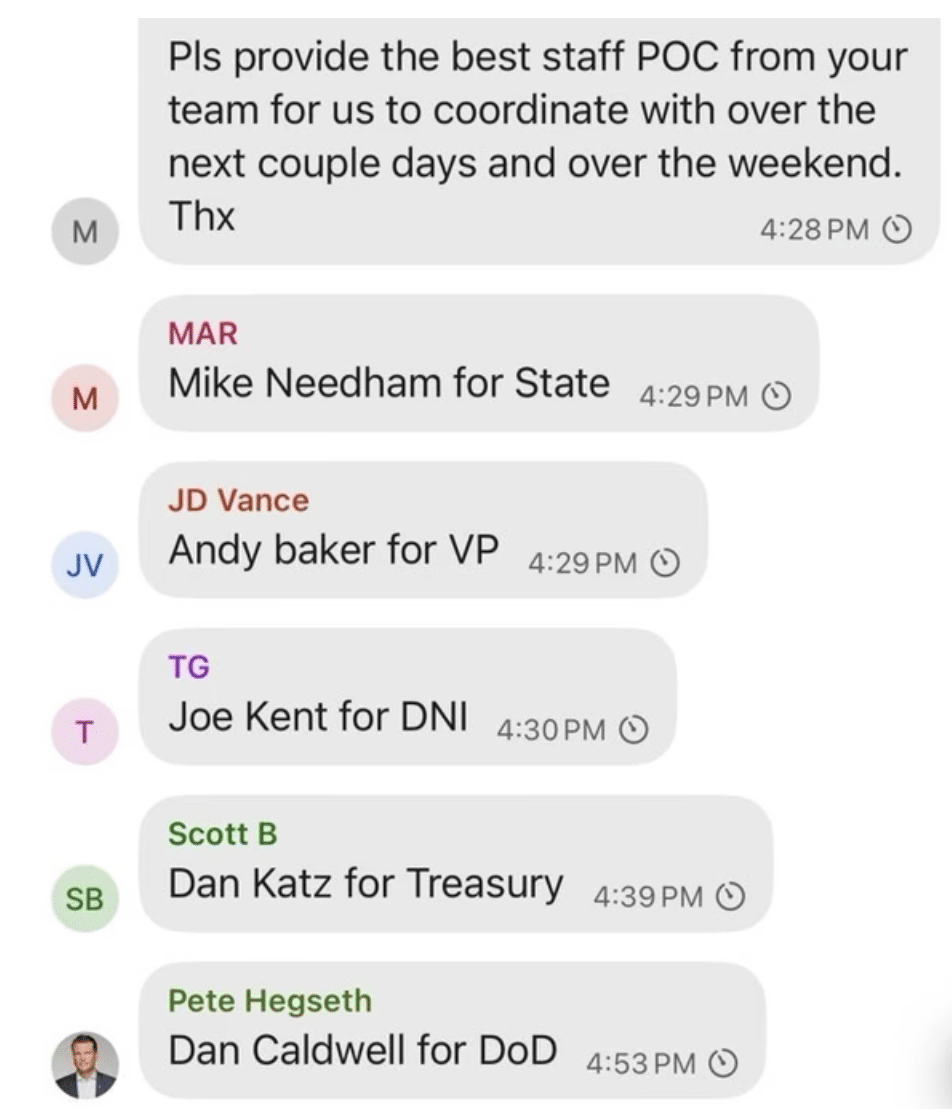
We’ve already seen that the three cabinet secretaries struggling to assert control over their own agencies deferred to Stephen Miller when he told the participants of the famous Signal chat what Trump thought.

That is, it’s not just that Stephen Miller is often the last one in the room with Trump. It’s not just that Stephen Miller’s policy ideas are batshit insane (and that he’s the author of Trump’s most egregious abuses of power). It’s also that Miller often stands in as the Word of DOGE, the Word of Trump.

Kremlinologists are pointing to evidence — his demotion at Trump’s most recent cabinet meeting, for example — that Elon’s power at the White House has started to wane (while ignoring that Elon has moved onto the next phase of takeover, cashing in, cashing in, and cashing in).

But behind all the intrigue, Stephen Miller’s ascendance remains, apparently uncontested and possibly unbound.

Whiskey Pete Hegseth Finally Finds Some White Men to Purge

Amid all the other news, the purge of suspected leakers Pete Hegseth announced last month has netted three targets — all white men, for a change! Politico has not only provided a roster, but described the scope of the leak investigation.

The Pentagon put a third top official on administrative leave Wednesday as part of a wide-ranging leak investigation, according to a defense official and a person familiar with the matter.

Colin Carroll, chief of staff to Deputy Defense Secretary Stephen Feinberg, was suspended a day after two other political appointees were placed on leave following a probe into potential leaks of sensitive information.

The leaks under investigation include [1] military operational plans for the Panama Canal, [2] a second carrier headed to the Red Sea, [3] Elon Musk’s controversial visit to the Pentagon to discuss China and a [4] pause in the collection of intelligence for Ukraine, according to the official.

[snip]

Dan Caldwell, a senior adviser to Defense Secretary Pete Hegseth, and Darin Selnick, the Defense Department’s deputy chief of staff, were escorted out of the Pentagon by security officers and had their building access suspended pending further investigation, the official said. Caldwell and Selnick both previously worked at Concerned Veterans for America, the nonprofit that Hegseth once led. [my annotation]

An Air Force Special Forces Command Chief Master Sergeant was also removed on Monday, though no one has said the investigation described to be targeting him is Pete Hegseth’s purge.

When this investigation was first reported by CNN, it focused on the disclosure to NYT, for a story published on March 20  [1], that Hegseth was about to give Elon Musk a briefing on US war plans against China.

The memo comes after President Donald Trump pushed back on a New York Times report that DOGE head Elon Musk would be briefed on US military plans for a potential war with China while at the Pentagon on Friday. Trump said he wouldn’t show such plans “to anybody.”

And surely that’s a big focus of this investigation. As news of these ousters broke, Marc Caputo released a story ret-conning Trump’s unhappiness with the briefing, claiming, against all sense, that Trump got mad at Elon but not, also, Hegseth about it.

  1. Defense Secretary Pete Hegseth suspended two top Pentagon officials, Dan Caldwell and Darin Selnick, as part of an investigation into who leaked word of a planned top-secret briefing on China for Elon Musk.
  2. Axios learned that Musk or Hegseth didn’t just decide to call off that briefing after the leak. President Trump himself ordered staffers to kill it.
  • “What the f**k is Elon doing there? Make sure he doesn’t go,” Trump said, a top official recalled to Axios.

Why it matters: Musk has annoyed several administration officials with his constant presence at the White House, his haphazard social media posts and his slash-and-burn tactics at his Department of Government Efficiency.

  • The planned Pentagon briefing, however, got him cross with the boss at the Resolute Desk.

Anyway, no one made sure Elon “doesn’t go;” the currently operative story is Elon went to the Pentagon, but didn’t get the briefing. If Trump were unhappy with the planned briefing, rather than its exposure, I doubt we’d have this kind of leak investigation, which purportedly prevented the briefing from happening.

But Politico mentions three more leaks targeted by the investigation:

  • A widely disseminated story [1] disclosing that DOD had developed military plans targeting the Panama Canal; NBC’s story was published March 13.
  • The deployment [2] of the USS Carl Vinson from Asia to the Red Sea; the Politico version, which noted USNI reported the news first, was like USNI’s report dated March 21. Both versions report the move first as a month-long extension of the deployment of the USS Harry S. Truman, which was damaged and then repaired in February after being struck by a merchant ship, with the Vinson sailing from East China to the Red Sea to overlap with it. On March 16, the Houthis attempted to attack the Truman in retaliation for the strikes on March 15 ordered up by Pete Hegseth’s signal chat, and potential Houthi disinformation has very recently claimed the Truman has been struck.
  • Stories [4] about a pause in intelligence sharing with Ukraine that were quickly and publicly confirmed by John Ratcliffe; here’s Politico’s March 5 version, bylined by one of the guys closely tracking the purge.

So in order, the leaks are:

  • March 5 story on Ukraine intelligence sharing
  • March 13 story on targeting Panama
  • March 20 story on the Elon briefing
  • March 21 story on the Vinson redeployment from the East China Sea to the Middle East

With that list in mind, let’s look at several aspects of the memo, dated the same day as the Vinson deployment, March 21, asking for the investigation.

It does, in fact, identify, “unauthorized disclosures of national security information involving sensitive communications with principals within the Office of the Secretary of Defense,” plural. So while the coverage focused on the Elon briefing, it reportedly entailed the others from the start, including the seemingly routine report on the Vinson deployment.

It not only mentioned “sensitive communications with principals within the Office of the Secretary of Defense,” but it asked for cooperation from “those responsible for maintaining and overseeing information security systems and in coordination with federal partners as required.” At first, in the days before Jeff Goldberg revealed Pete Hegseth conducts these discussions (including discussions about the Middle East operations like the Vinson deployment) via Signal chat, it seemed this might have been an investigation into DOD’s secure communications.

But given the inclusion of Dan Caldwell — the guy whom Hegseth instructed Mike Waltz to add as his representative to the famous Signal chat — as the first guy purged suggests this leak investigation could also be about the Signal chat.

Or other Signal chats. Mike Waltz apparently did this all the time.

American Oversight’s lawsuit seeking to preserve the signal chats Goldberg published already disclosed that the actual content of the chats did not get preserved on John Ratcliffe’s personal phone, and that between March 26 and March 28 — after Congress was already investigating — participants changed message settings.

In a filing asking James Boasberg to find that Ratcliffe defied his order submitted yesterday, American Oversight included this timeline of what we know from filings in that suit:

March 24: Excerpts of the Signal chat appear in The Atlantic.1

March 25: American Oversight files this action. On the same day, Defendant Ratcliffe testifies before the Senate Select Committee on Intelligence regarding his use of Signal.2

March 26: American Oversight files a motion for temporary restraining order. ECF No. 6. The same day, changes occur in the Signal chat “participants’ administrative settings . . . such as profile names and message settings.” Suppl. Blankenship Decl. ¶ 4, ECF No. 15-3. Also on the same day, The Atlantic publishes further excerpts from the Signal chat.3

March 27: This Court orders Defendants to “promptly make best efforts to preserve all Signal communications from March 11–15, 2025.” Min. Order, Mar. 27, 2025. The same day, the CIA’s Office of General Counsel reportedly issued a litigation hold notice. Blankenship Decl. ¶ 4, ECF No. 10-3.

March 28: Changes occur again in the Signal chat participants’ profile names and message settings. Suppl. Blankenship Decl. ¶ 4, ECF No. 15-3.

March 31: Defendant Ratcliffe’s Signal account is “reviewed” for the first time and found to contain no substantive messages from the Signal chat. Suppl. Blankenship Decl. ¶ 4, ECF No. 15-3.

1 See Jeffrey Goldberg, The Trump Administration Accidentally Texted Me Its War Plans, The Atlantic (Mar. 24, 2025), https://www.theatlantic.com/politics/archive/2025/03/trumpadministration-accidentally-texted-me-its-war-plans/682151/.

2 Sen. Select Comm. on Intel. Hr’g to Examine Worldwide Threats Tr., Mar. 25, 2025, available at https://www.dia.mil/Portals/110/Images/News/DIA%20in%20the%20News/Committee_Hearing _2025.pdf.

3 See Jeffrey Goldberg & Shane Harris, Here Are the Attack Plans that Trump’s Advisers Shared on Signal, The Atlantic (March 26, 2025), https://www.theatlantic.com/politics/archive/2025/03/signal-group-chat-attack-plans-hegsethgoldberg/682176.

All of that took place after Hegseth himself ordered an investigation into leaks including the extension of the Harry S. Truman deployment to fight the Houthis on March 21, the kind of thing that might have been on that Signal chat.

While American Oversight didn’t ask for any other declarations, it did note that the existing declarations [docket] raise real questions about who else, including Whiskey Pete, might have deleted these texts from their devices.

For example, rather than specifying which messages were preserved, the Supplemental DoD Declaration vaguely references the preservation of “existing Signal application messages,” which, as shown by the Supplemental Blankenship Declaration, could be none. Suppl. Bennett Decl. ¶ 2, ECF No. 15-1. Similarly, without specifying whether any substantive messages were preserved, the Supplemental State Declaration merely states that “images of the Signal chat”—including “any” images captured from the Secretary’s devices—have been preserved. See Decl. of Timothy J. Kootz ¶ 4, ECF No. 15-4. As with CIA, those “images of the Signal chat” may simply be the title of the group chat. The Supplemental State Declaration also suggests that Secretary Rubio accessed the Signal chat from multiple devices. Id. More broadly, the evidentiary issues identified in the Supplemental Blankenship Declaration raise substantial questions regarding what these other Defendants actually preserved.

In forthcoming filings, American Oversight will probe the clear deficiencies in Defendants’ recordkeeping practices evidenced by these standout omissions of whether and what substantive messages from the Signal chat still exist, as well as when and how any such messages were lost. [my emphasis]

All of which brings me to the last detail of the original leak announcement that has always struck me: it was set up not as conventional leak investigations are, as a referral to the FBI based on stories that include classified information. That’s how you find out who leaked what if you want all possible culprits involved. Rather, it was set up such that Hegseth himself would get reports on the findings, and from that point, the criminal referrals would go out.

This investigation will commence immediately and culminate in a report to the Secretary of Defense. The report will include a complete record of unauthorized disclosures within the Department of Defense and recommendations to improve such efforts. I expect to be informed immediately if this effort results in information identifying a party responsible for an unauthorized disclosure, and that such information will be referred to the appropriate criminal law enforcement entity for criminal prosecution. [my emphasis]

That is, this so-called leak investigation implicating the guy Hegseth would add to his inappropriate Signal chats was set up such that Hegseth himself gets to gatekeep who gets targeted by it.

He appears to have set it up that way, importantly, before he realized a journalist had witnessed him add Dan Caldwell to a Signal chat on which he himself would disseminate battle information to the personal cell phones of multiple list participants, including journalist Jeff Goldberg.

Update: Adding this for timeline considerations. Roger Wicker and Jack Reed asked DOD IG to investigate this on March 27, while participants in the Signal chat were altering names and retention.

[W]e ask that you conduct an inquiry into, and provide us with an assessment of, the following:

1. The facts and circumstances surrounding the above referenced Signal chat incident, including an accounting of what was communicated and any remedial actions taken as a result;

2. Department of Defense (DOD) policies and adherence to policies relating to government officers and employees sharing sensitive and classified information on non-government networks and electronic applications;

3. An assessment of DOD classification and declassification policies and processes and whether these policies and processes were adhered to;

4. How the policies of the White House, Department of Defense, the intelligence community, and other Departments and agencies represented on the National Security Council on this subject differ, if at all;

5. An assessment of whether any individuals transferred classified information, including operational details, from classified systems to unclassified systems, and if so, how;

6. Any recommendations to address potential issues identified.

This Is Your Social Safety Net on DOGE

[NB: check the byline, thanks. /~Rayne]

Elon Musk has repeatedly said government functions should be privatized.

You already know how that works out for the U.S., because it’s one of the biggest single differences between the cost of living in other first world countries and the U.S.

It’s also one of the biggest differences in life expectancy between other first world countries and the U.S.

Healthcare in the EU, for example, costs much less than it does in the U.S., and outcomes measured in life expectancy are far better.

But healthcare in the EU is not fully privatized; though not identical across all EU members, it’s based on universal access and publicly subsidized.

Ditto for Canada and Greenland, the countries Trump wants to seize. Better that they seize us and bring their healthcare systems with them.

But this month has also demonstrated the risk of taking Elon Musk seriously when it comes to privatization.

Imagine this is our social security system:

Screenshot of the Dow Jones, S&P 500, and Nasdaq composite indexes mid-day Friday, April 11, 2025 via Google Finance.
 

Who’s not going to get their checks if the bottom drops out even further? Why should Americans who’ve paid into Social Security over a lifetime of work have to worry about additional risk to their futures because unelected and unconstitutionally appointed Musk believes exposure to the market is what Americans need?

It’s bad enough that Americans’ cost of daily living expenses is further exposed to market risks because of Trump’s misbegotten, ill-considered tariffs. Musk believes Americans’ retirement years should be even more deeply risky.

It makes zero sense to listen to a man who has no empathy for others’ concerns, who has no experience dealing with a limited income and trying to make ends meet. He doesn’t have adequate background let alone personal history to make such judgments about what will work best for the American people; he doesn’t even view his children’s health as personal obligations (ex. recent public pleas by two of his children’s mothers for assistance with healthcare matters).

~ ~ ~

What really takes the cake is the silence of the business world.

Of course the financial industry is silently slavering over the chance to get their grubby mitts on our Social Security, and they’re staying quiet about it because they know they dare not set off the American public.

But Jeff Bezos’ Amazon-derived fortune was made in no small part off the subsidy that the U.S. Postal Service has been to American business.

USPS is the fallback for shipping nearly anything nearly anywhere in the U.S.; Bezos didn’t have to worry about whether his books would sell in North Utter Remote, Outer Territory USA. There was a post office nearby where purchasers could pick up their orders if they couldn’t be delivered to their door by USPS carriers on foot.

Bezos didn’t have to negotiate that. Didn’t have to buy sorter equipment, trucks, hire and train personnel, build sorting facilities, so on. All of that was on our dime when it wasn’t paid for by postage, until Amazon was successful enough to consider reducing shipping and handling costs further with their own trucks.

Furthermore, Bezos knew what the competitive rate for shipping a majority of Amazon’s products would be based on USPS rates – rates set by USPS bidding out trucking and equipment purchases. When Amazon started buying its own trucks, Amazon knew its costs had to be no more than USPS’ costs to deliver.

In short, our tax dollars and our volume of postage helped underwrite Jeff Bezos’ billions.

And he’s just going to sit there smug and mum, enjoying his irrational wealth while Musk shoots off his mouth about privatizing government.

Because Bezos will probably ensure the next billions he makes off our backs is from Amazon Postal Service.

Can’t begin to imagine how much our health care will cost once Amazon has the contract both for postal delivery of medications and health care insurance.

You can only imagine when Musk takes his chainsaw to Amtrak what will happen next: he’ll claim only his vaporware Hyperloop is the alternative, and American people should pay him billions to implement it instead of a long-proven passenger rail system.

Privatization will not yield better outcomes for the American people and you already know that. Don’t wait until Musk uses DOGE to shut off funds to the USPS; he’s already targeted USPS personnel. Contact your representative and senators and insist that government should NOT be privatized.

Not our Social Security, not our mail delivery, not a single government service which could end up becoming a pricey-to-us privatized profit center for billionaires.

Amid DOGE’s Failure to Find Fraud Committed by Entities Other than DOGE, DOGE Automates Deportation

The other day, Acting ICE Director Todd Lyons claimed he wanted to get his deportation system working like Amazon Prime does.

The leader of Immigration and Customs Enforcement said that his dream for the agency is squads of trucks rounding up immigrants for deportation the same way that Amazon trucks crisscross American cities delivering packages.

“We need to get better at treating this like a business,” Acting ICE Director Todd Lyons said, explaining he wants to see a deportation process “like (Amazon) Prime, but with human beings.”

At first, I had a hard time even envisioning what he could mean by that. But then NYT described how Trump has starting setting the Social Security records of immigrants to dead as a way to debank them.

The goal is to cut those people off from using crucial financial services like bank accounts and credit cards, along with their access to government benefits.

The effort hinges on a surprising new tactic: repurposing Social Security’s “death master file,” which for years has been used to track dead people who should no longer receive benefits, to include the names of living people who the government believes should be treated as if they are dead. As a result of being added to the death database, they would be blacklisted from a coveted form of identity that allows them to make and more easily spend money.

Earlier this week, the names of more than 6,300 migrants whose legal status had just been revoked were added to the file, according to the documents.

The initial names are limited to people the administration says are convicted criminals and “suspected terrorists,” the documents show. But officials said the effort could broaden to include others in the country without authorization.

Their “financial lives,” Leland Dudek, the Social Security Administration’s acting commissioner, wrote in an email to staff members, would be “terminated.”

[snip]

On Tuesday, Aram Moghaddassi, a software engineer working for DOGE, sent Mr. Dudek the first batch of names to be added: the list of more than 6,300 immigrants homeland security officials had identified as having temporary legal status but who were now either on what he described as “the terrorist watch list,” or had been flagged as having “F.B.I. criminal records,” the documents show. The people’s parole status had been revoked that same day, Mr. Moghaddassi wrote.

The list included a 13-year-old and seven other minors, raising fears inside the agency that it was overly broad, according to one person familiar with the list who spoke on the condition of anonymity to discuss sensitive information.

This will likely work in tandem with DHS’ plan to enforce a registration system, starting today, that serves to turn undocumented presence in the US into a felony (ironically, DHS is formalizing this registration system after Pam Bondi announced she’ll shift away from prosecuting FARA crimes, meaning the foreigners trying to influence US politics get better treatment than the ones picking crops).

Meanwhile, the acting IRS Commissioner, Melanie Krause, has announced her resignation after losing the battle to prevent tax data from being repurposed to feed Trump’s migrant campaign.

Krause’s decision to accept the agency’s deferred resignation offer comes on the heels of the IRS and Department of Homeland Security finalizing an agreement Monday to provide sensitive taxpayer data to federal immigration authorities to help the Trump administration locate and deport undocumented immigrants.

The controversial data sharing agreement between the agencies was one factor that played a role in Krause’s decision to leave, according to one source with knowledge of the situation. The source said that the last draft of the agreement that Krause had been involved with, and had reviewed, was different than the final agreement. Krause learned about the details of the final agreement from the news, the source said.

The Social Security-driven debanking and the IRS data-sharing are both DOGE-led efforts to mine data collected for one purpose and use it for another purpose — to make the deportation system work like a modern supply chain does. You might think this effort has nothing to do with waste fraud and abuse, but as I noted, back on February 19, Trump added streamlining deportation to the mandate of DOGE.

Meanwhile, yesterday Elon Musk confessed DOGE only expects to find $150 billion in saving for FY26 (that is, starting in October), a fraction of a fraction of what he previously claimed.

  • Musk said he anticipates the $150 billion savings in the next fiscal year at Trump’s cabinet meeting Thursday.
  • Musk repeated his claim that fraud and waste were “very common” in the government, this time giving the example, without evidence, of “people getting unemployment insurance who haven’t been born yet.”
  • As recently as last month, Musk told Fox’s Bret Baier he expected DOGE to reach $1 trillion in savings by the time his tenure as a government employee is up in a matter of months.

This means that Elon won’t manage the same level of savings that the Inspectors General that Trump fired were on course to find, all without cutting services like Elon has. We could still have cancer cures and achieve the same level of savings — and all that’s before you consider the $500 billion hole Elon created in revenue projections.

Trump brought in an alleged illegal immigrant in the guise of finding waste fraud and abuse.

And all he achieved was to dramatically cut services that Americans cherish and, in the guise of finding fraud, automate the deportation system.