
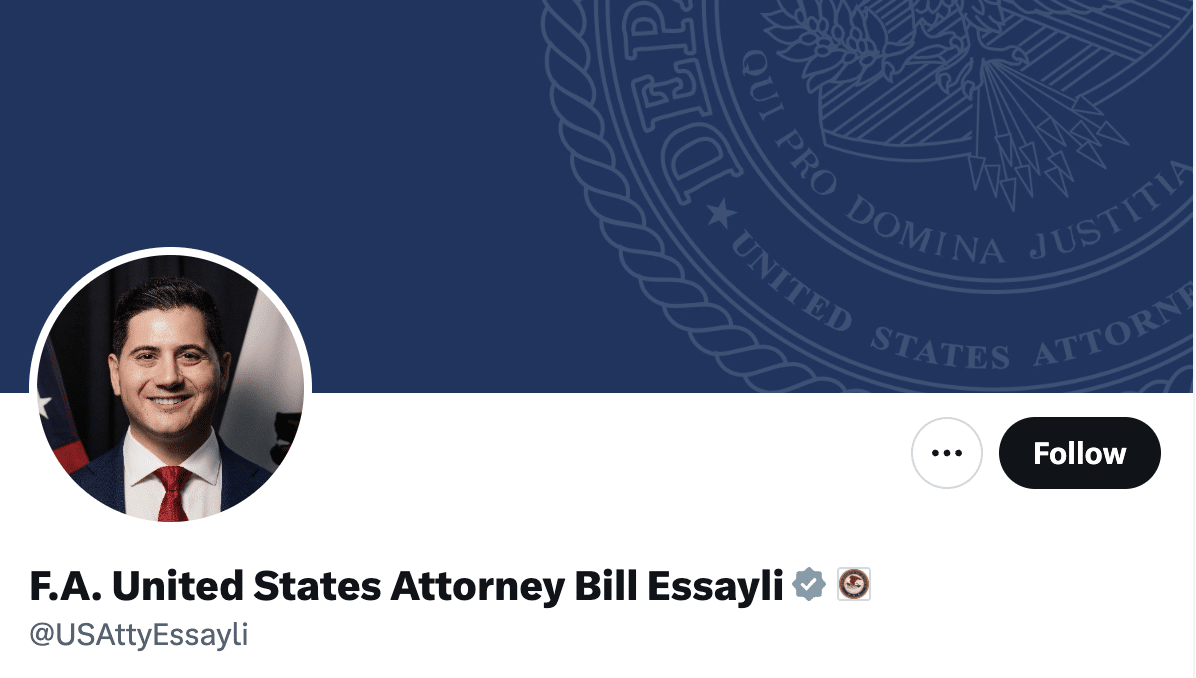
Bill Essayli Has an Identity Crisis
First Assistant AUSA Bill Essayli, who continues to serve most functions of US Attorney in Los Angeles even after Judge Michael Seabright ruled he’s not lawfully the US Attorney, has an identity crisis.
And it’s not his continued attempts to use textual gimmicks to obscure that he’s not the US Attorney, as the way he adds the initials “F.A.” in his Xitter profile as if his given name is “Fucking Asshole.”

Though the defendant who first forced a ruling that Essayli was playacting, Jaime Hector Rodriguez, continues to insist that Essayli can’t just change his title in a bid to keep powers he does not lawfully possess.
The simple answer is that Mr. Essayli is exercising power he does not possess. He has transcended the land of statutes. He is wielding significant authority, but the whole point is that he lacks that authority: it was not validly conferred on him by Congress. No powers are conferred on “a FAUSA” by statute, id., because the FAUSA position is absent from the statutes, R.M. 9–10. But this FAUSA has inferior-officer powers, because he is exercising powers he has never been conferred. E.g., R.M. 9 & n.2. This is just another way for the government to cast the trick it has played in benign language: appoint an ineligible individual to a vacant office, give him a different title not set out in the statutes, and thereby avoid all statutory limits on the appointment.
Lindsey Halligan’s similar identity problem in EDVA is heating up too.
Rather, I’m talking about the identity issues that threaten to destroy his efforts to criminalize doxing in the immigration context.
In US v. Raygoza, Essayli charged three women who followed an ICE officer — believing he was headed to conduct another snatching — only to arrive at his home. They continued to livestream, and from a neighbor’s property, they both invited others to come to the neighborhood but also announced to his neighbors that he’s la migra.
Yesterday, Fucking Asshole Bill Essayli responded to Sandra Samane’s and Ashleigh Brown’s motions to dismiss (Brown is represented by the same FPDs who made a frivolous assault charge against her go away last year). It’s not so much that their arguments were rock solid; motions to dismiss are really difficult to win. Rather, it’s that in the course of two footnotes, Fucking Asshole Bill Essayli revealed grave problems with his case. The second explained why a separate motion moved to dismiss the second count of the indictment, doxing, the crime which the defendants allegedly conspired to commit.
4 Defendants failed to state the actual home address of R.H. on social media, and instead said the number of a neighbor’s home approximately 100 feet from that of R.H. Because 18 U.S.C. § 119 criminalizes making publicly available “the home address” of covered individuals, the government has moved to dismiss the substantive count (Count Two).
The definition of restricted personal information as used in the law pertains only to the alleged victims own address; the defendants here livestreamed his neighbor’s address (in detention filings in her now-dismissed assault case, Brown explained that they stayed some distance from the victim’s house so as to comply with her release conditions).
A still graver problem for Fucking Asshole Bill Essayli is that — in a filing that elsewhere focuses closely on the terms specifically defined in the doxing statute (“restricted information” and “covered persons”) and on the import of the definitions generally (which is normal in responding to a void for vagueness challenge), Fucking Asshole Bill Essayli uses his first footnote to offer a definition of doxing.
1 Doxxing is short for “dropping documents.” Vangheluwe v. Got News, LLC, 365 F. Supp. 3d 850, 858 (E.D. Mich. 2019). The practice involves “using the Internet to source out and collect someone’s personal and private information and then publicly releasing that information online.” Id. The “goal of doxxing is typically retribution, harassment or humiliation.” Id.
He’s got two problems with that footnote.
First, what the defendants did — follow a guy home unwittingly and livestream where they ended up — is entirely different from “using the Internet to source out and collect someone’s personal and private information,” which only underscores that no one alleges that the defendants specifically sought out the ICE guy’s address. They didn’t dox him, according to the definition in this footnote.
Worse still, the defined goal of doxing in that footnote — “retribution, harrassment[,] or humiliation” — differs from the intent requirement in the statute:
(a) In General.—Whoever knowingly makes restricted personal information about a covered person, or a member of the immediate family of that covered person, publicly available—
(1) with the intent to threaten, intimidate, or incite the commission of a crime of violence against that covered person, or a member of the immediate family of that covered person; or
(2) with the intent and knowledge that the restricted personal information will be used to threaten, intimidate, or facilitate the commission of a crime of violence against that covered person, or a member of the immediate family of that covered person,
The defendants may have doxed the ICE goon. They may well have decided to humiliate him in front of his neighbors by revealing that he is an ICE goon.
But there’s a chasm between hoping to humiliate someone who does a disfavored job and intending for someone to use that information to commit a crime of violence against them. Fucking Asshole Bill Essayli attempts to dodge that by saying the conspiracy should not incorporate the elements of the count he’s seeking to admit and also stating that they won’t argue the defendants intended a crime of violence to happen to the ICE guy.
Separately, Brown argues the indictment must be dismissed because it does not specify the “crime of violence” Brown allegedly intended to incite. (Brown Mot. 19-21.) Even assuming this argument is applicable to the conspiracy alleged in Count One and not just the substantive count the government has moved to dismiss, at trial the government does not intend to proceed on the theory that defendants conspired to release R.H.’s home address with the intent to incite the commission of a crime of violence against him, or did so with the intent and knowledge that the restricted information would be used to facilitate the commission of a crime of violence against him. Defendant’s argument with respect to this portion of the statute is thus moot.
But he never gets around to addressing the larger point. Humiliation is not a crime of violence. But it is also not a threat or even intimidation.
The problem with this is made more apparent when Fucking Asshole Bill Essayli engages in a hypothetical dismissing Brown’s attempt to say she couldn’t have doxed the victim, because his address was already public. Brown’s tack would lead to absurd results, Fucking Asshole Bill Essayli says, because if it held, then how would they criminalize someone threatening the daughter of a judge (like Trump’s doxing of Barack Obama, something Trump has done), and how would they criminalize a defendant posting a witness’ address with the intent they they be intimidated by the criminal’s mob (again, something Trump has done more than once or twice or a hundred times).
And to interpret the statute as Brown would have it would lead to absurd results. Take, for example, the hypothetical of a judge’s daughter posting a photograph on Instagram that reveals her home address: a photograph of her family standing outside her home where the mailbox is visible. A defendant who later appears before the judge would not be subject to prosecution for posting the judge’s home address on an online forum with the intent to threaten the judge due to the daughter’s prior Instagram post. Similarly, a juror, informant, or witness would be cut off from statutory protection if a defendant’s family member or gang associate followed her home and posted the address on Facebook to intimidate her, but her address was already listed in the Whitepages.
In both those cases, of course, a prosecutor could — and should have, in the case of serial criminal Donald Trump — charged that as obstruction, witness tampering.
But these hypotheticals only underscore the point: in a filing asserting that doxing is done for humiliation, Fucking Asshole Bill Essayli is dodging language that requires further intent, not just to humiliate a goon in front of his neighbors, but to threaten him.
Threatening someone with social opprobrium is not the same as threatening someone with physical violence.
Yet the former is what Fucking Asshole Bill Essayli attempts to criminalize here.
Fucking Asshole Bill Essayli wants to criminalize any effort to shame someone for doing a shameful job. And while the argument may well get beyond this effort to dismiss the indictment, he has confessed in this filing that these women didn’t commit the charged crime.
