Posts

When Even the German Far-Right Thinks You’ve Gone Too Far . . .

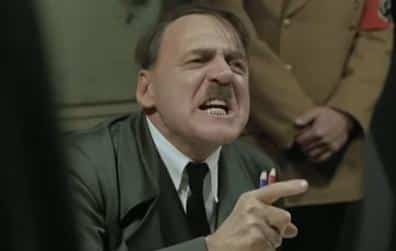
Der Führer, upon learning that things are not going as he would like.

From Politico.eu:

Germany’s far-right Alternative for Germany (AfD) party has long sought close ties to the Trump administration in its quest for powerful international allies and an end to its political isolation at home.

But as public sentiment in Germany increasingly turns against U.S. President Donald Trump and his foreign interventionism — in particular his talk of taking control of Greenland and his seizure of Venezuelan President Nicolás Maduro — AfD leaders are recalibrating, putting distance between their party and a U.S. president they previously embraced.

“He has violated a fundamental election promise, namely not to interfere in other countries, and he has to explain that to his own voters,” Alice Weidel, one of the AfD’s national leaders, said earlier this week.

Hmm . . . I don’t recall Weidel complaining when Trump, Vance, and Musk were stumping for the Afd in the last national elections in Germany.

With that as background, it’s that much more impressive that Weidel now is throwing Trump under the bus. Think about that for a minute: a would-be Führer who is underbussed by the neo-Nazi AfD is no Führer at all. And for it to be the German far-right . . . that’s really gotta leave a mark. Stephen Miller must be so sad.

Or emboldened. “These AfD folks are so soft, so lacking in strength . . . Looks like it is up to us to remind Germans of their own heritage and strength.”

The AfD is the second-largest party in the Bundestag, much to the horror of Germany’s conservatives and liberals alike, and the AfD seems to support everything Miller and Trump embrace: Islamophobia, anti-immigration, and historical revisionism, just to name a few. Even so, the AfD looks at Trump’s comments about Greenland (following his actions in Venezuela) and says “no thanks – that’s too extreme, even for us.”

Enter Mike Godwin, of Godwin’s Law fame, speaking with Politico two years ago:

So to be clear — do you think comparing Trump’s rhetoric to Hitler or Nazi ideology is fair?

I would go further than that. I think that it would be fair to say that Trump knows what he’s doing. I think he chose that rhetoric on purpose. But yeah, there are some real similarities. If you’ve read Hitler’s own writing — which I don’t recommend to anyone, by the way — you see a dehumanizing dimension throughout, but the speeches are an even more interesting case.

What we have of Hitler’s speeches are mostly recorded, and they’re not always particularly coherent. What you see in efforts to compile his speeches are scholars trying to piece together what they sounded like. So, it’s a little bit like going to watch a standup comedian who’s hitting all of his great lines. You see again and again Hitler repeating himself. He’ll repeat the same lines or the same sentiment on different occasions.

With Trump, whatever else you might say about him, he knows what kinds of lines generate the kinds of reactions that he wants. The purpose of the rallies is to have applause lines, because that creates good media, that creates video. And if he repeats his lines again and again, it increases the likelihood that a particular line will be repeated in media reporting. So that’s right out of the playbook.

And now the lines aren’t hitting in quite the same way, as the AfD (of all people!) has noticed. Nothing hurts worse that being the open-mic comedian who throws out what they think is a great punchline, only to hear the sounds of silence.

Godwin ends his interview like this:

When I was growing up and being taught the American system of government, we would always be taught that the U.S. government has checks and balances in its design, so you can’t take it over with a sentiment of the moment. But I think what we’ve learned is that the institutions that protect us are fragile. History suggests that all democracies are fragile. So we have to be on the alert for political movements that want to undermine democratic institutions, because the purpose of democratic institutions is not to put the best people in power, it’s to maintain democracy even when the worst people are in power. That’s a big lift.

“Even when the worst people are in power.”

Godwin said that two years ago, but damned it if doesn’t sound like he said it yesterday. And we are finding out now just how big a lift it is to maintain democracy with folks like that in power.
Four Years and Five Weeks

Trump announces the end of the transatlantic alliance

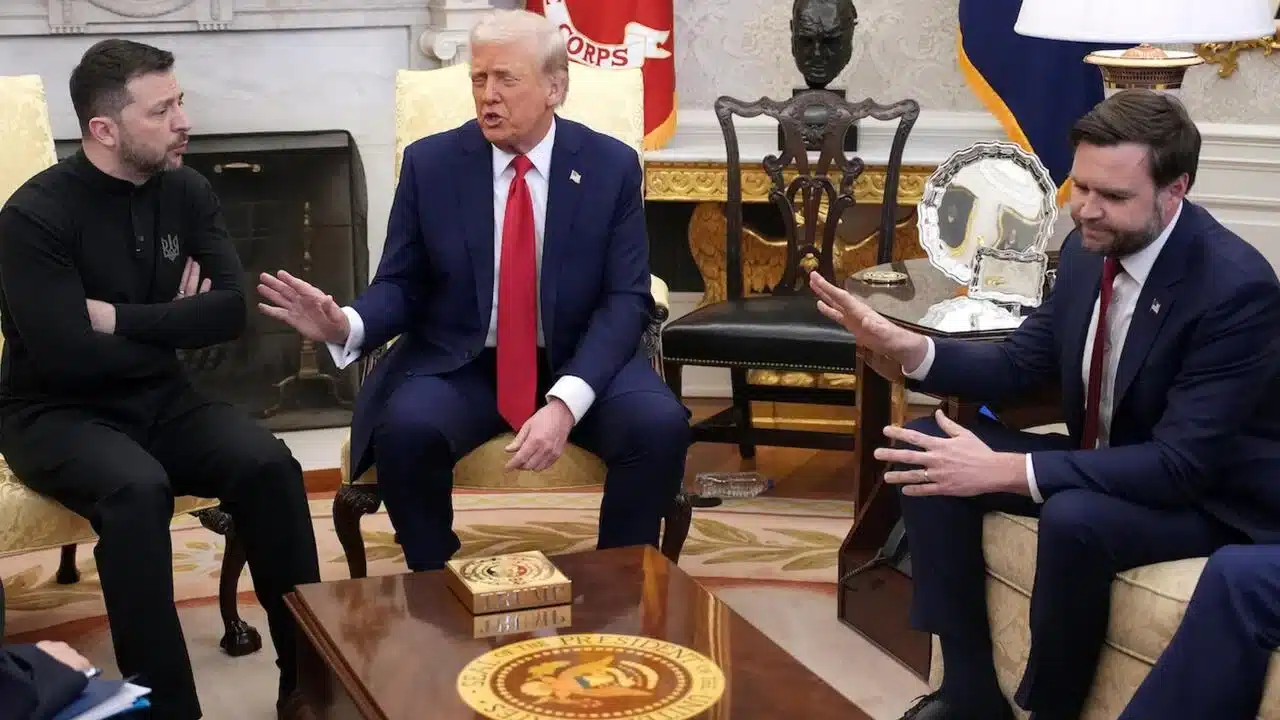
First it was Emmanuel Macron, putting his hand on Trump’s knee as he publicly corrected Trump in the Oval Office, in the presence of cameras, on the fact that Europe’s contributions to support Ukraine were (a) grants, not loans, and (b) larger than the contributions made by the US. Trump, in turn, tried to toss out his well-worn talking points, but the damage was done. Trump was called out by a foreign leader as a liar, in his very own office and seat of power.

Then it was Keir Starmer, waving a fancy invitation from King Charles to a state dinner, who did exactly the same thing. He publicly corrected Trump in the Oval Office, in the presence of cameras, on Europe’s support for Ukraine. Again, Trump hemmed and hawwed, and embraced the (Starmer: “unprecedented!”) invitation to a second state visit, but the damage was done. Trump was called out by a second foreign leader as a liar, in his very own office and seat of power.

You had to know this would not sit well.

As network after network played the clip of Macron’s hand on Trump’s knee, after all the networks showed Trump fawning over the Bright Shiny Thing that Starmer dangled in front of him, as Starmer very politely called Trump a liar, everyone knew that this would not end well.

And today, it was Volodymyr Zelenskyy’s turn . . . and as anyone with half a brain could anticipate, it *did* not end well.

Personally, I was amused by J.D. Vance’s holier-than-thou whining about Zelenskyy making a benign appearance in Pennsylvania saying “thank you” to the US for their support and calling it Election Interference. I don’t remember Vance taking up umbrage when the head of DOGE Elon Musk appeared and spoke at the national political rally of the neo-Nazi Alternative for Germany (AfD) party just days ahead of the recent German election, and who repeatedly praised the AfD via Xitter. After the AfD came in second, with a sizable caucus in the new Bundestag, Musk called the head of the AfD to offer congratulations and called her party the future of Germany, and Vance’s reaction was *crickets*.

Well, to be scrupulously fair, that’s not true. He *did* say something, but rather than condemning such interference, Vance joined it. At the Munich Security Conference, Vance praised the AfD (not by name but by lauding their political positions on immigration and other policies) and attacked mainstream German political parties for refusing to work with the AfD.

Americans might not have been listening to all of this, but the Europeans were – especially the Germans – and they knew exactly who Vance was praising. After the German elections, the victorious chancellor-elect made a stunning statement. From Deutsche Welle:

After his party’s victory in the election was confirmed Sunday night, [CDU party leader Friedrich] Merz said that he wanted to work on creating unity in Europe as quickly as possible, “so that, step by step, we can achieve independence from the US.”

Until recently, this would have been a highly unusual thing for any leader of the CDU to say. After all, it has always had a strong affinity for the US.

“Merz aligns himself with the legacy of historical CDU leaders such as [former chancellors] Konrad Adenauer and Helmut Kohl, both of whom played pivotal roles in strengthening transatlantic relations,” said Evelyn Gaiser, a policy advisor on transatlantic relationships and NATO with the Konrad Adenauer Foundation, a German think tank that is associated with but independent of the Christian Democrats.

[snip]

Merz spoke out after JD Vance’s speech at the Munich Security Conference (MSC) in February, in which the US vice president said that the biggest threat to Europe did not come from Russia or China, but “from within.”

“This is really now the change of an era,” Merz said on stage at the MSC. “If we don’t hear the wake-up call now, it might be too late for the entire European Union.”

Add this into the context of withdrawing from the World Health Organization and eliminating all the work done by USAID, and the message is crystal clear. While yes, this meeting today in the Oval Office was about Ukraine, it was really a sign of something much much larger.

In April 2021, when Joe Biden addressed a joint session of Congress in a non-State of the Union address, he said this:

I’ve often said that our greatest strength is the power of our example – not just the example of our power. And in my conversations with world leaders – many I’ve known for a long time – the comment I hear most often is: we see that America is back – but for how long?

We now know the answer: four years and five weeks.

RIP the Transatlantic Alliance (1945-2025).