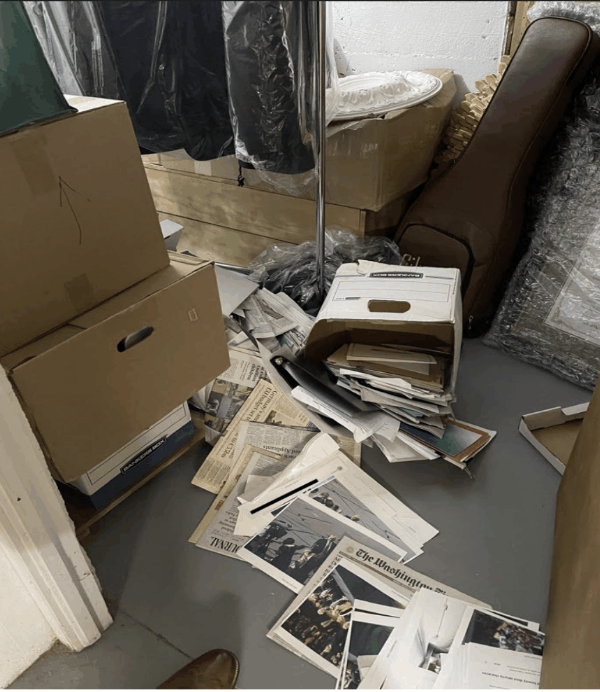
Stan Woodward Claims He Doesn’t Know Where the Missing Beautiful Mind Boxes Went

Perhaps the most amazing detail in the stolen documents transcript of last week’s hearing before Judge Aileen Cannon is that until the summer, Trump still had a Q clearance.

There is a category of documents that it — actually in unclassified discovery, we learned a week or two ago that there is a certain category of documents that require what is called a “Q clearance” and it includes one of the charged documents, and we learned that it’s a Department of Energy program. We learned that President Trump continued to have an active security clearance, even after he was indicted in this case, with the Department of Energy. Now that, in our view, is the definition of Brady. It was — I’m not going to say it was buried, but it was provided to us in discovery as part of miscellaneous materials at some point in the third or fourth production. I mean, it is literally a memo from the Department of Energy dated June — dated late June of this year, June 28th of this year, saying that, oh, we should remove Donald J. Trump from the person who has an active security clearance. He has been charged with possessing a document in violation of federal law, when he has an active security clearance with the holder of that document.

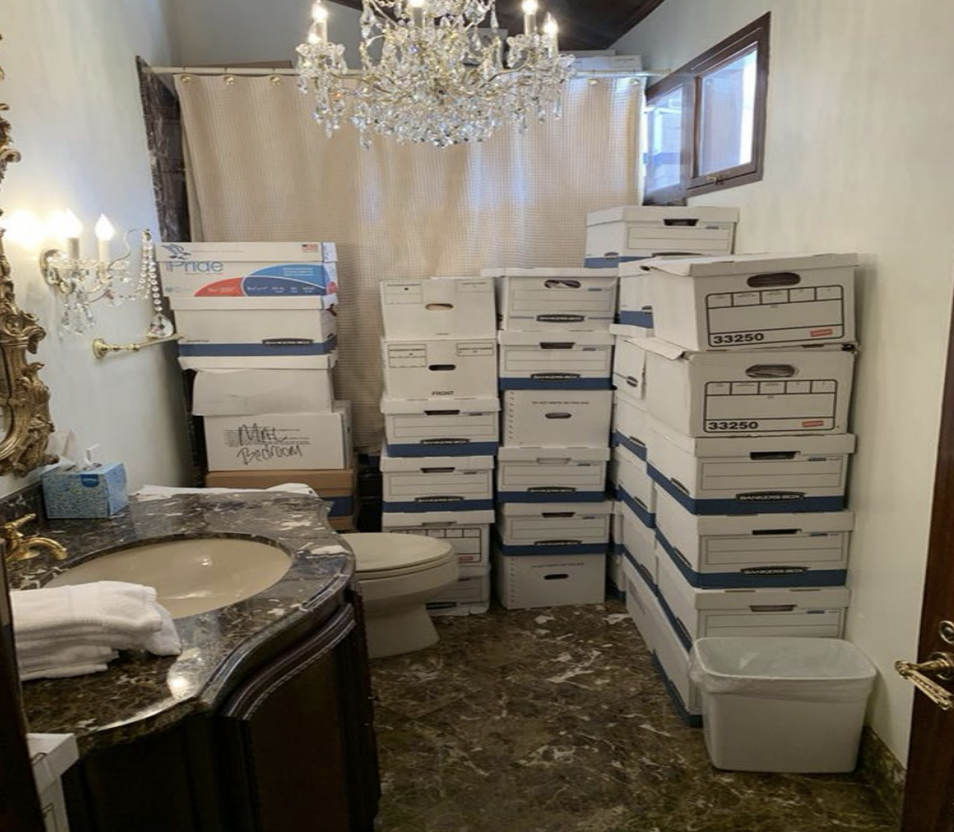
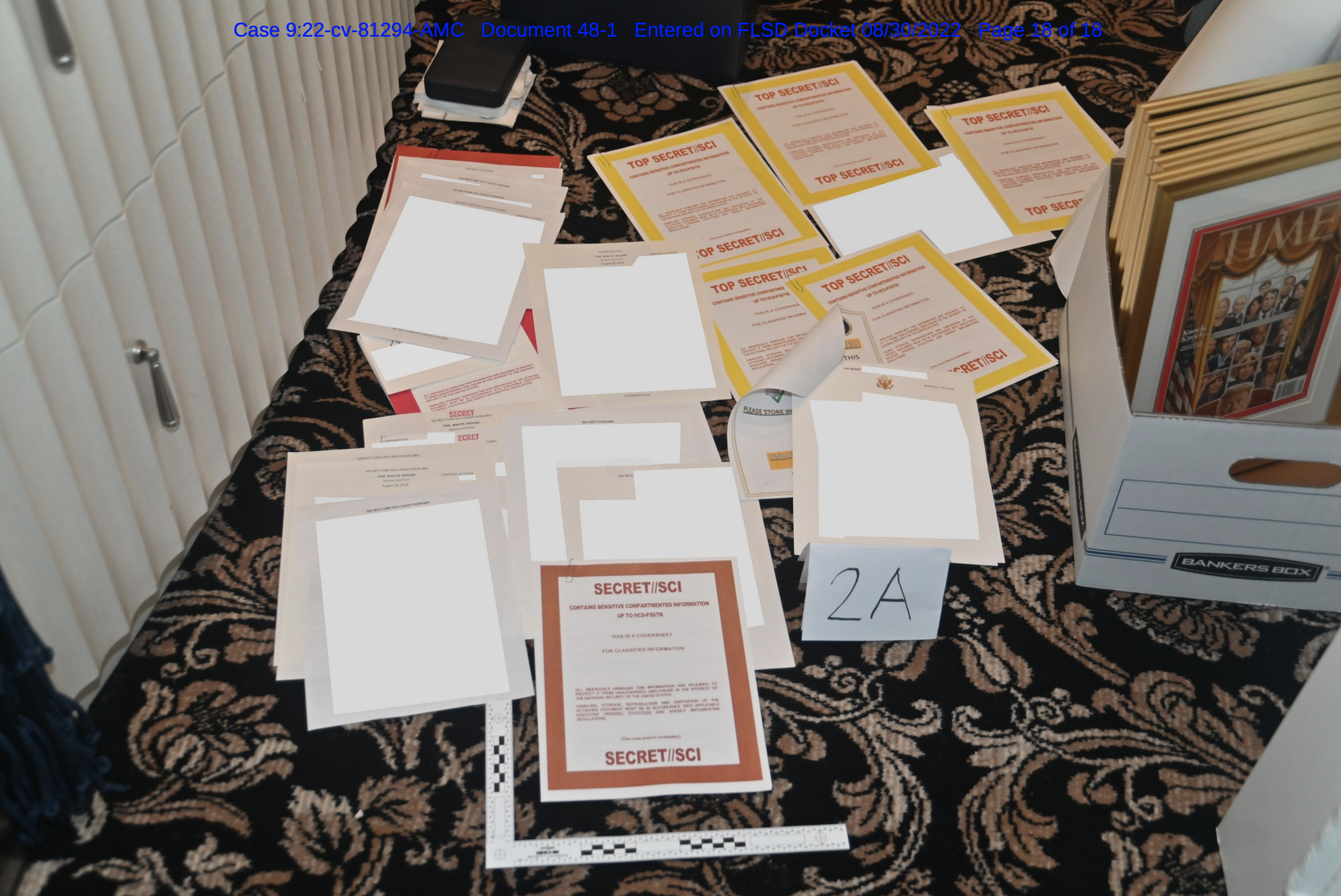
The detail doesn’t help as much as Trump’s attorney, Todd Blanche, would have you think. Whatever clearance Presidents get under the Atomic Energy Act (especially since presidents don’t get clearance; on Bluesky, Cheryl Rofer suggests he may have gotten DOE clearance while still a candidate) obliges them to follow document handling rules that might not have been as meticulously spelled out for Trump under his access to other classified documents. That he still had access when he was found with nuclear documents in August 2022 only means he was affirmatively violating the terms of his Q clearance, not that he could legally store nuclear documents in his gaudy bathroom.

Most people who get charged under the Espionage Act have or had clearances; those clearances actually make it easier to prosecute them.

Though Trump finally added someone appropriate to an Espionage Act trial last month, former SDNY National Security AUSA  Emil Bove, Blanche still seems to have a woefully inadequate understanding of how 18 USC 793 elements of the offense get proven at trial.

And Jay Bratt seems to be unable to conceive that his counterparts (and, probably, Judge Cannon) fail to understand that.

Bratt’s attempt to explain all this — something that makes a lot of sense to me from covering so many of these trials — was just one of two times where (in the transcript at least) Cannon abruptly cut off Bratt, as she often does when she risks embarrassment.

BRATT: I do not — we do not believe that the motion to compel litigation needs to be complete before they can file with the Court their theory of defense with respect to the 793 charges, and it kind of strains credulity that they say they can’t do that. You know, the elements of 793 are unauthorized possession of a document containing national defense information, possessing it willfully, that is with knowledge that what you are doing is unlawful, and failing to return it to a proper person. All that information they can flesh that out for the Court, and there is really — they may have legal — separate legal challenges to the 793 charges, but if you look at the elements, those are the defenses: Either he didn’t possess it, or he was authorized to possess it, or the information doesn’t contain national defense information, or he wasn’t acting willfully, or he returned it before he was being asked to return it. Those are the defenses, and they may have other color they want —

THE COURT: But to some extent, of course, one would have to review the relevant classified discovery in order to formulate a meaningful response, even if maybe not entirely complete, it would be difficult to just sketch out a skeleton, so to speak, of your theory without really doing so rooted in the documents themselves.

MR. BRATT: So I’m not sure that you do need to be able to say, no, we know this doesn’t contain NDI for the Court to rule on whether or not what we are presenting in Section 4 is relevant and helpful to the Defense, I don’t think so. I understand that, you know, they have said in their pleadings that they are going to strongly contest whether or not the information was national defense information, strongly contest whether it was closely held. Our burden is to prove that it was, and we embrace that burden; but these documents, you know, I —

THE COURT: That’s fine. We don’t need to talk about the actual contents of the documents, obviously, given this is a public hearing.

Blanche was pretty obsessed with the classification determinations, marveling over the fact that prosecutors had to talk to the Intelligence Community before deciding what documents to charge, what documents they could charge.

We have seen communications between NARA and the Department of Justice and the White House and the Special Counsel that started way before what has been publicly disclosed and extensive meetings, extensive communications; and so we feel very strongly and expect that we will win on that, when we file the motion that NARA is absolutely part of this prosecution team and that the intelligence communities that they worked very closely with in determining the — well, from what we can tell, the particular documents that they chose to charge, so there is purportedly a tranche of documents that have classified headings on them, and then 32 that they decided to charge. That wasn’t just done in a vacuum. They didn’t just, you know, pick 32 documents out of a hat and say, “We will go with these.” There was a lot of coordination that we can tell from the materials we do have with the intelligence community that ultimately led them to proceed the way they did.

So yes, we have an answer with them. They say very strongly that they view the prosecution team as being limited to the Special Counsel’s Office and the FBI, and we very strongly believe that’s wrong.

That may have been a cynical ploy to treat the IC as part of the prosecution team, which in turn may be an attempt at graymail.

Blanche also claimed that the defense had not yet received all the classification reviews for these documents, and had yet to receive Jencks production for people he imagines will sit on the stand and attest to the classification of each document, in a trial where the standard is National Defense Authorization, not classification.

THE COURT: What about classification reviews, have you received all of those?

MR. BLANCHE: No, Your Honor, we have not received all of them. That is one of the things that we are continuing to ask about. We have received them for — I believe for the charge documents; but as what should be obvious from the volume compared to the 32 counts, there is a tremendous number of documents that are extraordinarily important to our defense that are purportedly classified that we don’t have any information about at this time.

[snip]

A little bit about the classified Jencks material, as was discussed. The issue of whether a particular document is classified or not is something for the jury. And what we are looking for in discovery and what we don’t have is that has to be from a witness. There has to be a witness that is testifying about why a particular document is classified; and as part of that, like any witness, we are entitled to 3500 and Jencks material and we don’t have that. We don’t have that for all the witnesses, and our concern is that there is this class or category of Giglio and Jencks material that we are going to get at some later date which we are then going to — it’s another Section 4 litigation, at that point, because we are going to then ask the Court what we can use to impeach the witness, what information we are allowed to cross-examine him or her on.

Bratt did correct Blanche to say that Trump had already gotten all the classification determinations for all the classified documents retrieved from Mar-a-Lago.

THE COURT: Now, I went through some of these categories with Mr. Blanche, but classification reviews, are those included in the 5,500 and/or the disks?

MR. BRATT: Yes. And just to respond to something Mr. Blanche said, and it may have been oversight, it is not just for the 32 documents. It is for all 340-some documents that were at Mar-A-Lago.

But I just think that Blanche doesn’t get how easy it’ll be to convince jurors that you can’t put nuclear documents in a beach resort shower (and that’s all before the smoke and mirrors that the government uses in all Espionage Act trials, which will be epically contentious here).

I don’t think he understands any of this.

This all brings me to something I’ve been wondering: what the government has been withholding anticipating its CIPA 4 filing, which has been delayed by various Trump games about CIPA. CIPA 4 covers stuff they’ll share with Judge Cannon to have her rule whether the material needs to be turned over to the defense (the standard is whether the material is relevant and helpful to the defense), and if so, whether DOJ can use substitutions for some of the information.

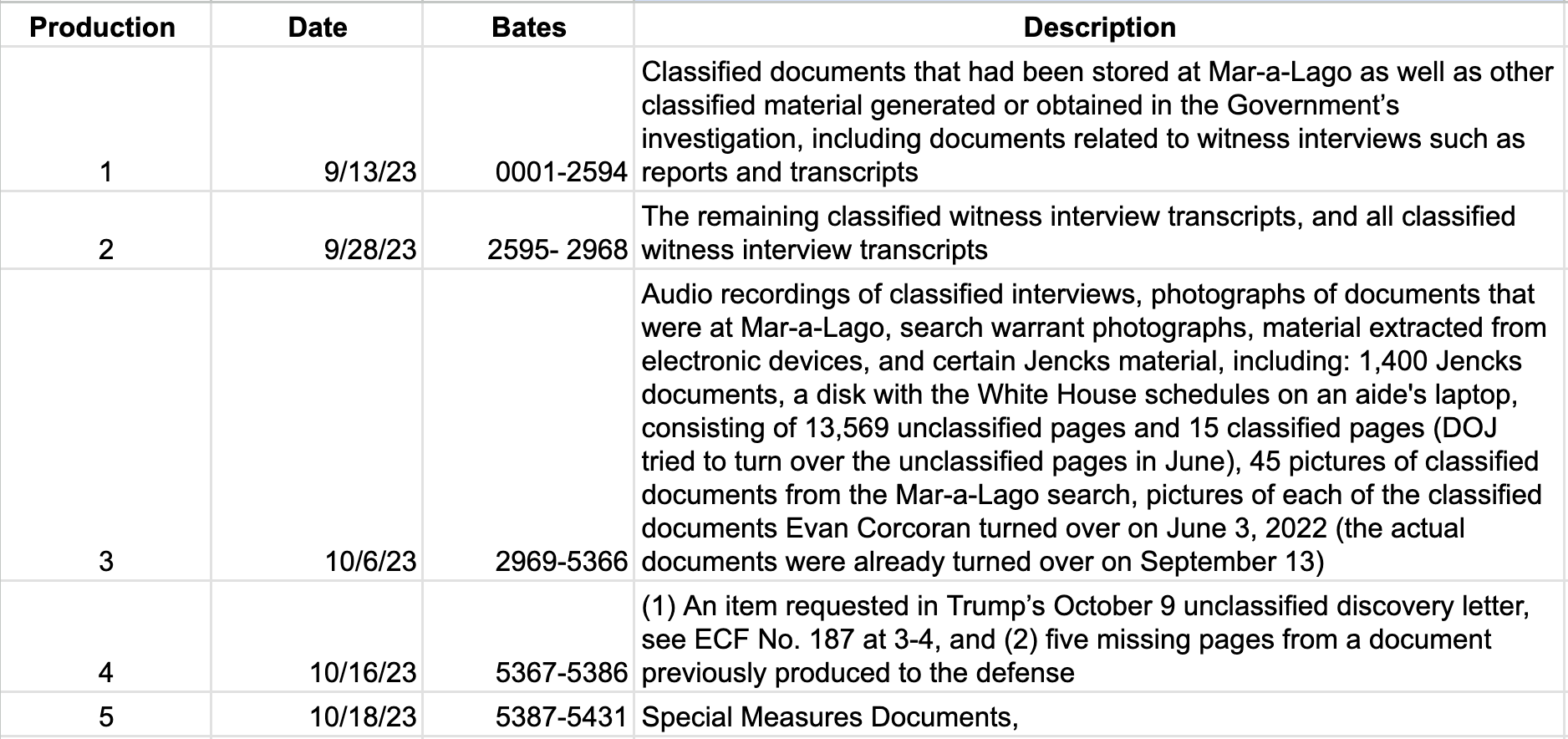
This is my updated track of the universe of classified discovery.

Pretty much everything that should obviously be there is there:

  • The stolen documents themselves
  • All the witness testimony about the documents
  • The discussions about classification reviews of the documents (which Brian Greer has suggested were likely somewhat limited in anticipation of trial)

But there’s one thing not mentioned — at least not obviously — that always proves contentious in 793 cases: The damage assessment.

One way defendants always attempt to prove that things aren’t National Defense Information is by pointing to a report — if they get one — that nothing blew up after they released a document or left it in their beach resort shower.

Often defendants don’t get them.

I’m particularly interested in what kind of damage assessment the Intelligence Community did here because of a footnote included in the 11th Circuit appeal last year, which I wrote about here:

footnote modifying a discussion about the damage assessment the Intelligence Community is currently doing referenced a letter then-NSA Director Mike Rogers wrote in support of Nghia Pho’s sentencing in 2018. [This letter remains sealed in the docket but Josh Gerstein liberated it at the time.]

[I]n order to assess the full scope of potential harms to national security resulting from the improper retention of the classified records, the government must assess the likelihood that improperly stored classified information may have been accessed by others and compromised. 4

4 Departments and agencies in the IC would then consider this information to determine whether they need to treat certain sources and methods as compromised. See, e.g., Exhibit A to Sentencing Memorandum, United States v. Pho, No. 1:17-cr-631 (D. Md. Sept. 18, 2018), D.E. 20-1 (letter from Adm. Michael S. Rogers, Director, National Security Agency) (“Once the government loses positive control over classified material, the government must often treat the material as compromised and take remedial actions as dictated by the particular circumstances.”).

Even on its face, the comment suggests the possibility that the Intelligence Community is shutting down collection programs because Trump took documents home.

You can’t very well do nothing after you learn some of the most sensitive government documents were parked on a stage in a room hosting weddings attended by all manner of foreigner and grifter. You can’t do nothing after learning that Trump freely blabbed about the content of his stolen documents to anyone who bought access to him. You can’t do nothing after a Five Eyes document gets dumped out of a box in a storage closet that musicians and other resort personnel have accessed. You’ve got to go to your Five Eyes allies and explain that America’s former President is a dumbass and so the allies should take measures assuming that some drunken guest got a look at that document.

You might not even be able to charge documents as sensitive as these if the underlying programs hadn’t had to be rolled up. The spooks are going to prefer to protect the programs over vengeance against the dumbass former President.

Which brings me to the most intriguing claim made at the hearing.

Stan Woodward — Walt Nauta’s attorney — claims that neither he nor the government have figured out where all the missing boxes have gone.

[T]he Special Counsel has directed us to certain portions of the CCTV footage that they view as the most relevant, but there is — from what we know and from our defense, there is a tremendous amount of CCTV footage that we believe has been produced that is not what they have identified that is extremely relevant to us. For example, to the extent that boxes were moved on occasions other than what is delineated in the indictment, that is certainly something that matters to us.

[snip]

We have, of course, the benefit of consultation with our clients and are able to talk about what video we should be looking at and what video we should not be looking at. And the entire nature of the allegations, of the charges in this case are about missing boxes, right? The indictment is charging Mr. Nauta — and I’ll just stick with my client, with Mr. Nauta — with having moved boxes. Some number of boxes come out of a storage room, a lesser number of boxes go into the storage room, and Mr. Nauta is charged with hiding those boxes from whether it is Trump’s then counsel or whether it is the Government. And obviously, we are interested in knowing where those boxes are if they are, in fact, missing. The CCTV footage is what is going to help us understand that riddle.

Now, the Government does not know where those boxes went. As far as I can tell, to this day, the Government does not know where the boxes they allege were hidden ended up.

[snip]

I have a whole separate computer that I’m using just to do these extractions so that I can go in and start watching this days of video so that we can make an assessment of what this case is all about and whether it is about missing boxes or about boxes that just weren’t found when the FBI conducted its search of the property.

Now, Woodward has a habit of saying things that I find … shall I say, unpersuasive?

This certainly feels like one of those instances, coming as it did amid a schtick whereby Woodward repeatedly referred to the government, then corrected himself to say Special Counsel, something that seems to mirror Judge Cannon’s own preferences for calling Jack Smith’s office the OSC (John Durham used this abbreviation but no one else does).

Woodward is attempting to claim that he needs to delay the trial past the election because he needs to review all of ten years worth of surveillance video to defend his client. I’ve seen him make similar claims in January 6 trials.

More importantly, this is not a remotely fair representation of the charges against Nauta, which have to do with Nauta claiming to know nothing about moving boxes within days of being caught on surveillance video moving boxes, then allegedly attempting to destroy the video that captured him moving those boxes. Importantly, even if someone else moved a bunch of boxes that aren’t otherwise included in the indictment, it doesn’t exonerate Nauta. It could even inculpate him: if boxes were at Mar-a-Lago for someone else to move because Nauta had taken steps to withhold them from the government, it means his alleged obstruction would have made those other movements possible.

Plus, one big reason why the government charged Nauta, I believe, is because they believe he knows what happened to the missing boxes, including the ones he packed up to go to Bedminster where they disappeared forever.

I don’t doubt that the government hasn’t accounted for all the missing boxes; certainly Bratt did not correct Woodward on this point.

But one reason the government would have had to get ten years of video is to attempt to see who else entered that closet, to see who was in the closet when a Five Eyes document tumbled out, to see whether any of the foreign visitors to Mar-a-Lago seemed to know to look in the closet.

That’s not something that would show up in the indictment, not without proof that Trump willfully told visitors where the documents were.

But if Woodward is telling the truth about needing to see who else was moving boxes around, rather than just using the volume of video to stall, it might suggest he’s trying to find out what you might otherwise learn from a damage assessment. It might suggest that either Nauta hasn’t been entirely forthcoming with Woodward or Trump isn’t being forthcoming with his lawyers or his trusted valet.

Learning what the government saw in the surveillance video about moving boxes is not remotely necessary for defending Nauta against the charges against him. It might have a lot to do with understanding how ugly the story prosecutors will tell at trial will be.
Share this entry

Hours After Aileen Cannon Suggests She’ll Stall Florida Prosecution, Trump Moves to Stall DC One

Judge Aileen Cannon has not yet released a ruling describing how much she’ll bow to Trump’s manufactured claims of classified discovery delays in the stolen documents case, but she made clear that she will delay the trial somewhat. As reported, at least, that delay will come because of the competing schedule in DC.

Trump’s lawyers argued that they need a delay in the documents case because preparations for it will clash with the federal election case, which is slated to go to trial on March 4 and could last several months.

Trump’s indictment in the election case — which came days after Cannon set her initial timeline for the document case — “completely disrupted everything about the schedule your honor set,” Trump lawyer Todd Blanche told Cannon.

Another Trump lawyer, Chris Kise, personified the crunch the former president’s attorneys are facing, phoning into the hearing from a New York courthouse where Trump is undergoing a civil trial targeting his business empire.

“It’s very difficult to be trying to work with a client in one trial and simultaneously try to prepare that client for another trial,” Kise said. “This has been a struggle and a challenge.”

Note: as DOJ pointed out, Kise’s NY trial schedule was already baked into Cannon’s schedule.

Having secured that delay, Trump turned to delaying his DC trial, with a motion to stay all other DC proceedings until his absolute immunity claim is decided, a 3-page motion Trump could have but did not submit when he was asking for a delay before submitting his other motions. Everything he points to in that 3-page motion, the completed briefing on the absolute immunity bid, was already in place on October 26. But he waited until he first got Cannon to move her trial schedule.

As I laid out the other day, Trump is not making legal arguments sufficient to win this case — certainly not yet. He is making a tactical argument, attempting to run out the clock so he can pardon himself.

Update: LOL. Trump filed the DC motion too soon, giving DOJ a chance to notice the cynical ploy in DC before Aileen Cannon issues her order.

Yesterday, the Court conducted a hearing on the defendants’ motion to adjourn trial, in which defendant Trump claimed that trial in this matter should be delayed in part because “[t]he March 4, 2024 trial date in the District of Columbia, and the underlying schedule in that case, currently require President Trump and his lawyers to be in two places at once.” ECF 167 at 1. Defendant Trump’s counsel reiterated that argument during the hearing yesterday. However, defendant Trump’s counsel failed to disclose at the hearing that they were planning to file – and yesterday evening did file – the attached motion to stay the proceedings in the District of Columbia until their motion to dismiss the indictment based on presidential immunity is “fully resolved.” See United States v. Donald J. Trump, No. 23-cr-257-TSC, ECF No. 128 at 1 (D.D.C. Nov. 1, 2023), attached as Exhibit 1. As the Government argued to the Court yesterday, the trial date in the District of Columbia case should not be a determinative factor in the Court’s decision whether to modify the dates in this matter. Defendant Trump’s actions in the hours following the hearing in this case illustrate the point and confirm his overriding interest in delaying both trials at any cost. This Court should [sic] allow itself to be manipulated in this fashion.

Share this entry

The “Piles” of Chris Kise Bullshit Devlin Barrett Claims to Believe

According to this piece, Devlin Barrett (this time, with Perry Stein) claims to believe a bunch of Chris Kise bullshit that has already been debunked in court filings.

One key issue is how much time Trump and his legal team get to review the piles of secret evidence in the case. Trump’s lawyers have accused the government of being too slow to provide access to the full catalogue of classified papers, and insist they need more time to prepare.

It’s true that Trump has claimed that. It’s true that Trump insists they need more time. But these claims were largely manufactured, which was readily apparent if you read the court filings closely.

Over the last five weeks, Trump’s lawyers have made a series of claims about classified production to support a bid to delay the stolen document trial until after the election.

Some of those were real: In particular, the Court Information Security Officer had to keep juggling a number of the documents Trump stole because they were so sensitive.

The first set probably involved the single charged and some number of uncharged nuclear documents, which defense attorneys were not yet cleared to access (the CISO basically removed them from the defense SCIF so the attorneys would be cleared to read everything that was left in there).

The second set — of first four and then another five — of the charged documents are Special Measures documents (those with additional compartments). Those could not be stored in the existing SCIFs in Miami without additional measures put in place. They were available in DC, and have now been made available in Miami. Altogether, it appears those Special Measures documents are around 44 pages in length. The defense team still needs a laptop equipped to write about them, the only apparent remaining delay in classified materials outstanding.

Those exchanges (most clearly laid out here) have revealed that, save for some classified FBI Agent emails that DOJ will provide closer to trial as Jencks production and some documents DOJ wants to provide with substitutions under CIPA 4 that this fight is holding up, this is the current universe of classified discovery in the case.

At less than 5,500 pages, it could hardly be called a “pile,” as Devlin did, unless you were referring to the horse manure that Kise was spreading.

Many of the claims that Chris Kise made were transparent bullshit. The most important one — because it appears to have fooled Aileen Cannon — is that the reason why a bunch of classified documents weren’t available in Miami (some were available in DC, where a number of Trump’s lawyers are) is because the defense attorneys weren’t in Miami to read them, something they delayed doing during several competing filings in this dispute. A CISO can’t just drop off nuclear documents in an unattended SCIF, but the guy who left the same document in his beach resort may not understand that.

It’s possible the defense put off going to Miami because the Special Measures documents were not yet there.

What’s clear, however, is that Trump’s team waited 11 days before reviewing documents that were ready for their viewing once they showed up to review them, then blamed DOJ because they waited.

A still more amusing complaint is that DOJ provided a disk with the items in a box of White House schedules that a Trump aide had scanned and then downloaded onto her computer, which because of duplicates amounted to 13,584 pages, of which just 15 pages were classified. DOJ had tried to provide all the unclassified pages in June, but Trump asked DOJ to hold off. That requested delay is one of the reasons Trump claims he can’t stand trial before the election.

Trump also spent weeks of October complaining that DOJ had provided 1,400 pages of Jencks materials (statements related to the case from people who’ll be witnesses at trial) in October, rather than the weeks before trial, when it is due.

Kise also complained he couldn’t review the classified discovery because he had to be in Trump’s 3-month fraud trial in New York, something that was known when Judge Cannon set the schedule.

As the government notes, Aileen Cannon’ schedule only had one deadline, for the initial production of classified documents, and the only delay in meeting that deadline came from Judge Cannon’s own dawdling over the protective order.

The Scheduling Order set September 7 as the deadline for the Government’s first production of classified discovery. The Government delivered certain classified discovery to the defense SCIF before then, but it was not available to the defense until September 13, after the Court entered the CIPA Section 3 protective orders, ECF Nos. 150-152.

Below I’ve put the series of claims Trump has made with DOJ’s debunking.


Claim:

On October 17, 2023, the Special Counsel’s Office caused approximately 2,487 pages of documents and four discs to be delivered to President Trump’s counsel, for the first time, at a secure facility in this District.

Debunking:

As the Government explained in a recent filing, ECF No. 187 at 5-6, it informed the defense on October 6 that the production had been provided to the Classified Information Security Officer (CISO) and inquired the next day when the defense would resume its review of classified discovery in the defense SCIF, so the Government could arrange for it to be delivered there. Defense counsel waited 11 days, from October 6 until October 17, to receive the materials in the defense SCIF.


Claim:

[T]he Office’s October 6, 2023 production of approximately 2,400 pages of additional classified discovery is still not available for review in this District.

Debunking, One:

As the Government explained in a recent filing, ECF No. 187 at 5-6, it informed the defense on October 6 that the production had been provided to the Classified Information Security Officer (CISO) and inquired the next day when the defense would resume its review of classified discovery in the defense SCIF, so the Government could arrange for it to be delivered there. Defense counsel waited 11 days, from October 6 until October 17, to receive the materials in the defense SCIF.

Debunking, Two:

As in all federal criminal cases involving classified discovery, to ensure confidentiality for the defense, the Government does not have access to the defense SCIF. To deliver classified discovery to the defense SCIF requires the presence of either the CISO or appropriately cleared members of the defense team.


Claim:

A recent, untimely production nearly doubled the volume of classified discovery, and the Office has not explained why those materials were withheld from prior productions.

[snip]

[T]he Special Counsel’s Office recently made available a classified production consisting of approximately 2,400 pages and four discs.

Claim:

[T]he Office still has not explained the timing of its October 6, 2023 production of thousands of pages of additional classified discovery, which is greatly in excess of what the Office estimated to the Court as recently as September 12, 2023.

Debunking:

[T]he largest set of documents in the most recent classified production—a set of about 1,400 pages of emails described in defendant Trump’s classified supplement—consists mostly of Jencks material, which this Court has indicated is not due until closer to trial.


Claim:

Mr. Kise has not yet been cleared fully to review all the CIPA materials and is currently representing President Trump in a trial in New York which is expected to conclude by December 22, 2023, well after expiration of many current deadlines as well as the hearing dates this Court has established. See People v. Trump, et. al, Index No. 452564/2022 (N.Y. Sup. Ct. 2022). He has therefore had no opportunity to review any of the CIPA materials or to participate in the preparation of the defense. President Trump should not be denied the assistance of core counsel in a matter of this significance due to the Government’s delayed discovery process.

Debunking:

Mr. Kise received an interim security clearance in late July, which authorized him to review about 2,100 pages of classified discovery the moment they were produced on September 13–the same day the protective orders issued. ECF Nos. 150, 151, 152. These materials included 16 of 31 charged documents and about 600 pages of classified interview transcripts, among other materials. So, although it is true that as of their filing Mr. Kise had not been “cleared fully,” it is inaccurate to suggest that that fact at all explains his failure to review “any of the CIPA materials.” This leaves only one of the proffered explanations for Mr. Kise’s alleged inability to review “any of the CIPA materials” as the possibly accurate one—Mr. Kise’s competing obligations in the New York trial. But those obligations were aired at the July 18 scheduling hearing, July 18 Tr. at 35, 43, and the Court has already taken them into account in setting trial in May.


Claim:

[T]the Office omits from its “supplemental response” that the four discs contained more than three gigabytes of data relating to six facilities, approximately 13,584 additional pages.

Debunking:

[A]ll but 15 pages of this 13,584-page set of materials had already been produced in unclassified discovery; and the reason the entire set of materials—including the previously produced unclassified pages—was provided together in classified discovery is that the defense asked that it be done that way. The 13,584 pages consist of multiple copies of documents from a box of scheduling materials from Trump’s presidency stored at Mar-a-Lago and elsewhere in West Palm Beach. During the investigation of this case, the Government obtained duplicate copies of the box’s contents—including from the box itself, as well as from a laptop and a cloud storage account to which an aide to defendant Trump had scanned copies—totaling the 13,584 pages, only 4,242 of which are unique. Fifteen of the pages were classified. On June 21, the Government produced to defendant Trump the unclassified digitized contents of the box, containing all but the 15 classified pages of the total of 4,242 unique pages. During a meet-and-confer on September 20, the defense indicated that rather than receiving productions of only the classified pages extracted from electronic devices, separated from the digitized unclassified material already provided in unclassified discovery, they wanted to receive any classified pages from electronic media together with surrounding contents so that it could ascertain where the pages had been stored.


Claim [classified supplement]:

The special measures documents could not be discussed in the defense SCIF when counsel resumed review of materials there on October 17 and 18.

Debunking:

[A]n equipment failure deactivated a security measure that prevented discussion of the special measures documents in Defense SCIF 1 (but review could still occur), and that the following day, October 18, counsel moved one block over to Defense SCIF 2, which was authorized for both review and discussion of all the classified discovery and to which the special measures documents were re-delivered.

Share this entry

Gary Shapley’s Handlers Revisit Past Leak Investigations into Chuck Grassley’s Staff

According to a press release on the website for Empower Oversight–the group handling Gary Shapley’s now-debunked media tour–Empower’s founder, Jason Foster, was the subject of an FBI subpoena to Google in 2017.

Google first alerted Foster to the September 12, 2017 subpoena on October 19, 2023. That’s one of the reasons I find this FOIA so interesting. The notice came more than six years after the subpoena, suggesting FBI likely continued to investigate someone tied to the investigation for at least a year longer than statutes of limitation would normally extend.

Empower seems to suggest there’s a tie between the subpoena and one served on Google pertaining to Kash Patel’s personal email two months later, on November 20, 2017, as does Margot “Federalist Faceplant” Cleveland in this propaganda piece reporting on the subpoenas. While Empower says that this subpoena asked for information on other staffers, it only cites Kash to substantiate its claim that other staffers had also gotten notice of a past subpoena (Cleveland does report that a HPSCI staffer was also included).

Empower Oversight has information indicating that the other accounts listed in the subpoena belonged to other staffers, both Republicans and Democrats, for U.S. House and Senate committees also engaged in oversight investigations of the Justice Department at the time pursuant to their authorities under the U.S. Constitution.

[snip]

Other former staffers have publicly referenced receiving similar notices, including former U.S. House of Representatives Permanent Select Committee on Intelligence (“HPSCI”) staffer Kashyap Patel.

They’re from the same grand jury (16-3). But they not only have different file numbers, but the one on Kash’s subpoena — that is, the later subpoena, by two months — has a lower file number, 2017R01887, as compared to 2017R01896.

Kash is suing roughly the same people over his subpoena as Empower is FOIAing: Empower is asking about former DC US Attorney Jessie Liu, Rod Rosenstein, his one-time Principal Associate Robert Hur (currently the Special Counsel investigating Joe Biden’s classified documents), and Ed O’Callaghan, who replaced Hur, along with then DOJ Spox Sarah Isgur. Kash is suing Liu, Rosenstein, Hur, and O’Callahan, plus FBI Director Chris Wray and the two AUSAs behind the subpoena.

There are problems with both of their target sets. For example, Liu wasn’t even sworn in as US Attorney until September 25, 2017 — after the Foster subpoena (though before the Kash one). So Empower’s suggestion that Liu had some influence on the subpoena on him is nonsense. Rosenstein wasn’t sworn in until April 26, 2017, almost five months after the request for conversations with the press starts.

Similarly, Ed O’Callaghan, whom Kash describes as, “the Principal Associate Deputy Attorney General for Mr. Rosenstein at the time in question,” didn’t move from the National Security Division to Rosenstein’s office until April 2018, after Hur was confirmed as US Attorney for Maryland and long after both the subpoena implicating Kash and his blow-up with Rosenstein. Though if these were really sensitive leak investigations, NSD may have had a role in them. (Empower includes NSD within its FOIA.)

Those details don’t seem to matter for their projects: both men appear to be using the subpoenas as an excuse to settle scores.

Kash, ever the conspiracy theorist, brought a Bivens claim insinuating that Rosenstein and others violated Kash’s Fourth Amendment rights because DOJ served a subpoena — something not requiring probable cause under the Fourth Amendment — to obtain the subscriber information for a list of around 14 identifiers, of which his personal email was just one. There’s nothing on the face of the subpoena to suggest that DOJ knew his email was tied to someone who was a Congressional staffer at the time of the subpoena (though again, Federalist Faceplant seems to know at least one other person listed was a staffer). In fact, the subpoena asked for contact information going back to April 2016, a year before Kash moved from DOJ to HPSCI, so it could have pertained to a leak internal to DOJ.

Nevertheless, Kash spins a tale where the November 2017 subpoena is in some way connected with what he claims is Rosenstein’s threat, over a month later, to subpoena HPSCI staffers.

5. The illegitimate grounds for the subpoena were made clear when, shortly after the FBI and DOJ previewed what would become the “Nunes Memo,” which outlined significant issues with FBI’s and the DOJ’s manner of opening and conducting the Crossfire Hurricane investigation, then-Deputy Attorney General Rod Rosenstein (“DAG Rosenstein”) threatened to subpoena the records of the House Permanent Select Intelligence Committee staff, including Mr. Patel, during a closed-door meeting about producing documents requested by the Committee for their investigation into DOJ’s and the FBI’s, its subagency, conduct in the Crossfire Hurricane investigation.

6. The Department of Justice attempted to defend against the allegation of this threat to Legislative Branch employees, but admitted, at a minimum, that DAG Rosenstein did threaten to subpoena records of Congressional staff in contempt proceedings over the DOJ’s noncompliance with multiple subpoenas. Regardless, this characterization was disputed by multiple Committee staffers, and the matter was referred to the House General Counsel and Speaker of the House as a threat to subpoena records of staffers to halt their investigation.

7. DAG Rosenstein made this threat in January of 2018, approximately one month after his Department of Justice had already subpoenaed Mr. Patel’s email records from Google. This confrontation establishes that DAG Rosenstein and other Defendants were searching for a reason to subpoena Mr. Patel’s official accounts as well as the personal ones that DOJ was already improperly pursuing.

Contrary to Kash’s claim, DOJ didn’t concede Rosenstein threatened to subpoena the HPSCI records. According to a Fox News article Kash himself cites in his suit, DOJ said that Rosenstein was advising staffers to retain their emails so he could use them to defend against any accusation of contempt. Though Rosenstein did threaten to ask the House General Counsel to investigate Kash and whoever else was involved.

A DOJ official told Fox News that Rosenstein “never threatened anyone in the room with a criminal investigation.” The official said the department and bureau officials in the room “are all quite clear that the characterization of events laid out here is false,” adding that Rosenstein was responding to a threat of contempt.

“The Deputy Attorney General was making the point—after being threatened with contempt — that as an American citizen charged with the offense of contempt of Congress, he would have the right to defend himself, including requesting production of relevant emails and text messages and calling them as witnesses to demonstrate that their allegations are false,” the official said. “That is why he put them on notice to retain relevant emails and text messages, and he hopes they did so. (We have no process to obtain such records without congressional approval.)”

Further, the official said that when Rosenstein returns to the United States from a work trip, “he will request that the House General counsel conduct an internal investigation of these Congressional staffers’ conduct.”

This all seems like a retroactive attempt to politicize the investigation into some contact Kash had, potentially even before he joined HPSCI with a lawsuit claiming a violation of the Fourth Amendment under Bivens for a subpoena for toll records that a former DOJ prosecutor, especially, should know are not entitled to any expectation of privacy.

Foster’s claim, which is only a FOIA, not a lawsuit, is a bit less ridiculous (so long as you ignore his demand for communications involving Liu before she started as US Attorney and Rosenstein before he was DAG).

He seems certain that the subpoena for his phone (which he says was used by his spouse) pertained to a leak investigation. He’s filing it to find out if Rosenstein’s office ever got the same scrutiny in leak investigations that (he seems sure) some Congressional staffers got in 2017.

It begs the question of whether DOJ was equally zealous in seeking the communication records of its own employees with access to any leaked information.

[snip]

(5) All communications exchanged between members of the press and DAG Rosenstein, Robert Hur, Edward O’Callaghan, Sarah Isgur, aka Sarah Isgur Flores, and/or Jessie Liu for the period from December 1, 2016 to September 26, 2017, regarding (a) communications between Michael Flynn and Sergey Kislyak, (b) Carter Page, (c) Joe Pientka, (d) Bill Priestap, (e) congressional oversight requests, (f) Senator Charles Grassley, (g) Jason Foster, and/or (h) the Crossfire Hurricane investigation.

(6)All grand jury subpoenas issued for personal communications of DAG Rosenstein, Robert Hur, Edward O’Callaghan, and/or Jessie Liu between May 1, 2017 and May 1, 2018.

(7) All communications exchanged between the U.S. Attorney’s Office for the District of Columbia, the National Security Division, the Deputy Attorney General’s Office and/or the FBI and Verizon between March 15, 2016, and the present regarding obtaining communications data associated with devices that Verizon serviced for U.S. House Representatives or U.S. Senate. [my emphasis]

The time range of the Foster subpoena, December 1, 2016 to May 1, 2017, covers the period of the known leaks about Mike Flynn and Carter Page — the former, especially, one of the leaks Republicans have never stopped bitching because it wasn’t charged. Yet here, a key Republican is complaining there was “no legitimate predicate” in investigating people who were briefed on information that subsequently got leaked.

There appears to have been an extensive and far-reaching effort to use grand jury subpoenas and perhaps other means to gather the personal communications records of innocent congressional staffers and their families with little or no legitimate predicate.

Empower’s mention of Carter Page also situates the subpoena temporally. The subpoena that included a number associated with Foster was served in precisely the same time period that — the Statement of the Offense and sentencing memo for James Wolfe case show — FBI was investigating the leak of the Carter Page FISA. DOJ opened that investigation in April 2017. They had shown enough probable cause against Wolfe to obtain a warrant to covertly image his cell phone by October 2017. No one complained that Wolfe was prosecuted for his presumed role in leaking some of these stories, and his prosecution alone shows that the subpoena had predicate.

Foster may have other specific stories in mind too: In addition to the leaked stories about Flynn undermining US foreign policy with the Russian Ambassador, the FOIA asks about other Russian investigation stories, including Joe Pientka, whose role in briefing Mike Flynn Grassley made into a personal crusade.

Curiously, the Steele dossier is not on here, even though that was another personal crusade of Chuck Grassley.

All that said, the timeline included in the FOIA is broader than that. Here’s how the various timelines overlap, or don’t:

  • Scope of Foster subpoena: December 1, 2016 through May 1, 2017
  • Rosenstein sworn in as DAG: April 26, 2017
  • Date of Foster subpoena: September 12, 2017
  • Jessie Liu sworn in as US Attorney: September 25, 2017
  • Scope of Foster’s FOIA for DAG communications with the press: December 1, 2016 through September 26, 2017
  • Date of Kash subpoena: November 20, 2017
  • Scope of Kash subpoena: May 1, 2016 through November 20, 2017
  • Scope of Foster’s FOIA for grand jury subpoenas targeting DAG: May 1, 2017 through May 1, 2018
  • Scope of Foster’s FOIA for Verizon records of Congressional staffers March 15, 2016 through October 24, 2023

Foster is FOIAing Rosenstein’s office, first, for conversations with the press — including about him — starting on December 1, 2016, before Trump was inaugurated and months before Rosenstein was sworn in on April 26, 2017. He is FOIAing conversations with the press that continue through the day after Liu was sworn in September 2017, still months before O’Callaghan was part of DAG.

Then he’s asking for any grand jury subpoenas (which he knows would be protected under grand jury secrecy rules and so won’t get) from the end date of the subpoena targeting him, after which point both the Flynn and Page investigations were underway, until May 1, 2018 — still four months before Legistorm shows Foster leaving his SJC job on September 4, 2018, but perhaps not coincidentally ending before the time when the Mueller investigation started to more closely probe fellow SJC staffer Barbara Ledeen’s role in Mike Flynn’s 2016 rat-fucking and two weeks shy of an interview when Mueller asked Flynn about Ledeen’s investigation of the investigation. A September 17, 2018 interview asked very specific questions about people leaking claimed details of the investigation to Flynn, as well as Flynn’s contacts with unidentified Congressional staffers.

Again, this request is a test about whether Rosenstein’s office was targeted for leaks, but the leaks that Foster suggest this subpoena pertains to — Mike Flynn’s contacts with Sergey Kislyak and Carter Page’s FISA — happened before any of these people were in DAG. Foster seems interested in leaks about leak investigations, not the leaks themselves.

It’s the final bullet I find the most interesting though. None of the subpoenas he raises in his FOIA — not the subpoena of Kash’s personal email, not the subpoena of his own Google voice phone, and not the subpoena to Apple targeting HPSCI members — target official phone records. But Foster FOIAs for official records as well: All communications between DC USAO, NSD, DAG, and FBI with Verizon — communications that might be something other than a grand jury subpoena — about obtaining phone records for the Congressional devices serviced by Verizon. He’s asking for a much broader period of time, too: March 15, 2016 — early enough to include the start date of Kash’s subpoena, but also to include some of Barbara Ledeen’s rat-fucking with Mike Flynn — through the present, late enough to include any contacts in which Chuck Grassley staffers used their official devices to share information about the Hunter Biden investigation with the press.

This last request is not about Rosenstein; Rosenstein was only DAG for two of the seven and a half years covered by this part of the FOIA.

This FOIA is, on its face, totally uncontroversial (though it attempts to do with a FOIA what DOJ IG is already doing, which it notes). It purports to test whether Rod Rosenstein exempted his own top deputies from the kind of investigative scrutiny to which Rosenstein — always a leak hawk — subjected Congressional staffers. Hell, I’m fairly certain Rosenstein and his top deputies were key undisclosed sources for a bunch of bullshit comments (though most of them were false, and therefore not criminal leaks). Some of those anonymous comments were to the same stable of journalists who also happen to serve as mouthpieces for Chuck Grassley propaganda (and as such, Foster may have specific reason to believe that Rosenstein teed up journalists’ questions to or about him).

And the FOIA for contacts with Verizon gets at important separation of powers issues: under what terms the Executive Branch can investigate the official business of the Legislative Branch, including times when the Legislative Branch is screaming for investigations into leaks that probably (and provably, in the case of Carter Page) include Legislative Branch staffers.

But it also serves as a fishing expedition, by the entity that championed the now debunked claims of Gary Shapley, into potential investigations into transparent ongoing efforts by Chuck Grassley to release details of criminal investigations in the guise of oversight.

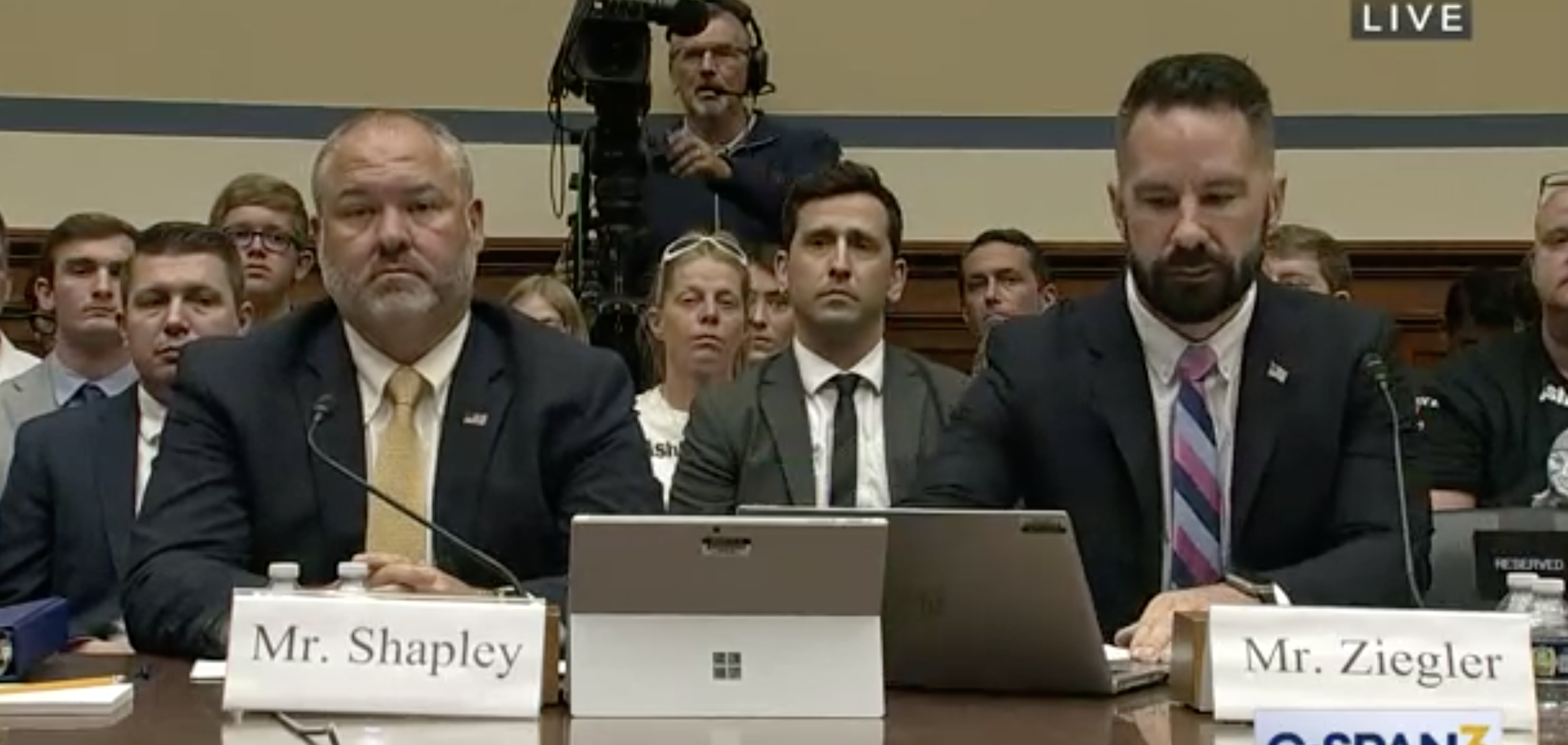
In a meeting agenda sent September 3, 2020, Joseph Ziegler included the Senate investigation led by Chuck Grassley and Ron Johnson among topics for discussion.

No later than December 2020, a document shared by Empower Oversight client Gary Shapley reveals, the IRS agents running this investigation cared more about catering to demands from Congress, including from Chuck Grassley, than preserving the investigation.

The USAO and FBI received congressional inquiries concerning this investigation and have repeatedly ignored their requests, openly mocking the members of congress who made the request.

Another document shared by Empower Oversight client Gary Shapley shows that, in May 2021, the IRS agents running the investigation continued to be aware of — and interested in catering to — requests from Congress.

The USAO and FBI received congressional inquiries concerning this investigation and it’s believed they have ignored their requests.

A document released by Empower Oversight client Gary Shapley reflecting a January 6, 2023 call with IRS’ Deputy Field Officer Michael Batdorf alerting him — among other things — that he expected the Delaware US Attorney to make “nefarious” allegations against him, also recorded that by the time, two days after he notified IRS and DOJ IG Inspectors General he was seeking formal whistleblower status which happens to have happened on the day the GOP took the House, his attorney had already, “participated in calls and/or meetings” with “the Congressional Judiciary committees.”

DFO asked about the process and Shapley responded that the Congressional Judiciary committees, OSC, IRS OGC and TIGTA have been notified and have participated in calls and/or meetings with my counsel.

Yet when one of Shapley’s attorneys, Mark Lytle, formally contacted the Chairs and Ranking Members of those same “Congressional Judiciary committees,” the Chairs and Ranking Members of the relevant finance committees, along with Chuck Grassley on April 19, 2023, he did not treat those contacts with the judiciary committees as protected disclosures. The letter mentions that Grassley is a member of the Finance Committee, but doesn’t mention that Grassley is a member and former Chair of the Judiciary Committee.

That was the first moment, publicly at least, that Empower Oversight client Gary Shapley sought protection to share IRS protected information with Congress. That is, even according to Lytle, if Shapley shared any IRS protected information — to say nothing of grand jury protected information — prior to that, by the plain terms of his letter it was not under a grant of protection.

A month after Gary Shapley’s claims — facilitated by Empower Oversight — were soundly debunked by his own documentation and his colleagues, Empower Oversight filed a FOIA that would, among other things, attempt to learn whether the FBI was conducting any investigation of leaks to the press from Chuck Grassley’s staffers, covering the period in 2016 when a Chuck Grassley staffer attempted to reach out to hostile intelligence services to find dirt on Hillary Clinton, the period when a Grassley staffer was seeding press stories — some that were fabrications — about the Russian investigation, and the period of time when those investigating Hunter Biden were more solicitous of requests from members of Congress like Chuck Grassley than they were in protecting the ongoing investigation.

Share this entry

Lurid Realities: Trump Implies That Selling Nuclear Secrets Is Treason

In this post, I noted that two passages from DOJ’s response to Trump’s Motion to Dismiss for Absolute Immunity — one pertaining to exchanging pardons as part of a quid pro quo, another describing otherwise official acts that would clearly be illegal — actually described things that may have or likely happened under Trump.

Here’s the latter discussion:

The same is true of an even splashier passage. A paragraph describing the implications of Trump’s claim to absolute immunity lays out what some commentators have taken as hyperbolic scenarios of presidential corruption.

The implications of the defendant’s unbounded immunity theory are startling. It would grant absolute immunity from criminal prosecution to a president who accepts a bribe in exchange for a lucrative government contract for a family member; a president who instructs his FBI Director to plant incriminating evidence on a political enemy; a president who orders the National Guard to murder his most prominent critics; or a president who sells nuclear secrets to a foreign adversary. After all, in each of these scenarios, the president could assert that he was simply executing the laws; or communicating with the Department of Justice; or discharging his powers as commander-in-chief; or engaging in foreign diplomacy—and his felonious purposes and motives, as the defendant repeatedly insists, would be completely irrelevant and could never even be aired at trial. In addition to the profoundly troubling implications for the rule of law and the inconsistency with the fundamental principle that no man is above the law, that novel approach to immunity in the criminal context, as explained above, has no basis in law or history.

These seemingly extreme cases of crimes a President might commit, crimes that everyone should agree would face prosecution, include (these are out of order):

  • A President ordering the National Guard to murder his critics
  • A President ordering an FBI agent to plant evidence on his political enemy
  • A bribe paid in exchange for a family member getting a lucrative contract
  • A President selling nuclear secrets to America’s adversaries

Like the pardon discussion above, these hypotheticals — as Commander-in-Chief, with the conduct of foreign policy, with the treatment of classified materials — invoke actions where DOJ typically argues that the President is at the zenith of his power.

We have no reason to believe that Trump ordered the National Guard, specifically, to murder his critics. But we do know that on January 3, 2021, Trump proposed calling out 10,000 members of the National Guard to “protect” his people and facilitate his own march on the Capitol.

And he just cut me off, and he goes, well, we should call in the National Guard.

And then I think it was Max who said something to the effect of, Well, we should only call in the Guard if we expect a problem. And then the President says, no, we should call in the Guard so that there aren’t – so that there isn’t a problem. You know, we need to make sure people are protected.

And he said – he looked over at Max, and I don’t know if somebody was standing behind him or not. He just looked the other way from me and says, you know,  want to call in 10,000 National Guard. And then  opened my folder and wrote down 10,000 National Guard, closed my folder again.

We know that days later Mark Meadows believed the Guard would be present and Proud Boy Charles Donohoe seemed to expect such protection.

Similarly, we don’t know of a specific instance where Trump ordered an FBI agent to plant information on his political enemy. But we do know that as part of a Bill Barr-directed effort to reverse the Mike Flynn prosecution in 2020, misleading dates got added to the notes of Trump’s political enemies, Peter Strzok and Andrew McCabe.

Days after those misleading dates were made public via Sidney Powell, Trump used the misleading dates in a packaged debate attack on Joe Biden.

President Donald J. Trump: (01:02:22)
We’ve caught them all. We’ve got it all on tape. We’ve caught them all. And by the way, you gave the idea for the Logan Act against General Flynn. You better take a look at that, because we caught you in a sense, and President Obama was sitting in the office.

We know of no instance where Trump accepted a bribe in response to which a family member got a US government contract. We do, however, know of an instance where the Trump Administration gave the Saudis something of value — at the least, cover for the execution of Jamal Khashoggi — which everyone seems to believe has a tie to Jared’s lucrative $2 billion contract with the Saudi government.

As to selling nuclear secrets to a foreign adversary? Well, we know Trump had some number of nuclear secrets in his gaudy bathroom and then in his leatherbound box. We have no fucking clue what happened to the secrets that Walt Nauta allegedly withheld from Evan Corcoran’s review that got flown to Bedminster just before a Saudi golf tournament, never to be seen again.

All of which is to say that these edge cases — examples of Presidential misconduct that some commentators have treated as strictly hypothetical — all have near analogues in Trump’s record. [my emphasis]

Trump’s reply to that response addresses this second passage — at least, two items from it — in what it deems to be “lurid hypotheticals.”

10 Ignoring actual lessons from history, the Government provides a list of lurid hypotheticals that have never happened—including treason and murder. Response, at 20 (speculating that a President might “murder his most prominent critics” or “sell[] nuclear secrets to a foreign adversary”). Some or all of these hypotheticals, depending on the facts, would likely involve purely private conduct, rendering them irrelevant here. See id. Yet even if such examples somehow were within the outer perimeter of a President’s duties, it is overwhelmingly likely the House impeach and the Senate would convict, and the offending President would then be subject to “Indictment, Trial, Judgment and Punishment” by criminal prosecution. U.S. CONST. art. I, § 3, cl. 7. That is the process the Constitution provides, and the prosecution may not ignore it here. [my emphasis]

Since Trump doesn’t include the entire list, here are the four items in it:

  • A President ordering the National Guard to murder his critics
  • A President ordering an FBI agent to plant evidence on his political enemy
  • A bribe paid in exchange for a family member getting a lucrative contract
  • A President selling nuclear secrets to America’s adversaries

This footnote seems to suggest more than one and possibly all of these things — in a list including an order to the National Guard and an order to an FBI Agent — would be private acts.

That’s a consistent stance with the claim, in a footnote that concludes on this very same page, that Nixon’s suspected involvement in the DNC burglary as part of an attempt to win an election would also be a private act.

9 The Government relies on President Ford’s pardon of President Nixon, arguing that it presupposes that Nixon could have been prosecuted for acts he committed as President. Doc. 109, at 18. Not so. The fact that Nixon was never prosecuted—despite widespread public outrage and compelling evidence of wrongdoing—provides compelling evidence of the strength of the historical tradition against prosecuting former Presidents for their official acts, not its weakness. Moreover, this argument overlooks that much of the conduct at issue in the Watergate scandal—such as ordering the burglary of the Democratic National Committee headquarters—may well have been purely private acts, not shielded by immunity at all, thus necessitating a pardon. (Both of these points apply equally to President Clinton’s admitted perjury in the Paula Jones litigation, for which he was never prosecuted. Response, at 19.)

FWIW, I agree with this reply’s argument that DOJ doesn’t aggressively lay out the extent to which Trump’s alleged acts in the January 6 indictment are private acts. But if Trump concedes that Nixon’s suspected role in the DNC break-in to win an election was a private act, then it seems to concede that Trump’s own actions to reverse the outcome of an election he lost would also be a private act.

And Trump’s extension of private acts to this list of four “lurid hypotheticals” would seem to swallow up the entire argument about Presidential immunity.

But it seems to do something else.

There is nothing on that list resembling treason.

Accepting a bribe from Saudi Arabia to win a $2 billion contract for your son-in-law? Not treason.

Ordering the FBI to alter records to gin up an investigation against Joe Biden? Not treason.

Ordering 10,000 National Guard members to protect your mob as it attacks Congress? Not treason — at least not until it kicks off Civil War.

The closest thing on that list to treason is selling nuclear secrets to America’s adversaries. Not treason.

But Trump’s lawyers, including two of the lawyers representing him in the stolen documents case, lawyers who had their first good look at the documents Trump is accused of stealing last week, seem to suggest it could be.

To be clear: Trump has never been accused of selling nuclear secrets to America’s adversaries.

He undoubtedly gave Israel’s counterterrorism secrets to Russia — why, and whether there was a quid pro quo involved, we still don’t know.

He is known to have Tweeted out highly sensitive satellite information to dick-wag Iran, with the result that Iran learned about the satellites targeting their country.

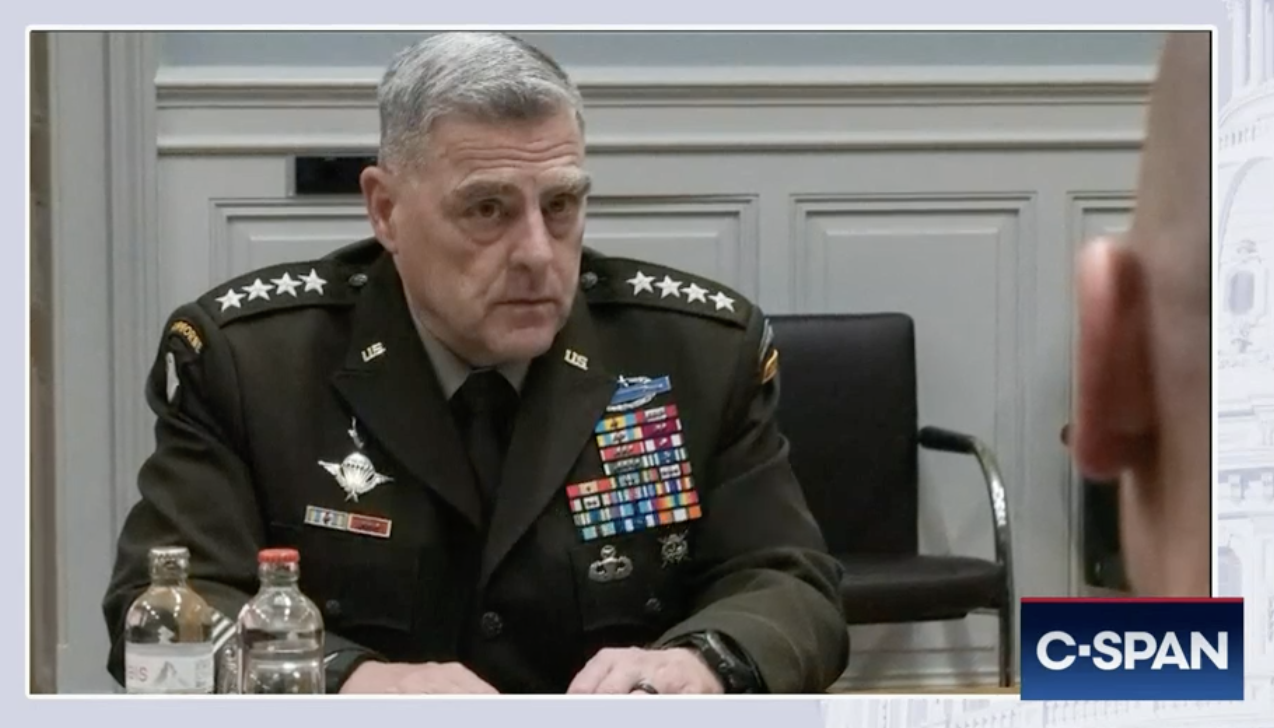
To spite Mark Milley, he showed a plan to attack Iran to Mark Meadows’ ghost writers.

Ongoing reporting, first from ABC and then from NYT, reveals that after Australian billionaire Anthony Pratt paid millions for access to Trump, Trump shared details of a conversation he had about a call he had with Iraq’s president after bombing Iraq, described his perfect phone call with Volodymyr Zelenskyy, and provided sensitive details of America’s nuclear subs.

And he is accused of leaving nuclear documents — documents that Trump’s lawyers may have reviewed for the first time last week — in unsecure ways at his beach resort, possibly even in his gaudy bathroom.

So, no. Trump has not (yet) been accused of selling nuclear secrets, to adversaries or anyone else. Though he did give away what he claimed to be nuclear secrets to a businessman from an allied nation after the guy paid a lot of money for access to Trump.

But as I noted, we don’t yet know what happened to some of the secret documents that Trump snuck away from Mar-a-Lago after hiding them from Evan Corcoran in June 2022, documents he took with him to host a golf tournament the Saudis paid an undisclosed sum to host at Bedminster.

Those documents have never been located.

Just so long as Trump didn’t sell any of these nuclear documents, but instead gave them away, I’m sure we’re all good.

Share this entry

Stan Woodward Blows Off Any Duty of Loyalty to His Former Client

I noted yesterday that the government claimed that Stan Woodward had conceded he had a duty of loyalty to Yuscil Taveras that would limit what he could do in an eventual trial of Walt Nauta.

In his own response, however, Woodward makes no mention of any duty of loyalty to a former client. Instead, he engages in a great deal of word games to suggest precedents don’t apply to what he repeatedly describes as “[very] limited” representation of Taveras.

Instead, the Special Counsel’s Office seeks to micromanage defense counsel’s handling of any potential conflict arising from the trial testimony of a witness, which such witness benefited from limited former representation, no ongoing dual representation, no indication of conflict resulting from the representation itself, no indication of attorney-client privileged information at issue, and no occasion for crossexamination by the counsel in question (as co-counsel is available for the same).2

[snip]

[T]he very limited representation of an individual whom the Special Counsel’s Office wished to question in relation to a matter that later developed into a criminal prosecution of another client.

It’s a ploy used in Woodward’s surreply, as well.

The case at bar – involving limited former representation, no ongoing joint representation, no indication of conflict resulting from the representation itself, no indication of attorney-client privileged information at issue, and no occasion for cross-examination by the counsel in question (as other counsel is available for same) – is entirely incompatible with these cases and demonstrates the insubstantiality of the Special Counsel’s Office’s present use of a conflict rationale.

Even if it were the case that clients weren’t entitled to privilege if a representation was limited in time or scope, it ignores a very crucial detail of this case.

DOJ told Woodward he had a potential conflict before Taveras testified to the grand jury in March, where he denied knowing about the attempt to delete surveillance video.

In February and March 2023, the Government informed Mr. Woodward, orally and in writing, that his concurrent representation of Trump Employee 4 and Nauta raised a potential conflict of interest. The Government specifically informed Mr. Woodward that the Government believed Trump Employee 4 had information that would incriminate Nauta. Mr. Woodward informed the Government that he was unaware of any testimony that Trump Employee 4 would give that would incriminate Nauta and had advised Trump Employee 4 and Nauta of the Government’s position about a possible conflict. According to Mr. Woodward, he did not have reason to believe his concurrent representation of Trump Employee 4 and Nauta raised a conflict of interest.

The only way this representation would be so limited would be if Woodward did nothing to figure out what kind of legal exposure Taveras was facing in his March grand jury appearance.

Woodward continued to deny his representation of both Nauta and Taveras created a conflict even after DOJ gave Taveras a target letter — in part because he had advised Taveras that if he wanted to cooperate, he could get a different lawyer.

[T]he government provides no information to support their claim that [Taveras] has provided false testimony to the grand jury. While counsel does not preclude that the government may have provided more information to the Court ex parte, the government’s current representation that [Taveras] has clearly presented false or conflicting information to the grand jury is wholly unsupported by any information available to counsel. Further, even if [Taveras] did provide conflicting information to the grand jury such that could expose him to criminal charges, he has other recourse besides reaching a plea bargain with the government. Namely, he can go to trial with the presumption of innocence and fight the charges as against him. If [Taveras] wishes to become a cooperating government witness, he has already been advised he may do so at any time.

[snip]

Ultimately, [Taveras] has been advised by counsel that he may, at any time, seek new counsel, and that includes if he ultimately decided he wanted to cooperate with the government.

Woodward seems to suggest that Taveras has waived his privilege because he told prosecutors what advice Woodward had given him.

Because it appears that the Special Counsel’s Office well knows what was disclosed to defense counsel by Trump Employee 4, the Special Counsel’s Office cannot maintain its position that the revelation of the same is barred. Put differently, the assertion of the Special Counsel’s Office of a presumption of continuing privilege in this context, where the Special Counsel’s Office sought and obtained new counsel for Trump Employee 4 for the purpose of providing a means for Trump Employee 4’s testimony to change, and for his prior assertions to be explained by him—all of which was done not in the District where this case is pending, but in a faraway District, raising separate issues of grand jury misconduct—warrants development of the record at a hearing so as to ascertain to what extent any applicable privilege has been waived by Trump Employee 4’s disclosures to the Special Counsel’s Office. At a minimum, if the Special Counsel’s Office persists in asserting that privileged information remains, an evidentiary hearing is warranted as to what the Special Counsel’s Office is withholding regarding Trump Employee 4, his claims as to prior representation, and whether there has been any failure to disclose such matters to the Special Counsel’s Office.

Here, Woodward fashions privilege to consist only of confidentiality, not loyalty. And he suggests that because Taveras has shown some kind of disloyalty to him, he doesn’t owe any back.

In the filing, Woodward makes an oblique reference to Beryl Howell’s ruling finding Evan Corcoran’s advice to Trump to be crime-fraud excepted (though as he always does, he calls the underlying grand jury investigation in this very case a “faraway” District).

[I]t is noteworthy that in the United States District Court for the District of Columbia the Special Counsel’s Office has taken precisely the opposite position with respect to privileged communications. Specifically, in that District, the Special Counsel’s Office took the position that where a witness represented by counsel in a government compliance matter is not forthcoming with their counsel, a crime-fraud exception applies, voiding the attorney-client privilege. While Mr. Nauta vehemently opposes any application of the crime-fraud rulings made in a faraway District to this case, it is nevertheless impermissible for the Special Counsel’s Office to tailor the positions it takes before courts and/or grand juries in the various Districts where it seeks an advantage in its prosecution of former President Trump and his coconspirators.

This appears to be an attempt to liken Trump’s affirmative lies to Corcoran to Taveras’ own communications with him.

But, particularly with the demand for a hearing to find out what Taveras has told SCO about Woodward’s advice to him, it comes off as flopsweat about his, Woodward’s, own conduct.

Share this entry

Stan Woodward Reportedly Concedes a Duty of Loyalty But Doesn’t Want His Name Used at Trial

In this post, I pointed out what all the coverage of the Garcia hearing last week missed: The prior briefing had been about whether to hold a Garcia hearing. It wasn’t about what to include in the briefing, which should all stem from ethical conflict rules.

On Monday, Judge Aileen Cannon (while blaming the Special Counsel’s Office) ordered that briefing.

In SCO’s submission in response, they clearly laid out not just that they had established the reason why Stan Woodward couldn’t cross-examine a former client, but that they had laid that out from their initial briefing — over two months ago, they observe — on the Garcia hearing: it arises from the Bar rules in both Florida and DC.

As the Government stated in its initial motion for a Garcia hearing, filed more than two months ago, “[a]n attorney’s cross-examination of a current or former client presents a conflict of interest.” ECF No. 97, at 6. Nor can Mr. Woodward otherwise seek to discredit Trump Employee 4 at trial, including in closing arguments.

And this time around they did what they should have been prepared to do at last week’s hearing: Cite 11th Circuit precedent.

Under the Florida ethics rules, “attorneys generally owe duties of confidentiality and loyalty to former clients.” Med. & Chiropractic Clinic, Inc. v. Oppenheim, 981 F.3d 983, 990 (11th Cir. 2020); see Fla. Bar R. Prof’l Conduct 4-1.9. These duties both come into play when, as here, a former client testifies at trial against a current client in a substantially related matter. During cross-examination, the attorney might “improperly” use the prior client’s confidential information or, alternatively, hold back from “intense probing” to avoid using those confidences. United States v. Ross, 33 F.3d 1507, 1523 (11th Cir. 1994). When the subject matters of the representations are substantially related, “the court will irrebutably presume that relevant confidential information was disclosed during the former period of representation.” Freund v. Butterworth, 165 F.3d 839, 859 (11th Cir. 1999). And given the duty of loyalty, a lawyer cross-examining a client, including a former client, faces “an impossible choice: [the attorney] can either vigorously cross-examine the client-turned-witness and thereby violate his duty of loyalty to the client on the witness stand, or he can temper his cross-examination and risk violating his duty of loyalty to the client on trial.” United States v. Almeida, 341 F.3d 1318, 1323 & n.17 (11th Cir. 2003). [my emphasis]

In its filing, SCO accuses Woodward of denying his ethical obligations to a former client at the contentious hearing last week, then lays out Florida precedent establishing it.

At the hearing on October 12, 2023, Mr. Woodward disputed that he had a duty of loyalty to his former clients, referring to “my hypothetical duty of loyalty to a former client, which again we dispute that duty even exists.” 10/12/2023 Hearing Tr. at 19. Similarly, when the Government conferred with Mr. Woodward in connection with this filing on October 17, 2023, Mr. Woodward continued to question whether he owes an ongoing duty of loyalty to Trump Employee 4. There is no basis for dispute: “a duty of loyalty exists apart and distinct from the duty to maintain client confidences.” United States v. Culp, 934 F. Supp. 394, 398 (M.D. Fla. 1996). Indeed, although Mr. Woodward and Mr. Irving have agreed to have another attorney conduct the cross-examination of their clients, courts frequently disqualify attorneys even where the attorneys propose that another attorney will conduct the cross-examination of a former client. See, e.g., United States v. Cordoba, No. 12-CR-20157, 2013 WL 5741834, at *12 (S.D. Fla. Oct. 17, 2013); Delorme, 2009 WL 33836, at *7; United States v. Miranda, 936 F. Supp. 945, 952 (S.D. Fla. 1996); United States v. Perez, 694 F. Supp. 854, 858 (S.D. Fla. 1988). Consistent with these authorities, Mr. Woodward acknowledged today that his ethical obligations to Trump Employee 4 and Witness 1 may constrain his ability to discredit those clients at trial, including during closing arguments. [my emphasis]

Importantly, the full context — at the hearing — of Woodward’s suggestion that he does not owe Taveras any duty of loyalty pertained to moving to strike Taveras’ testimony.

I am not certainly prepared to advise Mr. Nauta if he is prepared to proceed with a trial in which he doesn’t know what role his principal choice of counsel can play because, again, in the case law cited by the Government this isn’t limited to summation. The Government used summation as an example, but would I also be precluded from filing a motion to strike Trump Employee 4’s testimony because that potentially implicates his credibility, or my hypothetical duty of loyalty to a former client, which again we dispute that that duty actually exists. [my emphasis]

Those citations SCO provided of instances where courts have disqualified attorneys entirely may be why — at least per SCO’s representation, though we shall see whether he actually says that in his own filing — Woodward conceded he may not be able to close on Taveras. He still seems committed to remaining in this impossible position, largely incapable of defending Nauta against a key charge.

But Woodard is still dug in on one topic: About whether his name can be used in conjunction with Taveras’ testimony.

It is all but certain that Trump Employee 4’s testimony before the grand jury (while represented by Mr. Woodward) and his subsequent retraction and disavowal of that testimony will be subjects of cross-examination and redirect. The questioning may also encompass the fact that Trump Employee 4 was represented by Mr. Woodward at the time of his grand jury testimony, that Mr. Woodward’s legal fees were paid by a PAC controlled by defendant Donald J. Trump, and that Trump Employee 4 procured new counsel and quickly retracted his prior grand jury testimony. All of these facts will be relevant to Trump Employee 4’s testimony and may come out at trial.1

1 When the Government conferred with Mr. Woodward in connection with this filing, he asserted that his name should not come up during examination of Trump Employee 4, but he agreed that the other information referenced above could be relevant. [my emphasis]

I suspect SCO was trying to avoid making all this plain. I also suspect they pulled a great many punches (though that may have arisen from page limits). According to earlier filings, SCO warned Woodward about this conflict in early 2023, and he did nothing about it.

Woodward will file his response today as well. I expect it to be quite contentious.

Share this entry

Stan Woodward Contemplating His Former Client Might “Become Unavailable” for Testimony

Last week, Judge Aileen Cannon had the much delayed Garcia vote to make sure that Trump’s co-defendants, Walt Nauta and Carlos De Oliveira, had knowingly waived any conflicts their attorneys had. The reporting on the hearing all focused on the scolding Cannon gave the Special Counsel’s Office, because they had brought up a possible risk — that Stan Woodward would impugn Yuscil Taveras during closing arguments — they hadn’t previously briefed.

I do want to admonish the Government for, frankly, wasting the Court’s time because, had you brought up these issues in an appropriate way, we could have done this without circling the wagons and creating confusion that was unnecessary. So, I am disappointed in that.

Immediately after the hearing, journalists presented conflicting stories about the hearing, some reporting that biggest flashpoint was an assertion by the government that Stan Woodward should be categorically excluded from cross-examining his former client Yuscil Taveras at trial, and others reporting the problem to be that SCO’s David Harbach suggested that Woodward should also be prevented from maligning the man he used to represent in closing arguments.

None of the coverage I saw got something very basic right: what the past briefing had been about.

The past briefing was about whether to have a Garcia hearing. It wasn’t about what to include in a Garcia hearing.

David Harbach, arguing for Special Counsel, even pointed that out in the morning session.

MR. HARBACH: Specifically it is our view that a lawyer who suffers under a conflict, that — in that situation the lawyer is precluded from — by his duty of loyalty to his [former] client, from arguing to the jury that his former client lacks credibility or attacking his former client’s character.

And those obligations flow from the lawyer’s duty of loyalty to his or her former client, and do not turn on whether specific confidential information was provided to the lawyer that might or might not facilitate better or worse cross-examination of the witness.

THE COURT: All right. So, did you make this argument about sort of weaker arguments to juries in your papers?

MR. HARBACH: Not in our papers suggesting that we needed to have a hearing because that wasn’t necessary for the Court’s obligation to conduct this hearing.

Harbach pointed out — rather meekly — that previously they had only been arguing that Cannon needed to hold a hearing. She never asked what to include in it.

Don’t believe me? Here’s the tell: After the hearing, Judge Cannon ordered just that briefing.

On or before October 17, 2023, the parties shall meaningfully confer to further clarify the nature, scope, and potential manifestations of the conflicts alleged by the OSC regarding Stanley Woodward’s former representation of Trump Employee 4 and current representation of Witness 1. 1 This conferral should include a comprehensive discussion of the ways in which the OSC believes that Mr. Woodward’s former representation of Trump Employee 4 and current representation of Witness 1 could adversely affect Mr. Woodward’s performance so as to render his assistance of Defendant Nauta ineffective, in violation of the Sixth Amendment.2 The OSC shall disclose to defense counsel all legal authorities in support of its position so that Mr. Woodward may adequately advise Defendant Nauta prior to the continued Garcia hearing.

Sure, she blamed Jack Smith’s team, pretending they brought up new stuff. They did! But they did so only because she had never considered the full scope of the conflict.

She still isn’t. She views the conflict exclusively in terms of Nauta’s rights; she’s ignoring Yuscil Taveras’ right to have his past attorney-client privilege respected.

None of the discussion at the hearing addressed the obligations under the Florida Bar, which SCO included in their original motion.

The Rules Regulating the Florida Bar reflect these concerns, providing that, absent informed consent, a lawyer “must not represent a client” if “there is a substantial risk” that the representation “will be materially limited by the lawyer’s responsibilities to another client” or “a former client.” Fla. Bar R. Prof’l Conduct 4-1.7(a).4 Informed consent requires, among other things, that “each affected client gives informed consent, confirmed in writing or clearly stated on the record at a hearing.” Fla. Bar R. Prof’l Conduct 4-1.7(b)(4). The Rules further provide that “[a] lawyer who has formerly represented a client in a matter must not” either “represent another person in the same or a substantially related matter in which that person’s interests are materially adverse to the interests of the former client unless the former client gives informed consent” or “use information relating to the representation to the disadvantage of the former client except as these rules would permit or require with respect to a client or when the information has become generally known.” Fla. Bar R. Prof’l Conduct 4-1.9(a)-(b). The commentary to the Rule explains that “information acquired by the lawyer in the course of representing a client may not subsequently be used by the lawyer to the disadvantage of the client without the former client’s consent.” Fla. Bar R. Prof’l Conduct 4-1.9 commentary. [my emphasis]

And because journalists were so focused on Cannon blaming prosecutors, forgetting that she has already blamed prosecutors for her own fuck-ups and manufactured problems, they missed two specific things that Woodward said.

First, as ABC noted, Woodward was angriest that he might be be prevented from cross-examining Taveras. As part of his argument, he suggested he didn’t have to address that eventuality because Taveras — still a Trump employee — might instead “become[] unavailable.”

MR. HARBACH: So, that is why we think in this case it is crystal clear that Mr. Nauta should be advised and should be well aware of the possibility, likelihood, eventuality, however your Honor would like to put it, that his lawyer would not be able to cross-examine Trump Employee 4 at trial. That much seems clear, and we don’t, frankly, understand how Mr. Woodward could think that he could cross-examine Mr. — Trump Employee 4 under these circumstances. We are at a loss.

[snip]

MR. WOODWARD: To presume that I am incapable of cross-examining him is a presumption that is unnecessary because, contrary to the Government’s position, we don’t know that he will testify in this trial. There is the potential that the Court could preclude him from testifying. There is the potential that he becomes unavailable.

Woodward’s solution to a conflict is to contemplate that Taveras might become unavailable for testimony. Woodward did this even while arguing that SCO was asking both too early and too late for a conflicts hearing.

Plus, most coverage missed Stanley Woodward’s past claims.

It is absolutely bullshit that cross-examination didn’t come up. In Woodward’s sur-reply, his last bid to prevent this conflict hearing, he stated that of course cross-examination wouldn’t be a problem, because another attorney (Sasha Dadan) was available.

11 The Special Counsel’s Office cites particularly inapt conflict cases which reveal the lack of a sound basis to request the hearing that the Office now seeks. See United States v. Braun, No. 19-80030-CR, 2019 WL 1893113, at *1 (S.D. Fla. Apr. 29, 2019) (hearing as to, ”two defense attorneys from [the same firm, jointly] representing two defendants in this case[.]”); United States v. Schneider, 322 F. Supp. 3d 1294, 1296-97 (S.D. Fla. 2018) (addressing representation of two co-defendants, where counsel represented first defendant in his role as a cooperating government witness, and then thereafter newly took on representation of the second defendant, the target of the cooperation, while still representing the first cooperating defendant). The case at bar – involving limited former representation, no ongoing joint representation, no indication of conflict resulting from the representation itself, no indication of attorney-client privileged information at issue, and no occasion for cross-examination by the counsel in question (as other counsel is available for same) – is entirely incompatible with these cases and demonstrates the insubstantiality of the Special Counsel’s Office’s present use of a conflict rationale. [my emphasis]

I wrote about Woodward’s comments in a post called, “Stan Woodward Thinks Aileen Cannon Is an Easy Mark.”

We will get SCO’s brief later today about the scope of what Cannon should be asking, with Woodward’s due tomorrow, and the follow-up hearing Friday.

But things are going to get testy. In her order, Cannon finally copped onto how testy they might get. She envisioned the possibility of considering a disqualification motion after the Garcia hearing.

2 To date, the OSC has not moved the Court to disqualify Mr. Woodward as counsel or to impose remedial measures on Mr. Woodward’s ability to perform as counsel for Defendant Nauta [ECF No. 97 p. 9]. Any consideration of disqualification or imposition of other remedial measures will be addressed following the Garcia hearing as part of the Court’s decision to accept or decline any proffered waiver.

Taveras has not waived privilege. It’s not clear how, under Florida Bar rules, Woodward can comment about the conflicting testimony Taveras gave while represented by the DC attorney.

Share this entry

“POTUS is very emotional and in a bad place.” Donald Trump’s Classified Discovery

As part of Trump’s attempt (with some, albeit thus far limited, success — Judge Chutkan already gave Trump a small extension, and Judge Cannon has halted CIPA deadlines) to stall both his federal prosecutions by complaining about the Classified Information Protection Act, both sides have submitted recent filings that provide some additional details about the classified discovery in his two cases.

Among other things, the filings seem to suggest that Donald Trump was caught storing other documents about US nuclear programs at his beach resort, in addition to the one charged as count 19 of his indictment.

January 6 Election Intelligence

In Trump’s January 6 prosecution, the government’s response to Trump’s bid to delay the CIPA process described the classified evidence Trump’s team had reveiwed in the case this way:

Defense counsel responded that they anticipated review the week of September 25, and later the date was finalized for September 26. Due to the classification levels of certain of the discovery material, the CISO conducted additional read-ins that morning for Mr. Blanche, the Required Attorneys, and the Required Paralegal, and the defense was provided the classified discovery around 10:35 a.m., except for one further controlled document that was provided around 2:30 p.m.

The classified discovery reviewed by the defense consisted of approximately 975 pages of material: (1) a 761-page document obtained from the Department of Defense, the majority of which is not classified;1 (2) an FBI-FD 302 of the classified portion of a witness interview for which the Government already provided a transcript of the unclassified portion, as well as attachments, totaling 52 pages; (3) a 12-page document currently undergoing classification review by the Department of Defense; (4) the 118-page classified transcript the Government described at the CIPA § 2 hearing on August 28; and (5) a further controlled document that is a classified version of a publicly-available document produced in unclassified discovery that contains the same conclusions.2

1 The Government did not include this document in its page estimate at the CIPA § 2 hearing, only later determining that in an abundance of caution the entire document should be produced in classified discovery, even though—as indicated by page and portion markings—the majority of it is not classified. In its cover letter accompanying the classified discovery production, the Government made clear its willingness to discuss producing the unclassified pages and portions in unclassified discovery.

2 See Bates SCO-03668433 through SCO-03668447 (produced to the defense in the first unclassified discovery production on August 11, 2023).

Trump’s reply appears to have described what two of these — item 1 and item 5 (and possibly also item 3, which may have been included as part of item 1) — were.

Item 5 consists of the classified version of the Intelligence Community’s Foreign Threats to the 2020 Election publicly released in March 2021.

The Special Counsel’s Office alleges that the Director of National Intelligence “disabused” President Trump “of the notion that the [USIC’s] findings regarding foreign interference would change the outcome of the election.” (Indictment ¶ 11(c)). The Office points out that these “findings” are set forth in a “publicly-available version of the same document that contains the same ultimate conclusions.” (Opp’n at 12). This is a reference to the unclassified version of the National Intelligence Council’s March 2021 Report titled “Foreign Threats to the 2020 US Federal Elections” (the “Report”).3

3 The unclassified Report is available at: https://www.dni.gov/files/ODNI/documents/assessments/ICA-declass-16MAR21.pdf

Trump is demanding that DOJ provide details of every actual compromise during the 2020 election — things like Iran’s effort to pose as Proud Boys to suppress Democratic votes — in order to support his claim that the classified evidence in this case is more central than it is.

Item 1 appears to include a bunch of materials that Mark Milley had preserved about the fragile state of the country and — even more so — Trump after the attack.

The Special Counsel’s Office has sufficient access to the files of the Department of Defense (“DOD”) to produce to President Trump two documents, totally [sic] approximately 773 pages, that the Office “obtained” from DOD. (Opp’n at 5). It appears, however, that there is a larger set of relevant DOD holdings, which the Office must review and make any necessary productions required by Rule 16, Brady, Giglio, and the Jencks Act.

In November 2021, General Mark Milley told the House’s January 6 Select Committee that “we have a boatload of documentary stuff . . . both classified and unclassified stuff. And I will make sure that you get whatever we have. And it’s a lot.” (Tr. 10).6 In response to a question about a particular document, General Milley volunteered that he had overclassified a large volume of relevant material:

I classified the document at the beginning of this process by telling my staff to gather up all the documents, freeze-frame everything, notes, everything and, you know, classify it. And we actually classified it at a pretty high level, and we put it on JWICS, the top secret stuff. It’s not that the substance is classified. It was I wanted to make sure that this stuff was only going to go people who appropriately needed to see it, like yourselves. We’ll take care of that. We can get this stuff properly processed and unclassified. (Tr. 169).

In addition to the above-referenced classified documents “obtained” from DOD, the Special Counsel’s Office has produced nearly a million pages of documents from the House Select Committee. But it is not clear that those materials include any of the classified documents referenced by General Milley during his testimony, or whether the Office has even reviewed those materials.

6 The transcript is available at: https://www.govinfo.gov/content/pkg/GPO-J6-TRANSCRIPTCTRL0000034620/pdf/GPO-J6-TRANSCRIPT-CTRL0000034620.pdf.

What Trump accuses Milley of overclassifying appears to have been, instead, classified to prevent detrimental things said about Trump — including by his Chief of Staff — from being shared publicly. As Milley described to the January 6 Committee. he made a point of preserving all of it because he understood the significance of January 6.

So what I saw unfold on the 6th was disturbing, to say the least, and I think it was an incredible event. And I want to make sure that whatever information I have and I can help you determine facts, atmospherics, opinions, whatever, determine lines of inquiry. In any manner, shape, or form that I or the Joint Staff can help, I want to make sure that we do that, because I think the role of the committee is critical to prevent this from ever happening again.

[snip]

We also have — and I want to make sure that you know that we have and we’ll provide it to you, the Joint Staff — we have a boatload of documentary stuff. I think we provided a bunch of emails, which is good. We have both classified and unclassified stuff. And I will make sure that you get whatever we have. And it’s a lot. We have it in binders.

Immediately following the 6th, I knew the significance, and I asked my staff, freeze all your records, collate them, get them collected up. I had one of the staff, a J7, you 10 know, package it up, inventory it, put it all in binders and 11 all that kind of stuff. So we have that, and you’re welcome to all of it, classified and unclassified. And I want to make sure that everything is properly done for the future. That’s very important to me.

The materials include — again, per Milley’s testimony — commentary from people like Mark Meadows and Christopher Miller about Trump’s state on January 7.

General Milley. So where was I? Oh. Anyway, so general themes: steadiness overseas, constantly watching Iran, North Korea, China, Russia, terrorists. Venezuela, by the way, was another one. So there’s a series of these potential overseas crises. In several of the calls — and my theme was I sounded like a broken record: Steady, breathe through your nose, we’re going to land the — we’re going to 4 land this thing, peaceful transfer of power. That was a constant message of mine. And both Pompeo and Meadows didn’t push back on that at all. It was “roger that” sort of thing.

So, now, there was a couple of calls where, you know, Meadows and/or Pompeo but more Meadows, you know, how is the President doing? Like, Pompeo might say, “How is the President doing,” and Meadows would say, “Well, he’s in a really dark place,” or “he’s” — you know, those kind of words. I’d have to go back to some notes to get the exact phrasing, but that happened a couple different times.

I’m looking for — on this timeline, like, here is one, for example, on the 7th of January, so this is the day after, right? “It’s just us now.” And I can’t remember if it was Pompeo or Meadows that said that, but I didn’t say it. “It’s just us now.” In other words, it’s just the three of us to land this thing. I’m, like, come on, man. This is — there’s millions of people here. But anyway. I’m not trying to be overly dramatic, but these are quotes. “POTUS is very emotional and in a bad place.” Meadows . So that – – that’s an example. Same day, different meeting with Acting SecDef Miller.” POTUS not in a good spot.” Whatever that means.

Ms. Cheney. Uh-huh.

General Milley. You know, these aren’t my words. These are other people’s words. Kellogg, same day, seventh phone call: “Ivanka was a star.” “She’s keeping her father calm.” “Everyone needs to keep a cool head.” So it’s the — you know, it’s comments. These are just phrases, but there’s–

Ms. Cheney. Yeah.

General Milley. there’s conversations like that, and, you know, for me, as the Chairman, I’m, like, hmmm. So all I’m trying to do is watch my piece of the pie. I’m not in charge of anything. I just give advice and just trying to keep it steady.

Ms. Cheney. I know we have to take a break, General Milley, and the camera is not working here, so I can’t see you guys, but are the notes that you’re reading from, are those notes that we have? Are they in the exhibits, or are those notes that we can get if we don’t?

General Milley. No. We can — I can provide them. I’ll swear to it, you know, that kind of thing if I need to do an affidavit on whatever you want.

[Redacted] And I think this is in a classified production.

General Milley. Those notes came from the timeline that I produced to the Joint Staff, essentially.

Ms. Cheney. Yeah.

General Milley. On this timeline, it’s actually classified, but, again, almost all of the substance is it not classified. The document I classified the document at the beginning of this process by telling my staff to gather up all the documents, freeze-frame everything, notes, everything and, you know, classify it. And we actually classified it at a pretty high level, and we put it on JWICS, the top secret stuff. It’s not that the substance is classified. It was I wanted to make sure that this stuff was only going to go people who appropriately needed to see it, like yourselves.

We’ll take care of that. We can get this stuff properly processed and unclassified so that you can have it —

[Redacted] That would be great.

Trump is demanding this stuff under Rule 16 (the defendant’s own statements), Brady (exculpatory evidence), Giglio (deal made with other witnesses), and Jencks Act (statements by potential government witnesses). Trump is asking for all memorializations that Milley or anyone else made of things Trump said — and he’s preparing to claim that that amounts to exculpatory evidence.

And both the review of this memorialization and the court filings happened after Trump threatened to execute Milley on September 22, Trump’s treatment of it — and his claim that Milley overclassified it — can’t be taken in isolation from it, especially given the inclusion of the Iran attack document, which Trump was showing off at Mar-a-Lago even before Milley’s January 6 testimony — in the superseding stolen documents indictment.

That is, having discovered that Milley preserved the crazy things Trump said and the crazy Trump’s most loyal aides said about Trump, Trump wants to make that a centerpiece of his graymail attempt, preparing a claim that the very act of memorializing all this amounts to disloyalty, all while arguing that he needs it to discredit Milley or Meadows or anyone else involved if they testify at trial.

Stolen Documents

In the stolen documents case, classified material is obviously more central to Trump’s alleged crimes and the sensitivity of the materials involved is much greater. Even though there have been some sound educated guesses as to what the charged documents include, it’ll be months before we get real detail at trial.

Nevertheless, the competing claims about classified discovery have provided some new details about the documents charged against Trump — specifically, regarding ten documents that, for two separate reasons, held up reviews by Trump’s lawyers. at the SCIFs in Florida being used for the case.

As Trump laid out in his reply to his bid to delay the trial, at first five, then another four of the documents charged against him were not placed in the SCIF in Miami Trump has been using, because they are so sensitive — though are available in a SCIF in DC. In addition, there was one document that only recently became available in that SCIF.

Nine of the documents charged in the 32 pending § 793(e) counts, as well as “several uncharged documents,” are not available to the defense in this District. (Opp’n at 6).4 The document relating to Count 19 was made available to President Trump for the first time late in the afternoon of October 3, only after counsel left the District following two days of review at the temporary Miami SCIF.

4 As we understand it, documents relating to Counts 6, 22, 26, and 30 have been relocated to the District of Columbia at the request of the documents’ “owners.” (See Opp’n at 6-7 n.4). The documents relating to Counts 5, 9, 17, 20, and 29 are not available to President Trump or counsel at any location.

The one document that only recently became available is the single charged document classified under the Atomic Energy Act — here, marked as FRD or “Formerly Restricted Document.”

  • Document 19: [S/FRD] Undated document concerning nuclear weaponry of the United States; seized in August 8, 2022 search.

As noted here, because it was classified under the Atomic Energy Act, Trump could not declassify it unilaterally, which is undoubtedly why it was charged.

As the government described in its response to this CIPA request on September 27, the presence of one particular charged document and several uncharged documents which required some specific clearance had meant Trump’s lawyers couldn’t get into the SCIF at all, until the Information Security Officer withdrew them, which she or he did on September 26.

The Government has recently been informed that multiple defense counsel for Trump now have the necessary read-ins to review all material in the Government’s September 13 production, with the exception of a single charged document and several uncharged documents requiring a particular clearance that defense counsel do not yet possess. The Government understands that the presence of these documents in the set of discovery available in the defense SCIF in Florida had prevented the defense from gaining access to a safe containing a subset of classified discovery when the defense reviewed the majority of the September 13 production during the week of September 18, 2023. On September 26, at the Government’s request, the CISO removed the documents requiring the particular clearance from the safe so that the remainder of the subset would be fully available to Trump’s counsel.

If, as seems likely, document 19 was the one had to be withdrawn until all lawyers got an additional clearance, it suggests the other uncharged documents were also classified under the AEA. If so, it would mean FBI discovered additional US nuclear documents, potentially included ones that remain restricted, found at Mar-a-Lago but have not been charged.

These are the five that were always given that special handling, treating them as too sensitive to be placed in the SCIF in Miami.

  • Document 5: [TS//[REDACTED]/[REDACTED]//ORCON/NOFORN] Document dated June 2020, concerning nuclear capabilities of a foreign country; seized in August 8, 2022 search.
  • Document 9: [TS//[REDACTED]/[REDACTED]//ORCON/NOFORN/FISA] Undated document concerning military attacks by a foreign country; seized in August 8, 2022 search.
  • Document 17: [TS//[REDACTED]/TK/ORCON/IMCON/NOFORN] Document dated January 2020 concerning military capabilities of a foreign country; seized in August 8, 2022 search.
  • Document 20: [TS//[REDACTED]//ORCON/NOFORN] Undated document concerning timeline and details of attack in a foreign country; seized in August 8, 2022 search.
  • Document 29: [TS//[REDACTED]//SI/TK//ORCON/NOFORN] Document dated October 18, 2019, concerning military capabilities of a foreign country.

And these are the four that were initially placed in the Miami SCIF, but later withdrawn after a request by the document originators.

  • Document 6: [TS//SPECIAL HANDLING] Document dated June 4, 2020, concerning White House intelligence briefing related to various foreign countries; seized in August 8, 2022 search.
  • Document 22: [TS//[REDACTED]//RSEN/ORCON//NOFORN] Document dated August 2019, concerning military activity of a foreign country; turned over on June 3, 2022.
  • Document 26: [TS//[REDACTED]//ORCON//NOFORN/FISA] Document dated November 7, 2019, concerning military activity of foreign countries and the United States; turned over on June 3, 2022.
  • Document 30: [TS//[REDACTED]//ORCON/NOFORN/FISA] Document dated October 15, 2019, concerning military activity in a foreign country; turned over on June 3, 2022.

Here’s how Jack Smith’s team described these documents.

As noted above, a small collection of highly sensitive and classified materials that Trump retained at the Mar-a-Lago Club are so sensitive that they require special measures (the “special measures documents”), including enhanced security protocols for their transport, review, discussion, and storage. The special measures documents constitute a tiny subset of the total array of classified documents involved, which is itself a small subset of the total discovery produced. From the outset of this case, the SCO and the CISO have been aware of some of the special measures documents, but only recently, the SCO and the CISO learned that others—still constituting a small fraction of the overall discovery—fall into that category as well.

[snip]

To be sure, the extreme sensitivity of the special measures documents that Trump illegally retained at Mar-a-Lago presents logistical issues unique to this case. But the defendants’ allegations that those logistical impediments are the fault of the SCO are wrong. The defendants’ claim that the SCO has failed “to timely remedy the situation,” ECF No. 167 at 2, or “to make very basic arrangements in this District,” id. at 4, proceeds from the false premise that the SCO controls the situation—it does not. Nonetheless, the SCO has also offered to—and did—make a facility available to the defense in Washington, D.C., that can accommodate the review and discussion of all the discovery in this case, including the special measures documents.

What’s interesting about this collection is how they compare and contrast with others of the 32 documents charged.

For example, these documents are not being treated with greater sensitivity because they were subject to Special Handling requirements likely related to contents of the Presidential Daily Briefs; several other charged documents (eg, 1, 2, and 4), in addition to document 6, were subject to Special Handling.

Matt Tait and Brian Greer had speculated that some of these — documents 26, 29, and 30 — might be part of a cluster of related documents, but others that similarly date to October and November 2019 are not being treated with this same special handling.

Most of these documents include special compartments (reflected by the [REDACTED] classification mark(s)), but document 6 does not. That said, all the documents with such redacted compartments are being treated with that special handling. So perhaps the most likely explanation is that document 6 reflects Trump getting briefed on something outside the scope of a formal document, which therefore didn’t have the appropriate compartment marks.

Whatever explains it, someone doesn’t trust these documents to be stored in a SCIF in Miami.

Share this entry

After Threats Elicited by Gary Shapley’s Misleading Testimony, Hunter Biden Prosecutors Reneged on the Plea Deal

In the wake of two news reports on the communications leading up to the aborted Hunter Biden plea, Jim Jordan et al demanded the documents shared with the Politico and NYT from Hunter’s lawyers. In response, Lowell sent the following documents, which Betsy Woodruff Swan published here:

While the letters include a familiar catalog of the Shapley and Ziegler media tour, there are a few details worth noting.

First, the August 14 letter goes to great lengths to distinguish the topic of Gary Shapley and Joseph Ziegler’s purported whistleblowing — prosecutorial misconduct — from the materials released, which focus on investigative material implicating Hunter Biden. That distinction ought be a way for DOJ to rein in the two purported whistleblowers, as Merrick Garland quickly did in the case of Michael Sherwin.

The letter claims, as Abbe Lowell has in the past, that some of the statements Shapley and Ziegler have made are false.

[T]he “facts” disclosed and conclusions reached are either false, legally incorrect, or were otherwise addressed during the various meetings between defense counsel and your Office.

If that’s true, Lowell should ask for a criminal investigation for their false statements before Congress.

It also reveals something that should be obvious but I hadn’t realized: The iCloud warrant which produced a bunch of WhatsApp texts, which Shapley discussed at length in his original testimony, has never been disclosed to Hunter himself, so must be sealed.

On several occasions during their testimony, Mr. Shapley and Mr. Ziegler discussed a sealed search warrant, and showed and discussed with the Committee certain fruits of that sealed search warrant. Because we have never been notified of any such “electronic search warrant for iCloud backup”— nor of any other warrant to search for and seize any property of our client 13—we must presume that Mr. Shapley and Mr. Ziegler were discussing, in violation of a sealing order, a search warrant that has been sealed. Nevertheless, Mr. Shapley purportedly produced WhatsApp messages that are the: fruit of these warrants, and they have now been published.” Moreover, Mr. Ziegler offered to produce to the House Oversight and Accountability Committee additional and more fulsome grand jury materials concerning these messages, with the intent of making such materials public.

So it’s not just that Shapley was violating grand jury secrecy (he was authorized by Ways and Means Chief Counsel to share tax information, but not grand jury information), he was also almost certainly violating a sealing order that remained in effect almost two months after Hunter Biden received a summons in conjunction with the tax charges (conveniently so for the purported whistleblowers, because the warrant affidavit may rely on poisoned fruit from their mistreatment of “the laptop”). Whatever judge authorized that warrant and gag — presumably DE’s Chief Judge, Colm Connolly — might be interested that investigative agents are just blowing off the gag they themselves presumably asked for.

The most alarming thing in the August 14 letter, though, is a claim that Leo Wise — who has taken the lead role in the prosecution — claimed in a July 31 call to be unaware of any grand jury leaks in the investigation, at all!

On a July 31, 2023, call, Assistant United States Attorney Wise stated he was “not aware” of any leak of grand jury information by the Government during the course of the Government’s investigation of our client. Such a statement was surprising given that Mr. Biden’s counsel have discussed such leaks with the Goverment on multiple occasions over the past two years and addressed these leaks in at least four prior letters and countless telephone calls with your Office.

[snip]

Yet, given your Office’s inaction in the face of a torrent of illegal leaks about your investigation of Mr. Biden, and now your reinvented denial that leaks ever happened at all—your Offices assurances are being rendered false.

It’s as if the guy Weiss brought in to salvage the case believes he has to simply deny what everyone watching can plainly see, that Shapely and Ziegler have set off a torrent of prejudicial information that could make it impossible for Hunter to get a fair trial, much less be exonerated if not charged.

In both the August 14 letter and the one from yesterday, Lowell claims that the political pressure Jordan et al have put on Weiss led the newly minted Special Counsel to ratchet up his charges.

The change to a rare misdemeanor failure to file/pay and a felony diversion for possession of a firearm (and now the actual filing of those firearm charges) occurred only after a chain of events starting with the improper disclosures arranged by you and your Committees of the so-called “whistleblowers” claims of prosecutorial misconduct and your, and the right-wing media with whom you coordinate, taking up those claims.

But there’s something that Lowell didn’t mention.

It’s not just political pressure that this media blitz has created.

It’s credible threats of violence.

As Ken Dilanian first reported, after Shapley started representing Lesley Wolf’s adherence to DOJ and FBI guidelines as political interference, she was targeted with credible threats. Thomas Sobicinski told the House Judiciary Committee how Shapley’s testimony had led to the harassment of employees, employees whose parents got calls and children got followed. He specifically agreed that Wolf “has concerns for her own safety.”

It’s not just that Shapley’s testimony has led to political pressure. It has led directly to credible threats of violence against the prosecutor who crafted the original plea deal.

And in the wake of those credible threats of violence, David Weiss decided to ratchet up the charges against the President’s son.

The threats of violence may not have caused Weiss’ subsequent decision to renege on the plea deal (though that is one thing that is likely to be the topic of litigation going forward).  But the public record, at least, makes clear that those threats of violence correlate with a decision to seek more punitive treatment of the President’s son.

And that’s a very chilling prospect: that MAGA right wingers could bully prosecutors into taking punitive action against Hunter Biden.

Share this entry