Eric Holder Rewards the Teams that Gave Torturers and Mortgage Fraudsters Immunity

As TPM’s Ryan Reilly noted yesterday, among the awards Attorney General Eric Holder gave out at yesterday’s Attorney General’s Award Ceremony was a Distinguished Service Award to John Durham’s investigative team that chose not to prosecute Jose Rodriguez or the torturers who killed their victims.

The 13th Distinguished Service Award is presented to team members for their involvement in two sensitive investigations ordered by two different Attorneys General. In January 2007, Attorney General Michael Mukasey asked Assistant U.S. Attorney John Durham to lead a team that would investigate the destruction of interrogation videotapes by the CIA. Assistant U.S. Attorney Durham assembled the team and began the investigation. Then, in August 2009, Attorney General Holder expanded Assistant U.S. Attorney Durham’s mandate to include a preliminary review of the treatment of detainees held at overseas locations. This second request resulted in the review of 101 detainee matters that led to two full criminal investigations. In order to conduct the investigations, the team had to review significant amounts of information, much of which was classified, and conduct many interviews in the United States and at overseas locations.

The timing on this award–coming even as DOJ aggressively prosecutes John Kiriakou for talking about this torture–is particularly cynical.

Holder also presented a Distinguished Service Award to the team that crafted a $25 billion settlement effectively immunizing the banksters for engaging in systemic mortgage fraud.

The third Distinguished Service Award is presented to the individuals involved in procuring a $25 billion mortgage servicing settlement between the United States, 49 state attorneys general and the five largest mortgage servicers, representing the largest federal-state settlement in history.   The settlement includes comprehensive new mortgage loan servicing standards, $5 billion to state and federal treasuries and borrowers who lost their homes to foreclosure, $20 billion in consumer relief and a $1 billion resolution of False Claims Act recoveries by the Eastern District of New York.

As DDay has documented relentlessly, the settlement is little more than kabuki, with most of the “consumer relief” consisting of actions the banks were already taking.

To get an idea of how outrageous it is to give an award to the torture non-prosecution team and the kabuki settlement team, compare what those teams did with the rest of the Distinguished Service recipients.

  1. The team that successfully prosecuted United States v. AU Optronics et al.,an international cartel that fixed the price of liquid crystal display (LCD) panels sold in the United States and around the world
  2. The team that implemented national standards aimed at eliminating sexual abuse in our nation’s confinement facilities
  3. The kabuki mortgage settlement team
  4. The team that investigated and dismantled the Coreflood Botnet, also known as Operation Adeona [this was a controversial expansion of Federal power to combat hacking, though since the team worked with a court order, better at least than what the government did to WikiLeaks]
  5. The team that investigated and convicted 37 members of the La Mara Salvatrucha (MS-13) gang in the San Francisco area
  6. The Tribal Trust Negotiation Team, which negotiated settlements with more than 40 Tribes in complex and long-running Tribal Trust cases [I’m not sure, but I believe this is the Cobell settlement, which is in many ways another kabuki settlement, but at least the tribes finally get some compensation]
  7. The Raj Rajaratnam investigation and prosecution team
  8. “The team whose extraordinary service led to the prosecution of Ahmed Warsame” [I quoted this because Warsame has not been convicted yet; the second-to-last item in his docket was a sealed January 5, 2012 document following a continuance, suggesting he may be cooperating in some way; this award should be considered recognition for the further twisting of our legal system to allow for novel war on terror uses]
  9. The Rod Blagojevich investigation and prosecution team
  10. INTERPOL Senior Inspector Joseph J. DeLuca for his outstanding leadership and law enforcement coordination in the apprehension and extradition of international fugitives
  11. Assistant Inspector General Thomas F. McLaughlin for 22 years of service in OIG and certain initiatives he conducted while there, including prosecuting department employees
  12. The CrimeSolutions.gov Development Team for its leadership in creating and launching the premier online resource for information about evidence-based programs and practices in criminal justice, juvenile justice and crime victim services
  13. The torture non-prosecution team
  14. The Congressman William Jefferson investigation and prosecution team

Five of these are for successful prosecutions–AU Optronics, MS-13 gang members, Raj Rajaratnam, Rod Blagojevich, William Jefferson. Another two–the Coreflood Botnet and Warsame actions–neutralized a threat, albeit through novel and controversial means. And then there are the teams that worked to make the criminal justice system more humane.

But rather than holding criminals accountable–punishing those that degraded our nation and created new reasons for people to join terrorists, punishing those who crashed our economy and stole the wealth of millions of families–the Durham and Mortgage Settlement teams made us less safe. They immunized crime, rather than punishing it.

“No one is above the law,” Eric Holder has said on other occasions. Not surprisingly, he didn’t say that yesterday, because it’s clear that some people–the torturers and the banksters–are indeed above the law.
Share this entry

Putting the Torture Back in the Torture Whistleblowing Case

Kevin Gosztola has suggested and Josh Gerstein has confirmed that, along with Matthew Cole and Scott Shane, John Kiriakou has subpoenaed the Washington Post’s Julie Tate to give a deposition in his leak case.

The Shane subpoena is unsurprising. After all, it’s pretty clearly DOJ found Kiriakou through Shane’s June 22, 2008 story for which he claims to have 24 sources. Meaning any of the 23 other sources may be possible sources for Deuce Martinez’ identity, one of the charged leaks in the indictment. What’s interesting, however, is that Jesselyn Radack suggested to me on Twitter that Kiriakou might not subpoena Shane.

Matthew Cole is a more interesting subpoena, though also not surprising. After all, this investigation started not by investigating Shane’s story, but investigating the name of torturers submitted in a Gitmo filing. Presumably, then, DOJ first grilled the lawyers and their investigators about how they had learned the identities of the torturers they had included in that filing (note, Covert Officer A was not named there, because he was still covert), and from there they ultimately found Kiriakou.

Which brings us to Tate, who previously hasn’t been mentioned in this case. Gerstein writes,

Tate, a Post researcher who worked on stories about the Guantanamo prisoners and helped develop a Post databased of the inmates, was not mentioned in the indictment. However, Kiriakou’s lawyers said in a court filing “information developed by Mr. Kiriakou’s defense indicates that Researcher 1 [Tate] participated with Journalist A  [Cole] in certain activities alleged in the Indictment.”

Cole wasn’t actually alleged to have done anything in the indictment (though the complaint gets closer to suggesting he was investigating the torturers for the Gitmo defendants). But the suggestion is he was in a chain of information that ultimately led back to a bunch of lawyers unjustly accused of improperly treating classified information in a bid to defend their clients. Radack suggested Tate had a similar role.

What do @matthewacole & @JulieATate have in common?

I’m guessing this suggests Tate was somewhere in that same chain of information.

Consider for a moment how this complaint and indictment were structured by the now-retired Patrick Fitzgerald: Covert Officer A was not named in the original Gitmo filing, because he was covert. And Deuce Martinez may have been named, but he did not do the torturing; he did the questioning.

So Fitzgerald structured this case so as to avoid mentioning–much less admitting–that at its root lies a bunch of men guilty of torture. At its root lies the effort to hide the identity of torturers, and CIA’s efforts to punish those who brought that to light. If I’m right, and Tate is in that chain of people who exposed the identity of some torturers, then that’s part of what Kiriakou’s after: to show that he was simply involved in an effort to expose torturers. A whistleblower.

But there’s one other element. Radack also notes the irony here: the government is in a pickle, because they’ve been working very hard in the Jeffrey Sterling case to establish a precedent saying journalists can be subpoenaed in the same District as the Kiriakou case, EDVA, CIA’s home District. So they can’t very well turn around and say these journalists can’t be subpoenaed here. All the more so given that Kiriakou doesn’t have the luxury of just dropping the case to avoid subpoenaing the journalists, as the government does in Sterling.

I’m not sure it’ll work, but the Tate and Cole subpoenas sure seem like an effort to put the real lawbreakers–the torturers–back in the forefront of this case.

Share this entry

Obama Provides Paper Protection for Whistleblowers … Why Now?

Yesterday, Obama issued an Executive Order setting up nominal protection for national security whistleblowers who go to their chain of command (though not, apparently, the Special Counsel or Congress).

While they caution this doesn’t amount to sufficient protection–because it doesn’t offer legal review, and doesn’t protect disclosures to Congress–people I trust on Whistleblower issues (Project on Government Oversight, Government Accountability Project, and ACLU, for example) welcome this as a good first step.

And I was pleasantly surprised by this language, too, extending protection not just to reporting of “abuse” but also “violation of law.”

The term “Protected Disclosure” means: (a) a disclosure of information by the employee to a supervisor in the employee’s direct chain of command up to and including the head of the employing agency, to the Inspector General of the employing agency or Intelligence Community Element, to the Director of National Intelligence, to the Inspector General of the Intelligence Community, or to an employee designated by any of the above officials for the purpose of receiving such disclosures, that the employee reasonably believes evidences (i) a violation of any law, rule, or regulation; or (ii) gross mismanagement, a gross waste of funds, an abuse of authority, or a substantial and specific danger to public health or safety; [my emphasis]

Call me crazy, but there have been people persecuted for reporting even (especially!) law-breaking in the intelligence community.

What I’m really curious, though, is what explains the timing of this? It’s not like Obama has halted all the current cases against whistleblowers (indeed, the order only protects whistleblowers for actions after procedures are set up, which the order doesn’t require for 270 days). And while Congress did pass whistleblower protections last month, the bill has to make it through the Senate.

Is this an attempt to stave off court rulings because whistleblowers don’t have other alternatives but leak? Is it a response to an undisclosed incident of retaliation for an example of serious abuse (I’m thinking of Benghazi, or General Kip Ward, or something like that)? Is it a pre-election effort to counteract Obama’s well-deserved reputation as someone who doesn’t support whistleblowers? Is it just a way to put in place mechanisms to rein in Mitt (this doesn’t go into effect until July) if he wins the election? Or has the Obama Administration finally recognized that there are reasons DC is a leaky sieve and some of those reasons are entirely justified, apolitical reasons?

Share this entry

Barack Obama (and the Three Musketeers of Selective Leaking) Says Barack Obama Wanted an OBL Trial

The AP made some news yesterday with this Barack Obama quote from Mark Bowden’s new book, The Finish.

Frankly, my belief was if we had captured him, that I would be in a pretty strong position, politically, here, to argue that displaying due process and rule of law would be our best weapon against al-Qaida, in preventing him from appearing as a martyr.

It’s a quote repeated and expanded in this exclusive piece from Vanity Fair, which will have an excerpt of the book in its next edition.

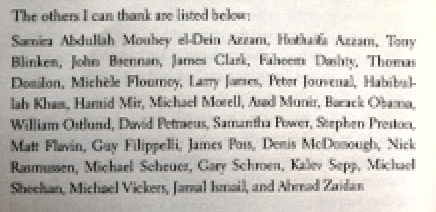
Now, both of these excerpts make it clear: This is a direct quote of an Obama claim, made after the fact. But if that didn’t already make you suspect the political efficacy of telling this story just weeks before the election, check out Bowden’s acknowledgements, above.

Not only does Bowden thank the Three Musketeers of Obama’s selective leaking, John Brennan, Tom Donilon, and Denis McDonough.

But it also thanks Obama personally.

(It also thanks CIA Director David Petraeus, a man who never met press coverage he didn’t like.)

Look, I’d love to imagine that Obama would have made the political effort to give Osama bin Laden a trial had he been captured alive. I’ve even rationalized how much easier that would be, given that we presumably would avoid the whole torture phase that has made trying Khalid Sheikh Mohammed.

There are both political and legal reasons why it serves Obama’s interests to say he considered the possibilities of a live capture followed by a trial. And given how closely Bowden worked with those trying to make the most of Obama’s OBL killing, I don’t see any reason to treat the claim as credible.

And this book–with Obama’s top aides identified as sources so clearly–is yet another reason why I think Mark Bissonnette won’t experience any legal troubles for publishing a book covering the same topic.

Share this entry

No Easy Day, WikiLeaks, and Mitt’s 47%: Three Different Approaches to Illicitly-Released Information

[youtube]nYXXkOLgMqQ[/youtube]

Last week, DOD issued a guidance memo instructing DOD personnel what they are–and are not–permitted to do with the Matt Bissonnettte book, No Easy Day, that they claim has sensitive and maybe even classified information. DOD personnel,

  • are free to purchase NED;
  • are not required to store NED in containers or areas approved for the storage of classified information, unless classified statements in the book have been identified;
  • shall not discuss potentially classified and sensitive unclassified information with persons who do not have an official need to know and an appropriate security clearance;
  • who possess either firsthand knowledge of, or suspect information within NED to be classified or sensitive, shall not publically speculate or discuss potentially classified or sensitive unclassified information outside official U.S. Government channels (e.g., Chain-of-Command, Public Affairs, Security, etc.);
  • are prohibited from using unclassified government computer systems to discuss potentially classified or sensitive contents ofNED, and must not engage in online discussions via social networking or media sites regarding potentially classified or sensitive unclassified information that may be contained in NED.

The memo points to George Little’s earlier flaccid claims that the book contains classified information as the basis for this policy, even though those claims fell far short of an assertion that there was actually classified information in the book.

The strategy behind this policy seems to be to accept the massive release of this information, while prohibiting people from talking about what information in the book is classified or sensitive–or even challenging Little’s half-hearted claim that it is classified. Moreover, few of the people bound by this memo know what the President insta-declassified to be able to tell his own version of the Osama bin Laden raid, so the memo also gags discussions about information that has likely been declassified, not to mention discussions about the few areas where Bissonnette’s version differs from the Administration’s official version.

Still, it does let people access the information and talk about it generally.

Compare that policy with the Administration’s three-prong approach to WikiLeaks information:

  • Government employees cannot discuss–and are not supposed to consult at all–WikiLeaks cables. The treatment of Peter Van Buren for–among other things–linking to some WikiLeaks cables demonstrates the lengths to which the government is willing to go to silence all discussion of the cables. (Though I imagine the surveillance of social media will be similar to enforce the DOD guidance.)
  • Gitmo lawyers not only cannot discuss material–like the dodgy intelligence cable that the government used to imprison Latif until he died of still undisclosed causes or the files that cite tortured confessions to incriminate other detainees–released by WikiLeaks unless the press speaks of them first. But unlike DOD personnel who do not necessarily have a need to know, Gitmo lawyers who do have a need to know couldn’t consult WikiLeaks except in closely controlled secure conditions.
  • The Government will refuse to release cables already released under FOIA. While to some degree, this strategy parallels the DOD approach–whereas the NED policy avoids identifying which is and is not classified information, the WikiLeaks policy avoids admitting that cables everyone knows are authentic are authentic, the policy also serves to improperly hide evidence of illegal activity through improper classification.

Now, one part of the Administration’s logic behind this approach to purportedly classified information (thus far without the legal proof in either case, or even a legal effort to prove in the case of Bissonnette) is to limit discussion of information that was allegedly released via illegal means. Read more

Share this entry

Chris Hedges et. al Win Another Round On the NDAA

You may remember back in mid May Chris Hedges, Dan Ellsberg, Jennifer Bolen, Noam Chomsky, Alexa O’Brien, Kai Wargalla, Birgetta Jonsdottir and the US Day of Rage won a surprising, nee stunning, ruling from Judge Katherine Forrest in the Southern District of New York. Many of us who litigate felt the plaintiffs would never even be given standing, much less prevail on the merits. But, in a ruling dated May 16, 2012, Forrest gave the plaintiffs not only standing, but the affirmative win by issuing a preliminary injunction.

Late yesterday came even better news for Hedges and friends, the issuance of a permanent injunction. I will say this about Judge Forrest, she is not brief as the first ruling was 68 pages, and todays consumes a whopping 112 pages. Here is the setup, as laid out by Forrest (p. 3-4):

Plaintiffs are a group of writers, journalists, and activists whose work regularly requires them to engage in writing, speech, and associational activities protected by the First Amendment. They have testified credibly to having an actual and reasonable fear that their activities will subject them to indefinite military detention pursuant to § 1021(b)(2).

At the March hearing, the Government was unable to provide this Court with any assurance that plaintiffs’ activities (about which the Government had known–and indeed about which the Government had previously deposed those individuals) would not in fact subject plaintiffs to military detention pursuant to § 1021(b)(2). Following the March hearing (and the Court’s May 16 Opinion on the preliminary injunction), the Government fundamentally changed its position.

In its May 25, 2012, motion for reconsideration, the Government put forth the qualified position that plaintiffs’ particular activities, as described at the hearing, if described accurately, if they were independent, and without more, would not subject plaintiffs to military detention under § 1021. The Government did not–and does not–generally agree or anywhere argue that activities protected by the First Amendment could not subject an individual to indefinite military detention under § 1021(b)(2). The First Amendment of the Read more

Share this entry

DOD Gets Awfully Sensitive When They’re Cornered

Just about every outlet that reported on George Little’s whine about Matt Bissonnette’s book yesterday claimed that Little had said there was “classified” information in the book.[all emphasis in this post mine]

CNN: A Pentagon official said Tuesday that a former Navy SEAL who helped kill Osama bin Laden included classified material in his new book and did not follow protocol for pre-publication review.

AP: George Little said that an official review of the book, “No Easy Day,” determined that it reveals what he called “sensitive and classified” information.

ABC: Top Pentagon officials said today that a controversial firsthand accountof the nighttime raid that killed Osama bin Laden written by a former U.S. Navy SEAL reveals classified information and could endanger other special operations servicemen.

Fox: “Sensitive and classified information is contained in the book,” Pentagon spokesman George Little told reporters in Washington. “It is the height of irresponsibility not to have this material checked.”

The reality is far more telling. Little did not commit to saying there was classified information in the book until cornered after repeated questions by the press. The transcript is worth reviewing in more detail since, if this ever gets litigated, Little’s hesitation to claim the book included classified information will become an issue.

In response to the first question on Bissonnette’s book, Little gave what was probably his rehearsed answer to it. He focused on Bissonnette’s failure to do a prepublication review (remember, Bissonnette’s lawyer, Bob Luskin, says such a review was recommended but not required). And when discussing the actual review, Little said there was sensitive information; only later, speaking more generally, did Little say “sensitive and classified.”

George, on the separate issue, on the SEAL book, has the department made a decision yet on whether to take any legal action regarding this and on whether or not there is classified material in the book, and if there — if, indeed, you’ve determined there is, can you tell us what it is and what action may or may not be taken at this point?

MR. LITTLE: Thank you very much, Lita, for that question. We continue to review our options when it comes to legal accountability for what in our estimation is a material breach of nondisclosure agreements that were signed by the author of this book.

With respect to the information that’s contained in the book, people inside the department have read it. And we do have concerns about some of the sensitive information that we believe is contained in it. I’m not going to get out ahead of what the process going forward might be and what options we might decide to pursue, but this is a very serious concern that we have.

When it comes to sensitive special operations missions, such as the operation that took down Osama bin Laden, it is important that those who are involved in such operations take care to protect sensitive and classified information. And if I had been part of the raid team on the ground and I had decided to write a book about it, it wouldn’t have been a tough decision for me to submit the book for pre-publication review. That is common sense. It’s a no-brainer. And it did not happen.

Thus far into the process, the press wasn’t buying Little’s slight of hand. He gets a followup on the sensitive/classified distinction, which he dodges by focusing on pre-publication review again.

Q: Will you — just as a follow-up — you made a distinction between sensitive and classified. So is the determination that it is sensitive information there and not classified? And also, is there any determination on whether the book will be sold on — on bases (off mic)

MR. LITTLE: There’s been no directive from this department to withhold sale of the book from military exchanges. This book is being made widely available in bookstores and online. It is not our typical practice to get into the business of deciding what and what does not go on bookshelves in military exchanges. But that doesn’t mean in any way, shape or form that we don’t have serious concerns about the fact that this process of pre-publication review was not followed.

Read more

Share this entry

DOD to Give Penguin the WikiLeaks Treatment?

As a number of outlets have reported, DOD has written a threatening letter to Matt Bissonnette, the Navy SEAL whose memoir comes out next week.

But I think they’re misunderstanding part of the nature of the threat (though Mark Zaid, a lawyer who has represented a lot of spooks in cases like this one, alludes to it here, which I’ll return to). Here are, in my opinion, the two most important parts of the letter. First, DOD’s General Counsel Jeh Johnson addressed it to Penguin’s General Counsel as the custodian for the pseudonymous writer he makes clear he knows the real identity of elsewhere in the letter.

Mr. “Mark Owen”

c/o Alexander Gigante, Esquire

General Counsel

Penguin Putnam, Inc.

That, by itself, is not a big deal. But it does mean Johnson knows Penguin’s GC will read this letter.

More importantly, here’s how Johnson ended the letter:

I write to formally advise you of your material breach and violation of your agreements, and to inform you that the Department is considering pursuing against you, and all those acting in concert with you, all remedies legally available to us in light of this situation. [my emphasis]

That is, DOD is also considering legal remedies against “those acting in concert” with Bissonnette.

As far as we know, the only people acting in concert with Bissonnette are at Penguin’s imprint of Dutton. Thus, as much as this is a threat to Bissonnette, it’s also a threat to Penguin.

Which would make sense because–as Zaid points out–the government has been trying to push the application of the Espionage Act to those sharing classified information since the AIPAC trial.

Mark Zaid, a lawyer who has represented a variety of former military and intelligence officials in disclosure and leak cases, said the Johnson letter looked like a signal that the Pentagon was “contemplating a test case against the publisher or media for disclosing classified information.”

Read more

Share this entry

Matt Bissonnette’s Information Operation Against a Broken System of Secrecy

“We all knew the deal. We were tools in the toolbox, and when things go well they promote it. They inflate their roles.” –Mark Bissonnette

HuffPo and AP/CBS have an initial description of how Matt Bissonnette’s story of the Osama bin Laden killing differs from the story the Administration has told. While the details are interesting, I expect we can learn as much about how a well-trained SEAL manages InfoOps as we learn about the events of Bissonnette’s life from the book.

As I pointed out yesterday, once DOD got a copy of the book, the publisher announced it would almost double the initial print run and advance the publication date by a week–making it much harder for DOD to pre-empt the unredacted publication by buying up the copies. Bissonnette has also already planned to give at least some of the proceeds of the book to the families of SEALs who have died (something that former CIA officer Ishmael Jones also did), meaning DOD can’t punish him by seizing his earnings.

And now, with just the bits of information already public about the book, Bissonnette has made it very difficult for the government to prosecute him–and certainly not before the election.

The most interesting detail that both HuffPo and AP report is that Osama bin Laden never put up a fight.

“We were less than five steps from getting to the top when I heard suppressed shots. BOP. BOP,” writes Owen. “I couldn’t tell from my position if the rounds hit the target or not. The man disappeared into the dark room.”

Team members took their time entering the room, where they saw the women wailing over Bin Laden, who wore a white sleeveless T-shirt, loose tan pants and a tan tunic, according to the book.

Despite numerous reports that bin Laden had a weapon and resisted when Navy SEALs entered the room, he was unarmed, writes Owen. He had been fatally wounded before they had entered the room.

“Blood and brains spilled out of the side of his skull” and he was still twitching and convulsing, Owen writes. While bin Laden was in his death throes, Owen writes that he and another SEAL “trained our lasers on his chest and fired several rounds. The bullets tore into him, slamming his body into the floor until he was motionless.”

While I’m sure there are many details that are of greater tactical sensitivity, this one differs just enough from the previously official version that it makes it toxic to pursue. After all, prosecuting Bissonnette would require acknowledging that Bissonnette violated his non-disclosure agreement, which would in turn requiring admitting to the truth of what he presents in his book. Read more

Share this entry

Dear CIA: Maybe It’s Time to Spring for New PO Boxes?

I’ve suggested since the “names” of the two “trainers” ambushed in Mexico last Friday were released they were likely covers.

Not only are they apparently covers, but one of them was tied to a PO Box whose prior user had already been publicly tied to the CIA’s rendition program.

But an examination of public records suggests that the name used by one of the men may be fictitious, with similarities to others created by the CIA to provide cover for its officers overseas.

Shortly after the shooting, major Mexican news organizations identified one of the U.S. officials as Stan D. Boss, a name associated with a post office box at a Dunn Loring mail facility tied to at least one previous CIA cover identity that was publicly exposed. Records indicate that Boss was issued a Social Security number in Texas in 2004. Beyond that, the records are largely blank, with not even a date of birth associated with the name.

That same Dunn Loring post office is linked to dozens of other names that have similarly scant records and to Social Security numbers issued around the same time. Among the previous holders of post office boxes at that location was an individual named Philip P. Quincannon, who apparently does not exist but who was listed as an officer with at least two aviation companies suspected of involvement in CIA rendition flights after the Sept. 11, 2001, attacks.

Call me crazy, but these narcos are pretty shrewd guys. If they discover Stan Dove Boss has been picking up noted rendition guy Philip P. Quincannon’s mail, they might make certain conclusions about what line of work Stan Dove Boss is in (as if the name weren’t already a dead giveaway). And they might show up with 4 cars full of Federales to try to keep Stan Dove Boss off their turf.

Jeebus. It’s bad enough we’re invading Mexico with our spooks. But we’re sending them in with transparent covers.

Share this entry