Moving the Boxes: Trump’s Valet and Alleged Co-Conspirator Buys the Boss a Three-Week Delay in His Trial

According to the motion to seal filed in his case, DOJ warned Walt Nauta he was a target of the stolen documents case on May 24, 34 days ago.

After he and his boss were indicted on June 8, he was issued a judicial summons, alerting him that his prosecution would take place in the Southern District of Florida, which has strict rules requiring a local attorney to appear and remain counsel, and scheduling a June 13 arraignment. That was 19 days ago.

But Nauta was not arraigned on June 13, as Trump was, because he had not yet arranged for local counsel.

That delay was totally excusable. There aren’t that many people in SDFL who are qualified for a case like this in the first place. And those that are may balk at the pre-existing conflict structure here, with Stan Woodward paid by Trump’s PAC, which itself is under criminal investigation. And those aren’t the only ethical concerns I would have about taking on this case.

But today’s delay is far less defensible. Particularly given the theater Woodward created surrounding the event.

Woodward made much of the fact that poor Walt Nauta was stuck on the tarmack yesterday at Newark Airport with flight delays and cancellations due to the same bad weather that I was planning around last Saturday when I was in New York state.

That was all a distraction. Nauta’s presence wasn’t required at the arraignment. Magistrate Judge Jonathan Goodman excused Nauta’s attendance at today’s hearing during Trump’s arraignment.

You only tell that story in a court room to get credulous journalists — like CNN — to report that as the primary reason for the delay. It had no legal import. (Note: Most initial Twitter coverage parroted Woodward’s weather excuse, but most outlets fixed that on publication of their stories.)

The rain had nothing to do with today’s delay. Nauta’s failure, thus far, to retain a Florida attorney was the only reason for the delay.

And there’s certainly reason to wonder whether that delay is intentional. Marc Caputo’s report on Nauta’s search for a Florida lawyer quotes someone “familiar with the discussions” stating that the trial won’t happen before the election, so (or perhaps, “because”) “there’s no rush to” find a lawyer.

The pace of hiring an attorney for Nauta has been slow — as has been the speed with which Trump is beefing up his own criminal defense team. Nauta continues to work for Trump’s organization and Trump’s political committee is financing his employee’s legal representation.

“If you ask three different people in Trump world what’s going on, you’ll get five different answers,” said the source familiar with discussions. “But the reality is there’s no rush to do this. This seems to be their posture: ‘The case is probably going to happen after the election anyway [on Nov. 5, 2024]. So what’s the rush?’”

Speaking to the Messenger before Tuesday’s arraignment hearing got delayed, the source said Nauta would likely have a lawyer within the coming weeks.

So now Nauta is not scheduled to be arraigned until July 6 (his personal appearance has again been excused), a full four weeks after his indictment, and the same day on which Judge Cannon has ordered the defense to weigh in on proposed schedule for the trial.

This is, in my opinion, why Jay Bratt proposed a schedule showing that it is possible to try this case such that it would be done — even assuming three weeks of jury selection and three weeks of trial — before the first primary. Any delay past that schedule comes from Trump. And his alleged co-conspirator, Walt Nauta, whose job is to move boxes for the boss.

What is going to happen is that Trump will cause enough of a delay to push this into the primary season, and once that primary season trial happens, he will wail about how the trial interferes with his right to be elected President on false claims again, so he can steal more classified documents.

And his trusty valet, Walt Nauta, has just bought 23 days of delay for his arraignment to help ensure that happens. He’s moving the boxes again to help his boss obstruct justice.

Update: WSJ has since updated a story that included only the storm excuse to note that the real reason for the delay was that Nauta has not yet retained a lawyer.

Share this entry

The Milley Tape: “Bring Some Cokes in Please!”

CNN obtained copies of the recording described in ¶34 of Trump’s Espionage Act indictment. This is my take.

“This thing just came up.”

Shortly after the CNN clip starts, Trump says, “I have a big pile of papers, this just came up.” He’s saying that, remember, after having transported the documents from Mar-a-Lago to Bedminster for the summer. His comment that, “this just came up,” suggests he was not only carrying these documents around, but reviewing them.

Given the fact that Trump’s lawyers weren’t able to find this document, it means he was reviewing them … before they disappeared forever.

“These are bad sick people”

Trump compulsively shared this document for revenge — the same reason he put together the dumbass Russian binder. It not just speaks to intentional retention of documents, but it shows that he intended, from the start, to retain documents to exact revenge on his perceived detractors.

Note that this is the same reason he released classified information at least once while President — when he shared details about the Josh Schulte investigation with Tucker Carlson on the same day the FBI planned to search Schulte’s home. He did so because of false claims he had been wiretapped, but also did so to blame President Obama for the leak.

Trump’s pathological need for revenge would be very very easy to exploit by anyone willing to push Trump’s buttons.

“You probably almost didn’t believe me, but now you believe me”

As multiple reports regarding this document explained, Trump was lying. This document didn’t come from Milley, it dated back to Milley’s predecessor, sometime in 2019. Nevertheless he kept saying, “this was him, this totally wins my case.”

So it didn’t prove his case. Milley didn’t want to attack Iran, but Trump was using an unrelated document to claim that he did.

But Trump was using it — waving a document he described as highly confidential — to substantiate a false claim.

“She’d send it to Anthony Weiner, the pervert”

Trump and his aide joke about Hillary printing this out and sending it to Anthony Weiner. That’s unsurprising: Trump always rationalized his own mistreatment of information by pointing to Hillary’s email server (this Roger Parloff post is a remarkably thorough debunking of Trump’s claims).

But understand how this comment will appear against the context of the five attacks on Hillary Trump used to get elected, cited in the indictment.

Jack Smith plans to use Trump’s past condemnation of Hillary to show that Trump knew this was wrongful. So even his false quip about Weiner will make this evidence more valuable.

And then, at the end of this recording, Trump called a staffer to bring some cokes, emphasizing how banal sharing classified information was for Trump.

Update: Several people questioned who leaked this in comments. Remember that at an equivalent point in Michael Cohen’s prosecution — when SDNY was about to get the recording Cohen made of Trump ordering a hush payment — Trump released the tape to preempt damage. In that case, Trump would have gotten the recording via discovery, because he was participating in the Special Master review. In this case, Trump independently owns copies of the recording, which was made for his own purpose.

It’s certainly possible someone else (perhaps the journalists who took it) released it. But Trump releasing it — then blaming Jack Smith just as Aileen Cannon gets involved in such issues — would be the most predictable thing ever.

Update: Fixed my misuse of avenge.

Share this entry

Aileen Cannon’s Not-Abnormal Orders

Judge Aileen Cannon just issued three orders in response to the motions I described here as well as a standard Classified Information Procedures Act (CIPA) request. They’ve got people in a panic, so I want to break them down by request and response.

Request 1: Motion to Implement Special Conditions of Release

Before Trump’s arraignment, DOJ asked for no special pre-trial release conditions, aside from Trump not breaking the law anymore. But Magistrate Judge Jonathan Goodman imposed one of his own: that Trump and Walt Nauta not communicate about the facts of the case with witnesses except through lawyers.

Goodman ordered the government to provide defendants with a list of witnesses this covered.

DOJ went beyond this — not only giving Trump and Nauta that list (of 84 witnesses), but also asking to file a sealed version on the docket, without explaining why it was doing so, and also asking Trump and Nauta to sign acknowledgment of the list.

Trump and Nauta objected to that part of it.

Defense counsel takes no position on the government’s motion to seal the list of witnesses, but the defense reserves the right to object to the special condition and the manner in which it was implemented by the government by providing a list of 84 witnesses in purported compliance with the court’s order.

I suggested, among other things, that Trump might oppose this because it could stymie his efforts to fundraise off of being an accused felon.

After that, a media coalition opposed the government motion, asking that any list be filed unsealed.

Cannon’s response, denying the motion without prejudice, basically requires the government to explain why it made the request in the first place.

PAPERLESS ORDER denying without prejudice 33 Government’s Motion to Implement Special Condition of Release. The Government seeks an order implementing a special condition of bond related to Defendants’ communication with eighty-four listed witnesses about the facts of the case, except through counsel [ECF No. 17 p. 4]. The Government conditions its request on the filing of the non-exhaustive list under seal. Defendants take no position on the Government’s seal request but reserve the right to object to the special condition and the manner by which the Government intends to implement it. In the meantime, numerous news organizations have moved to intervene to oppose the Government’s Motion to File Witness List Under Seal, citing the First Amendment and related legal principles 35 . Upon review of the foregoing materials, the Government’s Motion 33 is denied without prejudice, and the Motion to Intervene 35 and accompanying Motions to Appear Pro Hac Vice 36 37 38 39 are denied as moot. The Government’s Motion does not explain why filing the list with the Court is necessary; it does not offer a particularized basis to justify sealing the list from public view; it does not explain why partial sealing, redaction, or means other than sealing are unavailable or unsatisfactory; and it does not specify the duration of any proposed seal. See S.D. Fla. L.R. 5.4(a), (c)(1). The Clerk is directed to return the Pro Hac Vice fees to the filing attorneys. Signed by Judge Aileen M. Cannon on 6/26/2023. (sj00) (Entered: 06/26/2023) [my emphasis]

As written, Cannon, is not reconsidering the limits on contact with witnesses. Rather, she’s asking why the government feels the need to file the list and if so why it needs to be sealed.

Ultimately, Cannon is just shifting the presumptive power before she responds to the media outlets’ request, properly requiring the government to justify sealing something before doing so. As Kyle Cheney laid out in a worthwhile review of her history, Cannon has in the past been receptive to media requests.

Also of note in the proceedings: Cannon partially granted a motion by the Miami Herald to unseal key sealed documents in the case, agreeing to do so with redactions sought by the government.

So DOJ will refile its request with more justification and we’ll learn how Cannon really feels about this pre-release condition.

Request 2: Motion for a Continuance

On the same day, Friday, DOJ also asked for a multi-part motion for a continuance from the August trial date to a December one.

It laid out the following logic:

  1. The matter is not complex, meaning Trump doesn’t need a year to review discovery
  2. The matter does involve classified information, which will require using the Classified Information Procedures Act (CIPA), which takes some time
  3. Also, Trump will need more time to review discovery than the current schedule allows

DOJ provided some legal requests, as well as a proposed timeline.

In response to this request, Cannon asked the defendants what they think:

On or before July 6, 2023, Defendants shall respond to the Government’s Motion for Continuance 34, either individually or in a combined filing.

This is normal.

Request 3: Motion on CIPA

The motion for CIPA, which is mostly boilerplate, reviews how the process works, including steps that are mandated by law. DOJ included a standard order requesting the following:

  • Schedule a CIPA 2 conference to talk about the classified matters at issue
  • Appoint a Court Information Security Officer

In her order, Cannon cited the defendants’ lack off opposition.

The government has conferred with counsel for Defendant Trump and Defendant Nauta about this motion. They have stated that they have no objection to this motion. Counsel for Defendant Nauta, Stanley Woodward, has not yet been admitted pro hac vice or entered an appearance, but the government is providing him a courtesy copy of this pleading.

Then she granted both of these issues, setting the CIPA 2 conference for July 14 and appointing a CISO, both normal steps in this process. She did say,

The Court expresses no view on the other matters addressed in the Government’s Motion.

But those matters are dictated by law.

At this point, neither Cannon nor the defendants’ lawyers know how this works. The conference is the first step in introducing them all to it.

Cannon did say that “Defendants are not required to be present” which is also standard, and would be better here to discuss how this is going to work.

There is nothing to panic about here. Mostly, it seems, Cannon is trying to be careful.

I promise you, I’ll let you know if and when it is time to panic about Judge Cannon’s orders. Thus far, these are reasonable orders.

Share this entry

The Approach to Classification in Trump’s Stolen Document Case

The government has submitted materials in support of a requested continuance until December in Trump’s stolen documents case:

The Motion to Implement Special Conditions is basically a bid to get a list of 84 witnesses submitted, via sealed filing, to docket, and so subject to Judge Aileen Cannon’s discipline. Under the order issued by Magistrate Judge Jonathan Goodman, both Trump and Walt Nauta will be prohibited from speaking about the facts of the case with any of the 84 witnesses — a great many of whom are Trump employees — except through counsel.

Even at the arraignment, Todd Blanche balked at this condition, which Goodman imposed without DOJ requesting it. In particular, I think Blanche wants people to be able to discuss the case without counsel present so long as counsel has advised about that.

But per the filing, defense attorneys may yet object to the condition itself.

2 The government has conferred with counsel for Defendant Trump and Defendant Nauta about this motion. They have authorized government counsel to represent the following: “Defense counsel takes no position on the government’s motion to seal the list of witnesses, but the defense reserves the right to object to the special condition and the manner in which it was implemented by the government by providing a list of 84 witnesses in purported compliance with the court’s order.” Counsel for defendant Nauta, Stanley Woodward, has not yet been admitted pro hac vice or entered an appearance, but the government is providing him a courtesy copy of this pleading.

I would love to see briefing on this, because I think Blanche has specific concerns about preserving the nesting gatekeeping that has existed from the start of this. But this condition, if upheld, will also stymie Trump’s efforts to fundraise by lying about this case.

The other request is a motion to delay the trial — which Aileen Cannon initially scheduled for August — until December, largely for CIPA to play out. This is totally normal, and given Cannon’s past history in criminal cases — which Kyle Cheney reviewed here — there’s no reason to expect she would object (indeed, legally, CIPA requires her to work through this process).

The proposed schedule would envision a trial before the first primary, but it triggers everything to Trump (and Nauta’s) responsiveness. I suspect it was crafted to undermine any claims from Trump that DOJ is responsible for a trial as people are voting, but some of these deadlines are really aggressive.

Most interesting, though, is DOJ’s treatment of clearances. According to Jay Bratt’s declaration, once defense attorneys get their SF-86 filing in, the Litigation Security Group has committed to turning around their initial clearances unbelievably quickly: two days. And it has likewise committed to sharing SIGINT documents based just off that interim clearance.

To be granted an interim security clearance, defense counsel must submit a Standard Form 86 – Questionnaire for National Security (“SF-86”) and supporting documentation. To date, not all of the defense counsel have submitted their SF-86s. Once an SF-86 and supporting documentation are submitted, absent complicating circumstances, an interim clearance may be granted within a matter of days. In this case, LSG has committed to reaching an eligibility determination within 24-48 hours of the completed submission. Once defense counsel are granted interim security clearances, the government will be able to provide the vast majority of classified discovery, consisting of documents marked CONFIDENTIAL, SECRET, and TOP SECRET, including documents within the following Sensitive Compartmented Information Compartments: SI, SI-G, and TK. [my emphasis]

You can see from the list of charged documents, that would encompass many of the charged documents (some of the redacted classifications are probably SI-G).

But there are others that require further read-in.

However, interim security clearances are not sufficient for the government to provide in classified discovery a small number of documents-including some documents whose unauthorized retention is charged in the indictment-that contain restricted compartments for which a final security clearance and additional read-ins are required. LSG estimates that final clearances may be granted within 45 to 60 days of submission of the SF-86 and related documentation, depending upon the content of the applicant’s SF-86. The additional read-ins can be conducted promptly upon access approval. [my emphasis]

Among the unredacted classification marks not included among those Bratt listed are FR (Formerly Restricted, a nuclear designation under the Atomic Energy Act and one Presidents can’t declassify alone) and HCS-P (HUMINT product). The bolded language suggests that DOJ is planning to share all classified documents Trump stole; based on the redaction marks in the May 11 subpoena, I would be unsurprised if there were HCS-C, HUMINT collection, documents included as well.

This is an incredibly aggressive approach. As I’ve said, I think DOJ would prefer to find a way to get Trump to plead out, however unlikely that would be. The sooner they share documents with Trump and Nauta’s lawyers, the sooner they might be in a position to persuade Trump how bad this will look if he goes to trial.

But note the two caveats: At least one of three known defense attorneys has not yet submitted his SF-86, the list of foreign contacts needed to obtain clearance. At least one of them — Chris Kise, who worked for Venezuela’s government — may not be eligible.

So one other underlying context to this is that until Trump can find cleared attorneys, he may be responsible for delays that would result in a trial during the primary season.

Share this entry

Walt Nauta Testified to the Grand Jury before DOJ Obtained Surveillance Video

DOJ has turned over the first tranche of unclassified discovery in the Trump stolen documents case. It includes recordings, plural, of interviews Trump did, complete copies of the surveillance footage DOJ obtained, and pictures even beyond those included in the indictment.

The second part includes a reproduction of “key” documents and photographs included in Production 1 that are referenced in the Indictment and others determined by the government to be pertinent to the case. The third part consists of complete copies of closed-circuit television (CCTV) footage obtained by the government in its investigation. To facilitate review, the government also identified and separately produced for the defense “key” excerpts from the CCTV footage, including excerpts referenced in the Indictment or otherwise determined by the government to be pertinent to the case.

As I’ve suggested, DOJ would prefer to get Trump to plead out. It’s possible there is discovery that will make him decide going to trial will be more damaging for him than pleading out.

The discovery memo also reveals that Walt Nauta testified to the grand jury on June 21 of last year.

The June 21, 2022 grand jury testimony of Defendant Nauta.

This was days before DOJ subpoenaed surveillance footage on June 24. That puts the alleged conflict between Jay Bratt and Nauta’s attorney, Stan Woodward, in different light.

Nauta was not charged with perjury for that appearance, suggesting he already fixed his testimony before DOJ obtained the surveillance footage.

But not before his alleged lies in May helped Trump abscond to Bedminster with more classified documents.


Share this entry

Aileen Cannon Issues Another Perfectly Routine Order

Judge Aileen Cannon set Donald Trump’s trial for hoarding 31 highly classified documents for August 14, 2023.

The trial won’t happen that quickly. This is, instead, an order stemming from Speedy Trial Act (and in any case, the trial would be set back a few weeks once Walt Nauta is arraigned, because barring a plea or other unforeseen developments, they will be tried together). Per the boilerplate, the two sides have to file Speedy Trial notices every 21 days from here on out.

Other parts of the boilerplate order are more interesting. For example, Judge Cannon ordered that each side can propose no more than 10 voir dire questions to be used in jury selection. This suggests that Cannon plans to conduct the questioning of the jury (again, this is routine in many places) and that she doesn’t envision the kind of 200 word questionnaire I would have envisioned to weed out bias.

Counsel shall be prepared to conduct limited voir dire following the Court’s questioning of the panel. Prior to Calendar Call, each party may file no more than 10 proposed voir dire questions (including any sub-parts) for the Court to consider asking of the venire. The Court will not permit the backstriking of jurors.

As I understand it, the reference to “backstriking” means that the two sides must issue peremptory challenges against jurors in real time, rather than seeing everyone who is qualified and picking the most disfavorable to kick off the jury.

This part of the order, more than anything else in this filing, could determine Donald J. Trump’s fate before a SDFL jury, because it would limit the degree to which both sides could hand pick a jury.

Another part of the order that may matter pertains to Rule 404(b) notices.

All responses pursuant to the Standing Discovery Order and/or Local Rule 88.10 shall be provided in a timely fashion in accordance with the dates scheduled by the magistrate judge. Noncompliance with the Standing Discovery Order, the Local Rules, or the Federal Rules of Criminal Procedure may result in sanctions. Any notice submitted pursuant to Federal Rule of Evidence 404(b) must be filed as a motion—not as a notice—and must identify with particularity the evidence to be introduced and the factual and legal basis supporting admission. Responses to such motions are due in accordance with the standard timing requirements set forth in Local Rule 7.1(c).

404(b) notices pertain to related conduct that is not itself part of the charges. Often it pertains to events that happened before the crime in question that show a predisposition to commit a crime (but character evidence is prohibited).

In the indictment, for example, the incident in which Trump leaked details of an Iran document may need to be introduced as Rule 404(b), because while it is itself a crime, it is not the crime charged in the indictment. Similarly, DOJ could try to introduce evidence that Trump selectively spilled classified information even as President.

Cannon will have discretion to exclude such information as prejudicial, among other things. And because the Milley incident is key to proving that Trump knew he could no longer declassify information, it could harm the case.

But we honestly don’t know whether she would do that! This order is boilerplate, and all it shows is that Cannon is, thus far, treating the trial of a former President as she would any other trial.

Update: This piece from Kyle Cheney is a useful review of how Judge Cannon has treated the few trials over which she has presided.

Share this entry

Filling the Surveillance Footage Gaps: Place and Payments

The government has asked for — and Trump and Walt Nauta’s lawyers have not objected — to a protective order in the stolen documents case. That’s utterly routine — though sometimes there is a stink about the terms of a protective order, which didn’t happen here.

The actual protective order itself does not include extra restrictions to prevent Trump from tweeting shit out — as his Alvin Bragg protective order did — but it does require the defense to make everyone who reviews discovery to sign a protective order as well (sometimes defendants unsuccessfully object to this on Sixth Amendment grounds because it provides a way to track a defendant’s own investigation).

The motion itself has attracted a good deal of attention because of this language, describing why they need to keep the discovery confidential: There’s an ongoing investigation.

The materials also include information pertaining to ongoing investigations, the disclosure of which could compromise those investigations and identify uncharged individuals

This makes more explicit what a description of needing to send this indictment back to a grand jury in DC, in the motion to seal the indictment, already implied. DOJ needed to tell grand jurors in DC a story about how much work Donald Trump and Walt Nauta did to withhold documents from the FBI and the Archives, in part so they could load them on a plane to Bedminster.

Which is why I want to look more closely at what else — besides information on an ongoing investigation — DOJ is trying to protect.

  • personal identifiable information covered by Rule 49.1 of the Federal Rules of Criminal Procedure
  • information that reveals sensitive but unclassified investigative techniques
  • non-public information relating to potential witnesses and other third parties (including grand jury transcripts and exhibits and recordings of witness interviews)
  • financial information of third parties
  • third-party location information
  • personal information contained on electronic devices and accounts

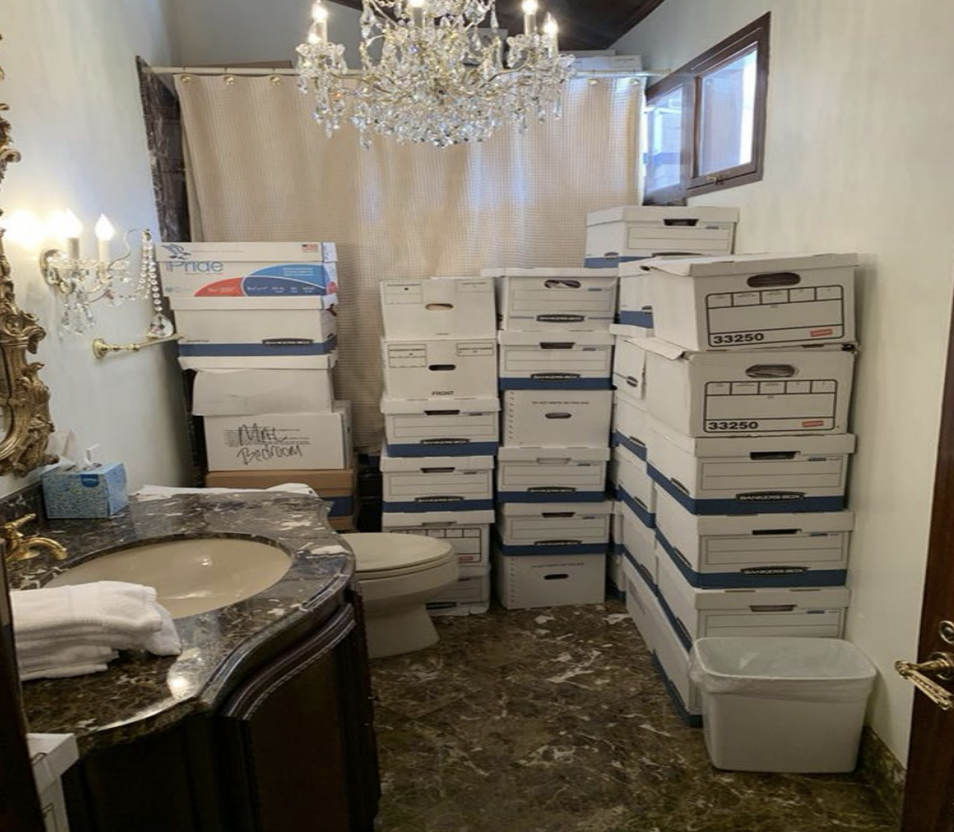
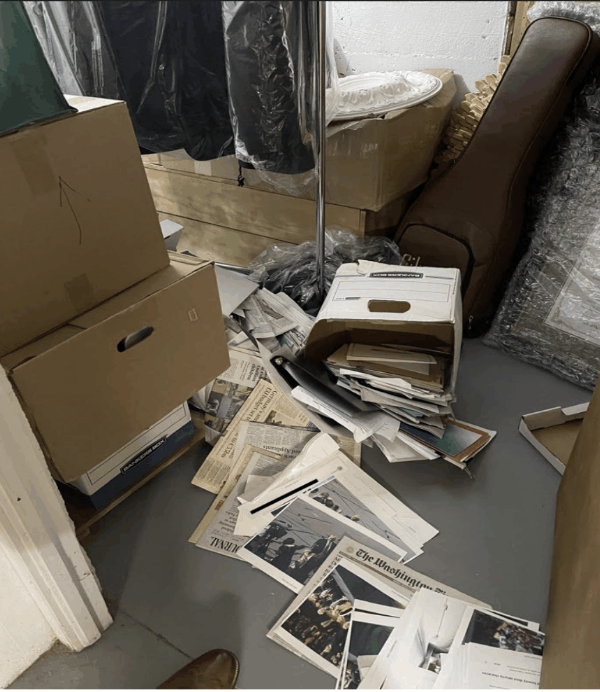
The first and second are routine — things like social security numbers and FBI techniques. The last, personal information on devices and accounts, is a nod to a great deal of content obtained in this investigation (including the pictures of stolen documents that appear in the indictment). Maggie Haberman reported that Trump hated those pictures in the indictment. A review of the pictures yet to come may prove sobering to Trump.

DOJ is, from the start, providing grand jury transcripts, but that’s likely a testament to the number of people who testified under a subpoena (normally, there would be more interview reports and DOJ might provide grand jury transcripts closer to trial).

It’s the remaining two I find interesting: financial information, and location data, particularly given the documents that went to Bedminster, never to be heard from again, and the gaps in surveillance footage.

Location data showing that someone was standing in front of a known surveillance camera at a particular time might help to fill the gaps that currently exist in the footage. Their bank account might provide more context.

These details may give Trump’s attorneys — and perhaps more importantly, Nauta’s — a sense of where DOJ thinks this investigation might head. In other circumstances, DOJ might try to obscure that an Espionage Act indictment charging 31 different highly sensitive documents is just the appetizer in a larger investigation. But in this case, they want Trump — and perhaps more importantly, Nauta — to know that from the start.

Share this entry

Aileen Cannon Did Something Normal

Aileen Cannon just issued an order for attorneys for Trump or Walt Nauta to contact DOJ’s Litigation Security Group to start the process of applying for security clearances by tomorrow.

This is just one order. It likely came as a result of DOJ contacting the Litigation Security Group, probably asking that a Court Security Officer be appointed, for this case, and alerting them that lawyers will need clearances. The Court Security Officer will be entrusted with the classified information that will, one day, be submitted at trial, including by ensuring that any filings to the docket are properly redacted. Possibly, it was Litigation Security Group, and not prosecutors, who contacted Judge Cannon and told her she needs to issue an order.

In other words, someone probably nudged her and told her this is the normal thing to do, and she did it.

It’s a bit awkward, because Nauta won’t even be arraigned until June 27, so he may not have any Florida lawyers file an appearance before then. But they are on notice that — if they don’t already hold clearance — they need to get their clearances stat.

Still, it happened. It is the normal thing that should happen. Cannon set short deadlines for things to happen, suggesting that she’s not starting out by helping Trump delay.

So, amid widespread concern, but also given evidence that DOJ is treating Trump with great deference, Cannon did something normal.

Share this entry

No Crime Alleged in the Mar-a-Lago Indictment Occurred in DC; Other Crimes Did

Today, SCOTUS ruled that the government can retry someone in the proper venue if the original case is thrown out on venue grounds without violating double jeopardy.

The decision matters for Vladislav Klyushin, “Putin’s pen-tester,” whose sole post-trial challenge to his Boston insider trading conviction was on venue grounds. The decision makes it more likely he’ll just move to sentencing and maybe decide to make his life easier by cooperating with the US government.

Contrary to what a bunch of TV lawyers are saying — who adopted this challenge as their favorite explanation for why Jack Smith would charge Trump under 18 USC 793(e) in Southern District of Florida rather than DC — the decision would never have mattered for Donald Trump.

I can’t tell you whether Smith charged Trump in Florida because he knew Trump would have successfully challenged venue elsewhere, because he has a larger strategy in mind, or because he just believes you don’t look for easy wins if you’re going to charge the former President of the United States. I suspect it is all of those things, plus a decision to do as much as possible to convince Republicans that this prosecution is legitimate, not merely an attempt to get Donald Trump.

I know that when Smith spoke publicly for all of three minutes, he mentioned the Florida venue twice.

Frankly, all the hand-wringing about venue in SDFL plays into the Republican doubters’ hands, because it sure makes it sound like you are trying to get Trump rather than prosecute a crime.

I can tell you those who think DC would have worked misunderstand the charge and misunderstand the only way an 18 USC 793(e) charge was going to be viable against the former President.

As a reminder, these are the elements of offense of 18 USC 793(e), taken from the very same jury instructions that a jury in SDFL one day may receive. As I showed in August, there was already abundant evidence that Trump met the elements of offense.

There are five elements:

  • Unauthorized possession (proof he had the documents after such time as he was no longer permitted to have them)
  • National Defense Information (NDI) (reasons a jury would agree that these documents were closely held and important to keeping the US safe)
  • Damage to the US (some kind of proof that Trump knew both that these documents could damage the US and that classified information could generally)
  • Willful (proof that he knew he had the documents, as distinct from — like Pence and probably Biden — he just accidentally removed them from his office along with other papers)
  • Refusal (some proof that he didn’t just not return the documents, but refused to do so)

To charge a former President — as distinct from someone who had clearance and brought stuff home from work — you have to prove two things: One, he knew he had  documents that remained classified after he left the Presidency, and two, that after such time as he realized he still had classified documents, he refused to give them back.

Biden and Pence discovered they had unauthorized possession of classified documents and they rushed to give them back.

By July 2021 — when Trump bragged about having documents that remained classified to a ghost writer — Trump knew he had unauthorized possession of classified documents. The Archives, Trump’s lawyers, and DOJ told him over and over that he had to give them back.

And then, in two different incidents, he took classified documents and removed them from a set of other documents that he did give back. That’s the refusal.

You do not have a crime with which you can charge a former President — as distinct from someone whose possession of classified documents would be unauthorized once he brought them outside the SCIF he had agreed to hold them in — until such time as he realizes he has them, someone asks for them back, and he refuses.

It is the refusing to give the documents back that is the provable crime, not the possession per se.

And Trump’s two big refusals — the two times he went to great efforts to sort through boxes personally to cull out documents he wanted to keep rather than return — were both in Florida, both long after he left the White House.

According to the indictment, Trump committed the act of refusing to give documents back under 18 USC 793(e) twice: once, from November 2021 until January 2022, when having been convinced he had to return documents, he went through box after box and carefully curated the boxes he returned on January 18, 2022 to keep some. The proof that he refused to give everything back in January 2022 is that there were still 38 classified documents when Evan Corcoran conducted a search in June, ten of which are charged as separate counts.

Trump refused again in May and June 2022, when he duped Evan Corcoran into claiming he had done a diligent search when in fact Trump had made sure that Corcoran would only search 30 of the 64 boxes Trump knew he still possessed. The proof that he withheld classified documents in June are the 100-some classified documents that the FBI found him to still have in his possession on August 8 of last year, 21 of which are charged as separate counts.

Jack Smith’s decision to charge this case in Florida — knowing full well he might face Aileen Cannon — was a decision about whether he could prove the elements of the offense of a crime that happened in Florida.

He is provably still considering charging crimes that happened in DC. He might even be contemplating charges for crimes that happened in New Jersey. Or maybe he is contemplating charging crimes that started in DC and ended in New Jersey.

I suspect we’re going to be surprised with the crimes he does charge, as virtually all the people saying this could have been charged in DC were surprised that he did choose to charge 18 USC 793(e), rather than just obstruction.

I wasn’t surprised. I laid out exactly how it would look last August; the big surprise to me are the pretty pictures proving Trump’s possession of these documents in Florida.

I also think virtually everyone is imagining that Smith is searching for the one trial to take Trump down, rather than making decisions about a package of conduct about which he might be able to reach a just resolution for the public interest.

I personally doubt an 18 USC 793(e) trial will happen in Florida (or elsewhere), because 793 prosecutions rarely go to trial.

They plead out.

And I promise you that Jack Smith would prefer to get a plea agreement with Donald Trump — however improbable that may seem to us now — than air 31 of the country’s most classified documents at trial.

The only prosecutorial decision Jack Smith has made public thus far is to charge a crime in Florida that happened in Florida. And none of us know how that decision fits in with the other prosecutorial decisions Smith might make or may already have made.

Share this entry

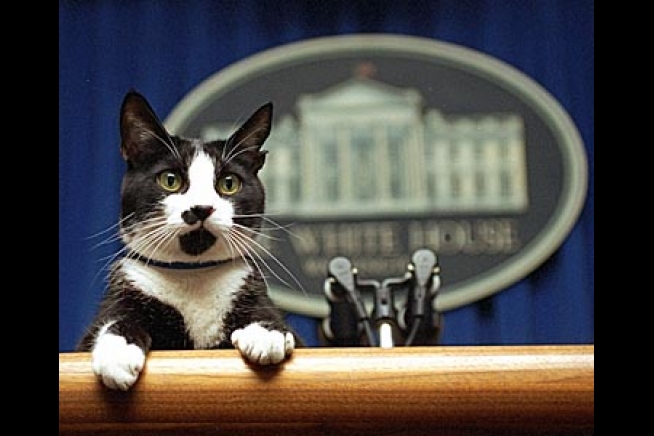
Down a Mouse Hole with Bill Clinton’s Cat, Socks

When I first read this WaPo article yesterday, I was struck by two things: first, the revelation that when Judicial Watch’s Tom Fitton appeared before a Jack Smith grand jury early this year, he was asked both about his central role in convincing Donald Trump he could rely on a case he, Fitton, lost, to justify stealing thousands of government documents (that’s the testimony we knew about), but also his role in January 6.

Fitton, who appeared before the grand jury and was questioned about his role in both the Mar-a-Lago documents case and the investigation into the Jan. 6, 2021, attack on the U.S. Capitol, acknowledged he gave the advice to Trump but declined to discuss the details of their conversations.

I wasn’t aware that Fitton had much of a role in January 6.

I was also shocked that, in the spite of the grave damage Fitton’s crackpot advice had already done to Donald Trump’s future, he was nevertheless permitted to be there with the accused felon Monday night, dining on what was undoubtedly overcooked filet mignon, as Trump and his supporters discussed his plans for beating the rap.

In an interview Wednesday, Fitton said he dined with Trump on Monday night at his club, eating filet mignon with the former president one day before his first court appearance on the document charges. “I saw him last night; he’s in a good mood. He’s serious and ready to fight under the law.”

On top of the sheer stupidity of letting Fitton anywhere close to Trump in the wake of his indictment, Fitton’s presence presumably would breach any privilege claim lawyers present could make in the future.

The report that Fitton has been chatting with Trump this week explains some of the insanely stupid things Trump has said on his failing social media site, not to mention Trump’s deceit in claiming he would see everything presented to the grand jury, much less have already seen it before any protective order is signed and discovery is provided.

By invoking Clinton’s Socks, his term for Fitton’s failed lawsuit, Trump was falsely claiming to have inside knowledge of something that would have legal merit, presumably so his followers would believe Trump had some viable defense (that they would send him money to fund).

I was not, however, surprised by the sheer stupidity of the opinions Fitton expressed to WaPo.

“I think what is lacking is the lawyers saying, ‘I took this to be obstruction,’” said Fitton. “Where is the conspiracy? I don’t understand any of it. I think this is a trap. They had no business asking for the records … and they’ve manufactured an obstruction charge out of that. There are core constitutional issues that the indictment avoids, and the obstruction charge seems weak to me.”

Several other Trump advisers blamed Fitton for convincing Trump that he could keep the documents and repeatedly mentioning the “Clinton socks case” — a reference to tapes Bill Clinton stored in his sock drawer of his secret interviews with historian Taylor Branch that served as the basis of Branch’s 2009 book documenting the Clinton presidency.

Judicial Watch lost a lawsuit in 2012 that demanded the audio recordings be designated as presidential records and that the National Archives take custody of the recordings. A court opinion issued at the time stated that there was no legal mechanism for the Archives to force Clinton to turn over the recordings.

For his part, Fitton said Trump’s lawyers “should have been more aggressive in fighting the subpoenas and fighting for Trump.”

It’s not just that Fitton was allowed to share these legally incorrect opinions with Trump. It’s that he badly misunderstands how his own advice about the “Clinton Socks” case might be viewed as an agreement with Trump to enter into a conspiracy to withhold classified documents.

Remember, after Trump fucked up releasing the Crossfire Hurricane documents, Fitton went after them himself, only to reveal that the collection was just one dumbass binder.

Anyway, after puzzling through what role Tom Fitton might have had on January 6, I started reading through a motion to compel that Ruby Freeman’s attorneys served on pardoned felon Bernie Kerik last week. Bernie was the guy who mailed a key strategy document to Mark Meadows on December 28, 2020. In addition to making clear that Bernie was sharing the document to “move legislators,” not win court cases, it included exhibits laying out the claims about Freeman and her daughter Shaye Moss that Rudy Giuliani would subsequently make publicly — that Freeman counted suitcases of votes multiple times after kicking out poll watchers, using a false claim of a water main break as the excuse — claims that Freeman alleges amount to defamation.

To be clear: those claims about Freeman are false, as is the claim she was arrested for her actions. Thus the lawsuit.

Freeman’s lawyers filed a motion to compel because when Kerik first responded to their subpoena last year, his attorney — Tim Parlatore — simply provided a link to the stuff that Kerik had provided to the January 6 Committee. Since then, Freeman’s lawyers argue, Rudy has disclaimed any work privilege claim over materials prepared for legislatures, as opposed to lawsuits. But when Freeman’s lawyers have gone back to Kerik to get the materials he withheld from J6C under a work product privilege claim that (they argue) Rudy has since waived, Parlatore explained there had been a “technical glitch” that creates some difficulties in consulting with Rudy’s attorney on the issue.

Relations between Parlatore and Freeman’s team have been sour for some time. Around the same time in December when Parlatore was telling a DC grand jury that he had done a diligent search of Bedminster — where at least two and probably a bunch of classified records have been sent, never to be seen again — he was telling Freeman’s team that Kerik didn’t have some documents that Freeman had obtained from other sources.

After Plaintiffs spent months negotiating with Mr. Kerik’s counsel and made more than a dozen unsuccessful attempts to effectuate personal service on Mr. Kerik,5 counsel for Mr. Kerik accepted service of the First Kerik Subpoena on November 14, 2022. (See Houghton-Larsen Decl. ¶ 4.) On November 21, 2022, Plaintiffs agreed to narrow the requests and provided examples of emails produced during discovery that were sent to Mr. Kerik but were not present in his production to the Select Committee. (See id. ¶ 5.) On December 21, 2022, Mr. Parlatore responded that “Mr. Kerik has looked and we do not seem to have any additional responsive documents to provide.” (See id. ¶ 6.) Mr. Kerik has never explained why he does “not seem to have” any of the example communications Plaintiffs provided to him, on which he was copied, and which have been produced by other parties.

By the time former Trump attorney Parlatore claimed a “technical glitch” was creating delays on June 7, the day before Trump was indicted, he also explained that, “there are other more pressing matters that have taken priority.”

The motion to compel includes fragments of both Rudy’s and Kerik’s March depositions in this case. In Kerik’s, Parlatore made a series of dickish responses to Freeman attorney Annie Houghton-Larsen’s questions that Parlatore deemed to ask for work product information, precisely the privilege claim that has since started to collapse.

In Rudy’s, there are a slew of hilarious responses showing how dissolute Rudy has gotten, such as when, struggling to come up with Sidney Powell’s name, he called her the Wicked Witch of the East.

Q. I’ll ask you about who was on it, but the team that was assembled at that point in time, is that the team that Ms. Bobb is referring to as the “Giuliani legal team”?

A. Correct.

Q. Now you can tell me, who was on this team?

A. It was myself, Jenna Ellis, Victoria Toensing, Joe DiGenova, Boris Epshteyn, originally.

We added Christina after about two weeks, and we added — oh my goodness, of course, her name will escape me.

Come on guys, help me. The wicked witch of the east.

Q. It’s — really, in this forum, I’m interested in what you remember.

A. Oh, I remember who it is. I just can’t remember the name. I block it out.

Q. We can come back to it.

A. On purpose. Everybody knows who it is.

Q. We can come back to it.

Anyone else aside apart this —

A. Sidney.

Q. Sidney?

A. It was Sidney.

Q. Sidney who?

MR COSTELLO: How could you forget that?

Q. Are you referring to Sidney Powell?

A. Sidney Powell, yeah.

Both men, however, struggled when asked about this passage of the strategy document, showing who, on December 28, its author considered key members of their team (Freedom Caucus members make the list on the following page), both struggled to remember who some of the members were.

There was little doubt that BK was Kerik and both ultimately decided that BE was Epshteyn.

But both simply couldn’t imagine what close Boris associate “SB” might be. Here’s Kerik’s epic struggle with the question:

Q. Okay. This might help you. Can we please turn to page 6.

Okay. So about two-thirds down the page it says, “Key team members. Rudy Giuliani.”

And then, “BK.” I’m assuming that’s you.

A. That’s probably me.

Q. Okay. “KF.” Do you know who that is?

A. Katherine Friess.

Q. And then, “Media advisors. SB.” Who do you think that is?

A. No idea. Well, I went through this before.

THE WITNESS: Who did I do this with? J6?

MR. PARLATORE: Probably.

THE WITNESS: Yeah. Boris Epshteyn would have been the BE. SB, I have no idea what that  is.

BY MS. HOUGHTON-LARSEN:

Q. Okay.

Sadly, Rudy dodged the TF question altogether and the excerpt cut off before Kerik was quizzed about the same question.

So we will have to wait to learn whether Tom Fitton is the TF who did influencer outreach on the effort to steal the election.

But it might help to explain why he was still welcome in the Boris Epshteyn-led effort to pursue political grievance rather than a sound legal defense.

Share this entry