Did Another Saudi Double Agent “Tip” Us Off to a “Plot” Against America?

ABC reports that the UndieBomber 2.0 plot revealed yesterday in breathless fashion was exposed by a double agent that–given that he delivered the bomb to Saudi Arabia–was presumably being run by the Saudis just like all the other men the Saudis have infiltrated into AQAP.

In a stunning intelligence coup, a dangerous al Qaeda bomb cell in Yemen was successfully infiltrated by an inside source who secretly worked for the CIA and several other intelligence agencies, authorities revealed to ABC News.

The inside source is now “safely out of Yemen,” according to one international intelligence official, and was able to bring with him to Saudi Arabia the bomb al Qaeda thought was going to be detonated on a U.S.-bound aircraft.

So as happened when Jabir al-Fayfi revealed the toner cartridge plot, we can now celebrate the skill of our spooks without thinking too much about what it means that the Saudis are running this terror show. (Though at least we’ve reached the point where US outlets are reporting this, rather than just British outlets.)

But here are a few questions:

Have Republicans already claimed this guy was a “recidivist” Gitmo detainee, as they have with other double agents? That effectively gives them a two-fer on detainee exploitation, “proof” that Gitmo detainees are too dangerous to release, followed by “proof” that the terrorists are planning attacks (not to mention “proof” that the CIA has good intelligence on al Qaeda).

Was the “international intelligence official” who revealed this double agent to ABC Yemeni? The Yemenis leaked Jabir al-Fayfi’s role back in 2010. If they again leaked the involvement of this double agent, we might want to start asking ourselves whether they can be trusted to keep these double agents secret.

I argued that the decision to use signature strikes in Yemen seems like a Saudi-driven demand rather than a well-considered US decision. We apparently made that decision around the same time the US reportedly learned of this “plot.” If the Saudis were–as I suspect–running this double agent like all the other double agents we’ve infiltrated into AQAP, then did they “tip” this plot as a way to convince us to make what on its face looks like a boneheaded decision?

One more bit of possible irony to contemplate. Ibrahim al-Asiri–the AQAP bombmaker reportedly behind this plot–sent his own brother, Abdullah, out to assassinate Saudi Prince Mohammed bin Nayef back in 2009. The attempt failed. Since then, two of the men Nayef presumably infiltrated into AQAP have foiled Asiri’s bomb plots. It sort of makes you wonder how Saudi double agents keep getting close enough to al-Asiri to foil his plots, doesn’t it?

Share this entry

Recruiting Informants: Framings, Expulsion, and Torture

Between this MoJo story from last week and this Telegraph story from today, it sure looks like the US and Brits have utterly dispensed with rule of law in hopes of recruiting informants.

Last week, Nick Baumann told the story of Yonas Fikre. While visiting family in Sudan, men purporting to be FBI (remember that CIA has repeatedly lied and said they were FBI since 9/11) pushed him to become an informant. When he refused, the Agents told him he had been put on the no-fly list. He then traveled to UAE, where he was detained (reportedly at the behest of the US, torture, and interrogated–in an effort, Fikre says, to elicit a false confession.

Meanwhile, the Telegraph tells of the process depicted by more of the documents liberated in Libya (I’m still wondering when the documents explaining how Ibn Sheikh al-Libi was suicided). In violation of laws prohibiting it, MI5 not only provided information to Libyans about Libyan refugees in the country, but set up meetings to try to coerce them to become informants.  If offering them citizenship didn’t work, the story describes, then they would prosecute them for meeting with the Libyan agents whose meeting they had set up.

The minutes suggest that MI5 preferred to use the carrot, rather than the stick, in inducing the target to start giving up information about his associates: ‘We might allow him to visit his family in Libya, then return to Britain. We could offer to help clear his name with Libyan authorities. We could offer to help with citizenship or residency. This could open the door to his co-operation. We could enter his office frequently, do business with him and open the door to further conversations.’

But if that didn’t work, then they could resort to coercion: ‘Libyan operatives could ask him [the target asylum seeker] about problems at home in Libya or in Britain.
‘They offer to help in return for giving information we want

about other targets. If he refuses, British police will arrest him and accuse him of associating with Libyan secret agents. He will be told that as a non-resident of Britain he could be deported if found guilty.’

At some point this isn’t about collecting intelligence anymore (particularly in the case of Fikre’s mosque, the Imam from which the FBI has probably sent 10 informants against without ever being able to make a case against him). It’s about instilling turning Muslim men into the puppets of the governments claiming to wage counter-terrorism campaigns.

Share this entry

So Much for the FBI’s $100,000 Informant

MoJo, which did a superb report on the FBI’s use of informants last year, reports that one of the guys they profiled in that package, Shahed Hussain, got sniffed out by a Pittsburgh area man, Khalifah Al-Akili, whom he was trying to ensnare in a sting.

Shahed Hussain, a long-time FBI terrorism informant Mother Jones profiled last year, has surfaced again—but this time, Google appears to have foiled his effort to identify a new target. Khalifah al-Akili, a 34-year-old Pittsburgh man who says he was approached by Hussain and another informant in January. Al Akili told the Albany Times-Union that after Hussain “repeatedly made attempts to get close” to him, he googled them. He found Trevor Aaronson’s August 2011 Mother Jones expose about the FBI’s massive network of undercover terrorism informants and confronted Hussain on the phone.

MoJo notes Akili is being held on gun charges, but it doesn’t really lay out what appears to have happened to him–which is that FBI was trying to build a terrorism charge against him, but then triggered the gun charge arrest after Akili publicized Hussain’s efforts to reach out to him.

Akili–formerly James Marvin Thomas Jr–was busted in 2001 on drug charges and sentenced to 2.5 to 5 years in prison. He says an informant tried to ensnare in him in 2005. The FBI Special Agent who testified in his bond hearing, Joseph Bieshelt, claimed that Akili expressed sympathy for the Taliban in 2005, which may be the same effort.

Mr. Akili is known to have expressed sympathy for the Afghan resistance movement in a 2005 conversation with a man he knew in prison, Agent Bieshelt said.

And both before and after his arrest and imprisonment, he had a history of fighting cops and ignoring warrants on minor infractions. He reportedly tried to run when the FBI came to arrest him on Thursday.

In December, according to Bieshelt, Akili was recorded saying, “that he was developing somebody to possibly strap a bomb on himself,”

Then, in January, Hussain and another informant, Shareef, tried to entrap Akili.

Al-Akili said he was approached by Hussain, who went by the name “Mohammed,” and another man, who used the name “Shareef,” in January when they turned up in his neighborhood and repeatedly made attempts to get close to Al-Akili. But Al-Akili said he quickly figured out Hussain’s identity as an FBI informant. He said the men were “too obvious” and requested receipts even for small items they purchased like coffee and donuts.

Al-Akili said Shareef also asked Al-Akili repeatedly if he could help him purchase a gun. Al-Akili said he told the man he could not help him.

Al-Akili said his suspicions the men were informants were confirmed when he saw a photograph of Hussain on the Internet. In addition, he said, a cell phone number Hussain had given him was the same number used by Hussain during a 2009 counterterrorism investigation against four Newburgh men in the small Orange County city. Al-Akili said he found the number and its connection to that case through a simple Internet search using Google.

Last week (so maybe around March 10), he called Hussain and asked if he was an FBI informant.

Al-Akili said the last time he spoke to Hussain was a week ago when Al-Akili said he called Hussain’s cell phone and asked him if he was an FBI informant. He said Hussain quickly ended the call. The other man, “Shareef,” vacated his apartment and vanished within a day, Al-Akili said.

He revealed all that to the Albany Times Union, which interviewed Al Akili on Sunday, March 11 (he also reportedly put it on his Facebook page, which I haven’t found yet). A US Marshall, Jonathan Neely, filed an affidavit for his arrest on March 14. And the FBI arrested him on Thursday–based primarily on a YouTube video from July 2010 showing him holding a gun at a gun range. On Friday, he was denied bail. On Saturday, the Times Union published their story revealing that Al Akili had identified and confronted Hussain.

Here’s what I find particularly interesting about all this.

Read more

Share this entry

How Good Are DOJ’s Reasons for Burying Its Case against Anwar al-Awlaki?

Today’s the day Eric Holder explains how his Department decided it was okay to kill a US citizen with no independent legal review, even while he says we should use civilian courts to, uh, give terrorists due process.

Now, at least as of late January, the Administration still planned not to include any real information about its case against Anwar al-Awlaki in Holder’s speech.

As currently written, the speech makes no overt mention of the Awlaki operation, and reveals none of the intelligence the administration relied on in carrying out his killing.

Since much of the evidence that has been used to implicate Awlaki came from Umar Farouk Abdulmutallab, I’m going to return to a question I first raised several weeks ago, why DOJ sat on the information it got from Abdulmutallab implicating Awlaki so long.

In this post, I considered why DOJ published a narrative explicitly describing Anwar al-Awlaki’s role in Umar Farouk Abdulmutallab’s terror plot last month, rather than when it learned the information from Abdulmutallab sometime in 2010. The reason is likely evidentiary. It appears the government never persuaded Abdulmutallab to testify against Awlaki even while he was implicating Awlaki during “plea negotiations,” meaning it’s unclear Abdulmutallab would have repeated the information implicating Awlaki in court. Note, since that post, Abdulmutallab prosecutor Jonathan Tukel confirmed in court that the UndieBomber was offered–but did not accept–a plea agreement.

In this post, I will consider other reasons why DOJ may have buried (and presumably will continue to bury) their case against Awlaki: a desire to hide its signals intelligence, its informants, as well as a desire to win legal cases.

Read more

Share this entry

Exploitation: How a “Recidivist” became a Double Agent

The Republicans are at it again: collecting lists of former Gitmo detainees they deem to have “returned to combat” and using those lists to fear-monger against transferring prisoners out of Gitmo.

Here’s the report the Republicans on the House Armed Service Investigations Subcommittee put out; here’s an excellent rebuttal from the Democrats, here’s Adam Serwer, and here’s Charlie Savage.

Subcommittee Ranking Member Jim Cooper summarizes,

The report was supposed to be a comprehensive and bipartisan look at former GTMO detainees, but fails at both objectives. Much of the failure is due to the majority’s insistence on releasing a public report during an election year. The majority is well aware that most of the relevant material is classified and politically sensitive. To their credit, committee staff did do a workmanlike job on the classified annex, which we recommend to all members. But the public report uses a highly problematic “methodology” in order to write ghost stories designed to scare voters. Americans deserve better.

Reports on terrorism should not further the terrorists’ goal of spreading fear. After all, terrorism is a double-barreled attack on civilization: violence is one weapon and publicity of that violence is another. Without publicity, the terrorist can never succeed. Regrettably, this report gives former GTMO detainees publicity by making them seem more numerous and dangerous than they are. Reengagers will like their image in the report.

[snip]

The report concludes that, despite the admitted improvements in the Obama Administration’s handling of detainee issues, the number of former detainees who return to terrorism will be as high or higher. This is purely speculative, and seems politically motivated. Time will tell, but the current rate of confirmed reengagement of transferees under the Obama Administration is closer to 3%, not the report’s cover graphic of 27%. The lower figure does not, however, make headlines.

I will have more on the report later. But I wanted to point out one detail about how the propaganda list of who is a “recidivist” and who isn’t changes.

In the April 2009 list leaked to ruin Obama’s efforts to close Gitmo, the Saudi former detainee Mazin Salih Musaid al-Awfi was listed second on the list of those “confirmed” to have “reengaged” in terrorism along with Said al-Shihri.

Abu Sufyam al-Asdi al-Shihri–repatriated to Saudi Arabia in November 2007, and Mazin Salih Musaid al-Alawi al-Awfi–repatriated to Saudi Arabia in July 2007. On 24 January, a 19-minute video was released wherein al-Shihri and al-Awfi announced their leadership within the newly established al-Qaida in Arabian Peninsula.

But in this week’s list, al-Shihri appears all by himself (though still second on the list).

Said al-Shihri 17 (ISN 372) was transferred in November 2007 to the Prince Mohammed bin Nayef Centre for Care and Counseling (also known as Care) in Saudi Arabia.18 This is an initiative, operated by the Saudi government, meant to rehabilitate those believed to be terrorists.19 However, after completing the portion of the program requiring him to reside at the Care facility, al-Shihri left Saudi Arabia for Yemen despite putatively being barred from foreign travel. In addition to raising questions about the Saudi government’s ability to enforce travel restrictions on former detainees, al-Shihri’s arrival in Yemen allowed him and another former GTMO detainee to assume leadership of the newly established al-Qa’ida in the Arabian Peninsula (AQAP).20  They released a video announcing their roles.21 [my emphasis]

The report invokes al-Awfi, but don’t name him or explain why they don’t consider him among those “confirmed” to have returned to extremism.

Maybe this is why:

Mohammed al-Awfi’s is an extraordinary story. He went through the rehabilitation programme like the others from Batch 10, but then fled to Yemen where he starred in the al-Qaeda launch video.

Astonishingly al-Awfi later re-crossed the border into Saudi Arabia and gave himself up.

I have never understood why he did so.

The Saudis told me it was because he had received a phone call from his wife telling him to return to look after her and the children.

The explanation caused me to raise a quizzical eyebrow. I was told it is not unknown for the Saudis to use families as bait.

Al-Awfi is now living in luxury accommodation in Riyadh’s top security prison where he is being drained of every scrap of intelligence.

He has all the comforts of home, a well furnished flat and regular visits by a grateful and relieved family.

I can’t guarantee al-Awfi was working as a double agent–presumably like that other “rehabilitated” Saudi detainee who joined AQAP only to return to Saudi Arabia to dump key intelligence, Jabir al-Fayfi–the whole time. But it sure does look like it.

Which means among the former detainees whose story fearmongers used in 2009 to argue against closing Gitmo was, probably, a double agent collecting intelligence on what became AQAP.

For all we know, the Subcommittee may be doing the same again now–claiming people have “returned to action” when they haven’t, exactly. In fact, it’s not even clear they know for sure that their “returned fighters” are what they claim. The folks who might know best–the CIA–refused to cooperate with this report.

The committee believes the Central Intelligence Agency may have been able to provide additional insight on reengagement issues and resolve factual discrepancies identified during meetings with U.S. officials abroad. Headquarters representatives from the CIA declined requests, made at the behest of the subcommittee chairman and ranking member, to meet with staff. This impaired the committee’s efforts to evaluate fully this topic.

Which highlights how brilliant it was to recruit double agents at Gitmo (if you want to sustain the fear of terrorism). If successful, recruits might serve double duty, both infiltrating al Qaeda and providing intelligence, and serving as (apparently false) examples of how dangerous this foe really is.

Share this entry

91% Fewer Terrorist Sympathizers with Twice the Cash and 48% More Surveillance

A number of people have pointed to this report showing that the terrorist threat is grossly overblown. Not only does it show that Robert Mueller was overselling the risk of Muslim-American radicalization in the early days of of the War on Terror, and he and Janet Napolitano and Peter King and others continue to do so.

Twenty Muslim-Americans were indicted for violent terrorist plots in 2011, down from 26 the year before, bringing the total since 9/11 to 193, or just under 20 per year (see Figure 1). This number is not negligible — small numbers of Muslim-Americans continue to radicalize each year and plot violence. However, the rate of radicalization is far less than many feared in the aftermath of 9/11. In early 2003, for example, Robert Mueller, director of the Federal Bureau of Investigation, told Congress that “FBI investigations have revealed militant Islamics [sic] in the US. We strongly suspect that several hundred of these extremists are linked to al-Qaeda.”1 Fortunately, we have not seen violence on this scale.

[snip]

These and similar warnings have braced Americans for a possible upsurge in Muslim-American terrorism, which has not occurred. Instead, terrorist plots have decreased in each of the past two years, since the spike of cases in 2009. Threats remain: violent plots have not dwindled to zero, and revolutionary Islamist organizations overseas continue to call for Muslim-Americans to engage in violence. However, the number of Muslim-Americans who have responded to these calls continues to be tiny, when compared with the population of more than 2 million Muslims in the United States5 and when compared with the total level of violence in the United States, which was on track to register 14,000 murders in 2011.6

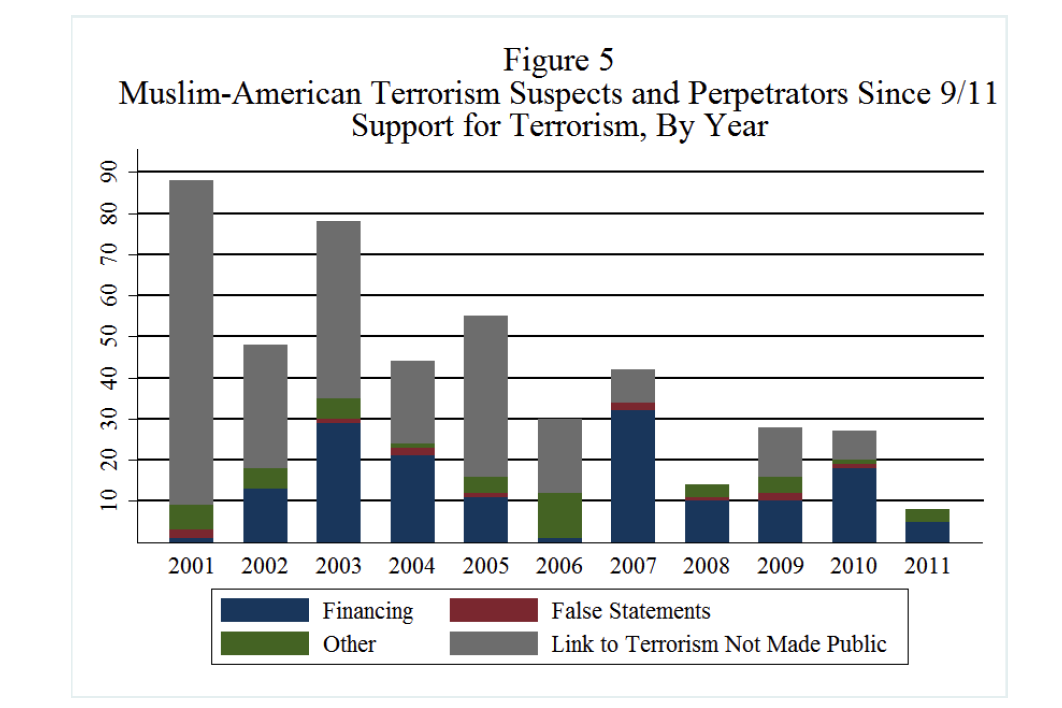
But, as Kevin Drum emphasized, the number of Muslim-Americans indicted for supporting terrorism–rather than engaging in a plot–has declined steadily over the last decade.

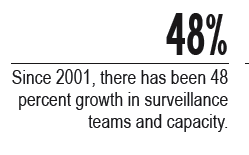
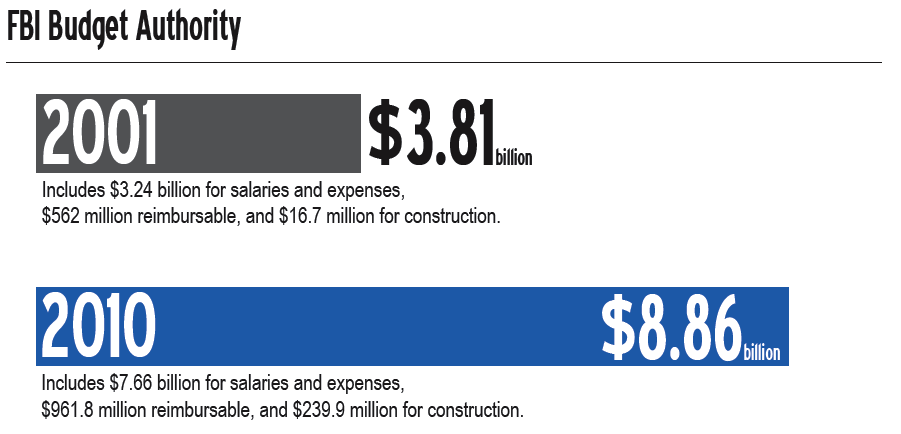
But while discussing how overblown the threat from Muslim-Americans in this country is, we ought to look at another report, too–perhaps this one, bragging about how much the FBI has changed in the last decade. Because along with visualizing how much more the FBI is spending–more than twice as much–it also notes the FBI has increased surveillance 48% over the decade (and that’s separate from the surveillance the NSA and Homeland Security and local law enforcement have put into place).

In other words, it’s not just that Muslim-American support for terrorism has declined. But it has declined even while we’re spending far more resources looking for it, and we’re just not finding it, much.

Share this entry

Lanny Breuer Rewards DOJ Lawyers for Winning Impunity for Prosecutorial Misconduct

I always like reading DOJ’s various expressions of their investigative and prosecutorial priorities–because they usually show a disinterest in prosecuting banksters, a thorough waste of resources on entrapping young Muslims, and an ongoing fondness for Anna Chapman.

Lanny Breuer’s choice of DOJ lawyers to recognize yesterday was, in some ways, an improvement over the trend. I’m happy to see prosecutors rewarded for taking down the “Lost Boy” website. Rather than fixating on Anna Chapman and entrapping young Muslims, Breuer recognized prosecutors who entrapped older Muslims who attempted to smuggle someone they believed to be a Taliban member into the US. And Breuer even celebrated the rare prosecution of a bankster, Lee Bentley Farkas.

And while Breuer’s multiple awards to people seemingly making it easier to shut down the InterToobz in the guise of IP violations concerns me, it’s this bit that I found disgusting.

The Assistant Attorney General’s Award for Distinguished Service was presented to Kirby Heller and Deborah Watson of the Criminal Division’s Appellate Section for their exceptional work in the successful appeal of sanctions imposed upon federal prosecutors in the case of Dr. Ali Shaygan.

Effectively, Lanny Breuer is rewarding two appellate section lawyers for winning an 11th Circuit Court decision overturning sanctions imposed on DOJ for gross prosecutorial misconduct. Breuer’s priorities, it seems, include ensuring that DOJ pays no price when it abuses its prosecutorial power.

The case goes back to February 2008, when Ali Shaygan was indicted for distributing controlled substances outside the scope of his medical practice; one charge tied that distribution to the death of one of Shaygan’s patients. Shaygan ended up hiring a defense team that included one attorney who had had a run-in with the prosecutors in his case. In addition, the lead prosecutor, Sean Paul Cronin, was admittedly buddies with the lead DEA Agent, Chris Wells. After Shaygan’s lawyers attempted (ultimately, successfully) to suppress a DEA interview with Shaygan on Miranda grounds, Cronin threatened the team.

AUSA Cronin warned David Markus, Shaygan’s lead attorney, that pursuing the suppression motion would result in a “seismic shift” in the case because “his agent,” Chris Wells, did not lie.

Nine months later, during the trial, one of the prosecution’s witnesses alluded in cross-examination that he had tapes of conversations–failed attempts to bribe Shaygan’s lawyer–at home.

During the cross-examination of Clendening on February 19, 2009, Shaygan’s counsel, Markus, asked Clendening if he recalled a telephone conversation in which Clendening told Markus that he would have to pay him for his testimony, and Clendening responded, “No. I got it on a recording at my house.”

This revelation led to exposure of the government’s collateral, failed investigation of Markus for witness tampering, as well as a significant number of discovery violations. In short, it became clear the government tried, unsuccessfully, to catch Markus bribing witnesses for favorable testimony and then hid all evidence they had tried. The prosecutor in the case was not properly firewalled form that investigation and even personally claimed to give authorization to tape the conversations. And in the days before the trial, the prosecutor checked in on the witness tampering investigation, apparently hoping to force Markus to withdraw from the case just as it went to trial. In the end, Shaygan was acquitted of all 141 charges against him.

After the trial, Miami District Court Judge Alan Gold held a sanctions hearing against the government for its gross misconduct. He held the government in violation of the Hyde Amendment. He had them pay all reasonable costs after a superseding indictment he judged was filed as part of the “seismic shift in strategy.” And he publicly reprimanded the prosecutors involved in the case.

Now, the government admitted that it committed significant errors.

The United States acknowledges that it initiated a collateral investigation into witness tampering and authorized two witnesses, Carlos Vento and Trinity Clendening, to tape their discussions with members of the defense team in violation of United States Attorney’s Office policy; that, although there were efforts made to erect a “taint wall,” the wall was imperfect and was breached by the trial prosecutors, AUSA Sean Paul Cronin and Andrea Hoffman, at least in part, because the case agent, DEA Special Agent Christopher Wells, was initially on both sides of the wall; and that, because the United States violated its discovery obligations by not disclosing to the defense “(a) that witnesses Vento and Clendening were cooperating with the government by recording their conversations with members of the defense team, and (b) Vento’s and Clendening’s recorded statements at the time of their trial testimony.” Finally, the United States “acknowledges and regrets” that, “in complying with the Court’s pre-trial order to produce all DEA-6 reports for in camera inspection on February 12, 2009 (Court Ex. 6), the government failed to provide the Court with the two DEA-6 reports regarding the collateral investigation, specifically Agent Wells’ December 12, 2008 report (Court Ex. 2) and Agent Brown’s January 16, 2009 report (Court Ex. 3).”

After the sanctions hearing, the government agreed to pay some legal fees associated with their misconduct. They just objected, and appealed, to the public reprimand and the requirement they pay for all fees after the superseding indictment.

But the appeals court not only threw out the entire financial sanction, it also vacated the public reprimands of the lawyers.

Read more

Share this entry

With Latif Decision, Section 1031 Authorizes Indefinitely Detaining Americans Based on Gossip

As I noted yesterday, both Dianne Feinstein and Carl Levin understand Section 1031 of the Defense Authorization to authorize the indefinite detention of American citizens. Levin says we don’t have to worry about that, though, because Americans would still have access to habeas corpus review.

Section 1031 makes no reference to habeas corpus, and places no limitation on habeas corpus review.  Nor could it.  Under the Constitution, habeas corpus review is available to any American citizen who is held in military custody, and to any non-citizen who is held in military custody inside the United States.

Even ignoring the case of Jose Padilla, which demonstrates how easily the government can make habeas unavailable to American citizens, there’s another problem with Levin’s assurances.

Habeas was gutted on October 14, when Janice Rogers Brown wrote a Circuit Court opinion holding that in habeas suits, judges must grant official government records the
presumption of regularity.

The habeas case of Adnan Farhan Abdul Latif largely focused on one report purporting to show that Latif fought with the Taliban. I suspect the report is an early 2002 CIA report, written during the period when the US was trying to sort through hundreds of detainees turned over (sometimes in exchange for a bounty) by the Pakistanis. The report I suspect is at issue summarizes the stories of at least 9 detainees, four of whom have already been transferred out of US custody. David Tatel’s dissent makes it clear that there were clear inaccuracies in the report, and he describes Judge Henry Kennedy’s judgment that this conditions under which this report was made–in the fog of war, the majority opinion agrees–increased the likelihood that the report was inaccurate. Of note, Latif’s Factual Return reveals the government believed him to be Bangladeshi until March 6, 2002 (see paragraph 4); they blame this misunderstanding on him lying, but seeing as how the language of an interrogation–whether Arabic or Bangladeshi–would either seem to make his Arab identity clear or beset the entire interrogation with language difficulties, it seems likely the misunderstanding came from the problem surrounding his early interrogations.

Beyond that report, the government relied on two things to claim that Latif had been appropriately detained: The claim that his travel facilitator, Ibrahim Alawi, is the same guy as an al Qaeda recruiter, Ibrahim Balawi (usually referred to as Abu Khulud), in spite of the fact that none of the 7 detainees recruited by Balawi have identified Latif. And the observation that Latif’s travel to Afghanistan from Yemen and then out of Afghanistan to Pakistan traveled the same path as that of al Qaeda fighters (here, too, none of the fighters who traveled that same path identified Latif as part of their group).

In other words, the government used one intelligence report of dubious reliability and uncorroborated pattern analysis to argue that Latif had fought with the Taliban and therefore is legally being held at Gitmo.

And in spite of the problem with the report (and therefore the government’s case), Judge Janice Rogers Brown held that unless Judge Kennedy finds Latif so credible as to rebut the government’s argument, he is properly held. More troubling, Rogers Brown held that judges must presume that government evidence gathering–intelligence reports–are accurate as a default.

When the detainee’s challenge is to the evidence-gathering process itself, should a presumption of regularity apply to the official government document that results ? We think the answer is yes.

Rogers Brown is arguing for a presumption of regularity, of course, for the same intelligence community that got us into Iraq on claims of WMD; the report in question almost certainly dates to around the same period that CIA went 6 months without noticing an obvious forgery.

Read more

Share this entry

More FOIA Refusals Hiding DOJ’s Informant Practices

The Center for Constitutional Rights is helping former Black Panther, community activist, and Common Ground founder Malik Rahim sue to get the FBI’s records on FBI informant Brandon Darby’s infiltration of Common Ground.

Today, the Center for Constitutional Rights (CCR), in collaboration with the Loyola Law School’s Clinic in New Orleans, filed a federal lawsuit against the U.S. Department of Justice and the Federal Bureau of Investigation demanding records related to Brandon Darby’s collaboration with the FBI during his involvement with Common Ground, a New Orleans relief organization that provided supplies and assistance in the aftermath of Hurricane Katrina and worked on rebuilding the New Orleans community from the ground up. Darby, who notoriously infiltrated protest groups at the 2008 Republican National Convention, co-founded Common Ground only to then infiltrate and disrupt the group. The lawsuit, filed in the District Court for the Eastern District of Louisiana on behalf of New Orleans community organizer and Common Ground Relief founder Malik Rahim, follows repeated unsuccessful requests by Mr. Rahim to have the FBI release documents detailing warrantless surveillance that he and other activists might have been subject to while working alongside Mr. Darby.

Darby’s work–and his work as an informant has been repeatedly documented (see also this report on the FBI file of Scott Crow, who started Common Ground with Darby and Rahim). But when Rahim tried to FOIA his own file in 2009, the FBI refused to turn over anything related to Darby’s work as an informant.

Plaintiff submitted, by letter dated February 24, 2009, and later amended on July 30, 2009, a FOIA request to Defendant FBI for all documents relating to Malik Rahim or his organization Common Ground Relief.

[snip]

Specifically, the FOIA request further sought “all records, documents and things . . . ” related to surveillance, investigation, use of informants and agents, planting or gathering “evidence,” and any other activities pertaining to Malik Rahim including anything related to Common Ground Relief and Brandon Darby.

On March 17, 2009, the FOIA request of Malik Rahim was denied on the grounds that the FBI would not respond to a FOIA request concerning another individual in addition to Malik Rahim without a “privacy waiver” being filled out by Brandon Darby.

On July 30, 2009, an appeal was filed to the denial. This appeal set out several reasons why the records should be made public, including: “the public right to be informed about what their government is up to,” citing U.S. Department of Justice v. Reporters Committee for Freedom of Press, 489 U.S. 749, 773 (1989); the fact that if Brandon Darby was an undercover informant for the FBI during his time at Common Ground, then that would be an act of such public concern that it would overcome personal privacy exemptions, citing National Archives & Records Administration v. Favish, 541 U.S. 157, 172 (2004). This appeal is attached.

[snip]

On September 25, 2009, the U.S. Department of Justice Office of Information Policy stated it was affirming the original refusal of the FBI to release any information pertaining to Brandon Darby and further affirmed the refusal of the FBI to neither confirm nor deny the existence of any records responsive to the request. They said: “Without consent, proof of death, official acknowledgement of an investigation, or an overriding public interest, confirming or denying the existence of the records your client requested would constitute an unwarranted invasion of personal privacy.”

The FBI response to Rahim’s FOIA is interesting on two counts. Rahim FOIAed for these records before Comac Carney ruled in the Islamic Shura Council FOIA case; the first denial, in which the FBI invoked privacy concerns, came before Carney’s June 23, 2009 ruling; the final denial came after it (remember it was two years before that ruling would be made public). But rather than excluding these files by pretending that no such files existed as they would under the Meese Memo, they responded using something like a Glomar response, “neither confirming nor denying” the records existed. And the denial is particularly odd given the hodge podge of reasons the FBI offered that might convince them to release the documents. Would Rahim get the same packet of documents, redacted the same way, if FBI released them with a privacy waver as they would with a public interest waiver?

One thing seems clear. The FBI is using all manner of dumb excuses to avoid handing over details of its infiltration of groups exercising their First Amendment rights. We can debate how they’ll respond under FOIA, but it’s clear their informant files exist.

Share this entry

The Waffle House Terrorists “Citizens Who Threaten Our Safety and Security”

When the Waffle House Plot broke last week, I joked that maybe the FBI will start profiling Waffle Houses rather than mosques; they’d probably have more luck finding terrorists there.

But I wanted to make a few points about the plot in addition to what Jim already said.

First, there are actually two sub-plots: one attempt to acquire silencers and explosives to attack federal buildings and employees; just Frederick Thomas and Dan Roberts are implicated in that plot. The other was a half-baked discussion to manufacture ricin. Ray Adams and Samuel Crump are primarily implicated in that plot, with Roberts and Thomas goading them on. That’s significant because while the weapons plot advanced steadily over time culminating in a purchase, the ricin “plot” consisted of some bragging in March, and some taped conversations in September and October, showing not only that the alleged attackers were largely ignorant about ricin, but also appearing to show them coaching the confidential informant in the case how to make ricin, not necessarily making it themselves.

If you’re gonna do this (unintelligible), it’s gotta be built, a hood. There can be no air, can’t be no disturbance.

[snip]

I can get ya seed (castor beans). I know where the seeds is at right now.

[snip]

You take a pound of that (unintelligible), get upwind, up around Washington, DC, get about 20,000 feet (in an airplane), and turn that shit loose, it’d cover the whole (unintelligible) of Washington.

That’s particularly significant because the last two conversations laying out the ricin plot–separate conversations October 29 with both Crump and Adams–were not recorded by the informant. And that informant? He’s a liar.

CHS1 is currently on bond for pending felony state charges. The FBI administered a polygraph test to CHS1 during the investigation of a militia group. The FBI polygrapher determined that CHS1 gave less than truthful responses concerning the activities of the militia group.

In short, the whole ricin plot seems like a bad advertisement for Red Devil lye, since Crump appeared to put off making the ricin because he couldn’t find that brand of lye; Adams, for his part, claimed he’d make lye himself by leaching wood ashes.

Given the lack of seriousness of the ricin plot, it appears to have been incited at the end in time for the bust in the other plot, to use guns and explosives to kill federal workers. That plot started back in March, included a surveillance trip in May, and discussions with an undercover FBI employee about buying weapons on June and July. On September 20, Thomas agreed to trade weapons 30 days later and also to pay $1000 for explosives. In late October, Thomas, Roberts, and the informant put together money to make the purchase. On November 1, Thomas and Roberts bought a silencer and what they believed to be explosives from an undercover FBI agent.

There’s just one weird thing about the evidence presented in the Thomas and Roberts affidavits. They describe planning for the final meeting–at which they’d pool their money to buy the silencers and explosives–to be held on October 29. The affidavits were signed on November 1. The indictment describes them buying a silencer and what they believed were explosives on November 1. But there’s no discussion about what happened at the October 29 meeting. Particularly given that the two ricin conversations on October 29 were not taped, I wonder whether the informant in this case got cold feet?

In any case, that’s what passes for a terrorist plot propagated by a bunch of senior citizen wingnuts.

Now, the plot is interesting for the way US Attorney Sally Quillian Yates used this FBI-abetted sting to warn about the risks posed by [senior] “citizens within our own borders who threaten our safety and security.”

While many are focused on the threat posed by international violent extremists, this case demonstrates that we must also remain vigilant in protecting our country from citizens within our own borders who threaten our safety and security.

I’m grateful that the FBI is finally focusing on domestic terrorists, even if they’re fluffing up the risk just as they do with aspirational Muslim terrorists. But note that, in spite of the involvement of the Joint Terrorism Task Force, it seems Yates can’t force herself to call these dudes terrorists.  Perhaps they should rename the JTTF the JCWOOBWTOSASTF?

And of course there’s another difference between this and the crimes those brown people called terrorists commit. As Manssor Arbabsiar was alleged to have done, these militia members allegedly discussed assassinations. As Arbabsiar was alleged to have done, these plotters allegedly discussed explosives. Whereas with Arbabsiar, there is zero public evidence he affirmatively sought to use explosives to commit assassination, there is here. Unlike Arbabsiar, these militia members actually bought what they believed to be explosives.

And yet, unlike Arbabsiar, these alleged terrorists did not get charged with a WMD charge–not even for their alleged attempt to make ricin. Once again, it seems almost impossible for white terrorists to be charged with the FBI’s favorite charge for brown terrorists.

Finally, one more difference between the treatment of these scary white terrorists and scary brown ones. As TP’s Lee Fang notes (piggybacking off this GAPolitico post), Thomas was a commenter at RedState, where Erick Erickson has called for violence in the past.

Thomas blogged on RedState.com, the website edited by CNN’s Erick Erickson. The Thomas blog post highlighted by Baker and AJC revealed that at one point, he did not “advocate a general rebellion against the U.S. Government for cause,” but seemed conflicted about the idea of violent revolution. Something apparently changed between that unpromoted post, published in July of 2008 and this year, when the alleged plot began taking shape.

A ThinkProgress examination of Thomas’s online writing in the following years shows that the alleged terrorist grew more and more upset, and expressed sympathy with the anti-Obama conspiracies posted on RedState. Last year, he posted a comment to a popular RedState post about the evils of health reform. Thomas claimed that the “ObummerCare Bill” not only “won’t be forgiven,” but will lead to “TYRANNY of the worst order” and “civil war.” (view a screenshot of the comment here)

And as the affidavits make clear, the plot was inspired by a Mike Vanderboegh novel; Fang notes that Thomas has also commented on Vanderboegh’s blog. Last year, Vanderboegh claimed credit for coordinated attacks in protest of the health insurance reform–one of them targeted at Gabby Giffords–in three states.

On Friday, former militia leader Mike Vanderboegh called for anti-Democratic vandalism across the country to protest the health care bill.

Vanderboegh posted the call for action Friday on his blog, “Sipsey Street Irregulars.” Referring to the health care reform bill as “Nancy Pelosi’s Intolerable Act,” he told followers to send a message to Democrats.

“We can break their windows,” he said. “Break them NOW. And if we do a proper job, if we break the windows of hundreds, thousands, of Democrat party headquarters across this country, we might just wake up enough of them to make defending ourselves at the muzzle of a rifle unnecessary.”

And, apparently in response, there were attacks in–at least–Wichita, KS, Tucson, AZ,  Rochester, NY, Niagara Falls, NY.  Vanderboegh has proudly claimed credit for the coordinated attacks.

Now maybe Vanderboegh and Erickson are just the FBI’s latest incarnation of Hal Turner, wingnut bloggers they pay to inspire other wingnuts whom they can arrest in Waffle House plots; maybe the FBI hasn’t tracked their calls for violence at all. But if Vanderboegh and Erickson were Muslim propagandists advocating violence–like Anwar al-Awlaki or Samir Khan–they’d probably be worried about a drone raining down from the sky. I’m definitely not advocating that for any propagandists, whether Muslim or wingnut, being killed for their protected, albeit vile, speech.

But maybe now that the government is using stings to warn of the danger of domestic terrorists, those inciting them ought to think more seriously about how our government combats terrorists.

Share this entry