[Photo: National Security Agency, Ft. Meade, MD via Wikimedia]

The Problems with Rosemary Collyer’s Shitty Upstream 702 Opinion

This post took a great deal of time, both in this go-around, and over the years to read all of these opinions carefully. Please consider donating to support this work. 

It often surprises people when I tell them this, but in general, I’ve got a much better opinion of the FISA Court than most other civil libertarians. I do so because I’ve actually read the opinions. And while there are some real stinkers in the bunch, I recognize that the court has long been a source of some control over the executive branch, at times even applying more stringent standards than criminal courts.

But Rosemary Collyer’s April 26, 2017 opinion approving new Section 702 certificates undermines all the trust and regard I have for the FISA Court. It embodies everything that can go wrong with the court — which is all the more inexcusable given efforts to improve the court’s transparency and process since the Snowden leaks. I don’t think she understood what she was ruling on. And when faced with evidence of years of abuse (and the government’s attempt to hide it), she did little to rein in or even ensure accountability for those abuses.

This post is divided into three sections:

  • My analysis of the aspects of the opinion that deal with the upstream surveillance
    • Describing upstream searches
    • Refusing to count the impact
    • Treating the problem as exclusively about MCTs, not SCTs
    • Defining key terms
    • Failing to appoint (much less consider) appointing an amicus
    • Approving back door upstream searches
    • Imposing no consequences
  • A description of all the documents I Con the Record released — and more importantly, the more important ones it did not release (if you’re in the mood for weeds, start there)
  • A timeline showing how NSA tried to hide these violations from FISC

Opinion

The Collyer opinion deals with a range of issues: an expansion of data sharing with the National Counterterrorism Center, the resolution of past abuses, and the rote approval of 702 certificates for form and content.

But the big news from the opinion is that the NSA discovered it had been violating the terms of upstream FISA collection set in 2011 (after violating the terms of upstream FISA set in 2007-2008, terms which were set after Stellar Wind violated FISA since 2002). After five months of trying and failing to find an adequate solution to fix the problem, NSA proposed and Collyer approved new rules for upstream collection. The collection conducted under FISA Section 702 is narrower than it had been because NSA can no longer do “about” searches (which are basically searching for some signature in the “content” of a communication). But it is broader — and still potentially problematic — because NSA now has permission to do the back door searches of upstream collected data that they had, in reality, been doing all along.

My analysis here will focus on the issue of upstream collection, because that is what matters going forward, though I will note problems with the opinion addressing other topics to the extent they support my larger point.

Describing upstream searches

Upstream collection under Section 702 is the collection of communications identified by packet sniffing for a selector at telecommunication switches. As an example, if the NSA wants to collect the communications of someone who doesn’t use Google or Yahoo, they will search for the email address as it passes across circuits the government has access to (overseas, under EO 12333) or that a US telecommunications company runs (domestically, under 702; note many of the data centers at which this occurs have recently changed hands). Stellar Wind — the illegal warrantless wiretap program done under Bush — was upstream surveillance. The period in 2007 when the government tried to replace Stellar Wind under traditional FISA was upstream surveillance. And the Protect America Act and FISA Amendments Act have always included upstream surveillance as part of the mix, even as they moved more (roughly 90% according to a 2011 estimate) of the collection to US-based providers.

The thing is, there’s no reason to believe NSA has ever fully explained how upstream surveillance works to the FISC, not even in this most recent go-around (and it’s now clear that they always lied about how they were using and processing a form of upstream collection to get Internet metadata from 2004 to 2011). Perhaps ironically, the most detailed discussions of the technology behind it likely occurred in 2004 and 2010 in advance of opinions authorizing collection of metadata, not content, but NSA was definitely not fully forthcoming in those discussions about how it processed upstream data.

In 2011, the NSA explained (for the first time), that it was not just collecting communications by searching for a selector in metadata, but it was also collecting communications that included a selector as content. One reason they might do this is to obtain forwarded emails involving a target, but there are clearly other reasons. As a result of looking for selectors as content, NSA got a lot of entirely domestic communications, both in what NSA called multiple communication transactions (“MCTs,” basically emails and other things sent in bundles) and in single communication transactions (SCTs) that NSA didn’t identify as domestic, perhaps because they used Tor or a VPN or were routed overseas for some other reason. The presiding judge in 2011, John Bates, ruled that the bundled stuff violated the Fourth Amendment and imposed new protections — including the requirement NSA segregate that data — for some of the MCTs. Bizarrely, he did not rule the domestic SCTs problematic, on the logic that those entirely domestic communications might have foreign intelligence value.

In the same order, John Bates for the first time let CIA and NSA do something FBI had already been doing: taking US person selectors (like an email address) and searching through already collected content to see what communications they were involved in (this was partly a response to the 2009 Nidal Hasan attack, which FBI didn’t prevent in part because they were never able to pull up all of Hasan’s communications with Anwar al-Awlaki at once). Following Ron Wyden’s lead, these searches on US person content are often called “back door searches” for the way they let the government read Americans’ communications without a warrant. Because of the newly disclosed risk that upstream collection could pick up domestic communications, however, when Bates approved back door searches in 2011, he explicitly prohibited the back door searching of data collected via upstream searches. He prohibited this for all of it — MCTs (many of which were segregated from general repositories) and SCTs (none of which were segregated).

As I’ve noted, as early as 2013, NSA knew it was conducting “many” back door searches of upstream data. The reasons why it was doing so were stupid: in part, because to avoid upstream searches analysts had to exclude upstream repositories from the search query (basically by writing “NOT upstream” in a Boolean query), which also required them realizing they were searching on a US person selector. For whatever reason, though, no one got alarmed by reports this was going on — not NSA’s overseers, not FISC (which reportedly got notices of these searches), and not Congress (which got notices of them in Semiannual reports, which is how I knew they were going on). So the problem continued; I noted that this was a persistent problem back in August, when NSA and DOJ were still hiding the extent of the problems from FISC.

It became clear the problem was far worse than known, however, when NSA started looking into how it dealt with 704 surveillance. Section 704 is the authority the NSA uses to spy on Americans who are overseas. It basically amounts to getting a FISC order to use EO 12333 spying on an American. An IG Report completed in January 2016 generally found 704 surveillance to be a clusterfuck; as part of that, though, the NSA discovered that there were a whole bunch of 704 backdoor searches that weren’t following the rules, in part because they were collecting US person communications for periods outside of the period when the FISC had authorized surveillance (for 705(b) communication, which is the spying on Americans who are simply traveling overseas, this might mean NSA used EO 12333 to collect on an American when they were in the US). Then NSA’s Compliance people (OCO) did some more checking and found still worse problems.

And then the government — the same government that boasted about properly disclosing this to FISC — tried to bury it, basically not even telling FISC about how bad the problem was until days before Collyer was set to approve new certificates in October 2016. Once they did disclose it, Judge Collyer gave NSA first one and then another extension for them to figure out what went wrong. After 5 months of figuring, they were still having problems nailing it down or even finding where the data and searches had occurred. So, finally, facing a choice of ending “about” collection (only under 702 — they can still accomplish the very same thing under EO 12333) or ending searches of upstream data, they chose the former option, which Collyer approved with almost no accountability for all the problems she saw in the process.

Refusing to count the impact

I believe that (at least given what has been made public) Collyer didn’t really understand the issue placed before her. One thing she does is just operate on assumptions about the impact of certain practices. For example, she uses the 2011 number for the volume of total 702 collection accomplished using upstream collection to claim that it is “a small percentage of NSA’s overall collection of Internet communications under Section 702.” That’s likely still true, but she provides no basis for the claim, and it’s possible changes in communication — such as the increased popularity of Twitter — would change the mix significantly.

Similarly, she assumes that MCTs that involve “a non-U.S. person outside the United States” will be “for that reason [] less likely to contain a large volume of information about U.S. person or domestic communications.” She makes a similar assumption (this time in her treatment of the new NCTC raw take) about 702 data being less intrusive than individual orders targeted at someone in the US, “which often involve targets who are United States persons and typically are directed at persons in the United States.” In both of these, she repeats an assumption John Bates made in 2011 when he first approved back door searches using the same logic — that it was okay to provide raw access to this data, collected without a warrant, because it wouldn’t be as impactful as the data collected with an individual order. And the assumption may be true in both cases. But in an age of increasingly global data flows, that remains unproven. Certainly, with ISIS recruiters located in Syria attempting to recruit Americans, that would not be true at all.

Collyer makes the same move when she makes a critical move in the opinion, when she asserts that “NSA’s elimination of ‘abouts’ collection should reduce the number of communications acquired under Section 702 to which a U.S. person or a person in the United States is a party.” Again, that’s probably true, but it is not clear she has investigated all the possible ways Americans will still be sucked up (which she acknowledges will happen).

And she does this even as NSA was providing her unreliable numbers.

The government later reported that it had inadvertently misstated the percentage of NSA’s overall upstream Internet collection during the relevant period that could have been affected by this [misidentification of MCTs] error (the government first reported the percentage as roughly 1.3% when it was roughly 3.7%.

Collyer’s reliance on assumptions rather than real numbers is all the more unforgivable given one of the changes she approved with this order: basically, permitting the the agencies to conduct otherwise impermissible searches to be able to count how many Americans get sucked up under 702.  In other words, she was told, at length, that Congress wants this number (the government’s application even cites the April 22, 2106 letter from members of the House Judiciary Committee asking for such a number). Moreover, she was told that NSA had already started trying to do such counts.

The government has since [that is, sometime between September 26 and April 26] orally notified the Court that, in order to respond to these requests and in reliance on this provision of its minimization procedures, NSA has made some otherwise-noncompliant queries of data acquired under Section 702 by means other than upstream Internet collection.

And yet she doesn’t then demand real numbers herself (again, in 2011, Bates got NSA to do at least a limited count of the impact of the upstream problems).

Treating the problem as exclusively about MCTs, not SCTs

But the bigger problem with Collyer’s discussion is that she treats all of the problem of upstream collection as being about MCTs, not SCTs. This is true in general — the term single communication transaction or SCT doesn’t appear at all in the opinion. But she also, at times, makes claims about MCTs that are more generally true for SCTs. For example, she cites one aspect of NSA’s minimization procedures that applies generally to all upstream collection, but describes it as only applying to MCTs.

A shorter retention period was also put into place, whereby an MCT of any type could not be retained longer than two years after the expiration of the certificate pursuant to which it was acquired, unless applicable criteria were met. And, of greatest relevance to the present discussion, those procedures categorically prohibited NSA analysts from using known U.S.-person identifiers to query the results of upstream Internet collection. (17-18)

Here’s the section of the minimization procedures that imposed the two year retention deadline, which is an entirely different section than that describing the special handling for MCTs.

Similarly, Collyer cites a passage from the 2015 Hogan opinion stating that upstream “is more likely than other forms of section 702 collection to contain information of or concerning United States person with no foreign intelligence value” (see page 17). But that passage cites to a passage of the 2011 Bates opinion that includes SCTs in its discussion, as in this sentence.

In addition to these MCTs, NSA likely acquires tens of thousands more wholly domestic communications every year, given that NSA’s upstream collection devices will acquire a wholly domestic “about” SCT if it is routed internationally. (33)

Collyer’s failure to address SCTs is problematic because — as I explain here — the bulk of the searches implicating US persons almost certainly searched SCTs, not MCTs. That’s true for two reasons. First, because (at least according to Bates’ 2011 guesstimate) NSA collects (or collected) far more entirely domestic communications via SCTs than via MCTs. Here’s how Bates made that calculation in 2011 (see footnote 32).

NSA ultimately did not provide the Court with an estimate of the number of wholly domestic “about” SCTs that may be acquired through its upstream collection. Instead, NSA has concluded that “the probability of encountering wholly domestic communications in transactions that feature only a single, discrete communication should be smaller — and certainly no greater — than potentially encountering wholly domestic communications within MCTs.” Sept. 13 Submission at 2.

The Court understands this to mean that the percentage of wholly domestic communications within the universe of SCTs acquired through NSA’s upstream collection should not exceed the percentage of MCTs within its statistical sample. Since NSA found 10 MCTs with wholly domestic communications within the 5,081 MCTs reviewed, the relevant percentage is .197% (10/5,081). Aug. 16 Submission at 5.

NSA’s manual review found that approximately 90% of the 50,440 transactions in the same were SCTs. Id. at 3. Ninety percent of the approximately 13.25 million total Internet transactions acquired by NSA through its upstream collection during the six-month period, works out to be approximately 11,925,000 transactions. Those 11,925,000 transactions would constitute the universe of SCTs acquired during the six-month period, and .197% of that universe would be approximately 23,000 wholly domestic SCTs. Thus, NSA may be acquiring as many as 46,000 wholly domestic “about” SCTs each year, in addition to the 2,000-10,000 MCTs referenced above.

Assuming some of this happens because people use VPNs or Tor, then the amount of entirely domestic communications collected via upstream would presumably have increased significantly in the interim period. Indeed, the redaction in this passage likely hides a reference to technologies that obscure location.

If so, it would seem to acknowledge NSA collects entirely domestic communications using upstream that obscure their location.

The other reason the problem is likely worse with SCTs is because — as I noted above — no SCTs were segregated from NSA’s general repositories, whereas some MCTs were supposed to be (and in any case, in 2011 the SCTs constituted by far the bulk of upstream collection).

Now, Collyer’s failure to deal with SCTs may or may not matter for her ultimate analysis that upstream collection without “about” collection solves the problem. Collyer limits the collection of abouts by limiting upstream collection to communications where “the active user is the target of acquisition.” She describes “active user” as “the user of a communication service to or from whom the MCT is in transit when it is acquired (e.g., the user of an e-mail account [half line redacted].” If upstream signatures are limited to emails and texts, that would seem to fix the problem. But upstream wouldn’t necessarily be limited to emails and texts — upstream collection would be particularly valuable for searching on other kinds of selectors, such as an encryption key, and there may be more than one person who would use those other kinds of selectors. And when Collyer says, “NSA may target for acquisition a particular ‘selector,’ which is typically a facility such as a telephone number or e-mail address,” I worry she’s unaware or simply not ensuring that NSA won’t use upstream to search for non-typical signatures that might function as abouts even if they’re not “content.” The problem is treating this as a content/metadata distinction, when “metadata” (however far down in the packet you go) could include stuff that functions like an about selector.

Defining key terms terms

Collyer did define “active user,” however inadequately. But there are a number of other terms that go undefined in this opinion. By far the funniest is when Collyer notes that the government’s March 30 submission promises to sequester upstream data that is stored in “institutionally managed repositories.” In a footnote, she notes they don’t define the term. Then she pretty much drops the issue. This comes in an opinion that shows FBI data has been wandering around in repositories it didn’t belong and indicating that NSA can’t identify where all its 704 data is. Yet she’s told there is some other kind of repository and she doesn’t make a point to figure out what the hell that means.

Later, in a discussion of other violations, Collyer introduces the term “data object,” which she always uses in quotation marks, without explaining what that is.

Failing to appoint (or even consider) amicus

In any case, this opinion makes clear that what should have happened, years ago, is a careful discussion of how packet sniffing works, and where a packet collected by a backbone provider stops being metadata and starts being content, and all the kinds of data NSA might want to and does collect via domestic packet sniffing. (They collect far more under EO 12333.) As mentioned, some of that discussion may have taken place in advance of the 2004 and 2010 opinions approving upstream collection of Internet metadata (though, again, I’m now convinced NSA was always lying about what it would take to process that data). But there’s no evidence the discussion has ever happened when discussing the collection of upstream content. As a result, judges are still using made up terms like MCTs, rather than adopting terms that have real technical meaning.

For that reason, it’s particularly troubling Collyer didn’t use — didn’t even consider using, according to the available documentation — an amicus. As Collyer herself notes, upstream surveillance “has represented more than its share of the challenges in implementing Section 702” (and, I’d add, Internet metadata collection).

At a minimum, when NSA was pitching fixes to this, she should have stopped and said, “this sounds like a significant decision” and brought in amicus Amy Jeffress or Marc Zwillinger to help her think through whether this solution really fixes the problem. Even better, she should have brought in a technical expert who, at a minimum, could have explained to her that SCTs pose as big a problem as MCTs; Steve Bellovin — one of the authors of this paper that explores the content versus metadata issue in depth — was already cleared to serve as the Privacy and Civil Liberties Oversight Board’s technical expert, so presumably could easily have been brought into consult here.

That didn’t happen. And while the decision whether or not to appoint an amicus is at the court’s discretion, Collyer is obligated to explain why she didn’t choose to appoint one for anything that presents a significant interpretation of the law.

A court established under subsection (a) or (b), consistent with the requirement of subsection (c) and any other statutory requirement that the court act expeditiously or within a stated time–

(A) shall appoint an individual who has been designated under paragraph (1) to serve as amicus curiae to assist such court in the consideration of any application for an order or review that, in the opinion of the court, presents a novel or significant interpretation of the law, unless the court issues a finding that such appointment is not appropriate;

For what it’s worth, my guess is that Collyer didn’t want to extend the 2015 certificates (as it was, she didn’t extend them as long as NSA had asked in January), so figured there wasn’t time. There are other aspects of this opinion that make it seem like she just gave up at the end. But that still doesn’t excuse her from explaining why she didn’t appoint one.

Instead, she wrote a shitty opinion that doesn’t appear to fully understand the issue and that defers, once again, the issue of what counts as content in a packet.

Approving back door upstream searches

Collyer’s failure to appoint an amicus is most problematic when it comes to her decision to reverse John Bates’ restriction on doing back door searches on upstream data.

To restate what I suggested above, by all appearances, NSA largely blew off the Bates’ restriction. Indeed, Collyer notes in passing that, “In practice, however, no analysts received the requisite training to work with the segregated MCTs.” Given the persistent problems with back door searches on upstream data, it’s hard to believe NSA took that restriction seriously at all (particularly since it refused to consider a technical fix to the requirement to exclude upstream from searches). So Collyer’s approval of back door searches of upstream data is, for all intents and purposes, the sanctioning of behavior that NSA refused to stop, even when told to.

And the way in which she sanctions it is very problematic.

First, in spite of her judgment that ending about searches would fix the problems in (as she described it) MCT collection, she nevertheless laid out a scenario (see page 27) where an MCT would acquire an entirely domestic communication.

Having laid out that there will still be some entirely domestic comms in the collection, Collyer then goes on to say this:

The Court agrees that the removal of “abouts” communications eliminates the types of communications presenting the Court the greatest level of constitutional and statutory concern. As discussed above, the October 3, 2011 Memorandum Opinion (finding the then-proposed NSA Minimization Procedures deficient in their handling of some types of MCTs) noted that MCTs in which the target was the active user, and therefore a party to all of the discrete communications within the MCT, did not present the same statutory and constitutional concerns as other MCTs. The Court is therefore satisfied that queries using U.S.-person identifiers may now be permitted to run against information obtained by the above-described, more limited form of upstream Internet collection, subject to the same restrictions as apply to querying other forms of Section

This is absurd! She has just laid out that there will be some exclusively domestic comms in the collection. Not as much as there was before NSA stopped collecting abouts, but it’ll still be there. So she’s basically permitting domestic communications to be back door searched, which, if they’re found (as she notes), might be kept based on some claim of foreign intelligence value.

And this is where her misunderstanding of the MCT/SCT distinction is her undoing. Bates prohibited back door searching of all upstream data, both that supposedly segregated because it was most likely to have unrelated domestic communications in it, and that not segregated because even the domestic communications would have intelligence value. Bates’ specific concerns about MCTs are irrelevant to his analysis about back door searches, but that’s precisely what Collyer cites to justify her own decision.

She then applies the 2015 opinion, with its input from amicus Amy Jeffress stating that NSA back door searches that excluded upstream collection were constitutional, to claim that back door searches that include upstream collection would meet Fourth Amendment standards.

The revised procedures subject NSA’s use of U.S. person identifiers to query the results of its newly-limited upstream Internet collection to the same limitations and requirements that apply to its use of such identifiers to query information acquired by other forms of Section 702 collection. See NSA Minimization Procedures § 3(b)(5). For that reason, the analysis in the November 6, 2015 Opinion remains valid regarding why NSA’s procedures comport with Fourth Amendment standards of reasonableness with regard to such U.S. person queries, even as applied to queries of upstream Internet collection. (63)

As with her invocation of Bates’ 2011 opinion, she applies analysis that may not fully apply to the question — because it’s not actually clear that the active user restriction really equates newly limited upstream collection to PRISM collection — before her as if it does.

Imposing no consequences

The other area where Collyer’s opinion fails to meet the standards of prior ones is in resolution of the problem. In 2009, when Reggie Walton was dealing with first phone and then Internet dragnet problems, he required the NSA to do complete end-to-end reviews of the programs. In the case of the Internet dragnet, the report was ridiculous (because it failed to identify that the entire program had always been violating category restrictions). He demanded IG reports, which seems to be what led the NSA to finally admit the Internet dragnet program was broken. He shut down production twice, first of foreign call records, from July to September 2009, then of the entire Internet dragnet sometime in fall 2009. Significantly, he required the NSA to track down and withdraw all the reports based on violative production.

In 2010 and 2011, dealing with the Internet dragnet and upstream problems, John Bates similarly required written details (and, as noted, actual volume of the upstream problem). Then, when the NSA wanted to retain the fruits of its violative collection, Bates threatened to find NSA in violation of 50 USC 1809(a) — basically, threatened to declare them to be conducting illegal wiretapping — to make them actually fix their prior violations. Ultimately, NSA destroyed (or said they destroyed) their violative collection and the fruits of it.

Even Thomas Hogan threatened NSA with 50 USC 1809(a) to make them clean up willful flouting of FISC orders.

Not Collyer. She went from issuing stern complaints (John Bates was admittedly also good at this) back in October…

At the October 26, 2016 hearing, the Court ascribed the government’s failure to disclose those IG and OCO reviews at the October 4, 2016 hearing to an institutional “lack of candor” on NSA’s part and emphasized that “this is a very serious Fourth Amendment issue.”

… to basically reauthorizing 702 before using the reauthorization process as leverage over NSA.

Of course, NSA still needs to take all reasonable and necessary steps to investigate and close out the compliance incidents described in the October 26, 2016 Notice and subsequent submissions relating to the improper use of U.S.-person identifiers to query terms in NSA upstream data. The Court is approving on a going-foward basis, subject to the above-mentioned requirements, use of U.S.-person identifiers to query the results of a narrower form of Internet upstream collection. That approval, and the reasoning that supports it, by no means suggest that the Court approves or excuses violations that occurred under the prior procedures.

That is particularly troubling given that there is no indication, even six months after NSA first (belatedly) disclosed the back door search problems to FISC, that it had finally gotten ahold of the problem.

As Collyer noted, weeks before it submitted its new application, NSA still didn’t know where all the upstream data lived. “On March 17, 2017, the government reported that NSA was still attempting to identify all systems that store upstream data and all tools used to query such data.” She revealed that  some of the queries of US persons do not interact with “NSA’s query audit system,” meaning they may have escaped notice forever (I’ve had former NSA people tell me even they don’t believe this claim, as seemingly nothing should be this far beyond auditability). Which is presumably why, “The government still had not ascertained the full range of systems that might have been used to conduct improper U.S.-person queries.” There’s the data that might be in repositories that weren’t run by NSA, alluded to above. There’s the fact that on April 7, even after NSA submitted its new plan, it was discovering that someone had mislabeled upstream data as PRISM, allowing it to be queried.

Here’s the thing. There seems to be no way to have that bad an idea of where the data is and what functions access the data and to be able to claim — as Mike Rogers, Dan Coats, and Jeff Sessions apparently did in the certificates submitted in March that didn’t get publicly released — to be able to fulfill the promises they made FISC. How can the NSA promise to destroy upstream data at an accelerated pace if it admits it doesn’t know where it is? How can NSA promise to implement new limits on upstream collection if that data doesn’t get audited?

And Collyer excuses John Bates’ past decision (and, by association, her continued reliance on his logic to approve back door searches) by saying the decision wasn’t so much the problem, but the implementation of it was.

When the Court approved the prior, broader form of upstream collection in 2011, it did so partly in reliance on the government’s assertion that, due to some communications of foreign intelligence interest could only be acquired by such means. $ee October 3, 2011 Memorandum Opinion at 31 & n. 27, 43, 57-58. This Opinion and Order does not question the propriety of acquiring “abouts” communications and MCTs as approved by the Court since 2011, subject to the rigorous safeguards imposed on such acquisitions. The concerns raised in the current matters stem from NSA’s failure to adhere fully to those safeguards.

If problems arise because NSA has failed, over 6 years, to adhere to safeguards imposed because NSA hadn’t adhered to the rules for the 3 years before that, which came after NSA had just blown off the law itself for the 6 years before that, what basis is there to believe they’ll adhere to the safeguards she herself imposed, particularly given that unlike her predecessors in similar moments, she gave up any leverage she had over the agency?

The other thing Collyer does differently from her predecessors is that she lets NSA keep data that arose from violations.

Certain records derived from upstream Internet communications (many of which have been evaluated and found to meet retention standards) will be retained by NSA, even though the underlying raw Internet transactions from which they are derived might be subject to destruction. These records include serialized intelligence reports and evaluated and minimized traffic disseminations, completed transcripts and transcriptions of Internet transactions, [redacted] information used to support Section 702 taskings and FISA applications to this Court, and [redacted].

If “many” of these communications have been found to meet retention standards, it suggests that “some” have not. Meaning they should never have been retained in the first place. Yet Collyer lets an entire stream of reporting — and the Section 702 taskings that arise from that stream of reporting — remain unrecalled. Effectively, even while issuing stern warning after stern warning, by letting NSA keep this stuff, she is letting the agency commit violations for years without any disincentive.

Now, perhaps Collyer is availing herself of the exception offered in Section 301 of the USA Freedom Act, which permits the government to retain illegally obtained material if it is corrected by subsequent minimization procedures.

Exception.–If the Government corrects any deficiency identified by the order of the Court under subparagraph (B), the Court may permit the use or disclosure of information obtained before the date of the correction under such minimization procedures as the Court may approve for purposes of this clause.

Except that she doesn’t cite that provision, nor is there any evidence deficiencies have been corrected.

Which should mean, especially given the way Collyer depends on the prior opinions of Bates and Hogan, she should likewise rely on their practice of treating this as a potential violation of 50 USC 1809(a) to ensure the harm to Americans doesn’t persist. She did no such thing, basically sanctioning the illegal use of back door searches to spy on Americans.

Up until this opinion, I was generally willing to argue for the efficacy of the FISC (even while arguing the job could and should be devolved to district courts for more rigorous testing of the law). But not now. This opinion discredits the entire court.

Last April when Collyer became presiding FISC judge, I pointed to what I considered Rosemary Collyer’s worst FISC decision, which was actually a District Court opinion that permitted the NSA to keep aspects of its upstream problems secret from EFF, which is suing over those same issues. I predicted then that, “I fear she will be a crummy presiding judge, making the FISC worse than it already is.”

In my opinion — as a civil libertarian who has been willing to defend the FISC in the past — with this opinion she has done real damage to any credibility or legitimacy the FISC has.

Update: Latter for former fixed in which choice the Administration picked, h/t CS.

The Documents

Here’s what I Con the Record released.

January 7, 2016 IG Report

This heavily redacted report describes a review of NSA’s compliance with 704/705b of Title VII of FISA, the authority NSA uses to spy on Americans who are located overseas (see my report on the 704 problems here). It was conducted from March through August 2015 and reviewed data from January through March 2015. It basically showed there were no compliance mechanisms in place for 704/705b, and NSA couldn’t even reliably identify the queries that had been conducted under the authority. This report is relevant to the reauthorization, because Americans targeted in individual FISA orders are approved (and almost certainly tasked) by default for 702 back door searches. Though the report was obviously done well before the 702 certifications were submitted on September 26, was not noticed to FISC until days before the court would otherwise have approved the certifications in conjunction with the upstream problems.

September 26, 2016 702 Certification Package 

ICTR released much if not all of the materials submitted for 702 reauthorization on September 2016. The package includes:

Certification cover filing: This is basically the application, which the metadata reveals is actually two parts merged. It describes the changes to the certificates from the past year, most notably a request to share raw 702 data directly from NSA or FBI to NCTC, some tweaks to the FBI targeting and minimization procedures, and permission for NSA, FBI, and CIA to deviate from minimization procedures to develop a count of how many US persons get collected under 702.

The report also describes how the government has fulfilled reporting requirements imposed in 2015. Several of the reports pertain to destroying data it should not have had. The most interesting one is the report on how many criminal queries of 702 data FBI does that result in the retrieval and review of US person data; as I note in this post, the FBI really didn’t (and couldn’t, and can’t, given the oversight regime currently in place) comply with the intent of the reporting requirement.

Very importantly: this application did not include any changes to upstream collection, in large part because NSA did not tell FISC (more specifically, Chief Judge Rosemary Collyer) about the problems they had always had preventing queries of upstream data in its initial application. In NSA’s April statement on ending upstream about collection, it boasts, “Although the incidents were not willful, NSA was required to, and did, report them to both Congress and the FISC.” But that’s a load of horse manure: in fact, NSA and DOJ sat on this information for months. And even with this disclosure, because the government didn’t release the later application that did describe those changes, we don’t actually get to see the government’s description of the problems; we only get to see Collyer’s (I believe mis-) understanding of them.

Procedures and certifications accepted: The September 26 materials also include the targeting and minimization procedures that were accepted in the form in which they were submitted on that date. These include:

Procedures and certificates not accepted: The materials include the documents that the government would have to change before approval on April 26. These include,

Note, I include the latter two items because I believe they would have had to be resubmitted on March 30, 2017 with the updated NSA documents and the opinion makes clear a new DIRNSA affidavit was submitted (see footnote 10), but the release doesn’t give us those. I have mild interest in that, not least because the AG/DNI one would be the first big certification to FISC signed by Jeff Sessions and Dan Coats.

October 26, 2016 Extension

The October 26 extension of 2015’s 702 certificates is interesting primarily for its revelation that the government waited until October 24, 2016 to disclose problems that had been simmering since 2013.

March 30, 2017 Submissions

The release includes two of what I suspect are at least four items submitted on March 30, which are:

April 26, 2017 Opinion

This is the opinion that reauthorized 702, with the now-restricted upstream search component. My comments below largely lay out the problems with it.

April 11, 2017 ACLU Release

I Con the Record also released the FOIAed documents released earlier in April to ACLU, which are on their website in searchable form here. I still have to finish my analysis of that (which includes new details about how the NSA was breaking the law in 2011), but these posts cover some of those files and are relevant to these 702 changes:

Importantly, the ACLU documents as a whole reveal what kinds of US persons are approved for back door searches at NSA (largely, but not exclusively, Americans for whom an individual FISA order has already been approved, importantly including 704 targets, as well as more urgent terrorist targets), and reveal that one reason NSA was able to shut down the PRTT metadata dragnet in 2011 was because John Bates had permitted them to query the metadata from upstream collection.

Not included

Given the point I noted above — that the application submitted on September 26 did not address the problem with upstream surveillance and that we only get to see Collyer’s understanding of it — I wanted to capture the documents that should or do exist that we haven’t seen.

  • October 26, 2016 Preliminary and Supplemental Notice of Compliance Incidents Regarding the Querying of Section 702-Acquired Data
  • January 3, 2017: Supplemental Notice of Compliance Incidents Regarding the Querying of Section 702-Acquired Data
  • NSA Compliance Officer (OCO) review covering April through December 2015
  • OCO review covering April though July of 2016
  • IG Review covering first quarter of 2016 (22)
  • January 27, 2017: Letter In re: DNI/AG 702(g) Certifications asking for another extension
  • January 27, 2017: Order extending 2015 certifications (and noting concern with “important safeguards for interests protected by the Fourth Amendment”)
  • March 30, 2017: Amendment to [Certificates]; includes (or is) second explanatory memo, referred to as “March 30, 2017 Memorandum” in Collyer’s opinion; this would include a description of the decision to shut down about searches
  • March 30, 2017 AG/DNI Certification (?)
  • March 30, 2017 DIRNSA Certification
  • April 7, 2017 preliminary notice

Other Relevant Documents

Because they’re important to this analysis and get cited extensively in Collyer’s opinion, I’m including:

Timeline

November 30, 2013: Latest possible date at which upstream search problems identified

October 2014: Semiannual Report shows problems with upstream searches during period from June 1, 2013 – November 30, 2013

October 2014: SIGINT Compliance (SV) begins helping NSD review 704/705b compliance

June 2015: Semiannual Report shows problems with upstream searches during period from December 1, 2013 – May 31, 2014

December 18, 2015: Quarterly Report to the FISC Concerning Compliance Matters Under Section 702 of FISA

January 7, 2016: IG Report on controls over §§704/705b released

January 26, 2016: Discovery of error in upstream collection

March 9, 2016: FBI releases raw data

March 18, 2016: Quarterly Report to the FISC Concerning Compliance Matters Under Section 702 of FISA

May and June, 2016: Discovery of querying problem dating back to 2012

May 17, 2016: Opinion relating to improper retention

June 17, 2016: Quarterly Report to the FISC Concerning Compliance Matters Under Section 702 of FISA

August 24, 2016: Pre-tasking review update

September 16, 2016: Quarterly Report to the FISC Concerning Compliance Matters Under Section 702 of FISA

September 26, 2016: Submission of certifications

October 4, 2016: Hearing on compliance issues

October 24, 2016: Notice of compliance errors

October 26, 2016: Formal notice, with hearing; FISC extends the 2015 certifications to January 31, 2017

November 5, 2016: Date on which 2015 certificates would have expired without extension

December 15, 2016: James Clapper approves EO 12333 Sharing Procedures

December 16, 2016: Quarterly Report to the FISC Concerning Compliance Matters Under Section 702 of FISA

December 29, 2016: Government plans to deal with indefinite retention of data on FBI systems

January 3, 2017: DOJ provides supplemental report on compliance programs; Loretta Lynch approves new EO 12333 Sharing Procedures

January 27, 2017: DOJ informs FISC they won’t be able to fully clarify before January 31 expiration, ask for extension to May 26; FISC extends to April 28

January 31, 2007: First extension date for 2015 certificates

March 17, 2017:Quarterly Report to the FISC Concerning Compliance Matters Under Section 702 of FISA; Probable halt of upstream “about” collection

March 30, 2016: Submission of amended NSA certifications

April 7, 2017: Preliminary notice of more query violations

April 28, 2017: Second extension date for 2015 certificates

May 26, 2017: Requested second extension date for 2015 certificates

June 2, 2017: Deadline for report on outstanding issues

Share this entry

I Rarely Say I Told You So, Section 704 I Told You So Edition

Since 2014, I have been trying to alert anyone who would listen about Section 704.

That’s a part of FISA Title VII — the part of FISA that will be reauthorized this year. When Congress passed FISA Amendments Act in 2008, they promised they’d protect US persons overseas by requiring an order to surveil them. Almost always, the section that accomplished that was referred to Section 703, which is basically PRISM for Americans overseas.

Except I discovered when I (briefly) worked at the Intercept that NSA never uses 703. Ever. Which meant that what they use to surveil Americans overseas is somewhat looser Section 704 (or, for Americans against whom there is a traditional domestic FISA order, 705b). Except no one — and I mean literally no one, not in the NGO community nor on the Hill — understood how Section 704 was used.

Exactly a year ago, I laid all this out in a post and suggested that, as part of the Section 702 reauthorization this year, Congress should finally figure out how 704 works and whether there are any particular concerns about it.

It turns out, four months before I wrote that, NSA’s Inspector General had finalized a report showing that in the seven and a half years since Section 704 was purportedly protecting Americans overseas, it wasn’t. The report is heavily redacted, but what isn’t redacted showed that the NSA had never set up a means to identify all 704/705b queries, and so couldn’t reliably oversee whether analysts were following the rules. The report showed that Signals Intelligence Compliance and Oversight only started helping DOJ and ODNI do their compliance reviews of 704/705b in October 2014, by providing the queries they could identify to the reviewers. But not all queries can be audited, because not all the feeds in question can be sent to NSA’s auditing and logging system.

The review itself — conducted from March to August of 2015 on data from the first quarter of that year — showed a not insignificant amount of querying non-compliance.

The 704 compliance problems are a part of the problem with NSA’s decision to shut down upstream surveillance (because 704 collection authorization is one of the things that automatically gets a US person approved for upstream searches]. Though, in her most biting comment in an otherwise pathetic opinion, Chief FISC judge Rosemary Collyer note the failure to tell her about this when 702 certificates were submitted in September or in an October 4 hearing showed a lack of candor.

At the October 26, 2016 hearing, the Court ascribed the government’s failure to disclose those IG and OCO reviews at the October 4, 2016 hearing to an institutional “lack of candor” on NSA’s part and emphasized that “this is a very serious Fourth Amendment issue.”

A review that post-dated the IG Report revealed the problem was even bigger than that. In the compliance section of the report, Collyer noted that 85% of the 704/705b queries conducting using one particular tool (which was rolled out in 2012) were non-compliant.

NSA examined all queries using identifiers for “U.S. persons targeted pursuant to Sections 704 and 705(b) of FISA using the tool [redacted] in [redacted] . . . from November 1, 2015 to May 1, 2016.” Id. at 2-3 (footnote omitted). Based on that examination, “NSA estimates that approximately eighty-five percent of those queries, representing [redacted] queries conducted by approximately [redacted] targeted offices, were not compliant with the applicable minimization procedures.” Id. at 3. Many of these non-compliant queries involved use of the same identifiers over different date ranges. Id. Even so, a non-compliance rate of 85% raises substantial questions about the propriety of using of [redacted] to query FISA data. While the government reports that it is unable to provide a reliable estimate of the number of non-compliant queries since 2012, id., there is no apparent reason to believe the November 2015-April 2016 period coincided with an unusually high error rate.

And NSA was unable to chase down the reporting based off this non-compliant querying.

The government reports that NSA “is unable to identify any reporting or other disseminations that may have been based on information returned by [these] non-compliant queries” because “NSA’s disseminations are sourced to specific objects,” not to the queries that may have presented those objects to the analyst. Id. at 6. Moreover, [redacted] query results are generally retained for just [redacted].

All of which is to say that the authority that the government has been pointing to for years to show how great Title VII is is really a dumpster fire of compliance problems.

And still, we know very little about how this authority is used.

The number of Americans affected is not huge — roughly 80 people approved under 704 plus anyone approved for domestic FISA order that goes overseas (though that would almost certainly include Carter Page). Still, if this is supposed to be the big protection Americans overseas receive, it hasn’t been providing much protection.

Share this entry

FBI Rewrote the Backdoor Search Query Requirement

In her opinion approving the April 26 certifications (which may be one of the most unimpressive FISC opinions I’ve read), Rosemary Collyer borrowed heavily on the 2015 authorization in finding this year’s constitutional. As such she refers to Thomas Hogan’s imposition of a reporting requirement for any back door searches “in which FBI personnel receive and review Section 702-acquired information that the FBI identifies as concerning a United States person in response to a query that is not designed to find and extract foreign intelligence information.”

She then describes the one incident reported this year: basically an Agent seeing an email of someone referring to violence toward children. The Agent searched on the person who allegedly committed the violence and the names of the children, only to find the same email again. The Agent reported the suspected child abuse to the local child protective services.

But, she reveals, no one reported this until DOJ’s National Security Division asked about such reporting during their review.

The Court notes, however, that the FBI did not identify those queries as responsive to the Court’s reporting requirement until NSD asked whether any such queries had been made in the course of gathering information about the Section I.F dissemination. Notice at 2. The Court is carrying forward this reporting requirement and expects the government to take further steps to ensure compliance with it.

There are several reasons this is troublesome.

First, the incident would have gone unreported unless someone felt obliged to be honest when asked specifically about it (ODNI/DOJ don’t do reviews in all field offices, so not everyone will get asked).

Moreover, the incident got reported not because it was “receive[d] and reviewe[d],” but because it was disseminated. So there may be a great deal of back door searches that get received and reviewed but because they don’t constitute evidence of a crime, aren’t disseminated, with the consequent paper trail.

Finally, this means certain kinds of criminal searches won’t be reported: those where FBI gets a criminal tip, then looks on their 702 data, only to find something they might use to coerce informants. Information used to coerce informants would suddenly become foreign intelligence information, so no longer subject to the reporting requirement.

To meet the actual requirement from FISC — rather than the one they’re willing to comply with — FBI needs to dramatically restructure the compliance to this reporting requirement, to measure when a search is done for criminal purposes, and then — as soon as an agent conducts that review — gets noticed to the FISC.

Of course, that would require precisely the kind of tracking the FBI has refused to do. Their arbitrary rewriting of this requirement demonstrates why.

Update: In application for certificates submitted on September 26, 2016, DOJ said this about its back door searches:

In a latter filed on December 4, 2015, the government noted that there is no automated way for the FBI to track whether a query is run solely for a foreign intelligence purpose, to extract evidence of a crime, or both. However, the December 4, 2015 letter detailed the processes the FBI put in place to attempt to identify those queries that are run in FBI systems containing raw 702-acquired information after December 4, 2015, that are designed to extract evidence of a crime. In addition, the December 4, 2015 letter explained that FBI had issued guidance to its personnel about this reporting requirement and the process to enable FBI to centrally track such scenarios and report any such queries to NSD that would fall under the reporting requirement described above. Additionally, NSD conducts minimization reviews in multiple FBI field offices each year. As part of these minimization reviews, NSD and FBI National Security Law Branch have emphasized the above requirements and processes during field office training. Further, during the minimization reviews, NSD audits a sample of queries performed by FBI personnel in the databases storing raw FISA-acquired information, including raw section 702-acquired information. Since December 2015, NSD has reviewed these queries to determine if any such queries were conducted solely for the purpose of retaining evidence of a crime. If such a query was conducted, NSD would seek additional information from the relevant FBI personnel as to whether FBI personnel received and reviewed section 702-acquired information of or concerning a U.S. person in response to such a query. Since the above processes were put in place in December 2015, FBI and NSD have not identified any instance in which FBI personnel have received and reviewed section 702-acquired information of or concerning a United States person in response to a query that is not designed to find and extract foreign intelligence information.

There are several key details here.

First, DOJ reported no queries on September 26, which means the query must have happened after that (though it’s not clear whether Collyer’s opinion would reflect the most recent reporting).

It’s also clear DOJ will only find these in spot checks. As DOJ makes clear here (and as was misrepresented at a recent hearing), NSD and ODNI don’t actually visit every FBI office (though I’m sure they hit SDNY, EDNY, DC, EDVA, MD, and NDCA routinely, which are the biggest national security offices). That means there’s not going to be a chance to find many possible queries.

There’s also some fuzzy language here. I’m particularly intrigued by this double usage of “FBI personnel,” as if someone from outside of FBI does review this, perhaps on an analytical contract.

If such a query was conducted, NSD would seek additional information from the relevant FBI personnel as to whether FBI personnel received and reviewed section 702-acquired information of or concerning a U.S. person in response to such a query.

Or perhaps FBI calls up NSA and asks them to access the same content?

Finally, it’s clear the definition FBI is using, with respect to “foreign intelligence, crime, or both” permits generalized queries (in part to see if there’s intelligence to use to coerce someone to be an informant) that could serve either purpose. Such an approach cannot measure how much more often someone more likely to talk with a 702 target — like Muslims or Chinese-Americans — get pursued for crimes after a longer assessment decides against using the person as an informant.

Which is another way of saying that this metric is not measuring what Judge Hogan wanted it to measure.

Share this entry

NSA Should Have Addressed Its Upstream Problem in 2013

I Con the Record has released a slew of documents pertaining to last year’s problem with upstream searches, including the opinion ultimately approving new certifications. I’m doing a working thread and suspect I will have concerns about FISC oversight that I haven’t had on past such reviews.

But for now, I’m aghast at this paragraph and accompanying footnote, describing how NSA’s office of compliance and IG were trying to get a grasp on the problems.

In anticipation of the January 31 deadline, the government updated the Court on these querying issues in the January 3, 2017 Notice. That Notice indicated that the IG’s follow-on study (covering the first quarter of 2016) was still ongoing. A separate OCO review, limited in many of the same ways as the IG studies, and covering the periods of April through December 2015 and April through July of 2016, found that some redacted] [improper queries were conducted by [redacted] analysts during those periods.21 The January 3, 2017 Notice stated that “human error was the primary factor” in these incidents, but also suggested that system design issues contributed. For example, some systems that are used to query multiple datasets simultaneously required analysts to “opt-out” of querying Section 702 upstream Internet data rather than requiring an affirmative “opt-in,” which, in the Court’s view, would have been more conducive to compliance. See January 3, 2017 Notice at 5-6. It also appeared that NSA had not yet fully assessed the scope of the problem: the IG and OCO reviews “did not include systems through which queries are conducted of upstream data but that do not interface with NSA’s query audit system.” Id. at 3 n.6. Although NSD and ODNI undertook to work with NSA to identify other tools and systems in which NSA analysts were able to query upstream data, id., and the government proposed training and technical measures, it was clear to the Court that the issue was not yet fully scoped out.

21 NSA further reported that OCO reviewed queries involving a number of identifiers for known U.S. persons who were not targets under Sections 704 or 705(b) of the Act, and which were associated with “certain terrorism-related events that had occurred in the United States.” January 3, 2017 Notice at 6. NSA OCO found [redacted] such queries, [redacted] of which improperly ran against Section 702 upstream Internet data. [redacted] of the improper queries were run in a system called [redacted] which NSA analysts use to of a current or prospective target of NSA collection, including under Section 702. Id. at 6-7. [my emphasis]

This passage seems to reveal several things: that NSA was querying upstream content before identifying whether something could be used as a target (which I suspect means it involved a triage process). It reveals that not all queries are being audited!!!!

And it also reveals that one reason NSA analysts were collecting upstream data is because over three years after DOJ and ODNI had figured out analysts were breaking the rules because they forgot to exclude upstream from their search, they were still doing so. Overseers noted this back in 2013!

NSA [redacted] incidents of non-compliance with this subsection of its minimization procedures, many of which involved analysts inadvertently searching upstream collection. For example, [redacted], the NSA analyst conducted approved querying with United States persons identifiers ([long redaction]), but inadvertently forgot to exclude Section 702-acquired upstream data from his query.

This problem should have been fixed in the first full period when they were doing upstream searches. But for some reason … NSA never did.

Update: This language seems to say that this problem existed for the entire time they were conducting upstream in the 2011 fashion.

In May and June 2016, NSA reported to oversight personnel in the ODNI and DOJ that, since approximately 2012, use of to query communications in had resulted in inadvertent violations of the above-described querying rules for Section 702 information. Id. The violations resulted from analysts not recognizing the need to avoid querying datasets for which querying requirements were not satisfied or not understanding how to formulate queries to exclude such datasets. Id. at 1-2.

Share this entry

Verizon Gets Out of the Upstream Surveillance Business

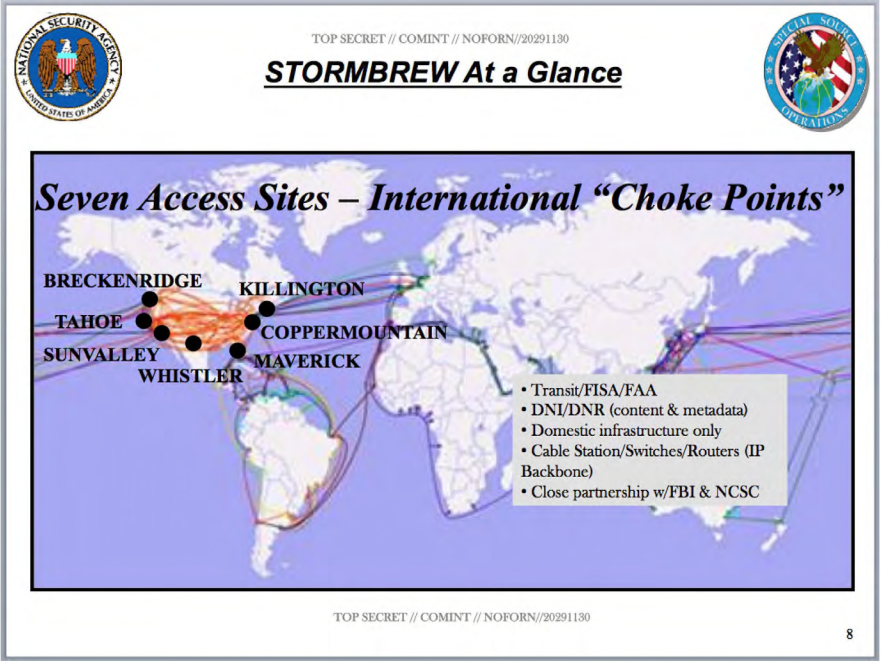
Even as the privacy world has been discussing how NSA got out of one kind of the upstream collection business on April 28, most people overlooked that someone else got out of the upstream collection business almost entirely just a few days later. That’s when Verizon finalized its sale of a big chunk of its data centers — including the ones used for Stormbrew collection — to Equinix. (h/t to SpaceLifeForm for reminding me)

When Equinix announced the $3.6B cash purchase in December, it emphasized the Miami data center — though which much of the traffic from Latin America passes on to the rest of the world — and the Culpepper site serving the National Security world.

  • The NAP (Network Access Point) of the Americas facility in Miami is a key interconnection point and will become a strategic hub and gateway for Equinix customer deployments servicing Latin America. Combined with the Verizon data centers in Bogotá and the NAP do Brasil in São Paulo, it will strategically position Equinix in the growing Latin American market.
  • The NAP of the Capital Region in Culpeper, VA is a highly secure campus focused on government agency customers, strengthening Equinix as a platform of choice for government services and service providers.

The purchase also expands Equinix’s presence in Silicon Valley.

Mind you, spying infrastructure has continued to evolve since Snowden documents elucidated where the Stormbrew collection points were and what they did. So maybe these data centers are no longer key “chokepoints’ (as the NSA called them) of American spying.

But if they are, then Verizon is no longer the one sifting through your data.

Share this entry

The Webster Report Recommendations and FBI’s Federated Back Door Searches

Back in 2013, in the context of a discussion of back door searches, I noted William Webster’s reference, in his report on the Nidal Hasan investigation, to using FISA communications with key targets as tripwires for further investigation, The following spring, in response to Bob Litt’s proclamation that it would be “impracticable” to require the government to count back door searches, I returned to Webster’s recommendations on fixing FBI’s archaic database access to make it easier to match communications from the same user (starting at 140). I suggested that back door searches — particularly their expansion in 2011 — might be a response to his recommendations.

To be fair, I suspect one of the issues is that after the Nidal Hasan attack (and this is just a very well educated guess), NSA rolled out a system whereby new communications between a targeted foreigner and an American automatically pulls up all previous communications involving that US person. That would count as a search, even though it would effectively feel like an automatic cross-referencing of all prior communications involving someone talking to a target, even if that is a US person.

Nevertheless, this means that NSA is conducting so many back door searches on US person data that it would be “impracticable” to actually give those searches some kind of review.

Not long after this hearing, we learned FBI was the agency for which it was impracticable to count back door searches, not NSA.

In the FISA court hearing on October 20, 2015 over whether FBI should provide individual justifications for back door searches, one of the government’s [redacted] lawyers explained that the way federated searches integrate back door searches indeed did come directly from the Webster Report recommendations.

To use an example more recent and even more on point, the Webster Commission’s report on the Fort Hood attack criticized the government’s queries of information in its possession. The people doing the assessment of Nidal Hasan did not identify several messages between Anwar Aulaqi and Nidal Hasan, and the commission deemed it essential that the FBI possess the ability to search all of its repositories and to do so without balkanizing those data sources.

And so these systems that do these federated queries that allow us to, yes, to query the 702 information, but all of these sources are in direct response to those findings, and they’re in direct response to our efforts over the last 15 years to bring down this artificial wall between the law enforcement mission of the FBI and its national security intelligence mission.

Reading this transcript reminded me that, back in 2014, I imagined all this would be automatic — not so much a search, but an interlinked search that would automatically pull up existing content.

There’s reason to believe that model, and the back door access at CIA and NSA to content (which was approved in 2011), was designed to work similarly.

One of the documents recently liberated by ACLU makes it clear that NSA’s metadata back door searches of 702 content are, in some way, automated, such that counts of such queries are counted using algorithms and business rules.

NSA will rely on an algorithm and/or a business rule to identify queries of communications metadata derived from the FAA 702 [redacted] and telephony collection that start with a United States person identifier. Neither method will identify those queries that start with a United States person identifier with 100 percent accuracy.

The I Con the Record report notes the back door content search number, which combined CIA and NSA, is also an estimate, which may suggest it is also counted algorithmically as well (though these are reviewed more closely in compliance reviews). In any case, CIA’s switch from counting each query using a US person identifier to counting each US person identifier queried leads me to suspect it — and NSA — use more of a tasking model, where certain US person identifiers automatically trigger for the period they’re tasked; at the NSA, at least, the duration of approval to do back door searches is either tied to the underlying probable cause FISA order or to a deadline set by the approving authority.

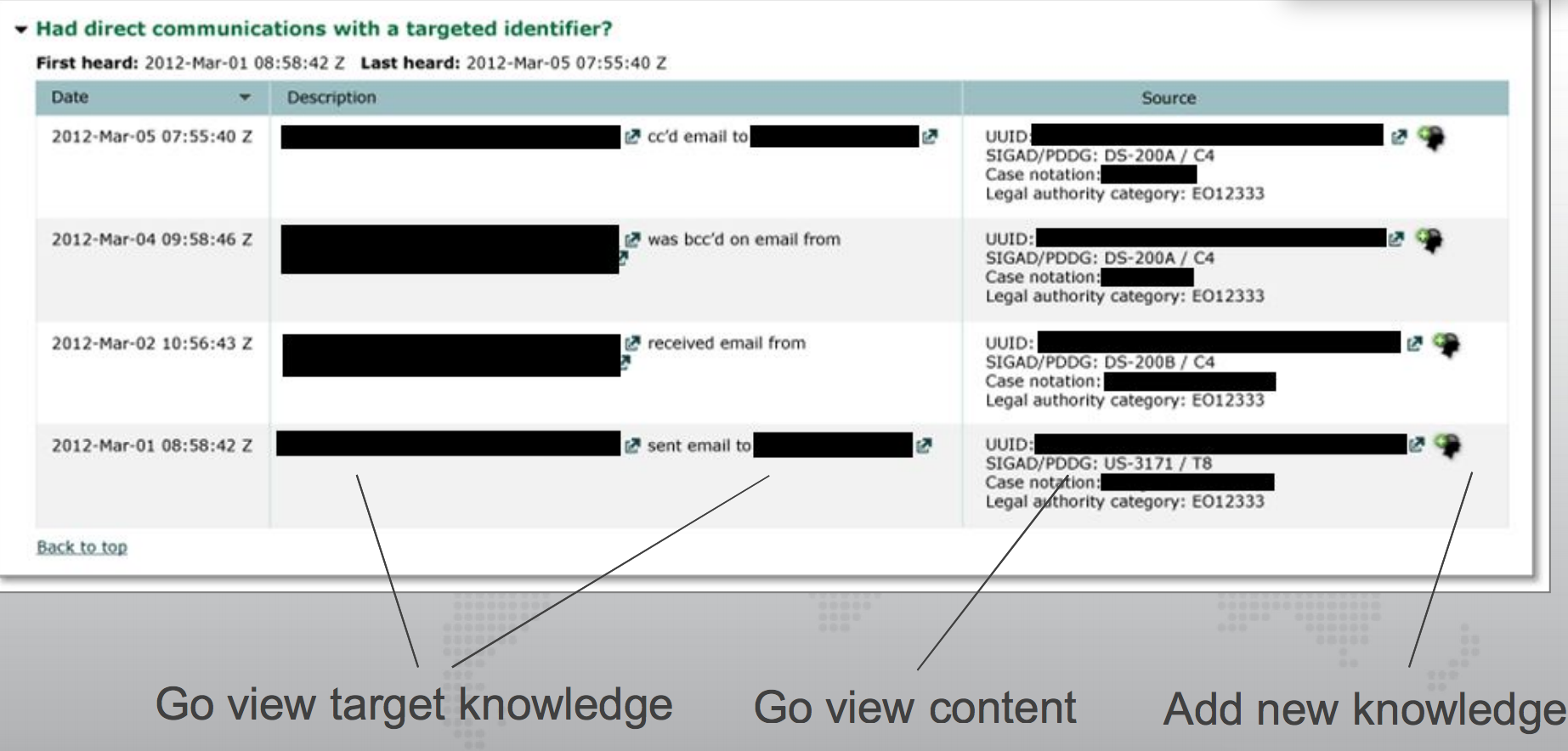
Finally, a Snowden document dating to March 2012 (when NSA was still setting up back door searches) shows that an NSA triage program would first walk users through methods to prioritize communications based off metadata, then have links to access the content directly.

At the time, the sole authority listed was EO 12333, but as noted, this is precisely when they were implementing back door searches on 702 content.

None of this is all that surprising (but hey! Yay me for understanding precisely where back door searches came from three years ago).

But it suggests as we talk about “back door searches,” what we’re really talking about — at least when looking at access programs like the one above — is automatic notice that back door content exists, where content is just a click away.

Share this entry

CIA or NSA Warrantlessly Accessed the Content of More than 300 US Persons (Probably More than 1,300) Who Aren’t Terror Suspects

Because Circa did a really sloppy report on the I Con the Record Transparency Report and Rand Paul quoted, there is a great deal of confusion about what back door searches are.

With the help of the NSA, the FBI collects information via traditional FISA orders. They got 1,559 of them last year, of which 1,477 were targeted at someone in the United States, and of which 336 were targeted at American citizens or permanent residents. All that data goes into a cloud server at the FBI and a separate one at NSA.

In addition, NSA collects information targeted at people overseas under Section 702. FBI can also ask NSA to collect on people they’ve come across in their investigations. Altogether, NSA collected on over 106,000 individual targets last year, via both upstream collection and by asking American providers (Google, Facebook, Yahoo, and the like) for any data they’ve got on those 106,000 targets. They’ll get both sides of targets’ conversations, stored documents and photos, calendar information, and other information.

After NSA gets that information, it will share the parts of that are most relevant to the CIA and the FBI’s missions with them, in raw form. At the FBI, that data is stuck on the same cloud server as the domestic-focused FISA data is in. It is understood that FBI receives any terrorism, counterproliferation, or spying data that has a domestic component (such as Russian spies or ISIS recruiters trying to recruit Americans).

All three agencies — NSA, CIA, and FBI — can then search their own collections of FISA information using the identifier of a US person (a citizen or permanent resident). At NSA and CIA, the analyst has to have a foreign intelligence purpose, such as they think Russians are trying to recruit Mike Flynn. At FBI, an agent has to be looking for criminal information, national security information, or even doing an assessment (such as to figure out whether Carter Page would make a good informant on what the Trump campaign is doing). FBI does so many of these searches they can’t count them.

If there are conversations involving these people in the relevant databases, it appears to the analyst or agent in unmasked form. Yes, if CIA and NSA want to write reports to the White House about what they found, then the name might be masked (but in the vast majority of reports based off 702 reports involving US persons — perhaps 74% — the US person identities eventually get unmasked), but the FBI may dump that data into investigative files.

To understand how and who this might impact in the United States, take this comment from Jim Comey the other day. When asked how many active terrorist investigations the FBI has, he said there were 1,000 investigations where the target was known to be talking to terrorist overseas, and 1,000 where the target embraced radicalism all by him or herself, without talking to an ISIS or any other overseas recruiter.

COMEY: Yes I do. If — we have about 1,000 home grown violent extremist investigations and we probably have another 1,000 or so that are — I should define my terms. Home grown violent extremists, we mean somebody — we have no indication that they’re in touch with any terrorists.

TILLIS: Any foreign touch. Right.

COMEY: Yes. Then we have another big group of people that we’re looking at who we see some contact with foreign terrorists. So you take that 2,000 plus cases, about 300 of them are people who came to the United States as refugees.

Let’s take the higher number, and say there are 2,000 people in the US the intelligence community thinks might be terrorists or susceptible to being convinced to become one.

Now let’s look at the back door search numbers. The NSA used the identifiers (say, their cell phone identifier or their email) of US persons and searched the metadata from their stash of 702 data 30,355 times last year. (The CIA and FBI refuse to count how many metadata searches they did.) That means that NSA tried to do a network analysis on over 28,000 Americans and permanent residents who are not the subject of investigations by the FBI for being terrorists.

Between CIA and FBI combined, they did 5,288 queries on US persons last year. Back in 2013, the CIA did far more searches than the NSA (on 1,400 selectors as compared to NSA’s 198); we don’t know how the split works now. But assume that at least one agency is doing at least 2,644 searches. At the NSA, all 336 traditional FISA targets can be (and I assume are) tasked for back door searches; presumably a chunk of the 336 people targeted under are being investigated for terrorism, though that would also include people like (allegedly) Carter Page, people the FBI has gotten the FISA court to believe are agents of foreign powers). But even if we assume none of the people targeted under FISA are terrorists and all domestic terrorists are being back door searched at NSA, that leaves over 300 people (2,644 – 1,000 – 1,000 – 336) who are having their content accessed without a warrant by the NSA (to say nothing of the FBI, which does it so often it can’t count it). The number is probably higher, though, given that 1,000 of those terrorist suspects aren’t conversing with foreigners. The NSA (or CIA) is only going to access content if they know it exists from metadata, and Comey comment suggests there’s no metadata indicating such conversations. And at least some of those 336 targeted US persons are terror suspects.

Which means one agency — NSA or CIA — is likely accessing the raw content of 1,300 people who aren’t terrorist suspects.

That’s fine. There are other things they might be: suspected weapons proliferators, suspected Russian or Chinese spies, people the government is worried are being recruited by spies, suspected hackers, suspected leakers, Americans who’ve been kidnapped.

But the numbers make clear that the presumption that all of this spying is targeted at terrorists is simply wrong. There are at least 300 people — and probably more like 1,300 people — who even the NSA is accessing the content of without a warrant who are not terrorist suspects.

And the number at FBI is so high it can’t count it.

Share this entry

Hemisphere 2.0

As I note in an update to this post, Charlie Savage is very cross I did some math. On top of making a hilariously bad misreading of my original post — claiming I said a number was implausible even though I said it was plausible on at least five occasions, including the headline — and making a number of other errors about how the phone dragnet works, he bitches that I go through the effort of laying out what the 151 million call event might actually mean. (As always, Charlie doesn’t hold himself to the standards of correction he demands I do, either in the NYT or on posts like this.)

The reason you do that is to lay out assumptions.

And I’ve realized two things about how we’re counting numbers. First, one source of redundancy no one has considered is a SIM/handset redundancy.

One thing phone dragnets are designed to do is correlate identities: track the various identities a suspect and his associates are using, so as to ensure you’re tracking all their possible communications. With cell phones, one thing you want to track is whether someone is swapping out SIM cards. This collection starts with identifiers from EO 12333 collection, which we know is stored logically by IMEI/IMSI. It is possible that providers get both those identifiers as separate identifiers and provide two separate streams of data, especially if they don’t coincide.

If that were the standard practice, it would mean there’d often be a dual set of identical call records.

The more interesting issue is telecom retention. As I Con the Record notes, a request will return historical, current, and prospective call records. We’ve talked a lot about minimum retention (and the two year data handshake that Verizon and T-Mobile agreed to). But we haven’t talked about maximal retention.

As I noted, AT&T has call records going back decades, collected on any call that crossed its lines. We know that under the Hemisphere program, it usually could come up with call records for phones, whether or not they were AT&T customers. That means that the government could always submit requests to AT&T (again, whether or not the target used AT&T as a provider, because the target would surely have used AT&T’s backbone), and get years of records for the handset and SIM, if they existed, as well as for the two hops. This data would effectively create a mini-Hemisphere for the cluster around a given target, including call records for far more than the five years NSA used to be able to obtain data (though they might only retain that decades old data for 5 years).

I’m not saying I think they’re doing that — I don’t. In public testimony, NSA and other agency officials have conceded that data really is most valuable in the first two years, so obtaining 20 years of data would just load down NSA with false positives.

But it is a possibility — one that I hope Congress considers.

Share this entry

One Takeaway from the Five Takeaways from the Comey Hearing: Election 2016 Continues to Suffocate Oversight

The Senate Judiciary Committee had an oversight hearing with Jim Comey yesterday, which I live-tweeted in great depth. As you can imagine, most of the questions pertained either to Comey’s handing of the Hillary investigation and/or to the investigation into Russian interference in the election. So much so that The Hill, in its “Five Takeaways from Comey’s testimony,” described only things that had to do with the election:

  • Comey isn’t sorry (but he was “mildly nauseous” that his conduct may have affected the outcome)
  • Emotions over the election are still raw
  • Comey explains DOJ dynamic: “I hope someday you’ll understand”
  • The FBI may be investigating internal leaks
  • Trump, Clinton investigations are dominating FBI oversight

The Hill’s description of that third bullet doesn’t even include the “news” from Comey’s statement: that there is some still-classified detail, in addition to Loretta Lynch’s tarmac meeting with Bill Clinton and the intercepted Hillary aide email saying Lynch would make sure nothing happened with the investigation, that led Comey to believe he had to take the lead on the non-indictment in July.

I struggled as we got closer to the end of it with the — a number things had gone on, some of which I can’t talk about yet, that made me worry that the department leadership could not credibly complete the investigation and declined prosecution without grievous damage to the American people’s confidence in the — in the justice system.

As I said, it is true that most questions pertained to Hillary’s emails or Russia. Still, reports like this, read primarily by people on the Hill, has the effect of self-fulfilling prophecy by obscuring what little real oversight happened. So here’s my list of five pieces of actual oversight that happened.

Neither Grassley nor Feinstein understand how FISA back door searches work

While they primarily focused on the import of reauthorizing Section 702 (and pretended that there were no interim options between clean reauthorization and a lapse), SJC Chair Chuck Grassley and SJC Ranking Member Dianne Feinstein both said things that made it clear they didn’t understand how FISA back door searches work.

At one point, in a discussion of the leaks about Mike Flynn’s conversation with Sergey Kislyak, Grassley tried to suggest that only a few people at FBI would have access to the unmasked identity in those intercepts.

There are several senior FBI officials who would’ve had access to the classified information that was leaked, including yourself and the deputy director.

He appeared unaware that as soon as the FBI started focusing on either Kislyak or Flynn, a back door search on the FISA content would return those conversations in unmasked form, which would mean a significant number of FBI Agents (and anyone else on that task force) would have access to the information that was leaked.

Likewise, at one point Feinstein was leading Comey through a discussion of why they needed to have easy back door access to communication content collected without a warrant (so we don’t stovepipe anything, Comey said), she said, “so you are not unmasking the data,” as if data obtained through a back door search would be masked, which genuinely (and rightly) confused Comey.

FEINSTEIN: So you are not masking the data — unmasking the data?

COMEY: I’m not sure what that means in this context.

It’s raw data. It would not be masked. That Feinstein, who has been a chief overseer of this program for the entire time back door searches were permitted doesn’t know this, that she repeatedly led the effort to defeat efforts to close the back door loophole, and that she doesn’t know what it means that this is raw data is unbelievably damning.

Incidentally, as part of the exchange wit Feinstein, Comey said the FISA data sits in a cloud type environment.

Comey claims the government doesn’t need the foreign government certificate except to target spies

Several hours into the hearing, Mike Lee asked some questions about surveillance. In particular, he asked if the targeting certificates for 702 ever targeted someone abroad for purposes unrelated to national security. Comey seemingly listed off the certificates we do have — foreign government, counterterrorism, and counterproliferation, noting that cyber gets worked into other ones.

LEE: Yes. Let’s talk about Section 702, for a minute. Section 702 of the Foreign Intelligence Surveillance Amendments Act authorizes the surveillance, the use of U.S. signals surveillance equipment to obtain foreign intelligence information.

The definition includes information that is directly related to national security, but it also includes quote, “information that is relevant to the foreign affairs of the United States,” close quote, regardless of whether that foreign affairs related information is relevant to a national security threat. To your knowledge, has the attorney general or has the DNI ever used Section 702 to target individuals abroad in a situation unrelated to a national security threat?

COMEY: Not that I’m aware of. I think — I could be wrong, but I don’t think so, I think it’s confined to counterterrorism to espionage, to counter proliferation. And — those — those are the buckets. I was going to say cyber but cyber is fits within…

He said they don’t need any FG information except that which targets diplomats and spies.

LEE: Right. So if Section 702 were narrowed to exclude such information, to exclude information that is relevant to foreign affairs, but not relevant to a national security threat, would that mean that the government would be able to obtain the information it needs in order to protect national security?

COMEY: Would seem so logically. I mean to me, the value of 702 is — is exactly that, where the rubber hits the road in the national security context, especially counterterrorism, counter proliferation.

I assume that Comey said this because the FBI doesn’t get all the other FG-collected stuff in raw form and so isn’t as aware that it exists. I assume that CIA and NSA, which presumably use this raw data far more than FBI, will find a way to push back on this claim.

But for now, we have the FBI Director stating that we could limit 702 collection to national security functions, a limitation that was defeated in 2008.

Comey says FBI only needs top level URLs for ECTR searches

In another exchange, Lee asked Comey about the FBI’s continued push to be able to get Electronic Communication Transaction Records. Specifically, he noted that being able to get URLs means being able to find out what someone was reading.

In response, Comey said he thought they could only get the top-level URL.

After some confusion that revealed Comey’s lie about the exclusion of ECTRs from NSLs being just a typo, Comey said FBI did not need any more than the top domain, and Lee answered that the current bill would permit more than that.

LEE: Yes. Based on the legislation that I’ve reviewed, it’s not my recollection that that is the case. Now, what — what I’ve been told is that — it would not necessarily be the policy of the government to use it, to go to that level of granularity. But that the language itself would allow it, is that inconsistent with your understanding?

COMEY: It is and my understanding is we — we’re not looking for that authority.

LEE: You don’t want that authority…

(CROSSTALK)

COMEY: That’s my understanding. What — what we’d like is, the functional equivalent of the dialing information, where you — the address you e-mailed to or the — or the webpage you went to, not where you went within it.

This exchange should be useful for limiting any ECTR provision gets rushed through to what FBI claims it needs.

The publication of (US) intelligence information counts as intelligence porn and therefore not journalism

Ben Sasse asked Comey about the discussion of indicting Wikileaks. Comey’s first refusal to answer whether DOJ would indict Wikileaks led me to believe they already had.

I don’t want to confirm whether or not there are charges pending. He hasn’t been apprehended because he’s inside the Ecuadorian embassy in London.

But as part of that discussion, Comey explained that Wikileaks’ publication of loads of classified materials amounted to intelligence porn, which therefore (particularly since Wikileaks didn’t call the IC for comment first, even though they have in the past) meant they weren’t journalism.

COMEY: Yes and again, I want to be careful that I don’t prejudice any future proceeding. It’s an important question, because all of us care deeply about the First Amendment and the ability of a free press, to get information about our work and — and publish it.

To my mind, it crosses a line when it moves from being about trying to educate a public and instead just becomes about intelligence porn, frankly. Just pushing out information about sources and methods without regard to interest, without regard to the First Amendment values that normally underlie press reporting.

[snip]

[I]n my view, a huge portion of WikiLeaks’s activities has nothing to do with legitimate newsgathering, informing the public, commenting on important public controversies, but is simply about releasing classified information to damage the United States of America. And — and — and people sometimes get cynical about journalists.

American journalists do not do that. They will almost always call us before they publish classified information and say, is there anything about this that’s going to put lives in danger, that’s going to jeopardize government people, military people or — or innocent civilians anywhere in the world.

I’ll write about this more at length.

Relatedly (though technically a Russian investigation detail), Comey revealed that the investigation into Trump ties to Russia is being done at Main Justice and EDVA.

COMEY: Yes, well — two sets of prosecutors, the Main Justice the National Security Division and the Eastern District of Virginia U.S. Attorney’s Office.

That makes Dana Boente’s role, first as Acting Attorney General for the Russian investigation and now the Acting Assistant Attorney General for National Security, all the more interesting, as it means he is the person who can make key approvals related to the investigation.

I don’t have any problem with him being chosen for these acting roles. But I think it supremely unwise to effectively eliminate levels of oversight on these sensitive cases (Russia and Wikileaks) by making the US Attorney already overseeing them also the guys who oversees his own oversight of them.

The US is on its way to becoming the last haven of shell corporations

Okay, technically these were Sheldon Whitehouse and Amy Klobuchar comments about Russia. But as part of a (typically prosecutorial) line of questioning about things related to the Russian investigation, Whitehouse got Comey to acknowledge that as the EU tries to crack down on shell companies, that increasingly leaves the US as the remaining haven for shell companies that can hide who is paying for things like election hacks.

WHITEHOUSE: And lastly, the European Union is moving towards requiring transparency of incorporations so that shell corporations are harder to create. That risks leaving the United States as the last big haven for shell corporations. Is it true that shell corporations are often used as a device for criminal money laundering?

COMEY: Yes.

[snip]

WHITEHOUSE: What do you think the hazards are for the United States with respect to election interference of continuing to maintain a system in which shell corporations — that you never know who’s really behind them are common place?

COMEY: I suppose one risk is it makes it easier for illicit money to make its way into a political environment.

WHITEHOUSE: And that’s not a good thing.

COMEY: I don’t think it is.

And Klobuchar addressed the point specifically as it relates to high end real estate (not mentioning that both Trump and Paul Manafort have been alleged to be involved in such transactions).

There have been recent concerns that organized criminals, including Russians, are using the luxury real estate market to launder money. The Treasury Department has noted a significant rise in the use of shell companies in real estate transactions, because foreign buyers use them as a way to hide their identity and find a safe haven for their money in the U.S. In fact, nearly half of all homes in the U.S. worth at least $5 million are purchased using shell companies.

Does the anonymity associated with the use of shell companies to buy real estate hurt the FBI’s ability to trace the flow of illicit money and fight organized crime? And do you support efforts by the Treasury Department to use its existing authority to require more transparency in these transactions?

COMEY: Yes and yes.

It’s a real problem, and not just because of the way it facilitates election hacks, and it’d be nice if Congress would fix it.

Share this entry

I Con the Record Transparency Bingo: Playing Card

In this post, I’ll cover the rest of the I Con the Record 2016 Transparency Report.

Title I, III, VII 703 and 704

As the report notes, these are the individually approved orders. To be assholes, ODNI includes Section 703, which is not used. I Con the Record reports 1,559 orders, which it does not break down.

For the same authorities (1805, 1824, 1805/1824, and 1881c), the FISA Court, which uses different and in most cases more informative counting metrics, reports 1,220 orders granted, 313 orders modified, and 26 orders denied in part (which add up to I Con the Record’s 1,559), plus 8 orders denied, which I Con the Record doesn’t mention.

As an improvement this year, I Con the Record has broken down how many of these targets are US persons or not, showing it to be 19.9%. That means the vast majority of targeted FISA orders are targeted at people like Sergey Kislyak, the Russian Ambassador all of Trump’s people talked to.

This is the target number for the original report, not the order number, and it is an estimate (which is curious). This means at least 28 orders target multiple people. Neither ICTR nor FISC reveals how many US persons were approved for 705b, meaning they were spied on when they went overseas.

Section 702

This is the authority that covers upstream and PRISM. After presenting its useless report that it had one certificate in 2016 (leftover from 2015), ICTR reports there were 106,469 knowably discrete 702 targets last year, an 11% increase off last year.

Note: one of the games played in the USA Freedom Act transparency procedures was that, once the other counts moved to a selector based count, this was removed from the required reports (which is why ICTR says they weren’t required by law to release it). They presumably did this to hide the likely fact that for every one of these 106,469 targets, there are multiple — possibly very many — selectors tasked, which would make the spying number look Yuge.

NSA and CIA provide the number of content queries they conducted. Since CIA has stopped double counting selectors it uses more than once, this represents more than the 12% increase in queries suggested by the numbers. So queries are increasing at a higher — potentially significantly higher — rate than targets.

Given the way the NSA’s querying process ties queries to deadlines (60 days, for example, or to the underlying authorization), it’s likely NSA just keeps these queries targeted tasked throughout that period (which may mean CIA moved to do the same this year). If that’s right, it would effectively alert an analyst any time a new communication involving the US person came in.

This post talks about what the report’s claim that just one query of FBI holdings designed to find criminal information had a positive hit — and was reviewed– on 702 information really means.

Meanwhile, NSA’s US person metadata queries have gone up much faster than content queries or target selectors, a 32% increase. As noted in this post, FBI doesn’t have to count their queries and CIA still does not do so.

Also note, this is an estimate. The underlying NSA document makes it clear this is done via algorithm or business rule to estimate these queries, which suggests they’re done automatically.

To put these queries into perspective, Jim Comey today said there were 1,000 Islamic extremists in the US who were communicating overseas. Even assuming they track the other 1,000 extremists not known to be communicating overseas, that’s just a tiny fraction of the Americans they’re tracking.

ICTR provided better information on unmasked US person identities this year than last, revealing how many USP identities got released.

As I said last year, ICTR is not doing itself any favors by revealing what a tiny fraction of all 702 reports the 3,914 — it must be truly miniscule.

All that said if you do get reported in one of those rare 702 reports that includes a USP identity, chances are very good you’ll be unmasked. In 30% of the reports with USP identities, last year, at least one USP identity was released in original form unmasked (as might happen, for example, if Carter Page or Mike Flynn’s identity was crucial to understanding the report). Of the remainder, though, 65% had at least one more US person identity unmasked. I believe that means that only roughly 26% of the names originally masked remained masked in the reports.

Pen Registers

See this post for an explanation of why we shouldn’t take too much from a seeming significant decline in pen registers. Note, I didn’t mention that 43.9% of the 41 targets are estimated to be US persons — but are estimates, which is a bit nutty given the small numbers involved.

Note, of the 60 pen registers ICTR shows, FISC shows 10 were modified (perhaps to include minimization procedures).

Section 215

The section on “traditional” Section 215 shows that for each order (of which up to 4 had more than one target), there were almost 1,000 selectors sucked in.

Except!

Except the number is likely far, far higher, because this metric doesn’t track people sucked in via financial or travel or other Section 215 orders.

This post explains why the 151 million call session records sucked in via the new Section 215 phone dragnet may not actually be that much — but also likely represents edge cases.

Note, the FISC report shows 125 total Section 215 reports, with 108 approved, 16 modified, and 1 rejected (the latter of which ICTR doesn’t mention). The approved reports adds up to the same 124 that ICTR shows. The modified orders likely include minimization procedures.

Here’s the number of queries of returned new phone dragnet data done by NSA and CIA (note, in the old dragnet, this data would not have been as readily available even within NSA, much less at CIA).

As always with meaningful metrics, FBI is exempt. I’ll return to this metric.

NSLs

I may come back to this as well, but for now, know that FBI requested fewer NSLs last year than in previous years.

Share this entry