Just in Time To Undercut Eric Schneiderman, the (Ongoing) HUD Investigation!

American Banker has an article suggesting that Tom Miller will be able to use the results of HUD’s investigations into servicing problems to craft a settlement with the banks.

The state attorneys general have a secret weapon in their negotiations with the largest mortgage servicers: the results of a HUD investigation into the banks’ robo-signing practices.

But by all appearances, this is an attempt on the part of IA Attorney General Tom Miller to undercut claims that the Attorneys General need to do more investigation. The article–which relies almost entirely on Miller’s own staff–concludes that this report will “fill in a major gap” in what the Attorneys General know (that is, real data about how bad the robo-signing problem is).

The Department of Housing and Urban Development has completed an investigation begun last year of foreclosure robo-signing and given state officials the results, a spokesman for Iowa Attorney General Tom Miller says.

A full government investigation would fill in a major gap in state officials’ information as they negotiate with the servicers: the attorneys general have not known the full scope of the banks’ robo-signing practices, or how many homeowners have been affected by their paperwork lapses.

[snip]

“One of our federal partners, HUD, has conducted a thorough investigation of robo-signing,” says Geoff Greenwood, a spokesman for Miller. “HUD has shared that investigation with our executive committee.”

The states and their “federal partners,” including HUD, “have the information we need concerning the banks’ robo-signing activities, and this is key to the strength of our understanding and our negotiating position,” he says. [my emphasis]

There’s something funny about Tom Miller’s flack’s claims that the HUD investigation fills in what the Attorneys General didn’t already have: the one thing that HUD would say about it is that it wasn’t finished.

A HUD spokesman would not discuss any investigation, except to say its probes into robo-signing are ongoing. [my emphasis]

Maybe the claim HUD’s probe is complete is just a mis-paraphrase of Greenwood’s comments; such a claim doesn’t show up in his direct quotes. But if the investigation is not done–and HUD says it’s ongoing–then how does the incomplete study give the AGs what they need?

In any case, I find it particularly neat that the AGs’ Executive Committee got this incomplete complete study after Eric Schneiderman got booted from it.

Share this entry

If Bank of New York Mellon Has So Many Tax Shelters It Doesn’t Pay Taxes, How Is It NY’s “Main Street”?

Update: Kelly just stepped down, citing “differences in approach.”

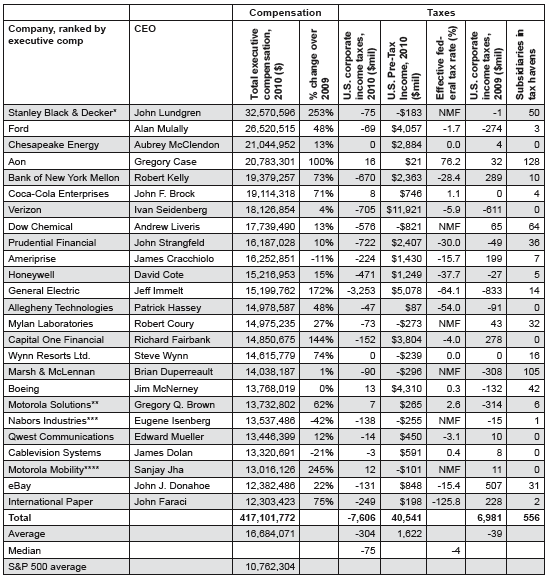
A number of outlets have carried the report on the number of CEO’s getting paid more than their companies paid in taxes last year, but few have linked to the actual report, which means just the usual suspects, like GE’s Jeff Immelt, are getting the bulk of the focus.

Yet if you look at the appendices (pages 31-33–click the picture to the right to enlarge it), the report not only lists all the companies paying their CEOs more than they pay Uncle Sam, but provide details like the company’s political spending.

Among those listed in the report not getting much attention is Bank of New York Mellon’s CEO Robert Kelly, who got millions while his company got a $670 million tax refund.

Bank of New York Mellon CEO Robert Kelly took home $19.4 million in 2010. The bank, the same year, claimed a $670 million federal tax refund, despite $2.4 billion in U.S. pre-tax income.

Kelly’s compensation has skated above $10 million during each of the past three years of financial crisis. The CEO artfully managed to avoid the salary limits President Obama’s “pay czar” imposed on bailed-out banks by making sure Bank of New York Mellon repaid the taxpayer funds before those restrictions went into effect.27 The bank raised the money to pay back its $3 billion in TARP assistance by taking on uninsured debt, slashing dividends, and issuing new stock.28

The Bank of New York Mellon, with 10 subsidiaries in tax havens, did not pay a dime in federal taxes in 2010. However, the banking giant did devote $1.4 million to lobbying over the year. The bank’s lobbyists worked diligently to exempt currency trading from new transparency and oversight rules.29 In related news, officials from eight U.S. states are conducting inquiries or pursuing litigation against Bank of New York Mellon for ripping off state pension funds by overcharging for currency trades. The Securities and Exchange Commission and Justice Department are also investigating the allegations.

Screwing pension funds on currency trades is not the only anti-social behavior the federal government gave BNYM a refund to engage in. They’re also the trustee on the controversial Bank of America settlement.

That’s relevant because of the terms the settlement’s chief defender, Kathryn Wylde, has used to defend it, particularly in the face of Eric Schneiderman’s lawsuit to stop it.

The lawsuit angered Bank of New York Mellon, and as Mr. Schneiderman was leaving the memorial service last week for Hugh Carey, the former New York governor who died Aug. 7, an attendee said Mr. Schneiderman became embroiled in a contentious conversation with Kathryn S. Wylde, a member of the board of the Federal Reserve Bank of New York who represents the public. Ms. Wylde, who has criticized Mr. Schneiderman for bringing the lawsuit, is also chief executive of the Partnership for New York City.

[snip]

Characterizing her conversation with Mr. Schneiderman that day as “not unpleasant,” Ms. Wylde said in an interview on Thursday that she had told the attorney general “it is of concern to the industry that instead of trying to facilitate resolving these issues, you seem to be throwing a wrench into it. Wall Street is our Main Street — love ’em or hate ’em. They are important and we have to make sure we are doing everything we can to support them unless they are doing something indefensible.”

Now, as I’ve already pointed out, it’s sort of odd for Wylde to defend Bank of America, a North Carolina corporation, in her role as NYC’s chief booster.

But if BNYM is paying nothing in the US–rather is getting tax refunds–on its $2.5 billion global profit, then presumably it’s a corporate resident of some other place, not New York, not the United States. So maybe, in addition to North Carolina, Wylde has added the Cayman Islands to the list of places whose corporations she defends as her own Main Street?

In any case, Wylde says Schneiderman shouldn’t sue to prevent BNYM’s scam settlement with BoA. Why is she protecting such a giant corporate deadbeat?

Share this entry

IA AG’s Office Whining That They’re Not Getting Credit for Settlement Bank of America Violated

The folks desperately working to give the banks a Get Out of Jail Free card for their servicing abuses are trying hard to deny they’re not doing so.

Take this anonymous accusation from someone involved in the settlement talks claiming that opponents of the settlement are using innuendo to smear those participating in it.

Another person close to the talks, who like several others spoke on the condition of anonymity to discuss the situation more freely, said many in the group are “just exasperated. . . . This smear campaign of lies and innuendo, it’s uncalled for, it’s unprecedented, and it threatens substantial consumer harm.”

Aside from the fact that even if there were such a campaign it would not be unprecedented, since folks have tried to suggest Eric Schneiderman committed an impropriety by paying himself back for a campaign loan he made to his campaign.

But unless the WaPo left the material describing the substance of the “smear campaign of lies and innuendo” on the cutting room floor, then what we have here is a person anonymously making vague innuendos about a smear campaign of innuendos.

And then there’s the whining from IA Assistant Attorney General Patrick Madigan, who says it’s unfair to say he and Attorney General Tom Miller are in bed with the banks (in spite of Miller’s fundraising outreach to the banks) because of the great work they’ve done holding banks to account in the past.

“We’ve been accused of being in bed with the banks. To say that to a group of people who have spent the last seven to 10 years fighting mortgage abuses day in and day out is an insult of the highest order,” said Iowa Assistant Attorney General Patrick Madigan, a longtime Miller deputy, who has worked on major settlements with subprime lenders such as Countrywide and Ameriquest. “It’s just unreal.

You know, their work “fighting mortgage abuses”? As in the settlement they signed onto with Countrywide in 2008? The one that–according to NV Attorney General Catherine Cortez Masto–Bank of America has basically blown off?

In her filing, Ms. Masto contends that Bank of America raised interest rates on troubled borrowers when modifying their loans even though the bank had promised in the settlement to lower them. The bank also failed to provide loan modifications to qualified homeowners as required under the deal, improperly proceeded with foreclosures even as borrowers’ modification requests were pending and failed to meet the settlement’s 60-day requirement on granting new loan terms, instead allowing months and in some cases more than a year to go by with no resolution, the filing says.

The complaint says such practices violated an agreement Bank of America reached in the fall of 2008 with several states and later, in 2009, with Nevada, to settle lawsuits that accused its Countrywide unit of predatory lending. As the credit crisis grew, the settlement was heralded as a victory by state offices eager to help keep troubled borrowers in their homes and reduce their costs. Bank of America set aside $8.4 billion in the deal and agreed to help 400,000 troubled borrowers with loan modifications and other financial relief, such as lowering interest rates on mortgages.

(See DDay for more on Masto’s complaint.)

Perhaps Madigan doesn’t understand this. But pointing to a settlement that, in retrospect, appears to have largely been a PR stunt as proof that you’re not in bed with the banks sort of proves the point that you are.

Share this entry

Jamie Dimon’s Company Fined $88.3 Million for Trading with the Enemy

That’s not the technical term for violating economic sanctions against Cuba, Sudan, Iran, and Liberia (and FWIW I think the sanctions against Cuba are stupid).

Nevertheless, that’s basically what the sanctions JP Morgan Chase just admitted to violating amount to.

The big dollar amounts involve $178.5 million in wire transfers with Cubans.

JPMC processed 1,711 wire transfers totaling approximately $178.5 million between December 12, 2005, and March 31, 2006, involving Cuban persons in apparent violation of the CACR.

But the more interesting violation came when JPMC refused to turn over some documents relating to Khartoum until the government told the bank they knew JPMC had the documents.

The apparent violation of the RPPR occurred between November 8, 2010, and March 1, 2011. On October 13, 2010, OFAC issued JPMC an administrative subpoena pursuant to section 501.602 of the RPPR directing JPMC to provide certain specified documents related to a specific wire transfer referencing “Khartoum.” In response to this subpoena and a subsequent communication, JPMC compliance management failed to produce several responsive documents in JPMC’s possession, and repeatedly stated that JPMC had no additional responsive documents. OFAC ultimately provided JPMC with a list of multiple responsive documents that OFAC had reason to believe were in JPMC’s possession based on communications with a third-party financial institution. This prompted JPMC to correct its prior statements that the bank possessed no additional responsive documents and to produce more than 20 responsive documents. JPMC did not voluntarily self-disclose the apparent violation of the RPPR to OFAC. The base penalty for this apparent violation was $250,000.

And in spite of that apparent obstruction, TurboTax Timmeh Geithner’s agency still treated Jamie Dimon’s disloyal company leniently because of what they called JPMC’s “substantial cooperation.”

OFAC mitigated the total potential penalty based on JPMC’s substantial cooperation,

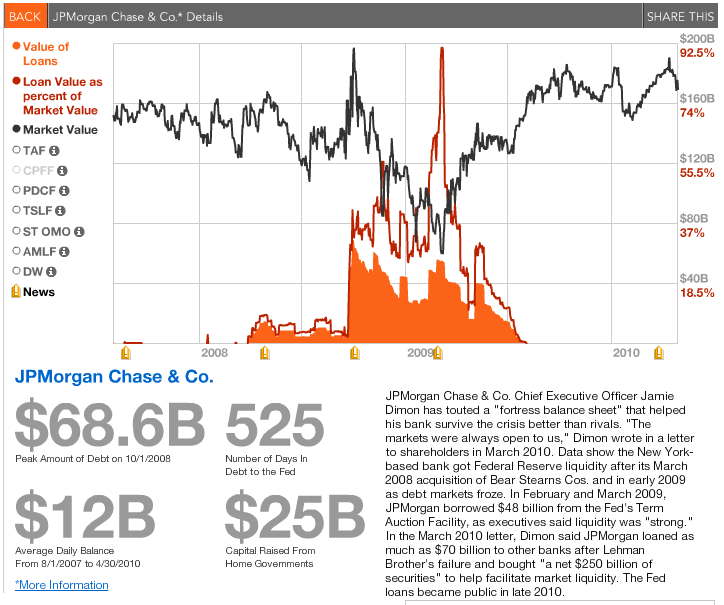
According to Bloomberg’s count, the Fed lent this disloyal company $68.6B after banksters like Jamie Dimon crashed the economy.

During and after the period JPMC took that money, it financed trade with Iran, tried to hide the Khartoum deal, and financed more trade with Sudan (though it sent money to Cuba and sent Iran 32,000 ounces of gold, now worth $55 million, before taking our money, in 2006). Some of this trading with the enemy was reported internally to “JPMC management and supervisory personnel;” at least some of this wasn’t the work of rogue employees.

This is the kind of MOTU that Obama considers an ally.

Share this entry

Paul Kanjorski: Government Can’t Control Multinationals Anymore

I confess. When I read Zach Carter’s account of his interview with Paul Kanjorski, my first response was to wonder why HuffPo had decided an interview with the former Congressman would make for the (admittedly very fascinating) article that resulted.

Turns out the reason is Bank of America’s woes; as one of the champions of breaking up the banks in Dodd-Frank, this ought to be an “I told you so” moment for Kanjorski, because had we already broken BoA up, it would have forestalled some of the difficulties we’re likely to experience in the near term.

And Kanjorski did address that, intimating that regulators who had left the Administration, like Sheila Bair, had been willing to entertain taking such step, but those who remain (Carter notes that Tim Geithner recently decided to stick around) basically made an agreement with the banks not to use Dodd-Frank’s authority to break them up.

But Kanjorski framed all this within the larger question of whether multinational companies have simply become too big for mere governments to control anymore.

“Because [corporations] have become so international and global in nature, it’s highly questionable whether governments can actually control corporations to a sufficient degree to prevent them from controlling governments,” said Kanjorski,

And he then demonstrated that principle in his discussion of discussions about a tax holiday, which would allow tax cheating corporations to bring money back into the US but only pay cut rate taxes.

“I’m not saying we shouldn’t adjust our tax code otherwise — there are thing we need to do there — but to give them a free ride, what are you encouraging? The next guy who doesn’t like the law will just do the same thing,” Kanjorski said of the proposed tax holiday. “The reality is, why should we be bargaining with super-national corporations who are actually acting against our interest in avoidance of what our law is? We are impotent to get them to respond.”

This takes the argument of Treasure Islands–that corporations are using secrecy havens to avoid taxes–to the level where a former senior legislator of the world’s economic powerhouse admitting to impotence in the face of the corporations because of their size and multinational status.

And he notes something often forgotten in DC: that these are no longer American companies, and their interests do not coincide with our interests.

Of course, that’s not necessarily going to help us, given that Kanjorski’s watching from the private sector as top financial regulators still do act as if these multinationals’ interests coincide with ours.

Share this entry

How Would States Divvy Up the Foreclosure Settlement?

For the record, I still doubt the 50-State-Less-the-Rule-of-Law-AGs Settlement will happen. A year in, they haven’t even agreed on the underlying guidelines for the settlement, like what they do with MERS.

But this line in the LAT’s coverage made me think of another issue that could kill that settlement.

New York and Delaware have more than a dozen attorneys working full time on their effort. They have subpoenaed or requested information from 13 financial firms, including Goldman Sachs Group Inc. and JPMorgan Chase. [Kamala] Harris would be a key addition to the investigation because California was the location of a vast number of the mortgages and foreclosures that fed into the crisis. She met with Schneiderman in San Francisco last month to discuss participating in the probe.

Harris is weighing whether she would sign on to the 50-state settlement if it gave banks immunity. The main consideration is how much money would go to California homeowners, according to a person familiar with her thinking. [my emphasis]

At least at the moment, the public explanation CA’s Attorney General is giving for her indecisiveness about which side to join is a concern over CA homeowners getting enough out of the settlement.

Now that may just be a convenient excuse to cover political indecision, but it’s a significant point. CA has a tenth of the country’s population, and it was very hard hit by the foreclosure crisis … two years ago.

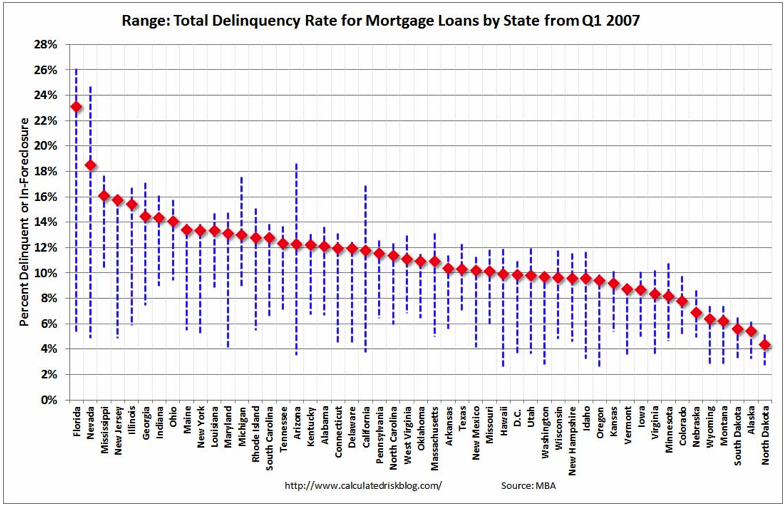
As the Calculated Risk chart above shows, while California at its worst had the sixth highest percentage of homes in default, it is now 22nd (out of 42 states plus DC) on the list of current percentage of homes in default. So while CA has had the most number of residents go through this shitty process, going forward it might appear to be in much better shape than a lot of other states that weren’t as hard hit by the foreclosure crisis.

But that’s not the entire story. Note, first of all, the reason CA no longer has so many delinquencies:

Some states have made progress: Arizona, Michigan, Nevada and California. Other states, like New Jersey and New York, have made little or no progress in reducing serious delinquencies.

Arizona, Michigan, Nevada and California are all non-judicial foreclosure states. States with little progress like New Jersey, New York, Illinois and Florida are all judicial states.

That is, CA has worked through its delinquencies because its residents (like those of AZ, MI, and NV), have been subjected to the full brunt of the servicer abuses that this settlement is supposed to address, without the opportunity to challenge a foreclosure in court. So if we could measure this quantitatively (precisely what Tom Miller is trying to avoid) CA’s residents would like be even more screwed by the servicer abuses, because no one had an easy way to push back against obvious abuses.

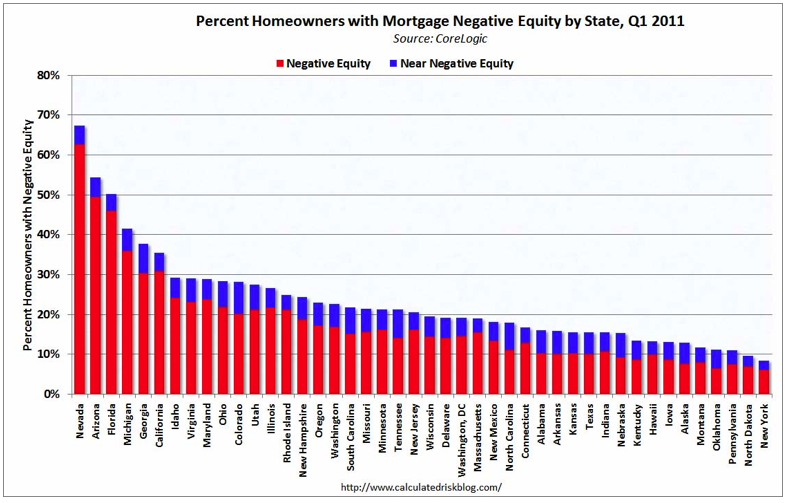
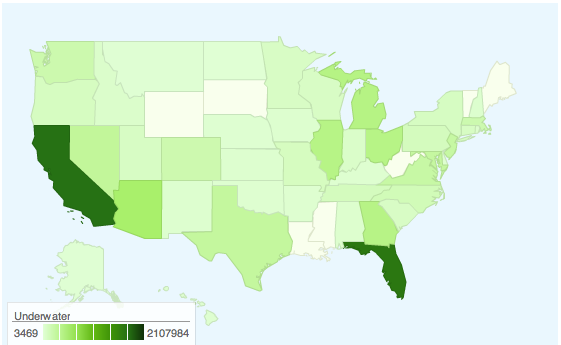
Now look at who–at least as of the first quarter of this year–remains underwater on their house (from this Calculated Risk post). Those states most affected by foreclosures, including CA, still lead the list of states with the highest number of houses underwater, a key indicator for future defaults. The map from the New Bottom Line shows this even more graphically; put FL and CA’s population combined with their high negative equity rate, and they’ve got the largest number of potential foreclosures, over 2 million homes in each (compare that to worst hit on a percentage basis, NV, with 358,241 houses underwater, or IA, with 31,077). Finally, add in the much higher median home price in CA, and it’s clear that Harris ought to be demanding a significant chunk of the settlement funds perhaps in the 15-20% range (nevermind that even that–optimistically $4B–would do proportionately very little in CA).

I originally thought the banks would get to decide how to divvy up the settlement money (which would be prone to abuse in any case). But if the 40-45 AGs who might participate in this settlement plan to decide how the paltry $20B gets split up, then one of the only fair solutions would be for most of those states to give up the right to sue while giving CA and FL the great bulk of the settlement money. That is, a fair solution would have about 20 AGs grant immunity in exchange for little for their own residents.

Is Tom Miller willing to boast of a great settlement only to tell his own constituents (well, his nominal constituents, anyway) they will get nothing?

Share this entry

The Timing of the Schneiderman Attack

I find this article odd for the way it mentions nothing of Bank of America’s attempts to game the legal system to stay in business, much less Tom Miller, Shaun Donovan, and Kathryn Wylde’s increasing attacks on Eric Schneiderman. Because his conclusion: that BoA may go under and if it does it may take the economy with it, explains why everyone just intensified their attacks on Schneiderman.

The article, by Tom Leonard, purports to weigh the prospect of economic chaos. On the plus side, Leonard looks at prospects China might not be as bad as some people have been thinking, the promise of QE3, and news that small banks may be returning to health. On the negative, he notes that manufacturing and housing continue to decline.

But none of that matters, Leonard suggests, as much as the fate of Bank of America.

But the most perplexing economic risk factor of all may be the case of the embattled Bank of America, which found itself at the center of a swirl of rumors on Tuesday. How Bank of America fares in the days to come could tell us more about the future of the U.S. economy than any other single factor.

And on that count, Leonard writes, we have reason to worry. He looks at Bank of America’s desperate attempts yesterday to refute the analysis of Henry Blodget, who said BoA is probably worth $100 to $200 billion less than it claims to be–potentially, that is, insolvent.

A big part of Blodget’s analysis rests on this Zero Hedge argument (though I saw the graphic at Ritholtz’s site first), which in turn notes that the key analyst–who happens to be a former Merrill Lynch employee–who thinks BoA can get away with just $8-11 billion to clean up what it will owe investors for the shitpile it (and Countrywide) sold them basically just took BoA’s estimates about the quality of the shitpile rather than looking at the underlying files. Zero Hedge quotes from a filing the Federal Home Loan Banks filed last month in NY (the bold is ZH’s; the screaming red highlighting is mine):

To get from $61.3 billion to a “reasonable” settlement range of $8.8 to $11 billion, Mr. Lin made two more assumptions. He assumed that only 36% of loans that go into default will have breached Countrywide’s representations and warranties about the quality of its underwriting. That assumption is difficult to understand. Mr. Lin did not do any independent analysis of this assumption. Instead, he simply adopted Bank of America’s estimates of this percentage, which in turn appear to have been based on a completely different portfolio of loans that were subject to the underwriting standards imposed by Fannie Mae and Freddie Mac. Moreover, Mr. Lin’s assumption is inconsistent with widely publicized reports by professional loan auditors that even Countrywide loans that are merely delinquent (that is, behind on payments but not yet in default) have a “breach rate” of well over 60% and often as high as 90%.

So to recap: Leonard says we should be worried because if this analysis is correct–if BoA is actually insolvent–it’ll take the economy down.

Now, I’ll set aside for the moment the underlying analysis Leonard does–his take that BoA’s continued existence is more important than the manufacturing decline and continued housing depression. And I recognize that he posted this last night before the news that Eric Schneiderman got kicked out of Tom Miller’s tree house broke widely.

But even without last night’s news, you can’t separate the ongoing pressure on Schneiderman from the underlying issue–whether the analysis which BoA used, which depended on their own internal review of completely incomparable files, to declare themselves solvent is valid.

Because what Schneiderman is insisting on doing, both in the $8.5 billion proposed securitization settlement and the $20 billion proposed servicing settlement, is to try to look at the files.

Schneiderman is insisting on doing the analysis that BoA’s handpicked analyst didn’t do.

Now what do you suppose it means that BoA’s surrogates have gotten so angry and panicked and, well, dickish, as Schneiderman continues to insist on actually looking at BoA’s books before making a settlement with them? And do you really think it’s a coinkydink that increasing numbers of Wall Street vultures are raising doubts about what’s in those books at precisely the time Obama’s surrogates are increasing pressure on Schneiderman to drop the legal efforts to do so?

I think the timing tells us everything we need to know about the quality of BoA’s analysis. The only question, really, is whether they’ll be able to abuse the legal system so as to continue to hide that reality.

Update: Schneiderman just sent out email vowing to continue:

You might have been following the latest developments related to the national settlement of the mortgage probe, including this story in today’s Huffington Post about our tough fight for a comprehensive resolution to this crisis.

Let me tell you directly: I am deeply committed to pursuing a full investigation into the misconduct that led to the collapse of America’s housing market, and to seeking a resolution that gives homeowners meaningful relief, allows the housing market to begin to recover, and gets our economy moving again.

Our ongoing investigation into the housing crisis cannot be shut down to accommodate efforts to settle quickly and give banks and others broad immunity from further legal action. If you have any thoughts or concerns about this critical issue, please contact me at 1-800-771-7755, or send a message via Facebook or Twitter.

Thank you for your support,

Eric T. Schneiderman

Share this entry

IA AG Tom Miller: Playing “Survivor” with Homeowners’ Futures

You may have heard that the Obama Administration and IA Attorney General are playing a giant game of Survivor with the homes of struggling Americans as the grand prize: they’ve kicked NY AG Eric Schneiderman off the island.

The New York Attorney General’s office was removed from a group of state attorneys general that is working on a nationwide foreclosure settlement with U.S. banks, according to a state official.

New York Attorney General Eric Schneiderman, who has raised concern about terms of a possible deal, was removed from the executive committee of state attorneys general, according to an e-mail today from Iowa Assistant Attorney General Patrick Madigan.

Only they made a key mistake in their little game of Survivor.

Update: I obviously misread IA Asst AG Patrick Madigan and IL AG Lisa Madigan. Meaning Miller’s the one making this public, not AG Madigan.

Well then I guess he’s just being a dick.

Update: Wow, in the longer version of the Bloomberg story, Miller gets even more dickish:

“New York has actively worked to undermine the very same multistate group that it had spent the previous nine months working very closely with,” Miller said. For a member of the executive committee, that “simply doesn’t make sense, is unprecedented and is unacceptable,” Miller said.

[And I removed my earlier screwup.]

Share this entry

Fed Lending: Bailing Out Banks over People

Bloomberg has a good summary and even better visual database of the various forms of Fed lending that have been revealed over the years since the bailout.

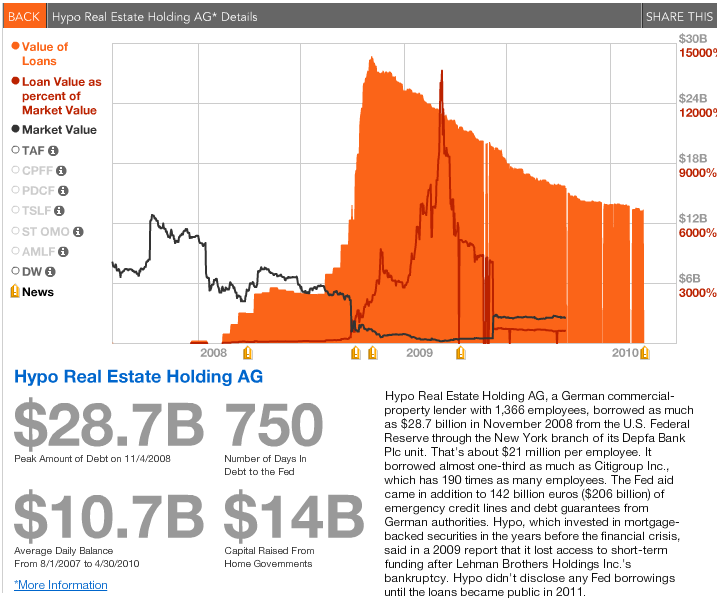
I encourage you to go play around in the database. For example, check out this summary of how the Fed lent Hypo Real Estate Holding AG, a German real estate company, $28.7B to keep the German banking system afloat after HRE’s subsidiary Depfa crashed in Ireland. Germany had already given HRE $206B; the Fed’s lending amounted to $21M for each of HRE’s 1,366 employees. And at its height, just the Fed’s lending represented 15,000% of HRE’s market value. And yet all of this remained a secret for three years after the Fed first started lending to HRE.

With the scope of all that in mind–with a way to visualize the incredibly leveraged house of cards this secret lending held up–now read what I consider to be the most important line in Bloomberg’s summary.

By 2008, the housing market’s collapse forced those companies to take more than six times as much, $669 billion, in emergency loans from the U.S. Federal Reserve. The loans dwarfed the $160 billion in public bailouts the top 10 got from the U.S. Treasury, yet until now the full amounts have remained secret

Fed Chairman Ben S. Bernanke’s unprecedented effort to keep the economy from plunging into depression included lending banks and other companies as much as $1.2 trillion of public money, about the same amount U.S. homeowners currently owe on 6.5 million delinquent and foreclosed mortgages. The largest borrower, Morgan Stanley (MS), got as much as $107.3 billion, while Citigroup took $99.5 billion and Bank of America $91.4 billion, according to a Bloomberg News compilation of data obtained through Freedom of Information Act requests, months of litigation and an act of Congress.

“These are all whopping numbers,” said Robert Litan, a former Justice Department official who in the 1990s served on a commission probing the causes of the savings and loan crisis. “You’re talking about the aristocracy of American finance going down the tubes without the federal money.” [my emphasis]

That is, the money the Fed lent out to these highly leveraged risk takers could have paid off (much less merely guaranteed) the 6.5 million delinquent and foreclosed mortgages that are currently dragging down the American economy.

But instead of offering money to homeowners who would have used it to stay in their homes and sustain their neighborhoods, the Fed instead loaned it to the banks that were leveraged to the hilt.

So here we are worried about the moral hazard of modifying principal on loans that were vastly overvalued. Here we are shredding the rule of law to try to let Bank of America (which borrowed $91.4B) off for its crimes for a mere $20B or so.

And, for the most part, all those corporations that secretly sucked of the Fed’s teat are still in business, gleefully lecturing others about moral hazard.

Share this entry

The Global Crisis of SOME Institutional Legitimacy

Felix Salmon has a worthwhile (but, IMO, partly mistaken) post on what he deems “the global crisis of institutional legitimacy.” I think he’s right to see this as a significant challenge to our current political economy.

While watching another Arab government get toppled on Sunday evening — this time that of Muammar Gaddafi, in Libya — I was also reading George Magnus’s excellent note for UBS, entitled “The Convulsions of Political Economy”; you can find it chez Zero Hedge.

Convulsions is right — not only in the Arab world, of course, but also in Europe and the US. And the result is arguably the most uncertain outlook, in terms of the global political economy, since World War II ended and the era of the welfare state began.

As Magnus says:

It seems that we are having sometimes esoteric tiffs between Keynesians and Austrians about if and how governments should sustain jobs and growth. But, deep down, we are having a much more significant debate as we are being forced to redefine what we think about the rights and obligations of citizens and the State.

Most fundamentally, what I’m seeing as I look around the world is a massive decrease of trust in the institutions of government.

But I think Salmon makes two mistakes. First, he maintains an unwarranted distinction between the Arab Spring and the UK riots.

Where those institutions are oppressive and totalitarian, the ability of popular uprisings to bring them down is a joyous and welcome sight. But on the other side of the coin, when I look at rioters in England, I see a huge middle finger being waved at basic norms of lawfulness and civilized society, and an enthusiastic embrace of “going on the rob” as some kind of hugely enjoyable participation sport. The glue holding society together is dissolving, whether it’s made of fear or whether it’s made of enlightened self-interest.

From the perspective of the underclass in our society, it has been some time since “enlightened self-interest” counseled compliance. And from most perspectives, it’s clear that the elites, not the underclass, were the first to wave a huge middle finger at basic norms of lawfulness.

A more problematic error, though, is Salmon’s claim that corporations have retained their legitimacy.

Looked at against this backdrop, the recent volatility in the stock market, not to mention the downgrade of the US from triple-A status, makes perfect sense. Global corporations are actually weirdly absent from the list of institutions in which the public has lost its trust, but the way in which they’ve quietly grown their earnings back above pre-crisis levels has definitely not been ratified by broad-based economic recovery, and therefore feels rather unsustainable.

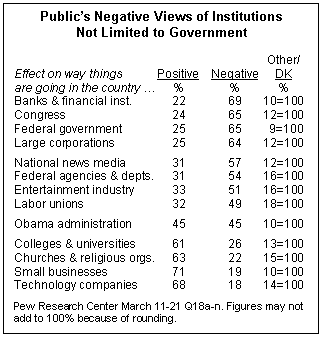
As a recent Pew poll shows, Americans are just as disgusted with banks and other large corporations as they are with their government.

While anti-government sentiment has its own ideological and partisan basis, the public also expresses discontent with many of the country’s other major institutions. Just 25% say the federal government has a positive effect on the way things are going in the country and about as many (24%) say the same about Congress. Yet the ratings are just as low for the impact of large corporations (25% positive) and banks and other financial institutions (22%). And the marks are only slightly more positive for the national news media (31%) labor unions (32%) and the entertainment industry (33%).

Notably, those who say they are frustrated or angry with the federal government are highly critical of a number of other institutions as well. For example, fewer than one-in-five of those who say they are frustrated (18%) or angry (16%) with the federal government say that banks and other financial institutions have a positive effect on the way things are going in the country.

But there are institutions that Americans still trust: colleges, churches, small businesses, and tech companies.

Distinguishing between those institutions (government and big corporations) people distrust and those (churches, small businesses, and tech companies) they do is important for several reasons. First, because it prevents us from assuming (as big corporations might like us to) that Americans will be content with corporatist solutions. People may or may not like the the post office, but there’s no reason to believe they like FedEx, Comcast, AT&T, or Verizon any more, particularly the latter three, which all score very badly in customer satisfaction. (Update: as joberly points out, Pew found that the postal service was by one measure the most popular government agency, with 83% of respondents saying they had a favorable view of the postal service.)

Such polling also suggests where Americans might turn during this convulsion. Barring Apple buying out the federal government, it seems likely Americans, at least, will turn to local institutions: to their church, their neighborhood, their local businesses.

That’s got some inherent dangers–particularly if people decide they want to change my governance with their church. But it also provides a nugget of possible stability amid the convulsion, one that might have salutary benefits for our environment and economy.

Apple aside, it’s the big institutions that have lost their institutional legitimacy. But we’re not entirely without institutions with which to rebuild.

Share this entry