Fed Lending: Bailing Out Banks over People
Bloomberg has a good summary and even better visual database of the various forms of Fed lending that have been revealed over the years since the bailout.

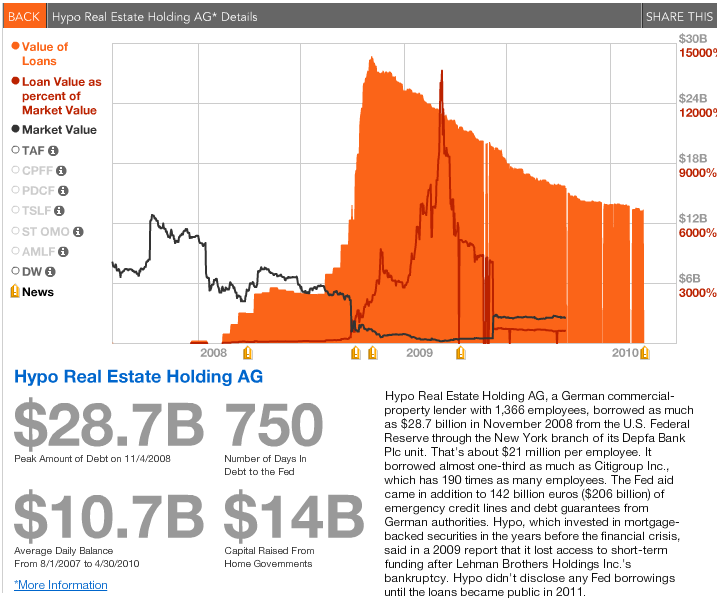
I encourage you to go play around in the database. For example, check out this summary of how the Fed lent Hypo Real Estate Holding AG, a German real estate company, $28.7B to keep the German banking system afloat after HRE’s subsidiary Depfa crashed in Ireland. Germany had already given HRE $206B; the Fed’s lending amounted to $21M for each of HRE’s 1,366 employees. And at its height, just the Fed’s lending represented 15,000% of HRE’s market value. And yet all of this remained a secret for three years after the Fed first started lending to HRE.

With the scope of all that in mind–with a way to visualize the incredibly leveraged house of cards this secret lending held up–now read what I consider to be the most important line in Bloomberg’s summary.

By 2008, the housing market’s collapse forced those companies to take more than six times as much, $669 billion, in emergency loans from the U.S. Federal Reserve. The loans dwarfed the $160 billion in public bailouts the top 10 got from the U.S. Treasury, yet until now the full amounts have remained secret

Fed Chairman Ben S. Bernanke’s unprecedented effort to keep the economy from plunging into depression included lending banks and other companies as much as $1.2 trillion of public money, about the same amount U.S. homeowners currently owe on 6.5 million delinquent and foreclosed mortgages. The largest borrower, Morgan Stanley (MS), got as much as $107.3 billion, while Citigroup took $99.5 billion and Bank of America $91.4 billion, according to a Bloomberg News compilation of data obtained through Freedom of Information Act requests, months of litigation and an act of Congress.

“These are all whopping numbers,” said Robert Litan, a former Justice Department official who in the 1990s served on a commission probing the causes of the savings and loan crisis. “You’re talking about the aristocracy of American finance going down the tubes without the federal money.” [my emphasis]

That is, the money the Fed lent out to these highly leveraged risk takers could have paid off (much less merely guaranteed) the 6.5 million delinquent and foreclosed mortgages that are currently dragging down the American economy.

But instead of offering money to homeowners who would have used it to stay in their homes and sustain their neighborhoods, the Fed instead loaned it to the banks that were leveraged to the hilt.

So here we are worried about the moral hazard of modifying principal on loans that were vastly overvalued. Here we are shredding the rule of law to try to let Bank of America (which borrowed $91.4B) off for its crimes for a mere $20B or so.

And, for the most part, all those corporations that secretly sucked of the Fed’s teat are still in business, gleefully lecturing others about moral hazard.

Share this entry

The Global Crisis of SOME Institutional Legitimacy

Felix Salmon has a worthwhile (but, IMO, partly mistaken) post on what he deems “the global crisis of institutional legitimacy.” I think he’s right to see this as a significant challenge to our current political economy.

While watching another Arab government get toppled on Sunday evening — this time that of Muammar Gaddafi, in Libya — I was also reading George Magnus’s excellent note for UBS, entitled “The Convulsions of Political Economy”; you can find it chez Zero Hedge.

Convulsions is right — not only in the Arab world, of course, but also in Europe and the US. And the result is arguably the most uncertain outlook, in terms of the global political economy, since World War II ended and the era of the welfare state began.

As Magnus says:

It seems that we are having sometimes esoteric tiffs between Keynesians and Austrians about if and how governments should sustain jobs and growth. But, deep down, we are having a much more significant debate as we are being forced to redefine what we think about the rights and obligations of citizens and the State.

Most fundamentally, what I’m seeing as I look around the world is a massive decrease of trust in the institutions of government.

But I think Salmon makes two mistakes. First, he maintains an unwarranted distinction between the Arab Spring and the UK riots.

Where those institutions are oppressive and totalitarian, the ability of popular uprisings to bring them down is a joyous and welcome sight. But on the other side of the coin, when I look at rioters in England, I see a huge middle finger being waved at basic norms of lawfulness and civilized society, and an enthusiastic embrace of “going on the rob” as some kind of hugely enjoyable participation sport. The glue holding society together is dissolving, whether it’s made of fear or whether it’s made of enlightened self-interest.

From the perspective of the underclass in our society, it has been some time since “enlightened self-interest” counseled compliance. And from most perspectives, it’s clear that the elites, not the underclass, were the first to wave a huge middle finger at basic norms of lawfulness.

A more problematic error, though, is Salmon’s claim that corporations have retained their legitimacy.

Looked at against this backdrop, the recent volatility in the stock market, not to mention the downgrade of the US from triple-A status, makes perfect sense. Global corporations are actually weirdly absent from the list of institutions in which the public has lost its trust, but the way in which they’ve quietly grown their earnings back above pre-crisis levels has definitely not been ratified by broad-based economic recovery, and therefore feels rather unsustainable.

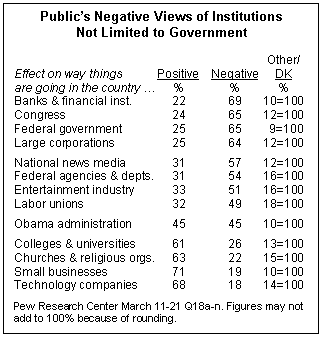
As a recent Pew poll shows, Americans are just as disgusted with banks and other large corporations as they are with their government.

While anti-government sentiment has its own ideological and partisan basis, the public also expresses discontent with many of the country’s other major institutions. Just 25% say the federal government has a positive effect on the way things are going in the country and about as many (24%) say the same about Congress. Yet the ratings are just as low for the impact of large corporations (25% positive) and banks and other financial institutions (22%). And the marks are only slightly more positive for the national news media (31%) labor unions (32%) and the entertainment industry (33%).

Notably, those who say they are frustrated or angry with the federal government are highly critical of a number of other institutions as well. For example, fewer than one-in-five of those who say they are frustrated (18%) or angry (16%) with the federal government say that banks and other financial institutions have a positive effect on the way things are going in the country.

But there are institutions that Americans still trust: colleges, churches, small businesses, and tech companies.

Distinguishing between those institutions (government and big corporations) people distrust and those (churches, small businesses, and tech companies) they do is important for several reasons. First, because it prevents us from assuming (as big corporations might like us to) that Americans will be content with corporatist solutions. People may or may not like the the post office, but there’s no reason to believe they like FedEx, Comcast, AT&T, or Verizon any more, particularly the latter three, which all score very badly in customer satisfaction. (Update: as joberly points out, Pew found that the postal service was by one measure the most popular government agency, with 83% of respondents saying they had a favorable view of the postal service.)

Such polling also suggests where Americans might turn during this convulsion. Barring Apple buying out the federal government, it seems likely Americans, at least, will turn to local institutions: to their church, their neighborhood, their local businesses.

That’s got some inherent dangers–particularly if people decide they want to change my governance with their church. But it also provides a nugget of possible stability amid the convulsion, one that might have salutary benefits for our environment and economy.

Apple aside, it’s the big institutions that have lost their institutional legitimacy. But we’re not entirely without institutions with which to rebuild.

Share this entry

2 Funny Things about Obama Administration’s Effort to Pressure Eric Schneiderman

The NYT has an article about efforts to strong-arm Attorney General Schneiderman to get him to put rule of law aside for yet another bank bailout.

First, it quotes HUD Secretary Shaun Donovan as saying,

The disagreement is around whether we should wait to settle and resolve the issues around the servicing practices for him — and potentially other A.G.’s and other federal agencies — to complete investigations on the securitization side. He might argue that he has more leverage that way, but our view is we have the immediate opportunity to help a huge number of borrowers to stay in their homes, to help their neighborhoods and the housing market. [my emphasis]

And it quotes DOJ spokeswoman Alisa Finelli saying,

The Justice Department, along with our federal agency partners and state attorneys general, are committed to achieving a resolution that will hold servicers accountable for the harm they have done consumers and bring billions of dollars of relief to struggling homeowners — and bring relief swiftly because homeowners continue to suffer more each day that these issues are not resolved. [my emphasis]

You see, the Administration has an “immediate opportunity to help a huge number of borrowers stay in their homes,” without any action from Eric Schneiderman. They have a way to do so more swiftly, in such a way the servicers actually would be held accountable. It would involve offering refis with principal reductions to all the underwater homeowners whose loans are owned by Fannie and Freddie. That would not only help a huge number of borrowers stay in their home, but it would be massive stimulus.

But instead they’re sending Donovan to pressure Schneiderman to pursue a measure that would benefit far fewer homeowners and probably take more time, while putting the last nail in the coffin of the rule of law in this country.

And then there’s Kathryn Wylde, who spins her shilling for Bank of America as an effort to protect NYC’s “Main Street.”

The lawsuit angered Bank of New York Mellon, and as Mr. Schneiderman was leaving the memorial service last week for Hugh Carey, the former New York governor who died Aug. 7, an attendee said Mr. Schneiderman became embroiled in a contentious conversation with Kathryn S. Wylde, a member of the board of the Federal Reserve Bank of New York who represents the public. Ms. Wylde, who has criticized Mr. Schneiderman for bringing the lawsuit, is also chief executive of the Partnership for New York City.

[snip]

Characterizing her conversation with Mr. Schneiderman that day as “not unpleasant,” Ms. Wylde said in an interview on Thursday that she had told the attorney general “it is of concern to the industry that instead of trying to facilitate resolving these issues, you seem to be throwing a wrench into it. Wall Street is our Main Street — love ’em or hate ’em. They are important and we have to make sure we are doing everything we can to support them unless they are doing something indefensible.”

Now why would Wylde believe she’s a more appropriate person to decide what is “defensible” than NY’s top state law enforcement official?

And while Wylde is directly doing the bidding of BNYM, ultimately this is about saving Bank of America from admitting that it is insolvent.

You know … Bank of America.

One of just a few of the big banks that is not headquartered in NYC?

One that considered–and then decided against–moving its HQ and related jobs to NYC a few years ago?

Why is Kathryn Wylde fighting so hard to get an elected NY official to put his constituents’ interests behind the interests of a Charlotte company? Why is the CEO of the Partnership for New York City working so hard to benefit a company that doesn’t even want to move to her city?

But then this effort to further erode rule of law isn’t about constituencies–about actual people rather than Mitt’s corporate people–is it?

Update: Nail, coffin, fixed. per Fractal.

Share this entry

Tony Fratto’s Post Office Field Trip

Ex-Bush flack Tony Fratto set me off on a rant this morning when he tweeted this:

Over the past 10 yrs I might have visited a post office 10 times, total.

(FWIW, Ed Henry also doesn’t frequent post offices, he mused from the luxury of Martha’s Vineyard.) Maybe I was misunderstanding what Fratto meant by the tweet, but he seemed to suggest that the frequency someone like him–someone so successful he once worked at the White House–used post offices should have any bearing on policy regarding the postal service. When I suggested that was, “probably why you have little understanding oof [sic] ppl who do,” he responded, “? Is there a certain “kind” of person who visits post offices??”

I started listing the kinds of people who I see when I go to the post office.

  • Poorer people
  • People using a post office box (some who might have unstable housing)
  • Rural people who live outside of delivery areas and have to pick up their mail
  • E-bay type entrepreneurs fulfilling sales orders
  • Immigrants sending care packages to people from their country of origin
  • Non-profits sending newsletters

Now, that’s an unscientific sample–it’s just who I see using the post office when I go. But in spite of the fact that these people at least look like they’re using the post office because it offers a reliable, accessible service for a price they can afford, I suggested the elite had access to a bunch of different services–like FedEx or UPS–that might make it easier to avoid the post office.

To which Fratto replied,

The issue isn’t “elite” vs “poor”! Good grief. It’s that we mail 1/10 of what we used to! My goodness…

Getting rid of post offices, Fratto said, was not “not ‘tearing down a public good’. We’re emailing.”

Which I think proved my point. For someone who doesn’t frequent a post office to see people who simply can’t replace the postal service with the technologies Fratto described as having replaced the postal service–fax, email, and online payments–it’s easy to forget that those technologies are simply inaccessible to a big chunk of the country–a chunk that is predominantly poorer.

The map above shows the non-mobile broadband access available in the country as of June 2010. As the NYT noted in an article earlier this year, 28% of America doesn’t use the Toobz at all.

As the world embraces its digital age — two billion people now use the Internet regularly — the line delineating two Americas has become more broadly drawn. There are those who have reliable, fast access to the Internet, and those, like about half of the 27,867 people here in Clarke County, who do not.

In rural America, only 60 percent of households use broadband Internet service, according to a report released Thursday by the Department of Commerce. That is 10 percent less than urban households. Over all, 28 percent of Americans do not use the Internet at all.

And some of these people live in places that may lose their post offices. Many of these people live in places that can’t afford to be among the places that could lose some 220,000 postal jobs in upcoming years, on top of the 212,000 already lost.

Yet policy wonks who don’t even use the post office (and presumably have the mobility that affluence offers) argue,

I’m fully aware of people who need the post office, but we can’t have them on every corner. Always going to be a balance…

…& cost has to matter. At some point it’s just not economically practical.

Fratto got a lot quieter when I pointed out the postal service deficit–$238 billion over the next decade–was actually peanuts compared on what we spend dropping bombs in Afghanistan and other forever wars.

Elite pundits increasingly seem to be making the argument that we simply can’t afford to be a nation-state anymore–we can’t afford to offer the most basic federal services to our poor and rural citizens. Yet they rarely consider how easily we manage to come up with unbelievable sums to remain an empire.

Drone strike budgeting: ruining rural lives here and overseas for fun and profit!

Share this entry

Jeff Immelt: EPA Should Say Fracking, Gulf Drilling, and Trans-Candian Pipeline Are Safe in One Week

[youtube]Df_XSkDz418[/youtube]

I wanted to return to Jeff Immelt’s Dartmouth talk to focus on what he means by regulatory reform. It’s newsworthy not just for the way Immelt creates straw men to try to claim the energy industry is overregulated. But given that he’s such a key Obama advisor, and given that Obama is also claiming that regulatory reform will create jobs, Immelt’s worrisome claims–such as that regulatory agencies should approve applications in a week–deserve some attention and publicity.

In response to a question posed indirectly by Hank Paulson about what he would do to create jobs (after 35:00), Immelt put regulatory reform as the first thing on his list (the others are infrastructure investment, retraining, and small business financing). (All transcriptions and errors therein in this post are my own.)

You’d look at regulation permitting cycles; you’d look at some regulatory schemes that are retarding growth. And as important, you’d just look at cycle time. Cycle time. You’d say, okay instead of three years, I’m gonna give you a week.

Later (after 46:30), an audience member asks him how to make us more efficient while still being environmentally safe. Rather than answering that question, he returns to the idea of regulatory reform.

I think that there are permitting cycle times that just are purely bureaucratic. The fact is, if you’re doing a cross-state line gas it takes four years, if you’re doing electricity grid it takes seven years. That seems a bit tardy, to me.

And then, I think, let’s pick three. Let’s pick drilling off the Gulf of Mexico, let’s take the Trans-Canada pipeline that goes from the oil sands in Canada down to the United States, and let’s pick shale gas.

Now, I think there should be rules for all of those. I don’t think people should be able to just do whatever they want to do. There should be rules for all of those. But we should be doing them all.

In other words, the role of a regulator, be it the FDA or the EPA or anybody else is how to make it safe. It’s not to switch an on or an off switch.

Now, this country could be an exporter of natural gas. We have more natural gas than almost any other country in the world. Why not celebrate that?

You know, we’ve been doing shale gas in Pennsylvania for a decade. There’s a 150 environmental laws that you have to adhere to if you want to shale gas discovery in Pennsylvania today. Do we need 300?

Look, I’m not anti-EPA, I’m not. I think in some ways the EPA drives good standards. And those standards are important for competitiveness and those standards create an equal playing field.

But I think today, we’ve let some agencies to run with no accountability at all. None. And I think that might have been okay when unemployment was 5%; it may have been okay at some other time. But I think if we’re making everybody else accountable, the FDA and EPA should be as well.

Aside from the straw men Immelt constructs here (after all, it’s not actually the case that the EPA is preventing most kinds of Gulf drilling from going forward; and legitimate political opposition is holding these issues up as much as regulatory reform), the passage is stunning for the way it spins real regulatory review as a lack of accountability. After all, FDA regulatory capture and accelerated review has led directly to problems with drugs and medical devices (some of the latter in GE market segments). And the same factors–EPA and DOI regulatory capture and speedy approval processes–led directly to what is probably the biggest energy disaster in the history of the country, the BP oil spill. Both of those cost lives and, because of the damage, business efficiency, and (in the case of the BP spill) jobs.

If anything, we need to hold regulators accountable for these failures, not give them a green light to go make more of them, on a larger scale.

But Jeff Immelt, the Chair of Obama’s jobs council, says instead of that kind of accountability, we need to approve things like fracking in one week’s time.

Share this entry

Jeff Immelt Claims Government Can’t Make Him Invest–Ignoring It Already Did

[youtube]Df_XSkDz418[/youtube]

Jeff “China China China” Immelt spoke at Dartmouth yesterday, ostensibly about energy. But as it happens, he had the opportunity (in question period) to pressure SuperCongress to “reform” taxes rather than raise them on people like Immelt (while later saying he didn’t think SuperCongress should also look at job creation). He claimed GE would embrace the elimination of loopholes, so long as the corporate tax rate was also lowered.

The largest U.S. conglomerate would accept the elimination of loopholes “in a heartbeat” if it was coupled with a lowering of the statutory 35 percent rate, Jeff Immelt told a group of students on Thursday.

Right. We’re to take Immelt’s word that GE will stop taking advantage of any means to evade taxes based on its own history of evading taxes.

Which, in combination with Immelt’s comments about investing are all the more interesting. Here’s how Reuters described it.

Immelt, who leads a panel advising the Obama administration on job creation, said he puts little stock in talk that the government could do more to encourage companies to invest and lower the nation’s persistently high unemployment rate.

“A lot has been said that business isn’t investing because of uncertainty. I think that’s rubbish,” the 55-year-old CEO said. “The government couldn’t do anything to make me invest and believe me the rest of the world isn’t that stable either. We’ve made our own choices that we’re going to keep investing regardless of what happens in Washington.”

But in an uncharacteristically animated moment, he blasted critics who contend that companies like GE that do much of their sales outside the United States are hurting the economy. He noted that GE sells 90 percent of its jet engines abroad but manufacturers all of them in U.S. factories.

“That’s not taking jobs out of the United States, that’s what we have to do,” Immelt said. “We’ve gotten this psychotic thing that anybody that does business outside the United States is a heathen, anti-American … I don’t understand why we’re rooting against companies that are out there competing because we’re creating good jobs here.” [my emphasis]

Now there’s actually more than this going on. First, in response to a question (around 42:10) about allegations that GE doesn’t pay taxes, Immelt shifted the answer to claim, incorrectly, that people were beating up on GE for exporting, rather than beating up on GE for not paying taxes. So rather than talking about tax evasion, he instead talked about how many jet engines GE exports from the US. And when, later (around 52:00), he was asked whether all the energy products GE sells in India and China were made in the US, he again focused on jet engines (energy products?) and gas turbines.

In other words, he avoided talking about taxes by pretending all GE does does export large manufactured goods. (More interesting, too, though probably worth another post, is his exhortation–around 50:00–that you shouldn’t watch TV or read the news, said in the context of the crash, “everybody had to wake up and realize you gotta change,” without admitting that GE’s financial games were a huge part of the crash.)

And yes, Immelt says that the government can’t do anything to make GE invest–though in context it appeared to say the government can’t make GE invest here (as opposed to other countries–he noted that investments in energy are primarily happening in Europe and China).

I find that claim, in particular, interesting given how GE is claiming credit for creating a greater proportion of jobs in the US. But the big headline item–a tech center in the Detroit area–happened precisely because of government intervention.

Chief Executive Officer Jeffrey Immelt has said GE will add more than 15,000 jobs in the three years through December. About 1,100 will be just outside Detroit in a center for information technology, a field emblematic of outsourcing. So far, GE has hired about 660 people in Michigan, a state that led the nation in jobless rates, making it a symbol of U.S. industrial decline.
[snip]
GE took advantage of incentives such as Michigan’s tax benefits and skilled workforce. Immelt said in announcing the Michigan site in 2009 that GE would invest $100 million, while state officials offered more than $60 million over 12 years in incentives.

“The change in approach is critical, and it comes right from the top,” said Harley Shaiken, a labor professor at the University of California at Berkeley. “He’s addressed it both from the context of GE and in the importance of the U.S. having a vibrant, high-tech manufacturing base.”

So I guess the government can do something to make Jeff Immelt’s company invest in the US. But for some reason he didn’t want to talk about it.

In a recent op-ed, Alliance for American Manufacturing head Scott Paul offered a number of suggestions to rebuild manufacturing in the US. Among other worthy suggestions, he suggested what might be called the “Immelt Rule”–banishing CEOs from federal advisory boards (like Obama’s job’s council) if they’re outsourcing faster than they’re creating jobs here in the US.

Kick any CEO off of federal advisory boards or jobs councils who has: (1) not created net new American jobs over the past five years, or (2) is expanding the company’s foreign workforce at a faster rate than its domestic workforce. Replace them with CEOs who are committed to investing in America. Shame is a good motivator.

I guess Immelt would rather just talk about exporting jet engines and be done with it.

Share this entry

Consensus that America Should Be Like Sweden


A number of people are circulating this video, graphically showing that Americans don’t know how unequal our society has become.

But I wanted to point to a few details about the underlying study, which not only shows that most Americans have no clue how unequal it has become, but asks them to describe what an ideal wealth distribution ought to be. It shows a real consensus that an ideal distribution would look like Sweden, and even agrees that that distribution ought to be effected by redistributing money from the very wealthy to the three lowest quintiles of wealth.

All groups—even the wealthiest respondents—desired a more equal distribution of wealth than what they estimated the current United States level to be, and all groups also desired some inequality—even the poorest respondents. In addition, all groups agreed that such redistribution should take the form of moving wealth from the top quintile to the bottom three quintiles. In short, although Americans tend to be relatively more favorable toward economic inequality than members of other countries (Osberg & Smeeding, 2006), Americans’ consensus about the ideal distribution of wealth within the United States appears to dwarf their disagreements across gender, political orientation, and income.

The study does reflect a bit on why this isn’t driving political change, citing other studies; Americans’ ignorance about the inequality of our society is just one part of it.

Given the consensus among disparate groups on the gap between an ideal distribution of wealth and the actual level of wealth inequality, why are more Americans, especially those with low income, not advocating for greater redistribution of wealth? First, our results demonstrate that Americans appear to drastically underestimate the current level of wealth inequality, suggesting they may simply be unaware of the gap. Second, just as people have erroneous beliefs about the actual level of wealth inequality, they may also hold overly optimistic beliefs about opportunities for social mobility in the United States (Benabou & Ok, 2001; Charles & Hurst, 2003; Keister, 2005), beliefs which in turn may drive support for unequal distributions of wealth. Third, despite the fact that conservatives and liberals in our sample agree that the current level of inequality is far from ideal, public disagreements about the causes of that inequality may drown out this consensus (Alesina & Angeletos, 2005; Piketty, 1995). Finally, and more broadly, Americans exhibit a general disconnect between their attitudes toward economic inequality and their self-interest and public policy preferences (Bartels, 2005; Fong, 2001), suggesting that even given increased awareness of the gap between ideal and actual wealth distributions, Americans may remain unlikely to advocate for policies that would narrow this gap.

But educating Americans about our inequality is one step in that process.

Share this entry

The New Ag Bubble and Climate Change

The Federal Reserve Bank of Chicago is worried enough about rising farm land values in the MidWest it is holding a conference to discuss it. Here in the MidWest, prices have gone up 17% in the last year.

And Bloomberg has a piece describing bankster types scouring farmland the world over for farms.

“I have frequently told people that one of the best investments in the world will be farmland,” says Jim Rogers, 68, chairman of Singapore-based Rogers Holdings, who predicted the start of the global commodities rally in 1996. “You’ve got to buy in a place where it rains, and you have to have a farmer who knows what he’s doing. If you can do that, you will make a double whammy because the crops are becoming more valuable.”

The growth in demand for food, spurred by the rising middle classes in China, India and other emerging markets, shows no signs of abating. Food prices in June, as measured by a United Nations index of 55 food commodities, were just slightly below their peak in February. The UN’s Food and Agriculture Organization said in a June report that it expects food costs to remain high through 2012.

So many investors have rushed to capitalize on food prices in the past three years that they may be creating a farmland bubble. The Federal Reserve Bank of Kansas City, which covers Colorado, Kansas, Nebraska and other agricultural states, said in May that farmland prices had surged 20 percent in the first quarter compared with a year earlier.

“Yes, farmland will be a bubble again; all agricultural products will be in a bubble again,” says Rogers, who is an investor in Agrifirma Brazil Ltd., a South American farmland owner.

Now, I’m interested (and concerned) about the way this will lead to problematic relations between investors and the farmers actually doing the work (“Feudalism returns,” Muniland’s Cate Long says).

But I’m even more rather amazed that the discussion of this doesn’t mention climate change.

Sure, the increase in prices is, in the short term, driven by demand in places like China.

The hedge fund Diggle co-founded, Artradis Fund Management Pte in Singapore, suffered about $700 million in losses. He closed it in March and opened another Singapore-based hedge fund, Vulpes Investment Management Pte. Diggle plans to incorporate his five farms into an investment management group run by Vulpes.

From his vantage point in Asia, where the British expatriate has worked for the past two decades, Diggle says he’s witnessed aspiring locals eating their way up the food chain.

“You can see what a more prosperous China will consume,” Diggle, 47, says. “It means more dairy, more meat — not just pork and chicken.”

But this year’s near-record food prices are tied, too, to weird weather and other disasters: fires in Russia and floods in Australia. Whether or not those disasters were tied to climate change, climate change already has changed productivity.

Sure, the horizon of investment here may be shorter than that which will see areas of the MidWest take on an increasing role in feeding the rest of the country as other parts because less farmable. But that horizon is not that far out.

This farm buying craze may well be a bubble. Or it may be the leading edge of financial changes tied to climate change.

Share this entry

“A Public Service,” My Fannie

I wanted to juxtapose two stories about Fannie Mae. The first, from this WaPo story reporting that the Administration has decided to keep some kind of federal entity guaranteeing mortgages. The story itself is interesting–as are Dean Baker’s post criticizing the underlying decision.

What I found particularly interesting, though, were the comments from the usual suspects about the role they perceive Fannie and Freddie as playing.

Two top Obama advisers, HUD Secretary Shaun Donovan and Treasury Secretary Timothy F. Geithner, think the government should maintain an outsize role in the housing market, administration officials said.

Donovan thinks federal support for housing fulfills a public service, while Geithner has been focused on the need for the government to have a way to keep the mortgage market operating during a financial crisis.

Other advisers, however, opposed a continued government role over the long run. Austan Goolsbee, who this month left his job as chairman of Obama’s Council of Economic Advisers, argued that the federal role in housing distorts the free market. By subsidizing mortgage investments, he argued, the government drives capital away from other types of investments — for example, those in companies developing environmentally friendly technology. He also warned that the government is putting enormous sums of taxpayer money on the line while conveying little actual benefit to home buyers.

In a meeting with the president, Goolsbee said that the government had finally brought Fannie and Freddie’s excesses to heel by taking over the companies and that it would be a mistake to let them loose in the market again, said a person familiar with the meeting. Goolsbee likened the companies to a villain held in a special prison who shouldn’t be freed just because he promises to help the poor, the source recounted.

Lawrence H. Summers, who was director of the National Economic Council until early this year, argued that, over the long term, it didn’t make sense to have a government-backed agency providing guarantees to the mortgage market but that Fannie and Freddie still play a crucial role.

“My position was that we needed to maximize activity in the short run to support the housing market,” Summers said in an interview. “Discussions of scaling down Fannie and Freddie were vastly premature under the circumstances of a collapsing housing market.” [my emphasis]

Compare those comments–particularly those favoring the GSEs from Donovan and TurboTaxTimmeh–with the description of the way Fannie Mae is fleecing the taxpayers and ruining communities by pushing servicers to foreclose even though homeowners are seeking a modification, an approach that violates Fannie’s own stated policy.

The documents show Fannie Mae has told banks to foreclose on some delinquent homeowners — those more than a year behind — even as the banks were trying to help borrowers save their houses, a violation of Fannie’s own policy.

Fannie Mae has publicly maintained that homeowners would not lose their houses while negotiating changes to mortgages under the federal Home Affordable Modification Program, or HAMP.

The Free Press also obtained internal records revealing that the taxpayer-supported mortgage giant has told banks that it expected them to sell off a fixed percentage of foreclosed homes. In one letter sent to banks around the country last year, a Fannie vice president made clear that Fannie expected 10%-12% of homes in foreclosure to proceed to sale.

[snip]

“Fannie just wants to clean up its balance sheet and get these loans off the books while taxpayers are eating these losses,” [Valpariso University Law Professor Alan] White said, referring to the multibillion-dollar federal bailout of Fannie Mae in 2008 and the rising cost to taxpayers.

“And Treasury and the FHFA are letting them get away with it. It’s a huge waste. Wealth is being destroyed, people are losing houses needlessly, and taxpayers are losing money.”

[snip]

According to White, the Valparaiso professor, foreclosing on a home typically costs Fannie Mae far more than a successful loan modification. But, he and others say, Fannie is willing to absorb higher losses because it knows taxpayers — not Fannie Mae — will eventually reimburse the loss.

In other words, even as Donovan and Timmeh appear to have won the argument on sustaining Fannie and Freddie (or something like them), what was implicitly clear (I’ve been hearing this accusation since 2009) has been proven: that the GSEs have been using their government backing to stiff taxpayers and ruin communities. (Kudos to Goolsbee who got it mostly right on this one: the taxpayer backing is providing little of value to taxpayers.)

It’s as if none of these folks overseeing Fannie know how badly it is screwing American communities. Or perhaps they don’t care?

Share this entry

Stimulus in Action, MI Edition

I’ve said a couple of times here that Jennifer Granholm’s record as governor was better than I gave her credit for, particularly economically.

The press is beginning to do some of the same reassessment. They’re discovering that, in spite of the Governor Engler tax cuts that made it harder to respond to MI’s downturn, Granholm did succeed in laying the groundwork for recovery.

But over the past year, a steady stream of economic statistics and research finds that Granholm is looking better in hindsight.

Here are some of the surprising Granholm highlights:

  • Michigan tied with Minnesota for the nation’s largest decline in unemployment from 2009 to 2010. The state also experienced the nation’s sixth-largest increase in per-capita personal income in that same year-to-year period.
  • State taxes as a percentage of personal income in 2011 are $7 billion lower than they were under John Engler in 2000. The fiscal problems the state faced were magnified by one statistic: Michigan’s overall tax revenues peaked during the prosperous year of 2000 and are not expected to return to that level until 2020.
  • Though the Granholm-backed Michigan Business Tax — the so-called “job-killer” tax — was still fully in place, the state achieved a substantial bounce in manufacturing jobs in 2010, a trend that was projected to continue throughout 2011.
  • Michigan ranks No. 1 in the nation for job creation improvement in a recent Gallup survey of state job markets, and Gov. Rick Snyder took office with some Granholm momentum that is expected to produce 64,600 jobs in 2011.

What this article doesn’t mention, of course, is that in addition to Granholm’s tireless effort to attract jobs and foster some diversity, MI also benefited from the massive government intervention of the auto bailout and received a number of grants that helped make possible factories like the Johnson Controls factory.

Speaking of which, here’s what the CEO of JCI, Steve Roell, had to say last Thursday about all the job creation Obama didn’t want to talk about.

Through innovation and investment in technology and people, Johnson Controls is a leader in the energy storage industry. We are investing more than $460 million in our advanced battery business for manufacturing and technical facilities here in Michigan and the U.S. These investments will lead to over 700 new jobs, retention of another 400, and provide approximately 1,000 construction workers.

We are doing that through several major efforts:

  • We recently announced we will be converting our Toledo, Ohio-area plant to produce batteries for Start-Stop vehicles, which have been successful in the European market and will be introduced next year in the U.S. These batteries help reduce fuel consumption and emissions by 5-12% for internal combustion engine vehicles with little added cost to the consumer. This investment will retain 400 jobs, and create 50 new positions and 800 construction jobs.
  • We recently opened our newly renovated Battery Technology and Testing Center in Milwaukee. It is the largest energy storage R&D center in the country, and we have added 60 new jobs. I’m pleased to say we just learned yesterday that Johnson Controls is receiving additional Department of Energy funding for research for developing green manufacturing processes and the next generation of lithium batteries.
  • This facility in Holland will be the first in the U.S. to produce complete lithium-ion battery cells and systems for hybrid and electric vehicles, producing battery systems for U.S. based automakers, such as the Ford Transit Connect. Employment at this facility will be 320 people at full capacity. We have committed to building a second facility in the U.S. Once we identify a location, build the plant and get to full capacity, we expect to add nearly 300 additional jobs.

These projects are great examples of public-private partnerships that use innovation and technology to produce products that reduce fuel consumption and create jobs.
We are very grateful for the outstanding support we have received from the White House, the U.S. Department of Energy, the state of Michigan and the city of Holland for their vision in building an advanced battery industry for vehicles in the U.S. and for the financial incentives they have provided. [my emphasis]

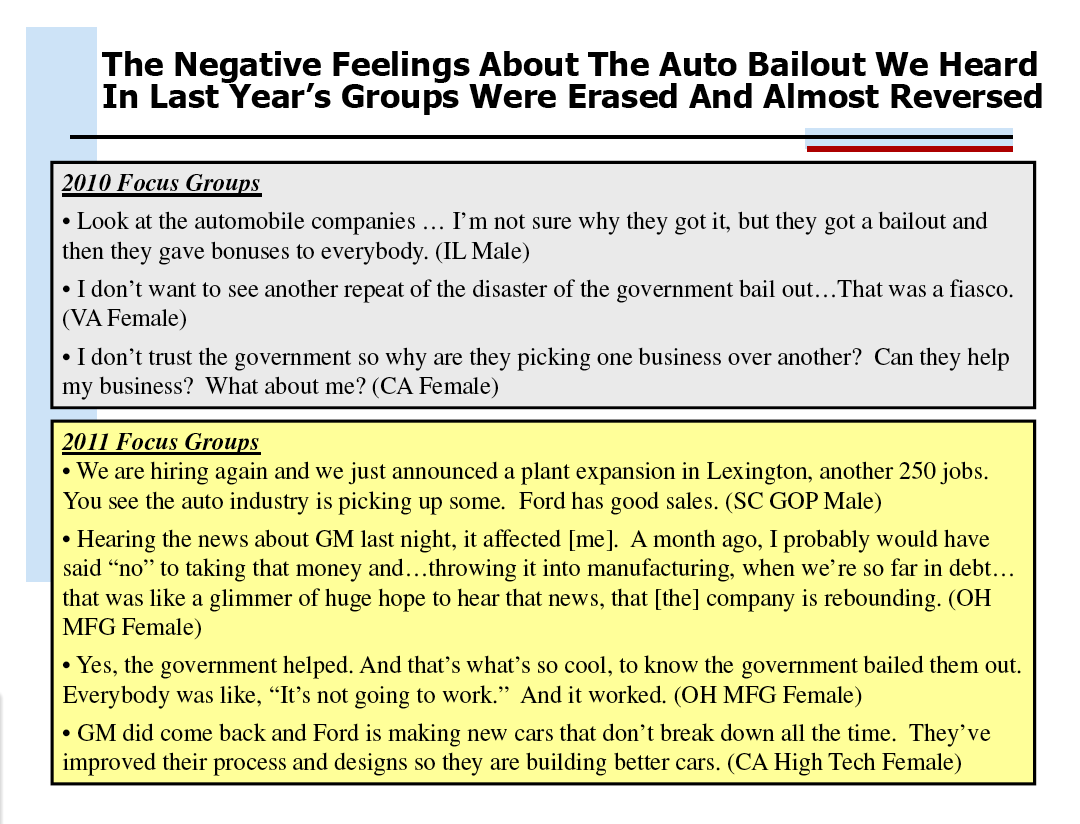
Even perspectives on the auto bailout are improving (as the graphic above, from focus groups associated with this poll, shows).

Yet seemingly at the moment when attitudes about government investment in the economy are changing, the Obama Administration wants to pretend it never happened.

MI is by no means out of the woods yet (Governor Snyder’s cuts of both incentives and social benefits risk doing real damage). But it’s clear that it had started to turn around in 2009-2010. It’s clear that, partly because of government stimulus, what was then the basket-case of the US has started to turn around.

Yet for some reason, the government wants to avoid taking any lesson from this.

Share this entry