I wanted to point to four different discussions as a way to situate a larger discussion of where the auto industry is at:
The automotive industry is driving the recovery (such as it is)
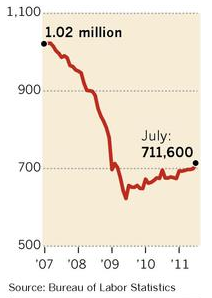 As the LAT argues–most compellingly with this graphic–the rebound in auto manufacturing in this country is one of the best pieces of news in our economy today.
It actually points to both automotive sales–with dealers doing good business–and an increase in manufacturing in this country. Those are two different things.
The story points to a GM dealer with stores in three states talking about his business.
“I have been adding dozens of employees for sales and sales support,” said Mike Bowsher, who owns Chevrolet and Buick dealerships in Atlanta; Nashville, Tenn.; and Orlando, Fla. “The economy is crazy, but our retail business is still growing and getting better.”
There are likely a couple of things going on. First, remember that GM and Chrysler closed a lot of dealers during their restructuring. I’ve long argued that was a necessary step because American brand dealers were cannibalizing each others’ sales. We would expect those that remain–like Bowsher’s dealers–to be doing better as a result. And US brands (including Ford) also did well during the post-earthquake period when Toyota and Honda had shortages due.
But then there’s the manufacturing side, where LAT notes a number of manufacturers are expanding here.
And it’s not just the Big Three American manufacturers that are thriving. Nissan, VW and other foreign-based firms are expanding in the United States, putting billions of dollars into building and refurbishing plants. Start-ups Tesla Motors in Palo Alto, Fisker Automotive in Anaheim and Coda Automotive in L.A. are hiring and spending hundreds of millions of dollars designing and launching electric and hybrid vehicles.
We’ve got an entire new segment–electric vehicles–expanding into viable production runs at the same time as we’re seeing transplants open new factories. Transplants are coming here, in part, to minimize the disruption of volatility in currency exchange. But I would expect it to become easier to justify opening plants in this country now that the Japanese earthquake showed the fragility of existing supply chains. Also note that US wages are more competitive internationally.
If only our country had done something meaningful to bring down the costs corporations pay on health care, we’d probably see a lot more manufacturing opening here.
And while I’m skeptical of David Shulman’s claim that the automotive turnaround will single-handedly keep us out of a double dip–after all, the beleaguered middle class drives the volume in car sales…
The health of the U.S. economy is so dependent on autos that economists such as UCLA’s David Shulman are watching car sales to assess whether the nation’s recovery will accelerate or stall.
“If you see a 13-million-unit sales rate in the fourth quarter, that would help a lot,” said Shulman, senior economist at the UCLA Anderson Forecast. “It would be very hard to see how the U.S. would go into recession with cars selling at that rate.”
I do think it fair to assess the role of the automotive industry in what little recovery we’ve got.
Battery factories driving the manufacturing industry
Which brings us to this excellent article from yesterday’s NYT Magazine. It tells the story I wish Obama had told when he visited Johnson Controls a few weeks back: the Administration’s investments in battery factories in the stimulus bill are coming on-line and they offer perhaps the single best piece of good news in the economy.
It talks about how the US fell behind in this and other critical manufacturing segments.
The semiconductor industry, for example, led to the LED-lighting and solar-panel industries, both of which are mostly based in Asia now. “The battery is another fascinating example,” [Harvard Professor Gary] Pisano told me. “The center of gravity is Asia. But why?” If you go back to the 1960s, he says, the American consumer-electronics companies decided they were better off in Japan, and then Korea, where costs were lower. “And then you have to ask: Who had the incentives to make batteries smaller or more powerful or last longer? Not the car industry. The consumer-electronics industry did.” This explains why the U.S. is now playing catch-up with lithium-ion batteries. It also underscores the vulnerability of an economy with a shrinking manufacturing sector. “When one industry moves,” Pisano says, “there can be other industries in the future that follow it that you couldn’t even anticipate.”
It talks about how we’re having to do what developing countries have always done to catch up: copycat existing technology (even though, as is the case here, our superior research universities led the development of the technology).
Its battery technology was developed at M.I.T., and for the last several years, the company had been making its lithium-ion cells in factories in Korea and China. When I asked Jason Forcier, the head of A123’s automotive division, why the company went to Asia to make its products, Forcier said he had no choice. “That’s where the supply base was,” he said. “That’s where the know-how was — it was nonexistent in the U.S.”
Repatriating a high-tech manufacturing plant to the United States is not simply a matter of hiring the local talent. It requires good-old foreign know-how. “We call it ‘copy exact,’ ” Forcier said. “We bought a company in Korea that had the technology around this type of battery and had developed the manufacturing process there. We basically brought that here, copied it exactly and scaled it up.” A123 also brought a team of six Korean engineers to help transfer the technology to the U.S. and sent a team of Americans to Korea to learn.
Read more →