Yesterday’s Some-Sayers Have Become Today’s Fact-Checkers

Paul Krugman makes a very good argument why the Bain attacks on Mitt Romney are necessary.

There is, predictably, a mini-backlash against the Obama campaign’s focus on Bain. Some of it is coming from the Very Serious People, who think that we should be discussing their usual preoccupations. But some of it is coming from progressives, some of whom are apparently uncomfortable with the notion of going after Romney the man and wish that the White House would focus solely on Romney’s policy proposals.

This is remarkably naive. I agree that the awfulness of Romney’s policy proposals is the main argument against his candidacy. But the Bain focus isn’t a diversion from that issue, it’s complementary. Given the realities of politics — and of the news media, as I’ll explain in a minute — any critique of Romney’s policies has to make use of his biography.

The first point is that voters are not policy wonks. They do not go to the Tax Policy Center website to check out distribution tables. And if a politician cites those distribution tables in his speeches, well, politicians say all kinds of things.

Nor, alas, can we rely on the news media to get the essentials of the policy debate across to the public — and not just because so many people get their news in quick snatches via TV. The sad truth is that the cult of balance still rules. If a Republican candidate announced a plan that in effect sells children into indentured servitude, the news reports would be that “Democrats say” that the plan sells children into indentured servitude, with each quote to that effect matched by a quote from a Republican saying the opposite.

He’s right. While I alluded to this in my post on Glenn Kessler’s changing belief in the seriousness of SEC filings, it deserves exposition directly. Glenn Kessler, back in the days when it was time to distinguish Gore’s economic plans from Bush’s, back in the days when it was time to consider whether Bush’s huge tax cuts would serve the interest of the country, committed just that kind of journalistic sin.

I pointed to this May 3, 2001 story, titled, “Some See Deficiencies in Bush’s Budget Math,” as just one example. It cited Rudolph Penner as the only expert speaking in any way supportively of Bush’s tax cut.

This fiscal situation, despite the uncertainties, is extraordinarily good.

But of course, Penner doesn’t actually say the tax cut is a good idea, just that Bush effectively inherited a good fiscal situation from Clinton.

Kessler then goes on to provide a bunch of anonymous quotes from Bush officials about the tax cuts–many admitting they’re not providing a full picture of the cuts and budget increases–as well as Ari Fleischer providing an excuse for why Bush didn’t include the cost to privatize social security in his estimates.

Which leaves this as the only non-Administration quote in support of the tax cuts.

“Look, [the spending ceiling is] going to hold because you have a different team,” said Sen. Pete V. Domenici (R-N.M.). “We’ve got the president in town.”

Compare that to evidence like this:

“The president is proving his critics right,” said William G. Gale, a budget expert at the Brookings Institution. “The ink isn’t even dry on the tax cut, and he’s already moving ahead on Social Security and defense. The president’s budget adds up only if you think the government will not do anything other than it has been doing.”

[snip]

One budget expert calculated that just the $100 billion in tax refunds will result in $73 billion in additional interest payments over the next 11 years. The entire tax cut would increase interest costs by about $400 billion, thus reducing the surplus by $1.75 trillion.

The budget agreement would increase spending on annually funded federal programs in fiscal 2002 by 4.9 percent, or about $667 billion, slightly higher than the 4 percent sought by the president. The rest of the nearly $2 trillion federal budget goes to pay for programs whose costs can’t be easily reduced — Social Security and Medicare, and interest payments on the national debt.

And while Kessler likely didn’t stamp that case with the “Some Say” headline, he failed to do what a journalist presenting such evidence should have: said clearly that Bush’s budget numbers didn’t add up, even before you accounted for the increases in defense and social security spending Bush planned (to say nothing of unexpected expenses like post-9/11 Homeland Security and two wars).

Mind you, that wasn’t the only version of such a story Kessler wrote. He also wrote the following “Some Say” stories:

May 3, 2000: Candidates Duel Over Tax Cuts; Gore and Bush Trade Analytical Shots, Seeking an Imprimatur of Fiscal Responsibility
Read more

Share this entry

BREAKING! Importers Get Cost-Benefit Consideration, But You Don’t

The Department of Homeland Security just blew off a deadline, last Thursday, to scan all US-bound shipping containers.

The Department of Homeland Security was given until this month to ensure that 100 percent of inbound shipping containers are screened at foreign ports.

But the department’s secretary, Janet Napolitano, informed Congress in May that she was extending a two-year blanket exemption to foreign ports because the screening is proving too costly and cumbersome. She said it would cost $16 billion to implement scanning measures at the nearly 700 ports worldwide that ship to the United States.

Instead, the DHS relies on intelligence-gathering and analysis to identify “high-risk” containers, which are checked before being loaded onto ships. Under this system, fewer than half a percent of the roughly 10 million containers arriving at U.S. ports last year were scanned before departure. The DHS says that those checks turned up narcotics and other contraband but that there have been no public reports of smuggled nuclear material.

You’ll see discussions about this measuring the relative danger of shipping containers: the possibility terrorists could ship a nuke or weapons to the US using a shipping container. You’ll see Janet Napolitano’s purportedly prohibitive cost–$16B–as rationale not to implement 100% scanning.

But what you won’t see is a discussion of why you have to be scanned not only every time you return to the US from another country, but every time you get on a plane, while cheap plastic goods from China don’t have to be.

The underlying message, though, after spending $360B implementing security measures that inconvenience you, many of which have no real effect on security, $16B is suddenly too much to spend on security measures on shipping.

Of course that’s not the cost Napolitano’s concerned about. She’s concerned about the cost the time delay of scanning shipping containers has on imports. She’s worried that implementing security measures will raise the price of cheap plastic goods from China.

Perhaps that might make US-manufactured goods more competitive against imports?

Of course, the $360B Homeland Security has paid on security infrastructure–including things like $170,000 backscatter machines at every airport, for example–doesn’t pay for the extra time it takes you to get through an airport, the extra time it takes you to drive rather than fly on closer trips, the decline in airline travel because flying is a pain in the ass., the actual fees the airlines charge you for the privilege of undergoing security theater before you get on a plane.

You are being asked to pay the security costs of your plane travel, but importers are not asked to pay the security externalities of shipping cheap goods to the US that undercut American manufactured goods. If something does blow up at a port, we’ll all be paying that price because Napolitano and her predecessors refused to ask shippers to pay their fair share.

This is a good time to talk about scanning shipping containers for security reasons. But it’s also a good time to ask why you’re treated with less respect than importers are.

One more point: scanning shipping containers would not just help prevent terrorism. It would help fight the war on drugs, counterfeits, illegal immigration, all of which use shipping containers to violate the borders of the US too. Precisely the same “wars” the Administration has fought so ruthlessly elsewhere would benefit from scanning shipping containers too.

But still the importers’ concerns win out.

Share this entry

Glenn Kessler Didn’t USED to Treat SEC Filings as Boilerplate

As gobsmacked as I am that no one can seem to find the people running Bain Capital from 1999 to 2002, when Mitt Romney was officially listed as its CEO, Chairman, and President, I’m equally shocked by Glenn Kessler’s claims that SEC documents are not to be trusted.

Kessler’s scarequoted SEC documents

On Thursday, Kessler suggested SEC filings don’t mean what they say.

There appears to be some confusion about how partnerships are structured and managed, or what SEC documents mean. (Just because you are listed as an owner of shares does not mean you have a managerial role.)

Then on Friday, he mocked the journalistic convention that treated “SEC documents” (his scarequotes) as factual.

There is a journalistic convention that appears to place great weight on “SEC documents.” But these are public filings by companies, which usually means there are not great secrets hidden in them. The Fact Checker, in an earlier life covering Wall Street, spent many hours looking for jewels in SEC filings.

[snip]

We had examined many SEC documents related to Romney and Bain in January, and concluded that much of the language saying Romney was “sole stockholder, chairman of the board, chief executive officer, and president” was boilerplate that did not reveal whether he was actually managing Bain at the time. (For instance, there is no standard definition of a “chief executive,” securities law experts say, and there is no requirement for anyone to have any responsibilities even if they have that title.)

Trillions of dollars are traded based on what these documents say, but a purportedly respectable journalist who used to cover Wall Street says they’re just boilerplate.

Only, he didn’t used to say that.

As Kessler reminds his readers, he used to cover finance. So to see how he, as a finance reporter, treated SEC documents, I thought I’d review what he wrote during precisely the period Mitt’s corporate whereabouts are in such dispute, 1999 to 2002. Kessler covered finance at the WaPo from the time he moved there in 1998 until about May 2, 2002, when he started covering foreign affairs. Thus, Kessler stopped covering finance just weeks after the time Mitt resigned from the boards of Marriott and Staples (presumably Mitt’s severance deal with Bain was around the same time).

SEC filings, more SEC filings, and no boilerplate

It was an interesting time to cover finance, too. In addition to a slew of articles engaged in one-side, other-side journalism citing experts warning that Bush’s tax cuts might bring back deficit spending but Pete Domenici and Ari Flesicher saying they wouldn’t so he couldn’t really be sure, Kessler covered growing awareness about tax havens, the end of the Dot-Com bubble, the AOL Time-Warner merger, and Enron. And in a number of those stories he treated earnings reports and other SEC documents as transparent truth.

Kessler pointed to corporate earnings reports for a January 29,1999 story predicting the economy would begin to slow.

Corporate earnings are closely watched on Wall Street because, in a world of dreams, deals and wild bets, earnings are real; they are the equivalent of batting averages for baseball addicts. Corporate earnings also provide hints on the general direction of the economy, which is why some analysts remain downbeat about the economy in the coming year despite the string of positive earnings reports. [my emphasis]

And he looked at them in very close detail.

Individual corporate earnings reports also turn up nuggets of how companies have boosted their profits. Compaq Computer Corp., the world’s number two computer maker, said Wednesday that fourth-quarter earnings rose a better-than-expected 2.2 percent. Profits rose to 43 cents a share, compared with 42 cents in the same period of 1997. But tax credits from Compaq’s purchase of Digital Equipment Corp. last year significantly cut the company’s tax rate, boosting net income about 5 cents a share.

In a January 13, 2000 story explaining different estimates for the value of the AOL Time-Warner deal, Kessler reveals the WaPo was the only paper to look beyond stock price in its calculations; it included Time-Warner’s debt, presumably gleaned from SEC documents.

Read more

Share this entry

Fat Al Gore Colludes with Banksters in the Midwest

There’s an ominous storm brewing in flyover country that may amount to little more than higher food and fuel prices, or may amount to something else.

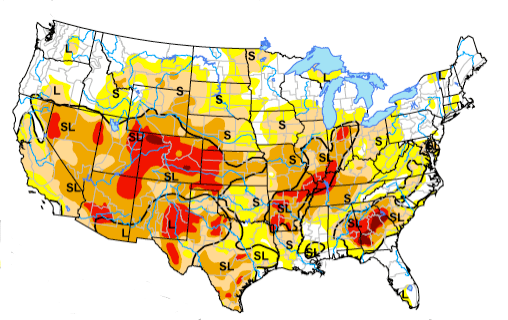
First there’s the drought. Last week’s heat wave and the last month’s dry weather hit just as much of America’s corn crop was set to pollinate. And if the corn doesn’t pollinate, it never grows kernels. Even as I’ve been writing this post, USDA sharply cut forecasts for the corn harvest.

As a result, corn prices (soy prices too) are rising sharply. Which will, for better and worse, have repercussions on all the aspects of our super-processed life that relies on corn.

“The drought of 2012 will be one for the records,” said Peter Meyer, the senior director for agricultural commodities at PIRA Energy Group in New York, who forecasts a drop in output to 11 billion bushels if the hot, dry spell lasts another three weeks. “Whether it’s ethanol or livestock, no one is immune from this impending disaster. The ramifications will be widespread, affecting everything from your food to your gasoline.”

And all that’s before any follow-on effects, if the drought continues. Even in Grand Rapids, we’ve had some unusual fires. Rivers that were experiencing historic floods last year are approaching record lows this year; traffic on the Mississippi has already slowed.

Yet all that–even with our country’s industrialized reliance on corn–might be no more concerning than other droughts, such last year’s drought in Texas.

Meanwhile, banksters keep stealing farmers’ money–first via MF Global and now with Peregrine.

The U.S. futures industry reeled as regulators accused Iowa-based PFGBest of misappropriating more than $200 million in customer funds for more than two years, a new blow to trader trust just months after MF Global’s collapse.

Read more

Share this entry

The Banksters Know They’re Banksters

The headline news from this survey is that almost a quarter of 500 bankster executives surveyed responded they need to engage in ethical or legal wrongdoing to succeed, and a sixth said they’d definitely engage in insider trading to make $10M if they knew they could get away with it.

In a survey of 500 senior executives in the United States and the UK, 26 percent of respondents said they had observed or had firsthand knowledge of wrongdoing in the workplace, while 24 percent said they believed financial services professionals may need to engage in unethical or illegal conduct to be successful.

Sixteen percent of respondents said they would commit insider trading if they could get away with it, according to Labaton Sucharow.

Couple those findings, though, with these responses from the survey showing that fewer than a third of those polled believe regulators are effective.

Only 30% of all respondents felt that the SEC/SFO effectively deters, investigates and prosecutes securities violations.

[snip]

With respect to FINRA and the FSA, only 29% of all respondents felt these agencies effectively deter, investigate and prosecute securities violations.

And those numbers are lower for American respondents than British ones.

The two details, together, are more important than in isolation. Not only do a significant proportion of finance execs admit they’d engage in wrongdoing if they wouldn’t get caught, but they also say the SEC and FINRA aren’t going to stop them.

No wonder the banksters keep crashing the economy.

Share this entry

Rupert Murdoch and the Invisible Hand Job of Capitalism

Someone let Rupert Murdoch free on Twitter again.

Libor ” scandal” very suspicious. 2008/9 huge crisis and Brown should defend pressure to keep rates down and prevent meltdown.

Don’t know, but suspect Diamond scapegoat used by old establishment who did not like energetic competitor.

So one of the richest and most powerful businessmen in the world–and the owner of America’s premiere business newspaper–considers the way the banks gamed a key market measure a scare-quote “scandal.” This newsman appears to suggest Gordon Brown (a man who has been trashing Murdoch relentlessly of late) should get out there and defend having his government tell Barclays to lie about how healthy it was, all to prevent a meltdown.

Nevermind the municipalities who got robbed in the process. Nevermind that the practice of gaming LIBOR started before the crash and reportedly continued after the danger had passed.

Rupert Murdoch appears to want to defend what Simon Johnson, cataloging the business press acknowledging what a big deal lying about LIBOR is, calls “Lie-More as a Business Model.”

I guess it shouldn’t surprise me. After all, some of Murdoch’s most important properties, starting with Fox, thrive on lying as a business model. But at a time when even the (British, at least) business community is finally awakening to what happens when the banksters reveal the “market” is just a bunch of really rich white guys operating behind a curtain, Rupert Murdoch is doubling down on lies.

Share this entry

The Invisible Hand-Job of Capitalism

[youtube]SjbPi00k_ME[/youtube]

First we confirm what we long suspected–bankers were manipulating the LIBOR rate to benefit themselves, corrupting one of the “market” measures at the core of the financial system.

And now, in an Abu Dhabi Commercial Bank suit against Morgan Stanley over residential backed mortgages, we get proof that banks pressured ratings agencies to rate shitpile as gold and even wrote their own ratings reports.

For example, when the primary analyst at S.& P. notified Morgan Stanley that some of the Cheyne securities would most likely receive a BBB rating, not the A grade that the firm had wanted, the agency received a blistering e-mail from a Morgan Stanley executive. S.& P. subsequently raised the grade to A.

And when a Morgan Stanley colleague asked for information about the Cheyne deal, Rany Moubarak, an analyst at Morgan Stanley on the deal, wrote in an e-mail: “I attach the Moody’s NIR (that we ended up writing)” referring to the new issue report published by Moody’s in August 2005.

The court filings also demonstrate a lack of methodology for analyzing the Cheyne debt. For example, in an e-mail before the deal was sold, S.& P.’s lead analyst wrote to a colleague: “I had difficulties explaining ‘HOW’ we got to those numbers since there is no science behind it. The documents show that the lead analyst at Moody’s noted there was “no actual data backing the current model assumptions” for segments of the Cheyne deal.

Read more

Share this entry

An IP Tax, before It’s Too Late

[youtube]N-Pfl6_DlF8[/youtube]

While I was at Netroots Nation, I thought a lot about how the US could tax Intellectual Property. When I saw Honeywell’s CEO claim he should pay no taxes I thought about how much his tech relied on protecting patents. Of course, I was prepping for my panel on tax cheat Apple, which is in a big fight with Samsung. And Microsoft’s earnings last year largely stemmed from tax arbitrage, yet it has no product if people can just copy its software for free.

America’s companies don’t want to pay their fair share to America anymore. And yet most of our most successful international firms–particularly the software and film and ag and drug companies–rely on us to police their intellectual property rights. Having the global bully backing these companies’ intellectual property rights is a cornerstone to their business.

Case in point:

China has overhauled parts of its intellectual property laws to allow its drug makers to make cheap copies of medicines still under patent protection in an initiative likely to unnerve foreign pharmaceutical companies.

The Chinese move, outlined in documents posted on its patent law office website, comes within months of a similar move by India to effectively end the monopoly on an expensive cancer drug made by Bayer AG by issuing its first so-called “compulsory license”.

The action by China will ring alarm bells in Big Pharma, since the country is a vital growth market at a time when sales in Western countries are flagging.

As Yves notes, this is all totally legal, and probably a way for China to start challenging our IP on drugs more generally.

The intriguing part of this is that this Chinese initiative is completely kosher under WTO rules when life-saving medicines are too costly. Given the high prices put on certain AIDS and cancer drugs in dollar terms, they’re the perfect targets for an action like this. India gave a compulsory license for the manufacture of Nexavar which is used to treat kidney and liver cancers. China appears to be using the compulsory license threat to improve its bargaining leverage for some of the newer HIV drugs, such at Gilead’s tenofovir. China was excluded from a deal with a group of nations to buy tenofovir by paying cost plus a small royalty. Gilead has offered more concessions after the media leaked that China was considering implementing compulsory licensing.

Given that China has repeatedly shown it does not have a lot of respect for intellectual property, and it already makes many active pharmaceutical ingredients, one also has to wonder whether this program will serve, intentionally or by accident, to embolden companies that already make the ingredients to start selling bootleg drugs on the side.

It may already be too late–in spite of Obama’s announced “pivot” to Asia, we’ve kept our resources in the Middle East losing another decade long war there. China knows we’re not going to push on IP too aggressively (even ignoring the shaky dollar).

Nevertheless all these wars and all this bullying is really serving the purposes of the IP holders, not the average American. And yet, those IP holders don’t want to pay their fair share–or anything, really–to support all this global bullying.

Shouldn’t we tax those companies relying on us to enforce their IP?

Share this entry

JPM and ING: Some Trading with the Enemy Is More Equal than Other Trading with the Enemy

ING just signed a $619M settlement with Treasury for sanctions violations, largely with Cuba, but also with Iran, Burma, North Korea, Sudan, and Syria. Aside from the fact that that’s the biggest sanctions settlement ever, I’m interested in it because of just how different Treasury’s publication of ING’s settlement looks from JPMC’s $88.3M settlement last August.

The difference largely comes down to one big detail: Treasury didn’t release the actual settlement with JPMC, but did with ING. Rather than the JPMC settlement, Treasury released just a PDF version of the public announcement on a blank sheet of paper (compare smaller civil penalties, for example, where they release just a link and a PDF of the details, link and PDF). With ING, the settlement appears in full, on letterhead, with the signatures of ING’s General Counsel and Vice Chair at the bottom, not far below the terms of the settlement. And the settlement reads like an indictment, with a 6 pages of factual statements. Indeed, ING signed Deferred Prosecution Agreements with both the NY DA and DC US Attorneys Offices.

And the information included in the settlement is quite interesting. Most interestingly, the settlement describes how ING manipulated SWIFT reporting to hide its transfers with restricted countries.

Beginning in 2001, ING Curacao increasingly used MT 202 cover payments to send Cuba-related payments to unaffiliated U.S. banks, which would not have to include originator or beneficiary information related to Cuban parties. For serial payments, up until the beginning of 2003, NCB populated field 50 of the outgoing SWIFT MT 103 message with its own name or Bank Identifier Code, Beginning in the second quarter of 2003, NCB populated field 50 with its customer’s name, but omitted address information. ING Curacao also included its customer’s name, but no address information, in field 50 of outgoing SWIFT messages.

Read more

Share this entry

The Banksters and the Cartels

Two Colombian economists decided to see who’s getting money off the illegal drug trade. And they discovered that American and British banks are getting a big chunk of the profits. (h/t Chris from Americablog) That’s because the cartels are laundering their proceeds through those banks.

The most far-reaching and detailed analysis to date of the drug economy in any country – in this case, Colombia – shows that 2.6% of the total street value of cocaine produced remains within the country, while a staggering 97.4% of profits are reaped by criminal syndicates, and laundered by banks, in first-world consuming countries.

Mind you, I’m not sure the analysis would be that different for any agricultural export. Even for food, farmers make less than 12% of all the money spent.

But one of the factors, the economists contend, is that the US more stringently polices money laundering in Colombian banks than in US ones.

Colombia’s banks, meanwhile, said Mejía, “are subject to rigorous control, to stop laundering of profits that may return to our country. Just to bank $2,000 involves a huge amount of paperwork – and much of this is overseen by Americans.”

“In Colombia,” said Gaviria, “they ask questions of banks they’d never ask in the US. If they did, it would be against the laws of banking privacy. In the US you have very strong laws on bank secrecy, in Colombia not – though the proportion of laundered money is the other way round. It’s kind of hypocrisy, right?”

I have noted (as does the Guardian), how banks like Wachovia used drug proceeds to help offset their losses from the mortgage bubble shitpile. I have noted how much less stringent we were in rooting out all the crime than we are with other banks, such as the Lebanese Canadian Bank. And I noted Citi’s recent wrist slap for allowing money laundering in the same shitpile period.

This article shows the other side to that: while our banksters get rich off of crime here, Colombia and Mexico and Honduras suffer the violence that results. That really has to change.

Share this entry