Who Are the Potential Targets of the OTHER Section 215 Program(s)

There are several small, but significant, discrepancies between what Dianne Feinstein and Keith Alexander said in yesterday’s Senate Appropriation Committee hearing on cyber and what others have said. As one example, last week James Clapper said this was the standard for accessing the dragnet of Americans’ call data:

The court only allows the data to be queried when there is a reasonable suspicion, based on specific facts, that the particular basis for the query is associated with a foreign terrorist organization. [my emphasis]

DiFi yesterday said this was the standard:

It can only look at that data after a showing that there is a reasonable, articulable suspicion that a specific individual is involved in terrorism, actually related to al Qaeda or Iran. [my emphasis]

These are slightly different things (and Congress has fought hard over the word “articulable” in very similar contexts to this in the past — plus, whichever word is used may trace back to Jack Goldsmith’s 2004 OLC opinion on the illegal wiretap program). It’s possible — likely even — that Clapper was just dumbing down his statement the other day. But it is a difference.

I’m particularly interested in the point I raised yesterday. DiFi, in discussing the NSA’s use of the Section 215 data, says it can only be used to find people in the US with ties to terrorists or Iran.

But when Clapper discussed all the potential targets the Intelligence Community might want to trace using Section 215 data, he mentioned a broader group.

There are no limitations on the customers who can use this library. Many and millions of innocent people doing min– millions of innocent things use this library, but there are also nefarious people who use it. Terrorists, drug cartels, human traffickers, criminals also take advantage of the same technology. So the task for us in the interest of preserving security and preserving civil liberties and privacy is to be as precise as we possibly can be when we go in that library and look for the books that we need to open up and actually read. [my emphasis]

But remember. Clapper oversees all 16 members of the intelligence community, including FBI and the National Counterterrorism Center. DiFi’s statement (and Alexander’s confirmation) applied only to NSA. Elsewhere in the hearing, Alexander said NSA only used what he called “BR” (for business records) to collect phone records. And we know that — at least as recently as 2011 — there was at least one other secret collection program using Section 215. So one of those other entities — almost certainly FBI — must run that program.

Moreover, there’s no reason to believe that Edward Snowden, who had unbelievable access to NSA’s networks and, some time ago, CIA’s records, would have access to programs that didn’t involve those agencies.

And Keith Alexander probably knows that.

Also, terrorists, certainly, and Iran, sort of, are legitimate targets for DOD (I’m actually wondering if the government has acrobatically justified going after Iranian contacts by relying on the still extant Iraq AUMF). For NSA to pursue drug cartels and criminals might present a posse comitatus problem (one that I believe was part of the problem behind the 2004 hospital confrontation).

So I’m wondering how many of the answers we’re getting are designed to minimize the scope of what we know by referring only to the NSA programs?


Share this entry

Is the Section 215 Dragnet Limited to Terrorism Investigations?

Unlike PRISM, most public discussions about the Section 215 dragnet program suggest that it is tied to terrorism. It’s a claim, for example, that Charlie Savage makes in this story, which he traces back to this statement from Director of National Security James Clapper.

And indeed, that statement does claim the program is limited to terrorism investigations.

The collection is broad in scope because more narrow collection would limit our ability to screen for and identify terrorism-related communications. Acquiring this information allows us to make connections related to terrorist activities over time. The FISA Court specifically approved this method of collection as lawful, subject to stringent restrictions.

The information acquired has been part of an overall strategy to protect the nation from terrorist threats to the United States, as it may assist counterterrorism personnel to discover whether known or suspected terrorists have been in contact with other persons who may be engaged in terrorist activities.

[snip]

By order of the FISC, the Government is prohibited from indiscriminately sifting through the telephony metadata acquired under the program. All information that is acquired under this program is subject to strict, court-imposed restrictions on review and handling. The court only allows the data to be queried when there is a reasonable suspicion, based on specific facts, that the particular basis for the query is associated with a foreign terrorist organization. Only specially cleared counterterrorism personnel specifically trained in the Court-approved procedures may even access the records.

All information that is acquired under this order is subject to strict restrictions on handling and is overseen by the Department of Justice and the FISA Court. Only a very small fraction of the records are ever reviewed because the vast majority of the data is not responsive to any terrorism-related query. [my emphasis]

Even assuming James “Least Untruthful Too Cute by Half” Clapper can be trusted on this point, consider a few things about this statement.

  • It was released after only the first Guardian release. Thus, it was almost certainly rushed. And while NSA has claimed they had identified Edward Snowden before he started publishing, it is possible they did not know precisely what he had taken (though it is equally possible they already knew).
  • Clapper avoids mentioning precisely what program he is referring to in this statement, not even mentioning the Section 215 authority directly (though he does mention the PATRIOT Act. The Executive Branch has a well-established history — on this and related programs precisely — in addressing just a subset of a program so as to try to hide larger parts of it.

In addition, recall that when DOJ Inspector General Glenn Fine referred to these secret programs in a 2008 report on the use of Section 215, he spoke in the plural and included two classified appendices to describe them. In 2011, Acting Assistant Attorney General Todd Hinnen referred only to programs, plural. Thus, there almost certainly are at least two secret programs, and Michael Hayden has claimed Obama has expanded the use of this authority, which might mean there are more than two.

Furthermore, compare Clapper’s statement from June 6 — which mentioned only terrorists — with how he explained the dragnet program to Andrea Mitchell on June 9.

ANDREA MITCHELL: At the same time, when Americans woke up and learned because of these leaks that every single telephone call in this United States, as well as elsewhere, but every call made by these telephone companies that they collect is archived, the numbers, just the numbers, and the duration of these calls. People were astounded by that. They had no idea. They felt invaded.

JAMES CLAPPER: I understand that. But first let me say that I and everyone in the intelligence community all– who are also citizens, who also care very deeply about our– our privacy and civil liberties, I certainly do. So let me say that at the outset. I think a lot of what people are– are reading and seeing in the media is a lot of hyper– hyperbole.
A metaphor I think might be helpful for people to understand this is to think of a huge library with literally millions of volumes of books in it, an electronic library. Seventy percent of those books are on bookcases in the United States, meaning that the bulk of the of the world’s infrastructure, communications infrastructure is in the United States.

There are no limitations on the customers who can use this library. Many and millions of innocent people doing min– millions of innocent things use this library, but there are also nefarious people who use it. Terrorists, drug cartels, human traffickers, criminals also take advantage of the same technology. So the task for us in the interest of preserving security and preserving civil liberties and privacy is to be as precise as we possibly can be when we go in that library and look for the books that we need to open up and actually read.

You think of the li– and by the way, all these books are arranged randomly. They’re not arranged by subject or topic matter. And they’re constantly changing. And so when we go into this library, first we have to have a library card, the people that actually do this work.

Which connotes their training and certification and recertification. So when we pull out a book, based on its essentially is– electronic Dewey Decimal System, which is zeroes and ones, we have to be very precise about which book we’re picking out. And if it’s one that belongs to the– was put in there by an American citizen or a U.S. person.

We ha– we are under strict court supervision and have to get stricter– and have to get permission to actually– actually look at that. So the notion that we’re trolling through everyone’s emails and voyeuristically reading them, or listening to everyone’s phone calls is on its face absurd. We couldn’t do it even if we wanted to. And I assure you, we don’t want to.

ANDREA MITCHELL: Why do you need every telephone number? Why is it such a broad vacuum cleaner approach?

JAMES CLAPPER: Well, you have to start someplace. If– and over the years that this program has operated, we have refined it and tried to– to make it ever more precise and more disciplined as to which– which things we take out of the library. But you have to be in the– in the– in the chamber in order to be able to pick and choose those things that we need in the interest of protecting the country and gleaning information on terrorists who are plotting to kill Americans, to destroy our economy, and destroy our way of life.

In speaking of the way in which the government uses this dragnet collection as a kind of Dewey Decimal system to identify communications it wants to go back and view, he doesn’t limit it to terrorists. Indeed, he doesn’t even limit it to those foreign intelligence uses the PATRIOT Act authorizes, like counterintelligence (though Obama’s roll-out of Transnational Crime Organization initiative in 2011 — which effectively started treating certain transnational crime networks just like terrorists — may suggest only those crime organizations are being targeted).

Given two more days of disclosures after his initial Section 215 statement, Clapper acknowledged that PRISM has been used (at a minimum) to pursue weapons proliferators and hackers in addition to terrorists. Then, the next day, he at least seemed to suggest that Section 215 collection is used to pinpoint not just terrorists, but also drug cartels and other criminal networks.

And as I’ll show in a follow-up post, it seems to have targeted far more than that.

Share this entry

BREAKING: Globalization Is Dangerous

Globalization is dangerous.

But not, as it turns out, because it has gutted the middle class. Not even because a globalized supply chain has made it easier for our rivals to sabotage our defense programs, or that a globalized supply chain has led to a loss of manufacturing capacity that threatens our defense, to say nothing of our distinctly American commercial sectors.

Rather, retired Admiral James Stavridis, in a more popularized version of a piece he wrote for a National Defense University volume on the topic, argues that “deviant globalization,” whether that of drug traffickers, terrorists, counterfeiters, or hackers, poses a rising threat.

Convergence may be thought of as the dark side of globalization. It is the merger of a wide variety of mobile human activities, each of which is individually dangerous and whose sum represents a far greater threat.

I’m sure it is a threat. But Stavridis makes the same mistake just about everyone else makes when they consider criminal globalized networks to be a security threat: they ignore that there is little these illicit networks do that licit ones didn’t already pioneer. They ignore that the only thing that makes them illicit is state power, the same state power that corporatized globalization has weakened.

In fact Stavridis’ fourth point telling how to combat deviant globalization is notable for what it’s missing.

Fourth, we must shape and win the narrative. Many have said there is a “war of ideas.” That is not quite the right description. Rather, the United States is a “marketplace of ideas.” Our ideas are sound: democracy, liberty, freedom of speech and religion — all the values of the Enlightenment. They have a critical role in confronting the ideological underpinnings of crime and terror. Our strategic communications efforts are an important part of keeping our networks aligned and cohesive.

You see it? In spite of using the metaphor of the market to describe the realm of ideas, Stavridis neglects to mention that one of our ideas, so-called capitalism (or the marketplace itself!), that value of Enlightenment, is precisely the logic that has made globalization imperative.

If the way to beat these criminal globalized networks is to compete ideologically, but the ideological foundation our elites cling to most desperately is the same one the criminal globalized networks are exploiting so spectacularly, haven’t we already lost the battle of ideas?

Stavridis’ choice to ignore capitalism is probably why he doesn’t get the problem with his call to “follow the money.”

Third, we must follow the money. Huge sums of cash from these trafficking activities finance terrorists and insurgents such as the Taliban, as well as corruption. The money is used to undermine fragile democracies. Efforts to upend threat financing must be fused with international initiatives, move across U.S. agency lines and have the cooperation of the private-sector institutions involved.

It is true that globalized cash flows undermine weak governments (the same ones that otherwise might make these criminal globalized networks illicit). But that’s at least as true of the money looted from poorer countries and deposited, completely legally per western elites, in secrecy regimes, or of the hot money that destabilizes the global economy more generally. Moreover, one of the biggest impediments to tracking the flows of criminal globalized networks is that the so-called licit multinational banks they use to transfer their money are more interested in the profits from the money than in cooperating with increasingly weak states. So long as HSBC can get away with a wrist slap, after all, why would any multinational bank give up its customer base to American authorities?

Stavridis ends his column by citing Hardy’s warning about icebergs.

Just over a century ago , the poet Thomas Hardy wrote “The Convergence of the Twain” about the collision of the Titanic and the iceberg that sank it. “And as the smart ship grew/ In stature, grace, and hue/ In shadowy silent distance grew the Iceberg too.” There is an iceberg out there in the form of weapons of mass destruction; what is most worrisome is the convergence of such a weapon with a sophisticated global trafficking route enabled by cybercrime and the cash it generates. That is the convergence we must do all in our power to prevent.

Stavridis almost gets it. He almost gets it that these global trafficking routes, whether deemed licit or illicit by increasingly weak states, are the iceberg that is looming.

It’s just that he chooses to ignore the iceberg he can see for the parts he can’t see.

Share this entry

Putin: You Show Me Yours and … I Might Show You Mine

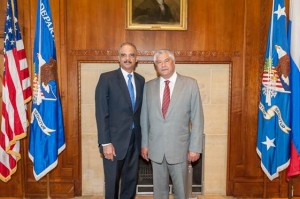
AG-meeting1-300x199It’s not until the 17th and 18th paragraph of this Moscow Times article on Russian Interior Minister Vladimir Alexandrovich Kolokoltsev’s discussion with Attorney General Eric Holder about sharing more law enforcement information that it reminds readers that just three days before the Boston Marathon attack, Russia and the US were exchanging blacklists of people prohibited from travel to their respective country.

The Interior Ministry won a court ruling to authorize Browder’s arrest and place him on an international arrest warrant shortly after the U.S. released its so-called Magnitsky list of 18 Russians banned from entry into the country. Among those on the list are Artyom Kuznetsov and Pavel Karpov, Interior Ministry investigators who put Magnitsky behind bars.

The blacklist, published April 12, provoked a storm of protest from Moscow and a tit-for-tat release of a blacklist of U.S. officials. But the Boston bombing occurred just three days later, causing the two sides to tone down their rhetoric and take a second look at relations.

The Russian blacklist not only includes torturers like John Yoo, but people involved in Viktor Bout’s prosecution.

And it makes no mention of the complaints that Russia has been slow to share information since.

Details on tensions surrounding Magnitsky come long after the details on information sharing in the article: Robert Mueller promises to open up some FBI files to the Russians in anticipation of the 2014 Winter Olympics, and we’ve exchanged 827 documents this year.

FBI director Robert Mueller promised Kolokoltsev in Washington late last week to open some FBI data to the Russians, saying, “Such resources could be useful to Russian law enforcement agencies in view of the Sochi Olympics,” the Interior Ministry said in a statement.

About 15,000 U.S. citizens could attend the Sochi Olympics, according to Mueller.

Mueller also thanked the Russian side for the help it provided in investigating the Boston Marathon bombing, which U.S. investigators believe was masterminded and carried out by brothers Tamerlan and Dzhokhar Tsarnaev, who have mixed Chechen-Dagestani origin.

[snip]

Kolokoltsev also met with U.S. Attorney General Eric Holder and suggested that the Interior Ministry sign a legal cooperation agreement with the U.S. Justice Department.

“Since the beginning of this year, we have exchanged 827 documents with U.S. law enforcement agencies,” Kolokoltsev told reporters, noting that the U.S. is one of top five countries with which Russia cooperates within the framework of the Interpol.

So if you’re planning on attending the Olympics in Russia next year, don’t piss off the FBI before then!

Then there’s the bit Russian Times doesn’t mention, which happens to be one of the very few things included in the US Department of Justice statement on this meeting. The US plans to share not just counterterrorism information, but also transnational crime organization.

They also discussed law enforcement cooperation between the two countries in areas including counterterrorism, transnational organized crime and child pornography.

Recall, Russian mobsters are among the four organizations the Obama Administration listed among the Transnational Criminal Organizations we would use terrorism-like tactics to hunt down; we’ve focused on Central Asian mobsters in our specific sanctions. It’s not clear that Russia has been particularly forthcoming with cooperation on this front in the past.

Let’s see whether this buzz about information sharing changes that.

Share this entry

The Transnational Crime Organizations the Presidents Didn’t Mention

Yesterday’s joint press conference with President Obama and Mexico’s President Enrique Peña Nieto was an opportunity for the two leaders to lay out their take on the new limits imposed by Peña Nieto on counter-narcotics partnership.

Peña Nieto repeated what he has elsewhere: Mexico will continue to combat crime, but with a priority on ending violence rather than stopping the flow of drugs.

In a different arena, we have addressed security. We have both recognized the level of cooperation that the U.S. has shown towards the Mexican government. And the strategy in the area of security in our country has a very clear purpose, and that is to fight organized crime in all of its forms, be it drug dealing, kidnapping for ransom, extortion, or any crime perpetrated. We are not going to renounce that responsibility as a government and my administration. We’re going to face crime in all of its forms.

But in our new strategy we have emphasized the fact that we will reduce violence. Fortunately systems between Mexicans to fight organized crime and reduce violence are not objectives that contradict each other. There is no clash between these two goals. These are two goals that fall within the framework of one same strategy. And President Obama’s administration has expressed his will, as we know, to cooperate on the basis of mutual respect, to be more efficient in our security strategy that we are implementing in Mexico. [my emphasis]

Obama didn’t actually address security partnership in his prepared remarks, but in response to a question, he repeated Peña Nieto’s formulation–organized crime–then described what he claimed was the US contribution to organized crime: drug use and the flow of guns and cash from the US.

PRESIDENT OBAMA: Well, first of all, just on the security issue, I think it’s natural that a new administration here in Mexico is looking carefully at how it’s going to approach what has obviously been a serious problem. And we are very much looking forward to cooperating in any ways that we can to battle organized crime, as President Peña Nieto stated.

And we anticipate that there’s going to be strong cooperation, that on our side of the border, we have continued work to do to reduce demand and to try to stem the flow of guns and cash from North to South.

So this is a partnership that will continue. I think that President Peña Nieto and his team are organizing a vision about how they can most efficiently and effectively address these issues. And we will interact with them in ways that are appropriate, respecting that ultimately Mexico has to deal with its problems internally and we have to deal with ours as well. [my emphasis]

But while he mentioned cash, he didn’t talk about the form of banking that facilitates organized crime, with multinational structures that permit banks like HSBC or Wachovia to facilitate organized crime for years, with mere wrist-slaps in response from US regulators.

Indeed, because the press conference emphasized trade over security, Obama twice touted the benefits of the Trans Pacific Partnership. Yet TPP will, unless things change, actually make it easier for big banks to capture international markets and speed money across international borders.

Prevent Public Banks and Banking Regulation: These same provisions about state-owned enterprises will affect public banking too. North Dakota is the only state in the US to have a public state bank, although over a dozen states and cities are considering them. Public banks are used to hold taxes that are collected, administer payroll for public employees and provide loans for public projects. The advantage is that all public dollars are managed in a public institution rather than having to pay fees and interest to a private bank. But the TPP would consider public banks to have unfair advantages and therefore violate free trade.

And trade agreements protect big finance by (1) preventing regulation of the finance industry by locking in a model of extreme financial service deregulation; and (2) allowing capital to move in and out of countries without restrictions.

Overall, Obama seemed to be avoiding discussing security at length, perhaps hoping a focus on increasing trade yet further would serve as a carrot to convince Mexico to continue allowing us to infringe on its sovereignty in the name of hunting drug lords.

Even still, it seemed the entire discussion failed to consider that our organized crime lords, the banksters, are as much a part of the problem as Mexico’s organized crime lords.

Share this entry

When a Counter-TerrorismNarcotic Partner Asks for a Divorce

Dana Priest has a fascinating piece ostensibly describing how the administration of Mexican President Enrique Peña Nieto has chosen to shift its counter-narcotic approach from the one Felipe Calderón’s PAN party had pursued for a decade. About 12 of the article’s 60-some paragraphs describe first how, in a scene reminiscent of Bob Woodward’s account of Michael Hayden and others briefing Obama on the national security programs they assumed he’d retain after he took over the presidency, the US presented the existing US-Mexican counter-narcotics programs to Peña Nieto’s team.

In a crowded conference room, the new attorney general and interior minister sat in silence, not knowing what to expect, next to the new leaders of the army, navy and Mexican intelligence agency.

In front of them at the Dec. 15 meeting were representatives from the U.S. Drug Enforcement Administration (DEA), the CIA, the FBI, the Office of the Director of National Intelligence and other U.S. agencies tasked with helping Mexico destroy the drug cartels that had besieged the country for the past decade.

The Mexicans remained stone-faced as they learned for the first time just how entwined the two countries had become during the battle against narco-traffickers, and how, in the process, the United States had been given near-complete entree to Mexico’s territory and the secrets of its citizens, according to several U.S. officials familiar with the meeting. [my emphasis]

Priest then notes, at the end of the story, that Mexico had ejected the US personnel who had been working in fusion centers in Mexico.

But the Mexican delegation in Washington also informed U.S. authorities that Americans will no longer be allowed to work inside any fusion center, including the one in Monterrey. The DEA agents and retired military contractors there will have to go.

But the guts of the story replicate work Priest did with the Top Secret America series and book (and perhaps, given that the program ostensibly deals with Mexican rather than US security, offers even more detail), laying out precisely what we were doing in Mexico, from drones to electronic surveillance and data analysis to personal direction of raids. She describes a number of approaches here that are presumably replicated in or borrowed from counterterrorism operations, which makes the article an interesting reflection of both.

This description of the way Mexico controls drones, for example, reinforces questions I’ve had about the Saudi drone base we use to target Yemen.

An agreement was reached that would temporarily give operational control to Mexican authorities during such flights. U.S. pilots sitting in the States would control the planes remotely, but a Mexican military or federal police commander would be able to direct the pilot within the boundaries of a Mexico-designated grid.

Here, though, are two of my favorite details.

[Mexico’s intelligence service] CISEN discovered from a captured videotape and a special analytical group it set up that some of the cartels had hired former members of the U.S.-trained Guatemalan special forces, the Kaibiles, to create sociopathic killers who could behead a man, torture a child or immerse a captive in a vat of acid.

Anxious to counterattack, the CIA proposed electronically emptying the bank accounts of drug kingpins, but was turned down by the Treasury Department and the White House, which feared unleashing chaos in the banking system.

This has been reported elsewhere, but it’s important to remember the lethal cartels we’re fighting in Mexico arose, in part, out of training we did that is not that different from what Priest describes here. Blowback, baby.

Then there’s Treasury’s concerns about chaos in the banking system if the US were to mess with drug accounts. We know drug money served as a key revenue source for shaky banks during the financial crisis. And we know the government gave HSBC a wrist-slap rather than indictments after discovering the vast amounts of money laundering it was facilitating. One reason Latin American leaders are increasingly choosing a different approach to combat drugs is that under the current plan, the money ends up in the US, while the violence largely remains in their countries.

There are a few details of Priest’s piece that deserve some challenge, though. Read more

Share this entry

America’s Human Rights Abusers: John Yoo, David Addington, and Bout’s Prosecution Team

In retaliation for the Magnitsky sanctions — in which the US placed sanctions on those deemed to have had a role in retaliating against Sergei Magnitsky’s whistleblowing — Russia just issued a list of 18 Americans who will be prohibited from traveling to Russia.

The list released by the Foreign Ministry includes John Yoo, a former U.S. Justice Department official who wrote legal memos authorizing harsh interrogation techniques; David Addington, the chief of staff for former U.S. Vice President Dick Cheney; and two former commanders of the Guantánamo Bay detention center: retired Army Maj. Gen. Geoffrey Miller and Navy Rear Adm. Jeffrey Harbeson.

[snip]

Also on Russia’s list are 14 Americans whom Russia says violated the rights of Russians abroad. It does not give specifics of the alleged violations, but includes several current or former federal prosecutors in the case of Viktor Bout, the Russian arms merchant sentenced in 2012 to 25 years in prison for selling weapons to a U.S.-designated foreign terrorist group. One FBI agent and four U.S. Drug Enforcement Administration agents also are on the list.

In addition, there’s a closed list of Americans who are, according to Russia’s Deputy Foreign Minister Sergei Ryabkov, personally responsible for legalizing torture and indefinite detention. So maybe Dick Cheney is on that list.

I’m actually more interested Russia sanctioned Bout’s prosecutors than Yoo (it doesn’t take much creativity, after all, to call Yoo a human rights violator). After all, Bout only ever did the same kinds of things Erik Prince does for us, and our claim that we had jurisdiction over his sales stretched traditional jurisdiction beyond belief.

In any case, it sure seemed pretty easy for Russia to accuse us of violating human rights just like it does.

Share this entry

Mexican Cartels: The Counter-Globalized Network?

Monday AP published a fascinating article reporting that Mexican drug cartels are altering an earlier organizational approach — which outsourced the distribution of drugs to and within the US to others, thereby insulating the core members. Now, it reports, cartels are actually putting their own operatives into US suburbs, who oversee (and retain control) of distribution from within the country.

Now, as a few of the AP’s sources note, domestic cops have a big incentive to claim the people they arrest are actual members of a cartel, rather than a subcontractor, because it makes convictions easier. So it may be (and I suspect) the trend is overstated.

Nevertheless, the AP does report several examples where cartels have installed their own middlemen outside US cities.

They describe it, in part, as a means to retain more of the profits from drugs.

As their organizations grew more sophisticated, the cartels began scheming to keep more profits for themselves. So leaders sought to cut out middlemen and assume more direct control, pushing aside American traffickers, he said.

Beginning two or three years ago, authorities noticed that cartels were putting “deputies on the ground here,” Bilek said. “Chicago became such a massive market … it was critical that they had firm control.”

[snip]

Because cartels accumulate houses full of cash, they run the constant risk associates will skim off the top.

But perhaps a more interesting advantage, for the cartels, is that they can exercise discipline by using fear of reprisals back in Mexico for any cooperation with US authorities.

Cartels can exert more control on their operatives than on middlemen, often by threatening to torture or kill loved ones back home.

Read more

Share this entry

Outsourcing Drug War Disappearances to Mexico

The other day I asked whether the US was complicit in any of the hundreds of official disappearances and tens of thousands of other disappearances propagated in Mexico’s drug war.

Friday, Spiegel published an interesting profile of a former DEA officer, Salvador Martinez, who ended up going to prison for trying to have his cousin’s killer murdered.

And sure enough, he describes allowing this kind of violence — even encouraging it — to happen. He describes leaving his counterparts in Ciudad Juárez to conduct torture.

In one of his first assignments, which he carried out together with the Mexican police, he was there when a commandant arrested a dealer. The police led the prisoner to a house on the edge of town. The officer hauled the prisoner to the bathroom, put his head in the toilet and flushed three times, says Martinez. The prisoner remained silent. The officer put a plastic bag over the prisoner’s head. “Who paid you? Who paid you, cabrón?” he demanded. Then, to Martinez, he said: “Have you seen enough?”

When he got into his car to leave, Martinez watched in the rearview mirror as a Mexican police officer took a small rod out of his car trunk. Martinez had seen a rod like that before; it was an electric cattle prod.

And he describes identifying suspects for Mexican cops to disappear.

He arrested a Mexican that he knew was working in the middle management of a cartel. He had no proof; he just knew it. After three weeks on trial, the court had to let the manager go free. So Martinez told the Mexican commandant what that man looked like and when he would be freed. After he crossed the border, a black minibus on the Mexican side stopped beside him and took him away.

“Alright,” says Martinez, taking a deep breath. So far he has laughed a lot on his journey through the memories. But he tells the next chapter without looking up, describing operations that weren’t recorded in any files.

“A lot of people disappear in Mexico,” he says. “They are buried where no one will find them. Some are eaten by tigers and some by sharks. There are also big tanks with acid in them.” He pauses for a long time between the sentences.

“We didn’t manage to catch all the bad guys. In those cases, we gave the Mexicans their names and said, ‘Do what you need to do.’ The Mexicans made those people disappear.”

Now, this guy appears to have been arrested in 1999. That is, this violence precedes the more recent disappearances Human Rights Watch and others have been documenting (and Juárez, at least, seems to be turning around finally).

But none of this is surprising.

As more and more people talk about the disappearances happening in Mexico, in a war that exists largely because American consumers create the demand that drives the violence, we should be careful not to blame it all on the Mexicans. Because we’re not just letting it happen, we’re asking for it to happen in some cases.

Share this entry

Disappearances Are Back. Is the US Involved (Again)?

Back in the 1970s, when various Latin American countries were disappearing their citizens, the US was closely tied to those efforts via Operation Condor.

According to Human Rights Watch, Mexico is now in the Disappearance business as part of its drug war. In a report released this week, it documents almost 140 cases where some official disappeared Mexicans. And while most of the cases appear to be corrupt local or Federal police partnering with drug cartels (that is, the problem seems to be about corruption as much as it is the state disappearing people), it also describes the Navy kidnapping groups of men, perhaps as an effort to force people to infiltrate the cartels.

Human Rights Watch documented more than 20 cases of enforced disappearances perpetrated by members of the Navy in June and July 2011. The concentration of the cases within a short time period, the similar tactics described by victims’ families and other witnesses, corroborated by photographic and video evidence, and the fact that the abductions were spread across three northern states strongly suggests that these were not isolated cases, but rather points to a clear modus operandi by the Navy. Given the number of members of the Navy that allegedly participated in these operations—at least a dozen official vehicles, according to witness accounts—and the fact that the Navy acknowledged that it detained several of the victims, it is unlikely that such operations took place without the knowledge of ranking officers.

Victims’ families and witnesses described near identical tactics in the raids. In each case, the Navy arrived in a large convoy of more than a dozen vehicles, the majority of which were marked with official insignia, along with two to four unmarked vehicles. They closed off entire streets, using vehicles as barricades. Heavily armed members of the Navy wearing masks then entered homes, often forcibly, without any search or arrest warrants. According to families, the people in Navy uniforms were not looking for individuals by name. Instead, they indiscriminately took young men, telling their families they were being brought in for questioning and would be released if they proved to be innocent.

That’s the Navy we partner with closely, the one our two CIA “trainers” were partnering with when they almost got killed last year. And remember: the Federales with ties to the Beltrán Leyva Cartel said they were investigating a kidnapping, the polite legal term for a disappearance. Remember, too, that one of the the CIA guys got exposed, in part, because he had his post office box in the same place as an earlier CIA guy managing renditions.

Read more

Share this entry