What Happened to Mehsud’s Dirty Bomb?

As I alluded the other day, the story the NYT told about the targeting of Baitullah Mehsud differs in key respects from the story Joby Warrick told in his book, The Triple Agent. And since the discrepancy involves yet another unsubstantiated nuclear claim, and since Mehsud’s targeting led directly to the double agent Humam Khalil al-Balawi’s successful attack on Khost, the difference is worth mapping carefully.

First, the stories provide different explanations for how Mehsud came to be targeted. As I noted here, Warrick explained that we started targeting Mehsud after NSA intercepted a discussion about nukes.

In May [2009] one such phrase, plucked from routine phone intercepts, sent a translator bolting from his chair at the National Security Agency’s listening station at Fort Meade, Maryland. The words were highlighted in a report that was rushed to a supervisor’s office, then to the executive floor of CIA headquarters, and finally to the desk of Leon Panetta, now in his third month as CIA director.

Nuclear devices.

Panetta read the report and read it again. In a wiretap in the tribal province known as South Waziristan, two Taliban commanders had been overheard talking about Baitullah Mehsud, the short, thuggish Pashtun who had recently assumed command of Paksitan’s largest alliance of Taliban groups. It was an animated discussion about an acquisition of great importance, one that would ensure Mehsud’s defeat of Pakistan’s central government and elevate his standing among the world’s jihadists. One of the men used the Pashto term itami, meaning “atomic” or “nuclear.” Mehsud had itami devices, he said. (62-63)

Shortly thereafter, the government intercepted Mehsud’s shura council debating whether Islam permitted the use of Mehsud’s devices. Ultimately, the CIA concluded Mehsud had acquired a dirty bomb and started targeting him (including killing a close associate in hopes Mehsud would show up at his funeral; the Administration targeted the funeral but didn’t get Mehsud).

The NYT provides a much vaguer story.

The C.I.A. worried that Mr. Mehsud, whose group then mainly targeted the Pakistan government, did not meet the Obama administration’s criteria for targeted killing: he was not an imminent threat to the United States. But Pakistani officials wanted him dead, and the American drone program rested on their tacit approval. The issue was resolved after the president and his advisers found that he represented a threat, if not to the homeland, to American personnel in Pakistan.

The description is not inconsistent with Warrick’s description, which describes the US originally hesitating to target Mehsud and the Paksitanis rejoicing once we did.

U.S. officials had long viewed the Mehsud clan as a local problem for the Pakistanis and were reluctant to agitate yet another militant faction that might cross into Afghanistan to attack U.S. troops.

The dirty bomb threat changed everything. Now the Obama administration was privately talking about targeting Mehsud, and Pakistani officials, for once, were wholeheartedly embracing the idea of a U.S. missile strike on their soil. (71)

Perhaps it was the dirty bomb that convinced the US Mehsud threatened US troops, as described by the NYT. Mind you, it’s unclear whether an as-yet unconfirmed dirty bomb in the hand of a guy targeting Pakistan (the Pakistanis blamed him for Benazir Bhutto’s death) really presented a threat to US troops.  Perhaps it represented–like the insurgents in Yemen–a sufficient threat to our allied government we considered it a threat?

In any case, the NYT doesn’t mention the dirty bomb. Maybe that’s because no one ever found it.

By the time the campaign [against the Pakistani Taliban] ended, the Pakistanis were sitting on a mountain of small arms and enough explosives to supply a madrassa full of suicide bombers. But they found no trace of a dirty bomb. The radiation detectors never sounded at all.
Read more

Share this entry

The Commercial for John Brennan’s Signature Strike Drone Shop TADS

Between them, the NYT and the Daily Beast published over 10,000 words on Obama’s drone assassination program yesterday. Both stories rolled out the new acronym the Administration wants us to use: terrorist-attack-disruption strikes, or TADS. Neither of them, in those over 10,000 words, once mentioned Abdulrahman al-Awlaki, Anwar al-Awlaki’s 16 year old American citizen son also killed in a drone strike last year.

And while both stories break important new ground and challenge the Administration’s narrative in key ways, the prioritization of TADS over Abdulrahman in them is a pretty clear indication of the success with which the Administration pushed a certain agenda in these stories.

As I suggested at the end of this post, I think John Brennan hoped to use them to reframe recent changes to the drone program to make them more palatable.

Drone Strikes before They Got Worse

Before I lay out the new spin these stories offer on the signature strikes and vetting process rolled out last month, let’s recall what was included in the drone program before these recent changes, in addition to the killing of a 16-year old American citizen.

According to the NYT, the Administration assumed that, “people in an area of known terrorist activity, or found with a top Qaeda operative, are probably up to no good” and therefore all military age males in a strike zone could be targeted. A former senior counterterrorism official calls earlier drone targeting, “guilt by association.” Of signature strikes in Pakistan, a senior (apparently still-serving) official joked “that when the C.I.A. sees ‘three guys doing jumping jacks,’ the agency thinks it is a terrorist training camp.” And one of Obama’s top political advisors, David Axelrod, was attending targeting meetings, injecting a political taint on the program.

Even with all of that, these stories don’t explain how the intense vetting process they describe resulted in the al-Majala strike that made Jeh Johnson think about going to Catholic confession and “shook” John Brennan and President Obama. Or, of course, how we came to kill a 16 year old American citizen.

So all of that was in place before the recent changes to the drone assassination program made it worse. Don’t worry, though, it’s TADS now.

With all that in mind–Abdulrahman and the guilt by association and the three guys doing jumping jacks–let’s look at how these stories reframe signature strikes in Yemen and White House consolidation of the vetting.

Assassination Czar John Brennan’s Drone Shop

Consider the way the articles describe the targeting process. The NYT–relying on a single source, “an administration official who has watched [Obama] closely”–describes a very aggressive vetting process led by the DOD, then nods to a “parallel” process at CIA in countries where it leads the vetting.

The video conferences are run by the Pentagon, which oversees strikes in those countries, and participants do not hesitate to call out a challenge, pressing for the evidence behind accusations of ties to Al Qaeda.

“What’s a Qaeda facilitator?” asked one participant, illustrating the spirit of the exchanges. “If I open a gate and you drive through it, am I a facilitator?” Given the contentious discussions, it can take five or six sessions for a name to be approved, and names go off the list if a suspect no longer appears to pose an imminent threat, the official said. A parallel, more cloistered selection process at the C.I.A. focuses largely on Pakistan, where that agency conducts strikes.

The nominations go to the White House, where by his own insistence and guided by Mr. Brennan, Mr. Obama must approve any name. He signs off on every strike in Yemen and Somalia and also on the more complex and risky strikes in Pakistan — about a third of the total.

Since for the most part, DOD has managed the Yemen and Somalia strikes, while CIA managed the Pakistan ones, this conflates the vetting for personality strikes targeted at known people and the signature strikes the CIA has targeted against men doing jumping jacks in Pakistan. Somehow, al-Majala and Abdulrahman still got through that vetting process, but the exhaustive DOD one was, for the most part, far more rigorous than the CIA one.

Now compare that description of the DOD vetting process with the one the AP gave on May 21, which it says is “mostly defunct.”

The previous process for vetting them, now mostly defunct, was established by Mullen early in the Obama administration, with a major revamp in the spring of 2011, two officials said.

[snip]

Under the old Pentagon-run review, the first step was to gather evidence on a potential target. That person’s case would be discussed over an interagency secure video teleconference, involving the National Counterterrorism Center and the State Department, among other agencies. Among the data taken into consideration: Is the target a member of al-Qaida or its affiliates; is he engaged in activities aimed at the U.S. overseas or at home?

If a target isn’t captured or killed within 30 days after he is chosen, his case must be reviewed to see if he’s still a threat. [my emphasis]

That is, that free-ranging discussion, the process by which targets could come off the list as well as get put on it? At least according to the AP, it is now defunct–or at least “less relevant.” Read more

Share this entry

Angler 2.0: Brennan Wields His Puppet Strings Differently

As I said earlier, the parallel between the Jo Becker/Scott Shane Angler 2.0 story and the earlier series by Becker and Barton Gellman is hard to miss.

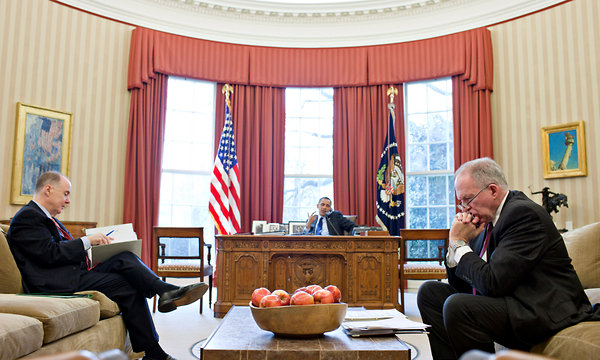
But I’m very interested in how the stories are structured differently. With Angler 1.0, the story was very clearly about Dick Cheney and the methods he used to manipulate Bush into following his advice. Here, the story is really about John Brennan, Obama’s Cheney, portrayed deep in thought and foregrounding Obama in the article’s picture. Indeed, halfway through, the story even gives biographical background on Brennan, the classic “son of Irish immigrants” story, along with Harold Koh’s dubious endorsement of Brennan’s “moral rectitude.”

But instead of telling the story of John Brennan, Obama’s Cheney, the story pitches Obama as the key decision-maker–a storyline Brennan has always been one of the most aggressive pitchmen for, including when he confirmed information on the Anwar al-Awlaki strike he shouldn’t have. In a sense, then, Brennan has done Cheney one better: seed a story of his own power, but sell it as a sign of the President’s steeliness.

The Silent Sources for the Story

I already pointed out how, after presenting unambiguous evidence of Brennan’s past on-the-record lies, the story backed off calling him on it.

But there are other ways in which this story shifts the focus away from Brennan.

A remarkable number of the sources for the story spoke on the record: Tom Donilon, Cameron Munter, Dennis Blair, Bill Daley, Jeh Johnson, Michael Hayden, Jim Jones, Harold Koh, Eric Holder, Michael Leiter, John Rizzo, and John Bellinger. But it’s not until roughly the 3,450th word of a 6,000 word article that Brennan is first quoted–and that’s to largely repeat the pre-emptive lies of his drone speech from last month.

“The purpose of these actions is to mitigate threats to U.S. persons’ lives,” Mr. Brennan said in an interview. “It is the option of last recourse. So the president, and I think all of us here, don’t like the fact that people have to die. And so he wants to make sure that we go through a rigorous checklist: The infeasibility of capture, the certainty of the intelligence base, the imminence of the threat, all of these things.”

That is the only on-the-record direct quote from Brennan in the entire article, in spite of the centrality of Brennan to the story.

And I would bet several of the sources quoted anonymously in the section describing Obama’s method of counting the dead (which still ignores the women and children) are Brennan: “a top White House adviser” describing how sharp Obama was in the face of the first civilian casualties; “a senior administration official” claiming, in the face of credible evidence to the contrary, that the number of civilians killed in drone strikes in Pakistan were in “single digits.”

Note, too, the reference to a memo his campaign national security advisors wrote him.

“Pragmatism over ideology,” his campaign national security team had advised in a memo in March 2008. It was counsel that only reinforced the president’s instincts.

The memo was written not long after Brennan started playing a more central role among Obama’s campaign advisors. But the story makes no mention of his presumed role in it. Further, in describing Jeh Johnson to introduce a quote, the piece notes that he was “a campaign adviser” (it doesn’t say Johnson was also focused on voter protection). But it does not note that Brennan, too, was a key campaign advisor, one with an exclusively national security focus.

Nor does the story note, when it describes how Obama “deployed his legal skills … to preserve trials in civilian courts” it was John Brennan making that case, not the Attorney General.

In other words, in several places in this story, Brennan plays a key role that is downplayed.

The Pro-Drone Narrator

Given that fact, I’m really interested in the several places where the story adopts a pro-drone viewpoint (it does adopt a more critical stance in the narrative voice at the end).

For example, the story claims, in the first part of the story, that the drone strikes “have eviscerated Al Qaeda” without presenting any basis for that claim. This, in spite of the fact that al Qaeda has expanded in Yemen since we’ve started hitting it with drones.

Later, the article uncritically accepts the claim that the drone–regardless of the targeting that goes into using it–is a “precision weapon” that constitutes a rejection of a “false choice between our safety and our ideals.”

The care that Mr. Obama and his counterterrorism chief take in choosing targets, and their reliance on a precision weapon, the drone, reflect his pledge at the outset of his presidency to reject what he called the Bush administration’s “false choice between our safety and our ideals.”

For fucks sake! This article describes how the White House has adopted a “guilt by association” approach to drone targeting. Read more

Share this entry

John Brennan, Liar

Since Jo Becker co-wrote the Angler series in the WaPo with Barton Gellman, her long piece today with Scott Shane will be seen as the Obama version of that story: how he evades the law to pursue ruthless counterterrorism policies.

I’ll have more to say about the story later. But for now, let me note how it proves, pretty definitively, that John Brennan is a liar.

The story describes Obama being informed, just days after his confirmation, that a drone strike had killed civilians.

Just days after taking office, the president got word that the first strike under his administration had killed a number of innocent Pakistanis. “The president was very sharp on the thing, and said, ‘I want to know how this happened,’ “ a top White House adviser recounted.

Now, who do you suppose informed Obama of this (see update below–it was Michael Hayden)? And who do you suppose was involved in discussions of it? I find it inconceivable to believe that John Brennan was out of the loop on that news, particularly as Obama responded by using less powerful missiles for drones to lessen collateral damage. John Brennan learned, in the first days of the Administration, that we had killed civilians.

And yet Brennan repeatedly and publicly has claimed there had been no civilian casualties.

The NYT story acknowledges Brennan’s comments (and probably quotes him again, anonymously, in this passage).

This counting method may partly explain the official claims of extraordinarily low collateral deaths. In a speech last year Mr. Brennan, Mr. Obama’s trusted adviser, said that not a single noncombatant had been killed in a year of strikes. And in a recent interview, a senior administration official said that the number of civilians killed in drone strikes in Pakistan under Mr. Obama was in the “single digits” — and that independent counts of scores or hundreds of civilian deaths unwittingly draw on false propaganda claims by militants.

If Brennan is indeed that anonymous source, then it means NYT presented evidence he lied his ass off–though didn’t call him on it–and then went back to him for more bullshit lies.

The story seems to accept as serious the funny accounting the Administration uses to pretend civilian drone deaths didn’t happen.

Mr. Obama embraced a disputed method for counting civilian casualties that did little to box him in. It in effect counts all military-age males in a strike zone as combatants, according to several administration officials, unless there is explicit intelligence posthumously proving them innocent.

But others (I’m guessing Dennis Blair is one of these) recognize this is all phony accounting.

The C.I.A. accounting has so troubled some administration officials outside the agency that they have brought their concerns to the White House. One called it “guilt by association” that has led to “deceptive” estimates of civilian casualties.

“It bothers me when they say there were seven guys, so they must all be militants,” the official said. “They count the corpses and they’re not really sure who they are.”

I guess it’s opposition like this that causes the White House to bring its drone war into the White House, to be overseen solely by John Brennan, so they can continue to pretend that all the dead teenage boys (including, of course, US citizen Abdulrahman al-Awlaki, who would also be counted as a fighter using these rules) were our enemies.

Read more

Share this entry

Brennan to Pakistan: The Beatings Drone Strikes Will Continue Until Morale Improves

There was yet another US drone strike in Pakistan today. According to Bill Roggio at Long War Journal, today’s strike is the fourth strike in six days. After the first strike in this series, I posed the question of whether that strike was more politically based than strategically based, as the strike came just two days (Roggio has it as one day after the summit, but there are large time zone differences; the summit ended on Monday in Chicago and the first strike was early Wednesday local time in Pakistan) after US-Pakistan negotiations on reopening NATO supply routes through Pakistan broke down at the NATO summit in Chicago and on the very day that Dr. Shakeel Afridi was sentenced for treason because he helped the CIA to gather intelligence that aided the US raid to kill Osama bin Laden.

There is now ample evidence to believe that politics are indeed behind the recent strikes and, as Marcy and I have been noting on Twitter, they likely will continue on a virtually daily basis to make the political points that the US is stressing. Recall that after the first strike in the series, I quoted a Guardian article that also came to the conclusion the strike was politically motivated:

The attack came as Washington runs out of patience with Islamabad’s refusal to reopen supply routes for Nato troops in Afghanistan.

US drone strikes have complicated negotiations over the routes, which Pakistan closed six months ago in retaliation for US air strikes that killed 24 Pakistani soldiers along the Afghan border. Pakistan’s parliament demanded the strikes stop after the attack, but the US refused.

In today’s report, Roggio provides a quote with direct evidence that the strikes now are tied politically to the impasse over reopening the supply routes (although it seems likely that Dana Rohrabacher isn’t the only one advocating the use of a “stick” on Pakistan over the Afridi sentencing, too):

A US intelligence official involved in the drone program in the country told The Long War Journal that the strikes would continue now that Pakistan has refused to reopen NATO’s supply lines for the International Security Assistance Force in Afghanistan.

“There certainly hasn’t been a shortage of targets in Pakistan’s tribal areas,” the official said. “Unfortunately the politics of getting the GLOC into Afghanistan has trumped the targeting of bad guys in Pakistan’s tribal areas,” the official said, referring to the Ground Lines of Communication.

But hold on just a minute here. Note the misdirection in this quote. Despite the claim that the US is “targeting bad guys” with these strikes, Roggio reports elsewhere in this article that no high value target has been reported as killed in today’s attack. In fact, he reports that there have been 17 US drone strikes in Pakistan this year, but only two high value targets have been killed in them.

Where have we heard someone recently trying to make the false claim that “signature strikes” are targeted rather than based simply on patterns of activity? Why that would be in John Brennan’s April 30 drone speech, which Marcy has cleanly dissected as a failed attempt to direct attention away from the war crimes committed regularly in signature strikes.

Roggio’s anonymous source says basically that the strikes will continue until the political situation improves. Despite the source’s claim that the strikes target “bad guys” the evidence instead shows that these are signature strikes that at best target mid-level or even lower level militants who happen to be in areas “known to harbor insurgents”. Given how closely this misdirection about targeting mirrors Brennan’s speech (and the fact that Brennan himself now controls signature strikes) it seems likely that the strikes themselves are Brennan’s way of telling Pakistan that the beatings will continue until morale improves.

Share this entry

The Assassination Czar’s War Crimes Dodge: Revisiting John Brennan’s Targeted Killing Speech

Now that John Brennan is in charge of selecting which patterns of behavior we should target with drones, it ought to be easy to charge him with war crimes. The at least eight civilians we killed in Jaar a number of weeks after Brennan seized control of targeting? John Brennan killed them, presumably based not on intelligence about who they were and what ties to AQAP they had, but because they ran out of a house after an earlier strike.

John Brennan is choosing to target people in Yemen without making adequate efforts to avoid civilian casualties. Given that we know he’s making these choices, you’d expect someone to try to hold him accountable.

Of course, such an effort would present all kinds of difficulties. You can’t really make a legal case against Brennan based on anonymous sources in an AP story. Furthermore, moving the drone program into the National Security Council makes it inaccessible to FOIA and, probably, to full Congressional oversight.

Most of all, though, Brennan appears to be preemptively crafting his defense.

When Brennan gave his drone speech on April 30, I–and a few other people–noted that the speech was already outdated. Brennan did admit, unequivocally, that we use drones to kill people.

So let me say it as simply as I can.  Yes, in full accordance with the law, and in order to prevent terrorist attacks on the United States and to save American lives, the United States Government conducts targeted strikes against specific al-Qaida terrorists, sometimes using remotely piloted aircraft, often referred to publicly as drones.

Yet he spoke repeatedly of targeting specific individuals.

Without question, the ability to target a specific individual, from hundreds or thousands of miles away, raises profound questions.

[snip]

In this armed conflict, individuals who are part of al-Qaida or its associated forces are legitimate military targets. [my emphasis]

Thus, he wasn’t talking about the program in Yemen that–perhaps 10 days earlier–had been expanded to target patterns rather than individuals. Rather, he was pretending that the program remained limited to personality strikes, strikes against known targets.

The speech always seemed like an attempt to put the best spin on the program. But the approach makes even more sense now that we know Brennan is the one who has legal liability for making these targeting decisions.

When and if anyone were to charge Brennan for war crimes for targeting civilians, for example, he will point back to these paragraphs as “proof” of his “belief” that we were not targeting civilians.

Targeted strikes conform to the principles of distinction, the idea that only military objectives may be intentionally targeted and that civilians are protected from being intentionally targeted.  With the unprecedented ability of remotely piloted aircraft to precisely target a military objective while minimizing collateral damage, one could argue that never before has there been a weapon that allows us to distinguish more effectively between an al-Qaida terrorist and innocent civilians.

Read more

Share this entry

John Brennan, Assassination Czar

Between appearing on Democracy Now this morning and some other things, I’ll be out of pocket most of the day.

But I should say that I didn’t invent the moniker “Assassination Czar.” I’m not sure who did (though I’m happy to provide credit!), but here’s to hoping use of it embarrasses the Administration into reversing their plan to run the Yemen war out of the White House.

Share this entry

US Drone Strike in Pakistan Reeks of Political Retaliation Yet Again

Map of the Federally Administered Tribal Areas in Pakistan. Note Orakzai and North Waziristan are as close as 50 milies in some spots. (Wikimedia Commons)

Today, US drones killed four more people in North Waziristan in Pakistan’s Federally Administered Tribal Areas (FATA). This strike comes at a critical time in US-Pakistan relations, as many believed that the US and Pakistan would announce an agreement reopening NATO supply routes through Pakistan at last weekend’s NATO summit in Chicago. Instead of reaching agreement, however, Pakistan’s President Asif Ali Zardari was essentially shunned at the meeting. Today’s strike adds to that insult, as Pakistan has been objecting strenuously to US drone strikes as an imposition on Pakistan’s sovereignty. Despite US claims that Pakistan does nothing to stop insurgents in the FATA, Pakistani jets also killed 12 people today in Orakzai Agency, which is near North Waziristan and also within the FATA.

Drone strikes in Pakistan by the US have occasionally been interrupted by various diplomatic issues. For example, there was a lull of over a month at the height of negotiations over the release of Raymond Davis.  One of the most notorious US drone strikes was on March 17, 2011, the day after Raymond Davis was released. This signature strike killed over 40, and despite US claims (was that you, John Brennan?), that those killed “weren’t gathering for a bake sale” it was later determined that the majority of those killed were indeed civilians at a jirga to discuss local mineral rights. Because it was so poorly targeted, this strike always stood out in my mind as the product of an attitude where high-level US personnel demanded a target, no matter how poorly developed, simply to have something to hit since drone strikes had been on hold over the Davis negotiations and there was a need to teach Pakistan a lesson.

Not too long after that strike, another strike seemed to be timed as a response to negotiations gone bad. On April 13, 2011, there was a drone strike in South Waziristan that occurred while Pakistan’s ISI chief was in transit back to Pakistan after discussions with the US over drones was cut short.

With those strikes as background, today’s strike may well be another example of the US deciding to send in a strike to make a political point. The Guardian seems to see the strike in the same way, and notes how the strikes may affect negotiations:

The attack came as Washington runs out of patience with Islamabad’s refusal to reopen supply routes for Nato troops in Afghanistan. Read more

Share this entry

UndieBomb 2.0 Led to John Brennan’s Personal Signature Strike Drone Shop

The AP story reporting on John Brennan centralizing control of drone targeting in his own grubby paws keeps evolving. Compare the first two paragraphs of what I believe to be the second version (the first was really a leak from DOD sources describing Brennan’s power grab):

The Pentagon’s role in choosing terror leaders to be targeted for drone attacks or raids has been minimized in a new system developed by White House counterterror chief John Brennan. The current procedure concentrates power over the use of lethal U.S. force outside war zones within one small team at the White House.

With Brennan’s team now in the lead, consulting with the State Department and other agencies as to who should go on the list, a previous military-run review process in place since 2009 has become less relevant, according to two current and three former U.S. officials aware of the evolution in how the government targets terrorists.

With the first three paragraphs  of what I believe to be the third version.

White House counterterror chief John Brennan has seized the lead in guiding the debate on which terror leaders will be targeted for drone attacks or raids, establishing a new procedure to vet both military and CIA targets.

The move concentrates power over the use of lethal U.S. force outside war zones at the White House.

The process, which is about a month old, means Brennan’s staff consults the Pentagon, the State Department and other agencies as to who should go on the list, making a previous military-run review process in place since 2009 less relevant, according to two current and three former U.S. officials aware of the evolution in how the government targets terrorists. [my emphasis]

One of the new details is that date: “about a month old.”

That is, around April 22.

Which means this decision–to bypass DOD’s evidence based targeting process and instead have Brennan do it all from the White House–coincides with and was probably a part of the decision to do signature strikes, which in turn both appear to have followed the Saudi delivery of a bomb “plot” to justify the change. Here’s what the known timeline currently looks like:

April 18: Greg Miller first reports on debate over signature strikes

Around April 20: UndieBomb 2.0 device recovered

Around April 22: John Brennan takes over drone targeting from JSOC

April 22: Drone strike that–WSJ reports, “Intelligence analysts [worked] to identify those killed” after the fact, suggesting possible signature strike

April 24: Robert Mueller in Yemen for 45 minute meeting, presumably to pick up UndieBomb

April 25: WSJ reports that Obama approved use of signature strikes

April 30: John Brennan gives speech, purportedly bringing new transparency to drone program, without addressing signature strikes

May 6: Fahd al-Quso killed

May 7: AP reports on UndieBomb 2.0

May 8: ABC reports UndieBomb 2.0 was Saudi-run infiltrator

May 15: Drone strike in Jaar kills a number of civilians

Note, other reporting makes it clear the Saudis had contact with the 2.0 UndieBomber leading up to him coming in, with some reports saying Obama had notice as well.

In any case, the chronology seems to be clear: the 2.0 UndieBomber came in, then Brennan brought the drone targeting–now including signature strikes!–into the White House for micromanagement.

Share this entry

More Failed Targeting Based on Travel Patterns

The other day I noted what happened when the US or its allies applied the standard it is using in the Latif case: targeting people based on claims the route they traveled makes them a terrorist. In Turkey, 34 Kurds were killed because they were using the same path PKK guerrillas use.

In Honduras, our travel-based targeting appears to have killed civilians as well, sparking anti-US outrage in response. On May 11, four Hondurans were killed in a joint DEA-Honduran attack against suspected drug traffickers. It turns out the law enforcement officials (the US claims DEA agents didn’t shoot) shot at an unlit boat carrying 4 civilians nearby, not the lit traffickers’ boat; the traffickers escaped.

In US denials of fault, they said the unlit boat could not have been civilians, since it was the middle of the night. But it turns out there is a reasonable explanation for their presence.

In fact, Ms. Lezama and her husband say, they were not fishing, as the mayor initially suggested — they were returning from a daily trip in which they dropped off lobster fishermen at the Caribbean coast, coming back with passengers picked up at several spots along the river.

“We’ve been doing this for 25 years, day and night,” Ms. Lezama said. Her husband and other relatives, surrounding her as she lay in bed, nodded. They and other town residents confirmed that the family business had been making the trip for years.

And the spot in the river where the shooting occurred is not as isolated as Honduran and American officials have suggested.

The Patuca River is like a highway; it’s always full of traffic from the village,” said Mayor Lucio Baquedano. Indeed, on Friday afternoon the landing where witnesses said the shooting occurred looked like a taxi stand: about 20 long, skinny boats bobbed in the brown water. A gray Yamaha motor hung from the back of one carrying families east to Brus Laguna, a larger town where Ms. Lezama’s boat usually stops. In another sat a red bike, while in a third, a man carried a hunk of freshly cut wood as long and wide as his leg.

Near the end was Ms. Lezama’s blue boat. A half dozen gunshot holes could clearly be seen.

“What worries me is that if there are more drugs moving along that river,” Mayor Baquedano said, “more of our people are going to be attacked.” [my emphasis]

Another common highway Americans didn’t recognize as such, seeing instead a route conveying only traffickers.

How many times do you suppose we’re going to do this before we learn that common travel routes are not, themselves, evidence of terrorism or trafficking?

Share this entry