Michael Hayden, Troll Extraordinaire

“Intelligence agencies often act on the edges of executive prerogative and move forward based on a narrow base of lawfulness and limited congressional notification,” says Michael Hayden, the guy who oversaw Bush’s illegal wiretap for 2.5 years before the full Gang of Eight first got adequately briefed, and who never briefed Congress on CIA’s assassination program.

In the same piece, Hayden hails media editors who ceded to his requests to hold or adjust a story.

So, how do we limit the damage? Well, journalists will have to expand the kind of sensitivities to the national welfare that some already show. In those calls I made to slow, scotch or amend a pending story, most on the other end of the line were open to reasonable arguments. In one case a writer willingly changed a reference that had read “based on intercepts” to “based on intelligence reports,” somewhat amazed that that change made much of a difference. (It did.)

But then insists the UndieBomb 2.0 story — for which AP editors had made precisely those kinds of concessions — was right to be investigated because John Brennan’s push back to it exposed a mole.

The two prominent cases being debated were indeed serious leaks, because they touched upon sources, not just information.

In the case of the Associated Press report on a Yemen-based bomb plot, the source had apparently penetrated an al Qaeda network and there were hopes that he could continue to be exploited.

[snip]

And, since the Yemen source appears to have actually been recruited by a liaison partner, the impact of a leak goes far beyond our own service. In that same talk with bureau chiefs, I pointed out that several years before 9/11, one chief of station reported that a press leak of liaison intelligence had “put us out of the (Osama) bin Laden reporting business”.

In both stories, investigations were in order. Journalists, of all people, should understand the need to protect sources and relationships.

As the LAT story Hayden links to says clearly, “The AP did not mention the informant in its report.” And, as I laid out some weeks back, to believe our mole was going to return, the former head of the CIA would have to believe that AQAP shows great tolerance for recruits who fuck up and then return right after high ranking operatives get drone killed.

Because to maintain that claim, you’d have to explain how an AQAP operative who had been entrusted with the latest version of Ibrahim al-Asiri’s UndieBomb sometime in early April, had left (at least as far as Sanaa), had not apparently succeeded in his mission (which was, after all, meant to be a suicide bombing), could return to AQAP without the UndieBomb and infiltrate even further than he had the first time.

“Oh, hi, AQAP gatekeeper” — their story must imagine the mole saying as he returned to AQAP — “I’ve both failed in my mission and somehow lost the bomb you gave me, but based on that would you be willing to let me spend some quality time with even higher-ranking AQAP operatives?”

In short, Hayden appears to have decided it’d be a good idea to ignore the facts, good sense, and his own history so as to suggest that the Obama Administration is worse than the reasonable old Bush Administration.

But the investigations have been very aggressive and the acquisition of journalists’ communications records has been broad, invasive, secret and—one suspects—unnecessary.

A quick survey of former Bush administration colleagues confirmed my belief that a proposal to sweep up a trove of AP phone records or James Rosen’s e-mails would have had a half-life of about 30 seconds in that administration.

Just ignore the fact that the government was asking people questions about James Risen‘s phone contacts — indicating they had probably doing just what the Obama Administration did to the AP reporters, only without telling him — before Obama took over.

But here’s my favorite part:

The government may also want to adjust its approach to enforcement. The current tsunami of leak prosecutions is based largely on the Espionage Act, a blunt World War I statute designed to punish aiding the enemy. It’s sometimes a tough fit. The leak case against former National Security Agency employee Thomas Drake collapsed of its own overreach in 2011.

Perhaps in many of these cases the best approach is not through the courts or the Department of Justice.

Remember, Drake was investigated for telling a journalist about Hayden’s own boondoggle that cost many times what NSA’s existing better solution cost. There is virtually no way the investigation against him didn’t rely, in part, on Hayden’s own testimony.

And now, 6 years after the investigation into Drake started in earnest, Hayden suggests Drake shouldn’t have been criminally investigated at all.

Hayden can afford that very belated generosity, of course. He’s been profiting off the same kind of boondoggles Drake tried to expose for years now.

I mean, sure, the main jist of what Hayden says is true: the Administration is pursuing leaks far too aggressively. But coming from a guy who has long benefitted from the Executive Branch asymmetric abuse of secrecy, he’s not exactly the right person to be making the point.
Share this entry

Why Would the UndieBomber Make a Martyrdom Video in Arabic?

In his drone letter to Congress 11 days ago, Eric Holder quoted a recording Anwar al-Awlaki made — it was prominently reported across the US media in March 2010, not long after he was added to the drone kill list — calling on Americans to take up jihad.

In this role, al-Aulaqi repeatedly made clear his intent to attack U.S. persons and his hope that these attacks would take American lives. For example, in a message to Muslims living in the United States, he noted that he had come “to the conclusion that jihad against America is binding upon myself just as it is binding upon every other able Muslim.” But it was not al-Aulaqi’s words that led the United States to act against him: they only served to demonstrate his intentions and state of mind, that he “pray[ed] that Allah [would] destro[y] America and all its allies.” Rather, it was al-Aulaqi’s actions — and, in particular, his direct personal involvement in the continued planning and execution of terrorist attacks against the U.S. homeland — that made him a lawful target and led the United States to take action.

Though Holder doesn’t quote these bits, the same recording mentions Umar Farouk Abdulmutallab several times, boasting about how such attacks proved the futility of American security systems.

9/11, the war in Afghanistan and Iraq, and then operations, such as that of our brother Omar al-Farouq which could have not cost more than a few thousand dollars, end up draining the US Treasury billions of dollars, in order to give Americans a false sense of security.

[snip]

Our brother Omar Farouq has succeeded in breaking through the security systems that have cost the US government alone over $40 billion since 9/11.

[snip]

And after the operation of our brother Omar Farouq, the initial comments coming from the administration were looking the same: another attempt at covering up the truth. But Al-Qaida cut off Obama from deceiving the world again; by issuing their statement claiming responsibility for the operation.

[snip]

The operation of our brother Omar Farouq was in retaliation to American cruise missiles and cluster bombs that killed women and children in Yemen.

When the recording was originally released, American news outlets noted they had not confirmed the authenticity of the recording. Whether it is or not, the Administration has formally presented this release — as anonymous reporting had in the past — as proof that Awlaki was trying to reach out to American Muslims in early 2010, and therefore proof he could be killed.

If the government maintains that Awlaki would propagandize Abdulmutallab’s attack in English, then why does it claim that Awlaki helped Abdulmutallab make his martyrdom video, which is in Arabic?

Here’s how they describe that claim in the narrative they submitted with Abdulmutallab’s sentencing.

Awlaki told defendant that he would create a martyrdom video that would be used after the defendant’s attack. Awlaki arranged for a professional film crew to film the video. Awlaki assisted defendant in writing his martyrdom statement, and it was filmed over a period of two to three days.

Why would al Qaeda’s best English language propagandist set out to make a video with a man schooled in English about an attack targeting America, but make it in Arabic?

Read more

Share this entry

American Drone War: Murder and Democracy

In his post on the drone killing of Waliur Rehman Mehsud earlier this week, Jim noted that CIA has sworn revenge for the 2009 Pakistani Taliban supported suicide attack on CIA’s base in Khost.

Sure enough, one of the things Press Secretary Jay Carney mentioned when asked about the strike yesterday was Rehman’s role in the “murder” of 7 CIA officers in Khost in 2009.

While we are not in the position to confirm the reports of Waliur Rehman’s death, if those reports were true or prove to be true, it’s worth noting that his demise would deprive the TTP — Tehrik-e-Taliban Pakistan — of its second in command and chief military strategist. Waliur Rehman has participated in cross-border attacks in Afghanistan against U.S. and NATO personnel and horrific attacks against Pakistani civilians and soldiers. And he is wanted in connection to the murder of seven American citizens on December 30, 2009, at Forward Operating Base Chapman in Khost, Afghanistan.

Now, I’m sorry that 7 CIA officers died, but let’s consider what it means that the US continues to call the attack murder.

As I noted almost 3 years ago when DOJ first sanctioned TTP and indicted Hakimullah Mehsud, the notion that they should be legally held responsible — in the US, at least — for “murder” is laughable. The Khost attack took place after an extended campaign to kill Baitullah Mehsud, as Jane Mayer recounts.

Still, the recent [in 2009] campaign to kill Baitullah Mehsud offers a sobering case study of the hazards of robotic warfare. It appears to have taken sixteen missile strikes, and fourteen months, before the C.I.A. succeeded in killing him.

[snip]

On June 14, 2008, a C.I.A. drone strike on Mehsud’s home town, Makeen, killed an unidentified person. On January 2, 2009, four more unidentified people were killed. On February 14th, more than thirty people were killed, twenty-five of whom were apparently members of Al Qaeda and the Taliban, though none were identified as major leaders. On April 1st, a drone attack on Mehsud’s deputy, Hakimullah Mehsud, killed ten to twelve of his followers instead. On April 29th, missiles fired from drones killed between six and ten more people, one of whom was believed to be an Al Qaeda leader. On May 9th, five to ten more unidentified people were killed; on May 12th, as many as eight people died. On June 14th, three to eight more people were killed by drone attacks. On June 23rd, the C.I.A. reportedly killed between two and six unidentified militants outside Makeen, and then killed dozens more people—possibly as many as eighty-six—during funeral prayers for the earlier casualties. An account in the Pakistani publication The News described ten of the dead as children. Four were identified as elderly tribal leaders. One eyewitness, who lost his right leg during the bombing, told Agence France-Presse that the mourners suspected what was coming: “After the prayers ended, people were asking each other to leave the area, as drones were hovering.” The drones, which make a buzzing noise, are nicknamed machay (“wasps”) by the Pashtun natives, and can sometimes be seen and heard, depending on weather conditions. Before the mourners could clear out, the eyewitness said, two drones started firing into the crowd. “It created havoc,” he said. “There was smoke and dust everywhere. Injured people were crying and asking for help.” Then a third missile hit. “I fell to the ground,” he said.

When CIA finally got Baitullah, they also took out his young new bride.

The people Humam al-Balawi took out at Khost were all, as far as is known, active participants in the drone campaign that created all this carnage. As NYU’s Sarah Knuckey laid out yesterday, the Khost attack is probably murder under Afghan law, but not under international law, which would count CIA drone killers as civilians directly participating in hostilities.

In an international armed conflict (IAC), members of the armed forces have combatant immunity and combatant privilege. Meaning: they can kill the other side’s combatants (if rules on killing satisfied in individual case), AND, they cannot be prosecuted under domestic law (of their enemy, if e.g., they were captured) for a killing that was permitted under IHL. They could be tried by the capturing enemy for any violation of IHL, e.g. war crimes.

But, this immunity only attaches to members of the armed forces. It does not apply to “civilians who directly participate in hostilities [DPH]” (e.g the farmer who picks up arms to fight the Americans one day, the US civilian – yes, including any CIA officer who “directly participates”). So, a CIA officer (not any of them, only those DPH’ing, eg. involved in, say, drone strikes, or night raids) could, under the laws of war, be arrested and tried in Afghanistan or Pakistan, and tried for murder under domestic law. (This is so, even if the “murder” was permitted by IHL). Ditto for some AQ or Taliban member – they have no immunity. Their killing might be permitted by IHL, but not by Afghan law. Whether the Khost killings violated Afghan criminal law, I don’t know (haven’t studied the Afghan crim code), but I’d assume yes.

In other words, calling Khost “murder” simply imposes a double standard, in which we’re allowed to kill scores of civilians, including funeral goers and young wives not directly participating in combat, but those DPHs are not allowed to strike back.

But that’s not the only thing that likely went on with this strike. As McClatchy lays out (and Jim also hinted at) it was probably just as much an effort to thwart peace discussions between the civilian government of Pakistan and the Pakistani Taliban.

Waliur Rehman Mehsud’s death comes just before the assumption of power next month of a government led by Nawaz Sharif, a center-right politician who’ll become the prime minister for a record third time. Sharif based his appeal partly on his demand for an end to drone strikes and a pledge to seek peace talks with the Pakistani Taliban.

Read more

Share this entry

CAIR-FL Calls for Investigation into Ibragim Todashev’s Killing

Last Thursday afternoon, the President of the United States said this:

For the record, I do not believe it would be constitutional for the government to target and kill any U.S. citizen — with a drone, or with a shotgun — without due process, nor should any President deploy armed drones over U.S. soil.

Less than 40 hours earlier, an FBI Agent shot and killed Ibragim Todashev during a 5-hour interrogation with at least 4 other law enforcement officers. As I noted yesterday, law enforcement sources now concede that Todashev was unarmed when he was killed. According to a lawyer from CAIR representing his family, Todashev was shot 7 times, including once in the head.

An ethnically Chechen Russian, Todashev was not a US citizen. Though he reportedly obtained his Green Card in February and as such became a US person for spying and law enforcement purposes.

While the FBI claims that Todashev was in the process of confessing to involvement, with Boston Marathon killer Tamerlan Tsarnaev, in a 2011 triple murder in Waltham, MA, newly revealed details –such as that the other law enforcement officers had left the room when Todashev was shot — suggests they were pressuring Todashev to confess and/or (I suspect) turn informant and did or said something that made him either react badly or feel the need to defend himself. Given those details, no credible press should report without far more proof — as many still are — that the dead man was willingly confessing or had confessed at all.

Now, the local chapter of the Council on American-Islamic Relations is calling on DOJ’s Civil Rights division to investigate whether excessive force was used.

Recall that the MI chapter of CAIR conducted an extensive investigation of another Muslim (in that case, a US citizen) deprived of due process by quick FBI shotguns, Imam Abdullah Luqman, and is now suing for wrongful death.

Presumably, the FBI will maintain, as they have already claimed, that Todashev attacked the FBI Agent (who, according to reports, had been left alone with Todashev by the others), and he became an imminent threat to that now-exposed FBI Agent’s safety.

You know? Imminent threat? The same broad word game we use to target people with drones?

Share this entry

Today’s Pakistan Drone Strike Targeted Khost Blast Key Figure in CIA Revenge Killing

Will the drone pilot get the $5 million reward?

Will the drone pilot get the $5 million reward?

The latest CIA drone strike in North Waziristan is described by Reuters as having killed the number two figure in the Pakistan Taliban group known as the TTP. This strike was a first on many fronts. It was the first since the election of a new government in Pakistan, with new Prime Minister Nawaz Sharif slated to take office next week, the first since President Barack Obama’s drone rules speech and the first strike in Pakistan since the Peshawar High Court ruled that US drone strikes in Pakistan are war crimes.

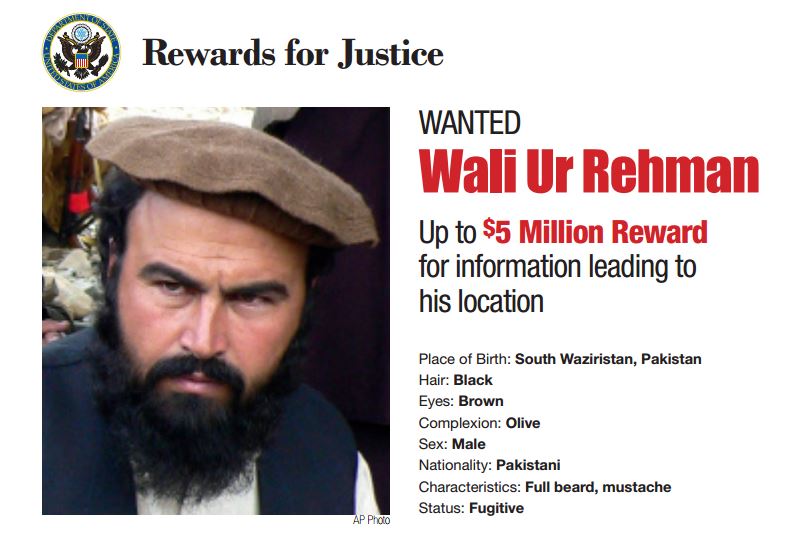
Despite public pronouncements by both the caretaker interim government and the incoming Prime Minister that they oppose CIA drone strikes, this strike is likely to produce less official backlash since the TTP has a long history of attacking both military and civilian targets inside Pakistan. But the CIA had their own reason to target this particular figure. From the State Department’s Rewards for Justice program, we have this description of Wali Ur Rehman (pdf):

Wali Ur Rehman, is second in command and chief military strategist of Tehrik-e-Taliban Pakistan (TTP). He commands TTP members in South Waziristan. He has participated in cross-border attacks in Afghanistan against U.S. and NATO personnel, and is wanted in connection with his involvement in the murder of seven American citizens on December 30, 2009, at Forward Operating Base Chapman in Khost, Afghanistan.

Shortly after the devastating attack in Khost, the CIA vowed revenge:

The CIA yesterday vowed to avenge the deaths of seven of its agents who were killed in a suicide bombing on Wednesday in Afghanistan, as it emerged that the bomber may have been invited on to the base as a potential informant according to two former US officials.

“This attack will be avenged through successful, aggressive counterterrorism operations,” a US intelligence official said on condition of anonymity.

It would appear that the CIA has now exacted that revenge, subject, of course, to the usual caveats that key figures targeted in drone strikes often have a way of popping up later unharmed. Gosh, I wonder if that was Mr. Moral Rectitude himself who gave that anonymous quote about revenge to the Guardian back when he was an “intelligence official” inside the White House instead of his current job running the CIA.

Update: I have been reminded on Twitter and elsewhere that in his speech last week, Obama said “America does not take strikes to punish individuals“. That seems to run in direct opposition to the vow from the CIA to avenge Khost and Ur Rheman’s accused role in that attack resulting in today’s attack.

Share this entry

Compare DOD’s Autonomy to Engage in Cyber-War with Obama’s Close Control over DOD Drone Targeting

It will likely be some time, if ever, before one of our enemies succeeds at doing more than launching limited, opportunistic drone strikes at the US. By contrast, every day brings new revelations of how our enemies and rivals are finding new vulnerabilities in American cyber-defense.

Which is why it is so curious to compare this account of the multi-year process that has led to an expansion of DOD’s authority to approve defensive cyber-attacks with this account of Obama’s close hold on DOD’s drone targeting.

In both cases, you had several agencies — at least DOD and CIA — in line to execute attacks, along with equities from other agencies like State.

An interagency process had been started because cyber concerns confront a variety of agencies, the intelligence community and DoD as well as State, Homeland Security and other departments, with each expressing views on how the domain would be treated.

For much of Obama’s term, it seems, both DOD drone attacks outside of the hot battlefield and cyberattacks had to be approved by the White House. With drones, Obama wanted to retain that control (over DOD, but not CIA) to prevent us from getting into new wars.

But from the outset of his presidency, Obama personally insisted that he make the final decision on the military’s kill or capture orders, so-called direct action operations. Obama wanted to assume the moral responsibility for what were in effect premeditated government executions. But sources familiar with Obama’s thinking say he also wanted to personally exercise supervision over lethal strikes away from conventional battlefields to avoid getting embroiled in new wars. As responsibility for targeted strikes in places like Yemen, Somalia, and, over time, Pakistan shifts to the military’s Joint Special Operations Command, Obama will be the final decider for the entire program.

With cyber, White House control was designed partly to limit blowback — almost the same purpose as his micromanagement of drone targeting — but also to mediate disputes between agencies.

In every instance where cyber was involved, the NSC had to be involved. That helped settle some of the disputes between agencies by limiting any independent application of cyber capabilities, but was useful neither for expediting any cyber action nor for integrating cyber into larger military capabilities. Several sources said that this has slowed the integration of cyber into broader military tactics, possibly giving rivals without the same hesitation, like China, a chance to become more adept at military cyber.

[snip]

Because every decision had to be run through the West Wing, potential political blowback limited the use of cyber tools, the former senior intelligence official said. “If they can’t be used without a discussion in the West Wing, the president’s got no place to run if something goes wrong when he uses them,” he said. Those decisions included what to do if the US confronted a cyberattack.

But over the course of the Obama Administration, DOD lobbied to increase its autonomy in both areas, in drones via the year-long process of crafting a drone rulebook, and with cyber, via the three year process of drafting new standing rules of engagement.

It had far more success in its efforts to expand autonomy with cyber.

Read more

Share this entry

Will the Saudis Let JSOC Take Over Yemeni Targeting?

There were three airstrikes in Yemen this week, with the last being a strike in al-Jawf, a province on the Saudi border, that local observers have variously described as a drone strike and a Saudi jet strike.

Keep ongoing confusion about airstrike attribution in mind as you read this Greg Miller article. It purportedly examines how easy it will be to cede CIA control over drones to DOD. But Miller focuses on Yemen, where, as he portrays it, the question of CIA control over drone strikes is inescapably tied to use of the Saudi base to launch them.

As Miller describes, after initially intending to keep JSOC in charge of strikes in Yemen, the Administration shifted to the CIA because of some serious fuck-ups, among them the al-Majala strike, which killed a Bedouin tribe, the May 2010 strike that took out the Deputy Governor of Shabwah province (probably on deliberately bad intelligence), and the May 2011 attempt that allowed Anwar al-Awlaki to escape.

The change was driven by a number of factors, including errant strikes that killed the wrong people, the use of munitions that left shrapnel with U.S. military markings scattered about target sites and worries that Yemen’s unstable leader might kick the Pentagon’s planes out.

But President Obama’s decision also came down to a determination that the CIA was simply better than the Defense Department at locating and killing al-Qaeda operatives with armed drones, according to current and former U.S. officials involved in the deliberations.

The first two of these fuck-ups almost certainly came from the intelligence sharing process. Yet one of Miller’s sources describes it as a problem with DOD’s kinetic skills, the actual targeting of drones.

“I never fully understood why they struggled so much,” the former official said, referring to the Pentagon’s problems. “Of all the pieces, the kinetic piece at the end was what they should have been good at.”

Given the chronology Miller’s story lays out, it was this last strike, the only one that represented an actual kinetic rather than intelligence failure, that led the Administration to decide to go to the Saudis.

Miller then lays out the thin kabuki the Saudis engaged in to claim this wasn’t a new expansion of US military presence on Saudi soil (as if building a 35,000 person infrastructure protection force, developed under the leadership of a US Major General, were not also one). And he describes the deal the Saudis struck: they’re in charge.

The Saudi government imposed conditions, including full authority over the facility and assurances that there would be no U.S. military personnel on site. The operation would be run by the CIA and Saudi intelligence, who for years had jointly operated a fusion center in Riyadh.

But it’s the excuses used to rule out JSOC drones that are most telling. JSOC couldn’t be involved, the kabuki claims, because it would involve a more tedious vetting process.

Feeding targeting intelligence to JSOC drones was not seen as a valid option, in part because doing so would require military approvals that could bog down a process requiring split-second decisions, officials said.

“The military’s culture is very uncomfortable with someone not in the chain of command handing them a target package and saying, ‘Hit this,’ ” said Jeremy Bash, who served as a senior aide to Panetta at the Pentagon and the CIA.

The first CIA flights began in August 2011. Six weeks later, Awlaki was killed in a CIA strike.

Voila! DOD no longer vets drone targeting and Awlaki dies within weeks!

Funny how that worked out.

Miller then lays out several of the advantages CIA purportedly has over DOD. In addition to the longevity of command at CIA’s counterterrorism center as compared to JSOC, he also cites CIA’s involvement in infiltrating terrorist organizations like al Qaeda in the Arabian Peninsula.

Among them is its expertise at penetrating terrorist groups through networks of informants, and the expertise of officers and analysts who tend to stay in their assignments longer than their military counterparts.

Of course, CIA doesn’t do that by itself in Yemen. It does it with the Saudis and the Yemenis. And always has.

Indeed, the Saudis were involved in at least one of the fuck-ups given as reason to switch to the Saudi base. The Yemenis probably dealt us the bad intelligence that killed the Deputy Governor of Shabwah.

Now, I’m willing to entertain the possibility that moving to CIA targeting under Saudi control is mostly about bypassing Yemeni vetting, as I’ve suggested before. But it is also the case that some of our more recent drone strikes took out people, like that Deputy Governor, who had reportedly served as mediators between extremists and the government in the past, so it is not entirely clear that putting the Saudis in charge has resulted in better targeting.

But we are doing what the Saudis asked us to do 4 years ago, giving them drone intelligence, if not drone kills, they can use to target Saudi enemies in the north of Yemen.

It’s fairly clear that CIA will remain in charge of drone strikes in Pakistan at least through the official pull-out of US troops from Afghanistan. But whether or not the CIA — and with them, the Saudis — will retain control of Yemeni targeting is a far more interesting question going forward.

Share this entry

What “Not Specifically Targeted” Means for Abdulrahman al-Awlaki

A number of people are discussing the killing of Abdulraham al-Awlaki as if the government has claimed he was accidentally targeted.

That’s not what the government has officially said. In his letter declassifying American drone deaths the other day, Eric Holder said Abdulrahman, Samir Khan, and Jude Kenan Mohammad were “not specifically targeted.” Which is quite different from saying it was an accident.

Administration officials were quick to offer an explanation about one of these deaths, that of Mohammad: he died in a signature strike, officials said anonymously, but a former consultant also suggests he was on the kill list.

American officials said on Wednesday that Mr. Mohammad had been killed with about 12 other insurgents in what the C.I.A. calls a “signature strike,” an attack based on patterns of activity, such as men toting arms in an area controlled by extremist groups. Such strikes have prompted the sharpest divisions inside the Obama administration, with some officials questioning whether killing unidentified fighters is legally justified or worth the local backlash.

[snip]

While Mr. Mohammad was not directly targeted, he had come under increasing scrutiny by American counterterrorism officials, who said he was involved in recruiting militants for Al Qaeda and the Pakistani Taliban, as well as making videos on YouTube to incite violence against the United States.

“He had risen to the top of the U.S. deck,” said Seth G. Jones, a senior political scientist at the RAND Corporation and former adviser to the military’s Special Operations Command. Mr. Jones said that while in Pakistan, Mr. Mohammad had made contact with five young Virginia men who disappeared from their homes around Thanksgiving in 2009 and turned up seeking to join militant groups. Instead they were arrested and remain in Pakistani custody.

But officials have been a lot more squirmy about Abdulrahman’s death.

At a pre-speech briefing yesterday, a senior Administration official was asked about Abdulrahman specifically. Between an unbelievable number of “ums,” he first tried to generalize about all three “not specifically targeted” individuals and then provided two possibilities: presence at “al Qaeda and associated facilities” or civilian accidents (neither of which incorporates the explanations provided the NYT for Mohammad’s death).

I don’t want to get into the details of each of those instances.  What I will say generally is that there are times when there are individuals who are present at al Qaeda and associated forces facilities, and in that regard they are subject to the lethal action that we take.  There are other instances when there are tragic cases of civilian casualties and people that the United States does not in any way intend to target — because, again, as in any war, there are tragic consequences that come with the decision to use force, including civilian casualties.

The first of those — presence at an al Qaeda “facility” — is closer to what the Administration has said about Abdulrahman’s death in the past, when they have claimed they were targeting Ibrahim al-Banna. Though AQAP reported that he was never at the site.

But here’s what a former Obama official told Jeremy Scahill about Abdulrahman’s killing.

A former senior official in the Obama administration told me that after Abdulrahman’s killing, the president was “surprised and upset and wanted an explanation.” The former official, who worked on the targeted killing program, said that according to intelligence and Special Operations officials, the target of the strike was al-Banna, the AQAP propagandist. “We had no idea the kid was there. We were told al-Banna was alone,” the former official told me. Once it became clear that the teenager had been killed, he added, military and intelligence officials asserted, “It was a mistake, a bad mistake.” However, John Brennan, at the time President Obama’s senior adviser on counterterrorism and homeland security, “suspected that the kid had been killed intentionally and ordered a review. I don’t know what happened with the review.”

In other words, it sounds like some in the Administration suspect that someone within the targeting chain of command may have invented the Ibrahim al-Banna presence as a way to get at Awlaki’s son. (Note, elsewhere Scahill suggested that the Awlaki family suspects a teacher may have been trying to recruit Abdulrahman to help hunt down his father, which might give those recruiters reason to want to silence him after they did kill Awlaki.)

In a piece on the drone program yesterday, Daniel Klaidman revealed that some people within the Administration were trying to keep mention of Abdulrahman and the two others out of Holder’s letter from the other day.

Officials tell The Daily Beast the original plan was to name only Anwar al-Awlaki, while referring to the other three anonymously. That changed when some officials at the Department of Justice argued that withholding the names would defeat the purpose of Obama’s much-touted call for more openness.

If Abdulrahman was killed deliberately, via some kind of deceit, I can understand why the Administration was reluctant to make its role in his death official. John Brennan’s report about it is presumably out there somewhere (though as a White House report, it would be harder to FOIA than a CIA IG Report).

Clearly, the Administration has made some effort to gain a greater understanding of how Abdulrahman was killed than the hemming and hawing official admitted to yesterday. Which suggests “not specifically targeted” might not even rule out “targeted in deceitful fashion.”

Share this entry

Obama’s Finger Is On the Trigger Except Where It Matters

Update: In his speech, Obama took clear responsibility for killing Awlaki.

And as President, I would have been derelict in my duty had I not authorized the strike that took out Awlaki.

Daniel Klaidman remains the Administration’s go-to guy for stories that report facts that contradict the spin he gives them. Today’s installment explains that Obama insisted on retaining direct say over DOD drone strikes in part to ensure we don’t get embroiled in new wars.

Obama wanted to assume the moral responsibility for what were in effect premeditated government executions. But sources familiar with Obama’s thinking say he also wanted to personally exercise supervision over lethal strikes away from conventional battlefields to avoid getting embroiled in new wars.

But at the same time reports that Obama didn’t exercise direct control over those strikes — in Pakistan and, starting in 2011, in Yemen — that have threatened to embroil us in new wars (and indeed, in the case of our strikes on the Pakistani Taliban, led directly to terrorist attacks on the US as well as the Khost attack).

While Obama had broadly signed off on the CIA’s targeted killing program through a presidential finding for covert action, he did not authorize individual killings except in rare instances.

Effectively, by the time Obama overruled the military in the fight Klaidman portrays in this piece last year, all of the strikes away from battlefields were conducted by the CIA, the strikes Obama apparently took no moral responsibility for.

Klaidman’s report includes another laugher, one which undermines the central Administration claim that today’s speech will represent new drone guidelines.

Lethal force can only be used against targets who represent a “continuing, imminent threat,” and where “capture is not feasible,” Holder said in his letter. It is unclear whether that would signal an end to the controversial practice of “signature strikes,” where groups of suspected terrorists have been targeted even though their identities were not known. (The tactic is believed to have led to significant civilian casualties, while at the same time increasing the number of high level al Qaeda members who were killed.) One senior Obama administration official said the question of signature strikes, sometimes referred to morbidly as “crowd killing,” has yet to be resolved.

I guess my earlier suggestion that the word “ongoing” will be defined so broadly as to allow a great number of problematic drone strikes was correct: it apparently might even include signature strikes.

But ultimately, this is the funniest thing about this perfectly time advertisement that on drones Obama is (yes, Klaidman uses this term) “the decider.” Klaidman’s headline (one he likely didn’t choose) is,

Obama: I Make the Drone Decisions

His closing two sentences are,

Obama won’t be declaring the end of the war anytime soon. And that is why his finger will still be on the trigger.

Yet the day before this obviously sanctioned story, Obama’s Attorney General sent out a letter that shielded the President from all responsibility for the decision to kill an American citizen. Again, maybe Obama will change this trend today by taking responsibility for personally ordering the execution of Anwar al-Awlaki. But it seems as though, even as the Administration boasts of “unprecedented transparency,” they still want to legally protect one of the most important facts about drone killing.

Share this entry

Obama (Almost) Capitulates to ACLU on Drone Killing Standards

Actually, that headline overstates things. Obama will never capitulate to ACLU, the organization. As I’ve shown, his Administration has gone to absurd lengths to defeat ACLU in Court, even holding up legitimate congressional oversight to do so.

But Eric Holder’s letter to Congress yesterday suggested that the government’s new drone rulebook will almost adhere to the standard the ACLU tried to hold the President to almost 3 years ago. Holder claims,

This week the President approved and relevant congressional committees will be notified and briefed on a document that institutionalizes the Administration’s exacting standards and processes for reviewing and approving operations to capture or use lethal force against terrorist targets outside the United States and areas of active hostilities; these standards are either already in place or are to be transitioned into place.

[snip]

When capture is not feasible, the [new drone] policy provides that lethal force may be used only when a terrorist target poses a continuing, imminent threat to Americans, and when certain other preconditions, including a requirement that no other reasonable alternatives exist to effectively address the threat are satisfied.

That’s very close to the standard Nasser al-Awlaki, the ACLU, and Center for Constitutional Rights sought in August 2010 when they sued to prevent the government from killing Anwar al-Awlaki unless he was such an imminent threat.

Plaintiffs seek a declaration from this Court that the Constitution and international law prohibit the government from conducting targeted killing outside of armed conflict except as a last resort to protect against concrete, specific, and imminent threats of death or serious physical injury; and an injunction prohibiting the targeted killing of U.S. citizen Anwar al-Aulaqi outside this narrow context.

When I noted the Administration was now embracing the standard it had refused in 2010, ACLU’s Jameel Jaffer responded on Twitter,

Is it? What’s the function of the word “continuing”?

He’s got a point. Read more

Share this entry