With US-Pakistan Relations Nearing Tipping Point Again, Watch the Border Crossings

When NATO forces killed 24 Pakistani soldiers in November of 2011, Pakistan retaliated by closing both of its border crossings into Afghanistan. They remained closed until then-Secretary of State Hillary Clinton issued an apology in July of 2012. Perhaps because that action by Pakistan stands out as one of the few times Pakistan has had a bit of an advantage in dealing with the US, Imran Khan, whose PTI political party controls the government in Khyber Pakhtunkhwa province, has called for the closing of the Khyber Crossing in retaliation for the drone strike that killed Hakimullah Mehsud. Khan blames the strike for derailing for now the budding peace talks between Pakistan’s government and the Pakistan Taliban.

Yesterday, Khan provided a bit of room for maneuvering, and gave until November 20 for US drone strikes to end in Pakistan before closing the crossing:

Taking yet another staunch stance, Pakistan Tehreek-e-Insaf (PTI) Chairman Imran Khan on Monday announced to extend the deadline for blocking NATO supply lines across Khyber Pakhtunkhwa Province (KP) for 15 days in respect of Moharram, asking the US administration to stop drone strikes inside Pakistan or deal with the blockade of supply lines.

In passionate speech in the NA, Khan said the KP government would suspend the supply line on November 20, urging Prime Minister Nawaz Sharif to seek guarantee from America that no drone strike would jeopardise future peace talks with the Taliban.

Some PML-N leaders, however, termed the change in mood of Khan and the postponement of deadline to cut NATO supply line a result of backchannel contacts with Khan by Interior Minister Nisar Ali Khan. They said Nisar had saved Khan and his party’s government from a head-on clash and tensions would decline as peace talks may soon be “back on track”.

So while there may be a cooling off period before closing the Khyber Crossing, there are a number of incidents to report in the vicinity of the southern crossing at Chaman. First, Pakistan Today noted that a US drone crossed into Pakistani air space at the crossing on Monday:

An American drone violated Pakistan’s airspace by 300 meters on Monday. Security sources said the drone, controlled from US base of the Afghan Qarahag district, entered Pakistani airspace at 6am and returned after flying over the city for five hours.

This is far from the tribal area where US drones hover nonstop. The article went on to state that the last time a drone had crossed the border at this location was three weeks ago.

Ah, but it appears that the drone missed its likely target by a day. There was a suicide bombing from the Afghan side of the crossing today: Read more

Share this entry

Crazy Posturing Over Hakimullah Mehsud Drone Killing Drowns Out Key Question: Why Now?

We are awash in analyses of the drone killing on Friday of Hakimullah Mehsud, who was the leader of Pakistan’s Taliban. Declan Walsh in the New York Times captures much of the puzzlement in the DC establishment over why Pakistan is responding not with celebration that Mehsud is dead, but with sharp questions for the US over yet another violation of Pakistani sovereignty. Walsh’s quote from Bill Roggio sums it up perfectly (under a headline of “In Pakistan, Drone Strike Turns a Villain Into a Victim”):

Virtually nobody openly welcomed the demise of Mr. Mehsud, who was responsible for the deaths of thousands of Pakistani civilians. To some American security analysts, the furious reaction was another sign of the perversity and ingratitude that they say have scarred Pakistan’s relationship with the United States.

“It’s another stab in the back,” said Bill Roggio, whose website, the Long War Journal, monitors drone strikes. “Even those of us who watch Pakistan closely don’t know where they stand anymore. It’s such a double game.”

And Christine Fair provided another nuanced take on Mehsud:

Christine Fair, a South Asia expert at Washington DC’s Georgetown University, claimed there was little prospect of the proposed talks achieving anything.

“The Taliban killed 40,000 people. What lunatic thought there would be peace talks,” she said. “The American taxpayer is again taking out Pakistan’s terrorist garbage.”

Not to be outdone, Mike Rogers chimed in on Sunday:

Representative Mike Rogers, who chairs the House of Representatives’ permanent intelligence committee, said the slain militant, Hakimullah Mehsud, was a “bad guy” who was connected to attacks against Pakistani soldiers and to the Taliban in Afghanistan, which has forced closures of many schools for girls.

“This was a bad guy,” Rogers said on CBS’ “Face the Nation.”

“There’s some information recently that concerned us about the safety of our troops. I feel a little better for our troops today than I did before this event happened.”

But all of this bleating about “wrongful mourning” threatens to drown out a very important point. Pakistan’s Interior Minister Chaudhry Nisar Ali Khan held a press conference on Saturday. Dawn provides some coverage of his comments:

Speaking to both local and foreign media today, Nisar said the identity of those killed in the drone strike was irrelevant. “The government of Pakistan does not see this drone attack as an attack on an individual but as an attack on the peace process,” he said.

The interior minister said a three-member committee, comprising of Islamic clerics, was scheduled to leave for a meeting with the Tehrik-i-Taliban Pakistan (TTP) leadership on Saturday morning.

Claiming that TTP leadership including Hakimullah was aware of the meeting, he said he had written and telephonic records of recent correspondence between the government and the militant outfit.

/snip/

Chaudhry Nisar questioned timings of the Hakimullah’s killing by the US asking why he was targeted just a day before the talks. “Can this be called supporting peace initiative?”

Most press accounts of Nisar’s press conference include a reference to Nisar questioning the timing of the strike. But on Twitter yesterday, Arif Rafiq provided more details after reviewing a video of the press conference. It appears that Nisar went on to suggest that US interest in attacking Mehsud was only very recent and that previous opportunities to strike him had been bypassed: Read more

Share this entry

How Ridiculous is Pakistan’s New Civilian Drone Victim Estimate? Terrorist Okra-Picking Grandma!

On October 24, 2012, Nabila Rehman, who was eight years old at the time, was helping her grandmother pick vegetables in the family’s garden in North Waziristan. Here is her description of what happened next:

[youtuber youtube=’http://www.youtube.com/watch?v=ZDlvGqQ7VUo’]
Remarkably, Pakistan’s government has now indirectly called Nabila’s grandmother, Mamana Bibi, a terrorist. That is because the government has released new figures, radically revising downward their estimate of civilians killed in US drone strikes in Pakistan. They must be calling Bibi a terrorist, because the figures claim that there were zero civilian casualties in 2012. Amnesty International provides many more details (pdf) on the strike that killed Bibi and on another strike in 2012 that killed eighteen civilian workers.

Here is Declan Walsh writing in the New York Times on the new figures from Pakistan:

In a surprise move, Pakistan’s government on Wednesday sharply revised downward its official estimate of civilian casualties caused by American drone strikes in the tribal belt, highlighting again the contentious nature of statistics about the covert C.I.A. campaign.

The Ministry of Defense released figures to lawmakers saying that 67 civilians were among 2,227 people killed in 317 drone strikes since 2008. The remainder of those killed were Islamist militants, the ministry said.

/snip/

Recently, a United Nations special rapporteur on human rights and counterterrorism, Ben Emmerson, said that the Pakistani government had reported at least 400 civilian deaths since the drone campaign started in 2004.

In an email, Mr. Emmerson noted that the revised figures were “strikingly at odds” with those he had been given earlier by the Pakistani Foreign Ministry and said he would be writing to the government seeking clarification.

“It is essential that the government of Pakistan now clarify the true position,” he said.

BBC gives us the directly comparable figures from The Bureau for Investigative Journalism:

The latest figures released by Pakistan differ dramatically from previous estimates, but no explanation was given for the apparent discrepancy.

London’s Bureau of Investigative Journalism, which researches Pakistan drone strikes, told the BBC it estimated based on reports that between 308 and 789 civilians had died since 1 January 2008 (of between 2,371 and 3,433 total deaths).

Since 2008 then, Pakistan has now revised their civilian death toll estimate down to 67 during a period when TBIJ documents a minimum of 308 civilian deaths and as many as 789. Somehow, Pakistan has reclassified several hundred deaths from civilian to terrorist. And among them is Mamana Bibi, who is now a terrorist okra-picking grandmother. [That one hits me especially hard; I have fond memories of my grousing about how itchy the okra plants were when I picked okra with my grandfather in his garden.]

Tom Hussain and Jonathan Landay at McClatchy sum up the response to this announcement by Pakistan: Read more

Share this entry

Haqqani’s Revenge?

As Jim laid out this morning, yesterday Nawaz Sharif visited the White House, where he scolded the President for the use of drones.

Pakistan and the United States have a strong ongoing counterterrorism cooperation. We have agreed to further strengthen this cooperation. I also brought up the issue of drones in our meeting, emphasizing the need for an end to such strikes.

The statement comes in the wake of an Amnesty International report finding some of the US drone strikes in Pakistan it examined were illegal.

Even before Sharif made his comments, Michael Hirsh pointed to a protocol between the US and Pakistan authorizing some of the strikes.

But what is obscured by the public dispute is that there has been, since the administrations of George W. Bush and Pervez Musharraf, a secret agreement in place by which Pakistani military and intelligence authorities have approved many of the strikes, U.S. and Pakistani officials say.

“The exact terms were never shared with civilians but there was a protocol between the Musharraf government and the Americans,” says a former senior Pakistani official who would discuss the classified matter only on condition of anonymity. “When the civilian government came in [in 2008], it was informed about it but there was no renegotiation.”

Elsewhere, Hirsh quotes from Husain Haqqani’s upcoming book, Magnificent Delusions, which is available but technically does not get published until November 5.

Then, later in the day, Woodward et al published a story reporting on the drone agreements between the US and Pakistan (note, Jonathan Landay reported this story back in April, though relying on different documents covering a slightly different span of time and US sources). The WaPo story covers strikes from late 2007 to late 2011, though the 2007 strikes were reported in a 2008 document.

Despite repeatedly denouncing the CIA’s drone campaign, top officials in Pakistan’s government have for years secretly endorsed the program and routinely received classified briefings on strikes and casualty counts, according to top-secret CIA documents and Pakistani diplomatic memos obtained by The Washington Post.

The files describe dozens of drone attacks in Pakistan’s tribal region and include maps as well as before-and-after aerial photos of targeted compounds over a four-year stretch from late 2007 to late 2011 in which the campaign intensified dramatically.

Husain Haqqani was Foreign Minister Ambassador to the US from April 2008 until November 2011.

The story relies on a document from Pakistan’s Ministry of Foreign Affairs that almost certainly wouldn’t have been shared willingly.

In a measure of the antagonism between the two sides, a 2010 memo sent by Pakistan’s Ministry of Foreign Affairs to its embassy in Washington outlined a plan to undermine the CIA.

“Kindly find enclosed a list of 36 U.S. citizens who are [believed] to be CIA special agents and would be visiting Pakistan for some special task,” said the memo, signed by an official listed as the country’s director general for the Americas. “Kindly do not repeat not issue visas to the same.”

And WaPo describes some of the documents may have been used in briefings Mike Morell gave to Husain Haqqani.

Several of the files are labeled as “talking points” prepared for the DDCIA, which stands for deputy director of the CIA. Michael J. Morell, who held that position before retiring this year, delivered regular briefings on the drone program to Husain Haqqani, who was the Pakistani ambassador to the United States at the time.

But Haqqani refused to comment for the WaPo.

When contacted Wednesday, Haqqani declined to comment and said he would not discuss classified materials.

Perhaps the most interesting file portrayed by the WaPo describes Hillary Clinton complaining to her Pakistani “counterparts” (again, suggesting these documents were Haqqani’s) about Pakistan’s support for terrorism.

Some files describe tense meetings in which senior U.S. officials, including then-Secretary of State Hillary Rodham Clinton, confront their Pakistani counterparts with U.S. intelligence purporting to show Pakistan’s ties to militant groups involved in attacks on American forces, a charge that Islamabad has consistently denied.

In one case, Clinton cited “cell phones and written material from dead bodies that point all fingers” at a militant group based in Pakistan, according to a Pakistani diplomatic cable dated Sept. 20, 2011. “The U.S. had intelligence proving ISI was involved with these groups,” she is cited as saying, referring to Pakistan’s Inter-Services Intelligence agency.

A Jeffrey Goldberg review of Haqqani’s book reveals it criticizes Pakistan for supporting terrorism.

Whether Haqqani talked to Woodward, the documents sure seem to come from his collection and may have been used to write his book. Maybe they got liberated in the process of publication?

Now, Landay’s story described how we originally got permission for drone strikes from the Pakistani government (though often had to fight to get it). But we stopped when it became clear Pakistan was protecting the Haqqani network to sustain its influence in Afghanistan (a topic Sharif and Obama also discussed yesterday).

The main reason for ending the ISI’s ability to veto targets, said two former U.S. defense officials and a senior U.S. official, was that after several years of arguing, U.S. military and intelligence officials finally persuaded the White House that ISI officers were protecting the Haqqani network to ensure that it could participate in peace talks and bring a pro-Pakistan government to power in Kabul. The three requested anonymity because of the sensitivity of the issue.

“Basically, they (the CIA and ISI) started out together but then they diverged because the two sides had different objectives. It was as simple as that,” explained the individual with knowledge of the North Waziristan strike.

As you’ll recall, Haqqani was ousted in 2011 for having passed on a memo in May 2011 to Admiral Mike Mullen expressing Asif Zardari’s concern that Pakistani military and intelligence would launch a coup in response to the Osama bin Laden raid. The entire point of the Mansoor Ijaz column that first revealed the memo was to call on the US to treat ISI’s Section S as a terrorist organization. But in ousting Haqqani, his column led to a stronger hand for ISI and the military.

Sharif has always been perceived as much more approving of terrorists than Zardari (and has very close ties to Saudi Arabia). And it may be that his call to end drone strikes is intended to protect Pakistan’s own sponsored terrorist organizations.

The leak doesn’t target Sharif directly — the materials all precede him. But it does make it clear that those aiming to halt strikes that target Pakistan’s terrorists have also used drones for their own uses.

Update: Thanks to Glenn Kessler who pointed out my error on Haqqani’s title.

Share this entry

Why Would Woodward Leak Confirmation of US-Pak Collaboration on Drone Strikes While Sharif Was in DC?

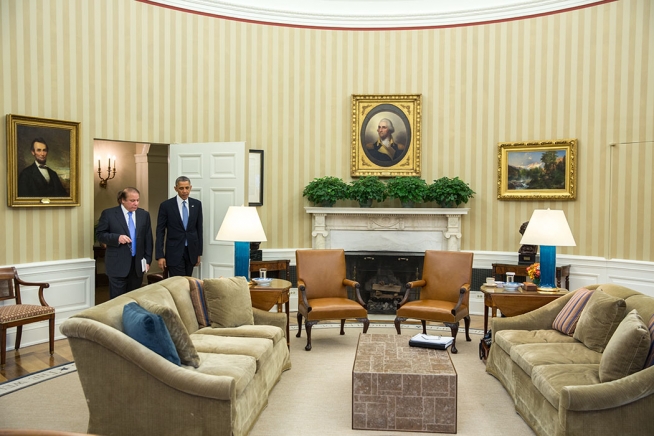
Obama and Sharif enter the Oval Office yesterday.

Obama and Sharif enter the Oval Office yesterday.

On the same day that Pakistan’s newly elected Prime Minister, Nawaz Sharif, spoke to the press alongside US President Barack Obama in Washington, Bob Woodward teamed with Greg Miller to release confirmation that Pakistan’s government has agreed to and collaborated in choosing targets for the US “secret” drone program inside Pakistan. Participation by Pakistan, and especially its military, has long been known by close observers and the regular insistence by Pakistan’s government that drone strikes are a violation of Pakistan’s sovereignty is viewed cynically as the government’s need to provide domestic political cover.

On first thought, the timing of this revelation seems to break the basic tenets of what Marcy describes as the Bob Woodward Law that applies to classified information being leaked to Woodward:

As explained by John Rizzo in the context of the Obama Administration’s leaks to Bob Woodward, they can and do insta-declassify stuff for their own political purposes all the time. They can do it to make the President look important; they can do it to lie us into an illegal war; they can do it to ruin the career of someone who might expose the earlier lies.

The timing of this leak seems to be aimed more at embarrassing Obama than making him look important. The description of the joint appearance by the New York Times is quite interesting if one assumes that Sharif and Obama were aware that the leak was about to be published:

But Mr. Sharif said after the meeting that he had asked Mr. Obama to halt American drone strikes in Pakistan, broaching an issue that has aggravated tensions. The president did not respond publicly, saying only that the two sides needed to find ways to fight terrorism “that respect Pakistan’s sovereignty, that respect the concerns of both countries.”

So Obama would not address the drone issue directly in his public remarks. But it seems that Sharif was not particularly enthusiastic in his obligatory public denouncement of drone strikes: Read more

Share this entry

Intelligence Committees: Not Informed about Torture, Not Informed about Drone Casualties, Not Informed about US Person Spying

Amnesty International and Human Rights Watch released reports on US drone killings today. For the moment, I’m going to outsource reading the reports to Sarah Knuckey’s excellent post.

Both reports (per Knuckey) point to individual drone strikes on civilians that may or probably violate international law.

Specific US strikes killed civilians in violation of the law and US policy.  These are the first major reports by each organization detailing field investigations into specific strikes.  HRW reviewed six strikes in Yemen (occurring between December 2009 and April 2013). HRW concluded that two of the strikes violated international law (pp. 54, 67), four may have (pp. 30, 39, 43, 60), and none of the six appeared to have complied with Obama’s May 2013 Presidential Policy Guidance (p. 89).  AI reviewed all 45 reported Pakistan strikes between January 2012-August 2013, and investigated nine in detail.  AI’s legal findings include that “evidence indicates” that an October 2012 strike unlawfully killed a grandmother and injured eight children (p. 23), and AI had “serious concerns” that a July 2012 strike that killed 18 and injured 22 (p. 24) may have been a war crime or extrajudicial execution (p. 27).  AI also investigated a number of strikes on apparent rescuers (those who came to the scene of a first strike to help the wounded), which it concluded may have been illegal (pp. 28-30).  Neither report seeks to assess the total number or rate of civilian casualties for all strikes.

[snip]

Investigations and accountability obligations. AI states that the US has legal obligations to investigate any cases where there are “reasonable grounds to indicate that unlawful killings have occurred,” and to prosecute, and remedy where appropriate (pp. 35-37).  HRW similarly states that the US has a duty to investigate violations of the laws of war, and that government secrecy effectively denies victims’ right to redress (p. 87).  Both reports also state the US should provide compensation or condolence payments for any civilian harm, but that neither organization is aware of the US having done this (AI, p. 39; HRW, p. 88).

This documentation of civilian casualties, of course, provides further evidence Dianne Feinstein and Mike Rogers’ claims about civilian casualties are false.

But we knew that.

Which means, in addition to the fact that we’re violating international law with some of our drone killings, we also are seeing a recurrent trend.

Even the CIA’s own lawyer agreed that CIA didn’t properly inform Congress, including the Intelligence Committees, about torture.

We’re learning that vast parts of the NSA’s spying — including spying that collects US person data — remains largely hidden from the Intelligence Committees.

And we have yet more proof they have been misinformed about drone killings.

Is there some dubiously legal program the Intelligence Community has fully informed Congress on?

Share this entry

CIA and the President: The Warm Embrace of Mutual Incrimination

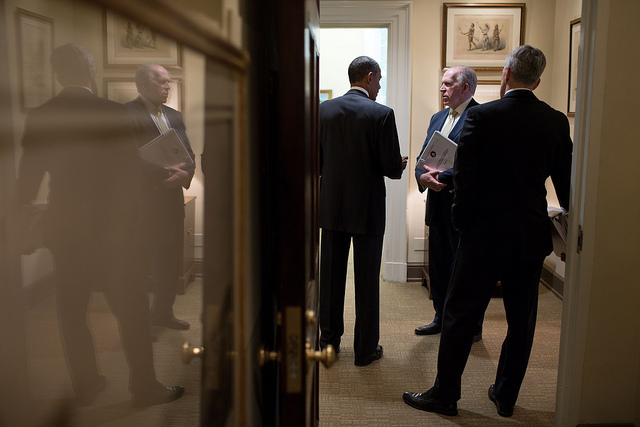
Brennan with TortureAndrew Sullivan is newly convinced — but surprised and confused — that President Obama is permitting John Brennan to hold up the release of the Senate Torture Report.

It is becoming clearer and clearer that one major power-broker in Washington is resisting the release of the Senate Intelligence Committee’s allegedly devastating report on the torture program run by the Bush-Cheney CIA. That major power-broker is the Obama administration.

You might be surprised by this, given the president’s opposition to torture and abolition of it. But the evidence is at this point irrefutable

[snip]

Brennan answers to the president, who has urged the release of the report.

So why the hold-up? That is the question.

Why is Obama allowing Brennan to undermine Obama’s own position? Why is the president allowing the CIA to prevent the very transparency he once pledged to uphold? I don’t know. But what I do know is that it is now Obama who is the main obstacle to releasing the Senate Report on Torture.

Mind you, the evidence was pretty irrefutable back in May, too, and became more so in July. Moreover, I’m not sure Obama has “urged the release of the report” — though Joe Biden has.

The explanation for Obama’s silence on this report seems pretty obvious if you read both Stephen Preston’s answers to Mark Udall’s questions and Obama’s past actions on torture. In short:

  • Torture was authorized by a Presidential Finding — a fact Obama has already gone to extraordinary lengths to hide
  • CIA has implied that its actions got sanction from that Finding, not the shoddy OLC memos or even the limits placed in those memos, and so the only measure of legality is President Bush’s (and the Presidency generally) continued approval of them
  • CIA helped the (Obama) White House withhold documents implicating the White House from the Senate (Sully does not note this fact, but Katherine Hawkins, whom Sully cited, did)

With specific reference to documents potentially subject to a claim of executive privilege, as noted in the question, a small percentage of the total number of documents produced was set aside for further review. The Agency has deferred to the White House and has not been substantively involved in subsequent discussions about the disposition of those documents.

Indeed, I wonder whether the evidence in the Senate report showing CIA lied to the White House is not, in fact, cover for things some in the White House ordered CIA to do.

This is, I imagine, how Presidential Findings are supposed to work: by implicating both parties in outright crimes, it builds mutual complicity. And Obama’s claimed opposition to torture doesn’t offer him an out, because within days of his inauguration, CIA was killing civilians in Presidentially authorized drone strikes that clearly violate international law.

Again, I think this is the way Presidential Findings are supposed to work: to implicate the President deeply enough to ensure he’ll protect the CIA for the crimes he asks it to commit.

But it’s not the way a democracy is supposed to work.

Share this entry

Barb Mikulski and Stephen Preston Seem to Disagree Over Whether David Petraeus “Jerked Around” Congress

A big part of Stephen Preston’s response to Mark Udall’s questions about whether he supports adequate disclosure to Congress consists of insisting the CIA Directors he worked with — Leon Panetta, David Petraeus, presumably Mike Morell as Acting Director, and John Brennan — have supported full disclosure to Congress.

Doing a better job of congressional notification and ensuring the proper provision of information concerning covert action and other intelligence activities to the Intelligence Committees has been a top priority of the Directors under which I have served, starting with Director Panetta, and one that I have fully supported.

[snip]

What we regard as proper practice today is driven by faithful application of the National Security Act of 1947. It is also informed by the very high priority the Directors under which I have served have placed on doing a better job of congressional notification and ensuring the proper provision of information concerning covert action and other intelligence activities to the Intelligence Committees. To repeat, I have fully supported these efforts and, if confirmed, will be fully committed to such efforts with respect to the Armed Services Committees.

While it may or may not be true that the Directors under whom Preston has served have not engaged in the kind of manipulative briefings that characterized the torture program, every time I read these assurances from Preston I remembered what Barb Mikulski said at John Brennan’s confirmation hearing.

Now, I want to get to the job of the CIA director. I’m going to be blunt — and this would be no surprise to you, sir.

But I’ve been on this committee for more than 10 years. And with the exception of Mr. Panetta, I feel I’ve been jerked around by every CIA director.

I’ve either been misled, misrepresented, had to pull information out, often at the most minimal kind of way, from Tenet, with his little aluminum rods to tell us that we had weapons of mass destruction in Iraq to Porter Goss, not worth coming.

You know the problems we’ve had with torture. The chair has spoken eloquently about it all the way.

And, quite frankly, during those questions, they were evaded, they were distorted, et cetera.

While she didn’t name him as she did Tenet and Goss, neither did she except David Petraeus, like she did Leon Panetta.

This would seem to suggest that Mikulski has a very different understanding of Petraeus’ commitment to briefing Congress than Preston claims to have.

Share this entry

Stephen Preston: Covert Operations Don’t Need OLC Approval

Jane Mayer has obtained a set of questions Mark Udall made CIA General Counsel Stephen Preston answer before he would release a hold on the latter’s confirmation as DOD General Counsel. They address CIA’s response to the Senate Intelligence Committee torture report. I will have more to say about these answers later (see also this post from Katherine Hawkins).

But for now I want to point to one of the few questions Preston really didn’t answer. While the non-answer is not at all surprising, it does have implications far beyond torture.

Udall noted,

The CIA response to the Committee Study states: “while it would have been prudent to seek guidance from OLC on the complete range of techniques prior to their use, we disagree with any implication that, absent prior OLC review, the use of the ‘unapproved’ techniques was unlawful or otherwise violated policy.”

The comment does two things.

First, it confirms CIA tortured before John Yoo authored memos authorizing that torture.

That confirmation is news, though we’ve long known it to be true.

But it also reflects CIA’s view that the legality of specific torture techniques did not stem from OLC review and authorization of them.

Udall asked Preston,

Please state whether you agree with this legal determination and explain your legal reasoning.

To which Preston responded,

On the particular point raised in (c) of the question, I also agree that CIA should have sought guidance from OLC with regard to the complete range of interrogation techniques prior to their use. I understand the Agency’s response to the SSCI’s study to acknowledge this point, noting only that failure to so engage with OLC did not, in and of itself, render any given technique unlawful.

Preston doesn’t actually say whether he agrees with the Agency’s legal determination or not, which was, after all Udall’s question. Which gets him out of answering Udall’s question about his legal reasoning.

But Preston has, for all intents and purposes, already answered that question in his speech last year on CIA’s use of lethal force. In it, he laid out was required for the use of lethal force (he doesn’t say it, but this includes lethal force against an American citizen) to be legal under US law.

Let’s start with the first box: Authority to Act under U.S. Law.

First, we would confirm that the contemplated activity is authorized by the President in the exercise of his powers under Article II of the U.S. Constitution, for example, the President’s responsibility as Chief Executive and Commander-in-Chief to protect the country from an imminent threat of violent attack.

[snip]

In addition, we would make sure that the contemplated activity is authorized by the President in accordance with the covert action procedures of the National Security Act of 1947, such that Congress is properly notified by means of a Presidential Finding.

As I’ve noted elsewhere, Preston doesn’t even acknowledge the National Security Act’s requirement that covert actions be legal under US law.

His speech makes it clear he agrees with the CIA’s response on torture. The CIA doesn’t need OLC approval for covert operations (which torture was during its early years), the implication seems clear, because the only thing needed to make covert operations legal is Presidential authorization with adequate Congressional notice.

This is a stance that most discussions on drones and torture miss. The CIA doesn’t believe it needs OLC memos — whether authorizing belly slaps or the assassination of Anwar al-Awlaki. It may consider it prudent to have OLC authorization in hand, mind you. But it does not believe such authorization gives covert operations any more legal sanction that simply the President’s authorization.

Share this entry

Why Did NSA Raise Traffickers for a Story about Drone Killing Terrorists?

Screen shot 2013-10-17 at 10.53.24 AM

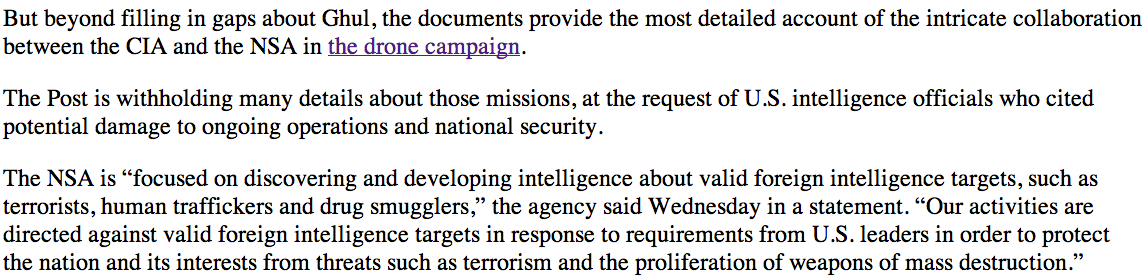
There was an odd statement from NSA in the middle of yesterday’s WaPo story describing how NSA facilitates CIA’s drone mission (click to embiggen).

The NSA is “focused on discovering and developing intelligence about valid foreign intelligence targets, such as terrorists, human traffickers and drug smugglers,” the agency said Wednesday in a statement. “Our activities are directed against valid foreign intelligence targets in response to requirements from U.S. leaders in order to protect the nation and its interests from threats such as terrorism and the proliferation of weapons of mass destruction.” [my emphasis]

While the NSA is finally admitting again their central cybersecurity focus, I believe this is the first time since the Snowden leak that NSA has suggested its “valid foreign intelligence targets” include “human traffickers and drug smugglers.”

It’s not surprising they are, mind you, especially given the Obama Administration’s focus on Transnational Criminal Organizations.

It’s just that the admission comes in a story about NSA’s contributions to drones for which the WaPo explained,

[T]he documents provide the most detailed account of the intricate collaboration between the CIA and the NSA in the drone campaign.

The Post is withholding many details about those missions, at the request of U.S. intelligence officials who cited potential damage to ongoing operations and national security.

It seems the only reason to raise the issue is if some of the materials on drones make it clear they’re being used — if not lethally — against entirely new kinds of targets: human traffickers and drug smugglers (though there have been a slew of stories that they were even used to hunt Chapo Guzman).

Ah well. It’s all moot now. OneKade alerts me that the reference has now been removed from the story.

Poof! All record the NSA and CIA used drones against drug traffickers gone!

Share this entry