Where Is The Proud Boys Verdict?

Friday has come and gone without a jury verdict in the Proud Boys case in front of Tim Kelly in DC District Court.

Couple of days ago, somebody asked me when I expected a verdict. That is fools’ play, but I said probably Friday because juries want to get on with their lives, and not come back, yet again, the next week.

Apparently I got that all wrong. Go figure.

So why did the PB jury blow past an obvious chance to be done? I do not know that either, but there is a fair chance it is not about ultimate guilt or innocence, but about multiple defendants and the complexity of the seditious conspiracy charge so many people (even here) have long clamored for.

Sometimes you get what you asked for, and that may be the case here. Counts, charges and jury instructions matter. I hope that is not the holdup here, but very much fear it could be. And that is what happens when you do not keep things narrow and strong.

We shall see.

Share this entry

The Michael Flynn Complaint For Damages Against The US

As commenter David F. Snyder noted yesterday, yes Michael Flynn has filed a complaint for $50,000,000 damages against the US Government for all the perceived wrongs and grievances that he, his unhinged lawyers like Sidney Powell, and rabid MAGA Republicans have been carping about forever. A thread on this started out in Marcy’s “JUDGE UNSEALS DETAILS ON COOPERATING WITNESS IN DOUGLASS MACKEY CASE”, but I am going to bring it here so as to not pollute that post and give people a place to discuss Flynn.

I took a look at the docket for the fledgling case. It is filed in the Middle District of Florida, where Flynn resides. That is the only discernible nexus to MDFL as pretty much all facts, actors and witnesses would be in or about the DC District. Here is the docket entry for the complaint, which was actually filed on March 3, 2023:

NEW CASE ASSIGNED to Judge Mary S. Scriven and Magistrate Judge Christopher P. Tuite. New case number: 8:23-cv-0485-MSS-CPT. (SJB)

The complaint itself is attached to this Rolling Stone article by a detestable SCRIBD (seriously, nobody should ever convey documents by SCRIBD). It is 50 pages long, and I am not wasting my PACER account on it.

Marcy, in the earlier thread, said:

Not only does it not have legs, but if it survives the summary judgment stage (which is unlikely) it may catastrophically backfire on him.

I think that is right, but the case may not ever get that far. It may not even make it to a summary judgment motion, as it may well not make it past a 12b6 motion, which would be the initial attack by the government.

Couple of notes, the complaint alleges compliance with the FTCA (Federal Tort Claims Act), but claims the government never responded. Scriven is a Bush Jr. appointee and Tuite a Trump appointee to the magistrate bench. Sid Powell is noticeably absent from noticed attorneys, but Shawn Flynn, son of Michael’s brother, Gen. Charles Flynn, is listed. That could be interesting if Charles is to be a fact/damages witness, which would kind of be expected.

Very hard to see this matter gaining any real traction given all the facts and rulings against Flynn in the underlying criminal case in front of (now senior status) Judge Emmet Sullivan of DC District.

Share this entry

Where Is The J6 Committee Beef?

From the Washington Post up all night desk:

Many close observers of the Jan. 6 committee are still looking for testimony transcripts, particularly with key White House advisers and campaign aides. Transcripts involving most of those names are still unreleased — and have been promised in the coming days. Many days of testimony by Trump aide Cassidy Hutchinson are not yet out, nor are transcripts for Trump’s family, lawyers and top campaign advisers. The committee talked to a remarkable number of people, and their exact words will be closely examined when the transcripts are released — including by Republicans looking for ammunition against the report.

Yeah, where are those?? It is Christmas weekend and they have released a whopping 34 of their supposed 1,000 or so transcripts. Why are they dribbling them out when their work is done? Have they given it all to the DOJ yet? My understanding is no, but cannot confirm that. DC, including DOJ, are going into holiday mode and this goofy Committee is still playing keep away. Why? What the hell are they doing? This is just ridiculous.

Share this entry

Three Questions at the Start of an Intelligence Review

Why? Why? Why not?

There’s been a lot of focus on the narrow legal battles over the documents seized at Mar-a-Lago, but sometimes stepping back to look at the big picture helps bring the conflict into focus. As a legal matter and a political matter, Trump, his lawyers, and his apologists are trying to make the claim that this is just a dispute about documents, like overdue library books. The passion with which the DOJ went after them since receiving the referral from NARA last February, especially the ferocity of the legal arguments and filings over the last two weeks, demonstrates how wrong the DOJ believes that framing to be.

I agree with the DOJ.

The documents are not really what is being fought over — the battle is over the damage  (hypothetical or actual) done to our intelligence services, our national defense, and our broader foreign policy by Trump’s possession of these documents at Mar-a-Lago. The documents are the first puzzle pieces the intelligence community [IC] has to put together, to fill in the whole picture and plan a way forward.

To understand why, let’s parse out what an intelligence review might look like. What follows is not based on any insider sources at the DOJ, ODNI, or any other federal agencies, but on my own experience (long ago) with classified materials and the general experiences of others I know with deeper and more recent work in classified matters, as well as analyzing other cases where classified materials were stolen from the government and passed along to foreign governments.

An intelligence review is designed to look at three things: what got exposed, to whom, and what dangers does that pose to intelligence sources, methods, and broader foreign policy objectives? These are all backwards-looking questions, to understand how this could have happened in the first place. They also serve as the starting point for forward-looking actions, as we and our allies pivot our overt and covert foreign policy approaches in a new context. Think of Klaus Fuchs, a German-born British scientist who passed US and British nuclear secrets to the USSR in the 1940s. A backwards looking intelligence review ultimately identified him as the spy and spotted the flaws in our security procedures, and a forward looking review pivoted the US and British policy toward a world with nuclear powers who opposed each other.

In the current case, the IC review begins with three interrelated questions:

  1. Why did Trump take government documents to Mar-a-Lago in the first place?
  2. Why these documents?
  3. Why not those other documents?

The second and third questions begin to move toward an answer to the first question, so let’s start there. Broadly speaking, I see five possible answers, each of which poses different dangers.

1: Vanity

If this is the answer to that first question, we would expect to find that Trump took documents that made him look good, that pointed to actions that he believed he could claim credit for, or that simply let him feel powerful because he knows stuff very few others know. Think of these as Extreme Presidential Souvenirs. These would be documents that shout to the world, “Look at how great Trump is . . .”

Danger: Simply having documents like this in his possession would likely not be enough for Trump’s ego. Trump’s ego would demand that he show them to others, so that they would know how great Trump is. The level and kind of danger depends on who the “others” are, and who they might have spoken to about what Trump showed them.

2: Fear

In this scenario, the IC review would see that Trump took documents that would help cover up his failures and/or possible crimes, such as a full transcript of the “Perfect Phone Call” with Zelenskyy. These would be documents that whisper in Trump’s ear, “This could get you into trouble. You better hide this . . .”

Danger: These are the documents least likely to be shared by Trump, so in that respect they are safe. On the other hand, they become prime material for blackmail if unfriendly parties realize he has them. Trump’s nightmare is getting a phone call about these documents, threatening to expose the documents to the “wrong” people. “I’d like you to do me a favor, though . . .”

3: Greed

Given Trump’s proclivity to monetize anything he can for his own personal gain, it is hard to imagine that Trump would not be looking at anything that crossed his desk to see how he might make money on it. (“Hmmm . . . I’m doing some traveling? OK, which of my properties are closest, and how much can I charge the Secret Service for staying there?”) Documents that showed him something that would let him make money would be particularly tempting to Trump. Think of this as corporate espionage, or a twisted form of insider trading. Perhaps he received knowledge of foreign government’s as yet unannounced plans to develop certain properties overseas, and figured he could jump in, buy the property first, and then get bought out for a profit. Or maybe he would buy the property next to the future development and cash in when the government project became public and went forward, driving up the value of what he purchased. Perhaps these were not projects led by foreign governments, but by US corporations acting abroad whose plans were picked up as part of a signals intelligence surveillance program aimed at less-than-friendly nations. Documents like this would be calling out to his wallet, telling him “Hey, you can really use this . . .”

Danger: Suppose Trump acts on this information in some way, and the foreign government in question starts wondering “Did Trump merely get lucky in choosing to invest right where our project was going in, or did US spies give him the information?” Questions like that might lead to the exposure of human assets (sources) and signals intelligence capabilities (methods), which in turn could lead to those sources being shut down/arrested/killed, those signals intelligence methods being countered, or either the sources or methods being turned and used to feed false information to the US.

4: Corruption

As bad as #3 is, this scenario is the IC nightmare: Trump took documents that he knows other foreign governments, perhaps some of our greatest enemies, would love to have, and then deliberately passed them along to those governments. It might be to get revenge on Biden and the Dems for beating him in 2020. It might be to sabotage the work of the current administration and cause great public political problems for the Dems, to enable his return to the White House in 2024. It might be that some foreign adversary has compromising information about Trump or holds a private loan to Trump, his family, or his Trump Organization, and that country demanded classified information from Trump in exchange for not revealing the compromising information they hold or for not calling in the loan he could not immediately repay.

Danger: Beyond the damage done to sources, methods, and US foreign policy objectives created by disclosing the classified information in these documents, this scenario is worse. It weakens our relationships with our allies and harms our position in the world, simply by indicating we can’t keep secrets and by making us weaker through whatever is revealed. Should Trump have provided classified intelligence deliberately, it only gives those folks more leverage over Trump, which they would use to push for more information and more favors. Once you’ve turned over classified information to a hostile power, those folks own you forever. “Nice resort you’ve got here. It’d be a shame if anything were to happen to it.”

And it is not beyond the realm of possibility that foreign governments might lean on Trump to use his family to further their goals. “You need to have Jared talk to his friends in the Middle East, and convince them to . . . “

5: Some/all of the above

Trump might have taken some documents to feed his ego, others to hide them, and still others to try to monetize their contents. He might have taken some for his own reasons, and others because he was pressured to do so by hostile powers. The permutations are . . . troubling.

Danger: some/all of the above.

HOW BAD IS ALL THIS? DON’T ANSWER YET . . .

On top of these five possible explanations of Trump’s motives, one other thing is absolutely certain. Documents like those that were seized by the DOJ would have been catnip for the intelligence agencies of other nations. Once word got out that Trump had taken highly classified documents out of the WH (or once folks even suspected he had done so), all manner of foreign spies no doubt became very interested in Mar-a-Lago – much more than they had been during the Trump administration itself. It’s hard as hell to get into the WH and take classified materials, or to plant electronic surveillance devices inside the WH. Mar-a-Lago, on the other hand, is a relative sieve, especially after Trump left office and the security around Trump was much more directed to protecting his person rather than protecting all the stuff around a sitting president. At Mar-a-Lago these days, you pay your membership fee, and walk right in for a grand tour. Whatever the reason Trump chose to take these documents, even if he simply wanted to hold onto them as presidential souvenirs and he does nothing with them otherwise, should foreign agents copy them or steal them from Mar-a-Lago, that’s almost as bad it as it gets for the US.

Danger: Exposing whatever classified information to the prying eyes of our adversaries not only exposes sources and methods of our intelligence services, but provides our adversaries with insight into our strengths and weaknesses, depending on what the intelligence said. It also opens Trump to blackmail, as noted above in scenarios #2 and 4. “Well look what we found at your home. It sure would be terrible if the FBI were to discover that you were so sloppy with security that we were able to waltz right in and take them.”

To sort out the likelihood of each of these scenarios and the specific dangers posed, those conducting the IC review will do a couple of things. First, the leaders of the intelligence agencies are likely going back to the original creators of these documents, to tell them they were found in unsecured locations at Mar-a-Lago, and therefore (a) the creators need to assess what the specific danger would be if this particular document were to be exposed, and (b) the creators should look around to see if they have any signs that these documents had been shared already. The former is to measure the hypothetical damage, while the latter is to assess the likelihood that this is not hypothetical. Did spies suddenly go quiet, or did the quality of their information suddenly become different? Did satellites that used to provide good, regular photos of intelligence targets begin to provide much less good intelligence? All the while, the IC reviewers know that this is likely even worse.

EVEN WORSE? HOW CAN THIS BE EVEN WORSE?

If any of this information came to the US IC through our partnerships with other friendly nations (like Five Eyes or NATO), that means going to the intelligence folks in those countries who trusted us with their secrets and telling them that their trust was misplaced, at least while Trump was in office. They are the folks who need to assess the danger that exposure of this information would create, and who would have to see if there were signs that this information had already been shared. Of course we would promise to do whatever we could to assist them in that analysis, but that’s like telling a shopkeeper that you will help sweep up the shards of all the broken crystal after your kid threw a bowling ball into the display case.

Danger: It’s bad enough if our secrets get exposed, but if we let their secrets get exposed, that’s going to make them less likely to trust us in the future. As I said before, this is why having career diplomat William Burns as head of the CIA was a stroke of genius by Biden, and why Burns and the rest of the IC is no doubt bending over backwards to help Garland get this right, and bending farther over backwards to help our allies get this fixed.

SO HOW MIGHT THIS REVIEW WORK?

This is why the analysis of what was taken and trying to determine Trump’s motive(s) is the starting place. It leads to other critical questions like these:

  • What does Trump’s selection of documents — classified and unclassified — tell us about what is going on?
  • Were the documents tucked away by Trump over a long period of time, or did they all get tucked away in a specific, relatively short time period?
  • And what else was tucked in the drawers, file folders, and boxes next to these classified documents? Are there notes or letters that appear to have been written based on the content of the classified materials?

Depending on what this initial analysis reveals, the reviewers will begin to talk to the counterintelligence people in their agencies, especially if there is some concentration of subject matters or particular time frames involved.

  • Have you noticed any unusual behavior in known foreign agents around those time frames?
  • Was there any unusual signals traffic between foreign agents here and their bosses back home?
  • Were there any new agents who arrived here, who have a particular focus to their work that meshes with the subject matters of the documents Trump took? What actions have they taken?

To dig into all this, the analysts will be looking at other information and also be in contact with the folks in the field who are managing the human sources or electronic surveillance methods, to see what insights they might have. They know that decisions will need to be made about protecting or extracting sources who might be in danger, shutting down electronic surveillance already in place (pull out/relocate bugs and cameras if possible, re-direct satellite orbits, change communications frequencies, reprogramming software, etc.), and otherwise working to replace these sources and methods in some way to avoid further exposure. They hope to restore secrecy to the people and programs, and restore quality to the intelligence that might have been harmed through exposure.

While all this covert review work is going on, the FBI will no doubt be doing an ordinary shoe-leather investigation into the folks who have been going in and out of Mar-a-Lago over the last 18 months after the security of the resort was scaled back to simply protect the former president. They will be looking at guests and staff alike, trying to see what can be learned from videos, logs of visits, work schedules, and in some cases interviews. They will be looking at the White House document handling, especially after December 18, 2020 when the head of the White House Office of the Staff Secretary resigned and no one was named to take his place — even in an acting capacity — until January 20, 2021. They will be doing deeper domestic investigations of any new foreign agents that were identifies by the IC analysts.

And then there’s the investigation that NARA is probably already trying to complete: what other documents from the Trump White House were not turned over?

This is all very time consuming and expensive. You don’t want to do this if it isn’t necessary, but you absolutely have to do it if these sources and methods are likely to have been (or actually were) blown. Only when the Why?, Why?, and Why not? questions have been answered can the forward looking work really begin in earnest.

There’s a lot more that can be inferred about what an intelligence review would contain, but one thing is certain. The panel of judges from the 11th Circuit Court of Appeals and Special Master Raymond Dearie are focused on what Judge Cannon does not want to recognize: this is not a case about misfiled documents, but a national security case in which documents hold the key to assessing the dangers posed and actual damage done to our nation, so that the current government can begin to address it.

Share this entry

What Family Rifts at Funerals can Teach Us About Pardoning Presidents

Exhibit A of Step Two Behavior

Watching the coverage of the death of Elizabeth II, two questions seem to be on a constant loop. The first is political: “How will Charles change the monarchy?” The second is personal: “Will the funeral heal the rift between Harry and William/Charles/the rest of the family?” The discussions that follow, between television anchors, reporters, and “royal watchers” have provided me with great amusement. “Oh look: Charles said something nice about Harry and Meghan in his first broadcast after the Queen’s death! Perhaps all is well again!!” The wishfulness of the discussion — “Surely the funeral of their beloved mother/grandmother will bring the family together, and they can heal from the past unpleasantness” — says much more about the hopes that these media folks have and much less about the reality of how a family torn apart acts as a family funeral approaches.

As a pastor for more than three decades, I’ve never done a royal funeral, but I’ve done plenty of regular funerals, including those of matriarchs who had presided over a divided family. Most of the time, what I’ve seen is that either (a) the family members manage to sit on their frustrations with one another for a week or so as the funeral goes forward, and then they return to their earlier fighting, or (b) the funeral intensifies the fighting, as they argue about the decisions made around the funeral itself. Occasionally, the funeral does help to begin a healing process, as folks who have not seen “those monsters” in years are now in the same room for the first time again, and they realize that these other folks aren’t the monsters they have seen them to be in the past. It doesn’t happen five minutes after the burial, but with a willingness to work on both sides, healing is possible. But it sure isn’t the magic “If only Harry and William can sit next to each other at the funeral, everything will be fixed!” that so many commentators are looking for.

Which brings me to the other crazy question I’ve seen popping up more and more often between anchors, reporters, and political pundits. This is the question posed by Chuck Todd that NBC chose to highlight as they tease the Meet The Press interview with VP Kamala Harris that airs in full tomorrow:

Let me try to go to 60,000 feet. What do you say to the argument that it would be too divisive to the country to prosecute a former president?

Earth to Chuck Todd, and anyone else who asks this question: the country *is* deeply divided already.

Giving Trump a pass to “avoid division” is like that scenario (a) at the family funeral, except you are betting that everyone can sit on their frustrations not for a week but forever. Turning the question around — “Would it be too divisive to the country to give a former president a pass for illegal behavior?” — ought to make it clear how silly both questions are.

Step One in dealing with divisions — either at a family funeral or in national politics — is admitting your family/nation is already divided.

As an interim pastor, I work with congregations whose previous pastor has left. Maybe that pastor retired, died, took a new call elsewhere, or was run out of town on a rail. One of the things I often have to help the congregation deal with is conflict, either between the old pastor and the members, or between the members themselves. Whenever I hear “Yes, we had divisions, but now that the old pastor is gone, everything is just fine now” I have to figure out how get them to pull their heads out of the sand. “What’s going to happen when you disagree with your next pastor?” I ask them, knowing that for the immediate future, I am that next pastor. “What do you have to say to the folks around here who loved that old pastor and blame you for running that pastor off?”

Within the House of Windsor, simply coming up with the right seating chart at the funeral for Elizabeth will not wash away the pain that led the Duke and Duchess of Sussex to withdraw from royal duties and decamp to the US. Similarly, pardoning Trump, either by choosing not to prosecute or by an act of President Biden, will not heal the nation either.

What *will* help both the House of Windsor and the United States is to admit that divisions already exist.

Step Two in dealing with divisions, then, is to explore that divided reality. What, specifically, does that painful divided reality look like? What are the presenting issues, that anyone can see at the surface? What are the underlying issues, that lie deeper down, at the heart of the trouble? What are the triggers, that bring all that buried pain out into the open again? How is everyone being hurt by these divisions?

Looking at all that is not easy. It requires a willingness to dig into a painful past, to admit to past bad behavior (your own as well as that of others), and to accept just how bad things have gotten for everyone involved. Until you do that, all you are doing is papering over division and pretending things aren’t that bad.

In the US, the arguments about race and the causes of the Civil War are a perfect illustration of this. So long as a non-trivial part of the country denies that the Civil War was about slavery (“it was the war of Northern Aggression, fought over state’s rights”), our country will never be able to fully deal with how race continues to divide our country today. If you don’t think racism divides our country today, please go back to step one and try again.

Only when the divided congregation or family or nation has done the hard work of examining its own ugly past are they ready to move to Step Three.

Step Three is to look at what you’d like the future to be. What would a healthy House of Windsor look like? How would members treat one another, in ways that are different than what caused the fractures in the past? What would a healthy United States of America look like? How would those with different political views treat one another, in ways that are different from what caused the fractures in the past?

Step Four, then, is to figure out how to get to that future. That’s a conversation about rules, roles, and responsibilities, with unstated assumptions put out in the open and mixed expectations clarified. It’s about crafting behavior that rebuild trust, dignity, and belonging for everyone involved.

The big lesson in all of this is that THERE IS NO SHORTCUT.

You can’t just jump to step four, without doing all the work of the other three steps. You can try, but you’re just sticking your fingers in your ears and singing “La la la – I can’t hear you.” You don’t need to take my word for this. Just look at the House of Windsor.

When the Duke and Duchess of Sussex announced they were leaving their royal roles behind, that was Step One behavior. “Our family is painfully divided.” No more smiling masks, no more pretending all is well, and no more trying to ignore the pain.

When they sat down for their interview with Oprah, that was Step Two behavior. “Here’s what happened, at least from our point of view.”

Ever since then, the royal family had various private conversations to sort things out further, including such things as whether Harry and Meghan would be part of the Platinum Jubilee celebration last summer. (The answers at that time were that they were included in small family gatherings, but not the big public ones.) Now they are having similar conversations around the Queen’s funeral and the coming coronation ceremony that will follow in a few months. This is all Step Three and Step Four behavior.

To the extent that things are getting better for the House of Windsor, it’s because they’ve been working hard at Steps One through Three, not that they simply came together magically at a funeral and jumped to Step Four.

The US political press and political actors could learn a lot from the House of Windsor. Those who worry about prosecuting a past president need to recognize that this doesn’t cause division, but is a step along the way to healing – part of the hard work of Step Two that explores the divided reality in all its painful, ugly depth. The work of the January 6 Committee in the House of Representatives is Step Two behavior, and so is the work of the DOJ to investigate possible criminal behavior of the former president and his minions.

Until we as a nation are willing to honestly look at our ugly reality, we will never heal.


Share this entry

The Redacted Mar-a-Lago Affidavit DOJ Should Submit

As you may know, DOJ is ordered by Magistrate Judge Bruce Reinhart to submit a “suggested” redacted version of the warrant affidavit for the Mar-a-Lago search executed on August 8, 2022.

The federal magistrate judge who authorized the warrant to search Donald Trump’s Mar-a-Lago estate emphasized Monday that he “carefully reviewed” the FBI’s sworn evidence before signing off and considers the facts contained in an accompanying affidavit to be “reliable.”

Magistrate Judge Bruce Reinhart offered his assessment in a 13-page order memorializing his decision to consider whether to unseal portions of the affidavit, which describe the evidence the bureau relied on to justify the search of the former president’s home.

“I was — and am — satisfied that the facts sworn by the affiant are reliable,” Reinhart said in the order.

Reinhart ruled last week that he would consider unsealing portions of the affidavit after conferring with the Justice Department and determining whether proposed redactions would be sufficient to protect the ongoing criminal investigation connected to the search. But in his order, Reinhart emphasized that he may ultimately agree with prosecutors that any redactions would be so extensive that they would render the document useless.

The last sentence of that quote is the key. Unless DOJ is going to capitulate to the clicks and reads voyeurism of the overly exuberant political press, nothing whatsoever should be released unless and until charges are filed against some defendant, whether it be Trump or otherwise. Why? Because that it how it is done, and properly so.

Reinhart has received abuse and threats. Is his willingness to even entertain a “redacted version” sound under such threat? His decision will yield the answer to that question.

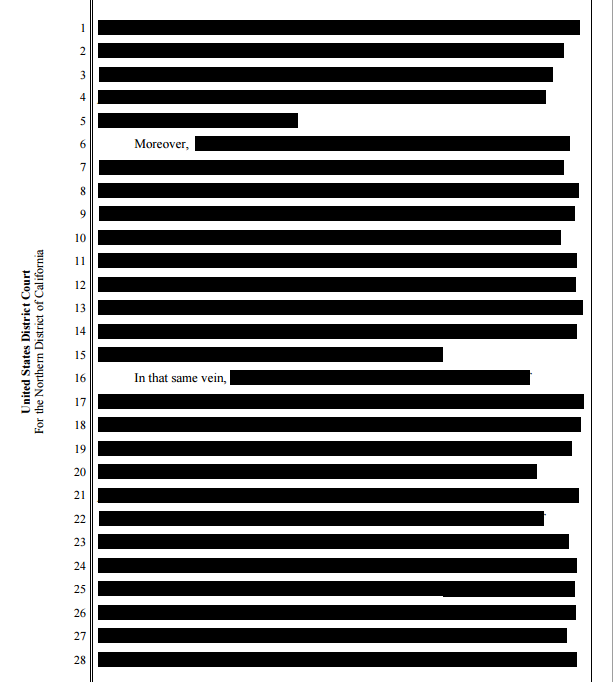
In the meantime, I have a proposed example of what DOJ should submit to Reinhart. Yes, this example is from CAND, not SDFL, but it is exactly what ought be handed over to Reinhart. And if Reinhart grants any “redacted version”, DOJ should appeal immediately and fully. Leave the affidavit sealed. The voyeuristic public, and press, thinks they have an interest because Trump. But they really do not. Do it the right and normal way.

Share this entry

Merrick Garland Preaches to an Overseas Audience

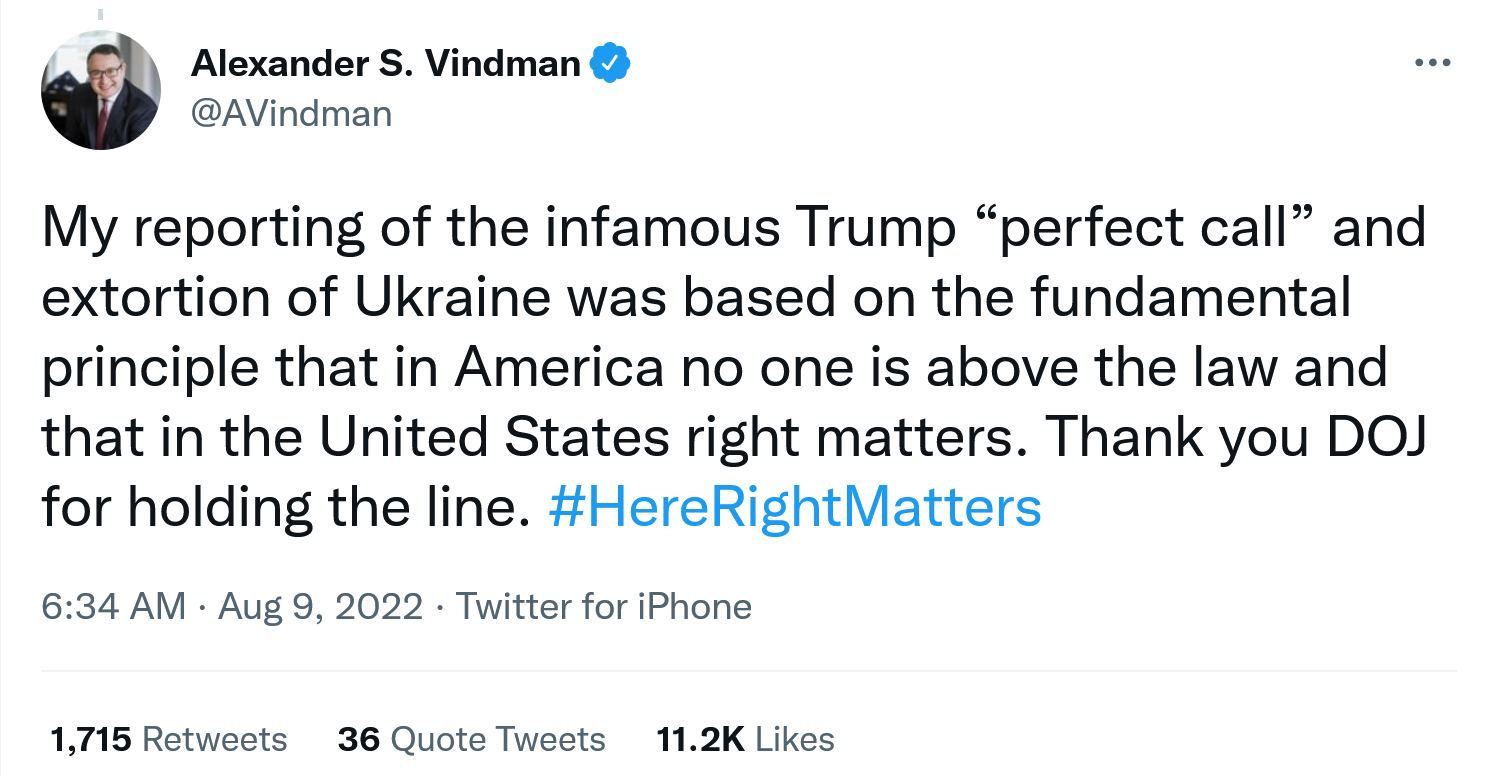
Alexander Vindman thanks Attorney General Garland

When Merrick Garland gave his brief press statement yesterday about the search of Mar-a-Lago, he had various audiences in mind. One was Donald Trump and his defenders, calling their bluff by announcing that the DOJ was moving to unseal the search warrant and list of items seized. Another was his own DOJ employees, to let them know that he had their backs and would support them when the rightwing attacked them. But as I listened to him, I thought that perhaps the most critical audience were the leaders of nations all around the globe — and especially the heads of their intelligence services. When hours later the story broke that some of the documents the DOJ were seeking were nuclear related, I dropped the mental “perhaps”. To build on one of Marcy’s previous posts, let me add that this is a huge foreign policy story, which is largely missing from the current discussion in the media.

Think back to the beginning of the Trump administration. On May 15, 2017, a disturbing story hit the news:

President Donald Trump disclosed highly classified information to Russia’s foreign minister about a planned Islamic State operation, two U.S. officials said on Monday, plunging the White House into another controversy just months into Trump’s short tenure in office.

The intelligence . . . was supplied by a U.S. ally in the fight against the militant group, both officials with knowledge of the situation said.

H.R. McMaster categorically denied it, and as the story unfolded over time, McMaster was lying through his teeth. The unnamed ally was later revealed to be Israel, who had a mole inside an ISIS cell. And Trump blithely blew the cover of that Israeli asset by bragging to Lavrov.

Shortly after this meeting (at which Trump also bragged about just having fired James Comey), US intelligence officials made a bold move. From CNN:

In a previously undisclosed secret mission in 2017, the United States successfully extracted from Russia one of its highest-level covert sources inside the Russian government, multiple Trump administration officials with direct knowledge told CNN.

A person directly involved in the discussions said that the removal of the Russian was driven, in part, by concerns that President Donald Trump and his administration repeatedly mishandled classified intelligence and could contribute to exposing the covert source as a spy.

The decision to carry out the extraction occurred soon after a May 2017 meeting in the Oval Office in which Trump discussed highly classified intelligence with Russian Foreign Minister Sergey Lavrov and then-Russian Ambassador to the US Sergey Kislyak. The intelligence, concerning ISIS in Syria, had been provided by Israel.

This was the opening act of the Trump presidency. From the very beginning, intelligence officers worried about how Trump handled classified information. Our intelligence officers worried, and so did the intelligence officers of our allies, as they asked themselves some version of the question “Will Trump say something or do something that will get us killed?” In a completely different way, so did the intelligence officers of our adversaries. If Trump were to rashly reveal something he learned about the capabilities of our adversaries, it could have disastrous consequences for those countries and their leaders, as the reaction to the revelation could easily spiral out of control in unforeseeable ways.

And the damage was done.

A lot of the work of intelligence services is, if not cooperative, then transactional. “I have some information you would like,” says an ally to us, “and we’ll pass it along to you in exchange for something we need.” That favor might be us passing information back to them on another subject, or supporting some foreign policy objective. That favor might be immediate, or something later. Among the Five Eyes nations (US, UK, Australia, New Zealand, and Canada) and the major NATO allies, that relationship was formalized into regular practice.

But now, with Trump’s first foray into intelligence matters, all these countries worried about passing things along that under previous administration they never would have hesitated to share. With good reason.

Fast forward four years, past all the bizarre meetings with Russia where notes were not taken, past the stunning press conference in Helsinki where Trump declared he trusted Putin’s word over the word of his own intelligence services, past all the coddling of authoritarians, past all the threats to withdraw from NATO, past all the insults to our allies around the world . . . Fast forward past all of that, and there came November 2020. On the Sunday after the election, when Biden was declared the president-elect and foreign leaders began to offer their congratulations, the New York Times discussed the deeper reactions of European leaders to Biden’s election:

David O’Sullivan, former European Union ambassador to the United States, said he looked forward to a renewal of American leadership — if not the hegemony of the past, then at least “America’s role as the convening nation” for multilateral initiatives and institutions.

But the world has changed, and so has the United States, where the Biden victory was relatively narrow and not an obvious repudiation of Mr. Trump’s policies. A fundamental trust has been broken, and many European diplomats and experts believe that U.S. foreign policy is no longer bipartisan, so is no longer reliable.

Biden, with his decades of experience with foreign policy, knew this was true, which meant that two of his most critical appointments would be his Secretary of State and his CIA Director. For State, he chose Anthony Blinken, who had served in the State Department under President Clinton and on the White House national security staff in both the Clinton and Obama administrations, and for CIA he chose William Burns.

Burns was not a product of the intelligence community. He was a career State Department diplomat, but not just any diplomat. From 2001 to 2005, as the US reacted to the attacks on 9/11, Burns was the Assistant Secretary of State for Near Eastern Affairs — that is, the Middle East. From 2005 until 2008, as Vladimir Putin tightened his hold of the office of President of Russia following the chaos of the Yeltsin era, Burns was the US Ambassador to Russia. From 2008 to 2011, Burns held the position of Undersecretary of State for Political Affairs – the #4 position at State and the highest office reserved for a career foreign service officer. By the end of his 32 year tenure, he held the rank of Career Ambassador – the State Department’s equivalent to a four-star general.

Beyond running the CIA, the new director had to rebuild all those broken international relationships and restore that “fundamental trust” between the US and the world. That’s what made Burns such a great choice.

When the National Archives discovered classified information had not been turned over when Trump left office, they brought the news to the DOJ. I have this vision of Garland swallowing hard, and then arranging a meeting with Burns, DNI Victoria Nuland Avril Haines [corrected], and the other US intelligence agency heads to let them know what Trump had done. I can see the shock on their faces, followed by the “of course he did” sighs of resignation. Then the wheels start turning as each tries to figure out how this affects their agency.

But I also imagine Burns, either in the meeting or in a private conversation, telling Garland one thing: “I have no doubts about your department and your passion for justice. If there is anything I can do to assist, just let me know. I won’t press you to share things with me that you shouldn’t share — you do your job and I’ll do mine. But there’s one thing you need to know. You may already know it, but let me reinforce it. The. Whole. World. Is. Watching. Our allies are just beginning to trust us again, and how you handle this will determine whether that continues or is blown to bits. From a foreign policy perspective, especially on the intelligence side, we *have* to get this right.” That’s total fantasy on my part, but I’m reasonably confident that something like that was communicated, one way or another.

Two days ago, when the search was first revealed, Garry Kasparov tweeted, “For those who live where the law exists only to serve the powerful and oppress the rest–as I did in the USSR and Putin’s Russia–the dictum that no one is above the law is nearly awe-inspiring.”

The American legal community is watching this all unfold very carefully, with an eye toward all the minutia of the various legal questions at issue. The US political folks on every side are watching this carefully, with an eye toward the midterms and 2024. US media organizations are watching this carefully, trying to figure out how to cover the story. Ordinary Americans are watching this carefully, for all kinds of reasons.

And beyond our borders, the whole world is watching, as that Kasparov tweet indicates. It shows that Garland is reaching that worldwide audience, even before the word “nuclear” became part of the story.

In his long-ago testimony before Congress about that “perfect phone call,” Alexander Vindman captured in three words the essence of US foreign policy, and he repeated them as a hashtag in that tweet above. In the actions of the DOJ this past week, Garland is giving Vindman a big “Amen.”

Russia, if you’re listening, listen to Vindman. #HereRightMatters indeed.

I know we’ve got a fair chunk of readers outside the US, and I’d love to hear in the comments what you all are seeing in the coverage your countries.


Share this entry

Three Things: Let’s Give Them Something to Talk About

[NB: check the byline, thanks. /~Rayne]

Before I go any further, I’m going to point to one of Marcy’s past posts:

What DOJ Was Doing While You Were Wasting Time Whinging on Twitter July 16, 2022

Whinger Verbs: To Investigate … To Prosecute … To Indict March 26, 2022

The Eight Trump Associates Whom DOJ Is Investigating February 8, 2022

While TV Lawyers Wailed Impotently, DOJ Was Acquiring the Communications of Sidney Powell, Rudy Giuliani, and (Probably) Mark Meadows February 2, 2022

Merrick Garland Points Out that Misdemeanors Are Easy January 5, 2022

Ten Things TV Lawyers Can Do Rather than Whinging about Merrick Garland December 3, 2021

Oops, that’s more than one post. Yeah. All that for the last eight months at least, with receipts along the way.

~ 3 ~

On Monday July 25, the Murdochian Wall Street Journal dumped:


DOJ has been one degree of separation and less from Trump in its investigation, but unsurprisingly so to those paying attention.

What may be more interesting is that it was the Wall Street Journal. Are the Murdochs and News Corp finally throwing in the towel on Trump?

~ 2 ~

Just before 7:00 pm ET last evening, the Washington Post published this piece confirming the DOJ was investigating Trump:

Shocking, SHOCKING, I tell you. Not.

~ 1 ~

In a bid for relevancy, the New York Times dropped this We, Too piece last night after WaPo’s piece above:

Unsurprising that communications of those close to Trump are under scrutiny. Especially since DOJ has had so many messages in their possession for months, like Giuliani’s.

~ 0 ~

I’m sure you’ll hear more from Marcy she’s got time, stable internet access, and something dramatically new and important arises.

This is an open thread. Have at it.

Share this entry

EDNY Notes that Tom Barrack Won’t Explain the Tactical Advantage of Waiting to Charge Him

I continue to follow Tom Barrack’s prosecution with interest, not least because it is the single example of a case that arose out of the Mueller investigation, was largely completed while Trump remained in office, yet was only charged after Merrick Garland took over.

As I noted last month, Barrack filed a motion to dismiss based, in significant part, on the two year delay between the time he interviewed with the FBI and when he was charged.

The government has submitted an omnibus response to Barrack’s filing as well as one from his alleged co-conspirator, Matthew Grimes (whose motion to dismiss focused more closely on the Foreign Agent statute under which they were charged).

The motion shoots down Barrack’s claims that the delays — and the treatment of his interview just like all other non-custodial FBI interviews — will make it harder for him to defend against the false statement charges, noting in part that he had a room full of lawyers with him making their own record of what he said.

Barrack claims that because of the purported delay, he is unable to obtain (1) “critical proof to establish what he was asked and how he answered” questions when he was interviewed in 2019; and (2) evidence of records from others of communications he may have had. Id. Neither has merit.

First, Barrack was represented by multiple attorneys who took notes during the 2019 interview, presumably with the intent of creating the “critical proof to establish what he was asked and how he answered” of which defendant claims he has been deprived. Barrack Mot. at 38. Barrack fails to articulate how these notes would have been more helpful to the defendant if the charges were brought earlier. And Barrack identifies no other proof that he could have gathered regarding his statements at his interview, had he been indicted earlier. As a result, Barrack not only fails to establish a substantial, actual, non-speculative prejudice, but fails to establish any prejudice at all. See Birney, 686 F.2d at 105-06.

More coyly, however, DOJ notes that Barrack has not tried to obtain any records from the Trump administration that might undermine the charges against him nor has he identified any witnesses who would have testified in his favor two years ago who cannot now.

Second, Barrack does not provide a single concrete example of attempts that he has made to obtain documents or offer examples about how these attempts have been thwarted by the passage of time. See Barrack Mot. at 38. He does not specify what documents he could have obtained, from whom he would have obtained them, or make any claims that this evidence would have been admissible. He merely speculates that the evidence could have helped his defense.

[snip]

Finally, Barrack makes a general claim about a loss of memories, without identifying a single witness who is now unavailable due to loss of memory. See Barrack Mot. at 39. “Faded memories or unavailable witnesses are inherent in any delay, even if justifiable.

[snip]

Even were Barrack to provide the names of witnesses with failing memories, this in and of itself would still be insufficient.

[snip]

He must also show that the witness would have testified, withstood cross-examination, and that the jury would have found the witness credible.” (citations omitted)); see also United States v. Valona, 834 F.2d 1334, 1339 (7th Cir. 1987) (noting that prejudice analysis must consider whether the missing witness “would have withstood cross-examination,” whether the jury would have found him a “credible witness,” and whether the testimony, when compared to other trial evidence “would affect the trial outcome” (internal quotation marks and citations omitted)).

Here, Barrack has not alleged that anyone would have been available to testify in the first instance, much less that he or she would have voluntarily agreed to testify at his trial in a way that would help, rather than hurt, Barrack.

There are, surely, witnesses who would have testified in favor of Barrack if they expected their own testimony would be immune from consequences or that they’d be receiving a pardon. Paul Manafort, for example, is a key witness to Barrack’s actions.

The government’s filing reveals more details about the circumstances of his interview in 2019 at which he allegedly lied. After he was alerted to the investigation, he asked for the interview and then — the government claims — he told a number of blatant lies about his own conduct.

After Barrack subsequently became aware that he was being investigated by the FBI for his actions at the behest of the UAE, Barrack, through counsel, contacted the government and affirmatively requested an interview. After the government consented to the request, the interview was scheduled for June 20, 2019, at the law firm offices of Barrack’s counsel in Washington, D.C. FBI special agents traveled from New York to Washington, D.C. to attend the interview. During the interview, Barrack was represented by multiple attorneys and was advised that the interview was entirely voluntary and that he was free to end the interview at any time. During the interview, an FBI special agent took detailed, contemporaneous notes, totaling more than 50 pages. Barrack’s counsel also took contemporaneous notes during the interview, but did not electronically record or transcribe the interview, nor did Barrack ever request that the interview be so recorded or transcribed, despite being the party that requested the interview and set its date, time, and location.

During the interview, Barrack repeatedly and materially lied about the events and activities that underlie Count One and Count Two of the Indictment, including, but not limited to, making misstatements about whether Al Malik proffered policies or requests to Barrack on behalf of the UAE, whether he was ever asked to download a messaging application or acquire a dedicated telephone to communicate with UAE officials, whether he facilitated communications between President-Elect Donald Trump and UAE officials after the 2016 Presidential Election, and whether he provided any guidance or input in arranging a former U.S. official’s meeting with a senior UAE official. Indictment ¶¶ 91-92, 98-107.

As I described, these alleged lies will make the core 18 USC 951 charges far more durable. Indeed, the government makes precisely that point: if Barrack was not intentionally hiding his ties to the Emirates, then why would he tell blatant lies about it?

Although not dispositive to Barrack’s vagueness challenge, if Barrack actually believed that he had done nothing wrong, it is unclear why he allegedly lied to FBI special agents during his voluntary June 20, 2019 interview as set forth in Counts Three through Seven of the Indictment.

But the circumstances of his charges raise questions about how he learned he was under investigation and whether he had any belief that if he lied to protect himself (and Trump) — as so many other Trump associates were prosecuted for doing — he could expect impunity.

Share this entry

Three Things: A Three-Ring Circus

[NB: Check the byline, thanks. /~Rayne]

Under the enormous canvas tent of the United States, come see the mightiest extant amusement organization, superior in character, regal in appointment, magnificent in conception, omnipotent in strength, with hundreds of witnesses, a plethora of attorneys and paralegals, the promise of the wild beast-like Chansley, multiple frustrated judges…

And one orange-tinted slack-bottomed kack-handed clown unseen off the stage entantrumed in the wings.

Ladies, Gentlemen, and those of pronouns without and within, welcome to the American circus.

I can’t even begin to imagine what all of this looks like from abroad.

~ 3 ~

Arguments just wrapped up in the U.S. Court of Appeals for the DC Circuit regarding former president Trump’s claim of executive privilege over testimony and materials subpoenaed by the House January 6 Committee. Twitter threads covering the hearing’s progress:

For BuzzFeed:


For DailyKos:

Stream the audio of the arguments on YouTube at: https://youtu.be/DcMnkpZOpxo

I have to admit this hearing is making me grit my teeth. No one is above the law; the executive’s job is to execute what Congress legislates, and Congress cannot do its job effectively without oversight of the executive’s work when its work product is not related to classified national security issues. There’s zero executive privilege for testimony and materials related to campaigning if performed in and by the White House.

~ 2 ~

Convicted shaman insurrectionist perp Jacob Chansley filed an appeal today.

Good luck with that, buddy. What a waste of a lengthy mea culpa in court.

Chansley wasn’t the only lower level perp on the agenda today — check Scott MacFarlane’s Twitter feed for more including another perp charged and another arraigned today.

~ 1 ~

Washington Post published an article today about Trump’s former chief of staff Mark Meadows, who until now has completely resisted compliance with a House January 6 Committee subpoena. Here’s the timeline of related events:

September 23, 2021 — House January 6 Committee issued a subpoena to Meadows;
October 7, 2021 — Due date for records subpoenaed;
October 15, 2021 — Deposition deadline;
November 11, 2021 — White House Deputy Counsel sent a letter to Meadow’s attorney advising that President Biden would not exert executive privilege over any testimony or records the House January 6 Committee subpoenaed;
November 11, 2021 — U.S. Court of Appeals for the D.C. Circuit blocked handover of National Archives’ presidential records responsive to a January 6 committee’s subpoena;
November 12, 2021 — Meadow’s attorney issued a statement which said Meadows would not cooperate with the committee until after the legality of the subpoenas was settled in court;
November 30, 2021 — See Thing 3 above, Court of Appeals for the DC Circuit hearing today regarding subpoena of testimony and records over which Trump claims executive privilege.

Hed and subhed of WaPo’s article today:

Former White House chief of staff Mark Meadows cooperating with Jan. 6 committee
Meadows has provided records to the committee investigating the attack on the Capitol by a pro-Trump mob and will give a deposition.

“Cooperating” is rather broadly used. Committee chair Bennie Thompson issued a statement today about Meadows:

“Mr. Meadows has been engaging with the Select Committee through his attorney. He has produced records to the committee and will soon appear for an initial deposition. The Select Committee expects all witnesses, including Mr. Meadows, to provide all information requested and that the Select Committee is lawfully entitled to receive. The committee will continue to assess his degree of compliance with our subpoena after the deposition.”

“has been engaging” isn’t the same as cooperating; an “initial” deposition doesn’t mean anything until Meadows has actually answered questions put to him without prevarication.

As Marcy tweeted, “Meadows could invoke a bunch of things and avoid testifying and avoid contempt that way.

Betting this “cooperating” is a stall tactic which won’t end until the Department of Justice indicts Meadows for contempt of Congress as they did Steve Bannon.

But perhaps there will be more than two charges if Meadows “has been engaging” in a little light obstruction.

Sure hope for his own sake Meadows turned information related to his phone records.

~ 0 ~

What other hearing(s) did I miss? Share in comments.

Share this entry