

There’s a general reason and specific reasons why people should care about Bill Essayli’s response to David Huerta’s motion to compel the government to turn over metadata associated with the evidence obtained against him.
Generally, DHS has permitted — encouraged, seemingly — DHS officers to use their own personal phones and to use Signal. And whether officers are using their own or government phones, DHS ditched its archiving software last year; it is relying on officers’ taking screen caps of relevant communications.
The Department of Homeland Security has stopped using software that automatically captured text messages and saved trails of communication between officials, according to sworn court statements filed this week.
Instead, the agency began in April to require officials to manually take screenshots of their messages to comply with federal records laws, citing cybersecurity concerns with the autosave software.
[snip]
The policy expects officials to first take screenshots of the text messages on their work phones, send it to their work email, download it on their work computers and then run a program that would recognize the text to store it in searchable formats, according to the department’s guidance submitted to the court.
Under the Federal Records Act, government agencies are required to preserve all documentation that officials and federal workers produce while executing their duties. They have to make federal records available to the public under the Freedom of Information Act unless they fall under certain exemptions.
And we’ve seen AUSAs rely on officers themselves to review their own devices for communications covered by discovery.
In the LaMonica McIver case, for example, officers didn’t turn over exculpatory texts until Judge Jamel Semper ordered supplemental discovery.
It wasn’t until November 26 — almost two weeks after Judge Jamel Semper ruled on McIver’s immunity bid — that DOJ turned over texts copying this video, observing that it looked bad.
5 The Spotlight News video came to light during the course of supplemental briefing only because it was referenced in a May 9, 2025, text message that the government finally turned over on November 26, 2025. HSI special agents exchanged the video in that May 9 conversation, where the agents also acknowledged that the evidence in the video was “bad.” Ex. Y at 2-3. The prosecution team therefore clearly knew about the text messages (and thus the video) when disclosures were due in July.
McIver’s lawyer, Paul Fishman, says he will address this delayed discovery in a follow-up letter.
Inexplicable delays in the government’s discovery productions mean that the record continues to be developed.1
1 Congresswoman McIver will detail these shortcomings in a forthcoming letter to the Court.
But the implication of this is clear.
DOJ was never going to turn over these discussions — conducted on Signal — until Judge Semper ordered this supplemental briefing. They were sitting on evidence that shows that before DHS first started calling McIver’s actions an assault on May 10 (McIver had to ask to have these Tweets taken down, but the timeline is in her motion to do so), they had shared video noting that their own actions looked bad.
Consider how this policy would work in the case of Jonathan Ross’ killing of Renee Good. Given that Ross’ video of the killing was released unofficially, it seems likely he was using his own phone that day. Particularly given the impunity with which Pam Bondi has treated him so far, there’s no reason to believe he’d retain anything incriminating himself, much less people like Greg Bovino or Stephen Miller.
It would take someone actually seizing his phone to see if there are incriminating details about his own motives.
That’s what David Huerta is asking for: that DOJ provide the metadata associated with both the videos and texts messages surrounding the day.
The metadata Mr. Huerta requests here—for the agents’ text messages already produced in this case,10 and for the photos and videos taken of the scene on June 6 and already produced—is critical and material to his ability to adequately prepare for his defense in this case. It is also relevant to understanding the sequence of events that occurred on June 6, both the actions of protestors and Mr. Huerta at the scene (e.g., shown in photographs and video recordings) and the agents’ statements to one another and activities that day as reflected in the text messages. Lastly, the metadata information affiliated with iPhone photos and messages is routinely stored in the ordinary course for such ESI, and would be straightforward to extract from the agents’ cellphones or devices. Moreover, producing the photos and videos in a native, load-ready format along with a corresponding index is routinely done in criminal cases by the Department of Justice.
10 Because the agents’ text messages and the photos and videos have already been collected by the government in this case and produced to the defense, there can be no dispute about the government’s “possession, custody, or control” of that material and/or those devices, as the government already had, and likely continues to have, access to them in preparing their discovery productions.
Even if these witnesses — HSI Supervisory Agent Ryan Ribner and Undercover Officer Jeremy Crossen — were reliable, this would be a reasonable ask. While the bulk of the video in discovery is unavailable publicly, the texts are difficult to unpack, and because Ribner “wrote the arrest report … from memory,” there are time discrepancies between the narrative he tells in the arrest report and the texts, to say nothing of additional discrepancies in Crossen’s countersurveillance report.
But these witnesses are not reliable. Crossen, for example, told interviewers that he was using his personal phone because his government phone “was not working at the time of the incident.”
TFO Crossen stated he used his personal phone to document the events which was turned over to an HSI Computer Forensics Agent (CFA) to download and preserve evidence.
TFO Crossen stated his government issued phone was not working at the time of the incident.
Except his texts show he switched phones during the incident (his testimony is so inconsistent I actually misunderstood whose phone this was on first read).

Plus, he told Ribner had had a couple hundred videos. The discovery includes far short of that.

And that’s just one reason to question Crossen’s candor when he told investigators, “he did not alter or delete any videos.” There are other holes in what appears in exhibits (this may be available in videos): he told investigators that somebody — I think he means protestors — called out “he’s a union member,” about Huerta, which is … not how I’d expect people in left-leaning politics to describe a senior SEIU official. The specific description of Huerta would go to the denials of everyone involved that they assaulted Huerta because he is a senior union official.
And Crossen described not filming the most important footage for this case, purportedly showing Huerta standing right in front of the van, rather than to its side, where the DHS goons assaulted him.
TFO Crossen recalled that immediately before 0:10 seconds before starting video 2790, he observed HUERTA standing in front of the van, closer to the center of the van. He stated that he did not film that particular moment because there were a lot of distractions “from persistent instigators” including HUERTA.
And that’s why Essayli’s argument — that DOJ can provide Electronically Stored Information in whatever format they want so long as it maintains the data integrity — falls short.
In relevant part, the ESI protocol recommends that (1) after conferral, any format selected for producing discovery should maintain the ESI’s integrity, allow for reasonable usability, and reasonably limit costs, and, if possible, conform to industry standards for the format;
Crossen’s testimony, along with problems in the testimony of others, raises more than enough reason to question the integrity of the data as provided. A Cellebrite extraction, which is what Huerta is asking for, would show whether there were gaps in production.
Essayli is also citing in poor faith to misrepresent Huerta’s argument (and in his motion to dismiss, switched between PDF and document page numbers, further obscuring his references). He repeatedly claims Huerta just wants DOJ to create a searchable index.
To the extent defendant is requesting the government create an index of the metadata in a searchable format, see Dkt. 58 at 3:1-5, that request is beyond the government’s discovery obligations.
[snip]
Instead, defendant’s true complaint is that the government has not created a searchable index of the photos’ and videos’ metadata. (Dkt. 58 at 3.)
But the cited passage (this is on document page 2) reveals they’re asking for far more than that.
The screenshot PDF images of the messages do not contain any metadata affiliated with the messages or the source iPhones, and no corresponding index was provided to defense counsel with this information. Notably, the phone numbers belonging to the sender(s) and recipient(s) of the messages, or even the iPhone contact cards, were not included in the production or visible in the screenshots. Nor do the iMessage screenshots contain a timestamp for each message; while some messages do have a timestamp at the top (sometimes owing to a gap in time), many of the messages contain no timestamp whatsoever.6 Additionally, because of the nature of the initial production (individual PDFs named only by “IMG” file number), there is no way in which to tell who the owner and custodian (e.g., which agent) is of each set of messages and each phone. Additionally, due to the screenshot nature of the messages, certain messages are cut off and the messages were not all provided in chronological order to Mr. Huerta. Finally, the iMessage screenshots do not contain any geolocation or coordinate information, if any is available, as is often part of cellphone metadata or any “native” file.
There are a whole bunch of reasons this is necessary to reconstruct what happened.
But in DHS’ new parallel evidentiary role, it’s not clear whether Huerta — or any of the other people accused of assault using evidence from officers’ personal cell phones — will have access to that.
F[ucking] A[sshole] Bill Essayli submitted his response to David Huerta’s motion to dismiss his information (see this post for an explanation of why I’m calling Essayli, “F[ucking] A[sshole]”).
Here’s a summary of the argument: Huerta intentionally blocked the only available entrance of the search (but not arrest) location, he did this via means other than standing in front of a van, and encouraged others to do so, which led (after Ryan Ribner assaulted Huerta) LAPD to declare a riot.
During the execution of a search warrant, defendant intentionally blocked the only available entrance of the Warrant Location. He did this by sitting down and walking in circles directly in front of the entrance of the Warrant Location, making it impossible for any law enforcement vehicles to enter or exit, without defendant moving. In addition, he also successfully encouraged other individuals to join him in blocking the entrance of the Warrant Location in the same manner eventually contributing to LAPD declaring a riot at the Warrant Location. As defendant concedes in the Motion, defendant was told explicitly he “shouldn’t block or impede the [law enforcement vehicle] that would be arriving.” (Dkt. 55 at 14.)
Even this passage conflates two things Huerta did — sit, and picket, before the van showed up — with blocking it.
But the most interesting part of the passage is that word “available,” which is doing a lot of work. Along with the filing, DOJ submitted seven exhibits: three compilations of video (filed manually, so we don’t get them), and the interview reports from HSI Special Agent J Smith (who seems to have overseen the search), a second interview with the van driver, Brian Gonzalez, an interview with HSI Special Agent Andre Lemon, who helped Gonzalez change a tire, and a picture of the tire that got slashed while or shortly after Huerta was being assaulted. These late interviews appear to be an attempt to salvage the case with witnesses besides Ryan Ribner and Carey Crook, the guys who assaulted Huerta. DOJ is spinning a new story that because of what happened with Huerta — that is, because Ribner, especially, assaulted the SEIU CA President — HSI had to flee the site of the search hours earlier than they otherwise would have, which limited the number of undocumented workers they could detain, which wasn’t supposed to be the point of the search.
As Lemon described, they fled out a back gate.
SA Lamon stated they loaded the vehicle with “Some of the detainees and snuck out of the back gate”.
You see, from the moment I read this line in Ribner’s affidavit supporting the arrest warrant, I was pretty sure there was another gate ready to open, just like Chekov’s gun, a plot point that must be resolved.
Our trusty cyber expert also suggests that the van entering the gate of the facility — the predicate for making Huerta move and therefore the predicate to tackling him, injuring him, and then arresting him — may not, after all, be the only entrance. He describes that “as far as I was aware,” it was.
As far as I was aware, this gate was the only location through which vehicles could enter or exit the premises.
I wonder whether his awareness has changed over the weekend.
Ribner said a bit more about Chekov’s gate in the arrest report (and also revealed that he left in a caravan via “the secondary gate,” which he did not otherwise explain).
ERO SDDO C C approached SSA Ribner to discuss a plan to safely escort an ERO USG vehicle into the facility. SSA Ribner provided the same information to SDDO C as he did to the DEA agents regarding subjects potentially impeding/blocking agents and USG vehicles. SDDO Cr asked if there was another entrance/exit to the facility; SSA Ribner related that he did not have knowledge of a secondary entrance/exit. SSA Ribner related that agents would need to go outside of the gate and encircle the sides of the van to make sure it isn’t blocked and/or damaged. SDDO C asked how agents would move the pickup truck [playing loud music] from the driveway. SSA Ribner advised that he would verbally request the driver to move the truck. [my emphasis]
DOJ didn’t bother to ask Crook whether he knew of a second gate last August, as it became clear neither his nor Ribner’s testimony was credible. But his interview report describes that Crook, “recalled himself and GS Ribner coming up with a plan for the main gate to slightly open to allow the van to enter the property and then close it after the van entered,” just before he made a claim — that Huerta had “straddle[d] the hood of the van” and “ma[de] his body an X,” a claim no other witnesses nor the video corroborated.
The “main gate.”
You only call something a main gate if you know there’s another.
Brian Gonzalez — the guy who drove the van and all of a sudden remembered David Huerta being close to it after he got a permanent job at CBP and had a follow-up call, probably the guy DOJ hopes will be their star witness given problems with calling Ribner or Crook to the stand –was not asked about any gates in his first interview (or the follow-up, where his memory about Huerta evolved).
But in his interview last week, he was asked about the gate.
Before I explain what he said, note that the F[ucking] A[sshole] Bill Essayli confessed in his response that earlier — right up until the moment David Huerta arrived, Essayli seems to suggest — DHS had no problem getting cars and vans through the entrance where protestors were.
Shortly thereafter, between 10:30 a.m. and 11:45 a.m. demonstrators began to show up at the Warrant Location and congregated near the entrance to the front gate. During this initial period, before defendant arrived, the demonstrators did not block the driveway and repeatedly allowed vehicles to enter and exit the Warrant Location through the front gate. (Ex. 1 at 7:30-7:35; 8:16-8:27; Ex. 2 at 4:25-5:25, 7:49-7:53, 8:22-8:26, 9:45-9:48, 11:47-11:58.)
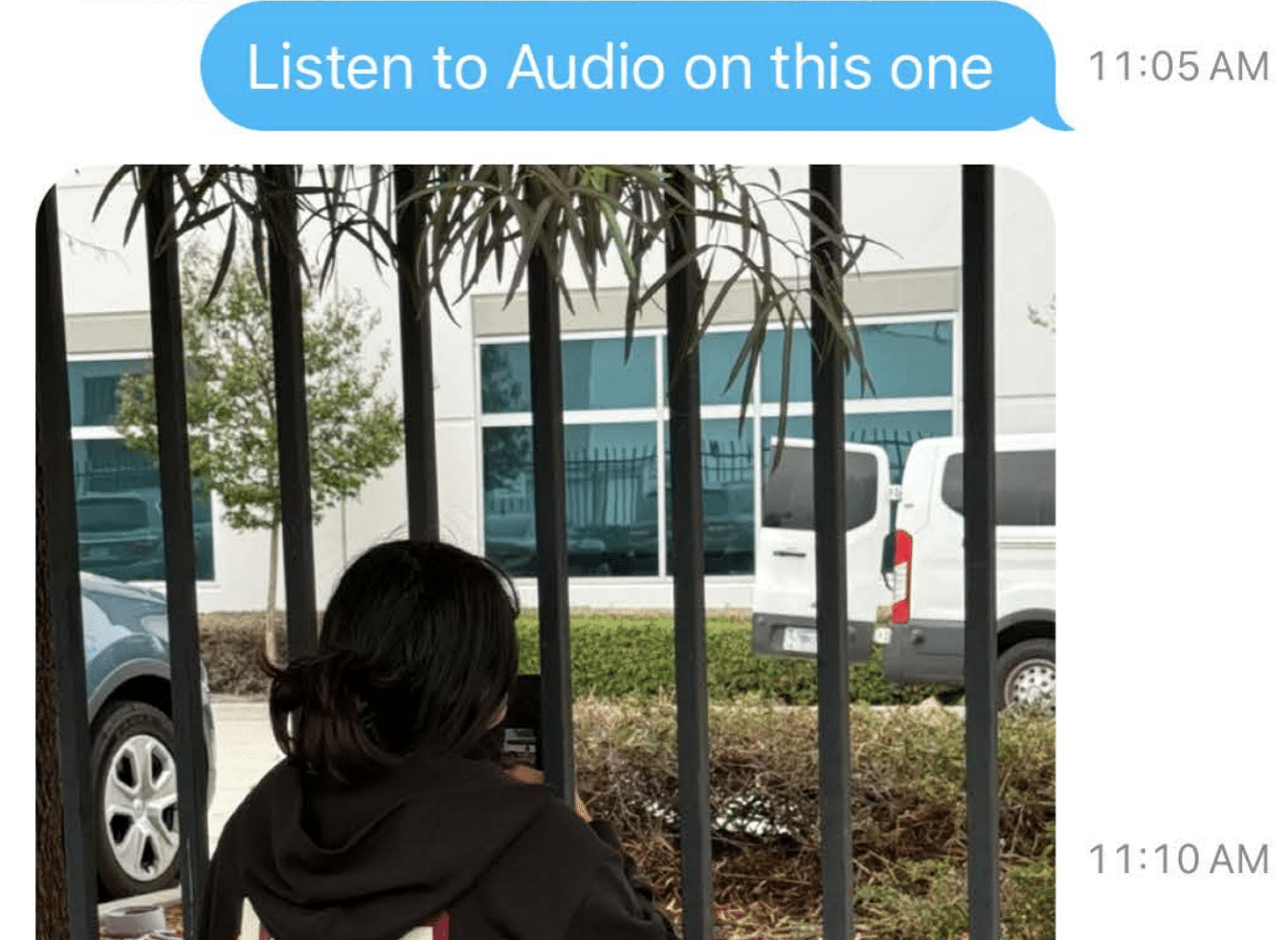
There was a white van captured in one of Jeremy Crossen’s photos, showing a time stamp of 11:10 (it’s possible the van in one or both of these pictures is the one driven by Gonazalez; per Google his drop-off at the Federal Building was a 9-minute drive away).

Crossen’s countersurveillance report describes what may be this van — at around that time, a van and a beige car were able to pass through the gate because someone asked nicely for the protestors to move and they complied.
At approximately 11:25 a.m., The southwest gate of the business opened, and a beige Toyota sedan and a white ICE ERO transport van approached the south apron of the driveway. As the gate opened, UHM-1 ran from where he was standing, just east of the apron. UHM-1 initially stood center driveway of the apron, blocking the egress of the car and van while filming. An unidentified agent standing just north of the gate ordered UHM-1 to move and he subsequently complied.
Half an hour later, per Crossen’s report, a mini-convoy came up at a time when Huerta was legitimately in front of the gate, if we can believe any of these reports (we can’t).
At approximately 11:54 a.m., A black Government Jeep Grand Cherokee, along with several other government vehicles, approached the apron of the driveway from E. 15 Street. The vehicle th remained stopped as both the gate was closed and standing protesters were blocking the apron of the driveway, preventing the vehicle from pulling closer to the south gate for entry into the business. At this time, TFO Crossen observed HUERTA, LENEHAN, UHF-8 and UHM-7 sit down on the ground, approximately two to four feet from the closed gate. TFO Crossen both audibly heard and video recording HUERTA motioning with his left hand with an “enviting motion” to the crowd around him, yelling “Sit down! Sit Down!” repeatedly. HSI Supervisory Special Agent (SSA) Ryan Ribner approached the closed gate from the other side and informed the seated protesters they were impeding the vehicles and needed to move. Upon hearing this, HUERTA, while still seated, “scooted” forward, where he was now seated on his knees, right against the gate. HUERTA ignored SSA Ribner’s orders to move because they were impeding law enforcement vehicles attempting to enter the business. HUERTA yelled to SSA Ribner, “What are you doing! What are you doing! I can’t hear you through your fucking mask! How are you keeping me safe by doing this!” SSA Ribner, calmly again admonished HUERTA that he was impeding law enforcement vehicles from entering.
Those vehicles do not appear in Ribner’s report, as far as I can tell, at all.
There’s no resolution to what happened to those vehicles, though. They disappear from the narrative by the time the van driven by Gonzalez shows up, which is when seven people move to block the van, and oh by the way, so does David Huerta, added as an afterthought in Crossen’s report.
At approximately 12:15 p.m., a white Law enforcement van pulls up to the apron of the driveway, just south of the main south gate with its siren and emergency lights activated. As the vehicle pulled up, agents opened the south gate, and several agents walked from inside the property compound to the apron of the driveway to assist with moving protestors so the emergency vehicle could gain entrance. As most of the crowd moved for the loud audible siren and emergency police lights, LENEHAN, GARDUNO, CUERVO, ALTAMIRANO, UHM-7, and an unidentified Hispanic female, later identified as Edith DIAZ (DOB: /1977; COC UNK) and UHM-8, who was now out of his unoccupied vehicle, which was playing loud music and blocking the apron, ran closer to and in front of the law enforcement vehicle to block it.. HUERTA also moved toward the emergency van with activated lights and siren and stood approximately two feet from the front bumper, directly in front of it, ignoring the emergency lights, activated siren and ignoring agents orders to move.
With all that in mind — with the way that Ribner stages confrontation over the expected appearance of Gonzalez’ van — here’s what Gonzalez said in his interview last week:
Gonzalez stated that he called Enforcement and Removal Operations (ERO), Supervisory Detention and Deportation Officer (SDDO) Carey Crook when he was about a block away from the location.
Gonzalez stated that he drove past the crowd at the front gate and asked SDDO Crook if he could come through the back.
Gonzalez stated that SDDO Crook informed him that the back gate was locked and they didn’t have the keys to the lock.
At noon, when Ribner was staging a confrontation with the people he believed were “vicious, horrible people,” he didn’t know there was a second gate.
But somehow Gonzalez, who found out just that morning he’d be doing this drive and had already done one pick-up that day, knew there was one. Not only Gonzalez knew of it. But Crook — whom Ribner claims asked him, Ribner, if there were a second gate — not only knew of one, but knew it was locked.
When they needed to get by protestors before Ribner had assaulted David Huerta, they asked nicely and everyone complied.
When they needed to get by protestors after Ribner had assaulted David Huerta, they knew exactly how to do that: go out the back door gate, which it turns out they had keys to.
Update: On Thursday, Huerta asked to delay the trial until May. I suspect this reflects a bid by DOJ to implicate Huerta — possibly even to supersede him with a felony — for the punctured tire.
b. Defendant contends that the omnibus opposition and the recent discovery productions of the government raise issues that warrant additional investigation and the need for additional pretrial filings. Moreover, defendant anticipates making additional discovery requests based on and in response to the recent productions of by the government that raise new trial issues.
c. In light of the foregoing, counsel for defendant also represents that additional time is necessary to confer with defendant, conduct and complete an independent investigation of the case, conduct and complete additional legal research including for potential pre-trial motions, review the discovery and potential evidence in the case, and prepare for trial in the event that a pretrial resolution does not occur. Defense counsel represents that failure to grant the continuance would deny them reasonable time necessary for effective preparation, taking into account the exercise of due diligence.
June 6: Arrest
9:00 AM: HSI task force officer (and Inglewood cop) Jeremy Crossen arrives under cover
9:20: Agents start executing search
9:57: Crossen interacts with Asian woman
10:26: Crossen interacts w/Hispanic protestor, claims he is monitoring the police

10:33: Crossen texts Ribner

11:07: Crossen sees pick-up without plates whose Hispanic driver films
11:19: Crossen describes a Hispanic woman with a neck gaiter; his report provides background on a Kids of Immigrants sweatshirt she wears; start time of alleged criminal conduct
11:25: A sedan enters the gate; after an agent instructs those filming it to step away, they do; Crossen texts Ribner,

11:31: A Hispanic woman whom Crossen IDs by name shows up, makes phone calls
11:36: Crossen describes a white woman by name, describes that she masked as the crowd grew
11:37: Crossen describes the Hispanic leader of ACCE Action, Council Member Jose Delgado, show up, make calls
11:49: Crossen claims he sees Huerta walk up
11:51: A white woman from Tenants Union starts yelling obscenities
11:53: Ribner instructs Crossen to focus on Huerta

11:54: Huerta and others sit in front of the gate
12:01 PM: Ribner leaves the property and assaults Huerta [note his report timeline goes haywire in here]
12:00-12:09: Crossen texts Ribner

12:15: Crossen claims van arrives (his description describe others who were in front of the van, then says Huerta also was)
12:15: Ribner calls 911 (claiming this is about pepper spray)
12:18: Crossen describes a scrimmage line
12:20-12:40: Discussions about Huerta’s attempt to call his attorney
12:30: LAFD responds; Huerta asks to be brought to the hospital; Crossen describes LAFD arrival this way:
At approximately 12:28 p.m., TFO Crossen observed a Los Angeles City Fire truck with activated emergency lights and loud audible siren, attempting to gain entry to the business, still being blocked by protestors, to render aid for HUERTA, inside the business, who had been exposed to OC Spray, during his arrest.
12:40: Ribner reports arrest to CACD US Attorney office
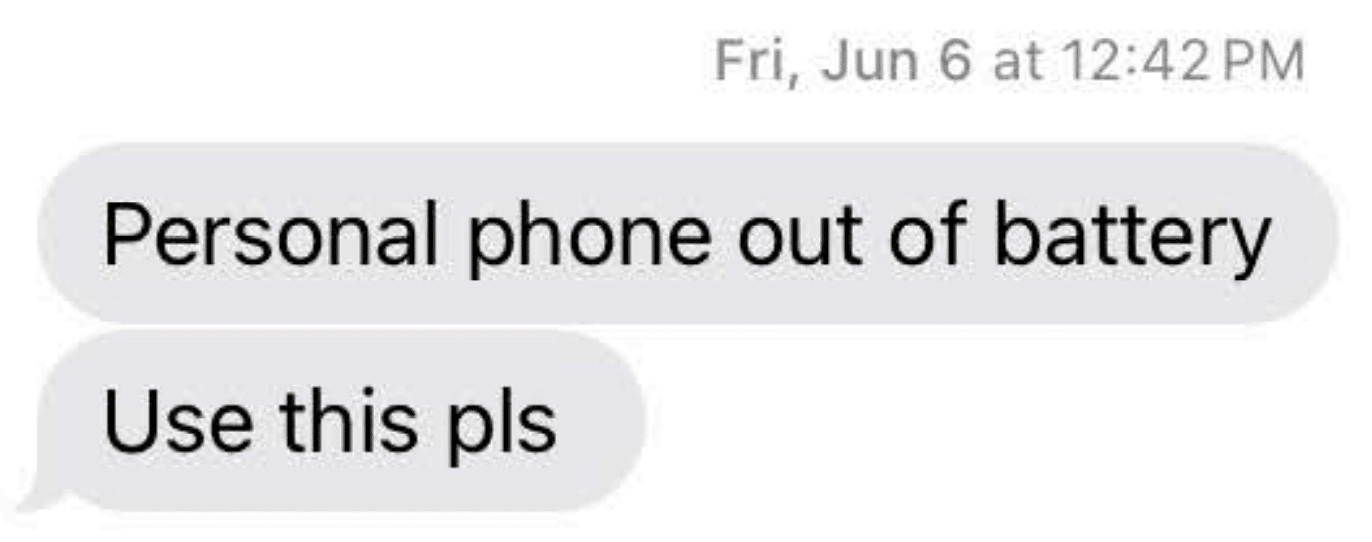
12:42: Ribner tells Crossen his personal phone is out of battery, asks him to use his government one
12:47: Ribner admits he used pepper spray
1:05: Ribner speaks to USAO again
1:30: Huerta taken to hospital w/agent in car
2:45: Ribner asks Crossen for pictures of Huerta

Unmarked time: Mayor Bass shows up to hospital room; they ask her to leave (and she does)
9:12: Crossen sends last clip from videos to Ribner (the discovery turned over provides nowhere near the “4 hours” or “100 videos” that Crossen told Ribner, five hours earlier, that he had taken (though the defense did not include all the texts in their exhibit)
9:36: Ribner obtains warrant for Huerta’s phone
10:30: Huerta attorney turns over the phone
June 8: Huerta charged with felony conspiracy
June 9: Case opened
June 17: Date created for one photo provided in discovery
June 19: Initial incident report; Ribner would later (in his September 10 interview) admit he wrote the report from memory and simply did not “recall that he told HUERTA, ‘You are not impeding’. He does not know why he did not include that statement in his report and agrees that his statement could sound exculpatory.”
June 23: Countersurveillance report from Crossen
July 2: Second set of discovery
July 17: Third set of discovery
July 28: Fourth set of discovery (including agent texts)
August 20: USAO interviews Brian Gonzalez, who drove the van allegedly blocked
August 27: USAO interviews Carey Crook; he told AUSAs that, contrary to Ribner’s claim, Huerta did not assault him
August 27: USAO interviews Crossen
September 9: USAO reinterviews Gonzalez; he says he does not remember Huerta straddling the van, as Crooks claimed
September 10: USAO interviews Ribner
September 11: Gonzalez starts at a new job at CBP
September 17: Later case opening date, possibly focusing on the lying agents
October 17: Huerta charged with misdemeanor
November 5: Huerta’s attorneys ask AUSA to identify the obstructive conduct
December 19: AUSA finally provides vague description of conduct
January 2: Interview of HSI Special Agent J Smith
January 9: Second interview with Brian Gonzalez
January 9: Interview with HSI Agent Andre Lemon
