In the Wake of Trump’s Third Electoral Failure, NYTimes Boasts of Hiring a Third Trump-Whisperer

His sanction-worthy misrepresentations of the Igor Danchenko indictment notwithstanding, Jonathan Swan is a good reporter. Indeed, his move to the NYT, which frees him to write like a human being rather than a McKinsey consultant (AKA Axios style), will likely be a significant improvement on his coverage of DC politics.

But it is downright insane that, at a time the GOP and Fox News are at least making noise about ditching Trump, the NYT pitched this hire — and their own political reporting — in terms of Trump.

Our insightful, authoritative and addictive coverage of the election this year drove home an essential truth: The Times’s political team is simply the best in the business.

Take our coverage of Republicans and Donald J. Trump.

We have Maggie Haberman, the dominant reporter of the Trump era, whose prolific, revealing and exclusive coverage has become indispensable to millions of readers. We have Michael Bender, whom Maggie admired as her “fierce competitor” from his days at The Wall Street Journal, and who has delivered exclusives on everything from the former president’s plans to buy Greenland to examinations of how Trumpism remade the Republican party.

And today we are thrilled to tell you that Jonathan Swan, a gifted, dogged and high-impact reporter, will be joining The Times. Jonathan, a national political reporter at Axios, is one of the biggest news breakers and best-sourced reporters in Washington.

Even if you have never met Jonathan, you know his stories. He first reported that Trump would recognize Jerusalem as Israel’s capital, that the U.S. would pull out of the Paris climate deal, that Steve Bannon would be fired and that Paul Ryan would retire from Congress.

Or perhaps you watched his riveting interview with then-President Trump in 2020, which won Jonathan an Emmy (and made his facial expressions famous.) Ben Smith, the former media columnist for The Times, wrote at the time that it was “perhaps the best interview of Mr. Trump’s term.’’

Jonathan’s nine-part written series on the final days of the Trump administration won broad acclaim, and the podcast on which it was based rose to No. 1 on the Apple charts. [my emphasis]

Again, I think the Swan hire is a net good for reporting — but aside from the degree to which Swan is an improvement over Jonathan Martin, who just moved to become Politico’s Politics Bureau Chief — that has nothing to do with the NYT.

Particularly accompanied as it is by Maggie’s multiple efforts to suggest Trump is still The One, the pitch of Swan as a Trump-whisperer — rather than simply as a very good reporter of right wing politics — this announcement commits to keeping Trump (as a politician, rather than, for example, a criminal suspect, something none of these three are very good at reporting) the center of attention.

And it comes in a piece that boasts of election reporting it calls, “insightful, authoritative and addictive,” but which had some rather spectacular failures — particularly with the Fettrman debate and a correct Kansas poll they downplay. While in August NYT acknowledged that a Red Wave might not come, their review of why it didn’t still seems to misunderstand what it means to vote to save democracy. If you wanted to understand the election, the NYT was generally unhelpful, and that’s before you consider its focus on horse race coverage rather than policy.

They think they did good a job, or at least are telling themselves they did!

Why would you boast that your political reporting is “addictive,” anyway? unless you’re proud of the way Trump used Maggie’s work to flood the zone with press clippings that had the effect of obscuring larger crimes.

The NYT’s pitch of a good reporter in terms of Trump comes as other outlets have made hires based on their shitty news judgment that there would be a Republican wave the outlet would want access into. Most famously, as early as March, CBS hired Mick Mulvaney in anticipation of a non-existent Red Wave still 8 months in the future.

[A] top network executive seemed to lay the groundwork for the decision in a staff meeting earlier this month, when he said the network needed to hire more Republicans to prepare for a “likely” Democratic midterm wipeout.

“If you look at some of the people that we’ve been hiring on a contributor basis, being able to make sure that we are getting access to both sides of the aisle is a priority because we know the Republicans are going to take over, most likely, in the midterms,” CBS News’s co-president Neeraj Khemlani told the staff of the network’s morning show, according to a recording of his comments obtained by The Washington Post. “A lot of the people that we’re bringing in are helping us in terms of access to that side of the equation.”

The thing is, these shitty expectations for a Republican landslide may distort coverage going forward, because multiple news outlets paid big money to invest in access to people who lost, most of all into a guy who lost fairly spectacularly three times now.

As they did in 2020, voters gave democracy another lifeline. They voted, affirmatively, for democracy. But it’s not clear the press view protecting democracy, as opposed to protecting access, with anywhere near the same urgency.

Update: Just as I published this piece, I saw this NYT column, which not only continues to make everything about Donald Trump, fails to account for how narrow margins in both houses change this calculus (particularly with regards to its facile claim that, “party leaders are asked to declare their allegiances to Mr. Trump or other potential rivals”), and has this incredible paragraph:

 First there was Mr. Trump’s proposed Muslim ban, and then the attacks on a federal judge’s Mexican ancestry, the “Access Hollywood” revelations late in the 2016 campaign, his public declaration that he trusted Vladimir Putin more than he did American intelligence agencies.More recently, Mr. Trump has waged a two-year misinformation campaign, claiming his 2020 defeat was “rigged.” His supporters stormed the U.S. Capitol in a violent attempt to disrupted the peaceful transfer of power. He now faces investigations into efforts to overturn the election results in Georgia, into his company’s finances and into his handling of classified documents.

It gets the chronology of the first sentence wrong. It calls Trump’s lies about 2020 “misinformation,” not “disinformation.” It claims he tried to “disrupted” the peaceful transfer of power and not prevent it. It suggests any investigation into an attempt to overturn the election is limited to Georgia. The description of the stolen document investigation as one into “handling” of classified documents misstates the crime, but it par for the course in legacy media coverage of that investigation. (And it has a typeset — with the missing space after the period — and a tense error that suggests it was not edited, even ignoring the lack of Oxford comma.)

Trump no doubt wants to keep himself as the center of attention. He no doubt will demand loyalty oaths from people willing to bet he’ll succeed. But if he does succeed — with whatever catastrophic effect on the country — it will be significantly because of editorial decisions the NYT made.

Share this entry

Trump’s Secret Document, with the Post-Administration Pollster Communication, in His Desk Drawer

In Trump’s stolen document case, the two sides have submitted disputes to Special Master Raymond Dearie. Because some earlier documents remain sealed (because of the hurricane, DOJ says), the most descriptive document included is this one, laying out disputes.

The two sides are fighting over whether Trump’s notes on clippings and briefing books are presidential documents (both are squarely within the Presidential Records Act definition).

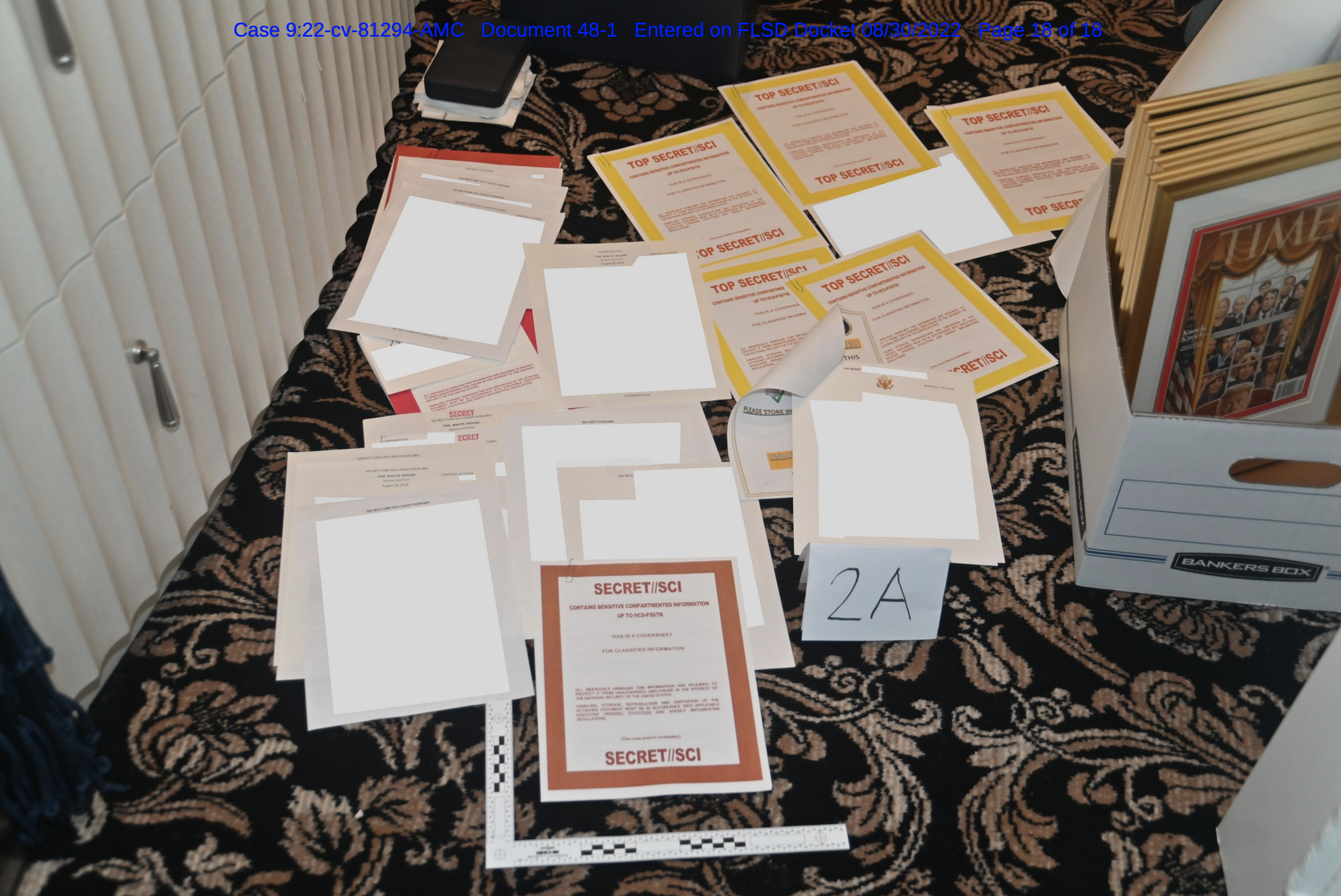
The most interesting description in the document pertains to one particular item over which the two sides are fighting: a “compilation” of two classified documents, with three communications that post-date when he left the White House.

This document is a compilation that includes three documents that post-date Plaintiff’s term in office and two classified cover sheets, one SECRET and the other CONFIDENTIAL. Because Plaintiff can only have received the documents bearing classification markings in his capacity as President, the entire mixed document is a Presidential record.

Besides the classified cover sheets, which were inserted by the FBI in lieu of the actual documents, none of the remaining communications in the document are confidential presidential communications that might be subject to a claim of executive privilege. Three communications are from a book author, a religious leader, and a pollster. The first two cannot be characterized as presidential advisers and all three are either dated or by content occurred after Plaintiff’s administration ended.

This passage explains something I was wondering from the inventory: how DOJ accounted for the classified documents in the Bates numbers. The answer is that FBI included cover sheets to mark where the classified documents were, so they count in the running Bates count.

This particular document (or “compilation”) was in a desk drawer in Trump’s office. (We know that because the Bates number appears in Item 4, the box of stuff from the desk drawer, in the main inventory. Aside from the Roger Stone clemency, this was the only document outside of the leatherbound box with classified documents in Trump’s office.

The compilation, as found in the desk drawer, includes:

  • A Secret document
  • A Confidential document
  • A communication that post-dates Trump’s administration, from a book author
  • A communication that post-dates Trump’s administration, from a religious leader
  • A communication that post-dates Trump’s administration, from a pollster

The secrets involved here are nowhere near as sensitive as the stuff in Trump’s leatherbound box, which stored the most sensitive documents. Confidential documents like the one in this compilation are often State Department cables.

But in some ways this document is more damning: because it shows he was commingling stolen classified documents with his ongoing affairs after leaving the White House. It gets far closer to showing that Trump was using government secrets for his own personal affairs even after he left the White House.

Share this entry

Yes, DOJ Is Reportedly Investigating the 2018 Election that Trump Just Invoked with Ron DeSantis

In the wake of Tuesday’s shellacking of Democrats in Florida and the losses of winnable seats by Trump endorsees, Republicans are explicitly discussing Ron DeSantis as if he is the head of the party, in lieu of Trump. That set off a temper tantrum on the second shittiest social media site run by a narcissistic billionaire [sic] in which Trump:

  • Accused Fox of fighting him and likened the focus on DeSantis to the 2016 election
  • Claimed his endorsement of DeSantis in 2018 was a “nuclear weapon” that took out Adam Putnam
  • Took credit for DeSantis’s victory over Andrew Gillum
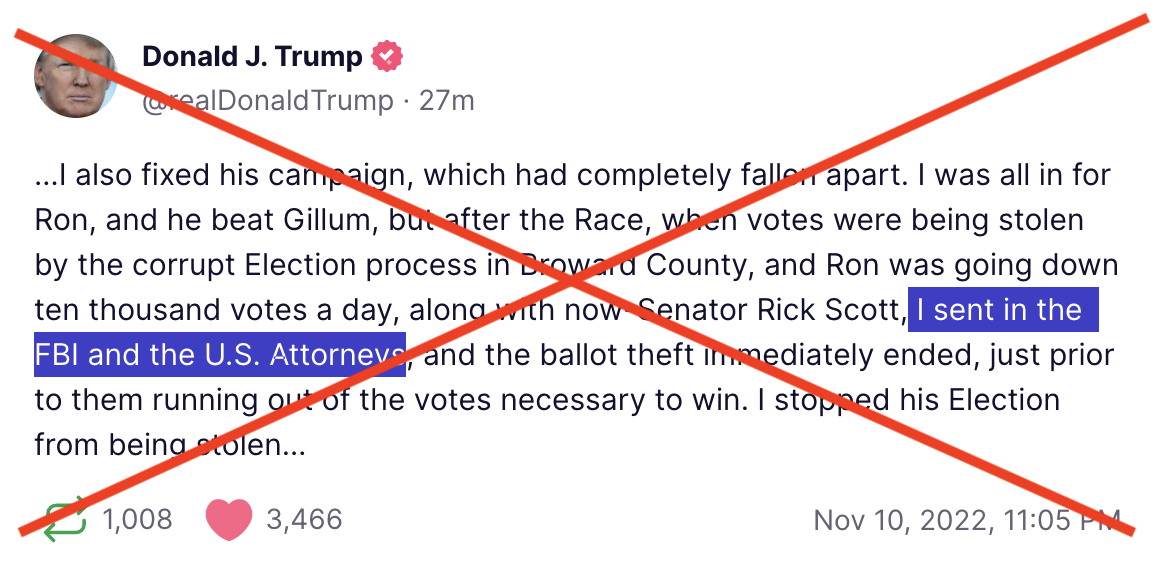
  • Claimed he “sent in the FBI and the U.S. Attorneys, and the ballot theft immediately ended, just prior to them running out of the votes necessary to win”

This last bullet, which seems to claim that Trump deployed DOJ resources to help DeSantis win, has attracted a great of attention.

It would be utterly corrupt to imagine that Trump used DOJ resources to help in an election — though there is evidence he did in 2020: when Bill Barr’s efforts to undermine the Mike Flynn prosecution released altered Peter Strzok notes that Trump used in an attack on Joe Biden. He of course tried to do far more, going so far as attempting to replace Jay Rosen with Jeffrey Clark to give DOJ sanction to frivolous lawsuits.

Plus, people are far too quickly suggesting this claim is made up entirely, and that there’s no evidence of misconduct in 2018. That’s true not just because Trump’s lies generally have some basis, albeit really tenuous, in reality.

Just ten days ago, after all, the NYT reported that prosecutors on at least two investigative teams (which might actually be prosecutors bringing together networked conspiracies as seemed likely for 14 months), implicitly boosted by cooperation from Joel Greenberg, are investigating the 2018 Stop the Steal effort in Broward County.

The NYT article focused on efforts by Trump’s rat-fucker and friends to shut down challenges to the vote count: a Jacob Engels/Proud Boy mob in Broward County.

President Donald J. Trump and other top Republicans were stoking claims that the election had been stolen, and their supporters were protesting in the streets. Members of the far-right group the Proud Boys and people close to Roger J. Stone Jr., including Representative Matt Gaetz, took part in the action as the crowd was chanting “Stop the Steal.”

The time was 2018, the setting was southern Florida, and the election in question was for governor and a hotly contested race that would help determine who controlled the United States Senate.

Now, four years later, the Justice Department is examining whether the tactics used then served as a model for the attack on the Capitol on Jan. 6, 2021.

In recent months, prosecutors overseeing the seditious conspiracy case of five members of the Proud Boys have expanded their investigation to examine the role that Jacob Engels — a Florida Proud Boy who accompanied Mr. Stone to Washington for Jan. 6 — played in the 2018 protests, according to a person briefed on the matter.

[snip]

The 2018 protests were triggered by the tight outcome of the races for United States Senate and Florida governor. On election night, the Republican Senate candidate, Rick Scott, declared victory over the Democrat, Bill Nelson, but the race was close enough that local officials were set to hold recounts in key locations like Broward County.

Prominent Republicans, including Mr. Trump and Senator Marco Rubio of Florida, suggested on social media that the Democrats were trying to steal the election. Mr. Engels promoted an event in Broward County, writing on Twitter that he was headed there “to handle this situation” and was going to “STOP THE STEAL.”

On Nov. 9, a group of about 100 angry protesters, including members of the Proud Boys, descended on the Broward County elections office, carrying pro-Scott and pro-Trump signs and protesting the recount.

The event drew support from several far-right activists in Florida linked to Mr. Stone — among them, Ali Alexander, who later organized Stop the Steal events around the 2020 election, and Joseph Biggs, a leader of the Proud Boys who has since been charged alongside Mr. Tarrio in the Jan. 6 seditious conspiracy case.

Undoubtedly, the Proud Boys are not the FBI (though the FBI in this phase was far too credulous of the Proud Boys). But given the NYT report, it is nevertheless the case that Trump-related Broward County rat-fuckery in 2018 not only happened but is already under investigation.

It may even be the case that DOJ collected information about such things in near real time. DOJ obtained renewed warrants on three Roger Stone accounts on August 3, 2018. It continued to investigate Stone and associates at least through October 2018. And an investigation into the rat-fucker remained ongoing through his November 2019 trial and into at least April 2020.

Again, that doesn’t mean that Trump’s specific claim — that DOJ was involved in all this — is specifically true. It means that before you dismiss it out of hand, you should ask what bread crumbs of reality this probable lie is based on.

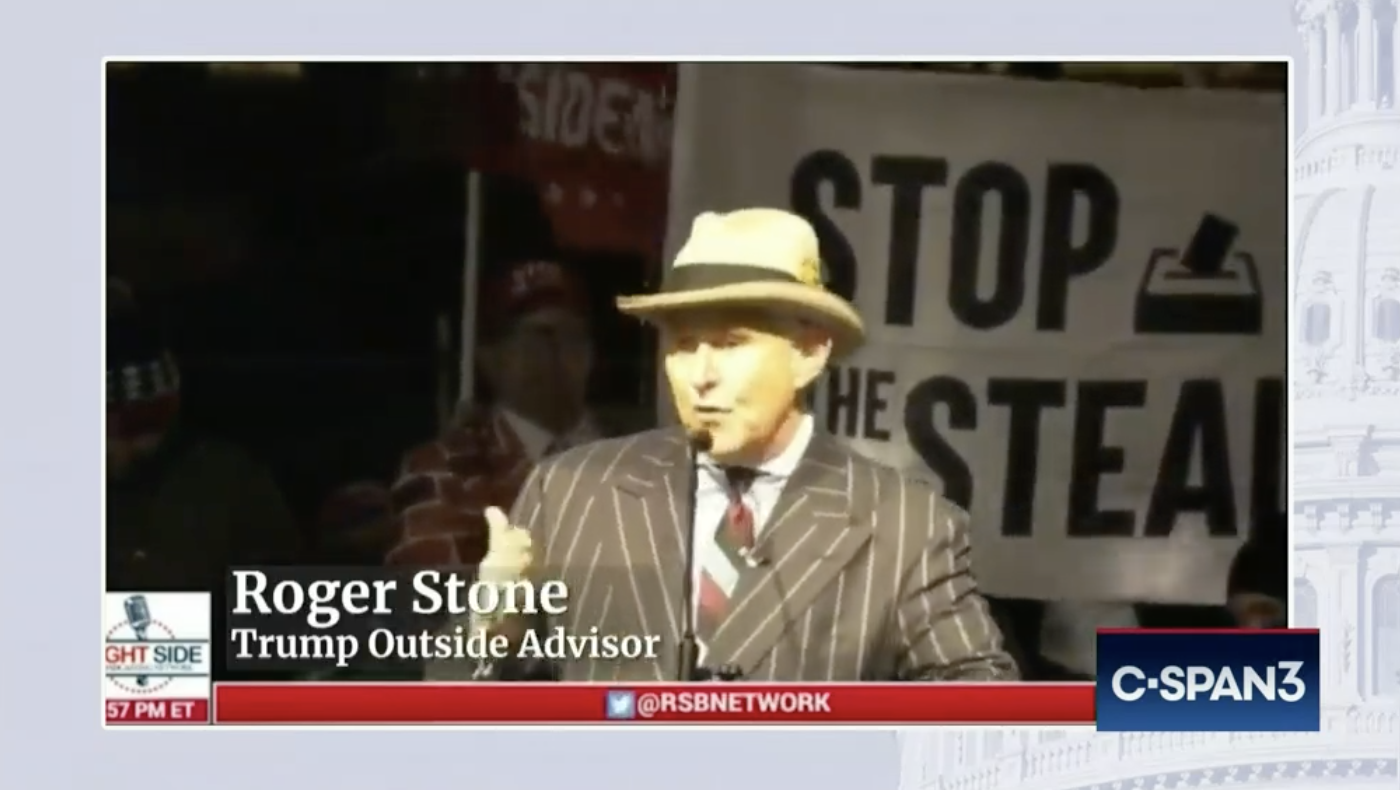
When Trump started threatening DeSantis, I immediately thought of Roger Stone, because collecting dirt with which to exert political pressure is what Trump’s rat-fucker does and because Stone was always active in these same circles. And the Broward County Stop the Steal effort may be the least of it.

Share this entry

After a Year of Executive Privilege Fights, Mike Pence Just Tweeted It Out

The WSJ has published an excerpt — the parts relating to January 6 — from the Mike Pence book coming out next week. It includes descriptions of the following conversations with the then-President, at least some of which Pence was the only witness:

  1. Lunch on November 16, 2020, at which Trump said, “2024 is so far off.”
  2. A call on December 5, on which Trump raised the possibility of challenging the vote.
  3. A December cabinet meeting.
  4. A December 19 conversation in which Trump mentioned plans for the January 6 rally (which Pence claims to have thought was a “useful” idea).
  5. A January 1, 2021 phone call in which Pence told Trump he opposed Louie Gohmert’s lawsuit arguing that Pence had discretion to decide which votes to count. Trump accused his Vice President of being “too honest” and informed him that, “People are gonna think you’re stupid,” for choosing not to claim the power to throw out votes.
  6. A call on January 2 on which Trump said that if Pence, “wimp[ed] out,” he would be “just another somebody.”
  7. A meeting involving John Eastman and others on January 4.
  8. A meeting involving John Eastman in the Oval Office on January 5.
  9. The call Trump made to Pence on January 6 where he again called Pence a wimp.
  10. A meeting on January 11, where in response to Trump’s question whether he was scared on January 6, Pence said he was angry, purportedly just about the people “tearing up the Capitol.”
  11. An exchange inside the Oval Office during which Trump told Pence “Don’t bother” to pray for him.

Every one of these conversations are ones that would traditionally have been covered by Executive Privilege. Trump claimed such exchanges were covered by Executive Privilege starting over a year ago. Both Pence’s top aides — Greg Jacob and Marc Short — and three White House Counsels claimed such exchanges were covered by Executive Privilege this summer, and only in recent weeks did Beryl Howell override the claims of Pence’s people.

And yet, all the while, this book was in the works, including just on this topic, eleven conversations directly with the former President, many of them conversations to which Pence was the only witness.

Much of this description is self-serving (as most autobiographies are), an attempt to craft his support for challenging the election but not rioting. The excerpt, at least, does not disclose the advice that led him to reject Trump’s demand that he throw out votes.

This passage, in particular, seems to project any testimony that Eastman knew the request of Pence was illegal onto Greg Jacob, not himself.

On Jan. 4, the president’s chief of staff, Mark Meadows, summoned me to the Oval Office for a meeting with a long list of attendees, including the legal scholar John Eastman. I listened respectfully as Mr. Eastman argued that I should modify the proceedings, which require that electoral votes be opened and counted in alphabetical order, by saving the five disputed states until the end. Mr. Eastman claimed I had the authority to return the votes to the states until each legislature certified which of the competing slate of electors for the state was correct. I had already confirmed that there were no competing electors.

Mr. Eastman repeatedly qualified his argument, saying it was only a legal theory. I asked, “Do you think I have the authority to reject or return votes?”

He stammered, “Well, it’s never been tested in the courts, so I think it is an open question.”

At that I turned to the president, who was distracted, and said, “Mr. President, did you hear that? Even your lawyer doesn’t think I have the authority to return electoral votes.” The president nodded. As Mr. Eastman struggled to explain, the president replied, “I like the other thing better,” presumably meaning that I could simply reject electoral votes.

On Jan. 5, I got an urgent call that the president was asking to see me in the Oval Office. The president’s lawyers, including Mr. Eastman, were now requesting that I simply reject the electors. I later learned that Mr. Eastman had conceded to my general counsel that rejecting electoral votes was a bad idea and any attempt to do so would be quickly overturned by a unanimous Supreme Court. This guy didn’t even believe what he was telling the president.

By context, Pence asked Eastman whether Eastman thought Pence had “the authority to reject or return votes.” Eastman’s response, without qualification that he was addressing just one of those two items, was that, “it’s never been tested in the courts.” Then, by Pence’s telling, he directly told the then-President that Eastman had only said that returning votes to the states would be illegal. But that’s not what Eastman responded to! He responded to both, and did so in front of Trump.

By stating that Eastman later told his general counsel, Greg Jacob, that the Supreme Court would overturn any effort to reject the votes, rather than just return them, Pence is making Jacob the key witness, and he’s telling the story in such a way that Trump was not directly a witness to the conversation.

Maybe it really happened like Pence tells it. Maybe not. There were other attendees (including, probably, Jacob), and some of them have likely already described what they saw to the grand jury.

But this protective telling of the story is particularly interesting given this description of how, on January 1, Pence told Trump he didn’t have the authority to decide which votes to count.

Early on New Year’s Day, the phone rang. Texas Rep. Louie Gohmert and other Republicans had filed a lawsuit asking a federal judge to declare that I had “exclusive authority and sole discretion” to decide which electoral votes should count. “I don’t want to see ‘Pence Opposes Gohmert Suit’ as a headline this morning,” the president said. I told him I did oppose it. “If it gives you the power,” he asked, “why would you oppose it?” I told him, as I had many times, that I didn’t believe I possessed that power under the Constitution.

This is the first, in the excerpt, that he describes telling this to Trump. But he also says he had already told him the same, “many times.” The circumstances of those conversations would be really critical for pinpointing the timeline of Trump’s machinations and the extent that Pence warned him they were illegal.

For months, the press has been squawking about how unprecedented it would be to subpoena the former Vice President. But he just made the case for doing so, right here.

Share this entry

As Pre-Election Pause Comes to an End, Look First to Arizona (and Nevada and Georgia)

Three times — with the Russian investigation, the Ukraine impeachment, and the January 6 insurrection — the GOP had a ready-made opportunity to distance the party from Donald Trump’s corruption. Each time, they not only declined to take that opportunity, but instead consolidated as a party behind Trump.

Given the swirl of investigations around Trump, Republicans will likely will have a fourth opportunity, this time at a moment when Ron DeSantis’ fortunes look more promising than Trump’s own.

That doesn’t mean Republicans will take it. Indeed, there are some Republicans — people like Jim Jordan — whose electoral future remains yoked to Trump’s. There are a even few members of Congress — Scott Perry, above all — whose legal future may lie with Trump.

But the possibility that yesterday’s results will change the Republican commitment to defending Trump at all cost will be an important dynamic in the face of any prosecutorial steps that DOJ takes now that the pre-election pause on such steps is over.

An indictment of Trump is not going to happen today. In the stolen document case, that’s likely true because DOJ will first want to ensure access to the unclassified documents seized in August, something that won’t happen until either the 11th Circuit decision reverses Judge Aileen Cannon’s decision to appoint a Special Master (that will be ripe for a hearing after November 17) or after a judgement from Special Master Raymond Dearie on December 16 that Cannon chooses to affirm. It’s not impossible, however, that DOJ will take significant actions before then — perhaps by arresting one or more of Trump’s suspected co-conspirators in hoarding the documents, or by executing warrants at other Trump properties to find the documents still believed to be missing.

In the January 6 case, DOJ’s unlikely to take action against Trump himself anytime soon because — by my read at least — there’s still a layer of charges DOJ would have to solidify before charging Trump, both in the prong working up from the crime scene (Roger Stone’s name continues to come up regularly in both the Oath Keeper and Proud Boys cases), and in the fake elector plot. With the testimony of Pence’s key aides secured before the election, Trump’s targeting of his Vice President may be the part of the investigation closest to fruition. There are probably phones — like those of Boris Epshteyn and John Eastman — that DOJ has not finished exploiting, which would have to happen before any charges.

Remember that the phone of Scott Perry — one member of that closely divided House — is among those being exploited right now.

In fact, particularly given the outstanding vote, a more interesting step DOJ might soon take would affect Arizona, even as the close election is settling out. There were several states where DOJ subpoenaed the bulk of those involved in the fake elector plot (here are two summary posts — one, two — of the most recent overt investigative steps). There’s one state, and I think it is Arizona (I’m still looking for the report), where everyone blew off these subpoenas. Mark Finchem is one of the people named on the subpoenas (though he appears to have clearly lost his bid to become Secretary of State).

In other words, in several states (NV, GA, and PA are others), DOJ was preparing the work to unpack the role of key Republicans in both states. Unpacking that role almost necessarily precedes a Trump indictment. But it will also significantly affect the electoral aftermath of these close states.

And all that’s before you consider that Fani Willis’ own pre-election pause will also end. Indeed, Newt Gingrich lost a bid to kill a subpoena in that investigation today.

As noted, the GOP calculus on how to respond to these investigations could change now that Trump has proven a loser once again (or maybe not!). But it’s worth remembering that top Republicans in at least four swing states — swing states that are still counting votes — are implicated in that investigation.

Share this entry

Judge Raymond Dearie Prepares to Consult with the Archives

In his last act before today’s election, Special Master Raymond Dearie issued the following order:

I’ve added the new dates to the timeline below.

The December 1 status conference, which has attracted the most attention, is scheduled for such time as Dearie will have had a chance to review the two sides’ disputes. More importantly, it comes after the 11th Circuit will have this issue fully briefed — and could well have decided to stop the entire process. It will also come after most results of the election will have been decided. It will be public, so Trump will have to make his bid to claw back all the documents he stole before the press.

The notice that he will consult NARA is a bit more interesting. As Dearie notes, this was specifically permitted in Judge Aileen Cannon’s order of appointment. At the first status hearing, Dearie said he would alert Trump before making such consultation. This order serves primarily to tell Trump that this is his chance — while his team is writing their 11th Circuit response and drawing up their general document — to weigh in. But nothing will prevent Dearie from making this consultation.

Dearie knows a good deal about what NARA will say, because the Presidential Records Act is clear. Any document Trump saw as President is a Presidential record. Most of Trump’s claims so far are without merit, even ignoring that the documents were seized with a valid warrant and have evidentiary value.

But the order will ensure that Trump makes a three-page argument about how he is above the PRA. And it’ll provide another authority on which Dearie can rely to rule that Trump cannot convert government documents to his personal property by the mere act of stealing them.

Update: Tweaked timeline.

Timeline

October 13: DOJ provides materials to Trump

By October 14: DOJ provides notice of completion that Trump has received all seized documents

On or before October 14: DOJ revised deadline to 11th Circuit

October 18: Phone Special Master conference

October 20: Deadline for disputes about Executive Privilege and Presidential Records Act on filtered material

October 24: Date Trump unilaterally declares his deadline to comply with Dearie’s order

October 25: Trump rethinks and submits his version of disputes

October 26: Both sides agree to brief general issues; Dearie resolves the remaining privilege issues and accepts briefing dates

November 2 (21 days after notice of completion): Trump provides designations for all materials to DOJ

November 7: Dearie reveals he will consult with NARA

November 8: Election Day; Principal briefs due to Dearie

November 10, 2022: Trump revised deadline to 11th Circuit; deadline to complain about consultation with NARA

November 12 (10 days after November 2): Both sides provide disputes to Dearie; response briefs to Dearie

November 17: DOJ revised reply to 11th Circuit

December 1: Status conference

December 16: Dearie provides recommendations to Cannon

Share this entry

Boris Epshteyn’s Clearance Problems

WaPo includes three details in a profile of Boris Epshteyn that I’ve long been pondering, though WaPo doesn’t consider their import.

First, it states more clearly than past whispers have that one of several reasons Epshteyn didn’t get a job in the White House early in Trump’s term was because of “issues [getting] security clearance.”

After the election, Epshteyn became an aide on the transition team and in the White House. But his tenure in was short — he lasted about two months in the White House and was abruptly moved from the transition to be communications director for the inaugural committee. Three Trump advisers, including one person with direct knowledge of the matter, said the White House exit came after issues gaining a security clearance and clashing with other White House aides.

This was a White House that gave Jared Kushner the highest levels of clearance, took a year to get rid of Rob Porter, and similarly took time before removing Johnny McEntee — and then brought McEntee back! Which is to say, the Trump Administration, which didn’t much care who had clearance, identified a clearance problem before the delayed vetting that identified Porter and McEntee as threats. And acted on it.

And yet, this is the guy that Trump — at a time he had almost no grown-ups left in his entourage — put in charge of his response to the stolen documents investigation.

Initially, many of Epshteyn’s calls to Trump were about the 2020 election. But this year, as the controversy over classified documents located at Mar-a-Lago intensified, Trump grew furious with some of his lawyers who were urging him to return the material to the federal government. In spring, according to advisers, Trump gave Epshteyn a larger role in his legal defense team — akin to an in-house counsel.

“He came in and started giving orders,” one person familiar with the matter said.

[snip]

Epshteyn has urged a pugilistic tone in court filings about the documents, has tried to shape public relations around those filings and has called Trump repeatedly throughout the day to talk strategy, other advisers say.

So the guy who even Trump wouldn’t give clearance to is the mastermind of Trump’s strategy to refuse to give back classified documents, some of the most sensitive documents in government.

We know that investigators find Epshteyn’s role of interest from the reporting on Christina Bobb’s interview with the FBI.

Bobb also spoke to investigators about Trump legal adviser Boris Epshteyn, who she said did not help draft the statement but was minimally involved in discussions about the records, according to the sources.

Apparently her testimony described additional contacts she had with Epshteyn.

Bobb testified to the justice department about the 3 June episode on Friday, detailing Corcoran’s role and additional contacts with Trump’s in-house counsel Boris Epshteyn, one of the sources said.

One of those contacts involved Ephsteyn calling her the night before DOJ came to Mar-a-Lago — remember, DOJ was only asked to come the night before — and telling her to show up the next day to play what was, unbeknownst to her at the time, the role of the fall gal.

She told them that another Trump lawyer, Boris Epshteyn, contacted her the night before she signed the attestation and connected her with Mr. Corcoran. Ms. Bobb, who was living in Florida, was told that she needed to go to Mar-a-Lago the next day to deal with an unspecified legal matter for Mr. Trump.

So I’m not the only one focusing on Epshteyn’s role in refusing to give documents back. FBI is too.

I point this out a lot, but I’m going to point it out again. 18 USC 793 — one of the crimes Trump is being investigated for — has a conspiracy clause that exposes those who help someone commit a crime under the statute to prosecution themselves.

(g)If two or more persons conspire to violate any of the foregoing provisions of this section, and one or more of such persons do any act to effect the object of the conspiracy, each of the parties to such conspiracy shall be subject to the punishment provided for the offense which is the object of such conspiracy.

By all descriptions, Trump literally brought in Epshteyn precisely because he encouraged Trump to refuse to give the documents back. And the easiest way to charge Trump under 793 would be to charge him just for hoarding the documents from June 3 to August 8, the period after which he had withheld documents in response to a lawful subpoena.

As I also point out incessantly, it would be a lot easier to charge Trump if he made highly classified documents accessible to someone who never was entitled to access them. Bobb once had clearance, and by description at least, never accessed the documents herself. Kash Patel had top clearances — indeed, by his own description, he still has clearance (though he wouldn’t have the need to know). Evan Corcoran at least treated the documents like they were sensitive.

But Epshteyn was, according to this WaPo profile, not hired into the Trump White House because of clearance concerns. And he’s the guy, by all reports, in charge of Trump’s efforts to refuse to give the most sensitive documents back. That doesn’t mean he had these documents in hand. But it does mean he was part of the effort to keep them.

There’s one more puzzle that I keep raising. The WaPo notes what a ton of stories have already: Epshteyn’s phone was seized in September.

Epshteyn recently had his phone seized by federal agents as part of that probe. A federal subpoena that went to more than 100 people across the country this spring — including fake electors and state officials — sought phone and email communications with dozens of people involved in the effort, including Epshteyn.

By all reports, the phone was seized as part of the investigation into Trump’s efforts to steal the 2020 election, rather than his efforts to steal classified documents. Epshteyn, who has a JD, was part of the group of lawyers dreaming up whack theories to justify stealing the election (or dupe Trump followers into an attempted coup), but there’s no indication he was lawyering then. Instead, by description, he was doing what he has always done for Trump: organizing.

But, perhaps for legal reasons, all the profiles of Epshteyn’s role in the stolen documents case describe him as playing a legal role. This WaPo piece describes him serving as “in-house counsel,” for example.

FBI seized Epshteyn’s phone almost two months ago, which presumably included five months of content from the period when he has played this purported legal role in helping Trump refuse to give highly classified documents back. Yet we’ve heard nothing about a privilege fight.

That’s particularly interesting given that — after Bobb’s testimony last month — DOJ may have had probable cause to broaden the scope of any filter on Epshteyn’s phone.

Share this entry

Trump Prosecutions: Making Tea While Awaiting the Post-Election Flood

One of the only citations any of the filings in the Trump stolen document case make to prior 18 USC 793 prosecutions — one of the crimes under investigation — is this reference to a letter that then-NSA Director Mike Rogers submitted in the Nghia Pho case. It was cited to explain that sometimes the government has to kill sensitive intelligence programs based on the mere possibility they’ve been compromised. The letter also talked about how, when things get compromised by people bringing them home from work, US intelligence partners grow reluctant to share information. The letter was cited even though the letter itself was never docketed online (it was liberated at the time by Josh Gerstein).

In other words, someone knew to reference something really obscure to make a highly inflammatory argument about the ways that Trump has already done real harm to US national security.

One of the prosecutors in the Nghia Pho case was Thomas Windom, the MD-based AUSA brought in to lead the investigation into Trump’s attempts to steal the election.

Obviously, lots of people at DOJ’s National Security Division would also know that case, and so presumably the letter, well. I wrote about the important lessons DOJ seemed to take from the compromises that the Shadow Brokers leak (in part, that it doesn’t matter why someone brought classified documents home, they can do catastrophic damage to national security anyway). But I raise it here because of an assertion WaPo made when they broke the news that David Raskin — who prosecuted a number of terrorism cases that faced really difficult classification complications — was involved in some way in the stolen document case.

Just two weeks ago, Raskin won a guilty plea in a case with parallels to the Trump case — a former FBI analyst in Kansas City who authorities say took more than 300 classified files or documents to her home, including highly sensitive material about al-Qaeda and an associate of Osama bin Laden.

It’s actually unclear how much the case of Kendra Kingsbury resembles Trump’s. She was charged over three years after being fired from the FBI for the theft, charged with just Secret documents and only two counts of 18 USC 793e (supported by ten documents each), which made getting the plea far easier than charging her for any Top Secret documents or charging her for all twenty individually. According to the docket, the case never started the CIPA process. Her change of plea documents have not been docketed (and so don’t explain the five month delay in sentencing).

All of which is to say the Kingsbury prosecution, like the Pho one, avoided a lot of the difficulties a Trump case would pose, particularly given how unlikely it is that Trump would plead guilty. The Ahmed Ghailani, Zacarias Moussaui, and other early SDNY terror cases make far better precedents for the classification problems that a prosecution of Trump would pose.

Besides, as the WaPo reported, that’s not why Raskin was first brought to DC; he was brought there, like dozens of other prosecutors, to help with the flood of cases after January 6.

Justice Department officials initially contacted Raskin to consult on the criminal investigation into the Jan. 6, 2021, assault on the U.S. Capitol. But his role has shifted over time to focus more on the investigation involving the former president’s possession and potential mishandling of classified documents, the people familiar with the matter said.

I raise all that because we’re beginning to get a whole bunch of new tea leaves in the various investigations into Trump.

CNN had a detailed report yesterday, describing that DOJ was prepping for post-election activity — as well as the likelihood that Trump will declare his candidacy for 2024 out of a belief it’ll shield him from indictment.

As it describes, in addition to Raskin, DOJ has brought on a former SDNY lawyer with extensive experience on conspiracy cases, David Rody, as well as added a high-ranking fraud and public corruption prosecutor and an appellate specialist, neither of whom they name.

Top Justice officials have looked to an old guard of former Southern District of New York prosecutors, bringing into the investigations Kansas City-based federal prosecutor and national security expert David Raskin, as well as David Rody, a prosecutor-turned-defense lawyer who previously specialized in gang and conspiracy cases and has worked extensively with government cooperators.

Rody, whose involvement has not been previously reported, left a lucrative partnership at the prestigious corporate defense firm Sidley Austin in recent weeks to become a senior counsel at DOJ in the criminal division in Washington, according to his LinkedIn profile and sources familiar with the move.

The team at the DC US Attorney’s Office handling the day-to-day work of the January 6 investigations is also growing – even while the office’s sedition cases against right-wing extremists go to trial.

A handful of other prosecutors have joined the January 6 investigations team, including a high-ranking fraud and public corruption prosecutor who has moved out of a supervisor position and onto the team, and a prosecutor with years of experience in criminal appellate work now involved in some of the grand jury activity.

CNN reports that DOJ is even considering whether to appoint a special counsel, though the implication seems to be that that would cover ongoing prosecutorial work, in the same way that John Durham was made a special counsel to shield his work from the snooping of outside oversight (which in Durham’s case led him to pursue ill-considered charges unsupported by his investigation).

I expect as other outlets (especially ones with reporters that have more closely covered the January 6 investigation) will add clarity to all this. But given everything that’s happening, with the exception of the move of the public corruption prosecutor, it’s not clear how much these developments stem from resource allocations that have been a constant feature of the post-January 6 investigation, how much DOJ is putting together a prosecution team, or even whether DOJ has deliberately selected prosecutors (aside from the public corruption one) who weren’t at DC USAO when Billy Barr made all sorts of corrupt moves to help protect Trump. There are DC AUSAs on the team; Mary Dorhmann, who is sort of a Jill of All Prosecutorial Trades, is working with Windom even while she served on the team that won one guilty verdict and one hung verdict against Capitol Police cop Michael Riley and other more pedestrian January 6 cases.

All this is happening as DOJ just locked in Kash Patel’s testimony by compelling his testimony with use immunity. WaPo’s report describes that, in addition to asking him about his claims that Trump declassified documents, prosecutors also asked about Trump’s motive for stealing documents (whether classified or not).

National security prosecutors asked Patel about his public claims this spring that Trump had declassified a large number of government documents before leaving office in 2021. Patel was also questioned about how and why the departing president took secret and top-secret records to Mar-a-Lago,

This story is as useful for its account of former Deputy White House Counsel John Eisenberg’s testimony as for Patel’s; he’s the guy who attempted to bury the Perfect Transcript of Trump’s call with Volodymyr Zelenskyy (remember that witnesses friendly to the subject of an investigation often share their testimony to help others, effectively a way to coordinate stories).

Finally, NYT reported something I’ve been expecting for some time: Trump lawyers are getting fed up with the incompetent advice of Boris Epshteyn, who is not a defense attorney but who claims to be playing a key role in Trump’s defense.

A tirade of a lawsuit that Donald J. Trump filed on Wednesday against one of his chief antagonists, the New York attorney general, was hotly opposed by several of his longstanding legal advisers, who attempted an intervention hours before it was submitted to a court.

Those opposed to the suit told the Florida attorneys who drafted it that it was frivolous and would fail, according to people with knowledge of the matter. The loudest objection came from the general counsel of Mr. Trump’s real estate business, who warned that the Floridians might be committing malpractice.

Nonetheless, the suit was filed.

[snip]

The new 41-page lawsuit against Ms. James was filed in Palm Beach by Timothy W. Weber, Jeremy D. Bailie and R. Quincy Bird, members of a St. Petersburg-based law firm — and was championed by Boris Epshteyn, an in-house counsel for the former president who has become one of his most trusted advisers.

[snip]

Unable to persuade the Florida lawyers to stand down Wednesday, the Trump Organization’s general counsel, Alan Garten, then took aim at Mr. Epshteyn, blaming him in an email to Mr. Epshteyn and other lawyers for the filing of the suit, said the people with knowledge of the discussion. Frustrations with Mr. Epshteyn among some of Mr. Trump’s other aides and representatives have been brewing for months and boiled over with the new legal action.

Another lawyer for Mr. Trump, Christopher M. Kise, a former Florida solicitor general, also objected to the filing of the lawsuit on Wednesday. And Mr. Trump’s legal team in New York expressed concern that the Florida lawsuit would undermine their defense in Ms. James’s case, costing them credibility with both the New York attorney general’s office and the judge overseeing the case, the people with knowledge of the matter said.

It’s fairly astonishing that someone as notoriously paranoid as Trump has not yet begun to wonder whether Epshteyn has Trump’s own interests in mind. Certainly I’ve questioned it.

But pissing off Alan Garten, especially — really one of the only stable legal presences in Trump’s life over the last six years — will not bode well for Trump going forward.

None of these details (not even the shift of the public corruption prosecutor, which I think is one of the more important developments) tell us where a Trump prosecution will start to move next week, after the election. Given all the factors — especially the resource allocations on account of the January 6 investigation and conflicts that may have been created by Trump’s past corruption — it will be impossible for anyone to understand where this is headed for some time.

But the tea leaves have finally convinced the TV lawyers that it is headed, somewhere.

Share this entry

The Intercept Helps Protect Rudy Giuliani’s Lies about Ruby Freeman

I had ambitious plans to do four things today: write this post on what I’m calling the Roger Stone convergence, wash my walls in advance of priming them for paint, writing about how we’d all be better off remembering that Elmo (Elon Musk — like most nicknames I adopt, I wasn’t smart enough to make that one up) just entered a forced marriage, and explaining why this Intercept article is a piece of shit.

Lo and behold, as I was sitting around procrastinating and rationalizing that I shouldn’t climb a ladder while Mr. emptywheel was on his tenth ever visit to the office where he has worked at for 18 months, I saw that Mike Masnick wrote the article about the Intercept piece I was contemplating writing, down to multiple observations that the journalists kept including things that have fuck all with what they claim they’re writing about.

In other words, this entire system has literally fuck all to do with the rest of the article, but the Intercept makes it out to be a system for suppressing information.

[snip]

The article continues to pinball around, basically pulling random examples of questionable government behavior, but never tying it to anything related to the actual subject. I mean, yes, the FBI does bad stuff in spying on people. We know that. But that’s got fuck all to do with CISA, and yet the article spends paragraphs on it.

There are just two things I wanted to add to Masnick’s post (really, go read his), first to add some points about the Intercept’s “Hunter Biden” “laptop” claims, and also to talk about why this matters so much.

Masnick writes at length about how fucking stupid the Intercept’s take on the “Hunter Biden” “laptop” is. I want to add a few key points, interspersed with Masnick’s.

And then, I can’t even believe we need to go here, but it brings up the whole stupid nonsense about Twitter and the Hunter Biden laptop story. As we’ve explained at great length, Twitter blocked links to one article (not others) by the NY Post because they feared that the article included documents that violated its hacked materials policy, a policy that had been in place since 2019 and had been used before (equally questionably, but it gets no attention) on things like leaked documents of police chatter. We had called out that policy at the time, noting how it could potentially limit reporting, and right after there was the outcry about the NY Post story, Twitter changed the policy.

Yet this story remains the bogeyman for nonsense grifters who claim it’s proof that Twitter acted to swing the election. Leaving aside that (1) there’s nothing in that article that would swing the election, since Hunter Biden wasn’t running for president, and (2) the story got a ton of coverage elsewhere, and Twitter’s dumb policy enforcement actually ended up giving it more attention, this story is one about the trickiness in crafting reasonable trust & safety policies, not of any sort of nefariousness.

Yet the Intercept takes up the false narrative and somehow makes it even dumber:

In retrospect, the New York Post reporting on the contents of Hunter Biden’s laptop ahead of the 2020 election provides an elucidating case study of how this works in an increasingly partisan environment.

Much of the public ignored the reporting or assumed it was false, as over 50 former intelligence officials charged that the laptop story was a creation of a “Russian disinformation” campaign.

Interjection: These men likely have spent too much time with Glenn Greenwald, who lies about what the former spooks did as regularly as some people attend church. They didn’t “charge” that the story was a creation of Russian disinformation. They said it had the hallmarks of such a campaign, but emphasized that they didn’t know.

It is for all these reasons that we write to say that the arrival on the US political scene of emails purportedly belonging to Vice President Biden’s son Hunter, much of it related to his time serving on the Board of the Ukrainian gas company Burisma, has all the classic earmarks of a Russian information operation.

We want to emphasize that we do not know if the emails, provided to the New York Post by President Trump’s personal attorney Rudy Giuliani, are genuine or not and that we do not have evidence of Russian involvement — just that our experience makes us deeply suspicious that the Russian government played a significant role in this case.

Then they provided around six reasons why they believed it might be true. All six were and remain true (and there has been reinforcement of several since then). Glenn likes to claim these spooks lied, which is nearly impossible, since they simply expressed a belief. Importantly, their belief was and remains eminently reasonable.

Now back to Masnick:

The mainstream media was primed by allegations of election interference in 2016 — and, to be sure, Trump did attempt to use the laptop to disrupt the Biden campaign. Twitter ended up banning links to the New York Post’s report on the contents of the laptop during the crucial weeks leading up to the election. Facebook also throttled users’ ability to view the story.

In recent months, a clearer picture of the government’s influence has emerged.

In an appearance on Joe Rogan’s podcast in August, Meta CEO Mark Zuckerberg revealed that Facebook had limited sharing of the New York Post’s reporting after a conversation with the FBI. “The background here is that the FBI came to us — some folks on our team — and was like, ‘Hey, just so you know, you should be on high alert that there was a lot of Russian propaganda in the 2016 election,’” Zuckerberg told Rogan. The FBI told them, Zuckerberg said, that “‘We have it on notice that basically there’s about to be some kind of dump.’” When the Post’s story came out in October 2020, Facebook thought it “fit that pattern” the FBI had told them to look out for.

Zuckerberg said he regretted the decision, as did Jack Dorsey, the CEO of Twitter at the time. Despite claims that the laptop’s contents were forged, the Washington Post confirmed that at least some of the emails on the laptop were authentic. The New York Times authenticated emails from the laptop — many of which were cited in the original New York Post reporting from October 2020 — that prosecutors have examined as part of the Justice Department’s probe into whether the president’s son violated the law on a range of issues, including money laundering, tax-related offenses, and foreign lobbying registration.

Interjection: The Intercept’s representation of what the WaPo and NYT wrote is horseshit (again, it leads me to suspect these gents have spent too much time listening to Glenn’s rants).

First, as I wrote about the NYT “authenticat[ion]” at the time, the description of the emails was of particular interest because it cited someone who had familiarity with the investigation.

People familiar with the investigation said prosecutors had examined emails between Mr. Biden, Mr. Archer and others about Burisma and other foreign business activity. Those emails were obtained by The New York Times from a cache of files that appears to have come from a laptop abandoned by Mr. Biden in a Delaware repair shop. The email and others in the cache were authenticated by people familiar with them and with the investigation.

That person could have been an FBI agent leaking about the investigation (as likely has happened more recently, when someone revealed they believe there is sufficient evidence to charge on crimes unrelated to the “laptop,” probably an effort to pressure US Attorney David Weiss to charge Hunter Biden). Or it could be someone like Mac Issac or Robert Costello, both of whom were in the chain of custody of the “laptop,” the testimony from whom might be of interest to the Hunter Biden investigation and/or might be of interest in the investigation into Rudy Giuliani’s negotiations with known Russian agents for Hunter Biden dirt that almost exactly resembles what the laptop is. The story actually doesn’t say the FBI first obtained the emails from the laptop. Indeed, the story reports that the foreign influence aspect of the investigation started in 2018, before the FBI got the laptop, in which case the FBI may have obtained the emails from Apple, which is where at least some of the content on the laptop came from. Almost certainly the FBI would have obtained the iCloud content independently anyway, to ensure the integrity of their chain of evidence. But all the NYT said is that someone — perhaps someone who has been questioned in the investigation — is leaking details to the press. All the NYT has done is get the emails from someone involved in the attack on Hunter Biden and — possibly with their help — authenticate the same headers anyone else has.

That doesn’t say “the laptop” is authentic; it says the investigation into Hunter Biden has been grossly politicized.

Now, before we review what the WaPo said, remember that reporters are citing this article to support a claim that the “laptop” was not disinformation. The goal here is to suggest authenticity. For those purposes, here’s what that WaPo story says:

Among the reasons for the inconclusive findings was sloppy handling of the data, which damaged some records. The experts found the data had been repeatedly accessed and copied by people other than Hunter Biden over nearly three years. The MacBook itself is now in the hands of the FBI, which is investigating whether Hunter Biden properly reported income from business dealings.

Most of the data obtained by The Post lacks cryptographic features that would help experts make a reliable determination of authenticity, especially in a case where the original computer and its hard drive are not available for forensic examination. Other factors, such as emails that were only partially downloaded, also stymied the security experts’ efforts to verify content.

[snip]

In their examinations, Green and Williams found evidence that people other than Hunter Biden had accessed the drive and written files to it, both before and after the initial stories in the New York Post and long after the laptop itself had been turned over to the FBI.

Maxey had alerted The Washington Post to this issue in advance, saying that others had accessed the data to examine its contents and make copies of files. But the lack of what experts call a “clean chain of custody” undermined Green’s and Williams’s ability to determine the authenticity of most of the drive’s contents.

“The drive is a mess,” Green said.

He compared the portable drive he received from The Post to a crime scene in which detectives arrive to find Big Mac wrappers carelessly left behind by police officers who were there before them, contaminating the evidence.

That assessment was echoed by Williams.

“From a forensics standpoint, it’s a disaster,” Williams said.

[snip]

Analysis was made significantly more difficult, both experts said, because the data had been handled repeatedly in a manner that deleted logs and other files that forensic experts use to establish a file’s authenticity.

“No evidence of tampering was discovered, but as noted throughout, several key pieces of evidence useful in discovering tampering were not available,” Williams’ reports concluded.

[snip]

Some other emails on the drive that have been the foundation for previous news reports could not be verified because the messages lacked verifiable cryptographic signatures. One such email was widely described as referring to Joe Biden as “the big guy” and suggesting the elder Biden would receive a cut of a business deal.

I’ve also been told that since the laptop was not airgapped, it’s possible Burisma emails were downloaded after Russia reportedly hacked Burisma, meaning those emails could absolutely be fraudulent.

So the Intercept reporters display their highly attuned nose for disinformation by deeming worthy of reporting a “laptop” that does have emails with valid keys downloaded from iCloud (in partial fashion, which should itself raise questions) but also includes a great deal of shit and obvious alteration. The only thing this “laptop” is useful for reporting on is how unreliable “the laptop” as a package is. It is useful for nothing more than serving as the shiny object it was used for in October 2020. Any reporter citing this report as proof that stuff wasn’t forged — or that the whole “laptop” wasn’t packaged up with the help of the same people who were peddling this information to Rudy in the same time period — discredits themselves. The report specifically said such conclusions were impossible and raised a lot of reasons to be more concerned about “the laptop.” The report shows that this “laptop” was a serial hit job and that for a second straight election, people close to Trump once again tried to win an election by using stolen personal data.

Back to Masnick.

The Zuckerberg/Rogan podcast thing has also been taken out of context by the same people. As he notes, the FBI gave a general warning to be on the lookout for false material, which was a perfectly reasonable thing for them to do. And, in response Facebook did not actually block links to the article. It just limited how widely the algorithm would share it until the article had gone through a fact check process. This is a reasonable way to handle information when there are questions about its authenticity.

But neither Twitter nor Facebook suggest that the government told them to suppress the story, because it didn’t. It told them generally to be on the lookout, and both companies did what they do when faced with similar info.

From there, the Intercept turns to a nonsense frivolous lawsuit filed by Missouri’s Attorney General and takes a laughable claim at face value:

Documents filed in federal court as part of a lawsuit by the attorneys general of Missouri and Louisiana add a layer of new detail to Zuckerberg’s anecdote, revealing that officials leading the push to expand the government’s reach into disinformation also played a quiet role in shaping the decisions of social media giants around the New York Post story.

According to records filed in federal court, two previously unnamed FBI agents — Elvis Chan, an FBI special agent in the San Francisco field office, and Dehmlow, the section chief of the FBI’s Foreign Influence Task Force — were involved in high-level communications that allegedly “led to Facebook’s suppression” of the Post’s reporting.

Interjection: This Intercept story was dated October 31, which last I checked is after October 28. Which means if these reporters were actually reporting from the docket, then they should be accountable for this October 28 filing which says that — according to Meta — the plaintiffs in this nonsense lawsuit made up the bit about Agent Chen.

Meta, however, recently sent Plaintiffs’ counsel a letter—attached as Exhibit A—explaining that Plaintiffs’ understanding of Meta’s statement concerning ASAC Chan is “incorrect.” Meta further stated that that “Mr. Chan at no point in time advised Meta ‘to suppress the Hunter Biden laptop story’ . . . [n]or did any of his colleagues.” Based on this newly received evidence, the Court should amend the Deposition Order, and withdraw its authorization of a deposition of ASAC Chan. ASAC Chan, a management-level FBI official, should not have to divert time away from his official duties to participate in an expedited deposition when the record contains no evidence suggesting that he has engaged in the communications that led the Court to authorize his deposition in the first place.

[snip]

Plaintiffs also relied on several of their own self-serving allegations concerning ASAC Chan—rather than actual evidence—to justify his deposition. See ECF No. 86 at 19-21 (referring to various allegations in Plaintiffs’ Second Amended Complaint). Those allegations generally embellished certain innocuous, public statements ASAC Chan made concerning routine cyber threat discussions he had with various companies, including social media companies. For example, Plaintiffs rely on their allegation that ASAC Chan “admits to regular, routine coordination about censorship with social-media platforms,” see id. at 19 (quoting 2d Am. Compl. ¶ 389), but that allegation relies on an interview in which ASAC Chan simply stated: the FBI regularly “shar[ed] intelligence with technology companies, with social media companies, so that they could protect their own platforms . . . we have all of these methods for collecting intelligence . . . [w]e share them with you and then you do what you want with them to protect your networks,” https://www.banyansecurity.io/resource/get-it-started-get-it-done/ (cited in 2d Am. Compl. ¶¶ 387-89) (emphasis added). Plaintiffs could not identify a single quotation in that interview where ASAC Chan ever stated that the FBI asked or pressured any social media company to remove any content from its platform. Plaintiffs also relied on an allegation that ASAC Chan had stated that social media platforms have been “trying to take down any misinformation or disinformation” and that they have “portals where [users] can report” election-related misinformation.” ECF No. 86 at 20. Again, Plaintiffs could not quote any portion of ASAC Chan’s statement where he stated that he, or anyone else at the FBI, asked or pressured any social media company to remove any content from its platform.

[snip]

Meta emphasized that “Mr. Chan at no point in time advised Meta ‘to suppress the Hunter Biden laptop story’ . . . [n]or did any of his colleagues.”

The letter from Facebook to the plaintiffs also notes there are no communications that support their Facebook claims.

We identified Mr. Chan to you during a phone call on September 15, 2022. On that call, we identified Mr. Chan as Meta’s primary individual point of contact on the FBI’s Foreign Influence Task Force. And we informed you that we had not identified any emails between Mr. Chan and Meta about Hunter Biden’s laptop. You confirmed in writing after that call that “as referenced in today’s call, we continue to request communications between Meta and FBI’s Foreign Influence Task Force, especially as it relates to the Hunder [sic] Biden laptop story. Reg represented today that he did not believe there are written communications involving” Mr. Chan.

Which is the perfect setup for Masnick’s conclusion about the Hunter Biden story.

Now here, you can note that Dehmlow was the person mentioned way above who talked about platforms and responsibility, but as we noted, in context, she was talking about better education of the public. The section quoted in Missouri’s litigation is laughable. It’s telling a narrative for fan service to Trumpist voters. We already know that the FBI told Facebook to be on the lookout for fake information. The legal complaint just makes up the idea that Dehmlow tells them what to censor. That’s bullshit without evidence, and there’s nothing to back it up beyond a highly fanciful and politicized narrative.

But from there, the Intercept says this:

The Hunter Biden laptop story was only the most high-profile example of law enforcement agencies pressuring technology firms.

Except… it wasn’t. Literally nothing anywhere in this story shows law enforcement “pressuring technology firms” about the Hunter Biden laptop story.

This story proves the opposite of what it claims.

It proves that the reporters who wrote it read a report that cautioned strongly about relying on the “Hunter Biden” “laptop” because of all the forensic problems with it — which is one reason among many why responsible reporters shouldn’t have reported on it in October 2020 (and most did not, precisely because there was nothing reliable). And it further shows to substantiate their core claim of coercion, the reporters rely on sources that themselves made up claims of coercion.

And here’s why it matters.

As Masnick lays out, the Intercept reporters “pingpong” from topic to topic, with little evident understanding of the topics they’re talking about. Several of the meeting notes they try to spin as wildly spooky deal with how one runs elections in an era of outright disinformation — shit like Presidential candidates repeatedly making false claims about the reliability of the vote count. This one, for example, focused primarily on the difficulties election workers face as they’re trying to tally election results amid a cloud of rumors and deliberately false claims.

The report makes quite clear that what’s at stake is the “peaceful transition of power.”

As Masnick recalled, Chris Krebs debunked a lot of false claims in 2020 and Trump promptly fired him for correctly stating that the elections were free and fair.

This is the kind of thing that the Intercept reporters — reporters who ignored a filing that debunked their key claim about FBI coercion and who didn’t understand that the WaPo said the opposite of what they claimed — appear to want to get rid of. If they achieved what they claim they want, CISA would no longer be able to tell local election supervisors about the false claims armed men trolling dropboxes are making to justify their actions. If they achieved what they claim to want, CISA would not be able to share information nationally about organized disinformation campaigns targeting mail-in votes.

The logical outcome, if these Intercept reporters succeeded in halting what they portray in the story, is that CISA would not be able to protect your vote.

Nor would it be able to protect election workers like Ruby Freeman from false claims that Rudy Giuliani spread, falsely claiming a ginger mint was a thumb drive used to steal votes.

In an opinion denying Rudy’s motion to dismiss a defamation lawsuit from Freeman and Shaye Moss, Beryl Howell cites the harm that the mother and daughter claim arises from Rudy’s false claims.

The accusations levied against plaintiffs had consequences. Plaintiffs claim they have experienced online, personal, and professional consequences directly resulting from Giuliani’s statements and conduct. See id. ¶¶ 140–57. Strangers camped out near Freeman’s home in Georgia, harassing her and her neighbors. Id. ¶ 141. “Christmas cards were mailed to Ms. Freeman’s address with messages like, ‘Ruby please report to the FBI and tell them you committed voter fraud. If not[,] you will be sorry,’ and ‘You deserve to go to jail, you worthless piece of shit whore.’” Id. ¶ 143. Protesters targeted her home on January 5 and January 6, 2021, though Freeman had fled her home at the recommendation of the Federal Bureau of Investigation. Id. ¶¶ 144–45. Pizza delivery orders were ordered to her home that her family never ordered, which is a common tactic of online harassment called “doxx[ing].” Id. ¶ 142. Local police received more than twenty harassing phone calls while monitoring Freeman’s phone and, eventually, she had to change her email and phone numbers. Id. ¶ 140. Freeman has experienced strangers harassing her in public and has lost friendships, id. ¶¶ 148–49, plus she has had to cease her online business because of prolonged harassment on social media and public events, id. ¶ 147.

She also cites Rudy complaining about how he got banned from social media for making those false claims.

3 Statement 8 was made by Giuliani during an OAN interview on January 18, 2021, as follows:

I mean, they pretty much censored it while it was going on, so they would love to turn the page on it. I mean, I get banned from any of the big tech things when I say that not only was there voter fraud, I have evidence of it, I’ve seen it, I have a motion picture of it. I can show you the voter fraud in living color. It was done in Fulton County, Georgia, it was well over 30,000 ballots were stolen. They were attributed to Biden instead of Trump. Had they been caught and held to account for it, Trump would have won Georgia. Amend. Compl. ¶ 89. A reasonable listener could read this message as referencing the Edited Video and the actions of election workers in Fulton County, which workers include Freeman and Moss.

Finally, she deems sufficiently credible Freeman and Moss’ claims that Rudy made these false claims about the two of them as part of a plan to overturn the democratic election.

7 Giuliani defends the Strategic Plan as a plan to “‘educate the public,’” Def.’s Mem. at 13 (quoting Strategic Plan at 1), rather than to disseminate false information. Regardless of how Giuliani characterizes the goal of the Plan, plaintiffs allege that the Plan’s goal was to overturn the 2020 presidential election, and they allege more than enough evidence in their Amended Complaint to infer that unlawful act was the Plan’s underlying purpose. See, e.g., Amend. Compl. ¶ 9 (noting that the Strategic Plan “relied on the following call to action: ‘YOU CANNOT LET AMERICA ITSELF BE STOLEN BY CRIMINALS – YOU MUST TAKE A STAND AND YOU MUST TAKE IT TODAY’”).

If the Intercept reporters achieved what they claim they want, it would be far harder to combat clear abuse like Rudy’s because it would halt CISA’s efforts to debunk such obvious false claims. It would make it less likely that Rudy would get banned for his false claims about two women who did nothing more than help count the vote. It would be harder to protect your vote, and it would be harder to protect the life and livelihood of election workers.

This article fed the efforts of fascists to delegitimize efforts to protect democracy. Tucker Carlson loved it. For good reason: because he peddles bullshit that poses a risk to your vote and the livelihood of Ruby Freeman.

Not only didn’t it substantiate what it claimed, but it discredited precisely the efforts that will be used next week to protect democracy.

Update: ProPublica reports that, contra Intercept’s claim that disinformation efforts are increasing, DHS under Biden has backed off the kind of support for election workers that was so successful (and important) in 2020.

In May, one Department of Homeland Security office instructed staffers that work on “sensitive” topics including disinformation should be put on “immediate hold,” according to material reviewed by ProPublica. In the months that followed, DHS canceled a series of planned contracts that would have tracked and studied the proliferation of disinformation and its connection with violent attacks. And after issuing six nationwide warnings about domestic terrorism fueled by disinformation in the first 13 months of the Biden administration, DHS has only issued one in the eight months since.

The government’s retreat comes ahead of midterms in which election officials throughout the country are being inundated with false rumors about their work. After talks on a project to help election officials monitor and respond to threats stalled, election officials from Colorado and Florida wrote a private letter in August to DHS Secretary Alejandro Mayorkas pleading for help.

“Threats and harassment of election officials has become an extremely serious concern and terribly frequent experience for election workers,” they warned, adding, “We are ourselves a crucial part of the nation’s critical infrastructure, in need of and deserving of protection.”

“Time is of the essence,” the officials wrote.

Weeks later, DHS scrapped the project.

[snip]

[E]lection administrators remain deeply concerned.

“States need more support. It is clear that threats to election officials and workers are not dissipating and may only escalate around the 2022 and 2024 elections,” Colorado Secretary of State Jena Griswold, a Democrat, said in an email to ProPublica. “Election offices need immediate meaningful support from federal partners.”

Kevin Drum compared the ProPublica’s worthwhile report with the Intercept one here.

Share this entry

The Roger Stone Convergence at the Winter Palace

There was a status hearing in the Owen Shroyer case last week that was so short it was over by the time I had entered the dial-in code. Shroyer, you’ll recall, is the Alex Jones sidekick who was charged for violating his specific prohibition on being an asshole at the Capitol. His lawyer, Norm Pattis, happens to be the lawyer who sent a large swath of Alex Jones’ data to the Texas Sandy Hook plaintiffs, and then presided over the $1 billion judgement in the Connecticut Sandy Hook lawsuit. On June 14, Pattis noticed his appearance on Joe Biggs’ legal team, effectively giving him visibility on how badly the discovery in the Proud Boy case implicates Shroyer and Jones and Ali Alexander. Shroyer appears to be stalling on his decision about whether he wants to enter a plea agreement — one that would presumably require some cooperation — or whether he wants to stick around and be charged in a superseding indictment along with everyone else.

Shroyer has until November 29 to make that decision, around which time I expect a Roger Stone convergence to become more clear.

The Roger Stone convergence has been coming for some time (I’ve been pointing to it for at 14 months). Yesterday, NYT reported that one means by which it is coming is in the dissemination of the We the People document laying out plans to occupy buildings — under the code “Winter Palace” — which the FBI found on the Enrique Tarrio phone it took over a year to exploit.

As I laid out here, the document is important because it shows Tarrio’s motive on January 6 in his assertion that “every waking moment consists of” planning for revolution.

41. Between December 30 and December 31, 2020, TARRIO communicated multiple times with an individual whose identity is known to the grand jury. On December 30, 2020, this individual sent TARRIO a nine-page document tiled, “1776 Returns.” The document set forth a plan to occupy a few “crucial buildings” in Washington, D.C., on January 6, including House and Senate office buildings around the Capitol, with as “many people as possible” to “show our politicians We the People are in charge.” After sending the document, the individual stated, “The revolution is important than anything.” TARRIO responded, “That’s what every waking moment consists of… I’m not playing games.”

And an exchange he had with now-cooperating witness Jeremy Bertino that they had succeeded in implementing the Winter Palace plan shows that Tarrio recognized that occupying buildings was part of his plan.

107. At 7:39 pm, PERSON-1 sent two text messages to TARRIO that read, “Brother. ‘You know we made this happen,” and “I’m so proud of my country today.” TARRIO responded, “I know” At 7:44 pm. the conversation continued, with PERSON-1 texting, “1776 motherfuckers.” TARRIO responded, “The Winter Palace.” PERSON-1 texted, “Dude. Did we just influence history?” TARRIO responded, “Let’s first see how this plays out.” PERSON-1 stated, “They HAVE to certify today! Or it’s invalid.” These messages were exchanged before the Senate returned to its chamber at approximately 8:00 p.m. to resume certifying the Electoral College vote.

The NYT story reveals that Eryka Gemma is the person who sent the document to Tarrio, but she was not its author.

As a part of the investigation, prosecutors are seeking to understand whether Mr. Engels has ties to a little-known Miami-based cryptocurrency promoter who may have played a role in the Capitol attack.

A week before the building was stormed, the promoter, Eryka Gemma, gave Mr. Tarrio a document titled “1776 Returns,” according to several people familiar with the matter. The document laid out a detailed plan to surveil and storm government buildings around the Capitol on Jan. 6 in a pressure campaign to demand a new election.

[snip]

The federal indictment of Mr. Tarrio says that the person who provided him with “1776 Returns” told him, shortly after it was sent, “The revolution is more important than anything.” That person was Ms. Gemma, according to several people familiar with the matter.

But Ms. Gemma was not the author of “1776 Returns,” which was written by others, first as a shared document on Google, the people said.

It remains unclear who the original authors were.

It may be unclear or detrimental to the sources for this story who originally wrote the document; it’s probably not to investigators who can simply send a warrant to Google.

And whether because investigators know who wrote the document or for some other reason (such as that they have just a few more weeks of pre-sentencing cooperation with Joel Greenberg), they’re trying to understand whether this document, laying out a plan to occupy buildings, had an analogue in the Florida-based riots that key Roger Stone associate, Jacob Engels, staged in 2018 in an attempt to thwart any delays in certification for Rick Scott (and Ron DeSantis, who gets a positive shout out by name in the Winter Palace document).

On Nov. 9, [2018] a group of about 100 angry protesters, including members of the Proud Boys, descended on the Broward County elections office, carrying pro-Scott and pro-Trump signs and protesting the recount.

The event drew support from several far-right activists in Florida linked to Mr. Stone — among them, Ali Alexander, who later organized Stop the Steal events around the 2020 election, and Joseph Biggs, a leader of the Proud Boys who has since been charged alongside Mr. Tarrio in the Jan. 6 seditious conspiracy case.

The NYT describes this line of inquiry as happening via two different sets of prosecutors, which is a sign of either convergence or simply the networked structure that DOJ’s approach, using parallel and (through Stone) intersecting, conspiracy indictments clearly facilitated (Shroyer’s prosecution team, incidentally, features an Oath Keeper prosecutor and a key assault prosecutor).

In recent months, prosecutors overseeing the seditious conspiracy case of five members of the Proud Boys have expanded their investigation to examine the role that Jacob Engels — a Florida Proud Boy who accompanied Mr. Stone to Washington for Jan. 6 — played in the 2018 protests, according to a person briefed on the matter.

The prosecutors want to know whether Mr. Engels received any payments or drew up any plans for the Florida demonstration, and whether he has ties to other people connected to the Proud Boys’ activities in the run-up to the storming of the Capitol.

Different prosecutors connected to the Jan. 6 investigation have also been asking questions about efforts by Mr. Stone — a longtime adviser to Mr. Trump — to stave off a recount in the 2018 Senate race in Florida, according to other people familiar with the matter.

While the NYT describes (breaking news!) that Engels was one of the people who in 2019, along with Tarrio, crafted an attack on the judge presiding over Roger Stone’s case, Amy Berman Jackson, it does not note that the Stop the Steal effort dates back two years earlier than the 2018 riot, to voter intimidation efforts that Stone pursued that look similar to the current drop box intimidation effort being disseminated via Trump’s shitty social media website (NYT does mention the Brooks Brothers riots in 2000 and notes the participants “apparently work[ed] with Mr. Stone” — more breaking news).

Nor does it describe the backstory to how Biggs showed up in Florida in 2018, fresh off his ouster from InfoWars after playing a key role in both the PizzaGate and Seth Rich hoaxes, both part of a Russian info-op that Stone played a key role in. But it’s part of the prehistory of the Proud Boys that prosecutors are now tracing.

I have no idea whether the very clear 2016 precedent is part of this. DOJ wouldn’t need to do (much) fresh investigation of it because Mueller and DC USAO did quite a bit of investigation before Bill Barr torched the investigation all to hell and then Trump pardoned Stone to avoid being implicated himself. But if it was part of this, no one who would share those details with NYT would know about it unless and until it was indicted. That’s even true of the 2019 incident; DOJ did at least some investigative work into the funding of that, the same questions being asked now about how Engels organized the 2018 riot.

But whether this investigative prong extends no further back than 2018 or whether it includes the Stone Stop the Steal activity that demonstrably paralleled a Russian effort, it does seem that DOJ is investigating how the prior history of the Proud Boys parallels these efforts to undermine democracy and did so in the place — Miami — where the Proud Boys, schooled by the master rat-fucker, are increasingly taking on an official role.

That may not be an investigation about Engels’ actions, directly (though he has long been in the thick of things). Rather, it may be an investigation into resources that were consistent throughout these developments.

Share this entry