“Why Did Mike Pence Wait So Long to Reveal His Stash of Classified Documents?”

At a press availability yesterday, Merrick Garland repeated a line he often uses, that DOJ applies the law the same for everyone.

“We do not have different rules for Democrats or Republicans, different rules for the powerful or the powerless, different rules for the rich and for the poor, we apply the facts, and the law in each case in a neutral, non-partisan manner,” Garland told reporters during a press availability at Justice Department headquarters. “That is what we always do.”

Many of the reporters covering it treated it as a comment about DOJ’s handling of the Trump and Biden classified document inquiries. Maybe it was.

Little did anyone know, though, that Garland might well have had the FBI’s collection of about a dozen documents with classified markings from Mike Pence’s home in mind.

Greg Jacob first told the Archives about the documents on January 18, six days ago and two days after the search. The next day, the FBI arrived in Indiana to collect the documents, which Jacob complained was against standard protocol. Yesterday Pence’s staff delivered several boxes to the Archives to check for adherence to the Presidential Records Act.

I don’t much care that Pence didn’t immediately run to the press to announce the documents, but it is the kind of thing that journalists who are good at horse race coverage, unaware of many of the thus-far distinguishing details about the Trump documents, and ill-equipped to cover classified documents stories latched onto with Biden.

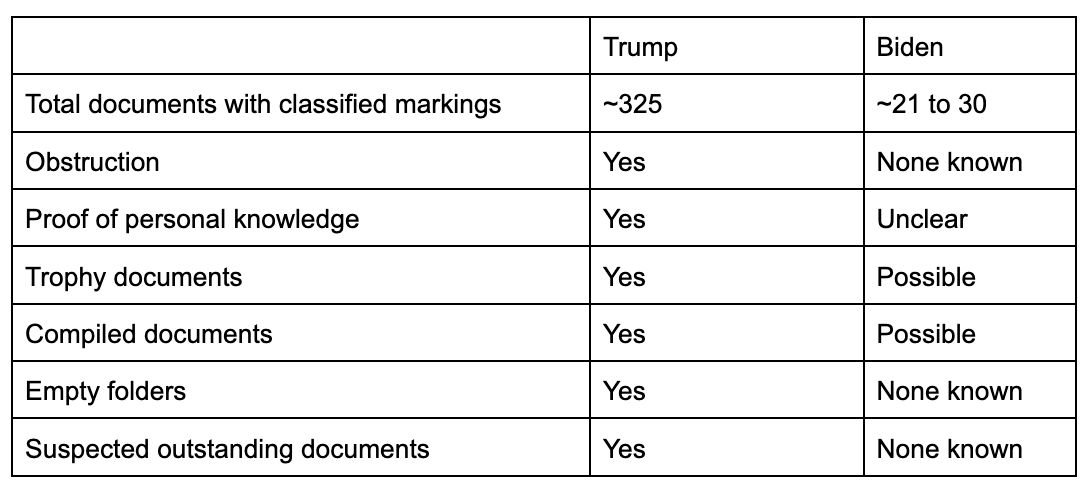
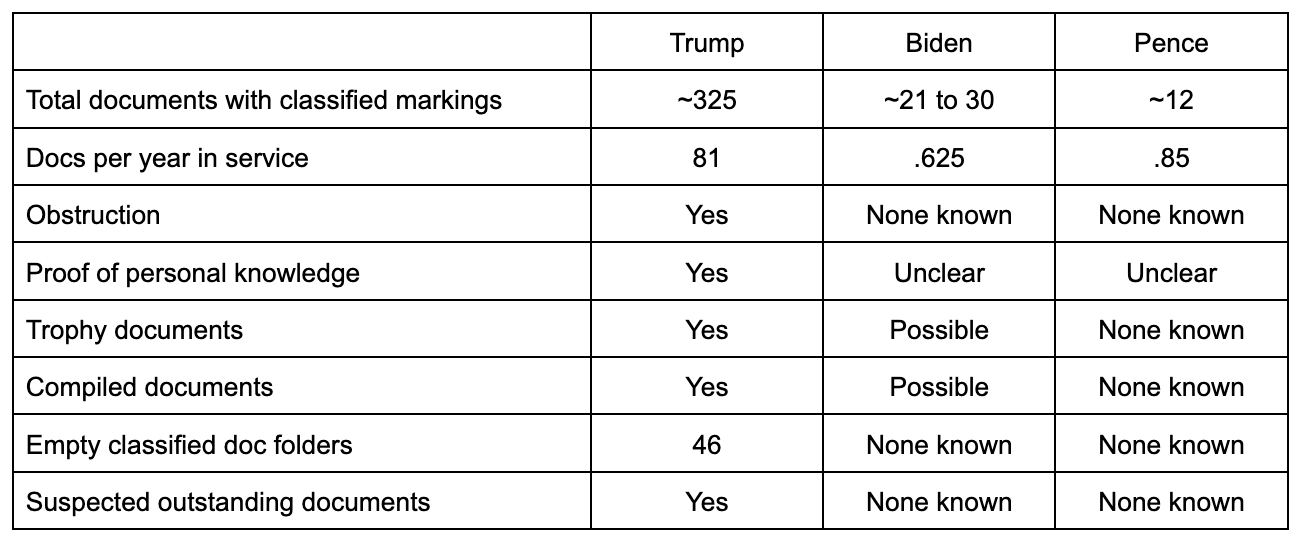
So in an effort to provide some structure for the kids-chasing-a-soccer-ball-like coverage we’re already seeing, here’s a table that summarizes what we know and don’t know about all three cases.

Until we have answers about some of the details that currently distinguish Biden and Pence from Trump — like whether they knew of the documents (both claim they did not), whether they ever accessed the documents after leaving office, whether we have reason to believe they’re harboring more — this should not be a story.

And the key difference, one that should be included in every story that tries to make such a comparison, is that Trump refused to give documents back, whereas Biden and Pence freely offered them up.

The reason that’s important, aside from the both sides drama of it, is that it is an element of the offense that would be most likely to be used if DOJ took the unprecedented step of charging a former Original Classification Authority with harboring classified documents.

As we can now see, it happens that men who have aides pack them up at the end of their tenure go home with documents they didn’t know they had. It happens. (By the time Kamala Harris leaves, there’s likely to be a new protocol in place, so Harris can set a perfect record as the first woman being packed up.) What matters — what distinguishes a mistake from a potential crime — is what you do with the documents when you become aware you have them.

It’s possible we’ll learn details that suggest Biden knowingly stashed classified documents. But thus far, we don’t have any such details. And that should — but thus far has often not — show up in any competent coverage.

Share this entry

When Your Lawyer is Acting Like H.R. Haldeman, It’s Time to Get a New Lawyer

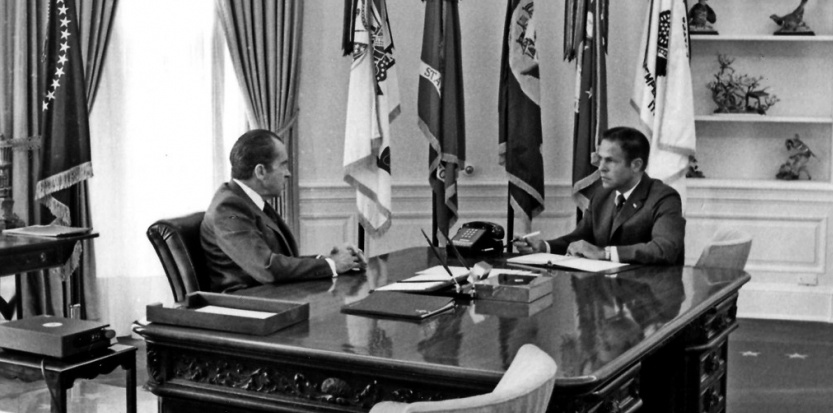
President Richard Nixon and his Chief of Staff HR Haldeman, before Nixon resigned in disgrace and Haldeman went to prison for 18 months after being convicted of perjury, conspiracy, and obstruction of justice.

When Cassidy Hutchinson’s September 14, 2022 testimony to the J6 committee first came out, I remember being struck by three sentences in bold below (emphasis added) as I read it (from p. 48):

Ms. Hutchinson. And then just, at the end of that meeting, we had — because I had asked him about doing the, like, mock question preparation, and he said, “No.” So said, “Well, do you recommend anything that I can do to prepare for next week?” He’s like, “Get a good night’s sleep,” like, a few wishy-washy things.

And he said, “Don’t read anything about this on the internet.” He said, “Again, Cass, like, just trust me on this. I’m your lawyer. I know what’s best for you. The less you remember, the better. Don’t read anything to try to jog your memory. Don’t try to put together timelines.”

And he was like, “Especially if you put together timelines, we have to give those over to the committee. So anything you produce we have to give over to the committee. So l really” — he was like, “You can have things in front of you, but really don’t want you to, because we have to give that to the committee.”

So now I’m like, oh now I’m kind of scared. — Like, what if I want notes in front of me and he gets mad at me because I have to give them to the committee now? I didn’t know I would have to give them to the committee, but he told me I did, and he was my lawyer, so I was trying to trust him.

This wasn’t the only place in the transcript where words like these were used – they were almost a refrain. “Where have I heard this before?” I asked myself, then kept reading. Over this past weekend, while helping my mom clean out some old magazines, the penny dropped.

The date was March 21, 1974 1973 [corrected] – two days before the scheduled sentencing of the convicted Watergate burglars. At the White House, things were tense, as the scandal was growing and the coverup was in the process of unraveling. President Nixon, Chief of Staff H.R. Haldeman, and White House Counsel John Dean met for almost two hours, taking stock of the mess and looking for possible routes forward. They discussed additional payments to keep people quiet (noting that earlier payments had bought them silence through the 1972 election), and tried to figure out how to sideline the recently formed Senate Watergate committee chaired by Sen. Sam Ervin (D-NC).

Toward the end of the meeting, Nixon brought up a suggestion from his Domestic Policy Advisor  (and former White House Counsel) John Ehrlichman: instead of letting the Ervin committee run riot in public, announce that all this was going to a new grand jury. From the transcript of the Nixon tapes (with all the typos, punctuation, etc. in the original, but with emphasis added):

PRESIDENT:    John Ehrlichman, of course, has raised the point of another grand jury. I just don’t know how you’re going to do it. On what basis. I, I could call for it, but I…

DEAN:              That would be, I would think, uh…

PRESIDENT:    The President takes the leadership and says, Now, in view of all this, uh, stripped land and so forth, I understand this, but I, I think I want another grand jury proceeding and, and we’ll have the White House appear before them.” Is that right John?

p. 89 [sic, should be 88]

DEAN:              Uh huh.

PRESIDENT:    That’s the point you see. That would make the difference. (Noise banging on desk) I want everybody in the White House called. And that, that gives you the, a reason not to have to go up before the (unintelligible) Committee. It puts it in a, in an executive session in a sense.

HALDEMAN:   Right.

PRESIDENT:    Right.

DEAN:              Uh, well…

HALDEMAN: And there’d be some rules of evidence. aren’t there?

DEAN:              There are rules of evidence.

PRESIDENT:    Both evidence and you have lawyers a

HALDEMAN: So you are in a hell of a lot better position than you are up there.

DEAN:              No, you can’t have a lawyer before a grand jury.

PRESIDENT:    Oh, no. That’s right.

DEAN:              You can’t have a lawyer before a grand Jury.

HALDEMAN: Okay, but you, but you, you do have rules of evidence. You can refuse to talk.

DEAN:              You can take the Fifth Amendment.

PRESIDENT:    That’s right. That’s right.

HALDEMAN: You can say you forgot, too, can’t you?

DEAN:              Sure. –

PRESIDENT:    That’s right.

p. 89

DEAN:              But you can’t…you’re…very high risk in perjury situation.

PRESIDENT:    That’s right. Just be damned sure you say I don’t…

HALDEMAN:  Yeah…

PRESIDENT:    remember; I can’t recall, I can’t give any honest, an answer to that that I can recall. But that’s it.

Hutchinson is too young to have lived through Watergate, but she clearly recognized that Stefan Passantino was acting more like he was more worried about someone else’s legal issues and not her own. It took her a while, but she eventually punted him and found a legal team who agreed to work on her behalf.

Passantino was clearly channeling his inner Haldeman when he told Cassidy Hutchinson “The less you remember, the better.”

Maybe this is a new entry in the DC book of Proverbs: “When your lawyer is acting like H.R. Haldeman, it’s time to get a new lawyer.”

Share this entry

Johnny McEntee: Enforcer of Trump’s Authority to Invoke the Insurrection Act

CNN’s ace Prettyman stakeout reporters spied John McEntee, Trump’s body man turned personnel enforcer, going into a grand jury appearance Friday.

That led me to spend quality time with his January 6 Committee transcript this weekend; I was trying to get a sense of whether this interview — one of the first that would have been scheduled after DOJ had an opportunity to read J6C transcripts turned over in early December — gave a sense of why Jack Smith prioritized McEntee.

I agree with CNN, this is likely part of it:

When testifying to the House committee, McEntee recalled a meeting in the Oval Office on Vice President Mike Pence’s role in certifying the election, in which he said he was asked to look into precedent. McEntee also recounted in-person exchanges between Trump and Pence, in which he heard Trump say, “Michael, do the right thing,” and “Do what you think is right, Mike.”

Here’s how it appears in the transcript.

Q Did you ever witness any conversations between the President and the Vice President about the Vice President’s role?

A No. No.

Q Or any phone calls? Anything like that?

A I remember the President saying, “Michael, do the right thing.” You know, “Do what you think is right, Mike.” That’s all I heard him say.

Q You heard him say that to Vice President Pence?

A Yeah.

Q Was it over the phone or in person?

A In person.

Q Okay. And was that in the Oval Office?

A Yeah.

Q Was anybody else there?

A I think Short was there, yeah.

Q Do you remember when that was?

A I don’t. It was, like, when he was going up for the evening, the President, and they were just finishing something up, so I came in to, like, grab all his stuff, and then he said that to him.

Q Okay.

A At the conclusion of the day at some point.

Q And did the Vice President say anything in response?

A No. He just nodded.

If credible, it would be exculpatory. DOJ needs to interview anyone who might have exculpatory information before they make a decision to charge Trump.

They may also be trying to get all testimony about Trump’s comments to Mike Pence before they move to interview Mike Pence, because they’d need to make a case they couldn’t get his testimony anywhere else.

But McEntee was not particularly credible, and I would imagine with call records and other testimony, DOJ would be able to prove that.

Indeed, even in the J6C testimony, McEntee got caught providing a dubious explanation for a call he had with Trump after the attack on January 6. At first, he claimed most of his conversation with Trump consisted of “colorful” comments about the people who resigned on January 6.

Q Did President Trump ever talk to you about the events of January 6th even after the fact?

A Just vaguely that night when we spoke.

Q Okay. Tell us about that conversation.

A I called, and I just went down the list of all the people who had resigned.

And then we discussed a little bit about each just colorfully. And then he just said this is a crazy day and, you know, I’ll see you tomorrow. But he didn’t go into many details.

Q Okay. Can you remember anything else he said about the events of that day?

A I can’t, other than he acknowledged that it was, like, wild, and we would talk tomorrow, you know, or next — we’ll see you in the morning, or something like that.

Q Okay.

A We were mostly going through all these people that resigned, and then kind of talked about them. And I was just relaying, because O’Brien called me and said you got to let him know I’m not resigning. So then I called, and he said, well, who has resigned? And then, like, I went through the list of the ones I knew at the time. And then the next day some more came out.

Q When the President said it was a crazy day, or something to that effect, what was his tone?

Q A Kind of like a little disbelief. Like, wow, like, can you believe this shit, you know?

A  Did he express any sadness over the violence?

Q No. I mean, I think he was shocked by, you know, it getting a little out of control, but I don’t remember sadness, specifically.

But in a final question, J6C pointed out the problem with that. Trump didn’t know any of the people who resigned on January 6; the people he knew who resigned only resigned on January 7.

Q I just want to ask, that conversation that January 6th evening, I think from the — the diary indicates it’s a 20-minute-long conversation. And you described it.

Many of the people who resigned that day Mr. Trump didn’t even know. In fact, the ones that he did know didn’t resign till the next day.

So 20 minutes is a long conversation, Mr. McEntee, and I’m wondering if you could just describe, when you say “disbelief” and “day is crazy,” what more color can you add to the feelings of that day as expressed to you?

A You know, it’s hard to remember, honestly. I don’t remember any details we went into about it. I know we went through each person, and I had to explain who each person was, so that took a minute or two on each –

There are other parts of McEntee’s testimony that strain credulity. He has little explanation for how he spent his day on January 6. He claimed not to understand most of what he was doing as he served as a go-between, between Steve Bannon and the White House via Bannon’s Chief of Staff Alexandra Preate. His response to being asked about a rumor that he slept at the White House for several days after the attack was weak — “not that I’m aware of.”

McEntee also described Trump using his (McEntee’s) phone — and he was a bit squishy about whether it was just his White House phone, or also his personal one — from time to time. McEntee likely learned this habit from working with Keith Schiller, who offered the same service as a body man.

But there’s an aspect of McEntee’s testimony that is far more alarming.

Shortly after returning to the White House in 2020, he was elevated to run personnel. He was wildly unqualified for the task, as intended for a government bureaucracy, but he was quite adept at politicizing every bit of the political appointment process, and demanding absolutely loyalty in the process.

And in that role, McEntee served as a means to drive the policy of the entire Pentagon.

The committee first reviewed McEntee’s role in firing Mark Esper for refusing to invoke the Insurrection Act during the summer of 2020. Then it turned to how, after simply interviewing Douglas MacGregor for an advisory role at the Pentagon, McEntee sent a memo to DOD ordering them, days after the election was called for Biden, to withdraw from Afghanistan and Somalia.

The exchange led his attorney, David Warrington, who at the time was paid by Trump’s PAC and who still represents a slew of January 6 witnesses, to go on an extended complaint about the scope of questions.

McEntee’s role in enforcing policy came up again in an exchange about the response to Army Secretary Ryan McCarthy saying, on December 18, that the military would play no role in determining the outcome of the election.

On December 18th, the Secretary of the Army, Ryan McCarthy, and the Army Chief of Staff issued a statement that there was no role for the U.S. military in determining the outcome of an American election.

Do you remember what impact, if any, that had on the White House?

A I don’t remember that being brought up.

Q Do you remember conveying a message to Secretary Miller about the White House’s frustration that DOD, particularly the Secretary of Army, had issued such a  statement?

A No, I don’t remember. I don’t remember that.

Q Secretary Miller told the committee that he was contacted by you soon after the statement was made and you asked why McCarthy made the statement and, quote, “wanted me,” meaning Mr. Miller, “to remind McCarthy that the President was not going to — it was — I know this sounds kind of wonky, but it was an authorities issue. He,” meaning you, “said the President is not going to invoke the Insurrection Act but that doesn’t mean he couldn’t, which I thought was an interesting comment because it dealt with the authority, not so much — the concern was not with what McCarthy said, was the way I interpreted it. It was the fact that the Secretary of Army was saying he had authorities that actually resided with the President.”

This was a response to Mike Flynn’s call for martial law, but it also came after Stewart Rhodes had already called for Trump to invoke the Insurrection Act several times. And it also came as Flynn and others were advising Trump to seize the voting machines.

After getting McEntee to deny remembering this and claiming any interference at DOD was simply in his role as Assistant to the President, J6C then brought out a note, written by McEntee, that Trump or someone else had ripped up before it was preserved by the Archives.

It showed that McEntee had intervened in this response in a personnel, not an assistant, function — because he got Miller to agree to fire McCarthy and others if they ever made comments about DOD’s role in the election again.

McEntee claimed he remembers none of that.

Q One second. Sorry.

These are handwritten notes that have been produced to us from the National Archives.

Is that your handwriting, Mr. McEntee?

A It looks like it, yes.

Q And it looks like the page has been torn. But it says, “Chris Miller spoke to both of them and anticipates no more statements coming out.” And then in parentheses, “If another happens, he will fire them.”

Do you remember writing this?

A No, I don’t remember writing this.

Q But this is your handwriting?

A Yes.

Q So, just want to be clear. This is your handwriting, but you have no memory of calling Secretary Miller and requesting him to call Secretary McCarthy to express the President’s disappointment with the statement regarding there’s no role of military in the United States election?

This is important background to McCarthy’s indolent response to the attack on January 6. Trump’s chief enforcer had already intervened to make sure he didn’t do anything to fall afoul of Trump’s whims.

But it’s also important background to another comment in the interview.

As I suggested in this post, the J6C transcripts make it clear that a long-public reference to Trump requesting 10,000 National Guard on January 3 was misrepresented, no doubt deliberately so. Trump made the request not, as reported, in the interest of keeping his followers safe. Rather, he first floated having 10,000 Guard after it became clear the National Park Service would not approve a permit for a march to the Capitol, out of security concerns.

Effectively, Trump floated having 10,000 Guard present on January 6 to enable his march to the Capitol.

And that, plus McEntee’s role in firing Esper because he refused to invoke the Insurrection Act and his threats of firing McCarthy because he said DOD would not intervene in the election, makes this reference all the more chilling. When asked about his role in the rally, McEntee described that he intervened to ask Christopher Miller to involve the Guard.

Q Did you have any conversations with the President that day?

A Only that night.

Q Okay. We’ll get to that in a minute. Did you go to the rally on the Ellipse?

A No.

Q Were you involved in any conversations about planning the rally?

A No.

Q Were you aware of any discussions about groups such as the Proud Boys, Oath Keepers, or anybody else being involved in the protests?

A I was not. The only thing I had to do that even remotely dealt with the rally was the President wanted to make sure it was safe. And either a day or two or three before, he had me call Chris Miller and ask if we could bring the National Guard in.

Q Okay. What did Mr. Miller say?

A I think he said he would look into it.

Q And do you know if anything happened after that?

A I don’t know if anything happened or came of it, no.

Q Did you report back to the President on what Secretary Miller said?

A I just let him know that I relayed his message to Chris, yeah.

Having earlier claimed not to recall using threats of firing to make demands on DOD and having earlier disclaimed any knowledge of Trump’s plan to walk to the Capitol, here’s the bullshit explanation McEntee offered for why Trump wanted to involve the Guard.

Q And did the President say anything about why he wanted the National Guard there?

A I think because that summer we had the Republican Convention. And if you remember, like, Rand Paul was getting attacked in the street. And, I don’t know, it just got kind of crazy. So this time he thought we’re going to have so many people, like, you know, we need to make sure that this city is safe. That kind of a thing.

Q Do you know why he said it to you?

A No, I think it was just on his mind and I just happened to be next to him. So he said call Chris and let him know. So I just called Chris.

Q Were you traveling at the time?

A We could have been, like, golfing, yeah, or something. You know, we could have been at his golf course maybe.

As I said above, I agree with CNN that one thing Jack Smith’s team would have wanted to ask McEntee about was his claim to have heard, alone among all known witnesses, Trump say something exculpatory.

DOJ would also want to see whether McEntee wanted to reiterate some of the more fantastic claims he made to J6C, especially knowing that DOJ would have the legal means to disprove some of them.

DOJ likely would want to ask about a conversation McEntee had with Trump, along with Dan Scavino (who has definitely appeared before the grand jury) and Molly Michael (who has definitely been interviewed in the stolen document case and likely interviewed in J6C), about testifying to J6C.

But depending on what other witnesses DOJ has already interviewed, DOJ may want to know more about McEntee’s role in arranging an ostensible Praetorian Guard for the President as he walked to the Capitol as they moved to certify his loss.

McEntee was among the people referred to, publicly at least, in the mix for a pardon after January 6. In his interview, McEntee only discussed that pardon, if it happened, in the context of a blanket pardon for staffers involved in January 6.

It was never entirely clear why McEntee might need one.

Unless he has knowledge of Trump’s attempt to use the National Guard as a Praetorian Guard to accompany his own march on the Capitol.

Share this entry

“Several Work and Storage Areas:” Why DOJ Likely Doesn’t Trust Biden’s Personal Attorneys

Charlie Savage has a story that — while he doesn’t say it — likely explains why DOJ doesn’t entirely trust Biden’s attorneys on the classified documents and so appointed a Special Counsel.

The currently operative story, as told by Savage, is the following:

  • Biden’s lawyers found the Penn Biden documents and interviewed the people who packed the documents
  • Based on those interviews, they told DOJ other documents would only be at Penn Biden
  • Without telling DOJ (though after they learned that DOJ had started to investigate), “and not because of any new information,” they decided to check that premise by looking at the boxes in Biden’s garage
  • On December 20, they told DOJ about the documents marked classified in the garage
  • They then decided to search other office areas, this time telling DOJ they were doing so
  • When, on January 11, they found a page with classification marks inside one of those office areas, they stopped their searches; FBI would find 5 more pages when they came to secure that single page

But look at this timeline with other dates added:

  • Biden’s lawyers found the Penn Biden documents and interviewed the people who packed the documents
  • November 4: NARA told DOJ about the classified documents
  • November 9: FBI started its assessment
  • November 14: Garland appointed John Lausch
  • Based on Biden’s lawyers’ interviews of those who packed Biden’s boxes, they told DOJ other documents would only be at Penn Biden
  • Lausch interviewed some of the people who packed the boxes
  • Without telling DOJ, “and not because of any new information,” Biden’s lawyers decided to check that premise by looking at the boxes in the garage
  • On December 20, they told DOJ about the documents marked classified in the garage
  • On January 5, Lausch recommended Garland appoint a Special Counsel
  • At some point not IDed in Savage’s story, Biden’s lawyers decided to search other office areas, this time telling DOJ they were doing so
  • On January 11, they told DOJ about another classified page, possibly inside an office, then stopped their searches
  • On January 21, FBI did a thorough search of Biden’s Wilmington home and found 6 additional documents

Biden’s lawyers probably didn’t decide to do further searches until after Lausch started interviewing people. Already, if I were DOJ, I would want to know whether Biden consulted with the people being interviewed, and based on that, realized they needed to do further searches.

But we still don’t know two other things. Savage describes the second space in Biden’s home, which heretofore had been described as the room adjacent to the garage, as “several work and storage areas inside the living area of the house.” Which is to say, we still don’t know whether the January 11 document was found inside a storage space or an office, where documents would be used rather than just stored. Or rather, John Lausch knows that, Savage’s sources know that, but we don’t.

We also don’t know if Biden found out that Garland was going to appoint a full Special Counsel and only then decided to search the interior of the home.

Something led Biden’s lawyers to take more seriously the possibility that documents weren’t just stored at Biden’s home, but used there. And while this all still could be lawyers stepping on their own toes as they try to be helpful, even just based on what we know, from DOJ’s perspective, that toe-stepping would be indistinguishable from Biden’s lawyers responding to learning things they should have been told from the start, which is different from — but not that different from — Trump moving boxes to prevent Evan Corcoran from finding classified documents.

One more detail that is actually fairly damning. Savage describes that the documents at Penn Biden were copies; the originals are stored at the Archives.

One set was believed to be material that might be useful to Mr. Biden for his post-vice-presidential career in public life or teaching, like his speeches and unclassified policy memos about topics he was interested in. Those materials were initially shipped to two transition offices and then on to his office at the Penn Biden Center when it opened in 2018. (The National Archives and Records Administration would keep original copies of the official records.)

If Biden’s office sent originals of the classified documents found at Penn Biden to NARA, it makes their inclusion in documents sent to the policy office far less attributable to a mistake.

Biden’s lawyers have been feeding the press a story about how cooperative they’ve been. But so did Trump’s lawyers. Trump’s story was far more obviously bullshit — in part for the way they spun a claim that by adding a lock to Trump’s storage room, they had made it secure.

Though this line about the Biden search — offered up as proof of extreme cooperation — gets close to lock-on-door levels of spinning.

[T]he Biden legal team invited the F.B.I. to also search every room in the residence — including bathrooms, bedrooms and the utility room, the people said.

There are still key parts of Biden’s story that aren’t being explained, most importantly whether the documents discovered this month inside Biden’s house were discovered in storage or in an actively-used office. If DOJ knows that the difference between the two would be critical information for the public to know, then this story would only further degrade confidence in Biden’s lawyer on the part of DOJ.

This is not about the reliability of lawyers like Bauer. Rather, it’s about whether Biden’s lawyers got information at the start they needed. But if they did not, it means that DOJ can’t just trust, but must verify, everything Biden’s lawyers tell them.

Share this entry

What We Can’t Rule Out with Biden’s Classified Documents

The FBI did a consensual, almost 13-hour search of President Biden’s Wilmington home yesterday. The FBI found and seized six more classified documents “with surrounding materials” (some of which date from Biden’s time in the Senate) as well as hand-written notes from his time as Vice President.

Note that after Biden’s lawyer’s found a document in the room adjoining his garage, they stopped searching. DOJ came to fetch that document and took 5 more pages, all of which may have been in the same place. It’s possible (though in no way certain) that these additional documents were simply stored in the same place, the obvious outcome of DOJ’s effort to return and do a more thorough search.

The voluntary nature with which Biden has given information back to DOJ still starkly distinguishes him from Trump. And that comparison may give DOJ leverage to try to obtain the records it believes Trump still has.

But at this point, we can’t rule out several of the most damning details that are known to be present with Trump to also be present with Biden.

There are, as far as we know, at least three things that make Trump’s retention of classified records particularly damning:

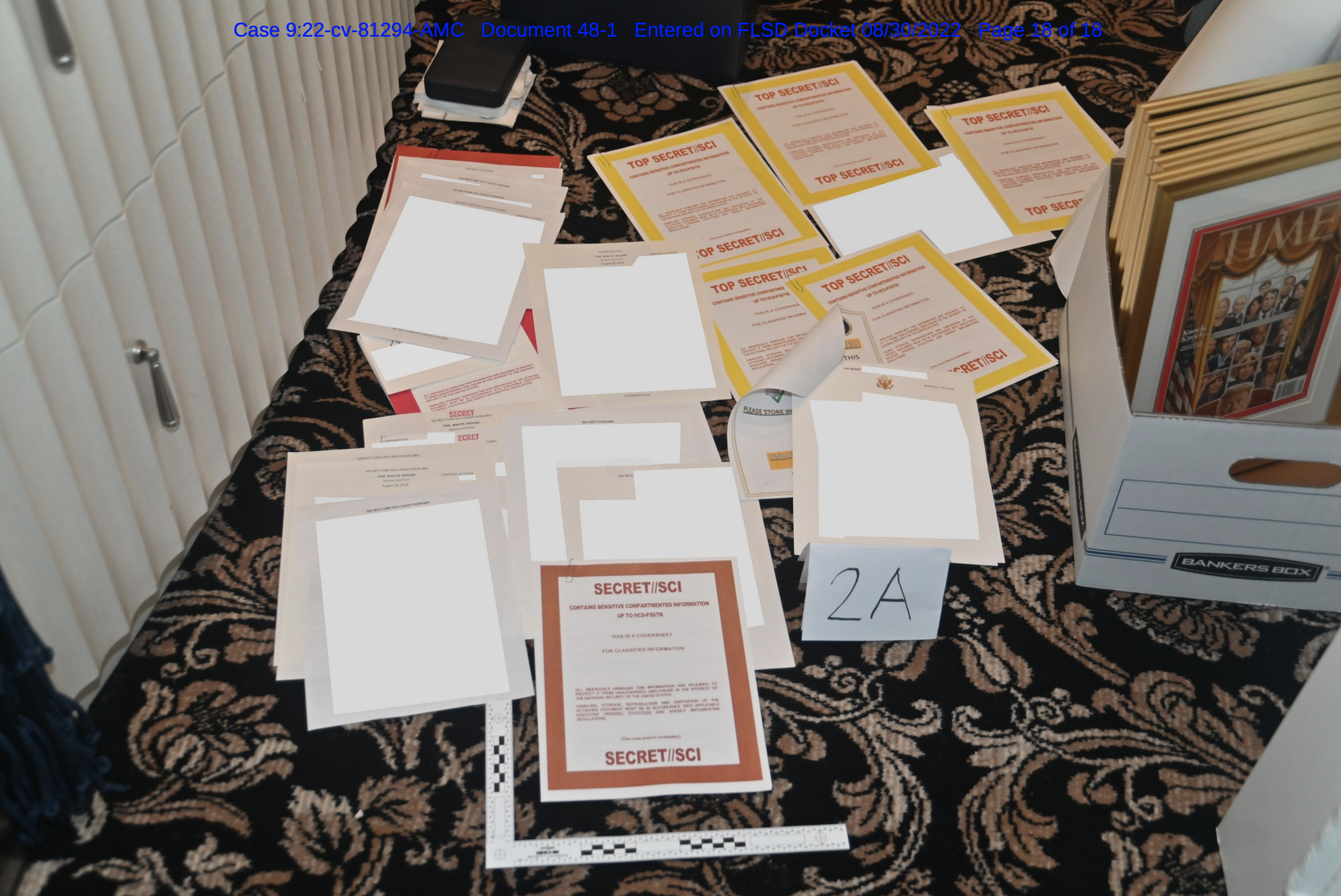
  • The existence of a leatherbound trophy box in his office storing the most classified documents (alongside Time Magazine covers, which is one piece of evidence these are trophies)
  • The existence of 46 empty classified folders, which may be one reason DOJ suspects not all of Trump’s documents are accounted for yet
  • Two compiled documents integrating classified records with other materials, one dating from Trump’s presidency (the grant of clemency for Roger Stone) and one that includes at least 3 messages that post-date his presidency

I’ll review that last document, because it hasn’t gotten nearly enough attention yet.

One of the last filings released in Trump’s Special Master process, summarizing the disputes, described a “compilation” of two classified records (one Confidential, one Secret), and what appears to be four other documents: messages from a book author, a religious leader, and a pollster, as well as what appears to be a fourth document involving a lawyer. The messages all post-date January 20, 2021.

One potentially privileged document that had been scanned was removed from the database (SM_MAL_00001185 to SM_MAL_00001195). That document – excluding the one potentially privileged page (SM_MAL_00001190) – is discussed in the next section about the Filter Materials Log. The potentially privileged page is the subject of a separate letter from the Filter Team to Your Honor, which is sent today.

[snip]

This document is a compilation that includes three documents that post-date Plaintiff’s term in office and two classified cover sheets, one SECRET and the other CONFIDENTIAL. Because Plaintiff can only have received the documents bearing classification markings in his capacity as President, the entire mixed document is a Presidential record.

Besides the classified cover sheets, which were inserted by the FBI in lieu of the actual documents, none of the remaining communications in the document are confidential presidential communications that might be subject to a claim of executive privilege. Three communications are from a book author, a religious leader, and a pollster. The first two cannot be characterized as presidential advisers and all three are either dated or by content occurred after Plaintiff’s administration ended. [my emphasis]

In other words, this document, which was stored in a desk drawer, suggests that Trump used classified documents at least once after he left the White House.

While there are press reports that Trump otherwise accessed documents after DOJ started looking for them — in part, by curating the ones he was willing to send back in January 2022 and hiding some from Evan Corcoran so they wouldn’t be turned over in the June 2022 search — this compilation seems to show that Trump not only knew the classified records were in his home, but he used them, at least once, after he left the White House.

Given the discoveries in yesterday’s Biden search, we can’t rule that out in his case, either. Bauer’s statement described the FBI taking, “documents with classified markings and surrounding material,” which doesn’t rule out a compiled document — though it also could describe documents and the other contents of the folder or box they were found in, which would be consistent with how DOJ approached the search of Trump’s home.

And the seizure of hand-written notes from the time Biden was Vice President means we can’t rule out the equivalent of the letters from Kim Jung Un that Trump took, memorabilia that, because it pertains to foreign policy, should also be treated as classified (and would be covered by the Presidential Records Act).

Both both-sides journalists and hopeful lefties are jumping to conclusions about what the Biden seizures mean. The truth is, we simply don’t know yet. We know the most damning details about documents Trump had largely because of his legal challenges, not because they would otherwise be available from this kind of report on the investigation.

Here’s a comparison of what we know of the two cases:

The obstruction is still what distinguishes Trump from Biden, because DOJ would most likely charge a Constitutional officer only with 18 USC 793(e), refusing to given classified documents back. Biden has made multiple efforts to give documents back: Trump has made multiple efforts to refuse to give documents back.

But as for the other damning details we know exist with Trump? We can’t rule them out with Biden.

Update: I’ve changed the number of Biden docs, to allow for some uncertainty about these are being referenced. We don’t have the FBI inventory, like we do for Trump.

Share this entry

The Primary Thing Eric Herschmann Remembers from January 6 Is that Cassidy Hutchinson Was Wrong about That Note

There’s a funny detail in Cassidy Hutchinson’s September 14 January 6 Committee testimony.

She claimed that on May 20, after a third appearance before the committee and after firing her lawyer, Stefan Passantino earlier that day, Eric Herschmann called her and told her, “I didn’t know you remembered so much.”

And Eric called me that evening, and I just apologized. And he was like, you know, “I didn’t know that you remembered so much, Cassidy. Mark [Meadows] really put you in bad positions. I’m really sorry that he didn’t take care of you better. You never should’ve had to testify to any of that. That’s all of our jobs. I don’t know why they didn’t ask us, they asked you instead.”

And I was just like, “Look, Eric like, it is what it is.” And he kind of talked for — it was probably a 30-minute conversation.

“Remembered,” she described Herschmann saying, not “knew” or “witnessed.”

It’s an interesting word choice, if accurate, because in Herschmann’s testimony before the committee back on April 6 (and so after Passantino had sat through Hutchinson’s first two appearances before the committee, on February 23 and March 7), he didn’t remember much.

The word “remember” shows up (sometimes used as part of a question to him) 482 times in the transcript. The word “recall” shows up 166 times. The word “recollection” comes up 24 times.

Among the things Herschmann professed to have little memory of were the fake electors casting votes in December, Trump’s December 19 tweet announcing the January 6 event,  the date of a key January 5 meeting involving Marc Short and John Eastman, the details (beyond an “intellectual discussion about [John] Eastman”) of a call he had with Rudy Giuliani — out of the blue! — on the morning of the 6th, what he said to Pat Philbin to try to convince him to join him at the rally before proceeding on his own, what Trump said to him while waiting to speak at the Ellipse (Herschmann invoked Executive Privilege to cover a call between him and Trump at 10:50PM that day), any claims in Trump’s Ellipse speech that Herschmann knew to be bullshit,  what Mark Meadows, Dan Scavino, and Trump were talking about in the dining room after returning from the Ellipse, and whether he had auto-delete set for his texts.

What Herschmann did recall — aside from the times he screamed at Jenna Ellis, Sidney Powell, and John Eastman, which made him a hero of the January 6 Committee hearings — was writing a note calling on people to leave the Capitol.

Q So do you recall, did you tell them what was happening or did they seem to already be aware?

A I don’t remember. I know I wrote out something, but I don’t remember if they were aware when they came back or I told them when I came in. I just don’t remember that detail.

Q And why did you write something out?

A I thought we should put out a statement.

Q Okay. Do you remember what you wrote?

A I don’t remember the exact words, but I remember going down to Mark’s outer office, chief of staff, and asking someone there to get me something to write on. And normally, if I had to — if I was grabbing something, it would be the chief of staff.

They have one of those cards, I don’t know, it’s a rectangular card that says chief of staff.

Q So this was a handwritten note?

A It was a handwritten note, yeah.

Q Okay. Let’s go — we’ll pull up Exhibit 11. Is that the note you’re referring to?

A That is the note.

Q Okay. And what did you do with the note?

A The actual physical note.

Q Yeah. Did you give it to the President?

A No, I didn’t give it to the President. I may have given it to Meadows, but I didn’t hand it to the President. I would have — I think the reason I edited “illegally,” is someone had a discussion, I don’t remember who it was — and it wasn’t the President, but someone had the discussion, how do we establish it’s illegally — that they entered illegally? Which I thought, okay, I don’t want to say overlawyering, but overlawyering, in my view. So I crossed out “illegally” and said “without proper authority.” Okay, that solves that issue, right? And I thought we should put out the statement.

Q Did you tell the President that he should put out a statement?

A Generally, I had discussions with the President about putting out a statement. I don’t remember if I read this or I handed it to Mark, or Mark and I discussed it in front of the President. I just don’t remember that detail. But this was my first reaction to seeing the violence and what I thought the White House should do.

Q Did the President have a reaction?

A I don’t recall his reaction, but obviously he didn’t put out this statement. [my emphasis]

It’s funny that that was one of the few things Herschmann recalled on April 4, because after Hutchinson testified in her May 17 testimony to remembering a whole bunch of things that Herschmann couldn’t remember (including a discussion between Meadows, Herschmann, and Pat Cipollone about Trump’s comment that Mike Pence might deserve to be hung), she went on to publicly testify, on June 28, that she physically wrote that note as Meadows dictated it, with Herschmann chiming into to offer the alternative, “without proper authority.”

LIZ CHENEY: Now let’s look at just one example of what some senior advisers to the president were urging. Ms. Hutchinson, could you look at the exhibit that we’re showing on the screen now? Have you seen this note before?

CASSIDY HUTCHINSON: That’s a note that I wrote at the direction of the chief of staff on January 6th, likely around 3:00.

LIZ CHENEY: And it’s written on a chief of staff note card, but that’s your handwriting, Ms. Hutchinson?

CASSIDY HUTCHINSON: That’s my handwriting.

LIZ CHENEY: And why did you write this note?

CASSIDY HUTCHINSON: The chief of staff was in a meeting with Eric Hirschman and potentially Mr. Philbin, and they had rushed out of the office fairly quickly. Mark had handed me the note card with one of his pens, and sort of dictating a statement for the president to potentially put out.

LIZ CHENEY: And — no, I’m sorry. Go ahead.

CASSIDY HUTCHINSON: That’s Ok. There are two phrases on there, one illegal and then one without proper authority. The illegal phrase was the one that Mr. Meadows had dictated to me. Mr. Herschmann had chimed in and said also put without legal authority. There should have been a slash between the two phrases. It was an — an or if the president had opted to put one of those statements out. Evidently he didn’t. Later that afternoon, Mark came back from the Oval Dining Room and put the palm card on my desk with illegally crossed out, but said we didn’t need to take further action on that statement.

LIZ CHENEY: So, to your knowledge, this statement was never issued.

CASSIDY HUTCHINSON: It was — to my knowledge, it was never issued.

The difference between Herschmann and Meadows dictating the note to Hutchinson (who is not once mentioned in Herschmann’s testimony) and Herschmann writing it himself is negligible in the larger story, so he could have left it well enough alone. Especially given the number of times Herschmann claimed not to remember details of what happened with the note, such as how it was presented to Trump or how the then-President responded.

But Herschmann didn’t leave it well enough alone. Shortly after Hutchinson’s public testimony, Herschmann’s spox put out a formal statement claiming he had written the note.

“The handwritten note that Cassidy Hutchinson testified was written by her was in fact written by Eric Herschmann on January 6, 2021,” a spokesperson for Herschmann told ABC News Tuesday evening.

“All sources with direct knowledge and law enforcement have and will confirm that it was written by Mr. Herschmann,” the spokesperson said.

This statement became one of two bases — along with the pushback from people in the vicinity of Tony Ornato about the Beast story — on which Hutchinson’s credibility was attacked in the days after her testimony.

The discrepancy on the note could be just that, a discrepancy. All of Herschmann’s claimed memory lapses might one day come to be refreshed.

The dispute, however minor, between Herschmann and Hutchinson is noteworthy for several reasons though.

First, Hutchinson told the committee that the first time she met with Passantino, after being referred by Herschmann via Alex Cannon, she asked him if he was representing anyone else before the Committee. Passantino wouldn’t answer, but according to Hutchinson, he did say he had represented Eric Herschmann, among others, in the past, and that “we really want to work to protect Eric Herschmann.”

Ms. Hutchinson. ~ You previously asked about individuals he had raised with me. In my conversation with him earlier that afternoon, when I [sic] asking him about the engagement letter, I did also ask Stefan if he was representing any other January 6th clients. And he had said, “No one that I believe that you would have any conflicts with.”

And I said, “Would you mind letting me know?” Now, again, to this day, I still don’t know if that’s really a kosher question to ask an attorney, if they can share their clients with me, but I wanted to make sure that there actually weren’t any conflicts, because I didn’t have anything in writing.

He wouldn’t tell me anybody he was representing before the January 6th Committee, but he did tell me that he had previously represented Eric Herschmann and Jared Kushner and Ivanka Trump in unrelated matters.

And in that same conversation, he said, “So if you have any conversations with any of them, especially Eric Herschmann, we want to really work to protect Eric Herschmann.”

And| I remember saying sarcastically to him, “Eric can handle himself. Eric has his own resources. Why do I have to protect Eric?” He said, “No, no, no. Like, just to keep everything straight, like, we want to protect Eric with all of this.”

Ms. Cheney. Did he explain what he meant?

Ms. Hutchinson. No. And, to be honest, I didn’t ask. I didn’t have anything with Eric anyway that I felt that I had to protect. And I say that because, at the time of being back in Trump world — this is where I look back and regret some of this, but — like, I did feel a need to protect certain people. But with somebody like Eric, I didn’t feel that need, I didn’t find it necessary.  didn’t — I didn’t think that Eric did anything wrong at the time.

Ms. Cheney. Did it have something to do with NARA?

Ms. Hutchinson. He never really explained to me what it was exactly that we wanted to protect Eric on. I sort of erred on the side of: Maybe he just represents Eric in ongoing litigation, whether it’s financial disclosures or whatever it might be.

And, again, I just didn’t prod too much on that either, because, you know, I was under the impression that Eric helped set me up with Stefan, so I didn’t — I was worried that Stefan would then go back-channel to Eric and — this is my very paranoid brain at the time, but I was worried that if I, you know, pushed this subject a little too much, that he would then go back to Eric Herschmann and say, “Cassidy asked a lot of questions about you, like, why she needs to protect you.” So just didn’t really press the subject too much on that.

By the end of that first day, per her testimony, she learned that Passantino was business partners on the election-related business Alex Cannon had with Justin Clark and, possibly, Herschmann.

S0 I — “I want to make sure that I’m getting the dates right with these things?

He goes, “No, no, no.” He said, “Look, we want to get you in, get you out.

We’re going to downplay your role. You were a secretary. You had an administrative role. Everyone’s on the same page about this. It’s extremely unfair that they’re” “they’re” being the committee – “that the committee is putting you in this position in the first place. You really have nothing to do with any of this. It’s Mark’s fault that you’re even involved in this. We’re completely happy to be taking care of you now. We had no idea that you weren’t being taken care of this last year. So we’re really happy that you reached back out to us. But the less you remember, the better. I don’t think that you should be filling in any calendars or anything.”

[Redacted] When he said a

Ms. Cheney. Go ahead.

[Redacted] So everyone’s on the same page about this, did he explain who he was referring to when he said “everyone”?

Ms. Hutchinson. He didn’t at that moment. Then there are times throughout my working relationship with Stefan where he said similar things that I asked.

Later that day, sort of put together that the “they” he was referring to then were Justin Clark, Alex Cannon, Eric Herschmann. I think that’s — yeah, think that’s all of them.

Ms. Cheney. And how did you put that together?

Ms. Hutchinson.  Because he — he had said that — Justin — yeah, Justin Clark. Stefan had told me that — towards the end of the day that because he was involved with Elections, LLC, and tangentially, I guess Trump’s PACs, he had law partners. And unless I was extremely unwilling for him to share, he said it would be natural for him to have to share that information with the people that he works with that are his partners that are involved in Trump world.

Then, after her third interview — the one in which Hutchinson remembered a lot of details about the response to the attack that Herschmann had already testified to not remembering — Passantino responded by confirming to Maggie Haberman that Meadows’ former aide had testified, and telling Meadows’ lawyers, his partners, and Herschmann about her testimony, all in defiance of Hutchinson’s wishes, according to her testimony.

Ms. Cheney. Did he also – so you said that he talked to Terwilliger, to his law partners. Did he also talk to Herschmann?

Ms. Hutchinson. He did. I’m sorry. I neglected to mention that. He –as we were leaving that evening, I got an Uber, and he walked me to my Uber, and he reiterated that he was going to have a conversation with his law partners. He was going back to Michael Best, and he said that he was going to have a conversation with his law partners that night.

And he asked — he asked — I forget how he said it. He said something to the effect of, “I think its best if we tell Eric about this, too. He’s not technically my law partner, but I think Eric deserves to know some of this, too.”

And I said, “Look, at this point, one, I kind of know you’re going to do what you’re going to do.” And I said, “Whatever you think is best”

That’s what led to the 30-minute call from Herschmann, the one where he expressed surprise that she remembered so much.

The discrepancy looks somewhat different give Hutchinson’s claim that Passantino told her, from the start, “they” were trying to protect Herschmann.

Particularly given that the transcripts reveal just how amorphous Herschmann’s job was. He has often been referred to as part of the White House Counsel’s office. I’ve done it. General Keith Kellogg did it in his interview with the Committee, which is why, Kellogg explained, he was so surprised that Herschmann sat silent in the Oval Office as Trump told Mike Pence he could reject electors from contested states, some details of which were something else Herschmann claimed not to remember.

Herschmann’s job was providing legal advice (he was also involved in Jared Kushner’s portfolio of pardons and Middle East negotiations, though when asked, he was coy about his relationship with the kids: “I had met them beforehand,” he said) And he did report through Pat Cipollone. But he was not part of the White House Counsel’s Office.

It’s almost like he was an in-house minder, paid by taxpayers, installed by the family or Bill Barr for the last five months of the presidency.

While working at the White House, Herschmann teamed up with Passantino and Don Jr’s buddy, Arthur Schwartz, to pitch the first Hunter Biden smears to the WSJ, even before Rudy disseminated the “laptop.”

Yet even in that short time period, Herschmann became a key gatekeeper for the President, ostensibly to prevent him from getting outrageous pitches.

Which makes a key discrepancy between Pat Cipollone and Herschmann’s testimony rather interesting, particularly given Passantino’s concern (at least per Hutchinson’s testimony) with protecting Herschmann.

Herschmann claimed that the reason Cipollone wasn’t in that meeting in the Oval Office on January 6, sometime after he spoke with Rudy out of the blue and at which he didn’t remember the Joint Session of Congress coming up, is because Cipollone hadn’t arrived to work yet. In fact, Herschmann remembered that even after the Oval Office meeting, Cipollone still wasn’t in the office; Herschmann described talking to just Pat Philbin before deciding to go, without prior planning, to the Ellipse.

I don’t remember, I don’t think Cipollone was in the office yet, but Philbin was.

The way Cipollone remembered it is that he came to the Oval Office before the meeting, but Herschmann specifically told him he didn’t need to participate — it was just family.

I remember Eric Herschmann was standing there and came and my recollection is he came to me as I was standing in the door and said, this is — this is family — just kind of –you don’t need to be here. And said, fine. And believe I went back to my office at that point.

And so, as Herschmann described, when he was in the Oval Office not hearing a discussion about the Joint Session of Congress, he was just on a social visit, just saying hello.

Q You were not there for any legal purpose. It was just, you indicated, sort of a social gathering?

A Yeah, when I first came in, it was just saying hello.

I’m sure that relative veracity of these claims are all being weighed by Jack Smith and his prosecution team. Indeed, after these events, DOJ started adding Passantino’s name to subpoenas.

I’m interested in one more detail about it. Immediately after Hutchinson testified about her claims of obstruction to J6C on September 14 and 15 (testimony which should have been secret), Maggie Haberman came out with two stories pitching Herschmann — who worked so closely on Jared’s portfolio at the White House — in positive light. On September 16, Maggie Haberman reported on Herschmann’s demand to get an Executive Privilege invocation in writing just in time to avoid testifying sometime that month. In it, Herschmann got to impugn Boris Epshteyn’s legal ability, just like he was made a star of the J6C hearings by yelling at Eastman and Powell.

The claim that Herschmann was invoking Executive Privilege is particularly interesting given two things he said in his J6C interview. First, he said that “based on his understanding” with the two Pats, he would not invoke privilege, at least with respect to Trump’s call to Mike Pence on January 6.

Q And could you hear the Vice President, or only hear the President’s end?

A Only hear the President’s end.

Q Okay. And what did you hear him say?

A Well, I guess from this, based on my understanding with Pat Philbin and Pat Cipollone — I don’t want to assert privilege on that as much as tell you that, at some point, it started off as a calmer tone and everything, and then became heated.

Given his claimed status as a social visitor and his role as an aide giving legal advice reporting to, but not part of, the White House Counsel’s Office, I’m curious what privilege he would claim.

Almost immediately thereafter, Herschmann asked to review with his own lawyers (former colleagues of his from Marc Kasowitz’ firm who also repped Ivanka, Jared, Ivanka Trump’s Chief of Staff Julie Radford and aide Rachel Craddock, and two of Trump’s Executive Assistants, Molly Michael and Austin Ferrer, as well as Alex Cannon, the latter of whom was represented pro bono), in part, whether “if I don’t recall something” it’s invoking a privilege.

Q  Okay. Others have said that President Trump said, I made the wrong decision four years ago?

Do you recall that.

A Let me — can we take a two-second break, so I get the privilege down in my head? Because if I don’t recall something, I presume it’s not invoking anything, right?

So can we take a five-minute break, so I can get my own ground rules covered.

Herschmann did, as noted, invoke privilege to cover one of two private conversations he had with Trump that day, one after the attack on the Capitol. But that was it. The single solitary thing all day he invoked privilege over. And yet somehow, there would be a lengthy discussion about privilege before he appeared before a grand jury.

The reason I find these discussions of privilege so interesting, though, is because while we know that the two Pats testified before a grand jury after Beryl Howell overruled Trump’s privilege invocation, we’ve never heard whether Herschmann did.

That’s relevant, too, because (like Alex Cannon), Herschmann also reportedly has a role in the stolen documents case. A few days after the story on privilege, on September 19, Haberman reported that Herschmann had warned Trump to return his stolen documents at some otherwise vague meeting in 2021.

As Hutchinson’s testimony and years of past practice make clear, sometimes people share stories with Maggie as a way to telegraph what has gone on in an investigation.

Share this entry

Special Master in Project Veritas Investigation Reviewed Crime-Fraud Submissions in December

Back in December, Paul Calli and his firm withdrew from the Project Veritas Special Master docket, and was replaced by Edward Greim, a partner in Matt “Big Dick Toilet Salesman” Whitaker’s firm. He also represents a number of Trumpsters before the January 6 Committee.

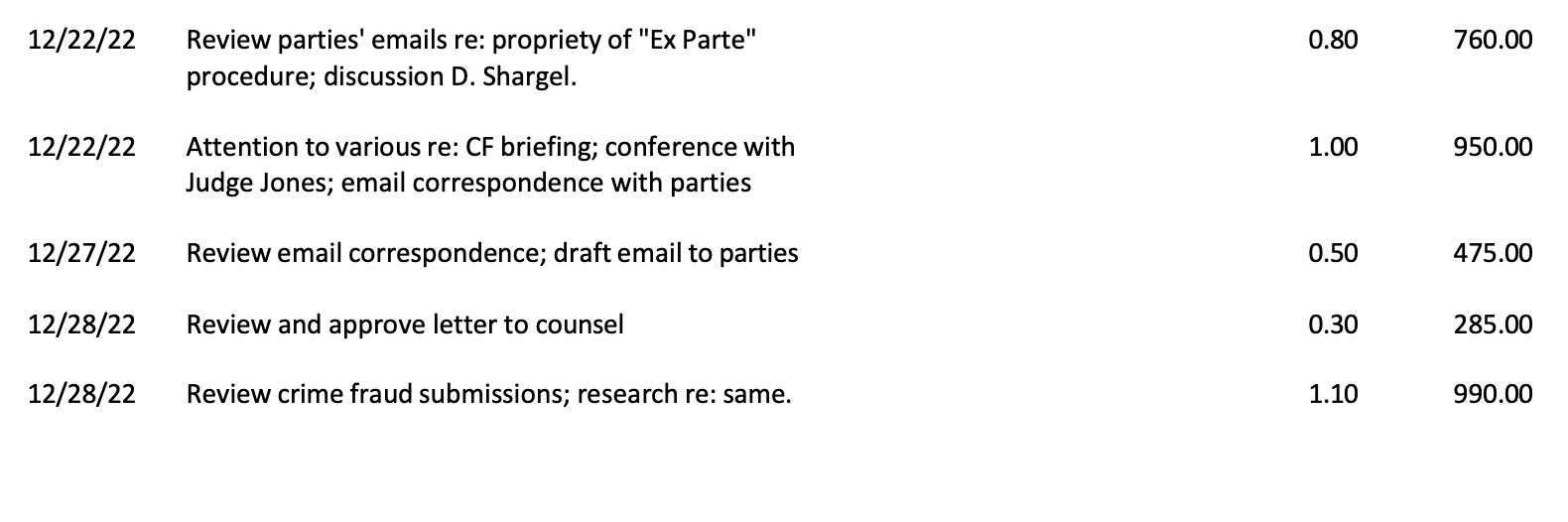
That’s interesting timing because, according to the invoice that Special Master Barbara Jones just submitted, she spent two hours that week reviewing Crime-Fraud submissions in the case.


Share this entry

Trump Worked with People Who Allegedly Worked with the Proud Boys to Obstruct the Peaceful Transfer of Power

By my count, at least 14 people are known to have pled guilty to some kind of conspiracy on January 6, with four more cooperating against them. Another four were found guilty of one or more conspiracy in November’s Oath Keeper verdict. Eighteen people, in one way or another have been convicted of conspiring to prevent the peaceful transfer of power on January 6, most by obstructing the vote certification.

Trump played a key part in all those conspiracies.

Ronnie Sandlin, for example, first started planning to go, armed, to DC in response to Trump’s December 19 tweet, posting on December 23 that he planned to “stop the steal and stand behind Trump when he decides to cross the rubicon.” After he watched Trump’s speech on January 6, Sandlin did a live stream where he said, “I think it is time to take the Capitol.” Once he arrived at the Capitol, Sandlin and co-conspirator Nate DeGrave participated in tactically critical assaults on cops in two places, the East door and the door to the Senate gallery. After Sandlin helped him get into the gallery, Josiah Colt then rappelled from the gallery to the Senate floor.

Like Sandlin, Brad Smith started arming himself and planning to come to DC in response to Trump’s December 19 tweet.

The call to action was put out to be in DC on January 6th from the Don himself. The reason is that’s the day pence counts them up and if the entire city is full of trump supporters it will stop the for sure riots from burning down the city at least for awhile.

By December 31, Smith predicted, “Militias will be there and if there’s enough people they may fucking storm the buildings and take out the trash right there.” Smith and his co-conspirator, Marshall Neefe, participated in an assault on cops using an 8′ by 10′ Trump sign. And after the attack he boasted that the mission was successful because “we literally chased them out into hiding. No certification lol.”

Trump played a slightly different role in the Oath Keepers conspiracy. The Oath Keepers — Stewart Rhodes above all — viewed Trump as a means to prevent Biden’s election, because as President he could invoke the Insurrection Act and with it (the Oath Keepers believed) make the militias a legal arm of the state, defending Trump. Rhodes repeatedly called on Trump to invoke the Insurrection Act — on November 9, December 12, December 23, and January 6.

He dictated a note to Trump after January 6 asking him to call on the militias as his army to stop Biden from taking power.

For the most part, none of the channels via which Rhodes tried to speak directly to Trump (including Kellye SoRelle’s attempt to work through Rudy Giuliani’s son) are known to have reached Trump.

One of his attempted interlocutors, though, undoubtedly had access to Trump: Roger Stone, on whose Friends of Stone list Rhodes was sharing his plans for insurrection shortly after the election.

DOJ has exploited at least four phones owned by members of the Friends of Stone list: Rhodes and SoRelle, Owen Shroyer, and Enrique Tarrio. Probably DOJ asked for content from Ali Alexander as well (though he disclaimed having any Signal texts to the January 6 Committee).

While a jury found all the Oath Keepers guilty of obstructing the vote certification, with the key exception of Kelly Meggs (who was also in contact separately with the Proud Boys, Roger Stone, Ali Alexander, and alleged 3 Percenter Jeremy Liggett, who in turn had ties to the MAGA Bus Tour) as well as Jessica Watkins, it found the greater part of their conspiracy either overthrowing the government or interfering with with official duties: not obstructing the vote count. Their larger plan to keep Trump in power used different means than Trump used.

That’s not true of the Proud Boy Leaders, who are three days into their trial.

Not only did the Proud Boys allegedly pursue the same plan that Trump was pursuing — obstructing the vote certification on January 6 — but they were in communication with people who were in communication, and central to, Trump’s plan: most notably, Alex Jones, Ali Alexander, and Roger Stone. They were in communication with people who were in communication with people close to Trump during the attack.

Even their telephony records show that Enrique Tarrio, Joe Biggs, and Ethan Nordean were in contact with Alex Jones and Owen Shroyer during the period.

Records for Enrique Tarrio’s phone show that while the attack on the Capitol was ongoing, he texted with Jones three times and Shroyer five times.124 Ethan Nordean’s phone records reflect that he exchanged 23 text messages with Shroyer between January 4th and 5th, and that he had one call with him on each of those days.125 Records of Joseph Biggs’s communications show that he texted with Shroyer eight times on January 4th and called him at approximately 11:15 a.m. on January 6th, while Biggs and his fellow Proud Boys were marching at and around the Capitol.126

Given the known communication habits of the men, it’s possible there are Signal or Telegram communications that were unavailable to the J6C as well.

Alex Jones and Ali Alexander knew in advance they would lead the mob to the Capitol (the January 6 Report offers an unpersuasive explanation that the request came exclusively from Caroline Wren). Roger Stone had planned to join them, probably until he got cranky about being denied a speaking role on the morning of January 6. Mike Flynn wanted to latch on, as well, until the General got too cold and had to go back to his posh hotel room. “Hell no,” he said, according to Caroline Wren. “It’s freezing.”

Meanwhile, even as Shroyer was in touch with Biggs, Alexander was in touch with Caroline Wren, who remained at the Ellipse, and asked for 5-minute updates on the Trump’s progress to the Capitol (the text in question appears to have come from Wren, but may not have been provided in Alexander’s production).

The communication between Proud Boys and Jones in real time is critical because once the riot police showed up and slowed the attack, the Proud Boy leaders pulled up, effectively waiting until Jones appeared. And after Jones did appear, he told the mob following him that Trump was coming to give another speech — something Alexander, and so almost certainly Jones — knew to be false because Wren had told Alexander. Nevertheless, Jones led his mob to the East steps, riled them up with a 1776 chant, and left them there, where they were soon joined by the Oath Keepers (led by Kelly Meggs, who also was in touch with Alexander) and Joe Biggs and some other Proud Boys (including one who had been directing traffic). That collective mob breached the East door of the Capitol, opening a second major front on the Capitol and adding to the invasion of the Senate chamber.

There are rioters who were sentenced to two months in jail because they followed Alex Jones credulously to the top of those steps and joined the mob storming the Capitol.

And it wasn’t just Jones and Alexander who were in touch with Trump’s handlers.

Mark Meadows was, per Cassidy Hutchinson, in communication with Stone about his plans for January 6, at a time when Stone still planned to march to the Capitol with Jones and Alexander.

LIZ CHENEY: Thank you, Mr. Chairman. Before we turn to what Ms. Hutchinson saw and heard in the White House during the violent attack on the Capitol on January 6th, let’s discuss certain communications White House Chief of Staff Mark Meadows had on January 5th. President Trump’s associate, Roger Stone, attended rallies during the afternoon and the evening of January 5th in Washington, DC On January 5th and 6th, Mr. Stone was photographed with multiple members of the Oath Keepers who were allegedly serving as his security detail.

As we now know, multiple members of that organization have been charged with or pled guilty to crimes associated with January 6th. Mr. Stone has invoked his Fifth Amendment privilege against self-incrimination before this committee. General Michael Flynn has also taken the Fifth before this committee. Mr. Stone previously had been convicted of other federal crimes unrelated to January 6th.

General Flynn had pleaded guilty to a felony charge, also predating and unrelated to January 6th. President Trump pardoned General Flynn just weeks after the Presidential election, and in July of 2020, he commuted the sentence Roger Stone was to serve.

The night before January 6th, President Trump instructed his Chief of Staff Mark Meadows to contact both Roger Stone and Michael Flynn regarding what would play out the next day. Ms. Hutchinson, Is it your understanding that President Trump asked Mark Meadows to speak with Roger Stone and General Flynn on January 5th?

CASSIDY HUTCHINSON: That’s correct. That is my understanding.

LIZ CHENEY: And Ms. Hutchinson, is it your understanding that Mr. Meadows called Mr. Stone on the 5th?

CASSIDY HUTCHINSON: I’m under the impression that Mr. Meadows did complete both a call to Mr. Stone and General Flynn the evening of the 5th.

In an earlier interview, when she was still represented by Stefan Passantino, she had attributed the idea for this call to Peter Navarro or a Navarro staffer; the Navarro staffer who had let Mike Flynn into the White House on December 18, Garrett Ziegler, was another White House contact of Ali Alexander’s, in addition to Wren.

All this matters because of the way conspiracy law works, as laid out in the bullet points from Elizabeth de la Vega that I always rely on.

CONSPIRACY LAW – EIGHT THINGS YOU NEED TO KNOW.

One: Co-conspirators don’t have to explicitly agree to conspire & there doesn’t need to be a written agreement; in fact, they almost never explicitly agree to conspire & it would be nuts to have a written agreement!

Two: Conspiracies can have more than one object- i.e. conspiracy to defraud U.S. and to obstruct justice. The object is the goal. Members could have completely different reasons (motives) for wanting to achieve that goal.

Three: All co-conspirators have to agree on at least one object of the conspiracy.

Four: Co-conspirators can use multiple means to carry out the conspiracy, i.e., releasing stolen emails, collaborating on fraudulent social media ops, laundering campaign contributions.

Five: Co-conspirators don’t have to know precisely what the others are doing, and, in large conspiracies, they rarely do.

Six: Once someone is found to have knowingly joined a conspiracy, he/she is responsible for all acts of other co-conspirators.

Seven: Statements of any co-conspirator made to further the conspiracy may be introduced into evidence against any other co-conspirator.

Eight: Overt Acts taken in furtherance of a conspiracy need not be illegal. A POTUS’ public statement that “Russia is a hoax,” e.g., might not be illegal (or even make any sense), but it could be an overt act in furtherance of a conspiracy to obstruct justice.

Co-conspirators don’t all have to meet in a room together and agree to enter a conspiracy. That can happen (and did, in the Oath Keepers’ case) via a series of communications which networks everyone.

The demonstrative exhibit prosecutors used in the Oath Keeper trials showed how the various communications channels included everyone, even if some members of the conspiracy only interacted with a limited group of other co-conspirators.

I circled Rhodes and SoRelle in pink to show that even in the Oath Keeper trial, prosecutors treated the Friends of Stone list part of the communications infrastructure of the conspiracy.

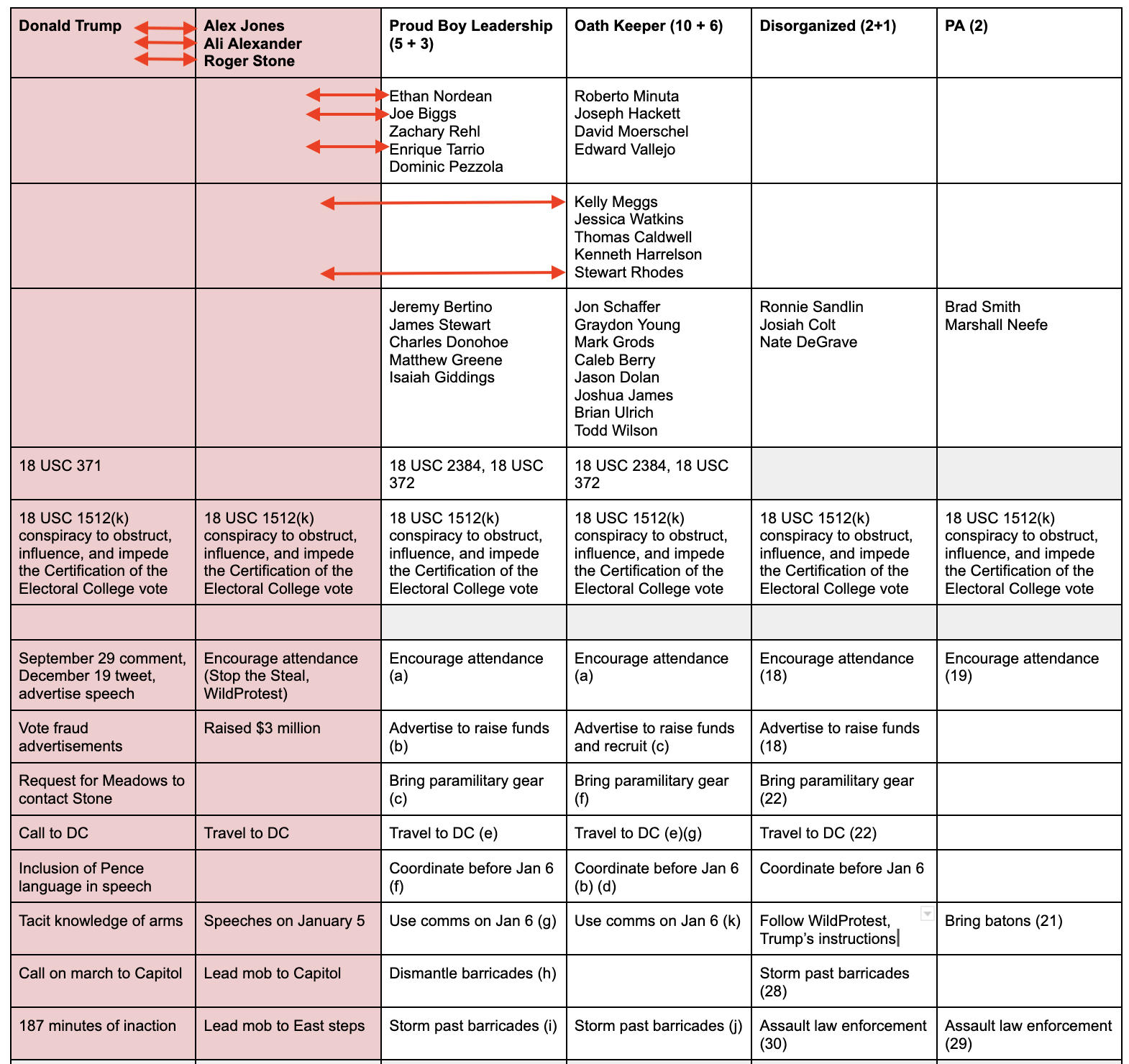
Here’s what the larger conspiracy looks like, reflecting  the known communications between Rhodes, Meggs, Tarrio, Biggs, and Nordean and Jones and Stone, and the known communications between Jones and Stone and Alexander with Trump or his handlers, like Meadows, Wren, and Ziegler by way of Navarro.

The numbers and letters in parentheses come from one or another of the indictments charging conspiracy. As you can see, Trump’s known actions map onto the known, charged overt acts of various conspiracies to obstruct the vote count like a mirror.

Obviously, the pink part of this table has not been charged (yet). And it may not be unless prosecutors win guilty verdicts in the Proud Boys case. It also may not be if the obstruction charge gets narrowed on appeal.

For reasons I laid out here, the Proud Boys trial is far more complex than the Oath Keepers trial. And in the Proud Boys trial, like the Oath Keepers trial, prosecutors don’t have a clear map showing that the plan was to occupy the Capitol; instead they have testimony that Biggs and Nordean kept consulting, and everyone took orders from them, and those orders had the effect of sending cells of Proud Boys off to breach parts of the building. So it is not at all certain that prosecutors will win convictions of the men — Tarrio, Biggs, and Nordean — who were working with people who were working with Trump and his handlers.

But this is one of the means via which DOJ has been working to hold Trump accountable since just months after the attack (I first laid this out in July 2021, long before most commentators understood how DOJ was using obstruction).

Even with the disorganized conspiracy (Sandlin and friends), prosecutors have carefully shown how the men took Trump’s December 19 tweet as an explicit instruction, took instructions from a WildProtest flyer put out by Ali Alexander, believed Trump had ordered them to march to the Capitol. There are hundreds more rioters who took Trump’s December 19 tweet as an instruction, though in the case of Sandlin and his co-conspirators, they took steps that were critical to the occupation of the Capitol and the Senate chamber in response.

But with the Proud Boys, to an extent thus far only seen with Oath Keeper Kelly Meggs, the communication ties, via a two step network, to Trump’s own actions and directions. And with the Proud Boys, that coordination builds off years-long relationships, particularly between Biggs and Jones and Stone, and through them, to Trump.

Everyone was working towards the same goal: to prevent Congress from certifying Joe Biden’s victory. There were, in various places, explicit agreements made. There were, as with Trump’s Stand Back and Stand By comment that prosecutors used to kick off this trial, more implicit agreements as well.

And DOJ is now at the point where it is beginning to show how those agreements, explicit and implicit, all worked together to make the assault on the Capitol successful.

Conspiracy guilty verdicts

Oath Keepers Stewart Rhodes, Kelly Meggs, Jessica Watkins, Kenneth Harrelson, Kelly Meggs, Mark Grods, Caleb Berry, James Dolan, Joshua James, Brian Ulrich, Todd Wilson (11 conspiracy verdicts)

Proud Boys Matthew Greene, Charles Donohoe, Jeremy Bertino, with Isaiah Giddings, Louis Colon, and James Stewart cooperating (3 known conspiracy verdicts)

Disorganized Militia Ronnie Sandlin, Nate DeGrave, with Josiah Colt cooperating (2 conspiracy verdicts)

“Patriots” Marshall Neefe and Charles Smith (2 conspiracy verdicts)

Share this entry

How Legal Certainty about 1512(c)(2) Has Wobbled Even as Certainty Trump Violated It Increased

In the past year, those who believe Trump could and should be held accountable for January 6 reached near unanimity that he should be charged with obstruction of the vote certification — 18 USC 1512(c)(2).

In the same year, certainty about how the law applies to January 6 has wobbled, with one appeal pending before the DC Circuit (which will be appealed no matter how it comes out), and either an expansion of this appeal or a follow-on one virtually certain. All that uncertainty may not change DOJ’s determination to use it; under all but the most restrictive appellate rulings, it should still easily apply to Trump and his ilk, though not necessarily all the January 6 rioters who’ve already been prosecuted with it.

But DOJ probably won’t know exactly how it’ll apply for at least six months, maybe another year.

This post will attempt to explain what has happened and what might happen going forward.

1512(c)(2) reads:

Whoever corruptly otherwise obstructs, influences, or impedes any official proceeding, or attempts to do so, shall be fined under this title or imprisoned not more than 20 years, or both.

You need an official proceeding — here, Congress’ vote certification mandated by the 12th Amendment, you need an attempt to obstruct it, and you need corrupt purpose. The “otherwise” here is at the center of the legal dispute, meaning how this clause relates to the rest of the obstruction statute is under dispute. But depending on that relationship, the obstruction statute has the advantage of including a potential 20 year sentence, an explicit conspiracy charge, with enhancements under the sentencing guidelines for things tied to the degree of obstruction and the use of violence that offers a good deal of flexibility to tailor sentences ranging from 4 months to 6 years (and hypothetically far higher).

At first, lawyers not following the actual DOJ investigation imagined that Trump could be held accountable for January 6 on an incitement model; indeed, that’s what Congress used in impeachment. But from the start, DOJ charged many of the rioters who premeditated their effort to stop the vote certification with obstruction. It charged Oath Keepers Jessica Watkins and Proud Boy Joe Biggs with obstruction from their initial arrest affidavits on January 16 and 19, 2021, respectively. A jury found Watkins guilty of obstruction (but not seditious conspiracy) on November 30, 2022, and Biggs’ obstruction and sedition conspiracy trial kicked off last Thursday.

In July 2021, I argued that Trump (and any of members of Congress prosecuted) would be charged with obstruction, not incitement. I repeated and expanded that argument in August 2021. In her December speech calling to hold Mark Meadows in contempt, Liz Cheney invoked obstruction as the crime under consideration, which led TV lawyers, almost a year after the fact, to consider Trump’s conduct using the frame of obstruction. In March, Judge David Carter ruled it more likely than not that Trump and John Eastman had attempted to obstruct the vote certification (adopting the 9th Circuit standard for corrupt purpose).

At that point, 14 months after the attack, everyone was in agreement: That’s how Trump could be held accountable. By prosecution under 18 USC 1512(c)(2).

But starting in a November 22, 2021 hearing in the case of Garret Miller, former Clarence Thomas clerk Carl Nichols explicitly raised questions about whether obstruction could apply to the President. In March, even before Judge Carter’s ruling, Nichols ruled that while the vote certification counted as an official proceeding, obstruction required the involvement of documents. In refusing to change his mind on reconsideration, Nichols also noted the discrepancy among DC judges as to what “corruptly” means in the statute.

And that’s how on December 12, 2022, almost two years into this process and a month after the appointment of a Special Counsel, former Trump White House lawyer Greg Katsas, Mitch McConnell protégé Justin Walker, and Biden appointee Florence Pan came to consider how 1512(c)(2) would apply to January 6. On paper, the question they were reviewing pertained to Nichols’ ruling that obstruction under 1512(c)(2) must involve documents. But along the way, the Republican judges invited both sides to weigh in on both how to define corrupt purpose under the statute and, procedurally, how to address it if they were going to rule on it (that is, whether to issue a ruling now, or to remand it back to Carl Nichols only to be appealed after he rules).

Defendants have challenged whether the vote certification counts as an official proceeding too, and I don’t rule out that this Supreme Court, would insert itself into that issue as well, especially given that protests associated with the Brett Kavanaugh confirmation have, from the start, been raised as an inapt parallel to January 6.

It has been a month since the DC Circuit ruling, so they could rule anytime. In the hearing, Katsas seemed inclined to rule for defendants on requiring obstruction to include a documentary component and to intervene to sharply narrow corrupt purpose. Walker seemed to start out in the same camp, but by the end may have come around to splitting his ruling, ruling with DOJ on the documents question but with defendants on the corrupt purpose one. Importantly, he seemed to favor tying “corrupt purpose” to some personal benefit. Pan, who presided over some of these cases before being elevated to the Circuit, seemed inclined to rule with DOJ on both counts.

Whatever the DC Circuit decides, it will be appealed.

If DOJ loses, they’re likely to ask for an en banc review, where they would not face a panel with a majority of Trump appointees. If the defendants lose, they’re likely to appeal it to SCOTUS, where they’d be guaranteed a conservative majority. If the DC Circuit remands the “corrupt purpose” issue — procedurally the correct thing to do — it might be another nine months before DC Circuit gets it back. And then that decision will be appealed by the losing side, to the full panel or SCOTUS. Plus there’s a minor issue on a Trevor McFadden ruling that will be appealed too, how much of a penalty to impose at sentencing.

There will not be certainty on how 1512(c)(2) applies to January 6 before June, and such certainty might not come until next June.

With rioters, DOJ has responded to these legal challenges by adopting several backstop positions. With edge cases, it allowed defendants accused of obstruction to plead down to the more serious misdemeanor, 18 USC 1752. With defendants who had some kind of confrontation with the cops, they have charged civil disorder, 18 USC 231. At the beginning of this process, there were the same kind of appellate challenges to 231, too, but those have been significantly resolved. With the Oath Keepers and Proud Boys, DOJ has also added 18 USC 372 charges, conspiracy to prevent Congress from doing its duty of certifying the vote count.

To see how those backstops would work, consider the Oath Keepers found guilty in the first sedition trial. If the obstruction verdict against all five were thrown out, Stewart Rhodes and Kelly Meggs would remain jailed on sedition guilty verdicts, Kenneth Harrelson and Jessica Watkins would remained jailed on 372 verdicts (as well as civil disorder in Watkins’ case), Thomas Caldwell’s other obstruction conviction — obstructing the investigation by destroying evidence — would stand, as would those of Rhodes, Meggs, and Harrelson. There seems to be some movement on plea bargaining in the third Oath Keepers group, which suggests DOJ may be offering some of them 231 pleas as well.

And because of that mens rea requirement, DOJ has had limited success in getting obstruction convictions. A jury hung on obstruction with Riley Williams, and Judge Amy Berman Jackson just acquitted Joshua Black of obstruction as well. Both Williams and Black were found guilty of other felonies.

As I said above, even if the DC Circuit or SCOTUS adopts the most restrictive rulings on existing challenges, an obstruction charge against Trump still should survive. That’s because Trump’s obstruction, which included the recruitment of fake electors to create falsified certificates that members of Congress could use to justify their vote challenges, entails a documentary component that should meet Nichols’ standard. And while the most restrictive imaginable definition of corrupt purpose would include a desire for personal benefit, Trump was seeking the most craven personal benefit of all: to remain President even after voters had fired him.

But the further you get from Trump, the harder proving such a corrupt purpose would be. Did Mark Meadows do what he did because he wanted to remain in a powerful White House position? Did John Eastman do what he did because he was seeking personal benefit? Did Peter Navarro? Did the lower level aides who flew fake elector certificates from state to state? Many of them did what they did because they believe Democrats are illegitimate, just like Clarence Thomas and Sam Alito do, or resent them like Brett Kavanaugh does, and so even that kind of ruling would constrain 1512’s applicability to the stuff that Jack Smith has been appointed to investigate.

Plus, if SCOTUS rules (perhaps driven byBrett Kavanaugh’s ever-festering resentment) that non-investigative Congressional proceedings are not official proceedings, then 18 USC 1512(c)(2) wouldn’t even apply to Trump.

As I alluded to in passing recently, one reason I think the scope of what has become the Jack Smith investigation has expanded, beyond the fact that it is investigating real corruption and the fact that numerous witnesses may be exposed on one part of the scheme and so could be coerced to cooperate on other parts of the scheme, is to backstop the Trump investigation. If you charge fraud based on raising money off false claims about vote fraud, and charge campaign finance violations tied to violating PAC rules, and charge  conspiracy to defraud the US, forgery, and extortion tied to the fake elector plot, then it meets the standard for corrupt purpose that Dabney Friedrich adopted on 1512(c)(2): otherwise illegal activity.

But it also ensures that if SCOTUS throws out the obstruction charge for anyone for January 6, even someone corruptly seeking to remain President after being fired, those other charges would backstop the main charge, just like 18 USC 372 and civil disorder are backstopping charges against the Oath Keepers.

I think Trump has exposure on other charges, too. I believe Trump has exposure to aid and abet charges tied to the assaults his armed mob committed; that’s a lonely position, but I’ll take Amit Mehta’s opinion on the issue over virtually anyone else’s. I’m increasingly confident DOJ is trying to charge Trump in a conspiracy, via at least Alex Jones and Roger Stone, with the Proud Boys and other militias (though what that conspiracy would be depends on the Proud Boy jurors and the various appellate rulings). I wouldn’t be surprised if DOJ used 372 as a backstop with people like Trump, Eastman, and Meadows, just like they did with the two militias.

And DOJ is no doubt doing a similar kind of analysis as it considers whether and if so, how, to charge others who tie Trump and his associates with the crime scene, along with people who, independently of the White House efforts, funded or otherwise abetted the attack. None of that will entirely hold off further charges; in September, DOJ charged Kellye SoRelle, who has ties to the Oath Keepers, Latinos for Trump, and Trump’s efforts to undermine votes in some states, with three counts of obstruction (one of which would not be affected by these appellate issues). But her case has been continued until March. And, in part, because of the centrality of the Proud Boys case to where things go from here, I expect a lot to remain in flux until then on a bunch of other cases.

No matter how much work Jack Smith and his team get accomplished in the weeks ahead, it will be hamstrung by appellate uncertainty around the one charge, most everyone agrees, that should be used to hold Trump accountable.

Resources

Opinions upholding DOJ’s interpretation of 1512(c)(2)

  1. Dabney Friedrich, December 10, 2021, Sandlin*
  2. Amit Mehta, December 20, 2021, Caldwell*
  3. James Boasberg, December 21, 2021, Mostofsky
  4. Tim Kelly, December 28, 2021, NordeanMay 9, 2022, Hughes (by minute order), rejecting Miller
  5. Randolph Moss, December 28, 2021, Montgomery
  6. Beryl Howell, January 21, 2022, DeCarlo
  7. John Bates, February 1, 2022, McHughMay 2, 2022 [on reconsideration]
  8. Colleen Kollar-Kotelly, February 9, 2022, Grider
  9. Richard Leon (by minute order), February 24, 2022, CostianesMay 26, 2022, Fitzsimons (post-Miller)
  10. Christopher Cooper, February 25, 2022, Robertson
  11. Rudolph Contreras, announced March 8, released March 14, Andries
  12. Paul Friedman, March 19, Puma
  13. Thomas Hogan, March 30, Sargent (opinion forthcoming)
  14. Trevor McFadden, May 6, Hale-Cusanelli
  15. Royce Lamberth, May 25, Bingert

Carl Nichols’ interventions:

DC Circuit proceedings

Amit Mehta opinion ruling it plausible that Trump conspired with rioters and the militias: February 18, 2022

David Carter opinion ruling, on 9th Circuit standard, it more likely than not that John Eastman and Trump obstructed vote certification: March 28, 2022

January 6 Committee Executive Summary, including referral for obstruction and other crimes: December 19, 2022

Share this entry

Why Trump’s Lawyer, Evan Corcoran, Says Joe Biden Couldn’t Violate 18 USC 1924

My Twitter feed continues to be inundated by a bunch of experts on the latest talking point telling me why Joe Biden violated the law.

He may have. We don’t know the circumstances surrounding the documents found at his home. Based on what we know, it’s far less likely that Biden broke the law than Trump. But we don’t know.

Virtually all those parroting the latest talking point are misunderstanding the likely law in question — 18 USC 793e, the same law in question with Trump — and how classification works with a former President or Vice President.

Maybe I’ll get into that at more length in days ahead, but for now, I wanted to lay out what Trump, in the voice of his lawyer Evan Corcoran, says about whether Biden could be charged.

Corcoran addressed many of the questions my Twitter experts have shared in a letter sent to Jay Bratt, DOJ’s head of counterintelligence, last May.

First, Trump — in the voice of Corcoran — says if a former President (a Vice President is also a Constitutional Officer) has voluntarily returned documents to the Archives, there should be no leaks about it.

There have been public reports about an investigation by DOJ into Presidential Records purportedly marked as classified among materials that were once in the White House and unknowingly included among the boxes brought to Mar-a-Lago by the movers. It is important to emphasize that when a request was made for the documents by the National Archives and Records Administration (NARA), President Trump readily and voluntarily agreed to their transfer to NARA. The communications regarding the transfer of boxes to NARA were friendly, open, and straightforward. President Trump voluntarily ordered that the boxes be provided to NARA. No legal objection was asserted about the transfer. No concerns were raised about the contents of the boxes. It was a voluntary and open process. Unfortunately, the good faith demonstrated by President Trump was not matched once the boxes arrived at NARA. Leaks followed. And, once DOJ got involved, the leaks continued. Leaks about any investigation are concerning. Leaks about an investigation that involve the residence of a former President who is still active on the national political scene are particularly troubling.

So Trump, in the voice of Corcoran, should be outraged that CBS broke this story before the White House or Attorney General revealed it.

Corcoran says that those vested with constitutionally-based authority to classify and declassify documents have unfettered authority to declassify documents, an argument that Trump still pretends he hasn’t waived both before at least three courts, SDFL, the 11th Circuit, and SCOTUS.

(1) A President Has Absolute Authority To Declassify Documents.

Under the U.S. Constitution, the President is vested with the highest level of authority when it comes to the classification and declassification of documents. See U.S. Const., Art. II, § 2 (“The President [is] Commander in Chief of the Army and Navy of the United States[.]”). His constitutionally-based authority regarding the classification and declassification of documents is unfettered. See Navy v. Egan, 484 U.S. 518, 527 (1988) (“[The President’s] authority to classify and control access to information bearing on national security … flows primarily from this constitutional investment of power in the President and exists quite apart from any explicit congressional grant.”).

Now, in reality, the authority of the President is not entirely unfettered. As we discussed last fall, nuclear documents require additional people to declassify.

But here’s the thing: There’s good reason to believe that the Vice President has the same authority to declassify documents that the President does.

To the extent that classification is constitutionally tied to Article II authority, it is governed by Executive Order. The Executive Order that governed classification for the entirety of the Trump Administration, and still governs classification, treats the Vice President on par with the President. The EO that governs classified information gives the Vice President the same original classification authority it gives the President, which is where the authority to declassify comes from.

(a) The authority to classify information originally may be exercised only by:

(1) the President and the Vice President;

The language on post-tenure access (which Trump later invoked in arguments before the 11th Circuit) also applies to the Vice President in the same way as the President.

(a) The requirement in section 4.1(a)(3) of this order that access to classified information may be granted only to individuals who have a need-to-know the information may be waived for persons who:

[snip]

(3) served as President or Vice President.

(b) Waivers under this section may be granted only if the agency head or senior agency official of the originating agency:

(1) determines in writing that access is consistent with the interest of the national security;
(2) takes appropriate steps to protect classified information from unauthorized disclosure or compromise, and ensures that the information is safeguarded in a manner consistent with this order; and
(3) limits the access granted to former Presidential appointees or designees and Vice Presidential appointees or designees to items that the person originated, reviewed, signed, or received while serving as a Presidential or Vice Presidential appointee or designee.

Biden could access stuff from when he was Vice President, but he’d have to do so at the Archives and get a waiver first (a waiver that Biden had after his term but Trump, because of a decision by Biden, did not).

Now, to be clear, none of this has been tested. Much of this language is a legacy of changes in a prior EO that Dick Cheney oversaw in March 2003, which were key in the Valerie Plame investigation.

Some of that is covered in this post I did in 2017, in which I asserted that Mike Pence had declassification authority.

But the fact of the matter is that Joe Biden could say, if he were ever charged, that his understanding is that his authority to classify and declassify as Vice President was the same as the President’s, and over the entire four years of the Trump Administration, Trump did nothing with his unfettered authority to change that (nor has Biden since).

In reality, Trump didn’t declassify these documents, nor did Biden. Trump has now waived his opportunity to claim he declassified these documents legally repeatedly. (Biden could have legally declassified them when he found them; instead he returned them to the Archives.)

But there’s good reason to believe that Corcoran’s arguments about Trump — for the little they’re worth — would apply equally to Biden as to Trump, thanks, in part, to Dick Cheney.

How about them apples, huh?

By far the most interesting argument Corcoran makes, though, is that the statute that most Twitter experts think is at issue, 18 USC 1924, cannot apply to the President, because the President — like the Vice President — is not an “officer” appointed by the President.

(2) Presidential Actions Involving Classified Documents Are Not Subject To Criminal Sanction.

Any attempt to impose criminal liability on a President or former President that involves his actions with respect to documents marked classified would implicate grave constitutional separation-of-powers issues. Beyond that, the primary criminal statute that governs the unauthorized removal and retention of classified documents or material does not apply to the President. That statute provides, in pertinent part, as follows:

Whoever, being an officer, employee, contractor, or consultant of the United States, and, by virtue of his office, employment, position, or contract, becomes possessed of documents or materials containing classified information of the United States, knowingly removes such documents or materials without authority and with the intent to retain such documents or materials at an unauthorized location shall be fined under this title or imprisoned for not more than five years, or both. 18 U.S.C. § 1924(a).

An element of this offense, which the government must prove beyond a reasonable doubt, is that the accused is “an officer, employee, contractor, or consultant of the United States.” The President is none of these. See Free Enter. Fund v. Pub. Co. Acct. Oversight Bd., 561 U.S. 477, 497-98 (2010) (citing U.S. Const., Art. II,§ 2, cl. 2) (“The people do not vote for the ‘Officers of the United States.”‘); see also Melcher v. Fed. Open Mkt. Comm., 644 F. Supp. 510, 518-19 (D.D.C. 1986), aff’d, 836 F.2d 561 (D.C. Cir. 1987) (“[a]n officer of the United States can only be appointed by the President, by and with the advice and consent of the Senate, or by a court of law, or the head of a department. A person who does not derive his position from one of these sources is not an officer of the United States in the sense of the Constitution.”). Thus, the statute does not apply to acts by a President. [my emphasis]

Corcoran made what could be a grave error with this legal analysis, which I’ll get to, but it’s not necessarily in his read about Constitutional officers.

In fact, DOJ seems to agree with Corcoran that Trump’s actions — taking classified documents home at the end of his term and keeping them — are not covered by this law. It was not among the crimes for which they had demonstrated probable cause on Trump’s search warrant affidavit.

It may be DOJ believes that because they agree with Corcoran, that Constitutional Officers who are elected directly by voters are not subject to this law.

It may also be that they believe that because it is routine for Presidents and Vice Presidents, when leaving office, to remove their papers from their official residences and offices and then sort through the stuff they have to send to the Archives. A CNN report describes that Biden, like Trump, didn’t wrap up his office until the last minute (though for different reasons — Trump didn’t because he was still trying to cling to power, whereas Biden didn’t because he was still working). The result was the same, though: the process was rushed and disorderly.

That is, it is possible that the removal of documents at the end of an Administration is not, per se, considered criminal because of how White Houses transition.

Whatever it is, there is nothing about the known fact set about Biden that would make this law apply to Biden if it did not with Trump. Both are believed to have retained stuff they took with them when they left their offices in a hurry.

If 18 USC 1924 cannot apply to Trump, like Evan Corcoran said, then it cannot apply to Biden.

I said, above, that Corcoran may have made a grave error in his analysis. That’s because he didn’t consider whether 18 USC 793, the law we know is under investigation, could apply to a former President (or Vice President). And that appears to have led him to give Trump really bad advice, allowing him to refuse to give back classified documents when asked.

That is a crime.

Taking classified documents unknowingly is probably not a crime, especially for a President or Vice President. Refusing to give them back may well be. That’s the question before Jack Smith, as well as the obstruction question. That’s probably the question before Robert Hur.

How about them apples, huh?

There’s one more interesting thing Corcoran said in his letter. He demanded that DOJ adhere to the White House contact policies that were routinely violated under the Trump Administration.

(3) DOJ Must Be Insulated From Political Influence. According to the Inspector General of DOJ, one of the top challenges facing the Department is the public perception that DOJ is influenced by politics. The report found that “[o]ne important strategy that can build public trust in the Department is to ensure adherence to policies and procedures designed to protect DOJ from accusations of political influence or partial application of the law.” See https://oig.justice.gov/reports/top-management-and-performance-challengesfacing-depatiment-justice-2021 (last visited May 25, 2022). We request that DOJ adhere to longstanding policies and procedures regarding communications between DOJ and the White House regarding pending investigative matters which are designed to prevent political influence in DOJ decision-making.

He’s not wrong that those contact policies should be upheld. And whatever else you think about Merrick Garland’s decision to appoint for John Lausch and then Robert Hur to investigate this, the necessity to uphold contact policies, to which Garland has (as far as is public) adhered to rigorously, is a really good reason to appoint a Special Counsel (and, for that matter, for the White House to be very reserved about its public comments). Trump’s favorite way of violating the contact policy was to Tweet something that would, fairly routinely, be followed almost immediately by DOJ taking action, including on criminal cases (most notably with Roger Stone’s).

Indeed, Biden’s people have said that one reason they have not issued more public comments was in an attempt to avoid even appearing to influence the process.

They should revert to that stance, in my opinion, and point to Evan Corcoran’s letter as authority to do so.

Evan Corcoran said a lot of things. He’s not a national security expert though, so if I were Biden, I wouldn’t rely on it.

But we should be able to rely on his argument that Trump doesn’t think that Biden should be charged, at least not with 18 USC 1924.

Share this entry