The Espionage Act Evidence WaPo Spins as Obstruction Evidence

The WaPo, with Devlin Barrett as lead byline and Mar-a-Lago Trump-whisperer Josh Dawsey next, has a report describing either new evidence or more evidence of obstruction in the stolen documents case.

Some of it, such as that investigators “now suspect that boxes including classified material were moved from Mar-a-Lago storage area after the subpoena was served,” is not new — not to investigators and not to the public. The version of the search affidavit released on September 14 showed that on June 24 investigators subpoenaed the surveillance footage for the storage room and at least one other, still-redacted location, going back to January 10, 2022, long before subpoena for documents with classification marks was served on May 11. So unless Trump withheld surveillance footage, then DOJ has known since early July 2022 on what specific dates boxes were moved. And a redacted part of the affidavit explains the probable cause the FBI had in August that there might be classified documents in Trump’s residential suite.

In other words, much of what WaPo describes is that DOJ has obtained substantial evidence since August to prove the probable cause suspicions already laid out in their August warrant affidavit. You don’t search the former President’s beach resort without awfully good probable cause, and they were able to show substantial reason to believe that Trump had boxes moved to his residence after he received the May 11 subpoena, where he sorted out some he wanted to keep, eight months ago.

They’ve just gotten a whole lot more proof that they were right, since.

Other parts of the story do describe previously unknown (to us, at least) details, and those may be significantly more important for Trump’s fate. The most intriguing, to me, is that witnesses are being asked about Trump’s obsession with Mark Milley.

Investigators have also asked witnesses if Trump showed a particular interest in material relating to Gen. Mark A. Milley, the chairman of the Joint Chiefs of Staff, people familiar with those interviews said. Milley was appointed by Trump but drew scorn and criticism from Trump and his supporters after a series of revelations in books about Milley’s efforts to rein in Trump toward the end of his term. In 2021, Trump repeatedly complained publicly about Milley, calling him an “idiot.”

The people did not say whether investigators specified what material related to Milley they were focused on. The Post could not determine what has led prosecutors to press some witnesses on those specific points or how relevant they may be to the overall picture that Smith’s team is trying to build of Trump’s actions and intent.

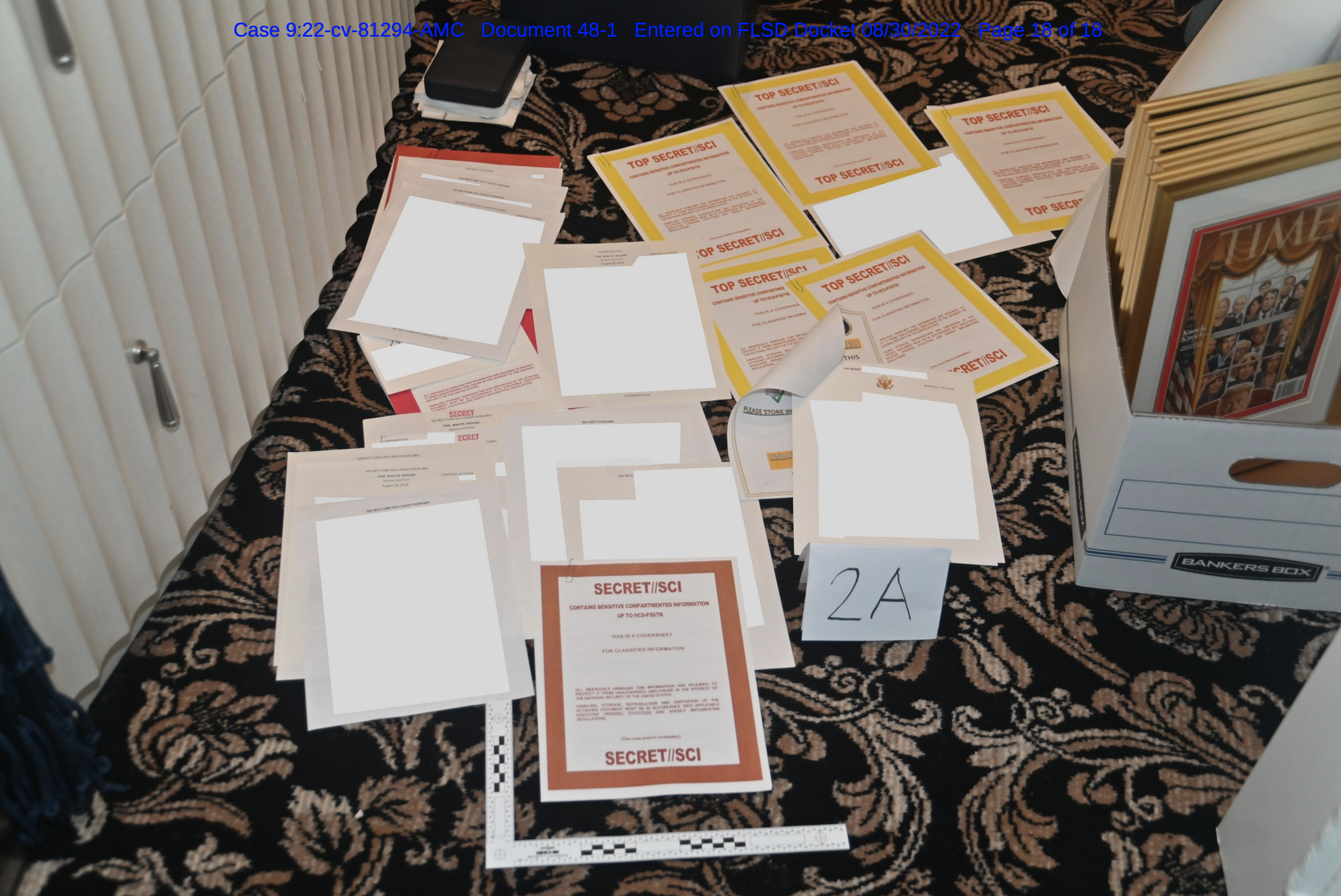
Remember that reports on investigations, especially ones that include Mar-a-Lago court reporters, often amount to witnesses attempting to share questions they’ve been asked with other witnesses or lawyers. Trump’s team has no idea what kinds of classified items were seized. This detail suggests that among the classified documents seized are a document or documents pertaining to Milley.

According to Bobs Woodward and Costa in Peril, Milley called China twice in the last months of the Trump administration to reassure his counterpart that the US was not going to attack China without some build-up first.

On Friday, October 30, four days before the election, Chairman Milley examined the latest sensitive intelligence. What he read was alarming: The Chinese believed the United States was going to attack them.

Milley knew it was untrue. But the Chinese were on high alert, and whenever a superpower is on high alert, the risk of war escalates. Asian media reports were filled with rumors and talk of tensions between the two countries over the Freedom of Navigation exercises in the South China Sea, where the U.S. Navy routinely sails ships in areas to challenge maritime claims by the Chinese and promote freedom of the seas.

There were suggestions that Trump might want to manufacture a “Wag the Dog” war before the election so he could rally the voters and beat Biden.

[snip]

This was such a moment. While he often put a hold on or stopped various tactical and routine U.S. military exercises that could look provocative to the other side or be misinterpreted, this was not a time for just a hold. He arranged a call with General Li.

Trump was attacking China on the campaign trail at every turn, blaming them for the coronavirus. “I beat this crazy, horrible China virus,” he told Fox News on October 11. Milley knew the Chinese might not know where the politics ended and possible action began.

To give the call with Li a more routine flavor, Milley first raised mundane issues like the staff-to-staff communications and methods for making sure they could always rapidly reach each other.

Finally, getting to the point, Milley said, “General Li, I want to assure you that the American government is stable and everything is going to be okay. We are not going to attack or conduct any kinetic operations against you.

“General Li, you and I have known each other for now five years. If we’re going to attack, I’m going to call you ahead of time. It’s not going to be a surprise. It’s not going to be a bolt out of the blue.

The two Bobs also described how, in the days after January 6, Milley reviewed nuclear launch procedures with senior officers of the National Mission Command Center to make sure he would be in the loop if Trump ordered the use of nukes.

Without providing a reason, Milley said he wanted to go over the procedures and process for launching nuclear weapons.

Only the president could give the order, he said. But then he made clear that he, the chairman of the JCS, must be directly involved. Under current procedure, there was supposed to be a voice conference call on a secure network that would include the secretary of defense, the JCS chairman and lawyers.

“If you get calls,” Milley said, “no matter who they’re from, there’s a process here, there’s a procedure. No matter what you’re told, you do the procedure. You do the process. And I’m part of that procedure. You’ve got to make sure that the right people are on the net.”

If there was any doubt what he was emphasizing, he added, “You just make sure that I’m on this net. “Don’t forget. Just don’t forget.”

He said that his statements applied to any order for military action, not just the use of nuclear weapons. He had to be in the loop.

Since these details about Milley came out, Trump and his frothers have claimed Milley committed treason, in concert with Nancy Pelosi (who had expressed concerns to Milley about the safety of America’s nuclear arsenal).

The attack on Milley is the same kind of manufactured grievance — often cultivated by investigation witness Kash Patel (who was DOD Chief of Staff during the transition) — as the Russian investigation. That other inflated grievance led Trump to compile a dumbass binder of sensitive documents that didn’t substantiate his grievances. If Trump did the same with Milley, either before or after he left office, those documents might include highly sensitive documents, including SIGINT reports about China’s response to Milley’s contacts.

If DOJ were ever to charge Trump for refusing to give back classified documents under 18 USC 793(e), DOJ would select a subset of the documents to charge, probably from among those seized in August. They would pick those that, if declassified for trial, would not do new damage to national security, documents that would allow prosecutors to tell a compelling story at trial. And given WaPo’s report, there’s good reason to think there’s a story they think they could tell about documents that may be part of Trump’s grievance campaign against Milley.

WaPo also described that witnesses are being asked whether Trump shared documents, including a map, with donors.

As investigators piece together what happened in May and June of last year, they have been asking witnesses if Trump showed classified documents, including maps, to political donors, people familiar with those conversations said.

According to the story, communications from Trump’s former Executive Assistant, Molly Michael, have been key for investigators.

[A]uthorities have another category of evidence that they consider particularly helpful as they reconstruct events from last spring: emails and texts of Molly Michael, an assistant to the former president who followed him from the White House to Florida before she eventually left that job last year. Michael’s written communications have provided investigators with a detailed understanding of the day-to-day activity at Mar-a-Lago at critical moments, these people said.

Michael is likely the person in whose desk drawer at least two of the classified documents seized in August were found: the two “compiled” with messages from a pollster, a faith leader, and a book author, the kind of document you would show to donors. That document, which combines two classified documents obtained before Trump left the White House with messages from after he left, is the kind of smoking gun that shows Trump didn’t just hoard documents because of ego (as Barrett reported even after the existence of this document was made public), but because he was putting classified documents to his own personal use. We learned back in November that there was evidence that Trump had used two classified documents in what sounds like a campaign document. Perhaps one of those classified documents was a map (of Israel? of Ukraine?).

Whatever it is, this is the kind of story prosecutors might like to tell at stolen classified document trials, not just because it would show Trump putting the nation’s secrets to his own personal gain and sharing classified documents with people who never had clearance, but because it would be proof that people on Trump’s team knew of and accessed documents after they lost their need to access such documents. This document would go a long way to proving that Trump didn’t just hoard classified documents out of negligence (which is currently the explanation why both Joe Biden and Mike Pence did), but because he wanted to make use of what he took.

Molly Michael is also the person who ordered a more junior aide to make a digital copy of Trump’s schedules from when he was President, an order that led to documents with classification markings being loaded to a laptop and likely to the cloud. That’s another example of the kind of exploitation of classified documents that would make a good story at trial.

It’s also the kind of story that could expose Michael herself to Espionage Act charges, such that she might work hard to minimize her own exposure. And yes, because she was Trump’s Executive Assistant, both at the White House and after he moved back to Mar-a-Lago, she likely can explain a lot about how Trump used documents he took from the White House and brought to Mar-a-Lago, including documents used as part of his political campaigning afterwards.

Without conceding it was incorrect, WaPo notes that in November, after it was already public that Trump had self-interested reason to refuse to return documents, it reported it was all just ego (it now attributes that conclusion entirely to what Trump told his aides, not — as claimed in the first line of last fall’s story — what “Federal agents and prosecutors have come to believe”).

Such alleged conduct could demonstrate Trump’s habits when it came to classified documents, and what may have motivated him to want to keep the papers. The Post has previously reported that Trump told aides he did not want to return documents and other items from his presidency — which by law are supposed to remain in government custody — because he believed they belonged to him.

Even in a story describing prosecutors collecting evidence about at least two stories about classified records that they might tell at a trial, the WaPo remarkably suggests to readers that obstruction is the primary crime being investigated here.

The application for court approval for that search said agents were pursuing evidence of violations of statutes including 18 USC 1519, which makes it a crime to alter, destroy, mutilate or conceal a document or tangible object “with the intent to impede, obstruct, or influence the investigation or proper administration of any matter within the jurisdiction of any department or agency.”

A key element in most obstruction cases is intent, because to bring such a charge, prosecutors have to be able to show that whatever actions were taken were done to try to hinder or block an investigation. In the Trump case, prosecutors and federal agents are trying to gather any evidence pointing to the motivation for Trump’s actions.

[snip]

Investigators have also amassed evidence indicating that Trump told others to mislead government officials in early 2022, before the subpoena, when the National Archives and Records Administration was working with the Justice Department to try to recover a wide range of papers, many of them not classified, from Trump’s time as president, the people familiar with the investigation said. While such alleged conduct may not constitute a crime, it could serve as evidence of the former president’s intent.

By treating this as only an obstruction investigation, WaPo incorrectly claims that lying to NARA (as opposed to the FBI) could not be part of a crime.

Here’s my attempt to lay out the elements of offense of both crimes — what prosecutors would have to prove at trial (I wrote more about the elements of an 18 USC 793e charge here and here).

To prove obstruction, DOJ would focus on the things of which — WaPo describes — Jack Smith’s team has developed substantial proof. Most conservatively, they would pertain to a grand jury investigation, because that application would be uncontroversial. After DOJ sent Trump a grand jury subpoena (which would be presented at trial as proof that Trump had notice of the grand jury investigation, his knowledge of which Evan Corcoran’s recent testimony would further corroborate), Trump took steps to hide documents and thereby prevent full compliance with that subpoena, and so thwarted a grand jury investigation. That’s your obstruction charge.

DOJ could charge a second act of obstruction tied to NARA’s effort to recover documents as part of its proper administration of the Presidential Records Act. But such an application would be guaranteed to be appealed. So the safer route would be to charge behavior that post-dates Trump’s knowledge of the grand jury investigation (and indeed, WaPo describes a close focus on events that took place starting last May).

But Trump’s longer effort to deceive the government in order to hoard documents is proof of 18 USC 793(e). To prove that, DOJ would need to prove that the government, whether NARA or FBI, told Trump he was not authorized to have documents covered by the Presidential Records Act, a subset of which would include documents with classification marks. They would need to show that Trump had been told about why he needed to protect classified records, which Trump’s former White House counsels and Staff Secretary have described (and documented) doing. For good measure they would show that Jay Bratt affirmatively told Trump that he had been (and, the August search would prove, was still) storing classified documents in places not authorized for such storage.

To prove 18 USC 793(e) at trial, you would need to describe specific documents Trump refused to give back and explain to a jury why they fit the definition of National Defense Information, material that remained closely held that, if released, could do damage to the US. That may be why they’re asking questions about Trump’s obsession with Milley or sharing maps with donors: because it’s part of the story that prosecutors would tell at trial, if they were to charge 18 USC 793.

All of which is to say that WaPo not only reported that DOJ has collected more evidence to prove what DOJ already suspected when they did the search on August 8, but they’ve been collecting information that would go beyond that, to a hypothetical Espionage Act charge.

Charging a former President with violating the Espionage Act is still an awfully big lift, and in the same way that charging obstruction for impeding NARA’s proper administration of the Presidential Records Act would invite an appeal, charging 18 USC 793(e) in DC would invite a challenge on venue (and charging it in Florida would risk spending the next three years fighting Aileen Cannon). But in addition to developing more evidence to prove the suspicions that they already substantiated in August, WaPo describes Jack Smith’s team asking the kinds of questions — about specific documents that might be charged as individual violations of the Espionage Act — that you’d ask before charging it.

Asking whether Trump (or Molly Michael or anyone else from Trump’s PAC) showed donors a classified map in a package also showing polling and a faith leader’s support for Trump’s policy in an attempt to raise money doesn’t get you evidence of obstruction. If the map is classified, though, it gets you proof that Trump not only knew he had classified documents, but had turned to profiting off of them.

That’s not a guarantee they’re going to charge 18 USC 793e. It’s a pretty good sign they’re collecting evidence that might support that charge.

Update: CNN has a much more measured story, describing how Jack Smith’s team is locking in the voluntary testimony they got last summer.

The new details come amid signs the Justice Department is taking steps typical of near the end of an investigation.

The recent investigative activity before a federal grand jury in Washington, DC, also includes subpoenaing witnesses in March and April who had previously spoken to investigators, the sources said. While the FBI interviewed many aides and workers at Mar-a-Lago nearly a year ago voluntarily, grand jury appearances are transcribed and under-oath – an indication the prosecutors are locking in witness testimony.

[snip]

The grand jury activity – expected to continue to occur at a frequent clip in the coming weeks – builds upon several known reactions Trump and others around him had to the DOJ’s attempt to reclaim classified records last year, and which prompted the FBI to obtain a judge’s approval to search Mar-a-Lago in August for classified records.

Some of the evidence the DOJ has used to persuade a judge to allow that search is still under seal.

It also notes that Smith is still pursuing how a box including documents with classification marks came to be brought back to Mar-a-Lago after the search.

Since then, the Justice Department has pushed for answers around how a box with classified records ended up in Trump’s office after the FBI search took place.
Share this entry

Pride before the fall? Testimony from witnesses in seditious conspiracy trial leaves weaknesses in defense wide open

From emptywheel: Thanks to the generosity of emptywheel readers we have funded Brandi’s coverage for the rest of the trial. If you’d like to show your further appreciation for Brandi’s great work, here’s her PayPal tip jar.

The end of the Proud Boys seditious conspiracy trial may be growing closer but the hole the defendants seemingly dug themselves into this week with yet more testimony from their own witnesses has grown larger.

Testimony continued briefly this week with Tarrio’s witness George Meza. Meza is the self-proclaimed rabbi and former third-degree Proud Boy who described Jan. 6 as ‘the most patriotic act” in a century in a gushing, white power-hand-gesture-wielding video post mere days after former President Donald Trump incited a mob to descend on the U.S. Capitol. 

As a witness for Tarrio, Meza was meant to credibly convince jurors that while he was admittedly once part of a rowdy, reactive brotherhood unbound by social mores, it didn’t mean that he or fellow members of the group, including its national leader, were ever part of a violent conspiracy to stop Congress from certifying the election in 2020. 

Their support of Trump was prolific but to hear Meza insist upon it, it was only in a wholesome patriotic fashion, the way that any American might exercise their right to free speech and assembly.

But Meza’s claims collided, in the final hour of his appearance before jurors, with the cold reality of the prosecution’s evidence against the defendants. Impeaching Meza was often done with a sober tone from Assistant U.S. Attorney Jason McCullough. 

When Meza, also known as “Ash Barkoziba,” insisted he had been ousted from the exclusive text channel at the heart of the charges; Tarrio’s so-called “Ministry of Self Defense” or MOSD, by Jan. 3, McCullough presented evidence where Meza’s frantic rantings about the 6th had continued into chats dated Jan. 9. 

“I can’t tell what chat this belongs to,” he said, speaking fast. “It’s hard to believe they would let me back in after they kicked me out…The average Proud Boy didn’t even know this chat existed. I question this statement if I made it at all in this chat.” 

Jan. 6 was “mass hysteria” Meza later told the jury. People were simply “emoting,” he said. He denied having any understanding that police were under extreme duress when he was near the Columbus Doors seconds before they were forced open. He denied attacking the door or being part of the breach there. 

And though suspicions had been raised about the truthfulness of his testimony for a little more than a day, before he left the stand he told one of Tarrio’s attorneys, Nayib Hassan, that he never received instruction from the Proud Boy leader to go to the Capitol. There wasn’t even a discussion about going there, Meza testified. 

Hassan worked to elicit testimony through Meza that seemed intent to portray Tarrio as all flash and no substance, or a showboater who simply enjoyed to “razzle dazzle” the masses or antagonize the media. But objections over the scope and relevance on this count were sustained, leaving an already thin argument more impotent.

Battered by Meza’s testimony, it was followed with a First Amendment heavy defense from fourth-degree Florida Proud Boy Fernando Alonso that was rich in controversy.

Like Meza, Alonso was a member of MOSD and told the jury when he joined the chapter on Dec. 31, 2020, it was his understanding that the local D.C. division of Proud Boys didn’t want “any heat” and the Vice City member learned that other chapters of the extremist group were warned about coming to Washington on Jan. 6. 

Nonetheless, Alonso came on the 5th. 

And when he did, it wasn’t because there was a plan arranged to storm the Capitol, he said. Any suggestion otherwise, Alonso repeated through a gruff, often heavy accent, was “just ludicrous.”

He knew to meet at the Washington Monument, however, having consulted the MOSD chat that day, he testified, but there was “no objective” discussed. Alonso told the jury he didn’t know what was going to happen and when a video of Proud Boys shooing press away from their group as they congregated near the Capitol was played in court this week, Alonso said this wasn’t about hiding conduct. 

It was because Proud Boys didn’t want to be “doxxed” and didn’t want attention on their club. 

Though Alonso testified on direct that the Proud Boys weren’t doing “photo ops” on Jan. 6, another defense witness, Proud Boy Travis Nugent, said that’s exactly how he perceived things. At trial, Alonso insisted Proud Boys were “peacekeepers” on Jan. 6. 

“The objective was we were going to walk towards the Capitol, stop somewhere along the line, and say a prayer. That was the only objective I knew of at that point,” he said.

Tarrio always contacted law enforcement before Proud Boys rallied, he told defense attorney Sabino Jauregui, “as he should.”

But when pressed, he testified that he never saw any messages about that himself, and he admitted to the jury, that while he considered himself a “good friend” of Tarrio who understood the ringleader’s intentions, he also never saw a single private message between Tarrio and Proud Boy elders or leaders like Nordean or Biggs.

 If he had even an inkling that the plan was for Proud Boys to attack the Capitol on Jan. 6 and stop the certification, well, that would have been an affront so severe to Alonso’s sensibilities, he told the jury, “I would have left right there and then.”

Alonso elaborated on how offended he was at the suggestion that Proud Boys would incite violence. They did charity work and hurricane relief. 

It “insulted” him, in fact, that people could think Proud Boys would even ponder the idea of storming the Capitol.

But in court, jurors heard and saw a different side of Alonso.

In an audio clip, he is heard breezing right over the news that a woman (Ashli Babbitt) had been shot inside the Capitol. From the grounds as people around him exclaim, he is heard only asking if then-Vice President Mike Pence had “betrayed” Trump and whether the vote had been certified. 

“Going on the 6th is not about fighting lefties. It’s about joining patriots on the Capitol steps and awaiting the outcome of history that affects us all,” Alonso once wrote under the handle “Deplorable51” in a message to fellow Proud Boy Michael Priest, also known as Al Tourna, on Dec. 20. Priest was brought into the Ministry of Self Defense by Tarrio, according to application records for the “ministry.”

When Tourna, who used the handle “AL PB,” told him that Jan. 6 would be the moment people would need to “take DC” and then warned that it “may not be peaceful,” Alonso didn’t shrink away. 

Unlike much trial testimony from other defense witnesses who vowed the Proud Boys focus was grounded in defending the Trump-loving masses from antifa, Alonso told Priest going to the Capitol on Jan. 6 “is not for antifa.” 

They were going “as patriots to stand with normies together united awaiting the outcome… when we are amongst them they feel safer and the purpose is what will happen that day…” he wrote

“It’s not a meet at Harry’s [bar at] 8 p.m. to go hunt antifa,” he added. 

Alonso had attended the Stop the Steal rally in Washington, D.C. in December 2020 with fellow Proud Boys, and on his application form for MOSD, he said he had “provided intel” to members of the extremist group while they were on the ground in D.C. for the Million MAGA March a month earlier. He stayed in Florida for that event.

Proud Boys engaged in violent clashes with counterprotesters after both of those rallies. After the rally in November, a Black woman with long braids brandishing a knife and surrounded by Proud Boys was knocked unconscious by a man who cracked a helmet over the crown of her head prompting her to crumple to the ground immediately.

Prosecutors say Alonso greeted that violence merrily.

“‘Put up the video of that predator bitch,’” Mulroe said in court, quoting Alonso’s texts found in a Miami Proud Boys channel that counted Tarrio as a member.  Alonso denied writing it. 

It didn’t sound like him, he said. 

But Alonso joked about that violent episode and others, Mulroe told presiding U.S. District Judge Timothy Kelly this week as he fought off objections from the defense that this evidence was prejudicial and irrelevant to impeaching one of Tarrio’s few witnesses. But Mulroe convinced Judge Kelly that this show of force, appearing sanctioned by Tarrio, encouraged Alonso to return to the next pro-Trump rally in December and later, to join his fellow Proud Boys in January after Trump’s “wild” invite to Washington. 

Assistant U.S. Attorney Conor Mulroe presented evidence spread out over a series of text messages where Alonso excoriated law enforcement roughly a week before he would officially be invited into the Ministry of Self-Defense by Proud Boy Gilbert Fonticoba, an intimate of Tarrio’s. 

Police in D.C. backed antifa, Alonso wrote on Dec. 23. So too did the FBI. Police had turned their backs on Proud Boys when one of their brothers, Jeremy Bertino, who has already pleaded guilty to seditious conspiracy, was stabbed at the Dec. 12 event.

Weeks later on Jan. 6, when defendant Ethan Nordean spoke to a mass of Proud Boys and others gathered at the Washington Monument with a megaphone, it was he who encouraged them to “back the yellow.” Jurors saw this footage of Nordean invoking the Proud Boys black and yellow “colors” in the same way pro-law enforcement groups may invoke their slogan “back the blue.”

Nordean told the crowd just before 11 a.m. on Jan. 6 that police had let the people who stabbed Proud Boys get away last time. Tarrio had been arrested unfairly just two days before, Nordean wailed. Video footage played for the jury on March 7 showed Nordean passing the bullhorn off to defendant Joseph Biggs next. 

Excitedly speaking to the crowd, Biggs told them it was their “goddamned city” and started chants of “fuck antifa.” But once Biggs would reach the location of what would be the first barrier breach of the day, Alonso testified in court this week that Biggs used the bullhorn again. This time as Proud Boys and non-Proud Boys alike were gathered near the Peace Monument less than 100 yards away from the Capitol, Biggs led chants of “Whose House, Our House” and “1776,” Alonso testified.

Prosecutors contend that Proud Boys relied on “tools” of the alleged conspiracy to pull it off and that included Proud Boys as well as non-members, the  “normies” at the Capitol. In sum, the Justice Department argues Proud Boys believed they could whip the “normies” into a frenzy and this would aid them to breach barricades, subsequently overwhelm law enforcement and get inside the Capitol to stop the certification.

After the Stop the Steal rally just three weeks before the insurrection, positive attitudes toward law enforcement among Proud Boys had dried up, prosecutors allege, and the group’s anger morphed and hardened into a multi-layered paranoia: Trump’s “victory” was stolen. Cops in D.C. had sided with “antifa.” The Democrats and radical left needed to be stopped. 

In a text chat seized off Tarrio’s phone dubbed “Croqueta Wars,” Tarrio and other Florida Proud Boys including Gabriel Garcia, George Meza, Pedro Barrios, and others, shared messages about efforts to keep Trump in power. On Dec. 17, Alonso forwarded a message to the group that laid out a “plan” for Trump to win. He had “dueling electors from 7 state legislatures [and] he has VP Pence as final arbiter of the ballots to accept,” Alonso’s friend “Tim Moore” wrote in the forward. The message was rich in conspiracy theories invoking Julian Assange, Seth Rich, and Sidney Powell’s “Kraken.” 

In the transcript from Alonso’s testimony, during a sidebar with Judge Kelly, Nordean’s defense attorney Nick Smith objected to the introduction of evidence indicating Michael Priest had something a “little less complex in mind” than the theories Alonso forwarded to the Croqueta Wars chat.

While Smith argued it was irrelevant, Mulroe managed to convince Judge Kelly to let in Alonso’s exchange in the next sequence. Priest, as a member of the Ministry of Self-Defense and “tool” of the conspiracy—something Kelly agreed with during the sidebar—was fed up. 

“Unleash the Kraken. Trust the plan. Blah. Blah. Blah. When do we start stacking bodies on the White House lawn?” Priest wrote. 

“Jan. 7,” Alonso replied. 

When Priest told him they would stack the bodies of “RINOs,” or “Republicans in Name Only” first and make Democrats watch, Alonso affirmed in court this week that he said “yes.” But it was just “locker room talk, if you will,” he said. 

In the Ministry of Self-Defense chat on Jan. 3, a day before Tarrio would be arrested and three days before the insurrection, Gabriel Garcia shared a message with MOSD members. It was a blog post from the Hal Turner Radio Show promoting the false claim that a “1776 flag” was flying over the White House that night. But the image wasn’t new. Trump White House deputy chief of staff Dan Scavino posted an image of a colonial-era flag over the White House in June 2019 though that image was doctored too.

But Garcia seemed to believe it was realand so did others in the Ministry like one Proud Boy identified in chats only as “BrotherHunter Jake Phillps.” When Phillips asked whether the “normies and ‘other’ attendees” were going to “push thru police lines and storm the capitol buildings,” and invoked the violence that unfolded in D.C. on December, Alonso replied: “cue in the music… let the bodies hit the floor, let the bodies hit the floor.” 

On direct, Alonso told Jauregui the “bodies” were “regular people” not the police. The police, he said, were going to make people hit the floor at the Capitol. On cross, he told Mulroe it was just a song. It was just locker room talk. It was all just a joke. 

Norm Pattis, for Biggs, argued during a bench conference that Alonso’s comments were protected under the First Amendment and “no more prohibited than saying you’re going to line up capitalists against the wall and shoot them.” 

At the end of his testimony on Tarrio’s behalf, Fernando Alonso said under oath that as far as overtaking the U.S. government was concerned or storming the Capitol, he had no part in it or wanted no part in it. It was a reprehensible suggestion. That was behavior that wouldn’t make him proud. 

Yet, Mulroe pointed out to him, he sat in court today with a yellow shirt bearing the Proud Boys laurel on its chest, hiding just beneath his fleece. And he didn’t seem insulted when Priest talked about storming the Capitol. No one else seemed put off by the suggestion in MOSD either, that Alonso could recall. And though he had claimed he knew Tarrio’s intent, he wasn’t ever a witness to meetings or calls or chats that Tarrio may have had with elders, leaders, or even local police in advance of a Proud Boys official event. 

There was no indication one way or the other to Alonso, Mulroe elicited, that Tarrio had even told local police Proud Boys would plan to meet at the Monument on the morning of the 6th. And he certainly had ample opportunity: Tarrio was arrested on the 4th and ordered by law enforcement to stay out of Washington after his release on the 5th. 

Yet, Mulroe elicited, there was no indication that law enforcement was hipped to the Ministry of Self-Defense’s plan to gather at the Monument with what Alonso said was at least 100 men.

Alonso never went into the Capitol on Jan. 6. He never went with the defendants or anyone else that day to hear Trump, their man of the hour, speak at the Ellipse. When people were breaching the Capitol, he told the jury he thought it would be “too extreme” for anyone to go inside or past police lines. Police could shoot them, he testified.  Alonso, like other Proud Boys on Jan. 6, carried a radio but like other members, he claimed “there was no communication” on it. He downplayed evidence of him railing over Proud Boy Eddie Block’s decision to circulate  footage from Jan. 6 just a week after the insurrection. The wheelchair-bound Block, he told Mulroe, was doxxing them. 

“Crip or not,” Alonso wrote in a Proud Boy chat. “Snitches get stitches.” He added later: “That fuck needs to be duct taped to the National Mall, his scooter placed at the top of it.” 

Congress went into recess on Jan. 6 ultimately stopping the certification for several hours after the mob had rushed past police barriers, subsumed the Capitol steps, tunnels, archways, and inaugural scaffolding before streaming through broken windows or doors like the 20,000-pound Columbus Doors that were ripped from their hinges. 

Tarrio, it appears now, is unlikely to testify on his own behalf. 

Following suboptimal testimony from Tarrio’s witnesses this week, defendant Ethan Nordean squeezed in witness testimony from an FBI confidential human source and Proud Boy who appeared in court using only his middle name, “Ehren.” 

Unfortunately for the defense, “Ehren,” testified under cross-examination that he was not at the Capitol on Jan. 6 as an FBI informant in any meaningful sense. He was there, he affirmed, as a member of the Proud Boys. Though the spelling of his name was not reported into the record, “Ehren” would appear to be the individual that Jan. 6 internet sleuths have identified as “TrackSuitPB.”

In video footage, jurors could see how “Ehren” entered the Capitol carrying zip tie cuffs he said he acquired incidentally as a memento of sorts. At another point, he appears in capitol CCTV  footage flanked by Kansas City Proud Boys like William “Billy” Chrestman, Chris Kuehne, and others, as he helps place a podium under an interior electric gate to keep it from closing while others set chairs in the way. Police are seen working over and over to drop the barrier as rioters advanced.

Poking holes in the defense’s direct and indirect suggestions over these many weeks of trial that the FBI was responsible for guiding the violence of Jan. 6, “Ehren” admitted he wasn’t instructed by the bureau to obstruct the gate. Or enter the Capitol. Or impede police. In hindsight, he admitted, he shouldn’t have helped prop open gates police were trying to lower at all.

While he testified, evidence was also presented to strongly support the government’s claim that he was playing up the “informing” he offered to the FBI. 

“Ehren” texted his handler on Jan. 6 at 1:02 p.m. ET just as barriers were overrun: “Pb did not do it, nor inspire. The crowd did as a herd mentality. Not organized. Barriers down at capital [sic] building crowd surged forward, almost to the building now.” 

During his interviews with the FBI in the summer of 2021, he claimed he was standing 100 people back from the front of the first breach. In court, however, footage showed him more like 20 or 30 people back. He was also close to defendant Zachary Rehl at one point as Rehl filmed from the fore of the crowd.

FBI Agent Nicole Miller testified earlier in the trial that in this particular clip shot by Rehl, she was able to identify the Philadelphia chapter president’s voice screaming “Fuck them! Storm the Capitol” moments before Proud Boy William “Billy” Chrestman is seen scrambling over snow fencing and outnumbered police start to run backward. “Ehren” told the jury he followed Chrestman. The crowd’s chants of “fight for Trump” reverberated as they ran closer to the Capitol. There were hundreds of people behind them, he affirmed. 

When he approached the terrace of the Capitol, he said in court that he saw people topple barricades. 

And yet, he told his handler that the Proud Boys didn’t inspire the breaches.

“Ehren” said he had sent his text vouching for the Proud Boys to his handler earlier than the handler received it but bad cell service caused his message to go through on delay. His testimony around the timing of the message changed over two interviews with the FBI and diverged again once he appeared in court this last week. 

“Ehren” told Nordean’s attorney on direct that his handler urged him: if he saw a crime committed and was asked to talk about it, he was to be truthful with the bureau. 

On cross, he testified under oath that the FBI never “embedded him” with the Proud Boys. He was tasked to report on “antifa” or leftist violence, then a focus for Trump’s Attorney General Bill Barr. “Ehren” was never part of MOSD or the Boots on Ground chat created just for Jan. 6. He said it was his local chapter president who told him to go to the Washington Monument on the 6th and not to wear Proud Boy colors. He never saw messages from Bertino or Tarrio suggesting otherwise but it would seem that information was passed down to him nonetheless.  When he arrived that morning, it was clear, he testified, that Nordean was in charge. 

Proud Boys were to blend in, he said, making themselves identifiable only to each other by slapping a piece of orange tape on their shoulder or arm. Antifa would infiltrate the crowds on the 6th, they believed, “Ehren” testified, and the orange tape allowed so-called Proud Boys brothers to identify each other.

Adding further ammunition to the prosecution’s “tools” argument, “Ehren” also said that Three Percenter Robert Geiswein approached him that morning and asked to march with the Proud Boys to the Capitol. “Ehren” said he told Geiswein he could stick around for a bit but once his brothers started to get on the move, he would have to go his own way.

On redirect by Dominic Pezzola’s attorney Roger Roots, “Ehren” said “Geiswein “didn’t listen very well about staying back once we met with other Proud Boys.”

Indeed, Geiswein would be spotted shoulder-to-shoulder with Pezzola on Jan. 6 just outside of the Senate Chamber. 

 As for “Ehren,” he wouldn’t leave the Capitol until after police told him a woman had been shot. Prior to that moment, he said, he didn’t attempt to de-escalate the situation because he figured if there was an “emergency situation” he “might be asked about it” by his handler. But this testimony ran up against video footage of “Ehren” also pumping his fist in the air in celebration after breaching. 

He rather sheepishly conceded that, in the moment, it all seemed “funny” and “exciting.” 

Witnesses for defendant Zachary Rehl didn’t fare much better this week, save for the largely innocuous testimony of Rehl’s wife, Amanda. Cutting a sympathetic figure, her voice was gentle as she testified and admitted to Rehl’s attorney, Carmen Hernandez, that she was nervous. They married after Rehl graduated from Temple University; she told jurors how three of her uncles were policemen and his father and grandfather were policemen, too. Jurors saw pictures of Zachary’s father and grandfather in their uniforms, including one photo of a young Rehl in tow. They also saw a photo of her child with Zachary, a cherubic-looking little girl of maybe two or three years old. 

On Jan. 6, her husband, she said, left out for D.C. with Isaiah Giddings, Brian Healion, and Freedom Vy. She didn’t come. On the witness stand, Amanda Rehl said she couldn’t distinguish her husband’s voice in the video he shot from the first breach at the Peace Circle. She could hear someone say “Fuck them! Storm the Capitol” but if it was her husband’s, she couldn’t say. 

Testimony from Rehl’s next witness, former West Virginia Proud Boy chapter president Jeff Finley followed. 

Finley was easygoing on the stand with responses neatly tailored on direct. He pleaded guilty to a misdemeanor charge of entering restricted grounds in last April and was sentenced to 75 days. Finley’s first reporting to prison was delayed so he could appear at the trial on Rehl’s behalf. 

Though not a member of MOSD, he was part of the Boots on the Ground chat using the handle “El Jefe.” Finley was often in close proximity to Biggs and the co-defendants on Jan. 6 including at the west terrace where some of the worst fighting of the day occurred. He couldn’t recall whether any police officers asked him not to come inside the capitol that day, however, and he couldn’t identify any of the  Proud Boys Rehl had brought to DC from Philly when Hernandez asked. 

But, he testified succinctly, “no,” he didn’t do anything that day to stop legislators from certifying the election. He was in and out in 10 minutes, he said. 

Finley was a fourth-degree Proud Boy deeply invested in the club—he has a tattoo etched across his chest declaring him a “West Virginia Proud Boy” jurors learned. And in the run-up to the insurrection, prosecutors brought out texts and video showing Finley looking to Nordean as the leader. In his guilty plea, he said as much to investigators and from the witness stand, Finley testified that while Proud Boys marched on the Capitol, it was Biggs, Nordean, and Charles “ Yut Yut Cowabunga” Donohoe, who would sometimes break off from the group for chats he was not privy to. Rehl, Biggs, and Donohoe did the same, he testified. 

Donohoe pleaded guilty to conspiracy to obstruct an official proceeding a year ago this week. 

Finley told the jury he never saw any of the defendants throw projectiles at police and didn’t hear any conversations that led him to believe a plan to stop the certification was in place. He presented Jan. 6 as an opportunity he seized on to “make my voice heard” about potential discrepancies in the 2020 election. 

Yet, prosecutors presented pages of text messages to the jury where Finley urged Proud Boys to delete their communications. Some of the messages showed Finley was furious with Eddie Block for filming, just like Alonso had been. In the weeks after the attack, Finley steadily discouraged Proud Boys from saving information or from having mementos, like challenge coins commemorating Jan. 6, mocked up.

“It would just place you in D.C. give more ammo against you,” he wrote on Jan. 12.

 He deleted his own socials after the 6th but not before making a podcast appearance where he told the interviewer he didn’t know a single Proud Boy who was remotely close to being in the Capitol on Jan. 6. 

“But you were a Proud Boy and you went in with Rehl and three other Philadelphia Proud Boys?” prosecutor Nadia Moore asked Finley in court on March 30. 

He did, he admitted, but in the podcast, the host wasn’t a member of law enforcement so he was in no way obligated to tell the truth. 

When the trial resumes starting Monday, it is expected that defendant Joe Biggs will start to come into focus as his attorneys, Norm Pattis and Dan Hull, make their case. Dominic Pezzola’s attorneys Steven Metcalf and Roger Roots shouldn’t be far behind. While it seemed that Biggs would likely take the stand earlier in the trial, after grueling days for the defense without any immediately obvious pay-off, that likelihood now seems low.

It may behoove Pezzola to try his luck or admit to charges that will be the hardest for him to beat because of compelling video evidence compiled by prosecutors, including video footage of him smashing open a window and allegedly stealing a police riot shield. In the first Oath Keepers case, which in many ways is quite similar to this one, defendant Jessica Watkins admitted to jurors that she impeded officers. In the end, her remorse from the stand may have helped her. She was convicted for impeding officers during a civil disorder (and conspiracy and obstruction) but she evaded a destruction of property charge despite being in the thick of a quite brutal push into the Capitol. She also was not convicted of seditious conspiracy. 

The light is now visible at the end of the tunnel in this three-month-long trial and this week, parties are expected to hash out jury instructions. If there are any Hail Mary moves to be made by the remaining defendants, the window to make them is inching closed.

Share this entry

Donald Trump’s Dumbass Russia Binder

There is some tie between Donald Trump’s effort — as one of his last acts as President — to declassify a binder of materials from the Crossfire Hurricane investigation and his hoarding of still-classified documents that could get him charged under the Espionage Act.

It’s not yet clear what that tie is, though.

On May 5 of last year, Kash Patel offered the declassification effort as an alibi, claiming Trump had declassified a bunch of materials, including not just the Crossfire Hurricane materials, but everything else discovered in boxes returned to NARA in January 2022. Kash’s claim would be included in the search affidavit for Mar-a-Lago and ultimately lead to his compelled testimony in the investigation.

Last fall, at a time when Alex Cannon and Eric Herschmann would have been under some scrutiny for their role in Stefan Passantino’s dubious legal advice to Cassidy Hutchinson, Maggie Haberman told a story in which the Trump lawyers heroically warned Trump about the risks of holding classified documents. That story claimed Trump had offered to swap the documents he did have for the Russian-related documents the former President believed NARA had.

It was around that same time that Mr. Trump floated the idea of offering the deal to return the boxes in exchange for documents he believed would expose the Russia investigation as a “hoax” cooked up by the F.B.I. Mr. Trump did not appear to know specifically what he thought the archives had — only that there were items he wanted.

Mr. Trump’s aides — recognizing that such a swap would be a non-starter since the government had a clear right to the material Mr. Trump had taken from the White House and the Russia-related documents held by the archives remained marked as classified — never acted on the idea.

The story doesn’t mention Cannon’s role in a fall 2021 inquiry to NARA about the Russian documents. Nor does it say that National Archives General Counsel Gary Stern told Cannon and Justin Clark that NARA had 2,700 undifferentiated documents, but that the binder Trump wanted declassified had been rendered a Federal Record when it got sent back to DOJ.

That’s what NARA told John Solomon on June 23, 2022 — that Trump’s lawyers had requested the binder in fall 2021 — in Stern’s first explanation for why NARA didn’t have the binder.

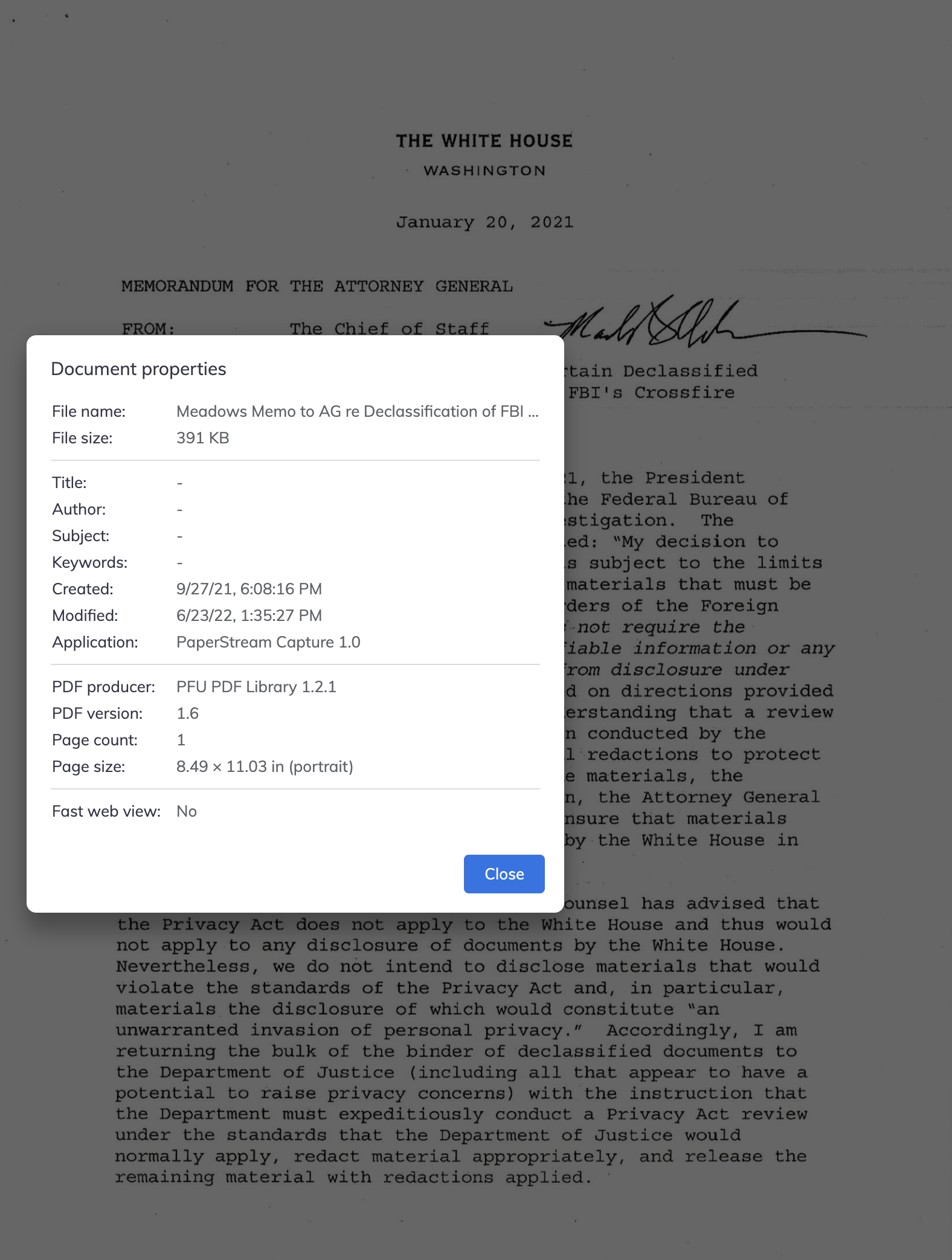
John, fyi, last fall Justin Clark, another PRA representative of President Trump, also asked us for a copy of this declassified binder. Upon conducting a search, we learned that the binder had been returned to the Department of Justice on January 20, 2021, per the attached memo from Chief of Staff Mark Meadows to the Attorney General, titled “Privacy Act Review of Certain Declassified Materials Related to the FBI’s Crossfire Hurricane Investigation.”

Accordingly, we do not have the binder containing the declassified records. As we explained to Justin, what we were able to locate is a box that contains roughly 2700 undifferentiated pages of documents with varying types of classification and declassification markings, but we could not be certain of the classification status of any of the information in the box. We are therefore obligated under Executive Order 13526 to treat the contents of the box as classified at the TS/SCI level.

Then on August 9 and again on August 10 last year, immediately following the search on Mar-a-Lago, Solomon asked for all correspondence between Cannon and NARA up until days before the search.

Gary, John: My research indicates there may be a new wrinkle to the Russian declassified documents. As part of my authorized access, I would like to see all correspondence between NARA and attorney Alex Cannon between December 2020 and July 31, 2022. I think the information will have significant value to the public regarding current events. Can that be arranged?

[snip]

Checking back on this. It’s time sensitive from a news perspective. Can you accommodate?

Stern, no dummy, likely recognized that this information would not just have news value, but would also have value to those under criminal investigation; he responded with lawyerly caution. As NARA representative for Trump, he explained, Solomon was only entitled to access Presidential records — those that predate January 20, 2021 — and communications between Cannon and NARA post-dated all that. But, Stern helpfully noted, Cannon was cc’ed on the request for the Russian binder.

It’s important to clarify that, as a designated PRA representative of President Trump, you may receive access to the Presidential records of the Trump Administration that have been transferred to NARA, which date from January 20, 2017 to January 20, 2021.

Alex Cannon has represented President Trump on PRA matters (along with Justin Clark) only since the summer of 2021, principally with respect to the notification and review process in response to special access requests. Accordingly, there would not be any Trump Presidential records between NARA and Alex Cannon.

FYI, in my June 23 email to you (which is below within this email thread), I noted that “last fall Justin Clark, another PRA representative of President Trump, also asked us for a copy of this declassified binder.” Alex Cannon was cc’d on Justin’s request and our response. I am not aware of any other communications that would exist between NARA and Alex about this matter. [my emphasis]

That would be the only communications “about this matter,” seemingly distinguishing the Russian binder from the missing Presidential records.

At the time Maggie was distracting the chattering classes with the swap story, ABC had a very thorough story that revealed some of what Stern had explained to Solomon last year. That story suggests the month-long focus on the Russian binder had led overall compliance with the Presidential Records Act to be lacking. As Hutchinson tells it, it was worse, with 10 to 15 NSC staffers madly copying classified documents in the last days Trump was in office, with two sets of four copies — one still classified, one less sensitive — circulating to who knows where.

The tie between the Russian documents and the documents Trump stole may be no more than the alibi Kash tried to use them as, an attempt to claim that the limited declassification was instead a blanket effort. Perhaps it was also a failed effort to use Kash and Solomon as moles to figure out what NARA got back. Or perhaps some of these materials madly copied at the last moment were among the classified documents Trump took with him. Perhaps some of those materials were among the still-classified documents Trump took and hoarded in a storage closet with a shitty lock.

But that tie is one of the reasons I read the version of the binder released earlier this year in response to a Judicial Watch FOIA closely (release 1, release 2).

That is one dumbass binder. If you’re going to expose yourself and your assistants to Espionage Act prosecution, this is one dumbass document to do so over.

Having reviewed it — even with great familiarity with the unending ability of certain frothers to get ginned up over these things — I cannot believe how many people remain obsessed about this document.

The document, as released to Judicial Watch, is little more than a re-release of a bunch of files that have already been released. Perhaps the only released documents I hadn’t read closely before were memorializations that Andy McCabe wrote of conversations he had in the wake of Jim Comey’s firing with and about Trump, including the one that described Rod Rosenstein offering to wear a wire to meetings at the White House.

And because DOJ subjected the documents to a real Privacy Act review, unlike declassifications effectuated by Director of National Intelligence John Ratcliffe when Kash babysat him as his Chief of Staff, a number of the documents actually are more redacted than previous versions, something that will no doubt be a topic of exciting litigation going forward.

Mark Meadows ordered DOJ to do a Privacy Act review and as a result great swaths of documents were withheld, page after page of b6/b7C exemptions as well as b7D ones to shield confidential information.

Here’s what got released to Judicial Watch, along with links to the previous releases of the documents:

The Bruce Ohr 302s are the only documents that include much newly released materials, mostly reflecting Igor Danchenko’s subsequent public identification. Both the candidate briefing and the Carter Page FISA application include significantly more redaction (and those are not the only interesting new redactions); given the redactions, it doesn’t look like Trump contemplated disseminating any Page material that was sequestered by the FISA Court, which would have been legally problematic no matter what Trump ordered, but references to the sequestration were all redacted.

As noted above as Requests 1, 5, 6, 14, and 17, there were five things Trump asked for that were still pending at DOJ when Trump left office. Two of those are identified: A request for materials on Perkins Coie lawyers, which (DOJ informed Trump) had no tie to Crossfire Hurricane, and a request for details on an August 2016 meeting involving Bruce Ohr, Andrew Weissmann, and one other person “concerning Russia or Trump.”

There were a number of communications between Ohr, Weissmann, and others later in 2016, including communications potentially relating to an effort to flip Dmitry Firtash, as well as October 2016 communications between Ohr and McCabe. But the jumbled timeline of Ohr’s communications has often been used to insinuate that the Crossfire Hurricane team learned of the Steele allegations earlier in the investigation than the September 19 that DOJ IG reflects. In any case, some of these meetings likely touched on Oleg Deripaska and some might touch on the suspected Egyptian donation Trump used to stay in the race past September 2016, not the dossier.

Between other then-pending requests and big chunks of withheld information (I’ve noted the biggest chunks above, but it would be around 300 pages total), there are things I would have expected to see in this binder that are not there. For example, almost none of the material released as part of DOJ’s attempt to undermine the Flynn investigation (links to which are in this post) is included here. Most of that stuff constitutes information that would never normally be released. It was egregiously misrepresented by Barr’s DOJ. Some of the files were altered. If these were requested, I can think of a number of reasons it would take DOJ a while to provide the materials. Even still, though, the materials didn’t persuade Emmet Sullivan to overturn Flynn’s prosecution, and documents left out of this bunch — such as Flynn’s later 302s, including some where he obviously told the same lies he had told in January 2017, would easily rebut any claims Trump might offer with the Flynn documents.

The documentation showing Strzok learning of a Russian intelligence product claiming not very damning things about Hillary is not in here. That, too, is something that would never have been released with a normal DNI not being led around by Kash Patel and it’s one that would take DOJ a good deal of time to clear. But as I laid out here, the report came after Trump had already demonstrably started pursuing files stolen by Russia. By the time Hillary purportedly decided to call out Trump for encouraging the Russian hack, Trump was encouraging the Russian hack.

Given that Mike Rogers’ 302 from the Mueller investigation is included here, you’d expect those of Trump’s other top intelligence officials to be included as well. Dan Coats and Mike Pompeo were interviewed in the weeks after Rogers. Coats’ aide Mike Dempsey and NSA Deputy Director Rick Ledgett were also interviewed about Trump’s March 2017 effort to get the IC to deny he had a role in Russian interference, as was Trump’s one-time briefer Edward Gistaro (Gistaro was interviewed a second time in 2018, in an interview treated as TS/SCI, which likely pertained to his involvement in briefing at Mar-a-Lago during the transition). Details of these interviews show up in the Mueller Report, and his request only helps to make Trump look more guilty.

It doesn’t include materials released as part of the failed Sussmann and Danchenko prosecutions. But like Barr’s effort to overturn the Flynn prosecution, none of that evidence sustained Trump’s conspiracy theories either. Indeed, during a bench conference in the Danchenko trial, Durham fought hard to keep the substance of the discussions — ostensibly about energy investments — between Sergei Millian and George Papadopoulos starting in July 2016 out of the trial because, “it certainly sounds creepy.” The Sussmann trial showed how justified people were in wondering about Trump’s Russia ties in the wake of his “Russia are you listening” comment. It provided a glimpse of how time-consuming being a victim of a nation-state hack had been for Hillary in 2016. Durham even demonstrated that FBI badly screwed up the Alfa Bank investigation. When subjected to the rules of evidence, none of Trump’s hoax claims hold up.

The point is, nothing in this binder — particularly as released — supports Trump’s claims that the investigation into him wasn’t independently predicated and didn’t lead to really damning information implicating at least five of his top aides and his own son.

Trump keeps trying to collect some set of evidence that will make go away the far more damning ties to Russia that his National Security Advisor, his Coffee Boy, his personal lawyer, his campaign manager, and his rat-fucker all lied to hide. And in this case, it may have led Trump to do something far dumber, to defy a subpoena and hoard highly classified documents.

Which possibility only makes the dumbass Russia binder even more of a dumbass Russian binder.

Share this entry

Kash’s Castles of Scatter and Evan Corcoran’s BCC

More than seven months after seemingly threatening to sue the National Archives because Mark Meadows and Donald Trump fucked up their effort to declassify the Russian investigation documents, John Solomon finally did sue on March 21, represented by the America First Legal Foundation — Stephen Miller’s gig.

I’d be shocked if the lawsuit went anywhere.

That’s because NARA General Counsel Gary Stern provided Kash and Solomon with the explanation of what happened with the attempted declassification over and over and over. First, Trump didn’t declassify the documents. He ordered the binder of Crossfire Hurricane documents be sent to the Attorney General, who would implement the final declassifications, then send the document back to the White House.

I have directed the Attorney General to implement the redactions proposed in the FBI’s January 17 submission and return to the White House an appropriately redacted copy.

Then the next day, January 20, 2021, Mark Meadows sent all that to the Attorney General to conduct a Privacy Act review before releasing anything.

As Stern explained to Kash and Solomon, what remained at the White House at that point was a collection of 2,700 “undifferentiated pages,” a cursory review of which revealed conflicting redactions and some documents lacking the requisite declassification stamp. The stuff that got sent to DOJ was a Federal Record, not a Presidential Record, and by the time Kash and Solomon started this process, it was already being processed as part of a Judicial Watch FOIA lawsuit (the first two releases in which — one, two — recently came out).

In other words, Trump and Mark Meadows fucked this up. NARA didn’t. Trump did.

The likely futility of the lawsuit notwithstanding, the lawsuit and its timing may have more to do with publicly sharing the correspondence Solomon and Kash Patel had with NARA last year, between the time Trump would have realized he had a legal problem with this stolen classified documents, and the immediate wake of the search that made that legal problem a far bigger problem.

As the correspondence Solomon released with the lawsuit reveals, Evan Corcoran initiated this process, on June 17, 2022, informing Stern that “because of his schedule” on June 17 and 18, he would sign a letter designating Kash and Solomon NARA representatives on June 19, after which the two wanted to immediately (Solomon explained in reply) get access to the Russian documents.

Because of his schedule today and tomorrow, former President Donald J. Trump will sign a letter on Sunday afternoon, June 19, 2022, informing the Acting Archivist of the United States that he has designated Kash Patel and John Solomon (copied) to be his NARA representatives.

I will transmit that letter to the Archivist and you (and John Laster) via email when I receive it.

Kash and John would like to begin work reviewing documents at the Archives on Tuesday, June 21, 2022.

I will leave it to the three of you to work out logistics (and feel free to move me to bcc)

Think about that! By April 29, Corcoran was the guy with whom Stern was coordinating on the FBI request for access to the documents Trump belatedly returned in January 2022. On May 5, Corcoran asked to access what had been returned and on the very same day — the search affidavit notes — Kash claimed that not just the Russian documents had been declassified, but a bunch of other documents had too. On May 11, FBI subpoenaed Trump for remaining classified documents. On June 3, Corcoran provided just a subset of the remaining documents.

And then, two weeks after participating in a shell game to facilitate withholding classified documents, Corcoran contacted Stern to arrange fairly urgent access for Kash and Solomon to the materials he had first asked to access in May.

The guy in charge of staving off criminal exposure for hoarding classified documents is the guy who arranged to have Kash and Solomon made NARA representatives!

And then, Stern noted, he moved Corcoran to “bcc.” That means it’s not clear whether Corcoran remained on bcc or not. We don’t know whether Corcoran, as was his intent, remained part of the rest of this exchange. Which makes the timing of this probably futile lawsuit — the second business day after Beryl Howell ruled that Corcoran must testify and the day before Corcoran was initially due to comply — all the more interesting.

There are other interesting tidbits of the correspondence Solomon includes — most notably Kash’s increasing frustration because he couldn’t name via what agency he retained clearance.

On July 18, for example, Kash wrote an email riddled with typos bitching because Stern did not take, from the letter Patel’s one-time contractor employer sent, as approval to access classified records at NARA.

Actually, that’s only part of the communications your security team and you received. The rest states:

they (NARA) could look up your clearance in DISS or Scattered Castles and your need to know came from working directly for President Trump. Per policy- In order to access anything – you would need a clearance and a need to know. You have both of these based on your position with President Trump.

If you are going to provide a correspondence on this matter and directly site a communication, please do not cut out the important, substantive portion that resolves the matter. As you can see, you can validate my clearance and my need to know is satisfied. The only question that remains is why I am getting poor/incorrect information, and why you haven’t used the data bases to verify my clearance, when that is clearly within your agencies ability (its literally how every agency in government validates said clearances). Again, I expect to be reviewing these records tomorrow since the data bases search to validate my clearance is instantaneous. Direct your security office accordingly and stop blocking my access. Thanks much

Kash

[my emphasis]

Much of this section of the exchange reads like a sloppy attempt to social engineer access. Which makes Kash’s claim that the NSC was a more recent employer of his than ODNI of particular interest.

Thanks for the update, please go to DoD and the NSC at the White House, those being my last employers in govt, they would be best suited to verify my clearance (they would not be held at ODNI) but anyone with access to Scattered Castles can easily verify the clearance and who holds it. Thanks much Kash

It’s not clear how this part of the exchange was resolved. The whole exchange led me to wonder whether Kash had a clearance during his time running DOD at all. But none of this would have amounted to a need to know in any case, notwithstanding what a former employer had said.

There was great urgency in this period to get into the archives, to see what Trump had actually turned over in January 2021. Then the correspondence ended — at least as Solomon has it — on August 17.

Incidentally, the correspondence provides at least some corroboration for my speculation that Kash was disseminating parts of the Carter Page FISA applications that had been sequestered under an order from the FISA court — sequestered, as it happens, by an order from Jeb Boasberg, who just took over as DC’s Chief Judge. It also may explain some curious metadata in the copy of the Mark Meadows order that John Solomon released on July 20, 2022. Solomon’s copy of Meadow’s order showed a creation date of September 27, 2021, but a modification date of June 23, 2022.

June 23 is the first of two times that Stern sent Solomon and Kash a copy of the memo. The modification date likely reflects NARA resending the document.

The September 27, 2021 creation date likely reflects the time when, in fall 2021, NARA first discovered the memo after Justin Clark and Alex Cannon came looking for it.

There’s one more reason this is significant. After receiving (or being described) that Mark Meadows’ memo last fall, Cannon — the guy who repeatedly advised Trump to return the classified documents — would have known the Russian documents were not declassified. But if those got returned as a result, it would mean that any other copies out there, including copies shared with Solomon, would be illegally disseminated classified records.

Update: I’ve updated my stolen documents resource page with some of the dates from Solomon’s lawsuit and caught up to my past posts.

Update: This led me to go back and review the stories John Solomon wrote in the aftermath of the search, which unsurprisingly include numerous bullshit claims.

August 11, 2022: Solomon regurgitates story describing “cooperation” in June, including Secret Service involvement in June 3 meeting and aftermath.

August 22, 2022: JustTheNews posts the text of letter from Debra Steidal Wall to Trump.

Update: Corrected which year Trump returned some documents.


Share this entry

Happy Crime-Fraud Exception Day, for Those Who Celebrate

Today marks the calendar start of celebration season for Mr. EW and I; all our big dates are squished into a short period that, this year, might well culminate in the first of several indictments for the former President.

For the US political world, though, today marks crime-fraud exception day, the day that at least one of Trump’s attorneys will be obliged to testify about how Trump lied to his lawyers to try to get away with hoarding stolen classified documents.

Because Evan Corcoran (and possibly Georgia attorney Jennifer Little) will testify today, I thought it a good day to update the list of attorneys who were or have been witnesses or who may be subjects in one or more investigations into Trump.

Since the Stormy Daniels payment may lead to Trump’s first indictment, Michael Cohen gets pride of place at number one on this list, a reminder that for seven years, Trump lawyers have been exposing themselves to legal jeopardy to help him cover things up.

The following lawyers have all — at a minimum — appeared in subpoenas pertinent to one or another of the investigations into Donald Trump, and a surprising number have testified before grand juries, including at least three with (Executive Privilege) waivers. To be clear: Many have no legal exposure themselves, but are instead simply witnesses to the efforts made to keep Trump in line before they were replaced with lawyers who were willing to let Trump do whatever he wanted, legal or no. But some of these lawyers have had legal process served against them, and so may themselves be subjects of one or multiple investigations.

  1. Michael Cohen (hush payment): convicted felon whose phones were seized April 9, 2018
  2. Rudolph Giuliani (Ukraine, hush payment, Georgia, coup attempt): phones seized in Ukraine investigation April 28, 2021, received subpoena for billing records in fundraising investigation around December 2022
  3. John Eastman (Georgia, coup attempt): communications deemed crime-fraud excepted March 28, 2022; phone seized June 22, 2022
  4. Boris Epshteyn (stolen documents, coup attempt, Georgia): testified in Georgia grand jury; phone seized in September after which he retroactively claimed to have been doing lawyer stuff
  5. Sidney Powell (fraud, coup attempt, Georgia): Subpoenas sent in fraud investigation starting in September 2021; testified before Georgia grand jury; appeared in November subpoena
  6. Jeffrey Clark (coup attempt): May 26 warrant for cloud accounts and phone seized June 22, 2022
  7. Ken Klukowski (coup attempt): May 26 warrant for cloud accounts
  8. Victoria Toensing (Ukraine, coup attempt): Phone seized in Ukraine investigation April 28, 2021, on June and November subpoenas
  9. Brad Carver (Georgia and fake elector): phone contents seized June 22
  10. Jenna Ellis (coup attempt and Georgia): Rudy’s sidekick, censured by CO Bar for lying serial misrepresentations, on June and November subpoenas
  11. Kenneth Cheesbro (fake elector, Georgia): included in June and November subpoenas
  12. Evan Corcoran (stolen documents): testified before grand jury in January, testifies under crime-fraud exception on March 24
  13. Christina Bobb (coup attempt, Georgia, stolen documents): interviewed in October 2022 and appeared before grand jury in January, belatedly asked for testimony in Georgia
  14. Stefan Passantino (coup attempt obstruction and financial): included in November subpoenas, alleged to have discouraged full testimony from Cassidy Hutchinson
  15. Tim Parlatore (stolen documents): appeared before grand jury in December 2022
  16. Jennifer Little (Georgia and stolen documents): ordered to testify under crime-fraud exception
  17. Alina Habba (stolen documents, NYS tax fraud): testified before grand jury in January
  18. Bruce Marks (coup attempt): included in November subpoena
  19. Cleta Mitchell (coup attempt and Georgia): included in November subpoenas
  20. Joshua Findlay (coup attempt): included in June subpoenas
  21. Kurt Olsen (coup attempt): included in November subpoenas
  22. William Olson (coup attempt): included in November subpoenas
  23. Lin Wood (coup attempt): included in November subpoenas
  24. Alex Cannon (coup attempt, financial, stolen documents)
  25. Eric Herschmann (coup attempt, Georgia, financial, stolen documents)
  26. Justin Clark (coup attempt and financial): included June and November subpoenas
  27. Joe DiGenova (coup attempt): included in June and November subpoenas
  28. Greg Jacob (coup attempt): grand jury appearances, including with Executive Privilege waiver
  29. Pat Cipollone (coup attempt): grand jury appearances in summer and — with Executive Privilege waiver — December 2
  30. Pat Philbin (coup attempt and stolen documents): grand jury appearances in summer and — with Executive Privilege waiver — December 2
  31. Matthew Morgan (coup attempt): included in November subpoenas

Tim Parlatore is the latest addition to this list, based off someone’s decision to reveal Parlatore’s testimony to the stolen documents grand jury in December. As ABC reported, Beryl Howell ordered him to testify after he belatedly revealed that investigators he hired had found four documents with classification marks in a box brought back to Mar-a-Lago after the August 2022 search (he emphasizes that he did so without a subpoena, but this was an effort to stave off a finding of contempt).

The Dec. 22 testimony from attorney Timothy Parlatore was ordered after months of wrangling between Trump’s attorneys and officials in the Justice Department, who had grown increasingly concerned that Trump still continued to hold onto classified documents after more than 100 were discovered in the August 8 search, sources said.

In fact, just days before his testimony, Parlatore revealed to the DOJ and D.C. district court Judge Beryl Howell that a search of Mar-a-Lago conducted by Trump’s legal team on Dec. 15 and 16 had discovered four additional documents with classification markings, according to sources.

[snip]

While Judge Howell declined to hold Trump or his legal team in contempt at a Dec. 9 hearing, sources said, she did order Parlatore to testify on issues surrounding a signed certification he had provided that outlined the results of his team’s searches of locations where records responsive to the DOJ’s original subpoena could be located.

Howell also suggested at the hearing that Trump’s legal team include Mar-a-Lago in their list of locations to be searched again, despite the FBI’s previous court-authorized search of the property months earlier, sources said.

On Dec. 16, following a two-day search of Mar-a-Lago, Parlatore submitted a revised certification that acknowledged the discovery of the four additional documents in a closet near Trump’s office, sources said.

This explanation makes no mention of the classified folder found — presumably during the same search of Mar-a-Lago done at Howell’s suggestion — in Trump’s bedroom. Parlatore, who was brought in to do searches to give the patina of reliability to the earlier subpoena non-compliance, did not voluntarily hand over that folder; instead, DOJ subpoenaed it. In the wake of disclosures about that, Parlatore went on TV and made the ridiculous claim that the former President has nothing better to use to cover up a light on his bedside phone than random folders that once contained classified records, random folders that were not found during the FBI’s August 8 search.

Nor does this explanation mention the laptop with the documents marked classified (now numbered as four) also turned over.

Perhaps the most important detail this Parlatore-friendly story left out, however, is the way Trump’s team fought unsuccessfully to keep the names of the people who did the searches secret. After Howell ordered them to share those names in January, they testified before the grand jury, after Parlatore had already done so.

In this story, seeded the day before Corcoran testifies before the grand jury, that belatedly reveals Parlatore’s testimony before the grand jury, he makes claims of prosecutorial misconduct.

Parlatore, when reached for comment by ABC News, said, “I voluntarily and happily chose to go into the grand jury so that I could present my client’s case to them in the context of our search efforts. During my testimony, it was clear that the government was not acting appropriately and made several improper attempts to pierce privilege and, in my opinion, made several significant misstatements to the jury which I believe constitutes prosecutorial misconduct.”

Had Parlatore really believed something amounted to prosecutorial misconduct, we would have heard about it in December — though that would have required revealing how documents marked as classified got moved back to Mar-a-Lago after the August search. Had Parlatore really believed something amounted to prosecutorial misconduct, he would have said that on TV instead of sharing his bullshit story about covering up the light on a phone.

He didn’t. He didn’t make this claim until the night before Corcoran is set to testify about the adequacy of Mar-a-Lago searches Corcoran did six months before the one Parlatore did.

In between the time Parlatore testified to the grand jury in December and today, though, Parlatore made this bizarre claim about the possibility that Boris Epshteyn, described here as the gatekeeper between Trump and the lawyers, could be a subject of the investigation. (This story, dated March 14, followed the February 12 bullshit claim about the light by the side of the bed by just over a month.)

Mr. Epshteyn’s legal role with Mr. Trump, while less often focused on gritty legal details, has been to try to serve as a gatekeeper between the lawyers on the front lines and the former president, who is said to sometimes roll his eyes at the frequency of Mr. Epshteyn’s calls but picks up the phone.

“Boris has access to information and a network that is useful to us,” said one of the team’s lawyers, Timothy Parlatore, whom Mr. Epshteyn hired. “It’s good to have someone who’s a lawyer who is also inside the palace gates.”

Mr. Parlatore suggested that he was not worried that Mr. Epshteyn, like a substantial number of other Trump lawyers, had become at least tangentially embroiled in some of the same investigations on which he was helping to defend Mr. Trump.

“Absent any solid indication that Boris is a target here, I don’t think it affects us,” Mr. Parlatore said.

As I’ve noted, DOJ almost certainly believes that Trump still has classified documents. DOJ almost certainly believes that the searches Parlatore did in November and December not only weren’t adequate, but were proven to be inadequate when his investigators found classified documents that had been moved back to Mar-a-Lago after the initial search.

They tried to obtain those documents by holding lawyers who had attested to searches in contempt back in December. Instead, Beryl Howell made them do more investigation first, culminating in what may be the last order she issued as Chief Judge ordering Corcoran to testify.

One possible outcome of today’s testimony is that someone finally gets held in contempt, someone finally risks jail time until such time as an adequate search of all of Trump’s properties is conducted. And that may be why Tim Parlatore chose this moment to announce his inclusion on the ever-growing lists of Trump lawyers who may be witnesses or may be subjects of his investigations.

Update: Going through old posts and thought I’d link this one from August 23, 2022, where I noted that two of Trump’s lawyers were either witnesses or co-conspirators in the stolen document case. It seemed prescient then, but jeebus, the number turns out to be at least 11 by now.

Share this entry

Remember: DOJ May Still Suspect Trump Is Hoarding Classified Documents

When I wrote up initial reports of Christina Bobb’s first interview with investigators in the stolen documents case, I noted,

Bobb’s testimony will clarify for DOJ, I guess, about how broadly they need to get Beryl Howell to scope the crime-fraud exception.

Here we are five months later, and Beryl Howell has indeed, very predictably, scoped out the crime-fraud exception for Evan Corcoran’s testimony and the DC Circuit has refused Trump’s request of a stay to fight that ruling.

In fact, ABC reported a list of the things that Judge Howell ruled Evan Corcoran must share with Jack Smith’s prosecutors, the scope I predicted she’d draw up five months ago.

As you read it, keep in mind that DOJ likely suspects that Trump still is hoarding classified documents. I say keep that in mind, because these questions will help to pinpoint the extent to which Trump or Boris Epshteyn masterminded efforts last June to hide classified documents, which may help DOJ to understand whether someone has masterminded efforts to hide remaining classified documents since.

The six things Corcoran has been ordered to testify about, per ABC, are:

  1. “[T]he steps [Corcoran] took to determine where documents responsive to DOJ’s May subpoena may have been located”
  2. Why Corcoran “believed all documents with classification markings were held in Mar-a-Lago’s storage room”
  3. “[T]he people involved in choosing Bobb as the designated custodian of records for documents that Trump took with him after leaving the White House, and any communications he exchanged with Bobb in connection with her selection”
  4. “[W]hether Trump or anyone else in his employ was aware of the signed certification that was drafted by Corcoran and signed by Trump attorney Christina Bobb then submitted in response to the May 11 subpoena from the DOJ seeking all remaining documents with classified markings in Trump’s possession”
  5. “[W]hether Trump was aware of the statements in the certification, which claimed a “diligent search” of Mar-a-Lago had been conducted, and if Trump approved of it being provided to the government”
  6. What Corcoran “discussed with Trump in a June 24 phone call on the same day that the Trump Organization received a second grand jury subpoena demanding surveillance footage from Mar-a-Lago that would show whether anyone moved boxes in and out of the storage room

Questions 1 and 2 are a test of whether Corcoran wrote the declaration that Christina Bobb signed on June 3 in good faith. Given the fact that boxes were moved out of the storage room, it’s quite plausible that Corcoran did do a good faith search of the remaining boxes. So the answer to question 2 — why did he think all the classified documents were in that room? — will help pinpoint who has criminal liability for that obstructive act. Someone told him only to search the storage room and he took Jay Bratt to that storage room on June 3 and falsely (but likely unwittingly) told them that’s where all the classified documents would have been stored. Who told him that was true?

Questions 4 and 5 go to Trump’s awareness of the attempt to mislead DOJ on June 3. Did he know about the signed certification, and if so was Trump aware that Corcoran and Bobb had, between them, claimed the search of a storage room out of which boxes had been moved amounted to a diligent search? Since he reportedly ordered Walt Nauta to move boxes out of there, does that mean he knew the declaration was false?

Question 3 is more interesting though: The fact that Corcoran wouldn’t sign the certification himself is testament that he had doubts about the search he did himself or, at least, that someone knew enough to protect him. Per reporting from after she spoke to investigators the first time (see this post), Boris Epshteyn contacted Bobb the night before the search to serve the role she played.

She told them that another Trump lawyer, Boris Epshteyn, contacted her the night before she signed the attestation and connected her with Mr. Corcoran. Ms. Bobb, who was living in Florida, was told that she needed to go to Mar-a-Lago the next day to deal with an unspecified legal matter for Mr. Trump.

When she showed up the next day, Bobb complained that she didn’t know Corcoran, which is one of the reasons she wisely caveated the document before signing it.

“Wait a minute — I don’t know you,” Ms. Bobb replied to Mr. Corcoran’s request, according to a person to whom she later recounted the episode. She later complained that she did not have a full grasp of what was going on around her when she signed the document, according to two people who have heard her account.

And Bobb wasn’t the custodian of records. Someone decided to have someone unaffiliated with the Office of the Former President sign as custodian of records, thereby protecting Trump’s legal entity — the one served with the subpoena — from liability for the inadequate response.

She was, however, someone who — like Boris Epshteyn — likely has significant exposure for January 6, and even (per her testimony to January 6 Committee) witnessed Trump’s call to Brad Raffensperger.

But either Corcoran knew or suspected his own search was inadequate, or someone built in plausible deniability for him. DOJ may find out which it was on Friday.

As noted, this may help DOJ understand what has happened since Bobb’s initial testimony. Reports of her testimony came in the same days as initial reports that DOJ had told Trump they believed he still had classified records. Both Bloomberg and NYT described the tensions that arose among Trump’s lawyers as a result, with some objecting to any further certification.

Christopher M. Kise, who suggested hiring a forensic firm to search for additional documents, according to the people briefed on the matter.

But other lawyers in Mr. Trump’s circle — who have argued for taking a more adversarial posture in dealing with the Justice Department — disagreed with Mr. Kise’s approach. They talked Mr. Trump out of the idea and have encouraged him to maintain an aggressive stance toward the authorities, according to a person familiar with the matter.

That was in October. In November, Merrick Garland appointed Jack Smith. In late November, Trump hired Tim Parlatore to do the search Kise had recommended over a month earlier. The search found, and returned to DOJ, two documents with classification markings found in a separate storage facility.

But even as Trump lawyers were dribbling out details of the result of that search, they were hiding at least two more details: that a Trump aide had been carting around — and had uploaded via the cloud — White House schedules that included once-classified information. And, Parlatore’s searchers had discovered, there was another empty classified folder on Trump’s bedside table that hadn’t been discovered in the August search. Whether willful or not, both likely show that additional documents with classification markers were brought back to Mar-a-Lago after the August search.

Since the time in December DOJ tried to hold Trump in contempt for refusing to comply with the May subpoena, they have chased down the box of schedules and the computer to which they were uploaded and subpoenaed the extra empty classified folder. They have interviewed the people who did the search, as well as the lawyers that Boris Epshteyn was giving orders. Significantly, they also interviewed Alina Habba, whose own search of Mar-a-Lago for documents responsive to Tish James’ subpoena had obvious gaps, most notably the storage closet full of documents where a bunch of classified documents were being stored. And finally, after five months, they will answer the questions first made obvious after Bobb’s initial interview in October: what Trump told Corcoran to get him to do an inadequate search.

Which brings me to Question 6: What Trump said to Corcoran after he received a subpoena for security footage that Trump knew — but Corcoran may not have known — showed Walt Nauta moving boxes that would thereby be excluded from the search Corcoran had done in May and June. Since this was a call, it may well be one of the things about which Corcoran took notes or even a recording that he later transcribed. Also recall that there was a discrepancy as to the date of the subpoena (as well as whether Trump greeted Jay Bratt and others when they were at MAL) when the search was originally revealed last year, a discrepancy that led me to suspect DOJ first served a subpoena on Trump’s office and only then served a subpoena on Trump Organization. June 24 may have been the first date that Corcoran became aware that his representations about the search for documents was incomplete.

Here’s the point, though. Trump played a shell game in advance of the search that Corcoran did last summer. Alina Habba’s declaration, on its face, reflects a shell game. There’s reason to believe — given the box containing additional documents marked classified and the empty classified folder — that Trump played another shell game when Parlatore’s investigators searched in November and December. And Howell reportedly also approved a crime-fraud waiver for Jennifer Little, a lawyer representing Trump in conjunction with the Georgia investigation.

If Corcoran does testify tomorrow, it may crystalize DOJ’s understanding of that shell game, at least. Not only will that help DOJ understand if another shell game, one involving Parlatore, managed to hide still more documents in November and December. But it may help to understand any other shell games Trump engaged in in NY and GA.

It may also finally provide the basis to hold Trump in contempt for withholding further documents.

Share this entry

Lordy, There Are [Transcribed] Tapes

ABC News reports that among the things Beryl Howell ordered Trump’s lawyer, Evan Corcoran, to turn over were “transcriptions of personal audio recordings” involving his representation of Donald Trump.

Sources added that Howell also ordered Corcoran to hand over a number of records tied to what Howell described as Trump’s alleged “criminal scheme,” echoing prosecutors. Those records include handwritten notes, invoices, and transcriptions of personal audio recordings.

It also reported that Howell ordered Jennifer Little, an Atlanta attorney who signed a big challenge to Fani Willis’ investigation into Trump’s attempts to cheat in Georgia, to testify further as well.

Sources told ABC News that Howell ordered Little’s testimony as well, with the exception of one of the topics for which she sought to assert attorney-client privilege.

CNN reports that Trump is appealing this decision.

Share this entry

Barbara Jones Rules Project Veritas Was Not Engaged in Journalism When Brokering Ashley Biden’s Stolen Diary

After 16 months, Barbara Jones has submitted her Special Master report in the Project Veritas investigation to Judge Analisa Torres.

See this post for background.

She found 1,021 documents on James O’Keefe, Eric Cochran, and Spencer Meads’ phones that were responsive to the warrants in the case. Of those:

  • She reviewed 17 for crime-fraud exception and after asking for submissions on 14 of them (which I noted here), she found that 10 were excepted
  • She found 61 documents that Project Veritas successfully argued were not related to the search warrant

By my math, that leaves 953 files she recommends be turned over to investigators.

Much of the decision builds off the guilty pleas that Miles Kerlander and Aimee Harris entered into last August. Having already identified PV’s sources and established a crime had been committed, many of the questions regarding journalistic equities were far more limited.

Jones never mentioned that this case arose — and the first warrants against journalists obtained — under the Trump Administration. Though she does scoff at PV’s claims of malice.

Perhaps the most significant part of this ruling pertains to how she applies Bartnicki, which protects the publication of illegally obtained materials that the journalist had no role in obtaining. Not only does she except the case of PV, who are subjects of the investigation, but she seems to distinguish between investigative protection and criminal protection.

First, Petitioners’ heavy reliance on Bartnicki v. Vopper, 532 U.S. 514 (2001), is misplaced. Bartnicki addressed the narrow question of whether civil liability may be imposed on a publisher who obtained information in a lawful manner but from a source who obtained it unlawfully, a question that the Supreme Court answered in the negative. See id. at 528, 533–35. Here, the question is whether the Government may receive documents responsive to valid search warrants. Bartnicki does not speak to this issue, nor does it provide general principles applicable to my review.

Petitioners repeatedly argue that they are like the publisher in Bartnicki and that their actions fall “within Bartnicki’s protection.” James O’Keefe and Project Veritas’s Brief on First Amendment and Journalistic Privileges 19, Apr. 1, 2022 (“PV Br.”). Petitioners argue that Bartnicki renders the crimes under investigation here—including interstate transportation of stolen property and possession of stolen goods—“non-crimes.”4 Id. But Bartnicki addresses liability for publication of unlawfully obtained information (there, by a source) and does not “protect” unlawful acquisition of information. It does not suggest that people are free to commit unlawful acts simply because they are journalists. In fact, Bartnicki explicitly left open the question whether the government may punish not only a publisher’s “unlawful acquisition” of information but “the ensuing publication as well.” 532 U.S. at 528 (addressing only punishment of publication of materials obtained by a publisher lawfully but by a source unlawfully). Bartnicki certainly does not foreclose a government investigation of unlawful acts in acquiring material or excuse unlawful conduct by a journalist. See also Branzburg v. Hayes, 408 U.S. 665, 691 (1972) (“It would be frivolous to assert . . . that the First Amendment, in the interest of securing news or otherwise, confers a license on either the reporter or his news sources to violate valid criminal laws.”).5 Nor does Bartnicki’s holding restrict the evidence that the Government may receive under the standards set forth above.

4 To the extent Petitioners assert “no credible claim that Project Veritas reporters stole the diary or anything else,” PV Br. 19, the crimes listed in the search warrant include conspiracy to transport stolen property across state lines, interstate transportation of stolen property, and possession of stolen goods.

5 Even if Bartnicki was applicable to this review, that decision was made based on a factual record that clearly established the publisher had nothing to do with the wrongdoing and received the materials in a lawful manner. Petitioners’ roles are currently under investigation.

The judge in this case will now decide whether to accept this report. But the case against James O’Keefe and others would still take some time for resolution.

In another case where a search warrant originally appeared abusive but turned out to be tied to something beyond journalism, NPR reports on how Rolling Stone protected James Meek in its story breaking the story of the search targeting him in child sexual abuse material case.

Share this entry

Marathon Proud Boys sedition trial hits milestone as prosecution prepares to hand off to defense

From emptywheel, 4/2: Thanks to the generosity of emptywheel readers we have funded Brandi’s coverage for the rest of the trial. If you’d like to show your further appreciate for Brandi’s great work, here’s her PayPal tip jar.

The winding road to a verdict in the Proud Boys seditious conspiracy trial has been rocky but after 39 grueling days featuring bitter objections, delays, and a steady stream of motions for mistrial by the defense, a crucial milestone in the historic case was finally reached after prosecutors called their last witness last week. 

Starting Monday, the defense is expected to take the reins and it will be left to them to attempt an unraveling of weeks of evidence and testimony from nearly two dozen government witnesses including former Proud Boy, Jeremy Bertino, who pleaded guilty to seditious conspiracy already and had intimate ties to the ringleader of the neofascist network now on trial, Henry “Enrique” Tarrio. 

Soon, it is expected that Tarrio will take the stand and offer his take on the insurrection at the U.S. Capitol. His co-defendant, the one-time Infowars contributor Joseph Biggs—who seemingly never met a microphone he didn’t want to get in front of—is also expected to testify. Whether their alleged seditious cohorts Ethan Nordean, Zachary Rehl, and Dominic Pezzola will risk joining them, is unclear for now. 

In a trial that has been anything but a one-two punch for the Justice Department, it will be the next (estimated) two to three weeks of proceedings that could ultimately make or break the historic case for prosecutors. 

When the Proud Boys trial opened on January 12,  assistant U.S. Attorney Jason McCullough presented the thrust of the government’s argument to jurors. On its face, the premise was simple enough: Tarrio, Biggs, Nordean, Rehl, and Pezzola coordinated unflinchingly to stop the certification of the 2020 election by sheer force. 

Motivated by Donald Trump’s lie of a “stolen” election and fueled by the fear of a societal collapse triggered by any number of perceived boogeymen (namely, leftists, antifa, communists, and Joe Biden to name a few), McCullough argued the defendants planned to stop the certification by recruiting scores of people—some Proud Boys, some not—to aid them in their coming revolution so when the time for Congress to certify the results of the election finally arrived on Jan. 6, they were ready to strike. 

Witting and unwitting midwives of their revolt alike were the “tools” that Proud Boys needed to help them physically breach police lines, push past barriers, and get inside the Capitol, the prosecution has argued. Some of those “tools” of the conspiracy were members of the organization and others, as government witness and former Proud Boy Jeremy Bertino testified, were “normies” or just anyone who supported Trump and showed up at the Capitol willing to let loose.

From Tarrio, who allegedly oversaw the storming of the U.S. Capitol from afar while cheering it on in private and public alike; to Biggs, Nordean, and Rehl, who whipped people into a frenzy as they stalked to, around, and in the Capitol; and to Pezzola, who prosecutors say smashed apart a window that ultimately allowed a stream of rioters to flow inside the building; the government alleges each defendant played their specific role in leading or executing the greater attempt to upend democracy. 

The Proud Boys as an organization is not on trial and the government has been adamant in defending this point in the last ten weeks of proceedings, always leaving a wide berth for the First Amendment to protect the group’s virulent expression of its “western chauvinist” me-first, America-first, men-first, “fuck-your-feelings” philosophy.

Much energy has been expended by the defense on claims that Tarrio and his co-defendants only stand trial because they are the convenient “scapegoats” of a politically corrupt judicial system that has found them an all-too-easy target when holding the main culprit of Jan. 6 to account, former president Donald Trump, is too challenging.

A week after the second anniversary of the Capitol attack, Tarrio’s attorney Sabino Jauregui introduced himself to the jury for the first time with a concession and then a question: “Jan. 6 was horrible, we agree. But was Enrique responsible?” he said.

The defendants are not on trial for their internal communications, unsavory or steeped in racist misogyny they may be. Nor are they facing charges for the overheated and often paranoid nature of their engagements leading up to and on Jan. 6. And indeed, Donald Trump is not on trial in this case though at one point defense attorney Norm Pattis, for Biggs, did launch a stalled attempt to subpoena Trump for testimony. 

Responsibility. Time and place. Motive. Intent. These have been the prosecution’s focus for its case in chief and through the testimony of Capitol police officers, FBI agents, forensic analysts, and two former Proud Boys themselves. it has been a sweeping case for the government to lay out amid a battery of objections from its multi-defendant opponent. The defense has often spent time twisting itself into knots litigating and re-litigating the admissibility of certain pieces of evidence with little fruit to bear. The central theme to the objections, regardless of the defense attorney, is that the government’s case is overblown and unfounded. For others, like Pezzola’s attorney Roger Roots, or Tarrio’s attorneys, Sabino Jauregui and Nayib Hassan, there have been more regular winks, nods, or at times, outright assertions, during questioning that the FBI has cooked up a sort of deep-state plot against innocent if now rowdy protesters like the Proud Boys. 

Drawn-out fights over evidence have often prompted trial days to begin with jurors forced to enter or reenter the courtroom late or after waiting for a long period of time. 

One recent snarl midday was triggered by what had surfaced in a Proud Boys elder chat known as “Skull and Bones.” It showed chat members referencing Nazi propaganda or users with handles featuring Nazi-affiliated phrasing. Tarrio’s attorney jumped on a motion for mistrial when a text chain appeared to show a “tool” of the conspiracy “Chris Cannon PB” sharing that Nazi propaganda video with Tarrio on Jan. 6. It featured World War II footage of Adolph Hitler saluting victorious Nazi soldiers, among other images from the period. Though jurors saw the video and the surrounding conversation, the defense managed to convince presiding U.S. District Judge Tim Kelly to strike it from the record and instruct jurors to ignore it. 

Nonetheless, the jury saw shades of the world Tarrio operated in and the people he engaged with. That message was sent to Tarrio after the first breach on Jan. 6 and after he had already sent out the message: “make no mistake…we did this.” 

In that same private elders chat, Cannon asked Tarrio: “Are we a militia yet?”

“Yup,” Tarrio replied in a voice note.

Where early weeks of the trial were aimed at establishing the Proud Boys patterns of behavior that trended towards violence at political rallies before the 6th or tracking things like the group’s internal rancor as Trump’s bid to stay in power failed in the courts, more recently, it has been the prosecution’s “tools” theory that has dominated the jury’s attention. 

One of those many alleged “tools” utilized by the Proud Boys on Jan. 6 was former police officer and Proud Boy Nathaniel Tuck of Florida. Tuck appeared in a video after the breach, taking what seems to be a celebratory group photo outside of the Capitol. He appears with defendants Biggs and Nordean and other Proud Boys who marched from the Washington Monument that morning to the Capitol that afternoon, per a previous discussion had among members of the Proud Boys Ministry of Self Defense. 

Tuck makes what appears to be a Nazi “heil” gesture in the footage

The prosecution, as it turned out, didn’t focus on that gesture, letting the images speak for themselves. Instead, the jury’s attention was brought to Tuck’s greater alleged conduct and his association with the defendants on trial as one of many “tools.” 

The defense has rejected this legal theory vehemently, arguing, in short, that it is a roundabout way of achieving a conviction when evidence of a hard and fast plan to stop the certification is too attenuated. But as other sedition trials of Jan. 6 have shown, like the first Oath Keepers case with that ringleader Elmer Stewart Rhodes, the evidence of an explicit plan is not necessarily needed for a jury to convict on seditious conspiracy. 

The government’s argument that Proud Boys incited the mob to join their revolt may be sufficient. On Monday, when witness Travis Nugent is expected to testify for the defense, he is largely expected to tell the jury that Proud Boys had no plan at all. 

Persuasive evidence of a concrete plan or not, the prosecution has continually pointed to the disruptive element that Proud Boys brought to each site they marched through on Jan. 6. Police testified on at least two occasions in the last several weeks that before Proud Boys showed up, people were calm. It was the Proud Boys who got edgy. It was the Proud Boys who were ready for a fight and had been for months, the government contends. 

To that end, when Tarrio and “Chris Cannon PB” were texting about the deteriorating scene at the Capitol in the Proud Boys elder chat and Tarrio appeared to take credit for it, prosecutors showed jurors simultaneous surveillance video footage that shows defendant Joe Biggs, with  “tools” like Nate Tuck or others like Arthur Jackman and Eddie George. Prosecutors also presented footage of Biggs reaching the Senate chamber with some of these same men in tow. Jurors saw evidence of how Biggs was part of a breach on both the east and west sides of the Capitol, and how he entered the building twice that day. Other evidence, like call logs extracted from the defendants’ phones, showed Tarrio’s phone connecting to Biggs for just under a minute moments before the national ringleader posted “1776” on Parler. It was also around this time that some of the worst violence of the day by rioters against police would explode. 

As for Ethan Nordean, the government relied on extensive frame-by-frame footage from the very front lines of the mob where Nordean so often appeared with Biggs. Nordean was also seen often striking a defiant posture toward police that morning. Before noon, as he marched toward the Capitol he used a bullhorn and told anyone within earshot how police had “just took our boy in” and that police “gotta prove your shit to us now” or the people would “do your goddamn job for you.”

“Our boy” was Tarrio. Tarrio had been arrested two days before for the burning of a Black Lives Matter banner at a historic church in the district in December. 

Nordean’s rantings whipped people up, FBI agent Nicole Miller explained during testimony. Jeremy Bertino had said too that the “normies” looked at Proud Boys like “superheroes” and would follow wherever they went if they led the way. 

By the time Nordean, Biggs, and Rehl got to the Capitol on Jan. 6, Nordean had already told those gathered around him “We represent 1776” and urged people to support and defend the Constitution against enemies foreign and domestic. 

“Let us remind those who have forgotten what that means,” Nordean said. 

On the way to the Capitol, Nordean at one point brought the marching group to a halt and was overheard in footage saying they needed to wait so they could “link up with Alex Jones.” Roughly 15 minutes later and moments before reaching the Capital, Nordean was overheard in another recording saying, “we have a plan. They can adjust.” 

Prosecutors used video from the initial breaches to show Nordean and Biggs standing along metal inaugural fencing in a thick crowd. Both men were touching the fencing, at the very least, in the moments before the fencing was rocked back and forth and ripped up from its embedded posts in the concrete.

Other surveillance footage played for jurors has depicted defendant Zachary Rehl, a Proud Boy chapter president, entering through the same door Biggs had come in at one point. At an earlier point, when he is outside, he is in proximity to Dominic Pezzola and it was around this time that Pezzola was, prosecutors allege, forcefully stealing a police riot shield away from a clearly outnumbered officer. 

Pezzola would use that shield to smash open a window to the senate wing hallway. CCTV footage shows Pezzola later standing on the other side of that window, appearing to look through it for several moments while using what prosecutors and one FBI agent said appeared to be a radio. Pezzola’s defense attorney described his client repeatedly as a “lost puppy dog.” An FBI case agent testified that Pezzola looked like he was searching for someone or something before taking off toward the Capitol crypt. The same agent testified that Rehl would eventually go to the crypt too followed by “tools” of the conspiracy like Proud Boy Isaiah Giddings and others. The same agent said it was Rehl’s voice she was able to identify saying “fuck it, storm the Capitol” in a video from earlier that morning filmed at the Peace Circle just moments before a crowd surged past police barricades there. 

Many of the alleged “tools” tapped by the Proud Boys are awaiting trials all their own. Tuck, for example, has pleaded not guilty to a number of charges including obstruction. A motion hearing for Tuck and several alleged “tools” including Arthur Jackman, Paul Rae, Edward George, and Tuck’s own father, fellow Florida police officer, Kevin Tuck was continued from February to May 5. 

The Proud Boys have, by and large, defended themselves as a fraternity-style drinking club with unserious political aims or interests. They have worked to paint themselves as rough-and-tumble “patriots” akin to the Hells Angels who seek out brotherhood and camaraderie where they can mutually defend America ideologically and peacefully from an increasingly hostile woke population. 

But when the insurrection at the Capitol was over, the prosecution argued text messages showed the group’s real intent. Nordean, for one, was livid with Trump after he released a statement a week after the insurrection saying there was “never a justification for violence.” Where once Proud Boys had been jubilant, Nordean was now in the elders chat with Tarrio, expressing his fury. 

“Fucking disgusting, I’m so pissed,” Nordean wrote in one message.

“What a load of shit that whole thing has been. All Trump did was get us to reveal ourselves to the enemy. Basically butt naked and unarmed against this new regime…. Fuck Trump… Fuck that cocksucker,” he added. 

The defendants may likely present a case to the jury in the days ahead that largely relies on varied claims of victimization of one kind or another by Donald Trump, or assertions that the Proud Boys were good old-fashioned protesters made unwilling pawns of the “deep state” and its legion of spooks. 

Share this entry

Just for Perspective: Investigations Take Longer When Presidents Don’t Wiretap Themselves

A few weeks ago, Peter Baker marked the day that the January 6 investigation has taken as long as the time between the burglary to Nixon’s resignation.

I reacted poorly to Baker’s claim to offer perspective; even on past presidential investigations, he has been overly credulous. And there’s really no comparison between Watergate and January 6, particularly if one compares — as Baker does — time-to-resignation under a still-sane Republican party with time-to-indictment in the MAGAt era. The comparison offers no perspective.

But I thought I’d take Baker up on the challenge, because the Watergate investigation offers a worthwhile way to demonstrate several of the reasons why the January 6 investigation is so much harder. (I plan to make running updates of this post because I expect feedback, particularly from people who know the Watergate investigation better than me, will help me fine tune this explanation.)

Same day arrests

In Watergate, the burglars were arrested in the act of breaking into the DNC headquarters.

On January 6, the cops tried to (and in a relative handful of cases, did) arrest people onsite. But this is the challenge they faced when they tried: Every attempted arrest required multiple officers to focus on one individual rather than the mob of thousands poised to invade the Capitol; every arrest was a diversion from the effort to defend the Capitol, Mike Pence, and members of Congress, with a woefully inadequate force.

In the case pictured above, the cops made a tactical decision to let Garret Miller go. After assuring the cops he only wanted to go home, just 33 minutes later, Miller burst through the East door with the rest of the mob.

There wasn’t a great delay in arrests of January 6 rioters, though. Nicholas Ochs, the first Proud Boy arrested, was arrested on January 7 when his flight home from DC landed in Hawaii.

Q-Shaman Jacob Chansley was arrested on January 8. The first person who would be convicted of a felony by a jury, Guy Reffitt, was arrested on January 15 (his son had tipped the FBI about him before the attack). The first person known to later enter into a cooperation agreement, Jon Schaffer, was arrested on January 17. Miller, pictured above, was rearrested January 20. VIP Stop the Steal associates Brandon Straka and Anthime “Baked Alaska” Gionet — the former of whom did provide and the latter of whom likely provided useful information on organizers to earn misdeamenor pleas — were arrested on January 25 and January 17, respectively. Joe Biggs — now on trial for sedition and an utterly critical pivot between the crime scene and those who coordinated with Trump — was arrested January 20, the same day that Joe Biden would, under tight security, be sworn in as President, the same day Steve Bannon’s last minute pardon was announced.

Kelly Meggs, the Oath keeper who facilitated cooperation among three militias who was convicted with Stewart Rhodes of sedition last November, was arrested on an already growing conspiracy indictment on February 19.

In the first month then, DOJ had already taken steps in an investigation implicating those who worked with Trump. The table below includes the arrests of some of the witnesses who will have an impact on an eventual Trump prosecution. There are others that I suspect are really important, but their role is not yet public.

Trial delays

The Watergate burglars didn’t go to trial right away. They were first indicted on September 15, 1972, 90 days after their arrest. Those who didn’t plead out went on trial January 8, 1973, 205 days after their arrest. Steps that John Sirica took during that trial — most notably, refusing to let the burglars take the fall and reading James McCord’s confession publicly — led directly to the possibility of further investigation. Nixon wouldn’t even commit his key crimes for over two months, in March.

That’s an important reminder, though: the Watergate investigation would have gone nowhere without that trial. That’s unsurprising. That’s how complex investigations in the US work.

Many people don’t understand, though, that there were two major delays before anyone could be brought to trial for January 6. First, COVID protocols had created a backlog of trials for people who were already in pretrial detention and for about 18 months, would limit the number of juries that could be seated. Efforts to keep grand jury members safe created similar backlogs, sometimes for months. In one conspiracy case I followed, prosecutors were ready to supersede several defendants into a conspiracy in April 2021, but did not get grand jury time to do so until September.

To make that bottleneck far, far worse, the nature of the attack and the sheer volume of media evidence about the event led DOJ to decide — in an effort to avoid missing exculpatory evidence that would undermine prosecutions — to make “global production” to all defendants. That required entering into several contracts, finding ways to package up media that started out in a range of different formats, getting special protective orders so one defendant wouldn’t expose personal details of another (though one defendant is or was under investigation for doing just that), then working with the public defenders’ office to effectively create a mirror of this system so prosecutors would have no access to defense filings. It was an incredibly complex process necessitated by the thing — the sheer amount of evidence from the crime scene — that has made it possible to prosecute so many of the crime scene culprits.

Here’s one of the memos DOJ issued to update the status of this process, one of the last global updates. Even at that point over a year after the attack, DOJ was just starting to move forward in a few limited cases by filling in what remained of discovery.

The first felony trial coming out of January 6 was that of Guy Reffitt, which started on March 3, 2022, a full 420 days after the event. Bringing him to trial that was made easier — possible even — because Reffitt never went into the Capitol itself, so didn’t have to wait until all global discovery was complete, and because there were several witnesses against him, including his own son.

The delays in discovery resulted in delays in plea deals too, as most defense attorneys believed they needed to wait until they had seen all of the discovery to make sure they advised their client appropriately.

Lots of people thought this process was unnecessary. But the decision to do it was utterly vindicated the other day, as DOJ started responding to defendants claiming that Tucker Carlson had found video that somehow proved their innocence. As I noted, prosecutors were able to point to the video shown by Tucker Carlson that he said vindicated Jacob Chansley and describe specifically when an unrelated defendant, Dominic Pezzola, had gotten what was effectively Chansley’s discovery.

The footage in question comes from the Capitol’s video surveillance system, commonly referred to as “CCTV” (for “closed-circuit television”). The Court will be familiar with the numerous CCTV clips that have been introduced as exhibits during this trial. The CCTV footage is core evidence in nearly every January 6 case, and it was produced en masse, labeled by camera number and by time, to all defense counsel in all cases.3 With the exception of one CCTV camera (where said footage totaled approximately 10 seconds and implicated an evacuation route), all of the footage played on television was disclosed to defendant Pezzola (and defendant Chansley) by September 24, 2021.4 The final 10 seconds of footage was produced in global discovery to all defense counsel on January 23, 2023. Pezzola’s Brady claim therefore fails at the threshold, because nothing has been suppressed. United States v. Blackley, 986 F. Supp. 600, 603 (D.D.C. 1997) (“For an item to be Brady, it must be something that is being ‘suppress[ed] by the prosecution.’”) (quoting Brady v. Maryland, 373 U.S. 83, 87 (1963)).

While discovery in this case is voluminous, the government has provided defense counsel with the necessary tools to readily identify relevant cameras within the CCTV to determine whether footage was produced or not. Accordingly, the volume of discovery does not excuse defense counsel from making reasonable efforts to ascertain whether an item has been produced before making representations about what was and was not produced, let alone before filing inaccurate and inflammatory allegations of discovery failures.

You may think the thirteen month delay for discovery was a waste of time. But it just prevented Tucker Carlson from being able to upend hundreds of prosecutions.

Obviously, most of the trials that have occurred in the last year won’t directly lead to Trump. Some will. I’ve said for 22 months that I think the Proud Boy trial is critical — and that won’t go to the jury for another two or three weeks yet. There are a number of steps that, I suspect, DOJ has been holding on pending the results of that trial, because so much else rides on it.

The Stewart Rhodes trial was likely helpful. I’ve suggested DOJ may use Danny Rodriguez as a way to tie Trump and Rudy Giuliani to the near-murder of Michael Fanone on an aid-and-abet theory. And there are a few more sleeper cases that seem to have greater significance than what went on at the Capitol that day.

Update: On May 4, 2023, a jury found four of the five Proud Boy leaders guilty of sedition. This trial was an important precursor for other investigative steps.

The legal uncertainty

In the Nixon case, there were fairly well established crimes: burglary, and obstruction of a criminal investigation.

I won’t say too much on this point, because I already have. But in this case, prosecutors were (and undoubtedly still are) trying to apply existing statute to an unprecedented event. One law they’ve used with a lot of the rioters — civil disorder — was already being appealed elsewhere in the country when prosecutors started applying to the January 6. Since then its legal certainty has been all-but solidified.

Far more importantly, the way prosecutors have applied obstruction of an official proceeding, 18 USC 1512(c)(2), has been challenged (starting with Garret Miller–the guy in the aborted arrest photo above) for over a year. That’s precisely the crime with which the January 6 Committee believes Trump should be charged (I advocated the same before their investigation even started in earnest); but I’m not sure whether Jack Smith will wait until the appeals on the law get resolved.

Still, DOJ has spent a great deal of time already trying to defend the legal approach they’ve used with the investigation.

Update: On April 7, the DC Circuit reversed Carl Nichols, holding that 18 USC 1512(c)(2) does not require a documentary component. That opinion raised new questions about the meaning of “corrupt purpose” under the statute. The Circuit rejected Fischer’s request for a rehearing, clearing the possibility of an appeal to SCOTUS. On May 11, the DC Circuit heard Thomas Robertson’s challenge to the same statute. Its decision in that case will almost certainly be the first DC Circuit ruling on “corrupt purpose” under the statute.

The insider scoop

For all the delays in setting up the January 6 Committee, it (and an earlier Senate Judiciary Committee inquiry into Jeffrey Clark’s efforts to undermine the vote) got started more quickly than Sam Ervin’s committee, which first started 11 months after the burglary.

Yet it only took Ervin’s Senate investigators about two months to discover their important insider, whose testimony would provide critical to both Congressional and criminal investigators. On July 13, 1973, Alexander Butterfield first revealed the existence of the White House taping system.

For all the January 6 Committee’s great work, it wasn’t until her third interview, on May 17, 2022, before Cassidy Hutchinson began to reveal more details of Trump’s unwillingness to take steps against his supporters chanting “Hang Mike Pence.” Even Hutchinson’s remarkable public testimony on June 28, 2022, when she described Trump demanding that his supporters be allowed to enter the Ellipse rally with the weapons Secret Service knew them to be carrying, is not known to have provided the kind of Rosetta stone to the conspiracy that disclosure of Nixon’s White House taping system did. In later testimony, Hutchinson provided key details about a cover-up. And her testimony provided leverage for first J6C and then, in at least two appearances, grand jury testimony from Pat Philbin and Pat Cipollone, the latter appearance of which came with an Executive Privilege waiver on December 2, 2022, 23 months after the attack.

Cell-xploitation

This brings us to the biggest difference in the timeline. Once the Senate and prosecutors learned that Nixon had effectively wiretapped himself, it turned the investigation into a fight over access to those materials.

The parts of the draft Nixon indictment that have been released describe a fairly narrow conspiracy. The proof against Nixon would have comprised, in significant part:

  • The report John Dean did disclaiming a tie to the break-in
  • Proof of payments to Howard Hunt
  • White House recordings, primarily from several days in March 1973, proving that Nixon had the payments arranged

That is, in addition to the James McCord confession and John Dean’s cooperation, any charges against Nixon relied on recordings Nixon himself had made, the import of which were made all the more salient with the disclosure of the 18-minute gap.

One thing likely made the January 6 prosecution easier: The sheer amount of data available to prosecutors using subpoenas. We have yet to see any of that with regards to organizers (though we know that Denver Riggelman, with far weaker subpoena power, was able to do a detailed map of ties between Trump, organizers, and mobsters).

There will undoubtedly be a great deal of evidence obtained from cloud companies. The only hint of this process we know about yet involves the emails from Jeffrey Clark, Ken Klukowski, John Eastman, and one other person, who is not a lawyer. DOJ had obtained emails from them with a warrant by last May. They have undoubtedly done the same for dozens of other subjects (beyond those arrested from the crime scene, where they have done so as well), but we won’t know about it until we see it in indictments.

But even that is not always easy. DOJ has spent seven months so far getting Peter Navarro to turn over emails from his Proton Mail account covered by the Presidential Records Act. Judge Colleen Kollar-Kotelly just issued an order requiring him to turn the emails over, but it’s not clear whether he’ll further obstruct this effort to simply enforce his normal record-keeping obligations.

But one challenge that didn’t exist fifty years ago makes prosecutors jobs much harder: the need to obtain and exploit individual cell phones to obtain encrypted communications — things like Signal and Telegram chats — not otherwise available. In Enrique Tarrio’s case, simply breaking into the phone took most of a year. In Rudy Giuliani’s case (his phones were first obtained in the Ukraine investigation starting on Lisa Monaco’s first day on the job, but the results would be available with a separate warrant here), it took a nine month Special Master review. In Scott Perry’s case, his speech and debate claims will be appealed to SCOTUS. The table below shows whose phones we know to have been obtained, including how long it took to exploit the phones to the extent that became public (It does not show known cloud content obtained; much of that remains secret.)

The point being, even for the Proud Boys and Oath Keeper cases, you had to get one phone, use it to get probable cause on the next guy, then get his phone to use it to get probable cause on the next guy. This process is very obviously at the stage where both Alex Jones and Roger Stone would be in prosecutors’ sights, as well as much of the fake elector plot. But that’s still several steps away from people like Mark Meadows, who would necessarily be involved in any Trump prosecution.

Privilege

When DOJ subpoenaed the two Pats last summer, multiple media outlets reported that subpoenaing the White House counsels was particularly “aggressive.”

Two top lawyers who worked in the White House under former President Donald Trump have been subpoenaed to appear before a federal grand jury investigating the events leading up to the Jan. 6, 2021, attack on the Capitol, people familiar with the matter said, in the latest sign that the Justice Department’s probe is entering a more aggressive phase.

Mr. Trump’s White House counsel Pat Cipollone and his deputy Pat Philbin received subpoenas in recent days seeking documents and testimony, the people said. [my emphasis]

But as coverage of, first, Mike Pence’s two aides and, then, the two Pats being compelled to testify about topics Trump had claim was privileged noted, it’s not actually a new or particularly aggressive thing to ask White House counsels to testify. Indeed, John Dean’s cooperation — the most important part of holding Nixon accountable — arose after he had gotten himself deeper and deeper into Nixon’s cover-up.

And in spite of the Nixon precedent that said there were limits to Executive Privilege, and in spite of the DC Circuit ruling that the import of investigation January 6 overcame Trump’s Executive Privilege claims, even with Congress, Trump has used — and DOJ has been obligated to navigate — a series of privilege claims to delay the investigation.

As I’ve noted, there are close to thirty key witnesses or subjects whose attorney-client claims have to be carefully addressed to avoid blowing both that case and those of any downstream investigation.

In the case of Scott Perry, DOJ has spent six months trying to get into his phone. That delay is not a sign of lassitude. On the contrary, it’s a sign they’re including subjects who very rarely get investigated in the investigation.

Update: On April 21 and 22, seven-plus months after DOJ seized his phone (which is often how long exploitation takes), Boris Epshteyn spent two days interviewing with Jack Smith’s prosecutors though not — at least by description — appearing before the grand jury. He played a key role in both January 6 and the stolen documents case.

Cooperating witnesses

According to this timeline, John Dean started cooperating on April 6, 1973, almost ten months after the arrest of the burglars, though just a few weeks after the day of Nixon’s crimes as alleged in the draft indictment.

As noted on this table, there were people who entered into cooperation agreements more quickly than that, but it’s not clear who of them will help prosecute those closer to Trump. As I keep noting, I’m really dubious of the value of Brandon Straka’s cooperation.

There are maybe 30 to 35 known known cooperators in January 6, but most only cooperated against their buddies, and most of those prosecutions didn’t much build prosecutions related to Trump.

This table only includes a few of the cooperating witnesses — the first (Schaffer, the nature of whose cooperation is still totally obscure), the dubious cooperation of Straka and, potentially, Gionet, the most important of at least five Proud Boy cooperators, Jeremy Bertino, and the most important of at least eight Oath Keeper cooperators, Joshua James.

James, along with a few of the other Oath Keeper cooperators, might help prosecute Roger Stone. But there is no one on this list who has the goods on Trump, like John Dean did. No one even close.

That said, we wouldn’t necessarily know if someone closer to Trump were cooperating. Even some people who are secondary cooperators remain entirely obscure, both that they are cooperating, and the extent of their knowledge. I suspect several people are cooperating — I even have specific people in mind, based on other details. But we won’t know anytime soon if someone has flipped on Donald Trump.

And given the ferociousness of his supporters and the aggressiveness of Trump’s obstruction that’s a good thing.

Update, May 26: I’ve updated the table below to reflect the Oath Keeper sentences and the Proud Boy verdict.

Share this entry