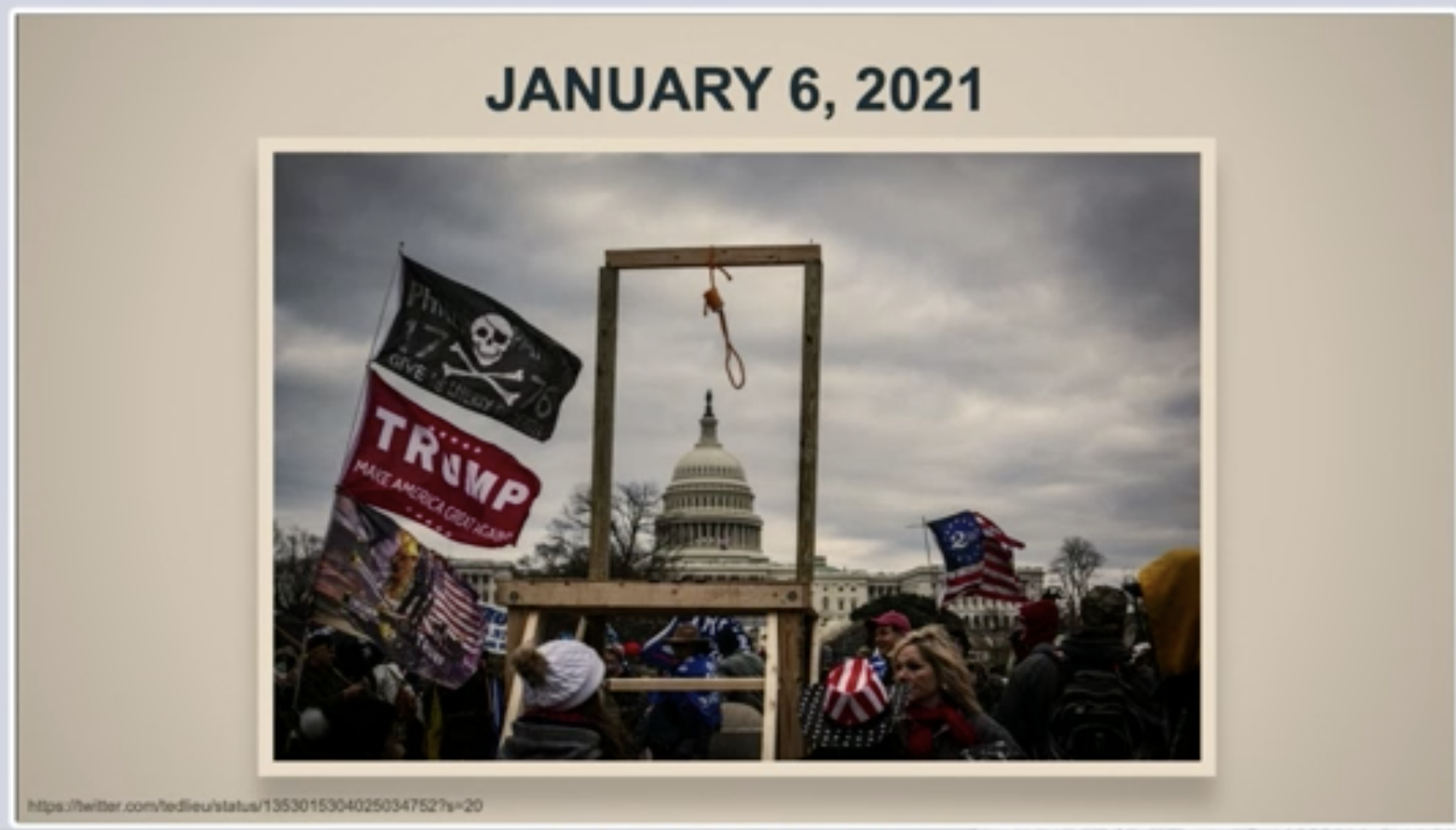
Ratifying Sedition: The Proud Boys 404(b) Evidence

As I noted yesterday, the government provided its 404(b) notice in Trump’s January 6 case. 404(b) notices alert the defendant to evidence that may or may not be intrinsic to the case but in any case shows the defendant’s criminal propensity.

In addition to showing how the Trump campaign tried to start a riot at the TCF Center in Detroit, DOJ also wants to show that Trump’s celebration of the Proud Boys bookends his own assault on democracy.

As the filing describes, Trump called out the militia at the first debate, and then — almost three years later — complained that convicted seditionist Enrique Tarrio faces a long sentence.

The Government plans to introduce evidence from the period in advance of the charged conspiracies that demonstrates the defendant’s encouragement of violence. For instance, in response to a question during the September 29, 2020, presidential debate asking him to denounce the extremist group the Proud Boys, the defendant instead spoke publicly to them and told them to “stand back and stand by.” Members of the group embraced the defendant’s words as an endorsement and printed merchandise with them as a rallying cry. As discussed below, after the Proud Boys and other extremist groups participated in obstructing the congressional certification on January 6, the defendant made clear that they were acting consistent with his intent and direction in doing so.

[snip]

Of particular note are the specific January 6 offenders whom the defendant has supported— namely, individuals convicted of some of the most serious crimes charged in relation to January 6, such as seditious conspiracy and violent assaults on police officers. During a September 17, 2023, appearance on Meet the Press, for instance, the defendant said regarding Proud Boys leader Enrique Tarrio—who was convicted of seditious conspiracy—“I want to tell you, he and other people have been treated horribly.” The defendant then criticized the kinds of lengthy sentences received only by defendants who, like Tarrio, committed the most serious crimes on January 6.

DOJ’s plan to show this is not surprising. After all, DOJ kicked off the Proud Boy sedition trial with Trump’s shout out to the Proud Boys.

But the significance, given the way DOJ has structured its conspiracy prosecutions from the start, is far more than damning evidence.

That’s because one of the conspiracy charges against Trump, 18 USC 1512(k), is one of the charges of which the Proud Boy leaders were convicted.

Aside from that public shout-out, which DOJ describes as, Trump speaking “publicly to them,” Donald Trump is not known to have communicated directly with any of them. But as I illustrated in January, Ethan Nordean, Joe Biggs, and Enrique Tarrio all communicated with Alex Jones and Roger Stone (and Owen Shroyer — who has two more days left in his sentence in Oakdale Correctional), even during the attack. Both of them, Jones and Stone — who have not been charged — communicated directly with Trump (and Mark Meadows). Stone’s actions leading up to January 6 were central to the guilty obstruction verdicts in Proud Boy Dan “Milkshake” Scott’s plea and Chris Worrell’s bench trial.

There may be more than that.

At the Proud Boy Leaders trial, for example, prosecutors introduced a series of Telegram chats from the day of, and immediately following, Trump’s shout-out. The men were giddy at Trump’s recognition.

In the wake of Trump’s debate recognition, there was talk of Trump inviting Proud Boys to the White House (Tarrio eventually did visit the White House, in December, as part of a Latinos for Trump event).

There was talk of mobbing election offices.

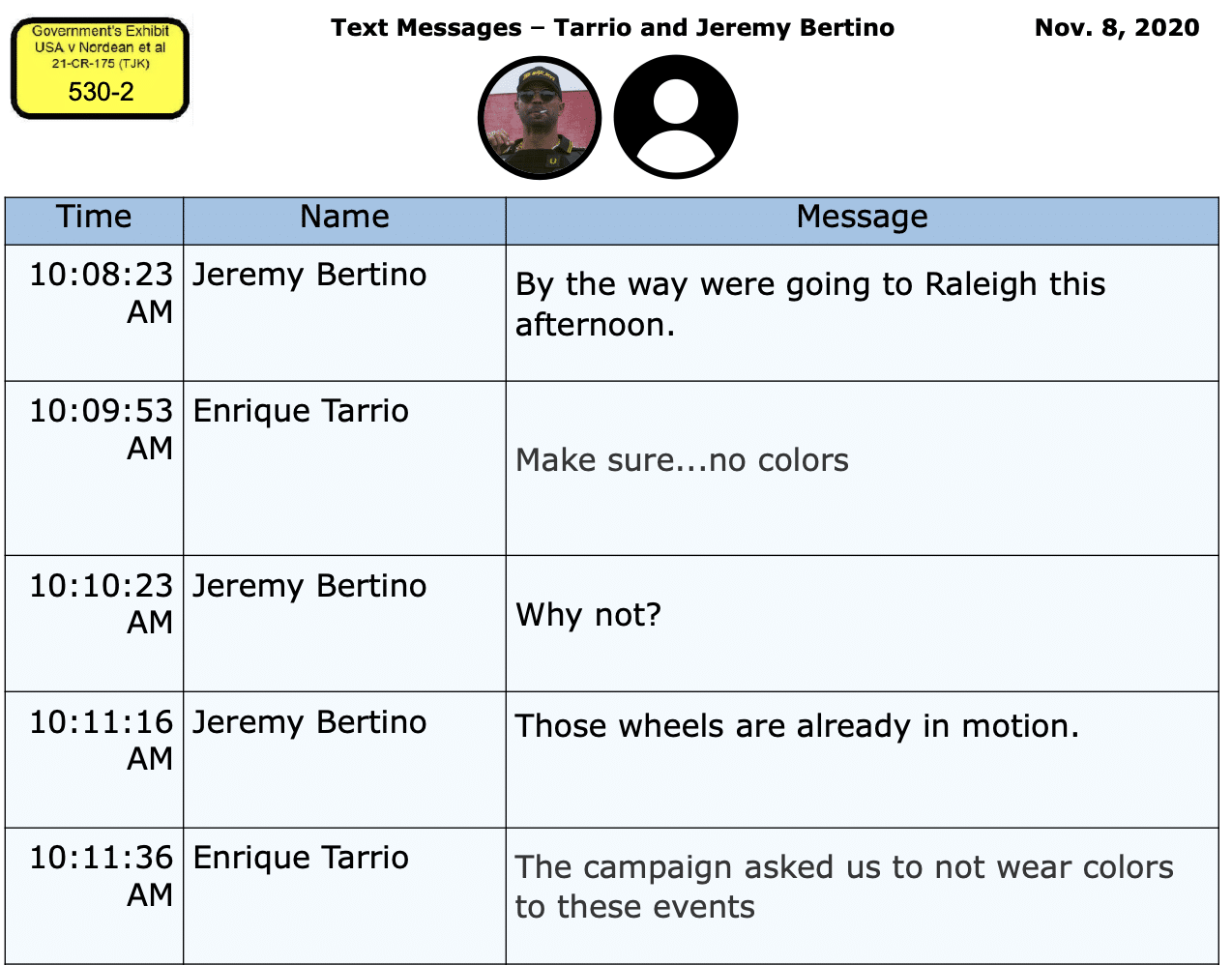
And, on November 8, Tarrio warned now-cooperating witness Jeremy Bertino not to wear colors because the campaign “asked us” not to do so.

As the campaign was ginning up mobs in swing states, Tarrio at least claimed to have some contact directly with the campaign. Stone is not the only candidate to be Tarrio’s tie to the campaign; Kellye SoRelle, who knew Tarrio from Latinos for Trump, was involved in the mob scene in Michigan.

A month ago, lead Proud Boys prosecutor Erik Kenerson dropped off one of the key pending Proud Boy prosecutions. There are many things that could explain that, but when other prosecutors — like Mary Dohrmann — moved under Jack Smith, that’s the kind of public activity that marked the move.

Several things have made clear in recent days that DOJ doesn’t consider the list of six uncharged co-conspirators in Trump’s January 6 indictment to be exclusive.

In their description of the TCF riot, for example, DOJ described the campaign employee who encouraged rioting (possibly Mike Roman) as “an agent (and unindicted co-conspirator).” Whoever it is would be a seventh co-conspirator.

More curiously, when Tanya Chutkan corrected Trump’s false representation of the indictment in her ruling that he did not have absolute immunity, she described that, “Defendant, along with at least six co-conspirators, id. ¶8, undertook efforts ‘to impair, obstruct, and defeat [that process] through dishonesty, fraud, and deceit,’ id. ¶ 10.” That comment stuck with me, as everyone else who has commented on the indictment has treated the six co-conspirators as an exclusive list. But sure enough, that paragraph she cites describes that the six co-conspirators laid out in the indictment — Rudy Giuliani, John Eastman, Sidney Powell, Jeffrey Clark, Kenneth Chesebro, and probably Boris Epshteyn — were only “among” those with whom Trump conspired.

The Defendant enlisted co-conspirators to assist him in his criminal efforts to overturn the legitimate results of the 2020 presidential election and retain power. Among these were:

If DOJ were ever to charge someone and make it a related case, it would come before Chutkan. That’s just one way that Chutkan might know of specific additional alleged co-conspirators that we wouldn’t yet know.

Conspiracy law doesn’t require co-conspirators to get together in a room to plot together. They need only agree on the objective and take steps to achieve it. If they have networked communications between them, all the better.

At the Proud Boys trial, prosecutors made Trump’s role in their conspiracy clear. Now, leading up to the former President’s own trial, DOJ has said they will present communications that amount to an agreement in September 2020 and ratification of the Proud Boy attack on the country in September 2023.

This is not just damning evidence of fondness for the right wing militia. It’s evidence that Trump pursued the same effort to obstruct the vote certification as the Proud Boys.

Share this entry

Three Things: Brilliant Opportunities Disguised

[NB: check the byline, thanks. /~Rayne]

At this site we tend to get caught up in the excruciatingly massive tarball that is Donald Trump – the conspiracy to unlawfully aid his 2016 election, his craptastically corrupt and fascistic tenure in the White House, and his ongoing effort to destabilize this country including the rolling insurrection punctuated by January 6.

But Trump is a tarball not only for this site and the American left. He’s a sticky mess tainting right-wing politics in so many ways having opened the door to the right-wing’s worst impulses.

You’d think the folks who identify themselves as conservatives would have clued in by now and begun to deal with the toxic waste Trump represents to the GOP’s future.

Former Chrysler CEO Lee Iococca once said, “We are continually faced by great opportunities brilliantly disguised as insoluable problems.”

Hello, GOP. You could fix your insoluable problems if you quit being bigots and pulled your heads out of your asses.

In the mean time we’re going to look at these as great opportunities demonstrating the Republicans’ inability to govern themselves let alone the entirety of any one community, state, or this nation.

~ 3 ~

This is what came up yesterday afternoon in Google News for Top News about the Florida GOP:

Here are the top four stories which surface in Google News this evening about the Florida GOP.

They’re not about Ron DeSantis, the state’s governor and current presidential candidate, at least not directly.

Not about any other GOP elected official or candidate.

Not related any court case related to Florida legislation.

Nope, it’s just another sex scandal this time involving a prominent member of Klanned Karenhood, I mean, Moms for Liberty and the head of the Florida GOP – a husband and wife couple who swing.

Apparently the husband and head of FL-GOP Christian Ziegler has a wee problem with consent.

The entire GOP has a problem with consent as Trump has demonstrated repeatedly, but this particular problem will likely result in criminal charges for rape and/or sexual battery in Florida.

The most galling part of this scandal is another layer of obnoxious fascist hypocrisy foisted on us by swinging spouse Bridget Ziegler was responsible in a big way for the infamous “Don’t Say Gay” bill foisted on Floridians.

Both Zieglers have been influential in Florida politics, especially after disagreements during the COVID pandemic led to a wave of conservative activism in schools. Bridget Ziegler helped draft the original bill in 2019 that later became the Parental Rights in Education Act after the Sarasota School Board — wrongly, in her opinion — approved guidelines that would make it optional for school officials to tell parents of elementary school children if they requested to go by a different pronoun. Previously she had spoken out against transgender students using restrooms that matched their gender identities.

When DeSantis signed the bill, which prohibits the mention of gender identity and sexual orientation, bans discussions that aren’t “age-appropriate” without defining what that means, and allows any parent to sue a school district over teaching they don’t like with the district paying the bill, Ziegler was standing behind him. The anti-mask-and-COVID-vaccine movement, combined with what critics called the “Don’t Say Gay” law, kicked off DeSantis’ campaign to eradicate “wokeness” and seemingly any acknowledgment of gender identity, sexuality and the racial issues mistakenly called critical race theory from the state.

Her husband went to the victim’s residence uninvited and allegedly raped her after the victim had backed out of another planned sexual encounter because the victim was only it it for Bridget.

In other words, the bill was intended to prevent young people from engaging in their First Amendment rights to discuss political figures like Bridget Ziegler having gay sex.

We know that the authoritarian personalities who make up much of the GOP’s base are immune to the shaming and blind to their hypocrisy about law and order or personal freedom – in this case, the freedom of a woman to say no to sex, or young people’s freedom to talk about their sexuality.

But it’s ridiculous for the GOP to expect Americans to trust them when they break the law while caring little for the fallout. They refuse to discipline themselves or their own party.’

~ 2 ~

Speaking of discipline, the Michigan GOP is a total shit show – one like January 6, in fact.

Half of the MIGOP has broken away in an insurrection against its own party leadership, doing so in a way which denied the just-less-than-half of the party aligned with current party chair and Trumper Kristina Karamo from having a quorum to conduct business.

The breakaway faction wants to kick Karamo to the curb. It’s not clear exactly what triggered their revolt but Karamo has been a crappy manager of the state party’s fundraising and organization.

More than one meeting under Karamo’s reign has resulted in physical altercations between party members.

MIGOP is also flirting with the bottom of its bank account. This past August its state central committee voted to assess party delegates a registration fee.

Big money donors have been thin on the ground; the Trumper who ran for state attorney general, Matt DePerno, bad mouthed them calling them “sore losers” though the big money was not happy pitching money toward an organization still in Trump’s thrall.

You’ll recall DePerno, who ran unsuccessfully for state attorney general in 2022, was investigated and indicted on four charges: undue possession of a voting machine, conspiracy to commit undue possession of a voting machine, conspiracy to commit unauthorized access to a computer or computer system and willfully damaging a voting machine in rural Roscommon, Barry and Missaukee counties.

The incredibly stupid and obvious fact – I cannot emphasize this enough, STUPID and OBVIOUS – about these three counties is that they are hard core GOP. They would not have flipped for Biden and didn’t in 2020, with Missaukee voting 76% and the other two counties hitting the mid-60 percentile for Trump.

Gee, I can’t understand why big donors aren’t throwing money at the MIGOP these days when they have such geniuses representing the party.

Somebody somewhere IS throwing money at defeating a Democrat in this state — like whoever is financing the PAC America Rising. They just aren’t donating to the MIGOP and they’re looking at something other than races in 2024 when they’re funding opposition research to spy on Governor Gretchen Whitmer who is now term limited after winning re-election in 2022.

Why don’t the donors funding a spy – willing to climb a slope approaching the governor’s summer residence this year, risking arrest to obtain photos of the governor and possible guests – doing this through the MIGOP?

~ 1 ~

Lack of personal and party discipline.

Lack of smarts, leadership, and management skills.

That’s the GOP today, as the state party apparatus has demonstrated in Florida and Michigan.

Texas doesn’t want to be left out, though. The Texas GOP is unable to give the heave-ho to Nazis.

You’d think Elon Musk was the TX-GOP party chair given the welcome mat they’ve left out for white supremacist Nick Fuentes.

The TX-GOP party chair Matt Rinaldi is directly involved as he was photographed entering Pale Horse Strategies, a far-right political consulting firm on October 6, as were the consulting firm’s president and other noted far-right political figures.

And of course the party apparatus handled the situation poorly, putting the entire state party on record as being anti-Semitic:

Two months after a prominent conservative activist and fundraiser was caught hosting white supremacist Nick Fuentes, leaders of the Republican Party of Texas have voted against barring the party from associating with known Nazi sympathizers and Holocaust deniers.

In a 32-29 vote on Saturday, members of the Texas GOP’s executive committee stripped a pro-Israel resolution of a clause that would have included the ban. In a separate move that stunned some members, roughly half of the board also tried to prevent a record of their vote from being kept.

Big donors may have a problem with this situation; billionaire Tim Dunn called it a “serious blunder,” which may pan out in the form of rejiggered donations bypassing the TX-GOP and going instead to other groups or to candidates.

But you can bet some news outlet will point out how the failings of the state GOP parties in these three states — which combined represent 85 electoral votes in the 2024 election — are somehow bad news for Joe Biden, and not the brilliant opportunities they represent for Democrats.

~ 0 ~

This is an open thread. Let’s fucking go!

Share this entry

DOJ Will Show that Trump’s Campaign Intended to Cause a Riot at TCF Center in Detroit

Jack Smith’s team has submitted a 404(b) notice — evidence that may not be intrinsic to the case but that describes Trump’s criminal propensity and helps prove his motive — in Trump’s DC case.

Along with providing examples where Trump continued to target someone (in this case Ruby Freeman) long after his prior targeting of her had resulted in threats and Trump’s celebration of insurrectionists like Enrique Tarrio, DOJ includes a heavily-redacted passage describing a Trump campaign employee’s attempt to cause a riot at the TCF Center, where election workers were counting the votes of Detroiters.

The Government also plans to introduce evidence of an effort undertaken by an agent (and unindicted co-conspirator) of the defendant who worked for his campaign (“the Campaign Employee”) to, immediately following the election, obstruct the vote count. On November 4, 2020, the Campaign Employee exchanged a series of text messages with an attorney supporting the Campaign’s election day operations at the TCF Center in Detroit, where votes were being counted; in the messages, the Campaign Employee encouraged rioting and other methods of obstruction when he learned that the vote count was trending in favor of the defendant’s opponent.

[seven lines redacted]

The Government will also show that around the time of these messages, an election official at the TCF Center observed that as Biden began to take the lead, a large number of untrained individuals flooded the TCF Center and began making illegitimate and aggressive challenges to the vote count. Thereafter, Trump made repeated false claims regarding election activities at the TCF Center, when in truth his agent was seeking to cause a riot to disrupt the count. This evidence is admissible to demonstrate that the defendant, his co-conspirators, and agents had knowledge that the defendant had lost the election, as well as their intent and motive to obstruct and overturn the legitimate results.

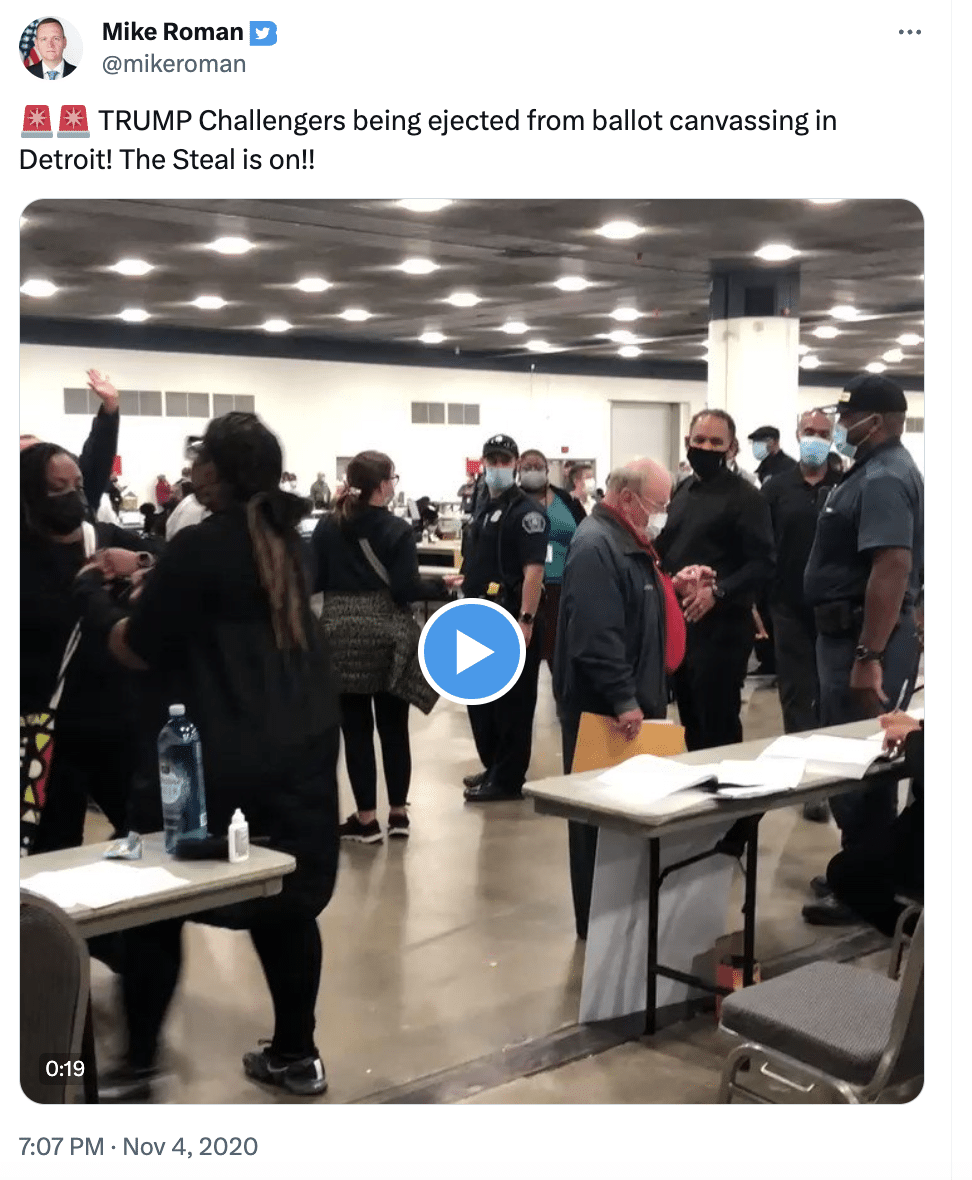
This is may be a reference to Mike Roman. Roman — Trump’s Director of Election Day Operations and a key ratfucker in other ways — posted a video falsely claiming that the challengers were being ejected improperly from the counting center.

According to the Election Integrity Project, Roman was also one of the most efficient spreaders of disinformation during the post-election period, wildly out of proportion to his number of Twitter followers (suggesting he had offline ways to help make things go viral).

Trump’s effort to make it harder to count the votes of Black voters has never gotten enough attention — not even though this specific tactic is a replay of Roger Stone’s Stop the Steal efforts in 2016, in some of the very same cities, as well as the Florida Brooks Brother’s riot. But it’s a key part of proving not just that Trump tried to throw out Joe Biden’s votes, but specifically the votes of Joe Biden’s Black supporters.

Share this entry

Principal Senior Assistant Special Counsel Leo Wise Insinuates David Weiss Lied to Congress

I hope that I was duly cautious in my discussions about Abbe Lowell’s request to subpoena Donald Trump, Bill Barr, Jeffrey Rosen, and Richard Donoghue.

I stated that “That political argument” Lowell was making about Trump’s hypocrisy “won’t work.”

I described that several aspects of the proposed subpoenas asked for the impossible.

These are impossible subpoenas, insofar as they ask for compliance according to an impossible timeline and ask for compliance that may not legally be available (indeed, to the extent Trump has items in his possession, for various reason they may be covered by the Mar-a-Lago protective order). To the extent subpoenas ask for things covered by various privileges, they would pose impossible challenges to overcome. To the extent the subpoenas ask for the perfect phone call in which Trump demanded Zelenskyy’s help with an investigation of Hunter Biden, they are impossible subpoenas because the White House altered that record in real time.

I similarly noted that Lowell didn’t mention, at all, the precedent that would make this request impossible.

Lowell doesn’t mention Armstrong, the precedent that usually makes it impossible for defendants to get discovery in selective prosecution challenges.

I gave all those warnings, in part, to make as clear as I could that this request likely won’t work.

But I also gave these warnings for another reason: Abbe Lowell is no dummy. He knows these precedents. He knows the significance of Armstrong. His silence about it ought to have raised questions — it certainly did for me — about what he was trying to accomplish with this motion.

But that may be instructive. Before Lowell is making a request for discovery based on a selective and/or vindictive prosecution claim, he is first asking for subpoenas, without fully laying out whether this would be a selective or vindictive or political influence prosecution claim.

I lay that out because David Weiss’ response — signed by “Principal Senior Assistant Special Counsel” Leo Wise, the third title Wise has adopted over the course of his seven month involvement in this case — goes to great length (twice the length of Lowell’s 16-page motion) to cite those precedents over and over and over. 48 times, Principal Senior Assistant Special Counsel Leo Wise invokes Armstrong.

Principal Senior Assistant Special Counsel Leo Wise is absolutely right about all these precedents.

Where he struggles, unsurprisingly, is in characterizing Lowell’s intent. He claims to be so sure that this request is exclusively about a selective or vindictive prosecution claim that he spends 17 pages arguing that Lowell has not met a selective or vindictive prosecution standard in the subpoena request before he gets around to arguing what is before him: a request for subpoenas.

Along the way, Principal Senior Assistant Special Counsel Leo Wise lectures Abbe Lowell, twice, that selective and vindictive prosecution claims are pretrial motions, not trial defenses.

Defendant contends that the requested material “goes to the heart of his pre-trial and trial defense that this is, possibly, a vindictive or selective prosecution that arose out of an incessant pressure campaign that began in the last administration, in violation of Mr. Biden’s constitutional rights.” ECF 58, at 14. It is worth noting from the outset that defendant misunderstands the difference between pretrial arguments to dismiss an indictment and trial defenses. It is black-letter law that claims of vindictive and selective prosecution are not trial defenses and may only be brought and litigated pretrial. They are not defenses and, therefore, are never argued to trial juries.

[snip]

As a preliminary matter, the government notes that defendant’s description of this claim as a “trial defense” is erroneous. “A selective-prosecution claim is not a defense on the merits to the criminal charge itself, but an independent assertion that the prosecutor has brought the charge for reasons forbidden by the Constitution.”

In the process, Principal Senior Assistant Special Counsel Leo Wise makes an important false representation. He claims that selective and vindictive prosecution is the “sole” reason Lowell is asking for subpoenas.

Defendant’s motion gives, as the sole justification for these subpoenas, that they are in support of his “pre-trial and trial defense that this is, possibly, a vindictive or selective prosecution.” ECF 58, at 14. [my emphasis; note, because Wise uses italics a lot, I’ve taken the painful step of using underline to emphasize throughout this post]

Principal Senior Assistant Special Counsel Leo Wise ignores at least three other descriptions of why Lowell wants the subpoenas, all of which precede that language on page 14 that invokes a trial defense.

In this case, production of documents by each of the Subpoena Recipients prior to trial may be used either in pre-trial pleadings or in a pre-trial evidentiary hearing on Mr. Biden’s motions to dismiss the Indictment (or, potentially, another issue).

[snip]

The information Mr. Biden seeks from the Subpoena Recipients is relevant and material to a fundamental aspect of issues in his defense that will be addressed in pre-trial motions and possibly as impeachment of a trial witness, should the case get that far: whether this investigation or prosecution arose because of or in response to any Executive Branch official or other outside influences placing undue pressure on government officials to investigate, formally or informally, or prosecute Mr. Biden.

[snip]

All the information sought from the Subpoena Recipients would be admissible in pre-trial motions or an evidentiary hearing or, depending on the author and recipient, to impeach a trial witness. [my emphasis]

Impeaching a witness is the antecedent to that reference to a trial defense.

Principal Senior Assistant Special Counsel Leo Wise appears to know that.

When Principal Senior Assistant Special Counsel Leo Wise finally gets around to arguing about subpoenas, rather than selective and vindictive prosecution, he seems to admit that he has read those references to impeachment, because he cites the part of Nixon that distinguishes between evidentiary subpoenas (which you can get pretrial) and impeachment ones (which you can only get at trial).

Accordingly, courts have concluded that “[t]he weight of authority holds that in order to be procurable by means of a Rule 17(c) subpoena, materials must themselves be admissible evidence.” United States v. Cherry, 876 F. Supp. 547, 552-53 (S.D.N.Y. 1995) (citing cases). Indeed, in Nixon itself, the Supreme Court noted that even though, “[g]enerally, the need for evidence to impeach witnesses is insufficient to require its production in advance of trial,” the “other valid potential evidentiary uses for the same material” rendered it properly obtainable through Rule 17(c). 418 U.S. at 701. Applying Nixon’s standard, the Third Circuit held that potential impeachment material without an independent basis for admissibility could not be produced to the moving party before the witness testified inconsistently at trial, even if the material had some exculpatory value. See United States v. Cuthbertson (Cuthbertson II), 651 F.2d 189, 192, 195 (3d Cir. 1981) (citing Cuthbertson I, 630 F.2d at 144-46).

Reading Armstrong and Nixon together compels the conclusion that Rule 17(c) may not be used to discover material for pre-trial collateral attacks. Nixon unambiguously imposed limitations on Rule 17(c) subpoenas to “evidentiary” and admissible materials for use at trial, which closes off criminal discovery on collateral, pre-trial issues. See 418 U.S. at 699; see generally Fed. R. Evid. 104, 1101(d) (providing that courts are not bound by the Federal Rules of Evidence other than privilege in various non-trial stages of criminal cases). Then, in Armstrong, although it proceeded on the undecided assumption that some discovery might be available on an adequate showing, the Supreme Court nonetheless unequivocally held that the defendant’s “defense” does not encompass collateral selective-prosecution attacks on the indictment. 517 U.S. at 463 (“[I]n the context of Rule 16 ‘the defendant’s defense’ means the defendant’s response to the Government’s case in chief.”); cf. supra note Error! Bookmark not defined.. Put simply, because Rule 17 is not “a means of discovery in criminal cases” (Nixon, 418 U.S. at 699), defendants may not use it to investigate whether some material that might be useful to some pre-trial motion a defendant may make exists in the files of the government or a third party. Instead, Rule 17(c) is a limited, trial-focused mechanism for procuring known, identifiable evidence. [underlines my own; bolded reference to a note that Principal Senior Assistant Special Counsel Leo Wise thought better of, his]

Only in reading Armstrong and Nixon together — along with citing an SDNY District opinion in Donzinger that is not remotely precedential in this case — does Principal Senior Assistant Special Counsel Leo Wise address the request before him. But in doing so, he confesses that his earlier representation — that the “sole” reason Lowell asked for these subpoenas was for pretrial motions to dismiss — was false. Maybe that’s why he decided to lecture Lowell that selective and vindictive prosecution are not trial defenses: to cover up his later admission he knows there’s something more here, impeachment of some witness Lowell doesn’t identify (but which might be related to Principal Senior Assistant Special Counsel Leo Wise’s recent promotion).

Because Principal Senior Assistant Special Counsel Leo Wise misrepresents what Lowell is trying to do here, much of his 32-page response resembles a quixotic effort (in the literal, literary sense) to beat down an imaginary windmill he has not yet come before. Over and over, Principal Senior Assistant Special Counsel Leo Wise argues that Abbe Lowell, whom he has lectured about how one uses a pretial motion to dismiss, has not met the standard for selective and vindictive prosecution claims he won’t argue until next week.

In seeking discovery for a claim of selective prosecution, defendant fails to identify even one similarly situated individual who was not prosecuted for similar conduct. This omission alone precludes his request for discovery. See, e.g., United States v. Armstrong, 517 U.S. 456 (1996).

[snip]

Defendant’s motion does not even attempt to make a showing of similarly situated individuals who were not prosecuted. It discusses no comparators at all, much less articulates the basis on which a court could find that they are “similarly situated” to the defendant but for a protected characteristic. [my underline, Principal Senior Assistant Special Counsel Leo Wise’s italics]

Of course Lowell did not discuss comparators! He’s likely to do that next week. This is not (as Principal Senior Assistant Special Counsel Leo Wise describes it here) a request for discovery. It’s a request for subpoenas.

I suggested that one reason Lowell may have done this, file a motion for subpoenas before filing the motions to dismiss, is to invite Weiss’ team to lay out their argument. If that was part of the goal, whooboy did Lowell hit paydirt in several specific arguments Principal Senior Assistant Special Counsel Leo Wise made.

For example, Principal Senior Assistant Special Counsel Leo Wise’s argument against vindictive prosecution was comparatively thin. As I laid out here, if Hunter Biden makes such a claim, he would argue that David Weiss entered into a Diversion Agreement that Leo Wise, then a garden variety AUSA, told Judge Maryanne Noreika on July 26, was a “contract between the parties … in effect until it’s either breached or a determination, period,” a contract, period, which then-Assistant Special Counsel Leo Wise breached (Lowell will argue) when he indicted the President’s son in retaliation for Hunter’s not guilty plea to the tax charges. Merits aside, such a claim is pretty obvious to me. But Principal Senior Assistant Special Counsel Leo Wise complains that Hunter Biden never identifies what right — the right to plead not guilty — he is being punished for.

Defendant never squarely identifies what right he is purportedly being punished for asserting. But Goodwin makes clear he is not entitled to a presumption of vindictiveness here, and that, in the absence of one, the prosecutor remains entitled to a presumption of regularity, which can be rebutted only by clear evidence that his motivation was “solely” to punish the exercise of a legal right, rather than the usual prosecutorial interests. Goodwin, 457 U.S. at 380 nn.11–12, 384 n.19. Defendant here offers nothing more than speculation and cannot meet the heightened standard necessary to obtain discovery on such a claim.2

2 The government notes that none of the charges in the indictment carry a mandatory minimum, and the two false-statement charges carry equal or lower statutory penalties to the information’s unlawful-possession charge. See ECF 40; compare 18 U.S.C. § 924(a)(1)(A), (a)(2), with § 924(a)(8).

Again, Lowell’s filing was no more the vindictive prosecution claim than it was the selective prosecution one: Abbe Lowell will presumably describe that right — pleading not guilty — next week.

It’s telling that Principal Senior Assistant Special Counsel Leo Wise never mentions the Diversion Agreement. Nor does he consider whether a Diversion Agreement — that contract, period — situates the decision to indict Hunter anyway in a pretrial or post-resolution posture. I don’t know the answer to that but Principal Senior Assistant Special Counsel Leo Wise better be prepared to address it after Abbe Lowell does file his motion to dismiss next week.

Yet Principal Senior Assistant Special Counsel Leo Wise does that while he makes a premature argument that he didn’t punish Hunter Biden by adding two felony charges that turn his previous 10 year maximum exposure into 25 years. He’s only pretending he doesn’t know what’s coming, it seems.

With regards to the selective prosecution claim, in addition to the standard boilerplate arguments, Principal Senior Assistant Special Counsel Leo Wise anticipates that Hunter Biden might argue he’s in a class of one — that his theory of selective prosecution will be different than claims based on racial discrimination. In obligingly providing Lowell his thinking on the matter, Principal Senior Assistant Special Counsel Leo Wise revealed that the citations he will invoke if and when Lowell does make this argument next week really aren’t all that apt to this case.

Defendant has the burden to plead a theory of selective prosecution that would allow discovery, and he has not done so. The government briefly notes that other theories of selective prosecution fit his case even less. For example, in some cases, a defendant may not need to show these elements if the Executive Branch’s action was “based on an overtly discriminatory classification”; in those circumstances, the overtly discriminatory classification itself satisfies the showing of discriminatory intent. Wayte, 470 U.S. at 608 n.10 (citing Strauder v. West Virginia, 100 U.S. 303 (1880), which invalidated a state law that prohibited African-Americans from serving on juries). But defendant’s motion contains no argument or evidence in support of such a claim. Instead, the arguments he advances appear to fall within the ordinary formulation of selective prosecution, which requires proof of both disparate treatment and discriminatory intent.

Alternatively, a defendant could theoretically seek to advance a selective-prosecution claim based on post-Armstrong/Wayte cases addressing what has been termed a “class-of-one equal-protection claim.” See, e.g., Village of Willowbrook v. Olech, 528 U.S. 562 (2000) (per curiam). But after the Supreme Court decided Olech, the Court rejected the class-of-one theory in a context where the government exercises broad discretion—namely, when the government acts as an employer and makes personnel decisions. See Engquist v. Oregon Dept. of Agriculture, 553 U.S. 591 (2008). The Court observed that “some forms of state action … by their nature involve discretionary decisionmaking based on a vast array of subjective, individualized assessments,” and “in such cases the rule that people should be ‘treated alike, under like circumstances and conditions’ is not violated when one person is treated differently from others, because treating like individuals differently is an accepted consequence of the discretion granted.” Id. at 603. Notably, to illustrate this point, the Supreme Court used an example where only some drivers who are exceeding the speed limit are stopped. “[A]n allegation that speeding tickets are given out on the basis of race or sex would state an equal protection claim. But allowing an equal protection claim on the ground that a ticket was given to one person and not others, even if for no discernible or articulable reason, would be incompatible with the discretion inherent in the challenged action.” Id. at 604.

Courts of appeals have extended Engquist’s limitation on class-of-one theories in various contexts where the government exercises broad discretion. See, e.g., Planned Parenthood Ass’n of Utah v. Hebert, 828 F.3d 1245, 1255 (10th Cir. 2016) (collecting cases). And as Engquist’s example of stopping speeders illustrates, the Supreme Court has repeatedly emphasized that “in the criminal-law field, a selective prosecution claim is a rara avis” and is so “[b]ecause such claims invade a special province of the Executive—its prosecutorial discretion.” Reno v. Am.- Arab Anti-Discrimination Comm., 525 U.S. 471, 489 (1999) (citing Armstrong, 517 U.S. at 463– 65). Cf. United States v. Moore, 543 F.3d 891, 901 (7th Cir. 2008) (“[A] class-of-one equal protection challenge, at least where premised solely on arbitrariness/irrationality, is just as much a ‘poor fit’ in the prosecutorial discretion context as in the public employment context” considered in Engquist). In addition to Rivera, in the context of parole decisions for sex offenders, the Third Circuit has recognized the force of Engquist’s limitations on equal protection challenges where the “state action … involves ‘discretionary decisionmaking based on a vast array of subjective, individualized assessments’ [that] necessarily results in different treatment among those subject to the discretionary action.” Stradford v. Sec. Penn. Dept. of Corrections, 53 F.4th 67, 76 (3d Cir. 2022) (quoting Engquist, 553 U.S. at 603–04). Engquist, Rivera, and Stradford provide no home for a class-of-one theory in the context of this case.

A class-of-one selective prosecution claim made by the son of the President is in no way going to be based on a theory of arbitrariness.

In fact Principal Senior Assistant Special Counsel Leo Wise recognizes that, elsewhere. When he tries to argue that the subpoena recipients had no role in the charges in this case, he mentions that private citizen Hunter Biden happens to be the son of the President.

In any event, both vindictive- and selective-prosecution claims turn on the actual intent of the specific decisionmaker in a defendant’s case: here, the Special Counsel. But not only does defendant’s motion fail to identify any actual evidence of bias, vindictiveness, or discriminatory intent on the Special Counsel’s part, his arguments ignore an inconvenient truth: No charges were brought against defendant during the prior administration when the subpoena recipients actually held office in the Executive Branch. Instead, every charge in this matter was or will be brought during the current administration—one in which defendant’s father, Joseph R. Biden, is the President of the United States and Merrick B. Garland is the Attorney General that was appointed by President Biden and who personally appointed the Special Counsel. Defendant has not shown, nor can he, how external statements by political opponents of President Biden improperly pressured him, his Attorney General, or the Special Counsel to pursue charges against the President’s son.

[snip]

Defendant focuses his narrative of selective prosecution largely on the actions and motivations of non-prosecuting officials in the previous administration prior to any charges being brought. However, after a change in administrations—to one headed by defendant’s father, who leads a competing political party—the President’s current Attorney General personally exercised his discretion to direct “a full and thorough investigation” of these matters and conferred on the Special Counsel statutory and regulatory authority to prosecute this case. See Order No. 5730-2023 (Aug. 11, 2023) (citing 28 U.S.C. §§ 509, 510, 515, 533 and 28 C.F.R. pt. 600). 1 Thus, defendant’s claim of selective prosecution must contend with the presumption of regularity not only for the Special Counsel’s decision to prosecute but also for both the Attorney General’s decision to direct a full and thorough investigation and the Attorney General’s determination that the prosecution warrants the greater authority and independence of the Special Counsel’s Office. On those points, in addition to offering no evidence that the now-Special Counsel had any animus or improper motivation against defendant, he offers no evidence that the current Attorney General acted out of any improper motive in empowering the Special Counsel to continue pursuing prosecution. [my emphasis]

The defendant is the son of the President?!?!?! Wow. You don’t say?!?!?!

I’m not certain, but I don’t think this has been stated explicitly in this case before. Hunter’s motion to do his arraignment by video described him as a Secret Service protectee, for example, but didn’t explicitly say why.

We have now taken judicial notice that Hunter Biden has some kind of familial tie to the Chief Executive.

And this is where Principal Senior Assistant Special Counsel Leo Wise’s efforts to disclaim any influence Donald Trump, Bill Barr, Jeffrey Rosen, and Richard Donoghue had on this case gets interesting.

Never mind that Principal Senior Assistant Special Counsel Leo Wise sort of ignores the issue that one of the intended subpoena recipients, Donald Trump, appointed Weiss; if Principal Senior Assistant Special Counsel Leo Wise wants to treat justice as a matter of competing parties, as he does here, then Weiss is a member of the other party.

The other things that Principal Senior Assistant Special Counsel Leo Wise does in these passages is to assert the presumption of regularity to Merrick Garland’s decision to honor a promise he made — to a Republican Senator — in his confirmation hearing, to appoint Weiss Special Counsel if Weiss ever asked to be so appointed.

That is, Principal Senior Assistant Special Counsel Leo Wise relies on Garland’s role — as an appointee of the defendant’s father, one who couldn’t fire Weiss without risking accusations of criminal obstruction and impeachment — to vouch for David Weiss’ presumption of regularity. But he does so in a filing where he argues that senior DOJ officials who, Lowell has already shown, were personally involved in the prosecution, along with the President who appointed David Weiss, had a non-prosecutorial role.

Principal Senior Assistant Special Counsel Leo Wise is trying to have it both ways: arguing that Merrick Garland is a part of this prosecution but Donald Trump, Bill Barr, Jeffrey Rosen, and Richard Donoghue are not.

Weiss has told Congress at least four different times that Merrick Garland exercised no supervisory role in this case.

Indeed, he has barely spoken to the man. Weiss told House Judiciary Committee, “I’ve never had any direct communications with the Attorney General, save my communication in requesting Special Counsel authority in August of 2023.” Nor has he had contact with the Deputy Attorney General, nominally his direct supervisor. “I have never spoken with [Lisa] Monaco. … Never.”

Rather than being overseen directly by any political appointee, Weiss’ “point of contact for the last year, year and a half ,” the Special Counsel explained, “has been Associate Deputy Attorney General Weinsheimer.” Brad Weinsheimer was first promoted to that position by Jeff Sessions in 2018.

Weiss’ appointment gets perilously close to violating Morrison v. Olson, because neither Biden nor Garland could fire Weiss, could ever have fired Weiss, without being accused of criminal obstruction. Yet now Principal Senior Assistant Special Counsel Leo Wise is claiming that Merrick Garland’s decision, made in response to a request Weiss made after Congress floated accusations of obstruction anyway, to give him even more independence is proof that Weiss wasn’t responding to political pressure.

Principal Senior Assistant Special Counsel Leo Wise is now suggesting that all Weiss’ claims that Garland had no role were false. He is basing much of his claim that Weiss was not influenced by politics on a reporting structure that has never existed under the Biden Administration, as Weiss has said over and over.

Contrast that with Principal Senior Assistant Special Counsel Leo Wise’s wildly misleading attempt to argue that Bill Barr’s DOJ had no improper influence on this case, the only treatment Principal Senior Assistant Special Counsel Leo Wise gives the specifically identified documents in Lowell’s motion.

Defendant’s attempts to manufacture discriminatory treatment or intent on behalf of the U.S. Attorney fall apart under the most minimal scrutiny. First, defendant obliquely references that “IRS files reveal that [Richard Donoghue] further coordinated with the Pittsburgh Office and with the prosecution team in Delaware, including issuing certain guidance steps regarding overt steps in the investigation.” ECF 58, at 2-3 & n.3. Looking behind the defendant’s ambiguously phrased allegation reveals the actual “overt steps” involved: (1) the U.S. Attorney making an independent assessment of the probable cause underlying a warrant and (2) a direction by Mr. Donoghue that the Delaware investigation receive the information from the Pittsburgh team, which was being closed out. See ECF 58, at 3 n.3 (citing memorandum of conference call). Assessing the validity of a warrant and merely receiving information from other investigating entities does nothing to show any disparate treatment or animus. Next, defendant alleges that “certain investigative decisions were made as a result of guidance provided by, among others, the Deputy Attorney General’s office.” ECF 58, at 3 n.4. In fact, the source cited revealed that the guidance was simply not to conduct any “proactive interviews” yet. Likewise, defendant’s last attempt to create a link involved guidance not to make any “external requests (outside of government),” which followed the long-standing Department of Justice policy to avoid overt investigative steps that might interfere with ongoing elections. See ECF 58, at 3 n.5; cf., e.g., Federal Prosecution of Election Offenses 40 (2d ed. 1980). In other words, the most defendant claims is that the Deputy Attorney General’s office was aware of and involved in some specific investigatory decisions in the most banal fashion possible—by waiting to take specific investigative steps at certain times out of caution.

I have no fucking clue what warrant Principal Senior Assistant Special Counsel Leo Wise is mentioning here; the word “warrant” doesn’t appear in Lowell’s filing (it may be a reference to other documents at the main Ways and Mean link for IRS documents). But what Principal Senior Assistant Special Counsel Leo Wise is doing is suggesting that the Pittsburgh effort to share dirt from Russian spies with David Weiss’ investigative team is the same action as Richard Donoghue’s order before the election not to take overt investigative steps. There’s not a shred of evidence they’re related.

As noted, that’s the only specific rebuttal Principal Senior Assistant Special Counsel Leo Wise attempts to Abbe Lowell’s description of several different kinds of influence on this case. Principal Senior Assistant Special Counsel Leo Wise only makes a general allusion to Donald Trump’s public comments: “how external statements by political opponents of President Biden improperly pressured him.” He certainly doesn’t deny that those threats contributed to the threats made against Weiss and the rest of the investigative team, threats that Weiss described to Congress.

And aside from describing that Lowell wants to subpoena Bill Barr, Principal Senior Assistant Special Counsel Leo Wise never mentions him. Indeed, I think Principal Senior Assistant Special Counsel Leo Wise trips up in not mentioning him.

Principal Senior Assistant Special Counsel Leo Wise claims that Lowell has referenced, “a direction by Mr. Donoghue that the Delaware investigation receive the information from the Pittsburgh team, which was being closed out.” The problem is, unless I’m missing something, there is nothing in the record that describes the investigation was being closed out. Here’s what Lowell referenced:

[I]t has been reported and revealed in the now-public IRS investigative files concerning this case (released by the House Ways and Means Committee1 ) that, separately, the Department of Justice (“DOJ”) under then Attorney General Barr opened a dedicated channel at the U.S. Attorney’s Office in Pittsburgh to receive information about Mr. Biden coming from then President Trump’s personal attorney, Rudolph Giuliani, and his associates. 2 That effort to review and vet any material was coordinated by then U.S. Attorneys Richard Donoghue (E.D.N.Y.) and Scott Brady in Pittsburgh (W.D.P.A.). When Mr. Donoghue was elevated to serve as Principal Associate Deputy Attorney General at the DOJ in July 2020 (and later, in December 2020, Deputy Attorney General under Mr. Rosen), IRS files reveal that he further coordinated with the Pittsburgh Office and with the prosecution team in Delaware, including issuing certain guidance regarding overt steps in the investigation. 3

2 See, e.g., Letter From Asst. Att’y Gen. Stephen E. Boyd to Hon. Jerrold Nadler (Feb. 18, 2020) (available via https://www.justice.gov/) (“[T]he Deputy Attorney General has also assigned Scott Brady, the U.S. Attorney for the Western District of Pennsylvania, to assist in the receipt, processing, and preliminary analysis of new information provided by the public that may be relevant to matters relating to Ukraine.”); Material From Giuliani Spurred a Separate Justice Dept. Pursuit of Hunter Biden, N.Y. TIMES (Dec. 11, 2020), https://www.nytimes.com/2020/12/11/us/politics/hunter-biden-justice-department-pittsburgh.html.

3 Gary Shapley Aff. 3, attach. 6 (IRS CI Memorandum of Conversation, Oct. 22, 2020), (“Pittsburgh read out on their investigation was ordered to be received by this prosecution team by the PDAG.”), available at https://gopwaysandmeans.house.gov/wp-content/uploads/2023/09/T87-Shapley-3_Attachment-6_WMRedacted.pdf.

Gary Shapley’s memo — the only description of how and why this was shared with the Hunter Biden team — only says that Donoghue ordered Weiss’ team to be briefed on it.

One of the most authoritative descriptions of how it got passed on came from … intended subpoena recipient Bill Barr, in an interview with Margot Cleveland.

It’s not true. It wasn’t closed down,” William Barr told The Federalist on Tuesday in response to Democrat Rep. Jamie Raskin’s claim that the former attorney general and his “handpicked prosecutor” had ended an investigation into a confidential human source’s allegation that Joe Biden had agreed to a $5 million bribe. “On the contrary,” Barr stressed, “it was sent to Delaware for further investigation.”

While Lowell hasn’t (yet) included this in his filings, Barr’s communications with Cleveland would be among the key things Lowell might obtain with a subpoena. They are critically important, too, because they prove that the Attorney General himself was involved in this process — that the interference in the Hunter Biden investigation went beyond the DAG’s normal interest in supervising US Attorneys.

And as I’ve mentioned before, Barr’s public intervention came at a critical time. He butted in while Lesley Wolf was still involved with this prosecution, before Weiss reneged on the plea deal negotiated by Wolf, and before David Weiss told Lindsey Graham that the FD-1023 obtained via the process to launder information from Russia spies into the investigation of Donald Trump’s opponent’s son was part of a still-ongoing investigation.

Your questions about allegations contained in an FBI FD-1023 Form relate to an ongoing investigation. As such, I cannot comment on them at this time.

In a filing that entirely ignores Lowell’s citation from Barr’s book, Principal Senior Assistant Special Counsel Leo Wise ignores the public evidence that Bill Barr not only remains involved in this case, but that David Weiss responded to pressure elicited by Barr’s public intervention, and did so by stating that that was part of the ongoing investigation into Joe Biden’s kid.

Principal Senior Assistant Special Counsel Leo Wise’s silence about Barr makes me wonder if the subpoena to him poses a particular risk for Weiss, as if before Weiss made that comment to Lindsey, he got a phone call that would be covered by the subpoena. In any case, whereas Weiss went years before his first contact with Merrick Garland about this case, he did tell HJC that, “I had conversations with Attorney General Barr, and I don’t want to get into the content of those conversations, because they’re with the AG.”

In any case, I’m genuinely shocked by the flopsweat that this subpoena request from Lowell produced. Indeed, that is one reason I’m so interested in Principal Senior Assistant Special Counsel Leo Wise’s fancy new title.

Though Lowell never said it, I suspect the likely witness Hunter Biden’s lawyer wants to impeach at trial is David Weiss himself.

Weiss is the single solitary witness who can attest to how and why the prosecution transitioned from Lesley Wolf to Principal Senior Assistant Special Counsel Leo Wise. He is the single solitary witness who can claim that that wasn’t a result of either political pressure directly or the pressure created by credible threats of violence targeted at him, his investigative team, and their families.

But Weiss has also now committed to the continued influence of Scott Brady’s task on the ongoing investigation into Hunter Biden. Brady told the House Judiciary Committee that he and Weiss spoke, personally, every four to six weeks between around January 10 and the final briefing in October. He described making “other recommendations about possible investigative avenues that we would recommend that they take.”

And by blabbing to Margot Cleveland, Bill Barr has made public that he was also in the thick of all that.

Weiss is in a position where he has no one to blame. He really can’t — and never could — borrow presumption of regularity from Merrick Garland, because his continued tenure always came on the threat of obstruction charges (and impeachment). He can’t — and never could — invoke Garland’s DOJ to claim his prosecution is not political, because Garland has made a point to be hands off, as Weiss has affirmed to Congress.

But he also is totally in the thick of the wildly inappropriate scheme that Bill Barr set up, one that catered to laundering claims Donald Trump’s personal lawyer had obtained from, among others, a Russian spy.

And that, I suspect, is why Principal Senior Assistant Special Counsel Leo Wise got another promotion: because Weiss himself now poses a threat to this prosecution.

Update: Added specifics about Weiss’ testimony as to contacts with Garland, Lisa Monaco, Brad Weinsheimer, and Bill Barr.

Share this entry

NYT Covers Up the Still-Ongoing Trump-Russian Effort to Frame Joe Biden

The reason I have so little patience for NYT’s decision to dedicate the resources of three senior reporters to warn about the dangers of a second Trump term is not that I disagree about the second term. They’re right that it would be far worse.

It’s that the same reporters continue to downplay Trump’s past corruption — some of which Maggie Haberman specifically enabled — and outright ignore the ongoing effects of it.

Imagine how much healthier American democracy would be if the NYT dedicated just half of the time and space that went into the eight, often repetitive stories on this topic to instead lay out how the ongoing effort to impeach Biden is a continuation of Trump’s efforts, made with the assistance of men now deemed to be Russian spies by both the US and Ukraine, to frame Joe Biden?

  1. December 4: Why a Second Trump Presidency May Be More Radical Than His First
  2. November 15/December 2: How Trump and His Allies Plan to Wield Power in 2025
  3. November 11: Sweeping Raids, Giant Camps and Mass Deportations: Inside Trump’s 2025 Immigration Plans
  4. November 1: Some of the Lawyers Who May Fill a Second Trump Administration
  5. October 31: If Trump Wins, His Allies Want Lawyers Who Will Bless a More Radical Agenda
  6. July 17: Trump and Allies Forge Plans to Increase Presidential Power in 2025
  7. June 21: Few of Trump’s G.O.P. Rivals Defend Justice Dept. Independence
  8. June 15: The Radical Strategy Behind Trump’s Promise to ‘Go After’ Biden

NYT appears not to have assigned a single reporter to chase down the following allegations that have come out of the GOP impeachment effort:

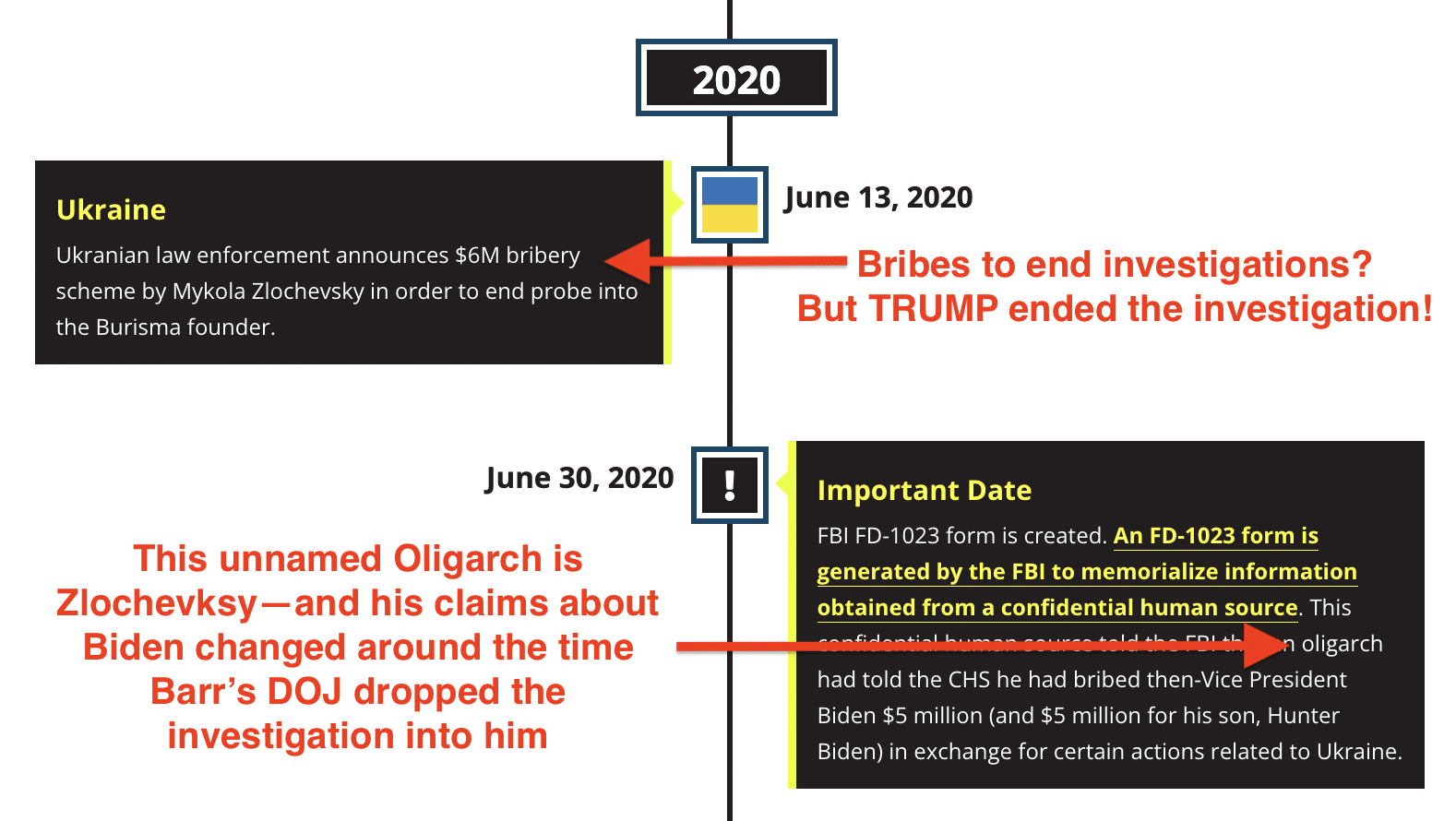
  • Bill Barr’s DOJ shut down a corruption investigation into Mykola Zlochevsky — which had been opened in January 2016, while Biden was VP and Hunter was on the board of Burisma — in December 2019, right in the middle of an impeachment defense claiming to prioritize the investigation of Burisma’s corruption.
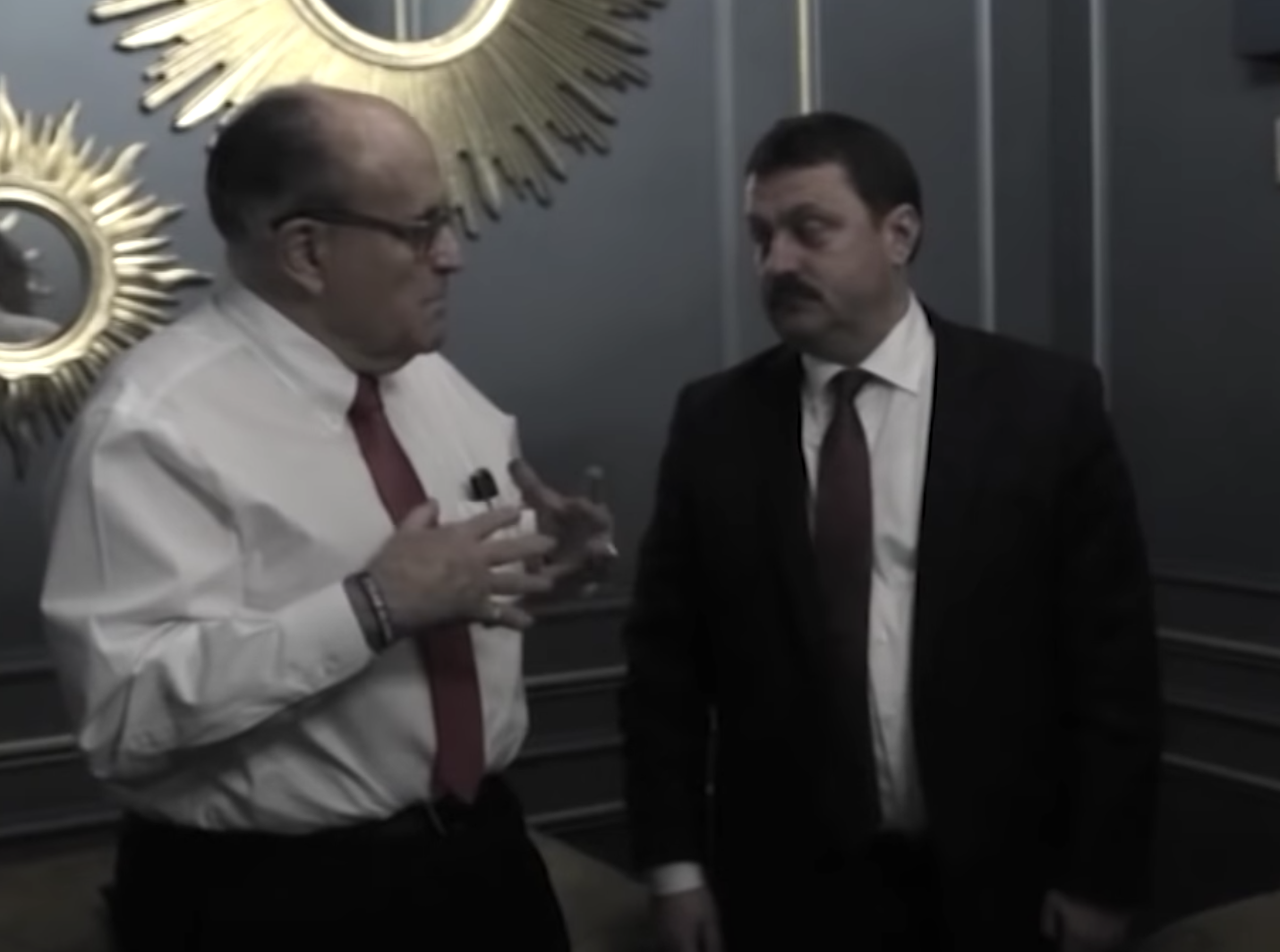
  • Days later, Barr set up a rickety effort to ingest the dirt Rudy Giuliani had obtained, including from known Russian agent Andrii Derkach and possibly from Burisma itself, without being forced to prosecute Rudy for soliciting dirt from known Russian agents. One of several details we’ve learned since NYT’s superb past reporting on this effort (besides that Scott Brady’s testimony completely conflicts with that past NYT report), is that Brady mined information from the newly closed Zlochevsky investigation to obtain an FD-1023 recording Zlochevksy making new claims about Joe Biden around the same time in 2019 as Barr shut down the investigation into Zlochevsky, claims that were utterly inconsistent with what he had said months earlier.
  • Hunter Biden’s lawyer claims, backed by newly disclosed communications, that Tony Bobulinski falsely told the FBI on October 23, 2020 that he had personally attended a February 2017 meeting at which he saw CEFC’s Chair hand Hunter Biden an enormous diamond. That meeting with the FBI took place one day after attending the October 22, 2020 debate with Donald Trump. Weeks later, according to Cassidy Hutchinson, Bobulinski and Mark Meadows had a covert meeting at a campaign stop; she claims she saw Trump’s chief of staff hand Bobulinski, “what appeared to be a folded sheet of paper or a small envelope.”
  • Separately, Hunter Biden partner Rob Walker described the concerns he and Hunter had about Bobulinski’s business ties to Russians, possibly including Viktor Vekselberg.
  • In addition to the informant report on Zlochevsky’s changed claims about Biden, there were three other dodgy informant reports shared with the Hunter Biden team: from two Ukrainians that seem tied to the Rudy effort, from Gal Luft at meetings where — he has since been accused — he lied about his ties to CEFC, and from Bannon associate Peter Schweizer (the latter of which this important NYT story on Tim Thibault did address).
  • Throughout this period, the IRS supervisor on the investigation documented repeated examples of improper influence on the investigation. In a recent subpoena request, Hunter’s attorney noted that Trump’s improper effort to influence the investigation continues to this day.

In short, basic reporting on Republican efforts to impeach Biden show that it, along with key parts (though not necessarily all) of the investigation into Hunter Biden, are simply a continuation of an effort Trump started in 2018 to frame Joe Biden. That is an effort that involved people that both the US and Ukraine have labeled as Russian spies.

Aside from some key articles (linked above), NYT has covered none of this.

Instead, NYT claims the exact opposite. It claims that the effort to gin up a criminal investigation into Joe Biden didn’t succeed.

And neither effort for which he was impeached succeeded. Mr. Trump tried to coerce Ukraine into opening a criminal investigation into Mr. Biden by withholding military aid, but it did not cooperate.

It’s right there, the full-time pursuit of three different House committees, ongoing, with an FD-1023 about Zlochevsky’s changed claims about Biden and Bobulinksi’s FBI report that seems to have close ties to Trump (in which Bobulinski was represented by a known Maggie Haberman source).

NYT tells you the first term wasn’t that bad, because Trump’s efforts failed. Yet what failed was NYT’s reporting on ongoing events.

NYT tells this fairy tale even as they continue to whitewash Bill Barr’s efforts. In a recent 4,000-word story, in which they claimed that the commutation of Jonathan Braun’s sentence “stood out” more than the pre-trial pardon of Steve Bannon issued the same day, NYT gives Barr two paragraphs to claim he tried to clean up pardons.

William P. Barr, a Trump attorney general who had left by the time of the Braun commutation, said when he took over the Justice Department he discovered that “there were pardons being given without any vetting by the department.”

Mr. Barr added that he told Trump aides they should at least send over names of those being considered so the department could thoroughly examine their records. While the White House Counsel’s Office tried to do so, the effort fell apart under the crush of pardon requests that poured in during the final weeks before Mr. Trump left office, according to people with direct knowledge of the process.

It is true that of the eight pardons given before he arrived, there were some doozies, including Joe Arpaio, Dinesh D’Souza, Scooter Libby, and the ranchers whose arson cases sparked the Malheur occupation.

But Barr was utterly complicit in the most abusive pardons Trump gave. Less than two months after he was confirmed based off repeated assurances that giving a pardon in exchange for false testimony was obstruction, Bill Barr wrote a memo declining to prosecute a crime in process, the effort to use pardons to ensure that Paul Manafort, Roger Stone, Mike Flynn, and others continued to lie to cover up Trump’s ties to Russia in the 2016 campaign. The Barr memo did not once mention pardons, even though that was a key thrust of the second volume of the Mueller Report (something Charlie Savage has also noted).

Of course, NYT joins Barr in that complicity. This story finally mentions one of those pardons in its discussion of Trump’s abuse.

His lawyers floated a pardon at his campaign chairman, whom Mr. Trump praised for not “flipping” as prosecutors tried unsuccessfully to get him to cooperate as a witness in the Russia inquiry; Mr. Trump later did pardon him.

But it does not mention that Manafort specifically lied about why he briefed Konstantin Kilimnik campaign information, an act that the Intelligence Community later stated as fact resulted in the sharing of campaign information with Russian intelligence. This is a topic about which NYT has a still uncorrected story, hiding the tie to Oleg Deripaska.

It’s not that Trump pardoned Manafort for “not flipping.” It’s that he pardoned Manafort after he lied about why the campaign manager shared information that Russian spies could use in their attack on US democracy.

And the very link NYT relies on here mentions the Stone pardon, a commutation and then pardon that halted a still ongoing CFAA conspiracy investigation between Trump’s rat-fucker and the Russians (another detail NYT has never reported).

Yes, I absolutely agree. A second Trump term would be worse.

But repeating that, over and over, even while misinforming readers about the ongoing five year effort to frame Joe Biden is not the best way to prevent a second term.

Share this entry

When John Eastman Acknowledged that Candidate Trump Spoke in His Personal Capacity

In Sri Srinivasan’s opinion in Blassingame holding that presidents, when speaking as candidates, are not immune from civil suit, he pointed to a key moment in the 2020 transition period to illustrate the distinction he was making between when a president running for re-election speaks as an office-seeker, rather than an office-holder: When Trump intervened in the Texas v. Pennsylvania lawsuit.

As an example, consider a situation directly germane to the cases before us in which President Trump publicly volunteered that he was acting—and speaking—in an unofficial, private capacity. In the period after the 2020 election and before January 6, the Supreme Court considered an effort by Texas to challenge the administration of the election in several battleground states in which then-President-elect Biden had been declared the winner. Texas v. Pennsylvania, No. 22O155 (U.S. 2020). President Trump moved to intervene in the case. In doing so, he specifically explained to the Supreme Court (and captioned his filing accordingly) that he sought to “intervene in this matter in his personal capacity as a candidate for re-election to the office of President of the United States.” Motion of Donald J. Trump, President of the United States, to Intervene in his Personal Capacity as Candidate for ReElection, Proposed Bill of Complaint in Intervention, and Brief in Support of Motion to Intervene 14, Texas v. Pennsylvania, No. 22O155 (U.S. Dec. 9, 2020) (Trump Mot. to Intervene). He relatedly elaborated that he wished “to intervene to protect his unique and substantial personal interests as a candidate for re-election to the Office of President.” Id. at 24.

President Trump, then, affirmatively communicated to the Supreme Court (and the public) that he was acting and speaking in that matter in his “personal capacity” as a candidate for reelection—indeed, he explained that his reason for wanting to participate in the case was a “substantial personal” one rather than an official one. That stands in sharp contrast with other cases in which he—like all Presidents—had filed briefs in the Supreme Court in his “official capacity as President of the United States.” See, e.g., Brief for the Petitioners at II, Trump v. Hawaii, 138 S. Ct. 2392 (No. 17-965). But while President Trump’s effort to participate in Texas v. Pennsylvania was made in an expressly and self-consciously personal, unofficial capacity, the content of his speech in his submission undoubtedly involved a matter of significant public concern: his challenge to the election results in various pivotal states, whose “electors [would] determine the outcome of the election.” Trump Mot. to Intervene 27.

As that example illustrates, an immunity for all presidential speech on matters of public concern—without regard to the context in which the President speaks—would be grounded purely in “the identity of the actor who performed it” rather than “the nature of the function performed.” Clinton, 520 U.S. at 695 (quoting Forrester, 484 U.S. at 229). Such a result is “unsupported by precedent.” Id. And it is unsupported by the basic object of granting a President official-act immunity: assuring that the President is not “unduly cautious in the discharge of his official duties.” Id. at 694 (emphasis added) (quoting Nixon, 457 U.S. at 752 n.32). That concern necessarily has no salience when the President acts—by his own admission—in an unofficial, private capacity.

b.

As President Trump’s intervention motion in Texas v. Pennsylvania highlights, whether the President speaks (or engages in conduct) on a matter of public concern bears no necessary correlation with whether he speaks (or engages in conduct) in his official or personal capacity. And because it is the latter question that governs the availability of presidential immunity—as a matter both of precedent and of the essential nature of an immunity for (and only for) official acts—we must reject President Trump’s proposed public-concern test as illsuited to the inquiry. [my emphasis; links added]

Remember that time, weeks before the actions alleged in these lawsuits, Srinivasan might have been nudging the six Republican appointees to the Supreme Court, where even Donald Trump admitted that sometimes when the president speaks, he speaks only in his personal capacity?

It was more than that, though, and in ways that might be significant to both the civil cases and Jack Smith’s case.

This was not just Donald Trump acknowledging that, at that moment in December 2020 when he asked the Supreme Court to make him the winner of the 2020 election, he was speaking in his personal capacity. It was John Eastman, Counsel of Record on that motion, who described Trump as such. Eastman filed that motion to intervene, representing Trump in his personal capacity, in a period when he was discussing with Clarence Thomas’ spouse about lawsuits to challenge the results of the election (though she told the January 6 Committee she had no involvement “at all” in Texas v. Pennsylvania). Even Republican members of Congress got into the act, starting with now-Speaker Mike Johnson and including Jim Jordan and Scott Perry.

When Ken Paxton asked the Supreme Court to throw out the votes of four swing states, a bunch of people who would go on to play key roles in the attack on Congress were party to an action in which Co-Conspirator 2 described that Defendant Trump spoke in his personal capacity.

In days ahead, we’ll learn more about how the DC Circuit civil decision being sent back to Amit Mehta will intersect with Tanya Chutkan’s criminal decision that former president Donald Trump is entitled to no immunity as former president. These two decisions may literally and figuratively pass each other in the halls of Prettyman Courthouse, as one decision heads back to the older District chambers and another heads up to the fancier Circuit chambers.

Srinivasan’s opinion is limited, inviting very specific fact-finding.

As I described, in a passage citing the Blassingame decision released just hours earlier, Chutkan very pointedly stopped short of that specificity. She declined to weigh in on whether a former president’s immunity from criminal prosecution would be different if he was acting “within the outer perimeter of the President’s official” duties than if he was engaged in official acts, effectively inviting Srinivasan and his colleagues to do that.

Similarly, the court expresses no opinion on the additional constitutional questions attendant to Defendant’s assertion that former Presidents retain absolute criminal immunity for acts “within the outer perimeter of the President’s official” responsibility. Immunity Motion at 21 (formatting modified). Even if the court were to accept that assertion, it could not grant Defendant immunity here without resolving several separate and disputed constitutional questions of first impression, including: whether the President’s duty to “take Care that the Laws be faithfully executed” includes within its “outer perimeter” at least five different forms of indicted conduct;5 whether inquiring into the President’s purpose for undertaking each form of that allegedly criminal conduct is constitutionally permissible in an immunity analysis, and whether any Presidential conduct “intertwined” with otherwise constitutionally immune actions also receives criminal immunity. See id. at 21–45. Because it concludes that former Presidents do not possess absolute federal criminal immunity for any acts committed while in office, however, the court need not reach those additional constitutional issues, and it expresses no opinion on them.

5 As another court in this district observed in a decision regarding Defendant’s civil immunity, “[t]his is not an easy issue. It is one that implicates fundamental norms of separation of powers and calls on the court to assess the limits of a President’s functions. And, historical examples to serve as guideposts are few.” Thompson v. Trump, 590 F. Supp. 3d 46, 74 (D.D.C. 2022); see id. at 81–84 (performing that constitutional analysis). The D.C. Circuit recently affirmed that district court’s decision with an extensive analysis of just one form of conduct—“speech on matters of public concern.” Blassingame v. Trump, Nos. 22-5069, 22-7030, 22-7031, slip op. at 23–42 (D.C. Cir. Dec. 1, 2023).

Chutkan’s decision might well be sufficient. There are plenty of things a president might do, claiming to do so in his official capacity, which would also break the law; DOJ raised five pretty familiar looking examples in their response to Trump’s bid for absolute immunity.

DOJ points to the possibility that a President might trade a pardon — a thing of value — as part of a quid pro quo to obtain false testimony or prevent true testimony.

[snip]

  • A President ordering the National Guard to murder his critics
  • A President ordering an FBI agent to plant evidence on his political enemy
  • A bribe paid in exchange for a family member getting a lucrative contract
  • A President selling nuclear secrets to America’s adversaries

It would be nice if first DC Circuit and then SCOTUS could put this matter to bed, so it stops holding up Trump cases.

But judges like to move cautiously, testing the easy cases before they test the harder ones. With the Srinivasan decision in hand, the DC Circuit might treat the criminal appeal differently than they otherwise might.

For example, they might note, as DOJ did in its response, that five of six Trump described co-conspirators are also private citizens: Trump’s personal attorney Rudy Giuliani, Eastman representing Trump in his personal role, Sidney Powell, whom Trump recent said would be conflicted from representing him personally), Ken Chesebro who also claimed to be representing Trump personally, and Boris Epshteyn, who nominally remained an employee of the campaign.

If invited to do further briefing in light of Srinivasan’s opinion, DOJ might note that after SCOTUS denied Texas v. Pennsylvania cert, Trump’s campaign lawyers gave up the fight, as the January 6 Committee Report describes, ceding the fight to Rudy and the other co-conspirators.

Not everyone on the campaign was eager to pursue the fake elector plan. OnDecember 11th, the U.S. Supreme Court rejected a high-profile lawsuit filedby the State of Texas challenging the election results in Pennsylvania, Georgia, Michigan, and Wisconsin.42 After that decision, the Trump Campaign’s senior legal staffers said that they reduced their involvement in thefake elector effort, apparently because there was no longer a feasible scenario in which a court would determine that President Trump actually won any of the States he contested.43 Justin Clark, who oversaw the Trump Campaign’s general counsel’s office, said that he basically conveyed, “I’mout,” and encouraged his colleagues on the legal team to do the same.44 Findlay told the Select Committee that “we backed out of this thing,” and Morgan, his boss, said he had Findlay pass off responsibility for the electorsas “my way of taking that responsibility to zero.”45

Clark told the Select Committee that “it never sat right with me that there was no . . . contingency whereby these votes would count.”46 “I hadreal problems with the process,” Clark said, because “it morphed into something I didn’t agree with.”47 In his view, the fake electors were “not necessarily duly nominated electors” despite being presented as such.48 Hesaid he believed he warned his colleagues that “unless we have litigationpending like in these States, like I don’t think this is appropriate or, you know, this isn’t the right thing to do.”49

DOJ might also note that, as charged in the indictment, the suit played a specific role in the Georgia allegations, when Chris Carr refused Trump’s request that he join in Texas’ lawsuit, because none of Trump’s claims had merit.

And it’s not just Trump’s personal lawyer co-conspirators. The invocation of Texas v. Pennsylvania even weighs heavily on the role Jeffrey Clark, then serving as Acting Assistant Attorney General at DOJ and so in a far better position to claim to be acting in an official role, played in the alleged conspiracy.

That’s because Trump’s bid to replace Jeffrey Rosen with Clark was directly tied to an effort to get DOJ to file a similar lawsuit. Here’s how Jeffrey Rosen described it to the January 6 Committee.

Q Okay. And want to talk to you also about the December 27th call where | believe you conferenced in Mr. Donoghue. ~ And that involved the President as well. In Mr. Donoghue’s notes, he references John Eastman and Mark Martin and has a note that says: P trusts him.

What do you remember about that aspect of the conversation?

A So I think that day someone had sent over to us a draft Supreme Court brief modeled on the Texas v. Pennsylvania case that the Supreme Court had rejected. And I was I think Rich Donoghue and Steve Engel and I had a meeting that we were there for t0 address an oversight set of issues that had produced some controversy that Members of Congress who – I won’t get nto all that, other than that Mr. Meadows had asserted to me that the thing had – that he and AG Barr had resolved it. But now AG Barr was gone, and it wasn’t resolved, and he wanted to talk to me about getting it resolved.

But at that discussion Mr. Meadows raised with us: ~ Did you guys see the Supreme Courtbrief that was sent over?

And I think we said: Haven’t read it carefully, but it doesn’t look viable.

And he responded in some sense — and, again, I’m paraphrasing, because I don’t I’m repeating the substance rather than the words was: Well, Mark Martin and John Eastman, who are, you know, these great legal scholars, think it’s great idea.

And we said: Well, you know, we’ll get back to you. But preliminary take is it has problems, that it doesn’t look like a good idea to us. But we’ve only had it 2 hours or something like that, you know, whatever the timeframe was, which it was relatively brief.

Trump followed up twice, pushing DOJ to sue as the government.

What I remember better was that, on Wednesday, after the Kurt Olsen incident, I spoke to the President. I think that was just me, or Rich may have been in my office, but I don’t think it was on the speakerphone. Some of these were on speakerphone with me and Rich, and some, it was just me, but Rich could’ve been in my office.

And the way I remember it is, on Wednesday, I wound up telling the President, “This doesn’t work. ~ There’s multiple problems with it. And the Department of Justice is not going to be able todo it” And–

In the same exchange, there was discussion of whether a DOJ attorney, like Jeffrey Clark, could represent the president in his personal capacity.

Q Okay. So is it fair then to say that this was not partof the Department’s official businessatthe time?

A Yes

Q And, to your knowledge, can Jeff Clark as the assistant — Acting Assistant Attorney General for the Civil Division, can he represent the President in a personal capacity while also maintaining his role at the Department of Justice?

A Let me just make sure I understand the question. You’re saying, can he outside of his DOJ role represent the President in a personal capacity? And I’m trying what I’m trying to distinguish is sometimes the President or others get sued in their individual capacity. But they have some form of governmental immunity or the like. And so the government can represent them as individuals. That’s not what you’re getting at. You’re talking about, can a – can someone who’s a government employee, You know, have like a side gig representing a private person?

But then, after Jeffrey Rosen refused to make DOJ Trump’s own personal law firm, Trump took steps to make Jeffrey Clark, who was willing to do that, Acting Attorney General.

This application may even have critical import to the application of 18 USC 1512(c)(2) and (k) to Trump’s actions. Weeks before Trump and Eastman allegedly conspired to obstruct the vote certification on January 6, Eastman described that Trump had “unique and substantial personal interests” in throwing out the votes of four states that voted for Joe Biden. That’s the kind of admission from co-conspirator 2 that would make any analysis of Trump’s corrupt purpose in obstructing the vote certification quite easy.

Srinivasan’s use of Trump’s motion to intervene was, at one level, a very convenient use of Trump’s own legal claims — made before a conservative Supreme Court that will eventually answer both of these questions — against him.

But it maps onto the criminal case, too, in ways that DC Circuit might choose to apply as a way to tiptoe their way into sanctioning the first prosecution of an ex-president for actions he took as an office-seeker, rather than an office-holder.

Update: Ben Wittes and Quinta Jurecic similarly discuss how these two rulings work in tandem.

Share this entry

Advent Week 1: Got Yer Stollen Election Right Here, Bub

[NB: check the byline, thanks. /~Rayne]

We’re already deep into the holiday season, barreling toward the winter solstice and the darkest part of the night for the northern hemisphere.

Some of us observed Diwali, the five-day Hindu festival of lights which began on November 12.

Some of us observed Thanksgiving a week ago this past Thursday – and before that, in Canada on Monday, October 9.

Ahead of us lies Hanukkah beginning this coming Thursday, December 7, the last candle to be lighted on December 15.

Christmas falls on Monday, December 25 with the winter solstice before it on December 21.

Boxing Day on the 26th coincides with the beginning of Kwanzaa, the end of which coincides with New Year’s Day – seven days, seven candles marking the principles of Kwanzaa in between.

Busy, busy, busy between now and the end of the year setting things alight to stave off the darkness.

This year’s Christian observation of Advent – the four Sundays marking the time until Christmas – will be very short since Christmas is observed the Monday immediately following the last Sunday of Advent. As a child my Catholic family observed Advent with calendars marking down the days and a candle-decked wreath lit each night at dinner as one of us kids would recite an Advent prayer.

A short advent like this meant my youngest sibling would get the full benefit of the shortest week. They’d only have to recite their prayer once whereas the other three siblings would have to do the entire week at dinner each night, lighting a respective number of candles on the wreath counting down the weeks.

I disliked being first as the oldest child because it meant the first candle lit would be the shortest by Christmas. If only life was as simple as that, if my only annoyance was a stubby guttering candle.

If I’d known more then about all the holidays during which candles and lamps were lighted, I would have committed to bonfires from the end of October to New Year’s Day.

~ ~ ~

Speaking of burnt offerings, I’m going to turn up the heat.

I’m sick and tired, utterly fed up with that orange-tinted fiberglass-haired scofflaw’s continued Big Lie about the 2020 election.

It’s been more than three years since Donald Trump lost the popular vote and weeks shy of three years since he and his conspirators whipped up an insurrection to obstruct the House’s electoral vote count.

And yet he just won’t stop cramming his Big Lie in every too-willing journalistic orifice he can reach. As recently as this past Tuesday by way of his feckless lawyers on a fishing expedition he demanded materials from active criminal investigations to support his Big Lie.

Less than three weeks ago Trump’s Big Lie bullshit was amplified by that hack House Speaker Mike Johnson who tossed his Christian beliefs aside to kneel and kiss the ring of his GOP grift master:

Asked about Trump’s efforts to challenge his loss in 2020 — including recent reporting in which his former allies said Trump planned to refuse to leave his office — Johnson was unwavering.

“It can’t be about personalities, it’s got to be about policies and principles,” Johnson said, arguing that Trump’s were superior to Biden’s.

Asked again about Trump’s frequent, false claims that the election was stolen through widespread fraud, Johnson said, “I take him at his word, I do believe that he believes that.”

Pressed on Trump’s well-documented airing of lies and misleading statements, Johnson said, “There are a lot of people in Washington who say things that are not accurate all the time.”

But he maintained that Trump’s views about the 2020 election results are “deep in his heart.”

“He just felt like he was cheated in that election,” Johnson said, “and I think that’s a core conviction of his.”

That’s not how this works. That’s not how any of this works in a democracy. Johnson is wholly unqualified to represent his constituents because he thinks the outcome of voting is voided by a single man’s “policies and principles” – which in Trump’s case are jokes because he has no principles or policies except propping up his ego and assets.

If it’s the season to bring light to darkness and make the season bright, let’s torch his Big Lie.

~ ~ ~

To that end we’re going to have a stollen election this Advent season – a start on Festivus for the Rest of Us who reject the Big Lie and enjoy baked goods.

Your challenge should you choose to accept it:

– Find a baked holiday bread or cake which must include dried or candied fruit in the dough/batter. By find I mean locate a recipe;

– Share the recipe you want to see made, or are going to make in this month’s Advent posts;

– Find a baked holiday bread or cake containing dried or candied fruit which you have bought in the past or are going to buy this year to enjoy at home or share as a gift with friends;

– Share details about the source or the baker from whom you’ve purchased this baked treat;

– Tell us about any background behind this baked good whether you’ve made it, are going to make it, are going to buy it, have bought it in the past.

Links to photos and recipes are greatly appreciated though you should note that links may take time to clear moderation.

The last weekend of Advent we’ll revisit these panettone, babka, fruit cake, panetón, christopsomo, pan de natale – whatever your cultural heritage calls it – we’ll vote on one which sounds the most delicious and appealing.

Let’s light a candle and let the stollen election begin!

~ ~ ~

This is an open thread.

Share this entry

James Comer’s War on Christmas: The Burial Ground of a Dick Pic Impeachment

Republicans have rolled out a shiny timeline in support of their impeachment stunt.

It is riddled with unsubstantiated and at times, false claims. As one example, it states as fact that a $40,000 loan repayment James Biden made in 2017 — when Joe Biden was a private citizen — was money laundered from China.

It juxtaposes a misleading (but potentially caveated) answer at the October, 22 2020 debate from Biden with Tony Bobulinski’s interview with the FBI the next day, but doesn’t mention that Trump hosted Bobulinski at that debate and then, according to Cassidy Hutchinson’s book, Mark Meadows handed him something at a covert meeting weeks later.

It doesn’t, however, mention Tony Bobulinski in its report about a meeting between Hunter and CEFC Chairman Ye Jianming on February 16, 2017 (the date of the meeting may not even be correct).

In the testimony Bobulinski gave to the FBI between attending the debate with Trump and having a covert meeting with Mark Meadows, he claimed to have attended that February 2017 meeting and seen Hunter receive a diamond.

BOBULINSKI first met in person with members of the BIDEN family at a 2017 meeting in Miami, Florida. BOBULINSKI, GILLIAR, WALKER, HUNTER BIDEN, and YE all attended the meeting. Also in attendance was Director JIAN ZANG (“ZANG”), a CEFC Director involved in forming new businesses and capitalizing them at the request of CEFC. At the meeting, BOBULINSKI witnessed a large diamond gemstone given as a gift to HUNTER BIDEN by YE.

Perhaps the silence about Bobulinski arises from the fact that Hunter Biden has claimed Bobulinski not only wasn’t at the meeting, but didn’t yet know of James Gilliar’s business ties to him. Rob Walker, who was at the meeting testified, twice, that he didn’t see a diamond pass hands at the meeting.

Walker has read about RHB receiving a diamond from people with CEFC, but he never saw the diamond.

And James Biden testified that an associate of Ye gave Hunter a diamond at his office (not the meeting) — but it ended up being worthless.

James B did recall RHB receiving a diamond from the Chinese but that they found out it was not valuable. RHB said that he received the diamond from an associate of the Chairman at his office [redacted] James B stated that the Chinese always gave something as a welcome gift. RHB was originally told that the diamond was worth $10,000, but James B took it to a friend of his and found out that it was worthless. James B is only aware of one diamond and was not aware of a larger diamond.

All this changes Biden’s statement at the debate significantly; Trump was working off a Bobulinski claim that isn’t backed by the available records.

And then weeks later (again, according to Hutchinson’s book), Trump’s Chief of Staff handed Bobulinski something that might be an envelope.

Much of the timeline focuses on Burisma owner Mykola Zlochevsky’s years-long effort to kill legal investigations into his corruption.

Unsurprisingly, the Republican timeline makes no mention of the investigation that — per Chuck Grassley — DOJ opened into the owner of Burisma in January 2016.

Likewise, James Comer forgot to mention that — again, per Chuck Grassley — Donald Trump’s DOJ shut down that investigation into Zlochevksy in December 2019, even while justifying his Perfect Phone Call with Volodymyr Zelenskyy with a claim to be concerned about corruption at Burisma.

Comer’s timeline definitely doesn’t mention that (per Chuck GrassleyBill Barr’s DOJ shut down an investigation into Zlochevsky when it discusses that Zlochevsky was offering bribes to shut down investigations.

Maybe in addition to impeaching Trump for whatever he handed Bobulinski to make claims about big diamonds he couldn’t see, James Comer should open an impeachment investigation into why Bill Barr’s DOJ shut down that Zlochevsky investigation — and whether there’s a tie between the closure of the investigation and Zlochevksy’s new claims about Biden?

Wow. James Comer’s case for impeaching Donald Trump just keeps getting stronger and stronger!

Admittedly, Comer does take a break from substantiating an impeachment case against Trump by providing scandalous details about Biden … inviting his son to a party.

A party!! Joe Biden invited his son to a Christmas party!?!?!

This is truly scandalous stuff, particularly when contrasted to Bill Barr’s noble efforts to shut down an investigation into Zlochevsky at the same time that Trump was claiming publicly to support an investigation into Zlochevksy and Zlochevksy was, apparently, offering billions to those who shut down such investigations.

A Christmas party!

How dare a good Catholic like Joe Biden invite his own family member — his son!! — to a party at his residence? Surely the 18 Republicans from districts Biden won will be happy to explain their vote to impeach because they’ve decided to declare War on Christmas?

This impeachment gets better every day.

There’s one more utterly ridiculous detail I’m rather obsessed about. In addition to proposing to impeach Joe Biden because he invited his kid to a party, James Comer thinks it’s scandalous that Vadym Pozharskyi sent Hunter notice that his father was traveling to Ukraine.

Wow. Scandal. Pozharskyi knew and shared details about when Biden was traveling to Ukraine.

But I’m interested for a different reason. You see, this claim is almost certainly sourced to the copy of the “laptop” that House Republicans won’t explain — at least not on the record — how they obtained. In addition to the email from 2016 that was resent on September 1, 2020 when the hard drive was in Rudy Giuliani’s possession, this email is one with which I’m obsessed.

Here’s how it appears at BidenLaptopEmails dot com.

The President of the US-Ukraine Business Council got the alert from the White House, he sent it to Burisma, and Pozharskyi sent it — at least by all appearances — to just Devon Archer and Hunter.

As I circled, whoever’s email box this appeared in recognized Pozharskyi’s email not as “Burisma,” but instead as “Burials.” The email also had an identity for Hunter associated; most other emails that he received don’t identify himself.

There’s just one other email in the public set like this — an important one.

It was a thread sent over one week — from November 11 ET through 18, 2015. On it, Pozharskyi, Eric Schwerin, Archer, and Hunter discuss bringing in Blue Star Strategies — they’re the ones who tried to fix Zlochevsky’s legal troubles, with some initial but ultimately short-lived success.

This effort, outsourced as it was, was undoubtedly one of the sleaziest things Hunter was involved in. But the GOP didn’t include this email in their timeline (probably because it makes clear that Hunter did a pretty good job of firewalling off the legal influence peddling).

Anyway, from this email, it appears that it is Schwerin’s email account that, for a few days only, recognized Burisma as “Burials.” Only, he’s not listed as being on the other one.

I really have only suspicions about what explains this anomaly. I care about it, for two reasons. First, because the anomaly, especially on one of about ten or so that really get into Burisma’s efforts to suck Hunter and Archer into this corruption, does raise questions about the provenance of the set of emails loaded up on a laptop attributed to Hunter Biden.

Also because, according to a spreadsheet Joseph Ziegler was generous enough to share with the world, this is among the not quite 10% of emails that the IRS used in its own influence peddling investigation that they sourced to the laptop when it should have been included in returns from warrants obtained from Google on both Hunter and Schwerin’s Rosemont Seneca emails.

There’s a lot in Comer’s timeline that makes a great case for impeachment — of Donald Trump.

There’s a lot in his timeline that shows he continues to rely on fraudsters to make his case.

There’s a lot that tries to criminalize … Christmas!

And then there’s this, an email probably obtained from the famous “laptop,” one that raises some real questions about what got packaged up on a laptop attributed to Hunter Biden.

Share this entry

Judge Tanya Chutkan Had to Tell Trump That, “There is no ‘Presidential Immunity’ Clause”

Less than twelve hours after the DC Circuit ruled that an office-seeker does not enjoy presidential immunity from civil suit, Judge Tanya Chutkan issued her order ruling that Trump does not enjoy presidential immunity for crimes committed while president.

Her opinion can be summed up in one line.

[T]he United States has only one Chief Executive at a time, and that position does not confer a lifelong “get-out-of-jail-free” pass.

The timing of Chutkan’s decision is almost certainly not accidental. The key issue in this opinion, absolute immunity, has been fully briefed (as Trump noted on November 1 when he asked to stay all other proceedings until this was resolved) since October 26.

Chutkan said she was ruling now because the Supreme Court requires immunity to be resolved as early as possible.

Defendant has also moved to dismiss based on statutory grounds, ECF No. 114, and for selective and vindictive prosecution, ECF No. 116. The court will address those motions separately. The Supreme Court has “repeatedly . . . stressed the importance of resolving immunity questions at the earliest possible stage in litigation.” Hunter v. Bryant, 502 U.S. 224, 227 (1991) (citations omitted). The court therefore rules first on the Immunity Motion and the Constitutional Motion—in which Defendant asserts “constitutional immunity from double jeopardy,” United States v. Scott, 464 F.2d 832, 833 (D.C. Cir. 1972).

She did not source that cite to Trump’s request for a stay, nor did she say she was also ruling on Trump’s motion to dismiss on Constitutional grounds, which includes a Double Jeopardy claim, because Molly Gaston asked her to,

But by ruling as she did (without a hearing), she simply mooted Trump’s request to stay any further proceedings with a minute order.

MINUTE ORDER as to DONALD J. TRUMP: In light of the court’s [172] Order denying Defendant’s [74] Motion to Dismiss Based on Presidential Immunity; Defendant’s [128] Motion to Stay Case Pending Immunity Determination is hereby DENIED as moot.

This puts the onus on Trump to appeal, which he reportedly will (though he has dilly-dallied on some of these motions, so we’ll see how much time he kills in the process).

It seems clear that Chutkan waited for Blassingame, the civil immunity opinion, because she found a way to cite it twice and still release her own opinion on the same day.

But it also seems likely that Judge Chutkan and her clerks simply reviewed that opinion to make sure nothing wildly conflicted with her already completed opinion, because her opinion doesn’t incorporate details of the absolute immunity argument — such as the significance of the fact that five of six co-conspirators described in the indictment (everyone but Jeffrey Clark) is a private citizen, which would be important if the DC Circuit applied any of their civil immunity test to the criminal context.

Indeed, one of Chutkan’s citations to Blassingame effectively admitted she didn’t get into its test — whether Trump was acting in his official role when he did the things alleged in the indictment.

Similarly, the court expresses no opinion on the additional constitutional questions attendant to Defendant’s assertion that former Presidents retain absolute criminal immunity for acts “within the outer perimeter of the President’s official” responsibility. Immunity Motion at 21 (formatting modified). Even if the court were to accept that assertion, it could not grant Defendant immunity here without resolving several separate and disputed constitutional questions of first impression, including: whether the President’s duty to “take Care that the Laws be faithfully executed” includes within its “outer perimeter” at least five different forms of indicted conduct;5 whether inquiring into the President’s purpose for undertaking each form of that allegedly criminal conduct is constitutionally permissible in an immunity analysis, and whether any Presidential conduct “intertwined” with otherwise constitutionally immune actions also receives criminal immunity. See id. at 21–45. Because it concludes that former Presidents do not possess absolute federal criminal immunity for any acts committed while in office, however, the court need not reach those additional constitutional issues, and it expresses no opinion on them.

5 As another court in this district observed in a decision regarding Defendant’s civil immunity, “[t]his is not an easy issue. It is one that implicates fundamental norms of separation of powers and calls on the court to assess the limits of a President’s functions. And, historical examples to serve as guideposts are few.” Thompson v. Trump, 590 F. Supp. 3d 46, 74 (D.D.C. 2022); see id. at 81–84 (performing that constitutional analysis). The D.C. Circuit recently affirmed that district court’s decision with an extensive analysis of just one form of conduct—“speech on matters of public concern.” Blassingame v. Trump, Nos. 22-5069, 22-7030, 22-7031, slip op. at 23–42 (D.C. Cir. Dec. 1, 2023).

Instead, Chutkan argued — in language that likely preceded the Blassingame opinion, in a section on whether holding a former President criminally accountable will pose some of the harms to the presidency and government that suing a current or former President might — that no matter what the analysis is for civil immunity, criminal immunity is different.

The rationale for immunizing a President’s controversial decisions from civil liability does not extend to sheltering his criminality.

[snip]

For all these reasons, the constitutional consequences of federal criminal liability differ sharply from those of the civil liability at issue in Fitzgerald. Federal criminal liability will not impermissibly chill the decision-making of a dutiful Chief Executive or subject them to endless post-Presidency litigation. It will, however, uphold the vital constitutional values that Fitzgerald identified as warranting the exercise of jurisdiction: maintaining the separation of powers and vindicating “the public interest in an ongoing criminal prosecution.” 457 U.S. at 753–54. Exempting former Presidents from the ordinary operation of the criminal justice system, on the other hand, would undermine the foundation of the rule of law that our first former President described: “Respect for its authority, compliance with its laws, [and] acquiescence in its measures”—“duties enjoined by the fundamental maxims of true liberty.” Washington’s Farewell Address at 13. Consequently, the constitutional structure of our government does not require absolute federal criminal immunity for former Presidents.

The analysis has to be different of course. If you can be impeached for using your office to extort campaign assistance, it should not be the case that you cannot, though, be criminally charged for that extortion.

This is an opinion about whether impeachment provides the sole recourse for holding a former President accountable.

Judge Chutkan provides a very neat solution to that problem, by noting that impeachment is just one of two ways to remove a President who has misused his office.

[T]here is another way, besides impeachment and conviction, for a President to be removed from office and thus subjected to “the ordinary course of law,” Federalist No. 69 at 348: As in Defendant’s case, he may be voted out. The President “shall hold his Office during the Term of four Years.” U.S. Const. art. II, § 1, cl. 1. Without reelection, the expiration of that term ends a Presidency as surely as impeachment and conviction. See United States v. Burr, 25 F. Cas. 30, 34 (C.C.D. Va. 1807) (Marshall, Circuit Justice) (“[T]he president is elected from the mass of the people, and, on the expiration of the time for which he is elected, returns to the mass of the people again.”). Nothing in the Impeachment Judgment Clause prevents criminal prosecution thereafter. [my emphasis]

Because voters saw fit to remove Trump, Chutkan held, he can now be charged criminally.

Chutkan punts the other questions upstairs to the DC Circuit and from there to SCOTUS.

And while I think Chutkan’s analysis of the two impeachment issues — immunity and double jeopardy — is sound, I do worry that her treatment of several other issues — the things Trump included in his motion to dismiss on Constitutional grounds besides double jeopardy — got short shrift as a result.

Those issues have only been briefed since November 22. She and her clerks probably wrote that part of the opinion over Thanksgiving weekend. And far less of her opinion addressed those issues — seven pages for the First Amendment issues and four for matters of fair notice — than addressed the impeachment issue:

Background (what the indictment really charges) 1

Standard 5

Executive Immunity 6

    • Text of Constitution 6
    • Structure (concerns of public policy, addressing Fitzgerald) 14
      • Burdens on the Presidency 15-20
      • Public Interest 20-25
    • History 25-29
    • Summary 29-31

First Amendment 31

    • Core political speech of public concern 33
    • Statements advocating govt to act 35
    • Statements on 2020 Election 37

Double Jeopardy 38

Due Process 44 (4 pages)

Importantly, while she noted at the outset of her opinion (in the five page “background” section) that Trump totally misrepresented the indictment against him, she didn’t lay out how, in addition to speech-related actions charged as conspiracies, there are some actions that are more obviously fraud, such as the effort to counterfeit elector certificates or the knowingly false representations about Mike Pence’s intent. Trump’s misrepresentation of the indictment is really egregious, but Chutkan barely explains why that’s a problem in this opinion.

Both the First Amendment issues and the notice issues (particularly on 18 USC 1512, though there’s readily available language on 18 USC 241 charge in the Douglass Mackey case) have been addressed repeatedly in other January 6 cases. Since those cases will be appealed on a more leisurely pace than this one, I worry that the issues are not fully addressed. And those are the issues about which Clarence Thomas and Sammy Alito were most likely to intervene in any case.

This is an opinion about holding a former President accountable before he becomes President again. The danger is real: On the same day two courts ruled that Trump didn’t have absolute immunity for his conduct while he was President, his Georgia lawyer argued that if he wins in 2024, he can’t be tried on that case until 2029.

But for now, the matter has been sent to the DC Circuit to deal with.

Share this entry

DC Circuit Rules that a President’s Speech as Candidate Is Not Official

The DC Circuit just ruled that three lawsuits against Donald Trump (and others) for actions on January 6 can move forward.

Chief Judge Sri Srinivasan wrote the majority opinion, joined by Greg Katsas and Judith Rogers. He wrote:

When a sitting President acts in his capacity as a candidate for re-election, he acts as office-seeker, not office-holder.

But Katsas — a former Trump White House counsel and a Trump appointee — may have summarized the holding best.

Today, we do not definitively resolve that question. Instead, we hold only that we cannot resolve it on a motion to dismiss. Our conclusion rests on two propositions persuasively established by Chief Judge Srinivasan’s lead opinion. First, in certain limited contexts, courts may reliably conclude that a sitting President is speaking only in a private capacity as a candidate for re-election or as the leader of a political party. These include instances where the President speaks at a party convention, in a presidential debate, in a political advertisement, at a campaign rally, or at a party fundraiser. Second, the operative complaints plausibly allege that the January 6 speech involved this kind of purely private campaign speech. In particular, the complaints allege that the January 6 rally was organized by campaign staff and funded by private donors, and was neither facilitated by White House staff nor paid for with congressionally appropriated funds. Given those allegations, which remain to be tested on summary judgment or at trial, we cannot resolve the immunity question in President Trump’s favor at this stage of the case.

Trump never argued that his actions were official. Instead, he said that when a President speaks on matters of public interest, even as a candidate, he is entitled to immunity.

But all three judges rejected that view.

Srinivasan engaged in an extended discussion of how unfair it would be for a former President running to be elected President again if he were running against the sitting President — that is, the presumed state of the 2024 race. Under Trump’s scheme, Biden would be immune for anything he said as a candidate; Trump would not.

Under President Trump’s proposed public concern test, if the candidate happens to be the sitting President (but not if she is a former President or any other candidate), her speech in the ad would be official—even though it is plainly campaign speech in a campaign ad given in her private capacity as candidate. A sitting President then would be absolutely immune from defamation liability for something she may have said about her opponent in the campaign ad, whereas a former President would face liability for saying the very same thing in the very same ad.

The pro-incumbent imbalance would be especially stark if the former and current Presidents were to run against each other. In that situation, one candidate, the former President, would face civil damages liability for statements on matters of public concern in campaign ads or in an acceptance speech at a party convention. But the competing candidate, the sitting President, would be wholly insulated from damages liability for making the very same statements on the opposing side of the very same race. We see no basis for giving an incumbent President that kind of asymmetrical advantage when running against his predecessor.

This case — and Trump’s criminal case, presumably — will now focus on certain aspects of January 6 to test whether this was a campaign event or an official event. It will pivot on who paid for what and who organized the event.

There’s a big problem with this opinion. A sitting President cannot be prosecuted if he spends official resources for campaign events. Trump’s White House was repeatedly found to have broken the Hatch Act, and the President and Vice President are not covered by it. So a future Donald Trump (and indeed, all Presidents to some degree) will now have an incentive to bill taxpayers for all events so as to enjoy presidential immunity.

But for now, it’ll go back before Judge Mehta for a renewed discussion about whether this was an official presidential event or a campaign event.

Update: Fixed Judith Rogers/Janice Rogers Brown for probably the 100th time in my life.

Share this entry