Walt Nauta Claimed Trump Hoarded Hairspray Cans in His Storage Rooms

The transcript from Walt Nauta’s May 26, 2022 FBI interview, at which he allegedly lied about his knowledge of Trump’s boxes of classified documents, has been released.

Several times, Nauta comes off as a skilled liar. For example, when the FBI asked reiterated that they wanted to know where the boxes that were sent to NARA in January 2022 had been stored and if there were more, Nauta changed the subject to the Embassy in Madrid.

But when the FBI asked Nauta what was in Trump’s storage rooms, he claimed that Trump hoarded hair spray.

He later went on to claim that Trump had so many golf shoes, but the FBI noted those wouldn’t be in bankers boxes.

Ultimately, Nauta came off like a guy who was wildly impressed with his own stature.

It is like, wow. Now how do I transition from a guy who used to scramble eggs to now I’m working for a former President?

It’s not surprising he was unwilling to give that up. I mean, if Trump regains the Presidency it will all have been worth it.

Share this entry

emptywheel Makes CIPA History

Yesterday, Judge Aileen Cannon issued a surly order, acceding to Jack Smith’s request to protect witnesses. In reversing herself, Cannon scolded Smith for not making a more fulsome case to seal information.

Only now, after failing to meaningfully “raise argument[s] or present evidence that could have been raised” in these responses, Wilchombe, 555 F.3d at 957, the Special Counsel moves for reconsideration and argues, in no uncertain terms, that the Court committed “clear error” by applying an unobjected-to legal standard [ECF Nos. 267, 282]

Ultimately, Cannon argued the 11th Circuit precedent on this — but not on other — types of pretrial motions is undecided.

Having done so, the bottom line is this. The Eleventh Circuit has not specifically addressed the instant question: whether, in a criminal proceeding, the First Amendment qualified right of access attaches to discovery materials referenced or attached in support of a publicly filed Rule 12(b) motion to compel discovery under Rule 16. Nevertheless, the most faithful application of Supreme Court and available Eleventh Circuit authority is that Defendants’ MTC in this case is not subject to a public right of access, whether constitutional or common law in nature, because it is a still, ultimately, a discovery motion as distinct from a substantive pre-trial motion requiring judicial resolution on the merits.

Remember: One reason Trump has these materials to attempt to publicly release is because Smith was more generous in discovery than the rules require. Cannon did not permit Smith to seal information that would otherwise be Jencks, aside from information identifying witnesses.

The Court reaches a different conclusion as to the Special Counsel’s broad-based request to seal the substance of all substantive Jencks statements referenced in and/or attached to the MTC [ECF No. 278 p. 2 (arguing for wholesale sealing of potential witnesses’ statements to avoid “influenc[ing] the testimony of other witnesses or the jury pool”)]. By granting this sweeping and undifferentiated request—which the Special Counsel also raises in seal requests associated with Defendants’ substantive pretrial motions [See ECF No. 348 pp. 6–7]—the Court would be authorizing the categorical sealing of large portions of the record attached in support of critical
pretrial defense motions.

Meanwhile, in SDNY, I won (or rather, Judge Jesse Furman used my intervention (and that of Inner City Press) as an excuse to grant disclosure of something even more rare: Redacted transcripts from the CIPA 6 conference in the Josh Schulte case.

[T]he Court concludes that CIPA overrides any common law right of public access to the transcripts of a closed CIPA Section 6 hearing, at least where, as here, the court determines that the classified information may not be disclosed or used at trial. But the Court concludes that the public has a qualified right of public access to such transcripts under the First Amendment. It follows that the transcripts at issue here, redacted to protect national security or to preserve other higher values, must be unsealed.

As Furman noted, he had already disclosed some of this in a conference on jury instructions; he had distinguished those who disseminated already-released classified information if they knew it was classified (and therefore, by re-disseminating it, would confirm that it was classified) from those who did not have means to know.

I gave you two hypotheticals. I think one is where a member of the public goes on WikiLeaks today and downloads Vault 7 and Vault 8 and then provides the hard dive with the download to someone who is not authorized to receive NDI, and I posed the question of whether that person would be guilty of violating the Espionage Act and I think your answer was yes. That strikes me as a very bold, kind of striking proposition because in that instance, if the person is not in a position to know whether it is actual classified information, actual government information, accurate information, etc., simply providing something that’s already public to another person doesn’t strike me as — I mean, strikes me as, number one, would be sort of surprising if that qualified as a criminal act. But, to the extent that the statute could be construed to [] extend to that act one would think that there might be serious constitutional problems with it.

I also posed the hypothetical of the New York Times is publishing something that appears in the leak and somebody sharing that article in the New York Times with someone else. That would be a crime and there, too, I think you said it might well be violation of the law. I think to the extent that that would extend to the New York Times reporter for reporting on what is in the leak, or to the extent that it would extend to someone who is not in position to know or position to confirm, that raises serious constitutional doubts in my mind. That, to me, is distinguishable from somebody who is in a position to know. I think there is a distinction if that person transmits a New York Times article containing classified information and in that transmission does something that confirms that that information is accurate — right — or reliable or government information, then that’s confirmation, it strikes me, as NDI. But it just strikes me as a very bold and kind of striking proposition to say that somebody, who is not in position to know or does not act in a way that would confirm the authenticity or reliability of that information by sharing a New York Times article, could be violating the Espionage Act. That strikes me as a kind of striking proposition.

So all of which is to say I think I have come around to the view that merely sharing something that is already in the public domain probably can’t support a conviction under this provision except that if the sharing of it provides something new, namely, confirmation that it is reliable, confirmation that it is CIA information, confirmation that it is legitimate bona fide national defense information, then that confirmation is, itself, or can, itself, be NDI. I otherwise
think that we are just in a terrain where, literally, there are hundreds of thousands of people unwittingly violating the Espionage Act by sharing the New York Times report about the WikiLeaks leak.

Furman has given the government an opportunity to further redact the transcripts, but ordered them otherwise released on May 3 — meaning they’d be available before the follow-up hearing in the Assange extradition case, on which — because they pertain to the First Amendment — they may have bearing.

I’m not entirely sure this move is as unprecedented as Furman makes out. Some of the CIPA materials in the Scooter Libby case were released.

But particularly because this may affect the Assange extradition and particularly because the CIPA hearings in the Trump case are sure to be contentious, I would not be surprised if the government appeals this decision.

Thanks, again, to National Security Counselors’ Kel McClanahan to agreeing to argue this for me. You can support them here or here.

Update: Here’s my post explaining the High Court order inviting assurances about Assange’s First Amendment protections. DOJ has 6 more days to issue those assurances.


Share this entry

Mr. Smith Goes to SCOTUS

Yesterday, Jack Smith submitted his brief on Trump’s immunity claim to SCOTUS. I’m working on a post on it, but thought I should go ahead and post this stub so people can chat until that’s done.

Share this entry

Bullshit and Also, Aileen Cannon, Post

I know you all probably want a thread where you can talk about Aileen Cannon’s 3-page order denying Trump’s motion to dismiss based on bullshit claims about the Presidential Records Act.

For these reasons, accepting the allegations of the Superseding Indictment as true, the Presidential Records Act does not provide a pre-trial basis to dismiss under Rule 12(b)(3)(B)(v)—either as to Counts 1 through 32 or as to the remaining counts, all of which state cognizable offenses.

Separately, to the extent the Special Counsel demands an anticipatory finalization of jury instructions prior to trial, prior to a charge conference, and prior to the presentation of trial defenses and evidence, the Court declines that demand as unprecedented and unjust [see ECF No. 428]. The Court’s Order soliciting preliminary draft instructions on certain counts should not be misconstrued as declaring a final definition on any essential element or asserted defense in this case. Nor should it be interpreted as anything other than what it was: a genuine attempt, in the context of the upcoming trial, to better understand the parties’ competing positions and the questions to be submitted to the jury in this complex case of first impression [ECF No. 407]. As always, any party remains free to avail itself of whatever appellate options it sees fit to invoke, as permitted by law.

Fine, fine, have at it. She claims Jack Smith is the one making nutty requests, not herself.

Lee Kovarsky, who generally has a great read about the appellate posture of such things, warns that it’s unlikely Smith will ask for a writ of mandamus, but might ask for her recusal, which probably won’t work.

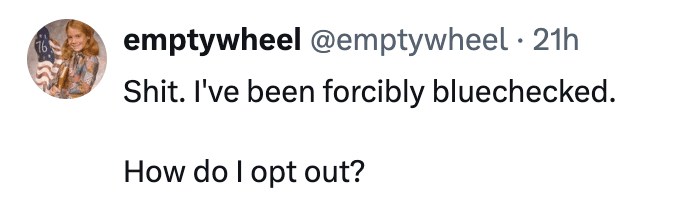
But really, I’m more immediately interested in this superb quote Will Oremus included in a WaPo article describing disgruntled new owners of a Xitter blue check, which may be my best ever quote in a mainstream publication.

Marcy Wheeler, an independent journalist covering national security who greeted her blue verification badge Wednesday by posting an expletive, said she remains on X mostly to monitor right-wing narratives and disinformation so she can push back on them. She said she believes the verification changes are part of an effort to restore X’s status as a “public square” so that Musk can use it to “mainstream far-right ideas.”

On Thursday, Musk amplified various posts from verified X users defending a Jan. 6, 2021, suspect, decrying a rise in the “foreign-born” population under President Biden, highlighting crimes by Syrian migrants, mocking diversity and inclusion programs, and suggesting that leftists want to disarm American citizens “because they intend to do things that American citizens would want to shoot them for.”

In between, he agreed with a post that said that “a blue checkmark is a stamp of authenticity.”

As I said, have at it!

Share this entry

Jack Smith to Aileen Cannon: Treating Non-Lawyer Tom Fitton’s Theories as Law Will Lead to Mandamus

Both Trump and Jack Smith have responded to Aileen Cannon’s whack order to write proposed jury instructions as if the Presidential Records Act says something it doesn’t. Neither are all that happy about it.

Trump used his response to claim that having the jury assess whether Trump really did make these documents personal records rather than simply steal them would put them in the role that, he’s arguing, only a (former) President can be in.

Smith — as many predicted — spent much of the filing arguing that Cannon cannot leave this issue until jury instructions because it must have an opportunity to seek mandamus for such a clear legal error; they cite the 11th Circuit slapdown of Cannon’s last attempt to entertain this fantasy in support.

Along the way, though, Smith also did something I had hoped he would do: explain where, and when, Trump’s own whack theory came from in the first place.

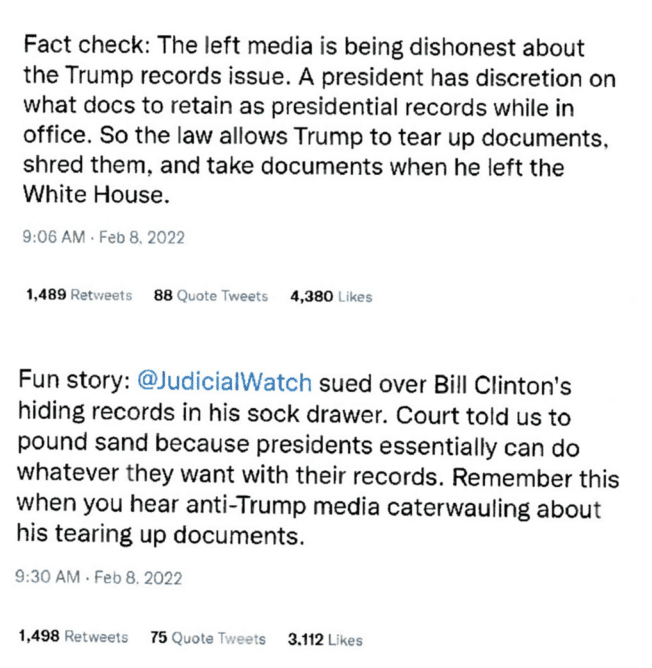
It came from Tom Fitton’s Xitter propaganda in response to the public report, in February 2022, that Trump had returned documents, including classified ones. But even after Fitton first intervened, Trump’s handlers continued to treat any remaining classified documents as presidential records for months.

On February 8, 2022, the day after the Washington Post article was published, the president of Judicial Watch posted the following two statements on Twitter5
:

Immediately after posting the second Tweet, the Judicial Watch president sent to an employee in Trump’s post-presidency office a link to the Tweet and offered to discuss the issue with Trump. A few hours later, the Judicial Watch president sent the same person his analysis of the case Judicial Watch v. NARA, 845 F. Supp. 2d 288 (D.D.C. 2012). That evening, the Judicial Watch president circulated to the employee a proposed public statement for Trump’s consideration, which included language that the PRA and judicial decisions gave Trump the right to keep the documents he returned to NARA. The statement never issued.

Around this same time, the Judicial Watch president, who was not an attorney, told another Trump employee that Trump was being given bad advice, and that the records Trump possessed at Mar-a-Lago should have been characterized as personal. The second employee advised the Judicial Watch president that they disagreed with the Judicial Watch president’s analysis: in Judicial Watch, former President Clinton had made the designation of certain records personal while President, whereas Trump had not done so. The second employee further informed Trump that the Judicial Watch president was wrong and explained why. Nevertheless, on February 10, 2022, Trump released a statement claiming in part, “I have been told I was under no obligation to give the material based on various legal rulings that have been made over the years.”6 Before this time, the second employee had never heard this theory from Trump. No other witness recalled Trump espousing this theory until after the Judicial Watch president conveyed it to him in February 2022.

Smith doesn’t, however, draw out the implication of this explicitly.

Not only has Trump been falsely suggesting — without evidence — that he did designate these documents personal records. He couldn’t have done so, because he didn’t know of this theory until over a year after he stole the documents.

But Cannon is such a chump that she has been chasing a theory spun up by Fitton, someone who has only an English BA.

Cannon may well respond poorly to Smith’s use of 20-some pages to lay all this out. It’s the kind of thing that routinely elicits miffed responses from her.

At this point, though, it seems Smith is simply laying a record for a challenge at the 11th Circuit.

Share this entry

Fridays with Nicole Sandler

Welcome to the Good Friday – Happy Birthday Marcy edition of Fridays with Nicole Sandler.

This weekend will be a bit quiet due to holiday observations and celebrations.

Share this entry

Worse than Segretti: Judge Recommends John Eastman Be Disbarred

Close to the end of Yvette Roland’s recommendation that John Eastman be disbarred, she considered the argument from the Office of Chief Trial Counsel of the State Bar of California (OCTC) that Eastman’s actions were worse than those Donald Segretti committed for Richard Nixon.

For a number of reasons — Eastman’s violations were done in the function of an attorney, Eastman exhibited no remorse, he’s more experienced than Segretti was — she agreed that Eastman’s actions were worse, and on that basis, she recommended a stiffer penalty than the two year suspension Segretti got.

In Segretti, the attorney pleaded guilty to two federal offenses related to his work on
President Richard Nixon’s 1972 reelection campaign, including violating 18 U.S.C. section 612
(publication or distribution of political statements) and 18 U.S.C section 371 (conspiracy).
Among other things, Segretti distributed letters containing false accusations about other
candidates for president in order to create confusion among the candidates. The court found
Segretti’s actions involved moral turpitude as he “repeatedly committed acts of deceit designed to
subvert the free electoral process.” (Id. at p. 887.) Segretti had significant mitigation. He was
only 30 years old at the time of the misconduct and thought he was acting under the umbrella of
the White House. The court emphasized that Segretti’s misconduct “was not committed in his
capacity as an attorney” and that he recognized the wrongfulness of his acts, expressed regret,
and cooperated with the investigating agencies. (Id. at p. 888.) Segretti received a two-year
actual suspension.

The scale and egregiousness of Eastman’s unethical actions far surpasses the misconduct
at issue in Segretti. Unlike Segretti whose offenses occurred outside his role as an attorney,
Eastman’s wrongdoing was committed directly in the course and scope of his representation of
President Trump and the Trump Campaign. This is an important factor, as it constitutes a
fundamental breach of an attorney’s core ethical duties. Additionally, while the Segretti court
found compelling mitigation based on his expressed remorse and recognition of his wrongdoing,
no such mitigating factor is present with Eastman. To the contrary, Eastman has exhibited an
unwillingness to acknowledge any ethical lapses regarding his actions, demonstrating an apparent inability to accept responsibility. This lack of remorse and accountability presents a
significant risk that Eastman may engage in further unethical conduct, compounding the threat to the public. Given the greater magnitude of Eastman’s transgressions compared to Segretti and
the heightened risk of future misconduct from his complete denial of wrongdoing, imposing
greater discipline than in Segretti is appropriate to protect the public and uphold public
confidence in the legal system.

To support that judgment, Roland went through each of eleven charges, finding that Eastman had dishonestly advised Mike Pence he could reject the electoral certifications, attempted to mislead two courts, and made public comments he knew or should have known to be false.

Roland did not find that the OCTC had proven that Eastman was responsible for the violence at the Capitol, actions that would be key to an obstruction charge under 18 USC 1512(c)(2) — though the Bar would not yet have access to much of the evidence that Jack Smith may one day present.

But Roland did find that the OCTC had proven that Eastman and Donald Trump conspired to disrupt the electoral count under 18 USC 371, parallel to count one of Trump’s indictment.

By contrast, OCTC has shown that Eastman conspired with President Trump to obstruct a
lawful function of the government of the United States; specifically, by conspiring to disrupt the
electoral count on January 6, 2021, in violation of 18 U.S.C. § 371. To prove a violation of
18 U.S.C. § 371, it must be established that: (1) at least two people entered into an agreement to
obstruct a lawful function of the government; (2) by deceitful or dishonest means; and (3) there
was at least one overt act in furtherance of the conspiracy. (See United States v. Meredith
(9th Cir. 2012) 685 F.3d 814, 822.) “An agreement to commit a crime ‘can be explicit or tacit,
and can be proved by direct or circumstantial evidence, including inferences from circumstantial
evidence.’” (United States v. Kaplan (9th Cir. 2016) 836 F.3d 1199, 1212.)

The evidence clearly and convincingly proves that Eastman and President Trump entered
into an agreement to obstruct the Joint Session of Congress by unlawfully having Vice President
Pence reject or delay the counting of electoral votes on January 6, 2021.

[snip]

Upon consideration of the totality of the facts, the court finds weighty circumstantial
evidence demonstrating a collaborative effort between Eastman and President Trump to impede
the counting of elector votes on January 6, 2021, as articulated in Eastman’s memos.
(See United States v. Kaplan, supra, 836 F.3d at p. 1212 [an agreement to commit a crime “‘can
be explicit or tacit, and can be proved by direct or circumstantial evidence’”].) There is also
extensive direct evidence demonstrating that each party involved in this plan actively
participated in overt acts through in person meetings, communications with Vice President Pence and his counsel, and in public remarks to advance their shared objective—i.e., to have Vice
President Pence reject or delay the counting of electoral votes on January 6. Furthermore, the
court has previously determined, in the aforementioned counts, that Eastman’s actions were
carried out with deceit or dishonesty, as he was aware that his plan was unlawful and lacked any
factual or legal support. Here, all elements of 18 U.S.C. § 371 are established.
Based on this evidence, the court finds that OCTC has met its burden of showing by clear
and convincing evidence that Eastman violated section 6068, subdivision (a), by violating
18 U.S.C § 371 as charged in count one.

Eastman says he will appeal — in part, because he needs to work as a lawyer to pay lawyers to defend him in his Georgia prosecution.

As of now, however, he is provisionally stripped of his ability to practice as a lawyer.

Share this entry

NBC Should Have Grilled Ronna McDaniel Until She Self-Deported

In December, Detroit News’ Craig Mauger described a previously unreported November 17, 2020 call involving then-President Trump, Ronna McDaniel, and the two Republican canvassers who were equivocating over certifying Wayne County, Michigan’s election results.

On the call, McDaniel instructed Monica Palmer and William Hartmann to go home without certifying the result and “we will get you attorneys.”

On a Nov. 17, 2020, phone call, which also involved Republican National Committee Chairwoman Ronna McDaniel, Trump told Monica Palmer and William Hartmann, the two GOP Wayne County canvassers, they’d look “terrible” if they signed the documents after they first voted in opposition and then later in the same meeting voted to approve certification of the county’s election results, according to the recordings.

“We’ve got to fight for our country,” said Trump on the recordings, made by a person who was present for the call with Palmer and Hartmann. “We can’t let these people take our country away from us.”

McDaniel, a Michigan native and the leader of the Republican Party nationally, said at another point in the call, “If you can go home tonight, do not sign it. … We will get you attorneys.”

To which Trump added: “We’ll take care of that.”

Palmer and Hartmann left the canvassers meeting without signing the official statement of votes for Wayne County, and the following day, they unsuccessfully attempted to rescind their votes in favor of certification, filing legal affidavits claiming they were pressured.

The report, which still hasn’t been widely covered nationally, is a testament not just that Ronna McDaniel played a key role in a conspiracy to steal the election, but also that there’s still a great deal we don’t know about that 2020 conspiracy.

And yet those two details have been largely (in the case of McDaniel’s role in a criminal conspiracy) or almost entirely (that there’s a bunch we still don’t know about Ronna’s role) absent from the “debate” over NBC’s stupid hiring, then firing, of the former GOP Chair.

Even solid lefties (including many people at NBC properties) are describing the problem with hiring Ronna Not-Romney to be entirely about her lying — about her willingness to lie about the 2020 election.

They are not describing that NBC should no more aim for diversity by hiring murder or rape suspects than they should choose to hire key players in a criminal attempt to overturn democracy.

Ronna occupies the sweet spot where the ongoing criminal investigation in Michigan and the ongoing criminal Jack Smith investigation might merge.

You purport to be a news organization, NBC!!! How could you hire someone who, the least little vetting would suggest, might be indicted at both state and federal levels in the not too distant future?

And about that: You purport to be a news organization, NBC.

This is what I don’t understand. Given all that we don’t yet know about the coup attempt — given that Craig Mauger, at least, is still producing scoops about Ronna’s role — why did you ever consider Ronna as a candidate for hiring rather than a candidate for four months of investigative focus?

Which is my real puzzlement. Once executives realized what a stupid mistake they had made, it seems they had a better alternative than simply firing Ronna, paying whatever she was contracted to get, only to feed right wing grievance culture.

Why didn’t you use the opportunity to grill Ronna about those details we don’t yet know? Why didn’t you define her “commentary” role to be entirely about answering questions from Ari Melber or Rachel Maddow about what calls she did have during the 2020 transition?

After just a few such sessions, I would imagine that Ronna Not-Romney would have removed herself from the situation. She would have self-deported.

And along the way, she would have properly been treated as an ongoing news subject, the focus of ongoing reporting on Republican attempts to steal the election.

Share this entry

Three Things: So Much Stupid

[NB: check the byline, thanks. /~Rayne]

There’s a lot of stupid going on right now. Here’s an open thread to talk about it. Let me start off with three examples.

~ 3 ~

Ding dong, the witch is dead — Ronna McDaniel has been terminated less than a week after she signed a contract with NBC.

Even her agency dropped her.

I like journalist Sam Adam’s take:

Story at HuffPo: https://www.huffpost.com/entry/nbc-fires-ronna-mcdaniel-election-lies_n_6602d903e4b06a4403a3e80a

NBCUniversal News Group Chairman Cesar Conde accepted the blame for McDaniel’s hiring though he noted it was a collective decision by “collective recommendation by some members of our leadership team” to hire the unindicted January 6 co-conspirator.

It’d be nice if folks who support democracy and a free press checked their investment portfolios for Comcast (Nasdaq:CMCSA) including their mutual fund holdings’ portfolios — and then sent letters to Investor Relations asking for accountability at Comcast and NBC for this stupid hiring decision which damaged NBC.

~ 2 ~

BlackRock CEO is fucking clueless about Millennials and Gen Z, spewing this crap:

You know what’s causing these two demographic groups so much economic anxiety? The two things which cost them the most: tuition debt and housing.

They can’t save for a house if they have tuition debt hanging over them. President Biden has steadily chipped away at this but it isn’t enough.

They can’t buy a house because there’s too little housing available which in turn drives up pricing. Sure, mortgages are pricey right now but if there’s not enough housing, mortgages aren’t the bigger problem.

Rental housing is also overpriced and getting worse; it’s been unaffordable for persons working a full-time minimum wage job for years thanks to continued corporate pressure to resist raising minimum wages at state and federal level for decades. This has begun to change but Millennials are digging their way out of a deep hole to amass savings.

One of the biggest contributors to rising rental housing costs is the commodification of housing as a tradeable asset in the form of real estate investment trusts (REITs). Investors treat REITs as if they should increase in value and payouts like other tradeable stocks.

Gee, guess what BlackRock’s funds include?

Fink also hasn’t gotten the memo that there is a growing wave of disability as a result of the COVID pandemic. People will need to retire earlier, not later, and his bullshit refusal to accept wealthier persons must pay more into Social Security is not going to help.

Side note: I can’t recommend using Fortune magazine at this time. The link to this story follows but be warned: Fortune changed its privacy policy and you will be forced to accept that policy in order to read the fucking privacy policy. Absolutely unacceptable dark pattern.

Source: https://fortune.com/2024/03/26/blackrock-ceo-larry-fink-boomers-fix-retirement-crisis-millennials-gen-z-economically-anxious/

~ 1 ~

Trump’s POS social media platform appears to have lifted older Mastodon source code and slapped on a new frontend, without having addressed vulnerabilities in the older source code or handled the open source licensing correctly.

source: https://mstdn.social/@stux/112163975507522652

This massive stupidity is what the new Trump Media & Technology group is based on — the stock for which began trading today.

I’m going to have to buy popcorn futures for this.

~ 0 ~

Once again, this is an open thread. Bring all the stray stupid here along with topics not covered by other posts.

Share this entry